This is topic the film-less "film" festival in forum Digital Cinema Forum at Film-Tech Forum ARCHIVE.
To visit this topic, use this URL:
https://ft-forum.com/ft/cgi-bin/ubb/ultimatebb.cgi?ubb=get_topic;f=16;t=001038
Posted by Scott Norwood (Member # 30) on 02-29-2012, 09:27 AM:
I recently worked for a "film" festival that had no actual film in it. This was a first for me, and I will post my thoughts here. Quick summary: not ready for prime time.
The film-less aspect was a result of the primary festival venue (a 6-screen cinema) replacing its 35mm equipment with D-cinema equipment last year. Since no one thought to keep 35mm around (because film is dead now, right? ![[Mad]](mad.gif) ), everything played on HDCAM, Blu-Ray, DCP, and a few DVDs.
), everything played on HDCAM, Blu-Ray, DCP, and a few DVDs.
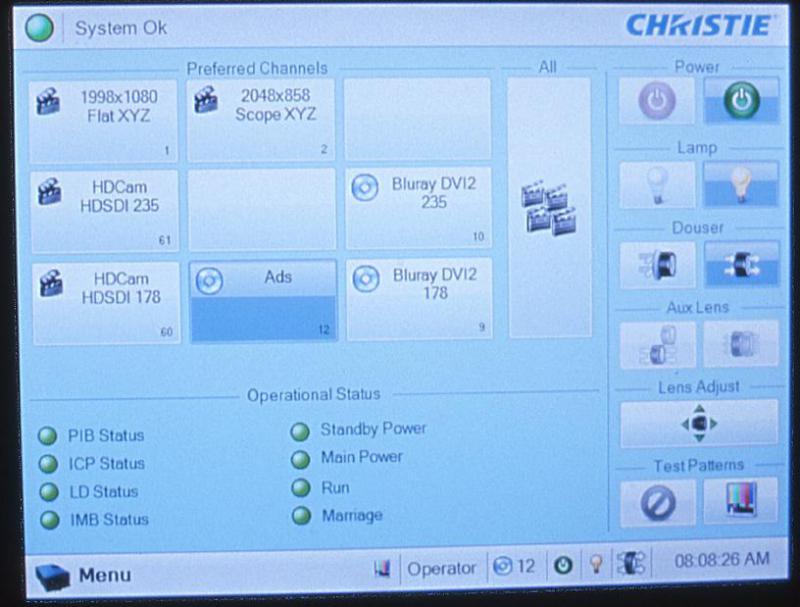
For this festival, we had Christie series II D-cinema projectors and GDC servers. The theatre provided scalers (Gefen AV Cinema Scaler Pro Model 1s), which turned out to be useless for film festival purposes, as they lacked HD-SDI inputs and had HDMI issues (we ended up using them as audio switchers). I ended up running HD-SDI from the HDCAM decks directly to the HD-SDI inputs on the projectors, and HDMI from the BR players directly to the DVI inputs on the projectors. I set up separate channels, ILS files, and screen files for each input and aspect ratio (HD-SDI 1.78, HD-SDI 2.35, BR 1.78, and BR 2.35).
Being able to switch almost instantly between different formats and aspect ratios was a definite win, as was having a high-quality video projector with adequate screen brightness. As much "film" festival material now arrives on video, the "average" image quality of all titles was far improved over what festival-goers are accustomed to seeing when "normal" video projectors are used.
Another win is the screen file setup, which allows very precise "aperture plates" to be set up for each separate format. This is surprisingly quick and easy, especially with radios and someone in the auditorium to look closely at the masking. The screen file and ILS settings (after ILS calibration) were more accurate than the masking motors.
One issue that became immediately obvious was that there were some "issues" with the original installation (including an ILS that had not been calibrated and a projector that was not square with the screen). There were also some color issues (everything looked slightly too red) which may or may not have related to the initial installation.
Another issue was that the scope formats resulted in extra "grey" being projected on the masking above and below the screen (no anamorphic lenses were in use). Is there a fix for this, or do all D-cinema installations without anamorphics have this issue?
Although this is not really an "issue," it is annoying: the GDC servers needed to be rebooted when the projectors are power-cycled; otherwise, they lose marriage (why?). I don't know if this is installation-specific or if it is true of all such installations.
Christie dousers take a second or so to open and are controlled by the touch panel interface. I would have preferred actual buttons (which could be done through the RS232 control) and faster dousers, but this is a relatively minor issues.
After the ILS issues with the projectors (involving non-repeatable presets) and HDMI issues with the scalers were sorted out, the only major equipment issue that I ran into was a projector that gave a random "ICP failure" error on the touch panel. This did not kill the show, but it did prevent the operator from changing channels mid-show. It caused a bit of a disruption in the middle of a shorts program while the projector was power-cycled (which solved the issue for the remainder of the festival).
Sadly, the 2.35:1 format is still not standardized for video, so the 2.35 channel presets did require some adjustment from show to show. Still, having the preset was handy, especially in shorts programs.
One surprise was that DCP image sizes are not standardzed. We had some that were 1.78 (instead of 1.85) and one that was 2.35 scope, but where the image was reduced, with black borders around all sides. Evidently, poorly made DCPs will replace poorly made video masters in the future. Argh.
As a side note, the Datasat AP20 is an interesting box. It is sort of an updated version of the CP500, with all of the flexibility of custom formats as well as modern digital inputs. It also has some automation functionality. This theatre did not have the optional film cards (as they had no film), and I would be interested in any comments as to the sound quality of the film input card. It would probably be nontrivial to use this box with a DA20, but DTS would (I assume) be fairly straightforward).
In summary: this was an educational experience, but the equipment still has issues that need to be worked out. The load time of the DCPs was a nonissue here, as there were very few of them, but it would be an issue in an all-DCP festival (as would the storage requirements). Most of the DCPs that we showed did not require keys, but key management could also be an issue, especially given that festivals often move screenings due to higher or lower than expected ticket sales. Also, "film" makers with DCPs seem to know little about how to deliver them. Someone brought a DCP on a firewire drive. I have not seen a DCI server with a firewire input. Oops. Another person sent a hard disk with the DCP in its own subdirectory; the GDC servers could accommodate this, but Dolby's cannot. In any case, it is obvious that this equipment and the associated procedures were designed for multiplexes and professional DCP mastering facilities, not film festivals and DIY productions.
I am interested to hear of others' experiences under similar circumstances.
Posted by Callonnec Laurent (Member # 6165) on 02-29-2012, 09:50 AM:
About GDC "marriage" issue, it's "normal". When you shutdown your projector, The inserted IMB block is out of power, and the server loose the link with it. Almost the same issue happens when you start the GDC before the Projector.
About the extra "grey", are we speaking about DCP or BLU RAY/DVD Scope ?
If everything looks too red, there is maybe some color calibration.
I'm also working on festivals too, and i get also to make a LOT of "ILS" and "aperture plate", and i find very useful to use wireless, and laptop (or tablet) with VNC to do the calibration directly in the theater. Just a tip.
Posted by Mike Blakesley (Member # 26) on 02-29-2012, 11:00 AM:
quote: Callonnec Laurent
About GDC "marriage" issue, it's "normal". When you shutdown your projector, The inserted IMB block is out of power, and the server loose the link with it. Almost the same issue happens when you start the GDC before the Projector.
We don't have that issue here. Our server stays on all the time but the projector gets shutdown nightly... could it be a projector issue?
Posted by Manny Knowles (Member # 1171) on 02-29-2012, 12:10 PM:
I only have limited experience with the Christie but, yeah, I didn't like the delayed-reaction of the douser.
I like the douser control on the Barco a lot better.
(But I still wish that the Barco touch panel would not "beep" if you touch an "invalid" area of the screen -- hearing that beep can trick you into having a false sense of having touched a button when, in fact, all you've done is touch the screen.)
Barco's ACS2048 has HD/SDI inputs as well as 2x DVI and others. At first, our 2048 didn't like our Denon Bluray player (HDCP issues) but upgrading from v1.03 to v1.04 resolved that. (There was also some question as to whether we could actually use both DVI inputs at the same time - it seemed to cause problems under 1.03.)
Screen files - if you have a long cable or a wireless router, you could take a laptop down to the auditorium and create the screen (and lens) files without needing to rely on a second person.
Scope images with grey borders - huh? - first of all, I have yet to see this so I'm not sure I understand what you're describing - but do you mean you were unable to "trim it off" via a screen file? I guess I'm just not sure what this is.
DCP aspect ratios - On actual "major" releases, I've seen 1.78 (Cave of Forgotten Dreams) and I've also gotten some 1.66 content. Mostly on re-releases (A Clockwork Orange) but also on a few contemporary art films (The Turin Horse). The DCI spec provides 1.85 and 2.39 as "example image aspect ratios" (3.2.1.8) but I don't see any wording that limits films to either one or the other.
And then there are the independent productions (and student films) that come in all different non-standard AR's - I keep a special ruler that I use to mark all the different AR's -- so that I can reuse those macro's instead of reinventing the wheel -- and it just seems that independent filmmakers are randomly letterboxing these days.
Posted by Monte L Fullmer (Member # 2797) on 02-29-2012, 12:51 PM:
quote: Manny Knowles
But I still wish that the Barco touch panel would not "beep" if you touch an "invalid" area of the screen..
You can turn that off when going into the "technician mode" and find the touchpanel properties...
Posted by Adam Fraser (Member # 1074) on 02-29-2012, 12:59 PM:
Mike, from what I can gather it is only a problem with the IMB models of GDC (IMB in the projector as opposed to server), which you probably do not have as they just came out a few months ago.
I also would like to leave my server on 24/7 but not the projector. This problem makes it difficult to do so. I assume the only way for them to re-marry is ctrl-alt-del as "restart application" does not allow them to communicate.
Posted by Alan Gouger (Member # 543) on 02-29-2012, 01:14 PM:
Thanks for sharing Scott. Can you comment on the image quality between the different formats. Any of them hold up well on the big screen, how did BD look. What screen size. Thx.
Posted by Scott Norwood (Member # 30) on 02-29-2012, 03:00 PM:
Image quality depends greatly upon the quality of the source material. It is hard to make a fair comparison between different productions delivered on different formats. A DCP that is shot with a handycam will look worse than a Blu-Ray that was properly transferred from 65mm negative.
Blu-Ray can look good, but it is not a reliable exhibition format. DCP is generally more convenient than HDCAM, though it doesn't really solve the major problems with video exhibition (ever seen a DCP with an embedded 2-pop? I just did.). There is no 60i (or 30p) option for DCPs, so anything shot on standard video cannot be easily delivered as a DCP, at least not without compromising motion quality.
The festival in question will only be accepting HDCAM and DCP next year, for whatever it's worth. Actually, they may have a 35mm setup by then, too, but that remains to be seen.
Posted by Brian Guckian (Member # 1678) on 02-29-2012, 05:46 PM:
Scott, regarding sound mixes - do you find that the video (non-DCP) material you're screening is mostly mixed for TV / broadcast and not theatrical?
It seems to me this is a big issue - over here at any rate - lots of DigiBeta tapes (for example) screened at festivals, and with unbalanced sound reproduction because the mix is inappropriate. Also, decks are often connected to the cinema sound processor without going through a desk; there may be some limited level and EQ adjustment, but in any case I'm not sure in any case if re-mixing tapes "on the fly" on the day is an adequate substitute for simply using a proper theatrical mix!
These concerns also apply to HDCAM, Blu-Ray and DVD formats.
Posted by Manny Knowles (Member # 1171) on 02-29-2012, 06:49 PM:
quote: Monte L Fullmer
You can turn that off when going into the "technician mode" and find the touchpanel properties...
Monte, I know you can disable the beep. I like the beep. I just wish it would ONLY beep as CONFIRMATION that you touched an ACTUAL soft-key.
Posted by Callonnec Laurent (Member # 6165) on 03-01-2012, 05:40 AM:
Adam, you're right, i was talking about SX-2000A Server with Integrated Media Block.
About Ratio, I don't know if you get the same problem on your side of the Atlantic Sea, but i get a lot of DCP with bad labeled Aspect Ratio. Most of the time I'm reading "Flat" on the DCP for 1,78 or 1,66 A.R.. The worst case : Kubrick's "2001". Flat mention AND it was a 2.20 ratio in 1998x1080 ratio with Black bar everywhere, awful !.
Posted by Mark Hajducki (Member # 1732) on 03-01-2012, 07:39 AM:
quote: Scott Norwood
One surprise was that DCP image sizes are not standardzed. We had some that were 1.78 (instead of 1.85)
This stems from 1080p video being 1920:1080. A large number of filmmakers will make their content full frame resulting in 1.78 content.
quote: Scott Norwood
and one that was 2.35 scope, but where the image was reduced, with black borders around all sides.
Was the image 1920 wide? If so the content will have been recorded onto HD video at some point in its life, the only alternative (when making the DCP) would be to scale the image before encoding. The UKFC funded install of digital projectors had presets for these formats (at both 1.85 and 2.39) and released some titles in these formats.
quote: Scott Norwood
Evidently, poorly made DCPs will replace poorly made video masters in the future.
Frame rates will also be a potential issue. Whilst 25 fps seems to work on most servers and projectors, it is (from reports on here) not universally accepted. Most European video will be recorded at this speed.
Posted by Scott Norwood (Member # 30) on 03-01-2012, 07:28 PM:
Sound mixes varied by source material. Some was clearly mixed for TV (and I have to explain the Dolby matrix system to someone at least once at every festival) and other material was clearly mixed for theatres.
The explanation for the "reduced 2.35" format being derived from HD makes perfect sense. Here is what I came up with for formats. The "Ads" format is smaller than the HD picture. I added a "reduced 2.35" format later.
Posted by Martin McCaffery (Member # 37) on 03-02-2012, 10:20 AM:
In related news from Berlin:
http://www.berlinale.de/en/presse/pressemitteilungen/alle/Alle-Detail_14356.html
MAR 01, 2012:
DIGITAL CINEMA @ BERLINALE 2012
The number of films screened in DCP (Digital Cinema Package) formats has risen significantly since last year’s Festival - especially at the European Film Market. The Berlinale 2012 presented a total of 659 screenings in DCP formats, as well as 627 in 35mm film and some 1,100 in diverse video formats.
For festivals worldwide – and the Berlinale in particular with its enormous programme - this development poses substantial technical, logistical and financial challenges. The Berlinale shows films on more than 50 screens all over the city, and even though most of these cinemas have already been equipped with the latest digital technology in compliance with the Digital Cinema Initiatives (DCI) and have a uniform standard of performance, they are still not able to meet the demands of such a large film festival.
The Berlinale’s office for the technical coordination of film screenings faces a variety of challenges each year, including insufficient compatibility between different server and projector types in the Festival’s cinemas, and their various software and firmware versions, as well as difficulties resulting from the heterogeneous IT infrastructures at these locations.
In contrast to how cinemas are usually scheduled, at least five different films are shown per screen each day of the Festival, which means new films have to be uploaded onto the servers daily to accommodate the Berlinale’s programme. Prior to the screenings, the films have to be technically tested and then loaded (“ingested”) onto digital cinema servers. This process must be completed in time to be able to address any issues that may arise. Due to the amount of data, these various procedures are very time consuming.
To complicate matters, the process of creating DCP files that work flawlessly and providing them each with a valid key (KDM) so they can be played back at the right time and place is in itself a common source of errors – a problem that is often underestimated by producers and/or post-production companies. In combination with the infrastructure available at a specific location, this can, in the worst case, make it impossible to play back a specific film or to show it without errors. Due to the complexity of this situation, workshops have often been offered at the Berlinale Talent Campus to educate emerging filmmakers on the topic.
To ensure the smooth operation of this year’s digital screenings, an elaborate procedure to test the technical quality and structural integrity of the submitted DCP formats was set up in close cooperation with the Fraunhofer Institute for Integrated Circuits.
To eliminate compatibility problems at this year’s Berlinale, Dolby, our internationally renowned partner, established a network of 37 digital cinema servers at the festival venues - each with a capacity of 2.75 terabytes. To enable DCP films to be transferred to the Festival’s projection booths around the clock, Dolby also supplied 5 SAS data libraries, each with a capacity of 24 terabytes. In addition to Dolby’s support, Belgian digital cinema specialist Barco provided the Berlinale with their know-how as well as 11 high-performance digital cinema projectors. They thus ensured perfect digital projections at the Berlinale Palast, the Friedrichstadt-Palast, the Haus der Berliner Festspiele and many other venues. The Festival was also equipped for 3D screenings, thanks to the loyal support of Dolby and Barco. In addition, Kinoton, a Munich-based company, supplied the Festival with additional projectors and assistance.
Colt Technology Services, the Berlinale’s official connectivity supplier, linked various Festival venues via a large number of high-performance video and data networks (12 Gbit/s). Thanks to this powerful broadband infrastructure, the Berlinale’s office for the technical coordination of film screenings could feed a number of servers at approximately 20 selected venues directly with films via fibre optic cables. To make this possible, Media Logic, a Berlin-based company, provided the Berlinale with DDP storage solutions.
Alongside a team of experts provided by our partners and suppliers, 45 employees worked for the Berlinale’s office for the technical coordination of film screenings during this year’s Festival. Without their tireless efforts, a number of screens would have remained dark. Prior to the Berlinale, an additional 80 projectionists were trained in-depth so they would be able to cope with the technical challenges.
For further details please check the video case study at www.berlinale.de.
Press Office
March 1, 2012
Posted by Jonathan Goeldner (Member # 4854) on 03-02-2012, 11:01 AM:
it will be interesting how DC Film Fest will play out this year, since one of the most prominent venues: Regal Gallery Place is now all digital. E Street, the Avalon and the main two large screens at Mazza are 35mm. Isn't it more cost effective to have the films in DCP form anyways?
Posted by Scott Norwood (Member # 30) on 03-02-2012, 11:29 AM:
Jonathan--I don't know that particular festival, but my guess would be that 35mm films would show only in the 35mm houses, and that temporary video equipment will be installed in those venues for video material. Most of the video will probably be on HDCAM tape, which does not require D-cinema equipment for playback.
DCPs have not really caught on for festivals yet (this was the first year that I have even heard of people asking about it as an exhibition format), so there will probably be 35mm or HDCAM copies of any material that is being shown as a DCP in the D-cinema houses.
The type of film festival also dictates formats, at least to some extent. I worked at one last fall that was almost entirely 35mm, as the programming largely consisted of upcoming major releases. Festivals which focus on documentaries and low-budget productions are more likely to have lots of video. Sadly, 16mm only really shows up for student and experimental-film programs now. (If anyone is doing a 16mm festival, call me. I happen to like the format.)
Posted by Jonathan Goeldner (Member # 4854) on 03-02-2012, 09:39 PM:
^ or Lord forbid - a film projected from a blu-ray disc, although I must say the two times that happened at the Avalon - the image was surprising, in a good way.
in regards to DC's Environment Film Festival - the folks who are in charge of the screening of Cane Toads is doing a deluxe setup over at E Street (on screen 4 I assume) - prior festival screenings were in 3D, but with some problems here and there, DC premier screening wont be in 3D but should look and sound top notch.
Posted by Tony Bandiera Jr (Member # 2365) on 03-02-2012, 11:02 PM:
This thread brings up a good point..if there is no actual film being run, should it be called a Film Festival? And if not, what would be a good alternate name for it?
Posted by Victor Liorentas (Member # 5272) on 03-02-2012, 11:26 PM:
Movie festival.
Posted by Edward Havens (Member # 4715) on 03-03-2012, 01:59 AM:
Cinema Celebration!!!
Posted by Louis Bornwasser (Member # 3063) on 03-03-2012, 06:39 AM:
Video-fest (cause that is what it is)
Posted by Brian Guckian (Member # 1678) on 03-03-2012, 06:45 PM:
Also, "Content Festival" ![[Razz]](tongue.gif)
Posted by Mattias Mattsson (Member # 4308) on 03-04-2012, 09:47 AM:
Thanks Scott for sharing your experiences!
I was responsible for the technical side of a 10-day film festival taking place this January/February. We had about 750 screenings of something like 470 films (a mix of features and shorts, mostly the former). Of these about 100 were DCP and the rest 35 mm, HDCAM, Digibeta and a few BD/DVD.
The venues were both art house theaters and multiplexes. Servers were exlusively Dolby (one DSS/DSP100, the rest DSS200). Projectors were mostly Barco (one series 1, rest series 2), and some Christies (all series 2). Some locations hade scalers, Barco ACS-2048 and Kramer VP-729. On the sound processor/media adapter side the theaters were equipped with several different makes and models: CP750, CP650, CP65, ECI-60 and DMA8Plus.
We prepared a bunch of CRU-carriers fitted with large disks (2 TB) onto which we loaded all the festival’s DCP:s in advance. We had five of these pre-loaded CRU-carriers in total. These disks were then carried around to the different locations and the material loaded onto servers in advance.
These preparations took a lot of time but I think it also saved us a lot of trouble. We could sort out obscure distribution media/formats in advance, such as: fragile USB/Fw/eSATA disks, HDD:s formatted with wrong file systems (eg. HFS+), wrong partition tables (GPT) etc.
Of course all the original distribution disks were transported around festival cinemas as well. Just in case a backup copy should be needed.
Overall we had very few issues, but this is what I learned:
- Be very careful to check that all projectors and servers have the latest firmware. We missed this at one location and had to cancel a screening (the only one for the entire festival!). This was due to old software in the Dolby server which fail to recover the journal of an ext3 fs and cosequently failed to recognize some language versions of a particular DCP. When we tried to save this screening by showing off BD - the ACS-2048 scaler had the old firmware with HDCP issues... Unfortunately I found out about the reasons for these problems when it was already too late.
- Most problems we had was with CineCanvas (Interop) subtitles. The ICP is VERY picky with parsing the subtitle XML. Eg. if it does encounter an empty <Subtitle>-element it cancels subtitle display altogheter! I strongly reccomend filmmakers to burn in their subtitles for festival screenings to eliminate these kind of problems. In my opinion this problem is all TI:s fault in writing a very unprecise and ambigious specification for the CineCanvas XML format.
- Additionally there are some problems when the projector is unable to retrieve the subtitles from the server (this is done over HTTP). Barco has an ICP patch (“Limit port range patch”) that is supposed to remedy this.
- We also had a issue on one DCP which had its subtitles slightly out of sync. Strangely this happened only on some screenings. I think this was due to too small “leader” (offset) before the FOA at the picture/sound start of the DCP.
- The Dolby DSP100 does not support DCP:s at 25 fps. Even with latest firmware. We had one such DCP which was impossible to reschedule to another theater. Fortunately the DCP was unencrypted and I was able to time-stretch the audio and remux this one to a 24 fps DCP.
- Managing the KDM:s was a nightmare. We had approx. 110 keys manually distributed to 11 servers.. (Just below 40% of the DCP:s were encrypted).
- To use some software to check DCP:s in advance (before ingesting) is very useful. I like Wolfgang Woel's dcp_inspect: https://github.com/wolfgangw/backports
- Lots of DCP:s in 1.78 (1920x1080). It is possible to run these with the ordinary FLAT macro, but it looks nicer if you do a proper one with the right masking.
- Lots of DCP:s with 2-channel audio (L+R only). If you have a DMA8Plus, you could set it to decode the first AES/EBU as ProLogic to somewhat remedy this. The real solution though, is to educate filmmakers to do a proper sound mix for cinema.
- The Barco and Christie projectors we used can not handle SD-SDI, only HD-SDI. Thus, the Digibeta players (Sony J-3) we used had to use a scaler between it and the projector.
- Be sure to set the right output frequency (50/59.94 Hz) on the scaler when playing PAL/NTSC tapes from HDCAM/Digibeta. Otherwise you get jerky motion!
- Educate the projectionists to test a DCP with unknown aspect ratio with SCOPE macro _first_, otherwise you risk cropping off too much of the frame.
About “grey” being projected. Barco has an “Info-T” describing this (or a very similar issue). “Info-T 917: Reflections outside active area of projected image (...) Cause: Reflection of the internal aperture in the DMD is causing this phenomenon.”
Posted by Martin McCaffery (Member # 37) on 03-04-2012, 11:12 AM:
quote: Tony Bandiera Jr
This thread brings up a good point..if there is no actual film being run, should it be called a Film Festival? And if not, what would be a good alternate name for it?
Ingest Fest!
Powered by Infopop Corporation
UBB.classicTM
6.3.1.2