This is topic Dolby's new sound system in forum Digital Cinema Forum at Film-Tech Forum ARCHIVE.
To visit this topic, use this URL:
https://ft-forum.com/ft/cgi-bin/ubb/ultimatebb.cgi?ubb=get_topic;f=16;t=001090
Posted by Jonathan Goeldner (Member # 4854) on 04-23-2012, 12:51 PM:
from http://www.hollywoodreporter.com/news/cinemacon-2012-dolby-new-sound-system-314999
LAS VEGAS-- Dolby Laboratories aims to advance the quality of cinema sound with the introduction of its new Dolby Atmos audio format, this week at CinemaCon.
"We think it is going to be breakthrough," Doug Darrow, senior vp of Dolby’s cinema business, told The Hollywood Reporter, noting that with more "precision and control of sound" in any theater, audio will be more "natural and lifelike."
Atmos is capable of transmitting up to 128 simultaneous and lossless audio channels, and renders from 5.1 up to 64 discrete speaker feeds, according to Dolby.
For sound teams, Atmos enables what Dolby refers to as "object-based mixing" by providing precise control over "placement and movement of individual sounds or 'objects' anywhere within a theater environment."
In order to create these mixes, Dolby reported that it plans to offer a new plug-in for Avid’s ProTools audio postproduction system, and it is also working with console manufacturers to enable support for the new format, which would be "layered" on top of a 7.1 mix.
A trailer mixed in Dolby Atmos will debut this week at CinemaCon for demonstration purposes. It was mixed by Will Files (Madagascar 3: Europe’s Most Wanted), and features sound design by Academy Award nominee Erik Aadahl (Transformers: Dark of the Moon).
Dolby said the mix could be delivered to theaters on standard Digital Cinema Packages (which are used today and are effectively the digital equivalent of a film print).
Exhibitors will need to outfit theaters for the format. According to Dolby, theater owners can still use the "majority of their existing sound system" though additional speakers and amplification must be installed. Dolby estimated that an "average mid-size" theater could expect to make an investment of around $25,000-$30,000 for this upgrade.
Audio equipment manufacturer Harman Professional is working with Dolby to design specialized loudspeakers to support the Atmos format.
Dolby is set to begin a limited deployment of Atmos in the U.S., Europe, China and Japan, and the first feature with an Atmos mix might be released as early as this summer. A larger rollout is planned for 2013.
~~
let the flaming begin!
Posted by Andy Frodsham (Member # 4061) on 04-23-2012, 03:33 PM:
They should have made this announcement on April 1st!
Posted by John Wilson (Member # 269) on 04-23-2012, 05:00 PM:
Cool! Now showing in Dolby 127.1!
Something else the major chains can upcharge for the privilege of providing to you. ![[Roll Eyes]](rolleyes.gif)
Posted by Manny Knowles (Member # 1171) on 04-23-2012, 05:07 PM:
This seems a little premature, considering that the basic D-Cinema rollout is still underway.
I'm not sure how many exhibitors will spring for an "optional" component when they're still in the midst of coping with the cost of purchasing and installing projectors. (Which ain't cheap.)
And now there's talk of projector upgrading, too. (HFR, 4K...)
Also, let's not forget what happened with SDDS-8. As long as there's a 5.1 downmix available, cinemas will probably just go with that. And, as long as studios know that the 5.1 will be the de-facto standard, they won't spring for the added time (and expense) required to mix anything more complicated than that.
No users --> No product --> No users
And, speaking of learning from the past, I'd also prefer to know that channel assignments have been standardized, so that we're not making this thing up as we go along (like 70mm).
quote:
Now showing in Dolby 127.1!
Probably 126.2 -- Dual-channel subs have advantages.
Posted by Marin Zorica (Member # 1716) on 04-23-2012, 05:26 PM:
I share opinios with you guys......but hey, when D-Cinema came I don't know what is pourpose to "invent" sound systems? There are wav files and normally 16ch supported, and with basicly adding some sort of compressing you can put how much channels as you like (theoreticly).......then another thing could be 260.3 channel sound.....only not suitable for smaller rooms because of 263 speakers in it ![[Smile]](smile.gif)
Posted by John Wilson (Member # 269) on 04-23-2012, 05:43 PM:
I still only have 2 ears.
Posted by Monte L Fullmer (Member # 2797) on 04-23-2012, 05:48 PM:
Two ears but non-directional sound to hear.
Now, we're prob entering into the world of "ambient" sound.
Posted by Louis Bornwasser (Member # 3063) on 04-23-2012, 06:35 PM:
Gee, I guess Dolby was "wrong" when then pronounced 70mm to only need 3 in front and 2/3 surrounds. Louis
Posted by Bruce Hansen (Member # 281) on 04-23-2012, 06:59 PM:
![[sleep]](graemlins/sleep.gif)
Posted by John Wilson (Member # 269) on 04-23-2012, 09:27 PM:
^ What Bruce said.
Posted by Randy Stankey (Member # 64) on 04-23-2012, 09:48 PM:
Any new, "breakthrough" invention that has to have a neologism for a name is automatically bullshit.
Posted by Aaron Garman (Member # 1653) on 04-23-2012, 09:55 PM:
I'm skeptical, but I'll wait to hear it until I make a judgement. Good news is, if it is a hit, it's definitely something that would be pretty hard to achieve at home which is good for the industry.
AJG
Posted by Manny Knowles (Member # 1171) on 04-23-2012, 11:39 PM:
The exhibitors are the ones who really have an interest in promoting the cinema experience -- over the home-theatre experience -- not the studios. There's BIG money in home-video for the studios.
Maybe if exhibitors start producing movies, we might see things happening in cinemas that can't be duplicated at home. But that's a pretty big "maybe" and I still have a hunch, they'd end up being seduced by the big money to be made from a home-video release. Even IMAX movies are on video...
But, whatever -- 128 channels of sound seems excessive. Good luck trying to mix that. You'd never get off the dub stage! (And that will cost a ton of money, too.)
Money is the main challenge here -- the cost to the studios of producing that soundtrack, and the cost to the cinemas of reproducing it.
And, finally, without wanting to state the obvious: They've had 16 channels at their disposal for some time now...and they're only using 7.1 of them. And how often is THAT happening..?
Posted by Eric Robinson (Member # 2966) on 04-24-2012, 12:05 AM:
Neato ![[Razz]](tongue.gif)
Posted by Joe Redifer (Member # 3) on 04-24-2012, 05:09 AM:
Holy crap! Just wait until Jane Campion hears about this!! She rocked the sound in The Piano HARD (blew the roof off... almost sounded like a real goddamn piano) and now she's gonna go nuts creating the mind-numbing, ever-enveloping sound mixes her movies are known for!
quote: Article
Atmos is capable of transmitting up to 128 simultaneous and lossless audio channels, and renders from 5.1 up to 64 discrete speaker feeds, according to Dolby.
So wait. 128 simultaneous and lossless channels but only renders up to 64 discrete speaker feeds? What are the other 64 simultaneous and lossless channels doing?
quote: Article
Atmos is capable of transmitting up to 128 simultaneous and lossless audio channels, and renders from 5.1 up to 64 discrete speaker feeds, according to Dolby.
Sorry. I just needed to quote that again. The stupidity just baffles me. Do these people even read their own stuff?
quote: Manny
Good luck trying to mix that.
I think the idea is to take a sound effect and steer it around some sort of 3D globe in the mixing stage so that the sound can travel wherever you put it. I don't think that the sound mixer would be paying attention to each individual channel specifically. He'd just move the sound around and it's basically just for fancy panning. I imagine every once in a while there might be a sound effect dedicated to this speaker or that one but again, I don't think any care would be taken to utilize each speaker.
Posted by Andy Frodsham (Member # 4061) on 04-24-2012, 06:13 AM:
I suppose we can expect a flood of re-released titles?
I can just see the likes of:
'Titanic' Re-Mixed
'Avatar' Re-Mixed
'Bambi' The Remix
'Gone With The Wind' - as you've never heard it before!
The list goes-on!!
Posted by Jonathan Worthing (Member # 803) on 04-24-2012, 09:34 AM:
The Artist Re-mixed
Posted by Dominic Espinosa (Member # 2122) on 04-24-2012, 11:15 AM:
I'd thought of this sort of thing long ago before knowing anything about the technical side of the business beyond threading up a Simplex.
There COULD certainly be an advantage to a system that can localize sounds more than the current system. Which is already fairly effective.
So all these channels is overkill to say the least.
The bigger question is, will any but a few screens in the majors really be able to justify the cost of adding it to a new build, let alone a retrofit?
Posted by Bobby Henderson (Member # 840) on 04-24-2012, 11:26 AM:
Dolby Atmos. While the idea seems interesting I'm not very optimistic it will get much use.
I have always thought the 2 channel surround array was limited. Certain effects fell flat in the middle of the room rather than clearly moving from the front to back wall or vice versa. "Surround ex" and the more recent development of 7.1 with four surround channels was supposed to make surround effects like transient fly-bys and such much more convincing. The problem is few movie productions have embraced the idea even when the 7.1 quad surround format could be supported in home theater thus extending the useful shelf life of a more elaborate audio mix.
The current D-cinema system can support 16 discrete channels of audio. The 10.2 surround format, the surround audio model promoted by Tomlinson Holman, could work in that arrangement. Any movie production could mix a feature in 10.2 surround. With a few phone calls it wouldn't be difficult to get at least a few dozen theaters rewired to support it. No movie productions have taken advantage of the capability. It's difficult enough to get any to mix in 7.1.
If anything, I think the Dolby Atmos idea is another attempt to secure the Dolby brand name on movie posters, movie end credits and theater booth racks. With D-cinema the audio is straight Linear PCM. There is no proprietary audio compression format used to where a brand name like Dolby or DTS can be applied. Essentially, Dolby and DTS are turning into audio formats exclusive to home theater. Dolby Surround 7.1 was false advertising in one sense since the audio was really LPCM 7.1. With Atmos, Dolby could apply TrueHD lossless encoding along with using proprietary hardware to get its brand name more prominently displayed in movie marketing.
quote: Joe Redifer
I think the idea is to take a sound effect and steer it around some sort of 3D globe in the mixing stage so that the sound can travel wherever you put it. I don't think that the sound mixer would be paying attention to each individual channel specifically. He'd just move the sound around and it's basically just for fancy panning.
A lot of audio editing software already allows for this sort of thing in the 5.1 format. For example, Adobe Audition can apply a timeline based surround steering control on every audio element in a multi-track mix. The round control reminds me of an analog clock. A "globe" audio positioning element wouldn't be much different. The Atmos style steering control would need good & fast downmix capability for 7.1, 5.1 and 2.0 channel layouts. If Atmos creates more work & expense for the 5.1/7.1 home theater mix then movie productions may avoid using it.
The biggest problem facing Atmos is the hardware side of things. All the extra speakers and amplification needed will represent too much of a pain and expense for the vast majority of commercial movie theaters to handle. Let's not forget the need of an entirely new cinema processor. But I imagine Dolby has a particular Dolby-branded product in mind for that.
And I imagine audiences will be bracing for yet another damned add-on surcharge to see a movie in an Atmos-equipped auditorium. Such an surcharge is almost a sure thing. Too many theaters don't do enough to maintain their regular 5.1 digital surround sound systems. Certain theaters are already charging extra for louder, boomy digital surround along with a 2K image being blown up to a giant size.
Posted by Aaron Garman (Member # 1653) on 04-24-2012, 03:56 PM:
quote: Manny Knowles
Good luck trying to mix that.
Worse, the average multiplex maintaining the integrity of the system. They have a hard enough time with 6 channels let alone 128...or is it 64...
Atmos: so amazingly complex we don't even know how many channels it is!
AJG
Posted by Scott Jentsch (Member # 1681) on 04-24-2012, 04:18 PM:
Is there a definitive list of the channel assignments for Digital Cinema? I looked around, but came up blank.
I watched the video where they talk about Atmos, and afterwards, and after reading through the text in the first post there, I'm still scratching my head as to how this is different than traditional multi-channel mixing, just with more channels.
My impression after watching the video was that they were trying to distance themselves from the idea of channels so that the expected Dolby processor box will appear to be magical in some way in how it does its job. At some point, it's still going to be multi-channel, so it seems like a smoke and mirrors ploy to me.
That said, I like the idea of more channels, especially a height channel. Give the mixers the tools to mix into that space above the audience and map those sounds to the appropriate channels in the theater, and voila, you have over-the-head sound and a more immersive experience.
However, the reality of the situation is that theaters aren't doing 7.1 now, or at least they're not admitting to it. If they can't even do that, I can't imagine that they're going to go through the effort of installing height channels, much less calibrating them.
Theatrical exhibition can't be Dolby's only play with this. I would imagine that they're coming up with a home version that will be implemented in the next round of home theater receivers. They may be able to shoehorn it into ProLogic IIz processing or something for backwards compatibility with existing receivers and the Blu-ray format, which would put it on the fast track to the home. Many years ago, I heard a demonstration of the Yamaha A-1000 (or some model close to it) and its use of upper-front channels to provide greater ambience, and it was really impressive. I've not played with ProLogic IIz at all, but if they can work with front presence channels and rear surround channels to get an over-the-head experience, I'm sure they will.
This whole Atmos thing may be a foot in the door with studios so that they can introduce something new in the home...
Posted by Bobby Henderson (Member # 840) on 04-24-2012, 09:30 PM:
quote: Scott Jentsch
Is there a definitive list of the channel assignments for Digital Cinema?
Here's what I found according to this:
http://isdcf.com/papers/ISDCF-Doc4-Interop-audio-channel-recommendations.pdf
Track 1 - Left
Track 2 - Right
Track 3 - Center
Track 4 - Subwoofer
Track 5 - Left Surround
Track 6 - Right Surround
Track 7 - Hearing Impared
Track 8 - Vocal Narration
Track 9 - Left Center
Track 10 - Right Center
Track 11 - Left Rear Surround
Track 12 - Right Rear Surround
Track 13 - Motion Data Signal
Track 14 - Undefined
Track 15 - Undefined
Track 16 - Undefined
quote: Scott Jentsch
Theatrical exhibition can't be Dolby's only play with this. I would imagine that they're coming up with a home version that will be implemented in the next round of home theater receivers.
I can't see but only a limited few hardcore home theater enthusiasts installing dozens of speaker drivers all over their walls, ceiling and floor to do the Atmos thing. As much as I like surround sound, I'm still doing the 5.1 thing. Buying a new receiver and redoing my surround speakers for 7.1 is just too much of a pain for the few Blu-ray discs I have that support it.
On top of that, I really have to wonder about the data bandwidth required to support the Atmos format. It's not a big deal to do 24-bit 48kHz lossless or uncompressed audio in up to 7.1 channels, or even 10.2 for that matter. It's another thing to balloon the audio stream to dozens or even over 100 of those channels. Something has to give. Will Atmos be 100 some odd severely lossy compressed Dolby Digital audio channels to save space/bandwidth?
Posted by Randy Stankey (Member # 64) on 04-24-2012, 10:34 PM:
It's Googlephonics all over again!
Posted by Brad Miller (Member # 2) on 04-25-2012, 01:17 AM:
Just a quick post.
Form the skimming over this thread I have done thus far, Dolby Atmos is a concept none of you are anywhere near guessing properly. In essence, it takes every individual sound, records it discretely and then permits the mixer to position it ANYWHERE in the field. The Atmos box then places it in the proper speaker(s) based upon that positioning data, and yes each auditorium is "mapped" so the sound truly goes EXACTLY where it is supposed to go, even if you have a funky shaped auditorium.
This means the mixers make one Atmos mix, and then ANYTHING else can be derived from it, whether it is 11.1 or 7.1 or even 5.1, without any effort or time delays (meaning less post production time). It also means when something pans around the room, it LITERALLY pans around the room from speaker to speaker to speaker, as opposed to an entire "zone" of surrounds.
Sure the name isn't terribly catchy, but it is absolutely THE future of sound.
Posted by Louis Bornwasser (Member # 3063) on 04-25-2012, 06:37 AM:
Since the soundmix is done after production, anything that accelerates it is good and the reverse is also true. It remains to be seen if Atmos is slower to mix or not. Financial reasons mostly killed EX.
Animation starts with the soundtrack, so, unless timing changes are made to the sound, there is plenty of time for fancy mixing. Louis
Posted by Steve Guttag (Member # 268) on 04-25-2012, 07:25 AM:
As Brad has stated...the Dolby Atmos system should NOT be thought of as in the past where one adds "channels" to the mix. There isn't a one-to-one sort of thing like in the past where with mono we had a center speaker, stereo three stage speakers and maybe surrounds, Todd-Ao, 5 stage speakers and one surround...etc
With Dolby Atmos, you have to think of speakers not as channels but a means to increase the resolution of the sound placement precision. You can keep your 3-behind the screen system or add LC/RC back in (recommended for any screens 40+ feet wide (I would say even smaller would be fine). One can't have too many surrounds and they recommend starting them right at the screen/side wall junction and then ceiling surrounds.
YOUR theatre will input your speaker locations into the Atmos processor so it knows where your speakers are. It will tune your room based on that information and then process an Atomos track so that the original sound placement creating on the dubbing stage is as faithfully located as possible based on the quantity and placement of speakers you have. This system is inherently scalable so smaller theatres do not have to have as many speakers as larger ones. The better the speakers, the better results, however. One wants to maintain constant Timbre between all channels and the Atmos processor will aid in that.
The possibilities for incredible sound mixes with this system are limitless...I do fear, however, that too much emphasis on "surround" audio placement will distract from what is happening on screen. I'm hoping that the ability to locate sounds on screen is greatly improved with this system and the surround speakers (regardless of where they are placed and how many of them there are) are used to merely augment what we see on screen and never "be the show."
What Dolby has done with Atmos is to pretty much take channels out of the equation from a movie mix standpoint. This is why it is likely to gain acceptance. It is a new sound format that hearkens back to the backward compatibility era so that and standard DCP can be used that will play 5.1 in in "normal" theatres and Atomos in Dolby-Atmos theatres. Compare that to Surround-7.1 where we have dual inventory DCPs that require separate kdms and loading two versions...Atmos will not have that overhead at the theatre or distribution level. So if you don't believe or can afford it...you can gleefully ignore it. If you are looking for an edge in your presentation, you can go about as wild with it as you want.
That is probably its biggest flaw, actually. One can do a very minimal Atmos installation in their theatre...put in say one ceiling speaker to a normal 5.1 system...and call that Atmos...while the guy down the street goes full-bore and follows all of the recommendations...the experiences will NOT be identical because the minimalist version does not have the "resolution" that the properly sized version has. So I do fear that it will cause customer confusion. I do hope that those that go for it do not do a crap job...but since I've seen mono in DCinema and people are already really under specifying lamp sizes and running them too long...I can't help but believe that some rotten apples will ruin this potentially revolutionary sound system.
Posted by Frank Angel (Member # 248) on 04-25-2012, 08:00 AM:
quote: Manny Knowles
No users --> No product --> No users
Actually, it's: No users --> No product --> No users --> No Consumer Interest/Demand --> Dead Format
Quite frankly, this almost seems like a knee-jerk reaction by Dolby, who for so long dominated exhibtion sound, to counter the upstart Barco with their new immersive Auro 11.1 sound system, which promotes height channels, as in:
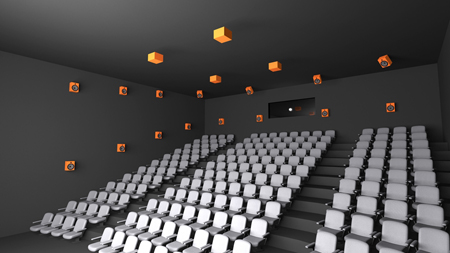
So is Dolby just trying to capture some of Barco's thunder and/or trying to maintain its dominance?
Thing is, even if this can translate into what can be marketed to the Blu-Ray home theatre crowd, and EVEN if guys like us who love surround sound would want to put this in our home theatres, realistically, what size market is that? What proportion of the "home theatre" market actually have a separate theatre rather than a setup in the living room and what woman will let her hubby, no matter how enthusiastic he is about Atmos, will let him put speakers all over the room? and UP ON THE CEILING?!
So if this format can't also be pushed into the consumer market, good luck with studios mixing for it if the only market is the commercial cinema. But let's for the moment say some productions did get the Atmos umpteen channel treatment, then it's all on the exhibitor to spend and install the extra stuff which he will do ONLY if he thinks he can sell this to the public and more importantly, if the public will BUY it. My gut says, No, they won't. Anyone hear any demand for 7.1 from Joe and/or Jane Public? Anyone REALLY think either Joe or especially Jane them will PAY EXTRA for Atmos or even choose a multiplex based on sound format?
I just went to see a movie...in a movie neighborhood multipled...walked up to the b.o. and asked for a ticket. The young man said, "That will be $13.50 please." I said, "No, no, son, not the IMAX theatre." He said, "Sir, that's the price for the regular cinemas." I was grateful he didn't immediately offer me the senior discount, truly I was, but I said to myself, screw this, and then said "Senior ticket please." He was kind enough to say "Really? Wow." Bless the lad. My point is, $13 effin dollars to see a MOVIE?!! What are these guys charging for IMAX and IMAX 3D? Wasn't this much as recently as 6 months ago.
Posted by Christos Mitsakis (Member # 143) on 04-25-2012, 09:15 AM:
Dolby Atmos Theatre Tech Guidelines
Dolby Atmos white paper
Perhaps they should be posted also here in the warehouse.
C.
Posted by Bobby Henderson (Member # 840) on 04-25-2012, 09:23 AM:
quote: Frank Angel
So if this format can't also be pushed into the consumer market, good luck with studios mixing for it if the only market is the commercial cinema.
Mixing for Atmos -or rather, doing the computer-based digital sound design for it shouldn't be difficult. As I said earlier, modern audio editing applications already allow the user to individually position and move every audio element in the mix around the surround field and change it along the time line. The current surround steering metaphor is a flat, 2D clock-like model. All Dolby and the audio editing software people have to do is create a more 3D oriented positioning metaphor in the editor and an export module to target the Atmos format.
If Atmos support is implemented properly in software it should be possible for editors to open other existing projects originally tailored for 5.1/7.1 and scale them over to Atmos. But those old mixes would be based on more of a level plane matching a traditional theater speaker layout, but various fly-by effects and what not would move about the sound field more smoothly.
The real issue is hardware cost to the theater. Both in terms of initial install and sound system maintenance. Many theaters are already very lax on keeping sound systems properly maintained. Atmos, or Barco's 11.1 thing, would make it a bigger issue. Atmos will require a more complex amplification scheme (according to Dolby's white paper, one channel of amplification for every speaker). Dolby probably won't be selling its Atmos processor for cheap either.
This system probably won't work so well in stadium seated theaters. Where are the back wall sub-woofers going to be installed?
I can't be the only one who thinks customers are simmering with anger over all the various upcharges at theaters. 3D: upcharge. Big screen: upcharge. Balcony seating: upcharge. Big cushy seat with a waiter call button: upcharge. Sound done well or loud: upcharge. Add to this some serious cost inflation at the snack counter. It's getting pretty damned ridiculous.
It's a guarantee Dolby Atmos will add another upcharge to an already expensive movie ticket price, especially when install costs are estimated between $20K and $30K. The idea that one theater can have an "Atmos done right" installation while another can install "Atmos half-assed" and still gouge the customer should be a warning to Dolby. They better have some enforceable standards to protect customers.
Posted by Carsten Kurz (Member # 5396) on 04-25-2012, 11:39 AM:
It uses a kind of routing metadata approach. This is certainly smart, but in no way different from immSound and Auro-3D.
Plus - it makes the whole postproduction and distribution scheme dependent of Dolbys metadata protocol and thus licensing. That's the smart part of the abstraction of channels. Channels can not be patented and licensed.
The audio and metadata is placed within the DCP - that means, you need a special DCI server to access and feed this data to the Atmos Dolby processor. Or e.g. a Doremi with a Dolby Atmos license package. So far no server/IMB has provision to output or input the additional audio channels and routing metadata. Guess what that means.
You will also need Dolby equipment and license for localization/dubbing. And home video compilations. Dolby is once more trying to rule the world. Will they succeed? Even more than with EX and 7.1, I guess...
- Carsten
Posted by Bobby Henderson (Member # 840) on 04-25-2012, 12:05 PM:
I remain skeptical. Some people think 5.1 is good enough. And there's other people who just don't care.
The cost outlay for theaters is big, and this is on top of all the d-cinema and 3D costs. Theaters aren't doing as good a job maintaining existing sound systems as it is. The Atmos setup (at least done properly) is far more complex. I don't know if it will require theaters to replace existing d-cinema servers with Dolby-branded servers.
I'm still wondering about how a Dolby Atmos audio stream will be encoded, such as its bit rate and foot print on a hard disc. They talk about having all the elements in a mix separated into discrete objects that can be positioned anywhere in the room. The thing is a movie mix in its editable form can have literally hundreds of separate audio elements placed on the time line. This can consume a fuck-ton of hard drive space and bandwidth. I'm guessing some kind of compromise has to be made somewhere, especially if a Dolby Atmos track is going to fit on a standard DCP hard disc alongside the movie video.
Posted by Jonathan Goeldner (Member # 4854) on 04-25-2012, 01:36 PM:
I'm waiting for the announcement from Sony that they would be resurrecting 8-channel SDDS for inclusion on DCP ![[beer]](graemlins/beer.gif)
...
![[Big Grin]](biggrin.gif)
or at least encode some of the SDDS mixes AND pre-1977 70mm/6-track mixes that had five front channel sound to archive and be able present them as such when DCP's are created
~~
... and here's the first movie to be released in Atmos Dolby Sound:
"Brave" (from Hollywood Reporter)
The Disney release will be mixed in Dolby’s new sound system, which will be installed in as many as 15 theaters.
LAS VEGAS -- Disney/Pixar’s Brave will be the first film to test Dolby's new Atmos format, which was developed to create sound that Dolby says is more "natural and lifelike."
Dolby aims to have the new sound system, which it debuted this week at CinemaCon, installed in 10-15 theaters worldwide for the test, for which Pixar will prepare a special mix of the film.
Seven-time Oscar winner Gary Rydstrom is serving as sound designer and re-recording mixer on the project.
At CinemaCon, sound designer and supervising sound editor Erik Aadahl, who was nominated for an Oscar for his work on Transformers: Dark of the Moon, said of the new format: “This is, I think, the biggest breakthrough in sound that has happened in my career.”
Speaking with The Hollywood Reporter, Aadahl, who did sound design using Atmos on a demonstration trailer that played at CinemaCon, likened the new Dolby format to having a new instrument to play.
“We’ve barely scratched the surface of what we can do with this technology,” he said. “What I could have done on the Transformers movie with this! … And it doesn’t have to be an action movie. It could be lush atmosphere.”
Atmos is capable of transmitting up to 128 simultaneous and lossless audio channels, and renders from 5.1 up to 64 discrete speaker feeds, according to Dolby. Speakers would be positioned around the theater and even overhead to create the immersive experience.
For the sound team, Aadahl noted that it might require some changes. He explained that the mix might add a “slight” amount of time to the schedule thought he expects it would be offset by a simpler process for creating deliverables as the sound team would only need to complete an Atmos mix.
Posted by Bobby Henderson (Member # 840) on 04-25-2012, 03:03 PM:
Somewhere I read Dolby was working on plug-ins for Pro Tools and similar applications.
quote: Jonathan Goeldner
I'm waiting for the announcement from Sony that they would be resurrecting 8-channel SDDS for inclusion on DCP
While the SDDS-8 layout (five stage channels, 2 surrounds, 1 LFE) can already be supported by D-cinema, there's no need to do it using any SDDS-branding. That would involve use of data lossy ATRAC encoding. Linear PCM is better.
quote: Jonathan Goeldner
or at least encode some of the SDDS mixes AND pre-1977 70mm/6-track mixes that had five front channel sound to archive and be able present them as such when DCP's are created
That is do-able, provided the right audio elements are available to do a straight dub into the digital realm. However, so many "catalog" titles are having their audio remastered as part of a "digital restoration" for home video release onto Blu-ray. The results are sometimes controversial. Take The Lion King for instance.
Posted by Carsten Kurz (Member # 5396) on 04-25-2012, 04:46 PM:
quote: Bobby Henderson
I'm still wondering about how a Dolby Atmos audio stream will be encoded, such as its bit rate and foot print on a hard disc. They talk about having all the elements in a mix separated into discrete objects that can be positioned anywhere in the room. The thing is a movie mix in its editable form can have literally hundreds of separate audio elements placed on the time line. This can consume a fuck-ton of hard drive space and bandwidth. I'm guessing some kind of compromise has to be made somewhere, especially if a Dolby Atmos track is going to fit on a standard DCP hard disc alongside the movie video.
Atmos doesn't use parallel tracks but audio objects. Basically, the Atmos processor is 'just' a modern multitrack audio workstation with a routing backend software tailored to the specific auditorium speaker layout. It reads audio objects and routing, EQ, etc. metadata, and like a DTS processor, is then synced to the DCI server during playout.
Audio objects are not full feature length audio channels, but can be anything from individual single gunshots or cracks with subsecond length, until full feature length music oder voice tracks. No compression.
Sure it needs more storage space than a conventional 5.1 mix, but not necessarily 20times as much. Who cares if a 160GByte DCP grows by 50Gbytes? 320GByte discs are not easy to obtain anymore, this toy is for the big boys anyway. So what's the problem to supply an Atmos DCP on 500GB or 1TB harddiscs?
As they will never risc the additional burden of realtime audio playout of so many (unpredictable) channels from the DCI server itself, the Atmos processor will receive the audio objects in advance from the server, probably buffering all of the full features audio object set to an internal SSD. Again, just like a DTS disc that you pick from your 35mm container prior to loading and playing it.
Upon play, the processor will sync to the DCI server, load the audio objects according to it's internal timeline, apply output routing/panning, volume and speaker-specific EQ, etc.
It is very similiar to the immSound System, which uses a special file and ingest on the DCP drive for audio storage, but uses a different acoustic auditorium model.
The way this works makes clear, how the 128/64channels spec must be understood - it's up to 128 audio objects, mixed and dynamically routed to up to 64 speaker channels, because it is obvious that this must allow on location mixing of voice, music, atmosphereric sounds, fx, etc. into individual speaker channels. A single speaker or speaker group can carry multiple audio objects at a given time.
- Carsten
Posted by Joe Redifer (Member # 3) on 04-25-2012, 06:30 PM:
quote: Carsten Kurz
The way this works makes clear
Sorry, it is still not makes clear.
Posted by Manny Knowles (Member # 1171) on 04-25-2012, 06:41 PM:
quote: Brad Miller
In essence, it takes every individual sound, records it discretely and then permits the mixer to position it ANYWHERE in the field. The Atmos box then places it in the proper speaker(s) based upon that positioning data, and yes each auditorium is "mapped" so the sound truly goes EXACTLY where it is supposed to go, even if you have a funky shaped auditorium.
This means the mixers make one Atmos mix, and then ANYTHING else can be derived from it, whether it is 11.1 or 7.1 or even 5.1, without any effort or time delays (meaning less post production time).
Okay, this is making more sense now.
It is still going to come down to how many movies (and cinemas) adopt the system.
It is a fact that sound formats over-and-above 5.1 don't have a great track-record, including Dolby's own modest attempts to increase the number of channels with EX and, presently, 7.1.
However, 64 channels -- there is a marketing angle for this. You may not appreciate one or two extra channels, but.... 64!!! ![[Eek!]](eek.gif)
Posted by Carsten Kurz (Member # 5396) on 04-25-2012, 06:46 PM:
What's so complicated to understand that the actual audio mix is not done on the studios mixing stage, but in the auditorium sound processor?
If the processor calls up 4 audio objects to be played from the left screen speaker only, then we play 4 objects through ONE speaker channel. Or up to 128 objects to any or all combinations of 64 speaker channels. It is not just a player, but a mixer/panner. While panning, a single object will as well be played to multiple speaker channels with varying volumens at the same time. But a single object is NOT the full soundtrack, but only a single element of a soundtrack. To make a sound scene complete, multiple objects like music, multiple dialog tracks, atmospheric/background elements, fx, foley, etc. need to be played back simultaneously to the same and/or different speaker channels in realtime in the cinema processor to accomodate for the different speaker layouts and designs.
- Carsten
Posted by Manny Knowles (Member # 1171) on 04-25-2012, 06:53 PM:
Carsten, it seems pretty clear...
Essentially, it's similar taking a Pro Tools session from one dub stage to another, and playing it back (with automation) in that location.
Basically, the sound doesn't get mastered down to "physical" tracks anymore. Instead, the raw elements and automation are passed on to the cinemas, and the whole mix process (elements and automation) is virtually re-enacted there.
The cinemas will then need to establish their own unique "pan laws" so that the sound goes to the "next-best" location (with a possible level offset) if they don't actually have speakers in an "intended" location.
Posted by Carsten Kurz (Member # 5396) on 04-25-2012, 07:10 PM:
Yes. Given the fact that EX and 7.1 is relatively easy to retrofit for mixing stages, Distribution AND Cinemas, yet has gained no widerspread use, I have a hard time understanding why Dolby can be too optimistic for Atmos to receive any market acceptance. But who knows what they actually expect to gain there.
- Carsten
Posted by Sam D. Chavez (Member # 1841) on 04-25-2012, 07:46 PM:
I believe Manny has the most lucid understanding so far.
I do not believe Dolby Labs will have any problem signing films.
"Brave" will be the first according to the demos yesterday.
The mixers seem to like it as they will be able to place objects more precisely than before and there should be no significant increase in this part of posting.
What I appreciate most is that the sound mix will remain an encode/decode process so what the film maker created will be preserved, otherwise we are back in the days of Kintek and other synthetic processors.
I do have some reservations about so much sound going on around you and not in front of you; on the screen.
If I repeated a point already made, sorry, it's been a long show and I did not read the entire thread.
Posted by Kevin Fairchild (Member # 4985) on 04-25-2012, 09:05 PM:
Listened to the demo today. Sounds amazing! I think this is the first time that sound made me smile
They played a few clips. My favorite was the sandstorm scene from Mission Impossible 4. You could literally hear the sound from all directions the wind and the sand zooming all around.
The examples were scenes from Mission Impossible 4, Woman in Black, Planet of the Apes, & The Incredibles. Best part is... the entire scene benefited from the new format. Not just a few gimmicky effects.
LOVE IT
Posted by Aaron Garman (Member # 1653) on 04-25-2012, 11:07 PM:
If anyone at the demo can comment: did they play the scenes in a normal 5.1/6.1/7.1 config before demoing Atmos for an A/B comparison?
AJG
Posted by Daniel Schulz (Member # 1881) on 04-26-2012, 01:23 AM:
Aaron, yes, they played a clip of Incredibles in standard 7.1 followed by the Atmos mix. They then did one better, and played the Atmos version with the 7.1 muted, so that we could hear only the added sound objects.
Posted by Mike Blakesley (Member # 26) on 04-26-2012, 02:10 AM:
I was at the demo today and I have to say I was impressed. I think many of us on Film-Tech, including me, predicted this idea in the past...we were speculating, what's next? Speakers on the ceiling? And so here they are.
Naysayers can gripe all they want, but the sound was impressive. The auditorium had 47 speakers including 5 stage channels. The effects were smooth as silk as they panned around the room. Occasional independent sounds (like a voice) were localized in one spot, rather than just coming from the wall area.
I have a feeling this could go places. Some of the other posters here (Brad, Manny, Steve G) have described it right: The sound effects are placed in the sound field by the mixing engineer, rather than in the individual channels, and then the local system sends the sound to the appropriate speaker(s) in that field based on the speakers available. The system works with how many speakers you have, rather than dictating how many you must have. You can start with just a couple of ceiling speakers right now, for example, and then add more later on as your budget allows.
I don't see a lot of multiplexes doing this in all their auditoriums but it would totally fit in with the "premium" auditorium in a multiplex. If it does catch on, and there is a good stream of movies in the format, I know I'd do it, if we could afford it.
And, Bobby H -- a $25,000 upgrade to a sound system probably won't cause an additional upcharge. With 3-D, you've got a lot more work plus the equipment cost plus ongoing glasses costs (or cleaning costs) -- none of which you would have with this sound upgrade. If anything, a multiplex owner would probably add this to the auditorium he's already charging a premium for, thereby justifying the premium even more.
Posted by Joe Redifer (Member # 3) on 04-26-2012, 04:00 AM:
quote: Brad Miller
Form the skimming over this thread I have done thus far, Dolby Atmos is a concept none of you are anywhere near guessing properly.
That's what I was talking about. Basically the mixer has a globe-shape where he can move the sound anywhere he wants to. Videogame systems have been doing this forever, moving live sounds wherever at any given time depending on what you're doing, but movies will need to be mixed because the audio can't be permitted to change (ie: sound plays through left channel in one theater, but back right in another during the same moment in time). How beneficial it is, we'll see. I'm sure it is impressive but it is a massive expenditure as each speaker will need its own amp or two.
To be honest, 128 sound channels doesn't seem like enough. 64 speakers is enough, but 128 channels is limited. Game systems have more than this (Xbox 360 has 256 audio channels and can handle 320 simultaneous and independent sounds, for example) . They'll need to combine multiple sounds into one on many occasions. Atmos is already gimped from the get-go.
Posted by Carsten Kurz (Member # 5396) on 04-26-2012, 07:13 AM:
I am absolutely sure that EVERY existing sound system beyond 5.1 or 7.1 can sound great. I would love an ATMOS system in our cinema for sure. I am not questioning it's capabilities. I am questioning it's market penetration. Premier installation in 15 cinemas and upcoming Atmos movies mean nothing. We all know that Dolby pays all these expenses for the product launch. The question is, how will it develop in the future? How many genuine Atmos mixes will we get if the installed basis stays so small? Would't it be better to further standardize the use of the remaining DCI sound channels so that they can be used by any studio, mixing stage, cinema?
Did anyone question Technicolors 3D capabilities? Yet what has become of it?
- Carsten
Posted by Bobby Henderson (Member # 840) on 04-26-2012, 11:10 AM:
quote: Mike Blakesley
And, Bobby H -- a $25,000 upgrade to a sound system probably won't cause an additional upcharge.
With all the extra amplifiers required, addition of new speakers, rewiring & re-aiming existing speakers (and the purchase of the Dolby Atmos processor) I really have to wonder.
The upgrade is not going to be cheap. And it will take considerably more work to set up properly and maintain properly. Speaker drivers eventually fail and have to be replaced. Amps can fail too. You guys have heard me frequently complain about regular 5.1 digital sound systems not being well maintained. Dolby Atmos will require a theater operator to be a lot more on the ball with the sound system. There will be a lot more parts that can fail.
quote: Carsten Kurz
Atmos doesn't use parallel tracks but audio objects.
Every audio "object" is still going to consume its own share of hard disc space (16 or 24 bits times the 48kHz or 96kHz sample rate) for its duration on the time line.
Sound designers will organize these audio objects onto their own layers and even layer groups in DAW (digital audio workstation) software like ProTools, Logic Studio, Audition, Sound Forge, etc.
In any modern mix for movies or TV dozens of individual sound elements can all playing simultaneously along the time line. That many audio elements playing at the same time can create a much larger bit per second bandwidth playback demand than you'll get from a standard 5.1/7.1 linear PCM track. The I/O bandwidth can reach the point of requiring RAID for real time playback. The completed DAW work files for a 1 hour TV show or 2 hour movie can easily weigh hundreds of gigabytes.
quote: Carsten Kurz
What's so complicated to understand that the actual audio mix is not done on the studios mixing stage, but in the auditorium sound processor?
Actually the sound design still has to be done in the studio, mixing stage, etc. The Atmos concept just seems like it is trying to take the finished DAW sound design files and play them in the movie theater without down-mixing them to 5.1/7.1 audio stems.
That approach may be practical as long as there is enough hard disc space to hold the audio content and the system can handle peak bandwidth demands.
I have a feeling at least some down-mixing has to occur and then Atmos audio effects will be piggy-backed on top of it. For instance, the music score may still be down-mixed to a 5.1/7.1 stem rather than featuring discrete audio elements for each musical instrument.
Posted by Carsten Kurz (Member # 5396) on 04-26-2012, 01:29 PM:
Of course no one is forced to lay down each individual piece of sound into individual channels. And certainly there is no need to play 128 objects at the same time. Dolby mentions different types of objects to work with it, and it is likely that a basic 5.1 or 7.1 can be the foundation. But it certainly does not have to be.
Even that worst case situation with 128 objects being played simultaneously would be 'only' about 18GBytes/s. Where is the problem? If a DAW can do it, why shouldn't a Atmos prcessor do it. Precaching to RAM from the Timeline will also be used. Come on, it's 2012, every decent consumer computer and software can play back so many channels of audio. Cheap samplers did it 10 years ago with pitching and filtering and dynamics.
I wouldn't question the Atmos systems capabilities. It has some nifty features like spectral smoothing for pans over different speakers, etc. It is well thought out.
But...
- Carsten
Posted by Bobby Henderson (Member # 840) on 04-26-2012, 03:28 PM:
It's not a matter of whether modern computer hardware can play back 128 different audio elements at the same time. Such a thing is feasible, particularly at basic 16-bit 44.1kHz/48kHz resolution.
The main thing I'm wondering is whether a Dolby Atmos track can be included in the same DCP hard disc with the JPEG2000 image stream and 5.1/7.1 LPCM tracks for the vast majority of other d-cinema theaters. Or will the Atmos track be a separately shipped or Internet-streamed item? Is the Atmos track going to be played straight from a Dolby Digital Cinema server alongside the video or will it be something that needs to be loaded separately into the Atmos processor?
Of course, I'm wondering about how Atmos can fit into an existing D-cinema setup that is not Dolby branded -like a theater using a Doremi server. Will such a theater need to switch to a Dolby-branded server in order to use Atmos?
quote: Carsten Kurz
Of course no one is forced to lay down each individual piece of sound into individual channels.
I never said it did. Modern DAW software lets you apply 360 degree panning controls on any audio element and have the position change along the time line at various key frame points. Spline curve paths can smooth the transition from one key frame to the next. The Atmos concept would simply take a flat circular shaped steering metaphor and turn it into a 3D globe shape. That setup would need to support 3D based motion paths to control the positioning of each audio element in the sound field.
Posted by Manny Knowles (Member # 1171) on 04-26-2012, 03:45 PM:
quote: Mike Blakesley
And, Bobby H -- a $25,000 upgrade to a sound system probably won't cause an additional upcharge.
<<---- falls off chair laughing.
...but seriously...
It seems that up-charging is the new "in thing." Theatres love it, and audiences tolerate it. So I totally expect to see theatres up-charging for Atmos. At the very least, I expect them to try.
BTW, the stronger rationale would be based upon the perceived added value, not the installation cost.
Now...
...would theatres get away with double up-charges for a 3-D movie presented with Atmos sound???
Another thought -- One would hope that Atmos-equipped theatres will specify how many (loudspeaker) channels are available.
"Atmos Mono" and "Atmos 5.1" could theoretically exist, right? quote: Bobby Henderson
The main thing I'm wondering is whether a Dolby Atmos track can be included in the same DCP hard disc with the JPEG2000 image stream and 5.1/7.1 LPCM tracks for the vast majority of other d-cinema theaters. Or will the Atmos track be a separately shipped or Internet-streamed item? Is the Atmos track going to be played straight from a Dolby Digital Cinema server alongside the video or will it be something that needs to be loaded separately into the Atmos processor?
Granted, I didn't read the whole thing cover-to-cover, but I think there's a hint of how this will play out in one of those PDF's.
Posted by Joe Redifer (Member # 3) on 04-26-2012, 03:56 PM:
Theater owners will upcharge for everything. If they have fancier sound in one auditorium they will upcharge for it. Theater owners cannot be stopped. They may have different stages of an upcharge, like more for the auditorium that has 64 speakers than the one that has 48 or 32.
quote: Bobby Henderson
Every audio "object" is still going to consume its own share of hard disc space (16 or 24 bits times the 48kHz or 96kHz sample rate) for its duration on the time line.
Yes, but that same sound can be used multiple times in a movie. Have a bunch o' punches? You probably need only 10 or so punch sounds. If the system has any flexibility you could probably change the pitch and duration on the fly. Every atmos processor will come stock with one "wilhelm scream" noise (which I've grown entirely sick of, by the way) built in that you cannot delete since 90% of movies use it and that's one less sound effect that must ship with the movie thus making the file smaller and the hard drive lighter to hold in your hand. I don't like calling them "objects", that's retarded. I will call them sound effects or sounds.
Posted by Carsten Kurz (Member # 5396) on 04-26-2012, 04:02 PM:
Bobby - do the math yourself. Worst Case 128 channels is 16times as much as a conventional 7.1 track file. But whereas a 7.1 trackfile will always have all 8 tracks occupied throughout the feature, an Atmos dataset will hardly ever have all 128 channels occupied throughout the full feature. Even if: It will result into an absolut maximum of about 130GBytes for a 2hr feature. A typical DCP has between 120-200Gbytes. Could contain multiple features. Now how cares wether the DCP harddisc needs to be a 500GB instead of a 320GB disc? The cinema doesn't care.
Most basic information regarding the content distribution and handling is covered in the PDFs.
According to Dolby, the Atmos mix is streamed from an Atmos enabled DCI server to the Atmos cinema processor over Ethernet. Wether that is actually streaming or a file based access with caching methods or not - who cares, Dolby would have done a bad job if they couldn't sustain the necessary datarates. The easiest method would be simply downloading the Atmos file to an internal SSD in the Atmos processor which has all the thoughput needed for this kind of performance.
And so far, only Dolby servers can deal with the Atmos mix. We will see wether other servers will be enabled at some time. Some thing happened with Dolby 3D.
I really don't see why anything that Dolby promises couldn't be met by todays hard- and software. Nobody will ever use simultaneous playout of 128 objects anyway. At least that is certainly not the hard performance limit of this system, there are probably others. And if it failed, it would be noticed already on the mixing stage and they would find solutions like partial downmixes.
The wiring effort could be reduced a lot by supplying dedicated 'Smart Speakers' with built in DAC and PowerAmp and special cabling for supply and digital daisychained audio, as available with some ProAudio-over-Ethernet standards. Wouldn't be cheap, but in high volumes as needed for Atmos installations...
- Carsten
Posted by Bobby Henderson (Member # 840) on 04-26-2012, 04:46 PM:
quote: Joe Redifer
Yes, but that same sound can be used multiple times in a movie. Have a bunch o' punches? You probably need only 10 or so punch sounds. If the system has any flexibility you could probably change the pitch and duration on the fly.
That reminds me of how symbols work in Flash and why I despise how some of that stuff has crept into Adobe Illustrator. Click an object once too many times in the wrong way and pow you're into Flash symbol editing mode. Ugh. I'm just wanting to align one item to another while keeping one of those items locked in place. So much easier to do in CorelDRAW. Anyway, considering how re-used pieces of audio will be individually trimmed, altered, etc. as they reappear at various places in the mix I'm kind of doubting the Atmos processor would have much less need an audio editing equivalent of symbols. Might be cool though.
quote: Carsten Kurz
And so far, only Dolby servers can deal with the Atmos mix. We will see wether other servers will be enabled at some time. Some thing happened with Dolby 3D.
I think Dolby will need to do something along these lines. I just don't see many theaters spending extra money to get rid of non-Dolby d-cinema servers and buying new Dolby-branded servers just to be able to install Atmos.
Posted by Carsten Kurz (Member # 5396) on 04-26-2012, 05:02 PM:
Me too. But I think even a new server is just a fraction of a full Atmos bill.
- Carsten
Posted by Manny Knowles (Member # 1171) on 04-26-2012, 06:38 PM:
I'm not worried about file size -- who cares how big the file is?
Nor am I concerned about processing. Pro Tools hardware (formerly Digidesign, now Avid) has been playing and processing hundreds of tracks simultaneously for years now. And, I should hasten to point out that -- in a mix situation -- a Pro Tools system is doing more than just multichannel panning. This kind of playback system won't be called upon to apply filters, EQ, compression, reverberation, fader moves and so on. Just panning. Shouldn't be a problem.
Y'know...In hindsight, I'm shocked we didn't see this sooner. It's a very elegant concept.
BTW, any Sound Effects Editor who re-used the same 10 punches over and over (in one film) wouldn't stay working for very long. At USC, we couldn't even get away with that on our STUDENT films. Traditionally, a body hit (like a punch) is a combination of various elements. An actual punch doesn't sound anything like what you hear in a movie. It's highly constructed and a lot of thought goes into EACH hit. There's a reason those people make the money that they make.
And, yeah -- BAN the "Wilhelm yell." Please! ![[puke]](graemlins/puke.gif)
Posted by Chris Slycord (Member # 4239) on 04-26-2012, 07:30 PM:
I, for one, don't see what was so laughable about Mike's surcharge comment. Seemed to me like he's saying that the theaters that install this will probably just use a continuation of surcharges to pay for it rather than making the surcharge higher than it is now.
Posted by Mike Blakesley (Member # 26) on 04-26-2012, 08:55 PM:
quote: Bobby Henderson
I just don't see many theaters spending extra money to get rid of non-Dolby d-cinema servers and buying new Dolby-branded servers just to be able to install Atmos.
There is a separate Atmos component. Nobody ever said anything about having to install new servers, in fact they specifically stated the Atmos system is installed on top of what you already have and will use as much of your existing equipment as possible.
Posted by Manny Knowles (Member # 1171) on 04-26-2012, 09:02 PM:
quote: Chris Slycord
I, for one, don't see what was so laughable about Mike's surcharge comment.
Oh look -- he disagrees with me AGAIN.
I'm not on your Christmas Letter mailing list. I get it. And, trust me, I'm not offended.
Posted by Bobby Henderson (Member # 840) on 04-26-2012, 10:20 PM:
quote: Manny Knowles
I'm not worried about file size -- who cares how big the file is?
It just depends on how/where they're storing the file or downloading it. One of my concerns was that the powers that be would want to squeeze the Atmos track down into some tiny space and bring back data lossy compression for limits in storage or bandwidth.
As long as the audio elements in an Atmos track are uncompressed Linear PCM or lossless compressed (Dolby TrueHD) then I'll be perfectly happy with the development. It will be a big step forward.
quote: Manny Knowles
Nor am I concerned about processing. Pro Tools hardware (formerly Digidesign, now Avid) has been playing and processing hundreds of tracks simultaneously for years now.
A Pro Tools "turnkey" system (custom hardware and software) has been a pretty expensive thing. In recent years mainstream computer hardware has allowed software-only setups to do a lot more heavy lifting.
Posted by Daniel Schulz (Member # 1881) on 04-27-2012, 12:07 AM:
One of the Dolby guys at NAB said that they were pretty far along the road of using lossy compression for Atmos, but abandoned that path after getting some pretty clear feedback from mixers and sound editors that they wanted to keep everything uncompressed or at the least losslessly compressed.
Posted by Chris Slycord (Member # 4239) on 04-27-2012, 12:55 AM:
quote: Manny Knowles
Oh look -- he disagrees with me AGAIN.
I'm not on your Christmas Letter mailing list. I get it. And, trust me, I'm not offended.
Sometimes a cigar is just a cigar. I wasn't at all considering who I was disagreeing with, no matter what you might think on the matter.
Posted by Carsten Kurz (Member # 5396) on 04-27-2012, 04:57 AM:
quote:
Mike Blakesley
There is a separate Atmos component. Nobody ever said anything about having to install new servers, in fact they specifically stated the Atmos system is installed on top of what you already have and will use as much of your existing equipment as possible.
Oh, Dolby DID say it. Read the PDFs. The Atmos mix is delivered on the DCP harddisc and is transfered from the DCI server to the Atmos processor through Ethernet. But probably Dolby simply assumes that anyone with Atmos ambitions will have a Dolby server installed anyway. Or Dolby will license this feature to other server manufacturers like they did with Dolby 3D.
- Carsten
Posted by Joe Redifer (Member # 3) on 04-27-2012, 05:12 AM:
quote: Manny Knowles
BTW, any Sound Effects Editor who re-used the same 10 punches over and over (in one film) wouldn't stay working for very long.
He might if he didn't advertise it. That'd be pretty much the only way that the majority of people would even notice or care about the punching sounds.
quote: Manny Knowles
At USC, we couldn't even get away with that on our STUDENT films.
That's because student films are usually fairly pretentious. Each sound must tell it's own story, have it's own life, loves and personality. It's own hopes and dreams. In slow motion and with shitty music. Plus, the instructor will look at your timeline and that's how he'll find out.
quote: Manny Knowles
Traditionally, a body hit (like a punch) is a combination of various elements. An actual punch doesn't sound anything like what you hear in a movie.
Common knowledge. Sounds like a baseball bat hitting wet leather handing on a punching bag to me. A real punch sounds more like a blunt slap. I should know. I've punched people cuz I'm tuff.
quote: Manny Knowles
It's highly constructed and a lot of thought goes into EACH hit.
Yes, I imagine the thought process is one of "How unrealistic can we make this sound?" I imagine they do the same thing if someone is knocking on a door. "This knock must sound completely different than the knock that just happened because here we should assume that the middle knuckle applied 1/60,465th less PSI than the previous knock and using the same exact knock sound as we did for the one that occurred not even a quarter of a second ago would just be unprofessional and ruin the entire scene."
Posted by Carsten Kurz (Member # 5396) on 04-27-2012, 05:49 AM:
Reusing foley sounds in the same feature is recognized even by uneducated audience. It's hilarious. I have seen/heard it in comedies.
It is certainly possible to a certain extent with unspecific sounds like rain or traffic (but beware of the reoccuring horn).
- Carsten
Posted by Bobby Henderson (Member # 840) on 04-27-2012, 09:12 AM:
I hear audio elements re-used ALL THE TIME in movies.
The Wilhelm scream is practically a tradition in sound design, thanks to movies like Star Wars. There's a certain black girl scream sound effect I've heard used in numerous TV shows, commercials and movies.
The TV station where I worked in Georgia had a few sound effects CDs. I've heard the fart, bone-crunching hit and .357 Magnum sound effects from that disc used lots of times.
Speaking of gun shots sounds, this is something movies aren't often good at portraying. They usually go for some canned effect, like the 40 year old Dirty Harry .44 magnum sound. Or they'll have something totally unrealistic -like the pistol sounds in Terminator 2: Judgment Day. At any rate, it's rare to hear a movie do a good job with gun sounds. Heat was pretty good.
I have two barrels for my SigSauer P226 (.357 Sig and .40 S&W). The two calibers have a very similar sounding, very loud "pop" when fired. Except the .357 Sig caliber is noticeably louder and has a bit of a super-sonic "crack" layered on top of the "pop". Fire one .357 Sig round without hearing protection and you'll probably have the cotton in the ears sensation. If you're firing the pistol or are nearby you might feel a little bit of a sub-bass style thump from air getting pushed from the gunfire.
I can't think of a single movie that has ever portrayed the gunfire sound from a suppressed pistol correctly. One reason is the true sound is pretty underwhelming. The main thing you hear is the metallic "clack" from the pistol slide recoiling back and a little bit of a puff from the report out of the barrel. What do movies do? Just re-use that James Bond silencer effect. Wrong.
Posted by Martin McCaffery (Member # 37) on 04-27-2012, 09:24 AM:
Jeez, suddenly we want movies to sound "real"?
Pretty sure for the last 80+ years they've been telling us what sounds real and we've believed it. We all know what a light saber sounds like, right? Suspension of disbelief is more important than reality.
I did some foley work on a Corman movie once (Slumber Party Massacre). I have no idea what a drill going through a body really sounds like, but the combination of blender, grapefruit and 2x4 makes a pretty convincing noise (also totally screws the blender).
Posted by Bobby Henderson (Member # 840) on 04-27-2012, 10:39 AM:
I'd like certain sounds effects, things that I know are supposed to sound a certain way, not sound fake. A hell of a lot of people own handguns and know how real gun shots sound. Quite a bit different than how movies portray it.
A fictional object, like a light saber? Sound designers can do whatever they want to it. Just make it sound convincing. I've never seen a real life T-Rex, but Gary Rydstrom did a pretty decent job on the T-Rex sounds in Jurassic Park -although some of the tiger and elephant sounds he layered into certain bits stood out.
Obviously some productions are going to be limited on budget and time constraints. They won't be able to go out and carefully record the true sound a certain object shown in a movie really makes. But some things are pretty obvious. Handguns fitted with suppressors? There ought to be plenty of accurate stock sounds of that kind of gun fire. But there isn't.
Posted by Brad Miller (Member # 2) on 04-27-2012, 12:51 PM:
quote: Carsten Kurz
But probably Dolby simply assumes that anyone with Atmos ambitions will have a Dolby server installed anyway. Or Dolby will license this feature to other server manufacturers like they did with Dolby 3D.
I guarantee you the Atmos system will become the defacto standard. It won't happen in the next year or two, but it will happen. This is how movies SHOULD have been mixed for years, but until now the technology has never been there.
My guess is that it will be noticeably more expensive if used with a different server, and not all servers will be technically ABLE to play it back either. Remember the price of Atmos will drop noticeably in the next few years just like digital sound for movies did. The Dolby server is in my opinion the best server out there anyway for all sorts of reasons (from an uptime perspective alone their hardware raid with 4 drive system cannot be beat) but at least with the Dolby server there is no concern for compatibility no Atmos. ![[thumbsup]](graemlins/thumbsup.gif)
Posted by Joe Redifer (Member # 3) on 04-27-2012, 04:53 PM:
quote: Carsten Kurz
Reusing foley sounds in the same feature is recognized even by uneducated audience. It's hilarious. I have seen/heard it in comedies.
That's intentional, they're supposed to be recognized in that scenario, obviously. But with the same canned (not foley) punch sounds and gunshots re-used not only in the same movie but thousands of different movies they get away with it. People may recognize it but the sound mixers don't get fired as Manny would suggest.
quote: Brad Miller
This is how movies SHOULD have been mixed for years, but until now the technology has never been there.
Yeah it has. Videogames, man! The only thing special Atmos is doing is on the output level. It just needs well-written software to tell it how to output given any particular auditorium's shape and configuration. Videogame systems do that, they're just scalable from mono to 7.1, not 64.0. But the whole "storing each sound element individually and placing it where it needs to go when called for" thing has been done for nearly two decades. Not new. Not cutting edge. Just new to the movie industry.
Posted by Chuck McGregor (Member # 6826) on 04-28-2012, 02:19 PM:
Try more than 3 decades:
I post this only as a point of reference as to the most advanced technology available for multi-channel sound for large audiences. In comparison, what’s been said about the Atmos system concept is not very impressive.
This system described below was designed prior to 1980 for live stage productions and as such had to work dynamically in real time. It has only been installed in a few places but gives an idea of the concepts used in live theater over 30 years ago.
These systems have been enormously upgraded and improved with today’s digital technology. One such system today provides coincident aural/visual localization of multiple live performers moving variously across a 300 foot x 100 ft stage to all seats in a 5,000+ seat outdoor venue. It should be obvious that the sound field for each seating location (in truth small areas of seating) must 1) be different for each performer, 2) different for each seating location, and 3) all this must change for each seating location in real time as multiple actors move across and/or up/down stage.
Indoor systems can do even more interesting localization feats and prerecorded effects are treated similarly. Here’s the general description of the original 1980 system taken from the paper cited below. I apologize for the rather opaque grammar as this is from a translation of the original German.
A Sound Delay System for Large Multipurpose Halls
Steinke, Gerhard
Rundfunk-und-Fernsehtechnisches Zentralamt, Berlin, German Democratic Republic
AES Convention: 65 (February 1980) Paper Number:1599
“A new sound system ( "Delta-Stereophony System”) is described which works so that coincidence of optical and acoustical directional impressions can be assured and which overcomes the shortcomings of other methods (as intensity stereophony etc.). [= “just panning” as Manny noted is all the Atmos system apparently does for localization]
“The stage/action area is divided in a number of segments we call "source sections." In each individual source section the original signals are picked up in normal way with one or more microphones and mixed, processed, amplified so, that for each source section a summarized signal resuits [much like an Atmos sound object]. The different sum signals feed a special delay system. The delay system works such that at any auditory place [listener] the sequence of the sound signals coming from that loudspeaker group which has the shortest distance from the connection line between listener place and original sound source arrives earlier than the sound of all the other loudspeaker groups, but nevertheless later than the sound of the concerning original source.
“With that method we get the security, that the original sound source can be localized according to the law of the first wave front. Beside the directional distribution also the distance impression is maintained. Furthermore at each place of the auditory [each seat] a good loudness balance exists because each loudspeaker group radiates a sum signal derived from the individual source signals with equal amplitude parts for the concerned auditory part. In cases where the sound sources have to move over the stage, for soloists, etc., the source signal feeds special directional regulators, which connect the concerning source sum signal to the different delay channels. The ceiling groups are connected to that localization delay system so that all the delay times are correct.”
Posted by Carsten Kurz (Member # 5396) on 04-29-2012, 07:39 PM:
http://www.dcinematoday.com/dc/pr.aspx?newsID=2804
----
Kortrijk, Belgium—Apr 27, 2012
Rapid Market Adoption for Barco’s 3D Cinema Audio Format
Barco, a global leader in digital cinema technology, is proud to announce that Barco’s Auro 11.1 3D sound format for cinemas continues to be installed at leading exhibitors around the world. Recently, Cinema City International and Blitz Cinestar have selected Auro 11.1 as their preferred cinema sound format which creates the most immersive cinema experience available for moviegoers.
Content providers such as Lucasfilm Ltd., Bad Robot Productions and Jerry Bruckheimer are supporting Auro 11.1, the next-generation cinema audio format.
Leading cinema sound format
As Barco’s digital cinema customers recognize the need for a premium audio experience in cinemas, they will equip more than 100 screens with Auro 11.1 sound technology. Leading exhibitors such as Cinema City International and Blitz Cinestar have selected Auro 11.1, making it the leading premium cinema sound format worldwide.
New possibilities in storytelling
“Auro 11.1 allows the creative forces behind today’s most successful films to envelop audiences in rich realistic sound for a more compelling motion picture experience. It opens up new possibilities in storytelling by using tools that are specifically developed for the existing production workflows. This makes mass adoption easy and affordable. The result is the ability to create more realistic soundtracks which greatly enhance the overall movie experience,” comments Brian Claypool, Senior Director Strategic Business Development at Barco. “With a steady slate of titles coming from our partners, Auro 11.1 continues to provide exhibition with the most immersive 3D sound experience at the most economically viable price.”
Commitment to the industry
“Barco is highly committed to offering the digital cinema industry the most comprehensive suite of products and solutions to create a premium movie experience,” says Wim Buyens, Senior Vice President of Barco's Entertainment Division. “We are very proud that Auro 11.1 is quickly gaining traction with leading exhibitors worldwide and that it is supported by industry icons such as Lucasfilm Ltd., Bad Robot Productions and Jerry Bruckheimer.”
3D sound
Developed by Auro Technologies and powered by Barco, Auro 11.1 turns conventional cinema audio into a fully immersive 3D sound experience, with three levels of sound coming from all around and above the listener. Auro 11.1 is designed along three spatial axes (width, depth and height) rather than the two axes of traditional surround sound. As the Auro 11.1 sound technology is fully compatible with existing formats, only a minimal hardware and installation investment is required to upgrade from traditional 5.1 to Auro 11.1.
About Auro Technologies
Auro Technologies (www.auro-3d.com; www.auro-technologies.com) is a spin-off of the Galaxy Studios Group and owner of the Auro-3D® Technology Suite. The Auro-3D® system has been designed by Wilfried Van Baelen, founder of Galaxy Studios, which is renowned worldwide for its state-of-the-art leadership in audio innovation for music and film sound. The Auro-3D® suite offers ground-breaking, easy-to-use and unprecedented levels of sound reproduction capabilities to the professional, automotive, broadcast and consumer electronics (such as gaming, smart phones, multimedia PC, notebooks, tablets, audio players, digital TV, media libraries and packaged media) markets.
----
Posted by Bobby Henderson (Member # 840) on 04-29-2012, 09:08 PM:
Um, am I missing something or does Barco actually have a specific list of movie titles that are mixed in a 11.1 channel discrete audio format to make use of their new sound system.
Or is Barco just going to artificially inflate a standard 5.1 LPCM audio track to 11.1 with the usual DSP tricks (like what has been done in home theater for a long time already)?
With Dolby Atmos, there's at least some kind of promise of new movie titles with sound beds being specifically authored for the Atmos format. I can get excited about that.
I refuse to get excited about a "11.1" channel sound system unless the movie being played on it is specifically mixed to take advantage of it. 5.1 blown up to 11.1 is still really only 5.1. Just bigger. Kind of like taking a low resolution JPEG and fake uprezzing it in Photoshop for large format printing output. The uprezzing doesn't work. A small turd just gets turned into a bigger more blurry turd.
Posted by Steve Guttag (Member # 268) on 04-30-2012, 06:09 AM:
Two things:
1) Yes, Barco's 11.1 is a format with specific authoring and there are movies, with Red Tails being the first, being mixed in the format.
2) This is a thread on Dolby's format, I believe there are other threads with Barco's format. They probably should not be co-mingled.
Posted by Carsten Kurz (Member # 5396) on 04-30-2012, 06:52 AM:
There is nothing wrong about mentioning the competition when a discussion tends to ignore the fact that there IS competition. More channels/higher numbers doesn't mean market dominance.
Each system has it's specific advantages and disadvantages.
- Carsten
Posted by Joe Redifer (Member # 3) on 04-30-2012, 08:56 AM:
What is the channel configuration of Barco's 11.1? They made some really crappy projectors last I used them. Just awful. Any home television set made after 1985 that could tune in a stable picture and was decently adjusted was far better and I say that without exaggeration. I can't imagine the same people doing anything decent with sound. It's like Dolby making 3D or servers or something, or maybe Mitsubishi making electronics or perhaps Ford being a cell phone carrier. Does not compute. If their sound is anything like their projectors were, then it's going to be very blurry/muffled and sound very, very cheap. Plus, the name "Barco" sounds like a waste disposal company.
Posted by Antti Nayha (Member # 4980) on 04-30-2012, 09:13 AM:
quote: Joe Redifer
What is the channel configuration of Barco's 11.1?
It’s all in the Auro 3D thread.
Posted by Chris Slycord (Member # 4239) on 04-30-2012, 12:23 PM:
quote: Joe Redifer
Plus, the name "Barco" sounds like a waste disposal company.
Given how fickle the industry can be with these electronics stuff, in a few years they may be one.
Posted by Victor Liorentas (Member # 5272) on 04-30-2012, 12:54 PM:
Posted by Carsten Kurz (Member # 5396) on 04-30-2012, 07:37 PM:
quote: Joe Redifer
They made some really crappy projectors last I used them. Just awful. Any home television set made after 1985 that could tune in a stable picture and was decently adjusted was far better and I say that without exaggeration. I can't imagine the same people doing anything decent with sound. It's like Dolby making 3D or servers or something, or maybe Mitsubishi making electronics or perhaps Ford being a cell phone carrier. Does not compute. If their sound is anything like their projectors were, then it's going to be very blurry/muffled and sound very, very cheap. Plus, the name "Barco" sounds like a waste disposal company.
Go and wash your mouth, Joe. You compare a 1985 TV set with a DCI certified cinema projector 'without exaggeration'? What do you want us to think of you?
http://www.barco.com/en/References?page=1&country=&market=8e195941-aa52-4578-aa57-bf4f45b5c9ad&product=&start=&end= &vidonly=False
Barco is the worlds largest supplier of display technologies for security, transport, aviation and aerospace control rooms. Without exaggeration.
And that is just one of their markets. Certainly the one where you can cheat like hell with lousy technology.
- Carsten
Posted by Joe Redifer (Member # 3) on 04-30-2012, 10:40 PM:
Where in my post did I say DCI certified projector? I've never worked with digital cinema. Ever. Never plan to, either. I don't feel like I'm missing out on anything.
quote: Antti Nayha
It’s all in the Auro 3D thread.
And in that thread I found this:
quote: Daniel Schulz
The Barco Auro 3D system is almost-but-not-quite discrete.
Barco Auro 3D sound = FAIL. Could have seen that coming by Barco.
Posted by Frank Angel (Member # 248) on 05-01-2012, 01:47 AM:
OK, so now we have essentially pulled the sound away from the screen and back into the auditorium. All those myriad of sounds coming from behind the audience, on top of them, around them -- but if the sounds are in theatre, what images are they related to on the screen? How many fly-overs can their be in the movie, and once the sound is behind us, the image is no longer on the screen so the majority of those well-placed, pin-pointed sounds are in a dimension that is apart from it's visual compliment.
Seems that until they can also make the same progress in the visual display and upgrade it so it ALSO surrounds the viewer, all these sounds will be disembodied, hanging in mid-air. Seems there will be a limit to how much you can pull the sound off the screen and into the theatre without it becoming more distracting than effective. Seem is would have to be used very judiciously or spinning those sounds around could easily become uber-cliche, like the jet fly over from the screen to the back of the theatre as if somehow there is always a landing field behind the last rows of the balcony. Even when the action and sound remain on the screen (the car speeding from right to left and the sound panning with it) it can become a cliche.
Problem is, once you have the capability, will Sound Designers fall prey to over-using it...will theatre owners demand that you HEAR sounds all over the room, above your head and below your belly-button since they'd paid all that money for the system, just like they kvetch that they "can't hear anything coming our of the surrounds." Some of them want the surrounds to sound louder that the screen channels.
Lots of potential here to distract from what is going on on the screen if all this audio movement is floating around the auditorium.
Posted by Martin McCaffery (Member # 37) on 05-01-2012, 11:44 AM:
I look forward to the early days of this when the sound designers go nuts with mickey mouse tricks. Should be laughable.
I imagine the sonic equivelant of "coming at ya" 3D effects. I imagine an actor looking into the screen and yelling "look out behind you" as some noise causes the whole audience to turn its heads. Fun-o-rama.
When they come out for home consumption, where most people won't have the sound setup, the viewers will get nothing but annoying noise.
Posted by Mike Blakesley (Member # 26) on 05-01-2012, 03:24 PM:
Probably the best thing to do on this will be to wait a few years. That way the price will come down, sound mixers will be over the initial "look what we can do!" stage, and (if necessary) Dolby will be into the "next generation" processor that can work with anybody's equipment.
Posted by Carsten Kurz (Member # 5396) on 05-01-2012, 04:58 PM:
For quite a while, the kids will not get a chance to play with a system like this anyway. And from what I hear of todays top-selling movies, even of the movies I don't like, I think these guys who do get access to Atmos mixing have a fairly good understanding of how to do it right.
- Carsten
Posted by Joe Redifer (Member # 3) on 05-01-2012, 06:25 PM:
I dunno, many if not most movies these days aren't mixed very well. They all seem to want to be overly aggressive with the subwoofer and the surrounds. Any object with massive girth sets off the sub just by being on the screen and doing nothing. The subwoofer doesn't need to be on all of the time.
Posted by Mike Blakesley (Member # 26) on 05-01-2012, 08:51 PM:
Man, isn't that the truth. In trailers especially these days, they don't want to let anything happen without a huge BOOOM sound accompanying it. A girl gets a letter...the camera zooms in, BOOOOM! A horse runs through a field and jumps over a fence...BOOOOM! Time was these kinds of "stings" were reserved for horror movies...not any more.
Posted by Bobby Henderson (Member # 840) on 05-01-2012, 11:24 PM:
The boom & whoosh crap in movie trailers has gone beyond the mere level of cliché and is now just laughably absurd. 20 years from now we'll look back at some of those trailers and groan with embarrassment they ever existed.
One genre where boom/whoosh stuff and overbearing music is nearly as bad as movie trailers: reality TV shows. Honestly, I just cannot tolerate most reality TV shows. The contrived drama and end of the world music are bad enough. The pacing is the worst thing. Shit, they could get all those story points done in 20 minutes. But hey! Let's stretch it out over 2 hours! No! Better yet, let's do 2 nights worth of 2 hour broadcasts! I think the average C-SPAN broadcast has a faster pace than reality TV. They'll squeeze in 3 commercial breaks before finally showing viewers what color panties the whore du jour is wearing for the bachelor. But hey, it's in Dolby Digital 5.1!
Posted by Carsten Kurz (Member # 5396) on 05-02-2012, 04:30 PM:
Well you need something to get the crowd silent and attentive before the main feature starts.
But honestly, are the main features of these trailers any different? What do you expect from a 'Battleship' trailer other than Booom?
- Carsten
Posted by Joe Redifer (Member # 3) on 05-02-2012, 06:02 PM:
If the audience is worth two shits they'll shut up when the movie begins. I always played trailer volume very low. The dialog was understandable, of course, but if the movie played at 7.0, the trailers played at around 4.0 to 4.2.
And people say that Transformers 2 and 3 had awesome-as-hell sound mixes. No they certainly did not! They were both very fatiguing. There was just too much shit going on and nothing stood out. They might sound OK if you watch just 1 minute of it and nothing more, but as a movie the mix was way too aggressive. It's the way most movies are and this will probably only get worst with Dolby Atom.
Posted by Mike Blakesley (Member # 26) on 05-02-2012, 06:04 PM:
No, that BOOOOM sound is pretty much exclusive to trailers, I think. Or at least, in a movie there's probably only one or two unless it's a horror movie.
Conclusion: Trailers cutters only have a 1.2 second attention span, and/or they think they need to blow your head off every few seconds to keep you from getting distracted by your cell phone.
Posted by Joe Redifer (Member # 3) on 05-02-2012, 06:22 PM:
I'm not talking specifically about the huge library of 3 sound effects that trailer editors use, but overall mixing in general.
Posted by Louis Bornwasser (Member # 3063) on 05-02-2012, 07:59 PM:
Remember trailers are a creature of the same guys who make toothpaste commercials, NOT the film maker. (I know this sounds stupid, but that is the way they do it.) This all came to light when Dolby attempted to get levels matched from trailers to feature. Louis
Posted by Scott Norwood (Member # 30) on 05-04-2012, 07:08 PM:
I am coming to this thread late. The Dolby thing sounds cool, but I agree that it will be abused for a few years (and a few more by the trailer people) before it becomes a really useful tool for sound editors and mixers. I wonder how many theatres will do a full-scale installation and how many will do a slap-dash job with as few speakers as they can get away with.
quote: Joe Redifer
Where in my post did I say DCI certified projector? I've never worked with digital cinema. Ever. Never plan to, either. I don't feel like I'm missing out on anything.
Joe--you really should give it a chance. I can't say enough bad things about using D-cinema equipment to show major motion pictures in commercial theatres, but for material that is provided only in video format (festival stuff, special screenings, etc.), D-cinema projectors really are the bee's knees. The ability to have format presets and electronic aperture plates is a huge win over "normal" portable video projectors.
Posted by Joe Redifer (Member # 3) on 05-04-2012, 07:43 PM:
I haven't worked with D-Cinema due to any kind of hatred for it. My non-involvement is due to that there really is nothing for me to do unless I want to travel, which I don't. There is nothing local to keep me employed and even if there were, I doubt it would pay very well.
Posted by Brad Miller (Member # 2) on 05-04-2012, 11:15 PM:
Dolby has confirmed people who want to be able to advertise Atmos and run the trailers will have to meet certain minimum standards which will not be very laxed. Good for them.
Posted by Joe Redifer (Member # 3) on 05-04-2012, 11:16 PM:
That will be good for the first year or two, but then those rules will be relaxed because they'll want to sell more and, well, money talks.
Posted by Brad Miller (Member # 2) on 05-04-2012, 11:26 PM:
THX all over again. Great at first, now a huge joke. You're probably right, but we'll see. It will definitely be HUGE for some time though.
Posted by Louis Bornwasser (Member # 3063) on 05-05-2012, 05:43 AM:
Should be interesting to watch at Carmike.
Posted by Eric Robinson (Member # 2966) on 05-07-2012, 11:51 PM:
quote: Joe Redifer
too much shit going on and nothing stood out
Yes ... right on the money Joe.
Posted by Scott Jentsch (Member # 1681) on 05-08-2012, 10:38 AM:
This thread has done more to increase my understanding of Atmos than any of the Dolby materials have, so many thanks to the people that provided good information...
As much as I am a sound guy and I welcome this development, I fear that reality of the situation is that it won't get past the initial burst phase.
At the risk of sounding like a wet blanket, I'm cynical about the willingness of theaters to adopt it, the willingness of studios to mix for it, the ability of any of the involved parties to market it effectively, and the ability of theaters to keep their equipment calibrated so that it actually means something to the viewer and over the long haul.
I love the idea that a theater could install as many speakers as they are able, and then the processor just deals with it to deliver the end result. Wonderful idea! However, wouldn't this mean that there potentially would be lots and lots of amps for all those discrete speakers?
If I understand it correctly, each speaker in the auditorium should be sourced and driven independently. So, in a conservative installation that's worth doing, let's say that we have the normal front three "channels", three "channels" on each side and in the back, and let's toss three up on/near the ceiling to keep things symmetrical.
That's fifteen discrete sources and amps, without counting bi-amping or dedicated subs. Let's round that up to 20 for the sake of discussion.
That's 20 amps that need to be checked, calibrated, and tuned. Each speaker has one or more drivers that need to be checked for proper operation. How practical is it to believe that the equipment will be checked, maintained, calibrated, and tuned on a regular basis?
Something like this screams for the processor to have a microphone input so that one or more microphones can be placed in the auditorium and a series of test tones generated by the processor can be checked by that same processor to automate the process of checking, calibrating, and tuning the auditorium. Basically, a commercial version of the Audyssey or YPAO technologies. (Yes, I'm sure there are sound techs who could run circles around this stuff in their sleep, but unless such a tech can serve every theater out there, such a tool could be very useful.)
I think the worry that this will turn into another THX debacle is very warranted. The only way to combat that is for Dolby to use the power of the Internet to provide a transparent system for tracking Atmos installations. Keeping a database of what each theater has and when it was last checked, calibrated, and tuned is any easy application that any decent web developer could create.
Even if all the behind-the-scenes work is done correctly (which is an obstacle that would make Pikes Peak look diminutive), how does this get marketed? How does Theater A that decked out its auditorium with speakers covering every inch of wall space differentiate itself from Theater B, which added a single speaker on the ceiling and called it good?
That aforementioned processor should be able to assign a resolution number to the theater for how well it can resolve a standardized Atmos test file. Some objective measurement is needed, akin to putting an engine on a dyno, so that theaters can measure their progress when they make changes, and people should be able to know that Theater A scored a 75 while Theater B only scored a 40.
Of course, all that could be covered by an Atmos theater being THX certified...
Posted by Louis Bornwasser (Member # 3063) on 05-08-2012, 01:15 PM:
Is this like "4D?" Louis
Posted by Bobby Henderson (Member # 840) on 05-08-2012, 02:48 PM:
quote: Scott Jentsch
At the risk of sounding like a wet blanket, I'm cynical about the willingness of theaters to adopt it, the willingness of studios to mix for it, the ability of any of the involved parties to market it effectively, and the ability of theaters to keep their equipment calibrated so that it actually means something to the viewer and over the long haul.
Dolby Atmos will give sound designers far greater control over how sound effects are positioned and panned through the listening space. Like you, Scott, I am skeptical it will achieve the installation screen counts of other processes that reached mass market success like 35mm Dolby Digital or standard 2K digital cinema. It might get install numbers more like 70mm and THX did back in the 1980's.
It shouldn't be difficult for movie post production units to mix audio for Dolby Atmos. A few computer software changes are all that's needed.
The big difficulties of Atmos lies 100% with the movie theaters.
First, there's the installation cost. I still run into people who don't really care all that much about surround sound. They could take it or leave it. Atmos must be marketed to audiences effectively. The customers first need to know specifically which theaters have it and are playing movies mixed in the format. This wasn't communicated well with SDDS-8, Dolby-EX and even the recent 7.1 offerings. Many theater chains have cut way back on newspaper advertising. Online directories often don't mention sound/projection format information or those web-based details could be misleading or outright wrong. On top of that, audiences must give enough of a damn to choose an Atmos equipped house over another theater playing the same movie in LPCM 5.1. With those hurdles to overcome I can easily see lots of theater owners balking at the $20K-$30K installation cost.
Dolby Atmos doesn't appear to be stadium seated friendly. Dolby's marketing materials and white papers on Atmos show diagrams and renderings of standard sloped auditoriums. Subwoofers are placed in all four corners of the room. Side surround speaker arrays are on an even level all around the room. Either one of those design ideas seem problematic for a stadium seated house. Add to that the ceiling height in some stadium seated rooms. Atmos would have been fantastic for the long gone General Cinemas Northpark #1 theater in Dallas. I don't think it will work quite so well in a lot of stadium seated builds at least not without some modifications in the auditorium.
Where are all those extra amps going to be placed? Some booths are pretty cramped already. Then there's some theaters actually hanging digital projectors from the ceiling in the auditorium.
On-going maintenance is perhaps the biggest bug-a-boo. Too many theaters are already doing a crappy job keeping standard 5.1 sound systems properly operational. An Atmos configuration would need quite a bit more attention, especially if the sound system was pushed at proper levels. How are regular theater staffers going to change out a blown ceiling surround driver 30' or 40' above rows of seats on a steep slope? Crawl through HVAC ducts above the ceiling Mission: Impossible style?
An Atmos-equipped theater certainly would need to get a handle on the outrageous volume levels of movie trailers so they're not threatening speaker drivers anymore than the main feature would.
Posted by Martin McCaffery (Member # 37) on 05-08-2012, 03:20 PM:
Wouldn't headphones be cheaper and easier? If your keeping track of glasses anyway...
Posted by Mike Blakesley (Member # 26) on 05-08-2012, 07:37 PM:
I don't know for sure exactly, but I don't THINK you need to have an amp channel for each individual speaker. The way I understood it, I *believe* the Atmos component comes after the amplifiers in the chain and that component handles the distribution of the sound to the speakers. (Correct me if I'm wrong, somebody.) The theatre they demoed the system in at CinemaCon had 47 speakers, counting the 5 stage channels and subwoofers, but there was no talk of having to install 40 more amplifier channels to achieve Atmos capability.
Also, the demo theatre WAS stadium seated. But it had a high enough ceiling to make it Atmos-friendly. Any of those "converted-to-stadium" houses where the back rows only have about an 8' ceiling might have a problem.
Posted by Brad Miller (Member # 2) on 05-08-2012, 11:12 PM:
Yes, one amplification channel per speaker. QSC currently makes 4 channel amplifiers that can be used which would help with the space and electrical issues.
Posted by Eric Robinson (Member # 2966) on 05-08-2012, 11:14 PM:
quote: Mike Blakesley
the Atmos component comes after the amplifiers in the chain and that component handles the distribution of the sound to the speakers
I'm fairly certain this is impossible.
Let us just assume the Atmos system is 2 channel and the available amp channels are 1. The amp has to have an input signal. So unless the Atmos toggles the input between two different channels while simultaneously toggling the speaker connections on the amp output for two channels, at exactly the same time, at some extremely high rate without degrading sound or making things impossibly complex...I don't see it happening.
Posted by Sam D. Chavez (Member # 1841) on 05-09-2012, 12:47 AM:
QSC also makes some 8 channel amps in other non cinema lines so I'm sure there will be some new products out to deal with Atmos in a more streamlined ways as time goes by.
Posted by Joe Redifer (Member # 3) on 05-09-2012, 02:02 AM:
Tuning an Atmos room should be fun. Of course the processor will probably apply an auto-EQ, but as we know EQing to the line rarely yields perfect results. And since there is no "known material" a tech can use to make adjustments by ear, you'll have to listen to the content directly while the movie is playing. "Hmmm. The back right top center #13 sounds like it could use a bit more punch in the 8K range".
How will this be dealt with on Atmos?
If there aren't 64 Cat 64 slots, then it is worthless, of course.
Posted by Steve Guttag (Member # 268) on 05-09-2012, 06:27 AM:
QSC also makes 8-channel amplifiers (CX-168)...only 90W/CH (8-Ohms) but given the sensitivity of the surround speaker...it could be a viable solution as well.
http://www.qscaudio.com/products/amps/cx/cx8/cx8.htm
The bulk of the added cost is in what I consider the least effective surround area...ceiling speakers...I've yet to hear them be effective or consistent. They are too dependent on dispersion and the geometry of the room. It is a cliff that people seem to need to keep jumping over. The ear placement on humans just doesn't lend itself to height displacement. Yes, there are height cues and if one does not hold their head perfectly straight, you will get said cues but it is nothing like lateral displacement.
The Dolby Atmos processor is to be one of self-calibration. One tells it where the speakers are in three dimensional space and then it tunes the room. So there is a chance of uniformity.
But it does come back to...the cost of those ceiling speakers (remember, they have to be anchored into structure so they will be the most expensive speakers to hang, particularly if they are retrofits) and will provide the least amount of impact. Adding 2-3 more speakers on each side wall will be chump-change compared to most other things...as will surround-subs. It is those ceiling speakers that will drive the costs way up.
Posted by Mike Blakesley (Member # 26) on 05-09-2012, 09:17 AM:
OK I stand corrected. Not quite as simple as I thought it would be.
Posted by Sam D. Chavez (Member # 1841) on 05-09-2012, 10:13 AM:
I see pairs of concert trusses in our future hanging from the ceiling.
It's the only was I see speakers hung quickly and safely in some retrofit situations.
Posted by Bobby Henderson (Member # 840) on 05-09-2012, 01:12 PM:
For ceiling surround installation, I would consider running rectangular steel tubing on two columns from the screen to back wall. A low profile aluminum extrusion might be able to accomplish the same thing if it's strong enough to hold the speakers. A 3" tall by 6" wide piece of tubing could be painted and textured to fit in with the look of drop ceiling tiles.
Either approach wouldn't use up much space and wouldn't be as unsightly as a steel truss. It might even be possible to run the metal columns above the drop ceiling and under HVAC ducts if speaker mounts allowed that sort of thing. The speaker wires could be run inside the aluminum extrusion or steel tubing.
Weight is a drawback to using steel square tubing. Match plates and concrete anchor bolts would need to be used to anchor the ceiling span into the cinder block walls of some theaters or attach to other spans of steel that tie into a metal building frame.
Would a steel tube or aluminum extrusion cause noise or interference in speaker wires run inside of it? A lot of speaker wire has to be run unshielded. I'm wondering if having such wire run inside of aluminum or steel would cause problems.
Posted by Tony Bandiera Jr (Member # 2365) on 05-09-2012, 01:39 PM:
quote: Bobby Henderson
......Would a steel tube or aluminum extrusion cause noise or interference in speaker wires run inside of it? A lot of speaker wire has to be run unshielded. I'm wondering if having such wire run inside of aluminum or steel would cause problems.
What would make you think that? Speaker wiring has been run in electrical conduits from booth to screen for literally a hundred years without issues. I have run tri-amp speaker lines with two or four sub lines to the screen all in one (large) conduit without issues. And that is using standard #12 or #10 AWG wire. I have used both individual wires (THHN) and 2 or 4 conductor cable assemblies in this manner.
Posted by Louis Bornwasser (Member # 3063) on 05-09-2012, 02:11 PM:
I did an 8 plex where the architect did not allow any attachment to the side walls; using jbl 8330. We originally thought of CB antenna truss because it was cheap. We ended up using 2" plumbing pipe between metal joists above drop ceiling; black steel cables, and black SJO cord. (Original plan was to use the supporting cables as conductors. The architect did not want to see "power cords." No problem on the speaker end, but the need to insulate on the pipe end was a non-starter.) We tied the 2" pipes to the trusses with radiator clamps.
Amazing what you can do with enough money; 14 surrounds times 8 rooms equals 112 installation nightmares. Louis
Posted by Mike Frese (Member # 4361) on 05-10-2012, 10:38 PM:
On Cinetopia's facebook page; they say that they will be putting this system in there Vancouver Mall 23 in their 85 foot screen auditorium.
Posted by Ray Derrick (Member # 1001) on 05-10-2012, 10:41 PM:
Hi all, I have been absent from participating in these forums for a rather long time, mainly due to heavy work commitments, but I still read them whenever I can. But I just couldn't help making a comment on this topic
As as a person who spent the first half of his career as a television/studio sound mixing engineer, I love the idea of being able to position sounds in a sound field with a whole lot more precision. Having a single bank of surround speakers on each side wall of a cinema was always a limitation that deserved inprovement.
However....
One of the major considerations in the creation of the DCI Specification was getting rid forever of proprietary exhibition technologies. The idea was that exhibitors should be able to choose projection/sound equipment from a variety of competing manufacturers and not be bound to just one or two companies that are trying to monopolise certain aspects of movie production. Yet here we have Dolby (and Barco) trying desperately bring back the bad old days of monopolisation.
The big question is are the big six movie production companies that created the DCI Spec really going to let this happen?
In the real world, the need for such a high degree of sound location in a movie theatre is highly doubtful. In my experience the vast majority of cinema goers don't even understand (or care) what surround sound is. As long as the sound is of good quality is all that seems to matter to most people. Just consider how many times have you walked into someone's home and noticed their nice new 5.1 sound system speakers are all in completely the wrong places? They have bought the system simply because their neighbours all have 5.1 and besides, it sounds bigger and better than their TV speakers. I truly feel most people are far more impressed by the sub-bass than they are with surround effects.
There is also the issue (and in my opinion the futility) of trying to create a vertical sound field when (as Steve Guttag has rightly pointed out) human hearing is rather poor at localising sound in the vertical axis. If we had an ear on the top of our head and another under our chin, things would be very different. Ceiling speakers were a part of Dolby's original Suround-EX scheme but the idea was never promoted because it was an ineffective and difficult to implement addition. To most people in the audience, the sound would seem to come from the middle of the room, not from above. It would be barely distinguishable from sounds panned equally between the left and right surrounds.
Yet here we are with not one, but multiple "channels" of ceiling speakers?
It would seem far more sensible to make full use of the current 16 x DCI audio channels, by splitting up the exisiting four possible surround channels into a greater number channels, say eight or twelve. The difference between being able to localise a sound to single surround speaker as opposed to a group of surround speakers, will be barely distinguishable to the audience in typical cinema auditorium.
None the less, I have to congratulate Dolby on coming up with a way to re-invent themselves at time when they had been well and truly shown the door.
As an aside, no doubt Dolby Atmos will also see the re-introduction of the "Dolby Consultant", often an expensive stooge (with usually far less knowledge and experience than the sound engineer he is supposedly overseeing).
Posted by Sam D. Chavez (Member # 1841) on 05-10-2012, 11:09 PM:
I am happy to see that Ray's long absence has not had an adverse effect on his bitterness.
I won't bother to debate the technical points as time will tell, but calling audio technicians that work for Dolby Labs stooges is pretty strong.
If Ray has a specific story to tell, tell it already.
Posted by Bobby Henderson (Member # 840) on 05-10-2012, 11:13 PM:
I can't fault Dolby for promoting Atmos even with it being a closed, proprietary, exclusive technology.
Regular D-cinema isn't really doing Dolby any favors in terms of marketing. I can't recall ever seeing a movie poster that touted Dolby Digital Cinema or even Dolby 3D for that matter. Real-D and IMAX 3D get ink on movie posters. The only thing I see Dolby-related on movie posters and movie end credits is the old, data lossy, 35mm film-based Dolby Digital audio format. It won't be long before we see the logos for 35mm film sound formats (Dolby Digital, Datasat/DTS and SDDS) get eliminated from movie posters, trailers, TV commercials and end credit runs.
If Dolby did nothing the company would see its name disappear from the cinema side of movie marketing. To consumers the company would only be visible on home video and there only in increasingly limited form with DTS dominating the Blu-ray market.
First and foremost Dolby Atmos is an opportunity to revolutionize cinema sound. And it will do it if commercial theaters are willing to adopt the format as well correctly install and maintain it. Atmos gives Dolby an opportunity to get the company name prominently displayed in movie marketing without a 35mm process being involved.
quote: Ray Derrick
One of the major considerations in the creation of the DCI Specification was getting rid forever of proprietary exhibition technologies.
This is one reason why I was wondering if the Dolby Atmos version of a movie soundtrack would be delivered on a separate hard disc or downloaded separately. A lossless compressed Dolby Atmos movie audio track will likely take up quite a lot more hard disc space than standard 5.1 and 7.1 LPCM tracks. Most D-cinema theaters will have no use for the Atmos track. Throw in the other things that are consuming more hard disc space, like 3D and perhaps the onset of 48fps D-cinema files. I guess as long as portable hard discs keep getting bigger and bigger it probably won't be a problem.
Posted by Steve Guttag (Member # 268) on 05-11-2012, 06:43 AM:
The way Dolby Atmos was presented to me was that unlike other formats, it resides within the 5.1 (or 7.1) mix. As such, a movie with Dolby Atmos can be issued single-inventory to ALL theatres and 5.1 theatres can play it just fine. Those with the proprietary equipment can get (and brag) about the superiority of the format.
As such, it is in harmony with the DCI intent...it does not penalize anyone for not having the new format and it does not add to the burden of the distribution model.
What Surround 7.1 has shown is that merely adding channels, as Ray has suggested, is a largish burden, at this time. It requires that version files be created for the 7.1 version and that specific versions have to find their way into specific theatres for the sound to be correct. That is, if you play a 7.1 version in a 5.1 theatre, one is missing part of the audio.
While I support the possibility of increased audio channels, like 7.1 (or my personal favorite, Todd-Ao's 5-across)...I think DCI should have required the mediablock to be able to "mix-down" to 5.1 any new format (the new format should have metadata to tell the mediablock how to do this. Again, this would have allowed single inventory and the exhibitor could choose which auditoriums they should spend the extra money on the fancy format. Lets face it, the "move-over" auditorium in a googleplex that caters to the bargain hunter patron is not the place to spend wads of extra money...but the big auditorium where patrons seeking to be the first to see a movie is (or is at least a better candidate). I know that one of the keys to a theatre like the Uptown in Washington DC was the perception that it was, technically, superior to other theatres. It wasn't JUST the big screen (but that definitely added into it).
PS...it is nice to see you back, at some level, on these forums Ray...you HAVE been missed (by me, at least).
Posted by Carsten Kurz (Member # 5396) on 05-11-2012, 08:39 AM:
quote:
It would seem far more sensible to make full use of the current 16 x DCI audio channels, by splitting up the exisiting four possible surround channels into a greater number channels, say eight or twelve.
None the less, I have to congratulate Dolby on coming up with a way to re-invent themselves at time when they had been well and truly shown the door.
Copy that.
The issue with Atmos is not only that a specific speaker layout and Atmos processor (and Atmos capable server) is needed - the specific routing metadata which allows panning and mixing in the auditorium will be part of the soundtrack transfer and is patented Dolby technology. Want to localize an Atmos mix for other languages? You need Dolby Atmos licensed technology. This is not just a cinema problem. They are getting rid of channel based mix transfers for the whole cinema sound industry. They want to rule the world of movie soundmixing.
This is like a Dolby-proprietary version of HTML for movie soundtracks. Barcos AURO System is a bit easier there because the idea is to mix the additional height channels into the existing 5.1 mix so that they can be played in ordinary theatres without the need for a special processor, and without losing these additonal tracks completely. So, single inventory and 5.1/7.1 compatible. Only dedicated Auro processors/codecs can extract the additional height channels separately and play them through height speakers.
Doremi has implemented this codec already in their IMB, so any 16ch enabled cinema processor can deal with them based on common practice with 8ch AES pairs.
This is still proprietary, but a concept that is more open and still allows for compatibility with DCI audio channel specs.
Dolby Atmos always needs a separate, dedicated 5.1/7.1 mix for non-Atmos equipped theatres. It can be single inventory as such as the additional Atmos information on the DCP drive will simply be ignored by non-Atmos compatible DCI servers.
- Carsten
Posted by Bobby Henderson (Member # 840) on 05-11-2012, 10:13 AM:
Regarding down-mixing from quad surround 7.1 to split surround 5.1, I agree the DCI committee should have done something about this early on to make it a standard feature in any DCI-compliant server. Not only that, they should have standardized down-mxing from 5 stage channels to 3 since the DCI specification has Right Extra and Left Extra channels assigned. The DCI folks probably could have gone even farther in regard to ceiling surround and other channel assignments that officially remain undefined.
quote: Steve Guttag
The way Dolby Atmos was presented to me was that unlike other formats, it resides within the 5.1 (or 7.1) mix.
The only way I could see this being possible is if the Atmos track was fake embedded in the LPCM 5.1 or 7.1 track similar to the way Dolby Digital tracks are hidden alongside Dolby TrueHD tracks on Blu-ray disc. The Blu-ray player will default to using the hidden but not embedded Dolby Digital track if the player isn't set up for transmitting lossless surround audio on HDMI.
Linear PCM audio isn't very friendly to having extra types of data added to it without compatibility being threatened. I can't add thumbnail album cover images and other stuff like that directly to LPCM music files I have ripped to an external hard disc. Lossy music formats like MP3 and AAC are friendly to extra pieces of data being added since the capability is built into those formats. In order to add things like album cover art and other info media players like iTunes or Windows Media Player must either convert Linear PCM music files into another audio format or add separate cover art images and what not that are associated with the LPCM tracks by the media player. Dolby Atmos data would have to be piggy-backed on top of the LPCM track rather than baked into the LPCM data itself.
Another problem is Linear PCM data is just "plain" audio data in discretely separate channels. I don't see how one can have "layers" of individual audio objects floating above the LPCM track, particularly when the independent audio objects are locating themselves across the separate channels as well as moving to dozens of room locations the standard LPCM track cannot support.
It's kind of like trying to add layers of floating image objects on top of a flattened JPEG image. You can't do that sort of thing without saving the changes into another flat JPEG image or saving it in a format that can support layered/floating image objects like Photoshop .PSD or TIFF and end up with a much bigger sized file.
I don't know how Barco is adding its Auro 11.1 stuff on top of LPCM 5.1/7.1 other than perhaps using crossover tricks like Theatrical DTS did to redirect subwoofer audio really embedded into the surround channels over to the ".1" channel.
Posted by Carsten Kurz (Member # 5396) on 05-11-2012, 06:21 PM:
quote: Bobby Henderson
The only way I could see this being possible is if the Atmos track was fake embedded in the LPCM 5.1 or 7.1 track similar to the way Dolby Digital tracks are hidden alongside Dolby TrueHD tracks on Blu-ray disc.
Atmos tracks are not embedded into 5.1 or 7.1 mixes. The Atmos data is not track-based but file based. The Atmos mixing system supports creating a plain-vanilla 5.1 or 7.1 mix for backwards compatibility.
The Auro-Codec mixes multiple channels into one, but adds information in unused/least significant bits (24->20) on how to separate the individual channels for true Auro playback. This sounds rather weird, but it seems to work well.
The benefit is - you can play it on any standard 5.1 or 7.1 system, the additional height channels will be played over the normal screen and surround channels. No dedicated 5.1/7.1 mix is needed for backward compatibility. Only Auro enabled processors can separate the height channels for playout over dedicated height speakers.
Every system has it's own strenghts and weaknesses. I doubt that any of them will gain significant market dominance.
- Carsten
Posted by Ray Derrick (Member # 1001) on 05-11-2012, 09:14 PM:
Nice to see you too, Sam.
Your devotion to Dolby is well known in the industry (which is understandable since you once worked for them), but it is also well known that I do not share that devotion. That is not to say that I don't have enormous respect for the design engineers at Dolby. They have come up with some brilliant technology over the years and that absolutely demands respect. But it does not automatically translate that everyone who works for that company also deserves that respect.
Do I have stories to tell? You have no idea !!!!! But I am not in the custom of making personal attacks against people (or companies for that matter) on the Internet, no matter how much they may deserve it. I simply stated my personal opinion on this particular topic. Either you agree or you do not and I have no problem either way. But calling me "bitter"? Bitter over what exactly?
Just for the record, my congratulations to Dolby were genuine and NOT made tongue in cheek. It is an excellent marketing move at a time when the company could easily face potential extinction and I have no doubt that the techology is indeed revolutonary. As I stated, as an ex-sound mixing engineer I love the idea, but.....
Sam, it is people like you that stopped me participating in these forums in the first place. You may well have succeeded in doing so a second time. Well done and have a nice day.
And thanks Steve, you are a true professional and a gentleman. It's always a pleasure to read your very informative posts.
Posted by Sam D. Chavez (Member # 1841) on 05-11-2012, 09:39 PM:
Ray says,
"Sam, it is people like you that stopped me participating in these forums in the first place."
What do you suppose that means?
Although I do not believe the word stooge was aimed anywhere near me, it is still sounds mighty abusive and personal.
I've been gone from there since 1994 but I still have many friends there.
I read the post again and it still sounds like someone with a chip on the shoulder.
I know you have been treated badly more than once in our industry, but the person(s) that treated you badly are not named Dolby.
Posted by Jonathan Goeldner (Member # 4854) on 05-11-2012, 10:11 PM:
quote: Bobby Henderson
Not only that, they should have standardized down-mxing from 5 stage channels to 3 since the DCI specification has Right Extra and Left Extra channels assigned.
absolutely. Why no studio particularly those who have (70mm) 6-track mixes that feature five stage channels can't be archived in that configurement for future DCP application is just claiming complete ignorance. As the trend has evolved into the chains installing custom large screen amenities and multiple channels of sound, it's completely counterintuitive for the studios to not release classic films that WERE mixed as such. In ten years from now, I don't think anyone will be able to hear the original five front sound mixes of '2001', 'The Sound of Music' 'West Side Story' etc., etc., etc., - the waiting game in seeing how or when the LE and RE channels of sound are going to be implemented and is ultimately just odd in how studios are turning a blind eye to classic movie soundmixes.
(And yes, I know I'm a broken record on this particular topic)
Posted by Ray Derrick (Member # 1001) on 05-11-2012, 10:20 PM:
Sam, I used the word "stooge" in the sense of someone that is superfluous, that does not need to be there. If it means something else to you then that was not my intention.
As a matter of fact, in the early 1980's I was asked by Dolby Labs in the UK if I would become the Australian Dolby Consultant for Dolby Surround (TV and Post Production sound tracks). I told them at the time that I was not interested.
It could have been quite an interesting and lucrative job but I was on good terms with most if not all all of the seniour sound mixers in the country and I felt it would just create resentment. After all, mixing a 5.1 soundtrack was not rocket science, we all worked it out pretty quickly and we certainly didn't need another engineer looking over out shoulders telling us how to suck eggs.
And I am not sure what you alluding too as far as being "treated badly". If a company that sends it's men in black to visit all of the major exhbitors in Australia and threatens them with cutting off supply (which is actually against the law in this country) can be termed "being treated badly" then I guess you may be right with the first part of your sentence at least.
I could have had them in the Supreme Court over that, but I did nothing because I just accepted (and still accept it to this day) that it as one of those things that happen in business. The world is not fair place and being bitter about it would be completely non-productive.
Sam, a small Australian electronics company with limited financial resources managed to create cinema products that were installed in over 30 countries around the world, not because they were cheap, because they weren't, but because they were better. Now is that something to be bitter about? No Sam, I have no chip on my shoulder, I am very proud of what we achieved.
Posted by Sam D. Chavez (Member # 1841) on 05-11-2012, 10:46 PM:
To be clear, I like most of your work and know well of your drive to make the best possible products.
I do not know of the story of black suits, but I'll take your word for it.
Enough said, we'll just bore everyone else with our banter.
I do hope you stay and contribute to Film-Tech.
Posted by Ray Derrick (Member # 1001) on 05-11-2012, 11:21 PM:
Thank you Sam
Sorry to everyone else for this getting off topic.
Cheers
Posted by Bobby Henderson (Member # 840) on 05-12-2012, 10:01 AM:
quote: Carsten Kurz
The Atmos data is not track-based but file based. The Atmos mixing system supports creating a plain-vanilla 5.1 or 7.1 mix for backwards compatibility.
Any computer-based movie sound design project is file-based. Each individual sound element will have cues to make it play at certain volume levels in specific channels over time. I don't know how Atmos will manage all the audio "assets" of a given movie. Will all the sound objects be embedded into a single Atmos container file? Or will the Atmos container be a folder with thousands of audio objects, sub-folders and control files (in XML or some other format) to tell the Atmos processor how to play them?
One thing is certain: this sort of thing cannot be embedded inside a standard Linear PCM 5.1/7.1 audio track. It would be like trying to bake a Pro Tools project into a music CD LPCM track and still expect the LPCM track to play on a CD player.
The 5.1/7.1 Linear PCM mixes would need to be created on the studio end and supplied with the DCP hard disc. 5.1/7.1 tracks couldn't be derived from an Atmos file on the theater end without the specific Dolby Atmos hardware to do it.
quote: Carsten Kurz
Every system has it's own strenghts and weaknesses. I doubt that any of them will gain significant market dominance.
I like the concept behind Dolby Atmos quite a bit more. I've been wanting something like 10.2 Surround installed in movie theaters for over a decade. Atmos has the potential to be much better than that. Underscore the word potential.
Formats like Dolby Atmos and Barco's Auro 11.1 will go nowhere without both the support of movie studios providing mixes in those formats as well as theaters installing the more elaborate sound systems and properly maintaining them.
Home video is a big enemy to either of those formats. The bean counters who run Hollywood have a one-track mind of getting movies into home video release as fast as possible. The way they see it: why spend any extra money on an Atmos or 11.1 mix that will be played for only a few weeks in theaters when the home video mix will only be 5.1/7.1 and be played for years afterward?
One advantage Dolby Atmos will have if the software is designed properly is it shouldn't really cause any huge change or create lots of extra work for sound designers. That might make it relatively simple for a lot of movies to be mixed and released in the Atmos format. Still, if there is extra licensing costs involved the studio bean counters might balk at that. The biggest issue is getting movie theaters to spend the big money installing it.
Posted by Joe Redifer (Member # 3) on 05-12-2012, 04:46 PM:
One thing I haven't heard yet is how ATMOS handle regular 5.1 and also the common 7.1 mixes. ATMOS isn't an add-on like Dolby Digital, it must be its own sound processor. No other processor can do 64 channels, after all. So do you tell ATMOS that you want these speakers over here to represent the left surround? And these cluster of speakers over here to represent the right? Or does it figure it out for itself. If so, it sounds like anybody can install ATMOST, no technician required. You certainly won't need somebody skilled to EQ the room or set the levels, that's for sure. If you can hook up a home stereo receiver, you can install an ATMOS system, it just might take a few more minutes.
Also, how do you guys pronounce ATMOS? Do you say it like "Dolby is at most a poor man's Panalogic". Or do you say it like you say you're at Kate Moss's house? "I'm over at Moss right now. Tons of Coke for everyone! Oh, and Coca-cola, too!"
Posted by Mike Frese (Member # 4361) on 05-12-2012, 10:52 PM:
More on Cinetopia
http://www.facebook.com/photo.php?fbid=10150877147479485&set=a.10150877137974485.431276.6570614484&type=3&theater
GXL #1, with an 85 foot screen, and the Atmos Dolby 128 channel sound system. — at Cinetopia Vancouver Mall 23.
Is this the first one?
(The comments are interesting.)
Posted by Ray Derrick (Member # 1001) on 05-13-2012, 10:27 AM:
On Dolby's website announcing Dolby Atmos:
http://www.dolby.com/us/en/professional/technology/cinema/dolby-atmos.html
Ioan Allen states in the video:
"The theatres want an immersive experience that is something superior to anything that the public can have in the home, because that's what keeps the cinema business driving..."
Yet in an article on Hollywood reporter website:
http://www.hollywoodreporter.com/news/peter-jackson-hobbit-dolby-atmos-318708
about Peter Jackson considering atmos for the Hobbit. At the end of the article is this sentence:
"Dolby indicated that after a cinema launch, the “longer term” goal is to bring an Atmos experience to the living room, including on tablets, PCs and mobile devices."
So theatres will have something the public can't have in their home for what, maybe 6 to 12 months?
Also 128 audio channels on your mobile device? So those little push-in-your-ear headphones will soon have an array of 128 sub-miniature speakers? Now that will be revolutionary
Posted by Steve Guttag (Member # 268) on 05-13-2012, 10:43 AM:
One of the things about ATMOS is that it is scalable. In the home, without a perforated screen in a projection environment, you are never going to really create the behind-the-screen audio experience.
There is also the difference between what can be attempted in the home and what will be realized. 4K for instance...yes, it can be had in the home...but the incremental benefit on such a small scale is notably less.
People can and have put Cinerama in the home...but now you are talking about a VERY small percentage of potential homes that would attempt such a thing. Most homes are dictated by aesthetics which often combat technical excellence. Every time I've had to make invisible surround work...it has been a struggle to make them work well.
Posted by Bobby Henderson (Member # 840) on 05-13-2012, 10:56 AM:
I'm still wondering how this can fit in with IMAX branded big screen theaters. IMAX has their own branded sound systems. While they boast a lot of wattage (at least the film-based screens do) they're just pretty straight forward sound systems. Would the IMAX company allow a different brand of sound system into its theaters?
This kind of brings back the whole question about whether Dolby Atmos will involve some kind of surcharge to the ticket price. At the very least, I figure Atmos will be installed in premium priced auditoriums that are trying to copy the IMAX Digital concept.
A multiplex with an IMAX Digital screen might not be open to installing Dolby Atmos on another screen or two if it is going to steal premium priced sales from the "Lie-MAX" screen. I wouldn't put it past the IMAX company to make demands its theater partners don't equip neighboring screens with processes that threaten to upstage the IMAX installation.
quote: Mike Frese
GXL #1, with an 85 foot screen, and the Atmos Dolby 128 channel sound system.
Dolby Atmos doens't do 128 channels. It does support up to 128 simultaneous sounds events across 64 speaker leads (I presume one could have one speaker lead going to more than just one speaker).
quote: Joe Redifer
One thing I haven't heard yet is how ATMOS handle regular 5.1 and also the common 7.1 mixes. ATMOS isn't an add-on like Dolby Digital, it must be its own sound processor. No other processor can do 64 channels, after all. So do you tell ATMOS that you want these speakers over here to represent the left surround?
I would be very surprised if the Dolby Atmos processor didn't have compatibility modes built in to handle D-cinema LPCM 5.1/7.1 as well as other stuff like lossy Dolby Digital or Dolby TrueHD audio coming in from a Blu-ray player.
It shouldn't be difficult for the Atmos processor to recognize a LPCM 5.1 mix and merely route its channels to only the speakers that are standard for 5.1 setups (LCR channels behind the screen and fewer surround speakers on the side walls).
It would be a pain for movie productions if all of them had to go through an extra step of blowing up standard 5.1 mixes to Atmos and create a separate sound mix inventory just to be compatible with a few theaters equipped to play Atmos sound files. It would be the whole DTS/SRD/SDDS format war crap all over again.
Posted by Joe Redifer (Member # 3) on 05-13-2012, 02:46 PM:
Yeah, but that doesn't answer my question about it. Can you allocate clusters of speakers to act as one channel? Are you allowed to EQ those channels? You're not allowed to EQ individual channels in ATMOS from what Steve Guttag has said. I think the bottom line is that nobody here knows jack shit about ATMOS yet.
Posted by Bobby Henderson (Member # 840) on 05-13-2012, 04:01 PM:
quote: Joe Redifer
Yeah, but that doesn't answer my question about it. Can you allocate clusters of speakers to act as one channel? Are you allowed to EQ those channels? You're not allowed to EQ individual channels in ATMOS from what Steve Guttag has said. I think the bottom line is that nobody here knows jack shit about ATMOS yet.
Yeah, I know I'm doing a fair amount of spit-balling regarding Atmos. But some of the issues we're discussing, such as backward compatibility with 5.1/7.1 LPCM tracks, is so obvious it would be embarrassing for the Atmos processor not to be able to address it.
For all the Atmos processor can do with up to 128 simultaneous audio objects on a movie time line it would seem fairly easy for the system to be able to group numerous side wall surround speakers into divided logical arrays for 5.1 or 7.1 function. If Dolby hasn't built it into the Atmos processor they need to work on an update to make it happen. The same should probably hold true for being able to manually EQ the channels in Atmos mode or 5.1/7.1 mode (in addition to the automatic EQ setup it apparently has).
I wonder if anyone from Dolby is lurking/creeping in this thread?
Posted by Joe Redifer (Member # 3) on 05-13-2012, 05:45 PM:
Of course it will handle it, I just want to know how.
Posted by Scott Jentsch (Member # 1681) on 05-15-2012, 05:29 PM:
Well, I'll take a shot at a theory and see if others can shoot prodigious amounts of holes into it...
Based on my evolving understanding of Atmos, the idea is to have the speakers installed (with the number and placement based on the possible installation parameters), and then the processor knows where each speaker/driver is located.
On the origination side, the Atmos-enabled software encodes the soundtrack as a series of objects in a virtual sphere of sound (or more likely a hemisphere if you will, at least until the next generation of Atmos places drivers in each seat cushion). Where each sound object should be in the hemisphere is then mapped to one or more speakers/drivers available in the auditorium.
Let's say there is an auditorium with speakers in their standard positions (three on the front wall, three on the right, three on the back, three on the left) above ear level. Additionally, there are three on the ceiling, an additional three on the front wall, and because there was a sale on speakers by the dozen, let's put a speaker in each upper corner.
That gives us an auditorium with 22 speakers total (not counting subs), spread throughout the room. Even though the room is rectangular, the processor can modify delay times to create a hemispherical sound environment.
My thinking is that no matter how many physical speakers are employed in the room, the processor should be able to determine which speaker needs to be used to reproduce any given sound object. If a sound is above your head and towards the screen, the front (screen) speakers may have some of the sound, as would the upper front corners, but the front center upper speaker and the frontmost ceiling center speaker would get the majority of the duty for reproducing that sound.
If you couldn't afford all those speakers right away, the system would make do with whatever you did have installed. The effectiveness is going to be limited by the number of speakers it has to play with.
Does that sound like it might hold water?
This would explain how a 5.1 soundtrack would be handled by the Atmos processor, since it knows where your speakers are and it knows what the source material is. Conversely, an ATMOS processor should be able to take an ATMOS soundtrack and mix it properly for installations that have just a standard 5.1/7.1 system. Such a configuration encourages upgrades, as adding even just a single ceiling speaker would open up quite a bit of that "sphere" of sound above the viewer (but adding more would yield greater results).
Dolby needs to get on the stick right away and put up a registry of ATMOS-equipped theaters, with some sort of rating that tells people how the theater scores on some scale (kind of like the Windows Experience Rating, but more precise). People like to compare numbers, so some sort of measurement/ranking system should be done to reward those theaters that go nuts with their investments.
ATMOS-equipped theaters should have to advertise not only which shows are ATMOS-equipped, but be required to log when the system has been checked and calibrated. The registry would be available for all to see and ATMOS-encoded movies should link to the registry web site, with the ability for people to leave comments.
Posted by Manny Knowles (Member # 1171) on 05-15-2012, 05:38 PM:
I don't think Atmos should be required to deal with backward-compatibility processing of 7.1 for 5.1 sites. I see it as an add-on. If a cinema is upgrading to Atmos, they won't ever need to mix anything DOWN to 5.1.
Who knows? 7.1 may have merely been an interim format, to frustrate the "Auro" rollout. Perhaps Atmos will be backward-compatible down to 7.1 -- and "7.1 versions" of DCP's will go away, returning the industry to a single-inventory for DCP's (at least for non-Atmos theatres).
The issue of scalability (of Atmos) concerns me just a little -- I think cinemas should be required to state how many channels they have in place.
Posted by Mike Blakesley (Member # 26) on 05-15-2012, 06:06 PM:
The problem with that though, is there is room size to consider. You might need 50 or 60 speakers in a great big room with an 80 foot screen but you could get by with maybe 15 in a small room. But the sound quality could be fairly close, if everything was matched properly to the room in both situations.
Posted by Joe Redifer (Member # 3) on 05-15-2012, 07:35 PM:
quote: Manny Knowles
If a cinema is upgrading to Atmos, they won't ever need to mix anything DOWN to 5.1.
Except that not all movies will be mixed for ATMOST. And to me ATMOS would be a replacement for any existing sound processor. It would be kind of hard to channel 64 inputs into any existing processor on the market, no? So ATMOS will have to know how to handle standard 5.1 and 7.1 soundtracks. These soundtracks will not exist as sound objects, just super-long streams of Linear PCM, just like a camcorder. So ATMOS will need to know (or be told) which speakers to turn on when a sound comes up in the left surround. And, repeating myself, from what Steve has said everything will be automatic with the technician having no say over anything except number of speakers in the room. But which speakers will it assign?
Posted by Louis Bornwasser (Member # 3063) on 05-15-2012, 08:46 PM:
Perhaps 8 channels could be dedicated to standard 7.1 operation. That would seemingly leave enough for ATMOS operation. Louis
Posted by Joe Redifer (Member # 3) on 05-15-2012, 11:00 PM:
Indeed, but the way 5.1 and 7.1 are configured now, multiple speakers make up one channel (15 speakers along the left side of your auditorium make you your left surround in a 7.1 configuration, etc). But I imagine with ATMOS the speakers are going to be all over the wall, top to bottom front to back.
Posted by Manny Knowles (Member # 1171) on 05-16-2012, 08:34 AM:
quote: Joe Redifer
Except that not all movies will be mixed for ATMOST. And to me ATMOS would be a replacement for any existing sound processor.
If it is a complete replacement, it would still need to have the basic 16-channel capability in order to be DCI compliant. So, of course it would be able to play back 7.1 without needing to down mix to 5.1.
Posted by Mike Blakesley (Member # 26) on 05-16-2012, 09:28 AM:
quote: Joe Redifer
But I imagine with ATMOS the speakers are going to be all over the wall, top to bottom front to back.
In the demo theater they were just in single rows on each wall, like any normal surround system. The ceiling speakers were in two rows on the ceiling, front to back. I would say the two rows were about 15 to 20 feet from each side wall. I'm not sure what size the screen was, maybe 50-foot.
I suppose the idea of multiple rows of side surround speakers will be brought up for Atmos II!
Posted by Jeff Kane (Member # 6372) on 05-16-2012, 12:57 PM:
IMO this'll translate quite well to the home and will likely do wonders to keep Dolby relevant in the home theater venue.
Lots of receivers/pre-amps already have quite sophisticated room-correction software/processing. They also have web interfaces. I imagine it wouldn't be a far leap to have the ability to 'draw' the room and place the speakers accordingly to tell the receiver what's where. Combine that with the auto-EQ that's already possible and the home experience would actually end up markedly improved on ATMOS and standard 5.1/7.1 even if no additional speakers are installed. Maybe.
Posted by Bobby Henderson (Member # 840) on 05-16-2012, 02:13 PM:
A couple Dolby Atmos white papers (in PDF) I downloaded from Dolby's web site had diagrams which clearly showed just one horizontal row of speakers for the side wall surrounds. Atmos adds two additional rows of speakers on the ceiling from the screen to the back of the room.
Dolby Atmos adds more speakers to left and right side surround array to fill the transitional gap between the edge of the screen and side surround speakers. Depending on the theater's configuration more side surround speaker cabinets could be added along the row to tighten the spacing between the side surround speakers. In a 5.1/7.1 mode I imagine Atmos would just use only the limited number of side surround speakers that would have been used previously.
Another odd thing that won't make 5.1/7.1 operation entirely seamless: all of the surround speakers on the side walls and ceiling must be re-aimed toward certain areas of the auditorium. Dolby's PDFs have diagrams that show how the speakers are supposed to be aimed. Those aiming methods are designed for Atmos, but may not be so great for the more diffuse aiming of the standard split/quad surround layout.
Posted by Joe Redifer (Member # 3) on 05-16-2012, 04:25 PM:
quote: Manny Knowles
So, of course it would be able to play back 7.1 without needing to down mix to 5.1.
What? Mixing 7.1 to 5.1 is not what I'm talking about. Go to the back of the line!
quote: Bobby Henderson
A couple Dolby Atmos white papers (in PDF) I downloaded from Dolby's web site had diagrams which clearly showed just one horizontal row of speakers for the side wall surrounds.
Leave it to the guy not in the industry to be the only one able to answer my question, though in fairness Mike did tell of his experience as well. So 5.1 and 7.1 will just use side/back wall speakers then. All of them, like normal.
So basically Atmos just adds a bunch of ceiling surrounds and makes each speaker its own channel and (I presume) some height channels behind the screen as well as subwoofers in every corner?
Posted by Mike Blakesley (Member # 26) on 05-16-2012, 04:39 PM:
It can provide for up to 5 screen channels. Apparently, no limit on the number of subs!
Posted by Steve Guttag (Member # 268) on 05-16-2012, 05:09 PM:
It does prescribe subwoofers for the use with the "surround" information. It "recommends" five screen channels for wider screens.
Posted by Bobby Henderson (Member # 840) on 05-16-2012, 05:56 PM:
Here is one of the diagrams from the Dolby Atmos Technical Guidelines PDF showing surround speaker placement:
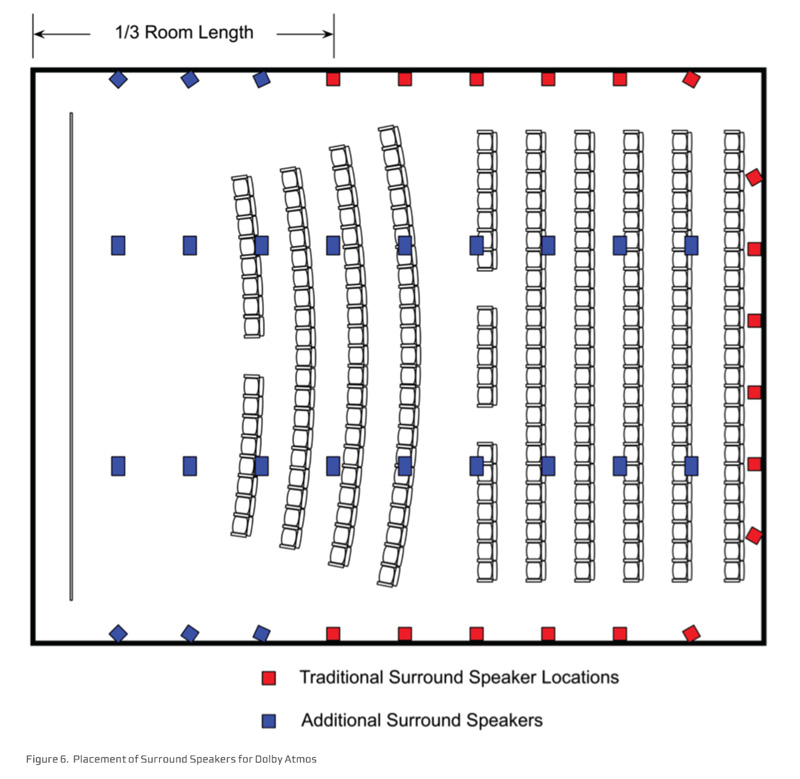
I'll repeat what I said earlier how it seems like Atmos would be best suited to a traditional sloped auditorium rather than a stadium seated design with a steeper seating slope. Alliteration much?
Posted by Ray Derrick (Member # 1001) on 05-16-2012, 08:53 PM:
The wall speakers are angled for obvious reasons. What the diagram does not show is that ceiling speakers towards the front and rear would also need to be angled for the same reasons.
So this diagram shows a system with 51 channels, if you include five screen channels and 4 individual sub bass channels (which just happens to be 5.1 x 10) .....
Bobby, I don't see why it would not work equally well with stadium seating. The only potential issue would be that the speakers on the ceiling would be further way from the audience at the front than at the rear, but this will probably be handled using staggered delays. The fact that the rear surrounds will be higher than the front I think will not be an issue due to our poor ability to localise sounds in the vertical axis.
I suspect that the majority of theatres that adopt this system will simply split their existing surround speaker arrays into individual channels and maybe add an extra surround speaker or two closer to the screen. I can't imagine too many will be willing to entertain the considerable cost of adding celing speakers. But we shall see.
One big problem I have with the whole concept is this... Sound mixing engineers will place sounds at different points around the "sound hemisphere", based on where they are sitting when they mix it, which is nearly always in the "sweet spot". For anyone else in the room, the more distant they are from the sweet spot, the more the sound will appear to come from a quite different direction.
Imagine a sound that is placed half way down the left side wall. For the sound mixer it will appear to be positioned on the left side and a little to the front. For audience sitting on the left side of the room, particularly those closest to the wall, those sitting forward of half way will perceive the sound as coming mostly from behind, whereas those sitting rearward of half way will perceive the sound as coming mostly from in front of them.
With the present system using speaker arrays this problem hardly exists, but with multiple surround channels it will become a major consideration.
However for the simple act of panning a helicopter around or over the audience (which seems to be the only example Dolby can come up with) it will work brilliantly. Will it be worth all that the cash outlay for the very occassional helicopter flying right around the audience?
Seriously though, I know it has many other uses other than for chopper sounds, it will certainly be great for sci-fi and horror movies, where you could swirl sounds around the audience to great effect.
If Dolby were prepared to license this technology to all sound equipment manfacturers (such as USL) I would be 100% behind it. But that is not how it works is it. We will be back to the bad old days where if you want to give your audience an Atmos experience you will have to buy an expensive under-featured Dolby sound processor.
The DCI committee could easily force this on Dolby - such that if they allow it into the DCI spec it must be available to all manufacturers. But I can almost guarantee they are too gutless for that.
Posted by Bobby Henderson (Member # 840) on 05-16-2012, 11:11 PM:
If Dolby had to license Atmos out to its competitors that would sort of defeat one of the purposes in creating the Atmos format in the first place: to keep the Dolby brand name prominently displayed in cinemas and movie related marketing. Like I said before, we're only a short time away from seeing those Dolby Digital, SDDS and "Datasat" logos associated with 35mm film disappear. D-cinema in its current form is not so Dolby-centric. Linear PCM requires no Dolby audio encoding.
Here is a link to the Dolby white paper:
http://www.dolby.com/uploadedFiles/Assets/US/Doc/Professional/Dolby-Atmos-Cinema-Technical-Guidelines.pdf
quote: Ray Derrick
The wall speakers are angled for obvious reasons. What the diagram does not show is that ceiling speakers towards the front and rear would also need to be angled for the same reasons.
Other diagrams in the white paper PDF show how the ceiling surround speakers should be aimed.
quote: Ray Derrick
The only potential issue would be that the speakers on the ceiling would be further way from the audience at the front than at the rear, but this will probably be handled using staggered delays.
I have other problems with what stadium seating does to a theater's sound environment.
The steep row of seating can reduce proper real wall surround imaging. Instead of a behind you effect it's more of an up above and behind effect. Natural hearing doesn't work to create such an audio blind spot. There's very little space back there compared to the front of the auditorium. The surround array has to rise on a pretty steep angle toward the back row.
Stadium seated theaters typically have taller areas of cubic air space, yet most of these theaters are using little surround array cabinets that were really designed for standard sloped rooms with much lower ceilings and much lower amounts of cubic air space to manipulate.
quote: Ray Derrick
Imagine a sound that is placed half way down the left side wall. For the sound mixer it will appear to be positioned on the left side and a little to the front. For audience sitting on the left side of the room, particularly those closest to the wall, those sitting forward of half way will perceive the sound as coming mostly from behind, whereas those sitting rearward of half way will perceive the sound as coming mostly from in front of them.
That's a good point about the disadvantages of using hard, single speaker positions in the surround array to play back sound elements. Sound mixers will have to pay attention to this. The nice thing is modern audio editing software can spread the sounds across more speaker drivers in the surround array to make surround panning effects more broad to the benefit of more listeners while actually maintaining the panning event instead of it falling dull and dead near the middle of the room.
One thing is certain, Atmos will have the capability of finally delivering proper "transient fly by" effects that smoothly move from the screen all the way to the back wall without any of the stupid, disappointing stopping in the middle of the room crap that happens too often with 5.1 setups.
With more surround array drivers positioned closer to the screen along the side walls and ceiling I can see Atmos being able to enhance more of what's happening on screen, particularly the big explosive moments. You can have 5 stage speaker enclosures firing as well as having the sound elements bleed forward from the screen into those side & ceiling surround cabinets nearest to the screen.
Posted by Manny Knowles (Member # 1171) on 05-17-2012, 11:27 AM:
Joe, the Dolby promotional material talks about Atmos being based on a 5.1 and/or 7.1 model. It likely handles that by clustering the surrounds as needed. It would probably also handle a standard 5.1 or 7.1 soundtrack in the same way.
But that's assuming that it's going to be released fully-formed as a complete replacement processor, and not a separate "adapter" like the original SR, SRD and EX products.
Posted by Mike Blakesley (Member # 26) on 05-17-2012, 11:40 AM:
quote: Bobby Henderson
Stadium seated theaters typically have taller areas of cubic air space, yet most of these theaters are using little surround array cabinets that were really designed for standard sloped rooms with much lower ceilings and much lower amounts of cubic air space to manipulate.
Like I said several pages ago, the demo theater we heard the system in WAS a stadium theatre with several rows of standard sloped seats in front of the stadium. We were seated about 2/3 up the auditorium in the stadium area. I didn't hear any problems that I would associate with the stadium at all. The surrounds didn't seem "too close."
As far as speaker types, to me all the surround speakers on the ceiling looked exactly alike, although that doesn't really say much -- a black cabinet can have anything in it. I don't remember them talking about what type or brand of speakers were used.
Posted by Joe Redifer (Member # 3) on 05-17-2012, 06:54 PM:
Manny, the only way it could work if it were released as an add-on (which would be dumb, but it's Dolby so who knows) is if it worked like SDDS. The old crusty processor would have to hook into it, not into the old crusty processor like the DA20. It would need its own volume control. It would need direct access to all of the amplifiers for each individual surround. It would be rather redundant to keep the old processor around.
Posted by Ray Derrick (Member # 1001) on 05-17-2012, 10:30 PM:
One other morsel of food for thought regarding this system is if you are going to be able to pan the sound of a helicopter (or whatever) seemlessly around the room, speaker by speaker, surely every surround speaker and it's associated amplifier is going to need the same acoustic power capability as the stage channels and thus be capable of delivering a maximum of 105dB SPL.
So presumably existing surround speakers will all have to be upgraded to something very much larger and more powerful than current models.
Posted by Joe Redifer (Member # 3) on 05-17-2012, 10:58 PM:
That's an interesting thought! But you're right, each channel will need the ability to produce an adequate SPL on it's own. Should be interesting. Guess those old 8330's probably won't be doing the trick.
Posted by Bobby Henderson (Member # 840) on 05-18-2012, 12:07 AM:
I guess the idea is to let subwoofers in the rear corners of the auditorium handle the bottom end for the surround speakers. I'm just wondering how well those things will work being tucked up high in the back row of a steeply sloped stadium seated theater.
Like I said earlier, this kind of system would be fantastic for a movie theater like the 1000+ seat General Cinemas Northpark #1 screen. Unfortunately that theater is long gone and any others similar to it that are still in operation probably have their days numbered too.
Posted by Mike Blakesley (Member # 26) on 05-18-2012, 12:19 AM:
Is that idea of surround-mounted subs in the white paper? It was never mentioned at the demo. The surround speakers were just like typical surround speakers. I assumed that any bass was being handled by the stage subs -- bass being fairly nondirectional.
With that in mind though, I don't remember hearing any explosions that were supposed to be coming from behind (or above)!
Posted by David Buckley (Member # 2600) on 05-18-2012, 07:13 AM:
The issue of 5.1 and 7.1 material should be a non-issue.
You've got an auditorium with a bucket load of speakers, and a processor which has a virtual "map" of the acoustic space in three dimensions. In Atmos mode each incomming sound element has a position associated with it, and the processor places the element where the mixman says it sould be. So the process is scalable from one speaker up to hundreds of speakers with just one incoming source format.
For an incoming standard 5.1 or 7.1 mix, then that mix also has a "standard" 3D map of where the speakers should be, the same as every theatre which has that system is today. Thus the processor just does the three dimensional map translation and places the 5.1 or 7.1 (or 11.1 or whatever) into the same space. To put it another way, rather than placing 128 elements into the virtual space in the processor, only the channels other than the LFE need to be placed, and tbey dont move, they have fixed locations.
There will probably be a range of these Atmos boxes, with the price tag going up by number of outputs. You would expect that all the obvious features would be in there too, such as crossovers, parametrics, limiters, simple routing to allow non-sync, etc, plus an auto-align system.
In business terms, Dolby is trying quite hard not to do a Kodak by remaining relevant, with DCI discrete audio obviating the need for any audio kit with a Dolby sticker on it. If Atmos doesn't catch on, then if Dolby have any brains at all they will exit the cinema audio business sharpish before it drags them under.
Posted by Scott Jentsch (Member # 1681) on 05-18-2012, 01:27 PM:
quote: Ray Derrick
One other morsel of food for thought regarding this system is if you are going to be able to pan the sound of a helicopter (or whatever) seemlessly around the room, speaker by speaker, surely every surround speaker and it's associated amplifier is going to need the same acoustic power capability as the stage channels and thus be capable of delivering a maximum of 105dB SPL.
I doubt that any one speaker in an Atmos installation would shoulder the responsibility of delivering a sound all alone. Given the sample diagram that was posted, and the challenges of satisfying a large number of people in an auditorium (not just a single sweet spot), I would imagine that multiple speakers will be involved for any given sound.
The speaker at the center of the sound will do the most work, but speakers within the area are going to be delivering some sound as well to support it. As such, I doubt that each speaker will have to deliver the same performance capability as one that is designed to handle distinct sounds by itself. Just a guess, though...
Posted by Sam D. Chavez (Member # 1841) on 05-18-2012, 01:42 PM:
I believe Scott is on the right track here.
One of the key things to keep in mind is that the Atmos box will know how many and where the speakers are, and presumably what they are by model #, as well as the available power, so will spread the sound around as needed to avoid blowing something up.
The setup procedure will no doubt shake some issues out, if any.
There will probably be a learning curve for all involved, including Dolby.
Posted by Bobby Henderson (Member # 840) on 05-18-2012, 02:39 PM:
quote: Mike Blakesley
Is that idea of surround-mounted subs in the white paper?
Yes. See section 2.3 (page 18) in the white paper pdf, Surround Sub-Woofers. A diagram on page 19 shows sub-woofer placement near (at least 1 meter away from) the rear corners of the room.
quote: David Buckley
If Atmos doesn't catch on, then if Dolby have any brains at all they will exit the cinema audio business sharpish before it drags them under.
Dolby is still doing just fine selling gear to commercial theaters, be it cinema processors and servers for digital cinema. Dolby's main problem is keeping its name in view of the general public.
IMAX and Real-D are getting all the promotional ink for 3D. I still never see Dolby 3D mentioned in any promotional material for new movies. Dolby 3D is never listed on movie posters or in movie trailers. I never see it mentioned on TV commercials. It's either IMAX 3D or Real-D and nothing else.
The Dolby brand is still prominent in home theater, but a brand loses some of its prestige to movie fans if real movie theaters move onto a different process. After almost 20 years of movie releases Dolby Digital on 35mm film is reaching the end of its life -at least in terms of being used on new Hollywood movie releases. Dolby Digital is ubiquitous in home theater, but it now has the vibe of a generic, default sound process. The promtional hype has moved on to other formats like DTS-HD Master Audio, despite Dolby TrueHD being able to do roughly the same thing.
Years ago I would not have predicted DTS to end up with the dominant lossless audio encoding format on Blu-ray. The company is trying to make inroads in other areas, like being used on "UltraViolet" cloud-based digital copies of movies. Just like Dolby, DTS is in real danger of no longer appearing to have any relevance with commercial movie theaters. The theatrical DTS company's name change to DataSat was a bad mistake, both in terms for the DataSat company and the now home-only DTS company. They should have maintained some ties in order to reinforce brand equity. DataSat has about the same level of brand equity as Kintek or something like that -basically a name regular movie theater customers aren't going to notice. I guess DataSat will live on to make hardware for digital cinema installations. Unless DTS or DataSat can develop something comparable to Dolby Atmos the DTS brand will be relevant only to home theater and primarily just to disc-based media like Blu-ray. The cable, broadcast and streaming rackets are still dominated by lossy Dolby Digital, even if Dolby Digital is seen as being generic.
I think Dolby Atmos can turn into a pretty big thing for movie theaters. But it's going to require quite a game change in how movie theaters install and maintain their sound systems.
Posted by Manny Knowles (Member # 1171) on 05-19-2012, 01:24 PM:
quote: Bobby Henderson
Dolby's main problem is keeping its name in view of the general public.
IMAX and Real-D are getting all the promotional ink for 3D. I still never see Dolby 3D mentioned in any promotional material for new movies. Dolby 3D is never listed on movie posters or in movie trailers. I never see it mentioned on TV commercials. It's either IMAX 3D or Real-D and nothing else.
This is all true, but we always run a Dolby trailer at the top of our digital presentations -- 2D and 3D, and I'm sure a lot of the other Dolby sites do as well. Probably not 100% of sites run the promos though.
It is interesting that Dolby is never listed along with IMAX 3-D and Real-D in the ads.
Posted by Mike Blakesley (Member # 26) on 05-19-2012, 02:01 PM:
Sad, is what it is. I can't believe Dolby let RealD get in bed with virtually every single studio regarding 3-D, after doing such a great job of getting the sound logos plastered all over everything back in the early days of surround and digital.
Posted by Steve Guttag (Member # 268) on 05-19-2012, 06:49 PM:
The realities are, Real-D has a business model that seems to have captured a large portion of the exhibition. They give you the system (or at worst it is a $10K up front)...and only charge 50-cents per ticket. They also get an exclusivity into their contracts (can't place any other brand of 3d in the theatre). For Sony (Regal and AMC), Real-D is the only 3D, at the moment.
The other thing that comes back on Dolby 3D is the hassle of collecting/cleaning the glasses...Real-D removes that hassle.
Now in France, I guess Real-D is effectively outlawed (as would Master Image). I hear that Dolby 3D has done better overseas than in the USA.
As to tags...most of my customers want to run the Dolby countdown, regardless of server!
Posted by Connor Wilson (Member # 6088) on 06-09-2012, 08:09 AM:
Dolby just recently announced the first theatres to include Dolby Atmos.
quote:
United States & Canada
AMC Barrywoods 24 (Kansas City, MO)
AMC Burbank 16 (Burbank, CA)
AMC Century City 15 (Century City, CA)
AMC Downtown Disney 24 (Lake Buena Vista, FL)
AMC Garden State 16 (Paramus, NJ)
AMC Van Ness 14 (San Francisco, CA)
Arclight Sherman Oaks (Sherman Oaks, CA)
Brenden Theatres at the Palms (Las Vegas, NV)
Century at Pacific Commons and XD (Fremont, CA)
Cinemark West Plano and XD (West Plano, TX)
SilverCity-Yonge Eglinton Cinemas (Cineplex) (Toronto, ON)
Cinetopia Vancouver Mall 23 (Vancouver, WA)
Kerasotes Showplace ICON at Roosevelt Collection (Chicago, IL)
The Dolby Theatre (Hollywood, CA)
Europe
Cinesa Diagonal Mar (Barcelona, Spain)
Empire Leicester Square (London, United Kingdom)
Asia
China Film Stella Theater Chain Hefei 1912 (He Fei, China)
Shanghai Film Art Center (Shanghai, China)
UME Shuangjing (Beijing, China)
Wanda Cinemas Wuhan Lingjiao Lake (Wuhan, China)
http://investor.dolby.com/releasedetail.cfm?ReleaseID=681590
Posted by Mike Olpin (Member # 1115) on 06-26-2012, 04:18 PM:
My review of Dolby Atmos
This was my third viewing of Brave, so I was pretty familiar with the standard mix of the film. I went solely with the intention to listen to Atmos, Dolby's new cinema audio format that allows up to 128 channels of audio across 64 locations. This is at it's peak. The thing about Atmos is that it is scalable, unlike previous Dolby formats. Atmos works with as few as 6 channels, or as many as 128, depending on how many amps, speakers, and wire-runs a theatre owner wishes to instal. Think of it this way, the listener sits in the middle of a sphere. The sound mixer is able to assign sound elements to any position in that sphere around the listener. The cinema processor takes that composite mix data and assigns each speaker a position relative to that sphere, and then creates a live mix for that specific speaker configuration in that specific auditorium in real time. It's pretty cool stuff.
The theatre I was in had 20 speakers in the ceiling, running in two rows from the front to the back. the left and right wall had 14 surround speakers each, running all the way up to about 5 feet from the screen, much closer to the front stage than is typical. The rear wall had 6 speakers. While I could not see behind the screen, the panning and imaging of the dialog (more on this later) seemed to indicate at least 5 full range stage channels. So that is at least 60 speakers, including the sub-bass. That does not necessarily translate into 60 channels, as the theatre may not have gone to the added expense of running 60 separate home runs back to 60 separate amps. I figured that after the movie started, I would be able to determine the number of actual channels if I listened carefully enough.
As I took my seat, the first look was playing. It sounded big, boomy, and harsh, which I had come to expect from XD and other "premium experience" theatres. They were built to sound big, not to sound correct. This had me worried, but I figured that I shouldn't start judging based upon the preshow. The First Look ended, and the trailers proper started. Again, the audio was big and it was harsh. I began to lament that my first Atmos show was going to have to be seen in a horribly EQ'd room. Voices were shrill and lacking in resonant natural lows. It was obvious that Atmos was not in use, as I was able to clearly localize the standard 5 channels and nothing outside of them.
Finally the lights dimmed. And what happened next was nothing short of breathtaking. You know that feeling, in a scope auditorium, when the screen expands from left to right to accommodate the larger picture? This was like the audio equivalent.
Over a completely black screen, plain white text appears. I cannot remember exactly what it said, but it was something along the lines of "What you see is only part of the movie. Sound makes it real.."
As the text fades away, jungle sounds fade in. The sound is incredibly smooth and immersive. I cannot localize a thing. The sound is just... everywhere. And it's rich and full. Gone is the harsh EQ from the trailers. A fly buzzes by above my head and to the left, but then flies, almost right over my shoulder, along the right and to the screen. Colors on the screen fade in, out of focus leaves in the fall become visible. One of the leaves snaps off with a nice crunch, and floats. The camera follows the leaf and, the entire ambiance of the sound space MOVES WITH THE CAMERA. In all of surround I've never heard such a cool sense of imaging across the entire room, each individual sound effect in the scene moving perfectly along the room with the camera as the leaf soars and tumbles through the air, finally landing on the ground. "Dolby Atmos" gently fades in, as the ambiance and sound fade out. "Hear the whole picture" fades in in near silence. It is the quietest and yet most impressive sound system trailer I've ever seen. Most sound trailers are about being loud and showing off the subs. Atmos isn't about being loud and in your face. It's a big statement, and a good direction to move in.
One of the things I miss about (and if you want you can take me to task and tell me I'm wrong) about traditional Dolby Stereo and ProLogic of the 80s and early 90s, was that it created a nice sense of spaciousness in the room. It's one of the few things I thought good matrix decoding was good at.
As the movie started, that was what I noticed most. The spaciousness was back. Individual channels melted away into an expensive sound stage. Just as in the trailer, I found it difficult to pinpoint exactly where a speaker channel was. But I could pinpoint the tens of individual sounds that made up the scene precisely.
As the films opening number "Touch The Sky" kicked in, I noticed how Atmos handled pop-music. In traditional 5.1, pop music is typically routed hard left and hard right, vocals hard center, and if the sound mixer was particularly talented, they might bleed a small amount of the instrumentation into the surrounds and center. In Atmos, the song, including vocals, was not at all directly locatable. "Front and Wide" is the best way I can think of to describe it.
Directional panning, not just with the camera as described in the Atmos trailer, is really great. Dialog followed all over the screen, no longer tied to the center. In one scene Fergus walks off the screen to the right. His voice follows from center, to right center, to hard right, and then to about the first 3 frontmost right surround speakers, perfectly timbre matched as it pans into them!
Now, here's the thing. about 10 minutes in, I forgot i was watching in Atmos. I forgot to continue to pay attention to the mix. I was in the movie. I had to pull myself back out several times and remind myself that I was there to critically listen. That is to say, Atmos NEVER drew attention back to itself. There was never any point in the movie where i thought, "Oh! Listen to those ceiling channels! That's really something!"
And I think that is really the point of Atmos.
Some will say having so many channels is overkill. But what I experienced, is the more channels you have, the more the sound system disappears. The less individual sections call out to remind you they exist. Instead, what you are left with is you and what is happening on the screen. The sound is just there.
Posted by Mike Blakesley (Member # 26) on 06-26-2012, 06:56 PM:
Great review! I hope some of the non-believers can be convinced. I had pretty much the same opinion when we saw the demos in Vegas but to hear a whole movie mixed with Atmos in mind would be great.
We'll be in Florida this winter so I hope there is an Atmos movie playing at the AMC Pleasure Island 24, I'm hoping to check it out there.l
quote: Mike Olpin
an expensive sound stage
I suppose you meant "expansive" but you are right on the money anyway!
Posted by Aaron Garman (Member # 1653) on 06-26-2012, 11:46 PM:
Hearing some great Dolby A this weekend and listening to some Pro-Logic at home (in Pro-Logic not Pro-Logic II) right now, yes, I miss expansiveness.
Can't wait to take a listen.
AJG
Posted by Tom Mundell (Member # 4555) on 06-27-2012, 10:43 AM:
Thanks for the review, Mike! I'm really interested in checking out an Atmos movie myself, I'm hoping they install this in some auditoriums here soon. Now if only AMC would fix the god awful picture in their ETX rooms, or install this in some non-ETX rooms.
Also I hope they keep with advertising which shows are presented in Atmos. I really like the 7.1 presentations I've seen, but it's never advertised so finding them can be a real pain; as this becomes more common (I hope) I don't want to have to do the same guesswork and/or numerous calls to theaters to verify which shows are actually in Atmos.
Posted by Bobby Henderson (Member # 840) on 06-27-2012, 11:03 AM:
I'd like to check out a show in Dolby Atmos. For the time being Cinemark's big theater 200 miles away in Plano, TX is the nearest place from here featuring a screen equipped with Atmos.
I was kind of hoping the Warren Theater folks would install Atmos on one or more of the screens at their Moore, OK location. That's just an hour's drive up the turnpike. The Warren folks tend to install better quality gear than one would see in a Cinemark booth, every screen is THX certified and running Dolby Digital Cinema related equipment. The addition of Atmos would seem to be an obvious upgrade.
I think most here agree Dolby Atmos is a groundbreaking change to how movie audio is played. There is no argument about the technology being very cool. For me, the problems with Atmos have to do with certain realities of the movie theater business.
The installation cost and complexity doesn't make Atmos very friendly to average multiplex auditoriums. Bean counting executives at theater chain home offices would be very tempted to have Atmos installed in minimal configurations and then do nothing to inform customers about the minimal configuration versus a fully tricked out Atmos rig in another auditorium or a rival theater. That could sour some customers on Atmos pretty fast, especially if they have to pay extra to hear a movie presented in the format.
Sound system maintenance is a real problem at many movie theaters. Add to that the compromises made with many houses when they were being designed, built and equipped. Dolby Atmos will demand a much greater commitment from theater operators to keep the sound system working in top form at all times. Elements of dialog and sound effects being panned across the screen and around the room in 3D space won't sound so well if certain speakers have blown drivers no one bothered to fix.
Posted by Aaron Garman (Member # 1653) on 06-27-2012, 01:07 PM:
Perhaps Atmos itself will bring more attention to sound related issues, and keep it on the cinema's radar more than it is now. I wish it at least.
Of course I could wish in one hand and crap in the other, and see which gets filled first.
AJG
Posted by Mike Olpin (Member # 1115) on 06-27-2012, 01:28 PM:
I went back for a second screening, and in between shows, I spoke with the on-site Dolby tech, who was supervising each performance. We spoke for about 40 minutes.
He did confirm that the installation at West Plano has over 50 discrete channels connected. He also confirmed my suspicion that when Atmos engaged, it used a separate, and in my opinion much better, EQ profile.
The floating leaf trailer was made for Dolby by Pixar.
Posted by Bobby Henderson (Member # 840) on 06-27-2012, 02:57 PM:
I'd really like to know the file size differences between a movie soundtrack in Dolby Atmos versus that of a standard 24-bit 48kHz uncompressed Linear PCM 5.1 soundtrack. My guess is the Atmos files would be quite a bit larger since they are fundamentally more similar to a Pro Tools audio project with many floating/layered sound objects.
Posted by Marc D Fishman (Member # 6992) on 06-30-2012, 11:43 AM:
quote: Bobby Henderson
Sound system maintenance is a real problem at many movie theaters. Add to that the compromises made with many houses when they were being designed, built and equipped. Dolby Atmos will demand a much greater commitment from theater operators to keep the sound system working in top form at all times. Elements of dialog and sound effects being panned across the screen and around the room in 3D space won't sound so well if certain speakers have blown drivers no one bothered to fix.
One of the great things about Atmos is that it is "aware" if there is a speaker issue and will take that speaker out of the system and use the adjacent working speakers, just as it would scale to a theater with smaller playback systems.
In addition, if a speaker or processor failure is detected, the exhibitor will get a notification (i.e. email) from the system alerting them to the issue.
quote: Mike Olpin
He did confirm that the installation at West Plano has over 50 discrete channels connected. He also confirmed my suspicion that when Atmos engaged, it used a separate, and in my opinion much better, EQ profile.
The floating leaf trailer was made for Dolby by Pixar.
The other benefit is that you get the new EQ for a 5.1 or 7.1 playback (my understand is there is an "overlay" string to account for the array configuration in such situations.)
Gary Rydstrom did the sound design/editorial duties for the Leaf trailer... my understanding is that it was audio first and then Pixar animated to that..
There is also a second Atmos trailer (which I thought was really cool.. much more aggressive and "bigger") that is currently only playing at the El Capitain.
Posted by Manny Knowles (Member # 1171) on 06-30-2012, 12:26 PM:
Is Atmos "aware" at all times, including playback, or only during a diagnostic mode?
If it depends on someone initiating tests, then it's only going to be as aware as the user allows it to be.
Posted by Marc D Fishman (Member # 6992) on 06-30-2012, 04:38 PM:
quote: Manny Knowles
Is Atmos "aware" at all times, including playback, or only during a diagnostic mode?
If it depends on someone initiating tests, then it's only going to be as aware as the user allows it to be.
I actually can't answer that definitely because I didn't ask.
However, I can surmise that there is active feedback due to the networked nature of distributing sound from the processor to the speakers in the auditorium.
At this point, and since there is no real booth hardware to speak of, we will have to wait and see what happens, and what may or may not change, once the final hardware is ready to be rolled out for permanent installations.
All in all, I'm am really excited at the creative possibilities, and hope this kind of active feedback helps keep systems running as designed.
Posted by Carsten Kurz (Member # 5396) on 07-01-2012, 11:43 AM:
I find it a bit odd we hear of Atmos installations, but no Atmos hardware is visible on Dolbys site. Are these all prototype installations?
I am writing this specifically because I get the idea Dolby launched Atmos earlier than originally planned. Maybe they have been taken by surprise by the Auro 3D and immSound announcements? The december release of Cinematechnology, covering Auro3D, mentioned a demo of a new Dolby surround sound system at Dolby UK HQ in october 2011 - but it was just a simpler discrete 9.1 and 11.1 channel approach like Auro3D.
Maybe Dolby thought they would loose too much market to Barco and immSound by waiting any longer to release the product?
- Carsten
Posted by Jussi Siponen (Member # 5572) on 07-02-2012, 01:19 AM:
Right now, Atmos installations are done using the same decoder hardware as is used at the mixing theaters.
The *real* cinema decoder system should be available in about a year.
Posted by Scott Jentsch (Member # 1681) on 07-06-2012, 12:06 PM:
Great, now I'm going to have to go to Chicago to check this out. Anyone know what kind of installation the Kerasotes ShowPlace ICON Theatre has?
I'm not really interested in seeing Brave, and so far, no other movies have been announced to my knowledge...
Posted by Mike Blakesley (Member # 26) on 07-06-2012, 02:25 PM:
quote: Carsten Kurz
no Atmos hardware is visible on Dolbys site.
They had a processor-looking piece of equipment on display under a glass cover at their CinemaCon demo theater. I wish now I'd taken a picture of it...must have been an empty shell or a "concept model."
Posted by Christos Mitsakis (Member # 143) on 07-07-2012, 06:11 AM:
Here it is, although I believe the final product will be different.
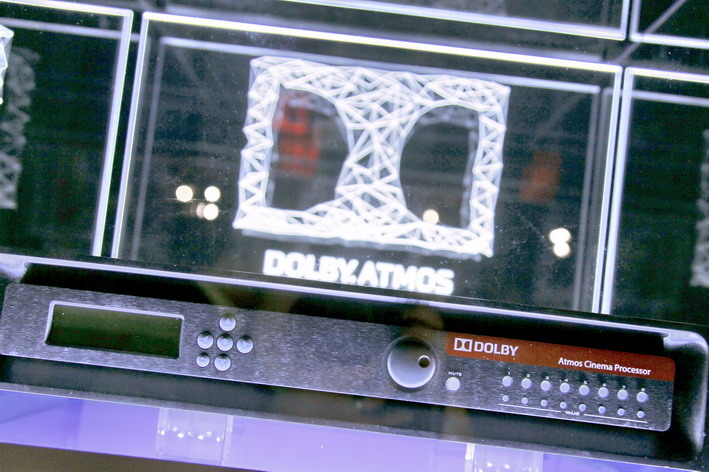
C.
Posted by Jonathan Goeldner (Member # 4854) on 07-14-2012, 12:57 PM:
quote: Scott Jentsch
Great, now I'm going to have to go to Chicago to check this out. Anyone know what kind of installation the Kerasotes ShowPlace ICON Theatre has?
I'm not really interested in seeing Brave, and so far, no other movies have been announced to my knowledge...
the only other movie I've heard that is rumored to get released is the first Hobbit movie but that ain't til December. I'm also really curious to know what the next movie will be too.
Posted by Peter Castle (Member # 1997) on 07-19-2012, 05:24 AM:
Just noticed on GDC server that "The Dark Knight Rises" has 14 channels of audio. Is this Atmos, or something else?
Posted by Carsten Kurz (Member # 5396) on 07-19-2012, 03:42 PM:
Every DCI compliant movie can have up to 16ch, without any need for Atmos, Auro or any other brand associated. HI/VI can occupy two channels.
Does the leaflet explain the channel mapping?
- Carsten
Posted by Paul Rousseas (Member # 7022) on 07-19-2012, 05:49 PM:
Dear Christos,
Do you happen to know if Dolby ATMOS is going to be installed in Greece?
Thank you in advance!
Posted by Christos Mitsakis (Member # 143) on 07-20-2012, 04:45 AM:
Paul,
"Difficult to see the future is"...
For the moment everything in digital projection is at a pause and waiting... As you may have noticed, aside some blockbusters, theatrical attendance is marginal and decreasing.
On the other hand lets have the actual Atmos processor on hand from Dolby, a pricelist and a bunch of films mixed in Atmos and may be we'll discussing this in a couple of years. Hopefully!!
C.
Posted by Paul Rousseas (Member # 7022) on 07-20-2012, 06:04 AM:
Indeed movie attendance in Greece is marginal, especially in multiplexes, this time of year (open air cinemas seem to be doing better). I believe that multiplexes should reorganize their repertoire and project the same movies that open air cinemas are currently showing. I also believe that establishing a more cultural - artistic profile would benefit the attendance of multiplexes. People go to movie theaters when good movies are shown, which is not the case, with the average movies distributed in Greece this period (i.e. “What to Expect When You are Expecting”, “The Lucky One”, “American Pie”, “Rock of Ages”).
Christos I’ am curious to know to which movie theater you are working, if I am not indiscreet. I have always wanted to chat whit a projectionist from Greece! I would also love to work in a movie theater as a projectionist, but things seem to be a little rough... Thank you very much!
Posted by Marc D Fishman (Member # 6992) on 07-20-2012, 12:41 PM:
quote: Peter Castle
Just noticed on GDC server that "The Dark Knight Rises" has 14 channels of audio. Is this Atmos, or something else?
Just to be clear... Atmos is not a commercial product at this time...
They have not ratified the DCI spec at this time for delivery on a DCP, and for Brave the audio was running off a separate audio server and being rendered in real time by the RMU production hardware.
Posted by Bobby Henderson (Member # 840) on 07-20-2012, 01:09 PM:
I figured the audio had to be delivered via some kind of separate, synched setup.
It doesn't make any kind of logical sense whatsoever to suggest Atmos audio can somehow be added to a standard LPCM 5.1/7.1 track on a DCP with small amounts of metadata.
I'm still wondering about the file sizes of a movie soundtrack authored in Dolby Atmos. The way that it is described, with lots of uncompressed audio objects, each object having its own separate parameters on mixing, surround steering, effects, etc. the finished Atmos mix would have to more closely resemble a ProTools project than some "flattened" LPCM 5.1/7.1 track.
Posted by Marc D Fishman (Member # 6992) on 07-20-2012, 01:59 PM:
Bobby,,, the idea is that it will indeed be deliverable on a DCP...
There will be some sort of "lossless" or "near lossless" audio compression..
From the ATMOS Production White Paper..
"The Dolby Atmos audio files delivered to the packaging facility can be imported into an appropriate digital cinema packaging system, such as the Dolby Secure Content Creator (SCC2000), to create a DCP. The audio track files may be locked together to help prevent synchronization errors with the Dolby Atmos track file that has been signed off in the dubbing theater. The SCC2000 may also respond to data in the print master file, such as first frame and last frame of action, to ensure accurate synchronization of sound to picture as was signed off in the dubbing theater."
"Upon creation of the DCP, the main audio MXF file (with appropriate additional tracks appended) is encrypted using SMPTE specifications in accordance with existing practice. The Dolby Atmos MXF is packaged as an auxiliary track file, and is optionally encrypted using a symmetric content key per the SMPTE specification."
"This single DCP can then be delivered to any DCI-compliant server. Any installations that are not suitably equipped will simply ignore the additional track file containing the Dolby Atmos soundtrack and will use the existing main audio track file for standard playback. Those installations equipped with a Dolby Atmos cinema processor will be able to ingest and replay the Dolby Atmos soundtrack where applicable, reverting to the standard audio track as necessary."
Posted by Bobby Henderson (Member # 840) on 07-20-2012, 04:01 PM:
Of course there's no problem including a Dolby Atmos MXF audio file package in with the other "assets" on a DCP as long as there is enough hard disc capacity to do so.
Nevertheless, the Atmos track absolutely would have to be a different, alternative track from the standard 5.1/7.1 LPCM track. With the way LPCM audio works there is no way one could embed all sorts of Atmos data into a standard LPCM audio track without ruining compatibility.
Here's a couple visual examples of how I think Atmos compares to a LPCM 5.1 track. Atmos is like a layered Photoshop file and the LPCM track is like a flattened, lossless compressed TIFF version of it no longer editable. Better yet, the Atmos track could be similar to an Adobe After Effects motion graphics project with separate layers of video and graphics elements from Photoshop, Illustrator, etc. all with their own effects parameters on the time line. By comparison the LPCM track would be like a flattened video file rendered from the After Effects project. To make any changes to that flat video file one would have to go back into After Effects, make adjustments and re-render the video.
You can't open a flattened, rendered video of motion graphics and select elements like type, graphics, etc. since it's all collapsed down to one layer. A final LPCM 5.1 mix is the same kind of thing. The dozens of audio elements used to create the mix are all destructively baked down into just one layer.
Posted by David Graham Rose (Member # 1450) on 07-22-2012, 02:36 PM:
Paid bod mor gwirion
Posted by Carsten Kurz (Member # 5396) on 08-01-2012, 09:00 PM:
Oooops...
http://www.screendaily.com/news/dolby-laboratories-acquires-immersive-audio-competitor-imm-sound/5044766.article
----
Dolby Laboratories acquires immersive audio competitor IMM Sound
24 July, 2012 | By Neal Romanek
IMM Sound’s immersive audio technology includes both theatre systems and audio post technology with their Immersive Audio Workstation mixing console.
Dolby Laboratories has acquired IMM Sound, the Barcelona-based provider of immersive audio systems for cinemas. IMM’s immersive sound technology will be discontinued and used to enhance Dolby’s own Atmos [pictured] immersive sound system.
Immersive, or “3D”, audio is a term given to a variety of technologies aiming to faithfully recreate the experience of hearing sound in real life, including height information, that goes beyond traditional surround sound. IMM Sound’s immersive audio technology includes both theatre systems and audio post technology with their IAW (Immersive Audio Workstation) mixing console.
Dolby’s Atmos immersive audio system also provides and end-to-end solution with cinema set ups and mixing technology. The Dolby Atmos theatre system has support for up to 64 speaker channels, including speakers in the cinema ceiling.
In June, Dolby equipped the first European Atmos screen with Barcelona’s Cinesa Diagonal Mar Screen 9. Other immersive audio systems include Belgian company Auro Technologies Auro 3D.
---
- Carsten
Posted by Antti Nayha (Member # 4980) on 09-02-2012, 05:57 AM:
I'll be in London next weekend, and was hoping to catch an Atmos demo... but alas, it seems that the Empire Leicester Square is not running Brave anymore.
I don't suppose that any of these titles are using Atmos?
Posted by Derek Young (Member # 7160) on 09-04-2012, 07:06 AM:
The Empire did not have the run of Brave its screening at the Vue. I think they done screenings of Brave at the Empire for
test showings,then it looked like Emipre Cinemas pulled the
film and it went to the Vue.
Posted by Daniel Schulz (Member # 1881) on 09-24-2012, 12:40 PM:
Weekend press release:
LOS ANGELES & SAN FRANCISCO--(BUSINESS WIRE)-- Dolby Laboratories, Inc. (NYSE: DLB) and Twentieth Century Fox® announced today that two of the studio's fall 2012 releases, Taken 2 (U.S. release: October 5, 2012) and Chasing Mavericks (U.S. release: October 26, 2012), will be mixed and released in Dolby® Atmos™, the new audio platform that has revolutionized the experience of sound in entertainment. Anticipating additional Dolby Atmos titles, Twentieth Century Fox is outfitting its Zanuck Theater postproduction facility with Dolby Atmos capabilities.
Dolby Atmos, the latest sound technology from Dolby Laboratories, delivers a more natural and realis ...
Dolby Atmos, the latest sound technology from Dolby Laboratories, delivers a more natural and realistic sound-field that moves sound around and above audiences, transporting them into the onscreen adventure.
"Dolby Atmos transports audiences into the onscreen adventure with the most lifelike sensory experience ever offered in cinema," said Doug Darrow, Senior Vice President, Cinema, Dolby Laboratories. "Dolby Atmos will immerse moviegoers in the sounds of Istanbul's bustling streets in the action-packed Taken 2 and atop the big waves of Chasing Mavericks."
Two acclaimed sound re-recording mixers will be at the helm of the Dolby Atmos mixes. Craig Henighan will mix Chasing Mavericks in Dolby Atmos; Chuck Michael will conduct the Dolby Atmos mix for Taken 2.
According to Darrow, Dolby has a long history of transforming and reinventing cinema sound and is attuned to the desires of both movie audiences and the creative community behind each film.
"Twentieth Century Fox and Dolby have had a long and trusted history together," said Ted Gagliano, President of Post Production, Twentieth Century Fox. "It is therefore not surprising to me that the breadth of Dolby's experience has given them a keen insight not just into the moviegoing experience, but into the wants and needs of postproduction. This has obviously greatly influenced the vision of Dolby Atmos. Fox looks forward to enriching the cinematic experience with this latest innovation from Dolby."
The list of North American theatres selected to show the fall 2012 releases of Taken 2 and Chasing Mavericks in Dolby Atmos will be made available closer to the release dates.
http://investor.dolby.com/releasedetail.cfm?ReleaseID=705984
Posted by Martin Brooks (Member # 1269) on 09-28-2012, 08:21 PM:
Taken 2 will be showing in Dolby Atmos at the Empire 25 in NYC.
I saw/heard a Dolby Atmos demo at the Dolby Screening Room a few weeks ago. The "jungle" trailer was phenomenal, but a remixed scene from MI4 lacked decent bottom and had the usual digital harshness. Having said that, the sound localization was amazing.
These films are mixed standard 7.1 and then Atmos is applied as "sweetening" on top of it. What we haven't seen yet is a film mixed totally with Atmos in mind and then played back in both Atmos and standard 7.1/5.1 theatres. I think that's probably at least a year away.
Posted by Jonathan Goeldner (Member # 4854) on 10-06-2012, 02:37 PM:
^ I'm a little annoyed that Fox didn't let the soundmixers (of Taken 2) also mix this in standard 7.1 ![[Mad]](mad.gif)
Posted by Tony Bandiera Jr (Member # 2365) on 10-06-2012, 06:59 PM:
The last thing this industry needs is yet another sound format. It is hard enough getting theatres to invest in a QUALITY 5.1 system, so who is the genius at Dolby who imagines that theatres are going to invest in yet more channels and speakers?
What this industry NEEDS DESPERATELY is a testing and certification program similar to THX but without the politics and BS. One that is actually enforced and followed up on. Any theater that does not meet the standard should be required to post signs advising filmgoers that their sound sucks.
I'd say that over 80% of theatres have sound that is at least lacking or more accurately (as Joe Redifer would say) sounds like ass.
Money for Atmos would be far better spent in bringing the existing 5.1/7.1 systems up to proper performance levels.
Posted by Mike Blakesley (Member # 26) on 10-06-2012, 09:15 PM:
I like your sign idea, but sound is so subjective. For example, lots of people think our sound here is good, but there are some who think it's too loud. And others who wish it was louder.
Posted by Brad Miller (Member # 2) on 10-06-2012, 11:17 PM:
Volume does not = good sound. You can't take a crappy sound system and turn it up to make it sound better. (You would actually be making it sound worse.)
The biggest problem aside from acoustics/room design and poor choice of amp/speaker is people either plug it in, set some basic levels and walk...or they go the other way and OVER-tune the room.
Either = bad sound. That being said though, a properly calibrated system won't sound as good if played at a volume off the mark.
Posted by Randy Stankey (Member # 64) on 10-07-2012, 08:57 AM:
quote: Tony Bandiera Jr
Any theater that does not meet the standard should be required to post signs advising filmgoers that their sound sucks.
Better idea: Movie theaters should have to post colored stickers on their front doors like some cities make restaurants do.
Posted by Steve Guttag (Member # 268) on 10-07-2012, 10:50 AM:
quote: Brad Miller
Volume does not = good sound. You can't take a crappy sound system and turn it up to make it sound better. (You would actually be making it sound worse.)
Damn! I just got through making up new silk screens for our volume controls (aka "faders" for your snooty people) that replaced the 0 - 10 markings (or -∞ - +10dB for the "engineering" types) with "Worse" - "Better" labels! Gone will be the phrases of "turn the volume up to more better."
Posted by Mike Blakesley (Member # 26) on 10-07-2012, 10:00 PM:
quote: Brad Miller
Volume does not = good sound.
Absolutely. But I don't care if you have the best sound system on this or any other planet, there are going to be SOME people who think it should be louder (teen boys), or softer (senior citizens).
Posted by Joe Elliott (Member # 4006) on 10-07-2012, 10:32 PM:
And isn't it funny that the teens sit in the of the auditorium, so they are the farthest from the speakers. And the seniors sit so far up that they nearly have their ears pressed to the speakers. Same goes with stadium seating. The seniors down front where the cool air settles complain it is too cold. The teens in the back up where the hot air has risen to, complain it is too hot.
Posted by Carsten Kurz (Member # 5396) on 10-08-2012, 05:47 AM:
Yep. We definitly need regulations there. Seniors up, teens down.
- Carsten
Posted by Scott Norwood (Member # 30) on 10-08-2012, 06:48 AM:
As for sound levels, I've felt for a while that one of the measures of a "good" sound system (room, speakers, setup) is that it can be played at a fader setting of "7" without generating complaints. Lesser quality systems always seem to have some degree of harshness or distortion that necessitates playing films at a lower setting.
Someone needs to make a remote fader box that goes to "11" (call it the "cat. 779 - Spinal Tap version"). Filmmakers always seem to be deaf, so it would be nice to give them something like that to twiddle with during their screenings.
Posted by Randy Stankey (Member # 64) on 10-08-2012, 08:14 AM:
quote: Scott Norwood
...so it would be nice to give them something like that to twiddle with during their screenings.
A former boss once complained about the sound and, after adjusting it several times, I let him adjust it. He stood there and twiddled dials on the sound console for five minutes then declared, "That's perfect!"
What he didn't know was that the EQ was in bypass!
Posted by Mike Blakesley (Member # 26) on 10-08-2012, 01:01 PM:
quote: Scott Norwood
Someone needs to make a remote fader box that goes to "11" (call it the "cat. 779 - Spinal Tap version"). Filmmakers always seem to be deaf, so it would be nice to give them something like that to twiddle with during their screenings.
That's a great idea, although it would be cool to label it "Fine volume adjust" and have it right where customers could see it. Then when someone says they want it louder or softer, you could say "Oh, I'm sorry, let me adjust that for you." Then give the knob a turn and they would be happy. I don't know how many times I've told somebody I would raise or lower the volume, but didn't actually change a thing, but then after the show they say "thanks for fixing the volume, it was much better."
As for being able to play a system at 7 and not generate complaints, well my wife and I had a chance to hear what's probably one of the best cinema sound systems in the world -- the one at the Dolby Screening Room in San Francisco. They were playing the movie "Transformers 3" and we both thought that was ridiculously loud. It sounded great, don't get me wrong....but my personal taste would have liked it not to be so loud. (Also that movie sucked, so maybe that played into it.)
Posted by Victor Liorentas (Member # 5272) on 10-08-2012, 02:21 PM:
Too many movies now forget to give our ears quiet time as great mixes in the past like Titanic and Saving Private Ryan...loud when they should be but you don't mind it because it's realistic and appropriate.
Posted by Marco Giustini (Member # 4544) on 10-08-2012, 04:21 PM:
quote: Mike Blakesley
there are going to be SOME people who think it should be louder (teen boys), or softer (senior citizens).
Sure, but on average a good sound system in a good auditorium will handle the sound much better. It won't sound "too loud" even though your fader is a bit up. What is being said is true: very few sound systems are actually up to the job. Neither raising nor lowering the volume is going to improve the situation here.
Transformers is a bad example. 45 minutes of 110dB is not what I call a "movie", that is showing off!
Posted by John T. Hendrickson, Jr (Member # 849) on 10-08-2012, 04:55 PM:
Given the fact that sound is so subjective, and givren the fact that exhibitors have experienced additional costs with upgrades to digital, 3D, and ever demanding sound systems, I have to ask an economics question:
At what point does the law of diminishing returns kick in?
Posted by Jonathan Goeldner (Member # 4854) on 10-08-2012, 05:05 PM:
speaking of loudness, was over at the new Angelika Mosaic and the first trailer ('Masquerade') on the DCP of the 'The Paparboy' was so insanely loud, I couldn't hear my friend complaining to me:
"It's too loud"
"what?"
thankfully the second trailer didn't have that problem - but good god - it was extreme.
Posted by Joe Redifer (Member # 3) on 10-08-2012, 06:18 PM:
quote: Mike Blakesley
there are going to be SOME people who think it should be louder (teen boys), or softer (senior citizens).
Why is that? You'd think with their aged ears they wouldn't hear anywhere near as well as they used to. So why are they complaining that a perfectly fine movie is too loud? What is wrong with these people?
Posted by Mike Blakesley (Member # 26) on 10-08-2012, 07:10 PM:
I think they are used to the "good old days" where all the sound came out of a 3" speaker on the front of the TV (or radio) so anything more "realistic" seems too loud.
I also get the occasional comment that the surround sound and hearing aids don't play well together (supposedly makes it harder to hear the front channels?), but I'm not sure why that is.
Posted by Scott Jentsch (Member # 1681) on 10-10-2012, 09:06 AM:
quote: Tony Bandiera Jr
What this industry NEEDS DESPERATELY is a testing and certification program similar to THX but without the politics and BS. One that is actually enforced and followed up on. Any theater that does not meet the standard should be required to post signs advising filmgoers that their sound sucks.
In concept, I agree wholeheartedly.
However, the consensus among many respected parties here is that good sound is unmeasurable. Or, rather, that sound that measures well doesn't sound the best.
Without a scientific standard by which to measure, judge, and adjust, everyone's just guessing and the industry is doomed to never get it "right" because "right" is seemingly different to everyone.
I continue to hold my stubborn position that THX got it right in its intention to raise the bar. I would even go so far as to say that the entire industry would be in a much more sorry state had they not done what they did back in the day. Politics and bureaucracy (and maybe a little greed thrown in for good measure) spoiled a good thing, so now we're in danger of heading backwards with no one at the switch.
As THX said at the time, THX isn't digital sound, but THX will make digital sound better. The same could go for 7-channel LPCM and Atmos. All the technology in the world can't make up for the fact that the management and/or staff at some theaters just aren't going to do what it takes to put on a flawless presentation.
If Atmos can't do more than a couple dozen installs and play movies several months apart (Brave opened 6/22), I don't see it getting traction. It needs a wider range of theaters and a movie that is going to blow the minds of those who see it in an Atmos-equipped theater, so as to generate word-of-mouth publicity that will build the momentum they need to become more than a curiosity in the annals of movie exhibition history.
I would like to see Dolby go after the premium theaters that are charging people $20-30 each for the next round of installs (iPic, Cinepolis, et al). These are theaters that are catering to people with spending money, who are probably also more discriminating moviegoers as well. One would hope that these auditoriums have been built well, have decent equipment, and the margins should mean that these theaters aren't pinching pennies just to keep the lights on another day and are willing to deliver something special to keep people coming back and paying their luxury prices.
One would hope Dolby is seeking out the best auditoriums in which to install their new system, so that they don't get a black eye by having some crap theater advertising Atmos only to deliver a half-witted presentation. Perhaps they are, and they are having trouble finding such locations, and that would explain what appears to be zero growth in locations since its introduction?
Posted by Martin McCaffery (Member # 37) on 10-10-2012, 10:46 AM:
quote: Joe Redifer
Why is that? You'd think with their aged ears they wouldn't hear anywhere near as well as they used to. So why are they complaining that a perfectly fine movie is too loud? What is wrong with these people?
Because they don't loose hearing uniformly across all frequencies. Hi range peaks are particularly bothersome to painful for lots of them.
Of course, they can't hear the voices and constantly have to ask each other, loudly, what was just said.
You can't win.
Posted by Mike Blakesley (Member # 26) on 10-10-2012, 11:16 AM:
quote: Scott Jentsch
One would hope Dolby is seeking out the best auditoriums in which to install their new system, so that they don't get a black eye by having some crap theater advertising Atmos only to deliver a half-witted presentation. Perhaps they are, and they are having trouble finding such locations, and that would explain what appears to be zero growth in locations since its introduction?
I think it's more the cost of it, than anything. If Atmos would have happened, say 15 years ago, things might have been different. But now, with theaters having having DC systems to pay off and supply bulbs, service and upkeep for, it'll probably be at least a few years down the road for most (and that's IF it turns into a necessity, which seems a little questionable at this point).
quote: Scott Jentsch
Without a scientific standard by which to measure, judge, and adjust, everyone's just guessing and the industry is doomed to never get it "right" because "right" is seemingly different to everyone.
There's also the fact that everyone hears differently and likes different things. Lots of people (including me) like big loud movies with lots of explosions and car chases and such, whereas a person who prefers quiet, dialog-driven movies would probably say that my car-chase movie "sounded terrible" even though it probably sounded fantastic to me. It's like trying to decide what music is "good" and what isn't. You can't do it definitively for everybody.
Posted by Randy Stankey (Member # 64) on 10-10-2012, 12:30 PM:
quote:
There's also the fact that everyone hears differently and likes different things...
... It's like trying to decide what music is "good" and what isn't. You can't do it definitively for everybody.
Here's an interesting idea.
If Atmos can mix down multiple tracks to fit a given theater, why not make it so that a soundtrack can be mixed down differently for the tastes of different audiences?
If you have an audience of more "mature" customers who like a dialogue-centered presentation, you switch to the "Quiet" mix. If you have a younger audience who like to hear car crashes and explosions, you switch to the "Loud" mix. If no specific choice is made, the system would default to the "Standard" mix.
With all the computerized stuff that we have, nowadays, this should be easy-peasy! ![[Wink]](wink.gif)
Posted by Mark Hajducki (Member # 1732) on 10-10-2012, 02:34 PM:
Dolby should restrict Atmos to theatres that are prepared to do a full install with enough independent, well placed, speakers to give the full effect. The auditoria would also need to be inspected to avoid installs in rooms with excessive sound bleed and background noise.
Ideally there would also be some certification process to ensure that the sound and venue remains up to standard (if the venue fails it would not be able to advertise itself as Atmos). This would be in contrast to the current situation where a cinema is able to advertise Dolby sound even if the rest of their setup is poor.
Posted by Martin Brooks (Member # 1269) on 10-22-2012, 01:06 AM:
quote: Mike Blakesley
I think they are used to the "good old days" where all the sound came out of a 3" speaker on the front of the TV (or radio) so anything more "realistic" seems too loud.
That's ridiculous. I'm 62 and an ex-recording engineer (so I think I know what good sound is supposed to sound like) and it's not sound from a 3" speaker. People who were of working age and moderately successful in the 1950s are those who bought into "hi-fi" (and many of those system sounded far better than the crappy digital home systems of today). Those people would be in their 80s now (although not necessarily hearing very well, especially if they've spent their lives in noisy environments).
I think most action movies ARE too loud. The problem is that almost no one understands what dynamic range is about anymore. The ego of directors (and many sound mixers) gets the better of them and they think they can create excitement simply by making it louder, but they never stop and so the movie is loud end to end, the mix turns to mud and dialogue intelligibility drops.
And unless you live on an airport runway, under a roller coaster or in a factory, "realistic" sound is not at 110db.
There's also the issue (although more in the music industry than the movie industry) that many mixers already have severe hearing loss, so they mix louder. Levels are so hot in music clubs today (and even many Broadway shows) that if they were factories, they would be violating OSHA regulations for noise exposure. If you come out of a show or sporting event or whatever and your ears are ringing, you already have hearing damage. Every musician I know has tinnitus. I had tinnitus for a year and it's not fun.
I was at an Audio Engineering Society convention some years back and there was a panel of music mixers and mastering engineers. A question came up of whether the Beatles would be as popular today as they were back in their day and aside from the issue of market fragmentation, the answer was "no" because their records would be highly level compressed today and they would become tedious to listen to.
That's the problem with today's action movies - if it's all loud, there's no surprise and it's tedious to listen to. When I saw the last Batman movie, when Bane is in the stadium I couldn't understand a word that he said. I thought it was my problem and due to hearing loss. Then I saw a video on YouTube that satirized this scene. Apparently, many people couldn't understand a word that he said.
As far as Dolby Atmos is concerned, I saw Taken 2 in Dolby Atmos and I have to say that I thought the sound was pretty terrific (the movie sucked, but I knew that going in). I didn't really think the extra channels would make such a difference, except perhaps for flyovers, but they did. First movie in a long time where the sound put a smile on my face. Atmos would definitely get me into theatres more often and I don't even think it's been used to its real potential as yet since the first few films have been mixed standard 5.1 or 7.1 and then "sweetened" with Atmos' object model. I think it's going to get better as mixers get used to using it (if it survives and actually becomes a fully realized commercial product.)
quote: Mark Hajducki
Dolby should restrict Atmos to theatres that are prepared to do a full install with enough independent, well placed, speakers to give the full effect. The auditoria would also need to be inspected to avoid installs in rooms with excessive sound bleed and background noise.
Unfortunately, Dolby is not doing that. They're marketing it on the basis that it can work in almost any configuration as long as you individually wire each speaker, even without adding the ceiling speakers or the rear woofers. I think that's a big mistake because if consumers go to a theatre where the movie is advertised as "Atmos" and the sound isn't distinctively better, they won't return, especially if there's an upcharge. They should have at least a minimum required configuration.
Posted by Mike Blakesley (Member # 26) on 10-22-2012, 03:18 AM:
You are missing my point. You are an audio engineer and thus you like nice loud sound if it's good. But MOST people in our age group (I'm almost 56), even if they bought into hi-if as you say, still listened to TV on sets with crappy sound. That's the group who think movies are too loud.
That said, I agree with you that today's action movies rely too much on a wall of sound. Some subtlety would be nice.
Posted by Christos Mitsakis (Member # 143) on 11-09-2012, 11:05 AM:
Atmos CP850 anounced.

Dolby Atmos Processor CP850 & DAC3201
Posted by Marco Giustini (Member # 4544) on 11-09-2012, 01:31 PM:
Someone explains what they mean with "Dolby commissioning service" please!
Posted by Sam D. Chavez (Member # 1841) on 11-09-2012, 02:40 PM:
It means looking at the blueprints, placing the speakers etc., and sending someone qualified to the site to tune, test, and aim speakers to see if it all works properly.
Kind of like a modern day THX. The idea is to have the early sites be a credit to Dolby, rather than a mess.
Posted by Marco Giustini (Member # 4544) on 11-09-2012, 03:54 PM:
that's look like a good idea, assuming the "qualified" engineers are actually qualified!
Posted by Sam D. Chavez (Member # 1841) on 11-09-2012, 05:36 PM:
I am told that there will be a tech from Dolby Labs sent to the site which would help explain the high price for the hardware.
Posted by Lyle Romer (Member # 1266) on 01-07-2013, 07:30 AM:
I was reading the Atmos technical guidelines that Dolby posted and came up with a question. According to the guidelines, EACH INDIVIDUAL surround speaker is supposed to be able to produce 105 dB SPL at the reference position. How can a small surround speaker produce quality sound at that level when stage speakers use huge horns and bass cabinets along with bi or tri amplificatioin to accomplish the same task?
Posted by Carsten Kurz (Member # 5396) on 01-07-2013, 10:51 AM:
Maybe you confuse peak SPL with sensivity (1W/1m).
- Carsten
Posted by David Zylstra (Member # 4230) on 01-07-2013, 04:16 PM:
I recently completed 3 Atmos installs and per spec each surround speaker is truly supposed to be capable of a peak 105db at the reference position - note that the requirement is peak and not continuous (during setup each individual surround level is set to 85db with some other levels done per array). This is partly why bass management is used for the surrounds - the LF is strengthened to compensate for surrounds that are weak in the LF range (these are not subs for the surrounds, regular bass cabinets work just fine).
This is definitely a game changer in selecting surround speakers - many larger auditoriums will need speakers that cost 2-4X what a normal surround does now - in 2 of our auditoriums we completely replaced all the surrounds as part of the install.
Posted by Jonathan Goeldner (Member # 4854) on 01-08-2013, 12:02 PM:
I wish I had heard 'Life of Pi' in Atmos because I thought the Atmos mix of 'The Hobbit' was obscenely loud at times - I'm not sure why "REALLY LOUD = State of the art sound" The 'riddles in the dark' scene really was impressive because it was one of the few times it was quiet enough to hear gollum's voice bounce around the auditorium to mesmerizing effect.
guess I've gotten to that age where even the trailers which are louder than the feature film is grating and really obnoxious.
Posted by Mark J. Marshall (Member # 1409) on 01-11-2013, 04:12 AM:
All of this is fantastic, but when AMC installs the surrounds in the ceiling, what does that do to the audio presentation?
Posted by Lyle Romer (Member # 1266) on 01-11-2013, 07:19 AM:
quote: Mark J. Marshall
All of this is fantastic, but when AMC installs the surrounds in the ceiling, what does that do to the audio presentation?
Does AMC still do this? I haven't been to the Pleasure Island 24 auditorium that has Atmos since they changed it to ETX but before that the surrounds were on the walls like a normal theatre. Other auditoriums in the complex do have the ceiling surrounds. I can't remember if the 2 big auditoriums with balconies (one of which became the ETX/Atmos auditorium) always had the surrounds on the walls or if they started in ceiling originally and were changed.
Regarding your question, since the Atmos technical guidelines specify the location of the surrounds and at least the early installs are being done with Dolby consultants that all installs to date have surrounds placed properly.
Posted by Jason McMillan (Member # 5542) on 05-21-2013, 02:41 PM:
Just wanted to add my $0.02. Just went to the recently opened Santikos Palladium AVX theatre in Richmond, TX. Saw Star Trek in one of the Dolby Atmos theatres. The next day, some different friends and I went to the Studio Movie Grill Copperfield to see Star Trek again. Now, I've always held the sound at SMG Copperfield in high regard.. but seeing it in Atmos one day, then at SMG the next.. while the sound at SMG was very good, it .. well.. just sounded kinda flat compared to the day before. But uhm.. the Korean street tacos were delicious.
Santikos invested in six of the Atmos sound systems in just this one theatre... and I think it's ruined every other theatres sound for me for action flicks. It was just like when I was the projectionist at AMC Town and Country 10 back in the day and our engineer came out to install a dts unit for Jurassic Park. I thought our analog CP200 was the baddest boy out there at the time, and that dts unit changed my opinion very quickly. It was that same feeling sitting in that auditorium with Atmos.
Posted by Jim Cassedy (Member # 4115) on 05-21-2013, 03:30 PM:
Just last week I was reading through some Dolby tech literature I had in my files from the late 1970's.
In one booklet they state "ceiling speakers are never a good idea."
I'm guessing they've changed their position on that.. . .
Posted by Mike Blakesley (Member # 26) on 05-21-2013, 03:46 PM:
My guess is what they really mean there is "Ceiling speakers are never a good idea if they're playing the same information as the side wall speakers are."
Just consider -- if a speaker is playing a door slam or some such sound, you wouldn't want it coming from above... but if you're hearing thunder, then maybe you would.
Posted by Louis Bornwasser (Member # 3063) on 05-21-2013, 04:02 PM:
So. . . . we have the VOG channel? (Voice of God) Louis
Posted by Jason McMillan (Member # 5542) on 05-21-2013, 04:34 PM:
I'm not completely sure if the fact Atmos uses 1/12 band octave equalization (instead of the standard 1/3) had much to do with it.. I will have to defer that to a more knowledgeable sound geek. But it did sound much more crisp and bright to my ears. I can say this much, the difference was enough that even though this theatre is 40 miles from my house, we've already decided this is where we are going to go see Man of Steel. But would I drive here to see, say, The Hangover.. no.. probably not.
I know they're using Crown CDi series amps, but I didnt get a close enough look to see which particular model. The brief tour I got was exactly that-- brief.
Posted by Bobby Henderson (Member # 840) on 05-21-2013, 04:40 PM:
I don't know how many movie theaters are going to bother installing Atmos any time soon. There doesn't seem to be any incentive if the Atmos process isn't going to get any "ink" in mainstream movie advertising.
I see plenty of the "see it in Real-D and IMAX 3D" crap added onto the tail end of movie trailers and TV commercials. I have not seen a single one make any mention of Dolby Atmos. I still have yet to see any movie poster make mention of Dolby Atmos. The posters still mention the 35mm digital sound formats (Dolby Digital, SDDS and DTS/Datasat) even though film projection and by extension those film-based sound formats are nearly dead. Those lossy digital sound formats are still listed in the end credits of movies, but I haven't seen Dolby Atmos mentioned there either.
Does anyone know if this is changing? Is Atmos going to get any attention at all?
The movie theater chains themselves deserve some flak too for all their imitation IMAX Digital screens that also carry a big price premium above regular admission. I'll see TV commercials for some movies, including the latest Fast and Furious sequel, throw up a few giant screen acronyms. But Fast and Furious 6 wasn't mixed in Dolby Atmos, so that's a moot point there. Still, those wannabe Lie-MAX processes are getting more publicity than Dolby Atmos. And that's really a shame. From the way it is described Dolby Atmos may be a very revolutionary sound process that gives commercial movie theaters the opportunity to get way the hell ahead of what can be done in home theater.
But very few movie theaters are going to invest the big sum of money it apparently takes to install Dolby Atmos the right way and keep the system properly tuned and maintained -so long as the Dolby Atmos process isn't getting a damned bit of marketing attention from movie distributors. The general public has to be aware of it and the differences between it and the regular 5.1/7.1 LPCM of digital cinema to go out of their way to experience it.
IMHO, Atmos isn't going anywhere as long as this marketing situation stays stupidly screwed up.
Posted by Aaron Garman (Member # 1653) on 05-21-2013, 05:21 PM:
I can't wait until a chain (and this is unlikely) comes up with a design that makes say, 10 screens, all premium sized and outfitted with Atmos capabilities, and then charges patrons nothing extra to see films there. Just standard ticket prices, including 3D.
That chain would tear it up!
AJG
Posted by Mike Blakesley (Member # 26) on 05-21-2013, 07:04 PM:
Dolby's apparently going to promote Atmos with all the gusto they threw behind their 3-D system, which is to say, nobody outside of "geekdom" will know about it.
Posted by Jason McMillan (Member # 5542) on 05-21-2013, 07:59 PM:
quote: Aaron Garman
I can't wait until a chain (and this is unlikely) comes up with a design that makes say, 10 screens, all premium sized and outfitted with Atmos capabilities, and then charges patrons nothing extra to see films there. Just standard ticket prices, including 3D.
Well the Santikos Palladium 22 AVX comes close.. at least 18 of the auditoriums are wall-to-wall and floor-to-ceiling screens (the other 4 "art house auditoriums" were still under construction and I didn't get a chance to see how big their screens were but I think they're also the same), 6 Atmos auditoriums, the rest are Barco Auro 11.1, no extra upcharge except for 3D features. I think the niftiest thing was the first two rows of seats are tilted backward to help with the viewing angle.
I do believe the six Atmos auditoriums have 85' screens (at least that is what they were saying on their facebook page while posting construction photos).
One thing that perplexed me tho.. they put a bowling alley in the theatre.
Posted by Joe Redifer (Member # 3) on 05-22-2013, 02:26 AM:
quote: Mike Blakesley
My guess is what they really mean there is "Ceiling speakers are never a good idea if they're playing the same information as the side wall speakers are."
But "never" is an absolute. They said "Ceiling speakers are never a good idea" and ended it there. "Never" meaning under absolutely any circumstances that could possibly present themselves. Ever. No matter what. Period. End of story. But not really. Because I keep on typing.
quote: Bobby Henderson
I see plenty of the "see it in Real-D and IMAX 3D" crap added onto the tail end of movie trailers and TV commercials. I have not seen a single one make any mention of Dolby Atmos.
Hell, I've seen ETX and RPX logos at the end of TV movie ads and those aren't even real things!
Posted by Bobby Henderson (Member # 840) on 05-22-2013, 11:12 AM:
quote: Mike Blakesley
Dolby's apparently going to promote Atmos with all the gusto they threw behind their 3-D system, which is to say, nobody outside of "geekdom" will know about it.
I really hope that's not the case. If so, Dolby Atmos won't get very far past a few key "flagship" style theater installations.
It's one thing for audio processes like Dolby Digital Surround EX or what Dolby was trying to brand as Dolby Surround 7.1 to not gain much traction with the public. Movie theater operators were able to install those capabilities at a cost that wasn't all that high. They might have attracted enough movie sound geeks to make the modest investment worth it.
Dolby Atmos is a very expensive process to install. The processor is more expensive. The auditorium needs better quality speakers and a hell of a lot more of them. The booth requires more amplifiers. The Atmos processor isn't cheap. I don't know the price breakdown, but I'm under the impression adding Atmos to an existing screen would top $30,000 or more. We also can't forget the cost of maintenance. If higher quality surround speakers are required (to hit 105db peak levels from reference position) and they're going to be pushed to really show off the muscle of an Atmos setup that's going to translate into repairing/replacing blown speaker drivers on a regular basis. Not only will Dolby Atmos cost a lot more than a standard 5.1 channel movie theater sound system, it's going to cost more to maintain.
If a movie theater operator is going to go through the extra labor and expense of installing Dolby Atmos he's going to expect something in return: a credible marketing push to advertise his costly investment.
Dolby on its own can do only so much. Somehow they've got to get the movie distributors on board with promoting Dolby Atmos. What the hell did Real-D and IMAX do to get their names all over the movie trailers, movie commercials, movie posters, etc.? Why wasn't Dolby 3D included with any of that? Are the movie distributors charging Real-D and IMAX a product placement fee to get advertising space in a movie title's marketing?
Whatever is happening the Dolby Atmos brand has to show up in every area of an Atmos-supported movie's marketing. Iron Man 3 and Star Trek: Into Darkness both had Atmos mixes created. But I damn sure never saw the Dolby Atmos brand in any of their promotions. I saw a lot of IMAX and Real-D though. The only way I can find out of a movie is going to be released in Atmos is by visiting Dolby's web site. That's not acceptable.
I want to see a lot of commercial movie theaters install Dolby Atmos (and install it in more than the minimal configuration). But theater operators aren't going to have any incentive as long as the movie studios aren't doing anything to build public consciousness about the Dolby Atmos brand in their movie marketing.
Posted by Terry Lynn-Stevens (Member # 7349) on 05-22-2013, 12:33 PM:
quote: Bobby Henderson
What the hell did Real-D and IMAX do to get their names all over the movie trailers, movie commercials, movie posters, etc.? Why wasn't Dolby 3D included with any of that? Are the movie distributors charging Real-D and IMAX a product placement fee to get advertising space in a movie title's marketing?
I used to work for a company that did document writing, one of our clients was IMAX, I can state for a fact that IMAX did not pay to have their logos on posters or trailers and marketing materials. The distributors understand how valuable the IMAX brand is right now and will work with IMAX to use it to promote movies.
One of the IMAX core internal mission goals was to ensure the power of the IMAX brand so that distributors or studios would not drop from the ads.
Posted by Claude S. Ayakawa (Member # 1401) on 05-22-2013, 02:30 PM:
When I saw STAR TRECK INTO DARKNESS with Dolby Atmos yesterday , I picked up a brochure about the sound system that had indicated the system uses up to sixty four speakers and a hundred twenty eight audio streams to create the illusion of an infinite field of sound all the way around you-even above your head. From what I heard yesterday, the sound 'almost' does this but it would have been even better if the sound was directional behind the screen like early four track magnetic stereo used to to with CinemaScope in the early fifties. Dolby Atmos still places spoken dialogue coming from the centre of the screen like all the recent stereo sound systems like SRD, DTS and SDDS.
-Claude
Posted by Bobby Henderson (Member # 840) on 05-22-2013, 03:27 PM:
IIRC, Dolby Atmos supports 5 full range speaker systems behind the screen. Those speaker systems can be used for dialog on screen tracking effects but only if the sound designers bother to mix the dialog in that manner.
Honestly, dialog can be panned across the screen even with a standard 5.1 setup with L, C, R stage channels. The problem with dialog being locked into the center channel has nothing to do with limits of the sound system. It has 100% to do with the conventional thinking of the movie-makers. They chose to place the dialog there. The sound format didn't force them to do so.
Posted by Steve Guttag (Member # 268) on 05-22-2013, 05:54 PM:
Dolby Atmos should bring back a bit of directional dialog as that is one of the things they now promote. One of the reasons given for the hard-center dialog is to avoid timbre differences between channels...also without 5-screen channels, there is often too big a "hole" between L and C as well as R and C.
However, it is truly up to the sound designer to use the capability. The system can certainly handle it.
Posted by Louis Bornwasser (Member # 3063) on 05-22-2013, 06:16 PM:
Time is the great equalizer; not enough of it in Post. Dialog to center and 2 channel surrounds is quick and easy. When a production falls behind, the sound is the first thing to be cut since it hasn't started yet.
Cartoons have it better, since a preliminary track is laid down first, the visual is cut to it. Changes to audio are easy as long as timing does not change. Louis
Posted by Steve Guttag (Member # 268) on 05-22-2013, 07:56 PM:
And Pixar movies are known for their directional dialog.
Posted by Ron Curran (Member # 3631) on 05-22-2013, 08:44 PM:
It would be hard to justify the cost of Atmos. With SR and DTS we could never be certain of getting the right print/discs.
Now, with almost every 7.1 release we receive a 5.1 KDM and have to request a 7.1.
Delivery timing means we can not risk advertising 7.1. The best we can do is add the Dolby ad to the front of the feature.
I don't know why they can't have all sound formats on the key.
Posted by Steve Guttag (Member # 268) on 05-23-2013, 07:12 AM:
Have you registered your 7.1 screens? As a dealer, we ensure our customers are registered. In the event a distributor does not always provide keys, we have had GREAT success via Dolby to rectify the problem.
Naturally, the policies of distribution in the USA and Australia are likely different animals.
Posted by Joe Redifer (Member # 3) on 05-23-2013, 11:23 PM:
I wonder how many ATMOS installations have gone to the trouble of adding two more speakers behind the screen. Most seem to concentrate on the ceiling channels, the ones people can see.
Posted by Jarod Reddig (Member # 6363) on 05-24-2013, 01:18 AM:
Pertaining to what Bobby said about not seeing Dolby Atmost on any movie poster. I have a Brave movie poster that says "Persented in Dolby Atmos" at the bottom of it.
Posted by Steve Guttag (Member # 268) on 05-24-2013, 05:27 AM:
As to LC/RC...I think more than you would suspect. In the big cost of things...those two are not that expensive as compared to the whole rigging and wiring of the ceiling surrounds. Note too, the additional side surrounds towards the front of the theatre (typically 2-3 speakers per side) have nearly identical performance requirements as stage channels (40Hz - 16KHz and able to hit 105dBc in the critical listening area).
Whereas LC/RC are "recommended" for large theatres (40' screens and greater)...the types of auditoriums that are likely to get Atmos, most will fall into that category.
There are also many SDDS-8 theatres out there still and they would likely be candidates for Atmos since they were the larger theatres of the SDDS days.
Posted by Sean Goodrich (Member # 475) on 05-24-2013, 11:47 AM:
It's a shame that SDDS-8 didn't take off. Imagine if 5 screen channels were more common when the digital revolution happened, then we'd see DCPs of 70mm movies with their original soundtrack, instead of remixing for 5.1.
Even if it's a hit, I doubt we'll see Sound of Music in Dolby Atmos just for the two extra screen channels, and mono surround.
Posted by Steve Guttag (Member # 268) on 05-24-2013, 09:23 PM:
5 screen channels was always in the DCI description.
Posted by Peter Angelo Bua-ay (Member # 7564) on 05-31-2013, 10:38 PM:
We've just finished installing/set up a dolby atmos sound cinema. We don't have yet the processor since as per dolby, they will be the one to install and align since we're not certified yet. I'm looking it to be one of the best sound system that we set up. For this new set up of sound, the only hard thing is the ceiling speakers installation
Posted by Jarod Reddig (Member # 6363) on 06-01-2013, 01:08 AM:
Peter is it a 5 speaker stage setup or 3?
Posted by Peter Angelo Bua-ay (Member # 7564) on 06-01-2013, 02:32 AM:
Jarod,
5 screen channels/stage speakers.
Posted by Jarod Reddig (Member # 6363) on 06-03-2013, 12:43 AM:
Excellent thanks.
Posted by Gavin Lewarne (Member # 5397) on 06-03-2013, 02:01 PM:
is there a minimum auditorium size for Atmos to function effectively ? im wondering about possibly speccing it for our potential new build - a 2 screener with approx. 200 / 250 seats per screen
Posted by Mike Blakesley (Member # 26) on 06-03-2013, 02:50 PM:
I think it should function fine in auditoriums of that size.
Posted by Bobby Henderson (Member # 840) on 06-03-2013, 04:04 PM:
Considering the high price for Atmos that money would go a lot farther in significantly bigger auditoriums. I have doubts a minimal configuration would be worth all the extra expense of installing a CP850 along with whatever else was added or replaced in the sound system just to get "Atmos" listed on the marquee.
I saw an article from the L.A. Times about Atmos, stating the Dolby CP850 Atmos processor has a list price of over $33,000. They clarify in parenthesis no one actually pays that full amount, but I'd still like to know how much of a discount is typically applied for commercial theater customers. If the CP850 is still costing north of $20,000 after discounts it still makes Dolby Atmos a very expensive sound system upgrade. The theater still has to budget in all the extra amplifiers, new speakers, installation costs, etc. And then there's the added maintenance costs that will be needed to keep an Atmos system working and sounding properly.
Back in the 1990s, when surround sound was actually still a marketable attraction (before stadium seating, digital projection, 3D and fake giant format experiences stole the limelight) movie theaters weren't paying nearly as much to install 5.1 digital surround sound.
The first Cinema Digital Sound and Dolby Digital processors carried $20,000 price tags. DTS shook that up with the $2,500 and $3,500 introductory prices for the DTS-S and DTS-6 players. Dolby ran pricing specials on the DA-20 system, getting it well below the $10,000 level. Cinema processors that integrated Dolby Digital (CP-500, CP-650) made the cost even more reasonable to install 5.1 surround.
Atmos is taking cost requirements in the opposite direction and possibly doing so at an extreme. Worse, this is happening when it seems like very few people (including many movie theater tech geeks) give a tinker's damn about good quality sound.
If it has to cost north of $50K-$60K to install Dolby Atmos in a single theater auditorium, in an effective configuration, I'm not optimistic the sound format is ever going to catch on with theater operators or even the general public if the marketing continues to be extremely weak. A theater operator looking to spend that kind of money might prefer to put it toward IMAX instead even if IMAX digital would cost more money than Atmos.
There's a decent number of movies coming out this summer with mixes in Dolby Atmos. Too bad the nearest Atmos equipped theater is more than 200 miles away, and probably will stay that way. Warren Theaters are big on everything Dolby, but have passed on Atmos to this point.
Posted by Mike Blakesley (Member # 26) on 06-03-2013, 05:28 PM:
He didn't ask if it would be practical. He asked if it would work.
We only have 194 seats here and I'd still install Atmos if there was a way to do it for, say, 10 to 15 grand. Of course I'm a gadget freak so I immediately fell for it when I heard it. But there are other things on my wish list ahead of it. (Stage curtain, for example.)
Posted by Gavin Lewarne (Member # 5397) on 06-03-2013, 06:40 PM:
Given the new build won't be hapenning until 2016 I was merely looking into its viability for our needs. Regardless of what will eventually be installed I have to start thinking of cost options and designs now as the financing stage takes a long time. Giving multiple options is a requirement .
I'd imagine it will be standard 7.1 but it doea not hurt to ask, and we never know we might get a yes
Posted by Scott Jentsch (Member # 1681) on 06-04-2013, 10:29 AM:
I think you're looking at it from the right perspective. You shouldn't start saying "no" to things when you're still in the ideas stage.
Better to keep yourself open than to assume that something isn't doable when it is, or will be.
If I were a financial backer of a proposed project, I would consider it to be irresponsible for the person doing the planning not to consider all options, especially if they deliver the best results. You can always say no if conditions warrant, but you can't say yes to a question that was never asked.
Posted by Gavin Lewarne (Member # 5397) on 06-04-2013, 12:17 PM:
quote: Scott Jentsch
I think you're looking at it from the right perspective. You shouldn't start saying "no" to things when you're still in the ideas stage.
Better to keep yourself open than to assume that something isn't doable when it is, or will be.
If I were a financial backer of a proposed project, I would consider it to be irresponsible for the person doing the planning not to consider all options, especially if they deliver the best results. You can always say no if conditions warrant, but you can't say yes to a question that was never asked.
Exactly! ignoring the 2016 date completely (who knows what is going to change or be available by then), why not go for broke and offer several options. Given the overall cost of a completely new build atmos / 4k will really make a small difference in the grand scheme of things
4k + atmos
2k + atmos
2k + 7.1
or a combination, like a 4k+atmos for screen one (mainstream films) and a 2k+7.1 for the second (arthouse / indie).
Posted by Bobby Henderson (Member # 840) on 06-04-2013, 02:40 PM:
With some luck, perhaps Atmos related gear will drop in price a great deal over the next year or two. Well, I don't see high quality speaker systems and amplifiers offering big price drops. But maybe the CP850 and any other computerized kinds of gear that needs to be involved with shed those big introductory prices.
Posted by Lyle Romer (Member # 1266) on 06-05-2013, 06:08 AM:
I can only assume that part of the crazy pricing for the CP850 is to purposely sell very few while they make sure that there aren't any design issues.
If you calculate for inflation the $20,000 original price (1992) for a DA10 Dolby Digital (well, Dolby Stereo Digital) processor would be over $32,000 in 2012 dollars. The CP850 does a lot more than the DA20 since it is a processor not just a decoder and d/a converter.
If they want to sell any volume of systems they will have to lower the price AND market it better. The marketing needs to be to a point where a regular (non IMAX, ETX, RPX or whatever other acronym) auditorium with ATMOS can command a surcharge of $1 or $2. Even though the surround field is fantastic very few people are going to travel extra just for ATMOS.
There is an ATMOS location 30 miles from me and there are a very few movies that I would consider traveling there for (and paying the ETX upcharge). I would be more inclined to travel if the ATMOS auditorium didn't have 3D. I don't like 3D and my wife can't stand it so anything in 3D we can't hear in ATMOS.
Posted by Ken Lackner (Member # 1002) on 06-05-2013, 07:16 AM:
http://www.2d-glasses.com/
Posted by Mike Blakesley (Member # 26) on 06-05-2013, 12:13 PM:
Unfortunately, those only work for RealD presentations. They really are a good idea. If there was a Dolby version I'd buy some. We get lots of grandparents who bring kids to 3D movies but would really like to watch in 2D.
Posted by Carsten Kurz (Member # 5396) on 06-05-2013, 04:11 PM:
You can make a Dolby 2D version just the same way. Only that you have to buy two of them, which is a bit more expensive than with RealD.
- Carsten
Posted by Steve Guttag (Member # 268) on 06-05-2013, 04:51 PM:
Yes, but you then have two 2D glasses. It is probably easier to switch the CAT 834s (though more expensive) than the CAT 832s (I don't recal if the CAT 834 lenses are shaped differently for each eye to clear the nose cutout.
Pop the left eye out of one, the right eye out of the other and "switch" so you have two 2D glasses...one that only sees the left image and one that only sees the right image.
Posted by Mike Blakesley (Member # 26) on 06-05-2013, 08:32 PM:
All the Dolby glasses have different-shaped lenses for left and right, so they're not interchangeable.
Posted by Carsten Kurz (Member # 5396) on 06-06-2013, 03:12 AM:
duct tape
honestly, there is always a way to get this working. The only bad thing is the small viewing angle of the dolby glasses for people who prefer 2D.
- Carsten
Posted by Bobby Henderson (Member # 840) on 06-10-2013, 10:25 PM:
I visited Dolby's web site earlier today, looking for more information about Atmos. It looks like they did a bit of an update and are now listing Atmos-equipped theaters on a map of the United States.
Apparently the Harkins Theaters Bricktown 16 in downtown Oklahoma City is adding or has added Atmos to at least 1 of their auditoriums. The Harkins web site has no information about this, but the theater is listed on Dolby's map as having at least 1 Atmos auditorium. The Bricktown 16 showtimes directory makes no mention of Atmos, even for the Friday opening of Man of Steel. I can't tell if they have added Atmos to their large "Cine Capris" house or put it in one of the smaller houses.
Has anyone tried putting together a list of theaters that will be showing Man of Steel in Atmos? I wonder if Dolby has bothered to try doing this.
Posted by Mike Blakesley (Member # 26) on 06-11-2013, 01:52 PM:
I wonder if Atmos theaters are tremendously louder than non-Atmos theaters are. If so, there will be people who don't even notice the difference about the surround sound but would rave about how much louder it is and how awesome that is.
Posted by Marco Giustini (Member # 4544) on 06-11-2013, 03:16 PM:
I guess the dynamic will be - potentially - higher. It's not a channel-based system, but if you've got 64 separate 'channels' in the auditorium, each capable of its own SPL just do the math.
Posted by Jarod Reddig (Member # 6363) on 06-11-2013, 03:59 PM:
At the AMC BarryWoods 24 in KC, MO I had frequented the ETX theater on a few occasions before they installed the Atmos system. Its hard to tell without comparing the same movie mix back to back but from what my ears can remeber, after they installed the Atmos, dynamics and amount of bass punch seemed to go up.
Posted by Lyle Romer (Member # 1266) on 06-11-2013, 07:00 PM:
I saw "A Good Day to Die Hard" (aweful movie) in Atmos at AMC Pleasure Island in ETX and it was very loud. It actually bordered on too loud and I like loud sound.
The surround field was very noticeably better to me (bullets hit a spot not a whole side of the auditorium) but my wife didn't really notice. She also didn't "get" that the Atmos trailer was trying to show off the sound placement. She said they needed a more impressive trailer.
Posted by Scott Jentsch (Member # 1681) on 06-11-2013, 10:36 PM:
quote: Bobby Henderson
Has anyone tried putting together a list of theaters that will be showing Man of Steel in Atmos? I wonder if Dolby has bothered to try doing this.
Bobby,
I whipped up a quick search utility:
http://www.bigscreen.com/advsearch/atmos.php
Shortcuts:
Man of Steel (2D)
Man of Steel (3D)
The search results are live, so as showtimes come in, they will be updated.
Posted by Bobby Henderson (Member # 840) on 06-12-2013, 12:35 PM:
quote: Scott Jentsch
I whipped up a quick search utility:
http://www.bigscreen.com/advsearch/atmos.php
Shortcuts:
Man of Steel (2D)
Man of Steel (3D)
The search results are live, so as showtimes come in, they will be updated.
Thanks for the effort. The Harkins Bricktown 16 doesn't show up in any of those Atmos-equipped theater lists, nor does any movie theater in Oklahoma for that matter.
Posted by Jarod Reddig (Member # 6363) on 06-13-2013, 12:14 AM:
Bobby have you heard if Warren theaters have any plans to instal Atmos in either the Wichita or Moore locations?
Posted by Bobby Henderson (Member # 840) on 06-13-2013, 11:27 AM:
It has been a few months since I last called their offices in Wichita, KS to ask about Atmos. At that time they had no plans to install Dolby Atmos in any of their theaters.
Warren Theaters pretty much has a monopoly on the Wichita, KS market. But there is some competition in Oklahoma City. If Harkins is really installing Atmos in any of the screens at the Bricktown 16 it could pressure Warren into adding Atmos. AMC has an IMAX Digital screen at their Quail Springs Mall theater, but Atmos is a no-go in IMAX-branded theaters. There isn't any IMAX Digital imitation theaters in the area (ETX, XD, RPX, etc.). If Atmos were to be added at any AMC or Cinemark location in the OKC area it would be installed in a "standard" house.
Edit:
I just checked the Harkins Theaters web site again. They now have their Bricktown 16 theater listings showing Man of Steel playing in Dolby Atmos on the Cine Capris screen. I'm thinking about checking it out this weekend. I haven't seen a movie in that particular theater since they were showing film (via a very good Kinoton projector no less). Another note: the Cine Capris will be showing Man of Steel in 2D. That's fine by me.
Posted by Scott Jentsch (Member # 1681) on 06-13-2013, 02:29 PM:
According to their web site, all of Harkins Theatres CineCapri screens are showing Man of Steel in Dolby Atmos.
I've made some inquiries to see if we can get the Atmos designation added for those shows and going into the future.
Posted by Marcel Birgelen (Member # 6801) on 06-13-2013, 06:35 PM:
Is Dolby currently actually requiring certain minimum standards for new Atmos installs? I know there are a whole bunch of specifications out there, but it seems they're just recommendations.
The way the system works, you could just take your existing 5.1 or 7.1 setup and with a minimum amount of rewiring (and depending on your configuration, maybe adding a few amps) and call it Dolby Atmos.
The end result might be slightly better than a normal 5.1 or 7.1 setup for Atmos soundtracks, but should never be as good as an implementation that has the theater blanketed with high power speakers and accompanying amps.
Posted by Bobby Henderson (Member # 840) on 06-13-2013, 10:11 PM:
I'll quote what David Zylstra wrote back on page 16 of this thread:
quote: David Zylstra
I recently completed 3 Atmos installs and per spec each surround speaker is truly supposed to be capable of a peak 105db at the reference position - note that the requirement is peak and not continuous (during setup each individual surround level is set to 85db with some other levels done per array). This is partly why bass management is used for the surrounds - the LF is strengthened to compensate for surrounds that are weak in the LF range (these are not subs for the surrounds, regular bass cabinets work just fine).
This is definitely a game changer in selecting surround speakers - many larger auditoriums will need speakers that cost 2-4X what a normal surround does now - in 2 of our auditoriums we completely replaced all the surrounds as part of the install.
By that description it doesn't sound like many theaters would be able to get away with using the stock surround array speakers they already have unless their existing speakers are already very good.
With as much as the Dolby CP850 costs alone, it would be pretty stupid for any movie theater to install Dolby Atmos in a minimal configuration -something that would seem akin to a 9.1 setup. If the theater is already spending tens of thousands on the CP850 they might as well invest in a reasonably proper Atmos setup. It doesn't necessarily have to mean 64 speakers. But I would hope to walk into an Atmos-equipped auditorium and see more than 2 surround speakers on the ceiling.
Posted by Jarod Reddig (Member # 6363) on 06-13-2013, 11:27 PM:
Thank you Bobby. They do indeed have a monopoly in Wichita.
Thats great news about that Harkins. Man Id love to see Man of Steel in 2D Atmos! Ive yet to see an Atmos mixed movie that wasnt in 3D and I don't wanna see every damn thing in 3D. Also have only experienced Atmos in one theater so I wanna hear a different setup. Im defintly gunna plan a trip there as I never mind driving 4 or 5 hours to experience a new theater and make a weekend out of it and let the wife shop.
Posted by Marcel Birgelen (Member # 6801) on 06-14-2013, 03:35 AM:
quote: Bobby Henderson
With as much as the Dolby CP850 costs alone, it would be pretty stupid for any movie theater to install Dolby Atmos in a minimal configuration -something that would seem akin to a 9.1 setup. If the theater is already spending tens of thousands on the CP850 they might as well invest in a reasonably proper Atmos setup. It doesn't necessarily have to mean 64 speakers. But I would hope to walk into an Atmos-equipped auditorium and see more than 2 surround speakers on the ceiling.
I agree, for now it would be strange for a theater to invest in the processor but not in the proper B chain. But prices will probably come down and maybe one of the competing next-gen sound formats will also gain some traction, generating at least some form of competition.
But as I see it, there is no real base-line standard here and anyone that puts a CP850 in, can put a Dolby Atmos logo on their advertising, right?
Has THX already updated their specs for Dolby Atmos? Or are they too busy certifying Logitech speakers, cars and bathtubs?
Posted by Carsten Kurz (Member # 5396) on 06-14-2013, 05:28 AM:
Isn't THX still busy with Dolby SR spec'ing?
- Carsten
Posted by Bobby Henderson (Member # 840) on 06-14-2013, 08:37 AM:
quote: Marcel Birgelen
I agree, for now it would be strange for a theater to invest in the processor but not in the proper B chain.
My point is there's no way to do Atmos on the cheap. The processor already costs a fortune. A theater merely installing the processor and doing as little as possible with speakers and amps is tantamount to somebody buying a Ferrari car body and putting a dinky 4 cylinder economy car engine in it. Why bother with it at all if the job isn't going to be done right.
A theater that can't afford to do Atmos right can put the cost of that CP850 into just transforming an ordinary 5.1/7.1 system into a kick-ass sounding 5.1/7.1 system.
If you show me a theater operator installing Atmos in the cheapest possible configuration I'll show you a theater operator being very stupid with his money. Even if he's just installing the CP850 only to get the Atmos brand onto the marquee and directory ads not enough of the general public have any idea of what Atmos is in order to justify the expense.
Posted by Marco Giustini (Member # 4544) on 06-14-2013, 02:17 PM:
quote: Bobby Henderson
A theater that can't afford to do Atmos right can put the cost of that CP850 into just transforming an ordinary 5.1/7.1 system into a kick-ass sounding 5.1/7.1 system.
I quote that.
Nothing wrong with Atmos, but I think we have forgotten how good a proper 5.1/7.1 system sounds.
But we live in a world where people don't bother asking questions, and they just follow the brand.
Thankfully in this case the Brand is a good one
Posted by Bobby Henderson (Member # 840) on 06-14-2013, 03:27 PM:
Sometimes the brand can do things that are not in the customer's best interests.
Remember the Dolby triple format all in one logo from 1993-95? It combined Spectral Recording, Dolby Stereo and Digital brands into one word mark with the tagline "verify theatre format."
The old theatrical version of Dolby Digital ran at an incredibly low bit rate. It's unacceptable by today's encoding standards -at least for things like DVD, Blu-ray, d-cinema. If not for competition from DTS, Sony, etc. we would probably still be listening to lossy Dolby Digital audio at low bit rates rather than uncompressed Linear PCM.
I don't think Dolby's recent move to brand 7.1 channel LPCM in commercial movie theaters as Dolby Surround 7.1 was a good move.
It remains to be seen what comes of Dolby Atmos. The concept seems very revolutionary. The way it is being marketed and how theaters may deploy Atmos (in a wide variety of minimal to maximum configurations) could end up hurting the fledgling audio format.
Posted by Marcel Birgelen (Member # 6801) on 06-14-2013, 05:20 PM:
quote: Carsten Kurz
Isn't THX still busy with Dolby SR spec'ing?
Maybe they are . But then again, their site is boasting 5.1 and 7.1 setups everywhere, even in your car.
quote: Bobby Henderson
My point is there's no way to do Atmos on the cheap. The processor already costs a fortune. A theater merely installing the processor and doing as little as possible with speakers and amps is tantamount to somebody buying a Ferrari car body and putting a dinky 4 cylinder economy car engine in it. Why bother with it at all if the job isn't going to be done right.
I totally agree that this is the situation right now, but those sound systems tend to hang around for quite some years, so what will be the situation in a few years, when the CP850 has become affordable and yet been replaced with a bunch of new models?
quote: Bobby Henderson
The concept seems very revolutionary.
Dolby Atmos, as far as I know, was actually created by imm sound in Spain (they finally acquired imm sound in july of 2012). They're not the only player in the immersive surround sound industry, a company called Iosono also is focussing on similar technology.
I've listened to both imm sound (before the acquisition by Dolby) and also Dolby Atmos. I've listened to native content on both systems. The possibilities are interesting, but I was honestly a bit disappointed. It sounded like super-charged surround sound, not like an all-immersive happening that made your mind melt.
I've also listened to Iosono, with native content and that was somehow truly an eyeopener or rather an "earopener". That system is capable of creating sound that seems to emerge from within the room itself, right in front of you, etc. Unfortunately, the format is not widely supported right now and the only movie that has a compatible soundtrack is Immortals...
Posted by Scott Jentsch (Member # 1681) on 06-14-2013, 05:36 PM:
Brands can hurt if handled improperly, but branding is an imperative element in marketing. Without a brand to put in front of people, how do you inform and educate them as to the benefits of the efforts put in, and to differentiate from competitors that haven't made that investment?
Unfortunately, the road to marketing hell is paved with failed branding efforts...
What Dolby did with Dolby Surround 7.1 seems ridiculous to those who know that it's just a name slapped on a generic sound format that comes with every Digital Cinema install, but it was a brand that people could reference and know exactly what they were getting. It leaned on the heritage of the Dolby name, it had the word "surround" which is the main thing people think about with movie sound, and the "7.1" moniker gave them something that was akin to or greater than what they have at home and may be familiar with.
Unfortunately, if Dolby lets theaters dilute the brand by buying the processor and nothing else, substandard installations are going to make Atmos the THX of the decade.
Maybe what Dolby could do is an equivalent to the Windows Experience Index benchmark in Windows. A single number that would rank the experience that someone can expect when watching a movie in that theater. While single numbers are much more marketable than a group of numbers, more detail could be given on the Dolby web site.
With the prevalence of the Internet these days, providing good information is more a matter of will than a matter of ability. A QR code at the door to the theater under the Dolby Atmos plaque could send people to that auditorium's Atmos page, complete with a "this theater is substandard" reporting tool so Dolby could hunt down the theaters diluting their brand.
I was concerned that Dolby was going to have a non-starting technology on their hands, but they've gotten more installs than I figured they would in their first year. They're going to have to sell many more, and make sure those installs are done right if they want a hit on their hands.
They aren't the only game in town, and Barco could eat their lunch like DTS did back in the day.
Posted by Marcel Birgelen (Member # 6801) on 06-14-2013, 06:02 PM:
quote: Scott Jentsch
Unfortunately, if Dolby lets theaters dilute the brand by buying the processor and nothing else, substandard installations are going to make Atmos the THX of the decade.
Well, Dolby isn't actually selling anything for your B Chain. A Dolby logo has never been a reliable seal of quality, that's where THX (or something similar) should've come in.
quote: Scott Jentsch
They aren't the only game in town, and Barco could eat their lunch like DTS did back in the day.
To be honest, the Barco Auro 11.1 system is rather backwards, compared to Dolby Atmos. Why you're still promoting an 11.1 discrete channel system anno 2013 is beyond me... I don't think that system is really going anywhere.w
Posted by Marco Giustini (Member # 4544) on 06-15-2013, 03:38 AM:
I think IMM was channel based like Auro 3D is. Atmos is a completely different story. I believe the IMM purchase by Dolby was only a strategic move.
Posted by Carsten Kurz (Member # 5396) on 06-15-2013, 06:47 AM:
No, IMMSound was more like a 'hybrid' version, that's why Dolby killed it, it was too close to what ATMOS does.
It had channel abstraction (sphere model) and sound objects. Plus it offered better compatibility with 5.1 and 7.1 installations. Too much for Dolby to ignore.
http://en.wikipedia.org/wiki/Imm_sound
Issue 17 of cinematechnologymagazine has an in-depth article on immSound.
I'm pretty sure that Dolby did not want to come out with ATMOS already last year - but they were seeing the competition coming up, Auro 3D and immSound Installations taking place - and naturally did not want to lose ground. That's why they rushed it somehow and that's why the first installations came with the computer-based prototype gear.
- Carsten
Posted by Lyle Romer (Member # 1266) on 06-15-2013, 06:58 AM:
quote: Scott Jentsch
They aren't the only game in town, and Barco could eat their lunch like DTS did back in the day.
DTS "ate their lunch" for a while because the system was essentially the same thing and was 1/4 the price. Before Jurrasic Park, Dolby was marketing Dolby Stereo Digital as a premium product meant to replace 70mm magnetic in premium theatres. DTS was marketed as "throw this processor into your sound system and have digital sound." They even had the ridiculous 2 track version so that theatres could throw DTS on the marquee.
Beginning with the DA20 and the promotion that was run with The Lion King, DTS stopped eating Dolby's lunch. Once the CP500 was released you could argue that Dolby "ate DTS' lunch" since by the end of the 35mm era, Dolby had more installations.
Atmos (which I'm still not sure how to pronounce) is a completely different situation. It is not the same thing as the 11.1 channel system. Atmos is the only game in town for a 360 degree sound field where sounds are placed in particular locations by the processor according to the soundtrack meta data and the specific auditorium configuration.
Posted by Marco Giustini (Member # 4544) on 06-15-2013, 08:28 AM:
Thanks Carsten. I though it was a normal channel based system. Am I mistaken or it needed two servers to run?
Why the IMM was better at 5.1 and 7.1? I think Atmos is just delivering 5.1 and 7.1 to the side and back surrounds as a normal processor would be. I dislike upmixes, so if that is the advantage, it's not for me!
Posted by Harold Hallikainen (Member # 5405) on 06-15-2013, 11:02 AM:
I THINK Iosono is based on "wave front synthesis" where an attempt is made to synthesize how the sound wave would appear at the location of the speaker array and duplicate that by driving the speaker array.
I believe object based systems are based on Vector Based Amplitude Panning as described here .
Harold
Posted by Marcel Birgelen (Member # 6801) on 06-15-2013, 06:06 PM:
quote: Carsten Kurz
No, IMMSound was more like a 'hybrid' version, that's why Dolby killed it, it was too close to what ATMOS does.
There is some conflicting information out there whether or not Atmos and imm sound share the same ancestors, but after some further reading it sounds more likely that Dolby Atmos was already around for a while and imm sound was primarily acquired to kill a potential competitor and get some useful technology in return too.
quote: Marco Giustini
Thanks Carsten. I though it was a normal channel based system. Am I mistaken or it needed two servers to run?
I don't know if they were using two "servers", the setup I've seen seemed to have just a single machine, but it did store the native soundtrack separately, on that machine and not in the DCP. I guess that was more of a temporary choice to avoid integration, distribution and certification issues.
quote:
Why the IMM was better at 5.1 and 7.1? I think Atmos is just delivering 5.1 and 7.1 to the side and back surrounds as a normal processor would be. I dislike upmixes, so if that is the advantage, it's not for me!
I've heard some 5.1/7.1 -> imm sound upmixes and a 5.1/7.1 to Atmos upmix. They didn't sound any different than good 5.1/7.1 to me. There is only so much you can do with the limited spatial information in a normal 5.1/7.1 mix.
quote: Harold Hallikainen
I THINK Iosono is based on "wave front synthesis" where an attempt is made to synthesize how the sound wave would appear at the location of the speaker array and duplicate that by driving the speaker array.
What both Dolby Atmos and imm sound are doing, is essentially the same what computer games have been doing for the past 15 years or so. They use a 3D sound model and dynamically map it to the speakers/channels that are present in the current configuration. The only really groundbreaking thing is that there are so many potential channels in this new configuration.
The sound model Iosono uses, is essentially the same, but the playback process is different. The Iosono sound system uses a high-density speaker array, probably even denser than a high-end Dolby Atmos install. They use wave field/front synthesis to create something like a sound hologram. Such a system cannot only create sounds that seem to originate from within the room, it also creates a far bigger sweet spot for your surround sound.
Posted by Steve Guttag (Member # 268) on 06-16-2013, 09:03 AM:
For Dolby Atmos...the CP850 decodes the sound directly from the DCP. The CP850 gets its own Ethernet feed directly from the server and is on the "trusted device list" (has its own certificate too). In the event that something goes wrong with the Atmos decoding (communications or otherwise), then the mediablock/IMB feed of the then normal 5.1/7.1 takes over.
I'm pretty sure that the CP850 does not "upmix" a non-Atmos track into Atmos (it couldn't). It will play the non-Atmos track identically to a non-Atmos processor. It will group the surrounds as they need to be.
Posted by Bobby Henderson (Member # 840) on 06-17-2013, 10:06 AM:
Is the separate Dolby Atmos track included on the standard DCP? For instance, does any theater showing Man of Steel via DCP see Atmos as one of the audio options? Or is the Atmos track delivered separately.
I've heard some people suggest "Atmos meta data" is merely applied to a standard 5.1 or 7.1 audio track. And that just doesn't make any sense whatsoever. Such a thing would not be able to be discretely object based. Any audio waveform is essentially just one single object no matter how many sources were mixed into it. It's no different than a flattened TIFF image made from a layered Photoshop file. The TIFF is just one flat object whereas the Photoshop file has layered objects that can be selected and modified separately. If Atmos is really just some clever metadata applied to 5.1/7.1 audio then it's not really truly object based. Certainly not like a Pro Tools sound design with dozens of discrete separate wave forms on a time line.
Posted by David Zylstra (Member # 4230) on 06-17-2013, 11:36 AM:
Currently there is a special DCP for Atmos, and the recent ones are also a full SMPTE DCP.
With Atmos every piece of audio becomes an object, even the stage and sub audio. The server still puts out 5.1/7.1 over AES as a backup and backward compatibility.
Posted by Claude S. Ayakawa (Member # 1401) on 06-17-2013, 01:21 PM:
USA TODAY in the MONEY section has a very nice article about Dolby Atmos by John Shinal. in today's edition.
The article is titled DOLBY CHANGES IT'S TUNE, AND MOVIE SOUND
-Claude
Posted by Victor Liorentas (Member # 5272) on 06-17-2013, 01:31 PM:
SAN FRANCISCO — Q: When does an engineering culture that is historically run by consensus learn a new way to speed innovation?
A: When it has to.
Five years ago, cinema owners came to audio pioneer Dolby Laboratories and said they needed better sound systems to draw in more movie viewers.
After considering the idea of merely adding more speaker output channels — a strategy that had been successful for decades — Dolby's product-research division instead undertook an ambitious re-think of the company's technology platform.
The new research initiative focused instead on data input channels, eventually creating a product that lets movie and TV sound editors separate out as many as 128 different sounds and place them spatially anywhere in a theater — from the rustle of a blowing leaf in a corner to the thumping thwack-thwack-thwack of a helicopter rotor overhead.
"We wanted to convey the subtleties of sound, not just its bombastic qualities," says Dolby's Brett Crockett, a senior director of advanced technology research, who describes the new technology as the audio equivalent of high-definition television.
The technology, called Atmos, greatly increases the audio resolution of a dialogue soundtrack or music score — and is smart enough to be customized for individual rooms and speaker types.
LOCATOR: How to find a theater with Dolby Atmos sound near you
On Friday, the movie Man of Steel became the 45th released picture to use the new technology in its first year, eclipsing the company's previous record for technology adoption-rate held by its Dolby Digital 5.1 product.
shinal
John Shinal is a technology columnist covering high-tech stocks.(Photo: USA TODAY)
But turning over Dolby's old platform wasn't easy in an engineering culture that prizes collaboration, Crockett says.
"It was a massive effort, and we're very collaborative," he says of a company that includes many musicians, sound mixers and other audiophiles among its ranks. "Sometimes consensus can take a long time," he said.
It was the largest and longest research project the company had undertaken since the invention of Dolby Digital, and by last year the investment was beginning to take its toll on the company's bottom line.
During the two fiscal years ended in September, the company's operating expenses had shot up 31%, while revenue had remained essentially flat during those 24 months.
By late spring 2012, the Atmos team was under the gun as Pixar, the studio producing the movie Brave, got ready to release its animated feature, which was the first to use the new technology.
Under the Hollywood-imposed deadline, Dolby's Nicolas Tsingos and Jurgen Scharpf worked feverishly in a special screening room within the company's headquarters on the edge of San Francisco's Potrero Hill neighborhood.
Scharpf, a professional movie mixer who'd worked for the post-production company owned by Star Wars creator George Lucas, was trying out Atmos on a sound mixing board and providing feedback to Tsingos, the senior platform manager for Atmos.
"I'd tell Nicolas, 'This would be better than that,' and he sat right here coding it in," Scharpf recounts. "Some days we were doing three full revisions a day."
Tsingos revised the software algorithms, the technology was finished on time, and Brave was a smash hit — providing a big boost to the new platform.
But Tsingos wouldn't have had the authority to make those changes on the fly if Dolby hadn't used a new development strategy for Atmos, Crockett says.
The strategy decentralized decision-making by putting together a small core team drawn from across the company in design, engineering, testing and marketing.
The team had the authority to make important decisions without waiting for approval from higher-ups.
"Once the team took ownership, you could see the velocity (of product development) increase," says Crockett, who called the development of Atmos "one of the most rapid iterative processes" he's ever seen at the company in his 16 years there.
Last week, Tsingos and Scharpf were back in the same screening room where they'd finished the product a year ago, this time to demonstrate the technology for this columnist.
One of the movie scenes the Dolby engineers chose to show off Atmos was the one from Life of Pi in which the main character is in a boat with a tiger amid a school of flying fish.
As the fish crossed the screen from right to left, the whizzing noise they made had the qualities of the Doppler effect, which causes sound waves to bunch up as they approach the human ear and spread out quickly after they pass — much like a speeding bullet or freight train does.
In another video clip, this a promotional one for Atmos, the technology translated the barely perceptible flutter of a seed pod into an audio experience with some oomph, what Crockett describes as "increasing the impact without increasing the volume."
One of the breakthroughs of the technology is the addition of overhead speakers, which help the sound track smoothly across a room and more accurately represent the sound of flying objects.
"We want to move the sound of a helicopter off the (movie) screen and into the room," says Tsingos, who called the result "a 3-D sound field that can be custom-mixed for any theater."
The technology is so powerful that it can lead to states of cognitive dissonance, as when my human brain heard in the room the effects of wind through trees on the screen, yet couldn't feel the breeze I expected.
After that experience, I wasn't surprised to learn that Dolby had employed neurologists and others trained in psycho-acoustics in the development of Atmos.
"Sound has immediacy," Crockett says. "We experience it instinctively and jump away from certain sounds before our brain has even processed what the source is."
As 100 movie screens in the U.S. and 200 worldwide have already installed the technology into their sound systems, I expect a lot of movie viewers will be jumping out of their seats this summer.
John Shinal has covered tech and financial markets for 15 years at Bloomberg BusinessWeek, the San Francisco Chronicle, Dow Jones MarketWatch, Wall Street Journal Digital Network and others.
http://www.usatoday.com/story/tech/columnist/shinal/2013/06/16/new-tech-economy-dolby-laboratories-shinal/2422403/
Posted by Bobby Henderson (Member # 840) on 06-17-2013, 01:44 PM:
Dolby, to some extent, must do a better job with marketing Atmos to the general public. Unfortunately Dolby also needs the cooperation of movie studios and movie theater chains to get the name out there too.
I watched Man of Steel this past Saturday on the Cine Capris screen at the Harkins Theaters Bricktown 16. They had just installed Dolby Atmos in time for that movie's release.
None of the movie posters I saw mentioned anything about Dolby Atmos. The end credits of Man of Steel didn't say anything about Atmos either. On the other hand the end credits did list the three obsolescent 35mm film digital sound formats. To me, that's just plain stupid.
The Dolby Atmos trailer that played before the movie was pretty cool though. It did a better job of demonstrating the directional capabilities of the sound format than the mix of Man of Steel.
Posted by Marcel Birgelen (Member # 6801) on 06-17-2013, 05:41 PM:
quote: Steve Guttag
I'm pretty sure that the CP850 does not "upmix" a non-Atmos track into Atmos (it couldn't). It will play the non-Atmos track identically to a non-Atmos processor. It will group the surrounds as they need to be.
The imm sound system specifically marketed the "up-mixing" capabilities of normal 5.1/7.1 sound. Whatever that up-mixing would be. I've not heard a noticeable difference between "up-mixed" and "plain" 5.1/7.1 sound.
Obviously, you could still do some tweaking in the way you map your discrete channels to the speaker array.
You could possibly also employ some "intelligent" algorithms on the audio-stream, but that require a lot of processing power and the result would probably still be questionable at best. Additionally, it would create additional latency (which could be compensated otherwise, but still would complicate things a whole lot).
quote: Bobby Henderson
I've heard some people suggest "Atmos meta data" is merely applied to a standard 5.1 or 7.1 audio track. And that just doesn't make any sense whatsoever.
It certainly isn't just a metadata layer on top of the 5.1/7.1 audio track. Maybe you could create some "pseudo Atmos" with this kind of thing (a bit like the matrix encoded EX and ProLogic stuff), but Atmos definitely is a real object based sound format. It doesn't necessarily have to be bigger than a traditional multichannel 5.1/7.1 LPCM mix.
quote: Bobby Henderson
Dolby, to some extent, must do a better job with marketing Atmos to the general public. Unfortunately Dolby also needs the cooperation of movie studios and movie theater chains to get the name out there too.
I agree, but new sound formats always have been a bit under-advertised, unlike stuff like "3D".
quote: Bobby Henderson
On the other hand the end credits did list the three obsolescent 35mm film digital sound formats.
Scarlet Letters might actually have to adapt their default end credits template... Although they managed to replace DTS with Datasat a while back .
But honestly, the end credits might not be your best marketing tool. It's just strange that Dolby Atmos isn't all over the film posters...
quote: Bobby Henderson
The Dolby Atmos trailer that played before the movie was pretty cool though. It did a better job of demonstrating the directional capabilities of the sound format than the mix of Man of Steel.
Those trailers are obviously made to show off the technology. I still remember a lot of shows, where the Dolby Digital and/or THX trailers were the only thing that could compensate for the crappy movie that followed .
Additionally, just like in the early days of the Digital surround formats, movie makers still need to get a grip on the new features that those new sound formats offer. Compare the movies from the beginning of those formats with the movies right now and you will notice that surround sound has, generally speaking, improved over the last two decades. Just about 10 years ago, most music would only use the L+R channel, nowadays it is quite common to have music playing trough the surrounds.
I guess the main focus for most current releases is still the 5.1/7.1 mix, because that's the biggest install base right now, you cannot afford to have it sound bad on those systems.
Posted by Mike Blakesley (Member # 26) on 06-17-2013, 10:57 PM:
quote: Lyle Romer
Atmos (which I'm still not sure how to pronounce)
It's pronouced "ATT-mose."
You say the "mose" part with a "s" sound at the end, like the word "dose," not with a z-sound like you would with "rose."
At least that's how the Dolby guys at CinemaCon were saying it last year.
Posted by Manny Knowles (Member # 1171) on 06-17-2013, 11:03 PM:
quote: Marcel Birgelen
The imm sound system specifically marketed the "up-mixing" capabilities of normal 5.1/7.1 sound. Whatever that up-mixing would be. I've not heard a noticeable difference between "up-mixed" and "plain" 5.1/7.1 sound.
Obviously, you could still do some tweaking in the way you map your discrete channels to the speaker array.
You could possibly also employ some "intelligent" algorithms on the audio-stream, but that require a lot of processing power and the result would probably still be questionable at best. Additionally, it would create additional latency (which could be compensated otherwise, but still would complicate things a whole lot).
This sounds like a horrible "slippery slope" idea.
It also begs the question: Why bother mixing in that format, if a "standard" (i.e. cheaper) mix can be "up-mixed" ?
See also: IMAX DMR and IMAX digital
Posted by Marcel Birgelen (Member # 6801) on 06-18-2013, 01:30 AM:
quote: Mike Blakesley
It's pronouced "ATT-mose."
You say the "mose" part with a "s" sound at the end, like the word "dose," not with a z-sound like you would with "rose."
Isn't it just "atmosphere" without the "phere"?
Posted by Mike Blakesley (Member # 26) on 06-18-2013, 02:53 AM:
No. Not unless all the Dolby guys at the convention were saying it wrong.
Posted by Manny Knowles (Member # 1171) on 06-18-2013, 04:09 AM:
(I think it is.)
Posted by Lyle Romer (Member # 1266) on 06-18-2013, 04:54 AM:
When I saw a Good Day to Die Hard the girl in the boxoffice pronounced it At-muss (ryming with fuss).
Mabye they need to say it in the trailer so people know how to say it.
Posted by Bobby Henderson (Member # 840) on 06-18-2013, 09:14 AM:
I don't understand why any English speaking person would have any problem correctly pronouncing "Atmos." It's just the first two syllables of "Atmosphere."
quote: Marcel Birgelen
I agree, but new sound formats always have been a bit under-advertised, unlike stuff like "3D".
The advertising of the 35mm film-based digital sound formats back in the early 1990s was definitely more aggressive than the efforts I've seen for improvements made to digital sound formats since then. In the early 1990s newspapers were using some of the same techniques I saw used to advertise 70mm in the 1980s and early 1990s.
Dolby Digital Surround EX received some reasonably decent advertising support, but efforts to showcase Dolby EX on DVD far outweighed any efforts I saw on the theatrical side.
There has been little if any advertising effort made to support uncompressed 5.1 channel Linear PCM audio in d-cinema shows. I never saw any movie poster or end credits list mention anything about LPCM audio EVER. Never mind the fact it is a serious upgrade above the data lossy compressed sound formats on 35mm film.
Even with film rapidly disappearing from commercial movie theaters the old film-based digital sound formats are still getting their logos used on most movie posters and virtually every end credits list. SDDS is basically a dead audio format. Data lossy DTS & Dolby Digital are only relevant now in home theater; they're becoming dead formats in the commercial movie theater environment.
Even though Dolby tried to co-op the 7.1 LPCM format as "Dolby Surround 7.1" I never saw the Dolby 7.1 logo used on any movie posters or end credits lists. I've seen it only a couple times in movie theater directories. The only place I can seem to find anything regarding Dolby 7.1 is at Dolby's own web site.
And now we have the situation with Atmos. This sound format breaks all kinds of unprecedented ground. As much of a leap forward as this is I'm flat out exasperated over how poorly Atmos is being advertised.
Given an either-or choice of seeing a movie with a well mixed Atmos track or watching it in 3D, I'd probably choose the Atmos show. I don't care about 3D that much.
Posted by Sam D. Chavez (Member # 1841) on 06-18-2013, 09:14 AM:
I was told it was Atmos, as in short for atmosphere.
Posted by Marcel Birgelen (Member # 6801) on 06-18-2013, 11:06 AM:
quote: Mike Blakesley
No. Not unless all the Dolby guys at the convention were saying it wrong.
Maybe they exceeded their legal daily "dose" of Kool-Aid? For "normal" people it seems quite obvious that Atmos is a reference to Atmosphere. Which at least would make a lot of sense in all kinds of ways..?
quote: Bobby Henderson
There has been little if any advertising effort made to support uncompressed 5.1 channel Linear PCM audio in d-cinema shows. I never saw any movie poster or end credits list mention anything about LPCM audio EVER. Never mind the fact it is a serious upgrade above the data lossy compressed sound formats on 35mm film.
Although it was a pretty great leap forward in regards of quality, most people didn't really notice the difference. But many people didn't even notice the switch from 35mm to digital. Sometimes I actually suspect that many people only notice "3D" because they need glasses to look at the otherwise fuzzy image...
The "Uncompressed LPCM" is probably hard to market. Dolby also had a hard time with it. They just slapped the "Dolby Surround" label on it, although it is obviously no real format and just an indication the theater is (probably) using a Dolby decoder in their A chain.
quote: Bobby Henderson
Even with film rapidly disappearing from commercial movie theaters the old film-based digital sound formats are still getting their logos used on most movie posters and virtually every end credits list.
Movies are actually still being released with DTS/Datasat and SDDS soundtracks (although 8-channel SDDS seems to have finally died in 2007). The inclusion of those logos is, for the time being still valid. LPCM just doesn't have a nice logo, nobody took care about putting a nice logo on it, nobody made a nice trailer for it...
But I agree, it is kind of stupid that Dolby Atmos is at least missing from some of those credits and even most movie posters. Yet, 3D and IMAX (3D) are all over them.
quote: Bobby Henderson
And now we have the situation with Atmos. This sound format breaks all kinds of unprecedented ground. As much of a leap forward as this is I'm flat out exasperated over how poorly Atmos is being advertised.
Movie studios probably aren't keen in marketing a system that hasn't yet seen a widespread adoption. They probably also don't
want to give Dolby free advertising as they most likely think that putting that in there doesn't sell any extra tickets, like ("fake") IMAX seems to do. But don't you think this will improve once the number of Atmos installs reaches a certain critical mass and a bit more main-stream exposure?
Posted by Mike Blakesley (Member # 26) on 06-18-2013, 12:45 PM:
quote: Marcel Birgelen
They probably also don't want to give Dolby free advertising as they most likely think that putting that in there doesn't sell any extra tickets
Maybe you're right about that....the studios are probably charging for every logo they put on their posters and Dolby would rather pay for the "Dolby Digital" logo (which is in tens of thousands of screens) rather than Atmos (which is in maybe a few dozen at this point?)
As for the pronunciation ... I always knew it was a play on the word "atmosphere" and I don't care one way or the other, I'm just reporting what I heard from at least 10 different Dolby people. Looks like Dolby should have a meeting.
Posted by Joe Redifer (Member # 3) on 06-18-2013, 02:28 PM:
It's pronounced Ate Moss. Geez.
Posted by Bobby Henderson (Member # 840) on 06-18-2013, 02:55 PM:
quote: Marcel Birgelen
Movie studios probably aren't keen in marketing a system that hasn't yet seen a widespread adoption.
70mm was never adopted in a widespread manner. Yet it commanded great prominence in many newspaper ads.
IMAX on film or digital isn't widespread either. I don't know just how many IMAX digital theater screens are operating now, but I'm willing to bet it's a lower number than the number of 70mm equipped screens that were in operation at the end of the 1980's.
I, too, suspect the movie studios are getting money from IMAX and Real-D for their brand placements in all forms of movie marketing. I never see Dolby 3D mentioned in any of those ads, much less other competing 3D formats like XpanD 3D. A few movie trailers and TV commercials show logos for other big screen brands from theater chains (RPX, XD, ETX, etc.).
Still, if the studios can't include Dolby Atmos in the advertising why do they even bother with the dying digital sound formats for 35mm film? It still doesn't make any sense.
quote: Marcel Birgelen
Although it was a pretty great leap forward in regards of quality, most people didn't really notice the difference. But many people didn't even notice the switch from 35mm to digital. Sometimes I actually suspect that many people only notice "3D" because they need glasses to look at the otherwise fuzzy image...
The switch from optical analog sound to digital is very noticeable. The only way I can see the switch not being noticeable is if the theater had its sound system goofed up. Unfortunately there's no shortage of 5.1/7.1 wired movie theaters with crappy sound.
IMHO, the switch from film projection to video projection is a little less noticeable. The digital image is more steady, but it's not really any better than a film-based image. In some regards it's worse in areas like overall contrast and black levels (not to mention resolution capability over 2K projection). Some of those issues are made moot by digital intermediate use in post production. The finished movie product as a digital file disables any advantages film projection has over video.
quote: Marcel Birgelen
The "Uncompressed LPCM" is probably hard to market. Dolby also had a hard time with it. They just slapped the "Dolby Surround" label on it, although it is obviously no real format and just an indication the theater is (probably) using a Dolby decoder in their A chain.
The movie studios and movie theater chains never made any effort to sell the public on LPCM 5.1/7.1 audio. They couldn't tell me "it's hard to market." They never tried in the first place.
The home video distribution departments of movie studios didn't have any problem marketing new sound formats on Blu-ray. Lots of Blu-ray discs have LPCM 5.1 and LPCM 7.1 audio. The vast majority these days use DTS-HD Master Audio (lossless compressed) and in some cases Dolby True HD (lossless as well).
I didn't like Dolby trying to re-label LPCM 7.1 as "Dolby Surround 7.1". There was no Dolby encoding/compression process involved. I suppose their effort was better than nothing, which is exactly the kind of marketing effort LPCM was getting.
Posted by Manny Knowles (Member # 1171) on 06-18-2013, 02:59 PM:
My impression is that Dolby has always relied on the movies to "sell" the format.
They provide a logo trailer for the cinema to use, and the rest is up to the film makers.
They did okay with that approach.
Posted by Mike Blakesley (Member # 26) on 06-18-2013, 11:26 PM:
quote: Bobby Henderson
The home video distribution departments of movie studios didn't have any problem marketing new sound formats on Blu-ray. Lots of Blu-ray discs have LPCM 5.1 and LPCM 7.1 audio.
Oh please. Do you really think all the people who buy Blu-Rays and DVDs have any clue whatsoever about sound formats? Most of them buy "home theater in a box" setups and have no idea what they're doing. Maybe 10% of them have any clue. I think I'm being generous.
If by the word "marketing" you mean putting logos on the boxes, then yeah, I'll agree with you, they're doing a better job with that than they are on movie one-sheets.
Posted by Brad Miller (Member # 2) on 06-19-2013, 01:15 AM:
But Mike how can that be??? The movie studios pay lots of money for "near field" (aka: "shitted up") remixes because they know the home viewers are incredibly nitpicky about the sound from their home-theater-in-a-box setups.
Posted by Marcel Birgelen (Member # 6801) on 06-19-2013, 03:27 AM:
quote: Bobby Henderson
The switch from optical analog sound to digital is very noticeable. The only way I can see the switch not being noticeable is if the theater had its sound system goofed up. Unfortunately there's no shortage of 5.1/7.1 wired movie theaters with crappy sound.
The switch between optical analog sound (even Dolby SR) and digital formats like SRD and DTS was a huge leap forward in my opinion. But I pointed at the switch between the lossy compressed SRD/DTS/SDDS formats and 5.1/7.1 LPCM. Although that also was a great leap forward, most people didn't notice it. I guess it will even be hard to notice most professionals in a blind hearing test in a random, decently equipped theater.
quote: Bobby Henderson
IMHO, the switch from film projection to video projection is a little less noticeable. The digital image is more steady, but it's not really any better than a film-based image. In some regards it's worse in areas like overall contrast and black levels (not to mention resolution capability over 2K projection). Some of those issues are made moot by digital intermediate use in post production. The finished movie product as a digital file disables any advantages film projection has over video.
Although that discussion would be better suited in another thread and has probably been done over again and again: Digital as in Video presentation has given birth to a whole subset of new SNAFUs like:
- Low resolution, like you already mentioned. Especially noticeable during credits, subtitles or in animation pictures. A 35mm projection seems to be capable of hiding those artifacts much better, even if it is pulled from the same digital 2K intermediate.
- Bad color convergence
- Scaling issues, resulting in all kinds of nasty artifacts on-screen. In my opinion, 2K leaves almost no room for scaling, keystone adjustments or other digital manipulations, without hurting the image quality. Some theaters don't zoom their picture in place, they stretch it in place, probably to avoid zooming during the show.
- More aspect ratio screw-ups, like failure to zoom the picture during scope presentations.
- Defunct screen masking (because the theater seemingly doesn't care anymore)
- Silver screens, because of Digital 3D
quote: Brad Miller
But Mike how can that be??? The movie studios pay lots of money for "near field" (aka: "shitted up") remixes because they know the home viewers are incredibly nitpicky about the sound from their home-theater-in-a-box setups.
I guess this is primarily the studios getting screwed here, because I've yet to encounter a Blu-Ray or DVD that markets its remastered near-field mix. Sure, there are re-releases that market the totally digitally remastered THX and whatnot approved and sealed soundtrack, but not specifically "optimized for your home-theater-in-a-box".
Posted by Bobby Henderson (Member # 840) on 06-19-2013, 11:57 AM:
quote: Mike Blakesley
Oh please. Do you really think all the people who buy Blu-Rays and DVDs have any clue whatsoever about sound formats? Most of them buy "home theater in a box" setups and have no idea what they're doing. Maybe 10% of them have any clue. I think I'm being generous.
The Blu-ray buying audience is a little more technically aware. Additionally, there was a big enough base of DTS fans to convince major studios to use DTS-HD Master Audio on just about all their Blu-ray releases. Sony Home Video specifically polled fans about that issue. Dolby TrueHD was used more often in the early days of Blu-ray, along with uncompressed LPCM. Now it's hard to find any new Blu-ray releases without DTS-HD Master Audio. Warner Bros. has even been re-releasing some of its old Blu-ray titles just to replace the lossy Dolby Digital 5.1 tracks with new lossless compressed tracks (again typically in DTS-HD). If the customers really didn't care the studios wouldn't be doing any of this. Further, if quality really wasn't an issue the HD-DVD format might have won that Blu-ray vs. HD-DVD battle several years ago.
Those who don't care about sound formats are probably still buying/renting DVDs or moved on to Netflix. You'll also find plenty in the crowd still using DVDs with SD TV broadcasts set to stretch-o-vision on their HDTV screens.
quote: Marcel Birgelen
I guess this is primarily the studios getting screwed here, because I've yet to encounter a Blu-Ray or DVD that markets its remastered near-field mix. Sure, there are re-releases that market the totally digitally remastered THX and whatnot approved and sealed soundtrack, but not specifically "optimized for your home-theater-in-a-box".
I've seen a few DVD releases where a new near field mix was mentioned. The Seven: Platinum Edition DVD featured DD EX 5.1 and DTS-ES 6.1 mixes that were labeled as being re-mastered for the home theater environment. I think the original DVD release of The Lion King had something similar mentioned (with Disney branding on top of that).
Posted by Aaron Garman (Member # 1653) on 06-19-2013, 01:29 PM:
DTS-HD Master Audio is the de facto standard because their software suite is on both Macs and PCs, and far easier to use than Dolby's Mac only suite. I do feel that part of the excitement was the brand though: early Blu-ray adopters were mostly aficionados and all preferred DTS anyhow. I know I was one of those people.
HD-DVD lost the war because of Warner Bros. Although, the potential of the format weighed in too: Blu-ray can just hold a lot more data. I wonder if they'd have developed a 60GB HD-DVD by now to handle 3D.
I'd say a good amount of Blu-ray collectors "get" home theater technology, but there are probably more that are completely misinformed by what they read online, especially Blu-ray.com.
AJG
Posted by Mike Blakesley (Member # 26) on 06-19-2013, 01:32 PM:
quote: Bobby Henderson
The Blu-ray buying audience is a little more technically aware.
That may be true, but a whole lot of Blu-Ray players being sold these days are sold because they're marketed as "better" than DVD and/or because DVD players are being phased out.
I know I personally have bought two Blu-Ray players. One of them is for our bedroom TV on which we have no extra componentry at all -- just the TV speakers so sound formats don't matter. The other one is on our downstairs "big screen" on which we don't have surround sound, and the amplifier is from about 2001 and pre-dates most of the formats on Blu-Ray disks anyway so the formats don't really matter there either. I think we're fairly typical of the "average" 50-plus consumer.
Maybe people in the 20 to 40 age range are more picky about this stuff but I have a lot of friends in that range and mostly what I hear from them about Blu-Ray is how nice the picture is. I don't remember anybody ever saying anything about the sound format and I've hardly ever talked to anyone of any age who mentioned a format by name. They just plug in and play.
Posted by Manny Knowles (Member # 1171) on 06-19-2013, 01:42 PM:
Yeah, I doubt if most Bluray consumers are technically-aware aficionados.
I suspect most are buying Bluray because "DVD is being phased out" or some such notion.
In time, Bluray users will just be "former DVD users." In my mind, it's very similar to the suspicion that the same people who "did film wrong" will probably "do digital wrong." It all comes down to the correct application of the technology. Not the technology in and of itself.
Posted by Bobby Henderson (Member # 840) on 06-19-2013, 02:39 PM:
quote: Aaron Garman
DTS-HD Master Audio is the de facto standard because their software suite is on both Macs and PCs, and far easier to use than Dolby's Mac only suite. I do feel that part of the excitement was the brand though: early Blu-ray adopters were mostly aficionados and all preferred DTS anyhow. I know I was one of those people.
I still think brand worship had some part in making DTS the most common audio format on Blu-ray.
Work flow definitely played a part too. The DTS Master Audio suite is available for Mac OSX and Windows. All of the enterprise level Blu-ray authoring systems, mainly Sonic Scenarist, Sony Blu-print & Sony Blu-code run only on Windows. AFAIK, there is no enterprise level Blu-ray authoring system available on the Mac platform. Adobe Encore CS6 can do Blu-ray authoring on a Mac or PC. It can even encode DTS, DTS-HD High Res and DTS-HD Master Audio. But it doesn't do all the hardcore BD-Java stuff that the mass production oriented applications can do. Anyway, with Dolby's TrueHD encoding application being Mac only and the professional BD disc authoring systems being PC-only it definitely created a work flow gap DTS was only too happy to fill.
quote: Manny Knowles
Yeah, I doubt if most Bluray consumers are technically-aware aficionados.
Many of the format's early adopters were at least aware of lossless and uncompressed surround sound formats, and even better than CD quality audio formats (like DVD-A and SACD). Perhaps in the last couple or so years Blu-ray has pulled in more mainstream consumers. But I still see a pretty big gap between quality conscious viewers and those who don't care about the differences.
The Blu-ray section of any video store still takes up a smaller space compared to the shelf space for DVDs. Blu-ray movies for sale still command around a $5 premium over the same movie on DVD. Netflix, Amazon, Vudu and other VOD services are options that make it easier to bypass the video store completely. Higher video quality is the biggest selling point for Blu-ray, but if someone has gone that far to understand the difference between Blu-ray and merely streaming a "HD" movie from Netflix the same customer is bound to at least noticed the audio formats Blu-ray has.
I've seen plenty of promo videos on Blu-ray discs, in store promotional displays and even stuff on the players themselves make some effort to promote the lossless audio aspect of Blu-ray.
By comparison, next to no effort has even been made to promote the same kind of high quality audio tracks that come standard with d-cinema. The audio track is the one aspect where d-cinema is clearly an improvement over film. It baffles me the movie theaters and movie studios haven't been selling the public on it. I guess they can just keep promoting the old Dolby Digital, SDDS and Datasat logos.
Posted by Mike Blakesley (Member # 26) on 06-19-2013, 09:23 PM:
I guess the studios don't feel the need to promote the sound, but theaters certainly should. I do think most people just assume (or hope?) that their local theater will have sound that's better than what they have at home. At least, around here they do!
We put a Dolby Digital logo on the marquee occasionally, but not always, due to space. We have a page about our sound system on our website, and the Dolby Digital logo on the main page. I'd put it in the newspaper too but nobody reads the paper so it'd be a waste of money. The website page needs updating...I might work on that tonight, actually, now that I'm thinking about it.
But....we've had digital sound (first DTS, then Dolby) since 1992 and I can think of maybe five or six times during the film days I was asked what format we have. It was usually people who work in other theaters doing the asking.
Posted by Jarod Reddig (Member # 6363) on 06-20-2013, 01:06 AM:
I have Oz: The Great and Powerfull on Blu-Ray and it has a DTS HD Master Audio track that they call a Nearfiled Mix in the audio menu. It defaults to Dolby Digital tho.
For the record there is a large following of front projection home cinema geeks that are as tech savy as they come. And theres and even bigger home theater following that dont know there ass from a hole in the ground. Those are the one that buy a home theater in a box than proclaim there "home theater" is better than the local cinema.
Posted by Manny Knowles (Member # 1171) on 06-20-2013, 07:50 AM:
I dunno.
Most guys I've come across who spend a ton of money on home-theatre equipment (versus "home theatre in a box" solution) still don't know their ass from a hole in the ground.
And, yeah. All of them are guys. Every one of them.
Buying a home theatre in a box doesn't automatically mean the user is an idiot. And, likewise, buying the best of everything doesn't automatically mean the user knows anything about anything.
Posted by Aaron Garman (Member # 1653) on 06-20-2013, 10:36 AM:
I think it is always going to be a war of misinformation. Some of these so called "aficionados" are just people that read Blu-ray.com and buy all their stuff at Best Buy.
AJG
Posted by Jarod Reddig (Member # 6363) on 06-20-2013, 04:52 PM:
Yes Manny theres definitly more of the oblivious out there than those in the know.
Exactly Aaron. As with any hobby the more informed one becomes the better. Its the same with cinema owners and/or managers. Some are on top of the game and keep up with the tech and lingo and others never educated themselves on the gear they own or have owned and just wait until theres enough complaints until they make a change. The classic if no one complains theres nothing wrong. Luckily theres guys like all you on this forum still left out there but not enough.
Posted by Scott Jentsch (Member # 1681) on 06-20-2013, 05:34 PM:
quote: Bobby Henderson
If the customers really didn't care the studios wouldn't be doing any of this. Further, if quality really wasn't an issue the HD-DVD format might have won that Blu-ray vs. HD-DVD battle several years ago.
The HD DVD/Blu-ray war was won with money changing hands in 11th hour back-room deals, not because one format was better quality than the other. Granted, Blu-ray had more potential because of the ability to do 50GB discs, but at the time, most Blu-rays were 25GB single-layer discs that were lackluster, so 30GB HD DVD's fared pretty well in comparison. Warner Bros. didn't do the hobby any favors with their support of Dolby Digital Plus instead of a lossless format, but the transfers were nothing to be ashamed of.
In retrospect, it's a good thing for the hobby that the higher capacity disc format won out, but its win had nothing to do with quality and everything to do with business deals to make it happen.
quote: Mike Blakesley
We put a Dolby Digital logo on the marquee occasionally, but not always, due to space. We have a page about our sound system on our website, and the Dolby Digital logo on the main page. I'd put it in the newspaper too but nobody reads the paper so it'd be a waste of money. The website page needs updating...I might work on that tonight, actually, now that I'm thinking about it.
We'll take that information, too! If you provide digital sound info when you submit your showtimes to CinemaSource/West World Media, we'll be able to display it on your showtimes.
quote: Manny Knowles
Most guys I've come across who spend a ton of money on home-theatre equipment (versus "home theatre in a box" solution) still don't know their ass from a hole in the ground.
Being ignorant can be a temporary situation, but two elements are required. 1) The correct information needs to be communicated effectively and 2) the person needs to be receptive to understanding it.
Every business in the exhibition chain is responsible for #1, but they can't do much about #2. Some seeds are going to fall on rocky soil, but that doesn't mean you stop planting.
Any theater is welcomed to link to the following articles on our site:
Posted by Sam King (Member # 4029) on 07-18-2013, 04:16 PM:
So what would be the price range for a proper ATMOS install and a proper Auro install?
Posted by Martin Brooks (Member # 1269) on 07-22-2013, 07:15 PM:
quote:
Dolby, to some extent, must do a better job with marketing Atmos to the general public. Unfortunately Dolby also needs the cooperation of movie studios and movie theater chains to get the name out there too.
None of the movie posters I saw mentioned anything about Dolby Atmos. The end credits of Man of Steel didn't say anything about Atmos either. On the other hand the end credits did list the three obsolescent 35mm film digital sound formats. To me, that's just plain stupid.
The Dolby Atmos trailer that played before the movie was pretty cool though. It did a better job of demonstrating the directional capabilities of the sound format than the mix of Man of Steel.
I think the marketing aspect has been a problem forever. While THX was heavily marketed in the west coast, the few THX New York City theatres never effectively marketed it - it was never in their ads.
In the days of 70mm, it was also sometimes difficult to find which theatres were playing in 70mm. I've been trying to research the 70mm presentation of "Woodstock", which I know I saw in 70mm 6-track at the Trans-Lux West theater, but when I've gone back and checked all the newspaper ads from that era, there's not even a mention of stereo.
The UA E-Walk theatre on 42nd street has a Dolby Atmos theatre, but they don't advertise that the movies are in Atmos. I went there to another screen, then realized that they were also playing in Atmos and went to the service desk to switch tickets. The manager there said, "I don't think we're advertising that in Atmos." But it was. (I forget what movie it was.)
I've seen that Dolby trailer several times, once at the Dolby screening room and several times in front of features. I agree that it does sound better than most of the mixes. Most mixers are still creating the 5.1 or 7.1 first, then sweetening with Atmos objects. According to Dolby, now that mixers are getting used to it, some supposedly say they will do the Atmos mix first, then mix down. Theoretically, that should create better mixes (if they would also stop trying to blast us out of the theatre.)
The other problem with Atmos is that Dolby has no minimum standard (other than the processor) for how many channels the theatre must have. So just as in the days when the b-chain sucked in many 70mm theatres, if they don't put in the extra channels or the height channels or the rear woofers, you can have a completely different experience from theatre to theatre. Also bad for marketing.
Posted by Lyle Romer (Member # 1266) on 07-23-2013, 06:19 AM:
quote: Martin Brooks
The other problem with Atmos is that Dolby has no minimum standard (other than the processor) for how many channels the theatre must have. So just as in the days when the b-chain sucked in many 70mm theatres, if they don't put in the extra channels or the height channels or the rear woofers, you can have a completely different experience from theatre to theatre. Also bad for marketing.
I assume the height channels are a de-facto requirement. I don't know of any Atmos installs without them. Really, there would be little point to spending all the money on the system and then cheaping out on the ceiling channels.
Aa far as the minimum number of speakers/channels, I think it is pretty much driven by the auditorium dimensions and normal surround spacing. The documentation doesn't say to define the number of channels and then place the speakers. It defines speaker placement and then you just see how many channels you end up with.
Posted by Frank Angel (Member # 248) on 07-23-2013, 08:53 AM:
So theoretically, the system tries to replicate sound element placement in the SAME place no matter what the theatre size or how many speaker/channels are installed. If less speakers than are necessary to get exact localization to where the mixer wanted the sound to originate from, then it only gets as close as the installed system will allow, but not necessarily a cigar. Which is fine, and certainly better than speaker/channels dedicated to very limited and specific points with a sound needing (expected) to come out of THAT speaker at THAT location, which we have had so far up until Atmos. Thing is, this leaves an awful lot of leeway to the exhibitor...a pretty dangerous thing, IMHO. It lets them get away with putting in the LEAST amount of speakers with the assumption that Atmos will do the best to compute hot to place the sound where it is supposed to be, regardless of the actual limitations of the speakers vs the room size (and the exhibitor's "thriftiness"). Like a commercial exhibitor I know who used only two screen channels and relied on a phantom center for 4.1. There was even a configuration I saw in either a Smart or UltraStereo manual that described one "acceptable" setup as FRONT/REAR only. I am assuming some exihibitor somewhere was actually using that for 4.1.
The thing that still puzzles me is Atmos' lack of emphasis on FRONT channels. Seems like the whole system is all geared to deal with sounds off the screen, which for the most part happen intermittently throughout most movies and then primarily for effects, except perhaps the big action type films where they throw sounds around the room like bad 3D throws objects off the screen at the audience.
For the major part of most movies, the audience is focused on what is happening on-screen, not behind them; anything that happens in the audience area necessarily is happening off screen and off-camera, hence they originally called the off-screen channel, the "effects track." I know we are way past that, but still, this is a REALLY elaborate system designed for pulling attention away from the screen while not even spec-ing five channels behind the screen, which in an era where the big, "X" large screens are all the marketing rage, I would think emphasizing good sound localization across a 60 foot screen would be a main component of any premium system. All the overhead, behind you and under you speakers will not be able to play back a TODD-AO mixed title if there are only three speakers behind the screen. Atmos needs some absolute specs for behind the screen speakers so exhibitors won't be able to cheat; the idea that Atmos can "compute" and place a sound regardless of how many or how few speakers are installed seems like a loophole that allows the exhibitor to shrug and say, "Atmos will figure it out no matter what I install."
Posted by Bobby Henderson (Member # 840) on 07-23-2013, 09:01 AM:
If the ceiling speakers are not a mandatory requirement in a Dolby Atmos installation they probably should be. The two rows of ceiling surround speakers is the easiest way for any average movie-goer to tell if a theater is truly equipped for Atmos or not.
A proper Atmos installation will also have more side wall surround speakers filling in that gap between the screen and where a surround array usually starts (about 1/3 the room length back from the screen).
What customers cannot see (without a trip to the booth) is how the speakers are wired & amplified. Atmos will adjust for how many separate channels of amplification are available to the system. An Atmos installation could have anywhere from perhaps a dozen channels of amplification or as many as 64.
quote: Frank Angel
The thing that still puzzles me is Atmos' lack of emphasis on FRONT channels.
Atmos does allow for five speaker towers/channels behind the screen. Whether anyone bothers to wire for that is another matter. I wonder if Dolby is pushing theaters who install Atmos to also use a baffle sound wall behind the screen.
In addition to supporting the LC and RC stage channels, the two rows of ceiling surrounds and extra side wall surround speakers closer to the screen would seem to add the capability of putting a lot more audio detail up front. With that configuration it's possible for certain sound elements to seem like they're floating in front of the screen. Sound elements can track far left or far right just off the screen more smoothly. With a standard 5.1 setup if you have a audio tracking effect going into the surrounds there's a kind of "snap" effect of the audio having to shoot over that big gap between the stage speakers and surround array. Dolby Atmos fills in that gap.
Posted by Marcel Birgelen (Member # 6801) on 07-23-2013, 06:29 PM:
I was wondering: With that many potential speakers and that many wiring and amps taking up rack space, wouldn't an active system with some kind of digital bus start to make sense?
Posted by David Zylstra (Member # 4230) on 07-23-2013, 09:21 PM:
Dolby has a digital network link ("Dolby Atmos Connect") - they use it to connect the CP850 to the DAC3201 units and it can be used to connect to amplifiers or other devices with the same network protocol.
"Dolby Atmos Connect" is a loop where the devices daisy chain together with the first and last in the loop connecting back to the processor - very similar to (or the same as) BLU Link.
Posted by Jonathan Goeldner (Member # 4854) on 07-23-2013, 11:29 PM:
quote: Bobby Henderson
Atmos does allow for five speaker towers/channels behind the screen. Whether anyone bothers to wire for that is another matter. I wonder if Dolby is pushing theaters who install Atmos to also use a baffle sound wall behind the screen.
In addition to supporting the LC and RC stage channels, the two rows of ceiling surrounds and extra side wall surround speakers closer to the screen would seem to add the capability of putting a lot more audio detail up front. With that configuration it's possible for certain sound elements to seem like they're floating in front of the screen. Sound elements can track far left or far right just off the screen more smoothly. With a standard 5.1 setup if you have a audio tracking effect going into the surrounds there's a kind of "snap" effect of the audio having to shoot over that big gap between the stage speakers and surround array. Dolby Atmos fills in that gap.
I know that I'm a broken record on this topic, but if Atmos can fill in the missing gap of LC/RC channel sound - fine, but I've not read one thing about the archiving of the five front channel mixes of classic pre-1977 70mm features (or 8-channel SDDS mixes) for DCP encoding/theatrical presentation. The aspect of sound seems to be so focused on surround sound, height, overhead - it unfortunately seems to be eliminating classic movie mixes that used directional dialogue and music that benefited from two additional channels of sound originating from behind the screen. as far as I am concerned every studio that released musicals, dramas in 70mm that had five front channel mixing, the DCP's should mirror what was heard in it's original theatrical incarnation - I'm looking directly at Fox in particular.
Posted by Marcel Birgelen (Member # 6801) on 07-24-2013, 02:56 AM:
quote: David Zylstra
"Dolby Atmos Connect" is a loop where the devices daisy chain together with the first and last in the loop connecting back to the processor - very similar to (or the same as) BLU Link.
I've seen that in the specs. It is supposed to be an Ethernet based protocol, but it's currently only used to connect DAC3201 units for additional analog channel breakouts.
But this same system could probably be used to directly hook-up active speaker equipment that supports this protocol. The question is whether or not active systems will work in such a setting.
Regarding the front channels: If a cinema goes the length and installs all supported five of them, then there is no reason why the same or an even better experience can be achieved than with five channel magnetic tracks and/or SDDS.
The Atmos sound format itself doesn't contain discrete channels, the sound mixer puts the sound where it's supposed to originate and the system calculates the best possible mapping for that sound for the installed sound system.
Existing mixes can be easily mapped onto something like "virtual channels", that mimic the old channel mapping. Or, somebody could even go the length of remastering the whole soundtrack into a native Atmos mix, but that would be very expensive and might be frowned upon by purists .
Posted by Carsten Kurz (Member # 5396) on 07-24-2013, 07:06 AM:
I'm a fan of active speaker systems myself - but in these quantities, I don't see a real benefit. You only need one wire pair per speaker with passive speakers. With a bus system, this would have to be a proprietary system, feeding signal and power supply to these speakers. The built in amplifiers would add weight, which is especially problematic for the ceiling speakers weight budget. Plus, reliability/replacement effort for these locations plays against it. 4ch amps in a rack is the better choice I guess. With some many systems, failure rates naturally have to go up, and proprietary systems will result in sourcing problems in the future.
- Carsten
Posted by Scott Jentsch (Member # 1681) on 07-24-2013, 12:11 PM:
quote: Frank Angel
So theoretically, the system tries to replicate sound element placement in the SAME place no matter what the theatre size or how many speaker/channels are installed. If less speakers than are necessary to get exact localization to where the mixer wanted the sound to originate from, then it only gets as close as the installed system will allow, but not necessarily a cigar. Which is fine, and certainly better than speaker/channels dedicated to very limited and specific points with a sound needing (expected) to come out of THAT speaker at THAT location, which we have had so far up until Atmos. Thing is, this leaves an awful lot of leeway to the exhibitor...a pretty dangerous thing, IMHO. It lets them get away with putting in the LEAST amount of speakers with the assumption that Atmos will do the best to compute hot to place the sound where it is supposed to be, regardless of the actual limitations of the speakers vs the room size (and the exhibitor's "thriftiness").
I would think that a multi-channel microphone or some sort of device would be in order that would detect the accuracy of an Atmos installation. Perhaps a half-dome shaped object with a bunch of directional mics sticking out of it, Hellraiser-style, and a test track is played. The theater would be judged/ranked on how accurate the placement of sound to what is expected by the analysis software.
quote: Frank Angel
...in an era where the big, "X" large screens are all the marketing rage, I would think emphasizing good sound localization across a 60 foot screen would be a main component of any premium system.
This is a good point. It would be nice to see directional dialog used again, and being able to support historical titles with directional dialog would be quite nice for those venues that show them.
Maybe Dolby should sponsor a "Legends of Movie Sound" roadshow that would be a series of movies with great sound mixes that would play in their Atmos-equipped theaters around the country/world. That would help with awareness and give the theaters a chance to show off their investments.
Posted by Jonathan Goeldner (Member # 4854) on 07-24-2013, 03:32 PM:
quote: Scott Jentsch
This is a good point. It would be nice to see directional dialog used again, and being able to support historical titles with directional dialog would be quite nice for those venues that show them.
Maybe Dolby should sponsor a "Legends of Movie Sound" roadshow that would be a series of movies with great sound mixes that would play in their Atmos-equipped theaters around the country/world. That would help with awareness and give the theaters a chance to show off their investments.
unfortunately it sounds like the planned 70mm shot 'Ivanhoe' ain't happening - ![[Frown]](frown.gif) - a great 'historical' that would looked great and perfect opportunity to bring back five front channel sound ... oh well [sigh]
- a great 'historical' that would looked great and perfect opportunity to bring back five front channel sound ... oh well [sigh]
I actually asked AMC via their facebook page if they could bring back 'Brave' to the Tysons' Atmos screen (since it didn't play in the DC area as such), they liked the idea and said they'd inquire with Disney and the higher ups at AMC to see if they could, but, alas, no dice.
Cinemark so far is the only chain that seems to like to book 'classic' films on Thursdays - if they had more Atmos systems on their ETX screens they could easily replay some of those missed Atmos titles.
Posted by Scott Jentsch (Member # 1681) on 07-26-2013, 12:25 PM:
Atmos showtimes are getting more prevalent; 39 theaters are showing The Wolverine in 2D/3D:
http://www.bigscreen.com/advsearch/atmos.php
I decided it was about time that we indicate Atmos in the "digital sound" column of the showtimes, so now we do.
Posted by Terry Lynn-Stevens (Member # 7349) on 07-26-2013, 06:53 PM:
I finally heard the new Atmos sound system today with Wolverine, sad to say, this system has no chance at ever being a success or relevant in the current marketplace. The marketing is just not there for it.
Posted by Sam King (Member # 4029) on 07-26-2013, 07:03 PM:
What types of licensing fees or annual percentage does Dolby impose to theatre operators with ATMOS?
Posted by Steve Guttag (Member # 268) on 07-27-2013, 02:41 PM:
There are zero annual fees on Atmos for the theatre. They own the equipment/system. It is just like when people bought Dolby Digital...once you have it, you own it.
Posted by Brad Miller (Member # 2) on 07-27-2013, 04:13 PM:
Scott you missed the Look theater in Dallas, running it on 2 Atmos screens.
Posted by Lyle Romer (Member # 1266) on 07-27-2013, 08:35 PM:
Scott,
AMC Downtown Disney 24 and Aventura 24 are playing The Wolverine in Atmos/ETX.
I'm pretty sure there are around 200 North America Atmos installations so I would think the number of Atmos presentations of The Wolverine would be pretty close to that.
Posted by Scott Jentsch (Member # 1681) on 07-29-2013, 11:39 AM:
Thanks for the heads-up about the LOOK Cinemas, Brad. I've contacted CinemaSource to get the Atmos and other indicators (Evolution, Look & Dine, etc.) added. It looks like the info is available, so it's just a matter of getting it sent through to us.
The AMC's are a different issue, Lyle. I looked on their web pages, and they say nothing about Atmos. Even though Dolby lists those two theaters on their site as having Atmos installations, the theaters apparently don't want anyone to know about it. They have Atmos listed in the right-hand column of amenities, but the shows aren't marked. Given that, I don't hold out too much hope for getting those indications from them.
As far as the number of installations go, I don't think it's up to 200 in the U.S. and Canada. My count the other day from Dolby's map showed about 80 theaters in the U.S., so even accounting for multiple Atmos installations in each theater and adding in the ones that are in Canada, we'd probably still come up a little short.
That said, I'm certain that a fair number of Atmos showtimes are not reflected in our listings. I would love to have all of that detail for every theater, and we pursue instances like the LOOK Cinemas example that Brad brought up, but we're really at the mercy of the theaters being willing to provide that information in the first place.
Which brings the conversation back to the fact that the entities involved really need to do more to publicize and promote Atmos for it to become more widespread.
Posted by Bobby Henderson (Member # 840) on 07-29-2013, 01:41 PM:
I don't understand why a movie theater that spent the money to install Atmos would not bother to advertise it much better or at least let customers know specifically which theater is equipped for it and if the current movie playing has an Atmos track.
I can think of a number of reasons why a theater wouldn't put forth the effort to advertise Atmos correctly. None of the reasons are good.
Maybe it takes them too much time/effort to figure out which specific movie and which specific theater has Atmos. Maybe they don't have staff who understands how to get that information properly updated on a theater web site or newspaper ad. If so, that's shitty customer service.
Maybe they want customers to guess which theater has Atmos or merely assume all the theaters are equipped with it. The goal is just getting customers into their multiplex buying tickets and snacks from the food counter rather than drive to a competing theater. Once the cattle are in the gate it doesn't matter which number chute they choose. Why give them any reason to have a preference of one screen over the other? They're all just as good and it doesn't make any difference. Again. This would be shitty customer service.
I'm sure various theater executives might like to explain to me about the sales motivations behind withholding technical information from customers. And I understand that. But I'm looking at it entirely from the customer's point of view. The customer comes first, not the damned sales executive.
AMC needs to be forthcoming about that information regarding Atmos equipped screens and actual Atmos shows. This is pretty easy shit compared to the other far more anal retentive stuff movie theater chains obsess over, like how many medium sized drink cups the 8-plex in Hamilton, Ohio went through last Wednesday.
Posted by William Kucharski (Member # 7246) on 08-06-2013, 05:34 PM:
Because advertising Atmos would cost money.
AMCs don't advertise anywhere anymore - AMC screens haven't been listed in my newspaper's theater listings in some time - though they sometimes note Atmos on their web site when they can be bothered to tell the web site programmers about it.
Frankly it's difficult at times to even tell which theaters are showing films in ETX.
I suspect AMC would prefer studios/Dolby pick up the costs for that, like the free "I Saw it in Atmos" tee I got when I saw A Good Day to Die Hard.
Posted by Mike Blakesley (Member # 26) on 08-06-2013, 10:35 PM:
Maybe they have their two or three "best" auditoriums equipped with Atmos, and those screens always have the two or three biggest movies playing, therefore attracting the most people, so most of the people coming to that venue are going to get the best experience even if they don't specifically seek it out.
They're figuring on people getting used to the big, bold Atmos sound and equating that with that particular theater -- then thinking, "Wow, this sucks" when they go to a competing non-Atmos theater. They won't necessarily know WHY the AMC is better but it will just seem that way.
I can see a marketing person thinking this way. Word of mouth is one of the best forms of advertising, after all.
Posted by Bobby Henderson (Member # 840) on 01-27-2014, 12:39 AM:
Having just started an Auro 11.1 thread and posting the brand imagery of that format I thought I would do the same for Dolby Atmos.
This first graphic is how the official branding looks.
I kind of prefer the version with the logo all on one line. It can be made larger on a movie poster, end credits, images on theater web sites. It's what's used in the Dolby Atmos trailers.
The two line version is more compact. Unfortunately, I've seen it reproduced on movie posters and theater web sites at very microscopic sizes. Sometimes a poster will have similar Dolby Digital and Dolby Atmos logos stacked on top of each other. I see little point with including the Dolby Digital logo anymore, given so few theaters left are showing 35mm film and studios like Paramount are discontinuing 35mm print production. This two line version doesn't "flow" from the Dolby Double D icon nearly as well as the single line version.
I played around with previous Dolby logo systems and made a few brand lock-up alternatives. I'm sure Dolby or an ad agency hired by Dolby has poured through similar lock-ups.
Alternative 1 is a vertically stacked lock-up that might actually be more legible on movie poster artwork and end credits. I don't know for sure though.
Alternative 2 is a play off the previous Dolby Digital logo, which many movies avoided using in end credits, going with a version that didn't have the rule line.
Alteratives 3 and 4 are similar to the Dolby Digital Cinema and 3D Digital Cinema badges.
Alternative 5 is a retro throwback to the classic Dolby Stereo lock-up, but with all the type set in Morgan Sans.
Posted by Buck Wilson (Member # 5885) on 01-27-2014, 01:16 AM:
Love the alternate 5! Alternate 2 is my second choice.
Posted by Joe Redifer (Member # 3) on 01-27-2014, 01:54 AM:
Bobby your mock-ups (they are unlocked for me so they can't be called "lock-ups") might be too detailed. The current trend is minimalism. You need to be more minimal. That's what Dolby has done (especially with their second logo) but if they want to make the big bucks with their ATMOS thingy they need to be even more minimal. Lose the Double-D logo. Lose any semblance of a font (if that's possible). Make it as plain-looking as possible. Then you will win and Atmos will take over.
Jesus S Christ will I be happy when the minimalism fad ends. That can't happen soon enough.
Posted by Bobby Henderson (Member # 840) on 01-27-2014, 02:36 PM:
Here's a few more Atmos logo alternatives, including a couple more minimal versions. Sorry, the Double-D logo has to be present, as well as the Morgan Sans typeface. I could do something with a big "A" set in Morgan Sans, or just hand-drawn to get people to think about Atmos. Unfortunately with our country having the mindset it has many would confuse the big A for America, Ass, Scarlet Letter Adultery or just plain "fuckin-A."
Alternative 6 is styled after the 1995 Dolby logo system, but with Morgan Sans type instead of the classic Eurostile and Helvetica arrangement. Alternative 7 mimics that Dolby Digital logo I see so often in movie end credits. Alternatives 8 and 9 are more minimal, using the Double-D to get people to think "Dolby" rather than having it spelled out for them.
quote: Joe Redifer
Jesus S Christ will I be happy when the minimalism fad ends. That can't happen soon enough.
That kind of depends. A lot of so-called "flat design," which counters the skeuomorphism trend from the previous decade, does tend to look pretty stark. However a lot of skeuomorphism-based designs are pretty freaking cheesy looking. People were going crazy with all the filter effects, trying to mimic real world materials (glass, chrome, leather, etc.). That trend was really starting to get old.
One thing I do like about "flat" logos is they make my day job a LOT easier. A logo that's entirely vector-based and able to be reproduced in a single ink color is a lot easier to turn into various types of signs. I can rout a single color, vector-based logo out of all sorts of materials. The same is not possible for logos created in pixel-based form within Photoshop, complete with all kinds of bevels, drop shadows, softened edges, etc. Any good logo should have a base version that's very simple and vector-based. Designing a logo in Photoshop and then trying to vectorize it and simplify it later is absolutely counterproductive. It ends up costing clients a bunch of money later when they need the logo produced in mediums other than the printed page or a computer screen.
Flat design is kind of a throw-back to pre-digital conventions in design -particularly the late 1950's through 70's period where the Helvetica typeface and Swiss design grew incredibly popular.
Posted by Terry Lynn-Stevens (Member # 7349) on 01-27-2014, 03:18 PM:
quote: Joe Redifer
The current trend is minimalism. You need to be more minimal. That's what Dolby has done (especially with their second logo) but if they want to make the big bucks with their ATMOS thingy they need to be even more minimal. Lose the Double-D logo.
Although I wish Dolby had a little more security over using the Atmos branding on a non Atmos movie, I actually like the new Dolby Atmos logo. The minimalism is good. The brand lock-up 1 has the best look.
quote: Joe Redifer
Lose the Double-D logo.
The Double-D logo should not go anywhere.
Posted by Joe Redifer (Member # 3) on 01-27-2014, 03:54 PM:
ITT: People taking things far too seriously.
Posted by Mike Blakesley (Member # 26) on 01-27-2014, 10:00 PM:
The whole "in selected theatres" thing has been stupid since it was first introduced with the original Dolby system. It makes it sound as if Dolby decided which theaters would get the system.
It should say, "in better theatres." That way it gives the high-end feel you desire when you put in the latest technology and gives the customer a reason to seek you out.
Posted by Bobby Henderson (Member # 840) on 01-27-2014, 10:37 PM:
I agree the term "in selected theatres" sounds like Dolby picked the theaters it thought were special enough to receive the gear. I don't think the term "in better theaters" would be a good replacement. It's kind of off putting to potential customers looking to upgrade.
"In Premium Theaters" might work, but that could be misunderstood to mean any premium priced theater would have Atmos. I remember seeing the term "In Premiere Theaters" applied to the Cinema Digital Sound logo on the credits of Edward Scissorhands. I'm not sure if average movie-goers would understand "In Flagship Theaters." It kind of has the same problem as the premium or better theaters thing.
quote: Terry Lynn-Stevens
Although I wish Dolby had a little more security over using the Atmos branding on a non Atmos movie, I actually like the new Dolby Atmos logo.
The only thing Dolby can do is try to educate theater operators when they should or should not play the Atmos snipes. If Dolby hounds theater operators too much about that issue the theater managers might adopt a policy of not playing the Atmos snipes at all.
Dolby can't have a company rep looking over the shoulder of every booth employee in an Atmos equipped theater when the employee is building a movie play list.
Posted by Mike Blakesley (Member # 26) on 01-27-2014, 11:10 PM:
quote: Bobby Henderson
I don't think the term "in better theaters" would be a good replacement. It's kind of off putting to potential customers looking to upgrade.
I don't see what you mean. If I had the opportunity to suddenly have my theater be included on a list of "better" theaters I would be inclined to try to join that list, not be put off by it.
Posted by Bobby Henderson (Member # 840) on 01-27-2014, 11:59 PM:
Perhaps. But not everyone is going to interpret that "better theaters" thing the same way. I also see the "better theaters" thing as a potential problem because it implies that theater is always going to be better than its competition. I've been in a few THX certified theaters and wondered how they got their certification. I've been in theaters that installed a certain digital sound format and then didn't maintain the sound system, or even do the B-chain correctly.
I guess it's kind of tricky to say "Dolby Atmos, it's in a limited number of theaters" and still have it the verbiage seem nice.
Posted by Joe Redifer (Member # 3) on 01-28-2014, 12:07 AM:
Mike has a good idea. "In selected theaters" sounds pretty generic. There's nothing special about them. They've just been selected. A reason why they have been selected is not even given. But the word "better" sounds pretty basic and, well, "layman". So how about:
In High-Quality Theaters
In Top Theaters
In Cutting-Edge Theaters
In Theaters Worth Experiencing™
In Advanced Theaters
Sorry if I offended anyone by me spelling it as 'theaters' instead of 'theatres'. It was intentional. Funny though, theatres is the one that's underlined in red for a spelling error which means I got it right in the list above.
Posted by Lyle Romer (Member # 1266) on 01-28-2014, 06:37 AM:
quote: Bobby Henderson
The only thing Dolby can do is try to educate theater operators when they should or should not play the Atmos snipes. If Dolby hounds theater operators too much about that issue the theater managers might adopt a policy of not playing the Atmos snipes at all.
They can make the snipes without a standard LPCM soundtrack and have the DCPs only contain the Atmos soundtrack. Better yet, have the LPCM track have a voice saying "This auditorium is not equipped with Dolby Atmos. If it is equipped, the Atmos soundtrack is not playing properly, please alert the theater manager."
I always thought that the 35mm digital sound snipes should not have contained an analog soundtrack.
Posted by Kenneth Wuepper (Member # 1174) on 01-28-2014, 07:18 AM:
Lyle,
You are one of those brave circus performers that fly without a net.
"Send in the Clowns"
Posted by Lyle Romer (Member # 1266) on 01-28-2014, 08:52 AM:
quote: Kenneth Wuepper
You are one of those brave circus performers that fly without a net.
Not really, I'm only talking about snipes that advertise a particular sound system.
Having ONLY the special track on those snipes would prevent the false advertising in a somewhat foolproof manner.
Even back on Jurassic Park, many people would comment on how awesome the DTS was when they saw the film in Dolby Stereo since the DTS snipe was on all prints (with analog audio). You were supposed to cut them off I guess but I know of sister GCC theatres that had prints interlocked with 1 DTS and 2 or 3 Dolby Stereo (or even mono) auditoriums. They'd leave the snipe on there for the DTS auditorium.
Posted by Scott Jentsch (Member # 1681) on 01-28-2014, 10:46 AM:
I like the Brand Lock-up 1 because it doesn't de-emphasize the Atmos brand for the Dolby brand. The horizontal aspect would work on print pieces and credits equally.
Alternatives #8 and 9 are the best of the bunch in my opinion, simply because it puts the Atmos brand in the forefront. The Dolby Double-D is there so people familiar with that mark will make the association. In reality, though, Atmos is the brand that should be put out there in front of people. It's short, to the point, and it emphasizes that particular product as opposed the company behind it. If they didn't want to lose the Dolby wording altogether, they could do "by Dolby" underneath it in a secondary/minimized placement.
Personally, I've never liked the "In Selected Theatres" phrase, as it immediately places a question in the viewers mind as to whether what they're seeing actually applies. It blunts the message as soon as it's delivered.
At the very least, the wording could be changed ever so slightly to "In Select Theaters" which implies a position or rank of sorts, as opposed to someone selecting which theaters get it. If you want to be one of those "Select" theaters, pull out your wallet and start installing some speakers!
On the subject of Atmos installations, Marcus Theatres last week announced their first Atmos installation will be at a new location they are building near Madison, WI. Most recently, a new UltraScreen in Gurnee, IL was opened with an Auro 11.1 sound system.
Posted by Sam D. Chavez (Member # 1841) on 01-28-2014, 11:25 AM:
"Selected by the size of the check"
Posted by Mark Lensenmayer (Member # 134) on 01-28-2014, 11:52 AM:
Marcus has already installed ATMOS in the UltraScreen unit of Crosswoods in Central Ohio.
Posted by Brad Miller (Member # 2) on 01-28-2014, 12:10 PM:
quote: Lyle Romer
They can make the snipes without a standard LPCM soundtrack and have the DCPs only contain the Atmos soundtrack. Better yet, have the LPCM track have a voice saying "This auditorium is not equipped with Dolby Atmos. If it is equipped, the Atmos soundtrack is not playing properly, please alert the theater manager."
I always thought that the 35mm digital sound snipes should not have contained an analog soundtrack.
I've voiced my strong opinion on this exact same concept years ago. Unfortunately the inferior tracks remain and still do today.
Posted by Bobby Henderson (Member # 840) on 01-28-2014, 12:37 PM:
quote: Lyle Romer
They can make the snipes without a standard LPCM soundtrack and have the DCPs only contain the Atmos soundtrack. Better yet, have the LPCM track have a voice saying "This auditorium is not equipped with Dolby Atmos. If it is equipped, the Atmos soundtrack is not playing properly, please alert the theater manager."
The auditorium Terry visited is equipped with Atmos. The problem is they've been playing the Atmos snipe in front of movies that aren't mixed in Atmos, such as Lone Survivor. The 90's equivalent of this would be attaching a Dolby Digital trailer to a movie with only an analog sound mix.
If I read Dolby's white paper about Atmos correctly, a DCP with Atmos gets separate KDMs generated for the LPCM and Atmos versions. That separate KDM could be one way to control the playback of those Atmos sound format trailers. But then an Atmos equipped theater probably already has other copies of the same trailers that can be dropped into any playlist without being restricted by a specific KDM.
quote: Lyle Romer
I always thought that the 35mm digital sound snipes should not have contained an analog soundtrack.
I'm just imagining how much more awful a worn-out SDDS sound format trailer would sound dropping in and out of silence rather than falling back to the SR track.
quote: Lyle Romer
Even back on Jurassic Park, many people would comment on how awesome the DTS was when they saw the film in Dolby Stereo since the DTS snipe was on all prints (with analog audio). You were supposed to cut them off I guess but I know of sister GCC theatres that had prints interlocked with 1 DTS and 2 or 3 Dolby Stereo (or even mono) auditoriums. They'd leave the snipe on there for the DTS auditorium.
I saw the same thing a few times from the Summer of 1993 to Spring of 1994. Lots of analog-only theaters were playing The Digital Experience trailer despite not being equipped with DTS. Here in Lawton I saw the UA Cache 8 theater do that. And even the Vaska dollar theater did it too. DTS trailers were attached on all release prints of movies featuring DTS time code until DTS released its longer "standalone" trailer in May of 1994. Was The Crow the first movie that used it? Speed was the first movie I saw that trailer used.
quote: Mark Lensenmayer
Marcus has already installed ATMOS in the UltraScreen unit of Crosswoods in Central Ohio.
Marcus also has Atmos at their UltraScreen DLX 21 location in Addison, IL
Posted by Bobby Henderson (Member # 840) on 01-28-2014, 03:12 PM:
Here's a list of movies released in North America with Dolby Atmos.
US Releases with Dolby Atmos
2014
Dawn of the Planet of the Apes, Fox, 7-18
X-Men: Days of Future Past, Fox, 5-23
Rio 2, Fox, 4-11
300: Rise of an Empire, Warner Bros., 3-7
Mr. Peabody and Sherman, Fox, 3-7
I, Frankenstein, Lionsgate, 1-24
2013
The Secret Life of Walter Mitty, Fox, 12-25
The Hobbit: The Desolation of Smaug, WB/New Line, 12-13
Frozen, Disney, 11-27
The Hunger Games: Catching Fire, Lionsgate, 11-22
Thor: The Dark World, Marvel/Disney, 11-8
Ender's Game, Summit Entertainment, 11-1
Metallica: Through the Never, Picturehouse Entertainment, 10-4
Gravity, Warner Bros., 10-4
Insidious: Chapter 2, FilmDistrict, 9-13
Elysium, TriStar, 8-9
Planes, Disney, 8-9
Percy Jackson: Sea of Monsters, Fox, 8-7
The Wolverine, Fox, 7-26
Turbo, Dreamworks, 7-17
Pacific Rim, Warner Bros., 7-12
The Heat, Fox, 6-28
Monsters University, Disney/Pixar, 6-21
Man of Steel, Warner Bros., 6-14
Epic, Fox, 5-24
Star Trek into Darkness, Paramount, 5-17
Iron Man, Paramount/Marvel/Disney 5-3
Oblivion, Universal, 4-19
Trance, Pathe/Fox, 4-5
G.I. Joe: Retaliation, Paramount, 3-29
The Croods, Dreamworks, 3-22
Oz the Great and Powerful, Disney, 3-8
A Good Day to Die Hard, Fox, 2-14
Mama, Universal, 1-18
2012
The Hobbit: An Unexpected Journey, WB/New Line, 12-14
Rise of the Guardians, Dreamworks, 11-21
Life of Pi, Fox, 11-21
Chasing Mavericks, Fox, 10-26
Taken 2, Fox, 10-5
Brave, Disney, 6-22
One thing I think is kind of odd is how there's only a few future Atmos releases in the pipeline. Maybe the studios are taking their time making the official announcements. There's a few Summer releases not already on the Atmos list that I think would be safe bets to have Atmos, such as Godzilla or Maleficent. But who knows?
Posted by Terry Lynn-Stevens (Member # 7349) on 01-28-2014, 09:44 PM:
quote: Bobby Henderson
other copies of the same trailers that can be dropped into any playlist without being restricted by a specific KDM.
Dolby could easily date-expire the existing Atmos trailer so even if the theatre has a copy it will not work. The technology is now available with digital distribution so Dolby could get it done.
Posted by Scott Jentsch (Member # 1681) on 01-29-2014, 10:11 AM:
quote:
quote: Mark LensenmayerMarcus has already installed ATMOS in the UltraScreen unit of Crosswoods in Central Ohio.
Marcus also has Atmos at their UltraScreen DLX 21 location in Addison, IL
Somehow, I missed that press release back in December. Thanks for letting me know -- I have made a note of that for those two theaters, and I'll have to edit the article I wrote about the new Madison location as well.
Posted by Bobby Henderson (Member # 840) on 01-29-2014, 02:05 PM:
I put together this list based on Dolby's own Atmos-equipped theaters map. There's about 120 locations. Unfortunately it doesn't break down how many screens are equipped with Atmos at each location. I've made note of multiple Atmos screens where I knew for sure 2 or more Atmos systems were installed.
Dolby Atmos Theaters in US & Canada - Jan 2014
United States
Alaska
Anchorage, AK - Regal Tikahtnu Stadium 16 IMAX & RPX
Arizona
Scottsdale, AZ - Harkins Scottsdale 101 14 (Cine Capri)
Tempe, AZ - Harkins Tempe Marketplace 16 (Cine Capri)
California
Agoura Hills, CA - Regency Agoura Hills Stadium 8
Buena Park, CA - Krikorian Park Metroplex 18
Burbank, CA - AMC Burbank 16 (ETX)
La Jolla, CA - ArcLight La Jolla
Corona, CA - Edwards Corona Crossings Stadium 18 & RPX
Dublin, CA - Regal Hacienda Crossings Stadium 20 IMAX & RPX
Folsom, CA - Cinema West Palladio 16 Cinemas (THX/Atmos on 4 Screens)
Fremont, CA - Cinemark Century at Pacific Commons and XD
Hollywood, CA - Disney El Capitan
Irvine, CA - Edwards Irvine Spectrum Stadium 21 IMAX & RPX
Los Angeles, CA - AMC Century City 15 (ETX)
Ontario, CA - AMC Ontario Mills 30 (ETX)
Orange, CA - AMC Orange 30 (ETX)
Pittsburg, CA - Maya Cinemas Century Plaza 16
Monrovia, CA - Krikorian Monrovia Cinema 12
Sacramento, CA - Regal Natomas Marketplace Stadium 16 & RPX
San Bernardino, CA - Regal San Bernardino Stadium 14 & RPX
San Diego, CA - Edwards Mira Mesa Stadium 18 IMAX & RPX
Santa Maria, CA - Edwards Santa Maria Stadium 14 & RPX
San Francisco, CA - AMC Metreon 16 (ETX)
San Francisco, CA - AMC Van Ness 14
San Francisco, CA - Cinemark Century San Francisco Centre 9 and XD
Sherman Oaks, CA - ArcLight Sherman Oaks
St Helena, CA - Cameo Cinema
Vista, CA - Krikorian Vista Village Metroplex 15
Colorado
Broomfield, CO - AMC Flatiron Crossing 14 (ETX)
Denver, CO - Harkins Northfield 18 (Cine Capri)
Denver, CO - Regal Continental Stadium 10 & RPX
Delaware
Middletown, DE - Westown Mall Cinemas (GTX)
Florida
Delray Beach, FL - Frank Theatres Marketplace 12 IMAX and FDX
Orlando, FL - AMC Downtown Disney 24 (ETX)
Pinellas Park, FL - Regal Park Place Stadium 16 & RPX
Miami, FL - AMC Aventura 24 (ETX)
Georgia
Acworth, GA - NCG Acworth Cinemas (Xtreme)
Alpharetta, GA - AMC North Point Mall 12 (Prime)
Atlanta, GA - Regal Atlantic Station Stadium 18 IMAX & RPX
Hawaii
Honolulu, HI - Consolidated Theatres Ward Stadium 16 (Titan XC)
Idaho
Meridian, ID - Cinema West Village at Meridian Cinema 15 (2 Screens)
Illinois
Addison, IL - Marcus Addison UltraScreen DLX 21
Champaign, IL - Carmike 13 (Big D)
Chicago, IL - ShowPlace ICON at Roosevelt Collection with ICON•X
Chicago, IL - AMC Randhurst 12 (ETX)
Chicago, IL - Regal City North Stadium 14 IMAX & RPX
Warrenville, IL - Regal Cantera Stadium 17 & RPX
Yorkville, IL - NCG Cinemas Yorkville (Xtreme)
Indiana
Noblesville, IN - Hamilton 16 IMAX
Iowa
Muscatine, IA - Fridley Palms 10 Theatre (XL Digital)
Louisiana
Kenner, LA - The Grand Esplanade 14
Alexandria, LA - The Grand 16
Massachusetts
Boston, MA - Regal Fenway Stadium 13 & RPX
Revere, MA - Showcase Cinema De Lux Revere
Millbury, MA - Showcase Blackstone Valley 14
Michigan
Canton, MI - Emagine Canton (E3)
Novi, MI - Emagine Novi (E3)
Royal Oak, MI - Emagine Royal Oak (E3)
Saginaw, MI - Goodrich Quality 10 (GDX) (3 Screens)
Minnesota
St. Louis Park, MN - ShowPlace ICON at West End with ICON•X
Missouri
Kansas City, MO - AMC Barrywoods 24 (Prime)
Nevada
Las Vegas, NV - Brenden Theatres and IMAX At The Palms
North Las Vegas, NV - Galaxy Theatres North Las Vegas Cannery (DFX)
New Hampshire
New Jersey
Paramus, NJ - AMC Garden State 16 (ETX)
Edgewater, NJ - Showcase Edgewater Multiplex 16 (XPlus)
New Mexico
Farmington, NM - Allen Animas 10
Las Cruces, NM - Allen Cineport 10 (2 Screens)
Las Cruces, NM - Allen Telshor Cinema 12
Roswell, NM - Allen Galaxy 8
New York
Brooklyn, NY - UA Court Street Stadium 12 & RPX
Long Island, NY - UA Kaufman Astoria Stadium 14 & RPX
New York, NY - AMC Empire 25
New York, NY - AMC Loews Lincoln Square 13
New York, NY - Regal E-Walk Stadium 13 & RPX
North Carolina
North Dakota
Bismarck, ND - Grand Theatres Grand 15
Ohio
Columbus, OH - Marcus Crosswoods UltraScreen DLX 17
Oklahoma
Oklahoma City, OK - Harkins Bricktown 16 (Cine Capri)
Pennsylvania
Johnstown, PA - Richland Cinemas
Tennessee
Knoxville, TN - Regal Pinnacle Stadium 18 IMAX & RPX
Memphis, TN - Malco Paradiso
Texas
Dallas, TX - LOOK Cinemas (Evolution, 2 Screens)
Dallas, TX - AMC Northpark 15 (ETX)
Humble, TX - AMC Deerbrook 24 (Prime)
Midland, TX - Cinergy Cinemas Midland (EPIC)
Richmond, TX - Santikos Palladium AVX (AVX MAX, 4 Screens)
Plano, TX - Cinemark West Plano and XD
San Antonio, TX - Santikos Palladium IMAX (AVX)
Southlake, TX - Harkins Southlake 14 (Cine Capri)
Tomball, TX - Santikos Silverado IMAX (AVX)
Waxahachie, TX - Showbiz Cinemas 12 (SDX)
Utah
West Valley City, UT - Megaplex West Valley Fair Mall (2 Screens)
Vermont
Virginia
Alexandria, VA - Regal Kingstowne Stadium 16 & RPX
McLean, VA - AMC Tysons Corner 16 (ETX)
Washington
Vancouver, WA - Cinetopia Vancouver Mall 23 (GXL)
Bellingham, WA - Regal Barkley Village Stadium 16 IMAX & RPX
Everett, WA - Regal Everett Stadium 16 & RPX
Lakewood, WA - Regal Lakewood Stadium 15 & RPX
Lynnwood, WA - AMC Loews Alderwood Mall 16 (ETX)
Renton, WA - Regal The Landing Stadium 14 & RPX
Canada
Calgary, AB - Cineplex Scotiabank Theatre Chinook 16 + IMAX
Vancouver, BC - Cineplex Scotiabank Theatre Vancouver
Winnipeg, MB - Cineplex Silvercity St Vital
Hamilton, ON - Cineplex SilverCity Hamilton Mountain Cinemas
Guelph, ON - Cineplex Galaxy Pergola Commons
London, ON - Cineplex Odeon Westmount and VIP Cinemas
Milton, ON - Cineplex Galaxy Cinemas Milton
Niagara Falls, ON - Cineplex Odeon Niagara Square Cinemas
Oakville, ON - Cineplex Odeon Winston Churchill Cinemas
Oakville, ON - Cineplex SilverCity Oakville and VIP Cinemas
Oshawa, ON - Cineplex Odeon Oshawa Cinemas
Toronto, ON - Cineplex Odeon Yonge & Dundas Cinemas
Toronto, ON - SilverCity Yonge-Eglinton Cinemas
Sarnia, ON - Cineplex Galaxy Cinemas Sarnia
Montreal, QC - Cineplex Odeon Forum Cinemas
Quebec City, QC - Cineplex Beauport Cinemas 16
Regina, SK - Cineplex Galaxy Cinemas Regina
Mexico
Mexico City - Cinemex Antara
Mexico City - Cinemex Santa Fe 14
Mexico City - Cinépolis Fórum Buenavista
Posted by Terry Lynn-Stevens (Member # 7349) on 02-07-2014, 09:48 PM:
This is the best marketing I have seen yet for Atmos
iwantdolbyatmos
Posted by Bobby Henderson (Member # 840) on 02-07-2014, 11:34 PM:
Looks primarily like a survey page to me. There's nothing else there unique. The rest of the content is duplicated at Dolby's web site and their primary Facebook page. Some of it is duplicated on their Atmos-specific Facebook page.
The survey idea is not without merit. It sounds like Dolby wants to use the results as a tool to lobby movie theater companies to install Atmos in certain markets. I humored the page and filled out its requests. Carmike Cinemas is going to build a new multiplex here in Lawton soon -12 standard priced screens plus a giant screen house, likely one of their "Big D" branded theaters. I don't expect them to put an IMAX-branded theater in Lawton. If they go the Big D route there's a very slim chance Dolby Atmos would be installed. Right now I think Carmike is leaning toward using Auro 11.1 even though movie title support for Auro is frankly pretty terrible.
It is kind of handy for that "I want Dolby Atmos" web page to have a theater search function. However it defaults to a mere 20 mile radius from the viewer's zip code. It would be nice if there was a user-selectable distance.
I wish Dolby was more on the ball with updating its schedule of Dolby Atmos releases. I know for sure The Amazing Spiderman 2 will have an Atmos mix (and Auro 11.1 mix too). New movie poster artwork for Captain America: The Winter Soldier confirms it will have a Dolby Atmos mix. Godzilla and Transformers: Age of Extinction will both likely have Atmos mixes since some online articles covering the sound design of both mentioned their mixes being tailored for Atmos.
Several other movies set for release between March and June are likely to have Dolby Atmos mixes. I think Dolby would only be helping themselves sell more Atmos systems if they could get the word out about upcoming Atmos supported movies as soon as possible.
Posted by Martin Brooks (Member # 1269) on 02-19-2014, 06:35 PM:
quote: Bobby Henderson
I think Dolby would only be helping themselves sell more Atmos systems if they could get the word out about upcoming Atmos supported movies as soon as possible.
Dolby should do some kind of co-op program where if they're dealing with the studio/distributor (since most move display advertising is placed by the distributor, not the theater), the studio gets a break on licensing fees if they include Atmos designations for individual theaters. If they're dealing with the theatre, the theatre gets some kind of credits (or cash) that would be good for service or equipment or promo material or something.
What's the point of having a great sound system if no one knows it's there?
This was a big problem for THX in those days as well. The few NYC theaters that were THX equipped never advertised the fact in movie ads. However, when I used to visit Los Angeles, they all did.
I went to a theatre some months back, bought a ticket and then realized that the film was playing in Atmos on the RPX screen. So I went to the service desk to switch to the different screen/show and I told them why. The manager said, "oh, it's not playing in Atmos." I said, "the film is in Atmos and that's an Atmos screen. Are you telling me you didn't get the Atmos DCP?" I bought a ticket for that screen anyway. It was in Atmos and they played the Atmos snipe. So even the theaters don't know what they're doing.
The fact is that in markets where either one chain dominates or where one chain has an exclusive on the film, they don't care where you see the film (with the exception that if they can get you into the "special" screens (RPX, ETX, Lie-Max, etc), they can charge you more. So with that exception, the theaters don't really have an incentive to push special sound formats if they don't think it drives revenue. Of course, then you can ask why they bothered to install it in the first place.
Posted by Mike Blakesley (Member # 26) on 02-19-2014, 07:13 PM:
quote: Martin Brooks
theaters don't really have an incentive to push special sound formats if they don't think it drives revenue. Of course, then you can ask why they bothered to install it in the first place.
That's just crazy. Probably the #1 compliment about our place that we get is about the sound. We play the Dolby tag before every single movie and we even have a page on our website about our sound system. I can't imagine why, if a cinema has good sound, they wouldn't shout it from the rooftops. It's one of the solid things we have over the home market...the "size" of the sound.
Posted by Carsten Kurz (Member # 5396) on 02-19-2014, 07:23 PM:
It's simply split responsibility. A typical chain issue. Someone up there decides that ATMOS is the next thing and great for marketing and to leave the local competition behind. The local white collar running the plex gives a shit. 'ATMOS what? I've seen a lot of this stuff come and go. Shove it into screen, err... 3! I'll look about it later.' This wouldn't happen on small family run operations.
And I think it's the same at Dolby with ATMOS marketing. Talented engineers. But the former coke selling new exec thinks Dolby Vision is the next big thing, because cinema is SOOO old style and this new pinky flashy 80inch flat screen SOOO cool. Ray Dolby is truly dead.
- Carsten
Posted by Bobby Henderson (Member # 840) on 02-20-2014, 02:43 PM:
The devil is in the details when it comes to good showmanship in a commercial movie theater. It takes good employees to care enough about details. With the way big theater chains are being operated too many of the jobs in the theaters have turned to shit. Why would an employee or manager care about details if they're really tweaking their resumes and keeping an eye out for a better job elsewhere?
This is essentially why some movie theaters equipped with Dolby Atmos aren't getting it right when it comes to advertising the process. I know for certain if Mike went to the effort & expense of putting Atmos in his Roxy Theatre he would be selling the hell of it whenever he got a DCP with an Atmos track. But Mike is vested in his theater. It's more than just a job to him.
The wannabe IMAX branding strategy is also to blame. Just take all the specific ingredients about the movie presentation, projection and sound format in particular, and hide that behind some acronym that doesn't mean anything.
quote: Martin Brooks
Dolby should do some kind of co-op program where if they're dealing with the studio/distributor (since most movie display advertising is placed by the distributor, not the theater), the studio gets a break on licensing fees if they include Atmos designations for individual theaters. If they're dealing with the theatre, the theatre gets some kind of credits (or cash) that would be good for service or equipment or promo material or something.
I don't know what Dolby charges in terms of licensing fees for a movie production to use Atmos. They may not charge anything at all. I don't think they were charging studios to encode audio in Dolby Digital. Dolby is mainly in the business of selling hardware and software. They do make a good amount of money licensing various Dolby technologies to consumer electronics companies.
I think Dolby would get Atmos into a lot more theaters if they could license it out in the same manner as RealD. That would spread out the high expense of installing a properly configured Atmos sound system to a far more manageable level rather than having to pay the entire cost at once up front. However, would such an approach be practical? A Dolby Atmos sound system is a far more complicated thing to install and maintain than a RealD processor and Z-screen.
If the licensing situation was work-able Dolby would get a larger, more steady stream of income flowing in from Atmos-equipped theaters -maybe even enough income to bribe movie studios into giving Dolby Atmos a larger listing on movie posters than the microscopic treatment the brand is currently receiving.
quote: Carsten Kurz
And I think it's the same at Dolby with ATMOS marketing. Talented engineers. But the former coke selling new exec thinks Dolby Vision is the next big thing, because cinema is SOOO old style and this new pinky flashy 80inch flat screen SOOO cool.
Dolby's marketing efforts in the past 20 years have been hit and miss. I'm not exactly sure what they're trying to accomplish currently, but consistency in branding doesn't seem like a high priority. Lately they've been mixing different type families into some of their stuff, such as this Dolby Vision thing and even some material for Dolby Atmos. Normally they use Morgan Sans, but now the Gustan type family is getting used as well. Gustan looks like a mash-up between Verdana and Frutiger with hints of Serpetine. Gustan has a lot more "weights" from light to extra bold than Morgan Sans. Unlike Morgan Sans, Gustan can be legally used as a web font. However, Gustan just isn't a typeface that makes me think of technology. It looks more like something good for an auto parts store. And it doesn't mesh particularly well with the Dolby lettering or Eurostile type that still appears in some places. If I was in charge of Dolby's branding look I could have made some better typographical choices.
Regarding Dolby Vision, I don't see the point for it now and maybe not even in the long term either.
All TV sets currently in use and for sale do no better than the REC 709 color space standard. Blu-ray discs are typically encoded with video using 4:2:0 chroma subsampling. How is Dolby Vision supposed to fit into that? HDMI 2.0 is touting a number of big improvements, with "x.v.Color" and REC 2020 color space being supported. This would allow better support of 4:4:4 "deep color" video. We could still be years away from seeing such TV sets.
Dolby Vision is being hyped from the point of view that modern video cameras have all sorts of dynamic range in their raw footage that's going unseen. Here's a big part of the problem: the need of mimicking the film look. All of the video processing, compositing work and color grading/finishing work deliberately mutes away a lot of that color. Some movies look like they were shot through a bag filled with urine. If viewers would be happy with an electronic, live video look to things then wider color dynamic range could come along for the ride.
Some of these people talk about HDR imagery. I, for one, am not such a big fan of it. The tone mapping sucks much of the time. The surreal looking results make me think the photo was taken from the point of view of a drug user whose brain cells were put into overdrive by some type of narcotic or hallucinogen. HDR just looks unnatural. And that's contrary to its intended goal: capturing imagery with the same wide dynamic range as human vision. Our eyes trounce cameras in several ways, with dynamic range being a very big one.
Posted by Terry Lynn-Stevens (Member # 7349) on 02-20-2014, 05:29 PM:
quote: Martin Brooks
What's the point of having a great sound system if no one knows it's there?
Dolby will send some marketing material for movies that are mixed with Atmos, I have seen t-shirt giveaways for Wolverine, Hobbit 2 and there are some posters as well. I have also seen an orange Dolby Atmos sign that leaves me shaking my head. Most of the promotion are ok at best, nothing great tho.
quote: Martin Brooks
This was a big problem for THX in those days as well. The few NYC theaters that were THX equipped never advertised the fact in movie ads. However, when I used to visit Los Angeles, they all did.
THX was always advertised in newspaper ads and at the theatre in my area. I have never seen Atmos advertised in the newspapers or any other website in my area aside from the Cineplex website.
quote: Martin Brooks
The manager said, "oh, it's not playing in Atmos." I said, "the film is in Atmos and that's an Atmos screen.
LOL, well at least it is not like my area where everything is in Atmos when it is played in the Atmos theatre, so far they have showed Jack Ryan, Lego Movie, Lone Survivor, and most recently RoboCop all in Atmos.
quote: Martin Brooks
I bought a ticket for that screen anyway. It was in Atmos and they played the Atmos snipe. So even the theaters don't know what they're doing.
Atmos is a single inventory, so if the movie was released in Atmos, you do not have to worry about the particular location getting an Atmos DCP. There is no worry about keys.
quote: Martin Brooks
So with that exception, the theaters don't really have an incentive to push special sound formats if they don't think it drives revenue.
They do have the incentive if the film makers and studios push a particular movie, more than ever directors and producers have the chance to reach out and push a particular format. When the director of Gravity says that people should see Gravity in Atmos, then there will be a faithful base of patrons that will want to see it in the format. Not everyone but some.
quote: Martin Brooks
Of course, then you can ask why they bothered to install it in the first place.
Cineplex has no competition in my area, they own practically everything, they have installed Atmos in all of their new AVX auditoriums. They do charge a premium for it.
Posted by Mark Lensenmayer (Member # 134) on 02-20-2014, 06:40 PM:
The only theatre near me with Dolby Atmos has much more advertising for the Dream Lounger chairs than the presentation. They have even added Dream Lounger to their outdoor signage.
Posted by Carsten Kurz (Member # 5396) on 02-20-2014, 07:03 PM:
ATMOS is single inventory in theory. In practical terms, it comes on dedicated hard discs. The KDM contains keys for the ATMOS processor as well, as it has to be in the TDL.
- Carsten
Posted by Jack Ondracek (Member # 1466) on 02-20-2014, 10:15 PM:
quote: Martin Brooks
What's the point of having a great sound system if no one knows it's there?
I think it's that society is already saturated with whiz-bang technology.
Personally, I don't think the average patron cares about a specific element of the experience. It's all in how everything comes together.
People knew when they saw a CinemaScope movie. They knew when they heard magnetic sound. The curved screen was impressive. All that was when they were driving Packards and waiting for their neighbors to get off the phone line. It takes a lot more to impress people today, so maybe its enough not to do such a crappy job that they go home, thinking their TV set would give them a better show.
If I go to a movie, the picture is sharp and properly presented, the sound is at least equal to the best I've heard to-date, and the auditorium is adequately appointed... as I've experienced them, then I go home happy. Whether I've experienced someone's brand-name gimmickry doesn't matter to me at all.
I understand that some here will seek out the newest technology. It's appropriate and expected from this group. I just don't think the masses are that much into the finer details, nor do they really need to be.
Posted by Terry Lynn-Stevens (Member # 7349) on 02-22-2014, 02:49 PM:
quote: Jack Ondracek
Personally, I don't think the average patron cares about a specific element of the experience. It's all in how everything comes together.
I think you are correct on that, the average person will care more in how it all comes together, terms such as "immersive, experience, etc" are what the younger generation expect today. These people who will pay $20 to see a movie in IMAX are usually the same group that never knew what it was like to pay a lot less for a movie. I remember 70mm having a price premium in the 70s in my area, but since those price premiums, I don't remember price premiums since.
As for Dolby Atmos, I think Dolby made the right decision with the name, Atmos is short for Atmosphere and it was a very good idea to move away from XX.1 or anything like that. Long-term, I doubt Atmos will be all that successful.
Posted by Bobby Henderson (Member # 840) on 02-22-2014, 07:41 PM:
Dolby updated their Atmos movies page in the last few days.
There's lots of Atmos mixed movies in international markets, but in the North American market that most of us care about the following movies have been made official:
300: Rise of an Empire, Warner Bros, 3/7
Mr. Peabody and Sherman, Dreamworks, 3/7
Noah, Paramount, 3/28
Rio 2, Fox, 4/11
The Amazing Spiderman 2, Sony, 5/2
Godzilla, Warner Bros., 5/16
X-Men: Days of Future Past, Fox, 5/23
Dawn of the Planet of the Apes, Fox, 6/11
I still think quite a few other Summer movies are going to be added to that Atmos list, quite a few more than Auro 11.1.
I would be surprised if movies like Malificent, Edge of Tomorrow, the latest Transformers sequel and Guardians of the Galaxy don't end up being added to the Atmos list.
quote: Jack Ondracek
Personally, I don't think the average patron cares about a specific element of the experience. It's all in how everything comes together.
Perhaps.
I believe lots of movie theater customers are both technically savvy but jaded. They might only care about how everything comes together, but very high ticket prices are eventually going to give them incentive to look further into what's what.
This is essentially why I believe IMAX has built their current digital house as a house of cards. Dual projector 3D is the only specific selling point they have. Anything else can be had in a standard priced, 2K resolution theater. 5.1 sound? Hardly anything special about that. 2K resolution video? That can be had on an ordinary HDTV set. Need to see 2K big? Just sit in the first few rows of a standard priced theater. It accomplishes the same damned thing as IMAX, but without the $3 to $6 surcharge. You might even get masking, curtains and a better sound system to boot.
It's only a matter of time before backlash starts to set into the situation. It's going to take more than a damned meaningless acronym to justify a very high surcharge. If I'm going to pay $3 to $6 above standard price I expect something extra.
Dolby Atmos at least qualifies as being something extra -some ingredient that actually might be worth a price premium.
In regards to movie screens which cost an extra $3, $6 or higher to enter, I have zero sympathy with what Dolby Atmos costs. They're raking in the dollars and can damned sure step it up a big notch to make the surcharge worth it. Paying $13 or $16 per ticket for plain 5.1 sound is idiotic.
I guess the main problem I see with Dolby Atmos right now is how movie productions are using it. It annoys me if I go to the trouble to see a movie presented in Dolby Atmos, but ends up sounding no different than a conventional 5.1 surround mix. It takes a considerable amount of extra effort above mixing a 5.1 or 7.1 audio track to do an Atmos mix right. If a movie production is going to fob off an Atmos track that is essentially no different than a 5.1 track they shouldn't bother in the first place.
Posted by Terry Lynn-Stevens (Member # 7349) on 02-23-2014, 02:13 PM:
quote: Joe Redifer
In High-Quality Theaters
In Top Theaters
In Cutting-Edge Theaters
In Theaters Worth Experiencing™
In Advanced Theaters
This is my favorite:
Dolby Stereo: For Your Listening Pleasure.
Posted by Jarod Reddig (Member # 6363) on 02-26-2014, 12:12 AM:
I think its the same old story of the only real thing that gets people into the cinemas are good movies. Out of everyone I know that goes to the movies regularly none of them really care about great sound or perfect perjection. Its the movie that gets them to go to the theater and new tech just doesnt' interest the average person that much. As said all the whiz-bang tech these days just confuses the average person. Its only when something goes wrong do they ever even consider the quality of the presentation. Its sad really but I honestly think that for the majority of the public this is the norm.
I hope Dolby is succesfull with Atmos. As long as studios keep mixing good movies in Atmos and more and more theaters install the systems eventually they should have a good grasp on the market. Hopefully
Posted by Terry Lynn-Stevens (Member # 7349) on 02-26-2014, 12:16 PM:
quote: Jarod Reddig
I think its the same old story of the only real thing that gets people into the cinemas are good movies.
I have said this on here a few times, the most important thing is is the movie. Usually, good movies bring in an audience.
quote: Jarod Reddig
Out of everyone I know that goes to the movies regularly none of them really care about great sound or perfect perjection. Its the movie that gets them to go to the theater and new tech just doesnt' interest the average person that much. As said all the whiz-bang tech these days just confuses the average person. Its only when something goes wrong do they ever even consider the quality of the presentation. Its sad really but I honestly think that for the majority of the public this is the norm.
You are right again, the average person just wants to watch the movie, they live close to a movie theatre, they go to see the movie and that's that. With digital presentation, a decent presentation is not hard to achieve.
I also don't believe the horseshit saying "they don't care because they don't know the difference", most average people are so busy with their lives that they don't have the time to worry about what type of projector or sound system is installed. They just want to watch the movie when they want to watch it.
quote: Jarod Reddig
I hope Dolby is succesfull with Atmos.
Just like 6-Track 70 in 70s, SR in the late 80s, Digital in 90s, then there was also EX, Atmos is just the modern version of a new Dolby format. It will play to the 5% of those who really think it makes a difference. Expect a new Dolby format down the road.
Posted by Paul Mayer (Member # 355) on 02-26-2014, 03:08 PM:
And it looks like the upcoming Godzilla reboot will be the 100th title to be released in Atmos:
Godzilla to Feature Dolby Atmos Mix
Posted by Mike Blakesley (Member # 26) on 02-26-2014, 03:19 PM:
quote: Terry Lynn-Stevens
I also don't believe the horseshit saying "they don't care because they don't know the difference", most average people are so busy with their lives that they don't have the time to worry about what type of projector or sound system is installed. They just want to watch the movie when they want to watch it.
It's got nothing to do with busy lives. It has everything to do with what people are interested in.
The majority of people, like you said, don't care about formats and such. They just want it to look and sound good. They don't care HOW it happens. It's kind of like a jet plane....I don't know exactly how they work nor do I care; I just want my flight to get there on time (and the guy in front of me not to recline his seat).
The whole point of advertising such things as Dolby, Atmos, Imax, or any of the "alphabet soup" that's proliferating lately, is to get the public to equate that brand with "good sound/good picture" without having to know how it's done.
Where things go wrong is when some crap cinemas have a "Super UX" (or whatever) auditorium that is really just a larger room with the same old stuff in it, that makes some people feel ripped off. Their conclusion is that the "premium" brand, whatever it is, just means a higher price for a bigger room with the same old stuff in it. This is why people are so upset with the recent Imax developments -- it's just a bigger room with the same old stuff and it's diluting that once-pristine brand name, but all the suits see is the increasing $ so it must be good! (Plus it's digital!)
But those suits missing the point that many movie fans are seeing that it's just a bigger room with the same stuff and many of them might decide not pay the premium the next time. They'll either seek out a cheaper theater or wait for the video. It's bad to advertise a "premium" and then not deliver one.
Posted by Terry Lynn-Stevens (Member # 7349) on 02-26-2014, 03:45 PM:
quote: Mike Blakesley
It's got nothing to do with busy lives.
I guess life is pretty boring in Forsyth, Montana
Posted by Mike Blakesley (Member # 26) on 02-26-2014, 06:24 PM:
Nope, but I can tell you that it's been at least 10 years since anybody asked me "what kind of sound" we have at the theatre. They know it looks good and sounds good and that's all they want to know. (Plus we show the Dolby tag before every movie.)
Posted by Terry Lynn-Stevens (Member # 7349) on 02-27-2014, 02:35 PM:
quote: Mike Blakesley
They'll either seek out a cheaper theater or wait for the video.
Or maybe just wait till the movie comes to you mobile.
Dolby to bring Atmos cinema sound to mobile
The audio company has special algorithms that deliver spatial sound similar to its Atmos technology to your basic headphones.
BARCELONA, Spain -- Want cinema-like audio when you play video games or watch a movie on your smartphone or tablet? You may be able to get it soon.
Here at Mobile World Congress, audio company Dolby gave me a demo of its Atmos technology running on a tablet. I listened to four different video clips via an ordinary passive headset (Sennheiser, if you must know), and came away impressed. I was particularly amazed at how audio came from below my chin and above my brow, enveloping me in a cocoon of sound
Atmos is basically a surround-sound system with the ability to support up to 128 audio tracks. It's capable of making rain sound like its falling from the ceiling.
Using algorithms running on either a dedicated audio processor chip or an ARM processor core, Dolby is able to simulate the same effect by tricking your brain into thinking the sound is 3D.
As exciting as this sounds, Dolby isn't releasing this just yet -- the company says it is up to its partners to implement the technology in their devices. Furthermore, Dolby hasn't even come up with a name for the technology yet, though I did suggest Atmos Mobile
http://reviews.cnet.com/8301-13970_7-57619496-78/dolby-to-bring-atmos-cinema-sound-to-mobile/?part=rss&subj=news&tag=title
Posted by Mike Blakesley (Member # 26) on 02-27-2014, 03:03 PM:
Wow. That is quite possibly the goofiest thing I've ever heard of. Even if if works, what's the point of "immersive" sound when you're looking at a 3 to 9 inch screen while sitting on a bus or something?
I wonder too if some of the "effect" is psychological...if they tell you it sounds like it's coming from under your chin, you might think you're hearing it that way. Who khows?
I don't think they'd use "Atmos Mobile" for a name...it's too easy. They'd want to come up with something really cool, like "AtmosGO" or some such.
Posted by Terry Lynn-Stevens (Member # 7349) on 02-27-2014, 03:49 PM:
You are right, it looks goofy. DTS already has an 11.1 headphone unit so that tells you why Dolby is entering the headphone segment, mobile device manufacturers are not required to include Dolby on their device, so Dolby has to find a way into the mobile segment somehow.
I don't view Dolby the same way I did in the past. It is sad, but applying the Dolby Atmos name to headphones is not a good idea and will probably ruin the brand in the long run, while it finds new fans in the short term.
Posted by Bobby Henderson (Member # 840) on 02-27-2014, 04:16 PM:
quote:
Where things go wrong is when some crap cinemas have a "Super UX" (or whatever) auditorium that is really just a larger room with the same old stuff in it, that makes some people feel ripped off. Their conclusion is that the "premium" brand, whatever it is, just means a higher price for a bigger room with the same old stuff in it. This is why people are so upset with the recent Imax developments -- it's just a bigger room with the same old stuff and it's diluting that once-pristine brand name, but all the suits see is the increasing $ so it must be good! (Plus it's digital!)
For now IMAX is getting by in nothing more than brand worship. People pay nearly double a standard ticket price to enter IMAX-branded auditoriums thinking they're getting something extra. I'll at least give IMAX credit for putting two digital projectors in the booth rather than just one for better, brighter quality 3D. But it's still only HDTV level resolution.
The other private label big screen concepts pass themselves off as being equal or even better than IMAX digital, but there's no telling what's in the booth. With a lot of these high priced rooms the screen is lit with only one projector regardless if the movie is in 2D or 3D. The fancy labeled theater may have equipment in it that is no better at all than stuff you would find in a non-labeled, standard priced theater.
A lot of people may not care about what sound or projection format is being used, that is until they're being asked to pay a lot extra for something, be it 3D, a bigger screen, 3D on a bigger screen, a seat that vibrates and wiggles during parts of the movie or a sound system that's cranked up louder than usual. Right now I don't think many people realize they're getting ripped off by a lot of these private label premium theaters. Most of the theater chains are very mum on specifics about what's going into them. Customers are under the illusion they're getting something extra by paying more to watch the the movie in the special branded theater.
I think it's ridiculous to have to pay anything extra for good quality projection and sound. That should be a base line level all commercial movie theaters should be delivering at the standard price, even though most aren't doing that.
At least it's kind of obvious something extra is in the room when you walk into a Dolby Atmos equipped theater. Normal theaters don't have rows of surround speakers on all the side walls and the ceiling. It's an obvious visual detail. I'm willing to pay a little extra for Dolby Atmos because I know it's not a standard sound format and sound system. A lot more goes into it than the conventional 5.1 audio IMAX is selling.
quote: Mike Blakesley
I can tell you that it's been at least 10 years since anybody asked me "what kind of sound" we have at the theatre. They know it looks good and sounds good and that's all they want to know. (Plus we show the Dolby tag before every movie.)
I have rarely ever hunted down a theater manager to compliment his theater's sound system or projection. Not everyone who appreciates good projection and sound is going to take extra time before or after the movie to find a staffer and offer positive feedback about it. Usually management only hears about issues with sound or projection when something has gone wrong. They rarely ever hear about it when it goes right.
It's a big mistake to assume customers don't care about sound and projection quality because they're silent about it. If people really didn't care about good picture and sound there wouldn't be much of a home theater industry.
Posted by Terry Lynn-Stevens (Member # 7349) on 02-28-2014, 10:34 AM:
quote: Mike Blakesley
That is quite possibly the goofiest thing I've ever heard of.
This is even worse:
"An undisclosed industry source tells us Dolby is asking manufacturers to consider producing a speaker that can sit on top of your main left and right front speakers that will fire up at the ceiling to create the height effect."
The Dolby Atmos Home Theater Paradox
It's Coming to Home Theater Near You. Are you Ready?
We’ve heard chatter in the industry that the new surround format Dolby Atmos, originally designed for Cineplexes, may be working its way into new AV receivers as soon as this fall. For those of you unfamiliar with Atmos, here are some bullet points from their website for a quick overview:
Dolby Atmos:
Creates clearer, more accurately positioned cinema sound; uses object-oriented mixing to layer independent sound elements over channel-based audio content
Captures all the director’s intent as descriptive metadata to provide customized playback for each theatre
Automatically generates optimum soundtracks for theatres with 5.1- and 7.1-channel setups
Delivers a rich, realistic sound experience through support for up to 128 simultaneous and lossless audio elements in a mix
Scales easily to any size theatre, with up to 64 independent speaker outputs
Essentially, Dolby Atmos provides more discrete channels, not just for the surrounds, but now for height channels as well, to create a more precise and immersive theatrical experience. We’ve already heard and written about a few demos of Atmos in action for movies like The Hobbit and Gravity at a local Cineplex. Our initial impressions were positive, though I felt the height channels were overdone similar to how the surround channels used to be goosed up during the early days of Dolby Digital and DTS.
We have quite a few questions about how Dolby plans to pull this off. How do they plan on scaling a 64 speaker technology into a 9 or 11 speaker format in a home theater environment? Are consumers willing to add more speakers, amplifier channels, and cabling to their existing home theaters? Will consumers have to reposition or replace back channels in favor of height channels? Below we bring even more questions and offer up some answers in hopes of starting a conversation about this to see what people think.
Who Will Adopt this new format?
Discrete 5.1 audio via Dolby Digital and DTS was a big sonic leap forward in producing a realistic surround sound experience in the home when it was introduced back in the 1990’s. This represented a legitimate reason for people to upgrade their AV receiver. Until that point we only had two-channel audio matrixed into a simulated 5.1 surround experience via Dolby Prologic Processing. When lossless discrete 5.1/7.1 surround sound processing was recently introduced to the home market via Dolby TrueHD and DTS HD, it was a huge sonic leap forward for audiophiles that wanted higher fidelity surround sound for music and movies. However the audience that appreciated this higher sound quality was and still is a small minority of the very most passionate audio enthusiasts willing to upgrade their already good sounding Dolby Digital/DTS AV receivers. The rest of us simply got the upgrade when the technology trickled down to affordable price points they were willing to spend to get the basic switching and processing features of an AV receiver necessary to build a basic home theater system.
What incentive is there for a customer to add more speakers to an already crammed and budgeted home theater by purchasing a new Dolby Atmos enabled AV receiver?
According to the vast majority of installers and AV manufacturers over 90% of home theaters today are only set up for 5.1. Why only 5.1? Limited placement options followed by budgetary concerns are often the two primary reasons. Not only that, but the market is gravitating more towards soundbars rather than adding more discrete channels. With people content with MP3 quality audio, one has to wonder just how many enthusiasts will be clamoring for 11 discrete channels of surround sound. We are looking at a new format that demands more speakers in a market driven by using less and often smaller speakers.
Only a small minority of home theater enthusiasts and Audioholics run a full 7.1 system, even fewer currently run height channels for post processing like Dolby Prologic IIz. This begs the question: Is adding more than seven speakers to a home theater environment more of a novelty than a necessity? Also, what will the source technology be for transmitting discrete 9.1 or higher audio formats when Blu-ray only supports up to 8 channels? Are we looking at a new Blu-ray standard to adopt more audio channels or will this be a matrixed solution like most 7.1 Blu-ray recordings are these days anyway?
A New Dolby Atmos Friendly Speaker?
An undisclosed industry source tells us Dolby is asking manufacturers to consider producing a speaker that can sit on top of your main left and right front speakers that will fire up at the ceiling to create the height effect.
This sounds a bit ridiculous to us for several reasons:
Placing a speaker on top of another speaker will compromise the fidelity of both speakers due to acoustical interference.
The listener will hear mostly reflected instead of direct sound that will also be very dispersed and not very cohesive.
Not everyone has main front left/channels that have flat surfaces large enough to accommodate speaker stacking.
And…not a minor consideration….it would look ridiculous.
Our brains are hardwired to perceive sound in a horizontal plane. We evolved to evade tigers not pigeons. So, adding direct-firing front height and back channels as opposed to coaxial in-ceiling speakers seems to be a more logical choice. However, how many consumers have high enough ceilings to accommodate additional speakers without having them be too closely placed to the listeners head or near existing speakers for that matter? To that end, how many people have rooms large enough to populate up to 11 speakers without the speakers being right on top of each other causing unwanted interferences? How much will the height channels need to be turned down to not be more of a distraction than a benefit (i.e. 6dB, 12dB?)
The more practical alternative would be to use in-ceiling speakers as height channels. But there are issues associated with in-ceiling speakers as well. Achieving good dispersion from a ceiling-mounted speaker is a problem for anyone but the listener sitting directly under the speaker. Sitting directly under an in-ceiling speaker can be distracting. Sitting too far off axis can result in poor fidelity and poor timbre matching to the rest of the horizontally firing speakers in your system. Not to mention, how many people are going to be able to run additional speaker cable through their ceilings to install more speakers?
More is Better? Maybe NOT!
So now we’ve added 2 or 4 “potentially” poor sounding, poorly positioned speakers to an existing 5 or 7.1 speaker system. Given the small size of most coaxial in-ceiling speakers, they can also be at a disadvantage dynamically to the rest of the speakers in the system. Listening to a highly dynamic soundtrack from a movie may reveal great dynamics of a gunshot if fired directly in front, but if a large dynamic peak from a plane flying overhead or an explosion is thrown at the height channels, how realistic will it sound when the speakers are distorting or compressing the effects? To be fair, this is a common problem with the tiny surround speakers used nowadays as well.
Most consumer budgets don’t allow for even two high quality speakers in a stereo configuration. Just how good will their speakers be spreading a two channel budget into 9 or 11 speakers?
The majority of consumers and even installers struggle to properly set up a high performance 5.1 or 7.1 speaker system in a home theater environment that will meet aesthetic appeal. Can we really expect them to do any better by adding up to 4 more speakers? What kind of confusion will this cause to a populous that believes audio nirvana is achieved from an iPod dock connected to a cube speaker system or so called “surround soundbar?”
How does this impact the hardware?
About 20 years ago AV receiver manufacturers starting implementing Dolby Digital into receivers. In order to hit the price points of previous generation receivers they often sacrificed amplifier power supply or other features. As the trend continued, more features were added as well as more channels. The roughly same sized power supply of last generation’s 5 channel receiver was now being used to serve 7 channels, followed by 9 channels in more recent Pro Logic IIz receivers. Basically, manufacturers will now need to adopt a barely adequate power supply designed for 5 channels in their new 9 or 11 channel Atmos receivers.
See: Trading Amplifier Quality for Features in AV Receivers for more information on this topic.
What about a source device? As previously mentioned, Blu-ray supports up to 8 channels of audio. Currently there is no physical or streaming format to support more discrete channels. Does this sound like a familiar story? Think about 4K or Ultra HD. We’ve had the higher resolution HDTV technology shoved down our throats, renamed for more appeal and incidentally more confusion, but still have few sources and little content that delivers the “better” promised resolution.
Early Atmos Adopter? Dolby Wants You!
We are hearing that Dolby Atmos will start working its way into AV receivers starting at around $1k this fall. Are you ready to jump on the 9.1 or 11.1 surround bandwagon? Or, do you think this will be another forced technology push like 3D and UltraHD have been, from an industry desperate to promote a shiny new product or feature rather than educating the consumers on how to better set up existing technologies to maximize their home theater experience? It will be interesting to see if consumers will identify a need and benefit for adding more speakers in their existing home theaters and if they will be willing to allocate both budget and space to accommodate.
While contemplating Dolby Atmos, let’s also not forget that DTS is working on their own competing Multi-Dimensional Audio (MDA) format.
Are we looking at another format war? Are we being too pessimistic and should support this movement simply in the name of innovation? Share your thoughts in our forum.
http://www.audioholics.com/editorials/dolby-atmos-home-theater
Posted by Mike Blakesley (Member # 26) on 02-28-2014, 11:47 AM:
Well...along with them hoping they snag some home entertainment bucks, they're probably also hoping to use the sales angle where they tell theater owners at convention trade shows "You must have this system because the home market has a scaled down version, and you need to stay ahead of the home market you know."
I'm all for staying ahead of the home market but theaters already have the one thing that 99.9% of the home theater people will never have: A huge room. While I would love to stick Atmos in my auditorium I just don't think I could ever justify the cost. Not when considering we'll probably need to buy another new digital projector in not too many more years.
Posted by Joe Redifer (Member # 3) on 02-28-2014, 01:22 PM:
So how will AtmosGO be any different than Q-Sound? They both use "tricks" to make you think you're hearing a wider image than you are. Q-Sound sucked my unshaved ballsack. I have no reason to believe that AtmosGO will be any better. And how is it Atmos? Is it storing the individual sounds as separate files that are called upon when needed like real Atmos? No? Then it's not fucking Atmos.
Posted by Bobby Henderson (Member # 840) on 02-28-2014, 02:01 PM:
Dolby can develop a new version of their Dolby Headphone technology if they like, but they're making a GIANT mistake if they attach the Atmos brand to it. This is even more ridiculous than the mistakes IMAX has made with its branding.
Honestly, Dolby will cheapen the Atmos brand if they attach it to anything related to consumer electronics, be it surround sound headphones or home theater systems. They'll make the same mistake THX did: ruin the prestige of the brand. I think that's a big reason why so many commercial theaters dropped THX certifications. Why bother going to the extra expense of building a THX certified auditorium and paying the yearly recertification fee when THX is stamping the same brand on DVDs and cheap computer speakers?
Dolby Atmos as it is used in the commercial cinema is a complex audio ecosystem. The propriety object & bed based audio track and specialized sound system compliment each other. I think it would be extremely impractical and expensive to deploy such a thing in a home theater environment and still have Atmos working the same way it does in a commercial theater.
Currently, 7.1 lossless surround on Blu-ray is as good as it gets for home theater sound formats. And a very small minority of home theater users wire in quad surround 7.1 systems. Most home surround sound setups are just 5.1. AFAIK, streaming services like Netflix, Amazon Prime, Hulu+, etc. just do lossy Dolby Digital 5.1. Some services like Ultraviolet offer lossy DTS. None of those guys are delivering formats like Dolby TrueHD or DTS-HD Master Audio. How would a real Dolby Atmos track work into that? I don't think the Blu-ray specification is open to support a Dolby Atmos track or any speaker layouts above 7.1 for that matter (which kind of messes up the home theater ambitions for Auro 3D).
Dolby needs to keep the Atmos brand exclusive to commercial movie theaters.
Posted by Mike Blakesley (Member # 26) on 02-28-2014, 02:06 PM:
I remember Q-Sound. It was a little cool, but only if you were sitting there paying attention. "Wow, the guitar sounds like it's over there in space instead of coming out of that speaker." But it was only cool as a freebie, not something you would pay extra for.
quote: Mike Blakesley
we'll probably need to buy another new digital projector in not too many more years.
I mis-typed - should have said "definitely."
Posted by Gordon McLeod (Member # 33) on 02-28-2014, 03:58 PM:
hmmmm multi channel SRSlabs
Posted by Jarod Reddig (Member # 6363) on 02-28-2014, 08:54 PM:
I agree Bobby the industry shoots themselves in the foot everytime they adopt a technology for consumer use. They need to creat tech that only can be experinced in the commercial theaters so it can stay special and a reason to go out and experience it. Atmos need to do that. If they wanna have there hand in the cookie jar anymore they need to develop an entire Dolby Cinema bundle. That way they can truly honestly say see and hear it only on Dolby whatever theyd call it lol.
Posted by Terry Lynn-Stevens (Member # 7349) on 03-01-2014, 01:55 AM:
quote: Joe Redifer
Q-Sound sucked my unshaved ballsack.
You are funny!
This chick already has Dolby Ass-mos, she don't need no stinking earphones.

quote: Mike Blakesley
Well...along with them hoping they snag some home entertainment bucks, they're probably also hoping to use the sales angle where they tell theater owners at convention trade shows "You must have this system because the home market has a scaled down version, and you need to stay ahead of the home market you know."
I think they are going to try and name it Atmos for all devices that use it, whether you are in a cinema, home, or riding an ass in the Afghanistan, it will be called Atmos. Atmos-Lite or Atmos-Mini or "Atmos without 64 speaker architecture" will just kill it.
quote: Jarod Reddig
they need to develop an entire Dolby Cinema bundle.
I have been saying this for a while, I think Dolby Vision will be there entrance into this segment.
quote: Gordon McLeod
hmmmm multi channel SRSlabs
??
Posted by Harold Hallikainen (Member # 5405) on 03-01-2014, 11:42 AM:
On headphones, has anyone tried the Smyth Realizer? I have not heard it, but have heard great things about it.
Harold
Posted by Frank Angel (Member # 248) on 03-01-2014, 08:50 PM:
SRSLabs and Circle Surround -- you beat me too it, Gordon. Processing the phase information and manipulating psychoacoustic cues that naturally occur in a stereophonic recording to spacially widen the stereofield to beyond the two speakers to even above and behind the listener.
Before any theatre that plays 3D titles spends the money to install 64 channels of speaker/amps and a new processor to play Dolby Atmos, if they were smart, they'd install a second projector instead so the 3D experience would be really worth the surcharge and not look like the crap experience it almost always does. I think the majority of patrons would be much more aware of a bright, normal looking (rather than underlit looking) 3D image than being able to hear a particular sound coming from precisely from the position the mixer placed it than coming from the general area the mixer placed it.
Posted by Bobby Henderson (Member # 840) on 03-02-2014, 01:07 PM:
Dual projector 3D is arguably overkill for modest sized screens. Dual projectors for 3D seems pretty necessary for giant sized screens. Unfortunately, all the 3D movies currently being produced are being shown in 2K only. Hollywood isn't doing 3D in 4K yet. And there's the added wrinkle of what laser-based projection will do to the marketplace. A theater operator looking at upgrading the projection in a premium priced auditorium will have to consider those factors before buying.
Not every Atmos-equipped auditorium needs the maximum configuration of 64 channels of amplification. Dolby's white paper about Atmos has a chart showing its recommendations of the number of surround speakers needed for auditorium sizes. Atmos is flexible in how surround speakers can be wired. A theater could have surround arrays wired in the usual manner, making for something as little as a 9.1 channel system. But for the cost of the Atmos processor a minimal start-up configuration might be a waste of time.
Posted by Terry Lynn-Stevens (Member # 7349) on 03-02-2014, 05:08 PM:
quote: Bobby Henderson
Dual projector 3D is arguably overkill for modest sized screens
Dual projection is not overkill for even the smallest screens, 3D is just way too dim to be acceptable, you probably just haven't been out to enough proper 2D presentations to see that 2D is much, much brighter. What is currently being shown on single projection 3D screens is simply not acceptable. (IMAX is an exception but they use two projectors) and good luck finding a dual projection (non-IMAX) screen as they are far and in between.
quote: Frank Angel
if they were smart, they'd install a second projector instead so the 3D experience would be really worth the surcharge and not look like the crap experience it almost always does. I think the majority of patrons would be much more aware of a bright, normal looking (rather than underlit looking) 3D image than being able to hear a particular sound coming from precisely from the position the mixer placed it than coming from the general area the mixer placed it
I agree with you Frank, the average customer probably does not care what the sound is inside the theatre if the 3D presentation is too dim.
Cineplex just showed Non-Stop (or did they) in Dolby Atmos with the RealD apparatus attached to the projector and there was this beautiful ghosting of the titles as they hit the screen. I would be more worried about the image on screen than the total mess up of what sound format the movie is in.
Why can't Dolby just lock out the Atmos trailers when not needed?
Posted by Mike Blakesley (Member # 26) on 03-02-2014, 05:14 PM:
I don't know if the Imax 3D presentation we saw at Boise was dual projector or not. But I was disappointed in the brightness -- it wasn't really much brighter (or any brighter) than our 3-D image here is.
There's probably no way to ever have a 3-D picture be as bright as a 2-D one when the 3-D version has to have two filters (projector and glasses) between the light and the image.
Posted by Bobby Henderson (Member # 840) on 03-02-2014, 05:57 PM:
quote: Terry Lynn-Stevens
Dual projection is not overkill for even the smallest screens, 3D is just way too dim to be acceptable, you probably just haven't been out to enough proper 2D presentations to see that 2D is much, much brighter.
Dual projection is overkill in smaller theaters from a standpoint of cost. Not enough butts in the seats to pay for that 2nd projector.
quote: Terry Lynn-Stevens
Why can't Dolby just lock out the Atmos trailers when not needed?
Why can't you complain to the theater management about their misuse of those Atmos trailers. Obviously you're not doing that if they're still running those snipes on every feature whether it has an Atmos mix or not. Complain to Dolby while you're at it. You're not going to accomplish anything complaining here. All you're doing is repeating yourself.
Posted by Mike Blakesley (Member # 26) on 03-02-2014, 07:13 PM:
Maybe the theaters running those Atmos trailers are just advertising the fact that they have Atmos. It doesn't say in the trailer that "the following feature is presented in Atmos," does it?
Obviously you and I know that they SHOULD only run that trailer on Atmos features but I can see a guy thinking, dammit I spent all that money, I'm gonna let people know it!
And, I'll bet even if people are watching a mono film from the 70s, if that Atmos trailer plays ahead of it and the movie sounds real good, people might be outside afterwards telling their friends "That Atmos system really sounds good!" Even if they only heard the center channel.
Marketing has very little to do with actual facts and everything to do with perception.
Posted by Steve Guttag (Member # 268) on 03-03-2014, 05:37 AM:
quote: Mike Blakesley
There's probably no way to ever have a 3-D picture be as bright as a 2-D one when the 3-D version has to have two filters (projector and glasses) between the light and the image.
Ummm not necessarily there. One advantage that the Barco lamphouse system has is that one can have a 2D and a 3D lamphouse for the projector...most of our Dolby 3D customers have gone that route. Since Dolby 3D is only 8-10% efficient, there is a HUGE difference in the brightness needed between the two formats. As such, who wants to burn a 6.5KW lamp when a 2KW or 3KW will suffice for 2D? The cost difference in $/hr is extreme.
We even have sites with Christie projectors that switch lamps between 2D and 3D. The Christie lamp change is the easiest/fastest of the bunch and Christie has the best lamp alignment system, BY FAR...not only does it work really well...in Series 2, the speed of it is very fast. They only tricky part with Christie is to ensure that one tells the projector that they made the lamp change to ensure that the current supplied is in the right range. Christie will take care of keeping track of the hours of each lamp. Barco wins there since the lamphouse itself keeps track of what is inside it. The mere switching of the lamphouse also has the projector know what lamp is installed.
Note, these sites don't switch the lamps on a show-by-show basis but on a day-by-day...so if there is ANY 3D that day, then the 3D lamp stays in all day.
Posted by Scott Jentsch (Member # 1681) on 03-03-2014, 10:13 AM:
I don't see a scenario where Dolby would not bring the Atmos technology and brand to home theater. The relative market size is much greater, and the potential revenue is too large to ignore. There are more enthusiasts with disposable income than there are theater owners willing to spend money on their sound systems.
A/V receiver manufacturers are going to be looking for something new to include in their next round of units, in order to make them worthy of crowing about each year. They've done 3D, they've done 4K, and now they need something, and "home Atmos" could be that ticket.
While not everyone can put in a 7.1 surround system, much less ceiling-mounted speakers, some can. If it doesn't add a lot to the cost of the unit, and they do a decent job of it, why not?
DTS has had the ability to have different surround profiles, based on whether the sound system was configured for side surrounds, rear surrounds, surrounds at particular angles, etc. I don't recall what that was called, but it has existed for quite a few years. If the receiver knows where the speakers are located, it can map the surround information in such a way to optimize playback for that particular room, even if the mix was created for a different configuration (e.g. side surrounds vs. rear surrounds). Unfortunately, no receivers have ever integrated that technology (to my knowledge).
That's where Atmos could come into play as well. The Atmos soundtrack is object-based, so the receiver would know where the mix wants the sound to play. Given the proper setup, the receiver would know what speakers are installed and where, and it can do the mapping, similar to what the theatrical Atmos processors do.
As long as they can solve the challenge of how to get the Atmos soundtrack onto a Blu-ray disc and deliver it to the receiver, it's not much more complicated than that. I would imagine that a BD-J app could access an Atmos soundtrack file and deliver it via a bitstream to a compatible receiver, but I don't know for sure.
Here we have another situation of theaters having a window of opportunity to impress their audiences in a way that they can't get at home, but that window isn't going to stay open forever. Nothing is exclusive these days, and I don't think Atmos will be any different.
Posted by Terry Lynn-Stevens (Member # 7349) on 03-03-2014, 10:41 AM:
quote: Mike Blakesley
Maybe the theaters running those Atmos trailers are just advertising the fact that they have Atmos. It doesn't say in the trailer that "the following feature is presented in Atmos," does it?
Actually the Dolby Atmos leaf trailer doesn't really say much at all, it states "At the heard of a good movie is sound" or something along those lines at the beginning. Then you have your leaf in the wind and at the end it says Dolby Atmos. I have heard a few "WTF" comments by the audience at the end of the trailer.
quote:
Obviously you and I know that they SHOULD only run that trailer on Atmos features but I can see a guy thinking, dammit I spent all that money, I'm gonna let people know it!
That might be possible, maybe Dolby is instructing theatres to play the trailer before every feature, I dunno perhaps they are desperate as they are now moving into Dolby Vision at home and almost every title on bluray is now DTS Master Audio encoded. The trailer problem could all be a avoided if Dolby would just lock out the trailer.
quote: Mike Blakesley
And, I'll bet even if people are watching a mono film from the 70s, if that Atmos trailer plays ahead of it and the movie sounds real good, people might be outside afterwards telling their friends "That Atmos system really sounds good!" Even if they only heard the center channel.
That seems to be the case, almost everything has played in Dolby Atmos at my local Atmos location (or has it?). I don't think the average person would be able to tell the difference between Dolby 7.1 and Dolby Atmos. If they release the next Woody Allen movie in Atmos, I guess the center channel thing would hold true, any theater could pretend to play the next Woody Allen movie in Atmos and just add the Dolby Atmos trailer before the feature.
quote: Scott Jentsch
I don't see a scenario where Dolby would not bring the Atmos technology and brand to home theater.
I think desperation for Dolby will kick in, they no longer have the foot print they once had in the home theater segment.
quote: Scott Jentsch
While not everyone can put in a 7.1 surround system, much less ceiling-mounted speakers, some can. If it doesn't add a lot to the cost of the unit, and they do a decent job of it, why not?
I think Dolby will find away for speaker manufacturers to bounce the sound off a wall or something.
quote: Steve Guttag
We even have sites with Christie projectors that switch lamps between 2D and 3D.
Are these big mega-chains or are they smaller mom and pop cinemas? I can't see Cineplex doing this.
Posted by Mike Blakesley (Member # 26) on 03-03-2014, 11:21 AM:
quote: Terry Lynn-Stevens
I think Dolby will find away for speaker manufacturers to bounce the sound off a wall or something.
Maybe they can get some advice from the Bose people -- they've been bouncing sound off the walls since the '70s.
Why doesn't Dolby just come up with a new name for their home Atmos-like thing? Obviously it's not going to be the same as the theater system in most cases but a "simulation." They'll just make the theatrical system look bad if they slap the Atmos name on headphones and little sound bars. Like somebody said above....shades of THX.
They've got the money and resources that they could come up with a new name for whatever home system they are selling. If they put the Atmos name on everything it'll just cheapen that brand. (Sheez, you'd think they'd have a marketing expert onboard who could tell them that lesson from Marketing 101.) But when it comes to suits and $$$, nothing surprises me anymore.
Posted by Terry Lynn-Stevens (Member # 7349) on 03-03-2014, 11:47 AM:
quote: Mike Blakesley
Why doesn't Dolby just come up with a new name for their home Atmos-like thing? Obviously it's not going to be the same as the theater system in most cases but a "simulation."
I get what you are saying about having a different name and such, but I think Dolby is in a difficult position, in order for Atmos to succeed in the theaters I think consumers need to be able to experience Atmos on the mobile platform, or in the home etc. They need to be exposed to the "Atmos" branding and then only then will they seek out the Atmos experience in the theater. I really don't think people are going to go out and buy an Atmos receiver or a set of Atmos headphones because they saw a movie in an Atmos equipped theater. The current generation does not care about speakers and receivers, a sound bar means good sound to a lot of folks.
Atmos Mini, Atmos Lite, would all be appropriate to you and me but to the general person I don't think it would be a good idea.
Posted by Mike Blakesley (Member # 26) on 03-03-2014, 01:59 PM:
quote: Terry Lynn-Stevens
in order for Atmos to succeed in the theaters I think consumers need to be able to experience Atmos on the mobile platform
I think you're overemphasizing the mobile arena. Sure the kids are all "connected" but that doesn't mean they don't engage with the real world AT ALL. And, keep in mind that there are billions of people in the world over age 25. The key to making Atmos succeed is to get it into a lot of theaters, get people talking about it and get it promoted. Not watering it down and jamming it into every device that has a speaker.
Of course I guess you need to clarify what you mean by "succeed." If it means just making a lot of money and not caring what the brand means, then yeah, they should jam away. If they want the brand to have integrity, then it should be theatrical only and promoted as such.
Posted by Bobby Henderson (Member # 840) on 03-03-2014, 02:34 PM:
quote: Scott Jentsch
I don't see a scenario where Dolby would not bring the Atmos technology and brand to home theater. The relative market size is much greater, and the potential revenue is too large to ignore.
The problem with that is the "home" version would be Atmos in name only. It wouldn't really be Dolby Atmos. In the end the brand would be cheapened. It would be like sticking a Lamborghini badge on a Chevy Impala. Spreading Atmos branding into headphones and home theater receivers would risk souring commercial movie theater customers from installing the real version of Dolby Atmos. Atmos needs to remain exclusive to movie theaters.
I don't see a practical way to have Atmos work in a home theater the way it does in a movie theater. Setting up Atmos in a home environment would require end users to do a bunch of complicated stuff measuring their listening space, buying and installing a lot more speakers and entering a lot of data into a Atmos equipped home theater receiver so it can actively render the object-based soundtrack. Very few people are going to bother with all that nonsense. As it stands, Dolby is still doing most or all of the commercial Atmos installations. Maybe Dolby is worried 3rd party technicians wouldn't get Atmos systems set up properly.
A real Dolby Atmos system for home theater would be pretty freaking expensive, if it really worked like Atmos. We're talking at least four or more surround speakers mounted in the ceiling, at least 2 or 3 speakers on each side wall and 4 or more speakers on the back wall. And then there's the issue of having either 3 or 5 stage channel speakers. The room geometry and specific location of all those speakers would have to be entered into the receiver equipped with Atmos rendering capability. Atmos doesn't work properly right out of the box. I suppose someone could incorporate gizmos of some sort to let an Atmos equipped home theater receiver "see" where all the speakers are positioned and maybe have digital connections to all of them for real time feedback. But that's going to add even more expense to an already very expensive system.
It's extremely likely any "home" version of Dolby Atmos would be little more than a standard channel-based sound format like LPCM 7.1, but just with a couple more surround speakers added to the ceiling and maybe separate surround sub-bass channels for better timbre matching. That kind of thing wouldn't need the Atmos name. Dolby might as well stick with the TrueHD brand in that regard. Just call it Dolby TrueHD 9.3 or 12-track Dolby TrueHD. It's a big mistake calling it Dolby Atmos.
quote: Scott Jentsch
As long as they can solve the challenge of how to get the Atmos soundtrack onto a Blu-ray disc and deliver it to the receiver, it's not much more complicated than that.
The current Blu-ray spec and home theater hardware infrastructure isn't designed to support anything more complex than 7.1 surround. The HDMI 2.0 specification is just about finished. It does add support for 16 channels of high bit rate LPCM. I'm not sure how an Atmos track would fit into that, but it would definitely be "packaged" data consuming a good chunk of optical disc real estate.
Bigger challenge: movie streaming. I'm still gung-ho on physical media like Blu-ray. Nevertheless video rental stores are reeling from the growth in movie streaming services. The vast majority of Americans can't get anything close to Blu-ray image quality from movie streaming services. Lossy Dolby Digital is the standard sound format. A tremendous amount of improvement in residential Internet connections would be required to make movie streaming capable of delivering things like 4K or object-based sound formats like Dolby Atmos.
Toughest challenge of all for "home" Atmos: getting people to install it correctly, if the home version is truly like Dolby Atmos. That's a very user-unfriendly installation process. It just wouldn't fly. In the end, some watered down bullshit would be passed off wearing the Dolby Atmos brand and then do more damage than good.
quote: Mike Blakesley
Maybe the theaters running those Atmos trailers are just advertising the fact that they have Atmos. It doesn't say in the trailer that "the following feature is presented in Atmos," does it?
I don't think any of Dolby's sound format trailers have specifically stated "this movie is presented in" the format of that trailer. All of the Dolby Digital trailers I've seen only featured the brand and nothing else. Same goes for the Dolby Surround 7.1 "Sphere" trailer.
Nevertheless, it's still understood if you see a specific sound format trailer placed on the front of a movie you're going to think that movie was mixed in and being presented in that specific sound format.
I understand a theater operator's need to get the most out of an expensive investment in Dolby Atmos. But playing the sound format snipe in front of a non-Atmos movie is just plain improper. It's no different than playing the Dolby Digital train trailer on the front of a movie with only analog Dolby SR sound. Such theaters need to advertise their investment in Atmos through use of posters, signs, plaques, etc. letting customers know they at least have that capability. Not every movie is going to have an Atmos mix.
Dolby Atmos has gone through quite a dry spell lately. Only 1 wide release in North America so far this year was mixed in Atmos, I: Frankenstein and that movie turned out to be a real dud (and didn't even play on a lot of Atmos equipped screens). Thankfully March is going to be more busy.
quote: Terry Lynn-Stevens
I get what you are saying about having a different name and such, but I think Dolby is in a difficult position, in order for Atmos to succeed in the theaters I think consumers need to be able to experience Atmos on the mobile platform, or in the home etc.
That doesn't make any sense. The only way to experience Dolby Atmos for real is by hearing it in a commercial movie theater. Throwing the Atmos brand on a phone or Blu-ray disc only works as advertisement at best, but will damage the Atmos brand by cheapening it and confusing it.
As for Dolby being "desperate," how can you make that assumption without seeing their balance sheet?
Posted by Terry Lynn-Stevens (Member # 7349) on 03-03-2014, 03:01 PM:
quote: Mike Blakesley
I think you're overemphasizing the mobile arena. Sure the kids are all "connected" but that doesn't mean they don't engage with the real world AT ALL. And, keep in mind that there are billions of people in the world over age 25. The key to making Atmos succeed is to get it into a lot of theaters, get people talking about it and get it promoted. Not watering it down and jamming it into every device that has a speaker.
You might think I might be overemphasizing the mobile segment but Dolby hasclearly recognized that mobile is essential. Dolby is on record and has said that in order for Dolby to grow in the future it is from the mobile area.
Dolby does not dominate the theatrical segment like it once did. The company cannot rely on Dolby Atmos exhibitor sales to keep them afloat.
quote: Mike Blakesley
If it means just making a lot of money and not caring what the brand means, then yeah, they should jam away. If they want the brand to have integrity, then it should be theatrical only and promoted as such
You are right, but I think Dolby will be going after the money.
quote:
(Sheez, you'd think they'd have a marketing expert onboard who could tell them that lesson from Marketing 101.) B
They did, I think they hired some former Apple marketing expert.
Posted by Mike Blakesley (Member # 26) on 03-03-2014, 03:42 PM:
quote: Terry Lynn-Stevens
The current generation does not care about speakers and receivers, a sound bar means good sound to a lot of folks.
That proves that a lot of the "current generation" are idiots who take whatever is shoved down their throats, but then it's always been that way.
I do think TV-philes forget that a lot (maybe most?) of TV listening is done through whatever speakers are built into the TV (or other cheap speakers). We have a decent-sounding setup in our downstairs "entertainment" room, but in the bedroom, about 75% of TV watching is done while one of us is asleep, and most of the other 25% is just stuff like the evening news, Jeopardy, etc. so there's no need for a big honking sound system in there.
quote: Terry Lynn-Stevens
The company cannot rely on Dolby Atmos exhibitor sales to keep them afloat.
You do realize they have a lot more than Atmos in their catalog, right? It's not like they're staking their whole future on Atmos.
Posted by Terry Lynn-Stevens (Member # 7349) on 03-03-2014, 04:04 PM:
quote: Mike Blakesley
You do realize they have a lot more than Atmos in their catalog, right? It's not like they're staking their whole future on Atmos.
Mike, less than 10% of overall sales are from exhibitors, most revenue is from licensing outside of theaters. Samsung alone makes up more than 10% of all Dolby related revenue.
Posted by Mike Blakesley (Member # 26) on 03-03-2014, 04:08 PM:
Right, which means they don't have to stake their whole future on Atmos, like I said. Going ahead they'll likely still sell way more plain-old sound processors for theaters than Atmos systems.
Posted by Terry Lynn-Stevens (Member # 7349) on 03-03-2014, 04:14 PM:
Well what other great and exciting products do they have on home market? Not much, Dolby Vision and the home version of Atmos are the future for them, manufacturers do not need to have Dolby installed on anything mobile. It is not like DVD where it was required to have Dolby Digital.
I would say the future of Dolby is riding on the shoulders of Atmos in the home segment. If Atmos does not succeed long term (which I think it won't) then Dolby has no future.
Posted by Bobby Henderson (Member # 840) on 03-03-2014, 04:25 PM:
quote: Terry Lynn-Stevens
I would say the future of Dolby is riding on the shoulders of Atmos in the home segment. If Atmos does not succeed long term (which I think it won't) then Dolby has no future.
Bullshit.
Dolby Digital is ubiquitous in TV broadcasting and content streaming via services like Netflix. An electronics company can't sell TV sets, computers, receivers, game consoles, etc. without including Dolby Digital decoding.
Dolby Atmos is a prestige brand that gets them back into commercial cinemas in a public way (even though they sell a great deal of booth hardware movie theater customers don't see). Atmos gives them the high end halo needed to back up all those other Dolby brands that were quickly getting relegated outside of the cinema.
quote: Terry Lynn-Stevens
You might think I might be overemphasizing the mobile segment but Dolby has clearly recognized that mobile is essential. Dolby is on record and has said that in order for Dolby to grow in the future it is from the mobile area.
I've got some bad news for Dolby. If they think mobile is essential to their business they came a few years too late to the party.
Mobile is well on its way to being in the same place as the traditional personal computer. The market is absolutely saturated. Sales trends clearly show customers are growing sour on the cycle of buying new phones or tablets every 18-24 months. Why replace a 2 year old smart phone that still works with a new phone that can't offer any new "must have" features? Smart phones are transforming from an "I want" piece of bling for others to envy to being a mere tool that only needs to be replaced/upgraded when it breaks or no longer works properly.
There's little if any room for new growth in the mobile market. Investors have made just about all the money they're going to make in that arena. It's time to move on to something else.
There are plenty of other things customers don't like about their mobile phone service, $100+ per month bills being one of them. We're going to see a lot more in the way of people keeping their old phones and going to rival carriers for cheaper contracts. T-Mobile is pushing the ball in that direction. It looks likely Sprint may engage in some price wars, given Softbank's CEO has taken over the Japanese market that way.
Applying Dolby Atmos-branded technology to headphones sounds like a solution in search of a problem. Most people only listen to music, watch YouTube style videos and peruse other social media content on smart phones. Surround sound, even simulated, isn't needed for any of that. Honestly, I don't think customers are going to give a damn about it. I'm a big surround sound fan, but I don't take headphone solutions and small screen viewing seriously at all for watching movies. I'm not going to spend $199 plus all the extra fees and shit (making it over $300 -plus contract renewal) to get some Atmos-branded crap bundled into a smart phone.
quote: Terry Lynn-Stevens
They did, I think they hired some former Apple marketing expert.
Hiring a marketing guy who used to work for Apple is absolutely no guarantee for success. Look at just how deep Ron Johnson plunged JCPenney into the toilet with his vision.
Posted by Joe Redifer (Member # 3) on 03-04-2014, 12:59 AM:
quote: Terry Lynn-Stevens
Dolby is on record and has said that in order for Dolby to grow in the future it is from the mobile area.
But does Dolby REALLY need to grow? How big do they need to be? How much is enough? Too much is never enough. I'd be happy with them staying their current size and just doing their thing. Just because a company doesn't grow doesn't mean they can't profit.
So much emphasis on growing NOW GET YOUR MINDS OUT OF THE GUTTER!
Posted by Lyle Romer (Member # 1266) on 03-04-2014, 05:32 AM:
quote: Terry Lynn-Stevens
I would say the future of Dolby is riding on the shoulders of Atmos in the home segment. If Atmos does not succeed long term (which I think it won't) then Dolby has no future.
To emphasize Bobby's point, Dolby Digital is THE standard for 5.1 cable and satellite. It isn't going anywhere anytime soon.
quote: Joe Redifer
But does Dolby REALLY need to grow? How big do they need to be?
As Freddie Mercury once said, "Bigger is better.....in everything!"
Posted by Bobby Henderson (Member # 840) on 03-04-2014, 10:32 AM:
quote: Joe Redifer
But does Dolby REALLY need to grow? How big do they need to be? How much is enough?
Unfortunately those questions don't matter when a company is selling publicly traded stock. Some investors wouldn't give a scent free fart if a company was merely operating at a profitable level. They demand that company increase its percentages of profit every quarter or, dammit, they're going to sell their stock. Just look at all the demands being made of Apple lately. When the company has shareholders who own a big enough stake to sit on its board (or at least become "activist shareholders") its executives can literally lose control of their strategy on running the company.
I wonder if some companies who have "gone public" realize what they're getting into with IPOs and all that stuff. They can get a huge infusion of money up front in the short term. But it can cost them the vision they had for that company in the long term. When your company has shareholders you basically have partners that will arm-chair quarterback your decisions even though they probably don't know dick compared to your own level of expertise.
It's interesting to see some companies, like Dell, trying to go private or others like In-N-Out Burger flatly refusing to go public at all, regardless of billion dollar size fortunes its ownership group could make in doing so.
This stuff of trying to shoe-horn "Dolby Atmos" into mobile devices smells like something that would come from a board of directors, or rather some guy trying to please the board of directors.
Posted by Terry Lynn-Stevens (Member # 7349) on 03-04-2014, 05:41 PM:
quote: Joe Redifer
But does Dolby REALLY need to grow?
You have to look back in the past at Dolby records to see how they are shaping their future, the Dolby of today (in emerging tech segments) is not the "de facto" standard that it once was.
Posted by Lyle Romer (Member # 1266) on 03-04-2014, 06:09 PM:
quote: Terry Lynn-Stevens
You have to look back in the past at Dolby records to see how they are shaping their future, the Dolby of today (in emerging tech segments) is not the "de facto" standard that it once was.
The fact that mobile is emerging (although I'd argue it has already emerged) doesn't mean normal TV and sound systems are declining. Even if people watch more on mobile than they used to (therefore splitting time with traditional TV sets/sound systems), they still need to own the traditional equipment.
Dolby's revenue isn't based on viewings, it's based on hardware sales. Emerging segments aren't killing Dolby's revenue.
Posted by Terry Lynn-Stevens (Member # 7349) on 03-04-2014, 06:19 PM:
quote: Lyle Romer was the last to post
Lyle, just take a read at some of the Dolby documents on their website. Dolby's revenue is about 10% hardware (exhibition only) and the rest is all licensing/royalties to third-party manufacturers (home theatre, PCs, optical discs etc).
The mobile segment (tablets/cell phone) is emerging, mobile is replacing optical/PC/ and some broadcasting. Mobile is not subject to include Dolby. This is the segment that they are losing out.
quote: Lyle Romer
Emerging segments aren't killing Dolby's revenue
For example: As PCs continue to be replaced by cell phones and tablets, Dolby loses out if those tablets are not equipped with Dolby technology.
Posted by Mike Blakesley (Member # 26) on 03-04-2014, 06:39 PM:
I suppose it's possible that Dolby could become the next Kodak, but not very likely. For one thing Dolby is debt free...meaning they have a ton of ability to leverage new technologies (and buy competitors). Don't underestimate them just because you don't see their logo all over everything like you used to.
Posted by Chris Slycord (Member # 4239) on 03-04-2014, 09:43 PM:
quote: Terry Lynn-Stevens
Lyle, just take a read at some of the Dolby documents on their website. Dolby's revenue is about 10% hardware (exhibition only) and the rest is all licensing/royalties to third-party manufacturers (home theatre, PCs, optical discs etc).
A big percentage of those licensing and royalty revenues were obviously included in his "hardware sales" statement. If I receive a royalty based on the number of wigets you sell, indirectly I am getting payments based on the hardware sale of the wigets even if I am not actually selling them myself.
Posted by Bobby Henderson (Member # 840) on 03-04-2014, 10:25 PM:
quote: Terry Lynn-Stevens
The mobile segment (tablets/cell phone) is emerging, mobile is replacing optical/PC/ and some broadcasting. Mobile is not subject to include Dolby. This is the segment that they are losing out.
Two things.
First, a news flash for you, Terry, Dolby is one of the developers behind the Advanced Audio Codec, better known as AAC. Dolby (along with co-developers AT&T Bell Labs, Fraunhofer IIS, Sony & Nokia) earn royalties off AAC decoding technology included in just about every mobile phone and tablet made currently. I'm kind of foggy on how well the Dolby AC-3 codec is supported in mobile devices, but I would suspect most do support it since a lot of MPEG-4 AVC encoded videos contain Dolby Digital audio streams.
Second, I'll repeat my statement how "the bloom has fallen off the rose" in terms of market growth. The developed world has become saturated with smart phones and those markets are now experiencing serious fatique in terms of product upgrade cycles and service plan prices. At the recent Mobile World Congress convention cheap phones for emerging markets took center stage. Companies like Apple, Samsung, HTC and others can't get away with the same high priced strategies in markets like China. They have to figure out how to sell a $100 smart phone or even a $25 smart phone and still make some kind of profit, even if it is miniscule in a per item basis.
I think Dolby is doing just fine with mobile, at least on the audio end of things. Perhaps they might be able to apply some of their Dolby Vision stuff into new OLED phone displays. I just don't see Atmos being relevant at all for a headphone-based portable device, such as a tablet or phone. That's like trying to fit a 155mm Howitzer artillery round into a handgun.
quote: Terry Lynn-Stevens
For example: As PCs continue to be replaced by cell phones and tablets, Dolby loses out if those tablets are not equipped with Dolby technology.
Yet another HUGE misunderstanding. Smart phones and tablets are not replacing traditional computers. I wrote this post on a real computer, not my smart phone. I can't run my graphics programs on my phone or a tablet. Hell, I can't even use standard office applications in an efficient, productive manner on a portable device. I gotta have something with a substantial monitor, real keyboard, real processing horsepower and lots of storage capacity. Mobile devices don't provide that.
People do a lot of playing on portable devices. To get a lot of work done you need a real computer for that.
Posted by Mike Blakesley (Member # 26) on 03-04-2014, 10:34 PM:
+1 to that. I keep hearing about how mobile devices are "replacing" desktop computers, but what they forget to mention is that desktops are used for ACTUAL WORK or data production, where mobile devices are used much more for CONSUMPTION.
Usually when I'm "waking up" in the morning, I'll use my phone to check the weather, Facebook, email and Film-Tech. Once in a while I'll feel like making a response to something and it's just maddening how hard it is to do it in comparison to having a real keyboard.
I think the whole notion of "getting work done" on a mobile device is a lot more specialized than tech-heads would have us believe. For example Mark Gulbrandsen uses a mobile all the time in his work, but he's got tools that are made for that. At the same time, he usually uses my office computer a time or two when he's here, to do stuff that requires a lot of typing (or a big monitor).
Posted by Bobby Henderson (Member # 840) on 03-04-2014, 11:03 PM:
This whole notion of mobile devices replacing PCs has been ridiculous. Yet the technology press and a LOT of investors have embraced that nonsense and repeated it constantly, even though it stinks the same way as political spin.
Very few people need to buy a new PC every couple of years. Honestly, that's how it has always been. Investors don't see it that way. They expect the public to buy new computers in the same rapid cycle as they've been buying phones and see a big problem with the computing industry because that cycle isn't happening. They're also bearish on TV sets for the same reason (even though lots of people keep the same TV for a decade or longer).
Over the past 15 years or so customers have been able to get more and more years of life out of each computer they buy. That's why Microsoft and other computer manufacturers are pulling their hair out trying to get a bunch of people to upgrade out of old Windows XP computers that still work.
Somewhere along the way someone made the silly assumption that if a customer has bought a smart phone or tablet in recent years, but hasn't replaced his old PC in a long time that must mean that old PC isn't getting used anymore. That's just flat out wrong. Most people now just keep using their computers until they break or no longer work properly. It can take upwards of a decade for a computer to complete that cycle.
Maybe the folks in the technology press and investing community will figure out this truth when mobile devices fall into that same camp. They'll realize the truth when they see more and more people using phones three, four or five years old. It will get to the point where phone users will keep an old phone until its battery no longer holds a charge and the AC adapter is broken and can't be replaced. That time is coming.
Posted by Terry Lynn-Stevens (Member # 7349) on 03-04-2014, 11:42 PM:
quote: Mike Blakesley
+1 to that. I keep hearing about how mobile devices are "replacing" desktop computers, but what they forget to mention is that desktops are used for ACTUAL WORK or data production, where mobile devices are used much more for CONSUMPTION.
Mike, let's not be silly here, everyone knows that they will need a desktop or a laptop for somewhat serious work, most people can get by with a tablet, I know at least 10 people who do not use laptops or desktops anymore. There is no doubt that the data is showing that the average person is replacing their laptop with a tablet purchase. There will probably be a market right now for the PC as we know it, but the ceiling for tablets is not determined.
The market share for PCs is simply declining while tablets are increasing year after year.
Here is some of the latest data:
The PC Market Is Doomed To Shrink For Another Four Years, Researchers Predict
Here's yet another gloomy report for the PC market. Even though 2013 was the worst decline on record, the market hasn't hit rock bottom yet and will continue to shrink until at least 2018, market research firm IDC says.
In 2013, the PC market declined by 9.8%, IDC says. That's a tiny bit better than how IDC thought it would go down - it had predicted a 10.1% decline.
IDC's 2013 numbers echo the report from another market research firm, Gartner. Gartner said that 2013 shipments were down 10%, the worst decline in PC history. As of the fourth quarter of 2013, the market had been shrinking for almost two years straight, seven quarters in a row.
Instead of replacing older PCs, people are buying tablets and smartphones. In emerging markets, where most of the PC growth used to happen, people are also skipping the PC for tablets and smartphones. But in some cases the economy is so soft, they aren't buying new devices at all.
In the corporate world, the last of the Windows XP PCs are finally being replaced with newer PCs. But that bit of corporate shopping hasn't offset the general downward trend.
The PC Market Is Doomed To Shrink For Another Four Years, Researchers Predict
quote: Chris Slycord
A big percentage of those licensing and royalty revenues were obviously included in his "hardware sales" statement.
I am assuming you took a look at the Dolby info?
Posted by Chris Slycord (Member # 4239) on 03-05-2014, 12:30 AM:
No, but am I to presume that the data shows that they make little off licensing their technology to DVD/Blu-ray/receiver manufacturers? Because I have a hard time believing that those amount to chump change.
Posted by Terry Lynn-Stevens (Member # 7349) on 03-05-2014, 01:00 AM:
quote: Chris Slycord
No, but am I to presume
Well, maybe you should go and look for yourself Chris.
Posted by Mike Blakesley (Member # 26) on 03-05-2014, 02:12 AM:
quote:
Mike, let's not be silly here
...
There is no doubt that the data is showing that the average person is replacing their laptop with a tablet purchase.
There's nothing "silly" about anything I said. Go read Bobby's last post again. Just because people aren't buying as many desktop computers as they were a couple of years ago doesn't mean they're not using desktops. There's rarely a need to replace a computer that is only a couple of years old. So, naturally sales are falling. Meanwhile those SAME people are buying mobile devices because they are the hot trending product right now. Why is this such a hard thing to fathom?
In other words you can't always read the real world by what's going on in the marketplace.
In my office at home I have a computer that is 6 years old. It's not going anywhere soon because it still works fine. My wife got an iPad about two years ago but she doesn't do any work on it... she uses a four year old laptop. She uses the iPad to read books and surf the web, mostly -- after work.
Posted by Terry Lynn-Stevens (Member # 7349) on 03-05-2014, 02:45 AM:
WTF? I didn't say people arent using desktops completely, there will be a need for desktops for the short term. The average person is replacing the use of PCs with tablets. Tablets haven't replaced them completely but the shift has started and tablets will keep getting better and better at replacing PCs. It is a shame you can't figure that out but whatever, your wife is using an iPad now so perhaps you'll notice.
Mike, it is a fact that PC sales are falling, there will be a whole generation that will grow up without ever having a need for a laptop or desktop. Is that to hard for you to figure out?
I have no need for a lap top anymore in my home, I can count a number of friends who don't need them either. I don't even need Office software anymore even when I need to use my laptop.
But my tablet on the other hand is so much more convenient for my needs.
(Typed on my Nexus Tablet)
Posted by Lyle Romer (Member # 1266) on 03-05-2014, 05:32 AM:
quote: Terry Lynn-Stevens
Mike, let's not be silly here, everyone knows that they will need a desktop or a laptop for somewhat serious work, most people can get by with a tablet, I know at least 10 people who do not use laptops or desktops anymore. There is no doubt that the data is showing that the average person is replacing their laptop with a tablet purchase.
With respect to Dolby, this means nothing. The people that only used desktops/laptops in the past for web surfing and email/facebook are the ones that fall into this category. They weren't using PCs that used Dolby technology before.
quote: Bobby Henderson
They're also bearish on TV sets for the same reason (even though lots of people keep the same TV for a decade or longer).
Exactly. This is what is behind the failed push for 3D TV and the current push for unnecessary and barely supported 4K TV. They are trying to create a product replacement cycle after they drove their margins down on LCD/Plasma.
Heck, I watch a TON of TV. I was an early adopter of HDTV and purchased a 65" rear projection CRT TV in 2002. It still works and looks just as good as most LCDs/Plasmas (better than the low end ones). I have no need to replace it until it breaks.
It's kind of the same with Smart Phones and Tablets. There isn't any pressing need to replace them unless they stop working. They all pretty much look the same and are the same size as they've been for years. They all have 4G LTE (except some of the prior iPhones still for sale on AT&T).
Apple will probably put the "Rods and Cones Display" on the iPhone 6 where you can't see pixels without an electron microscope in an attempt to get people to replace the iPhone 5.
Again, back to the point. The mobile segment isn't taking market away from Dolby. The "growth" that drives the stock price might not be there but they will still make nice profit. The reason public companies are always obsessed with growth is because fundamentally that is the only real way to drive the stock price up. If the company doesn't grow then the value of each share doesn't grow either unless there is a prediction that the company will grow in the future.
Posted by Terry Lynn-Stevens (Member # 7349) on 03-05-2014, 10:43 AM:
quote: Lyle Romer
Again, back to the point. The mobile segment isn't taking market away from Dolby. The "growth" that drives the stock price might not be there but they will still make nice profit. The reason public companies are always obsessed with growth is because fundamentally that is the only real way to drive the stock price up. If the company doesn't grow then the value of each share doesn't grow either unless there is a prediction that the company will grow in the future.
I think you should go and read some of the documents at the Dolby site for yourself before you jump to conclusions based on your personal assumptions. If Dolby is to grow in the future, the growth will have to happen in the mobile segment which is includes smartphones and tablets. I did not say this, Dolby said it.
Dolby revenues will remain flat going forward unless they penetrate the mobile area. Because Dolby is not mandated for the mobile segment, Dolby has to convince manufacturers to include Dolby technology. This is totally different from the optical/tv/dvd segment requires Dolby to be included.
quote: Lyle Romer
They are trying to create a product replacement cycle after they drove their margins down on LCD/Plasma.
I don't agree with you, the 3D TV segment is a whole different segment compared to regular 2D tvs. Most people just don't want them, it has nothing to do with upgrading or product cycle replacement.
quote: Lyle Romer
It's kind of the same with Smart Phones and Tablets. There isn't any pressing need to replace them unless they stop working. They all pretty much look the same and are the same size as they've been for years.
Again I do not agree with you, the planned obsolescence of smart phones and tablets is more prevalent than any other segment. Just look at how the removal of batteries has become the norm, older tablets/phones cannot download the newer designed apps in many cases, and then there is the way they are built. And then, the newer OS is not compatible with older devices which requires and upgrade.
Posted by Bobby Henderson (Member # 840) on 03-05-2014, 10:58 AM:
quote: Lyle Romer
The mobile segment isn't taking market away from Dolby. The "growth" that drives the stock price might not be there but they will still make nice profit. The reason public companies are always obsessed with growth is because fundamentally that is the only real way to drive the stock price up.
Unfortunately both the technology press and business press seize on things like stock price and act like that variable is determining market share or whether people are still using a certain product. Apple didn't lose more than a third of its customer base when its stock went from $700+ per share down into the $400 range (it's currently $531 a share).
The press pundits actually know the truth, but they get readers, web site visitors, earn ad dollars, etc. by stirring the pot and spinning statistics to get people talking more about an issue even if the truth is getting distorted or even thrown out in the process. Trolls in online forums do the same thing, even though money isn't involved. The press constantly works at creating controversy when there is really is none.
A smart phone or tablet is no more a replacement for a computer than any other digital device, be it a game console, smart TV, in-dash display in a car or whatever. Phones and tablets have far too many limitations to make them worthwhile replacements for real computers.
Statements claiming a whole new generation of people will never touch a standard computer are too ridiculous to take seriously. I'd laugh my ass off if I saw some teen trying to tap his way through a high school term paper using a tablet.
Regardless of this issue, Dolby has technology popping up in all of those areas. They're not missing out on anything. But putting Atmos branding in any of those consumer electronics areas isn't going to grow revenue. It won't really be Dolby Atmos for one thing. And the watered-down, affordable, Atmos in name only product won't be compelling enough to get someone to replace their still working phone, tablet, PC, home theater receiver, smart TV, game console, etc.
Dolby needs to focus its efforts with Atmos on cinema products manufacturers to develop new pieces of hardware that make it more simple to affordable to install Atmos -that way they can get Atmos into a lot more movie theaters.
Developing fake Atmos for consumer electronics products is a diversion Dolby doesn't need to pursue. Any progress they could make in that area would be offset by damage done at the theatrical level. Dolby has to realize they'll piss off a lot of theater operators with this direction they appear to be taking. At the very least they shouldn't be using the Atmos name for any of this consumer electronics stuff. They should try getting more mileage out of the TrueHD brand or come up with something else.
Posted by Mike Blakesley (Member # 26) on 03-05-2014, 02:17 PM:
quote: Terry Lynn-Stevens
Mike, it is a fact that PC sales are falling, there will be a whole generation that will grow up without ever having a need for a laptop or desktop. Is that to hard for you to figure out?
Obviously you didn't read my whole post and/or you can't admit when you're off-base, probably both. You can't fathom my very simple point, which was that computers are lasting longer than they used to which is why they aren't getting replaced as fast as they used to be. Why is that so hard for you to figure out? The computer I'm typing on right now is from 2008. We'll replace it -- with another desktop -- when it breaks, which could be tomorrow or five years from now.
Plus your "average person" isn't the whole computer market. Do you honestly think all the computers in businesses will someday be replaced by tablets? Among teenagers watching movies and playing games, yes, they certainly don't need a desktop computer, but (like Bobby says above) I'll bet they still use them in school and such.
I have no doubt that there are plenty of people who don't need a desktop computer. Most of them are probably people who don't use a computer for their work (if they have jobs, that is).
Posted by Bobby Henderson (Member # 840) on 03-05-2014, 03:39 PM:
Demographics is one key area that really screws up that whole "post-PC world" fantasy.
People who have no use for a real computer are more than likely people who aren't doing any productive work using digital devices. They may just be students or in some other bracket where they're bringing in little if any income. Did somebody (like Mommy or Daddy) buy that portable device for them? That demographic isn't exactly something any corporation can build long term plans of exploiting for never-ending profit gains, rising stock prices and big fat bonuses.
Even when it comes to "content consumption" leisure activities, like watching movies or checking Facebook, the portable devices still run into numerous problems. For one thing mobile versions of social media apps like Facebook omit lots of content. The portable version of FB in particular will drop all sorts of things from a user's wall and news feed. You have to check Facebook on a real computer to see what you missed.
The screen on a smart phone or tablet is better than nothing if you want to watch a movie. Just make sure you're connected to the Internet via WiFi so you don't bust through your service provider's bandwidth cap and get hit with overage charges in no time at all.
If someone already has a big HDTV set and a surround sound system why would he bother farting around with watching movies on a tablet (or even a computer for that matter)? The iPhone and iPad lack HDMI connections. You can spend $99 on an AppleTV device and connect the iPad to that wirelessly or spend a bunch of money on adapters to connect the iPad to the TV and/or surround sound system. Some Android devices have HDMI outputs, but not all work exactly the same, and MicroHDMI to HDMI cables are not exactly plentiful at stores. Most people who already have big HDTV sets, surround sound systems, etc. have plenty of other devices that play movies too -like game consoles, DVRs, Blu-ray players, etc. Those devices connect directly to the big TV set and surround system without the need for buying wireless adapters, proprietary cables, etc.
quote: Terry Lynn-Stevens
Just look at how the removal of batteries has become the norm, older tablets/phones cannot download the newer designed apps in many cases, and then there is the way they are built. And then, the newer OS is not compatible with older devices which requires and upgrade.
My current smart phone is about 2 years old. It still works fine and I have no plans of replacing it anytime soon. It would have to break for me to do that. My phone may not be able to get the latest version of the Android OS, but just about all my phone's applications still alert me (constantly) about new updated versions. So it's pretty clear developers are coding their apps with plenty of backward compatibility in mind.
I can't think of any features in the latest versions of Android or iOS that make me want to go out and spend $300+ on a new phone and renew my service contract. I'm actually more tempted to look around and see how I can knock about $30-$40 off my monthly phone bill.
Posted by Joe Redifer (Member # 3) on 03-05-2014, 06:28 PM:
quote: Bobby Henderson
Unfortunately those questions don't matter when a company is selling publicly traded stock. Some investors wouldn't give a scent free fart if a company was merely operating at a profitable level.
Yep, and that's the problem with public companies. The stockholders always want more, more MORE! It's never enough. They expect to expand into infinity. This is not in the company's best interests but the stockholders rarely care. They just want more.
Posted by Terry Lynn-Stevens (Member # 7349) on 03-05-2014, 08:48 PM:
quote: Joe Redifer
The stockholders always want more, more MORE! It's never enough. They expect to expand into infinity.
Joe, in order for a shareholder to get a return on their investment, they need the company to grow and thus make more profits. In the case of Dolby, all of their core segments are not growing or they are growing a small pace, this is why they have said on record that future growth for Dolby is dependent on the mobile segment.
You are right, shareholders want more, more, more. I don't see anything wrong with that.
Posted by Bobby Henderson (Member # 840) on 03-05-2014, 09:20 PM:
I guess you don't see anything wrong with leveraged buy-outs, hostile takeovers, "activist investors" who think they know more about a company than the guy who started it. Investors wanting more and more turn into things like corporate raiders picking apart an otherwise healthy company, selling off its parts piece by piece and pocketing the retirement fund as "green mail." Yeah, there's nothing wrong with any of that.
Screw greedy shareholders. They don't care about the health of a corporation. They only have their hands in the till, wanting more and more until there's nothing left. Shareholders have zero interest in long term health of a company. They're only there for the quickest, fastest buck possible.
Posted by Joe Redifer (Member # 3) on 03-06-2014, 06:36 PM:
quote: Terry Lynn-Stevens
Joe, in order for a shareholder to get a return on their investment, they need the company to grow and thus make more profits.
No shit, Sherlock! That's why I said I don't like public companies.
Posted by Terry Lynn-Stevens (Member # 7349) on 03-06-2014, 06:37 PM:
quote: Joe Redifer
No shit, Sherlock! That's why I said I don't like public companies.
Well Holmes, I guess you don't invest in any public company now do you?
You sound like the type of guy who would invest in a company and then hope the share price stays the same since the day you bought it
Posted by Chris Slycord (Member # 4239) on 03-07-2014, 04:28 AM:
quote: Terry Lynn-Stevens
Joe, in order for a shareholder to get a return on their investment, they need the company to grow and thus make more profits.
Actually, all they'd need is for the company to make enough of a profit for them to make good on the investment in a relatively short period. It doesn't have to be immediate and huge for the shareholder to get a return on their investment.
Posted by Lyle Romer (Member # 1266) on 03-07-2014, 05:48 AM:
quote: Bobby Henderson
Screw greedy shareholders. They don't care about the health of a corporation. They only have their hands in the till, wanting more and more until there's nothing left. Shareholders have zero interest in long term health of a company. They're only there for the quickest, fastest buck possible.
I think you are being a little bit unfair. Sure, there are investors that feel that way. On the other side, there are plenty of people like me that invest in stocks that pay dividends. In that case, the most important thing is that the company makes a good profit consistently.
It's nice if the stock price rises at least as much as inflation on top of the dividend but the most important thing to me is the dividend. I'm not going to get super rich this way but I'm a lot less likely to suffer big losses and I'm likely to get a MUCH better return than I could with a savings account or CD.
Posted by Steve Guttag (Member # 268) on 03-07-2014, 06:55 AM:
The problem with shareholders is they are never really in it for the long-term...they can see on each quarterly report (and daily profit/loss of their stock price) what a company is doing right now. If they get cold feet...they can move on to the next company for the day. It is hard for a company to really to invest in long-term development because that normally means a long R&D period...where no profit is generated for the new technology. You can't have people making long term decisions if their personal interest is in short term profits.
Dolby became what it is/was by being a private company that was interested in innovating. It could "afford" to invest in long-term projects.
Ask anyone that has dealt with Dolby as a public and as a private company and see which they liked dealing with more.
Posted by Bobby Henderson (Member # 840) on 03-07-2014, 09:01 AM:
quote: Steve Guttag
The problem with shareholders is they are never really in it for the long-term...they can see on each quarterly report (and daily profit/loss of their stock price) what a company is doing right now.
That's just it. The shareholders doing the most executive arm twisting in publicly traded corporations are not in it for the long term. The phrase "buy and hold" is looked upon as something only chumps do. These guys want immediate, big returns and want those returns one quarter after the next. They raise hell to the board and even file lawsuits to make companies do things that may or may not pay off big in the short term at the expense of long term strategy.
This kind of thing comes up in the business press all the time, like Carl Icahn screaming at Apple to pay out huge dividends from the mountain of cash they have. Maybe Apple shouldn't do that. It might be in their best interest to buy back as much stock as possible so they have more voting power in how to run their company.
Plenty of us have a lot of money tied up in stock. I have a bunch of money tied up in IRAs and that sort of thing. But I'm not calling board members of a company whose stock I own at all hours of the night making demands on how they should run their company.
Posted by Terry Lynn-Stevens (Member # 7349) on 03-07-2014, 11:00 AM:
quote: Lyle Romer
I think you are being a little bit unfair. Sure, there are investors that feel that way. On the other side, there are plenty of people like me that invest in stocks that pay dividends. In that case, the most important thing is that the company makes a good profit consistently.
It's nice if the stock price rises at least as much as inflation on top of the dividend but the most important thing to me is the dividend. I'm not going to get super rich this way but I'm a lot less likely to suffer big losses and I'm likely to get a MUCH better return than I could with a savings account or CD.
Which is all fine and dandy Lyle, but if a healthy company can grow then its profits should grow as well. That is the ideal situation.
In the case of Dolby, cinema products/optical discs/receivers and PCs sales are all declining. Broadcast is on the up. Where is the one segment that Dolby does not compete very well in (compared to their utter dominance in other segments) and that is the mobile segment.
Posted by Sam D. Chavez (Member # 1841) on 03-07-2014, 11:04 AM:
Bravo to Steve
In my ideal business world the company is formed to make excellent products. You do this by hiring the best people empowering them and taking care of them in order to have a motivated work force. This is the real value of the company, products and people and loyal, happy customers.
Instead we have MBA's playing games to increase short term value for the shareholders, selling off the cores of companies, outsourcing manufacturing, treating customer service people like the enemy, etc.
MBA's are taught to do just this at every business school and these are supposed to be the smartest among us.
There are exceptions of course, Costco does a good job and Wallmart is atrocious, but that's just me talking.
Posted by Lyle Romer (Member # 1266) on 03-08-2014, 05:49 AM:
quote: Sam D. Chavez
In my ideal business world the company is formed to make excellent products. You do this by hiring the best people empowering them and taking care of them in order to have a motivated work force. This is the real value of the company, products and people and loyal, happy customers.
Instead we have MBA's playing games to increase short term value for the shareholders, selling off the cores of companies, outsourcing manufacturing, treating customer service people like the enemy, etc.
MBA's are taught to do just this at every business school and these are supposed to be the smartest among us.
There are exceptions of course, Costco does a good job and Wallmart is atrocious, but that's just me talking.
Sam,
I agree with most of what you state here. Back "in the day" companies were formed and run by visionaries. Many of these people didn't graduate college (and didn't even go in some cases). They formed an ran a business based on your model of success. Prior to the early 1900s I guess the motivating of the workforce part was done in a different way by people like Andrew Carnegie (who, I don't even think attended high school or even middle school).
The only thing I disagree with is the Costco/Walmart comparison. The only real difference between the way the companies are run is the wages and benefits to employees are much better at Costco. However, the Costco model of compensation wouldn't work at walmart due to sheer size. Walmart has 9 times as many US locations and they are much bigger in square footage (requiring more employees per location).
The Costco model is to sell a higher dollar amount per square foot and per employee. That isn't to say that I don't think walmart could (and should) pay more than they do but they can't possibly get the productivity per employee to support the Costco model due to the sheer number of locations and average size of the locations.
In that comparison, it has nothing to do with MBAs.
Posted by Steve Guttag (Member # 268) on 03-08-2014, 07:37 AM:
And yet Ray Dolby did graduate college...was a visionary, and did this in the 1960s+. Did start a highly respected company and developed it on making quality products and innovations that the world, by and large, embraced. Unfortunately, as Mr. Dolby has recently proven, you can't live forever.
Posted by Sam D. Chavez (Member # 1841) on 03-08-2014, 10:52 AM:
I was not citing the Dolby example specifically although it does fit the bill. There are many examples of "enlightened capitalism".
Of course, a great company must start with a great idea. Hardest thing of all to do. I was talking more about what happens after the initial success. I like to think treating employees well and concentrating on excellent hardware and/or software before worrying about paying dividends is the right thing to do.
Posted by Joe Redifer (Member # 3) on 03-08-2014, 01:42 PM:
quote: Terry Lynn-Stevens
Which is all fine and dandy Lyle, but if a healthy company can grow then its profits should grow as well. That is the ideal situation.
But like I implied earlier, it can't grow forever. That's impossible. So your company will eventually become unhealthy. Shareholders will be pissed. Headlines will be written.
Also, I do not buy stocks. Like Sam, I'd be in it to make an excellent product and/or service. Making money doing it is certainly fine, preferably enough to stay afloat comfortably. I wouldn't have any greedy shareholders to answer to.
Posted by Terry Lynn-Stevens (Member # 7349) on 03-15-2014, 03:53 PM:
Is this really what Dolby is focusing on?
Dolby Targets the Conference Call
Company to Add Speakerphone to Its Effort
Dolby built a brand by enhancing sound in recorded music, movies and television shows. Now it's targeting a fixture of the business world—the conference call.
The San Francisco-based company, facing pressures to diversify, has been working to improve sound fidelity and isolate individual speakers' voices during meetings conducted over the phone. Dolby last fall disclosed its technology, along with a conferencing service offered through BT Group BT.A.LN -2.24% PLC, and on Friday is unveiling updates that include a speakerphone that Dolby hopes to deliver later this year.
Dolby has joined a crowd of companies that are trying to profit from the continued growth of conference calls despite the rise of video-based alternatives. Some also are exploiting Web-based technologies and the related shift of callers to personal computers and smartphones.
Mike Hollier, an auditory science expert who joined Dolby as chief technology officer of its new communications division, said face-to-face meetings are more intelligible because of visual cues and people's two ears, which help distinguish where sounds are coming from. He said most traditional conferencing offerings compress the sound of voices in ways that strip out useful clues such as who is talking.
Dolby developed new conferencing software, some of which runs on BT's servers; accompanying software is installed on PCs or other devices equipped for audio calls. Dolby and BT on Friday also plan to unveil smartphone apps to work with the new service.
In a demonstration at Dolby's offices, the company showed off a prototype of its speakerphone, a circular device with a touch screen and microphones that help distinguish the direction of people talking. A person calling in on a smartphone can also notice the sense of movement as a speaker stood up and walked across the room.
In user tests, the company asked people to perform sets of tasks that were easy in face-to-face meetings, but declined to about 30% efficiency in a conventional conference call, Mr. Hollier said. Their efficiency rose to the "high 60s" after using Dolby Voice, he said.
"It is so clear. It picks up everything," said Rich Lappenbusch, president of StratusCore, a Seattle-based digital-media services company that tested the Dolby-based BT MeetMe service and is now a Dolby Voice customer. "It reminds me of the first time I saw HDTV."
The conferencing-technology business has many players, including Cisco Systems Inc. CSCO -0.79% and Polycom Inc., PLCM -1.59% and competition among free and paid service providers keep pushing per-minute charges down.
Analysts at Wainhouse Research estimate the number of conference-call minutes offered by service providers will reach 114 billion this year, up more than 50% since 2010. But world-wide revenue has been close to flat since 2010 at about $4.1 billion, the firm said.
Some rivals have also been pushing their own improvements in sound quality, questioning whether customers that test the alternatives will prefer the new Dolby Voice offering.
"Time will tell, but I think they face a pretty strong headwind," said Jeff Rodman, a Polycom co-founder who holds the title of fellow and chief technology evangelist.
Dolby, whose founder Ray Dolby died last year, has faced pressures to move into new markets as licensing revenue has slowed from products such as DVDs and PC software. The company, founded in 1965, has sold hardware to studio professionals but more often licenses technology to others.
In the case of its new conference phone, expected to be priced at around $1,600, Dolby executives said they wanted at least initially to control all of the audio experience.
"We think we're bringing tremendous differentiation to an industry that has heard about nothing but price per minute," said Kevin Yeaman, Dolby's president and CEO. "This business could be as big as any of our existing businesses."
http://online.wsj.com/news/articles/SB10001424052702303546 204579437461592206926?mg=reno64-wsj&url=http%3A%2F%2Fonline.wsj.com%2Farticle%2FSB10001424052702303546204579437461592206926.html
Posted by Mike Blakesley (Member # 26) on 03-15-2014, 08:53 PM:
I expect Dolby is "focusing on" a lot of things you're not aware of. They're diversifying into a new field. What is wrong with that exactly?
The better question is, why are you constantly on here trying to disparage the Dolby name?
Posted by Terry Lynn-Stevens (Member # 7349) on 03-16-2014, 01:03 AM:
Mike, Dolby used to be a lot more relevant in cinemas, now they are nowhere near as relevant, almost forgotten. With Atmos, I don't think it will do well long term, I think it will go the way of Dolby 7.1.
Posted by Mark Hajducki (Member # 1732) on 03-16-2014, 12:15 PM:
According to BT Conferencing the Dolby partnership adds:
quote:
High quality sound - background noise reduction combined with high definition quality
Voice separation - sounds come from different directions (just like being round the meeting room table)
Which seems very close to Dolby's other activities.
Posted by Bobby Henderson (Member # 840) on 03-16-2014, 12:19 PM:
quote: Terry Lynn-Stevens
Dolby used to be a lot more relevant in cinemas, now they are nowhere near as relevant, almost forgotten.
Dolby is still very relevant in the theatrical market. They're making just as many (if not more) products for cinemas than when everything was film-based.
quote: Terry Lynn-Stevens
With Atmos, I don't think it will do well long term, I think it will go the way of Dolby 7.1.
Little news flash for you, Terry. Thousands of movie theater sound systems are wired for 7.1. And there's no shortage of theaters using Dolby-branded gear to play it. There's a hell of a lot more 7.1 wired theaters than IMAX-branded theaters.
Posted by Terry Lynn-Stevens (Member # 7349) on 03-16-2014, 12:29 PM:
quote: Bobby Henderson
Dolby is still very relevant in the theatrical market. They're making just as many (if not more) products for cinemas than when everything was film-based.
In the minds of the consumer (customers buying the tickets) Dolby is totally irrelevant. Compared to the 80s and 90s where Dolby 6-track was synonymous with event movies and the double D Dolby logo was all over newspapers ads and theatre marquees, the new generation simply does not see the Dolby logo like I did in the past. The Dolby Atmos does have some advertising and exposure that reminds me of the past but Atmos is just in their infancy and still only has 300 or so Atmos equipped locations. Also, you must not forget that Dolby True HD is almost nowhere to be found on blu-ray, it is there but it is not a prevalent as Dolby Digital was on DVD or laserdisc.
Posted by Mike Blakesley (Member # 26) on 03-16-2014, 12:54 PM:
quote: Terry Lynn-Stevens
Compared to the 80s and 90s where Dolby 6-track was synonymous with event movies and the double D Dolby logo was all over newspapers ads and theatre marquees, the new generation simply does not see the Dolby logo like I did in the past.
That's because today, good movie sound is a "given." It's expected. You don't see theaters advertising IN COLOR! anymore either.
Posted by Terry Lynn-Stevens (Member # 7349) on 03-16-2014, 01:05 PM:
quote: Mike Blakesley
That's because today, good movie sound is a "given." It's expected.
So that makes the success of object based sound even more difficult don't you think?
Sound up until up 2008 for 35mm was still a mixed bag IMO at least in my area, Famous Players always did sound well in their theaters but Cineplex was always a mixed bag. AMC was terrible especially with those wall/roof mounted speakers pointed down from all channels. Rainbow Cinemas was usually pretty good with 35mm but I have yet to see a digital presentation at one their cinemas.
Posted by Bobby Henderson (Member # 840) on 03-16-2014, 03:58 PM:
IMHO, most commercial movie theaters have mediocre to crappy sound quality. It may be 5.1 or 7.1, but I often find sound systems to be not well tuned or maintained.
Dolby Atmos has tools to improve on that. That format would put more pressure on a theater to keep up with sound system maintenance.
quote: Terry Lynn-Stevens
In the minds of the consumer (customers buying the tickets) Dolby is totally irrelevant.
The consumers aren't writing the checks for movie theater booth hardware. Dolby is still, by far, the most well known brand for movie theater sound gear.
quote: Terry Lynn-Stevens
Compared to the 80s and 90s where Dolby 6-track was synonymous with event movies and the double D Dolby logo was all over newspapers ads and theatre marquees, the new generation simply does not see the Dolby logo like I did in the past.
Newspaper advertising has nowhere near the reach it did 2 or 3 decades ago. Today most people look up movie and showtime info online. Nevertheless, the Dolby logo is still very common. It's all over consumer electronics devices, DVDs, Blu-ray discs, on the end credits of many TV shows and nearly every movie release.
quote: Terry Lynn-Stevens
Also, you must not forget that Dolby True HD is almost nowhere to be found on blu-ray, it is there but it is not a prevalent as Dolby Digital was on DVD or laserdisc.
Dolby TrueHD isn't on a lot of Blu-ray discs due to a pooch screw of sorts by Dolby's software engineers. Somebody, likely a Mac snob, chose to make Dolby's TrueHD encoding software available only for the Mac platform. The problem is all commercially produced Blu-ray discs are authored on Windows-based software. The DTS-HD Master Audio suite is available on both Mac and Windows platforms. It costs a hell of a lot less than the TrueHD suite. According to ![[joe]](graemlins/joe.gif) it's a lot more user friendly than Dolby's software. Movie studios also noticed a very vocal DTS fan base and made it look like they were responding to consumer wishes by choosing DTS-HD Master Audio for Blu-ray. The truth is DTS-HD just fits into a Blu-ray authoring work flow a lot better than Dolby TrueHD.
it's a lot more user friendly than Dolby's software. Movie studios also noticed a very vocal DTS fan base and made it look like they were responding to consumer wishes by choosing DTS-HD Master Audio for Blu-ray. The truth is DTS-HD just fits into a Blu-ray authoring work flow a lot better than Dolby TrueHD.
Nevertheless, the Dolby logo is all over a lot of Blu-ray discs in the form of English DD 5.1 compatibility tracks and foreign language tracks. I don't have many Blu-ray discs that feature DTS audio formats exclusively.
Posted by Scott Jentsch (Member # 1681) on 03-25-2014, 12:42 PM:
Atmos is getting 100 installations in Indonesia, according to this press release :
quote:
Cinemaxx to Roll Out 100 Dolby Atmos Screens in Indonesia
March 24, 2014 12:00 PM Eastern Daylight Time
CinemaCon 2014
LAS VEGAS--(BUSINESS WIRE)--CinemaCon 2014—Dolby Laboratories, Inc. (NYSE: DLB) and Lippo Group announced today that Cinemaxx, a new exhibitor under Indonesia’s Lippo Group, has committed to installing Dolby Atmos in 100 cinema screens over the next three or more years, with 30 of the 100 screens scheduled to be launched by the end of May 2015. With this news, the revolutionary new Dolby Atmos® cinema sound format reaches a significant milestone: more than 600 screens worldwide have now been or are scheduled to be equipped for Dolby Atmos.
“Dolby looks forward to working with Cinemaxx to bring the ultimate cinematic experience to moviegoers in Indonesia”
Dolby Atmos unleashes the potential of sound in storytelling by giving filmmakers the creative freedom to easily place or move sounds anywhere in the movie theatre to create a lifelike, virtual reality of sound and the most engaging cinema experience ever.
“Dolby looks forward to working with Cinemaxx to bring the ultimate cinematic experience to moviegoers in Indonesia,” said Mahesh Sundaram, Vice President, Asia Pacific, Dolby Laboratories. “With Dolby Atmos, you feel as if you are in the movie, not merely watching it. We are confident that moviegoers will go back again and again to Cinemaxx once they enjoy their first Dolby Atmos film.”
“Our goal is to offer state-of-the-art technology with first-class amenities,” said Brian Riady, CEO, Cinemaxx. “With Dolby Atmos, we aim to take the Indonesian cinematic experience to the next level.”
Dolby Atmos has quickly become the preferred choice for next-generation cinema sound among major studios, award-winning filmmakers, and exhibitors around the world. To find a Dolby Atmos equipped theatre and showtimes, please visit www.fandango.com/dolby. Movie patrons who would like to experience Dolby Atmos can visit iwantdolbyatmos.dolby.com or check with their local cinema for select showtimes when tickets become available.
Posted by Buck Wilson (Member # 5885) on 03-25-2014, 12:59 PM:
How does the Dolby Atmos launch/rollout timeline compare to other big sound rollouts like Dolby Digital?
Posted by Bobby Henderson (Member # 840) on 03-25-2014, 02:34 PM:
The growth of Dolby Atmos (at close to the 2 year mark) is somewhat comparable to that of Dolby Digital in March of 1994.
In March of 1994 there was only a couple hundred theater screens, at most, in North America equipped with Dolby Digital. In the Dallas-Fort Worth market Cinemark's Hollywood USA theater, the GCC Northpark 1-2 and the West End 10 theater each had a single screen equipped with Dolby Digital. At that time the Cat 699 reader and Dolby DA-10 processor were available, at a $20,000 price tag. The Cat 700 reader and DA-20 was launched in 1995 at half the price (and a $5900 introductory price timed for the releases of Die Hard With A Vengeance and Batman Forever). DTS had a huge lead at the time. The Dolby DA-20 package started to cut into that lead. The CP-500, released in 1997, was a game changer.
Atmos doesn't have a huge screen installation count at this time, but it is squarely in the lead, if there's really any race at all in terms of next generation theatrical sound formats. The Dallas-Fort Worth market is the best market for Auro, but even in DFW Atmos has more screens equipped (currently 6 versus 5).
I still think Dolby will have to release a 2nd generation Atmos processor (at a significantly lower price) and cinema equipment manufacturers will have to start making more speakers and amplifiers better suited to Atmos. Smaller theaters will need more amplifier options than the traditional 1-2 channel models. More 4-channel and even 8-channel models are needed.
Posted by Carsten Kurz (Member # 5396) on 06-24-2014, 07:25 AM:
It's coming. As expected - some height speakers + phase butchery:
http://blog.dolby.com/2014/06/dolby-atmos-coming-soon-living-room-near/
- Carsten
Posted by Lyle Romer (Member # 1266) on 06-24-2014, 09:05 AM:
The only positive I can see coming out of home Atmos is that maybe they will use the licensing revenue to subsidize real Atmos so that more theatres can install it.
Basically I'm hoping they will treat real Atmos as a marketing tool for home Atmos.
I really hate that they are doing this but I understand why. The licensing fees and income available from home sales are much greater than the max from theatres.
Of course this home Atmos doesn't seem like it will do anything to play the mix back differently depending on your setup. It seems like it will mix down an Atmos mix into a channel based mix and the only difference will be the ceiling speakers. If you have them, they will be ceiling channels. If you don't it will use psychoacoustic faking to simulate those speakers.
Posted by Bobby Henderson (Member # 840) on 06-24-2014, 10:20 AM:
The only way I see a home version of Dolby Atmos selling well at all is if movie makers really start going for broke with Atmos-specific mixes, making the differences between Atmos and conventional 5.1/7.1 surround a whole lot more obvious.
Fundamentally, far too much of the public merely thinks of surround sound as generic surround sound without going into any more detail than that. If they have a basic, cheap 5.1 system wired up at home they have surround sound. Why do they need to do anymore than that?
Speakers on the ceiling in addition to the ones on the walls are unusual, but much of the public may not understand why they're there. To add to this confusion, lots of companies doing residential, in-wall surround sound system installations like to install all the speakers up in the ceiling. It's easier & cheaper and many of the customers don't know any better about it. They're just looking at getting their overpriced McMansion decorated & equipped in time to show it off to other douche-bags.
In short, Dolby has a LOT of work to do in both educating the public about Dolby Atmos and proving that a home version of it would be worth buying and installing.
I love surround sound, but I still have a basic 5.1 setup at home. Getting a new 7.1 channel receiver is down the list of priorities, as is the pain in the ass that comes with wiring in those extra speakers. Installing a reasonably decent home version of Dolby Atmos would involve at least a 7.1 setup plus adding another 2 or 4 speakers on the ceiling. That sort of thing isn't going to be easy or cheap to install.
I'm still very concerned about how a home version of Atmos might cheapen the cinema version of Atmos. Movie theater operators have to spend tens of thousands of dollars installing Dolby Atmos on just one screen. I worry a far cheaper consumer version of Atmos might sour theater operators on investing any further in Atmos capable sound systems, even if the cinema version of Atmos is way the hell better than the cheaper, home version.
Posted by Randy Stankey (Member # 64) on 06-24-2014, 10:51 AM:
Facetiously....
It would be funny if Dolby created an Atmos track that contained localized sounds of people eating popcorn in the theater. Then, exhibitors could play those sounds in the theaters during trailers. When people hear the sounds of others eating popcorn, they'll go out to the concession stand and buy some for themselves.
Okay... I'd actually hate if that really happened.
It's just funny to think that Atmos could do that.
Posted by Scott Jentsch (Member # 1681) on 06-24-2014, 11:33 AM:
Atmos in the home was something everyone knew was coming, so there's no surprise there.
As the first comment on that blog post attests, the devil is in the details, which are few at this point. Until then, we have no idea what it's going to be like, or how easily it might fit into the living rooms of John Q. Public as well as the media rooms of the people that can really have fun with the new technology.
Doing DSP work to do phantom imaging has been around for many years. It must be more than 20 years ago when I saw a demo of Yamaha's A-1000 (or some such model number) that did a bang-up job of making you feel as though sounds were coming from where speakers were not. Even though the result is not going to be anywhere near the same as having an actual speaker, it's going to be a DSP mode that comes up on the display and does some unique thing in John Q. Public's living room that will be new and possibly enjoyable for them.
The add-on speaker modules will be interesting, as far as what they do with them and how they can be integrated into the system. Timbre matching is going to be important, so I would think that those modules are going to have to be matched to the speaker they're helping out, but who knows at this point.
The part that I'm anxiously awaiting is how they're going to implement Atmos in the home for those of us with the ability to put plenty of speakers wherever we need to, and buy a multi-channel amp to drive them. Those are the easy issues to tackle, so what I'm most interested in is how they're going to embed the signal onto a Blu-ray and what kind of processor is going to be available to feed those amps?
Some quick searching shows that Onkyo (and it's high-end brand Integra), Denon, and Pioneer have already announced products that will be available and which of their products will be upgradeable. So far, Yamaha doesn't seem to have gotten the memo, so either they're sitting this one out, rolling their own somehow, or their marketing team is still on their corporate retreat.
Somehow, they look like they're going to stuff Atmos into the audio bitstream over HDMI, and with a 9 or 11-channel receiver, it looks like it shouldn't be all that hard to do an upgrade for me, so I'm looking forward to the developments!
As far as the impact on theaters: I think this puts even more pressure on theaters to step up their Atmos/Auro installations. Once again, home theaters are now catching up and will leap-frog those that don't do any upgrades.
Unfortunately, I don't think the home products will do anything to help the pricing of the commercial products, since home theater is a licensing play for Dolby and commercial is a hardware market for them. The amp and speaker manufacturers do not overlap between home and commercial for the most part so there's nothing to be gained there.
If theaters have not begun researching how they are going to upgrade to Atmos or Auro, this is the shot across the bow to get their attention. How many steps behind the home can a theater get and still be viable? That's going to be a tough choice that theaters will have to make in the near future.
Posted by Brad Miller (Member # 2) on 06-24-2014, 11:37 AM:
Dolby has just THX'd Atmos. I understand financially why they felt the need to do this, but they have gone so out of their way to create strict standards for what I guess we now have to start calling "Cinema Atmos" in the beginning, then dropping various requirements such as 5 stage channels on all but the largest screens and surround bass extensions...and now this. In very few home installs will the sound truly be what it should be, so in the end the Atmos label will be destroyed just like with THX when they started to certify equipment that should've never even been considered. Atmos already has a free-for-all "everyone's speakers are good enough" approach, which I still say was a huge mistake because I've heard good Atmos installs and really awful Atmos installs...and that's with every one of them being calibrated by Dolby techs, so the blame can't be placed on some yahoo field tech.
Remember, a sound system must sound good in MONO before worrying about sound flying around you. The gold standard is to plug up one ear and take a listen with every speaker firing (not just downmixing through the center speaker). Does it SOUND good?
Atmos was the best thing to come around for cinema sound since the early 90s and sadly it's already being destroyed before it really got going.
Keep in mind also the jackasses remixing for "near field" on blurays are already destroying phenomenal 5.1 and 7.1 mixes for the bluray release. I guarantee you they destroy the mixes for Home Atmos as well.
Posted by Bobby Henderson (Member # 840) on 06-24-2014, 12:07 PM:
I think Dolby is goofing big time on this.
I didn't know they were relaxing standards about Atmos surround speakers or ditching the requirement or recommendation for sub-bass cabinets in the surrounds (to aid with timbre matching). I guess it's all about making the product a little more affordable to install and perhaps a little more competitive with Auro.
Dolby's announcement to consumer-ize the Atmos brand absolutely will ruin any enthusiasm exhibitors have about spending huge sums of money for the cinema version of it.
I can see this development actually being a good thing for the Auro folks. If standards don't matter and if Dolby is going to launch a consumer product that probably will be Atmos in name only it will only serve to help Auro. The Auro system has speakers on the ceiling just like Atmos.
I wonder how many people who watch a movie in one of Cinemark's Auro-equipped "XD" theaters understand those extra speakers aren't doing anything special without a specific Auro 11.1 audio track? 99% of them are probably watching movies like Think Like a Man Too, believing the movie was mixed to use those speakers. Or maybe they just think the extra speakers are there to make the movie sound a little better. But they feel great about it anyway.
Even though Auro has hardly anything in terms of title support, and nothing near the number of Atmos releases, the format's pace of installations will probably heat up. Exhibitors may adopt the attitude Auro doesn't cost anywhere near as much as Atmos, customers won't know the difference, and with enough Auro installations in place Hollywood will start supporting the living hell out if it instead of ignoring Auro like they've been doing.
I don't like Auro, but honestly, between Auro & Atmos the Auro format would be better in terms of being consistent between its cinema and home counterparts. Auro is a fairly conventional format that can be incorporated into Blu-ray. The same isn't true for Atmos -at least any version of Atmos that does what the cinema version is supposed to do.
Posted by Mike Blakesley (Member # 26) on 06-24-2014, 12:46 PM:
If Dolby is going to make a home version of Atmos, to me it's a big mistake to call it Atmos. They should come up with a new made-up word.
Of course I know that they will use the same word because it's cheaper to do that, marketingwise, and also tech-nerds will demand the "same thing" as the theatrical experience provides, even if the thing is a completely botched version with the same name tag tacked on it.
They have been touting cinema Atmos as something that cannot be duplicated in the home...well, they need to stick to that.
Too bad our old buddy "F" apparently isn't around to weigh in on all this but he's probably too busy figuring out how to muck up all those additional channels.
quote: Scott Jentsch
If theaters have not begun researching how they are going to upgrade to Atmos or Auro, this is the shot across the bow to get their attention.
I still think Dolby would be farther ahead to come up with a smaller, "FAR" less expensive Atmos for smaller houses. Ours, for example is 194 seats and is 35' wide, so there's not really a huge need for speakers all over the place like there would be a huge room. If there was an option that would use, say, 24 channels for about a third of the cost I'd be all over that.
Posted by Brad Miller (Member # 2) on 06-24-2014, 01:22 PM:
Mike, I pitched a 3 level Atmos solution to Dolby already for exactly the scenario you describe. They seemed interested, but now that this home crap is real, I don't see what it matters.
What's really funny is right now every auditorium's plans, speaker/amp models and the entire design must be submitted to Dolby for approval, then you must pay them several thousand to send one of their techs out to verify the equipment really was installed per the plans and press the "auto-EQ" button. (That fee is built into the CP850 cost.) They do this to supposedly control quality since they can't trust ANYONE but their own people, and for what? People who are going to cinch on things with crappy speakers and omitting everything they can get away with will still do it and their install still won't be a full and proper Atmos install. People who are serious about doing Atmos right will still do Atmos right.
Meanwhile for Home Atmos, any dipshit can setup the system any way he wants with terrible room acoustics, improper speakers, etc. ...and they still want to call it ATMOS???
So digital IMAX has it's catchy LieMAX title.
AMC's old horrendous HITS sound system had it's catchy SHITS sound system title.
I think we should start referring to the home version of Atmos as F'd Atmos, in honor of the way you read it and also in honor of our friend "F" who dutifully destroys home mixes every day. All in favor?
Posted by Mitchell Dvoskin (Member # 751) on 06-24-2014, 01:55 PM:
There once was a THX quality certification, that actually meant something. Then, "THX" was licensed to consumer audio products so that anyone could set it up anyway they wanted, and theatrical THX lost it's value in mind of the public.
Sometimes history really does repeat itself.
Posted by Marco Giustini (Member # 4544) on 06-24-2014, 03:45 PM:
I've read the blog post and I'm speachless. Not only are they downsizing one of the greatest sound ever to the living room, but they are allowing you to have Atmos without Atmos!
No space on the ceiling - or simply too lazy to put up the speakers? No worries! Our "Atmos Enabled" speakers will work anyway, just put them on the floor, behind the sofa, or in a drawer, sprinkle some fairy dust on them and sound will appear from all around you!
Sigh.
Posted by Bobby Henderson (Member # 840) on 06-24-2014, 03:54 PM:
I guarantee this home version of Atmos initiative is coming from sales/marketing people just wanting to make some quick cash. It can't be coming from any technology people actually wanting to improve the movie-going experience.
Let just sell some shit. Even though it is shit. It's the American way. Or, rather, it's the way of the world.
Posted by Connor Wilson (Member # 6088) on 06-24-2014, 04:24 PM:
You should check out Blu-ray.com's thread here. Hilariously plebeian and excitement is off the roof with some voices of reason. I also posted on here as sega3dmm, find me on page four.
quote: Brad Miller
AMC's old horrendous HITS sound system had it's catchy SHITS sound system title.
Funny you mention that. I was looking around eBay recently and I found this. I'm not sure if it's related, but it looks like a Dolby A trailer (or could it be SR?) to me.
Posted by Brad Miller (Member # 2) on 06-24-2014, 04:48 PM:
Yup, that's the HITS trailer you linked to on ebay. I've got one too, although mine has an "S" physically scratched into the emulsion on every frame since they forgot it in the animation.
Posted by Mike Blakesley (Member # 26) on 06-24-2014, 06:43 PM:
quote: Connor Wilson
You should check out Blu-ray.com's thread here. Hilariously plebeian and excitement is off the roof with some voices of reason.
For some reason I didn't even think of the fact that this will probably unleash a new torrent of reissues of Li'lAtmos/Li'lAuro remixed classic "super deluxe edition" BluRays so all the, for example, Star Wars fans can buy all the movies...again.
Posted by Scott Jentsch (Member # 1681) on 06-26-2014, 11:04 AM:
Wow, so much hate for something that isn't even past the "blog post pre-announcement" phase...
I can see why this announcement is anathema to theater operators, but I don't see how this is any different than everything that has come before.
Theaters had Dolby surround, and then homes got Dolby Surround, Pro-Logic, etc.
Theaters had THX certification, and then homes got THX-certified equipment, and some lucky few could afford actually getting THX certification for their entire setups.
Theaters had Dolby Digital and DTS and SDDS, and then homes got Dolby Digital and DTS.
Homes got LPCM, Dolby TrueHD, and DTS HD Master Audio, and then theaters got LPCM. (Not exactly sure of the timing here, but I think homes beat theaters in this iteration)
Theaters got Atmos and Auro, and in the near future, homes will get Atmos.
And that's just the audio side. But in each of these iterations, the fact that a home version of a theater technology exists has not killed the theatrical industry. In contrast, I think that enthusiasts who care about such technology are actually a theater's best opportunity. People who don't know any better or that think because they have a logo on their $100 Home Theater in a Box, they have the same stuff as their local movie theater aren't going to care what a movie theater has that makes the moviegoing experience special.
Enthusiasts are going to care. Some can do it in their homes, but not all. Those who can and those who can't are going to seek out the best movie experiences they can, so it is still incumbent upon movie theaters to make the investments in making sure that they are delivering the best possible experience in their theaters.
If Dolby is being unreasonable about its pricing for theaters and/or its requirements for Atmos installations, that's a completely different issue. Maybe theaters need to start making a concerted effort to apply some pressure on Dolby on those pain points and make them see that unnecessary expenses are a bad choice.
Home Atmos can be a good thing for theaters, as it raises awareness for an upgraded experience. It can be a bad thing for theaters that can't deliver a better experience than can be had in the home, but that's been a sticking point for me for a very long time.
A properly equipped, calibrated, and maintained theater that cares about delivering an excellent movie-going experience (and educating its customers about those elements) has nothing to fear from Atmos in the home.
Posted by Bobby Henderson (Member # 840) on 06-26-2014, 01:18 PM:
quote: Scott Jentsch
I can see why this announcement is anathema to theater operators, but I don't see how this is any different than everything that has come before.
One big difference is when it came to formats like matrixed Dolby Surround and discrete Dolby Digital 5.1 and DTS the audio tracks delivered to the home were fundamentally very similar to those played in the theater. That probably won't be the case with Dolby Atmos.
I don't know how much more space an Atmos audio track consumes on a DCP hard disc versus that of a standard 5.1/7.1 24/48 LPCM track. But given Atmos holds both channel-based beds and discrete objects I'm willing to bet the file sizes can get a whole lot bigger. That certainly is the case with sound design layouts in audio editing applications like ProTools. The file size of your layout balloons as you add more pieces of audio into the design. Such a thing will not be friendly to disc capacity limits on Blu-ray or the serious bandwidth limits which affect all movie streaming services.
I'll go out on a limb and predict the home version of Atmos will be far more of a channel-based thing, like 9.1 or 11.1 surround with perhaps a sprinkling of object based capability. Home Atmos will probably seem a lot more like Auro. It won't be nearly as elaborate and hard disc consuming as a real cinema Atmos audio track.
quote: Scott Jentsch
And that's just the audio side. But in each of these iterations, the fact that a home version of a theater technology exists has not killed the theatrical industry. In contrast, I think that enthusiasts who care about such technology are actually a theater's best opportunity.
In the 1990s plenty of theater operators were annoyed they had to spend $10,000 or more just to put Dolby Digital capability into an existing booth rack while Joe Schmoe could buy a Dolby Digital capable receiver for less than 5%-10% of that cost.
The cost gulf between home and cinema is amplified to an even greater extreme with Dolby Atmos. If a theater operator wants to install Dolby Atmos into just one auditorium he's probably going to spend at least $50,000 to $75,000 to do it, and probably above that $75,000 mark if he wants to do Atmos right. How can theater operators be expected to spend crazy sums of money like that on Atmos when a consumer can buy an Atmos-labeled surround receiver for under $1000 or $500?
With what theater operators are being expected to spend on the cinema version of Atmos, quite a lot of prestige and exclusivity must be incorporated into the Atmos brand. It should not be available to just anyone.
Disregarding prestige is essentially what killed THX. When it started in 1983 only the very best theaters could get certified. When money making motives took over, standards got watered down and any neighborhood multiplex could have THX branding all over the place. THX moved into consumer electronics, first only certifying very high end receivers and surround controllers, but before long, putting the THX logo onto all sorts of lower priced stuff, including computer speakers. By that time any exclusive prestige the THX brand had was long gone.
Dolby is going to do the same illogical thing with Atmos.
Dolby had an opportunity to re-take ownership of the high end of professional cinema audio. But they're not going to do that since Dolby is now a publicly traded company and its bean counters want to squeeze all the money they can out of the Atmos brand name in as little time as possible. And that means whoring it out to the consumer product level rather than re-establishing a proper high end in movie theater sound. Dolby could have given commercial cinemas something exclusive to hold over home theater, to provide just a little more pressure for people to see movies in theaters rather than wait for the home video release.
I don't have anything against Dolby wanting to revamp home theater surround sound with height channels, especially since Auro is already working hard to market the very same thing in home theater. They're just making a huge mistake associating the Atmos brand with it. Putting the Atmos brand on a home a theater in a box solution would be like sticking a Ferrari logo on a Chevi Cruze.
quote: Scott Jentsch
Enthusiasts are going to care. Some can do it in their homes, but not all.
The damage is still going to be done because it's a sure bet manufacturers like Denon, Onkyo, etc. are going to stick that Atmos label on as many products as they can. The Atmos brand will get cheapened. Home theater fans may like it, but it's going to kill any enthusiasm for exhibitors to spend $75,000 to put the same brand in a commercial cinema auditorium.
This situation reminds me of the IMAX home theater concept that was bandied about a year or so ago. Many were incredulous about the effort, but to IMAX' credit they made the concept a very exclusive, very expensive thing -just so it would have at least some logical relation to an IMAX-digital installation. Dolby isn't going to be doing that with this home version of Atmos.
Earlier I said this consumerization of Atmos might actually work to give Auro a boost in theater installations -a backlash of sorts by theater operators against Dolby. It might also work to give IMAX some breathing room to get its own deficient sound systems upgraded to support an object based, immersive format.
Posted by Mike Blakesley (Member # 26) on 06-26-2014, 04:02 PM:
quote: Bobby Henderson
The Atmos brand will get cheapened. Home theater fans may like it, but it's going to kill any enthusiasm for exhibitors to spend $75,000 to put the same brand in a commercial cinema auditorium.
Exactly. It's not that theater owners worry about this home technology "killing off" the theater industry, it's just that we see this as yet another slap in the face. The movie studios have long treated the theaters as if they're a thorn in their side, rather than the engine that pulls their train. Now the equipment companies are starting to do the same thing, although in their case it's a little different as there's more money to be made in home equipment due to the quantities involved. The studios have no excuse for it however...considering their movies would just be thought of as silly little videos without us.
Posted by Frank Angel (Member # 248) on 06-26-2014, 09:04 PM:
So if a theatre owner buy's himself a spiffy Dolby Home Theatre Atmos processor, what's to stop him from hooking it up in his theatre the same way he would at home, getting way with using only the number of channels the home system requires compared to the Cinema Atmos, but it would cost him chunks less money? Atmos seems to already be all over the place as to what is truly an Atmos system -- you have theatres that install Atmos with the full blown complement of all 64 channels and speakers (is it 64 or 128...I am lost with Joe on this). Then there's the guy who installs not much more than 12 channels and speakers, and presumably the processor/computer figures out how to place objects in the 12 channel array as well as it does in the 64 channel array, maybe with a little less perfect location -- ok, that sound is not EXACTLY 10 feet from the screen and 15ft in the air, it's only 9ft from the screen and 17ft in the air....WOOPIE DO. He isn't concerned about the slight misplacement of particular sounds because, hey, depending on where you sit, EVERYONE hears the sounds in slightly different locatons...how about THAT!. Yet he's get to mount as many Altos logos all over his theatre and his Altos standees are as big as the guy who spent 5 times as much for his 64 channel Altos system.
Both have Altos systems -- on is the real deal, the other is, at most (sorry, I couldn't resist) 1/10th the robustness of the full blown system. So how exclusive can this Dolby system be with that kind of disparity...the consumer has no way of knowing that's REAL Atmos and what's AlmostAtmos.
I say, given that kind of leeway, I can't see how much less of a "3D over/under/back and forth/up and down" dome surround sound experience the home system would be able to deliver over what the cheapest exhibitor can get away with while still being able to hawk that he's got Atmos. It could even be that the Home Theatre Atmos would be just as effective as the AlmostAtmos setup in a small closet multiplex cinema.
if the can be such and vast difference between the "low end" installation and the "over the top" installation? The low end exhibitor still slaps the Atmos name on his cinema same as the guy who spent umpteen thousand. I guess it like, there is I M A X and then there is imax. There is ATMOS and then there will AlmostAtmos. Then there will be the exhibitor who looks at all this and says, if the AlmostAtmos guy can get away with it, so can I...where can I buy me a HOME Atmos box.
Posted by Bobby Henderson (Member # 840) on 06-27-2014, 03:58 PM:
More details have emerged about the home version of Dolby Atmos. It's pretty much what I figured it would be: a 5.1 or 7.1 channel format with some modest object oriented capability piggy-backed onto it. The Atmos data will be embedded in Dolby TrueHD tracks on Blu-ray discs. The tracks will be backward compatible in terms of normal 5.1/7.1 playback on existing Dolby TrueHD capable receivers. A new receiver with Atmos-specific TrueHD decoding is required for Atmos playback.
Onkyo has a new Atmos home theater web page. The web page lists some new speaker/channel nomenclature. That terminology may end up being used on Blu-ray discs to tell customers how elaborate the Atmos track is on the disc compared to their speaker setup. To Onkyo's credit they do mention their own receivers' 11 channel/speaker limit compared to the 64 speaker capability of Atmos in professional cinemas. The professional cinema version of Dolby Atmos supports up to 128 simultaneous lossless compresssed objects. They didn't mention how many objects the home version will support. I'll bet it's well under 128. Blu-ray discs don't have the capacity of an external hard disc drive.
The configuration listings are a little confusing at first glance.
7-channel AV receiver:
5.1.2 = 5.1 layout + 2 ceiling speakers
9-channel receiver
5.1.4 = 5.1 layout + 4 ceiling speakers
7.1.2 = 7.1 layout + 2 ceiling speakers
11-channel receiver
7.1.4 = 7.1 layout + 4 ceiling speakers
9.1.2 = 9.1 layout + 2 ceiling speakers
Obvious things missing from the home version of Dolby Atmos:
• No additional sub-bass channels for the fronts or surrounds.
• No option for 5 stage channels of speakers.
I tried to extrapolate on that speaker layout method shown above and apply it to an Atmos equipped commercial theater. Something like the Harkins Cine Capri theater in Oklahoma City would come out to something like: 5/20/10.1.20.2 = 5 stage channels, 20 side surrounds, 10 rear surrounds, 1 stage sub bass channel, 20 ceiling surrounds, 2 surround sub-bass channels. Geez. I feel like I'm trying to list the wheel layout on a monster steam locomotive rather than describe an Atmos cinema speaker layout.
Posted by Marc D Fishman (Member # 6992) on 06-30-2014, 11:02 PM:
Bobby...
A couple of things..
Home Atmos can support 24 speaker outputs for the room and 10 for the ceiling/overhead.
"Obvious things missing from the home version of Dolby Atmos:
• No additional sub-bass channels for the fronts or surrounds.
• No option for 5 stage channels of speakers."
Just to be clear, there is no additional LFE channel in theatrical Atmos... since bass management has been a requirement for DD AVR's since it's introduction, I can't see how you can qualify this as a difference... if an AVR manufacturer wants to add a discrete second sub output that is up to them.
And theatrical Atmos doesn't support 5 screen channels via the bed channels... if you want to access them you must present the audio as an object....
Since Dolby has stated that the processors can support unto 24 channels "on the floor" there should be no reason you won't be able to add as many as you want along the front wall and a panning object will act the same as it does in a theater.
The big "if" is that they haven't yet released information on how flexible the rendering engine will be in terms of speaker placement when you exceed 7 floor channels....
This first generation of AVR's shouldn't be taken as an indication of what the maximum capabilities of the Home Atmos iteration are.
The biggest difference between the two at this time is the loss of the 2 overhead array channels in the object bed (7.1 at the home vs. 9.1 for the theater...)
I suspect that the OH bed channels will be converted to objects as needed...
I've heard a demo of the system in the 7.1.4 configuration and it was really impressive... both with overhead and Elevation (reflected sound module) speakers...
Posted by Jonathan Goeldner (Member # 4854) on 07-03-2014, 11:16 PM:
sad and unfortunate that DTS NEO X blurays and receivers are pretty much dead in the water.
wonder what the blurays that will support Atmos will be - rumor is that a rerelease of 'Gravity' (which is ONLY 5.1 on blu), and the October 3D blu-ray release of 'Frozen' will be encoded as such.
Posted by Bobby Henderson (Member # 840) on 07-07-2014, 11:30 PM:
quote: Marc D Fishman
Home Atmos can support 24 speaker outputs for the room and 10 for the ceiling/overhead.
Unfortunately most electronics companies will not sell Atmos branded products with anything near this capability. Onkyo admits their own Atmos branded products will be 11.1 in nature. That will put them on par with Auro 11.1. Considering so many surround sound receivers support multiple surround formats maybe that 11.1 limitation is something that has been done on purpose. Nevertheless, the Atmos brand name is getting devalued in the process.
quote: Marc D Fishman
Just to be clear, there is no additional LFE channel in theatrical Atmos... since bass management has been a requirement for DD AVR's since it's introduction, I can't see how you can qualify this as a difference... if an AVR manufacturer wants to add a discrete second sub output that is up to them.
What's the point of the separate left surround and right surround sub bass outputs if they're only sharing the same ".1" as the front sub bass channel?
quote: Marc D Fishman
This first generation of AVR's shouldn't be taken as an indication of what the maximum capabilities of the Home Atmos iteration are.
I can agree with that. However, the really bad situation remains with the extreme high cost associated with a professional cinema Atmos installation versus Joe Schmo's far more affordable home setup also bearing the Atmos brand name. I'm not a theater operator, but if I was one who had spent upwards of $75,000 or beyond for just one Atmos equipped commercial theater screen and turn around and see consumers buying "ATMOS" for their living rooms for only a grand or two I would be really freaking pissed off about it and thinking of going in a different direction for future sound system upgrades.
As I said before, the only positive point I can see from this short-sighted situation is Atmos equipped theaters might have to throw their own numbers out there in terms of amplified speakers channels to remind the Joe Schmo consumers out there that their toy home systems are pretty puny and cheap compared to a real commercial movie theater system. Unfortunately, most people are not that technically savvy. Most people I've mentioned Atmos to have kind of gone "whaaa?" And that's just at hearing the Dolby Atmos brand name. Nevermind attaching some numerical stuff to it.
Posted by Buck Wilson (Member # 5885) on 07-08-2014, 01:17 AM:
That is so frustrating to me. No one knows.
Naturally, anyone I take is wowed, but no one really seems to know or care about a quality, premium presentation
Posted by Lyle Romer (Member # 1266) on 07-08-2014, 06:49 AM:
The biggest issue with Atmos (aside from cost) is that there isn't enough "difference" for people to notice on their own.
Maybe it is the fault of the mixers but I'd say that if you hid the ceiling speakers behind a faux drop ceiling scrim and surveyed people after the movie, 90% wouldn't know they just heard Atmos.
They'd say that it sounded good or great but they wouldn't know why. My wife has known when we've gone to see things in Atmos and she doesn't really "get" the difference. She just says it sounded good.
When digital sound was first released for 35mm, it was a huge upgrade in quality. Anybody that wasn't deaf would immediately know the difference the first time they heard it. After the first experience, they would seek out digital.
Unless they figure out a way to market it much more clearly, the general public isn't going to go out of their way to seek out Atmos theatres.
The only people that will bother with home Atmos are the crazy "audiophiles" that claim to be able to hear the difference when they use gold plated connectors.
Posted by Bobby Henderson (Member # 840) on 07-09-2014, 10:09 AM:
When Atmos is handled right it is damned impressive. Conventional 5.1 surround just plain sucks compared to it. Surround panning and sound object placement simply works a whole lot better.
Unfortunately, it takes considerably more effort to create an effective Atmos mix than something in 5.1. Some movies released in Atmos have sounded very conventional, almost as if the sound people just copied and pasted the 5.1 or 7.1 mix into the "bed" channels of an Atmos layout and called it a day.
Movie theaters can't do Atmos on the cheap. They have to install as many amplifiers as possible so they Atmos rendering engine can do a more accurate job placing and panning sound objects. They have to install surround speakers powerful enough so each surround driver can be very clearly heard anywhere in the room. If theater operators want to cut corners on speakers, amps, etc. the quality of the listening experience is going to suffer.
Posted by Scott Jentsch (Member # 1681) on 07-09-2014, 03:54 PM:
It really does all get back to the responsibility being on the theater to demonstrate why they are better than their competition.
Not only does that include other movie theaters, but home theaters (media rooms and living rooms), all the way down to someone's phone connected with earbuds that they use to watch movies on the bus/train going home from work.
Expecting all the customers to magically know what goes into a great presentation is unrealistic. If I go to a restaurant that serves great food, I can still come away from the meal with a very positive impression, even if I don't know that the food was hand-picked from local organic farms that showered their crops with melted snow water from the Himalayas.
Of course, if the waiter were to tell me that, I might enjoy the meal on yet another level.
However, if the meal tasted like crap, it wouldn't matter where it came from or how it was prepared, I would still have a bad impression. Furthermore, if I knew where it came from, I'd probably hesitate to try another place that got their crops from the same source.
For all the bashing that IMAX deserves, they know how to convince their audiences that their admission dollars were well-spent. The speaker demonstration that some IMAX theaters do is a very easy way for people to understand and appreciate what the theater has done for their listening enjoyment. Whether or not the results are as spectacular as the marketing is up for debate, but I'll bet that people are more likely to come away with a positive impression after that little pre-show than without it.
This problem has been around for many years. THX had the same issue. Theaters who put little to no effort in marketing their investment to the public saw middling results and as a result, THX was not worth it to them. Fortunately, DTS and Dolby Digital on film was a big enough upgrade in quality that many people could notice on their own, but some theaters couldn't quite figure out how to show a DD presentation without dropouts at the reel splices (whether that was a Dolby issue or a theater issue, or both, I'm not sure any more).
If I were to stick $75k into my theater for anything, you can bet I would make sure that I had a plan for how I was going to milk every ounce of benefit I could get from it. Any theater that spends the money and time installing an Atmos system and then says nothing about it is setting itself up for disappointment.
Posted by Mike Blakesley (Member # 26) on 07-09-2014, 05:35 PM:
quote: Scott Jentsch
some theaters couldn't quite figure out how to show a DD presentation without dropouts at the reel splices (whether that was a Dolby issue or a theater issue, or both, I'm not sure any more).
That was a Dolby issue. It was one reason I was glad we decided to go with DTS on our first foray into digital sound, although we switched to Dolby when I started seeing problems with the discs coming with the prints.
quote: Scott Jentsch
If I were to stick $75k into my theater for anything, you can bet I would make sure that I had a plan for how I was going to milk every ounce of benefit I could get from it.
Yes. We don't have Atmos of course, but we DO play one of the Dolby sound trailers before every single movie, even kiddie matinees. It's a way to "show off" the sound system, even if the movie being played doesn't have big dramatic sound scenes.
Posted by Terry Lynn-Stevens (Member # 7349) on 07-15-2014, 02:06 AM:
Has anyone seen the $899 Onkyo Dolby Atmos home theatre in a box yet?
Posted by Lyle Romer (Member # 1266) on 07-15-2014, 07:41 AM:
quote: Terry Lynn-Stevens
Has anyone seen the $899 Onkyo Dolby Atmos home theatre in a box yet?
Congratulations Dolby on managing to kill what should have been the greatest revolution in sound in 20 years. The speed with which you have accomplished this self sabotage is impressive!
Posted by Gordon McLeod (Member # 33) on 07-15-2014, 02:06 PM:

Posted by Mark Gulbrandsen (Member # 72) on 07-15-2014, 02:50 PM:
LOL! What about Kimball?
Posted by Gordon McLeod (Member # 33) on 07-15-2014, 03:11 PM:
mark said "LOL! What about Kimball? "
ok any of Kimball, Marr Colton, Barton, Robert Morton, Kilgen ,Hill-Green Lane< Compton,Christie,Jardine,Warren Woodstock........
Posted by Terry Lynn-Stevens (Member # 7349) on 07-15-2014, 10:25 PM:
quote:
Congratulations Dolby on managing to kill what should have been the greatest revolution in sound in 20 years. The speed with which you have accomplished this self sabotage is impressive!
I was on my mobile yesterday, so I could not post the link. Here it is if you want to look at it.
http://www.bigpicturebigsound.com/Onkyo-Unveils-Dolby-Atmos-Home-Theater-in-a-Box-System-for-899.shtml
Posted by Brad Miller (Member # 2) on 07-15-2014, 11:20 PM:
I'm not sure which is more sad, the fact that this (and other) home products are claiming to be Atmos, or the fact that the upper management at Dolby has permitted their best product in decades to be "THX'd" by releasing it to the home market in such a pathetic excuse for a half-assed attempt at Atmos.
These people will not get the same experience at home as they do the cinema, but just like THX did Dolby is permitting it to be called the same thing, thereby destroying any positive branding that Atmos has (or could've had going forward).
Posted by Joe Redifer (Member # 3) on 07-15-2014, 11:29 PM:
quote: Terry Lynn-Stevens
http://www.bigpicturebigsound.com/Onkyo-Unveils-Dolby-Atmos-Home-Theater-in-a-Box-System-for-899.shtml
That is one of the most stupid things I have ever seen.
Posted by Carsten Kurz (Member # 5396) on 07-16-2014, 05:51 AM:
Well I guess it was never planned as the big thing for cinemas. They only wanted to establish the brand within the cinema environment in order to make the home cinema freaks go mad at it.
Now at 899$, how much will Dolby earn from a license?
I am sure Dolby is not too happy about it themselves. But with Auro 3D entering the home cinema market, they simply had to do something.
Studios want it simple, and the Auro 3D approach was easier to transfer into home cinema with the transparent codec. Auro 3D getting more traction in the home cinema could hurt Dolby in the cinema area where the fight isn't over yet, and MDA is just around the corner. Probably a desperate decision in trying to keep ahead of the competing systems.
- Carsten
Posted by Scott Jentsch (Member # 1681) on 07-16-2014, 09:13 AM:
There's some validity to the idea that Dolby had to come out with something for home theater, so that they don't get DTS'd in the market where money can really be made. The number of Blu-ray discs with TrueHD is very small in relation to those with DTS Master Audio, and I can imagine that Dolby didn't want it to happen again.
That said, no enthusiast with more than an introductory knowledge of the hobby is going to think that this HTIB is going to be the same as what can be had in a theater. Sure, they may buy it anyway, but it will be with the full knowledge that it's a compromise. Those that buy this with no clue will be easily swayed by even minimal marketing attempts by a theater, because they're not willing to find out for themselves what makes a good presentation and rely solely on what a company tells them.
In either scenario, this is not doom and gloom for a theater, nor is it doom and gloom for Dolby.
Dolby is smart enough to know that there is money to be had from the home theater market (my guess is, they'll make more in licensing fees selling stuff like this than they will in installing just one Atmos installation in a theater).
Theaters can benefit from the extra brand recognition that Atmos in the home is providing. While it can make for an awkward situation when John Q. Public has Atmos capability in his home while a theater bringing in thousands of people a day does not, a theater that has made the investment can stand on top of the home theater situation and say "you may have Atmos in your house, but have you heard Atmos in ours?" and then show them how puny their setup really is. They'll be impressed, and you'll likely keep them as a customer.
Smoke and mirrors. Entertainment has always had tiers of abilities. Skilled magicians dealt with hacks that couldn't do more than pull a rabbit out of a hat. Annie Oakley probably had to put up with that guy with a pop gun and a pony that tried to get people's attention while they stood in line for her shows.
Posted by Bobby Henderson (Member # 840) on 07-16-2014, 09:25 AM:
Dolby is a publicly traded American corporation now, so it probably shouldn't come as any surprise the bean counters driving the company's strategy are looking for the fastest, short term gain.
From 1983 it took THX a little over a decade to reach its peak. Stock investors don't have any patience for that shit. For Dolby to have treated Atmos properly they would have had to let it slowly roll out in more and more commercial theaters, while continuing to refine and improve the technology. Then, perhaps at some point, it could be rolled out to the consumer electronics world. Instead, they're going in the reverse direction. Consumer toys first, making it more practical for cinemas to install last.
Lots of financial gurus look at the practice of "buy and hold" as something only suckers do. Companies have to try anything to pump up their balance sheets every quarter to keep the attention of ADHD style investors (and prevent getting fired for not delivering enough profit this quarter versus what was delivered the previous quarter).
quote: Carsten Kurz
I am sure Dolby is not too happy about it themselves. But with Auro 3D entering the home cinema market, they simply had to do something.
The problem is Auro has had next to nothing in terms of title support. That situation has only recently started to improve with the addition of Lucy,, Teenage Mutant Ninja Turtles and Into The Storm to the summer slate of Auro mixes. BTW those movies are also being released in Dolby Atmos.
From its beginning Auro has been intended for use in home theater and gaming. Yet the format was getting next to nothing in terms of support from Hollywood theatrical releases. For the past 2 years Dolby has had a huge lead over Auro. But that could swing the other way.
Dolby Atmos has been a pretty tough sale to commercial theater operators due to its really high price. I'm afraid it's going to be an even more difficult sell with the brand being whored out to the consumer electronics space while the theatrical version remains extremely costly. This giant gulf between the cinema version of consumer version is certain to make theater operators consider the alternatives -mainly the less expensive Auro format or just sticking with 5.1 or 7.1 surround.
I think Dolby is going to be under some serious pressure to release a far less expensive "CP950" Atmos processor as well as getting amplifier manufacturers like QSC to make multi-channel amps to make Atmos installations more practical and less expensive. If they can't do that a lot more theater may end up installing Auro. Then we'll see a lot more movies mixed with Auro 11.1 than Atmos.
quote: Scott Jentsch
The number of Blu-ray discs with TrueHD is very small in relation to those with DTS Master Audio, and I can imagine that Dolby didn't want it to happen again.
There's two reasons why DTS Master Audio took over as the de facto audio format for Blu-ray. 1.: home theater fans rabid over the DTS brand name. 2.: (I think this is the bigger one) DTS' Master Audio encoder is easier to use and integrates into the Blu-ray Authoring environment better.
All commercial level Blu-ray authoring happens on Windows-based PCs. None of the software runs on Mac OSX. Yet Dolby insisted on making its Dolby TrueHD encoding software a Mac-only thing and made it a LOT more expensive than DTS' encoding software. DTS' Master Audio encoding software is available for both Windows and Mac OSX. Dolby should have got off its high horse and released a Windows version of its encoder and priced it to compete with DTS. BTW, this price and platform hopping problem is still going to be an issue when it comes to embedding Atmos mixes into Dolby TrueHD tracks on Blu-ray. It will be something that will give DTS and Auro 11.1/13.1 an advantage in home theater over Atmos.
Posted by Brad Miller (Member # 2) on 07-16-2014, 12:52 PM:
Let's also not forget "the THX isn't on" and "the Dolby surround isn't working" patron complaints from self-proclaimed experts who remind us "I have a THX sound system at home and when the actors talk ALL of MY speakers work".
In short, home vidiots are going to setup the Atmos incorrectly and then expect that's how it is supposed to sound, just like they always have.
Its similar to "just rewind the film" from people who used to run projectors in their high school classroom.
Posted by Gordon McLeod (Member # 33) on 07-16-2014, 01:46 PM:
Just wait for the Dolby Home Cinema Server that also can't keep time
Posted by Harold Hallikainen (Member # 5405) on 07-16-2014, 02:35 PM:
How about making a trailer with someone watching a HTIB with a relatively small screen and sound, then run a dramatic BIG picture and BIG sound. Follow with "The choice is yours."
Harold
Posted by Terry Lynn-Stevens (Member # 7349) on 07-16-2014, 03:50 PM:
quote: Scott Jentsch
In either scenario, this is not doom and gloom for a theater, nor is it doom and gloom for Dolby.
I disagree with you. I have changed my tune with regards to the theater experience versus that at home. With studios pushing for quicker releases on video, poor presentations (no masking or presentations with open masking) a clear lack of originality, especially in the summer months, the reasons for watching a movie in a movie theater are becoming less and less.
Other than, wanting to see a particular movie, there is very little that is attracting me to a movie theater these days. I wanted to watch Planet of the Apes this past weekend, I wanted to see it in Atmos but I do not want to see it in 3D, Planet of the Apes was FLAT, but there is no way I am going to the large multiplex theater near me that is playing a movie in scope as they just show it in flat with a letter box (common width/common makes no difference) presentation. I can live with no masking at all, but there is nothing worse than open masking with letterboxing added to the presentation.
Then there is the lack of magic, wonder, and awe of going to the movies. I remember in the 70s, 80s and mid 90s, I would leave the theater simply amazed by the movie. Now, before a movie starts, the pre-show shows you how the creators of Planet of the Apes created Caesar and who the live actor is and how it was done. The wonder and awe is gone, at it is sad.
quote: Scott Jentsch
I can see why this announcement is anathema to theater operators, but I don't see how this is any different than everything that has come before.
Theaters had Dolby surround, and then homes got Dolby Surround, Pro-Logic, etc.
Theaters had THX certification, and then homes got THX-certified equipment, and some lucky few could afford actually getting THX certification for their entire setups.
Theaters had Dolby Digital and DTS and SDDS, and then homes got Dolby Digital and DTS.
Homes got LPCM, Dolby TrueHD, and DTS HD Master Audio, and then theaters got LPCM. (Not exactly sure of the timing here, but I think homes beat theaters in this iteration)
Theaters got Atmos and Auro, and in the near future, homes will get Atmos
I disagree with you here as well. I am changing my tune of this idea as well. Home theater is destroying or has destroyed a certain segment of the movie going crowd that goes for new technology. While I don't have a real movie theater at home, my home cinema is a pretty decent 5.1 set up with good quality components and hardware, I can put on a pretty good show and with Master Audio and 1080p, the picture quality IMO can be on par or superior to going to a movie theater.
Atmos whether set up correctly or a HTIB set up just gives people even more reasons to not want to go to the movies. Shorter release schedules, Dolby 5.1, master audio, 1080p, home projectors all add up to a pretty excuse to not see certain movies at the theater.
If I had no possible way of watching a movie with 5.1 or a good picture, then I would probably have to go to the theater.
The movie theater really should have something that is impossible to replicated on any level or scale vs. the home.
Posted by Jonathan Goeldner (Member # 4854) on 07-16-2014, 05:59 PM:
quote: Terry Lynn-Stevens
The movie theater really should have something that is impossible to replicated on any level or scale vs. the home.
which in my opinion should be 9.1 discrete (five front channel) sound - you can't put five speakers equidistant above/below your tv/monitor screen (very easily). So why not bring back the art of mixing with left/center, right/center sound sourcing. Dolby Atmos accounts for them - use them and abuse them ... Maybe someone from LucasArts will actually mix the next Star Wars movie as such. Bring the circle back around: 70mm Dolby 'baby boom' for Ep. 4, Ep. 1 in 8-channel SDDS, Ep 7: 9.1 Dolby Atmos.
Posted by Marcel Birgelen (Member # 6801) on 07-16-2014, 07:14 PM:
quote: Brad Miller
These people will not get the same experience at home as they do the cinema, but just like THX did Dolby is permitting it to be called the same thing, thereby destroying any positive branding that Atmos has (or could've had going forward).
Publicly traded companies are driven by shareholders that want their returns, especially in close-to-zero-interest markets we're currently in. This move by Dolby was to expected, although I didn't expect it so soon already.
There is no reason to trust any publicly traded company to do the best for their customers. As soon as the possibility arises, they will screw their customer base ten times over if there is more money to be made on the short term. Dolby effectually proved that by screwing everybody who invested tons of money into their new sound system by destroying its brand-ability so fast.
If you want to get a "seal of quality", companies like Dolby, Barco, Datasat, etc. are not the ones you're looking for. The THX brand is owned by Logitech those days, so go figure...
I've ranted about this before, but in my rather humble opinion, there is still an opportunity for an independent quality label. Something like THX once was, one that's exclusively limited to professional auditoria. Maybe something that even more focuses on the whole package, rather than just the sound system.
It happens, I actually agree with Terry. (Although the answer most definitely isn't IMAX!) The movie theater business has been proclaimed dead since the invention of the television and although it did survive the video cassette, DVD and BluRay, there is definitely trouble brewing ahead. If my not-so-sophisticated home theater setup can already outperform the average multiplex experience by a long shot and the movie becomes available for download on Netflix the same day it's released, then, Houston, we do have a problem.
A movie theater needs to be more than just a dark box with crappy sound and mediocre picture. The problem is, who can discern between the Good, the Bad and the Ugly? That's exactly why a new, independent quality label is desperately needed...
Posted by Mike Blakesley (Member # 26) on 07-16-2014, 07:43 PM:
How about the Film-Tech Seal of Quality? Since digital installs are winding down, maybe there would be a market for something like that if it was reasonably priced. A theater could pay a fee for FIlm-Tech to come and pay a visit. Film-Tech could rate the theater on various attributes and assign a rating. The higher the rating, the better the cinema. It would be something like the AAA ratings given to hotels. And a cinema could get a better rating on the next "inspection" by installing upgrades.
And Joe Redifer could animate a bad-ass "Film-Tech Seal of Quality" DCP that would be shown at cinemas receiving the Seal.
The only problem with this idea is, a lot of moviegoers just pick the theater closest to them that's showing the movie they want to see. I don't think a majority of people will go out of their way to a more "premium-ish" theater. We've had this argument before, but I think a big reason for the huge grosses of "PLF" theaters is the higher ticket price + the fact that in any complex, it's the auditorium with the biggest movie and/or best showtimes for that popular title.
Posted by Brad Miller (Member # 2) on 07-16-2014, 09:21 PM:
There's only one problem with your idea Mike. Every one of those stupid theaters without masking would fail.
Posted by Kenneth Wuepper (Member # 1174) on 07-16-2014, 10:29 PM:
OK! So this trailer is to be seen in a theatre, right.
Then the attitude is pretty poor from the viewer's point of view.
A really good ending for this would be to acknowledge the patron's presence. We're glad you're here.
"Thank you for choosing to enjoy this film with us!"
Posted by Marcel Birgelen (Member # 6801) on 07-17-2014, 11:06 AM:
quote: Mike Blakesley
The only problem with this idea is, a lot of moviegoers just pick the theater closest to them that's showing the movie they want to see. I don't think a majority of people will go out of their way to a more "premium-ish" theater. We've had this argument before, but I think a big reason for the huge grosses of "PLF" theaters is the higher ticket price + the fact that in any complex, it's the auditorium with the biggest movie and/or best showtimes for that popular title.
Sure, lots of moviegoers never cared about THX either, but there were also many that did. Especially amongst those who regularly go to the movies and it surely was part of the decision making process for many.
The current three-letter LPF lingo signifies nothing and you can't fool customers forever, especially those quite important repeat customers. As sad as it is, the only entity with some "strong" concept and branding going on right now might be IMAX...
quote: Brad Miller
There's only one problem with your idea Mike. Every one of those stupid theaters without masking would fail.
Actually, I fail to see how this would be a problem .
Proper masking is important and a theater that can't get their basics right doesn't deserve a thumbs up or the whole point of certification is moot.
Posted by Bobby Henderson (Member # 840) on 07-17-2014, 12:15 PM:
quote: Jonathan Goeldner
Maybe someone from LucasArts will actually mix the next Star Wars movie as such. Bring the circle back around: 70mm Dolby 'baby boom' for Ep. 4, Ep. 1 in 8-channel SDDS, Ep 7: 9.1 Dolby Atmos.
9.1 is a minimal configuration for a Dolby Atmos cinema installation, not to mention pretty minimal for a Atmos mix (although I've heard a couple that didn't sound much different than 7.1).
I don't remember any Star Wars episodes having a 5 up front mix. The original trilogy was released in 70mm Format 42 "Baby Boom," which had 3 stage channels; the 4th & 5th stage channels were turned into sub bass channels. The "Special Edition" versions were re-mixed in 5.1 split surround. I think the second, prequels trilogy were 5.1 also, despite SDDS being on the print. Most SDDS releases were just 5.1 and most SDDS theaters were only wired for 5.1.
Nevertheless, I totally expect the new batch of Star Wars movies to use Dolby Atmos. However, I have no idea how far J.J. Abrams will push the object oriented capabilities of Atmos. From what I've heard his last Star Trek movie wasn't a very aggressive Atmos mix in terms of sound object placement and panning.
quote: Marcel Birgelen
If you want to get a "seal of quality", companies like Dolby, Barco, Datasat, etc. are not the ones you're looking for. The THX brand is owned by Logitech those days, so go figure...
Any seal of quality thingie for theaters probably needs to come from some type of independent organization not trying to sell a bunch of equipment to theaters. There's lots of paid critics reviewing movies, but not really any professional level group of people reviewing movie theater auditorium design, sound/projection implementation and presentation quality.
I think a lot of movie theater operators would either be very hesitant to participate in a certification program or they would just refuse outright. They might see it as a means of outing them for bad presentation quality rather than allowing them to sell themselves on delivering good presentation quality. Like Brad said, all those common width big screen rooms lacking masking would fail right off the bat.
Some sort of organized effort could be put together, perhaps even by the Film-Tech community. I think we would deliver more accurate, fair results than the theater reviews you see on Yelp.
quote: Marcel Birgelen
The current three-letter LPF lingo signifies nothing and you can't fool customers forever, especially those quite important repeat customers. As sad as it is, the only entity with some "strong" concept and branding going on right now might be IMAX...
All those other private label big screen premium theater concepts have been pissing on the THX brand with their own meaningless three letter acronyms. Meanwhile IMAX has been pissing on its own brand name with its 2K resolution digital system. At least some people are starting to realize the acronyms have grown silly, hence AMC transitioning away from the "ETX" thing and doing more with "Prime."
Posted by Steve Guttag (Member # 268) on 07-17-2014, 12:37 PM:
I believe Star Wars EP1 had an SDDS-8 mix.
Posted by Mike Blakesley (Member # 26) on 07-17-2014, 01:32 PM:
quote: Bobby Henderson
I think a lot of movie theater operators would either be very hesitant to participate in a certification program or they would just refuse outright. They might see it as a means of outing them for bad presentation quality rather than allowing them to sell themselves on delivering good presentation quality.
So what? It's just like some hotels are AAA Four Diamond, some are one diamond and some (in general, places that suck) aren't certified at all.
quote: Bobby Henderson
Some sort of organized effort could be put together, perhaps even by the Film-Tech community.
That's exactly what I'm thinking about. Something with different levels of quality like AAA has. Just for example, in my own situation, we don't have moving masking, but we DO have masking (our scope picture fills the screen but the flat picture is pillarboxed) so we might not qualify for the top-end certification but if there were different "levels" then we'd probably fall somewhere in the middle. (Maybe a little higher for sound!)
Posted by Brad Miller (Member # 2) on 07-17-2014, 01:44 PM:
quote: Marcel Birgelen
Proper masking is important and a theater that can't get their basics right doesn't deserve a thumbs up or the whole point of certification is moot.
Oh I wholeheartedly agree. I was just being sarcastic. ![[Cool]](cool.gif)
quote: Steve Guttag
I believe Star Wars EP1 had an SDDS-8 mix.
No need to believe...it did.
Posted by Bobby Henderson (Member # 840) on 07-17-2014, 04:10 PM:
quote: Mike Blakesley
So what? It's just like some hotels are AAA Four Diamond, some are one diamond and some (in general, places that suck) aren't certified at all.
The problem is at least someone on the review team would need to visit the theater's projection booth as part of the review process. One would need to verify certain pieces of equipment are in the booth rack as well as verify certain standards of practice appear to be in place. Some theaters might provide that kind of open access. I'm certain other chains would not be open to this at all.
It would be nice if one could review a theater solely on the basis of how things look and run in the auditorium. But that's really not enough.
Ultimately, how far would this certification process run? Would it go as far as checking acoustics and sound system performance with real computer based instruments (kind of like what THX did)?
It would be easy enough to have a check list of things that should be in a movie theater auditorium and certain score reductions for things that are missing (like masking) or controversial design flaws (like common width screens which letterbox 'scope movies). There is a lot of other things which would demand closer inspection and even electronic measurement to remove as much subjective opinion from the review process as possible. The certification wouldn't be worth a damn if it was mostly based on reviewer opinion rather than a check list of facts in where the theater was succeeding or failing.
quote: Steve Guttag
I believe Star Wars EP1 had an SDDS-8 mix.
What about the other two prequels? At least all three prequels did have Surround•EX enhanced mixes.
Aside from the possibility of an Atmos mix in the new movies, I guess I'm a little more concerned about some silly liberties J.J. Abrams might take with the Star Wars saga. He didn't have any reservations about doing so with his two Star Trek movies.
Posted by Jonathan Goeldner (Member # 4854) on 07-17-2014, 05:58 PM:
actually I thought what Abrams did to the two newer Star Trek films was what the series needed - if they are any tweeks he wants to do he'll have to pass them by the omnipotent George Lucas, he holds the decisions to how the Star Wars storylines intertwine pretty firmly in his grasping hands.
as to Ep 2 and 3, I had forgotten that those theatrical had 6.1 ES/EX mixes (as well as the blurays in DTS-HD MA 6.1 sound) - it's too bad the 3D conversion/ release of Ep, 1 did such a tremendous belly flop at the box office (yes, the conversion was pretty shitty) but Ep 2 and 3 in 3D and maybe remixing in 7.1 and/or Atmos would kind of be a cool idea.
Posted by Bobby Henderson (Member # 840) on 07-17-2014, 07:04 PM:
I thought George Lucas gave up all that creative control in return for the big check Disney gave him. I think any liberties J.J. Abrams takes with Star Wars will have to be approved by Disney executives. Of course those executives might be barking orders to Abrams about what to do with the story line.
One positive development about Disney taking ownership of the Star Wars movie saga: it radically improves the chances we'll at last see a high quality, original theatrical cut version of the original Star Wars trilogy. We might even see such a thing released just ahead of this new Star Wars episode 7 installment.
Posted by Mike Blakesley (Member # 26) on 07-18-2014, 01:28 PM:
The difference between Star Wars and Star Trek is, the first Trek movie by Abrams was a REBOOT, where this new Star Wars will be a SEQUEL, so he will have way less latitude to do weird things with the saga.
That said, it's supposedly set 30 years after Return of the Jedi, and we all know how much things can change in 30 years. (Harrison Ford's bones becoming much more brittle, for one example.)
Posted by Jonathan Goeldner (Member # 4854) on 07-18-2014, 02:17 PM:
quote:
That said, it's supposedly set 30 years after Return of the Jedi, and we all know how much things can change in 30 years. (Harrison Ford's bones becoming much more brittle, for one example.)
or that he's become more of a klutz
Posted by Steve Guttag (Member # 268) on 07-18-2014, 04:24 PM:
Mike...it's not the years, it's the mileage!
Since George himself seemed to have no problem with lattituding his own story, I'd say the sky or "space" is the limit!
Posted by Marcel Birgelen (Member # 6801) on 07-18-2014, 05:32 PM:
quote: Mike Blakesley
The difference between Star Wars and Star Trek is, the first Trek movie by Abrams was a REBOOT, where this new Star Wars will be a SEQUEL, so he will have way less latitude to do weird things with the saga.
They could always release a definitive Final Super Special THX Remastered 3D 4K Edition, in which Han shoots Greedo's brother from another mother, Darth Vader is Luke's mother and the Midget-Wookies a.k.a. Ewoks didn't survive the Endorian Holocaust and claim this was George Lucas last wish before setting the franchise free. The movies always were supposed to be like this, but the limited budget and technology at the time didn't allow to shoot it that way.
Posted by Jonathan Goeldner (Member # 4854) on 07-26-2014, 11:44 AM:
question: since Atmos is installed in both the Dolby Theater and the El Capitan that have balconies and particularly in the former with multiple one's - how is this actually achieved since some patrons don't have speakers actually above them (the ones sitted under balconies) - I'm just curious.
Posted by Lyle Romer (Member # 1266) on 07-26-2014, 04:59 PM:
quote: Jonathan Goeldner
question: since Atmos is installed in both the Dolby Theater and the El Capitan that have balconies and particularly in the former with multiple one's - how is this actually achieved since some patrons don't have speakers actually above them (the ones sitted under balconies) - I'm just curious.
At the Dolby Theatre, based on pictures, I don't think you get overhead surround if you are under the balcony. The effect can't really work because you don't have "line of site" to the more forward ceiling speakers anyway.
The Dolby Theatre only utilizes 3 screen channels and they are line array speaker setups (like a concert venue). The surround speakers don't appear to be typical movie theatre speakers either.
For the El Capitan I have no idea but I would guess that you just don't get the effect under there. I would think the people under the balcony would have the same line of site issue for the more forward surrounds.
The AMC ETX at the Downtown Disney 24 in Orlando has Atmos and a Balcony. I don't remember how it was configured there. The balcony in that location isn't very deep though and is pretty high up.
Posted by Bobby Henderson (Member # 840) on 07-27-2014, 11:52 AM:
If you do a search in Google Images you'll see pictures in the Dolby theater of overhead surrounds mounted on two black truss beams hanging from the ceiling by cables. I think they were for the benefit of people on the main floor of the auditorium. Those trusses would be eye sores for anyone in the balcony.
Posted by Steve Guttag (Member # 268) on 07-27-2014, 12:09 PM:
As someone that has to contend with balconies in many theatres...they can be most challenging for a surround array even before you try to consider Atmos. Numerically, they are such a minority that you aren't going to design a system around a balcony theatre.
We have come up with suitable speakers/designs that seemed have done very well and putting 7.1 in most any Balconied situation where all people will get the 7.1 mix rather effectively.
Depending on the amount of overhang of the balcony to the main section, one will have a very challenging task to try and get an effective Atmos system to work properly. Then again, as a percentage, those people that are in a bad spot of the theatre may be so small as to not worry about getting the full Atmos feel and just settle for a partial experience.
I know that due to some really odd shapes we have had portions that may only have a mono surround in their zone because stereo would not have been effective yet retained stereo surrounds (or even 7.1) in other zones. It really depends on the shape of the theatre/zones.
Posted by Joe Redifer (Member # 3) on 07-27-2014, 05:30 PM:
Does the Dolby Theater actually show movies? If it does I bet they close off the balconies during that time. There's no way those hanging speakers wouldn't be in the way of the screen... unless the screen is tiny.
Posted by Jonathan Goeldner (Member # 4854) on 07-27-2014, 09:46 PM:
The reason I ask is that I inquired to AMC if DC's Uptown Theater might get the Atmos conversion: what they replied was:
"We're testing some other options"
Given that the two surrounds speakers in the balcony section face forward to the audience in said section, this must be problematic. I guess that's code for possibly Auro 11.1 (maybe, maybe not - and something I'm not jumping up and down about) but I gather it is something on the burner that AMC is addressing in updating the theater's sound system.
Posted by Bobby Henderson (Member # 840) on 07-27-2014, 11:12 PM:
AMC has at least one Auro equipped theater (in the Miami area IIRC), so that wouldn't put the Uptown Theater totally off limits from an Auro install.
However, I think Auro would have even more problems in a balcony equipped theater than Atmos. You have the ceiling layer of speakers to consider in how the balcony overhang would disrupt it. Worse, how do you make those two layers of side wall speakers fit into the overhang? There's not enough vertical space. You can't just run one layer into the balcony seating area and the standard layer below it.
At least with Atmos, and perhaps some improved programming, one could have side and back wall speakers run for both the balcony level and floor level seating areas. If the overhang is high enough some ceiling surround speakers could work there as well. The main challenge Atmos is going to have in balcony auditoriums is the ceiling surrounds with the highest distances between ceiling and floor seats. Some different speaker and amplification combinations would be needed.
Posted by Ron Curran (Member # 3631) on 07-28-2014, 02:58 AM:
As a cinema that screens mainly to adults, plus family fare in the holidays, we don't see enough 7.1 fare. Although it is great to play the occasional title, our 7.1 format hardly gets a workout.
When we ran 35mm our Panastereo system gave us 7.1 all the time, so we miss it with digital.
I believe Dolby has leapfrogged advancement with Atmos. Cinemas like ours that see little use of their 7.1 system would hardly jump to Atmos.
If more titles embraced 7.1, we would be prepared to advance incementally.
We could be tempted to go 9.1 with 5 stage, 4 surround and 1 ceiling channel. And that could be achieved with an inexpensive add-on outrigger unit like the Dolby/DTS/Panastereo film processor.
Dolby could promote their Atmos processor as "future-ready" while encouraging the 9.1 format with studios and exhibitors.
So, if 7.1 became as common as 5.1 now is, and 9.1 was a serious mix, an exhibitor could weigh up the possibilities.
However, I think that Dolby or DTS would have more sales possibilities with smaller cinemas like ours with a 9.1 unit. Those exhibitors who haven't jumped into 7.1 yet could go straight to 9.1, but they would not consider 64 channels.
Posted by Harold Hallikainen (Member # 5405) on 07-28-2014, 06:32 AM:
It will be interesting to see how this all works out. The USL CMS can play MDA content today, rendering to 13.1 or less with HI/VI, or 15.1 without.
Harold
Posted by Bobby Henderson (Member # 840) on 07-28-2014, 08:51 AM:
Saying the USL CMS can play MDA content today is a little misleading. DTS (and anyone else working on the technology) don't appear to be finished developing the first generation of the technology. Electronics companies love to try to sell people products that are future proof somehow, but rarely ever manage to deliver on the promise.
Obviously the clarification is that the USL CMS is going to render to a certain number of channels. That's kind of like someone installing a Dolby CP850 and then only installing enough amplifiers for Atmos to fold everything down into a 9.1 channel beds-only approach.
Ultimately DTS intends to release something that can do everything Dolby Atmos can do. That's going to require a much better processor than something that can only output to 13.1 or 15.1. The processor will have to match Dolby's 64-speaker output capability or even outdo it.
quote: Ron Curran
I believe Dolby has leapfrogged advancement with Atmos. Cinemas like ours that see little use of their 7.1 system would hardly jump to Atmos.
Before Dolby Atmos was launched there wasn't a great deal of 7.1 releases for commercial movie theaters. Some movies would be released theatrically in 5.1 only and then when the movie appeared on Blu-ray there would be a 7.1 mix added.
If Dolby Atmos grows in popularity it will make 7.1 mixes more common as well since Atmos can output that format during post production.
I would like to see the people in charge of d-cinema standards make some clear decisions about the remaining "unused" channels available in the 16 channel LCPM format. If they did that then it would be easier for sound designers in post production to create detailed object based mixes that would work in Dolby Atmos and DTS Open MDA. Those mixes could fold down to a 9.1 or 11.1 LPCM format (and 7.1 as well).
If channels 15 and 16 are assigned to ceiling surrounds and the left extra and right extra stage channels are put into use that would make it possible for a movie theater to at least install the speakers needed for a future upgrade to Dolby Atmos. It could run in conventional 9.1 or 11.1 mode, supplied by folded down channel based mixes created from Atmos-oriented sound designs. When the budget would allow for the upgrade the theater could then install Atmos to kick the sound field up another big notch in quality.
Posted by Harold Hallikainen (Member # 5405) on 07-28-2014, 09:58 PM:
I'm sorry if I was misleading. It was not my intent. The MDA bitstream appears stable and works, but I expect it will migrate some towards a SMPTE standard. There are about 70 people on the standards committee working on this. There are good discussions with contributions by Dolby, DTS, Auro, and many others. In my opinion (as everything I write is), there is nothing in particular about a bistream that limits the number of speakers. The number of speakers is largely limited by the amount of hardware. In the case of the USL system, the limitation is the current number of AES outputs and forensic marking DSPs (but that could be increased). Other systems face this limitation plus processing power requirements if they render in real time.
So, yes, USL can play MDA right now, rendering to 13.1 or 15.1.
Thanks for the comments! It will be interesting to see how it all works out.
Harold
Posted by Mike Renlund (Member # 4675) on 07-30-2014, 11:35 AM:
The Dolby Theatre utilizes 5 screen channels which are JBL Vertec line arrays. Custom JBL subwoofers are used for the LFE channel and Meyer surround speakers.
The main floor (orchestra and parterre)along with the first mezzanine are used when showing movies in Dolby Atmos. The top two mezzanines are closed off.
Seats in the Parterre and Mezzanine 1 do have overhead speakers.
Attached are two PDFs that show the layout and speaker placement:
www.film-tech.com/ubbpics/Dolby_Theatre_1a.pdf
www.film-tech.com/ubbpics/Dolby_Theatre_2a.pdf
The only real change made since the creation of the documentation is that there are now two additional LFE subwoofers at the front of the auditorium.
Posted by Lyle Romer (Member # 1266) on 08-07-2014, 08:05 AM:
While waiting for the (increasingly pointless) end of credits scene in "Guardians of the Galaxy" yesterday, I was looking around the auditorium and trying to peak at the rack of the Atmos installation. A lot of comments about the difficulty Atmos has is the expense (especially vs Auro) of amplifying each surround speaker.
The auditorium I was in had a 60 foot common height screen. I didn't measure the depth. It didn't appear that shortcuts were taken in the Atmos design.
Each side and ceiling "channel" had 8 speakers as did the rear (which was a speaker in each corner and then 6 spaced along the wall). They also had 2 surround subwoofers hanging from the ceiling.
Anyway, point being there were 40 surround speakers needing amplification. It looked from what I could see of the rack that they were using 4 channel QSC amplifiers. At least most of what I could see had 4 green leds lit up.
Assuming the same power requirements, Auro would need 6 channels of amplification (round up to 2 amplifiers). Atmos needs 8 more amplifiers. I don't know what the amps cost but let's say $800 each. The added cost would roughly be $6400. I guess you have to add another few grand if you add the LC and RC channels plus the surround subs.
Unless the CP-850 is a lot more expensive than the Auro processor, I'm thinking that Atmos would be around $12,000 more (done right) than Auro.
Considering that Auro is a really stupid channel layout concept and I'd say that 7.1 might even be better, I would suggest that for the cost difference a theater should either do neither (and just stick to 7.1) or spend the extra $12,000 for Atmos. I don't see any reason for anybody to ever install Auro.
Posted by Carsten Kurz (Member # 5396) on 08-07-2014, 01:29 PM:
The real difference is about 5 times as much for Atmos vs. Auro 3D...
- Carsten
Posted by Lyle Romer (Member # 1266) on 08-07-2014, 02:50 PM:
quote: Carsten Kurz
The real difference is about 5 times as much for Atmos vs. Auro 3D...
Out of curiosity and for my own education, can you itemize the estimated costs of each (speakers, amps, processor, etc. broken out)?
The reason that your statement is somewhat shocking is that in the original announcement, Dolby said, "Dolby estimated that an 'average mid-size' theater could expect to make an investment of around $25,000-$30,000 for this upgrade."
I know it will be a little higher for larger auditoriums but for Atmos to be 5x Auro, either Dolby's own estimate is WAY low or Auro costs next to nothing.
They both require a bunch of additional surround speakers. Atmos "done right" also adds 2 screen channels and 2 subwoofers but the major cost difference between the two is the extra surround speaker amps and whatever the CP-850 costs in relation to the Auro processor.
Powered by Infopop Corporation
UBB.classicTM
6.3.1.2