This is topic Rocky Horror Digital in forum Digital Cinema Forum at Film-Tech Forum ARCHIVE.
To visit this topic, use this URL:
https://ft-forum.com/ft/cgi-bin/ubb/ultimatebb.cgi?ubb=get_topic;f=16;t=001199
Posted by Kirk Futrell (Member # 5006) on 08-23-2012, 12:31 PM:
I recently heard a rumor that Fox is not allowing screenings off of DVD or Blu-Ray. Because of the lack of quality prints for Rocky Horror Picture Show, it seems like a lot of folks have been screening it from DVD or Blu-Ray over the last several years. I also just heard there are only 8 35mm prints available from Fox. So it seems to me that more than 8 theatres around the world show RHPS right around Halloween or on Halloween night.
Does anyone know if a DCP has been created, and I am curious how most theatres who usually show this are handling it. Also, does anyone know of any good prints available if Fox books all the prints? And are people who scrapped their 35mm projectors,S.O.L, with no digital alternative?
Posted by Mike Blakesley (Member # 26) on 08-23-2012, 12:40 PM:
There are still theaters showing that awful thing?
Posted by Kirk Futrell (Member # 5006) on 08-23-2012, 12:43 PM:
There are still theaters SELLING OUT that awful thing. ![[beer]](graemlins/beer.gif)
Posted by Jock Blakley (Member # 6552) on 08-23-2012, 04:05 PM:
I'm not so sure about it being the case that there are no quality prints. There's a decent one - in stereo - kicking around Australia, at least ![[Razz]](tongue.gif)
In any case there is a 2K DCP, but I recall it's in 1.78:1 (the Blu-Ray master, I presume).
Posted by Travis Cape (Member # 466) on 08-23-2012, 04:43 PM:
Considering the quality of some of the 35mm prints I've seen over the years, how can they object to using a Blu-Ray?
Last year, they did allow us to play the Blu-Ray. The cinema I am at now doesn't have 35mm capability.
Posted by Mike Blakesley (Member # 26) on 08-23-2012, 04:55 PM:
Heck, just book one of the crappy 35mm prints and then play the blu-ray.
Posted by Ron Funderburg (Member # 4561) on 08-23-2012, 05:49 PM:
there are alternatives to booking through fox on it but can't remember which outfit. Criterion comes to mind but not sure. Why would they even object to a bluRay? They get their flat rental no matter what and this film can't be destroyed by lack of quality. I mean have you seen it?
Posted by Martin McCaffery (Member # 37) on 08-23-2012, 06:09 PM:
Another forum I'm on says Fox is refusing to let Criterion license DVD/BluRay for theatrical exhibition, thereby closing off a large hunk of the Fox library, including Rocky Horror.
I guess Fox is getting rid of film and non-DCI digital.
Posted by Mike Blakesley (Member # 26) on 08-23-2012, 06:49 PM:
I think studio decision makers must wake up in the morning and think, "OK, how can I screw things up today?"
Posted by Monte L Fullmer (Member # 2797) on 08-23-2012, 10:25 PM:
the many midnight showing of RHPS that I ran, I had fun with the audience since I had access to stage lighting and travel spotlights.
Yes, it was a crazy movie, but why go against it? People liked the theatre employees having fun with them, thus we would have repeat customers.
Posted by Edward Havens (Member # 4715) on 08-24-2012, 12:52 AM:
Hold on a second... first, we complain when studios have digital theatres to play their movies off DVDs or Blu-Rays instead of DCPs, and then we complain when a studio decides to no longer allow digital theatres to play their movies off DVDs or Blu-Rays?
What am I missing?
Posted by Carsten Kurz (Member # 5396) on 08-24-2012, 05:50 AM:
The problem is not either media but not being able to show a classic at all.
Similiar situation over here in germany - because of the Miramax issue, you can not play 'Pulp Fiction' and some other Tarantino titles in public. All 35mm copies have been destroyed.
We also have to play Life Of Brian on BD because 35mm prints are unplayable. Luckily we are allowed to do it.
- Carsten
Posted by Frank Angel (Member # 248) on 08-24-2012, 12:10 PM:
quote: Mike Blakesley
Heck, just book one of the crappy 35mm prints and then play the blu-ray.
Been there, done that. Sometimes in reverse. Many times I've booked a DVD from Swank (they charge the same as a 35mm print rental but still send you the Home Video version with the FBI warning and the menu and all the rest of the HV gack -- you would think for $500 buck rental they could cut a "theatrical" version with JUST the movie). Pay for the license to play the title and then arrange to play a collector's 35mm print.
These studio execs are hell bent on screwing the exhibitor and the public at the same time. They are not striking new prints of their classic libraries -- OK, we get it, they want to do away with film -- BUT, neither are they doing the costly work of making good transfers of those libraries because that costs money; it's not just a matter of putting a negative in a Rank-Cintel Flying Spot Scanner or a Davinci 8K Scanner and clicking the Record button. To do it correctly takes time, a team of video artists and even bringing in the director if he/she is still alive. Yah, they might make DCPs for their biggest tentpole titles in their libraries, but they are not going thru that expense for the bulk of their titles.
So for the embattled art house -- the only venue where the public can still see films in a theatre environment -- they are quickly loosing ground, EVEN if they have installed digital projection. When the existing prints that exist on a title, meager as the inventory may be, become unplayable due to wear and tear, for all practical purposes, that title is gone. Big screen public presentation of it is over, regardless of its historic value. Is a crime. This Fox thing, not at the very least allowing BluRay screening of a title which they cannot supply EITHER a 35mm print OR a DCP, is insane. They should loose the copyright for titles they cannot make available for public viewing. And by viewing, I don't mean on an freakin iPad.
Future generations may loose a good portion of our cinema heritage, at least being able to see it the way it was intended.
Remember the awe you felt when you saw LAWRENCE OF ARABIA or WEST SIDE STORY on a 60-70ft screen in 70mm? Our grand kids and great grand kids will never have that experience -- bad enough; but now they won't be able to see thousands of titles because there are not prints nor DCPs. Fox doesn't even HAVE a Classics Department anymore. These guys are not interested in anything that is more than a year old; they don't belong in the cinema business.
And BTW, this is aimed SOLELY at the few exhibitors -- art houses in particular -- who would program out-of-the-box and run something other than the top 10 current releases. Yet anyone who wants to rent a blow-up screen can run all the DVD & BR they want. Fox seems to WANT to kill the art house. They should find bed bugs in their beds.
Posted by Edward Havens (Member # 4715) on 08-24-2012, 12:53 PM:
quote: Frank Angel
Remember the awe you felt when you saw LAWRENCE OF ARABIA or WEST SIDE STORY on a 60-70ft screen in 70mm? Our grand kids and great grand kids will never have that experience -- bad enough; but now they won't be able to see thousands of titles because there are not prints nor DCPs.
Except they will. Columbia did create a DCP for Lawrence, which hundreds of theatres in America will be showing in five weeks time. In fact, Sony Repertory has continually added new titles to their DCP library, and not just the biggest blockbusters.
Posted by Manny Knowles (Member # 1171) on 08-24-2012, 01:19 PM:
I also think it's worth pointing out that a well-told STORY like LOA doesn't depend on 70mm to be enjoyed.
I'm not questioning the "special-ness" of 70mm but I think too much is made out of it. It can't make a bad story good and many movies have delivered a sense of spectacle without it.
And I say this as someone who has been known to drive out of town to catch a 70mm screening, so I'm not a "hater."
Posted by Martin McCaffery (Member # 37) on 08-24-2012, 02:36 PM:
We've gone from Rocky Horror to Lawrence of Arabia. Amazing ![[thumbsup]](graemlins/thumbsup.gif)
Posted by Jim Henk (Member # 3628) on 08-24-2012, 10:02 PM:
quote:
Except they will. Columbia did create a DCP for Lawrence, which hundreds of theatres in America will be showing in five weeks time. In fact, Sony Repertory has continually added new titles to their DCP library, and not just the biggest blockbusters.Except they will. Columbia did create a DCP for Lawrence, which hundreds of theatres in America will be showing in five weeks time. In fact, Sony Repertory has continually added new titles to their DCP library, and not just the biggest blockbusters.
It's still only a drop in the bucket. Frank is spot on.
Posted by Edward Havens (Member # 4715) on 08-25-2012, 03:35 AM:
It is a drop in the bucket, just as the number of 35mm prints of repertory titles available to theatres during the last great repertory renaissance (twenty to thirty years ago) was a drop in the bucket compared to the number of movies made up to that time.
But you know what's going to get those numbers up? Enough theatre operators asking for these titles to be converted to DCP, and then actually booking them once they do become available.
Posted by Ramon Lamarca Marques (Member # 3621) on 08-25-2012, 08:59 AM:
It is always reassuring to read posts by Frank Angel. Today reading on the news about the new standard approved of Super Hi-Vision 8K TV made me think on this issue of domestic material (DVD and Blu-rays) being used for cinema screenings. What will happen when 8K becomes the domestic standard? It is perhaps the first time that TV technology goes faster than cinema technology in terms of resolution. Will we have a cloud in cyberspace with all film titles in 8K resolution at some point? If that happens, I doubt it, it will still be nice seeing them in their original 35mm format, if anyone still screens them.
Posted by Scott Norwood (Member # 30) on 08-25-2012, 09:13 AM:
quote: Edward Havens
But you know what's going to get those numbers up? Enough theatre operators asking for these titles to be converted to DCP, and then actually booking them once they do become available.
What would cause this to happen? It is tough enough to consistently make money (or even break even) when showing these titles in 35mm. Will any more people come to see them in DCP format? I doubt it (actually, attendance may go down when customers realize that they are just seeing a glorified HD-quality picture). Yet the cost to the exhibitor to present DCPs is higher than it was for 35mm. As a business proposition, this seems like a loser for exhibitors.
Posted by Ramon Lamarca Marques (Member # 3621) on 08-25-2012, 09:47 AM:
quote: Scott Norwood
What would cause this to happen? It is tough enough to consistently make money (or even break even) when showing these titles in 35mm. Will any more people come to see them in DCP format? I doubt it (actually, attendance may go down when customers realize that they are just seeing a glorified HD-quality picture). Yet the cost to the exhibitor to present DCPs is higher than it was for 35mm. As a business proposition, this seems like a loser for exhibitors.
I think this is a very important point, for repertoire cinemas only, I am not talking about the rest. Many of us enjoy the look of film projected and may not bother if it is a DCP. Moreover, repertoire cinemas had something quite exclusive when the repertoire titles were on 35mm but now on DCP every multiplex can screen them, will this affect repertoire cinemas? And let me say that I also quite enjoyed the all digital Prometheus, not as a film but its images, when seen in a digital IMAX theatre, quite amazing. I just do not want to lose the experience of seeing film. Even if this is limited to some selected theatres for repertoire titles I would love it to continue.
Posted by Edward Havens (Member # 4715) on 08-25-2012, 11:28 AM:
Scott, all I can tell you is that at my currently location, a town of just over 50,000 people about an hour east of San Francisco (and a surrounding area population of about 100,000 more), we've been doing very good business with our "retro" cinema presentations. Part of that success, based on the feedback we get from our audience, is because I regularly give welcoming speeches to our audiences (when a show sells at least 50 tickets) where I highlight some of our upcoming repertory titles. And when we do show these older titles, I always play them in our larger auditoria, so they always get the best quality presentation I can give them.
Last night, during my speeches, I could audibly hear from right in front of the screens the excitement when I tell people our theatre is going to be playing Raiders of the Lost Ark for a week on the IMAX screen in two weeks, or that we will be playing Lawrence of Arabia for one night on October 4th on our 60ft screen. The "wow!" when I mentioned the double feature of Frankenstein and Bride of Frankenstein, and the "really!" during the mention of our 50th Anniversary screening of To Kill a Mockingbird.
Now, granted, some of those are NCM Fathom events through TCM and won't be of the greatest quality, but after all the shows we have done the past twelve months of Fathom events and one-off shows off DCPs (Ghostbusters, the first two Godfathers and The Untouchables come to mind first), our audience now know to expect these at our theatre, and are primed to enjoy more.
Create a demand for classic cinema then advertise the hell out of it through any means necessary, and you will have an audience that will want more. And that, Scott, is what would cause that to happen.
Fox kept making new 35mm prints for theatres that played Rocky Horror for years and years and years, because the demand was there.
That's how our business works.
Supply and demand.
No demand. No supply.
Posted by Manny Knowles (Member # 1171) on 08-25-2012, 02:02 PM:
For movies that were originated on film, I don't think the general public can tell if it's a DCP unless you tell them.
Without explicitly advertising that it's a DCP, the give-away has nothing to do with resolution. I don't think the general public is that critical - they've tolerated horrible film projection for decades. What they'll likely notice with DCP is the lack of damage and the steadiness of the image - and these are qualities that we strive for with film.
It baffles me when I meet someone who CLAIMS to "love film" because of the very imperfections that SHOULD drive them crazy if they truly love film. Just a misguided sense of sentimentality, IMHO.
Posted by James Westbrook (Member # 3690) on 08-26-2012, 02:06 AM:
The Showplace 6 in Lubbock used to run Rocky Horror via dvd every Halloween. The manager said the dvd at the time came from Criterion.
From this picture, it didn't look bad on screen at all. http://westtxphotographer.deviantart.com/art/Rocky-Horror-Picture-Show-28508284
Posted by Brad Miller (Member # 2) on 08-26-2012, 03:29 AM:
Nice DVD aperture shadow.
(Please don't link to pictures, upload them to the forums because sooner or later that link won't work anymore.)
Posted by Monte L Fullmer (Member # 2797) on 08-26-2012, 03:34 AM:
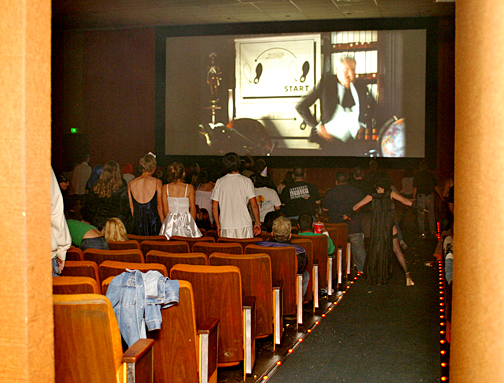
Like one of our RHPS midnight showings.. - Monte
Posted by Scott Norwood (Member # 30) on 08-26-2012, 08:52 AM:
Manny--agreed completely on the people who like film's imperfections. This is an insult to those of us who try to avoid them.
I also agree that the general public would likely not be able to tell the difference between film and a DCP. They might also not be able to tell the difference between a Monet painting and a photographic reproduction of that painting. Does that mean that art museums (musea?) should take down real paintings and replace them with reproductions? After all, the reproductions are cheaper, less fragile, and easier to replace if damaged. I believe in the idea of showing films in their original format. While it has become more difficult to determine the "original format" in recent years, pretty much every theatrical motion picture made before 2005-ish was made and intended to be shown on film. That is how I believe that they should be shown.
Edward--I am glad that you are having success with your repertory series. My experience with such things has been mixed. Last October, I ran mint-condition prints of Psycho and Frankenstien as a double-feature, and the theatre didn't get more than 100-ish customers per show. Not bad, but not as good as it should have been. Oh, well.
[ 08-26-2012, 11:06 AM: Message edited by: Scott Norwood ]
Posted by Ramon Lamarca Marques (Member # 3621) on 08-26-2012, 11:03 AM:
quote: Scott Norwood
I believe in the idea of showing films in their original format. While it has become more difficult to determine the "original format" in recent years, pretty much every theatrical motion picture made before 2005-ish was made and intended to be shown on film. That is how I should believe that they are shown.
I believe in that as well. We have had this discussion many times here in film-tech. The main difference is that the Monet paintings won’t degrade that much by repeated showings whereas film prints will (although many projectionists have told me that if properly handled prints will last for many screenings in very good shape). I suppose that it is important to keep the production of film and the running of film labs for the preservations of the entire cinema heritage. In this setting, it seems possible the survival of film screenings (at least of classic titles or in repertoire cinemas) for years to come, although no new prints are produced of many restorations. There is a wealth of expertise out there and plenty in this forum. It would be great if repertoire cinemas could network and work together and with the studios to maintain film exhibition for new generations and those of us who enjoy it. It would be great to have some cinemas around the world with competent cinema projectionists (there are many in this forum) being in charge of projection booths capable of handling several formats, 70mm, 35mm, digital and different sound systems. I know this is something that would not work for a multiplex or a small city but for big cities, maybe. It would be great to create a business model that could accommodate different options. I have no desire to see a film on its first weekend (contrary to the majority of the audience), I prefer to wait and see a film in the best possible conditions. For instance, I will wait until I can see The Master in 70mm, as its director intended.
I do not enjoy film imperfections either but would appreciate it if those who have nothing but praise for digital projection acknowledged as well that it can have its imperfections as well, one of them is looking too clinical or too cold (very subjective, I know) or becoming obsolete too son (2K, 3-D, higher frame rate, ...). When I saw the 4K screening of Samsara I thought it looked perfect but lacked the warmth of the 70mm prints of Baraka I have seen in the past.
Posted by Manny Knowles (Member # 1171) on 08-26-2012, 03:36 PM:
Scott -- the problem I have with your analogy is that, well, it's just wrong.
A Monet painting was intended to exist as the one and only original. Whereas something like "Lawrence of Arabia," for example, was always intended to be duplicated and sent out to theatres. They did not go around road-showing the one, the only, the original print. You saw a copy and I saw another copy. If you saw it three times in your life, chances are that you saw three different copies of it.
With your analogy, it appears that you may be suggesting that the correct thing to do would be to screen the original work print. I know that's not what you're suggesting. I just use it to point out why the analogy doesn't move me.
The film business is different from the Art World because not only are duplicates permissible, the whole industry DEPENDS on exhibition of duplicates -- and never the original -- so it is therefore perfectly acceptable -- even preferable -- to replace one compromised duplicate with another pristine duplicate.
And, yes -- I do consider a digital copy of a film to be a duplicate of the film -- the fact that it's not on film does not change the content, nor does it rob a film of whatever artistic or entertainment merit it possesses. The medium is not the message.
For me, "original format" means the following:
Theatrical presentation
Original Cut of the film at the time of its initial theatrical release -- not a director's cut -- or even a cut with censored scenes restored
Correct Aspect Ratio
Correct reproduction of the Original Sound Track
If you can get me a pristine film print of it, that's just great. But I'm happy to screen or watch a DCP. I don't care if it's on film or not, as long as it's going to allow me to put on (or experience) the best possible show. The medium is not the message. As far as "medium" goes, I do want to see it projected onto a screen -- so the screen itself would be the medium.
I would argue -- and have been arguing for some time now -- that screening a DCP of a classic actually brings us closer to the original than seeing a film print of it. Not just in terms of the condition of the print, but the number of generations from the OCN is reduced as well.
Posted by Mike Blakesley (Member # 26) on 08-26-2012, 06:09 PM:
Since this thread is pretty much off the rails anyway, here's a thing that drives me nuts....
Pictures like this one in Entertainment Weekly, talking about the "frame by frame" restoration of JAWS:
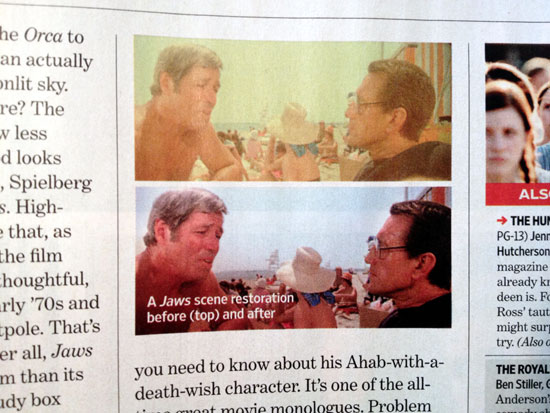
This implies that every single version of the movie, including all the VHS and DVD releases, looked like the top picture. It's just not true. I had the original VHS of "Jaws" as well as the "deluxe" DVD version from a few years ago and can attest that the image on both of those looks way closer to the bottom "restored" picture than it does to the "pre-restoration" picture.
Who writes these articles, sales hacks for the studios?
Posted by Mark Ogden (Member # 43) on 08-26-2012, 06:17 PM:
Scott, I respect your feelings about watching 'film on film', but there is another aspect to this: what if the DCP of a classic title actually improves on its quality?
Earlier this year, the Film Forum ran breathtaking digital restorations of some classic films, Grand Illusion and Children of Paradise were the two I saw. They looked spectacular, they were shown in 4K and I have no trouble believing that these were the best presentations of these films in probably the last 60 years. Children of Paradise especially, the negative of this film is beat to shit, and for years the US prints had export stamps pounded into the image area. Now, spotless. I await the new restoration of Jaws, and I am dying to see the 8K restoration of Lawrence of Arabia. I may be the Lone Ranger on this, but I for one would be happy to see a carefully made DCP of a classic film rather than a heavily bicycled and beaten up 35mm print any time, film origination notwithstanding.
It's sad in a way that the few rep houses still on 35mm will take a pounding on this, but for the classic movie lover there's not much to cry over, especially since the opportunity to view these films in pristine restored condition in the cinemas that survive is a real possibility.
quote: Frank Angel
Fox seems to WANT to kill the art house
Why would Fox want to kill art-house when they are one of its biggest players? There are three Fox Searchlight films in theaters as we speak: Beasts of the Southern Wild, Ruby Sparks and The Best Exotic Marigold Hotel. What Fox wants is to not make 35mm prints anymore. If they are smart, and small cinema owners are lucky, they will extend the no-more-prints cutoff for the Searchlight division past the tentative late-2013 date. We'll see.
Posted by Mike Blakesley (Member # 26) on 08-26-2012, 09:59 PM:
quote:
If they are smart, and small cinema owners are lucky,
Well that'd be the first time either one of those things happened, so don't hold yer breath.
Posted by Jim Henk (Member # 3628) on 08-27-2012, 01:00 AM:
quote: Mark Ogden
Why would Fox want to kill art-house when they are one of its biggest players?
Because they aren't. Art houses are a (comparatively) low-revenue pain the studio's patookahs.
That's why.
Posted by Ramon Lamarca Marques (Member # 3621) on 08-27-2012, 05:33 AM:
quote: Manny Knowles
Scott -- the problem I have with your analogy is that, well, it's just wrong.
I do not think it is completely wrong. Personally I think that he should be referring to lithographs in the art world. This would be the perfect analogy, there is an original but there is also a traditional procedure to produce copies of that original. Picasso, for instance, is known to have used lithographs quite often. Would new digital prints of those lithographs have the same look and/or value?
If you find this boring or pedantic, please stop reading.
The medium in film is important; ask Paul Thomas Anderson or Christopher Nolan or Alfred Hitchcock, who never used anamorphic lenses or Billy Wilder, who hated Technicolor. It is part of the final look of that work and film is mainly a visual medium. Digital and film projection look different.
Granted, most people do not notice that, but many of us do.
I think it is fascinating to talk about the medium in a film forum like this one. This is not about making money or a viable business process; it is about the beauty of film as a medium.
I have seen some restorations on film that are amazing, much better than some digital screenings (even those that were done digitally but printed back onto film). I think that nowadays digital restorations are missing the last step, producing a print, they are not restoring that. You may say it is too expensive, the print will be damaged, or any other arguments, but it cannot be denied that the closest experience to the one audiences originally had would be printing that restoration (even if done digitally) on film.
Moreover, most repertoire cinemas have 2K projectors whereas most restorations are done at least at 4K and hence a 35mm print, if properly done, may look better, in particular the blacks can look much better on a film print. In any case, they produce different looks, obviously.
As I said, you may say that talking about this is a waste of time, but if you cannot talk about film on film-tech, where can you? I really do not want to enter into a nasty argument, I think it is an interesting subject.
I think Scott’s point is perfectly valid. There is no reason why a digital restoration can’t produce an amazing 35mm print.
Posted by Kirk Futrell (Member # 5006) on 08-27-2012, 10:02 AM:
quote:
Future generations may loose a good portion of our cinema heritage,
Hear, hear, Frank!
Posted by Ramon Lamarca Marques (Member # 3621) on 08-27-2012, 11:20 AM:
I have just found this quote from a film archivist from Australia, which I think is relevant to our discussion.
NFSA Senior Curator Meg Labrum and Film and Video Specialist Susanne Haydon said it best at a lecture in 2010:
“It is a popular assumption that audiovisual archives of the future will be entirely virtual – a vast amount of digital files, containing the world’s recorded moving image and sound experiences. However, this quite misses one of the fundamental principles of such archives, which is that they are preserving not just the content of their collection, but also, to every possible extent, the complete viewing experience. And so that means that the content, the carrier, and the means of viewing and reproduction are inseparable from each other.”
Posted by Mike Blakesley (Member # 26) on 08-27-2012, 11:23 AM:
quote: Frank Angel
Future generations may loose a good portion of our cinema heritage
Since a good share of the current generation appears not to give a hoot about nostalgia or even their own heritage, they probably won't miss it.
Posted by Manny Knowles (Member # 1171) on 08-27-2012, 11:26 AM:
No argument from me when it comes to archiving on film -- even digital movies should be archived to film -- but I totally trust professional archivists to properly handle film -- history has proven that bad things will happen to film in projection booths.
quote: Ramon Lamarca Marques
If you find this boring or pedantic, please stop reading.
I could say the same thing right back at ya, buddy. ![[fu]](graemlins/fu.gif) Who the f*ck do you think you are!? If you only want people to agree with you all the time, you're in for a disappointment.
Who the f*ck do you think you are!? If you only want people to agree with you all the time, you're in for a disappointment.
For those who regard film prints as equivalent to a Monet (or whatever work of "Art") lemme ask you this:
Would you HONESTLY advocate trusting a Monet to just ANY gallery? To be handled by glorified ushers, etc?
If you would advocate that, then you are either (a) not a fan of Art -- or perhaps it's just Monet that you don't like; (b) a glorified usher; (c) suffering from a film fetish, and will say ANYTHING in favor of keeping film alive.
Posted by Ramon Lamarca Marques (Member # 3621) on 08-27-2012, 12:07 PM:
quote: Manny Knowles
I could say the same thing right back at ya, buddy. Who the f*ck do you think you are!? If you only want people to agree with you all the time, you're in for a disappointment.
Why are you so belligerent and rude Manny? I fail to understand it. I just said this jokingly because inevitably some people will find the subject pedantic or boring and I mean the subject of film exhibition for classic films, the issue of preserving the film format and the references to lithographs. I personally find it interesting and I think other forum members do.
It was not meant to offend, not like your post. I get a lot from reading other people’s information, your assumption on me is rubbish but frankly I do not want to start another online fight. I am happy to read different opinions and learn from them, I have learnt a lot from members on this forum. Some written sentences do not work, and I accept that mine probably does not work as I wished, it was not my intention but your abuse was uncalled for. As always, I kindly return your gestures and words to yourself, keep them please.
Posted by Manny Knowles (Member # 1171) on 08-27-2012, 12:12 PM:
Oh you were joking -- well then you need to add smilies -- that's how that works -- Seriously dude -- it's 2012 -- get with it.
Posted by Ramon Lamarca Marques (Member # 3621) on 08-27-2012, 12:23 PM:
quote: Manny Knowles
Oh you were joking -- well then you need to add smilies -- that's how that works -- Seriously dude -- it's 2012 -- get with it.
I thought about the smilies, I'll do it from now on. Seriously, I do not mind at all about new technology, as I said Prometheus looks great on digital IMAX. But seriously as well, can we talk about the merits of keeping film projection for classic titles? I really enjoy it when people recreate the original projection systems, three-strip Cinerama, original 3-D dual projection, 70mm, ... I find it fascinating. I think you can embrace both, the new technology and an admiration for the old.
Posted by Manny Knowles (Member # 1171) on 08-27-2012, 12:49 PM:
In rare cases, yes. For example, I'd go see a 3 strip Cinerama screening at the Cinerama Dome in Hollywood, CA -- but I'd be there primarily to observe a demonstration of the technology -- the movie itself would be secondary, maybe even irrelevant.
A crucial difference is that 3-strip Cinerama can't be presented at every theatre -- it has to be shown in a purpose-built venue -- and I think it's a sufficiently rare format that handlers would be acutely aware that they need to bring their "A-Game."
The trouble is that standard 35mm presentation doesn't enjoy that same level of recognition. Presentation quality varies wildly, and the prints are handled without due care and attention. And the studios have lost faith.
Even IMAX has become so commonplace that it's done wrong now. Just take a look at this thread.
quote: Ramon Lamarca Marques
I find it fascinating. I think you can embrace both, the new technology and an admiration for the old.
If you knew me, and knew where I worked, you'd see that I agree with you. For example, one of my favorite accomplishments was presenting "Metropolis" with live orchestra playing the original score by Gottfried Huppertz. (But the "print" was digital.)
And FWIW, I run film "all the time" -- on changeovers! With film, the frustration comes in knowing that excellent projection is so often compromised by a substandard print.
-----------
And now...One more thought on the subject of "original format" -- How open are we to seeing "Lawrence of Arabia" on 70mm with DTS sound? -- Does it matter that the "original format" was mag tracks?
Posted by Jack Theakston (Member # 4484) on 08-27-2012, 01:23 PM:
Actually, not to veer this topic already further off course, but museums always have a struggle with lending artwork out. There was a great interview with a museum curator about this that I read online a few months ago, but I can't find it now. Suffice to say, whenever you're handling anything, be it film or artwork, there's going to be accidents.
What I've got a problem with are the truly careless projectionists out there who don't give a shit about what they're doing. They're the ones wrecking these prints.
Posted by Ron Funderburg (Member # 4561) on 08-27-2012, 01:27 PM:
Art house films are designed to win awards to glorify the studios. They never go wide and the art houses are the only ones (in general) that play them. They studios love awards so they will keep making art house fair.
Posted by Edward Havens (Member # 4715) on 08-27-2012, 02:01 PM:
quote: Ron Funderburg
Art house films are designed to win awards to glorify the studios. They never go wide and the art houses are the only ones (in general) that play them. They studios love awards so they will keep making art house fair.
Except, you know, when arthouse fare like The Best Exotic Marigold Hotel goes on to expand to a thousand plus screens months before awards season because there was a consumer demand for this type of high-quality non-studio films.
It should also be noted that many arthouse films, including recent Best Picture winners The King's Speech and The Artist, as well as successful mid-summer releases like The Kids Are All Right and Midnight in Paris, were in fact financed independently from any distribution company and only picked up for distribution after they are completed and shopped around to distributors by a sales agent.
Posted by Kirk Futrell (Member # 5006) on 08-27-2012, 03:18 PM:
BTW, don't take the rumors, I just helped spread for granted, make sure you talk to your fox booker directly (re: Rocky Horror)
Posted by Ramon Lamarca Marques (Member # 3621) on 08-27-2012, 04:08 PM:
quote: Manny Knowles
And now...One more thought on the subject of "original format" -- How open are we to seeing "Lawrence of Arabia" on 70mm with DTS sound? -- Does it matter that the "original format" was mag tracks?
I have enjoyed Lawrence even on TV but the best time ever was when it was first restored and re-released in 70mm, even in Spain. It was in a gorgeous one screener now gone, with curtains, magnetic sound, an elegant bar for the intermission,... It was an experience I will never forget. I saw Cleopatra in Todd-AO and magnetic sound (pink print) and not long after the restored version with DTS sound. The magnetic sound was much better to my ears, it had a fuller sound.
Nevertheless, it is great that they have produced new 70mm prints with DTS sound of so many films. It is also great that they keep restoring films and DCPs are available, I just wish there were also good 35mm prints for some cinemas.
I am sure you will attend the Cinerama film festival. I did in Bradford this year and I strongly recommend it. I never thought I would see the Brothers Grimm in three strip Cinerama, the print is dye transfer and so the colours are intact.
Posted by Manny Knowles (Member # 1171) on 08-27-2012, 07:31 PM:
Again, that's fine for a special film-festival kind of arrangement. The difference will be in the handling of that film material. The trouble with film isn't film -- it's that we got to a point where "projectionists" included many people who had no knowledge of how to properly handle (or present) film.
Standard 35mm exhibition got onto a slippery slope. It was only a matter of time before digital projection became practical. The need was certainly there for some time already. Some time back, the industry made a series of choices that disregarded (or else took for granted) the special-ness of film, and then it became a fact -- 35mm presentation (generally speaking) wasn't special anymore.
What kinds of decisions?
- The 1.85 aspect ratio (instead of scope)
- Super-35 (great for light output and AR, but bad for grain)
- Ultra high-speed duplication of thousands of show prints
- CRAP Code
- Lower than 35mm resolution Digital Intermediate
- Xenon - not bad in itself, but makes it possible to run a lamp far beyond its usable life expectancy
- Automation -- not bad in itself, but adopted to make it possible to have...
- Non-professional "projectionists"
Of course, the transition has been covered in the press with a heavy "slant" in favor of digital. And, while I am in favor of digital PROJECTION, I take issue with the way the articles invariably make it seem that film itself was the problem. The way I see it, the real Achille's heel came from film projection, which became plagued with a "human error" factor. We have to admit our hand in this. Too many of us are in denial of this fact -- Exhibitors contributed to the demise of film.
My preference is to see films SHOT on film. But I definitely see the benefit in digital distribution and exhibition. I like the "film look" and I think it comes through just fine if the work originates on film. I don't personally believe that film projection is necessary to preserve that. If anything, it will introduce jump & weave, and add grain (too much of a good thing).
All movies (regardless of how captured) should be ARCHIVED on film.
When we start getting unskilled labor working in the Camera Dept of feature films, and in Archives, then I might revise my opinion. But, for the foreseeable future, one can expect those areas will be populated with people who know how to work with film.
I suspect we'll see 35mm continue as a sort-of technological curiosity, like 70mm and Cinerama -- and those events will (hopefully) hire the best film projectionists they can find -- Lord knows, there'll be a lot to choose from.
Posted by Jim Henk (Member # 3628) on 08-27-2012, 08:25 PM:
quote: Manny Knowles
All movies (regardless of how captured) should be ARCHIVED on film.
It's too bad that won't happen.
It's even too bad that to a great extent, even titles currently transferred to digital won't survive long in that format. Have heard from people in that part of the industry that as each new format change occurs (last count was 18) they can't keep up with it, so lots of titles exist only in formats that can't be read any more. Kind of like home data found on a zip cartridge: anybody have a zip drive out there? A few maybe, but statistically, not many. And if only a studio ever used a format, well...
It's also too bad that exhibitors will never be able to keep up with new technology. It will just get too expensive for them, and the bills will outstrip ticket payback pretty quick. The exhibitors *definitely* did that to themselves. They (the big chains anyway) could have resisted some time ago. But no.
Gawd, I'm going out to smell some flowers. I've depressed me.
Posted by Mike Blakesley (Member # 26) on 08-27-2012, 09:41 PM:
quote: Jim Henk
even titles currently transferred to digital won't survive long in that format.
I don't think I believe that. Storage is getting so cheap these days. If anything is made out of "files" it's a simple matter to convert files to whatever storage medium happens to come along. I still have some stuff that at one time was stored on 5 1/4" floppies....I just kept moving it to each new kind of disk that came along and now they're stored in the cloud plus a local hard drive.
Posted by James Westbrook (Member # 3690) on 08-28-2012, 12:50 AM:
I've started gathering a vast assortment of external hard drives myself.
My first computer had a 3 inch floppy drive, which never got used.
As the train called the topic title derailed a long time ago and seems to be a faint memory, does anyone recall the story of the original Toy Story almost being lost due to someone deleting the drive? Am I the only one having trouble believing this?
Posted by Manny Knowles (Member # 1171) on 08-28-2012, 01:01 AM:
I question whether that particular film would have been TRULY lost because it was a 100% film release initially, so there's most likely a full complement of archived film elements.
Posted by Chris Slycord (Member # 4239) on 08-28-2012, 01:03 AM:
It was Toy Story 2, btw and it's apparently detailed in the Blu Ray releases of the movie.
Posted by Paul Gordon (Member # 3320) on 08-28-2012, 08:50 AM:
Hard drives will fail. This is a fact whether its 3 years down the road or 15.
oh here is the Toy Story 2 story about almost losing everything, animated of course.
http://www.youtube.com/watch?v=EL_g0tyaIeE
Posted by Mike Blakesley (Member # 26) on 08-28-2012, 09:53 AM:
I personally think that story is a bunch of crap.
Posted by Marcel Birgelen (Member # 6801) on 08-28-2012, 10:40 AM:
quote: Mike Blakesley
I personally think that story is a bunch of crap.
Well, we will probably never know. But there is no reason why this couldn't be true.
I've seen this so many times in the real world... Storage system fails, some human error: massive data loss.
I've even seen a perfectly working backup off-site solutions fail in the end. Everything worked perfect, until that night that everything exploded. Luckily there was this off-site backup and it even did run without a hitch for more than a year, only nobody remembered the encryption key that was used to encrypt the data...
I could perfectly see the same happening with Digital movies. Especially because the studios are doing everything to keep you from the raw digital data. So, even if they do a perfect job of copying all their old DCPs from the old storage system to the shiny new one, I could, for example, perfectly imagine someone to trash the keys they've used to encrypt them.... Hey, what's this old bunch of PEM files good for? Who cares, rm -rf the hell out of them...
And who knows if the studios that we entrust those archives too, even exist in 10, 20, 50 or 100 years from now? Many studios have been merged, sold, split off or closed even in the last 15 years or so.
And it is not like this never happened before, isn't it? How many prints didn't vanish during the last 100 years? Even generally accepted masterpieces like Metropolis have at least partly vanished.
So, even if this story is bullshit, it actually isn't. Similar stuff happened before, with digital files and movie prints alike.
In this particular case, it probably not even involved a finished movie, but work in progress like character wireframes, textures, 3D scenes, etc.
Posted by Mike Blakesley (Member # 26) on 08-28-2012, 12:06 PM:
Just look at the story and consider when it supposedly happened. After a year of work, the movie was only on one system? They expect people to believe that ONE person with ONE mouse could wipe out all the files, folders, backups, copies of backups, test copies, etc etc etc of the movie that would have existed by the time this supposedly happened?
Then there's the idea of the home computer. That must have been one fantastic, ahead-of-it's-time home system to have that much storage space. If that one person had the movie on their computer, surely other people had it on theirs as well.
I just think it's some overactive imagination at work. I am not saying it COULDN'T have happened, I just have a feeling it wasn't quite as dramatic as the way they present it. You know, a little movie-type embellishment at work.
Posted by James Westbrook (Member # 3690) on 08-28-2012, 12:29 PM:
Not to mention that Pixar shared executives with Apple, and one would think they have knowledge to back up their data better than that.
Posted by Chris Slycord (Member # 4239) on 08-28-2012, 02:14 PM:
quote: Mike Blakesley
Just look at the story and consider when it supposedly happened. After a year of work, the movie was only on one system? They expect people to believe that ONE person with ONE mouse could wipe out all the files, folders, backups, copies of backups, test copies, etc etc etc of the movie that would have existed by the time this supposedly happened?
Taking the story at face value:
1) The command that was run didn't at all use a mouse. It was run at the command line.
2) The command would, in fact, remove everything in the current directory and everything in every sub-directory (and if it was done starting at the root directory it'd essentially erase everything on the computer). It happens more often than you'd think when people are remote connecting to multiple servers and run the command on the wrong one...
3) I saw a more detailed explanation of what happened somewhere and a guy who worked at pixar at the time explained that it wasn't everything that got destroyed but when they used the existing backups they found that they couldn't get them to work due to the backups being too corrupted and were going to use a fairly old, but proven functional backup before one of the people said they might have another copy.
Put short: The guy accidentally erased important stuff and the backups for that stuff were no good.
Posted by Jim Henk (Member # 3628) on 08-28-2012, 05:49 PM:
quote: Chris Slycord
Put short: The guy accidentally erased important stuff and the backups for that stuff were no good.
Confirmed. It happens all the time. From someone who has worked in a number of Engineering positions, yes. It's Pepto Bismo time a lot. Backups are *not* magic bullets.
Posted by Manny Knowles (Member # 1171) on 08-28-2012, 09:35 PM:
Okay, I'll ask the question we all want answered:
Did that guy get his ass fired???
And what is Pepto Bismo?
FWIW I think the story is BS too. No amount of explaining will change my mind. It's just my gut feeling and I'm going to stick with it on this one.
Posted by Monte L Fullmer (Member # 2797) on 08-28-2012, 10:59 PM:
quote: Manny Knowles
And what is Pepto Bismo?
Pepto Bismol ... that pink bismuth subsalicylate loaded fluid that quiets down an upset stomach .. in liquid or tablet form.
Tums, Roll-Aids came from behind to steal some of the anti-acid market.
Powered by Infopop Corporation
UBB.classicTM
6.3.1.2