This is topic Movie's Aspect Ratio "changing"? in forum Digital Cinema Forum at Film-Tech Forum ARCHIVE.
To visit this topic, use this URL:
https://ft-forum.com/ft/cgi-bin/ubb/ultimatebb.cgi?ubb=get_topic;f=16;t=001288
Posted by Maybelline Cabrera (Member # 4495) on 11-23-2012, 02:37 AM:
Has anyone experienced this, specifically with Life of Pi? We have this movie playing in our bigger room with side masking so we have our masking "closed in" as the movie is a flat film. The image projects onto the screen fine until towards the end when it plays as if it's a scope film. The image extends to both sides taking up the whole screen, thus projecting on the masking. We've just left the masking "open" to compensate for the widescreen shots during the end.
I'm sorry if this is in the wrong forum, I didn't know where else to post it.
Thanks!
May
ETA: I wanted to add that the image isn't distorted or anything when it takes up the whole screen.
Posted by Leo Enticknap (Member # 534) on 11-23-2012, 02:46 AM:
Haven't seen this one, but it could be the filmmaker deciding to be arty and irritating. I remember a similar issue with The Horse Whisperer back in the '90s. The entire film was printed anamorphically, but for about the first 40-50 minutes the image was 1:1.85, before suddenly changing into full-size scope. When the film started I opened the masking to 'scope at the start of the feature, but we then got complaints of a 'technical problem' with 'bits of black' on the screen. So it was then a case of remembering to be there to open the masking at the right moment in the movie (there was no automation in that place).
Robert Redford seriously deserves to be taken to a cellar and introduced to The Gimp for inflicting that on thousands of projectionists (though I will grudgingly admit that The Conspirator was quite good).
Posted by Frank B. McLaughlin (Member # 6683) on 11-23-2012, 04:08 AM:
The eternal problem: artist wants a dedicated professional at the controls to insure the intent of the work is achieved; management perfers a min-wage button pusher. After all once they have the money in hand why care?
Posted by Bajsic Bojan (Member # 4928) on 11-23-2012, 05:37 AM:
You mean that it changes from 1998 pix to 2048? that would be what, maybe a total 5 inches on the sides on the masking?
why dont you have a screen file that crops 1.85 at 1998?
if that is not the case, someone put a wrong macro somewhere and the lens changed to scope.
Posted by Dave Macaulay (Member # 813) on 11-23-2012, 05:48 AM:
That's unusual.
Even though a "flat" cpl shouldn't have any image outside of the 1998x1080 (assuming 2k) image format, there's nothing to stop it from being full chip 2048x1080.
When I set up electronic masking on an install, I bring the projected image in to blank anything outside the format limits even if they are at the screen masking edges. If some odd stuff gets put in the "lost pixels" it doesn't show on the masking that way, and test patterns don't go outside the screen. One can then easily check the projector alignment - they do move a bit with lamp changes and such - using a test pattern.
It sounds like whoever installed your system left the electronic masking at maximum and just fit the full format image into your physical masking. Sloppy, in my opinion, but unless something like this Pi thing occurs it doesn't matter - if your physical masking is right on format and your projection geometry doesn't have any keystoning.
The extra Pi image is probably a mistake in post.
Posted by Bajsic Bojan (Member # 4928) on 11-23-2012, 06:19 AM:
from the original post, it seems they get the picture on the whole side masking, which would point to the fact the lens changed to a scope setting.
Yes it could be it is full container, but that wouldnt stretch alot onto the side masking.
I would presume some sloppy installation work, maybe they're playing flat letterboxed inside a scope image (dreadful). Maybe someone just cropped of flat image to compensate for the lens not being able to zoom in more for that particular screen, or something to that degree and then wackiness ensues ![[Wink]](wink.gif)
Or it could be simply that instead of a macro that says 'cue lights', someone accidentally put in the 'change to scope' at the end of the movie...
Posted by Mark J. Marshall (Member # 1409) on 11-23-2012, 08:09 AM:
Just because the movie is set to play in scope, the scope image can still be pillar boxed for part of the show. I'm not sure if that's what he's talking about or not, but we've all seen this before on Horse Whisperer, Galaxy Quest, etc..
If that is what he's talking about, it would be cool if you could program the masking to open at the point in the movie when the picture opens up. THAT would be showmanship. Of course you would have to program flat trailers in front of it, and then program a lens change I guess. But that would be pretty cool.
He may be referring to something else entirely though, in which case you can ignore my post completely. ![[Smile]](smile.gif)
Posted by Maybelline Cabrera (Member # 4495) on 11-23-2012, 09:14 AM:
Please bare with me as I'm a bit new to the digital world (converted late September) and I am not all that familiar with the proper terms to use.
The movie was mapped 3D Flat - 1998. Trailers and everything were flat. As for the SPL, we don't create one for every (or any) show. The guy who installed our systems (NEC, Doremi) created a "Default Show" Show Template. We don't mess around with inputting cues, macros, and the like. Here's what we do: ingest, title map, schedule the movies (days and time), create a trailer pack and place those packs with their respective movies.
We noticed the movie playing like it was scope during our last set on Thursday-the 7th time to play the movie since we first opened it. I shouldn't have said it changed because I didn't see the beginning of the film for this particular showing. But I still don't know why it would have played like it did. The prior shows were fine and had no problems. I decided to sit in tonight to see just where in the movie the image extends out... and it didn't happen. I noticed the image change sizes in three different scenes, though. The bulk of the movie plays in the full square shape, then it plays in the "widescreen" shot (but still within the flat masking) for a scene and changes back to the full square, and another scene was a way smaller square then it went back to normal.
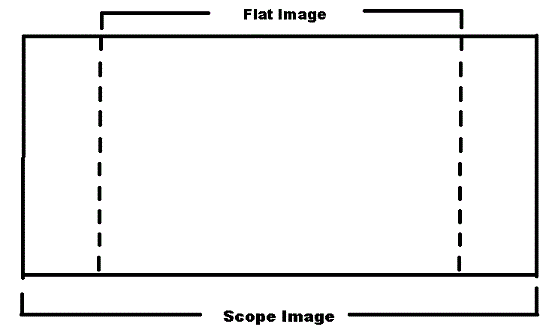
On Thursday night, the image projected onto the whole screen, on the masking. We opened the masking so we wouldn't run into that problem again--we thought that maybe the ratio changed sometime during the movie. As I watched earlier though, the image stayed within the flat range even with the changes for the three scenes.
Posted by Steve Guttag (Member # 268) on 11-23-2012, 12:25 PM:
I'm going with Dave on this one...the installer didn't set his screen files to force the 1998 side limit.
I don't know about others, buy my laptops have Flat1998x1080 and Scope 2048x858 SCREEN files that I'll upload to a new projector being set up just so I'm starting a what should be a full image without having to always mask down the scope image when starting out. (I have 4K equivalents too).
It is entirely possible they just pulled out on the image without realizing that the extra would show or a mistake was made...it is interesting to note though. While it is certainly possible to cue a masking system to pull back at any point in the movie it would be asking a lot of the industry to put in such mechanisms (automation, cues to be auto placed mid show)...just for a one movie.
Posted by Bajsic Bojan (Member # 4928) on 11-23-2012, 06:20 PM:
It is really simple it seems.
The situation is as follows: Nobody paid attention to the movie until somebody who was paid that night to supervise projections came to stop the last show, he found it to be playing in Scope rather than in flat as it was supposed to.
End of story.
There cannot be changes inside a Composition playlist that would control functions of a projector.
Since there are NO macros installed server-side there couldn't have been anything there.
Somebody pushed the scope button sometime. Maybe on purpose when a faithful employee rummaging the booths saw one of the mentioned 'scope' scenes, pushed the button to change to scope, and then left. Maybe it was by accident when some other faithful employee brushed up against the projector and hit aforementioned button.
Nobody noticed, not even the public apparently. At least it didn't seem to bother them to complain.
It has nothing to do with screen files as it stands now, but with operator error.
Posted by Paul Linfesty (Member # 214) on 11-23-2012, 06:57 PM:
I saw LIFE OF PI in 3-D in a common width theatre opening day. There is a sequence that is letterboxed to scope dimensions (the flying fish sequence) but it was being shown within the 1.85 image. HOWEVER, I could have sworn that some of flying fish (very fast) were projecting outside of the letterboxed image (below and above the letterboxed image into the black). If so, this must have been a way of creating the illusion that the fish were leaving the confines of the image. But you would hyave had to project this sequence in 1.85 in order for this illusion to work.
Later in the film, there is one overhead shot that is "hard matted" within the 1.85 image to give the Academy ratio of 1.37 or so. Not quite sure ewhat the purpose of this was.
Posted by Steve Guttag (Member # 268) on 11-23-2012, 07:36 PM:
You can put cue anywhere you want...I have one theatre that does indeed have volume changes mid trailer, mid movie...as they see fit. You could do a flat to scope cue too...if you really wanted it. I'd be more inclined to create a special preset if I had to do it so that the lens moved without the normal housekeeping to change a format. But the realities of something like this happening on purpose on a release move are slim and none.
Posted by Michael Brown (Member # 890) on 11-23-2012, 08:22 PM:
There is an interview with director Ang Lee here:
Talking with Life of Pi director Ang Lee about big cats, huge risks and the 3D canvas
------------------------
relevant parts:
How early in the development process did you decide to shoot the film in 3D?
I didn't think it was possible if I did it in 2D. ... If I had another dimension, maybe — just maybe — it might happen. Because in the regular way we go about making movies, it just could not be done.
The film really is an exceptional use of the technology. I remember when Prometheus came out this past summer and had the flying fish scene from Life of Pi attached to it — it seemed to demonstrate how important the technology was in bringing this story to life. And more so, that scene marks an aspect-ratio shift. Life of Pi is a standard 1.85:1, but for the flying fish, it becomes a wider CinemaScope ratio. Where did that decision come from?
I've always wanted to do that ... since film school, and no one allowed me to. Why do we have to stick with one ratio? It was like that with Crouching Tiger. When we were in some scenes, I want it to be standard. When we're in the desert, it should be wide screen. I felt that 'Scope was the only way to see this [flying fish] scene, and with the black areas [at the bottom of the frame], I could pull fish out of there; I think that's a great tool in 3D filmmaking. I think it's very exciting.
And then there's that exceptional overhead shot of all the various luminescent creatures below the raft, and that's a standard Academy ratio [1.37:1].
Now, with digital ... I hoped I'd done something that nobody noticed. But you noticed ... I thought it looked best that way. And it looked like the book cover.
------------------
I'm confused. How do you run the movie? In flat or scope macro?
Posted by Eric Hooper (Member # 1730) on 11-23-2012, 08:32 PM:
I wonder how the Century 24 in San Jose is handling this? ![[uhoh]](graemlins/uhoh.gif)
![[Roll Eyes]](rolleyes.gif)
Posted by Maybelline Cabrera (Member # 4495) on 11-23-2012, 10:31 PM:
quote: Michael Brown
I'm confused. How do you run the movie? In flat or scope macro?
We've been running it in flat. I did forget to check if the preset button that was active (at the time) was 3D flat or scope, but we didn't have problems with prior showings of the movie so it should have stayed Flat. I was trying to fix another problem with another unit when I happened to walk by and noticed the image on the masking. No one would have been upstairs to mess around with anything as the majority of our staff were gone. There's no way that someone pressed the scope preset or accidentally hit something because we had only gone upstairs when we encountered a problem with another feature.
Everything seems to be fine now, but man these pesky machines are starting to grate on my nerves.
Posted by Jeremy Weigel (Member # 4208) on 11-23-2012, 11:33 PM:
The only thing I've noticed is that some scenes are letter boxed.
Posted by Paul Linfesty (Member # 214) on 11-24-2012, 01:48 AM:
But if you were to actually show that scene in scope, you would be cutting off the effect of the fish leaving the apparent frame.
Posted by Mike Blakesley (Member # 26) on 11-24-2012, 09:05 PM:
What's the format designation in the file name? F or S?
Posted by Steve Guttag (Member # 268) on 11-25-2012, 12:22 AM:
It is "F". One is supposed to run it Flat and let it do its thing within that frame (which is the largest shy of a "C" or full-container).
Posted by Brad Miller (Member # 2) on 11-25-2012, 01:37 AM:
I have not seen this film, nor do I care to, but whatever. Running sections of a movie letterboxed is bound to bring complaints. This whole thing seems a bit silly to apparently, watch a fish jump into the letterbox. Really? Surely I am missing something.
Posted by Manny Knowles (Member # 1171) on 11-27-2012, 12:31 PM:
More (film) examples:
Biutiful
...and Spike Lee's CROOKLYN (1994)
Posted by Steve Guttag (Member # 268) on 11-27-2012, 02:44 PM:
There are examples of going from Academy aperture for an intro and then into the full screen...like Popeye or The Road Warrior.
Posted by Manny Knowles (Member # 1171) on 11-27-2012, 02:50 PM:
Ooooh, oooh! Mister Kotter!
That reminds me!
One of my all-time favorite movies -- "Superman: The Movie" (1978) -- did that also. But at least they padded out the scope screen with curtains on either side of the little black-and-white prologue.
Posted by Geoff Jones (Member # 3668) on 11-27-2012, 08:08 PM:
Dark Knight films switch ratios also.
But I agree. It does seem weird to switch ratios for one scene.
Posted by Mattias Mattsson (Member # 4308) on 11-28-2012, 12:56 AM:
Maybe you guys have heard about a little film called THIS IS CINERAMA (1952)?
Posted by Mark Lensenmayer (Member # 134) on 11-28-2012, 05:52 AM:
A Ratio change is very common in the early widesceen movies (such as THIS IS CINERAMA and the 3-strip works) and early Imax movies. It's a trick to make the giant screen look even bigger. TO FLY, one of the most famous true-IMAX movies, starts with a man launching a balloon in the center of the screen then goes full-screen as the balloon takes off. Very effective.
A similar trick is used with the sound in THIS IS CINERAMA. The overture is mono and sounds like elevator music. This makes it even more impressive when Lowell Thomas says "THIS IS CINERAMA" and the 7-track sound kicks in.
Posted by Manny Knowles (Member # 1171) on 11-28-2012, 05:05 PM:
It's all relative. This reminds me of one of my favorite movie quotes:
"If you wanna look thin, hang around fat people."
-- Rodney Dangerfield, in "Back to School"
Powered by Infopop Corporation
UBB.classicTM
6.3.1.2