This is topic A few questions about aspect ratio and 2K vs 4K in forum Digital Cinema Forum at Film-Tech Forum ARCHIVE.
To visit this topic, use this URL:
https://ft-forum.com/ft/cgi-bin/ubb/ultimatebb.cgi?ubb=get_topic;f=16;t=001347
Posted by Nastia Motovilova (Member # 7184) on 01-18-2013, 04:11 AM:
Hi to everyone,
I am trying to clear my head around the flat vs scope format and screen size. Regarding the DCI spec for the 2K aspect ratio, if the ratio for Flat is 1998X1080 and for Scope the ratio is 2048X858,
what are the options that one has to accomodate both the 2K flat & scope formats?
For example, the picture of a flat film would exactly fit in a screen size of 18.5ft X 10ft. A picture of a scope film would fit in a screen size of 23.9 ft X10 ft.
If a 23.9X10ft screen is installed and in this screen we'll watch a flat film, then we'll get the letterbox effect.
If we do the opposite and install a 28.5ft screen and we watch a scope film, we get the pillar box effect.
Is my above understanding correct?
And is this completely unavoidable? If yes, why can't a zoom lens used so that we can get the full screen effect in both flat and scope format irregarding of screen size?
Thanks!
Posted by Steve Guttag (Member # 268) on 01-18-2013, 04:21 AM:
Zoom lenses are how the industry deals with it. A serious flaw in the zoom lens concept is the light demands are dramatically different between Flat and Scope on adjustable side masking screens (the 10 x 23.9 screen in your example). A better way that has been shunned due to cost is an anamorphic lens for scope (kinda like that previous format...film) as it would negate the need for the zoom (improves format change reliability over time) and would keep the light requirements closer (narrows the difference by half).
Posted by Antti Nayha (Member # 4980) on 01-18-2013, 04:33 AM:
This is why should install a zoom lens and adjustable masking. The latter is actually a DCI requirement, although sadly it’s becoming more and more popular to ignore it. ![[Frown]](frown.gif)
Traditionally a common image height setup is preferred – that means your screen size is eg. 23.9 x 10 feet to accommodate the widest aspect ratio. Then when you’re projecting 1.85:1 content, you use adjustable side masking to reduce the visible screen area to 18.5 x 10 feet.
Ideally your masking should go as narrow as 1.33:1, or even 1.2:1 to accommodate Movietone silent films. (In the digital world, these are simply pillarboxed 1.85:1 DCP’s.)
Some theatres opt for a common image width solution, where only the top and bottom masking are movable. This might fit some narrow rooms better. However, it’s shunned by traditionalists who tend to feel strongly that Scope image should be larger than Flat, instead of being just shorter.
And some theatres even install four-way adjustable masking, where each of the four sides can be adjusted independently. This can be useful for a specialty venue where a lot of weird old formats are projected.
Edit: Steve beat me to it, and also included some wise words about the anamorphic option.
Posted by Nastia Motovilova (Member # 7184) on 01-18-2013, 04:49 AM:
Hi Steve & Antti,
So if I understand correct there are two options available:
to either use an anamorphic lens so when projecting on a screen 23.9 ft X10 ft, we can fit a flat film without getting the letterbox effect? Or is this not the case?
or
use a scope screen i.e. 23.9X10ft and when showing a 1.85 film, it's necessary to use adjustable side masking.
Thanks for your replies!
Posted by Marco Giustini (Member # 4544) on 01-18-2013, 05:11 AM:
quote: Nastia Motovilova
And is this completely unavoidable? If yes, why can't a zoom lens used so that we can get the full screen effect in both flat and scope format irregarding of screen size?
Because Flat e Scope were designed to be different - particularly Scope was designed to be 'bigger'. If Flat and Scope were the same area on the screen, well, there wouldn't be any purpose for them anymore.
To avoid black bars, you just install a masking.
Posted by Marcel Birgelen (Member # 6801) on 01-18-2013, 06:47 AM:
If you go anamorphic in a digital setup for scope, you need to stretch the image vertically.
That will give you more light, since you now use the whole DMD, but it also deteriorates the image quality. With a low quality scaler, you can even end up with ugly scaling artifacts.
Posted by Marco Giustini (Member # 4544) on 01-18-2013, 07:29 AM:
If you go for anamorphic, the scaling will be done by the TI electronics inside the projector.
Posted by Bajsic Bojan (Member # 4928) on 01-18-2013, 12:35 PM:
@Nastia
You first need to understand the very basics.
FLAT film and SCOPE film in digital both use square pixels. The one or the other is not 'stretched' or 'squashed'.
In DCI there are two standardized formats:
1.85 (referred to as Flat sometimes) and 2.39 (referred to as Scope)
The numbers represent aspect ratio, correlation between width and height of a projected image. In 1.85, while the image height is 1 unit, the height of the picture SHOULD BE 1.85 units.
Conversely on a 2.39 picture, while the image height is 1 unit, the width of the projected image should be 2.39 units.
Therefore, it is pretty much clear, that a picture that is projected in "scope" IS WIDER than the picture projected in "flat". Not necessarily physically, just imagine drawing equally high giant SQUARES, where you would get ie 4 side by side in 1.85, you would be getting more than 5 equally high squares side by side in 2.39.
If you project all pictures in the same aspect ratio, you will destroy the desired effect of the film maker(s).
In simpler terms: yes, you CAN project all films at 1.85:1, 2.39:1 or even 1.0:1 if that is what you wish. The problem is, this is completely WRONG.
Projecting a 1.85 film filling a 2.39 screen, you are cropping (as in, deleting, loosing, not showing) 20,6% of the image height. Projecting a 2.39 film filling a 1.85 screen, you are cropping 22,8% of the image width.
Your (everybody's) only options are using a masking system if you don't want to show the unused parts of the screen.
Posted by Nastia Motovilova (Member # 7184) on 01-21-2013, 04:15 PM:
Hi guys,
Sorry for replying late, I was away for the weekend.
The above clears a lot of confusion. So using adjustable side masking would be the most "right" way of projecting the images as they were intended to be previewed.
quote: Bajsic Bojan
Projecting a 1.85 film filling a 2.39 screen, you are cropping (as in, deleting, loosing, not showing) 20,6% of the image height. Projecting a 2.39 film filling a 1.85 screen, you are cropping 22,8% of the image width.
- How are the above figures derived?
- I also imagined that i.e. projecting projecting a flat film on a scope screen using an anamorphic lens, no picture is cropped - as this would be one of the reasons of using the anamorphic in the first place. For example,
http://www.schneideroptics.com/pdfs/projection/home%20theater%20brochure.pdf
using an anamorphic lens I imagined that the effect would be similar as in p3.
Thanks for all the replies.
Posted by Chris Slycord (Member # 4239) on 01-22-2013, 03:00 AM:
quote: Nastia Motovilova
How are the above figures derived?
I get similar numbers to his by simply looking at a percentage-difference formula.
The percentage change from an original value of x to a new value of y would be:
100 * [abs(y-x)/x]
So if you have a 2.39x1 image that is cropped to 1.85, the change in the ratio of the areas is 100 * [abs(1.85-2.39)/2.39] = 100* [0.540/2.39] = 22.6%
And if you crop a 1.85 image to a 2.39 screen, the change is 100*[0.540/1.85] = 29.2%
Now perhaps my numbers differ from his since I'm using the change in ratio instead of the area contained itself, although I think these would change at the same ratio I gave.
Posted by Nastia Motovilova (Member # 7184) on 01-22-2013, 05:04 AM:
Excellent, thank you for the figures and the clarification. I've been learning a lot here on this great forum. ![[Smile]](smile.gif)
I accept that a 1.85 or 2.39 films are to be previewed as they were intended, however what confuses me a little is that when reading up different articles, some claim that an anamorphic lens should be used (or should be used when possible), for example in the pdf "Optimizing Lens Choices for Digital Cinema" by Schneider.
Do you know why this may be the case?
Also, what would be the options for incorporating masking, are there
many ways of doing this? I've visited a cinema where curtains were used. Is curtains the only way to go?
Thanks for all the replies.
Posted by Antti Nayha (Member # 4980) on 01-22-2013, 05:20 AM:
The anamorphic lens is really just an alternative to a motorized zoom lens. It’s a popular choice for high-end home theatre enthusiasts who want a common-height image screen just like the best cinemas out there. In such a case, the native screen shape is 2.39:1 – but they will still need adjustable side masking, otherwise they will get black bars on the sides when running content in a narrower ratio.
Masking and curtains are two different things (although there are solutions that combine them into one). The classically preferred setup has black adjustable masking to deal with the various aspect ratios, and a beautiful curtain on top of that mainly for aesthetic/showmanship reasons. Sadly, curtains are getting very rare, and there are more and more screens without any masking at all (even though masking is required by the DCI as I mentioned).
Posted by Bajsic Bojan (Member # 4928) on 01-22-2013, 08:15 AM:
I thought about my previous calculation as it just didnt seem right so i redid them and the answer is that when playing 1.85 content filling a 2.39 screen completely (without pillarboxing), you are cutting 22.5% of image height.
When playing back 2.39 content filling a 1.85 screen completely (without letterboxing), you are cutting 22.5% of image width.
Posted by Steve Guttag (Member # 268) on 01-22-2013, 09:35 AM:
To clarify the statement:
quote: Antti Nayha
The anamorphic lens is really just an alternative to a motorized zoom lens.
While it is an alternative, they are NOT equivalent. The anamorphic lens also recovers approximately 23% of the light that would be lost by showing blank pixels on the ceiling/floor and puts that light back on the screen. They only make sense for constant height screens. They make progressively more sense, financially, as one moves towards higher wattage lamps such as 4.5-7KW since they can often reduce the lamp demand for Scope and move one to a smaller wattage but with proper light.
Posted by Nastia Motovilova (Member # 7184) on 01-23-2013, 09:15 AM:
quote: Bajsic Bojan
Projecting a 1.85 film filling a 2.39 screen, you are cropping (as in, deleting, loosing, not showing) 20,6% of the image height. Projecting a 2.39 film filling a 1.85 screen, you are cropping 22,8% of the image width.
Just to clear this in my head, this is when using an anamorphic lens,correct?
Also, as I understand, showing a scope film in a flat screen, are we essentially forced to crop the sides of the scope to fit the width of the flat screen? Using my example above, playing a scope film on a 18.5X10 ft screen, we would lose 2.7ft on each side of the screen - where otherwise the picture would have extended?
Posted by Bajsic Bojan (Member # 4928) on 01-23-2013, 09:46 AM:
The anamorphic attachment is a non-issue here. You can play the whole flat or scope movie on a flat or scope screen or vice versa, with one lens only and will never crop anything. The picture WILL be letter or pillarboxed, but you will never crop anything. You will never SCALE anything. You will never CROP anything. You will only use the lens ZOOM function. This has nothing to do with an anamorphic attachment which is there for the sake of getting a BRIGHTER image, or a full height scope image in a case when the zoom of a lens is not enough to put both a scope and flat image on a screen with constant height.
Posted by Antti Nayha (Member # 4980) on 01-23-2013, 10:28 AM:
^ What Bajsic said. Nastia, you’re being confused by the fact that the anamorphic lens does stretch the image optically… But the important part is this: the picture is digitally stretched in the other direction before it hits the anamorphic lens to compensate for the distortion!
Because of this, the end result is geometrically identical to a zoom lens solution. A 2.39:1 picture will always be 2.39:1 on the screen, regardless of whether you’re using an anamorphic lens or not.
Posted by Nastia Motovilova (Member # 7184) on 01-26-2013, 02:51 AM:
About the aspect ratio, in Brad's post here,
http://www.film-tech.com/cgi-bin/ubb/f16/t000669/p4.html
If you run a scope movie in flat, you then see the black bars AND you still crop off the sides. In other words, flat doesn't use the entire width of the chip and scope doesn't use the entire height.
I thought when showing a scope film in a flat screen, you only get the letterbox effect, but not both the letterbox and pillar box.
I have experienced this in a cinema, where there is top-bottom and side black bars, but when does this actually happen?
Thanks for the replies.
Posted by Bajsic Bojan (Member # 4928) on 01-26-2013, 03:24 AM:
you will not get pillarbox (that is black bars on the side) when showing a scope inside flat.
but since flat uses 1998 px, and scope uses 2048 px, you will be cutting 50px of the scope image.
Posted by Marco Giustini (Member # 4544) on 01-26-2013, 06:09 AM:
Nastia:
One thing is "showing Scope in Flat". Another is "showing Scope on Flat screen" - but using a Scope function.
You can indeed show a scope on a Flat screen having bars on top and bottom only. But you won't be using a Flat Macro, which is set for 1998 rather than 2048.
If you show Scope on a Flat screen, filling the entire screen, you'll end up cropping a huge part of the active picture.
Posted by Bajsic Bojan (Member # 4928) on 01-26-2013, 11:18 AM:
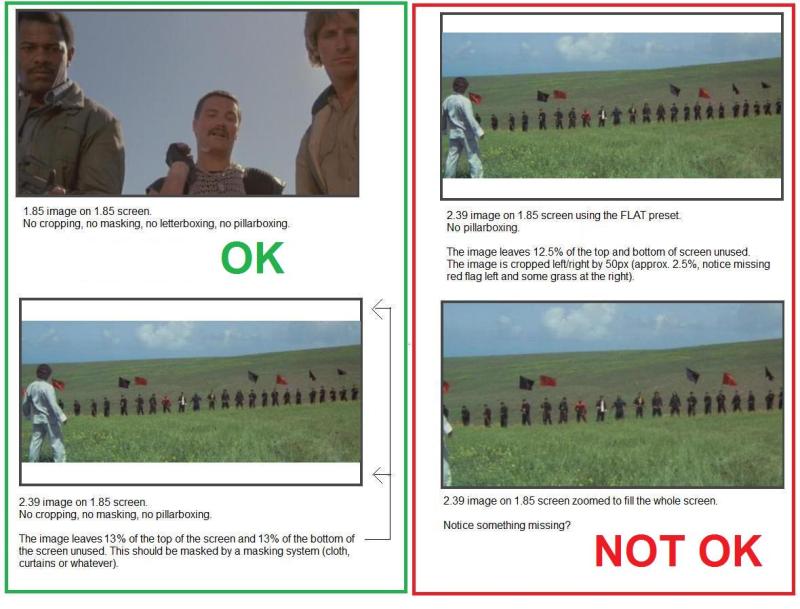
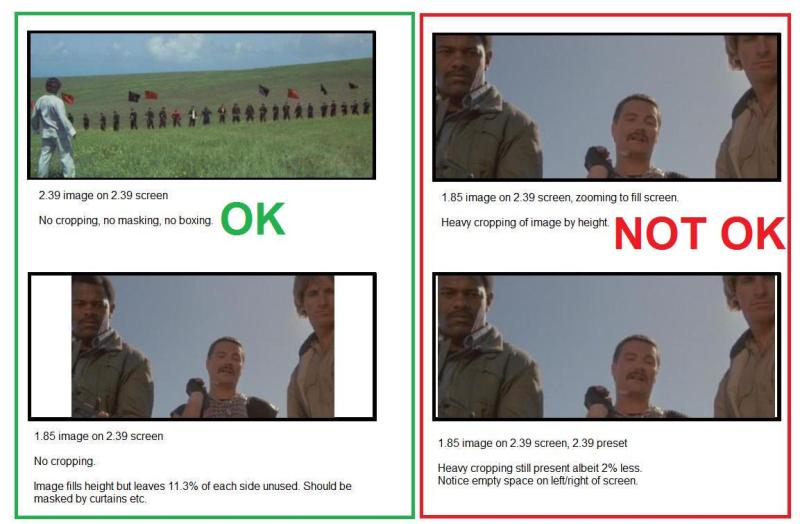
here's pictores i's mades (since they cannot be shown unless somebody gets mad, just click on them):
185 scenario
239 scenario
hope its useful and you will better understand. Others can just admire my MSpaint skills.
Posted by Manny Knowles (Member # 1171) on 01-26-2013, 11:42 AM:
Is it just me, or do those images seem mixed up somehow?
Posted by Dave Macaulay (Member # 813) on 01-26-2013, 12:33 PM:
Regardless of mixup, there's an error in a caption on one of the "185 scenario" images. This shows scope on a flat screen using the flat macro, saying "no masking". Wrong. The image is masked at left and right edges, removing 50 pixels (25 per side). it's a small difference but visible if you look at the man's elbow area.
Do whatever you want, there won't be any DCI police squad giving you the rubber hose treatment because you violated their rules. There is quite a bit of debate about what's best: I think that the ideal is a screen physically masked to the correct ratios and electronic masking adjusted to the format limits. Whether you have a scope ratio screen masked down to flat, or a flat screen masked to scope... doesn't much matter. The original idea of Scope was "bigger wider screen" and some think the scope screen should always be bigger. With stadium big-screen cinemas I don't think it matters. In recent 35mm film projection (recent being after 1.33 films disappeared in North America), 1.85 used a smaller film image area and could look pretty weak on a huge screen, scope used a lot more film image area and could look pretty nice on a big wide screen. Digital projection reverses that, the scope image has fewer pixels (-18%) than the flat image. So projecting scope inside a flat screen preserves the image resolution (infinitesimally improves it if you zoom back to use the extra 50 pixel width, but of course there's still less image on screen overall compared to flat). Using an external anamorphic lens restores the scope image to slightly higher pixel count than flat (+2.5%) but this is a very rare solution, hardly any venues are willing to pay the anamorphic accessory lens cost.
Once again, do whatever you want. It's not likely anyone will complain (nobody usually complains about even incredibly bad presentation in my experience). If you want to crop scope to fill a flat screen, no problem. My instinct is that people don't complain, but they don't come back. Venues with bad presentations where there's competition with a better product within easy travel will not prosper. Doing projection "right" won't make an immediate difference in patronage but it will over time steer a lot of people to prefer your cinema over a bad one. Putting on a crap presentation will steer them to your competition. I know people in an isolated town who will drive 4 hours to "the city" to see a blockbuster film rather than go to the (fair-poor image and mono sound) local cinema. They still take their kids to the local though, and teens don't have much choice. The local is finally installing stereo sound (5.1 even!) and "going digital" but it may take years to get people that care about presentation to come back through their door.
Posted by Bajsic Bojan (Member # 4928) on 01-26-2013, 12:34 PM:
ok, i see how they could be misinterpreted. i changed the naming now.
Since the point is to show two different movies, it would not be the point to show images from the same movie, right?
1.85 screen (constant width)
2.39 screen (constant height)
@Dave:
quote:
egardless of mixup, there's an error in a caption on one of the "185 scenario" images. This shows scope on a flat screen using the flat macro, saying "no masking". Wrong. The image is masked at left and right edges, removing 50 pixels (25 per side). it's a small difference but visible if you look at the man's elbow area.
Yes, I do mention the cropping of the 50 px. It is in the lines directly below the nomasking comment. I was implying there is no masking used in the representation. Well, i fixed that.
And yes, i agree with all the aspects you mentioned. The scenarios I show on the RIGHT side of the pictures are nonDCI compliant and completely WRONG ways to present movies. Which reminds me, why didnt i put that in before edited.
Posted by Nastia Motovilova (Member # 7184) on 01-26-2013, 04:45 PM:
Thanks for that practical example Bajsic! Much much clearer now.
So this
quote: Bajsic Bojan
Projecting a 1.85 film filling a 2.39 screen, you are cropping (as in, deleting, loosing, not showing) 20,6% of the image height.
refers to the top right screenshot of the 2.39 link scenario
whereas this
quote: Bajsic Bojan
Projecting a 2.39 film filling a 1.85 screen, you are cropping 22,8% of the image width.
refers to the bottom right of the 1.85 link scenario.
A few more questions to understand this better,
With which settings will we get a letterbox and pillarbox effect at the same time?
And if we were to use an anamorphic lens to avoid the pillarbox effect, would we get the same quality as when projecting a 2.39 film on a 2.39 screen? Or do we get even in the best of circumstances deterioration of the picture quality? (Is the main conclusion that in the end, anamorphic will be used when we have an issue of wanting to increase brightness?)
Thanks for all the replies!
Posted by Brad Miller (Member # 2) on 01-26-2013, 04:47 PM:
Bajsic - forum rules require you to upload images direct to this server for display on the forum discussion pages, not link externally (which kills the archives for the future).
You need to do this immediately.
Posted by Bajsic Bojan (Member # 4928) on 01-27-2013, 01:14 AM:
Yes. i wanted to do that, well here they are. Can you please delete the old links to the outside picture sharing site? (I cannot do that with the edit function)
1.85 common width screen:
2.39 common height screen:
Powered by Infopop Corporation
UBB.classicTM
6.3.1.2