This is topic Barco Vs Nec in forum Digital Cinema Forum at Film-Tech Forum ARCHIVE.
To visit this topic, use this URL:
https://ft-forum.com/ft/cgi-bin/ubb/ultimatebb.cgi?ubb=get_topic;f=16;t=001379
Posted by Phil Ilczyszyn (Member # 7311) on 02-04-2013, 02:39 PM:
Anybody have DP2K10Sx or NC900C YET?Can any body give me the pros & cons of each projector?
Posted by Carsten Kurz (Member # 5396) on 02-04-2013, 03:08 PM:
Barco has more light ouput. NEC has two fault-redundant lamps.
I hear some people already have got their NC900C - but firmware is not yet finished, it's preliminary, not all functions enabled.
Also the Doremi IMS it not ready for shipping yet - but that would be the same for Barco as well, as the Sx should use the same IMS.
- Carsten
Posted by Tom Bert (Member # 5719) on 02-05-2013, 09:54 AM:
Barco:
- Xenon light: more stable and safe than UHP, as well as lower TCO (NEC)
- Lamp house and modularity for quick and easy maintenance
- 9000lm: double of NEC
- all 3D supported: including Dolby 3D
- Eco Mode for lowest consumption in standbye mode
Posted by Monte L Fullmer (Member # 2797) on 02-16-2013, 02:01 AM:
And no lens files yet available for the 900C .. but coming over the horizon.
Posted by Marco Giustini (Member # 4544) on 02-16-2013, 05:27 AM:
Personally I would not consider any projector with UHP lamps inside as a suitable choice suitable for D-Cinema.
Posted by Oliver Pasch (Member # 1335) on 02-16-2013, 08:06 AM:
@Marco: any particular reason why, if I may ask?
Both high pressure mercury lamp driven projectors have passed DCI certification...
http://www.dcimovies.com/compliant_equipment/KEIO-NEC-NC900C-20121123.html
http://www.dcimovies.com/compliant_equipment/KEIO-SONY-SRX-R515-20130115.html
Cheers
O.
Posted by Marco Giustini (Member # 4544) on 02-16-2013, 09:00 AM:
Because UHP Mercury lamps feature the following:
- Several minutes to warm up and to show white light.
- Huge colour shift over life, particularly after 100-ish hours
- Huge light drop over life, estimated 50%
- 20% light ouput drop after calibration
Unless there is a colour meter inside the projector to compensate for light drift, I would never ever think of a mercury vapour bulb as a source of light for a critical environment as D-Cinema
That said, I am sure that once calibrated the picture will look "good enough". But considering the light coming off a similar machine is waaay off DCI W/P, I would not be surprised - actually I am expecting it - to find a 1-2 years old machine drifted from 0.341 to something like 0.270 (measured on a similar machine with no calibration) - which is noticeable to the untrained eye
Posted by Ken Lackner (Member # 1002) on 02-16-2013, 09:04 AM:
quote: Monte L Fullmer
And no lens files yet available for the 900C .. but coming over the horizon.
Huh??? How are you supposed to set the lens position?
Posted by Alan Gouger (Member # 543) on 02-16-2013, 12:02 PM:
quote: Ken Lackner
Huh??? How are you supposed to set the lens position?
Everything is motorized but no memory to create a macro. It is said this will be addressed in a future software update.
Posted by Monte L Fullmer (Member # 2797) on 02-17-2013, 12:11 AM:
quote: Marco Giustini
Several minutes to warm up and to show white light.
You basically have a mercury street lamp in that unit. When the bulb(s) fire up with the dowser open, you see a nice blue image that eventually brightens up.
Thus, I bet that the bulb(s) has to remain on all the time during intermission time so you don't get this 'street light' syndrome at each start up.
You think that Ushio and similar could have made bulbs for these units, but also notice that the 900C doesn't have any form of external exhaust connections - just a oversized home video projector... prob making the use of xenon bulbs an impossibility. At least, the BARCO uses xenon lamps to ensure stability in light output.
Now, have to see how the SONY SRX-R515 can do in this affordable market.
Posted by Alan Gouger (Member # 543) on 02-17-2013, 10:30 AM:
quote:
the 900C doesn't have any form of external exhaust connections - just a oversized home video projector...
Now, have to see how the SONY SRX-R515 can do in this affordable market.
The NC900 can run on 110 AC making it a nice alternative for smaller houses. It throws a great picture.
All reports so far from those who have demoed the Sony 515 have been positive. Has this shipped yet in the US?
Posted by Marco Giustini (Member # 4544) on 02-17-2013, 02:48 PM:
Any machine freshly calibrated will throw a nice picture on screen. What I am arguing here is the consistency of colour accuracy over time. I am familiar with those lamps and over time they are massively changing their colour temperature.
The 515 has a main advantage though: 8000:1 (ON/OFF) contrast ratio that DLP simply can't match.
Posted by Brad Miller (Member # 2) on 02-17-2013, 02:53 PM:
Here's an anonymous question submitted for everyone regarding the NEC 900C projector.
quote: NEC manual
This projector is equipped with a notch filter that has been optimized for projection in a movie theater. The image can be made brighter by removing the notch filter. Note that the projector does not comply with the Color Gamut in the DCI standards in that case.
Basically as I understand it, there is a dummy bracket that replaces the notch filter if you want more light. So the big question is...is NEC claiming brightness based upon that notch filter IN or OUT??? For DCI compliance, the notch filter must be IN (which means a darker picture and also possibly not DCI compliant in terms of brightness depending on the scenario).
If anyone has direct knowledge on this, please correct me if I am misinterpreting. Likewise, we must assume all brightness readings are taken when the projector is not DCI compliant.
Also, does this mean we cannot precisely calibrate the colors on the NEC 900S?
Posted by Alan Gouger (Member # 543) on 02-17-2013, 04:12 PM:
My understanding the spec is with yellow notch filter removed. From my limited time with the NEC when in D-cineme color space the notch filter is automatically engaged. You can turn the filter off, the image then takes on a reddish hue when projecting cinema content.
The projector offers the typical color calibration procedure as Ive seen on the Barcos. Alternative content when passing through the Showvault/IMB/IMS is converted to D-cinema color space by the Doremi therefore requiring the use of the notch filter. If you disengage the filter during alternative content a strange odd color effect takes place with missing colors, you must use this filter. You could bypass the filter if bypassing the IMB using a separate DVI card.
Posted by Carsten Kurz (Member # 5396) on 02-17-2013, 07:31 PM:
So far, NEC has not yet published any brightness specs, so it's hard to say wether the yellow-notch is counted in or not. What they give is screen size with DCI colourspace.
'Up to 30 ft./9m@14ft-L in DCI color (1.8 gain screen)'
And that calculates to something like 4500-5000 Lumens. Which is not much, but for a small screen, this is still a bargain at around 30.000US$ incl. server.
The Chrisitie Solaria One+ also has the option to disable DCI whitepoint for an increase in brightness. That said - probably ALL DCI projectors will be brighter before/without DCI whitepoint calibration. Naturally, the OHPs will lose more light when calibrated than XENONs do.
The UHP lamps for the Sony are manufactured by USHIO. I don't know if it is fair to judge them based on experience with previous UHPs. I have seen large differences in brightness and color shift with different UHPs.
Sony does not promote mixing lamps of different ages in the 515 - they just promote redundance in case of a lamp failure. If the existing lamp set can then not keep the necessary brightness, the whole set will have to be replaced. The Sony has a very complex lamp steering mechanism in the 515 - I like the 515 performance, the contrast is excellent - I just wonder where the economical benefit is compared to a much 'simpler' single XENON block.
- Carsten
Posted by Steve Guttag (Member # 268) on 02-17-2013, 11:33 PM:
Yes, the Christie Solaria 1 spec that is for non-DCI color is with the yellow notch filter removed.
Honestly, why are these companies even allowed to list the non-DCI brightness to a DCinema market? Note, ALL of the projector could have their yellow-notch-filters removed too. There is no magic there. If you don't need to achieve proper color space, the projector is brighter because color correction ALWAYS takes away from brightness.
Posted by Mike Moreno (Member # 4887) on 02-18-2013, 03:03 PM:
and also guys, are this 4 projectors (nec,barco crhistie and sony)ready for HFR or 4K?
i wonder because all is going to that way.
mike moreno
mexico
Posted by Marco Giustini (Member # 4544) on 02-18-2013, 03:29 PM:
Carsten,
That's exactly what I feared. "Change all lamps at the same time". This is NOT going to happen and they know it.
We will end up with R515 machines with lamps o mixed ages and horrible colours on the screen. And the excuse will be "we told you to change all the lamps at the same time".
What would happen if one of your six lamps failed way before its time? Say 500 hours. It can happen. It will happen - particularly with 6 lamps being used!
Shall the cinema replace all 6 lamps after 500 hours?
It can't work. It won't work. Sorry for being pessimistic here!
Posted by Carsten Kurz (Member # 5396) on 02-18-2013, 07:24 PM:
quote: Mike Moreno
and also guys, are this 4 projectors (nec,barco crhistie and sony)ready for HFR or 4K?
Only the SONY already has 4k and HFR. The other three support HFR, but not (never) 4k.
- Carsten
Posted by Monte L Fullmer (Member # 2797) on 02-18-2013, 08:05 PM:
Thus, if SONY needs six lamps, would the price of these six units be the same price as if the unit ran a USHIO 20SRX lamp in it - like the BARCO using a short gap, 2.4K xenon lamp ?
the NEC unit could have used a simple Ushio DXL-10BAF for their twin lamp setup...
True though: can see the worries and concerns on using these UHP lamps on color shifting and sudden bulb/module failures ...
Posted by Carsten Kurz (Member # 5396) on 02-19-2013, 09:18 AM:
The price for a set of 6 sony UHP lamps is basically the same as for a single xenon bulb of comparable brightness/screen size.
Question is how Sony will deal with premature failure - I haven't seen any warranty statement so far.
The NEC twin lamp set has been quoted at 600-650€ incl. a filter set. The NEC NC900C page quotes the lampe warranty period with 3000hrs. Which is not bad.
When dealt with properly, these lamps can live for a long time - I have experienced 4000-6000hrs myself. Of course, these would come out too dark for a cinema, but I have no reason to think that the quoted life can not be reached. Xenons DO fail, too.
The Sony UHPs are special versions with a Tungsten additive. They are said to lose only 20% brightness over their life-span. The Sony datasheet for the 515 says '15.000 lumen (Average)'. From what I have seen on a recent demo, I have no reason to doubt this is a cinema-business type of statement, not one that we're used to hear in the consumer projector market where speced lumens are, at best, initial peak values without calibration.
On small screens, the Sony can be used with e.g. only two lamps active. That way you can actually achieve something like 5000h-8000h operating time from the initial lamp set. And still have redundancy built in, that means, you don't have to have a spare set wasting money on the shelf.
- Carsten
Posted by Marco Giustini (Member # 4544) on 02-19-2013, 03:22 PM:
Thanks for the details.
Time will tell. I really want to see one of these projectors with 3000h old lamps. I want to take a colour measure and see what my Jeti says. Then replace the lamps with a brand new batch and check again.
Posted by Carsten Kurz (Member # 5396) on 02-20-2013, 02:57 AM:
The term 'UHP' is only a generic term for UltraHighPressure - it doesn't tell anything about the materials involved. So far, only Sony knows the aging specs of these lamps. From what I heard, this lamp is said to lose only 20% brightness over their life span. For now, we should assume that Sonys lamps are different from the ones we know from presentation and home video beamers.
- Carsten
Posted by Phil Ilczyszyn (Member # 7311) on 02-20-2013, 08:57 AM:
Quote nec manual
--------------------------------------------------------------------
Note for US Residents
The lamp in this product contains mercury.
Please dispose according to Local, State or
Federal Laws.
-------------------------------------------------------------------
Info on NC900C "UHP"lamps
Posted by Marco Giustini (Member # 4544) on 02-20-2013, 01:59 PM:
Carsten,
Thanks again for the info. My scepticism comes from the fact that such lamps are available in very expensive home theatre projectors and apparently at the time being no manufacturers have ever claimed a 'new' type of lamps as Sony have done now.
Hopefully this is a breakthrough in lamps technology and the 515 will work perfectly overtime with little or no degradation in light temperature and output.
Time will tell, I appreciate that at the time being we do not have elements to say otherwise.
Posted by Tom Bert (Member # 5719) on 08-13-2013, 04:43 AM:
Does anyone know how NEC and Christie expext you to switch between "DCI-mode" and "non-DCI-mode"? Is the notch filter removed from the lightpatch manually or motorized?
Posted by Ian Freer (Member # 1940) on 08-16-2013, 06:26 AM:
On the NEC it is a manual process. As I understand it, the filter is not intended to installed/removed regularily.
In a cinema installation the filter will be in (the proj is delivered with the filter installed by default).
If someone has a non-cinema application but the rest of the spec's of these machines suit them, then the filter can be removed at the time of installation to gain extra brightness.
If I am correct in my understanding of NEC's intention, I guess they've decided there is no direct need for it to be a motorised/automated function...
Cheers,
Ian
Posted by Carsten Kurz (Member # 5396) on 08-16-2013, 08:23 AM:
The NEC manual mentions an external (top accessible) cover for the notch filter. So this is something that the operator can do, but certainly not on a regular basis.
For the Solaria One+, I don't know. Maybe the slightly increased brightness on that machine is just achieved by disabling DCI colour correction.
BTW - I learned form a recent Christie Solaria training course that these Xenon machines use a similar filter. Quite probably with different characteristics and presumably less light loss, but as it seems Xenon needs such a correction as well.
- Carsten
Posted by Marco Giustini (Member # 4544) on 08-16-2013, 02:41 PM:
The notch filter has to be adjusted with a colour meter after it's replaced and I guess the colours have to be shot again. I don't really believe it's an operation which can be done on a regular basis.
Posted by Mark Gulbrandsen (Member # 72) on 08-19-2013, 12:37 PM:
This is the projector that my local competition has tried to down play by telling my customers that it doesn't have enough lumens. What a stupid statement... Any projector has plenty of lumens when used with in it's design limits. Most of them didn't buy the other dealers jive but they sure bought the NEC! I call it the "theater saver projector". It has allowed a half dozen clients so far to remain open that would have other wise shut down at the end of film.
I have installed about a dozen NC-900 so far and a have a lot more that are going in. I have one on a 30 foot wide 1.8 gain curved screen and it works comfortably with enough lamp head room left over. I have had exactly zero problems with them and my customers love them.
I tried the Doremi IMS and did not like it. The first demo unit we received didn't even work! The second one did but was buggy. I don't think including the three hard drives in the same IMS module was a very good idea and some of that drive space is taken up by the OS contrary to other Doremi products.
External drives are the best way.
I have used the SX-3000 IMB from GDC in all my recent installs. I much prefer the external PDP-3000 hard drive array. It is tiny, can be mounted with supplied bracketry for your projector, or can be tucked away inside the pedestal and velcro'd in place and forgotten about. It is hardware raid and fully automatic. Supplied in three or four drive configuration on order. It can be expanded to four drive version at any time and it will build the raid automatically upon power up with the new drive added. HAs automatic alret if a drive fails and a multi colored activity light for each drive that indicates it's status. Have had no real issues with these except for a few firmware bugs in the first release version that indicated hdd missing when it wasn't. The current build has been bug free and very stable. HDMI works great and the OS resides on an internal flash drive.
I have done a few tests with and without the notch filter removed. With notch filter removed one can pull the color almost back in and quite frankly the average person isn't going to notice any difference. One can gain about 4 fl with it removed and color corrected as close as it will get. I don't put myself in the situation of needing to pull the filter so have not let an install go in with out it. I would go to the next larger projector NC-1200 at that point, and that unit is still less expensive than the 10SX!
My pros and cons...
NEC:
Least Expensive Cinema projector to aquire, operate and maintain.
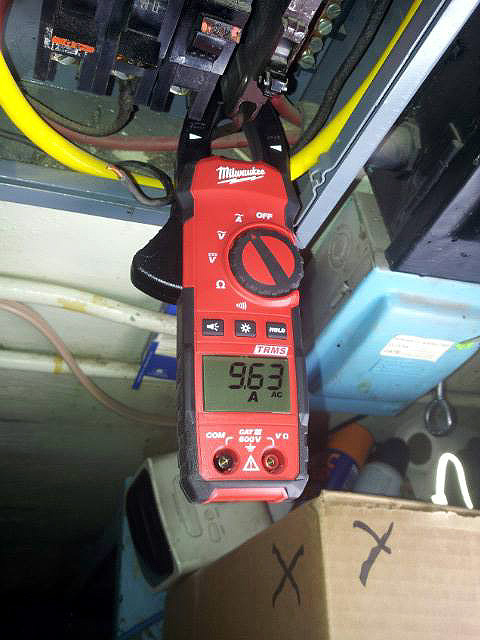
Draws only 9.6 amps system full lamp level and all gear up and running @ 120 volts. Makes it the cheapest by far to operate. Run it on 220 volts and cut that current draw basically in half to only 5.3 amps.
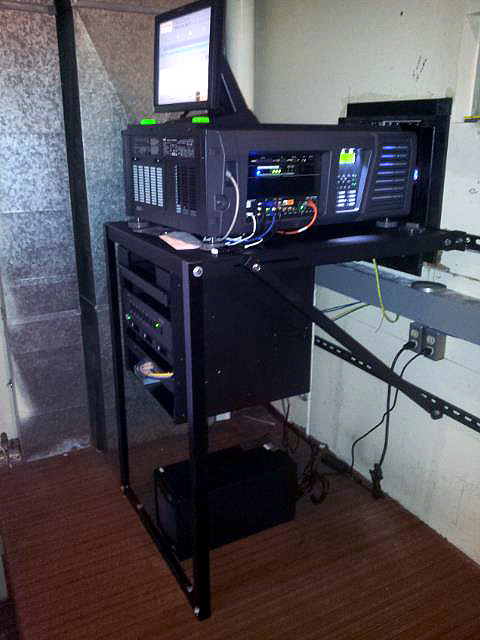
Entire systm is plug and play so does not require any electrician to install at all. Everything plugs into a 1500 kva 120 volt or 220 volt UPS.
Wide range of auto-lensing is finally available.
Light engine is air cooled.
Biggest advangate of this projector IMHO are the lamps. There are no multi thousand dollar glass reflector, or heat filter in this projector. Each lamp assembly has it's own internal reflector. If a lamp blows... so what! Unplug it and plug in a new one... even while the show is running. You can basically let your lamps run till the light level is no longer adaquate. Lamps have a 3000 hour warranty and have been proven in other NEC projectors in the past. There are a few installation of it in Florida that are comfortably running on just one lamp!
The new lamp kit includes two lamps and the hepa filters. Cost for the kit is no more than a 2kw cinema lamp was.
Cost is so much lower than the BARCO 10SX that the difference would easily buy either the SX-3000 or the Doremi IMS. If you have a Barco 10SX and a 24' wide screen you are essentially wasting the capabilities of the Barco. You'd have to run a very small lamp in it.
CONS:
Lamp does take about 45 seconds to ramp up to full brightness. It is not instant.
Projector vents into the booth. Other small projectors also do this. A bad idea IMHO! This can be a disadvantage in warm weatherand I have advised all my clients that have them to retain the ceiling mounted exhaust blowers. A few are now run from a thermostat that turns the exhaust blower on and off as needed. Some just do it manually or leave it running on a hot day.
Christie makes a side mount exhaust kit for theor small unit and so should NEC!
On the 10SX... I would leave it for screens larger than 30 feet wide. Operational cost is gonna be higher especially if of out of lamp warranty explosion occurs. Lamp change is much more of a hassle, same as full size projector is and opens more possibility of alignment mistake. 10SX costs considerably more than the NC-900 does.
EDIT: I will add one disadvantage of the NEC is that only one slotis functioning right now. Hence you can plug in either an IMB or Legacy input board and that's it. You can't have both. Yet.
Mark
Posted by Carsten Kurz (Member # 5396) on 08-19-2013, 04:59 PM:
What is the approximate price difference between the NC900 und 10sx in the US? In germany, it can be as low as 3000€ (4000US$) incl. server/IMS.
That's a tough competition for the NEC.
- Carsten
Posted by Marco Giustini (Member # 4544) on 08-20-2013, 12:32 PM:
I still believe that UHP lamps do not belong to this industry. Yes, they look cheaper, but I have a feeling that with time if you do the math you'll regret not having a Xenon lamp!
Posted by Mark Gulbrandsen (Member # 72) on 08-20-2013, 01:48 PM:
Carsten... It all depends on how many you are selling, what your price breaks are and so on. I can easily sell the NC-900 with the GDC IMB(which the latter is a little more expensive than the Doremi IMS)for what the basic 10SX would cost us. I can imagine the euro pricing would be closer since there is no import or long distance shipping involved. I have also on occasion have seen my (Christie) competition's quotes only to see the Christie projector is also priced about the same as the Barco. The local Christie dealer like to quote the DSS-200 which seems some what out of place and irrelevant in a small projector. Both Barco and Christie may ultimately be more expensive to operate on any screen because of the possibility of some day you may loose the mirror in say a 15 year operating span.
System as mounted on Kelmar wall hung platform.
Current draw full system in 120 volt UPS. Rnning the system on a 220 volt UPS cuts this current draw in half.
Mark
Posted by Steve Guttag (Member # 268) on 08-20-2013, 02:53 PM:
Taking the whole IMS/IMB thing out of it (you supply your own) so we are comparing same-same. The NEC is about $7K US less. Then again, it is also just shy of 1/2 the lumen output too.
As for servers...we all have our opinions on that...The Dolby DSS200 being my favorite, I don't see it as irrelevant in any installation except a Christie Solaria 1/1+ since they only come with the Christie IMB.
Posted by Carsten Kurz (Member # 5396) on 08-21-2013, 06:40 AM:
The price difference for europe I mentioned was for the same server/IMB combo in the NEC and Barco machine, in both cases a Doremi ShowVault/IMB.
- Carsten
Posted by Gordon McLeod (Member # 33) on 08-24-2013, 02:47 PM:
The only other problem I found was the DOREMI IMS has some issues formating the projector presets from automation cues from the server that on the first one we installed was not resolved
Posted by Mark Gulbrandsen (Member # 72) on 08-24-2013, 06:07 PM:
Carsten... Comparing the same IMS server in NEC or Barco the NEC is still about 5500 USD less for me to sell. Since I had bad luck with first IMS samples I stayed away from it all together. No issues at all with the SX-3000... or the NC-900 for that matter.
Steve... Again... It's a meaningless statement to say the Barco has more lumens. That is irrelevant when a given projector is used with in it's specs. Of course the Barco better have more light output or at least it certainly better, it costs a lot more. You also have that expensive reflector and heat filter in there to consoder and... legally one may have to employ a certified electrician on the install to keep with in code. The NEC runs on either 120 or 220V.
Athough Barco only rates the 10SX for a 33 foot wide screen and the NEC comfortably does a 30 foot wide screen so there is not that much of a real life difference. I can jump to the NC-1200 for the almost exactly the same price as the 10SX and I have already had an instance at a twin where I did just that, lenses are a bit more money is about all. However, both the 10SX and the NC-900 are way way less money than the other dealer here is selling the Christie for. I guess they all need new cars...
Marco... The light source in the NC-900 has already had a number of years of field use in another NEC projector that is built on the same chassis as the NC-900. I also know of another European DLP manufacturer that may be introducing a very similar unit. Tell me who's xenon lamp has a 3000 hour warranted life and who's xeon lamp can you change when the projector is running on screen? There are already many instances of small theaters running on just one of the pair of lamps in the 900. So in those cases one can get 6000 hours out of a set of lamps. One can also run part the warranty period with no worries about an exploding lamp. If one of these lamps explodes... so what!
Mark
Posted by Tim OBrien (Member # 5605) on 08-24-2013, 06:54 PM:
Given the advantages of the NC900, as Mark points out, not the least of which is cost, would there be any reasons to consider one of the larger .98 chip models where the screen size is 24' or less?
Posted by Marco Giustini (Member # 4544) on 08-25-2013, 04:07 AM:
I understand that the NEC900 is certified DCI when used with both lamps, I guess the colours and the uniformity is not within tolerances when used with only one lamp. I still need to see what happens after 500hrs to the colours; I don't argue that those lamps will have a number of advantages for the owner, but I know how much colours drift using those lamps and I am concerned that we may soon see cinemas with completely off colours after some years of operation.
The other NEC projector you mention is not a D-Cinema projector,: colour accuracy is not crucial outside our industry.
Posted by Mark Gulbrandsen (Member # 72) on 08-25-2013, 03:33 PM:
Marco...
I have one theater past 800 hours already! No change at all. You are correct about using one lamp. But one lamp will meet DCI color spec as long as you shoot the colors for that given lamp. You can also shoot the colors for the second lamp while you are in there and store that as a seperate renamed file for later application when that lamp is used.
There was some talk from NEC about also making a couple of changes in the firmware and DCC to allow one lamp to be used for flat and two for scope alternating the use of that single lamp to age the lamps evenly. I have a coouple of places where flat is a little too bright!
Posted by Steve Guttag (Member # 268) on 08-25-2013, 03:36 PM:
Mark, stop with your bogus arguments.
FACT, Barco 10SX lumen output with its 2200-watt lamp is near double the NEC NC900 (about 9000 lumens versus about 4500...with variances depending on lens used).
Your 30-foot screen claim is with what? a 1.8 gain screen...not DCI compliant because of uniformity...you'll say you curve it (though you didn't say that fact in your post immediately above)...but even then, it won't be DCI compliant because a cylindrical curve will still be dark in the corners...but okay...lets let that all slide because it looks good enough (to some)...put the 10SX on it...it'll STILL be twice as bright so you could skip the 2200 watt lamp and go to a smaller/lower cost lamp...that also lasts 3000-hours. You are not comparing same-same.
The maximum width for the NC900C on a Matte White screen (new...still attaining about 1.0 gain) with typical ports and color correction and still having its notch filter)...is going to be about 19.5 feet.
Can you remove the notch filter and eek out another 500-lumens...yes but you will not have the color uniformity anymore...you can put the numbers into the ICP and have it "correct" but your uniformity will never be right (its a notch filter, not a broad band color filter). Note, you could do this with any of the projectors and "cheat it."
That is a decision that each exhibitor will need to make for themselves. As I've always said, if you did it wrong with film, you'll do it wrong with digital too. One can always justify cheating the performance by claiming it costs less.
If the venue only needs 4500 lumens or less, then the NEC900 offers tremendous cost advantages with no proven drawbacks, but it is not for most theatres.
The Barco DP2K-10S is nearly a DP2K-12C in lumen output (though it needs a brighter, projector specific lamp to do it). Its costs savings are easy to find...Barco gets a lower cost light engine from TI, omits the DVI inputs (and won't include the HDSDI inputs at no cost), lower cost lenses...etc. There is a reason it is not as dramatically cheaper than the "C" series though it is significantly less. Christie's Solaria 1/1+ is essentially the CP2210 with the .69" chipset inside and the "included"/forced Christie IMB. Again, significantly cheaper than the CP2210 but not as much of a rollback (light wise) as the NC900 is to its next of kin.
I'm not advocating one over the other here, just stating the fact of what each brings to the table.
Posted by Marco Giustini (Member # 4544) on 08-25-2013, 06:19 PM:
I don't doubt that you have one projector happy at 800 hrs, but I am pretty sure that on the long term and when a bigger number of projectors are on the field it'll be clear that UHP lamps are a mistake.
NEC told me that the machine is supposed to run in dual lamp mode to be DCI. I believe it's also written in the manual somewhere, I haven't got it handy right now.
I am not saying that it can be run with just one lamp, but that it's another compromise to be taken into consideration.
Also, have you ever tried to, say, turn the lamp on at 80%, check the colours, then raise to 100% and check the colours again? Try also to drop it back to 80% and see how much time it takes to go back to the brightness level and colours you measured earlier - if it ever gets back to those levels.
Posted by Mark Gulbrandsen (Member # 72) on 08-28-2013, 09:37 PM:
Steve.... What does it say the 10SX is rated for at this link?
10SX Specs
To me the specs says they rate it for a 33 foot wide 1.2 gain screen, I'm thinkin ~35 feet with a 1.4 gain. While the NC-900 isn't the same in terms of Lumens from my experience with it it isn't really very far behind. I have about half of them running on old matte white screens up to ~24 feet wide and roughly the other half on new 1.4 gain screens. It has no problem making light spec it at ~76% lamp level give or take on the old matte surfaces. That leaves plenty of headroom for the lamp to age. I have the one unit running on a 30' wide 1.8 gain screen which is curved and it also has no issues, the lamp level there in scope is at 84%. And fortunately in this location the curve is deep enough for decent light distribution and the projector is dead center of the screen as well plus it is a somewhat narrow auditorium to boot. Their on screen image and ticket sales have improved dramatically, over double the sales actually... what it was the old system... which was pretty awful.
Anyway, this is more about using the right projector for the right situation anyway and for most of my situations the NC-900 works above expectations. Yes, the 30 footer is pushing it a bit and we are keeping an eye on the light levels there. That is the one already at 800 hours... and there is zero change. If things go for the worse and if necessary that screen can be masked down a bit in size if needed, or they could change their lamps earlier to maintain screen brightness. For now it's going to be a great indicator of how well these lamps fare over time.
By the way... how many NC-900's have you installed? I'm at 14 now with two more going in after the holiday. One more Mid Sept.
I have quoted several 10SX's to theaters with 35 foot wide screens but those theaters declined to spend that much money. Because the NC-900 won't work for them it wasn't even brought up and the NC-1200 is a tiny bit more expensive than the 10SX because of the increase in lensing cost. Anyway, one theater has already shut down and is being converted to other use as will the other two soon. The 10SX was simply too much money for them to spend, or try to raise or borrow, or available via X grant. And so far about half of the NC-900 systems I;ve installed have been paid for by donors or grants. The theaters just don't even have that much money in many cases.
Mark
Posted by Steve Guttag (Member # 268) on 08-29-2013, 01:27 PM:
Mark...what are you adding to the discussion here? Confirming what I had already stated? The 10SX has about 9000 lumens, depending on the lens. The NC900C has about 4500 lumens, depending on the lens...it has about 1/2 as much light...thems the facts. If you have enough light with that, then fine, if not, you need something bigger.
As for money...we have theatres raising funds to afford digital too...thus far, it has yet to force one into an undersized projector.
You claim about zero change after 800 hours is less than genuine since I've yet to find any lamp that does not change after 800 hours.
Posted by Stephen Furley (Member # 1277) on 08-29-2013, 01:53 PM:
How does the NC900 compare in lamp Wattage and light output to the NC800C, the only digital projector which I've actually used? The NC800C was putting more light on the screen per Watt than the Kinoton FP-30Ds. Xenon lamps normally have a much lower luminous efficacy than UHP mercury. Metal halide are higher still, but traditionally at the expense of very poor colour stability, but even this has improved somewhat in recent years.
Posted by Carsten Kurz (Member # 5396) on 08-29-2013, 02:36 PM:
The NC800C is rated slightly above 6000 lumens with the 1.25kW high efficiency lamp. However, these have to be replaced early and are quite expensive. I also believe the 4500 lumen quote for the NC900C is a bit conservative, that is, not peak lumen.
I guess it's safe to say NC800 and NC900 are roughly on par in brightness. Only that lamp replacement is less costly on the NC900.
- Carsten
Posted by Marco Giustini (Member # 4544) on 08-29-2013, 02:44 PM:
Mark,
quote: Mark Gulbrandsen
Yes, the 30 footer is pushing it a bit and we are keeping an eye on the light levels there. That is the one already at 800 hours... and there is zero change
Are you saying that you measured the colours after 800 hours on a NC-900C and measured exactly the same coordinates, that is, 0.314 x 0.351? If that is the case, I would be wrong and the NC900 would be the best projector in term of colour accuracy out there.
Posted by Steve Guttag (Member # 268) on 08-29-2013, 04:51 PM:
I have not had the pleasure of measuring the NC900C yet but I have measured numerous NECs (NC1200 on up) and NEC has yet to be conservative in their numbers. In fact, I've seen them raise them in literature without actually raising them in the projector. NEC also bases their 9-9.5m screen spec on a 1.8 gain...not DCI compliant and like all others presume zero lamp decay...so even if a lamp makes it at the day it is installed, it will not be in spec in pretty short order. I guess they are counting on also being at the bottom end of the spec.
They are all guilty of boasting what the projector can do when a lamp is brand new though.
Posted by Mark Gulbrandsen (Member # 72) on 08-29-2013, 08:41 PM:
I totally agree with your last statement. I hope the laser light people actually get this right!
On the NEC-900 the original light specs were published based purely on the design. Once they had measured a few projectors they upped it a bit as they found out the design was pretty conservative. As to the other NEC's I have used so many of them now (189 and counting) that applying the correct projector to the correct job is really very simple. I know what they'll do in real life situations with different screen surfaces... not just based on the spec sheet data.
Marco... I am waiting till 1000 lamp hours have gone by to check color again. I measured the light level of this site and it remained unchanged at 800+ hours. That should signify little to no color change as well. I am at a site today that is at 600+ hours with three NC-900 and same thing. No change in light levels. I would expect to see some change at least by 1200 to 1500 hours but we'll see.
The largest disadvantage I can see is it would be wise to shoot colors at each lamp replacement because you are also installing new reflectors and heat filters as well. That stuff is gonna change the colors no matter what.
Posted by Steve Guttag (Member # 268) on 08-29-2013, 11:52 PM:
They upped it 500 lumens (not by saying that...just by saying how big a screen it could work with).
Posted by Marco Giustini (Member # 4544) on 08-30-2013, 04:18 PM:
Mark,
What do you use to measure light? Won't it measure colours as well?
Anyway, no light level change in 800hrs with "feedback" disabled I presume?
Posted by Mark Gulbrandsen (Member # 72) on 09-01-2013, 05:55 PM:
Marco,
I use a Minolta CS-200 meter for color and light levels but I do not always carry it with me, depends on what I go to do at a site... Color gets checked at install and every 6 months after that. or if some major part in the optical path is replaced.
I don't want it needlessly bouncing around in the back of the Expedition.. I do however carry a Spectra screen luminance meter all the time that I use for quick light level checks. It's not a big deal if something happens to the Spectra... but it is if the Minolta gets broken. So far I haven't killed either though...
Posted by Marco Giustini (Member # 4544) on 01-30-2014, 06:31 PM:
To be fair with Mark, I have measured an NC900 which I calibrated a year ago.
I must admit I was impressed when after 735h (only one lamp being used) the colours were still within 0.006. I then switched the lamps (not enough light with lamp 1, so I moved to 2) and - surprisingly - my old calibrations were still correct. You only need to consider that when the power is changed the colours change as well - but you can save a separate calibration for that power level. And all my old calibrations were still ok with the new lamp at different power levels.
Now the matter is the reliability.
Posted by Mark Gulbrandsen (Member # 72) on 01-30-2014, 06:38 PM:
I'm replacing an ICP in one tomorrow in one of the first units I installed. But I can't really blame that failure on NEC because they don't manufacture the ICP. I've also lost one lamp so far. This is out of 25 installed NC-900. Another 6 to 8 still to go in...
If you think about it there is no real reason the colors should shift much with lamnp age. Because the inside of these lamps darkens. Perhaps no getter in there. On the other hand it makes perfect sense to have color shift when varying lamp current.
Mark
Posted by Steve Guttag (Member # 268) on 01-30-2014, 07:06 PM:
If you think about it...a projector that requires different color calibrations for each image is silly. My first NC900C experience was in a special venue theatre that has a 4x3 ratio screen. So each format (and since they will run everything from SD up through DCP) I had about 5 lens presets in there.
For each size, requires a different color calibration? Silly.
What is worse is that I didn't need both lamps for "scope" since that is the smallest image on a 4x3 screen but needed all of both lamps for 4x3 (largest zoom). There wasn't enough overlap of the lamp range too allow "proper" light levels of all formats either...dual lamp at minimum was too bright and single lamp at maximum was not enough.
Even stupider is that they don't have a mechanism (yet) for the projector to alternate lamps when running single lamp to ensure even aging. Basic A/V projectors do this. Perhaps the issue is the color balance between the two lamps is more of an issue than just aging the piss out of one lamp.
The other disappointment is that the lens adjustments are not only too course...it never hits its mark twice. Probably not noticed so much in a Flat/Scope theatre...particularly with common width...but in a multiformat one...it is a bit too crude.
Contrast ratio is a bit wanting too.
I'm hoping that the reported lamp aging thing holds true. I'm curious how fast they age. If one runs a lamp at 100%...will it go the full 3000-hours and retain most of its light?
Posted by Marco Giustini (Member # 4544) on 01-31-2014, 03:42 AM:
Mark,
UHP lamps are infamous for wildly changing colours, they tend to get reddish over time. It's in the technology, ask any AV enthusiast and they tell you how much they'd like a Xenon or LED projector!
Steve,
Lens positioning is inaccurate, correct. Takes a while to find a good compromise. I thought they would fix it with software but so far it hasn't been done.
Calibrations: yes, a little downside. But the real world is that cinemas are no more capable of replacing lamps properly. Nobody align them - or fail to do so. I'm not happy to say so, but realistically a lamp that does not need alignment is a must for 90% of cinemas these days. This is my European experience, not sure how it works in the US.
It looks like a calibration for minimum power gives you consistent colours over time even when changing a lamp, so not a big deal.
Don't get me wrong: if it depended on me I would stick on Xenons, but that would require PROJECTIONISTS.
Posted by Carsten Kurz (Member # 5396) on 01-31-2014, 06:15 AM:
Xenon is no longer the optimum choice for theses small panel DLP projectors. The light efficiency get's worse. They had to do something about that. That's how NEC get's so much light out of 700Watt NSH. Also handy for mobile applications where you do not need to take out the lamp for transport.
http://www.nec-display-solutions.com/p/download/pr/File/ cp/Internet/Shared/Content/SeeMoreNew/Whitepapers/Downloads/PDF-Whitepaper-NSHLamps-(english).pdf?fn=Whitepaper-NSHLamps-english.pdf
http://pro.sony.com/bbsccms/assets/files/mkt/digicinema/solutions/4277_Cinema_HPM_LAMP_WhitePaper-pages.pdf
That said - the Sony SRX-R515 lamps do not seem to keep brightness too well. At least not our 450Watt type.
- Carsten
Posted by Mark Gulbrandsen (Member # 72) on 01-31-2014, 02:24 PM:
I completely agree on the lens positioning. It's simply too coarse. But I've always been able to find a good compromise point with them where it's repeatable and accurate. I also don't see that improving either. I believe the coarseness is a function of the stepper motors being used.
Marco, I am aware of the color shift issues with AV gear with mercury lamps but I haven't seen that happen yet on this projector. This is not a new lamp design either. It's been around in NEC's larger Board Room type DLP projectors for some time. So it's aready a prooven design.
Steve... In a screening room? I hope not a critical one. I'd be the first to say it couldn't do that job correctly and that would be the last projector I'd use for that. The over brightness in flat is not such a big issue in a cinema use.
For 22K USD for the basic projector one can't get overly picky about this unit either... It is keeping a lot of theaters open that would have othersise shuttered for good.
And they have been reliable...
Mark
Powered by Infopop Corporation
UBB.classicTM
6.3.1.2