This is topic Barco DP2K-32B is 7FL all to be expected... in forum Digital Cinema Forum at Film-Tech Forum ARCHIVE.
To visit this topic, use this URL:
https://ft-forum.com/ft/cgi-bin/ubb/ultimatebb.cgi?ubb=get_topic;f=16;t=001524
Posted by Dave Handley (Member # 1637) on 06-06-2013, 12:07 PM:
A local (formerly my local...) drive-in here in southwestern OH, with a brand new 32B and 7 FL. Kinda pathetic after I maintained about 11 FL scope with film for about the last 17 or so years. The installing tech says thats the best they can do. The light field seems way flat to me. To the point of wasteful. Am I used to a "hot spot" set up you ask. I stayed near a 25 to 30% roll-off from center to edge on film which I found nearly invisible with film. Can at least some level of this be done with these units without damage? Then can gamma be adjusted to compensate for below normal brightness? This is an 80ft screen approx 200ft throw, no tilt, SW XL100 paint two years ago. Barco states this machine can handle a 105ft screen.! Guess they dont mind pushing truth and reality some. That light is half what it should be with a brand new Ushio(6.5KW). CLO is off ("bulb savings"). And after a couple hundred hours...beyond pathetic! Thanks for any feedback/suggestions. Dave
Posted by Darryl Spicer (Member # 711) on 06-06-2013, 12:54 PM:
If your bulb is using the normal mode and not the CLO mode, check the slider and see if it is slid all the way over to the left or right. If all the way to the left then it is too low. If all the way to the right then it is using max power. With the size lamp you mention there should be three power supplies installed in the projector. Look in the back compartment of the projector and make sure you see three power supplies and not just two.
You do not want to focus the lamp out of position because you run the risk of overheating the integrator rod and the UV mirrors.
Are you using a 2K light engine chip set or a 4K light engine chip set? When we switched our 2K light engines to 4K we found that our light levels had increased.
Posted by Tim Sherman (Member # 569) on 06-06-2013, 01:27 PM:
The rated output is of the barco is with a 7k bulb, and is the brightest projector made. Also that claim for that size of screen is assuming your using a gain screen like and indoor screen does, and a drive-in screen does not have much gain at all. I am running 2 32B's at my drive-in, one on a 118' x 50' screen with a 513' throw. and i am impressed at the light output. Unfortunately i do not have a light meter to give you my exact numbers. What lens are you using? Also don't forget with film your scope picture was brighter, in digital your flat picture is brighter.
Posted by Brad Miller (Member # 2) on 06-06-2013, 01:30 PM:
Dave,
Tell us what your screen width is and what your throw (distance from projector to screen) is. Also look on the front edge of the lens barrel and tell us everything printed on it. (You don't need to remove the lens to see this.)
If you had a brighter image with film, then I'll bet you anything your installer/dealer ordered you the wrong lens and he is scaling the image on the chip, essentially throwing out most of the available light.
Posted by Jack Ondracek (Member # 1466) on 06-06-2013, 04:41 PM:
Actually, that is fairly close to what I am getting with a 32B on my 86-foot screen, non-gain, corrugated metal, flat-white Kelly-Moore paint. The projector was calibrated by American Cinema, using some fairly impressive equipment.
Prior to that, I was using Big Sky 7kW lamphouses. I found them easily the equal of the Strong Ultra-80, except they had glass dichroic reflectors and kept my projectors much cooler than the Strong. I also had new Schneider lenses on that screen. In short, I think I was shoving about as much energy through a frame of film as you could safely do. I was NOT shaving my shutters, so I imagine some drive-ins could have had marginally brighter pictures than I had here.
The performance of the 32B surpassed what I was getting out of film in most respects (I won't get into the film/digital debate here). My screen is easily brighter, but not substantially so. It is evenly lit and the picture is rock solid and crystal clear. I'm in the high 9's with my 23Bs on 60-foot screens.
I don't know what you were expecting from a projector with comparable wattage, but my experience here is far from "pathetic".
BTW... this could be debated, but my tests here showed that Kelly-Moore paint is "whiter" than the comparable Sherwin Williams product. Years ago, I started with SW and found it to be darker than the Killz primer that I painted it over. A SW rep admitted that they put a small amount of black into the paint, purportedly to help hide dirt better (?)... I've used Kelly-Moore ever since. Still, I know a lot of owners seem to like the A-100 product from SW.
Posted by Monte L Fullmer (Member # 2797) on 06-06-2013, 07:51 PM:
In the past, I knew of some "ozoner" owners that would use reflective street paint for their screens when they were due for repainting.
Made fantastic results after this paint usage.
Happy Anniversary to the Drive-Ins and their respective owners !!
-Monte
Posted by Dave Handley (Member # 1637) on 06-07-2013, 07:53 AM:
Thanks for the responses and suggestions. This owner has developed the habit of starting before total darkness in the evenings. So he has noticed the reduction in light on his screen. I have particularly noticed (due to very high contrast) the loss of impact from very dark scenes. Film may have compressed to some degree the range of light to dark and for our situation here with reduced overall light level, netted us a plus. Digital technology offers the ability to correct/adjust things like light to dark tracking. Even my home video projector has a "gamma" adjust feature. Some bluray content needs a nudge up, some down. As my bulb ages, at some point, I give gamma a click untill I get a new bulb. Gamma adjust can and should be used to compensate for below standard light level. I presume with such lavish control over color correction which these machines are capable is some control over gamma but I need some expert input here to confirm and describe. Jack, we also had that Big Sky 7KW lamphouse with dichroic reflector. I heard that the reflector may have been Kineton-but whatever it was, I never got such a spectacular spot of light in a projector before. I lined it up with laser, "shaved" ten degrees off the shutter(each blade) but moved it as close as possible to the film. Louis Bornwasser manufactured a replacement shutter drive which allowed me to do this without any noticable travel ghost whatsoever (was rid of that century gallup). I dumped the water jacket on the Century DA but added several tight (to the light cone) Macor ceramic heat shields to the gate block, including a Macor aperature plate got me a very cool (well pee warm) gate. I believe that film buckle and blister was minimized by keeping the film as cool as possible right up to the very moment of exposure(s). An older Schneider high speed prime and WA anamorphic, and lastly a properly angled piece of PPG Starfire port glass got my 11 FL with new Ushio 6 KW bulb. I only got one emergency call about a print being cooked (just slightly) as it ran, and that was one of Nolans Dark Knight films, which was using some of that silver retained super high contrast Eastman stock. Just what a drive-in needed! So this new gadget has some pretty high standards to rise to, and I think it is fully capable of doing so. But a little more expertise and massagin by somebody beyond me or the guy who put this thing in. Thanks to all who have responded. The slider is 75% full up, its the right lens, its 2K of course, and lastly: the screen is what it was when we had 11 FL scope with film! By the way this installer has the new port angled precisely to cast reflected light perfectly centered back upon the projection lens. No glare in the eyes of the operator etc and whatever, lol. Now that is truly attention to detail!
Posted by Ken Lackner (Member # 1002) on 06-07-2013, 10:57 AM:
http://en.wikipedia.org/wiki/Paragraph
I don't believe D-Cinema projectors have a means of correcting gamma. At least I've never come across such adjustment and I've certainly never used it.
Posted by Brad Miller (Member # 2) on 06-07-2013, 10:59 AM:
Dave - If you are going to come on here and ask for advice, be prepared to answer the questions when people try to troubleshoot. You are complaining that the digital got darker than your film was (with or without any improvements). That's not the case. Something is wrong. Who is telling you that you have the right lens? I don't buy it. Either you have the wrong lens for your scenario and somebody is trying to cover their ass, or your installer has no idea how to align that bulb. Either way, that points to the dealer/installer (who by the way is improperly reflecting the image back into the lens).
Ken - Christie projectors can. It's right there in the GUI and in the simplest sense, can make a "drive-in print" out of a normal DCP.
Posted by Bajsic Bojan (Member # 4928) on 06-07-2013, 01:41 PM:
You state attention to detail by reflecting light straight back and starting shows before it gets dark?
You also state using a new 6kW ushio at one point and 6.5kW ushio with a 'couple hundred hours'. So which one is it?
Then you say the slider is 75% up, which would be in the operating range of about 5400W for the 6kW lamp? Do a read out off the lamp info screen. Why would you run at "75% up" and moan about not getting bright enough if your projector is capable of it? its two buttons to push.
You say you had 11 ftL on scope before, which means you had about 7-8 ftL on flat? Thats way below standard and 'detailed'. Digital is the other way around and if you have 7 on scope, should have about 10 on flat with the same screen. Still, just by calculating numbers on a fully operational new 6kW lamp, it should be closer to 10-11 for scope and 14 for flat. on a 1.0 gain screen. But since you state 11 ftL on 35mm with a 7kW lamp (and a modified projector shutter), it is apparently more 'gainy'...
Someone has made something wrong and you should get it properly checked.
Posted by Marco Giustini (Member # 4544) on 06-07-2013, 02:12 PM:
I think the gamma can be adjusted in the TI software - Christie happen to have it on the GUI as well. SONY have it on the GUI as well.
You cannot calibrate it though, only set different values such 2.2-2.3-2.4 and so on.
Posted by Steve Guttag (Member # 268) on 06-07-2013, 07:31 PM:
Christie has made Gamma presets (usable by any DLP projector,BTW...They are LUT-DG files. Barco and NEC opted to go for full PCF files that contain the Gamma built into the file. And, if you have the Post-Production version of the Communicator program, you can create your own Gamma files...and not just simple uniform color gamma...you can adjust the gamma on a color by color basis too.
I'm sure the theory has been...Gamma is at 2.6 for DCinema (by specification) and 2.3 for HDTV so there is no need to muck with it.
However, there probably is a legitimate reason to make allowances for Drive-Ins but it should be a bit more controlled and not by the untrained eye. The key would be to hit the right light level (that doesn't make the drive-in screen look ugly) and also presents the movie as faithfully as the Drive In system can reasonably achieve. Historically, there were "Drive-In" prints and I don't see why that can't be carried forward to today. In some respects, running a "3D" version of the movie with just one "eye" should look better (light wise) than the normal 2D version since the 3D version was timed for lower light.
Posted by Dave Handley (Member # 1637) on 06-08-2013, 04:05 PM:
Steve, you make changing those operational control files sound easy as 1-2-3. I am unsure our installer would be equipped to handle this or anyone under the Strong banner for that matter. Can you suggest someone, some alternate way to get this accomplished? I suspect a minimal gamma reduction from the 2.6 down to 2.4, even 2.5 , along with getting that light up to 10FL scope(where it should be) would make the significant improvement we're looking for.
Brad, the throw ratio here is 2.75. I assume the 2.15-3.6 lens has been installed, but intend to double check this as soon as I can. You assume a degree of carelessness/incompetance on the installers part that even my cynical self doubted. I think you are spot on with your assessment that the bulb simply, for what ever reason, has not been aligned properly.
Thank you all for your input and help on this. I haven't posted here, but I have used this site for a wealth of info. Brad, as purely difficult as you are fully capable of being, you need to be commended for keeping this thing alive and well all these years. May it and you continue for many more. Thanks again.
Posted by Carsten Kurz (Member # 5396) on 06-08-2013, 08:01 PM:
These bulbs will have to be changed frequently. Will you do this yourself? Maybe it would be advisable to invest into one of Barcos more expensive lamphouses with auto alignment?
You say the installer put the new port glas in without proper tilt towards the lens (will you have him fix this?).
Did the same installer also choose the glas type for this port?
- Carsten
Posted by Monte L Fullmer (Member # 2797) on 06-09-2013, 12:08 AM:
quote: Dave Handley
Brad, the throw ratio here is 2.75. I assume the 2.15-3.6 lens has been installed
A bit of a short throw on a big screen, or a very small screen on a long throw with that low of lens factor
Or, run without port glasss - to get every bit of light out to the screen.
Plain glass contains so much lead that it soaks up light, why with most digital installs, a lead free port glass is used.
It's rather pricey on the side, but allows more light to pass through.
I bet your installer didn't calibrate the light sensor inside the projector. He needs to do some more adjustments to get you a better picture.
Posted by Marco Giustini (Member # 4544) on 06-09-2013, 03:51 AM:
quote: Dave Handley
Steve, you make changing those operational control files sound easy as 1-2-3. I am unsure our installer would be equipped to handle this or anyone under the Strong banner for that matter
Sorry but if you don't know how to change the gamma in a D-Cinema projector you're doing the wrong job! It IS easy as 1-2-3 if you know what you're doing. 1. Connect to the ICP 2. Go to the relevant menu 3. Change the gamma value
Posted by Steve Guttag (Member # 268) on 06-09-2013, 11:31 AM:
I think you are confusing an A/V projector that you can just "fiddle" with until "it looks good". That isn't how DCinema systems work (or should) work. They are more precise and one should not just adjust it until "they" think it looks good.
It is a catch-22...if you don't see this as easy as 1-2-3 then you don't have the training to really do the work.
Your posts, thus far, show someone who cares about the quality of their show but "shoots from the hip" when it comes to alignment. Something that I don't condone.
The reason you have a particular light output level is predictable and explainable...it is a matter of having the proper information provided (screen size, gain). Set up can absolutely factor into the final light output too and there are many ways installers deal with particular problems.
BTW...if you want to raise your light by 23% for scope...buy an Anamorphic lens...Sure, it is $10K or so for the set up but the increase in light is undeniable and most every Drive-In should have one.
Posted by Dave Handley (Member # 1637) on 06-09-2013, 07:46 PM:
Come on folks, save some of that sanctimonious spouting for some other forum. Remember you are part of an industry that has so recently seen fit to endorsing some of the most ruinous pummeling of any reasonable quality standard in cinema projection since the industry began:(3 FL scope 3D). Anything goes..so give me an f'in break, please. Thank you!
Posted by John Wilson (Member # 269) on 06-09-2013, 08:42 PM:
quote: Dave Handley
Thanks for any feedback/suggestions. Dave
Well Dave, you did say "any". You didn't say "please pity me and agree my drive-in image is now shit with no hope of it ever improving". ![[Roll Eyes]](rolleyes.gif)
Posted by Brad Miller (Member # 2) on 06-09-2013, 09:05 PM:
Any feedback? Ok here's some. ![[Razz]](tongue.gif)
Dave, any chance you used to be a projectionist at this site and they now no longer need you?
The reason I ask that is because I've never seen a drive-in's picture get worse after converting to digital, and I've been to a few with some really high end 35mm systems. It just doesn't happen. Digital at a drive-in is brighter and looks better all around than 35mm is capable of.
Regardless of this fact, your posts seem to indicate you're not too happy with the change. The fact of the matter the way I see it is that either you are exaggerating the truth on the image quality (that whole "digital sucks" thing), or your equipment dealer under-spec'd your projector, or your installer is an amateur and you should get a real tech in there.
Which is it? Enquiring minds want to know!
By the way, here are a few NON-photoshopped pictures of a drive-in I installed last month, and they've got a LOT of ambient light both front and behind the screen.
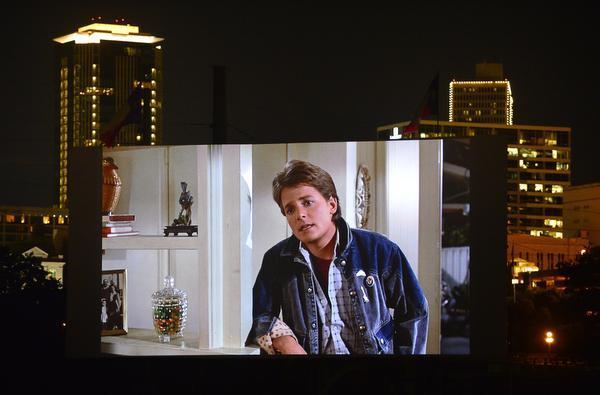
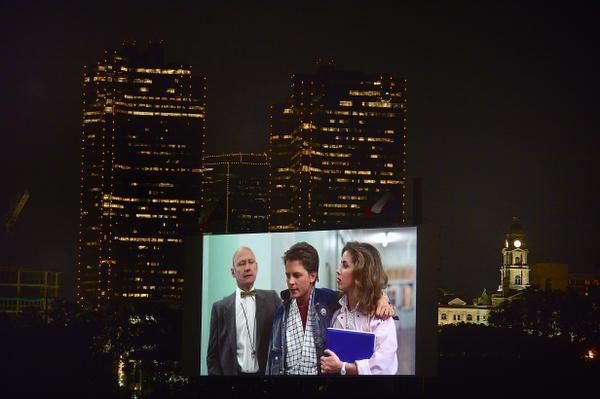

Posted by Manny Knowles (Member # 1171) on 06-09-2013, 09:07 PM:
If you didn't want "sanctimonious spouting," why'd you come to Film-Tech?
Don't you know we actually do believe in doing things the right way? (Maybe not, with only 4 posts.)
What sort of advice did you expect to receive?
More to the point: What did you want to be told? I'm curious.
And I'll concur with Brad -- I've seen a few converted drive-in's and they're all WAAAY better with digital.
Posted by Dave Handley (Member # 1637) on 06-10-2013, 03:24 AM:
Nope, I am not the disgruntled projectionist who just got the boot when digital went in. The two guys who have owned this drive-in now for about 5 or 6 years (former Disney exec's) were interested (naturally) in getting and maintaining really first class film presentation, which I delivered. The place is just a few minutes from my home and has been something of a pet project/labor of love for many years, along with my projection/sound servicing of just a handful of screens around SW. OH, Eastern Indiana and N. KY. The digital image is stunning of course but in this case we all feel it is simply not enough better. It is indeed noticeably dimmer. As the 7FL new level will slide to around 3.5 to 4FL near 4-500 hrs. Average performance then it would seem, be a bit beyond dismal. Contrary to dealer/installer opinion, and based on what I am hearing here (a pretty damned good source of practical and engineering points of view), I believe this can all be improved upon. Thats it, believe it or not. Thanks.
Posted by Steve Guttag (Member # 268) on 06-10-2013, 06:37 AM:
While the 4.5 +/- 1 fL for 3D does indeed suck (you've never seen me endorse 3D or excusing 3D from meeting the standards, the DCPs for 3D are TIMED for 4.5fL so that the blacks are not lost so it ISN'T "anything goes" It acknowledges the shortcomings and provides, in a controlled way, a suitable solution, for now.
Everyone that I know in the industry WANTS 3D to also be at the 14fL standard...hence the laser light sources to allow larger screens AND 3D to attain the same standard as 2D. The big winner on lasers for 3D would be Dolby, believe it or not. They would shoot from 10% (on a good day) efficient to 50% efficient! Filtering light aways takes away...much better to start with what you need.
I don't think the Drive-In situation has been adequately evaluated though. 14fL on a Drive In screen, by and large, can look ugly due to the screen construction. Coming up with a suitable Drive-In PCF would probably mitigate much of working with less reflected light.
Posted by Dave Handley (Member # 1637) on 06-11-2013, 09:07 AM:
First off I would like to correct some information I put out here about this install. The throw is 230', 80' wide screen. So scope throw ratio is 2.87 and flat is 3.59. The installer has installed the 2.8-5.5 lens which is actually useable BUT forces maximum magnification for scope. I'm not an optics expert, but I have always noticed a steep downturn in light output at extremes of zoom useage, especially magnification (yes I compensated for projected image size). With a 2.15-3.6 lens available I suspect that would have been the correct choice and not the 2.8-5.5. Brad scores once more I think on this! The other correction is although the advance spec sheet stated a 6.5KW bulb, the machine was delivered with the standard 6.0 KW Ushio and a PHILLIPS 6KW spare (which needs to go right back to where it came from) The port glass is probably non-coated lead free however I havent had the chance to check it(strong product). The entire port frame needs to be removed, turned upside down and re-installed for the reflection issue I previously mentioned (this is a drive-in, not an indoor cinema). I do know that if normal eighth inch plate glass has been used we get another 1.5 to 2 fl of light loss.
I would very much like to see Steves recommendations on PCF changes related to Gamma reduction put into play here, but I am not sure this project is currently in the right hands to get it done and this equipment is of course theirs for at least a year. Any suggestions? His recommendations on going with anamorphic setup I actually early on suggested to the owners, but due to Barco removing that option from their catalog, I assumed it was no more. I since have come to question the validity of it at all for two reasons. We dont have the option of prime lensing (only light sucking zoom PLUS the anamorphic) and we no longer have an image carrier with significantly more useable vertical space than its native aspect of 1.78 (gotta double check this). But even if we had that 23% gain (which WAS the kind of gain with 35mm and its 2X factoring), getting in this case that 7fl. up to 8.6 fl. falls short of a high enough goal to justify that ten to fifteen grand. So if ever there was a moot point... Thanks for the feedback!
Brad, those pics look like MAGIC has happened on a drive-in screen. Of course some of us know the first pinciple of magic: lie like a rug (lol). Seriously, good job--it looks breath takingly incredible.
Posted by Steve Guttag (Member # 268) on 06-11-2013, 11:38 AM:
The imager has a ratio of 1.896:1 so your throw ratios are wrong. Using your supplied data the Flat throw ratio would be 3.62 and the Scope would be 2.88 so the lens chosen is the correct one. Generally speaking, a zoom lens will be "brightest" with the lens zoomed for the largest picture (towards the short-end of its range).
If the gain of your screen is indeed 1.0, then on a new 6.5KW lamp, you could expect 9fL on scope. With an Anamorphic, basically 12fL. It is the difference between being in DCI compliance and not. As for adding an anamorphic, it is true that Barco has turned their back on it...but the lenses are still there (Schneider/Isco) and Moving Image Technologies makes a mount/mover for it. Using the GPIO port on the projector, you could trigger the lens to move in at the correct time.
But moving back to reality a bit. Anyone that specifies a system based on the NEW lamp is a bit deceitful (though that is how it is done).
If the gain is really 1.0, then about 6.5 is about as much as one can sustain (sans anamorphic). However, I hear with a fresh coat of paint like the SW A-100, the gain is closer to 1.4 or 1.5 (I have not measured to verify). If so, then that changes things a bit. With 1.4 gain and getting the port glass right, it would bump up to about 9.7fL and again, with an anamorphic, we are up to just shy of 12fL.
More importantly, with an anamorphic, the light needed between scope and flat move much closer making the lamp's life a bit better.
As for gamma and such being in the right hands...whos hands do you want it in?
Powered by Infopop Corporation
UBB.classicTM
6.3.1.2