This is topic Does DLP chip size have an impact on image quality? in forum Digital Cinema Forum at Film-Tech Forum ARCHIVE.
To visit this topic, use this URL:
https://ft-forum.com/ft/cgi-bin/ubb/ultimatebb.cgi?ubb=get_topic;f=16;t=001533
Posted by Jon Augustyn (Member # 7644) on 06-13-2013, 02:36 PM:
Putting aside 4k and light output, do the larger chips offer better image quality? 1.2 > .98 > 0.69 ?
For example, on a 20' wide screen would a Barco DP2K-12C look better than a Barco 2K-10sx? Or maybe a better example, would the DP2K-19B look better than the DP2K-19C?
Posted by Carsten Kurz (Member # 5396) on 06-13-2013, 03:20 PM:
Definitely existing 0.69" machines have a somewhat lower contrast ratio. Wether that is due to the chipset itself or compromises that had to be made to increase light output, I don't know. Other than that, I think you won't realize actual image quality differences between DLPs. Lenses, contrast, MTF, sure there are measurable differences, but from the patrons seats, I don't think you will see noticeable differences.
My personal criteria would be light efficiency/cost ratio (->1.2") or portability/lowest entry cost (S2k).
With the advent of S2k machines, the 0.98" systems are at an even less attractive pricepoint than before.
- Carsten
Posted by Steve Guttag (Member # 268) on 06-13-2013, 06:51 PM:
From an installation standpoint...I've noted that the 1.2" machines almost always have a more crisp image (very noticeable with test patterns).
Posted by Brad Miller (Member # 2) on 06-13-2013, 09:30 PM:
I'm with Steve, the 1.2 inch chips found in Barco B series and Christie 2220/2230 machines put out a better image than the 0.98" chips. I haven't done much testing with the 0.69" chips yet.
Still what makes more of a difference to me is a quality lens. Christie uses exclusively Minolta lenses, whereas Barco does not. So if you put up for example a Barco with one of their off-brand lenses (Fujinon, Infocus, etc) against a Christie where you are guaranteed a Minolta lens, the Christie will win hands down. With Barco only a few select lens sizes are available for Mintolas, and their B lens mount is a joke, inducing vibrations that effectively cut down the resolvable resolution, so again Christie's image quality wins again.
Posted by Monte L Fullmer (Member # 2797) on 06-13-2013, 11:51 PM:
Thus, we're talking about the results of the presentation - like with audio: one can have the snazziest setup ever constructed, but you'd better get speakers to match the source.
Thus, it can look like what audiophiles do: work backwards with speakers first then the system to match.
Can this make NEC, BARCO, SONY and others be 2nd rate in presentation to Christie due to Christie uses the Minolta lens sets?
Posted by Steve Guttag (Member # 268) on 06-14-2013, 03:42 AM:
For the most part,NEC uses Minolta too.
Posted by Marcel Birgelen (Member # 6801) on 06-14-2013, 04:10 AM:
Shouldn't a larger chip size also reduce the screen door effect, at least if you compare two chips of equal resolution?
Posted by Carsten Kurz (Member # 5396) on 06-14-2013, 05:15 AM:
That only works for the 0.98" vs. 1.2" relation - and that is why 1.2" is brighter and has slightly more contrast. AFAIK the 0.69" 2k and 1.38" 4k DLPs are based on the same production method and have identical pixel measures.
The 'relative' screen-door of the the 4k is 'smaller' than that of the 1.2" 2k, and that is also why the 0.69" have an even smaller screendoor, hence less light efficiency. Same basically for 4k 1.38" , but as far as brightness is concerned that is counteracted by the larger target/Xenon efficiency. And the reason why xenon is not the optimal choice for the small 0.69" imagers.
I have heard people saying that after an upgrade of their 2k DLPs to 4k light engines, the image had slighty less punch.
BUT - a very sharp lens also reproduces the DLP screen door/pixelshape more exactly and introduces less 'optical smoothing'.
A DLP pixel is not just a 'dot', but a complex square shape with spacing inbetween, all of these features show their own interaction with the screen perforation, depending on the projected size of the pixels.
I thus feel that 1.2" 2k DLPs produce more pronounced moire artifacts with typical screen perforations. Which is bad because moire is the only image artifact left in an otherwise perfect digital presentation.
Different quality lenses of course, for 0.69", 0.98", 1.2" and 1.38" (same as 1.2", but new high contrast lenses should be used for 4k) also do have an effect.
- Carsten
Posted by Frederick Lanoy (Member # 5416) on 06-14-2013, 05:20 AM:
I agree with Brad and Steve. We have changed a DP2K20C for a DP2K23B to get more light on a 3 D screen. The image looks sharper and i have the feeling that the contrast ratio is also better. Yet i don't really have an explanation for the last point.
Posted by Steve Guttag (Member # 268) on 06-14-2013, 06:00 AM:
As I understand it...the .69" chips are based on taking the 4K chip design and cutting it into 1/4s so it should have similar issues as the 4K chips (4K generally has a lower contrast ratio and less "purity" on color).
As for xenon and .69 and light...it is all about the size of the "point-source" for the light and the aperture you are trying to get through. The smaller the aperture, the smaller the light source has to be for efficiency.
Morie is a bit more complex than some are making it out. Things that make it more pronounced are when the perforation size in the screen is on par with the pixel size. as the grids line up...Tiger-stripes develop. Since the screen grid size is based on the manufacturer's material and not screen size, it is all about the magnification of the image (larger screens will have larger pixels but the same size perforations...smaller screens will have smaller pixels but the same perforations).
As for digital's "perfect" picture...please...just stop with that nonsense. Ever seen a credit scroll? How about any diagonal line? Or SXRD trying to reproduce green? And the list goes on. Morie is just a common problem that most have been frustrated with, to some degree.
Posted by Carsten Kurz (Member # 5396) on 06-14-2013, 06:40 AM:
Steve, I'm not watching movies for credit scrolls ;-)
From a normal viewing distance, single line aliasing is hardly visible, but moire can be visible even from the back seats, and it can be quite annoying.
- Carsten
Posted by Monte L Fullmer (Member # 2797) on 06-14-2013, 02:05 PM:
quote: Steve Guttag
As for digital's "perfect" picture...please...just stop with that nonsense
Kinda shows that analog wins again, but who really cares?
Posted by Steve Guttag (Member # 268) on 06-14-2013, 02:27 PM:
I didn't say analog wins...I merely point out that most every technology has its up and downs and digital is almost never perfect...for most things, it is an approximation. Its speed/datapath...etc. allow it to to better or worse.
Posted by Aaron Garman (Member # 1653) on 06-14-2013, 02:35 PM:
But HD-DVD was PERFECT! It says so right on the disc!!!
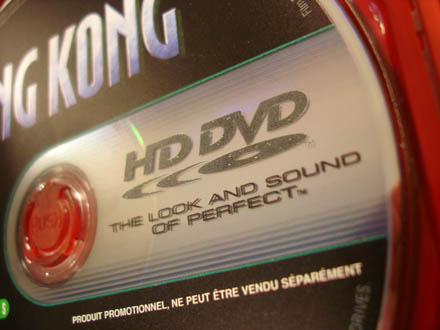
Toshiba wouldn't bullshit us!
AJG
Posted by Jack Ondracek (Member # 1466) on 06-14-2013, 09:02 PM:
I wonder what baseline tests might be available to fairly evaluate lenses.
With all due respect, I'm pretty happy with the results of my Barco "off-brand" lenses, and with nearly a 500-foot throw, I detect no vibrations that might reduce resolution. I've seen the Christie output in a large screen application, and I'm not sure there's that much of a detectable difference. For all I can tell, you could chalk up a certain variance to installation & calibration quality.
I'm all for brand preference, and I have my favorites, but I'm not sure that merely being "not Minolta" is a particularly fair proclamation against Barco.
Posted by Steve Guttag (Member # 268) on 06-14-2013, 09:14 PM:
Jack,
When you've put in many, many systems across several brands (both projectors and lens manufacturers)...you can see definite trends. Your sample of one theatre is not enough to judge a generalization by.
They ALL have their good and bad batches...nobody is saying the inVision and Fujinon don't have good lenses but their ratio of good-bad is not as good as Minolta.
I don't consider either InVision nor Fujinon "off-brands" myself but you ask ANY installer if you needed "x" size lens and I lined up 10 Minoltas, 10 InVisions and 10 Fujions and based on their lens selection their entire reputation would be judged...just see how many would reach for the Minolta pile versus the others.
Even within the Minoltas, there are better/worse ones as well as High Contrast versus High Brightness (in the Christie line up)...The High Contrast does tend to do well.
For InVision, they are the only ones that have some sizes designed for 4K MTFs.
In fixed focal length lenses (almost always going to be better than variable-focal length), Schneider is there and seems to be better than the other brands too.
As to image vibration...on the Barco B series...it really depends on lens, stability of the floor and projection angle. If things are not to your favor...even a roof-top HVAC system can put a good shake in the image (without you feeling it in the floors/walls)...I've had that. I have some that are just rock solid. They support their entire lens mount from the bottom and it is spring mounted and HAS to have slop to allow for the focus mechanism. Their "fix" for it was to mount a spring loaded ball-bearings to press down on the top. Often one can find a sweet spot on the spring tension to minimize the vibration. Compare that to the focus racks of the other brands.
Posted by Monte L Fullmer (Member # 2797) on 06-14-2013, 11:40 PM:
deleted
Powered by Infopop Corporation
UBB.classicTM
6.3.1.2