This is topic Laser "upgrade"? in forum Digital Cinema Forum at Film-Tech Forum ARCHIVE.
To visit this topic, use this URL:
https://ft-forum.com/ft/cgi-bin/ubb/ultimatebb.cgi?ubb=get_topic;f=16;t=001619
Posted by Jack Ondracek (Member # 1466) on 09-04-2013, 09:04 AM:
I've been watching the story about a laser projector, about to be installed in the Seattle Cinerama. This makes me wonder if we'll see the technology at the smaller theater level any time soon.
Barco maintains that they'll build an upgrade that basically allows you to convert to laser by swapping out the light module. Interesting, if it works out that way.
I have two "23-B" models that put plenty of light on my back screens. I don't see the (assumed) cost of converting them being paid off in xenon savings during my lifetime, so I'm not considering conversion of those two. As for my big screen (86 ft with a 32-B), I would consider upgrading that one.
The light on my big screen is adequate, but doesn't pop like the back ones do. I'm also burning through bulbs. 4 of them have gone out on me during my 7-month season. I'm averaging 130 - 150 hours on the Ushio 6.5kW lamp before the anode droops and won't strike. Maybe I shouldn't complain... I'm getting free replacements, but we do have to keep an eye on the machine. One of my 4kW bulbs had the same thing happen with something like 600 hours on it.
Cooling isn't an issue, at least as applies to specified operation here. Barco specs something like 350cfm external. I'm running twice that. Due to the dusty environment here, I'm venting the machines directly into the booth and pulling the heat out with commercial air conditioners. They maintain a constant 73 degrees in the booth.
I assume that, cost notwithstanding, laser would cure all those problems. Less heat? The Cinerama says the Christie laser will do over 60,000 lumens, too.
Posted by Dave Macaulay (Member # 813) on 09-04-2013, 09:14 AM:
There's a vast lack of information on the laser lamphouse. From what I have heard it is brighter, uses less power, and doesn't "burn out" either ever or not in a very long time.
What I haven't found out is how well the de-speckling works.
Posted by Bobby Henderson (Member # 840) on 09-04-2013, 09:26 AM:
I thought IMAX had the patents or some sort of exclusive arrangement over the use of laser-based video projection. Does this mean we'll see the various IMAX-D rivals (XD, RPX, ETX, AVX, BigD, etc.) installing dual 4K laser projectors to match what IMAX plans on doing?
Posted by Steve Guttag (Member # 268) on 09-04-2013, 11:46 AM:
Jack, what is odd is that we have customers with the Ushio 6.5K. All have made it to warranty without incident. They have, at most 600cfm too. We did drop one of them back to the 6KW and that one too made it to warranty without incident (did real well, in fact...very low light fall off...the DXL-60BA2/L. I'm wondering if the lamp not striking isn't partly a Barco issue...they have the weakest igniter of the bunch and their software has it give up a bit too soon. I have had to put multiple strike cues into our automations...mostly to deal with Osram though. Ushios normally are just not an issue.
As for lasers...they are not talking about an indefinite life span...the longest I've seen published is approaching 50K hours...most seem to be talking about 20K-30K hours. So we are talking about 10-15 xenon lamps on the smaller side but 40+ lamps on the larger.
The cost of lasers will REALLY need to drop down for them to make economic sense in most cinemas. Those with 4500 watt and above lamps, it starts to make sense.
Posted by Scott Norwood (Member # 30) on 09-04-2013, 12:45 PM:
How does the laser thing actually work? Separate red/green/blue lasers? How does the laser beam get do the DLP chip? Is there a beam spreader to make the laser beam cover the area of the chip, or does a narrow beam scan the chip line-by-line (like a CRT)?
Is the benefit just operational (less heat, more light, no lamp changes), or does the image quality improve in some way as well?
Posted by Marcel Birgelen (Member # 6801) on 09-04-2013, 12:46 PM:
I'm wondering... how will this whole upgrade thing work in a 3-chip DLP setup? A laser projection system doesn't use a single light source, it uses three.
So, for this to work, you would need to change the whole light path from the sources to their respective DLP chip. Only what comes after the DMDs could possibly stay the same.
quote: Scott Norwood
How does the laser thing actually work? Separate red/green/blue lasers? How does the laser beam get do the DLP chip? Is there a beam spreader to make the laser beam cover the area of the chip, or does a narrow beam scan the chip line-by-line (like a CRT)?
There are three separate light sources for R, G and B. Either, you flash the different light sources at a single DMD (like the color-wheel or LED based single chip DLP chips), or you have a dedicated DMD for every color.
The laser beam, in the setups I've seen, is spread over the whole chip. The problem with this technique is that it creates a static speckle pattern that needs to be hidden/blurred somehow.
There are also some laser projectors using a CRT-style technique, but they don't seem to be proposed for cinema usage. The main advantage of such a setup is, that you don't need any lenses to focus the picture. The biggest disadvantage is the non-static picture, which can introduce flicker.
Posted by Louis Bornwasser (Member # 3063) on 09-04-2013, 02:43 PM:
Most industrial lasers have an "exciter bulb." This is in cost similar to xenon.
But c'mon guys. . . .sign contract, mail money, don't ask too many questions! Louis
Posted by Carsten Kurz (Member # 5396) on 09-04-2013, 05:02 PM:
Most LIPs use multiple laser sources (some hundreds) as a first measure to reduce speckle. As far as I know, the better ones use multiple methods to reduce it.
http://lipainfo.org/wp-content/uploads/Greg-Niven_Projection-Summit-2012.pdf
To my knowledge, the Barco retrofit option actually attaches to the light pipe, it sends all three colours through it, simulating a white light source like the Xenon bulb. This could be improved technically, but is probably not possible without replacing/deconstructing the whole light engine. You do not get to the individual RGB paths without that, and then the retrofit idea is no longer there.
As a side effect of this simple retrofit idea, there is little improvement in overall picture quality - especially On/Off contrast remains as low as before.
Kodak used a dedicated laser based design, which among other things achieved higher contrast using DLP imagers. Wether IMAX goes the Kodak way, or follows the Barco retrofit strategy, or a mix of both, who knows?
Scanning concepts are not used in cinema projectors. The only professional alternative approach so far nearing market readiness could be REDs laser projector, which to my knowledge uses grating light valve technology.
Sony already demo'ed a laser illuminated cinema projector using their SXRD imagers. So all relevant imager technologies can use laser illumination. Sony even has 3LCD based business laser projectors in the market.
NEC has a 5000 lumen professional laser projector ready for this autumn. Seems to be based on their large venue or maybe even their DCI projector engines. Is said to cost more than 150.000US$. 4k, 20.000hrs laser life span. The idea is simply to cut costs for units with high runtimes like in the simulation or entertainment market. Not only runtime of the light source, but also to reduce wear on other components during continuous operation.
NEC says they can offer upgrades to 10.000, 30.000 and 60.000 lumens once laser safety regulations are relaxed.
Still, I don't see this coming to cinemas soon. Only very large screen operators will have an economical benefit.
- Carsten
Posted by Edward Havens (Member # 4715) on 09-04-2013, 07:36 PM:
One also needs to look at the marketing aspect.
In my neck of the woods, we were the first theatre to be all-digital projection when we opened back in 2008. Five years later, the moviegoing audience in our market still equate us with being the best theatre to see a movie at, even though all our competitors save one have since gone digital as well. Our guests saw the difference in the picture and sound quality versus the other houses, and we've been enjoying a 55-65% market share since the day we opened. Adding an IMAX digital system in 2011 has only helped increase our market share, since we have the only IMAX system in the entire county. People will drive 25+ miles, past two competitor houses with their PLFs, in order to see our IMAX presentation. I even got a compliment about our theatre when I was getting something to eat at a Burger King drive-thru just last night, a good 25 miles from my theatre.
Being one of the first to have something like Laser Projection will be a leg up on your competition. Start watching the local Seattle grosses now, and watch them jump at the Cinerama when present something like Thor or The Desolation of Smaug or Captain America exclusively in 4K Laser Projection.
Something like sound most people don't care too much about. Most non-industry people don't have the capacity to understand the difference between 4-track Dolby A, 6-track magnetic, 8 Channel SDDS or Atmos, but they can certainly see how much clearer most DLP presentations look compared to what they used to get at poorly-maintained 35mm houses of the past. And Laser sounds newer and cooler than mere digital projection.
Posted by Carsten Kurz (Member # 5396) on 09-04-2013, 09:10 PM:
That's 150.000US$ for a rather narrow marketing channel.
- Carsten
Posted by Mike Blakesley (Member # 26) on 09-04-2013, 10:31 PM:
We saw the laser demo at CinemaCon last year. While the 3-D picture was definitely brighter than Xenon, it still looked dim-ish. I was hoping that the laser image in 3D would be as bright as a nice 2-D image, but nope...the colors still looked gray-ish and muffled compared to the same image in 2-D. Better than Xenon, but not "nearly-the-cost-of-another-digital-projector" better. I expected to be overwhelmed with a "gosh, I've GOTTA have that" feeling but.....I wasn't.
They DO have a good point about less heat, less lamp replacements, less power; but even so...it would take a l-o-n-g time to pay that price off in savings per screen.
Posted by Jack Ondracek (Member # 1466) on 09-05-2013, 01:08 PM:
quote: Steve Guttag
Jack, what is odd is that we have customers with the Ushio 6.5K. All have made it to warranty without incident. They have, at most 600cfm too. We did drop one of them back to the 6KW and that one too made it to warranty without incident (did real well, in fact...very low light fall off...the DXL-60BA2/L. I'm wondering if the lamp not striking isn't partly a Barco issue...they have the weakest igniter of the bunch and their software has it give up a bit too soon. I have had to put multiple strike cues into our automations...mostly to deal with Osram though. Ushios normally are just not an issue.
As for lasers...they are not talking about an indefinite life span...the longest I've seen published is approaching 50K hours...most seem to be talking about 20K-30K hours. So we are talking about 10-15 xenon lamps on the smaller side but 40+ lamps on the larger.
Steve, good thoughts.
I don't see anything wrong with the projector. When relatively new, the bulbs strike whenever you turn them on. The anode droop is pretty easy to see. You can tell the plasma ball isn't hitting the center of the anode. Rather, it's hitting the top third, then rolling off the top of the anode. Do they put magnets in these lamphouses, too?
Admittedly, I'm not giving the 6.5kW bulbs much of a break. It's taking everything they put out to give me a good picture on my 86-foot screen. By the time they quit, the drop-off is pretty noticeable. I don't doubt I'd get better life if I turned them down. In any case, I'm not taking them anywhere the projector isn't willing to send them, power-wise, and they're running within spec. Seems they ought to get a lot closer to warranty, if not meet it. In the meantime, I'll accept the replacements until someone figures out what's happening. I've hit the screen with the output of a fresh bulb 4 times this year... something that's pretty unusual for anyone, I suppose.
The other interesting thing (to me), is that while I didn't make a habit of rotating my bulbs when I was running 35mm, it isn't an option with these Ushios. the wires are too short.
As for lasers... I'm running about 900 hours a season, +/-. At the short end of your life estimates, that gives me 22 years on the system. I'm really hoping to turn this place over to someone else by then!
Still, that works out to 29 bulbs, assuming I made warranty on all of them. At roughly $1,700 each (w/tax & shipping) and no price changes (!), that's just over $49,000 for light. Since I'd be spending the money anyway, getting a better product for a conversion cost in that ballpark wouldn't be a deal breaker for me.
Posted by Mark Gulbrandsen (Member # 72) on 09-11-2013, 04:52 PM:
Jack...
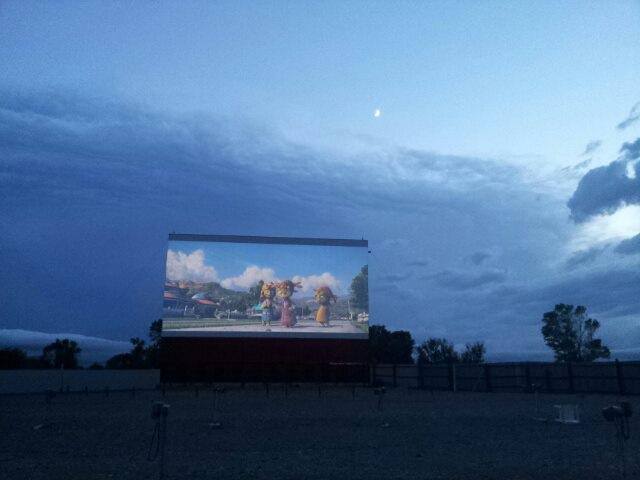
You mentioned you are getting only ~150 hours out of the Ushio 6.5kw lamps and I find that really odd. I did a drive in conversion with an NC-3240 quite a while back and they have not had any issue at all with large Ushio lamps. Their screen there is 115' wide and the light level is brighter than most indoor systems. Screen is pretty good shape... but still just a painted surface. They are now closing out their second "digital" season on the new projector with the same 6kw Ushio lamp.
I also have another customer closing out theor first season with an NC-3200 running a 4kw Ushio on a metal surface 78' wide screen. No lamp issues there either and brighter than all get out. I only have the lamp level at 82% for scope on this screen! They passed the 300 hour mark already...
You must have some other issues there you are over looking... Air temp on the intake, exhaust air flow, projector or rectifier issues, etc. Both these locations did air condition the booth but that was the only other addition other than the 4K projector on the larger screen. Perhaps look at other options to lessen lamp strain... better screen surface or going to 4K on that one.
Photo taken at 8:50 PM MST: scope image, 4kw lamp at 86%. Screen does face east. Screen surface is approximately 27 years old. Has never been painted... has never needed to be.
Mark
Posted by Brad Miller (Member # 2) on 09-11-2013, 10:28 PM:
quote: Mark Gulbrandsen
I did a drive in conversion with an NC-3240 quite a while back and they have not had any issue at all with large Ushio lamps. Their screen there is 115' wide and the light level is brighter than most indoor systems. Screen is pretty good shape... but still just a painted surface. They are now closing out their second "digital" season on the new projector with the same 6kw Ushio lamp.
Your indoor installations suck then.
Just sayin' ![[Razz]](tongue.gif)
Posted by Mathias Decru (Member # 7857) on 09-12-2013, 05:03 AM:
As it looks now, all companies are going a different route on how they implement the laser technology and some are getting very high contrast, but are unable to deal with specle reduction. It'll be a difficult choice.
Biggest plusses: Contrast goes up; Long lifetime of the lasers compared to Xenon; and higher lightoutput/efficiëncy.
Biggest downsides: Specle and Initial cost, which is to be expected for all early adopters of new technology. It's the price you pay for being the first. Look at new computer or smartphone technology..
Posted by Mark Gulbrandsen (Member # 72) on 09-12-2013, 03:02 PM:
Notice I said "most" installations. Mine all meet spec... Including the outdoor sites. I have seen way too many crappy digital installs around here... Way too many Sonys!
Re lasers..... I'd also want to know what the projected fade rate is gonna be as all lasers outputs decline just like LED's do. Once they decline enough the laser will cease to operate and no longer light.
Mark
Posted by Jonathan Bodge (Member # 4072) on 09-12-2013, 08:47 PM:
Mark, what a beautiful picture. (A few posts back) I went to Infocom a few months ago and I saw a laser projector that hit a prosperous plate, then went to the imager. I liked that the projector could be turned any degree angle at any axis. (Which in our television business solves many problems) I was told that a real laser however, straight from the projector has legal problems because of lasers potentially hitting the eye. Any feedback on this?
Posted by Mark Gulbrandsen (Member # 72) on 09-13-2013, 05:36 PM:
Jonathan...
Any laser used for this purpose (and any other purpose where public exposure may occur) has to be approved by the FDA... so yes... there are some technical approval and possible legal ramifications involved in using lasers.
Powered by Infopop Corporation
UBB.classicTM
6.3.1.2