This is topic HFR in 2013 in forum Digital Cinema Forum at Film-Tech Forum ARCHIVE.
To visit this topic, use this URL:
https://ft-forum.com/ft/cgi-bin/ubb/ultimatebb.cgi?ubb=get_topic;f=16;t=001717
Posted by Steve Guttag (Member # 268) on 11-29-2013, 08:42 PM:
So in 2012, HFR (High Frame Rate) was ALl the buzz in the industry...everyone was boasting what equipment was required...that this was going to be THE thing that separates the men from the boys...that will make 3D actually be worth while...etc.
The Hobbit comes out in 48fps and, at best, the reviews of HFR were mixed with the majority, seemingly, being against the look of HFR.
Combine that with WB being stingy with HFR versions of the movie so those that invested in IMBs that could run it...were denied digital copies as if it was like film and one had strike a special 70mm print for each site.
So this year, I've barely heard a peep about HFR...there has been much more talk about "immersive audio" like Dolby's ATMOS, and to a far lesser degree, Barco's 11.1.
So, it is that time of year again when the second installment of The Hobbit is coming out in just a couple of weeks and I'm still not hearing anything about HFR for it. Are they scrapping it as a bad idea? Are they issuing it on the sly this time? Can anyone that has the equipment get it? Will it be highly restrictive and Top Secret again?
Is there anyone out there slated to run Hobbit this year in HFR 3D?
And what about HFR 2D? There is no reason to limit HFR to just 3D...ToddAo used 30fps with 70mm 2D, ShowScan used 60fps with 70mm and 2D and it was amazing.
Is James Cameron still going through with the next Avatar in 60fps? If so, I don't see anyone really preparing for it yet but I guess they'll wait until the last minute to issue test material, suitable blank CPLs...etc.
Posted by Jock Blakley (Member # 6552) on 11-29-2013, 09:31 PM:
IMAX Melbourne have Hobbit 2 scheduled for both 15/70 3D and HFR digital 3D, the latter apparently "by popular demand".
Of course 2D HFR is technically possible - it's no different in overall frame rate to standard 3D. Apparently the decision to restrict HFR to 3D only was primarily because it looked so appallingly bad in 2D. It was pretty obvious that on the back of the poorly-received preview screenings that Warner's took fright and wanted to limit their exposure, so to speak.
Personally I can't say I'm interested in any way... even the 2D SFR trailers for the first Hobbit looked a bit strange. I ended up running one against a 35mm trailer for LOTR 3 just to check that it hadn't looked weird either.
Posted by Victor Liorentas (Member # 5272) on 11-29-2013, 09:41 PM:
Douglas Trumbull made a 10 min 4k HFR 3d short which was meant to be a big demo in the summer just past. I haven't heard a thing about it since.
I don't know if he has given up or what?
He also shot it at 120 fps to be projected at 60 or multiple frame rates.
All has been quiet since the summer.
The last I heard Cameron is shooting Avatars at 60 fps forever and ever! ![[Smile]](smile.gif)
Posted by Justin Hamaker (Member # 2165) on 11-29-2013, 10:14 PM:
Steve
Here's what's on the one-sheet on display at my theatre. I'm pretty sure I've also heard HFR on the TV ads.
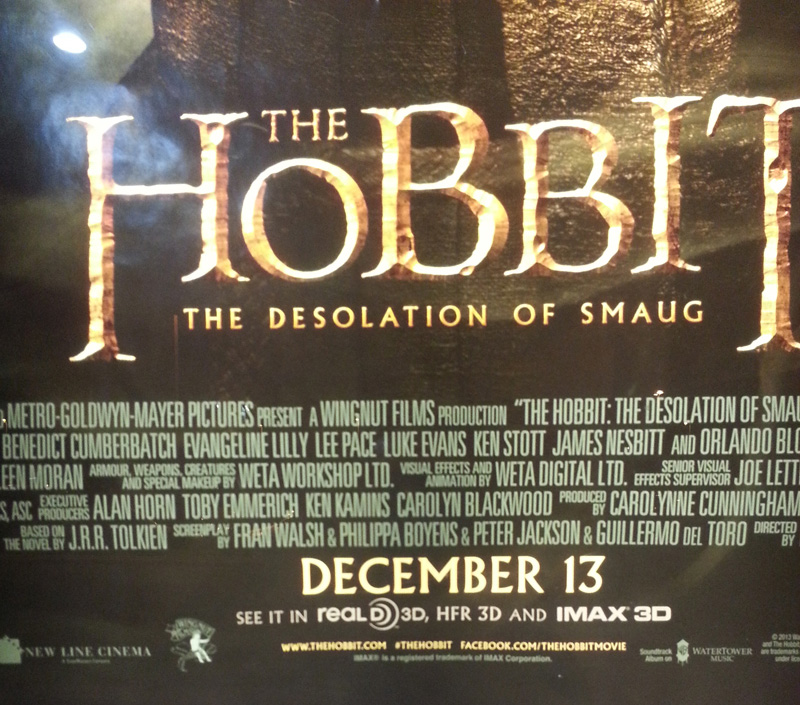
Posted by Mike Blakesley (Member # 26) on 11-29-2013, 11:49 PM:
That right there tells you they're just doing it out of an obligation to somebody, somewhere. I'd bet about 99.9% of people wouldn't have a clue what "HFR 3D" means. If HFR was "the" format to push, it would have been big and spelled out (and, if it was a Disney movie it'd have its own logo and be called "DISNEY High Frame Rate 3-D!"
Posted by Randy Pryde (Member # 7488) on 11-30-2013, 12:20 AM:
Steve,
Warner Brothers is allowing 3D HFR versions of Hobbit 2 to those exhibitors who ask. Their preference is to pick up locations that were not selected last year. They have also provided a FAQ flyer for posting at theatres and on circuit webpages.
We had a lot of patron requests last year, so have booked the HFR version of Hobbit 2 in one location as a test. Dolby had a nice price reduction on the media block for our existing DSS200.
Posted by Buck Wilson (Member # 5885) on 11-30-2013, 12:49 AM:
I REALLY enjoyed my HFR experience with the first Hobbit, I will absolutely be driving the 100+ miles round trip plus $12+ for the ticket to see the second one in HFR. It seriously blew my mind. Sure helped that that was my first Atmos experience too
Posted by Dave Macaulay (Member # 813) on 11-30-2013, 06:19 AM:
The Hobbit Pt 2 in 3D HFR is definitely on the schedule for a lot of the theatres I service. Does anyone know if a 2D HFR version will be available for it?
At least there's no HFR readiness test required from WB this time! (yet) It looks like any cinema that has HFR capability can book the HFR version, rather than the limited availability with part 1. That may be a nightmare for anyone lucky enough to be on call for opening night, the system still has to be configured and hopefully tested before it will work properly. There's still a dearth of HFR test material and probably the KDMs will open late.
For Doremi at least the current sw/fw setup is less clunky than the original "live beta" stuff. It still has to swap IMB firmware between HFR and ... LFR?? (normal) playlists but the persistent weirdness is gone - usually the server would show "PROJECTOR COMMUNICATION ERROR" in red across the playback window although it would work just fine, sometimes the projector tail-light would stay red (but show movies just fine). The server does a preroll and pause 2 minutes before a scheduled start time to allow the firmware swap to finish. Watch out that you don't have macros at zero seconds in your playlists.
Posted by Carsten Kurz (Member # 5396) on 11-30-2013, 07:35 AM:
Again, no 2D HFR. The procedure for getting HFR is the same as last year, you apply for it, you receive encrypted test footage, you give them feedback, you receive a HFR DCP.
This year they are not restricting it to only selected HFR capable locations - normal booking conditions. The only restriction I heard of in germany is that no Non-HFR previews and Double-previews are allowed. Means, if you want to see it at opening midnight, it has to be 3D and HFR.
- Carsten
Posted by Aaron Garman (Member # 1653) on 11-30-2013, 09:33 AM:
The local Cinemark has tickets on sale already for 3D HFR. They did not offer this last year. Finally, I'll check it out.
Now if only Atmos can get closer to home.
AJG
Posted by Steve Guttag (Member # 268) on 11-30-2013, 10:55 AM:
Justin,
Yeah, I like how the "HFR" is in the smallest, non-bold type as compared to Real-D and IMAX 3D. And as Mike said...it is as if the public would know what HFR means.
I wonder if they have done anything to improve the look of HFR at 48 with the year they've had to work on it or if they are just going to through it out there as-is...take it or leave it.
Posted by Pete Naples (Member # 761) on 11-30-2013, 12:30 PM:
Over here screens certified last year do not require re certification. So no checks on light level etc required ![[Eek!]](eek.gif)
Screens not certified last year require certification, same routine as before.
Posted by Brad Miller (Member # 2) on 11-30-2013, 12:55 PM:
HFR is dead and needs to stay dead.
It took the cinema out of movies and made everything home video. No long-term good could've come from that.
Posted by Martin Brooks (Member # 1269) on 11-30-2013, 01:56 PM:
Totally agree with Brad. The Hobbit looked horrible in HFR. The trailers for the sequel also look horrible. But the other day, I attended an AES meeting at the Dolby Screening Room in NYC and they showed a clip from the Hobbit in 2D in Dolby Atmos and it looked fine.
The problem is that in order to hear the sequel in Dolby Atmos, you're probably forced to see it in 3D because generally only those screens are so equipped.
Posted by Justin Hamaker (Member # 2165) on 11-30-2013, 03:54 PM:
I disagree about HFR being dead. It may not be ready for prime time, but I don't think we should be locked into the mentality that a movie in a theatre should look a certain way. I really think HFR has the potential to make action movies much more watchable and enjoyable.
Posted by Terry Lynn-Stevens (Member # 7349) on 11-30-2013, 07:39 PM:
We have a number of HFR locations in my area. At least 10+ in the local area, Cineplex even charges a surcharge for it as it is bundled in with Ultra AVX in my area. Cineplex is also charging extra for Atmos as that is bundled in as well with AVX but not with HFR. Cineplex added a number of HFR locations for this release along with the existing locations.
The formats we have are:
UltraAVX 3D High Frame Rate
IMAX 3D High Frame Rate
UltraAVX 3D Atmos (Can't be combined with Atmos) in local area
Regular 3D
IMAX 3D
Regular 3D High Frame Rate at one location only (Former AMC)
Regular 2D
Posted by Marcel Birgelen (Member # 6801) on 11-30-2013, 08:04 PM:
Besides not being released in 2D HFR, there probably won't be a 2D 4K release either.
I guess, the only option of showing it in 2D HFR would be by running a dual projector setup with one of the lamps off ![[Wink]](wink.gif)
I'm curious about the aspect ratio on this thing though... I've been told that the Digital IMAX release of the last Hobbit movie was in 1.78:1. If that's true, did the rest of the world see a letterboxed version of the IMAX release or did the IMAX folks see a pan&scan version of the scope release?
Posted by Arnold Chase (Member # 7988) on 11-30-2013, 08:42 PM:
The issue of most people reportedly not responding favorably to HFR continues to intrigue me. After much thought, I think the problem is really a case of "something different" or "It's not what I was expecting or used to" that is being translated as unsettling or off-putting.
I can relate to this when in the 1970's the television networks abandoned their 7.5kHz monaural Telco lines for the first digital audio system that gave them "high-fidelity" sound for the first time. Instead of the narrow, highly compressed sound that was reminiscent of A.M. radio, suddenly the audio was life-like and clear. My first reaction was, "I hate it"! After watching Walter Cronkite for all those years, suddenly he sounded different. Same thing with the cast of "Saturday Night Live". The new dynamic range was driving me crazy!
Here it is, decades later, and I wouldn't think of going back to the "old" sound, yet I still remember my first reactions well. A similar thing happened to me a few years ago, when after having listened to the newscasters on WCBS-880 (A.M.) for decades, I was now able to listen to them through my computer. Again, they sounded so different ! It was audibly far superior to the A.M. broadcasts, but the difference really bothered me the first time I heard them so "up close and personal".
HFR is clearly superior, and we WILL get used to it. For the new generation, they won't notice any problem with it at all. Do any of you want to go back to the old "Academy" sound systems? Even if you did, the audience would abandon your theater in a heartbeat. If people weren't looking for that "better than home" experience, they wouldn't be making the IMAX houses as popular as they are.
Posted by Steve Guttag (Member # 268) on 11-30-2013, 09:06 PM:
Arnold...I think you are wrong on this...HFR is not clearly superior...it doesn't look natural. I'm NOT a fan of 24fps...never have been. I preferred the look of 30fps in Oklahoma!, and definitely like the 60fps of ShowScan. But the 3DHFR stuff I've personally seen looked "wrong". That is, the motion looked wrong...it wasn't more natural but less.
I'd be all willing to be on the cheerleading side of HFR if it actually looked good...but what I've seen just hasn't impressed me...in fact, just the opposite...it was a let-down.
Posted by Marcel Birgelen (Member # 6801) on 11-30-2013, 09:11 PM:
I'm not totally anti-HFR, but I absolutely hated the look of the first Hobbit movie. As a side-note, I also hated the look of the 24 fps version, but the HFR version had more issues going.
So, if that same ugly look of HFR cannot be fixed, I'm not going to support HFR, just like I'm not going to support stereoscopic 3D for most releases, if it cannot be done without all the tradeoffs associated with it.
The problem here is that last year's release of The Hobbit made many scenes look absolutely fake. Even my girlfriend, which I explicitly didn't tell we're going to watch a "special version" and who had no real understanding of what HFR even means, did notice that there was something rather wrong with the picture, it looked fake.
I still remember the switch from Dolby SR to SRD. I loved it, why would we ever want to go back? I also remembered the first CDs and I didn't know why anybody would ever want to go back. Personally, I do embrace every step closer to a perfect illusion, but unfortunately, HFR hasn't yet proven to do that.
Posted by Arnold Chase (Member # 7988) on 11-30-2013, 09:37 PM:
I watched last year's Hobbit film in IMAX 3D, mistakenly thinking the IMAX theater was showing the film in HFR as a matter of course. After, I was able to 'sneak' into another theater that was showing a HFR version, in the few moments I had to analyze it, it looked more like video to me.
I am curious if the problems that you guys have seen are related to the 48 fps rate (maybe we inherently perceive that rate as troublesome), or is it just bad mastering? When the CD players first were introduced, I had my brother-in-law (who was going to Japan) bring me back two different players with some CD's. While I loved the absence of noise, frequency response, dynamic range, and instant access to any track, many discs had a harshness that was noticeable. As time proved, while there certainly were hardware improvements made such as roofing filter refinements, the mastering process itself needed the most refinement and experience to make things sound great. The same thing happened with DVD's.
I personally would like to see 48 fps just forgotten about and go right to 60, that way we know the audience would be experiencing a frame rate they're already used to.
Posted by Terry Lynn-Stevens (Member # 7349) on 11-30-2013, 10:57 PM:
quote: Justin Hamaker
I disagree about HFR being dead. It may not be ready for prime time, but I don't think we should be locked into the mentality that a movie in a theatre should look a certain way. I really think HFR has the potential to make action movies much more watchable and enjoyable.
quote: Arnold Chase
HFR is clearly superior, and we WILL get used to it.
Yes, people will get used to it and it become more commonplace, that is the trend that will happen. Like it or not the movie that will put HFR on the map for the general population will be Avatar 2, from there we will see a few directors take the chance and use it. James Cameron will likely insist on many theatres making upgrades to support HFR. The popularity for HFR for Avatar 2 will be what 15/70 was for The Dark Knight, after that we will have a few copycats but there will be very little buzz for it until Avatar 3.
HFR did not take off all that well with The Hobbit because The Hobbit is a fan-boy type movie. People should remember that The Hobbit did gross a billion dollar worldwide so HFR or not, it did not have any financial impact on the box office. Avatar did gross almost three times that without a built in audience so if James Cameron can get it right and into enough theatres, the general population will then have a chance to view it.
Posted by Justin Hamaker (Member # 2165) on 11-30-2013, 11:46 PM:
The only HFR I have seen was the WB demo of The Hobbit at CinemaCon 2012. I agree with what Steve said about the movement of the actors looking different in close shots. I don't know if it looked too fluid, which made it look unnatural, but it was definitely different. I did not run The Hobbit in HFR, or see it in HFR, so I only have that one experience to go by.
That being said, I though the wide outdoor shots were nothing short of amazing, as well as a few other things.
Where I see HFR being best used is for fast paced action scenes, for documentaries such as the Disney Nature films, and possibly for CGI/animated movies.
What I would be interested to see is if it's possible to only shoot action sequences at 48fps, and the rest of a movie at 24fps. Could this be done by essentially double flashing each frame for the 24fps portions of the movie?
Posted by Brad Miller (Member # 2) on 11-30-2013, 11:56 PM:
I'll bet the people who like or are on the fence about HFR have a tv at home they watch with that 120Hz refresh rate bullshit turned on. I've got news for you guys...turn that OFF and watch how much better your picture becomes.
HFR is nothing more than a retro 1980's VHS video look with more resolution! Yes indeed, let's step back to that time. ![[Roll Eyes]](rolleyes.gif)
Posted by Antti Nayha (Member # 4980) on 12-01-2013, 07:11 AM:
quote: Marcel Birgelen
I'm curious about the aspect ratio on this thing though... I've been told that the Digital IMAX release of the last Hobbit movie was in 1.78:1. If that's true, did the rest of the world see a letterboxed version of the IMAX release or did the IMAX folks see a pan&scan version of the scope release?
Just speculation, but it could have been a combination of both. Since they shot it with a RED camera, the native aspect ratio would have been 2.00:1. It's altogether possible that they composed it for a 2.39:1 framing in camera, and then opened it up vertically for IMAX while cropping about 5 percent from left and right at the same time.
Of course, showing more picture height in IMAX would have required rendering all the expensive FX for the whole picture area, not just for the 2.39:1 extraction which most of the world saw. They may even have opened it up for non-fx-shots only, simply cropping the rest. Who knows.
Back on topic, word on the street is that X-Men: Days of Future Past was shot in HFR but will only be released as regular 2D 24fps and 3D 24 fps versions. Another proof that the studios are still being really cautious about HFR.
Posted by Marcel Birgelen (Member # 6801) on 12-01-2013, 07:49 AM:
quote: Arnold Chase
I am curious if the problems that you guys have seen are related to the 48 fps rate (maybe we inherently perceive that rate as troublesome)
One of the most obvious problems was the “sped-up” motion in some scenes, that was clearly not present in the 24p version. I’m quite sure that this is a motion blur problem and can be solved by either shooting at another shutter angle or digitally adding more motion blur afterwards. But I don’t think you will ever be able to make it look good on both 24p and 48p without a lot of trickery.
When it comes to the video look, there are probably more things at work. First of all, I found the 24 fps version to be very video-ish too. That might have had several causes, like the lightning and the general aspects of the RED cameras (up until now, I don’t like the look of most features acquired on those cameras). I suspect that the higher frame rate just adds to the problem and thus brings us back to that “80’s sitcom” feeling.
quote: Arnold Chase
I personally would like to see 48 fps just forgotten about and go right to 60, that way we know the audience would be experiencing a frame rate they're already used to.
Large parts of the world are actually quite used to 50 fps or rather 50 fields per second. I guess that’s close enough to 48 fps. So, I don’t think that people inherently see this frame rate as troublesome. The reason for choosing 48p is rather obvious. Once 35mm has sadly gone the way of the dodo, you could probably easily ramp up to 60 fps and down-convert to 30p.
quote: Brad Miller
I'll bet the people who like or are on the fence about HFR have a tv at home they watch with that 120Hz refresh rate bullshit turned on. I've got news for you guys...turn that OFF and watch how much better your picture becomes.
Those same people also stretch 2.35:1 features into place on their 16:9 widescreens or use some “auto-stretcher” (that usually stretches the sides more than the center) to stretch the few remaining 4:3 features across their screen.
Posted by Antti Nayha (Member # 4980) on 12-01-2013, 09:35 AM:
quote: Marcel Birgelen
I've been told that the Digital IMAX release of the last Hobbit movie was in 1.78:1
It just occurred to me that I was actually told that the 15/70 release was 2.39:1. Dunno about the LieMax version.
Posted by Marcel Birgelen (Member # 6801) on 12-01-2013, 04:11 PM:
I've not seen it with my own eyes, so my info might be wrong... Not everybody is as obsessed with those things like I am .
I do vaguely remember even IMDB listing a different aspect ratio for IMAX, but that info hasn't always been reliable.
Posted by Joe Redifer (Member # 3) on 12-01-2013, 07:24 PM:
quote: Brad Miller
I'll bet the people who like or are on the fence about HFR have a tv at home they watch with that 120Hz refresh rate bullshit turned on. I've got news for you guys...turn that OFF and watch how much better your picture becomes.
Ug. I can see the effects of that a mile away. The problem is that it can be tough to turn off. Of course the first thing I did when I got my TV was to turn all of that off before even viewing any kind of signal input into the new set. It's not just a single option. You basically have to turn ALL processing off. All of it. Of course people like us will all (hopefully) want to do that anyway. Having DNR on or anything that has a has a label that's not CONTRAST/PICTURE, BRIGHTNESS, COLOR/TINT or similar not only adds tons of lag but will likely interpolate both the framerate and the image detail. So you'll get a shitty picture with a shitty framerate that's at least 4 frames behind the audio. Sign me up!
Posted by Bobby Henderson (Member # 840) on 12-01-2013, 08:07 PM:
The "motion flow" stuff on 120Hz and 240Hz HDTV sets is one thing that drives me nuts about walking into electronics stores or department stores that sell electronics. They tend to have that crap enabled on every demo TV in the store. That frame interpolation crap literally removes a lot of detail from a video. The texture detail on actors' skin or other objects goes from looking natural to looking like plastic. I try to tell sales people to turn off that shit, that it's probably causing them to sell less TV sets. The motion flow effect looks like videotape playing in fast forward mode.
The HFR thing doesn't have that problem since the video is shot natively in that frame rate. However, the video source origins scream out louder than they already do when shot of 48fps. The movie stops looking like a movie (or sort of like a movie) and then more like a "live from the set" video documentary about the making of the movie.
I think the HFR approach could work with dramatic material that doesn't need a film look. All those horror movies shot as 1st person POV camcorder footage might work really well in HFR. Sports shows and concerts would be good with it.
Posted by Mike Blakesley (Member # 26) on 12-01-2013, 10:06 PM:
quote: Terry Lynn-Stevens
the movie that will put HFR on the map for the general population will be Avatar 2
The way Avatar 1 did for 3-D? I doubt it. The 3-D in Avatar 1 enhanced the picture, it didn't make it look like a bunch of plastic models being viewed from a helicopter.
Posted by Arnold Chase (Member # 7988) on 12-01-2013, 10:22 PM:
When HDTV was about to be introduced, everyone behind the camera was going crazy because of the feared "new flaws" that would now be seen on the on-air talent, as well as the materials on the sets that would appear to look fake.
Does anyone still think that way now?
Posted by Danial Simmonds (Member # 4638) on 12-02-2013, 01:42 AM:
Here they are releasing hobbit in HFR 3D too same as last year, all sites had to be tested before the KDM/DCP was distributed.
Ive seen 48FPS HFR and it is true as many has said, i wonder how would 60FPS look like, is there any movies coming out with 60?
but i believe this is an effort to improve the motion picture industry in the long run same as what Dolby has done for ATMOS which is great improvement for Audio experience.
Posted by Manny Knowles (Member # 1171) on 12-02-2013, 02:33 AM:
quote: Justin Hamaker
I don't think we should be locked into the mentality that a movie in a theatre should look a certain way.
Perhaps not, but this has been the trend with movies pretty much every step of the way.
Long form replaces short
Sound replaces silent
Color replaces B&W
Widescreen replaces Academy ratio
AR's limited to 1.85 and 2.39
Digital replaces analog (first sound, then picture)
...even 70mm got kicked to the curb once digital sound eliminated the need for those mag tracks...
I'm not psychic, but I could safely guess that pretty much any first-run/mainstream cinema is showing movies that are all:
around 90-120 minutes in length
in color
in sound -- minimum 5.1
AR of 1.85 or 2.39
one main character, usually male, played by a "star"
at this point, higher probability of being a DCP presentation
if 35mm, digital soundtrack available, probably digital sound presentation
...and I don't even know (or care) what you're showing. If it's a mainstream Hollywood movie, then ^that about sums it up.*
So, my argument is that Hollywood seems inclined to get "locked into the mentality that a movie in a theatre should look a certain way" and so, therefore, it is reasonable to suspect that the dust will eventually settle and we will find ourselves in a world where HFR either emerges as the standard format, or else gets kicked to the curb.
Hopefully, the latter.
----
*I could also comment in depth regarding common story structure and elements, but we're talking about what movies "look like," not how they operate. Even so, suffice it to say that there's a sameness to stories of typical mainstream movies, which transcends even genre.
Posted by Marcel Birgelen (Member # 6801) on 12-02-2013, 04:08 AM:
quote: Danial Simmonds
Ive seen 48FPS HFR and it is true as many has said, i wonder how would 60FPS look like, is there any movies coming out with 60?
About a year ago, the press covered many stories about Avatar 2 being shot in 60 fps. But the last time I checked, the release was scheduled for 2016...
Posted by Justin Hamaker (Member # 2165) on 12-02-2013, 05:12 AM:
Manny, what I'm talking about has to do with the way the movie looks on the screen and the way it sounds, not with how the image or sound is delivered. When you compare a 2K DCP presentation with a clean 35mm presentation, they are more or less comparable. Setting aside those with a more refined preference, the two presentations are essentially the same for the average moviegoer.
What I'm talking about is the way the captured image looks different for modern movies than it did 40-50+ years ago. I don't know if the change is the result of technology advancements in film stock, development techniques, lighting, camera systems, or some combination of these and other factors. But there is an overall different look to movies made prior to about the mid 1970's.
And the same goes for sound. One of the things that bothers me about watching older movies is they way they often sound like they are in a tin can.
That being said, film makers are still free to make movies that are in black and white, or that have under or over-saturated colors. They can play with different aspect ratios. They can make use of surround sound or just use basic stereo. There is no rule that says a movie has to look a certain way.
The point I'm getting at is HFR has a different look. It's possible that 48fps or 60fps will always look different from 24fps. But it shouldn't mean it's off limits just because it doesn't have the same look as 24fps.
Posted by Brad Miller (Member # 2) on 12-02-2013, 12:55 PM:
Justin, I think you are referring to the look of IB dye transfer Technicolor up into the 70s.
Posted by John Roddy (Member # 7348) on 12-02-2013, 01:34 PM:
It seems Jackson showed off an HFR version of the first trailer a few weeks ago, as well as some extended footage from the final cut, although in 2D, not 3D. In both instances, people were commenting that the strange "video" look from the first feature was gone. Maybe they were able to fix it in post after all? The first screening of the movie is later today, so more detailed reports should start popping up soon.
I saw lots of potential with the frame rate in the first Hobobot, even if the overall implementation was a bit flawed. Then again, I never did expect it to be absolutely perfect on the first attempt. If they really were able to improve it further for the second, it's something I want to see.
Posted by Arnold Chase (Member # 7988) on 12-02-2013, 01:39 PM:
Please take a step back for a moment...
Is this forum's sentiment an effort to stop HFR from spreading?
HFR, like every other new technology or enhancement has a learning curve that must be undertaken before it matures and delivers its full potential. To kill the 'infant' before it can mature seems to me to be just plain wrong. When stereo and quadraphonic recordings came out, the content was skewed to showcase the technology. For those of you old enough to remember, the first stereo recordings inevitably featured "Ping-Pong" side to side effects that got annoying and repetitious fast. Rather than killing stereo because of this, we learned from our mistakes, and stereo evolved into a more natural sound. Record stores used to have dual inventory, i.e. both mono and stereo versions of every album title. Are mono recordings still available? The same thing with quad. It seemed that every recording always had the sound constantly swirling around you.
When theaters introduced surround sound, the surround channels were silent until some discrete sound effect was called for, and then and only then did the surrounds boom forth. It was completely gimmicky and annoying after the first 20 times it was used in a film, but the content producers responded and today the surround channels are an integral part of the sound field with music, soft background noises, as well as the discrete effects. If we had protested and stopped the surround introduction, would we really have been better off? Instead of trying to kill surround sound, the industry promoted it and proffered the idea that surround sound was an improvement and an enhancement worth seeking out.
What is really needed is for all of us to embrace the new technology and expand the number of HFR venues as much as possible. The content will inevitably improve and result in a net gain for the industry. The 'kids' today have no memory of the past technology or 'look', they only know the high-definition and high frame rate look of their computer and video games. It is the look that they will increasingly expect on the theater screens.
Posted by Edward Havens (Member # 4715) on 12-02-2013, 01:42 PM:
quote: Manny Knowles
I'm not psychic, but I could safely guess that pretty much any first-run/mainstream cinema is showing movies that are all:
around 90-120 minutes in length
in color
in sound -- minimum 5.1
AR of 1.85 or 2.39
one main character, usually male, played by a "star"
at this point, higher probability of being a DCP presentation
Depends on the week. This week, my sixteen screen mainstream cinema had three features over 120mins, and had five movies where the main character was a female, and two of them were definitely not "stars" (although one of them is an Oscar winner). And next week, we'll have a black and white movie, one that is already playing in a hundred theatres.
But the items about color, AR and sound are things that have been commonplace for most theatres for at least 15-20 years, if not a half century or more. Might as well add "playing on a screen that is either white or silver" to the list.
Posted by Brad Miller (Member # 2) on 12-02-2013, 02:58 PM:
Arnold, not all new technology is a good thing.
I can watch a movie shot on video. I don't like it, but I can sit through it. Watching HFR makes me feel like I'm watching British tv from the 80s. It's the MOTION and frame rate that is the problem, and HFR is exactly that. It will never look good (and yes I used to run 60FPS 70mm Showscan, which also had that horrible HFR look to it). It cheapens the entire experience.
Are you not aware of how big of a deal it was when 24P videocameras came out that consumers and professionals jumped at? I'll let Mr. Redifer take over from here.
Posted by Manny Knowles (Member # 1171) on 12-02-2013, 03:03 PM:
quote: Justin Hamaker
Manny, what I'm talking about has to do with the way the movie looks on the screen and the way it sounds, not with how the image or sound is delivered.
Oh I know! And we're talking about the same thing. Many of us are saying that HFR looks horrible. And I'm saying that we DO need to be worried about getting "locked in" to being stuck with it -- if it gains traction -- because, historically, a new technology tends to replace an older one.
There can be only one.
quote: Edward Havens
Depends on the week.
Ed, I know it's a huge waste of time trying to have a sensible conversation with you. But, for the benefit of others reading now or in the future: Ed's numbers would fall apart shamefully if we looked at what his theatre showed in a quarter or a year -- and he knows it.
Stop being silly, Ed!
It is better to remain quiet and have people think you're a fool, than to speak, and remove all doubt.
quote: Arnold Chase
What is really needed is for all of us to embrace the new technology and expand the number of HFR venues as much as possible.
This sounds a lot like the rapist who says "relax, and it'll be easier."
Eff. That.
Posted by Arnold Chase (Member # 7988) on 12-02-2013, 03:15 PM:
I don't disagree that you will never like HFR. The point I was trying to make was that there is a new generation of viewers that hold no fond memories of the soft-focus, multiple flash frames, etc., and it is those people to whom the future of commercial exhibition belongs.
Last year I stayed at the same hotel as "Midnight in Paris" was filmed. Naturally, the movie was playing continuously on one of the TV channels. The high-end LCD TV's at this hotel, due to refresh rates or something made the film look EXACTLY like it had been shot on video. I had previously seen the film in a theater, and I HATED what it looked like on that set. It looked like a sitcom, and a lot of the 'magic' appeared lost to me. I complained to my wife and two daughters who were with me, and they looked at me like I was crazy and they had no idea what I was talking about.
What I am trying to say is that WE should not be determining whether HFR is a 'good' thing or not. Let the regular patrons decide.
Posted by Bobby Henderson (Member # 840) on 12-02-2013, 03:23 PM:
quote: Martin Brooks
The problem is that in order to hear the sequel in Dolby Atmos, you're probably forced to see it in 3D because generally only those screens are so equipped.
There are exceptions to that. For instance, the "Cine Capri" big screens at five Harkins Theaters locations are all equipped with Dolby Atmos. They're single projector installations and only show movies in 2D. The upside is you pay a standard ticket price for the show. No upcharge.
![[thumbsup]](graemlins/thumbsup.gif)
quote: Justin Hamaker
That being said, film makers are still free to make movies that are in black and white, or that have under or over-saturated colors. They can play with different aspect ratios. They can make use of surround sound or just use basic stereo. There is no rule that says a movie has to look a certain way.
The "film look" is something most (but not all) movies have to maintain, even though more and more of them are being videotaped. Some of the video camera systems being used to electronically record movies can show really wide color gamma, but movie makers these days are too afraid of the video look. So the footage is all processed in various pretentious ways.
I'm kind of sick of all the color drained/tinted movies. Some are yellow like someone held a bag of urine in front of the camera lens. Others are so blue you would swear someone forgot to white balance the camera. Lately some TV commercials and music videos have been processing video to look like really badly shot film (extremely muted colors, light fogging the film, blacks that are gray, etc.). It looks really terrible. I guess we can look forward to features looking like that. The "motion flow" effect from HFR is annoying, but I find some of these color processing effects even more distracting (and, yes, pretentious).
It isn't happening now, but once film-based production is gone I think the 'scope aspect ratio will become endangered.
Common width screens in regular theaters and premium priced big screen theaters are a problem and more of them are being installed. D-cinema doesn't have a true anamorphic 'scope system; all 'scope titles are cropped to that ratio. They're not 1080 or 2160 pixels tall with an anamorphic squeeze applied to the image. The flat and HD aspect ratios have significantly more pixels as a result. Customers want the screen filled. The problem is a bunch of these new theaters, including a lot of high priced big screen theaters have no curtains, no masking, nothing. Some of these theaters literally expose how the screen is stretched into place. It makes it look like you're watching a movie projected on a white trampoline. 'Scope movies are letterboxed on those things. Customers don't know any better or don't care, they just want the image to fill the entire screen.
Over the long term I think we'll see a lot more big event movies shown in 1.85:1 or 1.77:1 rather than 2.39:1. Features like The Avengers and Pacific Rim could be the start of a trend to ultimately kill 'scope.
Posted by Brad Miller (Member # 2) on 12-02-2013, 03:31 PM:
quote: Arnold Chase
What I am trying to say is that WE should not be determining whether HFR is a 'good' thing or not. Let the regular patrons decide.
Yes let's let the fools of the world decide. You know the kind I mean...the ones that can't tell a difference in a true 24FPS presentation vs. a 60FPS presentation. The same kind that didn't notice the center channel woofer was blown, and there were no left surround speakers working. The same kind that didn't notice the green and yellow lines running across the picture on a film presentation, or the skewed convergence on Sony/RealD projector. The same kind that sat in their seats for 30 minutes before complaining that the audio wasn't on. The same kind that actually thinks LieMAX is somehow better than a properly designed large screen auditorium with a traditional DLP projector setup. I could go on and on. Yes indeed, that's a GREAT idea. We shall let the fools of the world make the decision and punish those of us that know better!
And by the way, that hotel had that damned 120Hz refresh rate turned on I wrote about earlier. That's why it looked like ass and THAT is what you are suggesting we all embrace just because it's "new".
I've got news for you. ![[fu]](graemlins/fu.gif) that! This industry is already in a self-destructing path. HFR will only speed it up.
that! This industry is already in a self-destructing path. HFR will only speed it up.
Posted by Manny Knowles (Member # 1171) on 12-02-2013, 03:35 PM:
Dear Brad,
For Christmas, I'd sure love it if we could get a troll filter installed here.
I've been real good this year.
Love,
Manny.
Posted by Arnold Chase (Member # 7988) on 12-02-2013, 03:40 PM:
WE are not dissimilar. In 1984 I put a commercial TV station on the air. Because quality mattered to me, I even aired kids cartoons from Type "C" machines instead of 3/4" as was customary. It took me several years to realize that no one cared, and I went back to 3/4".
Having said that, there is no excuse for not making sure that a presentation is exactly as it should be, but what it should be is for the audience to decide.
With that said, I certainly want to give this subject a rest.
Posted by Bobby Henderson (Member # 840) on 12-02-2013, 03:53 PM:
The producer/creator of the artwork, performance, etc. is the one who decides how it will be presented (within the parameters of what is practical). Not the audience.
Audiences, with the grading curve applied, are too clueless to know any better. Too few members of the audience are technically astute enough to be making important choices about frame rates, aspect ratios, sound formats, etc. This is one area where the lowest common denominator shouldn't be considered.
A lot of these folks can't tell the visual difference between film and video. To them an afternoon soap opera or the 6 o'clock news looks just like a Hollywood movie. HFR probably wouldn't bother them. But then they wouldn't understand why they need to pay another freaking surcharge for it either.
The average person is probably happy as a pig in poo with his cheap 55" 60Hz HDTV set, fed with a SD cable image put into stretch-o-vision. He thinks that's real HD. The same guy probably has a surround sound system, but hasn't figured out how to get his devices out of their stereo output defaults and actually do 5.1 channel surround.
Not too many people honestly understand the basics of this kind of stuff.
Posted by Marcel Birgelen (Member # 6801) on 12-02-2013, 05:29 PM:
quote: Manny Knowles
For Christmas, I'd sure love it if we could get a troll filter installed here.
That might filter The Hobbit all together...
This discussion about the looks of HFR isn't exactly new here, I still remember most of the arguments passing by last year.
Getting back to the original topic: Most first run cinemas around here showed The Hobbit in HFR as an option, those same cinemas are showing it again in HFR this year. I've noticed one additional chain now also jumping the HFR bandwagon, but they're not advertising it big time, they're just saying: Showing in HFR 3D, 3D and 2D.
What worries me though, is that all those additional versions are clogging up the schedule...
Posted by Harold Hallikainen (Member # 5405) on 12-02-2013, 05:46 PM:
I understand that Hobbitt HFR is the first major release using a SMPTE DCP. How's that working? Is the audio routed properly?
Harold
Posted by Sam D. Chavez (Member # 1841) on 12-02-2013, 06:41 PM:
Brad is right,
Yes, let the sheep decide. Why should cinemas be any better than the lowest common denominator.
Of course, a lot of today's films are made that way for that audience.
Posted by Joe Redifer (Member # 3) on 12-02-2013, 07:30 PM:
quote: Arnold
When HDTV was about to be introduced, everyone behind the camera was going crazy because of the feared "new flaws" that would now be seen on the on-air talent, as well as the materials on the sets that would appear to look fake.
Does anyone still think that way now?
Everyone wasn't going crazy with fear. It was mostly old-ish news anchors who were insecure in their looks. I loved the transition to HD as a dude who watches stuff, a dude behind the camera and also a dude who edits stuff.
More frames per second is exactly what it sounds like. And unless they are doing some weird-ass interpolation of the frames, I don't see how there could be a learning curve. It's just a different look. It just doesn't work for dramatic material. It's friggin' great for videogames. It's OK for comedies I guess (at least those on TV which I do not watch). If more realism is what's desired, get rid of all music, only have one camera (handheld, of course) and just put the camera guy in the middle of the action and tell the actors to act out the entire thing. Not all things need to be more realistic.
Posted by Mark Gulbrandsen (Member # 72) on 12-02-2013, 08:07 PM:
So far I haven't seen any Digital HFR that impressed me even half as much as anything with the name Showscan or Todd-AO attached to it.... Heck, even 24 fps Todd-AO looked batter!
Mark
Posted by Mike Blakesley (Member # 26) on 12-02-2013, 09:56 PM:
quote: Joe Redifer
If more realism is what's desired, get rid of all music, only have one camera (handheld, of course) and just put the camera guy in the middle of the action and tell the actors to act out the entire thing. Not all things need to be more realistic.
Right! Realism is for...reality. Movies should look like movies.
The whole issue of how older people would look in HD was solved with makeup, apparently.
Posted by Bobby Henderson (Member # 840) on 12-02-2013, 10:05 PM:
Solved? I don't know. When I worked in TV some of those anchors applied that pancake makeup rather heavily.
Maybe that's what they were afraid would show up in HD. Perhaps some TV anchor makeup application methods have changed?
Posted by Terry Lynn-Stevens (Member # 7349) on 12-04-2013, 11:00 AM:
quote: Arnold Chase
but what it should be is for the audience to decide.
quote: Justin Hamaker
But it shouldn't mean it's off limits just because it doesn't have the same look as 24fps.
I sort of agree, let the customers decide if they want to watch it in HFR or not. Good or bad, I like to see filmmakers take chances and try out new technology.
What I have finally accepted is that going to the movies in the last five or so years is nothing like what it was like back in the 70s, 80s, and 90s. There is all this new crap that costs extra such as D-Box, Atmos, IMAX, AVX, 3D, expanding aspect rations and yes HFR, to watch any of these things costs extra in my territory.
HFR will get a big push with Avatar 2, a lot of regular folks will get the chance to see it and decide if it is something worth watching in the future. My hunch tells me that it will probably look good with Avatar 2 as James Cameron has usually been pretty consistent with embracing new technology and might make it work.
Posted by Scott Jentsch (Member # 1681) on 12-04-2013, 11:02 AM:
I did a query for showtimes for 12/13/2013 for all the variations of "The Hobbit: The Desolation of Smaug" and here are the number of unique theaters showing each:
[CODE]
1442 The Hobbit: The Desolation of Smaug
1248 The Hobbit: The Desolation of Smaug 3D
377 The Hobbit: The Desolation of Smaug in HFR 3D
231 The Hobbit: The Desolation of Smaug An IMAX 3D Experience
16 The Hobbit: The Desolation of Smaug An IMAX 3D Experience (HFR)
1 The Hobbit: The Desolation of Smaug The IMAX Experience
[/CODE]
Obviously, those numbers will change as more theaters report their showtimes.
Just to be thorough, I reran the query for 12/12/2013:
[CODE]
1615 The Hobbit: The Desolation of Smaug
1200 The Hobbit: The Desolation of Smaug 3D
599 The Hobbit: The Desolation of Smaug in HFR 3D
124 The Hobbit: The Desolation of Smaug An IMAX 3D Experience
19 The Hobbit: The Desolation of Smaug An IMAX 3D Experience (HFR)
2 The Hobbit: The Desolation of Smaug The IMAX Experience
[/CODE]
Posted by Steve Guttag (Member # 268) on 12-06-2013, 05:17 PM:
We just got our first confirmed booking of Hobbit 2 in 3D HFR (Apex Calvert Village 5). They were denied a copy on Hobbit 1 so yeah, the rules must have changed. I'll be curious to see if they've made any improvements to the the look of it on this version. I don't have my hopes up though.
Posted by Joe Redifer (Member # 3) on 12-06-2013, 06:43 PM:
Why do they need to call it "The Imax Experience" even in stuff like this? A company's shitty slogan shouldn't be perpetuated into every little thing. They really must have everyone in their pockets. Fuck iMax.
Posted by Bobby Henderson (Member # 840) on 12-06-2013, 09:58 PM:
IMAX is going a lot farther than THX did in selling out its brand, labeling things that aren't shot in IMAX as an "IMAX Experience." It's baloney.
Customers can by a 2K digital cinema experience in countless thousands of theaters not labeled IMAX. IMAX doesn't have any exclusivity on the HFR 3D thing. This new Hobbit movie does feature a Dolby Atmos mix, so at least that's something specific, but it doesn't involve IMAX.
Posted by Terry Lynn-Stevens (Member # 7349) on 12-07-2013, 05:22 PM:
Some of the reviews are appearing, it seems some critics are liking the HFR this time around.
the distractingly vivid images provided by the 48 frames-per-second in the first film appear to have been massaged properly this time, http://www.hollywoodreporter.com/movie/hobbit-desolation-smaug/review/663372
the high-frame-rate projection for this film somehow looks richer and denser than it did the last time around
http://www.theguardian.com/film/2013/dec/08/the-hobbit-the-desolation-of-smaug-review
Posted by Joe Redifer (Member # 3) on 12-07-2013, 05:43 PM:
You can't have IMAX and Atmos in the same room. The reason is because Atmos sound is good and IMAX requires harsh, shitty sound in their auditoriums. Anyone who likes the loud, harsh poorly EQ'd IMAX sound is an idiot. It's not subjective. Yo HAVE to be an idiot to like things that are complete shit.
Posted by Connor Wilson (Member # 6088) on 12-07-2013, 08:15 PM:
There is a place around 30 miles from my spot that is showing The Hobbit: Smaug in HFR 3D, Dolby Atmos, as well as RPX all together. Hmm, I guess I can have all three.
Posted by Terry Lynn-Stevens (Member # 7349) on 12-07-2013, 08:52 PM:
Conner, from what I understand, RPX is 100,000 watts. So Hobbit 2 in Atmos will be presented in a theatre with 100,000 watts and then next door the Hobbit 2 will also be presented in Atmos with who knows how many watts? It is nice that Regal does offer Atmos in a regular auditorium.
I have never been to an RPX cinema but I have heard ETX at AMC, that really was bad. Cineplex Ultra AVX is the only way to watch a movie with Atmos in my area, it is not bad but Cineplex is using all 2K projectors for all AVX screens and 3D can be a bit dim. Cineplex does not advertise how many watts they have for AVX but they do call it "high performance surround sound"
Posted by Buck Wilson (Member # 5885) on 12-08-2013, 01:16 AM:
Soooooooooooooo what about the people who LIKE HFR?
Posted by Jonathan Goeldner (Member # 4854) on 12-08-2013, 02:00 AM:
Conor - the only theater I thought was showing The Hobbit Part II in Atmos, HFR and RPX was Regal Kingstowne in Alexandria - is there another theater in the DC metro area that I'm not aware of ??
Posted by Connor Wilson (Member # 6088) on 12-08-2013, 02:14 PM:
No, that's the theater, Jon.
Terry, my experiences with RPX/Atmos have been much, much better than ETX/Atmos. I would certainly go the extra miles for RPX/Atmos in that theater. No harsh EQ, nothing overpowering, just a clean, powerful-sounding theater. The Atmos setup in Tyson's is- based on my experiences- puny and too loud compared to Kingstowne.
And I am skeptic about the 100,000 watts thing. It could be marketing BS.
Posted by Marcel Birgelen (Member # 6801) on 12-08-2013, 05:04 PM:
So, that's the new measure in cinema sound quality?
Come to our Super-Badass-Mega-Box-Theater-Thing, because we've got more Watts per dollar!
Posted by Mike Blakesley (Member # 26) on 12-08-2013, 10:40 PM:
quote:
nd I am skeptic about the 100,000 watts thing. It could be marketing BS.
It's probably marketing BS done by some guy who, in the 1980s, thought his car stereo was badass because he had an amp that "puts out 1000 watts" and probably had no clue about what criteria was used to make that measurement.
Besides, wattage is only part of the picture. You can have 100,000 watts and still have crappy speakers, bad dampening, shitty alignment, blown drivers, etc etc.
Posted by Jonathan Goeldner (Member # 4854) on 12-08-2013, 11:34 PM:
I know I've stated this in the past but yes Conor, the RPX/Atmos setup at Regal Kingstowne is superior to AMC's ETX/Atmos Tysons screen - the loudness of the Tysons' screen is simply unacceptable in my opinion. Why pump all the sound at '11' and expect it to not be brain (and ear) assaultive - you can't hear the nuance of the mixing if every other sound element drowns it out. Tysons' may have the larger screen, but one it's not High Frame rate (only the IMAX screen is), and two it's just too damn loud.
Posted by Buck Wilson (Member # 5885) on 12-08-2013, 11:59 PM:
http://cdn.memegenerator.net/instances/500x/37546726.jpg
Posted by Terry Lynn-Stevens (Member # 7349) on 12-09-2013, 09:30 AM:
quote:
I did a query for showtimes for 12/13/2013 for all the variations of "The Hobbit: The Desolation of Smaug" and here are the number of unique theaters showing each:
It turns out that the theatres showing Hobbit DOS in HFR have doubled.
‘Hobbit’ Sequel’s High Frame Rate Theaters Nearly Doubled – But Warner Bros. Keeps It Quiet
Thousands of theaters will show “Desolation of Smaug” at director Peter Jackson’s preferred speed, but Warner Bros. and Jackson hope the divisive format stays out of the spotlight.
“The Hobbit: The Desolation of Smaug” arrives in theaters next week with a marketing blitz reserved for billion-dollar franchises, but a key aspect of the fantasy sequel is sneaking through unnoticed.
Director Peter Jackson shot the film at 48 frames per second, double the standard speed, in an attempt to make its 3D crisper and more realistic. The first “Hobbit” film was shown at the higher frame rate — one of a half dozen different formats viewers could watch it in – and Jackson hailed it as the future of film.
The studio is substantially expanding the number of theaters this time around. As many as 750 theaters will exhibit “The Desolation of Smaug” in the enhanced projection — up from roughly 450 theaters the first time.
The growth overseas is even more impressive, as “The Hobbit: The Desolation of Smaug” will screen on almost 2,500 screens internationally — up from 1,669 last time.
Despite those increases, discussion around his use of higher frame rates has been virtually non-existent in recent months. That stands in sharp contrast to a year ago, when dissections on the merits of faster shooting and projection dominated many stories leading up to the release of 2012′s “The Hobbit: An Unexpected Journey.”
“The issue with the last one was the focus in a lot of the press was on the format and not the movie,” Warner Bros. domestic distribution chief Dan Fellman told TheWrap. “This time we downplay the formats and are playing up the movie.”
Jackson has acknowledged that they want to shift the focus with the sequel, telling a reporter at a recent premiere of the film that “technology drove a lot of the reviews” last time.
Critics screenings for “Desolation of Smaug” were offered in standard projection, so that it will not factor into reviews. Some major exhibitors have opted not to stress the higher frame rate screenings with expansive splash pages as they did before, even though they will continue to offer the film at the higher speed.
The reticence to bang the drum for higher frame rates is filtering into the online buzz around the film. Last year, at a similar point prior to “The Hobbit: An Unexpected Journey”s’ debut, conversation about the films amped up frame rates on Twitter, Facebook and other digital platforms were eight times more prevalent than they are as its sequel gets ready to launch, according to social media tracker Fizziology.
“There’s almost no social conversation and buzz around frame rates this year,” Ben Carlson, Fizziology’s president and co-creator, said. “That may be indicative of a change in strategy…the smallness of the high frame rate conversation seems to signal it’s not as big a part of the marketing and publicity.”
Carlson said that once the last film debuted, reactions across the web were evenly divided between those who thought it made the 3D imagery pop and others who argued that it left them feeling dizzy.
The absence of chatter about the film’s higher frame rate may be attributable to its lack of “newness,” but there’s no question the studio wants to avoid the great debate that greeted the release of the first “Hobbit” film.
“You don’t want to lead with your chin,” as one former studio executive put it.
A special high frame rate sneak peek at the exhibition trade show Cinemacon in April, 2012 sparked a wave of withering articles and left the studio scrambling to put out public relations fires.
The discussion over the benefits and demerits of the new technology also dominated many reviews, leaving some critics like New York magazine’s David Edelstein, who likened it to “tatty summer-stock theater,” and Slate’s Dana Stevens, who compared it to an ’”80s-era home video,” unimpressed.
Part of the problem was the hype, as Jackson, James Cameron and other prominent filmmakers rhapsodized about how 48 frames per second represented the next revolution in filmmaking — a step forward that was analogous to the introduction of sound and color and the growing popularity of 3D.
(Cameron, who will shoot his follow-ups to “Avatar” at higher frame rates, is one of the only prominent filmmakers to follow Jackson’s lead.)
The controversy had no impact on the film’s bottom line, as “An Unexpected Journey” still grossed more than $1 billion worldwide. Yet the lack of conversation this go round has been noticeable.
“They seem a little gun shy after what happened the last time,” a rival studio executive said.
The mixed reaction didn’t scare off the major theater chains. A spokesman for AMC Theaters, which offered the higher frame rate versions of the first film in roughly 140 theaters, said it will screen 48 frame copies in “dozens and dozens” of theaters this time.
Regal Cinemas is the most bullish, expanding from 100 locations for the first film to nearly 400 high frame rate compatible theaters this go-round and reporting strong sales as a result.
“With the original ‘Hobbit,’ we kept selling out of tickets for our high frame rate auditoriums,” Russ Nunley, a spokesman for Regal, said. ” There was a huge demand from moviegoers who wanted to see the film exactly the way director Peter Jackson shot it.”
Likewise, IMAX will double the number of screens with the technology to more than 100 worldwide, IMAX Entertainment CEO Greg Foster told TheWrap. He said that number will rise, because the company is still determining screen counts in China.
Some exhibitors remain conflicted about its value even as they have expanded the number of theaters that can screen higher frame rate productions.
“Some theater owners were fine with it,” an exhibition executive said. “But except for people who are really, really into that kind of experience, it’s not a big draw.”
At a reported cost of $10,000 to update equipment to screen films at 48 frames per second, it represents a relatively small expenditure for the bigger chains. Still, the format does not exert the same pull on audiences that 3D or IMAX, with their premium ticket prices, enjoy.
Fellman agreed, suggesting most moviegoers don’t consider format when selecting a particular showing of a film. Those who do care will go out of their way to see it at the higher frame rate.
They will just have to find those theaters on their own.
“We’re not going out of our way to spell out the pros and cons of every format,” Fellman said. “It’s there; it’s one of a variety of formats.
Posted by Alexander Tarakin (Member # 7140) on 12-09-2013, 02:04 PM:
I believe that a 2D HFR could have done a greater impact on the cinema audience. The 3D HFR may cause headache to a low present of the viewers (last Hobbit experience). In general a large amount of cinema regular visitors do not like 3D... so the 3D HFR is not an option for them. Also we had a lot of arguments with customers that were insisting that we are "projecting the movie faster" and they demanded a cash return (haha it was hard to explain to them that we are not.
Posted by Scott Jentsch (Member # 1681) on 12-09-2013, 04:21 PM:
quote: Terry Lynn-Stevens
Some of the reviews are appearing, it seems some critics are liking the HFR this time around.
Has anything changed with the implementation?
I wonder how many people would object to the first one in HFR, now that some time has passed and less a big deal is being made of the whole affair.
I had no issues with it the first time around, so I expect none this time either. I do wish that I could see it in HFR, Atmos, and 2D, but that's not gonna happen, so I guess I get to pick the first two and be happy with that. The 3D in the first one wasn't bad, but it wasn't necessary either.
As of today, we're up to 652/23 theaters for Thursday (3D/3D IMAX) and 409/18 for Friday.
Posted by Manny Knowles (Member # 1171) on 12-10-2013, 07:56 AM:
quote:
“The issue with the last one was the focus in a lot of the press was on the format and not the movie,” Warner Bros. domestic distribution chief Dan Fellman told TheWrap.
And whose fault was that?
quote:
“This time we downplay the formats and are playing up the movie."
Jackson has acknowledged that they want to shift the focus with the sequel, telling a reporter at a recent premiere of the film that “technology drove a lot of the reviews” last time.
I wonder if they'd feel this way if HFR had scored positive reviews last time.
Posted by Terry Lynn-Stevens (Member # 7349) on 12-10-2013, 07:59 AM:
Not sure what has changed, perhaps the movie being better than the first one has something to do with it. Some critics were shown the 48 HFR version while some where not. I guess it is possible that some of the critics thought they were watching the HFR version when in fact they were not.
Posted by Chris Slycord (Member # 4239) on 12-10-2013, 05:32 PM:
I saw the trailer in HFR and thought it made it look like I was watching something shot for TV news.
Posted by Marcel Birgelen (Member # 6801) on 12-10-2013, 05:58 PM:
If you haven't seen last years Hobbit presentation in HFR and are not "enjoying" it right now, here is a site that gives you some examples of what you might expect at higher frame rates.
Most of those sample movies are made using interpolation. That's essentially the same technique some of those flat screen TVs are using to artificially increase the frame rate, although probably with a bit more sophistication. So, it's not the real deal, but a rather strikingly close simulation: I've not yet seen this year's iteration of the Hobbit, but the look of the HFR version last year's release had some striking similarities with many of the "upconverted" trailers on that page.
Posted by Elise Brandt (Member # 5552) on 12-11-2013, 12:46 AM:
Wau. This time around, HFR does rock. It looks... amazing. Awesome. Pick-your-jaw-off-the-floor great.
Jus one woman's opinion of course, and not of the whole movie, but what I saw during the testing last night right before the midnight screening. I absolutely cannot wait to see the whole thing.
Posted by Harold Hallikainen (Member # 5405) on 12-11-2013, 09:11 AM:
Glad to hear it's looking good! I wonder what has changed. Maybe adding motion blur and showing each frame twice?
Harold
Posted by Terry Lynn-Stevens (Member # 7349) on 12-11-2013, 03:19 PM:
quote: Elise Brandt
Wau. This time around, HFR does rock. It looks... amazing. Awesome. Pick-your-jaw-off-the-floor great.
Jus one woman's opinion of course, and not of the whole movie, but what I saw during the testing last night right before the midnight screening. I absolutely cannot wait to see the whole thing
Very interesting Elise, I am going to find out for myself on Friday. It looks like Warner outsmarted the naysayers. I going to wait till I see it for myself.
Here are some interesting things about Hobbit 2 HFR"
http://variety.com/2013/film/news/peter-jackson-hobbit-3d-looks-1200941962/
Peter Jackson: High Frame Rate 3D Look Improved on ‘Smaug’
In 2012, Warner Bros. and Peter Jackson were eager to show the world the latest innovation in filmmaking technology: “The Hobbit: An Unexpected Journey” in High-Frame-Rate (48 frames per second) 3D. Reaction to the format was mixed, but the picture did over $1 billion at the box office.
This year, HFR 3D is back for part two of the trilogy, and there are 812 screens in the U.S. showing the HFR version of “The Hobbit: The Desolation of Smaug” — up from 462 for “An Unexpected Journey.” The studio chose not to show the HFR version of “The Desolation of Smaug” to press this year, but Jackson isn’t backing down. He not only says HFR is the best way to see the picture, he’s promising audiences will see a better version of HFR, thanks to lessons learned on part one.
Jackson insists “48 (frames per second) is a way, way better way to look at 3D. It’s so much more comfortable on the eyes.” And it addresses the problems with “strobing,” a.k.a. “judder,” where the image blurs up when the camera moves or there’s fast action onscreen.
“(Strobing) certainly is one of the contributing factors to eyestrain and people having an uncomfortable experience in 3D,” says Jackson.
But he concedes there were lots of objections on the blogosphere and among cinephiles to the super-crisp images of the first installment of “The Hobbit.”
“It was interesting to try to interpret what people’s reaction was,” he says. He concluded the problem was that the image looked like HD video, and was simply sharper than people are used to in cinema.
“So what I did is work that in reverse,” says Jackson. “When I did the color timing this year, the color grading, I spent a lot of time experimenting with ways we could soften the image and make it look a bit more filmic. Not more like 35 mm film necessarily, but just to take the HD quality away from it, which I think I did reasonably successfully.”
“The film speed and the look of the picture are almost, kind of, two different things,” he says.
By tweaking the picture digitally, he says, he was able to keep the advantages of HFR, he says, but tone down the hi-def-video look. “I was experimenting all the time and trying different things. It’s to do with diffusing the image a little but, using what’s called a Pro-Mist; it’s the saturation of the color. Scene by scene I’d make decisions and choices as to which way to go, so it wasn’t really one magic button to press.”
Jackson says he had many “so-called normal” people tell him “An Unexpected Journey” was “the best 3D I’ve ever seen.” But they were really talking about the high frame rate, because the 3D was really the same as anybody else’s 3D.” Warner Bros. president of domestic distribution Dan Fellman says the HFR screens “overperformed” on “An Unexpected Journey.”
Fellman says Regal Cinemas had especially good results with HFR. “The consumer liked what they saw and (Regal) decided to expand their footprint,” says Fellman.
But why stick to 24 frames per second for press and critics? ”I was part of that decision,” Jackson says. “Last year people felt compelled, for obvious reasons, to write about the frame rate, as well as about the film itself. So we just said any press screenings this year, do it at 24, so at least people will just focus on the movie itself.”
The HFR version is being shown at the film’s various official premieres.
Jackson says that he is certain of one thing: “100 years from now films are not going to be at 24 frames a second. The technology is going to move in ways we probably can’t even predict now. 100 years ago it was 16 frames a second, black-and-white. 100 years from now it’s going to be different again. At what point does a filmmaker use technology to push things along?
“‘The Desolation of Smaug’ is best seen in high frame rate, that’s all I can suggest to anyone who’s interested in seeing it.”
A full list of HFR theatres: Full HFR Theatre List
A Q & A is up with Peter Jackson:
Never heard this one before "The reduced motion blur on each frame increases sharpness and gives the movie the look of having been shot in 65mm or IMAX" Peter Jackson Q & A
ps: I am so sick of the word immersive He used it in every answer,
"I can assure you that every format will provide you with an incredible and immersive experience. "
"giving the movie a wonderful immersive quality"
" I wanted film audiences to experience just how remarkably immersive the theatrical cinema experience can be."
Posted by Manny Knowles (Member # 1171) on 12-11-2013, 04:24 PM:
Hmm. Maybe I'll go check it out.
I'm curious how many of us will check it out -- even if we didn't like the look of the first one -- and how many will stay away, regardless of how good people say the 2nd one looks..?
I'm sick of "immersive" too.
Posted by Carsten Kurz (Member # 5396) on 12-11-2013, 04:28 PM:
quote: Harold Hallikainen
Glad to hear it's looking good! I wonder what has changed. Maybe adding motion blur and showing each frame twice?
Adding motion blur will get rid of most of the benefits they claim for HFR.
- Carsten
Posted by Harold Hallikainen (Member # 5405) on 12-11-2013, 06:31 PM:
Well, that was my idea of a joke.... Run the content through a processor to make it look cinematic (24fps double flash). To do that, you add motion blur and have each frame repeat...
Harold
Posted by Marcel Birgelen (Member # 6801) on 12-12-2013, 12:54 AM:
quote: Carsten Kurz
Adding motion blur will get rid of most of the benefits they claim for HFR.
I don't fully agree on that one. For me the primary reason for higher frame rates would be to get rid of the "judder" during camera movements and strobing issues like the wagon-wheel-effect.
Adding that extra motion blur will probably get rid of that fast-forward-effect, that was really rather annoying in last year's presentation.
It is also clear that this year, the color timings were tweaked to look more like film. That's not really a HFR thing. I'm still convinced that a large part of the video look of the first Hobbit movie was due to sloppy color timing and lightning jobs, since even the 24 FPS version also looked rather videoish. So the combination of the bad color timing, dull lightning AND the HFR al conspired to make it look like (soap) opera, rather than fantasy epic.
Posted by Buck Wilson (Member # 5885) on 12-12-2013, 01:57 AM:
Does anyone on this forum like ANYTHING? I am simply amazed at the negative aspect of almost everyone on almost everything. Jeez. Going so far as to talk someone down because of using the word 'immersive'..... Wow. I'm done.
Anyways, I loved the HFR in the first one, very excited to see it this time around as well. Now reading that he 'dumbed it down', I am worried, but very excited none the less.
Posted by Manny Knowles (Member # 1171) on 12-12-2013, 11:37 AM:
Buck, there's that old saying: "If three people tell you you're drunk, lie down."
The Kids in the Hall used to put it another way: "Thirty Helens agree..."
If you like HFR, fine. But take note that you are in the minority. Not just here on Film-Tech, but the world over.
There is no doubt in my mind that if HFR had been a "hit" when it debuted, we would have seen (a) more movies in HFR; and (b) more hype about HFR. Instead, we got ZERO other HFR movies and LESS hype about HFR this time around.
Figure it out.
(In my own defense... I *did* say I'd give it another shot in light of the positive remarks from people who had seen HOBBIT 2)
Posted by Steve Guttag (Member # 268) on 12-12-2013, 12:22 PM:
I definitely plan to see if they "fixed" anything. Remember Buck, I was predisposed to like it since I've liked other HFR stuff. I don't as a rule, like 3D though. However, what I have see of HFR 3D I have not liked. If I thought it looked good, I'd say so...Unlike Mikey, I do like some things.
Posted by Terry Lynn-Stevens (Member # 7349) on 12-12-2013, 02:15 PM:
quote: Buck Wilson
Going so far as to talk someone down because of using the word 'immersive'..... Wow. I'm done.
Buck, I am pretty supportive of a number of things on this forum. I am going to check out HFR tonight for the Hobbit 2, I am into new technology and I am not stuck in the past like some others on the forum are.
As for immersive, I am sick and tired of so many people using the damn word. Peter Jackson used it in every answer he made during the FAQ for the Hobbit 2.
Posted by Buck Wilson (Member # 5885) on 12-12-2013, 02:29 PM:
Fair enough y'all. All the negativity bugs me is all. Carry on!
Posted by Claude S. Ayakawa (Member # 1401) on 12-12-2013, 02:29 PM:
It looks like the list Terry had posted of theatres playing THE HOBBIT: TDOS in HFR in the United States and Canada was for last year' debut of the series. The newspaper theatre advertisements in this morning's Honolulu Star Advertiser lindicates two other complexes and possibly more in Honolulu that was not on the list will also be playing the movie in HFR.
-Claude
Posted by Marcel Birgelen (Member # 6801) on 12-12-2013, 02:35 PM:
quote: Manny Knowles
There is no doubt in my mind that if HFR had been a "hit" when it debuted, we would have seen (a) more movies in HFR; and (b) more hype about HFR. Instead, we got ZERO other HFR movies and LESS hype about HFR this time around.
Well, there is also another important factor to consider: cost and the still highly unproven "added value". It's not particular cheap to shoot a movie in a higher frame rate. The costs of the shooting itself might not be that much higher, but the post production and CGI stuff is definitely going to weight in. Somebody had to take the risk and try this on a big budget feature and it backfired a bit.
Then there is also the limited use in distribution for the HFR version, both for the cinema market and also for the rental and streaming market. Blu-ray doesn't currently even support 1080p in 48 fps.
Posted by Chris Slycord (Member # 4239) on 12-12-2013, 02:38 PM:
quote: Buck Wilson
Does anyone on this forum like ANYTHING? I am simply amazed at the negative aspect of almost everyone on almost everything. Jeez. Going so far as to talk someone down because of using the word 'immersive'..... Wow. I'm done.
Who was being talked down to for using the word immersive? Because the complaint started with a post pointing out Peter Jackson overusing the term, someone who's not exactly involved in the conversation to get talked down to...
Posted by Joe Redifer (Member # 3) on 12-12-2013, 04:34 PM:
OK I haven't seen the Hobbit in HFR but I hear people mentioning a "fast forward" like effect. This is weird to me. I have a videogame for the Sega Saturn that runs at either a perfect 30 or a perfect 60 frames per second. The game looks normal at 30 frames per second. This is how it appeared in the arcade in 1987. The 60fps mode seems SOOO MUCH SLOWER even though the game is actually running at the exact same speed, just a different framerate.
So why do some people experience a fast forward effect and I experience a slow down effect?
Posted by Manny Knowles (Member # 1171) on 12-12-2013, 05:29 PM:
quote: Marcel Birgelen
Well, there is also another important factor to consider: cost and the still highly unproven "added value".
I would not consider this "another" important factor. This is precisely what I'm getting at. If the HFR screenings were clearly a huge draw, the studios -- all of them -- would have pursued it more vigorously.
We had more than enough locations offering THE HOBBIT in various formats (at comparable showtimes) to get a sense of whether there was a real market for HFR.
There wasn't.
As for big budget productions -- are you saying that between HOBBIT 1 and HOBBIT 2 there were no big budget spectacles?
Special effects cost money. Stars cost money. Nothing in the movie business is cheap. Spending big money doesn't scare Hollywood Moguls if they think it'll make their product more marketable. The fact that we only see HFR on HOBBIT movies speaks volumes.
The only reason we're getting HOBBIT 2 in HFR is: Peter Jackson is forcing them to do it.
Posted by Marcel Birgelen (Member # 6801) on 12-12-2013, 05:31 PM:
It will be hard for any of us to judge about that "old" console of yours without sufficient reference. And how can you be sure that the actual speed of the 30 FPS mode was the same as the 60 FPS mode? Maybe the console wasn't capable of maintaining the same game speed at the increased frame rate and thus slowed stuff down?
Regarding the "fast forward" effects of the last Hobbit release:
- It was mostly visible in character movements, most notably fast movements. It looked a bit like somebody pressed fast-forward for just a second. It's practically not present in any of the sweeping scenic shots or non-closeup battle scenes.
- I've stated my theory about this several times around here. I'm only guessing, but I suspect that the stuff being shown on screen actually exceeding human vision capabilities. There is probably too little motion blur in those scenes, compared what the human mind would expect for those movements and as such is interpreting the motion as being sped-up.
quote: Manny Knowles
As for big budget productions -- are you saying that between HOBBIT 1 and HOBBIT 2 there were no big budget spectacles?
Sure, there were tons of big-budget spectacles this year. Still, it takes someone with sufficient guts to pull it off though. I don't think that any big studio exec would be happy to sign off on a big experiment when 100M+ dollars are at stake. People like Peter Jackson, James Cameron, etc., they all don't really have anything left to prove and they do have the means to do it. Other directors will just be happy they do have a movie to direct...
Posted by Victor Liorentas (Member # 5272) on 12-12-2013, 05:31 PM:
I think the sped up effect is caused by the 48 fps not meshing with the types of 3d systems in use with the KST.(kinda sorta thing)
Oh and lack of masking is also a suspected cause when coupled with a lack of 35mm film! ![[beer]](graemlins/beer.gif)
Posted by Marcel Birgelen (Member # 6801) on 12-12-2013, 05:48 PM:
quote:
I think the sped up effect is caused by the 48 fps not meshing with the types of 3d systems in use with the KST.(kinda sorta thing) [Smile]
No, it isn't . If the 3D kinda sorta thing is not in sync, you would see a massive amount of ghosting. And by the way, I've also seen it in Dual-Projector HFR 3D and it had the same sped-up look there.
Posted by Carsten Kurz (Member # 5396) on 12-12-2013, 05:56 PM:
quote:
- I've stated my theory about this several times around here. I'm only guessing, but I suspect that the stuff being shown on screen actually exceeding human vision capabilities. There is probably too little motion blur in those scenes, compared what the human mind would expect for those movements and as such is interpreting the motion as being sped-up.
Our natural vision is faster than 24 and 48 fps. Why should something slower than natural vision exceed our vision capabilities?
The problem is not the amount of 'data' in HFR. The problem is that the 'missing data' in lower frames rates allows to establish the suspension of disbelieve. HFR simply looks natural. But we are not going to the movies to see something natural. We want to see fiction. If we point a HFR camera to a movie set, the result will not show the movie, but the movie being shot. As if being on set physically with the actors and props would give the better movie experience?
Claiming that HFR can only be better because 48fps is the higher number is plainly wrong. Cinema is not image analysis but entertainment.
Did people give up painting when photography turned up? Are comics 'inferior' compared to film or photo?
- Carsten
Posted by Marcel Birgelen (Member # 6801) on 12-12-2013, 06:19 PM:
quote: Carsten Kurz
Our natural vision is faster than 24 and 48 fps. Why should something slower than natural vision exceed our vision capabilities?
Yeah, I know that people smarter than me claim that the threshold is somewhere around 60/70 fps for most people. You can easily test this with an old CRT monitor with adjustable refresh rate, it seems to be mostly true if you ask me.
And although this "flicker fusion" starts only around 60 fps, that doesn't mean we can easily distinguish different frames at lower frame rates, since we've been looking at far lower frame rates for decades...
But maybe my formulation was a bit brain dead here. What I wanted to point out is that, due to the fact that there are more frames now, there is less for your brain to fill in (mostly like you already put it).
The problem probably is, that the motion blur that is being depicted, is to less than what an average person would see at the speed of the object(s) involved.
So, this tricks your brain into perceiving this object moving at a faster speed than it actually is.
quote: Carsten Kurz
Claiming that HFR can only be better because 48fps is the higher number is plainly wrong. Cinema is not image analysis but entertainment.
I would be happy if we could find a solution to retain the current "cinematic look", but fix the few remaining issues of the "good ol' 24 FPS". If that happens to be an unsolvable problem, imho, we can burry HFR somewhere deep and forget about it.
Posted by Carsten Kurz (Member # 5396) on 12-12-2013, 06:50 PM:
One of the most fascinating aspects of HFR is that it looks perfectly brilliant with panoramic shots of landscapes, etc. And then it completely sucks with human (and probably animal) action in a fictional context. There is something very strange about our perception there. I would love to see more and different types of footage to reason about that.
Of course I will watch the Hobbit in HFR. Not because I love HFR, but because I love to hate it.
- Carsten
Posted by Manny Knowles (Member # 1171) on 12-12-2013, 08:28 PM:
quote: Carsten Kurz
One of the most fascinating aspects of HFR is that it looks perfectly brilliant with panoramic shots of landscapes, etc. And then it completely sucks with human (and probably animal) action in a fictional context. There is something very strange about our perception there.
I had ^this same reaction/observation.
I think it really does make things appear "more real" -- but the problem is that it ends up revealing the reality that the sets, costumes and makeup are fake. It looked like "filmed theatre" to me.
Perhaps that's what they "fixed" this time around. More realistic sets, etc. Or clever ways to direct attention away from some of the fakery.
Posted by Dave Macaulay (Member # 813) on 12-12-2013, 08:35 PM:
After seeing the test HFR stuff (identical from last year) and the movie itself, the old test trailers still have an unsettling "giant TV" look. The new movie has sort of the same look but the edge is taken off, it isn't as strange looking. Much of - most of - this movie is very dark and to me the live action well lit outdoor stuff was most weird in Hobbit 1.
Anyway... I didn't really mind the HFR look for the first movie although always aware of it. In this one the video look was pretty quickly forgotten.
Posted by Justin Hamaker (Member # 2165) on 12-12-2013, 09:44 PM:
After watching the 48FPS trailer linked farther up the thread, I really lean toward HFR just being something new which our eyes and brains are not used to. In some ways I would compare it to how something at 16fps makes movement seem a bit stiff or robotic. We are so used to seeing things at 24 or 30 fps, that something different looks unnatural.
Posted by Harold Hallikainen (Member # 5405) on 12-12-2013, 10:39 PM:
Isn't reality "infinite frames per second?" Our brain SEEMS to deal with that ok, so I don't think the HFR look is too much information for the brain to handle. I the real world, we generate motion blur on our own. Why do we apparently have to do it in movies? How we interpret images (and motion) is really interesting. So, is HFR like looking out a window, or like watching TV?
Harold
Posted by Brad Miller (Member # 2) on 12-12-2013, 10:47 PM:
I saw a few minutes of it today during a QC and it was some action scene with the blonde arrow fighting dude doing backflips on some rocks in a river. It looked COMPLETELY FAKE! I'm talking downright awful and amateurish.
HFR isn't the only thing bad about the Hobbit movie. Their pathetic CGI is right there contributing to it's awfulness. The animated motion was similar to what I see on X-Boxes on those games where people are running around (like Grand Theft Auto).
Posted by Terry Lynn-Stevens (Member # 7349) on 12-12-2013, 11:06 PM:
quote: Elise Brandt
HFR does rock. It looks... amazing. Awesome. Pick-your-jaw-off-the-floor great.
I was able to compare Hobbit 2 in 24fps and 48fps tonight. It does look great in 48fps although it also looked very good in 24fps. I think shooting at 48fps improves the image quality and from what I have seen, I think I am down with it.
Posted by Jarod Reddig (Member # 6363) on 12-13-2013, 01:52 AM:
Im seeing it in the morning but my local theater doesn't offer HFR 3D so ill just be seeing in regular 3D for the first go. The second time I will see it in HFR 3D when I go to Wichita. One of The Warrens is on the list but ill call ahead to make sure before I head down the road.
About the sped-up look of HFR. I havn't seen HFR in a theater yet but I do know that all the motion smoothing on display panels looks sped up to my eyes like old Benny Hill reruns. I hate the look and its always plastered all over all the HDTVs at every big box store. Fn hate IT!! I hope HFR doesn't look like that but from what people are saying it does. Ill see for myself in a few weeks.
Posted by Monte L Fullmer (Member # 2797) on 12-13-2013, 04:17 AM:
In the few posts above that I've glanced on the pros and cons about HFR presentation kind of exposes who are the ones who actually ran film and those who only watches film presentations and don't really know what running film was like.
Myself, (we had mids on both Hobbit II formats in various houses) after going around and checking presentations on both 24 and 48 fps formats (and no 2D HFR is released yet..), there is that difference in presentations where the 24fps definitely has that "film feel" to it on the screen while the other one was like watching a video production my big screen at home - lost all of that personality of a film presentation.
Posted by Carsten Kurz (Member # 5396) on 12-13-2013, 09:03 AM:
quote: Harold Hallikainen
So, is HFR like looking out a window, or like watching TV?
I think it is like looking out of a window. It is real. It is too real to support fictional content. And motion blur helps enormously with CGI and action. Same as 'speed stripes' in comics. A sword stroke in HFR looks like any ordinary person swaying a sword. Which is not actually impressing in real life.
At 24fps with the obligatory 180degree shutter and educated editing, it looks devastating.
The TV references are not there because TV has it's specific look, but because the higher frame rate of interlaced video creates the same naturalistic look, in combination with lower standards for other aspects of dedicated TV production, incl. lower contrast resolving capabilities of video cameras it looks cheap.
We know that cinematic footage displayed on a TV still looks perfectly cinematic from more than 50 years of Hollywood movie broadcasting, if no frame interpolation is activated. Even after telecine and deinterlacing/scaling and 60p conversion for todays displays, the original 24fps relation between shutter speed, frame rate, motion blur and perceptional timing stays intact.
- Carsten
Posted by Bobby Henderson (Member # 840) on 12-13-2013, 12:16 PM:
quote: Carsten Kurz
The problem is not the amount of 'data' in HFR. The problem is that the 'missing data' in lower frames rates allows to establish the suspension of disbelieve.
Suspension of disbelief is a function of how well the story details its world and how convincing it makes the actions of its characters. The look of film and video is all about aesthetics. And a lot of people can't even tell the difference between either medium.
quote: Carsten Kurz
One of the most fascinating aspects of HFR is that it looks perfectly brilliant with panoramic shots of landscapes, etc. And then it completely sucks with human (and probably animal) action in a fictional context.
Viewers who can tell the difference between film and video simply aren't used to watching feature movies without the film look. They associate the look of video with news broadcasts, afternoon soap operas, TV series or mini-series shot on videotape and other kinds of live broadcasts (concerts, sports events, stage plays, etc.). Those productions, which include fiction and non-fiction content, don't carry the big budget of a feature movie production.
Technically speaking, the 24fps rate absolutely sucks for some camera moves, like panning across any high contrast subject matter. I've seen strobing in some shots bad enough to make me wonder what the filmmakers were thinking staging a shot like that.
quote: Harold Hallikainen
Isn't reality "infinite frames per second?" Our brain SEEMS to deal with that ok, so I don't think the HFR look is too much information for the brain to handle.
No computer in existence could even remotely handle the amount of data the human brain processes from sensory input alone. Never mind breaking the barrier into the realm of conscious thought. The human brain is pretty awesome despite the fact it sometimes won't let us remember where we left our car keys.
quote: Carsten Kurz
I think it is like looking out of a window. It is real. It is too real to support fictional content.
Anything is possible. Some story lines may improved by the video look or window into another reality look. There's lots of things in movie production that aren't remotely tied to reality, even with the look of film, video or HFR taken into account. Consider the lighting for instance. Movies often have some wildly unnatural lighting setups to overcome the limited dynamic range that film and video cameras can capture compared to human eye sight.
Despite what happens with The Hobbit, I don't think HFR is dead. I think some other types of video productions, such as music concerts, will need to utilize it and then let the technology branch out from there.
quote: Carsten Kurz
And motion blur helps enormously with CGI and action. Same as 'speed stripes' in comics.
Motion blur still exists even at 60fps. The combination of blur and persistence of vision creates all kinds of real world optical illusions, like what you see on a moving fan blade or a helicopter propeller. In some instances blur doesn't need to exist in the scene. Some of the boxing scenes in Raging Bull were shot with fast shutter speeds to prevent blur and get more of the look of high speed sports photography stopping the action.
quote: Carsten Kurz
We know that cinematic footage displayed on a TV still looks perfectly cinematic from more than 50 years of Hollywood movie broadcasting, if no frame interpolation is activated.
This is entirely due to how film looks in terms of its CMY chemical-based nature instead of frame rate. Movies and TV shows can be shot on film at 30 frames per second and still look like film. The 24fps thing doesn't automatically turn a video camera into a film camera either. I've seen plenty of 24fps video that still looked very much like video. It takes some considerable color processing work to get video to mimic film.
Posted by Chris Slycord (Member # 4239) on 12-13-2013, 03:54 PM:
quote: Harold Hallikainen
Isn't reality "infinite frames per second?" Our brain SEEMS to deal with that ok, so I don't think the HFR look is too much information for the brain to handle. I the real world, we generate motion blur on our own. Why do we apparently have to do it in movies? How we interpret images (and motion) is really interesting. So, is HFR like looking out a window, or like watching TV?
Wouldn't it be both?
Your brain knows you aren't looking at a window and so in some ways it likely has visual cues to tell you that this isn't reality (like the fact that there are speakers, a masking, the image being blown up to a significantly large size. So that's the way it's like TV in that the TV itself and its surroundings tell you it's not reality and is a TV image.
But then it has the motion sped up in fps to be closer to what something like that would look in real life. So that's like the window.
Personally, it made it seem more like I was watching a video game or something shot for the news. But YMMV.
Posted by Bobby Henderson (Member # 840) on 12-13-2013, 04:25 PM:
Isn't one of the goals with this whole 3D craze to mimic reality? Isn't that supposed to be the point? Wouldn't HFR, at least in principle, do more to enhance that look of realism?
If the movie-maker is trying to use the movie screen as more of a fictional boundary of sorts it would make more sense just to shoot the movie in 2D and use all sorts of color grading tricks to process the hell out of the video footage. Then it wouldn't look real at all. OTOH, I think some of this overly processed, color-drained or (urine, green or blue colored) "cinematography" these days is doing more to take me out of the movie rather than allow me to get into the story.
Posted by Scott Jentsch (Member # 1681) on 12-13-2013, 05:28 PM:
quote: Manny Knowles
I would not consider this "another" important factor. This is precisely what I'm getting at. If the HFR screenings were clearly a huge draw, the studios -- all of them -- would have pursued it more vigorously.
If this argument were applied to the use of 70mm film, would it apply? Christopher Nolan used IMAX footage, but save for just a few movies since he did it the first time, the technique hasn't been used.
Things like IMAX footage and HFR are done because the filmmaker has a vision and has the money/influence to have it his way.
The vitriol against HFR really has me wondering if I was watching the same footage at the Kerasotes ICON in Chicago last January... It's disappointing to see that Jackson had to apply filtering to the movie this time around in the hopes of placating those who disliked it the last time. I had heard that this one was more desaturated, which is unfortunate. It's like adding pops and hisses into a CD to make it sound more like vinyl. Why can't the people who dislike HFR just go to the non-HFR version instead?
Hopefully, they kept the originals so that we can purchase it on home video when the time comes!
Posted by Carsten Kurz (Member # 5396) on 12-13-2013, 08:16 PM:
Here comes the next conspiracy theory. The HFR on the first Hobbit was flawed because they had to make compromises for the 24p version and because of the preview reactions. The second Hobbit's HFR is flawed because of the negative reactions against the first Hobbits flawed HFR...
Camerons AVATAR 2 HFR will be flawed because of the Hobbit Trilogy's flawed HFR.
Too bad we will never see the full potential of HFR because of an irrelevant small group of naysayers forcing the production of 100.000000$+ blockbusters into depreciating their HFR.
- Carsten
Posted by Manny Knowles (Member # 1171) on 12-13-2013, 11:03 PM:
Scott -- didn't you see the part where I said the only reason THE HOBBIT is in HFR is that Peter Jackson forced the issue?
Posted by Buck Wilson (Member # 5885) on 12-14-2013, 01:30 AM:
Scott put my thoughts into words!!
Posted by Jonathan Goeldner (Member # 4854) on 12-14-2013, 02:32 PM:
personally I thought the indoor studio shot sequences in the latest Hobbit movie at high frame rate made it look cheap - the outside cinematography in HFR though - wow!
Posted by Marcel Birgelen (Member # 6801) on 12-14-2013, 04:00 PM:
So, I've seen this thing last night... Ugh.
Since this is not the movie review section, let's go right to the HFR thing.
As I've stated before, I'm not a HFR-hater by definition and it actually works on a few limited scenes in this last Hobbit movie.
This one was supposed to look better than the last one. But to be honest, most of the movie just looked ugly to me. I will withhold final judgement once I've at least sneak peaked the non HFR version, but... I don't know what Peter Jackson is thinking, but he's probably on a mission to destroy the "cinematic look" and replace it with something that looks more like a mixture of videogame and stage play. And it's not just the HFR at work here, I'm dead certain about that.
The cinematography in this movie is just plain bad. Most of the movie is dark and grey. Almost every face in this movie looks bleak. It doesn't help that those ugly orks also happen to be grey.
On the positive side, the Benny Hill/Fast-Forward look seems to be less present in this iteration.
quote: Carsten Kurz
I think it is like looking out of a window. It is real. It is too real to support fictional content.
While it might be "too real to not break suspension of disbelief", it doesn't look like looking out of a window to me, at least most of the time.
The reasons are obvious:
- Reality doesn't have "depth of field". If I'm looking out of the window, I decide what to focus on, not some director.
- Reality does have a higher resolution than 2K.
- Yeah, reality doesn't have wizards, orks and even no hobbits, but even if it would have, they wouldn't be 25 feet high all the time.
I could go on for a while...
quote: Bobby Henderson
Isn't one of the goals with this whole 3D craze to mimic reality? Isn't that supposed to be the point? Wouldn't HFR, at least in principle, do more to enhance that look of realism?
I don't think that "realism" is the best word here, it's that other word that I don't dare to say, but I do it anyway: "immersion".
For me, better immersion is less distraction. Unfortunately, in the case of the last two Hobbit movies, HFR didn't do that better immersion thing.
Posted by Steve Guttag (Member # 268) on 12-14-2013, 04:39 PM:
Today I was able to catch some of Hobbit 2 in HFR. The "defects" I saw in previous 48fps HFR seemed to be still here. This includes the "Benny Hill" effect (though perhaps with the edge taken off).
I agree with the comment that the cinematography didn't seem to work with 48fps HFR 3D. This had to be 3D in particular too. There are times with the foreground objects will be out of focus and just look really bad and out of place. This is notably true if it happens when the camera is moving about and an out of focus object suddenly pops into the image as a result of camera movement. Or worse, the camera movement has an out of focus object quickly come onto screen and then jump off...it actually seemed to call attention to itself...despite being out of focus and clearly not important to the image. In short, it was distracting.
Maybe there is something with 48fps that just is too close to the division of when our brains declare something real or fake and needs brain interpolation. Maybe there is something up with the field sequential nature of single lens 3D at 48fps that is mucking with with the motion. Whatever it is...it just isn't looking right or better or helping with telling the story.
I'm wondering if HFR 3D wouldn't do much better if one where on a VERY large screen where one could not see the edge of the image. I could see where a concert movie would be really enhanced by that. But as far as telling a story...so far, no-sale...it has something but still seems like it has kinks to be worked out. I would still like 60fps 2D...I've seen that...it can look phenomenal.
Posted by Marcel Birgelen (Member # 6801) on 12-14-2013, 05:46 PM:
quote: Steve Guttag
Or worse, the camera movement has an out of focus object quickly come onto screen and then jump off...it actually seemed to call attention to itself...despite being out of focus and clearly not important to the image. In short, it was distracting.
Personally, I find all out-of-focus objects that have some perceivable depth rather distracting. That's probably because it is very unnatural to look at. You try to focus on them, but it won't work, they remain blurry. Having them going in and out of focus makes stuff even worse.
There was one shot where they did this with two actors on screen. The focus went from the one in the foreground to the one in the background. While this might work perfectly fine in 2D, it is utterly distracting and unnatural in 3D.
quote: Steve Guttag
I'm wondering if HFR 3D wouldn't do much better if one where on a VERY large screen where one could not see the edge of the image. I could see where a concert movie would be really enhanced by that. But as far as telling a story...so far, no-sale...it has something but still seems like it has kinks to be worked out. I would still like 60fps 2D...I've seen that...it can look phenomenal.
A screen that could fill your entire field of view would also allow for a more realistic "in your face" 3D effect. Once an object that's supposed to be in front of the screen passes the edge of the screen, the 3D effect is largely lost.
But 3D HFR in 2K would never have sufficient resolution to pull this off in a realistic manner.
Posted by Edward Havens (Member # 4715) on 12-14-2013, 06:36 PM:
quote: Manny Knowles
There is no doubt in my mind that if HFR had been a "hit" when it debuted, we would have seen (a) more movies in HFR; and (b) more hype about HFR. Instead, we got ZERO other HFR movies and LESS hype about HFR this time around.
Figure it out.
I guess this ignores the general fact that it takes a lot longer than 12mos for a big-budget movie to be made. So even if HFR was a "smash" when it debuted last December, we would not have seen another HFR film yet anyway.
What film would have been HFR this year?
Gravity? Finished principal photography in July 2011.
Thor? Finished principal photography in December 2012, the week The Hobbit was released.
The Hunger Games? Finished principal photography in December 2012, the week The Hobbit was released.
Robocop? Finished principal photography in December 2012, the week after The Hobbit was released.
You can't just post-convert HFR like you can 3D. Or maybe you can. And it'd probably look at crappy as early post-converted 3D movies like The Last Airbender did. But decisions like "Shoot we shoot in HFR?" are probably made far earlier in the pre-production process.
Posted by Mike Blakesley (Member # 26) on 12-14-2013, 08:53 PM:
Well if it was a slam-dunk, we certainly would have heard about more movies "coming soon" in HFR, but so far only Jackson and Cameron are on the bandwagon.
When 3D got hot, it wasn't too long before just about every "big" director announced a 3D movie.
Posted by Stu Jamieson (Member # 4626) on 12-15-2013, 10:11 PM:
Here's my uninformed, plucked-out-of-my-arse opinion on why HFR is shit.
If you quickly scan your eyes from one corner of the room to another you notice that there's motion blur and lots of it! This is how we naturally see the world and so any image delivered to us which does not have this "flaw" is (by definition) unnatural.
But Harold makes a good point, that "real life" is essentially infinite frames per second so why doesn't our brain process HFR images the same way we do "real" images? And I think the answer to this is when we watch a movie, the camera does most of the panning for us. The movie camera is the proxy for our eye and therefore must replicate what our eye sees or we simply don't buy it. Therefore we need motion blur for the moving image to look authentic.
If you can't see the problem with HFR then good for you. You probably don't see the rainbow effect on single DMD DLP devices or CAP codes on 35mm presentations either. Be happy; you are truly blessed.
Posted by Harold Hallikainen (Member # 5405) on 12-15-2013, 10:38 PM:
Interesting concept! So, if there is no camera panning, should it look natural?
Harold
Posted by Stu Jamieson (Member # 4626) on 12-15-2013, 11:12 PM:
Yes, and it does. Take a look at a hi-res photograph. Or take a look at the outdoor aerial shots in HFR Hobbit - it looks stunning! But any shot which has significant movement looks like a video game cut scene.
Anyone with a HDTV can see the direct difference between SFR and HFR simply by toggling the (so-called) motion enhancement function.
Posted by Justin Hamaker (Member # 2165) on 12-15-2013, 11:47 PM:
I don't know if this link will get us any closer to understanding how to make HFR look more like what we're used to seeing in a movie theatre, but it's an interesting read.
100fps.com - How many frames per second can the human eye see.
Posted by Arnold Chase (Member # 7988) on 12-16-2013, 01:31 AM:
Tonight was the first time I actually sat down and watched an entire HFR movie. Last year, after watching the first Hobbit film in an IMAX house (mistakenly thinking it was going to be in HFR there), I snuck into an adjacent HFR house to get a quick peek at HFR. The AMC theater I saw it in tonight was using a SONY 4k projector. I brought a pair of high-end (real glass lenses) Polaroid Real-D format glasses with me.
Apart from a constant very loud (and noticeable) 60 Hz hum in the left side surrounds, with a lesser hum coming from the screen, the biggest fault I had with the film was it seemed as if the director knew he was using superior motion capturing ability equipment, and then proceeded to play with every camera technique he could to show it off. Until the movie was more than half over did the director start “normalizing” the shooting and editing to follow a more conventional fixed camera shots and conventional cuts, reaction shots, etc. The filming technique was “different” depending on where in the film you were. It was almost like film student that has just rented a jib dolly and Steadicam for the first time, and he/she couldn’t stop using them. This was filmed with so many scenes swooping up to the actor’s faces, quick pans to meet a speaking actor, shaky-cam shots, etc. that a smooth story line was impossible to follow due to all the technique distractions. Many scenes looked like the camera was attached to a pendulum, etc. As has been reported before, the outdoor long-range scenes were absolutely gorgeous, probably because the camera motion was inherently limited.
I experimented during the film by removing my glasses during the most “real” (non film-looking) parts of the movie, and to my surprise the “film look” returned. Since this was a SONY 4k projector, I assume the ‘flash’ rate to the eyes stayed the same in both 2D and 3D, since the lens splits the same frame making the two polarities simultaneous, no?
Since I saw the film on a HFR 4k projector with superior glasses (with NO perceived ghosting), I got the most intense HFR/video/non-film look experience possible. It looked VERY different from what I was used to (and expecting). At first I really didn’t like it, but by the second hour I found my negative reaction waning. HFR seemed to make me acutely aware of bad acting, and even stunts such as actors jumping from place to place looked far less believable than a regular film would present, almost like looking at a person in real-life trying to jump across the room and only moving a few feet, while in film at 24fps the same attempt would have looked believable, like a lot more distance had been traveled.
I found HFR looked better with close-ups than medium shots as well.
My conclusion was that the technology has great potential, but the implementation and how it is shot can drastically change the end result. Historically, every new tool for the filmmaker has faced a steep learning curve, whether it was the addition of sound, color, low-light film stock, etc. One thing that is for sure is that we are closer than people think to the day when film-stock will no longer be available and ALL movies will originate on video. Once those ties with legacy frame rates are gone, I expect HFR to be a regular, (but much better utilized) part of movies.
Posted by Joe Redifer (Member # 3) on 12-16-2013, 07:16 PM:
quote: Arnold Chase
HFR seemed to make me acutely aware of bad acting
^This. Actors need to know about this. People need to make a bigger deal about this. It makes even the best acting seem more like pretend-time.
Posted by Marcel Birgelen (Member # 6801) on 12-18-2013, 10:55 AM:
quote:
I experimented during the film by removing my glasses during the most "real" (non film-looking) parts of the movie, and to my surprise the "film look" returned. Since this was a SONY 4k projector, I assume the ‘flash’ rate to the eyes stayed the same in both 2D and 3D, since the lens splits the same frame making the two polarities simultaneous, no?
The Sony split-lens solution indeed shows both images on screen at the same time, just like a dual projector setup usually does.
It's a bit strange that the "film look" returned after you removed your glasses. The actual "perceived frame rate" didn't change at all in your situation, obviously the brightness increases a lot once you get rid of the glasses. So, if this is the case, all we need to do to bring back the film look to HFR is add a lot of blur. ![[Razz]](tongue.gif)
quote: Arnold Chase
My conclusion was that the technology has great potential, but the implementation and how it is shot can drastically change the end result. Historically, every new tool for the filmmaker has faced a steep learning curve, whether it was the addition of sound, color, low-light film stock, etc. One thing that is for sure is that we are closer than people think to the day when film-stock will no longer be available and ALL movies will originate on video. Once those ties with legacy frame rates are gone, I expect HFR to be a regular, (but much better utilized) part of movies.
It is hard for most of us (including me) to imagine how it felt when movies got sound. Color is even a more complex beast, because it went even trough more iterations than sound, back from tinted black and white productions from over a century ago up to the multi-layered color 35mm films of today. The switch from 35mm to digital was rather unimpressive, compared to previous achievements. In many cases it's even hard to consider it a real upgrade. It is noteworthy tough, that the transition from 35mm to digital didn't really hurt the cinematic feel of most movies.
While HFR could have the potential of eliminating the few remaining 24 FPS artifacts, it's of no use, when we introduce only new issues. A lot of what we now perceive as "cinematic look" might be based on what we've become used to: The limited color gamut of filming, printing techniques and projection techniques, the 24 frames per second and 35mm film width, as a tradeoff between motion fluency, resolution and the amount of film and technical sophistication that's needed to make it work.
Modern innovations allow us to bypass those "golden standards" and even make those "improvements" affordable on a greater scale.
But, maybe it's just not such a good strategy to make movies feel more like reality... If you make movies look more like the Evening News, then your mind might perceive it just like that, like the Evening News. If a movie looks more "cinematic", your mind might perceive it more like what it is: a form or art. A story, told in picture and sound and not a capture of reality.
Something that looks like reality could be great for a sophisticated theme park ride, but not necessarily for a movie.
I would love to get rid of the remaining distractions, which are still largely due to the limitations of the technological standards as of today. Until now, HFR didn't really solve any of those distractions, it actually created new ones. Personally, I would rather like to see other improvements happening first, before we consider an increased frame rate the next level of achievements:
- A general increase in resolution. For me, 2K is just too low as a standard. It might be "good enough" for current projection standards in many locations, but it sure isn't good enough as a master or even intermediate and it is obviously not good enough for "oversized screens". The push for higher frame rates is actually bad for the developments in higher resolutions, since the extra bandwidth that newer technology allows is being used for that, instead of resolution.
- None of the current DMD designs allow for anything that resembles real black. Ever since the switch from 35mm to Digital, dark grey has become the new black. I would really love to see some improvements here. Some say that laser light sources will solve this problem in the future, but I'm still quite curious how that's going to work if the imager itself is still a conventional DMD.
Posted by Bobby Henderson (Member # 840) on 12-18-2013, 01:55 PM:
quote: Marcel Birgelen
Something that looks like reality could be great for a sophisticated theme park ride, but not necessarily for a movie.
It all depends on the subject matter. I think certain movies shot with video cameras would have been better with the video looking like video. I've cited Collateral as one example, partly because such a poor job was done with hiding its video origins.
These various horror and thriller shows largely using "found" POV footage would be more authentic looking if the video looked like video. The story characters aren't going to professionally color grade their video footage and they certainly can't do it while the footage is still in the camera.
Any movie spoofing the reality TV angle should look like video instead of film. Most of those TV shows look like video.
Ultimately it would be nice if video camera technology could rise past the contraints of the movie look or six o'clock news video look. I don't know if that necessarily lies in using a higher frame rate, such as 48fps or 60fps. But deeper color bit depths would help a lot. Combine that with better lenses, better camera sensors and we should arrive at something that looks better than film or standard video at some point. This pretentious process of taking video footage and trying to make it look like film can be pretty destructive to image quality.
quote: Marcel Birgelen
A general increase in resolution. For me, 2K is just too low as a standard.
It's OK for a HDTV screen in the living room, but it sucks on a really big screen. The limits of 2K resolution, namely that pixel grid, becomes glaringly obvious when displaying graphics, or even the end credits. In some of these big screen theaters I suspect they're either throwing the image slightly out of focus or even using lesser quality lenses as a means of hiding that pixel grid.
Posted by Arnold Chase (Member # 7988) on 12-18-2013, 03:08 PM:
quote:
The Sony split-lens solution indeed shows both images on screen at the same time, just like a dual projector setup usually does.
It's a bit strange that the "film look" returned after you removed your glasses. The actual "perceived frame rate" didn't change at all in your situation, obviously the brightness increases a lot once you get rid of the glasses. So, if this is the case, all we need to do to bring back the film look to HFR is add a lot of blur. [Razz]
Actually, I was not addressing the perceived effect of just the higher frame rate, per se, but rather the total perceived experience which was a combination of 4K resolution, 3D, and frame rate.
In 1977, a film production company used our corporate offices to film a scene for a major CBS movie, "The Deadliest Season" with some really seasoned actors such as Meryl Streep, Patrick O'Neal, and Michael Moriarty. I was there when they filmed it, and I kept thinking to myself, "Boy, their acting is SO phoney looking and way over the top". Yet, when I saw it on TV, it looked absolutely fine and energy level appropriate! Around that same time I was featured in an "PM Magazine" segment for my pre-World War II TV set collection. While it was being filmed, my perception was that I had done a good job, yet when I saw it on-air, I was stunned as to how laid back and non-expressive I was. I then realized that in everyday life we experience things in three dimensions, and when we watch movies or TV, we are minus a dimension which requires actors to "boost" or compensate their delivery to make up for the dimensional deficit.
The reason I took off my glasses during Hobbit was to see if the "overacting" I perceived in the "fully dimensioned" setting (with all three things) would now seem in balance in a 2D world. Interestingly, even though it was still at 48 fps and 4K, the removal of 3D was enough to tamp down any "overacting" perception.
Posted by Marcel Birgelen (Member # 6801) on 12-18-2013, 06:12 PM:
quote: Bobby Henderson
Any movie spoofing the reality TV angle should look like video instead of film. Most of those TV shows look like video.
If we're talking about stuff like Cloverfield (which must have had an impressive surround microphone system mounted to the camera), Paranormal Activity, etc. Sure, that stuff may look as video-ish as they want. In this case, Digital projection might even help them to achieve that look a bit easier. Luckily, those kind of productions are still an exception.
quote: Bobby Henderson
In some of these big screen theaters I suspect they're either throwing the image slightly out of focus or even using lesser quality lenses as a means of hiding that pixel grid.
Trowing the image slightly out of focus is the most used solution and it works quite OK to hide the pixel grid for most viewers. But still, it is far from optimal. Also, around here, most shows do have subtitles as they're usually shown in their native language. Those pixels are almost always clearly visible, even if the subtitles are using some form of anti-aliasing, the contrast is large enough to single out the pixels. Those same subtitles also continuously cause ghosting issues during 3D shows, only Dolby 3D and active systems like XPand3D seem to be largely immune to that, but that's a different story...
quote: Arnold Chase
Actually, I was not addressing the perceived effect of just the higher frame rate, per se, but rather the total perceived experience which was a combination of 4K resolution, 3D, and frame rate.
I hope I don't disappoint you, but you didn't watch a 4K presentation. First of all, there is no 4K 3D out there yet and certainly not in HFR. Even the newest IMBs on the market don't support the bit-rates necessary... (And actually, the DCI specs also don't allow it for now.)
Furthermore, the Sony 3D solution horizontally splits the imager between left and right eye when you use that split lens option, so there goes your 4K.
quote: Arnold Chase
I then realized that in everyday life we experience things in three dimensions, and when we watch movies or TV, we are minus a dimension which requires actors to "boost" or compensate their delivery to make up for the dimensional deficit.
Besides that "dimensional deficit" as you put it, there are other things that are vastly different. For example, there is no direct eye contact possible, there is absolutely no bi-directional feedback. Also, you're not 100% in control as what to look at, the director will focus on what he deems important. That way, your brain will lose important cues that would otherwise be interpreted as emotions.
It has been shown before that higher frame rates have an interesting aspect on how people perceive human expressions and it would not be unreasonable to expect that it also has an impact on the perceived "fakeness" of those expressions.
quote: Arnold Chase
The reason I took off my glasses during Hobbit was to see if the "overacting" I perceived in the "fully dimensioned" setting (with all three things) would now seem in balance in a 2D world. Interestingly, even though it was still at 48 fps and 4K, the removal of 3D was enough to tamp down any "overacting" perception.
Maybe the fuzziness of the image was sufficient to "fix" your subconsciousness, as it is now clearly aware that the image it is receiving is utterly fake.
Posted by Chris Slycord (Member # 4239) on 12-18-2013, 06:52 PM:
quote: Marcel Birgelen
Furthermore, the Sony 3D solution horizontally splits the imager between left and right eye when you use that split lens option, so there goes your 4K.
And because the physical internal mechanism splitting the image itself takes up space, some of the imager is no longer used for the individual eyes and so you are given each eye at less than even 2K resolution.
Posted by Arnold Chase (Member # 7988) on 12-18-2013, 07:21 PM:
True, but having a simultaneous left and right eye stream rather than the brain relying on vision persistence and memory has got to count for something.
Posted by Marcel Birgelen (Member # 6801) on 12-19-2013, 04:18 AM:
I've never noticed any flicker with any of the currently common 3D systems, as long as they're calibrated correctly. And I'm quite sensitive to that, for me, looking at an old-school 50 or 60Hz CRT tube is a rather eye-straining experience. The only system that I'm able to discover some strobing effects on, is the active XPand3D system in combination with for example, a cellphone with CCFL backlights. I guess that's because of interference with the backlight frequency. The flash rate of all those systems should also be well beyond the flicker fusion threshold.
All DLP systems actually depend on some slight degree of vision persistence, since every pixel on screen is just a tiny mirror, vibrating between "on and off" at high frequency to produce the desired level of light for that pixel. Sony's LCoS based SRXD might be the notable exception here, as it uses mirrors coated with an LCD layer.
Whether or not the flash rate of the "alternating image 3D" systems really introduce some noticeable artifacts that are subconsciously still being picked up is something that's probably hard to prove without some profound research.
I've seen (bits of) last year's Hobbit in HFR in both "alternating image 3D" and in "always on 3D" and the look, at least for me, was essentially the same.
Posted by Carsten Kurz (Member # 5396) on 12-19-2013, 06:45 AM:
Yes, the Sony 3D system obviously has some benefit, but I think only a minority of people will apprectiate it. Most people have no problem with flashing from 120- 144Hz onwards.
Some systems can not perform double flashing with HFR, e.g. Masterimage. That's another story, as this could bring the flashing down again to 96 or 120Hz.
- Carsten
Posted by Marcel Birgelen (Member # 6801) on 12-21-2013, 07:27 PM:
I've stumbled upon a recent "remake" of Big Buck Bunny, an animated short, released in 2008. Originally, it was in 2D and 24 FPS. It was entirely created using Blender, which is a popular open source 3D modelling, animation and rendering software.
They remade it in Stereoscopic 3D, 4K and 60 FPS, so way beyond what's even feasible with DCI installations right now. I've downloaded it, but the notebook I've tried it on, was nowhere near capable of handling it, even the Full-HD version 2D version at 60 FPS had issues. I will give it a shot at a beefier workstation another time, although 4K and 3D will have to wait a bit longer .
This is just an animated movie, so it doesn't really compare to live action in 60 FPS, but it gives a nice first impression of what to expect from HFR in 60 fps in the future.
Powered by Infopop Corporation
UBB.classicTM
6.3.1.2