This is topic cp2230 v nc3200s v dp2k - 32b in forum Digital Cinema Forum at Film-Tech Forum ARCHIVE.
To visit this topic, use this URL:
https://ft-forum.com/ft/cgi-bin/ubb/ultimatebb.cgi?ubb=get_topic;f=16;t=001725
Posted by Fernando Caldeira (Member # 5680) on 12-12-2013, 10:08 AM:
Christie, Nec or Barco. Witch one is the best?
Wold very much like to read your experiences with these models.
I´m about to buy one of them.
What say you?
If this has been discussed some were else in this forum please redirect me.
Thank you.
Posted by Mark Gulbrandsen (Member # 72) on 12-12-2013, 12:18 PM:
You should see the same reliability factor out of any of those three from an operating standpoint. Texas Instruments after all makes the main components, ICP, DMD's (and formatters for some) for all three brands! Christie and NEC use very similar xeon rectifiers. You have to look at other issues and the solutions that each brand offers you. In my case I did almost all my installs in arid desert areas that are very dusty. Neither Christie or BARCO have sufficient air filtration on the air intakes for this area but NEC does. Barco uses a fine metal mesh screen air filtration (and NEC also offers them as an option) but the amount of filtration the mesh provides is almost worthless in the Desert Regions of the USA. NEC uses HEPPA air filters on All air intakes. Christie uses HEPPA on their electronics air intake ONLY and no filtration on their lamphouse air intake. I have literally seen popcorn oil dripping from the rear lamp support in Christie Digital projectors!
As far as light output... BARCO, Christie then NEC. However if you use any projector within it's design specifications you will be fine as far as screen brightness and lamp brightness over time. Some times the extra light available is just wasted, unless you will be running 3-D. I have had a couple of instances where a certain projector-lamp combination provided too much light and you have to waste that light to get down to the required screen brightness. This was with the smallest lamp available for that projector. Light efficiency isn't everything in this buisness!
Warranties are all about the same and all can be extended, at least in the States they can be.
Light engines are easy to swap in all three brands.
Barco uses an electronic key called a Dallas Key. If you loose it you can not reset your projector if some one removes a cover. Christie and NEC just use a password you type in. I much prefer the latter use of a password even though I carry my own Dallas Key. The theater's Dallas Key ALWAYS gets lost n the booth somewhere or the manager locks it up in the key cabinet and forgets it's there or someone steals it. All BARCO's can utilize the same Dallas Key or a different one or multiple keys. All Christie and NEC brand specific pass codes that are easy to remember.
Projector control software is readily available and some argue that Communicator is more comprehensive then DCC is... which is true. Well, if you just learn to use the T.I. ICP Control program instead, that's as comprehensive as a control program gets... should you even need something that comprehensive. The same T.I. control program applies to all three brands.
One thing on Christie. They use a small touch panel monitor that runs the long obsolete Windows CE operating system and if that monitor fails your projector is down till you get another TPC. Barco and NEC use an internal CPU to operate the projector. NEC includes an LCD display right on the projector. Barco offers a small "Communicator" touch screen monitor as a rather pricy option. It isn't necessary though and you can monitor all the projectors in a complex from a PC running the specific manufacturers control software anyway. Christie uses the TPC for all setups and adjustments which is included with each projector sold.
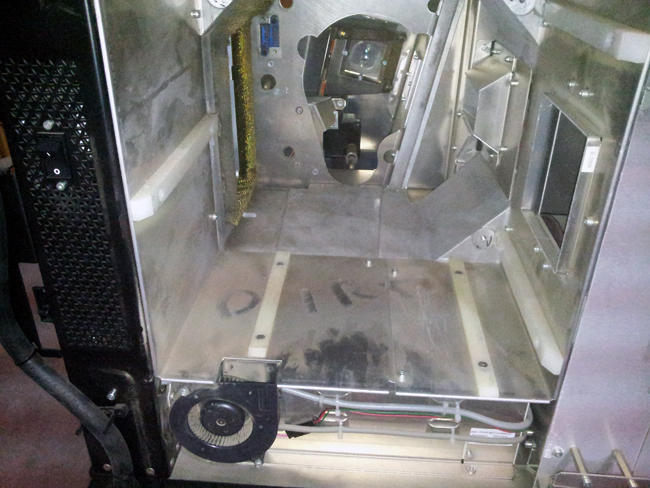
Here is a picture of a lamphouse end of a BARCO DP-2000 that was installed in 2009 in a theater n Bakersfield, CA and saw about 2 years of use... There was enough dust to be able to write in it. The rest of the optics were also this dirty! The entire projector had to be dismantled and cleaned before it was re-installed at a new location. Keep in mind if the air handling system in a given building filters the outsde air comming in really well you won't see this happen as fast... but it is still going to happen...
I hope some of this helps!
Mark
Posted by Fernando Caldeira (Member # 5680) on 12-12-2013, 03:07 PM:
Hi Mark,
Thanks for the reply.
The projector will be used in 15m wide mate screen.
Right now we are using an old barco dp90 that we will transfer to
To a smaller room were it will be very usefull.
My main concern is in image quality and of course reliability.
The barco survived for almoast 10 years in this booth and is still running smoothly.
I'm also concerned about the christies imb running on windows. We are mainly a festival venu and i kinda trust doremi. Not shure how christies imb will cope with home made dcps and wierdly formated drives.
Also will be doing some 3d premiers and barco's 7k lamp with its 300 hour time life is not very smart money. Changing bulbs every 3 moths or so, is absurd.
Until now nec seems the best choise economicly and my dealer is ofering a 5 year warranty. So the question is; is christie that much better than nec? Is its light and picture so diferent than its competition?
Sorry for the spelling hope its readable
Posted by Carsten Kurz (Member # 5396) on 12-12-2013, 06:29 PM:
An existing Barco is at least one reason for another Barco, same for an existing Doremi.
Imagewise, all DLPs within the same class show the same image quality. Even side by side you won't notice a difference, all other aspects identical.
3D?
- Carsten
Posted by Fernando Caldeira (Member # 5680) on 12-13-2013, 04:46 AM:
Hi carsten,
Yes we will be doing 3d. Mainly premieres. We already have the xpand sistem. The dp 90 obviously can't handle it.
I would love to do a side by side coparison between the three. But that is completely impossible so i will gladly trust your word on it.
Fernando
Posted by Carsten Kurz (Member # 5396) on 12-13-2013, 06:48 AM:
The most relevant parts of these machines, concerning image quality, comes from TI and are the same across the three manufacturers. There a slight differences in the optical path, but after all, same imager size and lens, they will look identical. It's really more about the handling, servicing, and other logistical issues. Even if the DP90 is old, your staff will still value identical aspects in handling. And sure enough a Barco is not a bad choice anyway.
At that screen size, there is no need to choose an exceptional high brightness machine, nor one of the cheaper 0.98" or S2k machines. Contrastwise, the proven 1.2" 2k DLPs are still the best option.
With 3D in mind, you should choose the optimal lamp/brightness combination for your screen size and 3D system. That is probably the most important part.
You should aim for 7-10fL, not the mediocre 4.5 that some installers still suggest.
And the system should be able to keep that brightness over most of the lamps lifespan. Balancing the right 2D and 3D brightness within the operating limits of the xenon lamp is the key aspect.
- Carsten
Posted by Mark Gulbrandsen (Member # 72) on 12-13-2013, 09:09 PM:
While I agree with Carsten that the 1.2" projetors spec. out with better contrast range the images I see comming off the small Barko and NEC "look" far superior to the .89' and 1.2" projectors. And that may be due to the smaller lenses being much easier to grind and manufactrure. The lenses themselves may also be of much higher optical quality as far as MTF curve and coatings. I have to admit that I was astounded the first time I saw a picture off an NC-900.
Mark
Posted by Fernando Caldeira (Member # 5680) on 12-14-2013, 05:10 PM:
But i need the "big ones" to get the 7FL in 3D. need the 30k lummens.
Posted by Steve Guttag (Member # 268) on 12-14-2013, 05:20 PM:
I tend to agree with what Mark said on most of his comparisons here.
Things I'd point out...generally speaking, NEC comes in about 20% less efficient on light than the other two major brands. Color wise...it stars off furthest from where you want to go. As Mark points out, however, it is the only one that really filters the air going to the lamp though.
While we are on light still...NEC does not have a motorized lamp adjust option though that may not be a factor for you. Since you are doing 3D though...there is no way to have the same lamp do 2D and 3D and have the light levels where you'll want them. So if you plan on doing lamp changes between formats...this can be a factor:
Christie has the best lamp alignment of them all...it is fast and very accurate so going between 2D and 3D can be quite fast...just have to wait for the lamp to cool.
Barco has a separate lamphouse so you can have a 2D and 3D lamphouse. The lamphouse has the board that stores the lamp information so as one changes the lamphouse, the projector will know what is installed. With a separate lamphouse, you have an inherent spare in the event of a catastrophic failure.
For the point of "Service" Barco really stands ahead of the rest. They have everything very well laid out and everything is very modular. One does not need to cut themselves up or contort to get most any part out. While the other two do a better job of sending the projectors from the factory converged well, Barco is BY FAR the easiest to converge. Likewise on the bore-sight (aka Sheimpflug) is the easiest to adjust on the Barco but followed closely by Christie (Christie has one rock the lens mount upon two axises while Barco has a spring loaded mount that allows pretty precise alignment. NEC's is a nightmare in the lateral direction and odd in the vertical direction.
Moving over into image quality...NEC and Christie use Minolta lenses, just about exclusively (NEC has some InVision lens options). Barco, on the 1.2/1.38", use primarily InVision but has some Minolta. While all brands have their good and bad batches, most techs will tell you that if you had a random batch of 10 lenses from each manufacturer, they would reach to that Minolta batch first.
People tend to have less repeatability on InVision lenses (zoom on the 1.2"/1.38"). InVision also have very heavy lenses that are far more likely to exaggerate any shakes making their way to the projector. Since the lenses are gripped so far back, particularly on the Barco, this can cause issues with Barco's flimsy lens mount on the B series. Note, Barco has come out with a new lens mount to address the shakes. The jury is out on if they have addressed it sufficiently. I have had steady B Barcos and unsteady B Barcos. This is not to say that I have not had random issues with the others but there is more than a trend on a Barco B series with an InVision lens. I have not tried the new lens mount yet on the B Barcos.
Christie is the fastest format to format lens change...BY FAR. It is almost instant it is so fast...and it hits its mark pretty much every time. That despite having the cheesiest motorized zoom system of them all (it involves plumbing pipe clamps and plastic gears!).
Posted by Brad Miller (Member # 2) on 12-14-2013, 05:34 PM:
From a service standpoint, Christie absolutely wins. We see the least issues hands down coming from Christie screens. NEC is second. Barco has proven themselves to be the most troublesome with weird quirky failures, usually involving reseating boards and such to get the show on screen.
Posted by Steve Guttag (Member # 268) on 12-14-2013, 06:59 PM:
While I've certainly had to reseat Barco boards...that is for sure...I have had that on all three and as a percentage of our installed base...Barco is no more problematic than the other brands. In terms of component replacement...my most reliable is the Christie CP2000-SB (series 1)...zero failures (kiss of death, I know). But I've had Christie and NEC board reseat issues. I have had all three crap out on their LPS (lamp power supply). NEC's power switch WILL fail so never use it. NEC has a fan that runs 24-hours a day...even in Stand By...probably they deemed that whatever electronics remain on for Stand-By need some form of cooling.
Posted by Brad Miller (Member # 2) on 12-14-2013, 07:02 PM:
Nope. We monitor a much larger base of projectors than you service Steve. The failure rate is an absolute landslide win on Christie, and yes I'm talking series 2. Barco is crazy high in terms of quirky failures that cause show loss or delay. NEC is in the middle, but leans higher.
Posted by Steve Guttag (Member # 268) on 12-14-2013, 07:05 PM:
No doubt you do...I can only speak from personal experience...I'm not seeing what you are seeing. Even our overlap of Cardinal/Film-Tech/Barco installs...I haven't heard of board reseat issues.
Posted by Brad Miller (Member # 2) on 12-14-2013, 11:22 PM:
Yup there have been a couple, although not as much as the sites that did firmware upgrades. There is absolutely a line between those sites that routinely do every new upgrade vs. the ones that let working equipment run.
Posted by Steve Guttag (Member # 268) on 12-15-2013, 06:22 AM:
We only do updates twice per year unless there is a critical update. For instance...almost all of our sites missed Barco 1.10 but almost all are on 1.11. A few site have had to chase the updates to keep up with subtitling issues in art houses but that has been a while.
Posted by Mark Gulbrandsen (Member # 72) on 12-15-2013, 12:50 PM:
I just had my first board failure(ICP)ever in an NEC and it was a board they don't even manufactrure! That is... my first failure in over 200 installations of NEC Series 2. I've had to reseat boards in perhaps three or four NEC's in the last couple years but I attribute the rare need to do this because when I do installs I also always remove all the boards and reseat them as well as go over all the connectors and cables inside. I don't tink a lot of techs either have the time or take the time to do this on install. It was always something we did with new broadcast equipment when it got installed and I kept that habit. And... new broadcast gear rarely EVER worked out of the box or crate. All DLP projectors have functioned as intended out of the box which is pretty amazing if you ask me.
As for updates... Generally twice a year although I have some that I do more often. I have not seen any correlation at all between doing updates and projector reliability factor.
Posted by Gordon McLeod (Member # 33) on 12-16-2013, 02:08 PM:
We have had 2 ICP failure in the 1200c's and one lamp ballast in a 1200c as well and a light engine that the blue formatter died in a 900c
but far more ballasts in the christie 2210's have had to be replaced
Posted by Steve Guttag (Member # 268) on 12-16-2013, 08:40 PM:
I have had 1 ICP in an NEC fail within the first week, 1 ICP fail in a Barco (this week), 1 Christie ballast fail, 1 Christie LVPS fail, 1 NEC LPS fail, probably 3 Barco LPS fail and one or two Barco Cinema controllers fail. In the light engine department...I've had one outright fail and one that had a stuck pixel within a week of installation (both Barco "C" projectors). Now my ratio of Barco the rest is about 85/15 percentage wise. So I would expect more Barco failures. I've had probably 5 enigma modules fill up on me spread between NEC and Barco.
With NEC I get weird failures that come and go..."Tamper Fail" when nothing seems amiss and it doesn't interfere with the show and may or may not clear itself. There was a period when the NEC software couldn't deal with ICP 4.x software if you were doing an image shift for vertical masking...it may or may not shift...that was addressed eventually. But NEC is definitely to strange one for out-of-the-blue error messages. Their tail-lights going red for a lamp age is plain dumb. Red should be reserved for things that will prevent the show from running NOW.
I get the most ICP Signature Test failures from Christie...then from NEC and to a much lesser extent from Barco...I have no reason for this since they all use the same ICPs and same ICP software...perhaps Barco doesn't give that test any attention. Christie will flat out tell you to disable the test to shut it up.
Posted by Manny Knowles (Member # 1171) on 12-16-2013, 08:46 PM:
quote: Steve Guttag
People tend to have less repeatability on InVision lenses (zoom on the 1.2"/1.38"). InVision also have very heavy lenses that are far more likely to exaggerate any shakes making their way to the projector. Since the lenses are gripped so far back, particularly on the Barco, this can cause issues with Barco's flimsy lens mount on the B series. Note, Barco has come out with a new lens mount to address the shakes. The jury is out on if they have addressed it sufficiently. I have had steady B Barcos and unsteady B Barcos. This is not to say that I have not had random issues with the others but there is more than a trend on a Barco B series with an InVision lens. I have not tried the new lens mount yet on the B Barcos.
Vibrations here, even after the "upgrade" -- which you have to pay extra for.
Posted by Steve Guttag (Member # 268) on 12-16-2013, 09:43 PM:
Manny...did you get the more recent upgrade (within the past few months)? The other one you shouldn't have had to pay for...your projector should have been in warranty. That was just a stabilization kit.
Posted by Manny Knowles (Member # 1171) on 12-16-2013, 09:50 PM:
No! I didn't know anything about further improvement to the lens situation. (IIRC, that stabilization kit wasn't something they openly talked about either. I had to go digging for that.)
I specifically challenged the extra charge for the stabilization kit, stating that it was really a "fix" for a design flaw on their part. Barco insisted it was an upgrade.
As it turned out, one of the motors in our lens mount failed right around that time. The replacement lens holder assembly had the stabilization kit pre-installed. So, in the end, we did not have to pay extra for the stabilization kit.
I'm curious about this new thing you're talking about.
Posted by Brad Miller (Member # 2) on 12-16-2013, 10:43 PM:
quote: Manny Knowles
I specifically challenged the extra charge for the stabilization kit, stating that it was really a "fix" for a design flaw on their part. Barco insisted it was an upgrade.
Barco is full of shit. Their original design WAS and IS flawed. They just don't want to admit it for fear they will have to actually put forth money to fix their screwup. They owe it to everyone that bought a B machine to supply it free of charge at a minimum. They should actually be covering the tech's expense to travel to each theater and install it too.
Posted by Marco Giustini (Member # 4544) on 12-17-2013, 12:05 PM:
Steve, could you tell us more about the new Barco lens holder?
Posted by Mark Gulbrandsen (Member # 72) on 12-17-2013, 05:17 PM:
quote: Steve Guttag
Their tail-lights going red for a lamp age is plain dumb.
Of course that is technician settable and you can essentially shut it off until the lamp life ends if you like at which point the tail light turn red. Most of my customers appreciate a 50 to 100 hour warning on this because they can then schedule the person (or tech in some cases) that knows how to change the lamp to be there at the appropriate time. NC-1200's and 2000's can have somewhat flakey lamp door switches. It can be adjusted but I have had several on install that cause quirky tamper errors. It's an easy fix.
Mark
Posted by Marco Giustini (Member # 4544) on 12-17-2013, 06:41 PM:
Mark,
I believe Steve was talking about the colour of the alert. A lamp running past its warranty should come up with a YELLOW light. RED status lights should be only used for show-stopper events - and I agree with that.
The customer should know that RED = need to have a look.
Same RED alarm comes up when the Power On fan exceeds the recommended hours. I don't see it as a critical alarm, you can delay it a week and nothing will happen. That's a yellow for me.
Posted by Steve Guttag (Member # 268) on 12-18-2013, 07:01 AM:
Exactly. RED = NO SHOW. And it should be reserved for that on all DCP stuff...servers, projectors. Ambler/Yellow/Orange...should be the "you should do something about this before I turn red" notification. I think NEC was just plain wrong for using red to notify someone of a non-show stopping event.
I give Barco marks in this category that user-discretionary events like lamp changes or even filter cleanings turn the tail light blue. It is something that YOU the user has to address and the projector thinks you should do it now. But no, there is no immediate danger of losing a show. Now if you don't clean/change your filters, the temps can rise and you'll then get a yellow light...but that is controlled by the the fact that your lack of maintenance is now actually causing an issue that will lead to a red tail light and no show.
Christie strikes a reasonable balance on their tail lights with just three colors.
Posted by Scott Norwood (Member # 30) on 12-18-2013, 07:35 AM:
I have no comments on the service issues, but, as an operator, I will take the Christie, mostly because of the touch panel and the automated lamp alignment feature (not sure if the NEC does automated lamp alignment, but Barco does not, at least in the default configuration). One can walk into a random booth with a Christie and be able to do anything that needs doing on them (at least as an operator) without a separate laptop or other items.
Note that Christie and Barco lenses come in different ranges (last I checked, anyway), so the lens that you need may dictate the projector that you need, unless you want to swap out lenses for different formats. (For example, if you have a 13x31' common-height screen and a 113' throw, the Christie is not the machine for you, anamorphics notwithstanding.)
Posted by Fernando Caldeira (Member # 5680) on 12-18-2013, 08:29 AM:
Thank you all for the replyes. Tis beeing very helpfull.
I think these are the importante facts in my litle world:
1- Wil be changing lamps beteween 2D and 3D. Doing 10 3D shows a year +-.
2- Will be doing many festivals and premieres with directors and producers present.
3- Mate screen 49x18' with 101' throw distance.
4- Money is an issue.
Oh by the way, im going for the 4K projector. So now it´s between the CP4230 , NC3240 and DP4k-32B
Posted by Brad Miller (Member # 2) on 12-18-2013, 10:18 AM:
If money is an issue you won't be going 4k.
Also if money is an issue, you won't be going Barco with the intention of buying a second lamphouse for 3D shows, as its expensive.
And finally if money is an issue, you may find it is cheaper to change the screen to a 1.8 gain than buy a larger size projector and burn larger lamps. (Some exceptions are made to that generalization, as the specifics would have to be ran through a calculator.)
Posted by Steve Guttag (Member # 268) on 12-18-2013, 10:34 AM:
Scott,
Barco does have a motorized OPTION though it is not nearly as good as Christie is standard. Barco's motorized system can take well over 10-minutes to fiddle around with the lamp and get you only 80-90% there. Christie's current system on series 2 take a couple of minutes and it is pretty much right on...it is quite impressive to see work.
NEC...we'll no...they don't even do manual alignment well (and I'm not kidding). If you like the Christie "H" series console lamp alignments...you'll be right at home with the NEC...three allen key adjusters with a rather impressive amount of slop in the gears to make adjusting the lamp "interesting". Also, NEC's light sensor is a hit and miss...often it will read a brighter number even though the illumination isn't brighter.
Posted by Fernando Caldeira (Member # 5680) on 12-18-2013, 12:21 PM:
money is an issue because i have a 75.000€ limit.
I hopeI might be able to go for the NEC 4k. Almoast shure Christie wil go above. Not shure about Barco.
But with what´s been said here, NEC will be the best and cheaper choise. Perhaps more work needed but... Thats life.
Posted by Mark Gulbrandsen (Member # 72) on 12-18-2013, 12:42 PM:
It is doubtful you will be going 4K then... Most likely you will end up with an NC-2000 and have to run the DXL-40SN2 to make brightness. I have a few NC-2000 on 38' wide 1.4 gain curved screens running DXL40SN2's and they easily meet brightness. If you can try to squeeze a little more funds for an NC-3200 you would be better off, especially if you contemplate ever doing 3-D down the road a bit. That should put you into the realm of a DXL-31SN2 lamp at lower operating cost or at worst the DXL-41SCN and both are 1500 hour lamps. This is all assuming a good 1.4 gain screen...
RE: the lamp adjusters. NEC's pretty much suck until you get used to them. Very little adjustment is required after a lamp change, perhaps ~1/4 +/-turn but the initial setting might take you a half dozen trips across the three adjusters to get it right. And who uses the built in light meters? Really guys? Use a real light meter for cryin out loud and do a fine tweek to get it right after your auto set is done, or at least verify it. No one's built in light meter works perfectly all the time and for every type of lamp. The motorized ones are expensive to replace when they become permeated with popcorn oil goo or a lamp explosion and if the motorized aspect breaks down then good luck adjusting it at all. The stepper motors used in these only offer so much resolution in that adjustment! I'll stick with manual adjusters as my favorite type no matter how sloppy they are. They are the most reliable because they are ALWAYS going to work!
Posted by Ken Lackner (Member # 1002) on 12-18-2013, 01:39 PM:
quote:
I'll stick with manual adjusters as my favorite type no matter how sloppy they are. They are the most reliable because they are ALWAYS going to work!
I've never seen a Series 2 NEC in person, and I don't know how much they've improved over the Series 1, but I've had to replace the lamp adjustment assembly on a 2500 twice because it stopped working. I don't remember the details, as it was years ago. But I would turn and turn and turn the allen screws and nothing would happen.
Posted by Marco Giustini (Member # 4544) on 12-18-2013, 04:01 PM:
Mark,
A cinema does not usually have a light meter. When the lamp file is properly set on a Barco it's quite accurate for the everyday use - till next service where you re-calibrate them.
You cannot justify NEC for coming up with a VERY POOR light alignment because we should all use a light meter!
That being said, on an NEC the light tends to be quite uneven, a light meter wouldn't be very useful. You just have to ignore the light sensor and look at the screen the old fashion way.
On a Barco what the light meter says is spot on. When it says you are at peak level, you are at peak level, I tested it. Same with Christie.
Maybe your customers are all super clever technicians, I don't know. In the real world the lamp alignment is a massive problem because nobody does it. It's hard to explain a customer how to do the alignment on a Barco - or persuade them to tap the DO AUTO on a Christie. Are you saying that all your customers use a light meter and do an average on screen when they align the lamp ever few hundreds hours and at lamp change?
I wonder why SONY and NEC came up with High Pressure Mercury lamps then - which do not require alignment.
Posted by Steve Guttag (Member # 268) on 12-18-2013, 04:49 PM:
$75,000 EUR is about $102,500 US (Depending on the day you check the exchange). You should easily be able to get a 4K projector and server for that kind of money. Any brand.
Well put Marco!
Posted by Scott Norwood (Member # 30) on 12-18-2013, 05:48 PM:
I have a light meter, but the Christie auto-alignment mechanism does a better job than I can do with a light meter on any film projector lamphouse. I really wish that Kinoton (or someone) would implement something like this for 35mm equipment; it would be especially useful for venues that regularly re-align their lamps to accommodate both silent and sound films.
Posted by Ken Lackner (Member # 1002) on 12-19-2013, 09:08 AM:
Scott, it's pretty much a non-issue now, but I used to wish for the exact same thing on film lamp houses. It would also be useful for increasing the current throughout the life of the lamp while making sure you are at the proper light level on screen.
Posted by Fernando Caldeira (Member # 5680) on 03-05-2014, 10:43 AM:
Ordered the NC - 3240s. Arriving sometime next week. Its christmas again!!!
Posted by Fernando Caldeira (Member # 5680) on 04-22-2014, 06:38 PM:
Hey guys, Thanks for all the help.
We bought the NC3240s, with the Doremi IMB and server.
Had a litle bug with a fixed pixel, but in 2 days had a new Prism and the problem was no more.
Also bought another Barco ACS2048.
The thing is that the IMB only has either the dual HD-SDI or the single HDMI.
The dealer loned me the old card with the Dual DVI so I could conect de ACS and use de 12 bit colour and I am tempted to buy it and have both cards on.
Done three Festivals and everybody has been very happy.
Just did the first ever screening (I was told) of "The Last Emperor" in 3D. Vittorio Storaro was here for the Italian Film Festival, and he aproved, so I´m very happy has you can imagine.
Just discoverde DCP-O-Matic and i´m making DCP´s like a mad man. No more Blurays!!! ![[Smile]](smile.gif)
Going to Build a MediaCenter and I´m having some trouble finding the right Sound Card. One witch I could conect directly to the Sound Processor. Meaning a DB25 output Plug with 7.1 decoder built in. Is ther such a sound Card Out There? Like the ones on the DCP servers...
Thanks Again.
Fernando
Posted by Mark Gulbrandsen (Member # 72) on 04-22-2014, 09:08 PM:
That's interesting about the stuck pixels this late into the 4K game. I had two NC-3240 with stuck pixels but these were projector serial numbers 10 and 12 respectively. Literally when 4K was brand new. The pixels on one prism also kept failing and by the time the new ones arrived I had counted over 80 stuck or failed pixels on one prism alone. The other prism just had a few bad. No other issues I've seen on any 4K's since then and I have installed quite a few.
Mark
Posted by Mark Gulbrandsen (Member # 72) on 04-23-2014, 05:23 AM:
quote: Marco Giustini
It's hard to explain a customer how to do the alignment on a Barco - or persuade them to tap the DO AUTO on a Christie.
All my customers are taught to align the lamps, and yes, they actually do it. I still make normal service rounds and I also check them myself. I rarely find them very far off. On the NEC's I find that if you stick with Ushio lamps the light distribution is very good, same with LTI/Phillips if you are brave enough to use them. Osram is very poor and as the Osrams age it gets even worse because they darken very unevenly on the inside of the envelope. Something about the shape of the Osrams makes them a poor match for the USHIO reflectors that NEC uses in their projectors. I also find that the built in light meter is also very accurate when used with Ushio lamps but not with Osrams. Its also interesting that NEC and Christie read the light the same way at the same point in the optical system.
USHIO also makes the mercury lamp system for the NC-900... and the ballast board.
Mark
Powered by Infopop Corporation
UBB.classicTM
6.3.1.2