This is topic Paranormal Activity blowing out Center Speakers in forum Digital Cinema Forum at Film-Tech Forum ARCHIVE.
To visit this topic, use this URL:
https://ft-forum.com/ft/cgi-bin/ubb/ultimatebb.cgi?ubb=get_topic;f=16;t=001754
Posted by Steve Guttag (Member # 268) on 01-04-2014, 03:24 PM:
It would appear that there is a possible issue with Paramount's Paranormal Activity: The Marked Ones.
I have not heard it but the reports are that center speakers are particularly vulnerable to this soundtrack. My personal suspicion is that any speaker with a passive crossover feeding the HF driver (this includes 3-ways that have a passive crossover on the MF/HF) are particularly susceptible as distortions getting to a crossover often have harmonics that come out of the HF portion of the crossover.
Technicolor seems to be handling issuing a replacement soundtrack (Version file that is downloadable) as well as issuing the replacement KDMs to use the new soundtrack version.
Below is the text from the Paramount letter:
quote:
PARANORMAL ACTIVITY: THE MARKED ONES
Dear Projectionist,
Paramount has had reports of speaker damage from some theatres playing PARANORMAL ACTIVITY: THE MARKED ONES. In several cases we have been able to research, the volume had been turned up to high levels at patrons’ requests.
We are currently working to get information on speaker/amplifier brand and model to see if any particular combination of hardware might be more susceptible to damage. At this time, most of the damaged speakers have been identified as JBL model 4632’s, but this is preliminary data.
We are also working on an audio patch which may lessen the potential for damage.
For the time being, please do not set your volume at a high level on this film.
Thank you for your cooperation.
Lefko Horner
Paramount Motion Picture Operations
Vice President, Worldwide Print Control
Lefko_Horner@Paramount.com
Posted by Mike Blakesley (Member # 26) on 01-04-2014, 04:36 PM:
What do they mean by "high level?" That's pretty vague.
Posted by Adam Martin (Member # 641) on 01-04-2014, 05:02 PM:
Technicolor issued the version file and keys earlier today. Seven seconds of audio in reel 4 are replaced. The closed caption in this snippet of the reel displays "(HIGH-PITCHED BUZZING)". ![[Big Grin]](biggrin.gif)
Posted by Steve Guttag (Member # 268) on 01-04-2014, 05:07 PM:
My favorite part of the letter is "Dear Projectionist" Show of hands...how many people have those right now? As a percentage of the industry?
Posted by Scott Norwood (Member # 30) on 01-04-2014, 05:21 PM:
Do the 35mm prints have the same issue? (Are there any 35mm prints?)
Posted by Marco Giustini (Member # 4544) on 01-04-2014, 06:58 PM:
For a distributor to admit a problem like that there must be a serious issue with the soundtrack!
Posted by Frank Cox (Member # 6258) on 01-04-2014, 08:35 PM:
I wonder who's responsible for the cost of repairing those speakers? And the lost shows while waiting for the repairs, and the refunds given that night as well.
Posted by Mark Gulbrandsen (Member # 72) on 01-04-2014, 08:49 PM:
quote: Mike Blakesley
What do they mean by "high level?" That's pretty vague.
You'll know when it hits Mike. That new ticket counter window that was just installed will simply explode.
Yep.... had a Paranormal happenning in Elko this weekend. It blew the amp and hf diaphram out! Of course the email about the replacement patch arrived while we were driving home but it's since been taken care of. Was just waiting for some force to pull pop ladder out from under mke while I was back screen...
Actually it was nice to get to do a "normal service call" again. I haven't done one in almost two years now.... but hey, conversions resume again tomorrow... so back to that.
Posted by Mike Blakesley (Member # 26) on 01-04-2014, 10:57 PM:
It probably won't hit here...we've never played one of the Paranormal Activity movies yet!
Posted by Frank Cox (Member # 6258) on 01-04-2014, 11:38 PM:
Really? You should consider playing them. They always do reasonably well here. They've never been really huge, but still worth the week on the screen.
Around here, the real chop-em-up stuff can do better than Paranormal Activity, sometimes, but it's really inconsistent. I've had huge crowds for some of the blood-and-guts stuff, and three or four people for others. Unfortunately, there's no way to tell which it will be in advance.
Posted by Chris Slycord (Member # 4239) on 01-05-2014, 03:01 AM:
The previous Paranormal Activity movies don't completely translate into how well this one will do due to the fact that it's the only one so-far to be Rated R (instead of the PG13 like the previous movies).
This is, of course, the US ratings but that's really the only type Mike would care about.
Posted by Justin Hamaker (Member # 2165) on 01-05-2014, 03:51 AM:
Chris, you are incorrect about the ratings on the Paranormal Activity movies. All of them have been rated R so far.
Paranormal Activity (2009) Rated R for language.
Paranormal Activity 2 (2010) Rated R for some language and brief violent material.
Paranormal Activity 3 (2011) Rated R for some violence, language, brief sexuality and drug use.
Paranormal Activity 4 (2012) Rated R for language and some violence/terror.
Paranormal Activity: The Marked Ones (2013*) Rated R for pervasive language, some violence, graphic nudity and some drug use.
*The current movie was originally scheduled for release the last weekend of October 2013.
The ratings are all from the MPAA rating site: Filmratings.com
Posted by Marcel Birgelen (Member # 6801) on 01-05-2014, 06:00 AM:
quote: Frank Cox
I wonder who's responsible for the cost of repairing those speakers? And the lost shows while waiting for the repairs, and the refunds given that night as well.
The studios surely put something into their contracts that avoids their responsibility, although that might not always stick in a court room. Also, they've chosen their wording carefully: "In several cases we have been able to research, the volume had been turned up to high levels at patrons’ requests." They're already tentatively pointing the finger at someone else.
It might also be an interesting issue if your equipment becomes damaged while it's still under warranty.
Posted by Marco Giustini (Member # 4544) on 01-05-2014, 06:14 AM:
I guess very few systems are - on paper - capable of coping with a 0dB FS soundtrack when the sound processor is set to 7.0, and you always need to prove that your system is properly calibrated.
I have the feeling that it would be quite tough to prove that the speaker has failed because of something wrong on the soundtrack. Studios can easily say "the speaker wouldn't have failed if your speaker had been properly spec'ed for the size of the room".
Posted by Steve Guttag (Member # 268) on 01-05-2014, 08:51 AM:
quote: Justin Hamaker
Paranormal Activity: The Marked Ones (2013*) Rated R for pervasive language, some violence, graphic nudity and some drug use.
And that is just from the technician having to change the diaphragms!
Anyone? Huh? Anyone? Tough crowd.
Posted by Adam Sherwood (Member # 7802) on 01-05-2014, 11:56 AM:
How many times have you had Customers come out and Demand surround sound for the whole film ?. Esp on film were their is just 2 people talking.
Posted by Harold Hallikainen (Member # 5405) on 01-05-2014, 02:19 PM:
"I guess very few systems are - on paper - capable of coping with a 0dB FS soundtrack when the sound processor is set to 7.0, and you always need to prove that your system is properly calibrated."
"I have the feeling that it would be quite tough to prove that the speaker has failed because of something wrong on the soundtrack. Studios can easily say "the speaker wouldn't have failed if your speaker had been properly spec'ed for the size of the room". "
If one speaker can do 85dB with -20dBFS (-23rms), and we gain 3dB every time we double the power put into the room by doubling the number of speakers at this level, we get 85 (C) +3 (doubling by adding L), +3 (doubling from 2 to 4 by adding R, Ls+Rs at 82 each) for a total of 91 for a 5.1 system with all speakers except LFE driven at -20dBFS. Add 20dB for FS and we have 111dB in the room. That's loud!
Headroom is for transient signals above nominal, not for continuous signals above nominal. It seems that mechanical failures in speakers could be due to instantaneous amplitude, while electrical failure would be due to longer term signals, depending on power dissipated, heat capacity, heat dissipation (convection, conduction, etc.), and temperature limits of materials. Recent amplifier designs have speaker protection circuits. Are these adequate for the job?
Harold
Posted by Marco Giustini (Member # 4544) on 01-05-2014, 03:34 PM:
Harold,
111dB is correct, but what if the sound designer/mixer just pushed a FS sound through the centre channel for a short period of time? It would 'only' be 105dB. I know tons of cinema with speakers unable to cope with such demand if running at 7.0. The amp may or may not be able to protect - depending on the amp, the limiter and whether the limiter has been engaged or not.
Posted by Steve Guttag (Member # 268) on 01-05-2014, 03:51 PM:
I can say that "we" design sound systems that are capable of playing 0dBFS from any/all speakers with the fader set to 7.0 (or 0dB for those people)...I think it is incompetent to not design a system that is capable of playing the program material.
Part of the confusion is what is perpetrated by the speaker companies in the quest for sales and for exhibitors that have the "Ghostbusters" mentality. That is..."We are ready to believe you."
Speaker companies rate their drivers in either continuos ("AES"), program or peak values. Where program is double pink noise, and peak is double program. While it is true that typical signals are not well represented by pink noise or a continuous signal, subwoofer IS best represented by continuous pink noise (band limited to the pass band of the system).
Another thing that will zap the inexperienced are passive crossovers. First, most suck nowadays...they do the minimum, it would seem, to have the various sections play the frequencies that they are supposed to play but very little matching seems to be going on. Also, with passive crossovers, any distortion is going to likely take its vengeance out on the higher frequency drivers because that is where the distortion is going to end up and the passive crossover is all to happy to send it that way.
When one looks at the response of a speaker...if you have a speaker that needs a lot of inherent EQ, particularly boost...that boost is on TOP of the normal power going to the driver. If you boost 1.3KHz by 3dB to make things look flat on the analyzer...well you just doubled the power going to that driver at that frequency. If the crossover isn't well matched you are going to be doing a lot more EQing...that all comes off of power handling.
In short, don't cheap out on speakers and if you are going to buy a 3-way or 4-way system, tri or quad amp it...you WILL get better results. In cinema, a speaker that requires little EQ to be flat in response is going to be a better choice than a cheap speaker that needs a lot of electrical help to play all of the frequencies equally. A 3 (or 4) way speaker is NOT necessarily a better speaker than a 2-way. A good 2-way beats a mediocre 3-way EVERY TIME. If you can't afford a good 3-way or 4-way, buy a good 2-way for less. You'll get more speaker for your money and have fewer problems. Get the crossover right too. Make sure that the crossover point is correct, the slopes are correct and any time delay actually matches the actual speaker. Balance each section properly. "Out of the box" crossover settings rarely work as well as you would hope.
105dBc, the required level from all channels except Subwoofer...which has to be able to hit 115dBc, takes more power than you think. If you were running optical sound (SR) before DCinema, you need about 10dB more power than you used to. If you were running Dolby digital before, you need 2dB more...and with each 3dB meaning TWICE as much POWER...this all adds up fast.
When looking at speaker sensitivity...watch out...the proper rating is the decibel level measured with 1-watt at 1-meter. Some will cheat this and use a voltage rating like 2.83V...do the math and get it into watts.
If one downloads the Dolby Technical Manual here on Film-Tech...you can skip the math, for the most part...since it was for Dolby Digital, it is 2dB light for today's needs and it is 5dB light on the subwoofer spec. Look up the pages with the nomographs where one can see sensitivity, compare it to room length and then see what the required power is.
Posted by Sam D. Chavez (Member # 1841) on 01-05-2014, 05:27 PM:
I'm with Steve on the passive x/overs not being much. It is quite easy to overload and saturate the inductors and produce all sorts of nasty harmonics that end up in the HF.
Also agree a good two way beats a so/so 3 way speaker. Meyer's cinema speakers are 2 way, albeit at great cost, but don't cut any corners.
Posted by Mike Blakesley (Member # 26) on 01-05-2014, 11:05 PM:
quote: Frank Cox
You should consider playing them. They always do reasonably well here. They've never been really huge, but still worth the week on the screen.
We don't really do well with horror movies. We played "The Conjuring" last summer and it tanked, despite being a huge hit and well-reviewed and everyone who DID see it loved it. I have all sorts of theories about why scare flicks don't work here but it's too boring and off-topic to go into at this point, I guess.
Posted by Kurt Werbrouck (Member # 2667) on 01-06-2014, 01:11 AM:
Hello,
In Granada Spain, they have a lot of damage speakers already since the screening of that movie..
How will pay the bill of the broken HF drivers?
Kurt
Posted by Marcel Birgelen (Member # 6801) on 01-06-2014, 12:07 PM:
quote: Kurt Werbrouck
How will pay the bill of the broken HF drivers?
You, or rather the company you work for ![[Wink]](wink.gif)
But, shouldn't a THX certified theater be somewhat immune to such problems? ![[evil]](graemlins/evil.gif)
Posted by Steve Guttag (Member # 268) on 01-06-2014, 12:22 PM:
If it did indeed meet THX specifications, was in calibration/good repair...then yes, you should not have an issue in a THX room. Note, if the room was designed/calibrated in the film-era (most of them)...then you may have a 2dB deficiency. Also, if you have a company that got THX to approve non-qualifying theatres...well, you get what you got.
Posted by Scott Norwood (Member # 30) on 01-06-2014, 12:30 PM:
I am confused as to why a D-cinema track would have more headroom than an SRD track. Both are recorded so that 85dBC == -20dBFS, correct (sub excluded)? If so, then the maximum achievable SPL per channel in an ideal room at a fader setting of 7.0 should be 115dBC (in that magical seat, 2/3 back, slightly off-center), right?
What am I missing?
Posted by David Zylstra (Member # 4230) on 01-06-2014, 01:17 PM:
I find it interesting that the memo specifically mentions a common denominator of JBL 4632 speakers.
I am curious if anyone has had issues with other models?
quote: Steve Guttag
Another thing that will zap the inexperienced are passive crossovers. First, most suck nowadays...they do the minimum, it would seem, to have the various sections play the frequencies that they are supposed to play but very little matching seems to be going on. Also, with passive crossovers, any distortion is going to likely take its vengeance out on the higher frequency drivers because that is where the distortion is going to end up and the passive crossover is all to happy to send it that way.
When one looks at the response of a speaker...if you have a speaker that needs a lot of inherent EQ, particularly boost...that boost is on TOP of the normal power going to the driver. If you boost 1.3KHz by 3dB to make things look flat on the analyzer...well you just doubled the power going to that driver at that frequency. If the crossover isn't well matched you are going to be doing a lot more EQing...that all comes off of power handling.
When I started my current position I had 2 auditoriums with 4632s that regularly popped HF drivers, after fixing a bad EQ (in a 6AD with a lot of HF boost) the issues dropped from every few months to every couple years . . . . . those racks have now been rebuilt with all new amps (swapped Crowns for QSC) and new processors (1 CP850 and 1 DCP300) - they perform much better now and without issues.
Posted by Sam D. Chavez (Member # 1841) on 01-06-2014, 01:59 PM:
If I recall, Dolby decided on +18 from 85 dB as the headroom. Don't recall the reasoning except perhaps caution.
This was early '90's so there were a lot of cinemas having trouble making these numbers.
Posted by Marco Giustini (Member # 4544) on 01-06-2014, 02:14 PM:
quote: Steve Guttag
I think it is incompetent to not design a system that is capable of playing the program material.
I agree 100% with that.
But what happens when the customer asks for a smaller sound system? It may be different in the US but in Europe I know very few sound systems properly spec'ed to the room. Most won't break so easily and many are protected by the amps' limiters.
Most cinemas run film at the stellar fader of 5.0 (many lower than that) so it does not really matter.
I may know one or two sites running films at fader between 6 and 7. And I've seen many cinemas, trust me.
Glad that in the US, sticking to the math does not take you out of business in a blink.
I see why Dolby Digital is 2dB light than PCM, but why 5dB for the sub? I thought DD was 113dB and PCM was 115dB?
Posted by Sam D. Chavez (Member # 1841) on 01-06-2014, 03:18 PM:
Our customers are just as cheap as in the UK. We have many underspec'd cinemas for sure. There may be more competition here so keeping up with the others may be more of a factor here but just guessing.
The subwoofer spec is hard to meet in a room of any size and continues to be a problem as the customers just don't believe the # of boxes required so end up skimping.
Since they often run the fader too low it does not blow up subwoofers as often as one would think.
Posted by Marco Giustini (Member # 4544) on 01-06-2014, 04:38 PM:
Sam, that sounds more like the world I'm used to! ![[Smile]](smile.gif)
Posted by Sam D. Chavez (Member # 1841) on 01-06-2014, 05:01 PM:
We all work in a carnival. We don't move the tent and rides every week; we put up one-sheets instead. Back when I was young we had way less tattoos but no longer.
Posted by Michael Riley (Member # 5693) on 01-06-2014, 06:01 PM:
quote: Scott Norwood
Do the 35mm prints have the same issue? (Are there any 35mm prints?)
No 35mm prints of this one, Anchorman 2 was the last 35MM Paramount is issuing, Wolf of Wallstreet, this one, and Jack Ryan in a few weeks are digital only, and it seems everything else they release will be that way going forward.
Posted by Steve Guttag (Member # 268) on 01-07-2014, 05:56 AM:
quote: Marco Giustini
But what happens when the customer asks for a smaller sound system? It may be different in the US but in Europe I know very few sound systems properly spec'ed to the room. Most won't break so easily and many are protected by the amps' limiters.
As Sam pointed out already...in the US people by poorly designed systems here too...remember my statement about...exhibitors have the Ghostbusters statement of "we are ready to believe you" what it comes to being able to by too small a system (pick your device...it isn't limited to sound).
However, I have never found I had to deliberately under-spec a system. If a customer says they want something smaller (and honestly, that really hasn't come up for me)...then it becomes THEIR decision and consequences for the failures...it isn't something I put upon them. Those times that it has occurred...almost without exception, they have indeed paid the consequences. If you have an exhibitor that does indeed always play their volume really low (say an "art house" yes you do have some more wiggle room there.
An amp's limiter really doesn't protect a speaker from being under-speced. A limiter will prevent an instantaneous peak from clipping an amp but if you are constantly in the limiter's active area...you'll cook your driver. A limiter is not an AGC...it hard limits the signal which is like sustaining it.
quote: Marco Giustini
I see why Dolby Digital is 2dB light than PCM, but why 5dB for the sub?
Misinterpretation. The Dolby digital track is 2dB lower on all channels than current DCinema. It is the nomograph in their technical guidelines that is 3dB low in the math. As Sam pointed out...when digital audio hit...people already couldn't believe the amount of subwoofer (speakers and amp power) that was needed...if Dolby had the real numbers back then...it would have meant doubling amplifier power yet again.
quote: David Zylstra
I find it interesting that the memo specifically mentions a common denominator of JBL 4632 speakers.
I am curious if anyone has had issues with other models?
I think you are going to find any speaker that is using a passive crossover is going to be more susceptible to this sort of damage. It is the nature of the distortion and how a passive crossover will send that to the HF driver in the system. So, if you have a system with a passive crossover and you aren't clipping the amp, saturating the crossover and keeping the levels within the capabilities of the system, you should be fine.
I generally like JBL speakers but like with every brand, there are models that I am not the biggest fan. The 4632 is one of those. In my experience, it does not tune up well...that is, it need a fair bit of tuning in order to play back with a "flat" response...there are some notable dips in it. This leaves one with the option to ignore them since the speaker just can play those frequencies or to boost the crap out of it and put the speaker at risk and also not really improve the sound. I don't think I've ever heard a 4632 sound good...they have a very nasal quality to their sound that doesn't agree with me. I've tried this speaker with numerous crossovers and amps...I've tried hand tuning it with program material and have generally spent more time on this one speaker model trying to get it to perform than any other...and it just doesn't do it for me. Oddly enough, its "economy" model, the 3632 has performed much better for me despite having "inferior" components and a similar design philosophy. JBL has sold a lot of the 4632 so clearly people have opinions that differ from mine.
I think you'll find that the reason that speaker was singled out was more to do with one of the larger chains suddenly having problems and that happened to be the speaker in their larger rooms. I highly doubt that there is any real statistical evidence to base that the 4632 is anywhere near the only speaker with such problems. It does have the right combination of elements...particularly if it wasn't tri-amped that could make it susceptible. When I heard about this issue..it was from two different techs reporting that they were off to change diaphragms due to Paranormal Activity...neither place was using the 4632.
I do come back to...if the system was properly designed...the problems would not have happed.
Posted by Kurt Werbrouck (Member # 2667) on 01-07-2014, 07:12 AM:
quote: Kurt Werbrouck
--------------------------------------------------------------------------------
How will pay the bill of the broken HF drivers?
--------------------------------------------------------------------------------
You, or rather the company you work for
But, shouldn't a THX certified theater be somewhat immune to such problems?
THX or' No THX, no system is immune....
But we have received a new patch file that we can upload to the server.
So all ends well....
Posted by Jack Ondracek (Member # 1466) on 01-07-2014, 09:10 AM:
I find interesting the frequent references to the magic fader number "7". Unless I'm missing something, this is a completely arbitrary number, almost meaningless, except as a reference point for calibration purposes.
A tech can calibrate a system to "3" or "9", just as easily as he can "7". Without knowing if your auditorium was ever set up at "7" in the first place, stating you are running at "5" really doesn't mean a lot.
Posted by Steve Guttag (Member # 268) on 01-07-2014, 10:33 AM:
Jack,
While it is possible to tune up with any fader number referenced...or to use a different pink noise reference or tune to 80dB...etc. Yes, that is possible. It is also incompetent. Our industry enjoys an actual calibrated reference point that is shared by the content creators (studios) and the exhibitor such that the level from room to room should be uniform (not that they will sound the same but the overall level should be very similar).
Knowing this, allows a great amount of control over things like headroom and noise floors. It means one can actually design a system and know how loud it could possibly get (both signal level as well as SPL). If one chooses to do their own thing...well that is incompetent and one deserves damaged equipment for showing their ignorance.
As to "7" being arbitrary...well...NO...it is not...there is a bit of history there.
First you have the way people hear and just what 3dB of difference makes because it is not uniform. Historically, if one uses a potentiometer (pot)...in order to have the fader seem like it is evenly divided it has to be logarithmic. Which means that difference between "7" and "6" is not the same, in dB, as the difference between "3" and "4". One will want the fader to be towards the upper end of its range to allow for more precise adjustment.
This became more necessary in the days of early analog "VCAs" (Voltage controlled amplifiers" If you take an older sound processor like a CP50, calibrate the faders at "7" and then move the fader to "4"...you'll find that the channels are no longer at the same levels as each other. When you are moving things in 1-2dB increments allows for less precision than when you are moving in 20dB increments.
You wouldn't want to make "10" the reference because the thought is that you may need to raise things a bit and at that end of the fader range, we are only talking about 10dB or so (maybe less) between 7 and 10. "7" enjoyed being in the sweet spot of the electro-mechanical fader, VCA tolerance and providing for adequate range.
It could be argued that in the digital world that its importance is not there as much as it once was. In fact, some have taken to using a dB scale (like QSC) where what was "7" is "0dB"...so that is reference...but note...0dB is still where 7 was in terms of headroom. I counter that the dB scale, due to being logarithmic is not intuitive to humans...it is okay if the control is a single-turn knob or a slider on a mix board because your brain can still cut up the range into equal parts...but on a multi-turn pot...there is no "feel" for if -3dB is too loud how far down should I go to make it a "little quieter." People can get their head around that if 6 is too loud that 5.5 will be a little quieter.
Posted by Marco Giustini (Member # 4544) on 01-07-2014, 03:59 PM:
quote: Steve Guttag
If a customer says they want something smaller (and honestly, that really hasn't come up for me)...then it becomes THEIR decision and consequences for the failures...it isn't something I put upon them
Thanks for clarifying Steve.
But rather than "something smaller", I'd say "something cheaper". Properly spec'ing a sound system may end up with a higher price, which the customer may reject. Then the customer accepts a little compromise, particularly on LF.
Which is where I was when I first mentioned the studios paying for the damage. I believe the studio could easily show that the sound system was not up to the job somewhere.
quote: Steve Guttag
Misinterpretation. The Dolby digital track is 2dB lower on all channels than current DCinema. It is the nomograph in their technical guidelines that is 3dB low in the math
I am aware of the normograph bot being accurate, in fact I use my own excel sheet. But are you saying that Dolby Digital has +18dB headroom and not +20dB?
Posted by Sam D. Chavez (Member # 1841) on 01-07-2014, 07:31 PM:
Steve did a great job of explaining the fader issue even to excess maybe.
There is 10dB of volume increase between 7 and 10. This allows the house system designer to spec the sound system with this 10dB of extra gain in mind. If the 85 dBC reference ends up at 4 or 5 there is a much higher chance of clipping speakers and amps if the sound is turned up all the way to 10 on purpose or by accident.
Posted by Steve Guttag (Member # 268) on 01-07-2014, 07:40 PM:
Yes, Dolby Digital only ever had +18dB above reference.
Posted by David Buckley (Member # 2600) on 01-07-2014, 09:32 PM:
There's a facet that is being overlooked here.
The HF driver in the JBL 4632 is a 2426H, rated at 100W.
Pink noise (and music, generally) will has the vast majority of the energy in the LF region, and only a relatively small amount heading for the HF driver. However, there is no reason why the sound mixer can't put a 0dBFS signal purely in the HF region. On a triamped system, this would probably put the HF amp into clip, and that clipped out will go straight to the HF driver. On a passive cross, the full benefit of the amplifier (say 800w?) will head directly for that driver rated at 100W.
Either way, the driver is not going to be a happy camper...
Posted by Steve Guttag (Member # 268) on 01-08-2014, 07:03 AM:
Oooooh...math problems...I love math problems.
Lets look at the 2426H for a moment. It is really only rated at 50-watts AES (band limited pink noise). The figure you quoted would be "program" power which is nothing more than a doubling of AES power on the presumption that the signals presented are momentary and not sustained. In the case of a movie effect, that is not always the case...for dialog, yes absolutely.
So lets look to see how much power is going to that HF driver in a sustained effect. In a 70-foot deep room (pretty typical) to have the HF component be able to play 105dB at the reference position...it would need...25.5-watts since it is on a horn that has a sensitivity with that driver of 114dB 1-watt/1-meter. So even if they wanted to contain the entire sound to the HF region, in a 70-foot room...it should survive with about 3dB to spare. If it was a 100-foot room...well we hit just above 50-watts needed. Now again, this presumed a sustained effect and no BOOST was applied to the EQ and all of the SPL was delivered from the HF section...enough presumptions to disqualify it from reality because when we set the 105dB reference, it was based on a speaker with a response from 60Hz to about 10KHz flat and then decreasing to 40Hz and 16KHz, respectively. So 2/3rds of the energy is already allotted to the LF section...so you are going to get more than 3dB more headroom.
The odds you have such a pathetic amplifier that it is going to clip out on an 8-Ohm load at 50 watts or so is not realistic either.
Looking at the passive situation...You have a MF/HF section that presents a 4-Ohm load to the amplifier and a 200-watt rating (AES)...no specifics of the crossover's handling are mentioned in the specifications. The odds you have 200-watts of amplifier power or more is very high since you will need about 525-watts for the LF section (back to our 70-foot room) and both are going to be at 4-Ohms. So you will have the amplifier you need to cause harm in the system. If you under-sized your amp then yes, more harm will be coming your way. However, if you do saturate your crossover or have any other distortion...that crossover is going to have over 500-watts behind it to feed the HF section all of the distortion it can.
In this example, the tri-amp theatre survives...the bi-amp theatre...maybe, maybe not. The potential is definitely there for harm.
Note, in the 4732 JBL changed drivers and the 2432H is rated at 85W AES so it would be less likely to fail in this situation. The moral...if you are going to buy a 3-way (or 4-way), also have that many amplifier channels to handle it. Passives are a false economy in most situations and particularly in a room expected to play the system anywhere near its limits.
Posted by Bobby Henderson (Member # 840) on 01-08-2014, 12:03 PM:
quote: Steve Guttag
As Sam pointed out already...in the US people by poorly designed systems here too...remember my statement about...exhibitors have the Ghostbusters statement of "we are ready to believe you" what it comes to being able to by too small a system (pick your device...it isn't limited to sound).
I suspect this is a very common problem.
In the 1990s I got pretty spoiled by the sound quality I heard at General Cinemas Northpark 1-2 theater, particularly the #1 THX house. I've never heard a stadium seated theater come even close to sounding as good as this theater did. I strongly suspect a lot of it has to do with exhibitors cutting corners with the speakers and amplifiers, only doing what they feel is "good enough."
The Northpark 1-2 theater was unusual in that they re-tuned the sound system a lot more frequently than other theaters, but they weren't using any "secret sauce" choice of equipment. To me it seemed like the sound system was simply put together properly for that room size and then properly maintained. Both music and loud movie dynamics sounded great in that theater. I really liked its sub-bass response (very clean yet punchy with enough "slam" in it to move the air in your chest).
Stadium seated theaters have higher ceilings and perhaps more overall cubic air space. From my layman's point of view it seems like they need significantly more powerful speakers and amplifiers for that space yet they're putting in systems that appear to me more suited for smaller, standard sloped houses. In so many of these theaters the sound character is thin or hollow and the sub-bass response is only partially effective.
A sound system that is already weak to begin with might be more susceptible to speaker damage when something like this Paranormal Activity issue appears. Back in May when I watched Star Trek: Into Darkness some components in the center channel were blown, and this was a brand new theater that had opened only a couple weeks prior to my visit. They were playing the movie plenty loud, but obviously the sound system just couldn't handle it.
Posted by David Buckley (Member # 2600) on 01-08-2014, 02:01 PM:
quote: Steve Guttag
Oooooh...math problems...I love math problems.
Nothing wrong with your maths, Steve, not that this is actually a math problem; what is wrong is your assumption of programme material. For pink noise, with the energy being spread throughout the spectrum, your example is absolutely valid.
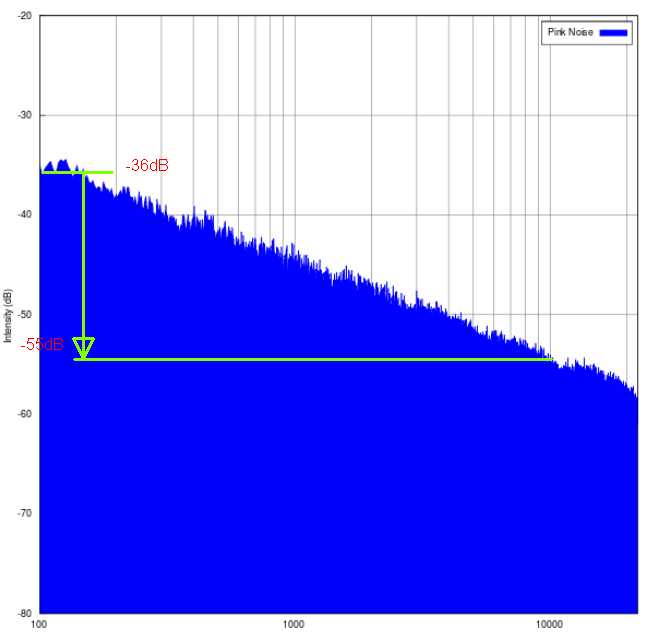
This graph is stolen from Wikipedia, and I've annotated it a bit. As it shows, with pink noise, the power required of the HF driver at 10KHz is about 20dB less than that of the LF driver at 100Hz. This is why HF drivers can have much less power handling than the LF driver, and I'm absolutely certain that this is nothing that you haven't heard a thousand times before, its established knowledge.
Although the relationship is not precise, for the kinds of programme material placed through a typical speaker unit, the spectral proportions are not a million miles away from pink noise either.
However, feed a close to full scale signal at 10KHz into the system, and all that energy will come out through the HF driver. It'll be something like 20dB higher than the normal levels the driver will experience. Given that 3dB is a doubling of power, you can see where this is going.
A chirp or clicky or whizzy sound effect can easily be mixed to deliver this level of HF energy.
And this is why on pro PA systems for live use there are individual limiters on each band of the crossover, as a loony with a synth can quite happily melt HF drivers whilst the overall levels are well below the system overload level. Busted HF drivers is not exactly an unknown problem.
Posted by Francois Bouzigues (Member # 8030) on 01-09-2014, 04:00 AM:
I'd like your opinion about that. You send a tech to replace an amp and a speaker. He performs the EQ.
Pink noise at 7, 83dB, eveything is fine. Then you play this movie a 4.5 and the speaker (the same that last 10 years without issue) dies in a second at timecode 58something... I don't think it is the fault of the tech, or the exhibitor...
The sound engineer of the movie is to blame.
Posted by Marcel Birgelen (Member # 6801) on 01-09-2014, 08:44 AM:
quote: Francois Bouzigues
The sound engineer of the movie is to blame.
Maybe this is the price to pay for playing such a stupid movie anyways
But why can't professional cinema speakers not be built with limiters for each and every band, even when using passive crossovers? I guess, I know why, but still, what are we potentially talking about? A few bucks per limiter?
Posted by Jeffry L. Johnson (Member # 453) on 01-09-2014, 03:07 PM:
Does anyone use a polyfuse to protect loudspeaker components?
Posted by David Buckley (Member # 2600) on 01-09-2014, 07:29 PM:
There are two ways to damage a loudspeaker driver.
The first is through thermal overload. This is as simple as it sounds; pump too much power into the speaker, it gets too hot, and the overheating causes failure. This is fairly easy to protect against, and for decades HF drivers have had light bulbs in series with them so as the power goes up the bulb acts as a crude limiter. It does this because as the filament of the lamp heats up its resistance increases, and thus reduces the power being fed to the driver. Push hard enough the lamp may even blow.
Thermal effects take time, as there is always more or less thermal inertia, so a short period of overload is not usually disastrous, but a moderate overload for a long time can be a killer.
The second damage mechanism is excessive displacement. Push the mechanics of the speaker too hard, and the suspension mechanisms cannot return the drive components back to their resting position, and the driver is knacked. This damage occurs instantly, push too hard once and its all over. It all happens far too fast for a simple thermal limiter, and it can happen without apparent excess power. Putting too low a frequency into a driver is a good way to damage it mechanically.
In terms of limiting generally; modern audio is now processed by DSPs, which do their magic by means of software, and software is free. Thus the cost to put limiting into a DSP crossover is zero, so any decent DSP crossover should have limiting on board. Of course, to be useful, it needs to be set up correctly, and setting up a limiter correctly is far harder than most people think.
This is why active speakers with onboard amplifier, DSP including crossover and protection from quality manufacturers is such a sensible idea. The safe operating envelope of the drivers is determined with destructive testing during R&D, and that knowledge is embedded into the onboard DSP, making such speaker almost indestructible no matter what you do to it. It also is perfectly set up out of the box.
Posted by Francois Bouzigues (Member # 8030) on 01-10-2014, 03:05 AM:
quote: David Buckley
Putting too low a frequency into a driver is a good way to damage it mechanically.
That would explain why it is all the time the centre high frequencies speaker that goes boom. I guess it will be all the more sensitive to low frequencies.
Posted by Steve Guttag (Member # 268) on 01-10-2014, 06:46 AM:
quote: David Buckley
what is wrong is your assumption of programme material.
I thought I covered that:
quote: Steve Guttag
enough presumptions to disqualify it from reality because when we set the 105dB reference, it was based on a speaker with a response from 60Hz to about 10KHz flat and then decreasing to 40Hz and 16KHz, respectively. So 2/3rds of the energy is already allotted to the LF section
As to the power needed for a given SPL in the passband...well that is factored into the response of the driver/horn system.
quote: Francois Bouzigues
Pink noise at 7, 83dB, eveything is fine. Then you play this movie a 4.5 and the speaker (the same that last 10 years without issue) dies in a second at timecode 58something... I don't think it is the fault of the tech, or the exhibitor...
The sound engineer of the movie is to blame.
It is impossible for the sound engineer of the movie to be to blame. He can't record above 0dbFS...a properly designed system can play 0dBFS material. I guess you may argue that one can under-design a system since you can get away with it for a long period of time. But it is still an under-designed system.
quote: Marcel Birgelen
But why can't professional cinema speakers not be built with limiters for each and every band, even when using passive crossovers?
Why not just design the system right to begin with? If your system can handle the power (amps and speakers)...you won't have a problem with this or any other sound track. It just isn't that hard to measure the room (length/width) and then select equipment that can handle that much space. Normally, the only shocker is how much subwoofer one really needs.
While limiters (and compressors) make sense in live situations...for cinema...the sound is VERY controlled...well defined...you know what maximum is. About the only way one can damage equipment that is big enough to begin with is to intentionally turn the fader up past reference.
Posted by Bobby Henderson (Member # 840) on 01-10-2014, 08:29 AM:
quote: Steve Guttag
It just isn't that hard to measure the room (length/width) and then select equipment that can handle that much space. Normally, the only shocker is how much subwoofer one really needs.
Theater chain executive who writes the check to buy the sound system, "do we really need that many subs and amplifiers for them? Can't we just install half that number? I'm sure it will sound just as good."
This is what I suspect is going on in many theaters, even the premium priced houses. They might crank the sound up some to let audiences hear/feel the bass a little so they know it's there. But it never really impresses. And those who have heard movie theater sound at its best know better.
Posted by Louis Bornwasser (Member # 3063) on 01-10-2014, 08:51 AM:
In my experience, during the digital install, the amps and speakers are retained and the processor is replaced.
Only about 20% of the new processors are then tuned. I mean at all. Is there any surprise that the sound got worse? (despite the higher quality source.) Louis
Posted by Marco Giustini (Member # 4544) on 01-10-2014, 02:46 PM:
I was aware that most sound systems were rushed when Digital was installed but not configured at all... So sad:(
Steve,
Thanks, Dolby technical notes say +18dB over reference (103dB for stage channels) but I've always thought it was only a way to keep costs down. Then Mark was correct when he claimed that the subwoofer was louder in D-Cinema than in 35mm.
Posted by Marcel Birgelen (Member # 6801) on 01-10-2014, 05:59 PM:
quote: Francois Bouzigues
Pink noise at 7, 83dB, eveything is fine. Then you play this movie a 4.5 and the speaker (the same that last 10 years without issue) dies in a second at timecode 58something... I don't think it is the fault of the tech, or the exhibitor...
Maybe you could share what kind of equipment is involved in the failure at your end?
quote: Steve Guttag
Why not just design the system right to begin with? If your system can handle the power (amps and speakers)...you won't have a problem with this or any other sound track. It just isn't that hard to measure the room (length/width) and then select equipment that can handle that much space. Normally, the only shocker is how much subwoofer one really needs.
I totally agree that you should design a system to be capable of playing all content within the specifications given to begin with. But, although we're not talking nuclear power plant here, I'm personally also a fan of multiple fail-safes. Especially in cases were it is rather simple to screw up and rather straight-forward to implement those additional safeguards.
I guess speaker manufacturers themselves won't be to eager to install those, blown out speakers are part of the business for them.
Posted by Scott Norwood (Member # 30) on 01-10-2014, 06:27 PM:
Are blown speakers really a regular occurrence in movie theatres? I have worked in plenty of places that have under-spec'd sound systems (most of which were running 35mm optical, admittedly) and the only time I have seen speakers blow was when someone did something stupid with a wireless microphone (same guy, twice!).
Questoin: would a properly spec'd sound system have issues with a peaked square wave recorded on the soundtrack?
Posted by Steve Guttag (Member # 268) on 01-11-2014, 09:31 AM:
Square waves are an interesting thing...especially when digitized...they don't digitize well.
My suspicion, though I have not tested it, is yes, it would though it would depend on the system. You are essentially presenting a clipped signal to a speaker. The higher the mass (woofers) the harder a time it is going to have moving very fast...coming to a dead stop, then moving in the opposite direction. So I would think woofers would have a harder time, particularly those with very low f3s. They would tend to bottom-out easier.
The other issue with square waves is heat most drivers use the motion of the driver to cool itself...with a square wave, particularly lower frequencies, one is holding the driver in opposite extremes for a large period of time.
So to answer your question, with an educated guess, the higher the frequency of the square wave, the greater the chance that the properly speced speakers/amps will survive...note...again passive crossovers are more likely to send harmful power/frequencies into the higher sections of the speaker system.
Powered by Infopop Corporation
UBB.classicTM
6.3.1.2