This is topic MasterImage 3D disc position for optimal brightness in forum Digital Cinema Forum at Film-Tech Forum ARCHIVE.
To visit this topic, use this URL:
https://ft-forum.com/ft/cgi-bin/ubb/ultimatebb.cgi?ubb=get_topic;f=16;t=001772
Posted by Justin Hamaker (Member # 2165) on 01-21-2014, 03:05 AM:
I'm just curious if anyone has measured how the brightness of MasterImage changes based on how close the disc is to the lens.
My understanding is the disc should be as close as possible to lens. With both of my MasterImage units, the disc is less than ½" from the lens.
Posted by Marcel Birgelen (Member # 6801) on 01-21-2014, 04:37 AM:
I'm curious right now. Why should there actually be a significant difference in brightness between e.g. ½ inch v.s. e.g. 1 inch?
Posted by Marco Giustini (Member # 4544) on 01-22-2014, 01:41 AM:
I guess if the disk is closer to the lens then you'll need a smaller dark time - the distance the disk has to travel in in order to get clear of the projected picture is shorter.
Same with dolby 3D, keep the light as small as possible and as close as possible to the edge of the disk where the angular speed is higher.
Posted by Marcel Birgelen (Member # 6801) on 01-22-2014, 02:54 AM:
That indeed makes some sense for rotating polarizer (or color filter in case of Dolby/Infitec) solutions, although I didn't do the necessary math to determine when this really becomes significant. ![[Wink]](wink.gif)
My first train of thought was: Why would it matter if the light traveled trough the polarizer in a smaller bundle and thus hitting a smaller surface? Wouldn't the light efficiency be practically the same?
Posted by Carsten Kurz (Member # 5396) on 01-22-2014, 05:49 AM:
The Masterimage wheel has the L/R split point at 180degrees. The difference in image size should not matter much thus for the dark time. As the disc is not easy to keep clean, I would probably prefer the largest possible image on the disc itself, this should keep image quality and polarization efficiency as high as possible.
- Carsten
Posted by Justin Hamaker (Member # 2165) on 01-22-2014, 08:34 AM:
The more I think about this, I think a smaller image on the disc would be more preferable because less light would be reflected back. It seems to me that if the picture on the disc is 2" x 2" and 5% of the light is being reflected back, you would be losing less than if your image was 2.5" x 2.5" and 5% was being reflected back.
Posted by Sam D. Chavez (Member # 1841) on 01-22-2014, 10:15 AM:
Interesting point, but the larger patch of light would be less intense and be "diluted" relative to the smaller patch so the loss would likely be the same.
Also, the polarizer might last longer with a larger patch of light due to less heat bleaching of the hot spot. Just thinking...
Posted by Carsten Kurz (Member # 5396) on 01-22-2014, 04:11 PM:
Justin, the reflectivity is based on the amount of luminous intensity reflected back. It is irrelevant of the size of the surface. 5% of xLumen is always 5%, wether reflected back from a small or a large patch. But the optical quality of the masterimage disc and the impact of dirt has a larger impact on resolution and stereo separation with the patch becoming smaller.
MasterImage should know - they recommend the largest possible image through the
disc segments (read the installation manual). Brightness efficiency is a valuable parameter for them to advertize - they will not downsize that asset for no technical reason.
- Carsten
Posted by Mark Gulbrandsen (Member # 72) on 01-24-2014, 08:57 AM:
This is how a properly set up MI should look. I was taught on this unit on site by their old Chief Engineer who has since gone on to work with Laser Light Engnes. Some of you fomr the great White North probably know him from his Imax days...
Mark
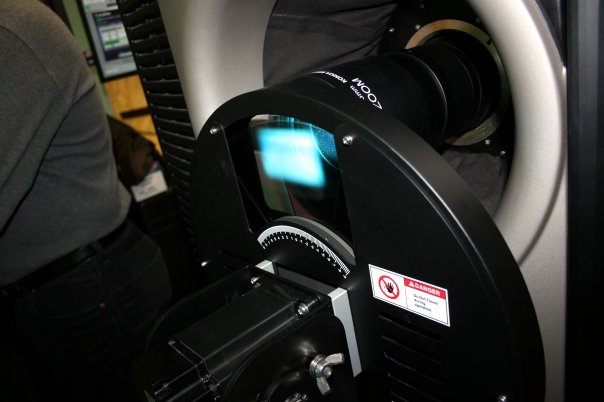
Posted by Justin Hamaker (Member # 2165) on 01-24-2014, 01:44 PM:
Mark, how far is the disc from the lens?
Posted by Mark Gulbrandsen (Member # 72) on 01-24-2014, 02:31 PM:
It wasn't more than an inch or two. Basically move it for or aft to what ever distance it takes to get that size light hitting the filter wheel.
Powered by Infopop Corporation
UBB.classicTM
6.3.1.2