This is topic Auro 11.1 - Its Rollout & Marketing in forum Digital Cinema Forum at Film-Tech Forum ARCHIVE.
To visit this topic, use this URL:
https://ft-forum.com/ft/cgi-bin/ubb/ultimatebb.cgi?ubb=get_topic;f=16;t=001777
Posted by Bobby Henderson (Member # 840) on 01-26-2014, 07:41 PM:
The Auro 11.1 sound format has been around for a couple years, but now it looks like some actual installation progress is starting to take shape in the US. Cinemark intends to install Auro 11.1 on all of its "XD" labeled premium big screen rooms, starting with "top tier" markets but eventually going into all XD houses. There is around 100 of them with more to open.
The Auro 3D web site now has a map showing Auro installations around the world. There's not very many at this point. Here's a list of Auro 11.1 houses in North America:
California
Calabasas - Edwards Theaters Stadium 6
Glendale - Pacific Theaters Glendale 18
Folsom - CinemaWest Palladio 16
Los Angeles - Pacific Theatres at the Grove
Redwood City - Cinemark Redwood Downtown 20 and XD
Florida
Boca Raton - Cinemark Palace 20 and XD
Lakeland - Cobb Theaters Lakeside 18
Miami - AMC Sunset Place 24
Georgia
Canton - Carmike Riverstone 15
Illinois
Gurnee - Marcus Theatres Gurnee Mills Cinema
Nebraska
Omaha - Strong Ballantyne
Nevada
Las Vegas - Century 16 South point and XD
New Jersey
Ridgefield Park - Starplex Luxury Cinemas 12
New York
New York - Regal E-Walk Stadium 13 & RPX
Texas
El Paso - Cinemark Cielo Vista Mall 14 and XD
El Paso - Cinemark East Montana and XD
Fort Worth - Cinemark Alliance Town Center
Frisco - Cinemark Frisco Square and XD
Galveston - Moody Gardens
Grapevine - Cinemark Tinseltown Grapevine and XD
Plano - Cinemark Legacy and XD
Plano - Cinemark West Plano and XD
San Antonio - Santikos Paladium
Virginia
Leesburg - Cobb Theatres Village 12
Canada
Kelowna, BC - Landmark Grand 10 Cinemas
Mexico
Morelia, Michoacán - Cinepolis
Santa Fe, Cuajimalpa - CineMex
The marketing and branding for Auro 11.1 is a little odd for its inconsistency. Here's the Auro3D company logo:

Here's two logos Barco put together for Auro 11.1:

Which logo is supposed to be used by movie theaters and movie studios? I've seen some theater chains use the Auro3D logo. Cobb Theaters is using one of the Barco Auro logos.
The advertising situation for Auro seems even worse than that of Dolby Atmos. I can't recall seeing Auro logos on any movie poster artwork or end titles. However, I haven't seen every movie with an Auro 11.1 mix (there's not very many; Dreamworks Animation seems to be the biggest source for future Auro 11.1 titles).
What seems even worse is how specific movie theaters are treating Auro. What the hell is Cinemark doing? The movie I: Frankenstein has Atmos and Auro 11.1 mixes, but I checked a few of the XD theaters in the Dallas area. They don't mention anything at all about Auro 11.1. This makes me wonder if Cinemark is trying to give "XD" all the pomp and circumstance for the more elaborate sound system and deliberately not give Auro 11.1 any credit at all.
I: Frankenstein hasn't been exactly well received by critics at all. It has a dismal 5% tomato meter score at Rotten Tomatoes. A lot of Dolby Atmos equipped theaters aren't playing the movie; shows like Ride Along and Lone Survivor are playing on those screens instead. IMAX branded theaters would be stuck playing that movie for weeks, if not for the re-release of Gravity going back on a lot of those screens 1/31.
Anyway, if Cinemark is going to spend a bunch of money on more than 100 Auro 11.1 installations, they probably ought to be making a far better effort at promoting the sound format. If Auro is supposed to be an unspoken ingredient in the XD theater recipe then that would be a pretty stupid move.
Posted by Mike Blakesley (Member # 26) on 01-26-2014, 09:45 PM:
I'm surprised AMC didn't put it into their Pleasure Island 24 at Disney World....that's a pretty deluxe, "dine-in" location. (Or maybe they put Atmos there? We're going to be there next weekend, if we get over to that area I'll find out.)
Posted by Bobby Henderson (Member # 840) on 01-26-2014, 10:30 PM:
AMC has installed Dolby Atmos in its ETX theaters and Prime screening rooms. The AMC Downtown Disney 24 has an ETX screen, but I'm not sure if that's the same theater you're talking about. I: Frankenstein is currently playing on that screen. I don't know if it will still be on that ETX screen Friday.
It would be kind of cool if they had Gravity in Dolby Atmos on that screen then.
Posted by Mike Blakesley (Member # 26) on 01-26-2014, 10:42 PM:
That is the location.....I forgot they changed the name of it when Disney basically shut down most of the Pleasure Island area. (And they'll probably change it again, because the whole Downtown Disney area is being re-imagined as "Disney Springs."
Posted by Buck Wilson (Member # 5885) on 01-27-2014, 12:00 AM:
Why even bother with Auro when Atmos is available? Cost?
Posted by Bobby Henderson (Member # 840) on 01-27-2014, 12:27 AM:
I think cost is the main thing. I don't know the price of the Barco AP-243D (a re-badged Datasat cinema processor), but I'm guessing it costs quite a bit less than a Dolby CP850 Atmos processor. The Auro 11.1 format probably doesn't require nearly as many amplifiers for a full 11.1 or 13.1 configuration.
But, a well configured Auro 11.1 capable sound system is going to cost quite a bit more than a regular 5.1 or 7.1 based sound system. That investment is going to be useless without a steady stream of Auro 11.1 movie mixes.
We're kind of in the dregs of the movie release schedule right now. I: Frankenstein is the only new movie in theaters with both an Auro 11.1 and Atmos mix. The way it looks, it might be March before we see more movies with Auro or Atmos.
There could be some last minute title entries, such as the upcoming Robocop remake. But if the mix in a movie like that was fully optimized for those next-generation sound formats I think we would have seen an announcement from Dolby, Barco or Auro by now. A movie whose 5.1 or 7.1 mix is basically ported over into Atmos or Auro with little change is pretty disappointing.
Posted by Joe Redifer (Member # 3) on 01-27-2014, 01:58 AM:
Barco sound? Sorry I'm waiting until Panavision comes out with their sound system.
Posted by Marcel Birgelen (Member # 6801) on 01-27-2014, 05:33 AM:
I've heard rumors that will be released right after their 3D system ![[Wink]](wink.gif) .
.
Posted by Ken Lackner (Member # 1002) on 01-27-2014, 12:09 PM:
Wayyy off topic...
quote: Mike Blakesley
the whole Downtown Disney area is being re-imagined as "Disney Springs."
Um. Huh? ![[Confused]](confused.gif)
Posted by Mike Blakesley (Member # 26) on 01-27-2014, 12:23 PM:
Yes, they are re-making the whole area, adding a parking garage (because parking there is ridiculous), adding more shops and restaurants and a foot-bridge to a resort across the lake, and so on. They abandoned the whole "Hyperion Springs" concept that was originally planned for the Pleasure Island area and incorporated it all in to Disney Springs. But the AMC Theatre (with whatever sound system it has) will still be there!
Sorry for the topic drift...of the two Auro logos above I like the second one better, it is more interesting. The top one looks like an 80s refuge.
Posted by Bobby Henderson (Member # 840) on 01-27-2014, 02:10 PM:
Barco's two Auro logos are more interesting. They have a better sense of style to them than Auro's own company logo.
However, Barco's two Auro 11.1 logos won't reproduce well at small sizes. The dots in that criss-cross "A" icon are fairly complicated. They get muddy looking when shrank to small sizes. And then the "experience sound in 3D" lettering is so thin in weight that it's only legible at large sizes. That lettering is barely 1 pixel in width in the examples above. Maybe that lettering would be dropped in versions of the logo made for smaller sizes. The Dax Pro typeface has many weights to it, from very light to very heavy. Barco should work on some other alternatives that can reproduce well as small icons on a web-based theater show times page.
Posted by Terry Lynn-Stevens (Member # 7349) on 01-27-2014, 02:23 PM:
While Barco does make good quality projectors, there really is not much of a chance that Auro 11.1 will ever succeed.
quote:
I've heard rumors that will be released right after their 3D system [Wink]
![[Big Grin]](biggrin.gif)
Posted by Bobby Henderson (Member # 840) on 01-27-2014, 02:52 PM:
As much as I want Dolby Atmos installations to proliferate into thousands of theaters, Auro 11.1 is going to stick around if enough theaters have Auro 11.1 sound systems.
Right now around 120 theater locations in North America have screens equipped with Atmos and some of those locations have multiple Atmos capable screens.
Auro 11.1 won't have any trouble growing to the 120 theater locations level. There are around 100 Cinemark XD screens with several more set to open this year. Regal has a deal to install Auro 11.1 in 20 of its RPX theaters. Carmike appears to be leaning toward putting Auro 11.1 in its Big-D theaters after testing both Atmos and Auro 11.1 in two of their Big-D theaters.
One thing I don't think has good odds is DTS' object-based MDA format taking over. I'm skeptical it can be a one size fits all format for immersive sound in D-cinema. Atmos and Auro 11.1 are very different in how they are encoded. Both are proprietary. The authoring environments for both are very different. Adding another layer via a DTS MDA authoring environment may create even more work. The results would have to be checked within the Auro and Atmos.
Having a "single delivery" for immersive sound on DCP hard discs is asking a bit much. Just look at all the different projection format "deliveries" on some DCPs. There's already separate 5.1 and 7.1 audio mixes on many DCPs. The situation is just going to get more complex rather than going the other direction to greater simplicity. If all the audio/video deliveries won't fit on a DCP disc the studios will just have to use some bigger capacity hard discs.
Posted by Terry Lynn-Stevens (Member # 7349) on 01-27-2014, 03:26 PM:
quote: Bobby Henderson
Having a "single delivery" for immersive sound on DCP hard discs is asking a bit much.
Dolby Atmos will play in any cinema, 5.1, 7.1 or up to 64 channels. Atmos is a single inventory format.
Posted by Mark Gulbrandsen (Member # 72) on 01-27-2014, 04:08 PM:
Ha?
And I figured everyone was installing Christie Vive by now because their sales people told me it was the best thing going out there today. Their claim was that it is even better then their projectors and even better then the guy that actually runs Christie. Seriously though. Isn't that just the old ribbon speaker line that Big Skie used to sell and no one bought? Or did they actually bother to design a whole new line of ribbon speakers that no one will still buy? I probably shoudla started another thread for this but I had to poke fun at it some where... Ala Vive!
Mark
Posted by Bobby Henderson (Member # 840) on 01-27-2014, 04:37 PM:
quote: Mark Gulbrandsen
And I figured everyone was installing Christie Vive by now because their sales people told me it was the best thing going out there today.
Christie Vive is a speaker hardware package. It competes with the speaker systems from QSC, JBL, Meyer Sound, etc. In the growing debate about new immersive sound formats, Christie has sided with Dolby's Atmos approach. But they're promoting Vive for use with 5.1, 7.1, Atmos and Auro.
quote: Terry Lynn-Stevens
Dolby Atmos will play in any cinema, 5.1, 7.1 or up to 64 channels. Atmos is a single inventory format.
Not really. In the Dolby Atmos authoring process sound mixers will generate the Atmos track and also render down-mixed 5.1/7.1 LPCM tracks that are bundled with the Atmos audio.
This is similar to the approach with Dolby TrueHD on Blu-ray. A "hidden" Dolby Digital track is present for backward compatibility. But that DD 5.1 track isn't actually inside of the TrueHD audio data. DTS Master Audio has an inner core of backward compatible DTS data.
Posted by Connor Wilson (Member # 6088) on 01-27-2014, 04:50 PM:
Here's to the best of my knowledge. There are only 2 Dolby Atmos screens and 1 Auro 11.1 screen in NoVA, the two Atmos screens being the only Atmos screens around DC. Cinemark just recently installed Auro 11.1 in their XD screen at the Egyptian 24 in Hanover, MD. So if you take the entire DC metropolitan area and the radius surrounding it, you got Atmos and Auro split half-and-half.
As a moviegoer of Cobb's Village 12, I can assure you that Cobb does indeed use the Barco Auro logo in posters and other general marketing. But before an Auro movie, it plays the Auro 3D logo. I would prefer the trailer Barco made for Auro as the generic corporate Auro 3D logo is unimpressive and I can barley pinpoint where the voices are coming from.
I saw four films in Dolby Atmos. A Good Day to Die Hard, Oz the Great and Powerful, Pacific Rim, and Gravity, with each film sounding progressively better than the last.
I only saw two films in Auro 11.1. Turbo and Ender's Game. Turbo sounded non-gimmicky but had robust bass. Ender's Game, however, sounded more aggressive and yet remained clear. The latter had a female voice countdown to liftoff from the overhead channel as Ender and his peers launch into space for camp.
As Bobby implied, the more channels and speakers a room gets for a new sound format like Auro and Atmos, it will cost more to get it sound up and running. Screen 11 at Cobb, which has Auro installed, had a blown subwoofer for Ender's Game and it wasn't present for Turbo. I have been a patron of Cobb since it opened in Leesburg and it has little issues from time to time. I remember in screen 8, during The Avengers, the sub was blown, and this was a 7.1 setup I presume. Next show I went to in the same screen, the woofer was replaced/repaired. Ender's Game was the last movie I saw in screen 11.
Cobb is not showing I, Frankenstein on their Auro screen, all shows are on their D-box screen (screen 8 again). The Cinemark Egyptian is showing it on their XD screen, but Auro doesn't seem to be advertised. The RPX Atmos screen in Alexandria (my favorite Atmos theater) is booked for Lone Survivor.
But I think this is a special treat. The ETX Atmos screen in Tyson's Corner is showing Gravity this week at a discounted price than usual for ETX, it seems.
And yes, I did see the Barco Auro logo on the end credits of The Croods and Turbo. It seems like Dreamworks Animation really likes Auro even if their movies are simultaneously released in Atmos as well.
Posted by Mike Blakesley (Member # 26) on 01-27-2014, 06:25 PM:
quote: Connor Wilson
It seems like Dreamworks Animation really likes Auro even if their movies are simultaneously released in Atmos as well.
It doesn't matter who likes what, it's how much $$$ changed hands that determines where the logos go.
Posted by Jarod Reddig (Member # 6363) on 01-28-2014, 12:47 AM:
I unforunatly have no Auro equipped theaters anywhere near me but there is Atmos in KC. What pisses me off is that my only local Atmos theater within 5 hours is isntalled in an AMC ETX house which means everytime I wanna experience Atmos I also have to watch a letterboxed presentation if the film is in Scope format being as we all know how much AMC loves to not use masking.
Posted by Mark Gulbrandsen (Member # 72) on 01-28-2014, 10:46 AM:
quote: Bobby Henderson
It competes with the speaker systems from QSC, JBL, Meyer Sound, etc.
I hardly think it's going to "compete" with any of those three, especially QSC and Meyer!
Posted by Scott Jentsch (Member # 1681) on 01-28-2014, 11:12 AM:
None of those Auro logos do anything for me. You can see how they tried to be minimalistic with the latter two, but then someone got in there and added the 3D sphere thing on the left, and then someone thought the logo needed a tagline, so the impossible-to-reduce "experience sound in 3D" text was added.
Messy.
At least the first Auro 11.1 logo gets the brand placements right.
So, with "11.1" being in a different color, does that mean that they will have different numbers? Maybe "Auro 5.1" for those theaters that don't want to upgrade their speaker system, and then "Auro 11.4" for those that add extra subwoofers?
More and more, I like the object-oriented approach of Atmos and the rumored DTS (ahem, Datasat) MDA approach. That's based entirely on one Atmos presentation and no Auro presentations, yet. I've not heard an Auro presentation (they're really hard to find).
What I have yet to hear about either format is some way to measure the effectiveness of the sound system. I would think that some sort of multi-channel microphone could be used with some kind of test track to essentially map the output of a particular system. Such a test bed could also be used to calibrate the system and detect defective equipment. Does anything like that exist?
Posted by Bobby Henderson (Member # 840) on 01-28-2014, 01:07 PM:
quote: Connor Wilson
The Cinemark Egyptian is showing it on their XD screen, but Auro doesn't seem to be advertised. The RPX Atmos screen in Alexandria (my favorite Atmos theater) is booked for Lone Survivor.
Cinemark isn't doing anything to advertise Auro 11.1, even though they plan on installing Auro on nearly all of their XD screens. Cinemark has 3 Dolby Atmos installations, which I assume are on XD screens.
quote:
I hardly think it's going to "compete" with any of those three, especially QSC and Meyer!
From what I can tell Meyer Sound makes some of the most coveted cinema speakers around. QSC ain't bad though. Those huge 4-way towers they make are kind of scary looking.
![[evil]](graemlins/evil.gif)
quote: Scott Jentsch
So, with "11.1" being in a different color, does that mean that they will have different numbers? Maybe "Auro 5.1" for those theaters that don't want to upgrade their speaker system, and then "Auro 11.4" for those that add extra subwoofers?
Barco's Auro logos can be reproduced in a single color. The company is actually kind of big on using a lot of gradients in the full color versions.
As to channel layouts, I think the cinema version of Auro is only available in 11.1 and 13.1 configurations. There's a 9.1 setup Auro is trying to promote for home theater.
Auro 5.1? That, I think, would just be a plain 5.1 surround sound system. What would be "Auro" about 5.1?
Posted by Bobby Henderson (Member # 840) on 01-28-2014, 03:08 PM:
Here's a list of movies released in North America with Auro 11.1.
US Releases with Auro 11.1
2014
The Adventurer: Curse of the Midas Box, E-Motion, 1-10-2014
I, Frankenstein, Lionsgate, 1-24-2014**
2013
Ender's Game, Summit Entertainment, 11-1-2013**
Diana, Ecosse Films, 9-20-2013
Elysium, Columbia, 8-9-2013**
Turbo, Dreamworks, 7-17-2013**
The Croods, Dreamworks, 3-22-2013**
Oz the Great and Powerful, Disney, 3-8-2013**
2012
Rise of the Guardians, Fox, 11-21-2012**
Red Tails, Fox, 1-20-2012
Future Releases:
Trolls, Dreamworks, 11-4-2016
How To Train Your Dragon 3, 6-17-2016
Kung Fu Panda 3, Dreamworks, 12-23-2015
The Penguins of Madagascar, Dreamworks, 3-27-2015
Home, Dreamworks, 11-26-2014
How to Train Your Dragon 2, Dreamworks, 6-20-2014
Oculus, Relativity Media, 4-18-2014
Mr. Peabody & Sherman, Dreamworks, 3-7-2014**
**Dolby Atmos available on the same movie release.
Posted by Scott Jentsch (Member # 1681) on 01-29-2014, 10:21 AM:
This discussion got me wondering how many theaters were advertising Auro, so I did some queries and found only one.
I also modified the Atmos advanced search tool for Auro:
Movies Playing in Barco Auro 11.1
The first result is a false-positive, since the theater has a comment that matches "auro", so that leaves just the Pacific Theatres Glendale 18 in Glendale, CA showing I, Frankenstein in Auro.
If theaters aren't going to advertise the sound system, it really minimizes the return they will get on their investment. I guess there's some truth to just declaring your xD screen the "best available" and not let people in on what you are doing behind the scenes, but I think you have to let people know some of this stuff so they can be informed and you can use things like Auro to back up your claims of being the best.
Posted by Lyle Romer (Member # 1266) on 01-29-2014, 10:39 AM:
quote: Scott Jentsch
What I have yet to hear about either format is some way to measure the effectiveness of the sound system. I would think that some sort of multi-channel microphone could be used with some kind of test track to essentially map the output of a particular system. Such a test bed could also be used to calibrate the system and detect defective equipment. Does anything like that exist?
Atmos tunes itself. I've also read in the Dolby literature that there is an in theatre mic that monitors the sound system and reports problems.
Posted by Bobby Henderson (Member # 840) on 01-29-2014, 12:58 PM:
quote: Scott Jentsch
If theaters aren't going to advertise the sound system, it really minimizes the return they will get on their investment. I guess there's some truth to just declaring your xD screen the "best available" and not let people in on what you are doing behind the scenes, but I think you have to let people know some of this stuff so they can be informed and you can use things like Auro to back up your claims of being the best.
I have a theory on why certain theater chains, like Cinemark for instance, are restoring to this, what I feel is a very stupid tactic: they're trying to be as much like IMAX as possible. Chains like Cinemark are trying to position brands like "XD" onto the same level as IMAX. "Auro 11.1? Nah, the 11.1 sound is really a unique part of the XD experience!" Of course their web site won't say which XD screens have Auro 11.1 sound capability and which movies have actual Auro 11.1 soundtracks.
IMAX doesn't say squat to the public in terms of specifics about its sound system other than boasting its "laser aligned" set up and talking wattage levels at some theaters. Nevermind it's just 5.1 (or even 5.0) audio. IMAX is all about pimping its brand and raking in lots of money over it.
No matter what Cinemark does with XD, or any theater chain using a ridiculous acronym involving the letter X, it will never have the brand equity of IMAX. With its digital system IMAX is taking advantage of over 40 years of history, primarily in the giant format films space and letting a lot of customers assume its multiplex digital concept is the same thing as true IMAX.
These like-LieMAX private label big screen theater concepts have acronyms that really don't mean anything by themselves. In fact, I think it's just another way for some customers to confuse this stuff with the original three letter acronym brand: THX.
I couldn't care less if something was XD, ETX, GDX, GTX, GXL, AVX, FDX, DLX, DFX, RPX, SDX, BigD, ICON•X, Titan-XC, Xtreme, EPIC, E3, XPlus, etc. These are all real labels for premium priced big screen houses. And that's not all of them either. When you see such a collection of them together they really start looking pretentious and downright silly. There's so many of these big screen acronym labels you can't keep up with them if you deliberately try. With so many different labels they all end up meaning nothing. It's all static.
In some cases two different theater chains step on each other using the same acronym. Both Cineplex in Canada and Santikos in Texas use the AVX and AVX MAX label. It's only coincidental (I think). Each chain has different logo artwork for those labels.
Harkins Theaters' Cine Capris concept has more legitimacy. For one thing their Cine Capris theaters pre-dated the conversion to digital projection. They're loosely modeled after the original Cine Capris theater in Phoenix. Another thing to keep in mind about the Cine Capris theaters: they're not showing 3D movies (single projector setup on 70' wide screens). For a long time they charged nothing extra to see movies in that auditorium. Now it costs $1 more than the standard ticket price. Being able to watch a movie in Dolby Atmos for $10 isn't too bad.
I guess I care more about these fundamentals:
1. The native resolution of the movie, typically 2K or 4K.
2. The make of projector(s) and native resolution, 2K or 4K.
3. The sound format (5.1, 7.1, Auro 11.1, Atmos).
Those are the things I want to see in theater show time directories, if they bother listing any technical information about the movie at all. I couldn't be forced to care about some over-hyped acronym taking the place of that technical information. XD doesn't mean anything to me. 4K projection with Auro 11.1 sound is more informative.
Posted by Lyle Romer (Member # 1266) on 01-29-2014, 01:20 PM:
Bobby,
You forgot MDX - Marcus Digital Xperience (which I guess is a new word). Apparently this translates to "auditorium has a digital projector."
According to a press release they use 4K NEC projectors but that info isn't stated on the website.
Posted by Terry Lynn-Stevens (Member # 7349) on 01-29-2014, 01:33 PM:
quote: Bobby Henderson
Both Cineplex in Canada and Santikos in Texas use the AVX and AVX MAX label. It's only coincidental (I think).
Bobby, for Cineplex in Canada it is actually called "UltraAVX" not just AVX.
quote: Bobby Henderson
Nevermind it's just 5.1 (or even 5.0) audio.
You forgot to add that it is proprietary to IMAX only and IMAX does change/modify and/or enhance the soundtrack. The sound is also uncompressed. IMAX also uses completely different speaker design than "just" 5.1 theatres.
quote: Bobby Henderson
I guess I care more about these fundamentals:
1. The native resolution of the movie, typically 2K or 4K.
2. The make of projector(s) and native resolution, 2K or 4K.
3. The sound format (5.1, 7.1, Auro 11.1, Atmos).
Still stuck on the 4K thing huh? You should be watching digitally projected scope movies with anamorphic lenses and proper masking before you start worrying about 2K or 4K.
quote: Bobby Henderson
3. The sound format (5.1, 7.1, Auro 11.1, Atmos
The smartest thing Dolby ever did was abandon the whole XX.1 nonsense, calling it just Dolby Atmos was a good marketing move.
Posted by Bobby Henderson (Member # 840) on 01-29-2014, 01:57 PM:
quote: Lyle Romer
You forgot MDX - Marcus Digital Xperience (which I guess is a new word). Apparently this translates to "auditorium has a digital projector."
There's quite a few I didn't mention actually, which is why I put the "etc" thing on the end of that list. And that's only theaters in North America! There's a whole shitload of these labels being used in the international market as well. Sound and fury signifying nothing.
It's dissapointing Marcus doesn't mention 4K projection on its web site, or more specifically which movies have 4K resolution DCPs and are being shown in true 4K.
Maybe it will take 4K Ultra HDTV becoming more widespread in the home to force theaters to start getting specific about when they're showing a movie in 2K or 4K.
quote: Terry Lynn-Stevens
Bobby, for Cineplex in Canada it is actually called "UltraAVX" not just AVX.
Whatever. It's still meaningless, alphabet soup gibberish.
quote:
You forgot to add that it is proprietary to IMAX only and IMAX does change/modify or enhance the soundtrack. The sound is also uncompressed. IMAX also uses completely different speaker design than "just" 5.1 theatres.
All d-cinema theaters can play uncompressed 5.1 LPCM audio. That's all any of the "plain" standard priced d-cinema theaters play. There's quite a few standard priced d-cinema theaters that play uncompressed 7.1 channel audio (something IMAX can't do).
The suggestion IMAX steps in and alters a movie's mix speaks more to the limitations of its speaker system. In terms of sound quality and surround coverage IMAX' sound system is pretty lacking. It would get blown away by a good 4-way system from QSC or Meyer Sound, which incidentally are going into some of these like-LieMAX theaters.
quote:
Still stuck on the 4K thing huh? You should be watching movies with anamorphic lenses a proper masking before you start worrying about 2K or 4K.
You're probably one of those guys who thinks you can use Photoshop to "up-rez" a tiny, low quality JPEG image into something equal to a real high resolution image. Native resolution matters a hell of a lot more than some fucking brand or an acronym trying to become a brand.
Posted by Terry Lynn-Stevens (Member # 7349) on 01-29-2014, 02:06 PM:
quote: Bobby Henderson
The suggestion IMAX steps in and alters a movie's mix speaks more to the limitations of its speaker system. In terms of sound quality and surround coverage IMAX' sound system is pretty lacking. It would get blown away by a good 4-way system from QSC or Meyer Sound, which incidentally are going into some of these like-LieMAX theaters
That is where I don't agree with you. I would much rather watch a D-IMAX film for the audio alone over a standard cinema or even Atmos.
quote: Bobby Henderson
Native resolution matters a hell of a lot more
You focus way too much on native resolution, there are many variables that factor into a good picture than just resolution.
Posted by Bobby Henderson (Member # 840) on 01-29-2014, 02:10 PM:
quote: Terry Lynn-Stevens
That is where I don't agree with you. I would much rather watch a D-IMAX film for the audio alone over a standard cinema or even Atmos.
IMAX audio over Atmos? You really are that far gone as an IMAX fanboy, Terry. Just keep on drinking that IMAX Kool-Aid.
quote: Terry Lynn-Stevens
You focus way too much on native resolution, there are many variables that factor into a good picture than just resolution.
You believe it's possible to throw away one of more variables required for great projected imagery -like a high resolution source image.
High native resolution is a fundamental requirement for big screen viewing. That's one of the reasons why 70mm was popular for a time with film projection.
Posted by Terry Lynn-Stevens (Member # 7349) on 01-29-2014, 02:24 PM:
quote: Bobby Henderson
High native resolution is a fundamental requirement for big screen viewing.
And so is your lamp house, your lenses (zoom lense, fixed lense or anamorphic lense), masking vs no masking. Common width set ups vs common height set ups.
A 2K presentation with a proper anamorphic lense which utilizes the full efficiency of the lamp and sensor can potentially look better than a 4K presentation using a single lense setup. Pick your screen size common width or height does not matter in this comparison.
quote:
hat's one of the reasons why 70mm was popular for a time with film projection.
You have to stop comparing film vs digital set ups, they are not the same. The larger film gauge always wins with film.
Posted by Mike Blakesley (Member # 26) on 01-29-2014, 04:08 PM:
quote: Terry Lynn-Stevens
I would much rather watch a D-IMAX film for the audio alone over a standard cinema or even Atmos.
You must not have many good theater audio systems in your neck of the woods.
Having heard a movie (Gravity) in D-Imax and then later on our own system, I thought it sounded just as good, or possibly slightly better, on our standard 5.1 system. (We have QSC 3-way stage speakers, two QSC dual-driver subs and 12 QSC surrounds, and all QSC amps, for anyone who wonders.) The Imax sounded good, but it didn't blow me away like I expected it to do.
Meanwhile, I think it's fairly cool that I don't need to bother coming up with a cool sound system name because our theater's name already has an X in it, so we're good to go. We've been ahead of our time since 1930 and didn't even know it. I just need to design a logo where the X is huge and red.
Posted by Bobby Henderson (Member # 840) on 01-29-2014, 04:32 PM:
quote: Terry Lynn-Stevens
A 2K presentation with a proper anamorphic lense which utilizes the full efficiency of the lamp and sensor can potentially look better than a 4K presentation using a single lense setup. Pick your screen size common width or height does not matter in this comparison.
I'm not talking about common width or common height screens. I'm talking about how much an image with a fixed pixel count is getting magnified. The projector's imaging chips have a fixed pixel grid. As the screen gets bigger that pixel grid gets bigger, more coarse and more noticeable.
If a digital projection setup has all the right ingredients (great light engine, great quality lens, proper screen alignement, etc.) it's going to show off a 2K pixel grid plain as day if that image is magnified on a big enough screen. Then the theater has to deliberately de-focus the image to hide that grid. The end result is big yet kind of blurry digital projection.
4K has four times the pixel count as 2K. On the same size screen 4K has four times the pixels per inch resolution. The pixel grid is going to be less visible.
This stuff actually matters to people. Look at Apple making money off Retina Displays in its iPad and MacBook Pro products. Google one-upped the iPad with a higher resolution display in its Nexus 10 tablet. Dell recently released a 4K resolution XPS 15 inch notebook. These guys have software companies like Adobe jumping through hoops re-doing the user interfaces in their applications so the menus aren't microscopic on those screens. DPI ratings are marketing material in smart phone displays. This is a reality with digital technology. Movie theater operators are fooling themselves if they think it doesn't matter with their digital technology.
quote: Terry Lynn-Stevens
You have to stop comparing film vs digital set ups, they are not the same. The larger film gauge always wins with film.
It's not really an apples to oranges comparison. With film, getting the projected image sharp as possible was a primary goal. Get close enough to the screen and you would see the film's natural grain structure swimming around on the screen. It looked natural. A visible pixel grid doesn't look good.
But, yes, you are right that a larger film gauge like 70mm does beat a smaller film gauge like 35mm. The grain structure in 5/70mm is 250% more fine than that of 4/35mm. Plus the bigger film gauge runs in a more steady manner than 35mm. It can be blown up on larger screens and look brighter and more rock solid than 4/35mm.
There are similarities in that between 2K and 4K resolution. A 4K image can be blown up larger without making its pixel grid noticeable. Light output is another matter. 5/70 put a lot more light onto the screen than 4/35. The same isn't true with some 4K projector models.
Posted by Mike Blakesley (Member # 26) on 01-29-2014, 06:44 PM:
quote: Bobby Henderson
Look at Apple making money off Retina Displays in its iPad
Actually I'd wager that at least half of the sales of iPads are due to other factors besides the Retina displays. Such as: New-model fever, other new features besides the display, the old one is broken or lost or stolen, and so on. I don't quite get why super-hi-res is necessary on a screen that small.
Posted by Bobby Henderson (Member # 840) on 01-29-2014, 06:58 PM:
Other factors are important, but Apple made a big enough deal about Retina Display™ that it made a bunch of its competitors take notice. High ppi resolution levels are, like it or not, marketing material now.
I don't mind the higher resolution displays either. It's actually a good thing to have a pixel grid tight enough to where individual pixels can barely be seen. Graphics, and type in particular, look very sharp rather than chunky and all pixellated like it does on lower resolution displays. High resolution photographs have a much more continuous tone appearance.
Posted by Terry Lynn-Stevens (Member # 7349) on 01-29-2014, 09:17 PM:
quote: Mike Blakesley
You must not have many good theater audio systems in your neck of the woods.
We have enough Dolby Atmos screens within driving distance of my area.
quote: Mike Blakesley
Having heard a movie (Gravity) in D-Imax and then later on our own system, I thought it sounded just as good, or possibly slightly better, on our standard 5.1 system.
Which is fine I am glad you feel that way, however for most event movies that I have seen I thought the IMAX digital presentation was far better than standard 5.1 and Atmos as well. IMAX also has a far brighter picture than anything Cineplex has on their current AVX or regular screens.
I reserve IMAX for big event movies that I want to see, I don't mind paying the premium. I personally would not pay a dime extra for Dolby Atmos.
Posted by Buck Wilson (Member # 5885) on 01-30-2014, 12:05 AM:
How many features have you seen with Atmos?
Posted by Terry Lynn-Stevens (Member # 7349) on 01-30-2014, 12:18 AM:
Maybe eight total. Last year was Gravity, Wolverine, Insidious 2 and a few others, apparently I also saw Lone Survivor and Jack Ryan in Dolby Atmos. I don't pay for the tickets so the showtimes just conveniently work. I was going to say I saw Hobbit 2 as well but there was a Dolby 7.1 ad before the movie.
I have seen two IMAX digital movies in the last year, Catching Fire and Gravity for a second time. Both I gladly paid for and both were event/special nights especially the Catching Fire screening. I don't want to see every movie in IMAX, just the event titles.
How about you?
Posted by Brad Miller (Member # 2) on 01-30-2014, 01:41 AM:
Well since you asked...nothing about IMAX is impressive anymore. Nothing. Their sound systems are vastly inferior as well (unless you like shrill audio).
Are you sure you aren't on IMAX's payroll? Seriously, LieMAX is nothing impressive anymore and it seems everyone knows it but you.
For the record, Atmos vs. Auro? Well, just forget Auro. Atmos is THE system of the future.
Posted by Lyle Romer (Member # 1266) on 01-30-2014, 08:21 AM:
quote: Brad Miller
For the record, Atmos vs. Auro? Well, just forget Auro. Atmos is THE system of the future.
I agree with you but Dolby needs to bring down the cost so it will get installed in more than just the acronym auditorium at most complexes.
Posted by Bobby Henderson (Member # 840) on 01-30-2014, 09:52 AM:
Unfortunately there is currently no way to install Dolby Atmos into a movie theater without it costing quite a lot of money.
The only ways anyone could install Atmos at a lower cost is by putting Atmos into a smaller house that doesn't need nearly as many speakers and amplifiers. Or they could install Atmos wrong, basically buying a CP850 and wiring together what amounts to a 9.1 channel configuration. Or use fewer surround speakers, even in a big room (kind of like what IMAX does; they only use two).
![[Razz]](tongue.gif)
Here's a reduced size image of the back of a Dolby Atmos booth rack. All that hardware can't be cheap. The installation cost probably isn't very cheap either.
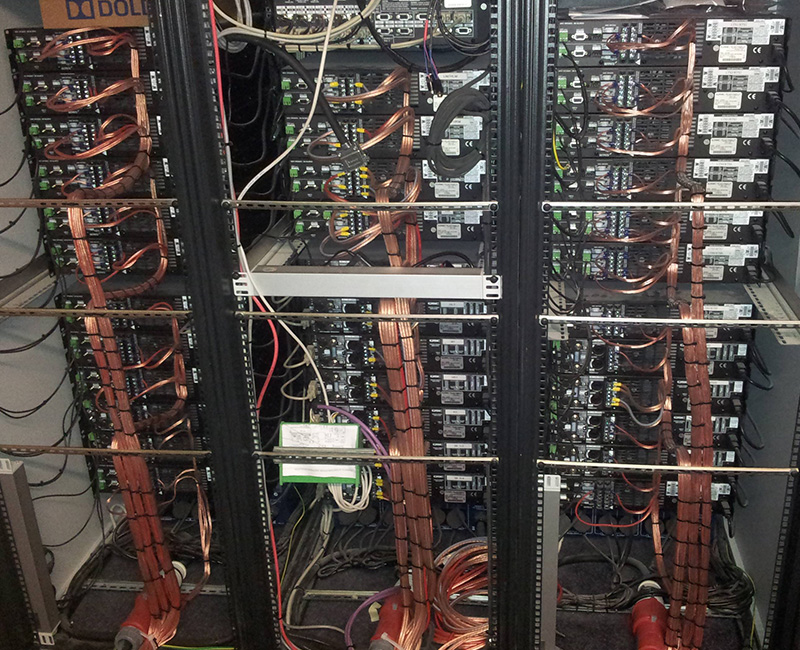
It looks like there's close to 3 dozen QSC amplifiers in those racks, which at first would seem like a near-maximum configuration, but each stage channel might require multiple amplifiers, and there would be five stage channels behind a really big screen. I found this image in a Google Image search using Dolby Atmos as key words. It's from someone's Flickr account and sparking some discussion at Reddit. I didn't look hard enough to find which theater has this booth rack.
Posted by Daniel Schulz (Member # 1881) on 01-30-2014, 11:04 AM:
quote: Scott Jentsch
More and more, I like the object-oriented approach of Atmos and the rumored DTS (ahem, Datasat) MDA approach.
Actually, MDA has nothing to do with Datasat (other than we are of course an interested party inasmuch as we manufacture cinema processors). MDA was originally developed by SRS labs, and was inherited by DTS when they bought SRS (in 2012, or 4 years after they sold their cinema business to Datasat). DTS is pitching MDA as a format for creating object-based mixes, and would then license the software to do the rendering to any interested hardware manufacturers (Datasat, QSC, UltraStereo, etc.)
Posted by Scott Jentsch (Member # 1681) on 01-30-2014, 02:10 PM:
quote: Bobby Henderson
I guess I care more about these fundamentals:
1. The native resolution of the movie, typically 2K or 4K.
2. The make of projector(s) and native resolution, 2K or 4K.
3. The sound format (5.1, 7.1, Auro 11.1, Atmos).
Those are the things I want to see in theater show time directories, if they bother listing any technical information about the movie at all.
1. Are there any reliable sources for this? The IMDb is spotty and can't be considered definitive.
2. Sometimes, this can be determined by scouring press releases or other promotional material, but unless the theater does something location-wide or the chain does something circuit-wide, there's no way to know aside from personal observation what equipment is being used. Marcus Theatres is usually pretty good about marking their auditoriums with "4K" signs, but that info is usually not included in their showtimes (it was at one time).
3. As long as the theater provides the info, we show it. Getting them to provide that info? For whatever reason, harder than you would think!
Posted by Bobby Henderson (Member # 840) on 01-30-2014, 03:02 PM:
quote: Daniel Schulz
DTS is pitching MDA as a format for creating object-based mixes, and would then license the software to do the rendering to any interested hardware manufacturers (Datasat, QSC, UltraStereo, etc.)
License the MDA software? I thought DTS' MDA format was supposed to be open source/royalty free.
SMPTE wants an object-based capable sound editing front end for movie post production that generates results that are compatible to some extent with Atmos and Auro. The term "harmonize" between the two formats has used, but it sounds to me a little like lowest common denominator. Atmos and Auro are very different sound formats with little common ground other than some measure of backward compatibility to allow the same DCP to work on a LPCM 5.1/7.1 sound system.
SMPTE and NATO want a single delivery sound format on a DCP. Having multiple projection formats for 2D and 3D didn't seem to be much of a problem for them, nor was it a problem to have separate 5.1 and 7.1 tracks on a DCP.
Dolby has an almost 2 year lead on its rivals. I just can't help wondering if this sudden call for "open standards" is really a way of preventing Dolby from capturing the immersive cinema sound market. Dolby's lead with Atmos would probably be much larger if it weren't for the expense and complexity that goes into an Atmos install.
quote:
As long as the theater provides the info, we show it. Getting them to provide that info? For whatever reason, harder than you would think!
The theater operators know the native resolution of the movies they are ingesting into their servers. The DCP spells out those details very clearly. I wish a lot more DCP info was shared here at Film-Tech in the forum made just for that purpose. The theater operators know the make and model of their projectors, not to mention their resolution. It's actually not very complicated information. Same goes for the sound format.
Movie studios and theater chains don't provide any of that info unless they are forced in some manner to do so. Instead, they'll voluntarily plop "QRX" or whatever on an exterior wall of the building and expect the paying customer to be impressed with that. The letter they use make me think they were playing Scrabble and used their last three remaining letters for the big screen label. JZX ought to be a winner.
Posted by Harold Hallikainen (Member # 5405) on 01-30-2014, 03:26 PM:
In a discussion at ICTA, exhibitors seemed to want to brand and sell the overall premium experience instead of the bits and pieces of that experience (superior sound, superior image, superior seats, legroom, food, etc.). So, as part of branding, they take a spoonful of alphabet soup and see what they get.
Harold
Posted by Sam D. Chavez (Member # 1841) on 01-30-2014, 06:37 PM:
I think this a continuation of the design effort of the DCI specification to ensure these was no IP for the audio bitstream for Dolby Labs or anyone else.
Now that we've moved on to multi-dimmensional audio and Atmos looks like the most elegant idea, competitors don't wish to see Dolby run off with the prize again. NATO and its members want this open "standard" to spare them the painful choice of having to decide which system to buy. (Socialism for Theatre owners?). The last time around some ended up buying CDS, DTS, and SDDS, all for the same screens and we all know how that worked out.
Dolby won because it was practical, robust and agnostic. CDS was an engineering disaster, DTS had inherent limitations, SDDS was a mess, expensive when was not part of some film deal co-op deal, proprietary, and tied to Sony Studios.
Ought to be great fun.
Posted by Harold Hallikainen (Member # 5405) on 01-30-2014, 08:20 PM:
And, of course, people are invited to join the SMPTE working group on interopable immersive sound.
Harold
Posted by Bobby Henderson (Member # 840) on 01-30-2014, 09:31 PM:
All I can do is wish DTS the best of luck in getting SMPTE, NATO, and several other interested parties in North America and Europe to agree on the specs of an open standard quickly. The problem with committees, particularly multiple committees, is too many cooks in the kitchen. Disagreements and ego slow progress down to a crawl.
As of now, nearly 300 theater locations worldwide have Atmos. Some of these multiplex sites have 2 or more screens equipped (something I wish Dolby would track on its installations map). Atmos is way ahead of Auro both in terms of movie titles and theater installations.
The "open standard" approach, if it can work, won't be available in hardware for nearly two years. There's no telling how many screens might be equipped with Dolby's own Atmos-specific hardware by then. And Dolby might even have a 2nd generation Atmos cinema processor already shipping by then.
IMHO, the powers that be need to just stay out of it and let the market sort out whether Auro or Atmos will "win" (or if they end up having to co-exist with each other). I don't expect a format like Dolby Atmos to take over all screens in a regular multiplex theater. I expect regular 5.1 and 7.1 LPCM to remain the most common formats, with Atmos and perhaps Auro reserved for the biggest rooms.
Posted by Harold Hallikainen (Member # 5405) on 01-31-2014, 06:38 AM:
Committes do take time. Note that QSC, Doremi, and USL can
play MDA today. Firmware changes required to play a SMPTE bitstreams should not be major.
Harold
Posted by Carsten Kurz (Member # 5396) on 01-31-2014, 07:08 AM:
The idea of an open standard is that Auro installations can be upgraded to MDA (or whatever the future standard may be). This is no longer a 'who wins' issue. It is clear to me that the existing Auro 3D will disappear at some time, being replaced by something like Auro MDA, and Atmos will stay. But there will be more choices for MDA systems and Atmos being only one of them (maybe the best).
The standard Auro decoder now is a modified Datasat AP20. No big deal to upgrade it to accomodate MDA, by hardware and software.
BTW - Germany has a single Auro 3D installation, and about 10 Atmos installations.
- Carsten
Posted by Bobby Henderson (Member # 840) on 01-31-2014, 08:52 AM:
I think it's going to take more than a firmware update for Auro-equipped theaters to play object-based audio that's in any way like that of Dolby Atmos. Surround speakers will have to be wired to a lot more amplifiers. Auro in its present form supports no more than 3 screen channels. Adding a level of height enhancement does nothing to change that. Atmos can support five stage channels.
My greater concern is the results of this multiple committee effort will reduce the quality of Dolby Atmos. The DTS MDA format aims to strike a balance between Auro and Atmos, but that also could mean compromise and watered down effectiveness between the two systems. It means Dolby Atmos not working nearly as well as it would playing its own native sound format. I know achieving "Best of Both Worlds" results is the goal. Unfortunately committees rarely ever deliver that.
Posted by Sam D. Chavez (Member # 1841) on 01-31-2014, 09:57 AM:
I'm predicting Atmos will slowly pull away as Dolby seems to have the ability to sign and service more titles.
The most elaborate sound track gets mixed first in post and the other, perhaps lesser sound formats get mixed from the stems or elements of the track mixed first.
MDA will always be the alternate soundtrack if the format survives.
Posted by Lyle Romer (Member # 1266) on 01-31-2014, 10:23 AM:
quote: Sam D. Chavez
I'm predicting Atmos will slowly pull away as Dolby seems to have the ability to sign and service more titles.
It will probably be similar to Dolby Digital during the 35mm format war. If Sony didn't practically give AMC the systems, Dolby would have "won" sooner since it appeared AMC was going to go with SR-D in the months before the SDDS deal.
Posted by Bobby Henderson (Member # 840) on 01-31-2014, 10:36 AM:
The problem is SMPTE, NATO and a few others only want Hollywood studios feeding these Auro and Atmos installations the same sound format file. They want movie productions making only one kind of immersive sound layout and distributing only one "deliverable" on a DCP. It has to play on both Auro and Atmos hardware. I'm not sure that can be done without messing up something. And I wonder if the effort violates certain laws.
A crude example of this: imagine a few interest groups persuading Google and Microsoft to dump their existing operating systems and center on a single OS -regardless of all the hardware differences both ecosystems have. And then, in the vain of having just one deliverable, they force Apple to dump its OS and replace it with their thing. That wouldn't seem right.
quote: Lyle Romer
It will probably be similar to Dolby Digital during the 35mm format war. If Sony didn't practically give AMC the systems, Dolby would have "won" sooner since it appeared AMC was going to go with SR-D in the months before the SDDS deal.
Prior to the AMC deal with SDDS, DTS was installing thousands of DTS-6 machines. They had a very commanding lead in terms of screen count. SDDS made deals with other chains too, like UA and Cinemark, just to get the hardware into more theaters. I remember in late 1995 through 1996 the Dallas-Fort Worth market had DTS and SDDS installations all over the place. There was only a handful of places in DFW that had Dolby Digital. The one area where Dolby Digital did lead was in movie titles.
When Dolby released the CP500 the situation changed entirely. They started catching up fast in screen numbers. It didn't take long for them to pass SDDS. It took a little longer for them to pass DTS (end of the 1990s or early 2000s, I forget which).
With immersive sound Dolby is in the lead in both areas, screen numbers and movie titles. Technologically it's clearly the better system too.
Posted by Sam D. Chavez (Member # 1841) on 01-31-2014, 01:15 PM:
I was with Dolby during those days. I visited UA/Crest Sales in Englewood, CO and was surprised to find out they had hundreds of SDDS units sitting in the warehouse and here I'm trying to sell a few DA20's.
Despite a major price advantage DTS (lowere cost) and SDDS (essentially free to the big guys) lost out. Lots of reasons but it could all happen again and Atmos get the prize. IMHO, if it were not for the hassle of ceiling speakers, Dolby would have run away with the prize already.
Posted by Bobby Henderson (Member # 840) on 01-31-2014, 02:22 PM:
In the digital sound on film segment I wouldn't characterize the final results as anyone winning or losing. I think the contest wound up in a stalemate due to most major studios shifting away from using only one or two digital formats to supporting quad format prints.
Even after Dolby Digital overtook DTS in screen numbers DTS was still selling new systems and getting movie studios to include its sound format in their releases -even after the spin-off/name change to Datasat. SDDS was the only real loser out of the three and that was due to Sony abandoning production and further development of SDDS. Amazingly, some movies are still being released with SDDS tracks roughly a decade after that format "died." I guess SDDS is a zombie of sorts now.
quote: Sam D. Chavez
Lots of reasons but it could all happen again and Atmos get the prize. IMHO, if it were not for the hassle of ceiling speakers, Dolby would have run away with the prize already.
At first I thought the idea of ceiling surround speakers was a pretty gimmicky thing. Having heard a couple movie mixes that properly utilize Atmos (Gravity and the second Hobbit movie) I'm sold on them. Atmos provides a complete hemisphere of sound rather than something that works on a more conventional 2 dimensional plane.
My only complaint about Atmos is really more a complaint about stadium seated theaters. Dolby recommends the addition of sub-bass speaker cabinets in the rear corners of the room (in part to improve timber-matching between stage & surround speakers). Some stadium seated theaters are placing their sub-bass surround speakers above the auditorium entrances in the narrow corridors formed by the walls and stadium riser. How are the sound waves from those speaker cabinets going to do any good being stuffed down there like that? The stadium riser puts a big, solid, diagonal shaped wall right in the way of the sound waves.
Posted by Terry Lynn-Stevens (Member # 7349) on 01-31-2014, 02:44 PM:
quote: Bobby Henderson
When Dolby released the CP500 the situation changed entirely. They started catching up fast in screen numbers. It didn't take long for them to pass SDDS. It took a little longer for them to pass DTS (end of the 1990s or early 2000s, I forget which)
The CP500 is not what allowed Dolby to win with the 35mm discrete digital wars. For a significant period of time, if you wanted to show such movies from SONY or Universal Pictures and present them with discrete 5.1 sound you were forced to use SDDS or DTS.
It was when the studios went to quad format releases that Dolby simply made the most sense for anyone building new theatres or upgrading their sound systems and at this point the CP500 was the smartest move Once quad releases happened it was either Dolby or DTS for most with Dolby clearly being the better option.
Posted by Sam D. Chavez (Member # 1841) on 01-31-2014, 03:15 PM:
I am not against ceiling speakers as used by Atmos nor do I think it's a gimmick, just saying it is very expensive to do properly in a retrofit, and given an out, cinema owners might take the easier, cheaper path provided by Auro, or MDA.
The subwoofers in the tunnels thing is very tacky and I've done this with extra subs behind the screen in difficult circumstances. Dolby will pass it if need be.
Posted by Gordon McLeod (Member # 33) on 01-31-2014, 03:24 PM:
Actually the CP500 was the key to dolby success in the digital war if the DTS 6AD had come out sooner (and was sonically and reliably better) then they might have kept their market share the all in one box was an important consideration to most circuits
Posted by Terry Lynn-Stevens (Member # 7349) on 01-31-2014, 03:34 PM:
Gord, you are right the CP500 was a factor in the success however quad format release prints eliminated the need for a DTS/SDDS or Dolby Digital unit in the same complex or same theatre. If you were building a new complex it made almost no sense to not go with the CP500. If wasn't for quad format releases, you would still need a DTS unit regardless if you had the CP500 or not.
Posted by Bobby Henderson (Member # 840) on 01-31-2014, 03:40 PM:
quote: Terry Lynn-Stevens
The CP500 is not what allowed Dolby to win with the 35mm discrete digital wars.
I didn't say the CP500 helped Dolby "win" the digital sound wars. I didn't say anyone "won" the supposed format war (see the term "stalemate" above). I said the CP500 allowed Dolby Digital to overtake DTS in installation numbers.
Quad format prints didn't mean anything in terms of Dolby Digital. Whenever two or more formats were present on a film print 99.9% of the time Dolby Digital was one of those two. In the cases where a 35mm print had only one digital sound format that format was more often Dolby Digital than DTS or SDDS. Dolby Digital had the lead from the get go in terms of movie title support.
What Dolby Digital didn't have was a cost advantage. The original DA-10 setup cost around $20,000. The DA-20 cut that cost in half, which made it cheaper than SDDS, but still a few grand more than DTS' $5900 list price. Theaters were still installing DTS in big numbers even after quad format 35mm prints were coming out of more major studios.
Someone building a new theater could put DTS in every booth rack and save money over a Dolby DA-20. But a good 6-channel cinema processor was still needed. That's a few thousand dollars more. The Dolby CP500 effectively eliminated DTS' cost advantage. Add to this the stadium seated theater building boom that was already underway. The CP500 moved lots and lots of units. DTS responded with its DTS-6AD, but it didn't have nearly the level of popularity as the CP500.
quote: Terry Lynn-Stevens
If wasn't for quad format releases, you would still need a DTS unit regardless if you had the CP500 or not.
Not all the major studios were doing quad format in 1997 when the CP500 was introduced. Universal didn't start releasing quad format prints until January of 1998.
Posted by Terry Lynn-Stevens (Member # 7349) on 01-31-2014, 03:44 PM:
Bobby, Dolby Digital was the clearly won the format 35mm digital format war.
Posted by Bobby Henderson (Member # 840) on 01-31-2014, 04:15 PM:
Not really. In order for Dolby Digital to have "won the war" on 35mm, studio support for the "losers" (DTS and SDDS) would have had to vanish once Dolby was declared the victor. The truth is even with Dolby Digital building up huge installation numbers, DTS still had a giant sized installation base of its own -far too big for major studios to abandon. Major studios still continued to support creation of SDDS tracks even after Sony stopped supporting its own SDDS hardware. Again, enough theaters had SDDS to make it worthy of support from at least some major studios. Even with very few 35mm-based theaters remaining there are still some places playing movies in DTS (now Datasat actually).
Uncompressed Linear PCM is by far the dominant sound format in d-cinema. Yet the logos for lossy Dolby Digital, Datasat and even SDDS are still seen on the end credits of most major studio movie releases. Those logos still manage to get on a few movie posters too. No mention of LPCM is ever made in the advertising even though it is better.
Posted by Lyle Romer (Member # 1266) on 01-31-2014, 07:40 PM:
What's funny about the CP500 "all in one" processor is that there literally was a DA-20 inside of it. It just eliminated the cables.
The only difference was the D/A converters were replaced with bit rate converters. Why the CP500 wasn't designed to have the same bit rate as the DA-20 I have no idea.
To see the error rate you had to open the front panel and view the LED. You couldn't display it on the front LCD screen.
Posted by Bobby Henderson (Member # 840) on 02-01-2014, 12:38 PM:
Obviously Dolby solved that problem with the CP650.
quote: Terry Lynn-Stevens
Bobby, Dolby Digital was the clearly won the format 35mm digital format war.
I'm so glad the editing time limit expired, allowing this baffling phrase to become permanent. I think whoever came up with "I Can Has Cheeseburger" might be proud.
Posted by Chris Slycord (Member # 4239) on 02-01-2014, 01:08 PM:
I'm still seeing DTS/Datasat and Dolby Digital logos on movies, but I am noticing less of them having SDDS. And I'm certain that's because of AMC being almost exclusively digital and having gotten rid of all the SDDS stuff.
Posted by Bobby Henderson (Member # 840) on 02-01-2014, 05:45 PM:
SDDS has been the odd format out on releases from certain studios for a long time. Fox started reducing its support for SDDS tracks on its releases back in the early 2000's. Still, studios like Warner Bros., Universal and Columbia/Tri-Star (Sony) keep striking quad format prints.
I'm not sure what theaters would be running SDDS hardware these days. One guess would be smaller theaters that bought used SDDS gear. I imagine there are stacks of SDDS processors and readers just gathering dust. It's another question of whether that equipment put into mothballs actually works.
At least with Dolby Digital and DTS there's still recent year model equipment available to play the audio tracks. The last SDDS hardware was made around 2002 (I think).
With SDDS being a dead format that still marches on like a zombie, that gets back to the topic of Auro. The odds for Auro beating Dolby Atmos are very slim, but if Auro gets a large enough installation base in theaters the major studios will be more inclined to author Auro 11.1 mixes.
Posted by Terry Lynn-Stevens (Member # 7349) on 02-01-2014, 06:31 PM:
quote: Chris Slycord
I'm still seeing DTS/Datasat and Dolby Digital logos on movies, but I am noticing less of them having SDDS.
SDDS is still advertised on some movie credits. Even some of the more recent posters have SDDS on the poster, I don't see why a studio would not want to offer SDDS for some of the bigger budget titles as I am sure there are some locations that are still using SDDS.
quote: Chris Slycord
And I'm certain that's because of AMC being almost exclusively digital and having gotten rid of all the SDDS stuff.
That is possible, but AMC still does have 35mm locations.
quote: Carsten Kurz
Germany has a single Auro 3D installation, and about 10 Atmos installations.
We'll see how well Atmos does, but I doubt it will have much an impact at all long term from what I have seen. Sure it might become the standard but I am pretty confident that Atmos will be reserved for large big budget titles (Hobbit, Gravity or Man of Steel) only and I still think they need to get their cinemas to advertise the format correctly, I recently saw Lone Survivor, Wolf of Wall Street and even Jack Ryan in Atmos, or did I?
I have heard rumors that IMAX will jump into the object based sound area and it will be a proprietary 12.1 layout that will accompany any laser projection upgrades. If IMAX gets involved and brings out a 12.1 type format, I can see their system gaining more acceptance and relevance. IMAX is more popular with moviegoers right now.
Auro is going nowhere.
Posted by Brad Miller (Member # 2) on 02-01-2014, 08:33 PM:
Auro is going nowhere.
So is IMAX.
Posted by Chris Slycord (Member # 4239) on 02-02-2014, 03:20 AM:
quote: Terry Lynn-Stevens
That is possible, but AMC still does have 35mm locations.
1) I worked at an all SDDS AMC. Well, all SDDS except the two digital houses at the time (remaining 28 were 35mm). And prior to it converting to digital, the tech swapped in a few houses of Dolby penthouse readers from converted houses elsewhere. At the time, I presumed he did this because he didn't like dealing with SDDS since it wasn't supported one bit. It's since converted to all-digital.
2) Given the number of houses that AMC converted, I assume that they were able to find enough non-SDDS units to cover all the remaining 35mm-only locations. It'd be stupid of them not to do it.
3) Heck, the only local AMC I know of that's still 35mm is an acquisition from another chain that rarely used SDDS.
Posted by Mike Blakesley (Member # 26) on 02-05-2014, 02:47 AM:
Hmm, it's the 90s all over again.
Spider-Man 2 Declares Truce in Sound Format War
Thu, 01/30/2014 - 15:16 -- Nick Dager
The Amazing Spider-Man 2 is being mixed in both Barco Auro 11.1 and Dolby Atmos cinema sound.Spidey has decided to call a truce in the cinema sound format war. Sony Pictures Entertainment is teaming with Dolby and Barco to mix The Amazing Spider-Man 2 in both Auro 11.1 and Dolby Atmos cinema sound. The movie will be released in theaters internationally beginning April 16 and domestically on May 2. The move will no doubt increase the number of movie theatres available to show the movie.
The studio has also converted its landmark William Holden Theater to support both technologies for mixing. The studio teamed with both Dolby and Barco to install a 56-speaker system and related equipment that is capable of mixing and playing both formats and has 4K digital projection and 3D capabilities.
Rory Bruer, president of Worldwide Distribution for Sony Pictures said, “We’re thrilled to be working with Barco and Dolby, both to convert the William Holden Theater and to incorporate these innovative technologies into The Amazing Spider-Man 2. We are always looking for ways to offer greater definition and further enhance the moviegoing experience. These technologies are one more way that we offer consumers a richer and unique theatrical experience.”
Paul Massey and David Giammarco will be creating both the Dolby Atmos and Auro 11.1 mixes. Commenting on the announcement, they said: "We are thrilled to have these groundbreaking formats available for audiences viewing The Amazing Spider-Man 2. Both Atmos and Auro will allow us the creative freedom to fully immerse the audience with 3D sound as Marc Webb's vision of Spider-Man's world unfolds. Every member of the audience will experience what it's like to be Spider-Man swinging from building to building above a busy New York street!"
“Barco has channeled our industry-leading cinema technologies into an immersive audio solution that provides uniquely significant benefits to studios and exhibitors around the world,” comments Brian Claypool, senior director of strategic business development for Barco Entertainment. “We are deeply honored to have this opportunity to work with Sony Pictures and by empowering film makers with the perfect rendering environment that integrates seamlessly with their existing workflows, we can help them easily and cost-effectively deliver the most realistic, natural and comfortable immersive listening experience to bring their movies to life.”
“Dolby Atmos, the world’s first and only object-based cinema sound platform available today, marked a giant step forward in the evolution of movie storytelling. We are proud to have pioneered an approach to sound that delivers a sense of being in the moment alongside your favorite characters," said Doug Darrow, senior vice president, cinema, Dolby Laboratories. "We have successfully deployed Dolby Atmos in hundreds of cinemas around the globe, and dozens of the world's leading filmmakers embrace our new approach to sound.”
[URL= http://digitalcinemareport.com/article/spider-man-2-declares-truce-sound-format-war#.Uu_NlXddWtl]Digital Cinema Report article[/URL]
Posted by Bobby Henderson (Member # 840) on 02-05-2014, 08:27 AM:
The Amazing Spiderman 2 won't be the first movie featuring a mix in both Dolby Atmos and Barco/Auro 11.1. Several movie releases have already done that. Actually, most movies that have been released with Auro 11.1 have also featured Dolby Atmos.
Rise of the Guardians, Fox, 11-21-2012
Oz the Great and Powerful, Disney, 3-8-2013
The Croods, Dreamworks, 3-22-2013
Turbo, Dreamworks, 7-17-2013
Elysium, Columbia, 8-9-2013
Ender's Game, Summit Entertainment, 11-1-2013
I, Frankenstein, Lionsgate, 1-24-2014
Coming Soon
Mr. Peabody & Sherman, Dreamworks, 3-7-2014
The Amazing Spiderman 2, Sony, 5-2-2014
There's probably quite a few more titles that will be added to the list as the Summer season gets closer.
Posted by Mike Blakesley (Member # 26) on 02-05-2014, 09:59 AM:
I know, but didn't some of those other movies (or all of them) go through some sort of "conversion" to arrive at one of the soundtracks? I think the point they're making is that this movie is being specifically mixed both ways.
Or were all the ones you mentioned done that way?
Posted by Bobby Henderson (Member # 840) on 02-05-2014, 11:01 AM:
Dolby Atmos and Auro 11.1 both require specific mixes, at least to get any results that are worth a damn. The two formats are very different in regard to speaker arrangement as well as how the audio is encoded.
It's possible for someone to mix a movie in either 5.1 or 7.1 and then merely port that mix into Atmos or Auro format where it's nothing more than a plain 5.1 or 7.1 mix carrying a more fancy brand label.
Auro's "base" layer is essentially a straight 5.1 or 7.1 audio mix. It takes considerable, deliberate effort to pull elements in the sound mix up into Auro's height and ceiling speaker layers.
Dolby Atmos supports channel-based "beds" in addition to discrete sound objects. For some audio effects it's better to create a down-mixed stem as an audio bed that can be spread across an entire array of speakers as opposed to having the sound come out of only one speaker in a specific array. A good Atmos mix may have a bottom layer of audio as a bed and then have numerous audio objects floated above it. A more complex mix can be built faster in that manner than using nothing but independent objects.
Unfortunately the audio bed capability in Atmos can allow some movies to cheat and basically be an Atmos mix in name only. You could literally paste a 5.1 layout into the Atmos environment and output it as an "Atmos mix" as is. I didn't hear very much in Man of Steel or Thor: The Dark World to make me believe the sound mixers did much with Atmos at all. Both mixes sounded barely any different than a standard 5.1 mix.
When the sound editing/mixing crew goes to the extra effort of really utilizing these new sound formats then they can impress. I haven't watched a movie in an Auro 11.1 equipped theater yet. But I have heard Dolby Atmos used very well, particularly the mix for Gravity.
Posted by Joe Redifer (Member # 3) on 02-05-2014, 02:10 PM:
quote: Idiotic article
The movie will be released in theaters internationally beginning April 16 and domestically on May 2. The move will no doubt increase the number of movie theatres available to show the movie.
Say what? Sorry my screen JUST ISN'T AVAILABLE to show the movie because it hasn't been released abroad 2 weeks before it was released in the US.
Or, in case they are referring to being in both Barco 11.1 and Atmos 63.1:
Sorry, we don't have either Atmos or that Barco thing. WE REFUSE TO PLAY THE MOVIE AT ALL!
Posted by Terry Lynn-Stevens (Member # 7349) on 02-05-2014, 02:22 PM:
quote:
Or, in case they are referring to being in both Barco 11.1 and Atmos 63.1:
Sorry, we don't have either Atmos or that Barco thing. WE REFUSE TO PLAY THE MOVIE AT ALL!
Freaking hilarious.
Posted by Ron Curran (Member # 3631) on 02-09-2014, 01:23 AM:
Is there any data on anamorphic attachment vs zoom lens, particularly regarding light efficiency?
I refer to proper cinema common-height screens of course.
Posted by Steve Guttag (Member # 268) on 02-09-2014, 01:47 PM:
It is pretty cut and dried. An anamorphic lens will yield about 23% more light than zooming.
Furthermore, if using an anamorphic means you don't have to shift your prime lens any, you gain on focus/shift accuracy since the prime lens need not move once it is set.
I have used anamorphics in several venues...always a success.
Posted by Bobby Henderson (Member # 840) on 02-09-2014, 11:52 PM:
Considering the throw-away nature of digital technology hardware, including d-cinema hardware, there's always a slim chance for the powers that be to go back and do 'scope right in some future generation of d-cinema.
Doing 'scope right means starting with an anamorphic-based DCP, an image designed to fill the entire imaging chip. If it's 2K, that would mean a 2048 X 1080 image with a slight anamorphic squeeze applied to it so when it's unsqueezed it fills a full 'scope ratio screen.
I see little point in taking the usual, cropped, lower resolution 2048 X 852 image and stretching it both vertically and horizontally. It makes me think of how terrible my non-anamorphic DVD of The Abyss looks blown up to fill a HDTV screen. Anamorphic widescreen DVDs look far better.
What I'm imagining would involve a dual lens setup on the projector, one spherical for flat ratio movies and a 1.25x lens for unsqueezing 'scope DCP content. Two lenses tailored for more specific aspect ratio duties wouldn't have to be nearly as big as these single lens setups trying to cover all bases. I think there would have to be some possibility of cost savings there.
IMHO, if 'scope continues to be treated the way it is being treated in commercial cinemas it isn't going to be around in the long term. Eventually everything will just fill these common width screens that aren't significantly different in shape than home HDTV screens.
I don't mind 'scope movies being letterboxed on HDTV at home. I can live with that. I don't think it's acceptable in the commercial movie theater environment. Scope should be handled better.
Posted by Ron Curran (Member # 3631) on 02-10-2014, 12:37 AM:
Thanks Steve. And I agree with Bobby, but the video forces behind digital cinema look at the world through 16x9 glasses while film makers continue to compose for 2.4 and think that it will be wider in the cinema, not smaller.
Xenons available for my Barco are 1.2K and 2K. In my little cinema, the 2K Xenon slightly washes out flat images and the 1.2K is just right. When the lens is zoomed to Scope the 1.2K doesn't quite cut it, in my opinion.
Given the extra cost and power consumption of a 2K over a 1.2K, an anamorphic option might pay for itself over 20 years and give us the little extra brightness we seek. Quotes are coming, so I will keep you posted.
Posted by Terry Lynn-Stevens (Member # 7349) on 02-10-2014, 02:49 AM:
Ron, regarding your 1.2k, 2k issue, digital projection was designed to make efficient use of the of the 16x9 imager, I am assuming you are common height based on your comment earlier. With your zoom lense, you are knocking off about 20% of light and 20% of your image resolution when in scope with either a 1.2k or 2k bulb. This is the complete reverse of the principles of 35mm where the flat image had less light hitting the screen and scope had more light hitting the screen.
As sad as it is, I know you don't want to hear it and I don't want to say it but if you were common width (assuming you had a really large wall) you would have to no issues with your 2k bulb lighting up both flat and scope images.
The perfect scenario for you would be (common height of course) a prime lense for flat and an anamorphic lense for scope, I'm assuming you would still be using a 1.2k bulb. In this scenaio your projector would be running 98% efficient for flat and a full 100% efficient for scope. In scope you would be getting 2048x1080p from the imager and 1998x1080p for flat. You should also get better bulb life and effiency as your imager and projector where designed to run most efficient when using the whole imager and light source.
Posted by Steve Guttag (Member # 268) on 02-10-2014, 05:47 AM:
So you know, Moving Image Technologies makes an Anamorphic mount for their "XL Mover" so the whole process can be automated. If you have an NEC, then I believe they still offer their anamorphic mover too. Barco does not and Christie discontinued their MALMs.
In my opinion, common height screens should all use anamorphics for scope to keep the light difference between flat and scope in a tolerable range. However, the "payback" of the anamorphic on lower wattage lamps, in your case 1.2 - 2KW, is horribly long. You are speaking of 20-years and I don't think your equipment will be operating in 20-years. If it is, it will likely not be supported such that any failure could take you down. Nobody is promising that sort of longevity anymore. Even if the projector manufacturers wanted to (and they likely don't...they want to sell more projectors), the various semiconductor manufacturers they use don't have life cycles that long. At some point I did th math on payback for anamorphics and in the 4.5 versus 6KW/6.5 KW range, the payback was very fast (just a couple of years for a matinée theatre)...but on the low-end it is extremely long. If you have a Barco, and if you have lamp prices similar to what we have in the US...then the payback is never. We sell the DXL-12BAF and the DXL-20BAF/L for the SAME price and the DXL-20BAF/L now has a longer warranty than the 12! So your only saving is in electricity and likley not enough to offset lamp life.
That said, I still think anamorphics on common height screens come away looking better.
Posted by Bobby Henderson (Member # 840) on 02-10-2014, 09:45 AM:
D-cinema gear lasting 20 years? Not very likely with so much computer-based stuff inside. After about 10 years of time any number of components will be obsolete and no longer have replacement parts made. If just one key obsolete part fails then the device is turned into a door stop.
I've heard of 35mm film based theaters keeping things like old DTS-6 machines alive. But they're usually only alive because other still good parts have been cannibalized out of other DTS machines put into mothballs. D-cinema gear is a little more complicated and not quite as abundant in terms of spare systems just laying around in storage.
Posted by Gordon McLeod (Member # 33) on 02-10-2014, 01:30 PM:
What is so puzzeling is that a industry that is profit driven and the most profitable movies on average are in the scope format any theatre designs for constant width
Posted by Mark Gulbrandsen (Member # 72) on 02-10-2014, 02:01 PM:
quote: Bobby Henderson
D-cinema gear lasting 20 years? Not very likely with so much computer-based stuff inside.
And why not? DTS players and a lot of Dolby gear lasted longer than that. How long it all lasts is really up to T.I. and the ancillary manufacturers. Projector manufacturers can pull the plug but T.I. can support it all if they want to with out them. I can see servers disappearing completely from the scene and large full size rack mounted servers are already dinosaurs of the past anyway. Next step would be a direct link to distribution via satellite. Ya still need the same projector though.
Mark
Posted by Terry Lynn-Stevens (Member # 7349) on 02-13-2014, 03:02 PM:
quote: Mark Gulbrandsen
And why not?
I don't think anyone really knows the lifespan of digital gear. I am sure the projectors are built to last.But you are right, there is a lot gear out there that is still going strong.
quote: Mark Gulbrandsen
Next step would be a direct link to distribution via satellite.
I think internet downloading at the theatre will be the next step.
Posted by Mike Blakesley (Member # 26) on 02-13-2014, 05:30 PM:
Satellite is already happening. Just not in the majority of places, yet.
Internet isn't reliable enough or fast enough yet for the size files required. And even when it is, it'll probably scare the studios to death ... considering they don't even like to ship out a hard drive without a silly code name and a plastic zip tie to "secure" it.
Posted by Bobby Henderson (Member # 840) on 03-11-2014, 03:00 PM:
Bump.
Are any Auro 11.1 equipped theaters in the United States actually playing Mr. Sherman & Peabody in Auro 11.1?
According to the Auro 3D web site not very many theaters in North America are equipped with Auro 11.1 capable sound systems. Most of those installations are at Cinemark sites, presumably in their "XD" premium priced houses.
Mr. Sherman & Peabody had the unfortunate timing of opening the same weekend as 300: Rise of an Empire. The 300 sequel, which has an Atmos mix but no Auro mix, grabbed most of the premium priced screens in the country. Just about every one of Cinemark's "XD" screens are playing the 300 sequel.
Mr. Sherman & Peabody has both Atmos and Auro mixes. In order to hear that animated movie in Atmos one typically must visit a theater with more than one Atmos equipped screen. There are some, but not very many, sites with 2 or more Atmos screens. I'm not aware of any theater in North America with two or more Auro equipped screens.
It looks like anyone wanting to check out Auro 11.1 will have to wait until May when the next Spiderman sequel is released.
Need For Speed doesn't appear to have any next generation sound mix, but it will likely move the 300 sequel off most non-IMAX branded premium screens this Friday.
Posted by Terry Lynn-Stevens (Member # 7349) on 03-11-2014, 07:11 PM:
This just goes to show that the chains really do not give a shit about Auro 11.1 Auro has absolutely no chance at ever becoming successful.
Dolby Atmos on the hand is a different story, it does have the potential at becoming somewhat relevant, but I think the chains have realized that comfy reclining faux chairs and giant wall to wall movie screens with no masking and RealD 3D apparatuses still attached to 2D showings is more important than a sound format that can place sound at one or more individual speakers in the auditorium. (in average customer language "Who gives a shit about Atmos, my seats are more comfy)
Anyways, for those who want to see the weekly new release in Atmos, they should just visit the theatre near me as they advertise and play everything every week in Ass-mos. Or do they?
Posted by Scott Jentsch (Member # 1681) on 03-13-2014, 02:31 PM:
Three theaters in the entire country are advertising Mr. Peabody & Sherman in Auro:
http://www.bigscreen.com/advsearch/auro.php
And those showtimes are only for today. Even though they are playing the movie again starting tomorrow, they aren't indicating Auro presentations. If they don't advertise it, it doesn't exist.
Now compare that to the list for Atmos:
http://www.bigscreen.com/advsearch/atmos.php
Posted by Jonathan Goeldner (Member # 4854) on 03-14-2014, 04:14 PM:
maybe it was how it was mixed, but "Mr. Peabody & Sherman's" 11.1 mix didn't wow me in the slightest. There was supposed to be height channels? - really? ... huh...
and for the record I saw this over at Cobb Village 12 (Leesburg Virginia) (screen 11) last Wednesday.
Posted by Bobby Henderson (Member # 840) on 03-15-2014, 10:23 AM:
Jonathan, do you know for sure you saw the movie in that theater's Auro-equipped auditorium?
I haven't visited an Auro-equipped theater (yet), but the images and illustrations I've seen of Auro 11.1 sound systems show two levels of speakers on the side & back walls. One layer of speakers is in the normal position while another "height" layer runs parallel to those speakers, but much closer to the ceiling. And then the sound system is supposed to have some speakers in the ceiling. I don't know if theater operators can play around with the speaker layout in an Auro 11.1 setup, such as cutting corners on how many extra speakers (if any) are installed.
It should be obvious to anyone if a theater's sound system has been wired for Auro or Atmos based on the number of surround speakers and where they are positioned. That is as long as the theaters are installing these sound systems as Auro and Dolby intended. In the case of Atmos, Dolby may still be doing all the installations.
Of course, it's only one thing to have the hardware installed either for Auro 11.1 or Dolby Atmos. Those sound systems cannot show off their full potential without a movie mix that actually takes advantage of those specific formats.
I thought Thor: The Dark World was mostly a Dolby Atmos mix in name only, while Gravity used Dolby Atmos much more to its full potential.
Perhaps Mr. Peabody & Sherman didn't do very much at all with the Dolby Atmos and Auro 11.1 formats. If that's the case it would be kind of surprising since animated movies arguably have to do more work with sound since many of the sound effects have to be created from scratch and/or manipulated to varying degrees to fit the scene. Animated movies have to start the sound design process much earlier in a production than live action movies. The dialog gets recorded before the characters are animated. That would seem to give an animated movie production more time to experiment with surround effects.
Either way, the Auro 11.1 format is in pretty deep trouble as far as I can tell. So far this year only two movies have been released with Auro 11.1 tracks: I: Frankenstein and Mr. Peabody & Sherman. Very few theaters have played those two movies in the Auro 11.1 sound format. Of the few Auro 11.1 theaters that could have played those two movies in Auro 11.1, most of them booted those two movies into non-premium houses in order to play Ride Along and 300: Rise of an Empire instead.
I don't know how often Auro updates its Auro 11.1 theater installations map. I haven't seen any changes to it over the last couple or so months. I don't see more Auro 11.1 installations popping up at Cinemark sites. I don't see any of the 20 installations Regal intended to deploy.
Dolby is making more progress with Atmos. Installations are slow but steady. Atmos certainly has far more in the way of movie titles than Auro. Only 3 movies with Atmos mixes have been released in North American theaters so far this year, but more movies than that have been released internationally. Noah and Captain America: The Winter Soldier will both be released soon. The Amazing Spiderman 2 will be the next release to support Auro, but that isn't until May.
With the way things are going for Auro, particularly with the lack of Auro 11.1 movies, I'm wondering if Regal and Cinemark are re-thinking their intentions with Auro. Carmike seemed to be leaning toward supporting Auro, but I don't think they've done anything with Auro or Atmos after putting 1 of each system in 2 of their BigD houses.
Posted by Terry Lynn-Stevens (Member # 7349) on 03-15-2014, 12:43 PM:
quote: Bobby Henderson
Dolby is making more progress with Atmos. Installations are slow but steady. Atmos certainly has far more in the way of movie titles than Auro. Only 3 movies with Atmos mixes have been released in North American theaters so far this year, but more movies than that have been released internationally.
Dolby is making very little progress at making a difference in the top tier premium large format (PLF) segment. I would say that Dolby is almost making no difference at the box office for theatres owners. Cineplex ditched 300 in Atmos at most Atmos equipped locations in my area, 300 opened in all Amtos equipped locations for opening day and in week two, it is now showing in Atmos in just three locations. That is not good for the Dolby fan boys as they have a very limited chance at seeing a movie in Atmos and it tells me that Cineplex is losing confidence in the audience drawing power of Atmos.
Cineplex charges a premium for Atmos, they have rolled the extra charge into the AVX price, either customers are not seeing the value of paying extra for Atmos or they just don't care. I think it is a bit of both as Cineplex is ditching Atmos movies after just one week.
I wonder if using Atmos for the non-AVX auditoriums which are smaller might be the solution, these smaller auditoriums usually are move-over auditoriums so perhaps opening an Atmos movie in the move-over auditorium might keep the option of seeing a movie in Atmos open a little longer.
I know Dolby asked the question "Would you pay extra for Atmos?" on their iwantdolbyatmos.com website survey, I think the answer is a no, just like Auro 11.1 that would put Atmos in pretty deep trouble.
Posted by Harold Hallikainen (Member # 5405) on 03-15-2014, 01:36 PM:
Object-based sound systems (Atmos and MDA) are scalable to any number of speakers in any location while channel-based systems (such as the current Auro) use speakers at defined locations. Besides the defined number of speakers and their locations, the main difference is where the objects are rendered to channels.
Sound location can be varied by panning between speakers to cover locations where there is a no speaker. With Auro, this panning is done on the dub stage. With Atmos and MDA, the panning is done in the auditorium based on meta data delivered with the sound object and knowledge of the speaker locations in the auditorium. Dolby's implementation of Atmos and QSC's implementation MDA do the object panning (object rendering) in real time during playback. USL's implementation of MDA pre-renders immediately after ingest, saving the resulting channel-based audio in encrypted form. During playback, the pre-rendered audio is decrypted and forensically marked in the media block.
USL will be demonstrating this at Cinemacon. I know Dolby and QSC will also be demonstrating, but do not have the details.
Harold
Posted by Gordon McLeod (Member # 33) on 03-15-2014, 01:58 PM:
Terry often booking requirements will force a film out of a larger specific screen just to accomodate the next new release
Posted by Bobby Henderson (Member # 840) on 03-15-2014, 02:23 PM:
quote: Terry Lynn-Stevens
Dolby is making very little progress at making a difference in the top tier premium large format (PLF) segment. I would say that Dolby is almost making no difference at the box office for theatres owners.
Let's underscore that you would say part of it. Everybody is fully aware of your IMAX fanboy stance, which pretty much makes all the pissy things you keep saying about Dolby Atmos very easy to reject.
IMAX has nothing in terms of next generation sound. All they have is plain 5.1 audio. Or is it really only 5.0 audio? IMAX' sound system cabinets are designed more like the sound cabinets you see in basketball stadiums. They have high output, but put out muddy, harsh sound quality. IMAX puts only two of those things in the rear corners of the room. That's their idea of surround sound. Kind of like a two speaker surround installation in a home living room.
quote: Terry Lynn-Stevens
Cineplex ditched 300 in Atmos at most Atmos equipped locations in my area, 300 opened in all Amtos equipped locations for opening day and in week two, it is now showing in Atmos in just three locations. That is not good for the Dolby fan boys as they have a very limited chance at seeing a movie in Atmos and it tells me that Cineplex is losing confidence in the audience drawing power of Atmos.
That's not a fault of Dolby Atmos. It all comes down to the theater's choice on what they're going to run in their house-brand premium priced auditoriums. They tend to cycle titles out on a weekly basis. Need For Speed opened Friday and took over a lot of the house-brand premium priced screens that were playing 300. This issue is no different than the early days of digital sound in the 1990s where only a select few theaters had only one 5.1 equipped house. This problem will be reduced as more theaters are equipped with Atmos.
Certain movies run in IMAX-branded auditoriums longer, but that's only due to deals made between movie studios, IMAX and theater operators. When a certain IMAX-promoted release turns out to be a turd, such as I: Frankenstein, it may get pulled out of IMAX-branded houses after only a week and then replaced with something older -like Gravity. Those hold-over deals, keeping certain movies on the high priced big screen longer can sour exhibitors on the whole IMAX-branding program. When I saw the first Hobbit movie on the Warren Moore's IMAX-branded screen it had already been playing for a couple weeks. A lot more of that theater's seats were empty than full. At the same time, just about all other house-branded premium screens had moved the same Hobbit movie to other houses.
quote: Terry Lynn-Stevens
I know Dolby asked the question "Would you pay extra for Atmos?" on their iwantdolbyatmos.com website survey, I think the answer is a no, just like Auro 11.1 that would put Atmos in pretty deep trouble.
Atmos isn't in any trouble. Dolby has very little competition in terms of next generation sound formats. Auro can't match Atmos in terms of screen installation numbers and movie titles. IMAX is a no-show in terms of next generation sound. IMAX can't even do 7.1 surround, which is available in thousands of standard priced auditoriums.
quote: Harold Hallikainen
USL will be demonstrating this at Cinemacon. I know Dolby and QSC will also be demonstrating, but do not have the details.
It will be interesting to see what happens with DTS' object based MDA format and how various manufacturers implement it. They are late to the game though. With Dolby Atmos nearly 2 years old I have a feeling Dolby could release a 2nd generation Atmos processor with a significantly lower price sometime soon. The same process took place with Dolby Digital between the release of the DA-10 and DA-20 processors. If anything, the threat posed by DTS' MDA format could light a fire under Dolby to make further innovations with Atmos.
Posted by Terry Lynn-Stevens (Member # 7349) on 03-15-2014, 03:10 PM:
quote: Bobby Henderson
which pretty much makes all the pissy things you keep saying about Dolby Atmos very easy to reject.
Bobby, I think I hit a nerve with you, maybe BOBBY: Is Believing
quote: Gordon McLeod
Terry often booking requirements will force a film out of a larger specific screen just to accomodate the next new release
Gord, not always, but that is part of the problem. Atmos if successful, "in theory" should draw out of the close area enough patrons for at least a 1-2 week run in Atmos. Movies such as Peabody and Walter Mitty received no exposure in the Canadian market for Dolby Atmos and 300/I Frankenstein received two weeks total. We are already about to hit the second quarter of 2014 and Cineplex has played Atmos movies for a total of two weeks in Atmos. The drawing power of Atmos just does not seem to be there. An Atmos theater should draw more box office revenue than a non-Atmos theater.
If I were a theater owner, after installing such an expensive sound system, I would be very concerned right about now.
I think rolling Atmos into a PLF auditorium is the wrong move for theater chains, they would be probably benefit more if Atmos was in the move-over house as this way an Atmos movie would have a better chance at stay more relevant in the marketplace. The fact that Dolby is asking customers if they would "pay a premium" is pretty telling that Dolby Atmos is struggling to gain traction.
Posted by Bobby Henderson (Member # 840) on 03-15-2014, 03:43 PM:
quote: Terry Lynn-Stevens
Bobby, I think I hit a nerve with you
You're getting on everyone's nerves. Troll.
Posted by Terry Lynn-Stevens (Member # 7349) on 03-15-2014, 03:49 PM:
quote: Bobby Henderson
You're getting on everyone's nerves. Troll
Bobby, you really are such a sensitive man, no need to call me names, I did not call you names. But whatever, I will tone down the Dolby Atmos comments if it bothers you that much.
Posted by Gordon McLeod (Member # 33) on 03-15-2014, 04:32 PM:
Actually almost always the studio insist on the lkargest house for the opening weeks in fact we had product denied when we had film locked in to the largest house being the only 3d house in a complex
Posted by Terry Lynn-Stevens (Member # 7349) on 03-15-2014, 04:41 PM:
Gord, that is not always the case. AMC 24 opened Need for Speed in a non AVX auditorium while most others opened Need for Speed in AVX. Individual auditorium size can be overcome by booking in multiple screens, this happens all the time. Most modern multiplex cinemas will usually have two identical size large auditoriums, so this comes down to premium pricing vs standard pricing.
quote: Gordon McLeod
in fact we had product denied when we had film locked in to the largest house being the only 3d house in a complex
Which makes it all the more important for Dolby to keep Atmos out of the PLF auditoriums and into the smaller move-over auditoriums if they are going to get any consistent exposure.
Posted by Brad Miller (Member # 2) on 03-15-2014, 04:46 PM:
Terry, there is a good amount of truth in Bobby's comments about you being a troll. I for one am starting to have a real hard time believing IMAX is not compensating you for your constant pro-IMAX posts. IMAX isn't even in the same league as Atmos is. That's a fact, not an opinion.
Dial it down a notch please.
Posted by Gordon McLeod (Member # 33) on 03-15-2014, 05:34 PM:
Terry said "Individual auditorium size can be overcome by booking in multiple screens, this happens all the time."
Not if it can be avoided as the house allowance drops drasticaly with tandem screens
Posted by Mike Blakesley (Member # 26) on 03-15-2014, 08:50 PM:
Studios don't care about whether their movies are exhibited in the "best" house of a complex. They do, however, want their movie to play in the BIGGEST house, therefore having the best potential gross.
When we first installed DTS sound all those years ago, I was hoping that we might score some bookings due to the fact we had digital sound and no other theaters within 250 miles of us had it yet. WRONG, it made absolutely zero difference in our bookings because we didn't raise our prices. When we installed 3-D, however, different story: We have been able to get a number of big films sooner than we otherwise could have due to our gross potential. (Not a huge number, but a few.)
The only reason why Dolby might have been surveying people asking if they'd pay extra for an Atmos experience, is they were looking to build a selling point. If 75% of the respondents said yes, they'd pay more, then Dolby's salespeople could say "According to our survey, 75% of people said they would pay MORE for the Atmos experience....so think of all the extra money you could make, blah blah blah."
I personally don't think a nicer sound system by itself should be a reason for higher prices. If a cinema was already charging more for their "best" auditorium, I would be against raising the price EVEN MORE if a premium sound system was installed later.
Posted by Bobby Henderson (Member # 840) on 03-15-2014, 09:19 PM:
quote: Mike Blakesley
I personally don't think a nicer sound system by itself should be a reason for higher prices. If a cinema was already charging more for their "best" auditorium, I would be against raising the price EVEN MORE if a premium sound system was installed later.
With the ridiculous prices I'm seeing charged to enter IMAX-branded rooms or rooms labeled with some kind of acronym they ought to be offering a hell of a lot more than HDTV resolution imagery and plain 5.1 audio. Viewers can get that in any d-cinema theater. If they need the screen to fill up more of their view they just need to move a few rows closer.
![[Roll Eyes]](rolleyes.gif)
Posted by Jonathan Goeldner (Member # 4854) on 03-15-2014, 11:13 PM:
quote: Bobby Henderson
Jonathan, do you know for sure you saw the movie in that theater's Auro-equipped auditorium?
I haven't visited an Auro-equipped theater (yet), but the images and illustrations I've seen of Auro 11.1 sound systems show two levels of speakers on the side & back walls. One layer of speakers is in the normal position while another "height" layer runs parallel to those speakers, but much closer to the ceiling. And then the sound system is supposed to have some speakers in the ceiling. I don't know if theater operators can play around with the speaker layout in an Auro 11.1 setup, such as cutting corners on how many extra speakers (if any) are installed.
It should be obvious to anyone if a theater's sound system has been wired for Auro or Atmos based on the number of surround speakers and where they are positioned. That is as long as the theaters are installing these sound systems as Auro and Dolby intended. In the case of Atmos, Dolby may still be doing all the installations.
Of course, it's only one thing to have the hardware installed either for Auro 11.1 or Dolby Atmos. Those sound systems cannot show off their full potential without a movie mix that actually takes advantage of those specific formats.
I thought Thor: The Dark World was mostly a Dolby Atmos mix in name only, while Gravity used Dolby Atmos much more to its full potential.
Perhaps Mr. Peabody & Sherman didn't do very much at all with the Dolby Atmos and Auro 11.1 formats. If that's the case it would be kind of surprising since animated movies arguably have to do more work with sound since many of the sound effects have to be created from scratch and/or manipulated to varying degrees to fit the scene. Animated movies have to start the sound design process much earlier in a production than live action movies. The dialog gets recorded before the characters are animated. That would seem to give an animated movie production more time to experiment with surround effects.
Either way, the Auro 11.1 format is in pretty deep trouble as far as I can tell. So far this year only two movies have been released with Auro 11.1 tracks: I: Frankenstein and Mr. Peabody & Sherman. Very few theaters have played those two movies in the Auro 11.1 sound format. Of the few Auro 11.1 theaters that could have played those two movies in Auro 11.1, most of them booted those two movies into non-premium houses in order to play Ride Along and 300: Rise of an Empire instead.
I don't know how often Auro updates its Auro 11.1 theater installations map. I haven't seen any changes to it over the last couple or so months. I don't see more Auro 11.1 installations popping up at Cinemark sites. I don't see any of the 20 installations Regal intended to deploy.
Dolby is making more progress with Atmos. Installations are slow but steady. Atmos certainly has far more in the way of movie titles than Auro. Only 3 movies with Atmos mixes have been released in North American theaters so far this year, but more movies than that have been released internationally. Noah and Captain America: The Winter Soldier will both be released soon. The Amazing Spiderman 2 will be the next release to support Auro, but that isn't until May.
With the way things are going for Auro, particularly with the lack of Auro 11.1 movies, I'm wondering if Regal and Cinemark are re-thinking their intentions with Auro. Carmike seemed to be leaning toward supporting Auro, but I don't think they've done anything with Auro or Atmos after putting 1 of each system in 2 of their BigD houses.
yes it was - auditorium 11. There was even the Auro intro before the movie - which when compared to Dolby's Atmos rain forest intro was severely lackluster. I even had issue on how this film was positioned on the screen; for a 1.85 AR film there was black borders completely surrounding the image - it was as if they hadn't pulled the projector back far enough to fill out the entire screen - it was rather baffling. I also don't understand how the Auro setup negates the use of rear center sound - I saw '300 - Rise of an Empire' in Atmos the next day and holy crap - that mix used the stereorized rear channel to extraordinary stunning effect.
Posted by Bobby Henderson (Member # 840) on 03-16-2014, 01:19 AM:
I didn't mean to doubt you, Jonathan. Just being thorough. With modern multiplex theaters new movies often play on 2 or more screens in the first week.
I'm hoping The Amazing Spiderman 2 has a particularly aggressive surround mix. It would be interesting to hear at least some kind of comparison, as inaccurate as it might be, between Dolby Atmos and Auro 11.1. I don't think there's any practical way a single auditorium could support both of those sound formats since the speaker layouts are so different. Any comparison would have to take place between two different auditoriums.
I'd like to do that kind of comparison. Such a thing might be able to take place in the Dallas-Fort Worth area since that market has a respectable number of Atmos-equipped auditoriums and, with 5 Cinemark locations, seems to be a decent place within North American to hear Auro 11.1 (if Cinemark will allow an Auro 11.1 feature to play in one of their supposed Auro 11.1 equipped houses). Clue to the executives at Cinemark: if you guys really want to back Auro 11.1 and intend to stick it in every "XD" house you had better start actually promoting that format instead of hiding it under that "XD" bullshit. That investment in Auro is going to be a complete waste of money unless Hollywood studios see enough theaters using it. If Cinemark wants to keep promoting XD only without crediting formats like Auro or Atmos the Auro thing is just going to die. Those XD houses are Auro's only shot at life.
I wonder just what sort of speaker layout DTS MDA intends to use. Is it going to be friendly to Auro 11.1 and its 2 layer stage and surround speaker layout? Or will it be closer to Dolby Atmos' layout featuring a more conventional speaker layout augmented with two rows of ceiling surround arrays?
Posted by Mike Blakesley (Member # 26) on 03-16-2014, 01:53 AM:
I'm sure surprised that another "sound format war" is starting. You'd think some of the powers that be would remember the DTS/SDDS/SR-D fiasco.
Posted by Terry Lynn-Stevens (Member # 7349) on 03-16-2014, 12:08 PM:
Mike, what makes you think there is going to be some new sound format war?
The 90s digital sound war only happened because Universal and SONY (at first) had their own proprietary sound formats for their movies while Dolby Digital was more open to anyone, the times have changed and it is not like that anymore.
Dolby Atmos has Auro as their only real competitor and Auro is just not going anywhere. Dolby would win over Auro any day of the week as the name is more trusted and the product is better. But it is damn expensive.
Dolby has two hurdles in my opinion to overcome, Dolby's main issue is that they are trying to sell object based sound when digital cinema 5.1/7.1 is good enough for most folks. The second issue I see, is if Dolby can get their movies that are mixed in Atmos to become more synonymous with big "event" movies then it will take off. Dolby 6-track in 70MM was always a special "event" for those who went to see it, Dolby 6-track 70MM commanded a premium in certain markets and Atmos has to become more like that. Also, Atmos does face more competition that previous Dolby sound formats ever did.
Posted by Bobby Henderson (Member # 840) on 03-16-2014, 12:09 PM:
quote: Mike Blakesley
I'm sure surprised that another "sound format war" is starting. You'd think some of the powers that be would remember the DTS/SDDS/SR-D fiasco.
In the 1990s digital sound in theaters was a brand new thing. The various formats had their advantages, disadvantages, selling points, etc. DTS in particular exploited a big opening in the market, one Dolby clearly didn't anticipate.
This new generation of cinema sound is different. Dolby pretty much has this contest wrapped up. Things look bleak for Auro 11.1. I'm very skeptical DTS will get anywhere with its MDA format. If it's supposed to be similar to Atmos in terms of object based capability it's not going to be cheap at all to install. I kind of wonder how they're going to deliver such a system without violating any of Dolby's patents.
The price of an Atmos cinema processor or MDA capable cinema processor is just one thing. The theater also has to install a lot more speakers and a hell of a lot of amplifiers. DTS has competed well against Dolby in the past in terms of price. I don't think they're going to have much of a price advantage this time around. Even if DTS or other manufacturers can deliver MDA capable cinema processors at a significantly lower cost than the Dolby CP850 they're already two years behind and counting. Dolby could very well have the "CP950" in final stages of development.
I think there could have been a sound format war of sorts in terms of object based sound if ImmSound and Iosono were able to get Hollywood studios on board years ago.
Posted by Mike Blakesley (Member # 26) on 03-16-2014, 12:39 PM:
quote: Terry Lynn-Stevens
Mike, what makes you think there is going to be some new sound format war?
It's the same thing, just on a smaller scale. If Dolby and Barco had worked together they could have come up with one system that could be sold for less money. Instead they each dumped millions of dollars into their own respective systems which are not compatible with each other. Those costs have to be recouped. Then you have certain players who are "in bed" with Barco and would buy their system even though it's the inferior one. If it wasn't for that, Dolby's system would be in even more theaters than it is.
They should learn from the example of the music CD. When that was invented, multiple companies pooled their ideas and talents and came up with ONE standard, which was embraced worldwide, and a whole lotta people got rich. Of course that probably all happened before most of the decision makers of today were born.
Posted by Terry Lynn-Stevens (Member # 7349) on 03-16-2014, 01:52 PM:
I see what you are saying Mike, but I don't think object based audio is going to be that successful long term. It is a good idea but so was Dolby Digital EX, SDDS 8-channel, and SR. Those all did OK but were quickly forgotten by consumers.
Posted by Bobby Henderson (Member # 840) on 03-16-2014, 03:34 PM:
Object based audio, like that of Dolby Atmos, is a breakthrough leap in surround sound. It's revolutionary. It offers huge advantages over conventional 5.1/7.1 audio. The surround field is turned into a three dimensional hemisphere that can mimic life like audio far better than any 2D, flat conventional surround array. Sub-bass surround cabinets improve timbre matching with the stage. Large screens can have 5 stage channels instead of only three -a limitation of all other d-cinema sound formats, including Auro 11.1. Object based audio greatly expands the "sweet spot" in the room, allowing far more viewers to accurately hear various surround panning and point location effects. Conventional 5.1 surround arrays too often exhibit a big left-right stereo effect. 7.1 surround expands the sweet spot, but has limitations with panning effects. I heard a lot of things in the mix for Gravity that are simply impossible to do in a conventional 7.1 surround theater.
The channel based Auro 11.1 format is more evolutionary. It also has drawbacks in that the extra channels encoded in Auro's format (above the base 5.1 LPCM audio) are bit reduced. All of the audio beds and objects in Dolby Atmos are lossless compressed.
Dolby•EX and DTS-ES were evolutionary formats never fully understood by consumers. They became irrelevant as the exhibition industry converted to digital cinema and quad-surround 7.1 became commonplace (even though IMAX can't do 7.1).
SDDS-8 was rarely ever properly utilized by movie studios and not many theaters that installed SDDS wired in the 5 stage channel verison of it. Sony ended support of SDDS a decade ago. The funny thing is plenty of new movie releases on 35mm film are still including SDDS audio tracks (along with DD, DTS and Dolby SR).
Dolby SR is the best noise reduction process for analog recording, but it wasn't a consumer format (some tape decks did feature Dolby S, but not many pre-recorded music cassettes featured Dolby S).
quote: Mike Blakesley
If Dolby and Barco had worked together they could have come up with one system that could be sold for less money. Instead they each dumped millions of dollars into their own respective systems which are not compatible with each other.
That might have something to do with the high cost of a Dolby CP850. Even if Barco and Dolby had worked together, the cost of installing an object based sound system with current speaker and amplifier technology would still be very high. The only way to lower the cost is by watering down the audio format itself. But then making serious design compromises would probably make the entire effort pointless.
I'd love to see Dolby Atmos in thousands upon thousands of movie theaters, but some fundamental design changes have to be made in speaker and amplifier technology to make Atmos practical for more than just premium priced theater screens. That's really the biggest challenge for Atmos.
Another challenge is getting Hollywood studios to think a little differently in terms of the post production work flow. Movie sound designs are all already object-based. But expanding that 2D surround mix into a layered 3D surround mix requires more time and effort. Right now the sound mix is one of the very last things that gets done in a movie production and the sound recorders and mixers typically have very little time to do their work.
Posted by Jonathan Goeldner (Member # 4854) on 03-16-2014, 09:29 PM:
speaking of the marketing: Barco denotes Cinemark Egyptian as an Auro location (the 'map' though is so off base and puts the theater in Baltimore proper when in fact it's south of the city, and BWI airport for that matter). But for Cinemark to not even advertise the XD screen (#12) 'can' playback an Auro feature is equally bewildering.
Posted by Jonathan Goeldner (Member # 4854) on 05-22-2014, 12:08 PM:
so WHY (and what) is the reasoning why Auro doesn't include the 7.1 back left/ right sound elements, and just has the side surrounds? that in my mind seems like a step backwards - it's interesting that for the home version that DTS does factor in 7.1 soundmixing and distributes the sound appropriately.
Posted by Bobby Henderson (Member # 840) on 05-22-2014, 02:04 PM:
Plain vanilla LPCM audio doesn't have any special "fold down" capabilities in itself. There is no lossy/lossless compressed format to decode in LPCM like there is with Dolby & DTS' name brand formats. Or any extra features like DTS' lossy "core" data for backward compatibility within DTS HD Master Audio tracks. This is a big reason why a lot of DCPs have separate 5.1 and 7.1 audio tracks.
I don't know why the Auro folks chose not to support 7.1 as a base and build Auro's height layers on top of it other than a 13.1 format might have been more difficult to fit than 11.1.
Still, I would consider clearly defining the back wall and dividing the surround field into four quadrants a much greater priority than adding a height layer if one was presented with an either-or choice. 5.1 surround in movie theaters far too often exhibits a big left-right stereo effect and is pretty limited with imaging proper surround fly by panning effects. A plane flyover in 7.1 surround yields far more satisfying result than 5.1 because the sound can be panned all the way to the back wall and out of the side surround channels.
Dolby Atmos in a minimal configuration at least supports 7.1 surround and adds two surround channels to the ceiling. Theaters add more amplifiers to allow more of the surround speakers to be controlled individually from each other. And that can make for panning & point source imaging effects that simply blow away what 7.1 surround can do.
Posted by Bobby Henderson (Member # 840) on 06-12-2014, 10:53 PM:
It looks like Auro's biggest customer, Cinemark, is once again not really doing Auro any favors. The sequel to How To Train Your Dragon is opening this evening and all day Friday. Even though Cinemark has by far the most Auro 11.1 equipped theaters (in those premium priced "XD" houses) few if any of those screens are going to be playing How To Train Your Dragon 2. Another sequel, 22 Jump Street has just about all those XD screens booked.
This is just like what happened with Peabody & Mr. Sherman back in March. The movie had an Auro 11.1 mix, but couldn't get on any of those XD screens since the 300 sequel had them occupied.
Like Peabody & Mr. Sherman, anyone wanting to see How To Train Your Dragon 2 with a next-gen sound presentation will have better odds seeking out a Dolby Atmos equipped theater. There are at least some Atmos-equipped theaters playing How To Train Your Dragon 2 in Dolby Atmos.
Maybe Auro will have better luck when the next Transformers and Expendables sequels are released. Still, Cinemark probably isn't going to bother mentioning Auro in their directory ads. The company actually does list Dolby Atmos shows in the 3 theaters it has equipped with Dolby Atmos. Meanwhile other theater chains are getting better about listing Dolby Atmos in their showtime listings.
Posted by Lyle Romer (Member # 1266) on 07-21-2014, 11:40 AM:
I was just poking around on Barco's Auro site. I wanted to confirm what I think I see there. Did they really get rid of the rear surround channels and go back to just left and right surround and add the height to that?
If so, that seems to be a HUGE step backwards. Why would they deem it more important to have a 2 level side surround field vs having a rear surround field? For the 2nd level of height you could phantom that with the standard side surround and the ceiling channels. Trying to do phantom rear goes back to the same issue that Surround EX tried to address a long time ago.
Posted by Monte L Fullmer (Member # 2797) on 07-21-2014, 12:02 PM:
"Dragon II" is the only Auro release that I've seen on the HD content labels.
With tonnage of ATMOS systems being installed, I suspect that Auro will give in, fade away, and join the growing list of obscure A/V formats.
Posted by Bobby Henderson (Member # 840) on 07-21-2014, 04:19 PM:
quote: Lyle Romer
Did they really get rid of the rear surround channels and go back to just left and right surround and add the height to that?
5.1 + height and ceiling layers is the nature of the theatrical version of Auro. There is nothing to separately define the back wall of the room the way that 7.1 quad surround and Dolby Atmos do.
OTOH, the consumer version of Auro touts both 11.1 and 13.1 systems, with the 13.1 version restoring 7.1 quad surround capability. Why 13.1 hasn't been the standard in theatrical installs makes absolutely little sense to me. The 5.1 + height thing makes the surround field just some big left to right arc. It doesn't create a properly defined dome of controllable sound the way Atmos can do (if it is deployed correctly).
quote: Monte L Fullmer
With tonnage of ATMOS systems being installed, I suspect that Auro will give in, fade away, and join the growing list of obscure A/V formats.
I'm not an Auro fan, but I wouldn't count out the format just yet. If anything, Auro has been gaining momentum lately. I don't know if strategic decisions made by Dolby have some share of blame in this or if it's just coincidence.
Cinemark has installed a lot of Auro 11.1 systems and intends to install it on nearly all their 100+ "XD" theaters (3 of their XD screens have Dolby Atmos). Regal is installing Auro on 2 dozen of their RPX screens (they have 2 dozen Atmos installations on other RPX screens). Some other chains have installed a few systems. Carmike is leaning strongly in the direction of Auro; the sound systems in their "Big D" theaters are set up as Auro-ready. There is a lot of theaters in international markets either installing Auro or leaning in that direction. And all this has been happening with a serious lack of Auro encoded movies.
Title support is another area where Auro is suddenly gaining. Lucy opens this Friday in both Auro & Atmos. Two movies are being released in Auro on August 8, Into The Storm and Teenage Mutant Ninja Turtles (again, both also have Atmos mixes available). The Expendables 3 is coming out the following week, Aug. 15, with both Auro & Atmos mixes. I expect we'll see even more of this dual format approach this fall.
Meanwhile, I haven't seen a whole lot of new Dolby Atmos systems going into service. Dolby revamped its web site recently, but the Atmos theaters installations map hasn't changed very much over the past year.
I think Atmos is a far better system (when it is done right), but some movie theater operators are putting cost ahead of that. Auro is a more simple, less costly system to install. Theaters can still tout it as "next generation surround sound" or even fib a bit, claiming it's the best sound format available to theaters. Most consumers aren't going to dig deep into the details and uncover the limitations with Auro 11.1, such as it lacking discrete channels for the theater's back wall. "Plain" 7.1 surround at least has the back wall covered.
The home theater environment will be an even more interesting situation regarding the Auro versus Atmos contest. The two formats have different speaker layouts. Consumers will have to choose one format over the other. Perhaps this is why Dolby just had to push Atmos into the consumer space early. They had to attempt to gain ownership over object based home theater speaker layout standards before Auro beat them to it. Nevertheless, I think Auro is easier to encode onto a Blu-ray disc (embedded in DTS-HD Master Audio data). And reflective modules on the top of front towers and surround speakers might actually make more sense with Auro than it does Atmos.
I'm rooting for Dolby Atmos, but I've grown pretty concerned about it over the past several months.
Posted by Lyle Romer (Member # 1266) on 07-22-2014, 05:16 AM:
quote: Bobby Henderson
I'm rooting for Dolby Atmos, but I've grown pretty concerned about it over the past several months.
Unfortunately, I agree with you. Unless Dolby can get the price down and/or do a special deal with a major chain to get hundreds of new installs soon, I think the format might be essentially dead.
I haven't heard Auro but to me the format is stupid. I would think you would get a better surround field with just a 7.1 plus left and right ceiling channel format.
I don't really understand the format's obsession with the height layer between the normal channels and ceiling. It doesn't seem like it would make very many sounds more realistic.
I guess some kind of argument could be made for the front channel height channels for on screen action but for the surrounds it makes very little sense to me. The front height channels also provide a use for AMC if they left the speakers in place from when they used to have the torus screens!
Posted by Bobby Henderson (Member # 840) on 07-22-2014, 09:13 AM:
As long as Dolby Atmos can maintain some exclusivity with some movies the format will still have a shot. This week Hercules is being released; it has an Atmos mix, but no Auro. The same goes for Guardians of the Galaxy the following week.
If all the major studios start supporting both Atmos and Auro on a fairly equal basis then Atmos could indeed fall deep into trouble. Most theater chains will simply gravitate to the cheaper next-gen surround sound solution rather than the better one.
Frankly, if I was a theater operator who didn't have the budget for Atmos, I'd simply go with 7.1 surround and improve my theater's sound system(s) as best as I could. I'd forget about Auro. I think Auro's lack of discrete back wall surround channels is a huge drawback. I'd take the money I would have spent on Auro and put it into things like 4-way front stage speakers and more powerful sub-bass cabinets.
I think some theater operators are installing Auro now with some kind of understanding they'll have some sort of simple upgrade to true object based sound with whatever emerges from DTS' Open MDA format. They'll have something equal to Atmos without all the high cost. Unfortunately there is no getting around the need of installing dozens of separate channels of amplification for surround speakers, not to mention installing dozens of more powerful surround speakers. Aside from what Dolby's CP850 costs (and the tech services bundled with it) perhaps the biggest cost with Atmos is simply doing what's necessary to make object based surround sound work properly. In the end a DTS Open MDA surround system done right is probably going to cost just about as much as a good Atmos system.
With all that being said, the vast majority of those Auro systems going into place will just be Auro and not be upgraded to anything better.
quote:
I guess some kind of argument could be made for the front channel height channels for on screen action but for the surrounds it makes very little sense to me. The front height channels also provide a use for AMC if they left the speakers in place from when they used to have the torus screens!
I even have to wonder about Auro's implementation of height channels for the stage. It might work okay in terms being added to a modest 2-way or 3-way stage system. Those cabinet setups aren't all that big. There's room to add new speaker systems above the existing ones.
The situation might be different with a top of the line 4-way system. Some of those beasts are pretty tall. Someone might be able to add height channel speaker systems above an existing 4-way stage system in a theater with a really big screen. However, how are those new height channel speaker systems going to be configured and amplified? There might be some real shitty timbre matching problems between the main stage channels and height channels if there isn't some careful thought put into it first.
Posted by Lyle Romer (Member # 1266) on 07-23-2014, 10:42 AM:
quote: Bobby Henderson
Frankly, if I was a theater operator who didn't have the budget for Atmos, I'd simply go with 7.1 surround and improve my theater's sound system(s) as best as I could. I'd forget about Auro. I think Auro's lack of discrete back wall surround channels is a huge drawback. I'd take the money I would have spent on Auro and put it into things like 4-way front stage speakers and more powerful sub-bass cabinets.
I agree 100%. Properly done 7.1 will be at least as good as Auro (if not better due to rear surrounds) over 90% of the time even in a movie that is mixed well.
If they released a discrete 9.1 mix with 7.1 plus 2 ceiling left and ceiling right it would be better than Auro (and cheaper) in almost all cases.
I really don't understand the point of Auro when compared to a channel based 9.1 setup. It can't "pinpoint" objects like Atmos because it is still a channel based system. The "in between" layer of surrounds makes almost no sense to me. How often does a mixer try to make a sound seem like it is moving vertically next to you?
If they want that effect, the normal surround channel combined with a ceiling surround channel can certainly accomplish the effect well enough that the money spent on those speakers isn't worth it.
Posted by Bobby Henderson (Member # 840) on 07-23-2014, 01:15 PM:
Going by d-cinema standards for uncompressed LPCM audio, 7.1 quad surround plus two ceiling surround channels is do-able right now. All that is needed is for the industry to agree on applying channels 15 and 16 as ceiling based surround channels. According to ISDCF Doc4, Interop audio channel recommendations (May 7, 2014 revision) channels 15 and 16 remain "unused at this time."
Going one better, one could have a straight 11.1 channel "unbranded" LPCM based format featuring five stage channels, four standard surround channels, 1 sub bass channel and the two previously mentioned ceiling surround channels. Channels 9 and 10 are reserved for Left Center and Right Center stage channel assignments.
This 11.1 setup would arguably be better than Auro since the back wall and ceiling would each have a pair of discrete surround channels. All of the sound channels would feature full 24-bit depth (unlike Auro).
Dolby Atmos mixes would map over to this 11.1 layout a lot better than trying to map an Atmos oriented mix over to Auro since all the surround channels would be identical in placement to Atmos' "beds" layer. The two extra stage channels would provide backward compatibility with Atmos objects tracking across the screen.
I would even go so far to say a 11.1 implementation like this would help Dolby Atmos. It wouldn't cost theaters such a huge amount of money to install or retrofit 9.1 or 11.1 channel based sound systems. A high traffic theater could have Atmos on one or more of its "big" houses and have the straight 9.1 and 11.1 thing in the smaller houses. It wouldn't be such a big letdown to miss seeing a movie when it played in the Atmos house if the other rooms had 9.1 or 11.1. With more theaters wired for 9.1 or 11.1 use it would encourage movie productions to allow more time and effort to be applied to object based sound designs.
Posted by Lyle Romer (Member # 1266) on 07-23-2014, 01:43 PM:
I agree with the 11.1 full 24 bit LPCM setup that you propose.
The Auro channel layout seems to have come out of a meeting where the goal was just to come up with something "different" even if it doesn't really make sense. They just seem to have wanted a brand that can be applied to home theater.
Atmos is much different. Obviously Dolby can't have patents on the concept of object based sound but I wonder how much IP they have when it comes to the adaptive rendering. To me, that is what makes the system valuable from a ticket buyer standpoint. As long as the theatre follows the recommendations for setup, I will get the same experience in theatres of various sizes.
Object based recordings that are mapped to a specific channel layout without dynamically accounting for speaker placement like Atmos does, can't provide this level of consistency.
What I would hope to see is a day where the largest 4-8 auditoriums (depending on complex size) are Atmos equipped and the rest are done with a 9.1 or 11.1 setup like you described. In a pipe dream scenario, IMAX would partner with Dolby to include Atmos as part of "The IMAX Experience."
Posted by Sam D. Chavez (Member # 1841) on 07-23-2014, 03:01 PM:
quote: Lyle Romer
What I would hope to see is a day where the largest 4-8 auditoriums (depending on complex size) are Atmos equipped and the rest are done with a 9.1 or 11.1 setup like you described. In a pipe dream scenario, IMAX would partner with Dolby to include Atmos as part of "The IMAX Experience."
I agree with Lyle. This would be the ideal application for Atmos. IMAX certainly needs the help. Always did though even way back but was always committed to going it alone. Don't know if this stance this will ever change.
Posted by Carsten Kurz (Member # 5396) on 07-23-2014, 03:35 PM:
IMAX, as it seems, already turned to the dark side.
http://www.film-tech.com/ubb/f14/t000258.html
- Carsten
Posted by Bobby Henderson (Member # 840) on 07-23-2014, 04:19 PM:
I think that story about IMAX going with Auro was all speculation. Some rumors suggest IMAX is developing an object based sound format on its own rather than endorsing a system made by someone else. We'll just have to see what IMAX does over the next couple years.
Obviously IMAX has to do something. Their 5.0/5.1-based approach is clearly out of date, no matter how big they make the speaker cabinets or how loud a particular IMAX branded theater cranks up the volume.
Posted by Jonathan Goeldner (Member # 4854) on 07-23-2014, 04:32 PM:
and being 'loud' isn't that great when you drown out the other speakers - [it's like buying a portable boom box at Best Buy - "listen to the speakers man" [raises volume even more] (um... no, all I hear is noise)] - and yes. Bobby - IMAX sound is antiquated at best.
Posted by Carsten Kurz (Member # 5396) on 07-23-2014, 05:18 PM:
Speculation? You mean IMAX' own Andrew Cripps and Giovanni Dolci 'speculate' in public over a new 11.1 sound system for IMAX:
---
'The “new" IMAX: solutions and commercial models for the German market
Hauptsponsorenveranstaltung
Referenten: Andrew Cripps, Giovanni Dolci
Presentation featuring an overview of:
How the IMAX business model has evolved over the years
Commercial models and deal structures for the German market
What IMAX is today: Technology, film slate, studio partnerships, collaboration with Hollywood’s biggest directors & producers
The new IMAX technology: Xenon and Laser projection, new 11.1 sound'
---
Of course, that doesn't mean it will be Auro 3D. It will never be 'Auro 3D', because IMAX will certainly not allow any Co-branding. It could be a discrete channel based 11.1 system just as well, there's plenty of free channels in the DCI format. But who will mix for an IMAX proprietary sound system? Doing another audio mix is a completely different thing than applying some DMR magic.
The fact that Barco supplies IMAX server/IMS technology means that Auro 3D is already a feature of these servers. Will Barco implement support for the competing ATMOS in their IMS? Sometimes the easiest solution is the easiest solution. And picking up existing Auro 3D mainstream mixes is the most economical solution as well.
- Carsten
Posted by Terry Lynn-Stevens (Member # 7349) on 07-25-2014, 03:34 PM:
@ Carsten, IMAX as of yesterday has officially confirmed that they are adding more channels to their sound system.
Posted by Jonathan Goeldner (Member # 4854) on 07-25-2014, 05:52 PM:
^ interesting; I hope to see/read a press release detailing this
Posted by Frank Angel (Member # 248) on 07-26-2014, 02:09 AM:
The thing I still find worrisome about Dolby's Altos is that although the object based approach has great potential, the very fact that exhibitors can opt to use any configuration of the system that they chose -- the full compliment of all 64 amps and speakers or the bare minimum of, what? 11? To me, that is too much left up to the exhibitors' pocket books, and we KNOW how badly that can play out for the consumer.
Seems like there is too much room for inconsistency with Altos. I don't think anyone is willing to say that the Altos processor can make a sound mix using a system with the bare minimum amp/speaker compliment sound just the same as a system where the mix is reconstructed using a full compliment of amps/speakers. Given that, when a consumer sees the name Altos plastered all over the marquee, he will really have no idea of what he will be getting. There is too much leeway here allowing exhibitors to be spendthrifts at the expense of accuracy of the system and the expense of the patron. At least with a channel based system, they can't just leave out a channel or two and get away with it. Altos will try to compensate for any configuration of the system that exhibitor installs, whether meager or robust.
Posted by Lyle Romer (Member # 1266) on 07-26-2014, 10:31 AM:
quote: Frank Angel
The thing I still find worrisome about Dolby's Altos is that although the object based approach has great potential, the very fact that exhibitors can opt to use any configuration of the system that they chose -- the full compliment of all 64 amps and speakers or the bare minimum of, what? 11? To me, that is too much left up to the exhibitors' pocket books, and we KNOW how badly that can play out for the consumer.
I don't see this as a huge issue because of the baseline expense of Atmos. If you are going to spend over $50k on a sound system, why bother trying to save a couple of thousand dollars by skimping on the recommended number of surround speakers/amps?
If the CP-850 cost $5,000 and an exhibitor could advertise Atmos by installing that and then skimping on the installation then I could see an issue with that. As it stands now, if an exhibitor wants to skimp, they'll install Auro (which does eliminate channels in its design).
There is also a misconception that a "full" Atmos installation has 64 speakers. If you read Dolby's design guidelines, all 64 speakers would only be used in very specific auditorium dimensions. Even though it is counterintuitive, the way the system is designed is that when a particular dimension (length or width) of the auditorium grows, the speakers are spread out further.
It seems the design is to place speakers every x degrees along a "circle" around the primary listening position. As the walls get further away they become spaced out more. It takes some weird dimensions like long but very narrow auditorium to require all 64 speakers.
Also, although there is flexibility, at least currently Dolby is providing design service for the system with each CP-850.
Posted by Carsten Kurz (Member # 5396) on 07-26-2014, 07:24 PM:
Dolby still has to confirm the design. So, while in theory the exhibitor could suggest an 11 speaker config, Dolby will not comply with it. Dolby will not deliver the CP850 if the design is not compliant.
Of course, while they still fight with Auro 3D, they will probably confirm a few sub-optimal designs. We have one of those close by where they converted a previous IMMsound installation to ATMOS utilizing only a few ceiling mounted speakers.
A screen won for Atmos is a screen lost for Auro 3D.
- Carsten
Posted by Bobby Henderson (Member # 840) on 07-27-2014, 11:08 AM:
Dolby does market and sell Atmos as a system that can be upgraded. Dolby does have to approve the speaker implementation the theater operator wants to use (although in another post Brad said Dolby is compromising in certain areas, like not requiring sub bass surrounds). However, theater operators are not required to separately amplify each surround speaker. They can install Atmos in anything from a basic 9.1 setup where all the objects are folded down into the beds layer to a maximum setup where every surround speaker is individually programmable. And it can go anywhere in between.
Perhaps with all the "5.1.2" and "7.1.4" style stuff we're about to see in home theater regarding home Atmos, it might put some pressure on Dolby and its Atmos equipped cinemas to put those cards on the table, showing home theater nuts some much bigger numbers to make those home systems seem numerically puny by comparison.
Posted by Lyle Romer (Member # 1266) on 07-27-2014, 11:58 AM:
quote: Bobby Henderson
However, theater operators are not required to separately amplify each surround speaker. They can install Atmos in anything from a basic 9.1 setup where all the objects are folded down into the beds layer to a maximum setup where every surround speaker is individually programmable. And it can go anywhere in between.
I know that they can do this but why would an exhibitor spend let's even say $20,000 on a CP-850 (assuming a big discount from list) and then skimp to save $5,000 or whatever on not doing individual amps for the surrounds?
It's kind of like back when digital sound first took off. The theaters that installed Dolby Digital with the DA-10 (and $20k price tag) tended to do the required upgrades. The theaters that wanted to do digital on the cheap would install DTS and leave everything else.
The equivalent now would be just doing 7.1 if you want to do something on the cheap, or even Auro if you want to throw speakers on the ceiling for people to see.
If they wanted to skimp, why bother installing Atmos at all? It's not like back when digital sound first came out and there was a huge advantage to just have "Digital" on the marquee. Other than the trailers, most of the exhibitors that actually have it installed are making very little effort to market the fact that they have it.
In Florida, there are 2 Atmos auditoriums within reasonable driving distance of my house. One is an AMC ETX and one is a Frank "FDX" auditorium. If I didn't know they had Atmos, I'd never know by looking at show times. They do market the fact that it is playing in the acronym auditorium but not the Atmos installation.
Posted by Terry Lynn-Stevens (Member # 7349) on 07-27-2014, 08:40 PM:
quote: Lyle Romer
there are 2 Atmos auditoriums within reasonable driving distance of my house.
Do you actually drive out of your way to see a movie in Atmos?
Posted by Bobby Henderson (Member # 840) on 07-27-2014, 09:31 PM:
I won't speak for Lyle, but I've gone out of my way to see movies in Dolby Atmos. Of course, I do more when I go to Oklahoma City than just see a movie in Dolby Atmos. But if a certain movie is coming out in Dolby Atmos that I have more than a casual desire to see I'll put it into my plans for a visit as one of the things to do in what we in the Sooner state call "the city."
Driving 100 miles to see a movie in Dolby Atmos isn't all that big a deal to me. I've driven 200 miles each way to see a movie in 70mm.
Posted by Lyle Romer (Member # 1266) on 07-28-2014, 05:07 AM:
quote: Terry Lynn-Stevens
Do you actually drive out of your way to see a movie in Atmos?
Yes. I've driven 35 miles extra (past at least 8 closer theatres) to see a movie in Atmos. I'm more likely to do it on the rare occasion that an Atmos movie is in 2D (I really don't like 3D movies, especially conversions).
Twice I have planned 200+ mile trips to Orlando (and done other things while there) around seeing something in Atmos at the AMC Downtown Disney 24.
Posted by Jarod Reddig (Member # 6363) on 07-31-2014, 12:46 AM:
I've driven 4 hrs one way twice to see a movie in Atmos. Making the same trip for the third time this weekend to see Gaurdians of the Galaxy in Atmos in KC. Usually go to the AMC Barrywoods Atmos but gunna try the other one this time. Cinetopia I think is the theaters name.
Posted by Lyle Romer (Member # 1266) on 08-07-2014, 09:26 AM:
I finally decided to read Barco's whitepaper on Auro so I could decipher the channel layout once and for all. The more I read about it, the dumber it seems.
The overhead channel that I assumed was at least left and right is just a mono overhead channel.
The layout is just 5.1 with a height channel on top of each of the normal 5 channels and then the mono overhead channel added.
Who came up with this layout as "3D sound" is questionable. The whitepaper talks about having a regular and height channel at the 4 corners of a cube. The only thing is that the normal surround channel is relatively high off the floor to start with. Then, with stadium seating, some of the speakers are only a couple of feet lower than the new height channel.
If you isolated one speaker from the normal and one from the height channel that are on top of each other in the rear third of a stadium auditorium and alternated a sound from one to the other I doubt that anybody could tell which speaker was playing.
One funny thing in their whitepaper comparing Auro to object based systems is the apparent justification for eliminating rear surrounds. They say that because of human "Tiger Gene" instinct to be sensitive to sounds from the rear, it is too distracting for rear channels to be used very much.
I still say that a 9.1 (7.1 plus stereo ceiling) or 11.1 (my 9.1 plus Lc and Rc) mix down of an Atmos mix would be far superior to Auro 3D and not require any expensive processor, just channel assignments).
Hell, make it 15.1 (utilizing all DCI audio channels) by splitting the side and ceiling surrounds into front and back. That would be even more superior to Auro.
In reality, all Auro seems to be is a way to play processing tricks on the existing channels. They add the mono "Voice of God" channel from the enhanced Surround EX (whatever Dolby called using the 4th matrix decoded channel for ceiling).
Only they removed the biggest enhancement to 5.1 in the last 20 years which was the addition of the rear (mono or split) surround to allow for better flyover effects.
I would like somebody in the industry to set up an auditorium that can play back Atmos and Auro using the same speaker and amplifier models. Then put an audience in there and run A/B clips from movies with both mixes and let people choose which sounds better. After Atmos wins, run the same test between Auro and 7.1.
Posted by Connor Wilson (Member # 6088) on 08-07-2014, 11:02 AM:
I'm curious as to if anyone actually saw a movie in Auro 11.1. This thread is filled with skeptism, not that I oppose it but I rarely hear anyone talk about how a film sounded in 11.1. You might say your 96kHz/24bit FLAC of a classic album sounds better than my original vinyl pressing from the original analog masters, but you haven't listened to it. While your case may be true, if the FLAC is direct from the studio masters and does not include any peak limiting, compressing BS that is on lots of CDs today. But perhaps my vinyl was cut during a time when the masters were new and hardly had been degraded, making your FLAC sound grainier than my campfire-sounding LP. The truth is, it's all a matter of subjection.
I saw "Lucy", a movie mixed in both Atmos and Auro, on the XD screen at Cinemark Towson 15. The day before I spoke with the manager if the screen was Auro-capable, and he said it was ready but yet to be configured. I sworn I could've heard height effects when I watched the movie, perhaps very obviously during the song 'God's Whisper' at the end credits, in which the height left and height right surrounds ping-ponged each other. There was no 7.1 available in the DCP, and the 5.1 has Auro metadata. There was a gaping hole behind me in the sound field, but at least I felt sounds above me. Overall, it's a more subtle, more dense format over 5.1.
So did I really hear Auro, or was my mind playing tricks?
Oh, and the "voice of god" is mono because the creator of Auro said anywhere in the room should give you the same feeling of hearing from above, rather than split the two. I guess he wants to prevent in a split overhead setup one guy sitting on the left not hearing the overhead right as clear as the overhead left to him, vice versa for a guy on the right.
In the end, if I were to make a line of succession from least favorite to most favorite sound set up, it would be like:
1.0, 2.0, 4.0 (Dolby), 4.2 (Baby boom), 5.1, 11.1 (Auro), 7.1, Atmos
Posted by Steve Guttag (Member # 268) on 08-07-2014, 11:45 AM:
I have listened to Atmos and Auro 11.1 (not necessarily of the same move/content). One is worthwhile, if you have the dough and competition such that your theatre needs an edge.
Posted by Lyle Romer (Member # 1266) on 08-07-2014, 11:51 AM:
quote: Connor Wilson
Oh, and the "voice of god" is mono because the creator of Auro said anywhere in the room should give you the same feeling of hearing from above, rather than split the two. I guess he wants to prevent in a split overhead setup one guy sitting on the left not hearing the overhead right as clear as the overhead left to him, vice versa for a guy on the right
This coming from the same design philosophy that says rear channels are too distracting. By the same token, should we go back to mono period. Every seat will hear every channel differently.
With the way they do the overhead channel, it is impossible for every seat to hear the same thing. Left to right down a row maybe but there will be people sitting behind the ceiling array. It is also somewhat useless for flyover effects. In Atmos, I've heard several airplane/spaceship/helicopter fly overs and you can hear it go front to back.
Posted by Carsten Kurz (Member # 5396) on 08-07-2014, 01:24 PM:
quote: Lyle Romer
In Atmos, I've heard several airplane/spaceship/helicopter fly overs and you can hear it go front to back.
Same here in our classic 7.1 theater ;-)
- Carsten
Posted by Lyle Romer (Member # 1266) on 08-07-2014, 02:53 PM:
quote:
Same here in our classic 7.1 theater ;-)
I should have added "over the top of my head" to complete the statement properly! ![[Smile]](smile.gif)
Although, what you say adds to my opinion that Auro isn't much (if any) step above a 7.1 theater.
Posted by Buck Wilson (Member # 5885) on 08-07-2014, 02:54 PM:
quote:
I know that they can do this but why would an exhibitor spend let's even say $20,000 on a CP-850 (assuming a big discount from list) and then skimp to save $5,000 or whatever on not doing individual amps for the surrounds?
It's kind of like back when digital sound first took off. The theaters that installed Dolby Digital with the DA-10 (and $20k price tag) tended to do the required upgrades. The theaters that wanted to do digital on the cheap would install DTS and leave everything else.
The equivalent now would be just doing 7.1 if you want to do something on the cheap, or even Auro if you want to throw speakers on the ceiling for people to see.
If they wanted to skimp, why bother installing Atmos at all? It's not like back when digital sound first came out and there was a huge advantage to just have "Digital" on the marquee. Other than the trailers, most of the exhibitors that actually have it installed are making very little effort to market the fact that they have it.
In Florida, there are 2 Atmos auditoriums within reasonable driving distance of my house. One is an AMC ETX and one is a Frank "FDX" auditorium. If I didn't know they had Atmos, I'd never know by looking at show times. They do market the fact that it is playing in the acronym auditorium but not the Atmos installation.
Why does an exhibitor cheap out on a lot of things?
Because they can. Because that 5 grand is somebody's raise. Because they just want to say they have it, and don't actually care that it's not the best.
Posted by Terry Lynn-Stevens (Member # 7349) on 08-07-2014, 03:12 PM:
quote: Lyle Romer
I finally decided to read Barco's whitepaper on Auro so I could decipher the channel layout once and for all. The more I read about it, the dumber it seems.
The overhead channel that I assumed was at least left and right is just a mono overhead channel.
The layout is just 5.1 with a height channel on top of each of the normal 5 channels and then the mono overhead channel added.
Who came up with this layout as "3D sound" is questionable. The whitepaper talks about having a regular and height channel at the 4 corners of a cube. The only thing is that the normal surround channel is relatively high off the floor to start with. Then, with stadium seating, some of the speakers are only a couple of feet lower than the new height channel.
If you isolated one speaker from the normal and one from the height channel that are on top of each other in the rear third of a stadium auditorium and alternated a sound from one to the other I doubt that anybody could tell which speaker was playing.
One funny thing in their whitepaper comparing Auro to object based systems is the apparent justification for eliminating rear surrounds. They say that because of human "Tiger Gene" instinct to be sensitive to sounds from the rear, it is too distracting for rear channels to be used very much.
I still say that a 9.1 (7.1 plus stereo ceiling) or 11.1 (my 9.1 plus Lc and Rc) mix down of an Atmos mix would be far superior to Auro 3D and not require any expensive processor, just channel assignments).
Hell, make it 15.1 (utilizing all DCI audio channels) by splitting the side and ceiling surrounds into front and back. That would be even more superior to Auro.
In reality, all Auro seems to be is a way to play processing tricks on the existing channels. They add the mono "Voice of God" channel from the enhanced Surround EX (whatever Dolby called using the 4th matrix decoded channel for ceiling).
Only they removed the biggest enhancement to 5.1 in the last 20 years which was the addition of the rear (mono or split) surround to allow for better flyover effects.
I would like somebody in the industry to set up an auditorium that can play back Atmos and Auro using the same speaker and amplifier models. Then put an audience in there and run A/B clips from movies with both mixes and let people choose which sounds better. After Atmos wins, run the same test between Auro and 7.1.
I think you take things way too seriously.
If you don't like Auro, then do seek it out. Keep watching your movies in Atmos. I am amazed that you would drive out of your way to watch a movie in Atmos, but to each his own.
I am always amazed at people who keep bitching about sound formats, people like what they like, so what is wrong with that? It is like cars, people buy cars that make no sense sometimes, but whatever, they bought it because they liked it.
I for one prefer classic purpose built IMAX auditoriums where the speakers are placed way up high and these speakers are custom built for that particular theater, to me it gives a better localized source and it works for me, I also like the classic purpose built locations as they add a form excitement when going to see a DMR movie as the auditorium is unique, I think theater architecture is interesting. I could care less about Atmos and my experience with it (Man of Steel) was downright dreadful, I will never seek it out again. I have seen a number of Atmos movies (just happened to be Atmos) but I don't remember all that much about the sound as I was more focused on watching the movie. I will say this though, every time I have been in an Atmos location, the previews always sound like the preset hall, game modes on a home theater pro logic system, I wonder if the Atmos processor is playing some sort preset on the trailers. The Dolby Atmos unfold trailer is one of the best sound trailers I have heard, I gotta say that.
I do not care too much for IMAX digital retrofit surround speakers (the non-purpose built locations, the ones you find in a AMC stadium seating theater) as the way they are designed, you have to really sit in the second third of the theater to hear the sound. The front speakers drown out the rears in the front half of the theater.
Before stadium seating, THX theaters were pretty good but stadium seating THX locations were still better than non THX theaters.
For me, I think sound mixing, theater design, theater speakers and EQ play a much more important role in the enjoyment of the movie than whether the movie is 5.1, Auro or Atmos.
Posted by Bobby Henderson (Member # 840) on 09-24-2014, 11:51 PM:
Here's an interesting press release from Barco earlier today, one that could make the future a little more murky for Auro and kind of confuse or duplicate efforts already made by DTS with its MDA format. If I read the release correctly Barco is buying Iosono, a company that had been pioneering 3D object based audio.
Press Release Link at D Cinema Today
quote: Barco Press Release
Kortrijk, Belgium—Sep 24, 2014
Barco Gains the Team and Expertise from IOSONO Gmbh to Further Enhance the Immersive Sound Experience in Cinemas Worldwide
With 500 screens committed or installed, Barco is now ready to take immersive sound to the next level. The digital cinema leader is adding the team of 3D audio expert IOSONO and its assets to the Barco family to further enhance and customize its object based immersive sound technology. In this way, it wants to help cinema exhibitors bring even more magic to the movie-going experience.
In close collaboration with its partners at Auro Technologies, Barco is committed to providing the best immersive sound system in the cinema market. These efforts are clearly bearing fruit. This year, Barco passed the landmark of 500 planned Auro 11.1 installations and a growing number of directors and producers around the world are embracing the sound format. 2014 box office successes like ‘Lucy’, ‘Into the Storm’, ‘Teenage Mutant Ninja Turtles’, ‘The Amazing Spiderman 2’, ‘How to Train Your Dragon 2’, ‘Expendables 3’ and ‘Transformers: Age of Extinction’ have all been mixed in Auro 11.1 by Barco. Joining forces with IOSONO will provide Barco with access to an even deeper pool of experience and expertise with object based immersive sound.
Open standard
As a pioneer in the push for an open standard for immersive sound together with Auro Technologies, Barco is proud to further customize the immersive sound playback experience for exhibitors. “Creating a standardized format for immersive sound is critical as it helps to control costs for content to be produced and distributed and will ultimately speed the adoption of immersive sound worldwide,” states Brian Claypool, senior director of strategic business development at Barco. “As this standardization effort continues, Barco remains committed to providing immersive sound solutions with its partners Auro Technologies and IOSONO that are designed to fulfill the needs of the exhibition industry and give content creators the flexibility and tools to produce the best work imaginable.”
Innovators joining forces
Wilfried Van Baelen, CEO of Auro Technologies, adds: “Being a pioneer in cinema sound is a privilege and an honor. We are so excited to be able to work together with more innovators like IOSONO to further develop, the tools and processes that make the object based part of the Auro-3D format a truly magical experience. IOSONO and Barco are the perfect complementary partners to further develop the Auro 3D listening experience and we look forward to showing the world what this new element of collaboration will yield for the industry.”
Ultimate cinematic experience
Founded in Erfurt, Germany, in 2004, IOSONO quickly became the technology leader in 3D audio. The company specializes in object-based sound rendering in various professional applications, including cinema, by incorporating distance data which takes the simple panning of sound around a three-dimensional space to the next level. “We are honored to now be part of a company like Barco which has a vision and passion for creating the ultimate cinematic experience,” states Olaf Stepputat, former CEO of IOSONO and now Director of Barco Audio Technologies. ”We have been involved with making immersive sound for motion pictures before any other company in the market. Adding our capabilities to Barco’s will create a compelling system which will create a listening experience unparalleled in the industry. We look forward to a bright future with Barco bringing Iosono’s experience in the accurate processing and display of acoustical information to Barco’s portfolio of market leading visualization products.
CinemaBarco approach
With an installed base of over 50,000 screens, Barco is the world’s digital cinema market leader and the company increasingly delivers innovative solutions to help exhibitors create a true value-added moviegoing experience. Barco’s audio solutions are an important component of its recently introduced ‘CinemaBarco’ approach, which combines a rich array of entertainment concepts to dramatically enhance the showmanship and immersive qualities of the movie for audiences. This recent transaction perfectly fits this vision for the – immersive – cinema of the future.
Posted by Martin Brooks (Member # 1269) on 10-04-2014, 04:42 PM:
quote: Terry Lynn-Stevens
I think you take things way too seriously.
If you don't like Auro, then do seek it out. Keep watching your movies in Atmos. I am amazed that you would drive out of your way to watch a movie in Atmos, but to each his own.
I am absolutely NOT amazed that someone would drive out of their way to seek a better presentation and especially for people on a site like this one. Especially these days, when most of us have pretty good presentation capability at home, what's the point of going to the movies unless the presentation is going to be spectacular?
I've been going out of my way to attempt to see films in the "best" formats and theaters since I was 12. When I was a kid, that meant going to Manhattan and seeing films in roadshow. In the Dolby era, that meant seeking out the better 70mm theaters. When digital sound came in, that meant seeking out theaters in which the sound system didn't sound harsh and brittle. When digital presentation came in, that meant seeking out the theaters that had both a good sound system and a decent level of screen brightness. And now I absolutely do seek to see films in Atmos.
The problem is that since Atmos has been installed on the 'enhanced presentation' screens like ETX and RPX, that also usually means being forced to see those films in 3D. With most films, given a choice between digital IMAX and Dolby Atmos, I'd rather see the film in Atmos.
Posted by Bobby Henderson (Member # 840) on 04-16-2015, 01:50 PM:
This press release below from Barco would seem to make it official that the existing channel-based Auro 11.1 format is indeed an interim sound format. They make no specific mention of DTS, DTS:X or the Open MDA format. But the verbiage is pretty clear that "AuroMax" is going to be based on it.
Barco is debuting AuroMax at Cinemacon, at the same time DTS will be showing off DTS:X.
quote: Barco AuroMax Press Release
Barco Continues Drive Toward “Open” Approach to Cinema Sound, Debuting AuroMax Immersive Sound at Cinemacon
Barco, the worldwide market share leader in digital cinema, further expands its footprint of the Auro 11.1 immersive cinema sound solution, with more than 550 screens committed or installed and over 100 films released in Auro 11.1.
This year, Barco anticipates the beginning of the adoption of a standardized format for immersive sound. As such, Barco will be publically showing, for the first time, AuroMax®: a system that incorporates support for the placement of “objects” in any immersive mix and the most revolutionary rendering technology available from Iosono.
The momentum continues with more “Auro” movie titles
With an open standard format now imminent thanks to Barco, Auro Technologies and other partners advocating for this new “open” approach to sound, production companies worldwide are embracing the Auro-3D® format due to its flexibility and excellent audio quality. Over 100 films have been released globally in Auro 11.1 – including this summer’s blockbusters “Minions,” “Pixels,” and “Everest” – with even more announcements expected in the coming weeks.
Spearheading the evolution of an “Open Format” approach to immersive sound
“Barco and Auro Technologies are proud to celebrate this achievement with our industry partners as we worked diligently to secure the creation of a standardized distribution format for immersive cinema sound. Our desire is to protect exhibitors and studios from potential ‘gatekeeper’ entities that could impose proprietary technology, thus ensuring the ability to play any movie regardless of the system used to create it,” comments Brian Claypool, Senior Director Strategic Business Development for Barco. “Thanks to SMPTE, DCI and NATO representatives, which are also dedicated to developing these standards, our customers can expect more content, with an increased focus on quality, so that audiences understand the full potential of what immersive sound can be. The arrival of these standards will allow content creators to focus on one workflow rather than making sacrifices to create multiple versions of one mix. The arrival of a true standard in the marketplace will help achieve this.”
Premium immersive sound with AuroMax®
Barco has always approached the market with technologies and solutions defined by the requirements of the exhibition industry. AuroMax® continues this tradition by offering the most natural representation of standardized immersive sound at up-to half the cost of a typical object based sound system. Auro-3D sound systems are the only immersive system with 3 distinct layers and a vertical stereo field on screen divided over 6 screen channels to provide a realistic reproduction of sound in movie theaters. All current Auro 11.1 auditoriums are built from the existing 5.1 design philosophy. AuroMax® allows for the discreet placement of “objects”. This makes AuroMax compatible and upgradable with existing Auro 11.1 systems. This new approach maintains the same large sweet spot and guarantees the most natural representation of channel- and object-based immersive sound as intended by the creators, regardless of the size of the room.
Platform flexibility for studios
More than 35 leading post-production studios have installed the Auro-3D® Studio System, with more on the horizon because of its ability to offer total freedom to content creators regarding immersive sound development. “An open standard ensures that no manufacturer can hold exhibitors hostage by levying license fees for immersive audio. Instead, studios can effortlessly create both channel- and object-based sound masters for movies without fear of incurring exorbitant costs or being locked-in to one authoring or playback system. Best of all, by using the Auro-3D® Creative Tool Suite, a single distribution master can be created within the existing workflow that can be used on any legacy or new immersive audio system to ensure the widest distribution of their movies,” comments Wilfried Van Baelen, inventor of the Auro-3D® concept and CEO of Auro Technologies.
The most natural acoustical experience
Auro 11.1 by Barco is designed in accordance with a sound reproduction layout consisting of three layers (traditional surround sound with height and overhead layers), which enables studio sound mixers to move objects around in space to create the most realistic and acoustically perfect experience. Auro 11.1 is fully compatible with existing audio equipment and current workflows. Auro 11.1 is an integral part of the CinemaBarco experience.
CinemaBarco is a complete cinema experience featuring unmatched sight and sound technology designed to re-ignite the magic of the movies. Barco offers unprecedented solutions and economics to the cinema industry, focused on delivering compelling experiences for cinema audiences that also generate additional revenue for our exhibition partners
About Auro Technologies
Auro Technologies (www.auro-3d.com; www.auro-technologies.com) is a spin-off of the Galaxy Studios Group and owner of the Auro-3D® Technology Suite. The Auro-3D® Concept and Listening Formats have been designed by Wilfried Van Baelen, founder of Galaxy Studios, which is renowned worldwide for its state-of-the-art leadership in audio innovation for music and film sound. The Auro-3D® suite offers ground-breaking, easy-to-use and unprecedented levels of sound reproduction capabilities to the professional, automotive, broadcast and consumer electronics (such as gaming, smart phones, multimedia PC, notebooks, tablets, audio players, digital TV, media libraries and packaged media) markets.
Powered by Infopop Corporation
UBB.classicTM
6.3.1.2