This is topic First digital film? in forum Digital Cinema Forum at Film-Tech Forum ARCHIVE.
To visit this topic, use this URL:
https://ft-forum.com/ft/cgi-bin/ubb/ultimatebb.cgi?ubb=get_topic;f=16;t=001866
Posted by Stephen Furley (Member # 1277) on 04-07-2014, 12:54 PM:
What, and when, was the first film to have a generally available digital release?
Posted by Jeffry L. Johnson (Member # 453) on 04-07-2014, 03:00 PM:
If you don't count STAR WARS: EPISODE 1: THE PHANTOM MENACE (1999), then Disney released TARZAN (1999), TOY STORY 2 (1999), and BICENTENNIAL MAN (1999).
I think BICENTENNIAL MAN was the first digital cinema release in the Cleveland, Ohio area.
Posted by Mark Ogden (Member # 43) on 04-07-2014, 03:06 PM:
You'll have to define your terms a little better. Do you mean "generally available to anyone with a digital projector who wanted to show it that way" or "generally available to any moviegoer anywhere who wanted to SEE a specific movie digitally projected".
Posted by Terry Lynn-Stevens (Member # 7349) on 04-07-2014, 04:23 PM:
quote: Stephen Furley
What, and when, was the first film to have a generally available digital release?
quote: Jeffry L. Johnson
I think BICENTENNIAL MAN was the first digital cinema release in the Cleveland, Ohio area.
The first digital release in my area was Bicentennial Man, it was advertised as the first digital motion picture presentation with "All Digital Projection and Sound with DLP cinema"
Posted by Justin Hamaker (Member # 2165) on 04-07-2014, 04:43 PM:
I think Star Wars Episode 2 was the first title where there was a nationwide digital release. I don't know how many digital screens it had, but I know I watched it a the Metreon in San Francisco. I can't find any breakdown of the number of digital screens by year, but in 2000 there were on 15 nationwide.
This Wikipedia article gives some of the history of digital cinema, but doesn't have any info about early releases.
Wikipedia Digital Cinema
Posted by Marcel Birgelen (Member # 6801) on 04-07-2014, 05:13 PM:
The Phantom Menace had a very, very limited digital release in the U.S. The locations were hand picked by Lucasfilm and not many got the possibility to see it in all-digital. They presumably did some shows in Europe too.
The first DLP projected movie I've seen was Toy Story 2, which had a very limited run on some first generation 1.3K prototype machines in a few select sites. Kinepolis Brussels was one of them. In 2003, the Belgian Kinepolis group put a 1.3K Barco machine in every theater and from there on, there was a regular digital program, branded "Kinepolis HD". You even had to pay a premium to see something in 1.3K DLP. The first movie with a widespread Digital release on this platform was Finding Nemo.
I still remember the ugly screen door effect of those 1.3K machines, reminds me of the look of current Digital IMAX installs while sitting too close to the screen.
Posted by Michael Coate (Member # 757) on 04-07-2014, 05:15 PM:
quote: Justin Hamaker
I think Star Wars Episode 2 was the first title where there was a nationwide digital release. I don't know how many digital screens it had
I suppose the real answer depends on your definition of "nationwide" or by breaking down milestones (i.e. first non-test, first shown outside LA or NY, first with more than 100, more than 1000, first 2K, etc.). Whatever the case, my data indicates there were 56 Digital Cinema engagements of "Star Wars: Episode II" in North America.
The Digital Cinema Engagements of "Attack of the Clones"
quote:

The Digital Cinema Engagements Of "Attack Of The Clones"
Compiled by Michael Coate
Posted May 7, 2005
Updated August 15, 2005
Digital Cinema presentations of "Attack Of The Clones" were held at the following theatres. The movie was released on May 16, 2002 (except where noted).
UNITED STATES (Released May 16, 2002)
ARIZONA
Peoria: Harkins Arrowhead Fountains 18
Yuma: Main St.
ARKANSAS
Rogers: Malco Towne Cinema 12
CALIFORNIA
Carlsbad: UltraStar La Costa 6
Chula Vista: UltraStar Chula Vista 10
Irvine: Edwards Irvine Spectrum 21
Los Angeles (Baldwin Hills): Magic Johnson Theatres at Crenshaw Plaza
Los Angeles (Century City): Loews Cineplex Century Plaza
Los Angeles (Hollywood): Mann Grauman's Chinese
Los Angeles (Park La Brea): Pacific The Grove Stadium 14
Los Angeles (Sherman Oaks): Pacific Galleria Stadium 16
Poway: UltraStar Poway Creekside Plaza 10
San Diego: AMC Mission Valley 20
San Diego: Edwards Mira Mesa Stadium 18
San Diego: UltraStar Del Mar Highlands 8
San Francisco: AMC 1000 Van Ness
San Francisco: Loews Cineplex Metreon
San Jose: Century 22
Santa Monica: AMC Santa Monica 7
Universal City: Loews Cineplex Universal Studios CityWalk
COLORADO
Denver: UA Denver Pavilions Stadium 15
CONNECTICUT
Hartford: Crown Palace 17 & Odyssey
Trumbull: Crown Marquis 16
FLORIDA
Lake Buena Vista: AMC Pleasure Island 24
Pinellas Park: R/C Movies 16 at Parkside Mall
West Melbourne: CinemaWorld 16
ILLINOIS
Chicago: Loews Cineplex McClurg Court
Schaumburg: Loews Cineplex Streets of Woodfield
Skokie: Crown Village Crossing 18
KANSAS
Olathe: AMC Studio 30
Wichita: Dickinson Northrock 14
MARYLAND
Annapolis: Crown Annapolis Mall 11
MASSACHUSETTS
Boston: Loews Cineplex Boston Common
Framngham: GCC Framngham 16
Randolph: National Amusements Showcase Cinemas Randolph
MICHIGAN
Birch Run: Emagine Cinema Hollywood
Southfield: Star Southfield 20
NEVADA
Las Vegas: Century 18 Sam's Town
Las Vegas: Century Orleans 18
NEW JERSEY
Edgewater: National Amusements Edgewater Multiplex
Elizabeth: Loews Cineplex Jersey Gardens
NEW YORK
Farmingdale: UA Farmingdale 10
New York (Manhattan): AMC Empire 25
New York (Manhattan): Clearview Ziegfeld
OHIO
Springdale: National Amusements Showcase Cinemas Springdale
Valley View: CineMark at Valley View
TENNESSEE
Memphis: Malco Cordova
Memphis: Malco Majestic 20
TEXAS
Big Spring: Ritz
Plano: CineMark at Legacy
VIRGINIA
Merrifield: National Amusements Lee Highway Multiplex
WASHINGTON
Seattle: Seattle Cinerama
CANADA (May 16)
BRITISH COLUMBIA
Richmond: Famous Players SilverCity Riverport
ONTARIO
Oakville: AMC Winston Churchill 24
Vaughan: Famous Players Colossus Woodbridge
Waterloo: Galaxy 10 at Conestoga Mall
INTERNATIONAL
AUSTRIA (May 16) ("Star Wars Episode II Angriff Der Klonkrieger")
Vienna: UCI Kinowelt Millennium City
BELGIUM (May 17) ("Star Wars Episode II L'Attaque Des Clones")
Brussels: Kinepolis Brussels
BRAZIL (July 1) ("Star Wars Episodio II Ataque Dos Clones")
Rio de Janeiro: UCI New York City Center
Sao Paulo: UCI Shopping Jardim Sul
FINLAND (May 16) ("Star Wars Episodi II Kloonien Hyokkays")
Helsinki: Sandrews Helsinki
FRANCE (May 17) ("Star Wars Episode II L'Attaque Des Clones")
Grenoble: Grenoble Nef Chavant
Paris: Gaumont Aquaboulevard
GERMANY (May 16) ("Star Wars Episode II Angriff Der Klonkrieger")
Berlin: UCI Kinowelt Zoo Palast
Cologne: Cinedom Koln
HUNGARY (May 16) ("Star Wars II. Resz A Klonok Tamadasa")
Budapest: UCI Palace
ITALY (May 16) ("Star Wars Episodio II L'Attacco Dei Cloni")
Milan: Arcadia
JAPAN (July 13)
Gunma: Tokyu 109 Cinemas Takasaki
Hiroshima: T-Joy Higashi Hiroshima
Nerima: T-Joy Nerima
Niigata: T-Joy Niigata Bandai
Osaka: Toho Kitano
Osaka: Toho Umeda Scala-za
Tokyo: AMC Ikspiari 16 at Tokyo Disney Resort
Tokyo: T-Joy Oizumi
Tokyo: Toho Nichigeki Plaza
Tokyo: Toho Hibiya Scala-za
MEXICO (July 1) ("Star Wars Episodio II El Ataque De Los Clones")
San Lucas Tepetlacalco: Cinemex Mundo E
NORWAY (May 16)
Bergen: Bergen Kino
SLOVAKIA (May 16)
Bratislava: UCI Bratislava
SPAIN (May 17) ("Star Wars Episodio II El Ataque De Los Clones")
Barcelona: UCI Cinesa Diagonal
Madrid: Kinepolis Ciudad de la Imagen
THAILAND (May 16)
Bangkok: Bangkok Major Cineplex Central Rama 3
UNITED KINGDOM (May 16)
Birmingham: Warner Village Star City
London: Oasis Ritzy
London: Odeon Leicester Square
Manchester: UCI The Filmworks
Source: starwars.com, newspaper advertisements.
Posted by Marcel Birgelen (Member # 6801) on 04-07-2014, 05:36 PM:
For what it's worth, this list is incomplete (at least regarding the International listing), as Kinepolis Group in Belgium alone was playing Attack of the Clones in DLP in at least 9 of their locations, although some of them were still on 1.3K machines at that time waiting for the Barco DP100 units to arrive.
Posted by Terry Lynn-Stevens (Member # 7349) on 04-07-2014, 05:40 PM:
quote: Marcel Birgelen
For what it's worth, this list is incomplete
Does it really matter?
The first digital release was not Episode II.
Posted by Justin Hamaker (Member # 2165) on 04-07-2014, 06:11 PM:
Terry, no one is claiming Episode II was the first digital release. What we are trying to arrive at is the first digital release which was offered wide enough that a significant number of people had the opportunity to see it. To that end, I think Episode II is much closer to the mark than Episode I or Toy Story 2 - both of which were came out when there were only 15-20 digital screens nationwide.
If you want to start getting into truly widely available, you're probably going to have to look at the early 3D films like Chicken Little in 2005. Or maybe Polar Express in 2003.
Posted by Mike Blakesley (Member # 26) on 04-07-2014, 06:47 PM:
You need to define "widely available to a lot of people" for the purposes of the question. That's very vague. I mean, "a lot of people" live in L.A. alone.
I suppose an easier thing to pinpoint might be, when was digital available in all 50 states?
Posted by Claude S. Ayakawa (Member # 1401) on 04-07-2014, 08:07 PM:
Hawaii movie theatres did not get to show movies in digital until 2006 when the Dole Cannery 18 had a exclusive showing of 300 in that format. This was the first time I saw a movie projected in digital and I was very impressed with the presentation. Since that time, Hawaii's movie theatres started to slowly add more digital screens and now, all of it's commercial movie theatres are digital.
-Claude
Posted by Michael Coate (Member # 757) on 04-08-2014, 12:02 PM:
quote: Marcel Birgelen
this list is incomplete (at least regarding the International listing), as Kinepolis Group in Belgium alone was playing Attack of the Clones in DLP in at least 9 of their locations
I suspect you're confusing "Episode II" with "Episode III."
Posted by Marcel Birgelen (Member # 6801) on 04-08-2014, 02:38 PM:
You're absolutely right... I happen to confuse those crappy prequels from time to time. ![[Wink]](wink.gif)
Posted by Michael Coate (Member # 757) on 04-08-2014, 04:05 PM:
quote: Justin Hamaker
What we are trying to arrive at is the first digital release which was offered wide enough that a significant number of people had the opportunity to see it. To that end, I think Episode II is much closer to the mark than Episode I or Toy Story 2 - both of which came out when there were only 15-20 digital screens nationwide.
I agree with your point, but want to emphasize that the installation numbers during the first year were much smaller than 15-20. It was still single-digit in the U.S. during 1999 ("Star Wars: Episode I" x4, "Tarzan" x3, "Toy Story 2" x6, and "Bicentennial Man" x6).
quote: Justin Hamaker
If you want to start getting into truly widely available, you're probably going to have to look at the early 3D films like Chicken Little in 2005. Or maybe Polar Express in 2003.
The numbers were still under 100 in North America during 2003-2005. In '02 the numbers topped 50 for "Star Wars: Episode II" and in '05 topped 75 for "Star Wars: Episode III" and "Chicken Little," but at this point there were still several major markets not represented with at least one digital-projection-capable theater.
quote: Mike Blakesley
I suppose an easier thing to pinpoint might be, when was digital available in all 50 states?
I think the first movie to get released with a digital projection presentation in at least one theater in each U.S. state (and each of the lower-tier Canadian provinces) was "Jonas Brothers: The 3D Concert Experience" in 2009.
I believe the first movie to have more than 1,000 D-Cinema presentation in North America was "Pirates of the Caribbean: At World's End" in 2007. At this time there were still four U.S. states and a few Canadian provinces without at least one digital-projection-capable theater.
So, I'd say the takeaway would be that it took about a full decade for D-Cinema to really gain any traction.
Posted by Justin Hamaker (Member # 2165) on 04-08-2014, 05:52 PM:
I'm really surprised it was that low for Chicken Little. I remember there was a pretty substantial emphasis on 3D in the marketing, and we had many customers asking about 3D. But it was still about 5 years ahead of when we went 3D.
Posted by Michael Coate (Member # 757) on 04-08-2014, 06:50 PM:
Actually, the "Chicken Little" digital projection numbers were higher than I had previously stated (though not by much). I think I was trying to cram too much information in my previous post, and when going through my data I failed to account for the fact that "Chicken Little" was shown digitally in both 2-D and 3-D (81 3-D and 21 2-D domestic) and I had accounted only for the 3-D.
Posted by Joris Springer (Member # 4175) on 04-10-2014, 03:24 PM:
In my country it was The Incredibles. I remember we had almost every show the 35mm copy running as a backup as well, just in case the server had problems.
Posted by Carsten Kurz (Member # 5396) on 04-10-2014, 03:34 PM:
Also read through this.
http://mkpe.com/digital_cinema/history/
I would think that Star Wars: Episode II was sort of a major step. 100 digital screens does no longer qualify for prototype installations. And sure enough the cinemas installing these wanted to make business, not just demonstrate something.
- Carsten
Posted by Bobby Henderson (Member # 840) on 04-10-2014, 03:49 PM:
In terms of wide-release availability, d-cinema really didn't go "wide" until the 2nd generation projectors (2K DLP, JPEG 2000 DCI content, etc.) became available.
The 1st generation 1.2K based stuff was crap. It didn't deserve to be widely available.
I can't remember for sure when the Cinemark Legacy theater in Plano, TX installed their 1.2K d-cinema system. I know they had it for Dinosaur and Toy Story 2, but I'm not certain they had it for the first Star Wars, Phantom Menace prequel.
Posted by Michael Coate (Member # 757) on 04-10-2014, 04:07 PM:
quote: Bobby Henderson
I can't remember for sure when the Cinemark Legacy theater in Plano, TX installed their 1.2K d-cinema system.
In November 1999 for Toy Story 2.
Posted by Joris Springer (Member # 4175) on 04-11-2014, 03:25 PM:
@Bobby, JPEG2000 was a couple of years after the release of 2K projectors. I don't know when exactly but the choice was made after the release of these projectors even after 2006 I think because that year I switched to the projection booth and we were still using servers that did not understand JPEG2000. I don't know when exactly but once we made the switch to JPEG2000 we recieved DOREMI servers. I know it was after the release of the G3 servers of XDC though.
Posted by Carsten Kurz (Member # 5396) on 04-11-2014, 05:21 PM:
True, J2k became mandatory fairly late, and loads of existing XDC MPEG-2 servers needed to be upgraded to J2k in the field.
- Carsten
Posted by Terry Lynn-Stevens (Member # 7349) on 04-12-2014, 11:07 AM:
quote: Michael Coate
I agree with your point, but want to emphasize that the installation numbers during the first year were much smaller than 15-20. It was still single-digit in the U.S. during 1999 ("Star Wars: Episode I" x4, "Tarzan" x3, "Toy Story 2" x6, and "Bicentennial Man" x6).
I found a few articles claiming what the first digital releases were:
D Day for Two Digital Movies as "The Cruise" and "The Last Broadcast" Debut in Theaters Today
D Day for Two Digital Movies as "The Cruise" and "The Last Broadcast" Debut in Theaters Today
Following the digital filmmaking panel at the 1998 IFFM, filmmakers Stefan
Avalos, Lance Weiler, and Bennett Miller joined a small group of us for a
casual lunch at Veselka in the East Village. As the meal progressed we
recapped the seminar and also talked about what a big day October 23rd
would be...
Today is D Day for two American movies that indieWIRE has been following --
in this case the "D" stands for digital. Bennett Miller's acclaimed
documentary "The Cruise" debuts today at the Angelika Film Center in New York, while Stefan Avalos and Lance Weiler's "The Last Broadcast" is being distributed via satellite tonight in five cities.
"The Last Broadcast" first came to our attention last summer when we
reported that it was made for the unbelievable price of just $900 -- shot
mostly on digital video and edited on home computer desktops. Described as
a "pseudo-documentary," the movie is an investigation into the murder of
two public access TV hosts (portrayed by Avalos and Weiler).
The film was projected digitally for one week in a Pennsylvania theater
this spring where it grossed over $5,000. For tonight's satellite debut
the filmmakers have teamed with producer Esther Robinson to bring the movie
to traditional film theaters in Minneapolis, Philadelphia, Providence,
Portland, and Orlando.
In the case of Bennett Miller's documentary, the indieWIRE team jumped on
board "The Cruise" after seeing it at the 1998 LAIFF. Our Features Editor
Anthony Kaufman wrote, "When it screened at the LAIFF, indieWIRE staffers
were astounded. We did not know, as New Yorkers
sharing in a similarly exhilarating and isolating experience in our
(un)fair city, if we were the only ones struck by Bennett Miller's witty
and profound portrait of Timothy "Speed" Levitch, a Manhattan double decker
tour guide who cruises through life, thriving on chaos, and waxing
hilarious bits of history and philosophy to unsuspecting people from all
around the world." -- we have been tracking the film's journey to the big
screen ever since.
Along the way we have witnessed the increasing interest in digital
filmmaking and Bennett graciously worked with us to present an overview of
the challenges he faced shooting the doc digitally and ultimately
transferring it to 35mm for its theatrical release -- the film was picked
up by Artisan and will be released in additional cities throughout the
fall. Today's New York Times calls "The Cruise" a "compelling documentary
film" adding, "Filmed in high-contrast black and white that makes the city
look harshly magnificent, at once irresistible and forbidding, 'The Cruise'
could be described as a whirlwind tour both of New York and of Levitch's
feverish mind."
Live via satellite: the first digital premiere
Live via satellite: the first digital premiere
The 21st century is still three years away, but a piece of it will arrive early on Friday, Oct. 23. That's when Bucks County filmmakers Stefan Avalos and Lance Weiler will give their new film "The Last Broadcast" its first theatrical release in five U.S. cities simultaneously via satellite. The filmmakers themselves will be on hand for the Philadelphia simulcasts at 8 and 10 p.m. at International House. "The Last Broadcast" has been called "the first desktop feature film," and it showcases the potential of digital technology to make filmmaking more accessible. Shot for the ridiculously low sum of $900, the film is a whodunit focused on a filmmaker's attempt to discover why a young psychic, aiding a crew producing a cable-access TV program about the Jersey Devil, would viciously murder them. As the film's plot progresses, the question shifts from "Why did he do it?" to "Did he do it?" as the videotapes reveal their secrets.
Wired magazine named the duo to their list of the 25 new players who are "reinventing entertainment... helping to bring 21st-century Hollywood to life." "The Last Broadcast," created using the latest digital video and desktop editing systems, shows why.
Posted by Michael Coate (Member # 757) on 04-12-2014, 02:48 PM:
Terry...
1) I'm not sure why you're quoting me to set up your comment.
2) Please follow the posting guidelines when quoting articles. Please quote any article text so it doesn't look like you're the one writing it!
3) As interesting as that article is, I'm not sure it should necessarily be considered a first. I think you'll find all sorts of examples of oddball "digital" and video-based projection formats being experimented with during that era. For example, even earlier than the timeframe of those satellite presentations, I attended a test screening of Lost in Space which was projected from a digital videotape format. Not to mention, decades ago sporting events, like boxing matches, were commonly exhibited in movie theaters via satellite. But I think what's really being discussed here is DLP or what we now typically refer to as Digital Cinema or DCP. That said, it would be nice if Stephen Furley would chime in and clarify his original question. For all we know, he may have been asking about digital sound!
Posted by Terry Lynn-Stevens (Member # 7349) on 04-12-2014, 03:04 PM:
I think if the movie was open to the public and cinemas were charging for it and the cinema had to book it, then it should count as the first digital film release. DCP or DLP is irrelevant IMO.
Posted by Mike Blakesley (Member # 26) on 04-12-2014, 03:34 PM:
Those two things were "experimental" exhibition and also for movies "broadcast" via satellite which is a lot different from a mass theatrical release. I think the more interesting answer (as far as this group is concerned, anyway) would be when the first mainstream presentations, on equipment meant for ongoing use and not meant to be "taken out" right after the experimental showings, took place.
Also, Coate is right about quoting articles -- or another method is to put the headline in bold at the top of the article, and put the author of the article (or the source name) just below the headline instead of having all that info at the end of the text.
Posted by Sean Weitzel (Member # 244) on 04-12-2014, 05:16 PM:
Here is the first digital projector installed in San Jose at the Century 22.
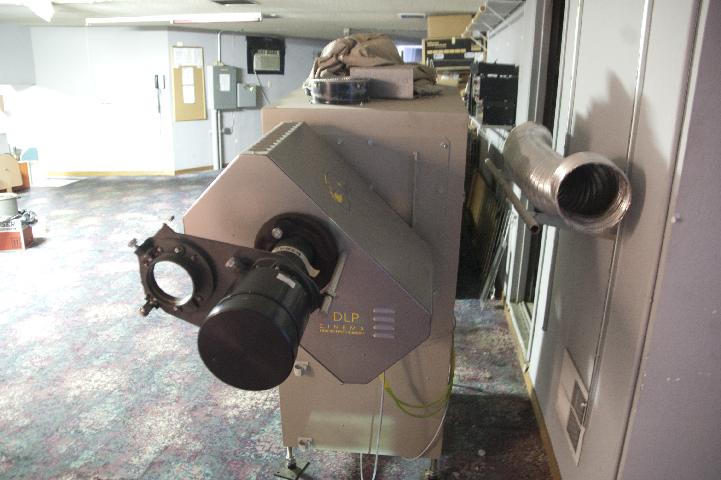
Posted by Marcel Birgelen (Member # 6801) on 04-12-2014, 06:07 PM:
Kinoton meets Barco... The result is one ugly baby. But at least they considered anamorphic lenses to be part of the "standard" back then.
quote: Terry Lynn-Stevens
I think if the movie was open to the public and cinemas were charging for it and the cinema had to book it, then it should count as the first digital film release. DCP or DLP is irrelevant IMO.
I've shown "movies" to audiences using digital LCD projectors in auditoria even before 1998 (but psst... sometimes the source wasn't digital, or the link between the digital source and the projector was analog!)... So, if the rest is all not relevant at all, then I'm the king now!
Posted by Frank Angel (Member # 248) on 04-14-2014, 08:10 AM:
Wait a minute -- wasn't JURASIC PARK 3 (1993) widely screened with the first generation DLP 1.2K projectors -- you know, the screenings that made anyone with eyes think digital projection was the equivalent of a vanilla sunday topped with a dog turd, while those with vested economic interests in digital all of a sudden went conveniently blind and claimedg that it looked just as good as film?
I remember seeing it in NYC and thinking, if this is what digital is going to look like, we are all doomed. Wasn't that one of the first forays into a full digital commercial launch, at least in key cities?
Posted by Michael Coate (Member # 757) on 04-14-2014, 12:33 PM:
quote: Frank Angel
Wait a minute -- wasn't JURASIC PARK 3 (1993) widely screened with the first generation DLP 1.2K projectors...Wasn't that one of the first forays into a full digital commercial launch, at least in key cities?
"Jurassic Park III" was released in 2001 in ten D-Cinema presentations in North America. The only thing noteworthy about it was it was Universal's first D-Cinema release.
Posted by Carsten Kurz (Member # 5396) on 04-14-2014, 07:59 PM:
quote: Frank Angel
Wait a minute -- wasn't JURASIC PARK 3 (1993)
1993 was the release year for the original Jurassic Park movie. There was no such thing as DLP projectors or 1.2k back then.
The whole digital cinema thing started around or slightly before the Millenium.
- Carsten
Posted by Frank Angel (Member # 248) on 04-15-2014, 08:34 AM:
Right. I got my dates mixed up. And I didn't realize it was such a limited DCinema release. quote: Michael Coate
The only thing noteworthy about it was it was Universal's first D-Cinema release.
Other than it was the first time lots of us saw our first commercial example of DCinema in a movie theatre (not at a trade show demo) and we sat there, or at least I did, mouths opened, aghast. And believe me, there haven't been many times in my life when I've be "aghast" or would even use that word. But it certainly was notable for me in that it set my mind squarely against digital at the time, if that was what it was going to look like on movie screens. It made me think those who said it looked "as good as film" were, at best, been fed some sort of horse tranquilizes that TI had slipped into the punch at the demos, or they were just low-life scum con artists who had an economic interest in selling what would eventually become useless digital door stops. Even people whose opinions I usually respected, seemed to have gone blind and would wind up spewing that "it's good enough" kool-aid line. It was like all of a sudden I was living in some cinema tech's version of the INVASION OF THE BODY SNATCHERS movie.
Was JPIII released before or after STAR WARS: THE DIGITAL MENACE?
Posted by Mike Blakesley (Member # 26) on 04-15-2014, 12:16 PM:
Star Wars EPI: The Digital Menace was released in '99. Jurassic Park III: The Dinosaurs Are Fake was in 2001.
Powered by Infopop Corporation
UBB.classicTM
6.3.1.2