This is topic Screen: Common Height or Common Width? in forum Digital Cinema Forum at Film-Tech Forum ARCHIVE.
To visit this topic, use this URL:
https://ft-forum.com/ft/cgi-bin/ubb/ultimatebb.cgi?ubb=get_topic;f=16;t=001872
Posted by Martin Thuss (Member # 7976) on 04-18-2014, 09:41 AM:
In the planning stages to build a new movie theatre and beginning to think about our screens. I believe that many theatres (particularly the big chains) use common-width screens. However, just because "they" are doing it doesn't necessarily mean it's the best thing (they also don't typically use masking). I'm curious to get some opinions ... common height or common width?
Based on a quick bit of research (using IMDB to look up the aspect ratio of the top 20 grossing movies from 2013 and 2014 YTD), it appears that around 80% of "mainstream" wide-release movies are in Scope. We plan to have three screens, so it would be rare that we would show non-mainstream movies. It would seem to me then that a common-height screen using the Scope ratio and masking for the occasional Flat/other movie would make the most sense. Having a Scope screen also allows our ceilings to be 4-6 feet lower which could save us considerably on construction costs (we are building from the ground up as our town has no existing theatre and no existing buildings which are even close to suitable for renovation).
Thoughts? Thanks in advance!
Posted by Victor Liorentas (Member # 5272) on 04-18-2014, 10:21 AM:
The right way to do film was common height with side moving masking. With digital I think it's still the best way to do it even though scope uses less pixels than flat.
Most of us on here hate the practice of floating screens or no masking that's become more and more common. Cineplex now leaves masking open for flat and scope even if the masking works.
It's a bad trend.
Sounds like you want to do things right in Strathroy!
I say common height with full masking.
At the Hyland in London we have film/digital/masking and main curtains with common height.
Rainbow cinemas has common height with movable side masking.
Posted by Buck Wilson (Member # 5885) on 04-18-2014, 10:23 AM:
Common height is indeed the way to go!
Sounds like you are already, but do get proper masking as well. And screen curtains as the cherry on top ![[Big Grin]](biggrin.gif)
Posted by Steve Guttag (Member # 268) on 04-18-2014, 11:29 AM:
If you go common height and let Scope be WIDER instead of less tall, then I suggest also springing for an Anamorphic lens/mover...it will go a long way to improving the brightness and lamp life.
Posted by Steve Kraus (Member # 476) on 04-18-2014, 11:46 AM:
Are those still available and do they meet DCI? I seem to remember 007 telling me he'd bought the last ones Strong had for NEC, or something like that. One setup would probably pay for a lot of bulb hours though.
Posted by Frank Cox (Member # 6258) on 04-18-2014, 01:03 PM:
I'm not sure what's it's called or if this is the gadget that you mean, but I have an auxiliary lens that automatically moves into position in front of my projector when I play a scope movie. I think there's a label on that lens somewhere that says something about it being a "spreader".
This is on a Christie 2210 and I have a common height screen.
Posted by Terry Lynn-Stevens (Member # 7349) on 04-18-2014, 03:08 PM:
quote: Martin Thuss
In the planning stages to build a new movie theatre and beginning to think about our screens. I believe that many theatres (particularly the big chains) use common-width screens. However, just because "they" are doing it doesn't necessarily mean it's the best thing (they also don't typically use masking). I'm curious to get some opinions ... common height or common width?
If you are building from the ground up, then I would say common height is the way to go, from an enthusiasts point of view it is the proper thing to do, it is also the "correct" thing to do. And you should also be using an anamorphic lense and stay as far away as you can from a fixed lense.
However, for maximum impact, an ultra high common width screen with no masking is what will allow you (whether you think you compete with Cineplex or not) to compare favorable with the largest Cineplex ULTRA-AVX and IMAX screens in the London Ontario. Cineplex has successfully shown that these super large/no masking screens can command a much higher premium price. The perception of how large the screen is outweighs a screen that has masking from a pricing point of view.
Have you had a chance to visit some of the other locations in the London area? I strongly suggest you research what people will pay for. Is the SilverCity North London showing open flat with scope projected. How about the location with the AVX and VIP?
In Toronto, the most expensive ticket I have ever seen is $24.99, the auditoriums are about 125 seats, the screens are in the range of 25-30 feet, they are 16x9, floating and with no masking. The perception is that these screen are better. The location is also the first Cineplex to have two Ultra-AVX auditoriums that are common width with no masking.
Posted by Brad Miller (Member # 2) on 04-18-2014, 10:33 PM:
Frank you have a WCL (wide angle converter lens). Basically it's nothing more than a "zoom" lens. It isn't anywhere near as efficient as a true anamorphic, but when the projector's lens doesn't have enough zoom ratio to switch between flat and scope on a common height screen (as was the case with most series 1 lenses), it was the solution.
Posted by Steve Guttag (Member # 268) on 04-19-2014, 06:52 AM:
Steve...yes and yes. Schneider still makes the ISCO version and it was ALWAYS DCI compliant...anyone that would have said otherwise doesn't know the spec. Furthermore, every DCI compliant projector has always supported them via their internal scaler. Even Sony has/had an anamorphic lens. Moving Image Technologies has an Anamorphic lens mount for their XL Mover so any projector can still have them.
23% of your light is a lot to throw away on scope movies. Just do the math on the lumen difference by just zooming the lens for scope.
Cost wise, the payback is much faster on the larger lamps...whereas if you are in the 2KW lamp category, or smaller, it probably won't payback until near the end of the projector's life.
Posted by Mark Gulbrandsen (Member # 72) on 04-19-2014, 11:24 AM:
quote: Steve Guttag
If you go common height and let Scope be WIDER instead of less tall, then I suggest also springing for an Anamorphic lens/mover...it will go a long way to improving the brightness and lamp life.
Well Mr. Anamorphic Lens salesman I agree if this is some really huge screen or perhaps a drive in or critical screening facility. But he makes no mention of the screen size. Neither does Frank. Frank obviously has manually operated zoom on his Christie with the primitive excuse Christie used for changing aspect ratios automatically. It is simply not worth spending an extra 10 grand on a screen size that is easily within the realm of the projector and it's zoom lens. That's like saying hey, lets throw another 10 grand at this projector to gain a few foot lamberts and 20 lines per mm more sharpness. No one is gonna notice it in the average theater going crowd.
Lets find out from him how big the screen is first... Martin?
Posted by Brad Miller (Member # 2) on 04-19-2014, 11:59 AM:
Mark, I understand your financial argument. It makes a lot of sense, but I should note that anywhere I do a large screen I do anamorphics. It really does pay for itself and looks significantly better. I even use an anamorphic in my screening room, not so much for the light efficiency, but moreso in the overall picture quality which is better than simply zooming.
Posted by Mike Blakesley (Member # 26) on 04-19-2014, 01:21 PM:
Would it be possible for some of you guys to put up pictures of an "anamorphic" picture vs a "zoomed" one using similar equipment? I'm just curious what the A-B differences would be. I mean, we have a zoom lens and I think our picture is really good -- my only complaint is the old standard "blacks aren't black enough."
Posted by Amanda Mundin (Member # 3386) on 04-19-2014, 03:13 PM:
Are people using Prime lenses rather than Zoom lenses with the Anamorphic to get a better quality image?
Posted by Steve Guttag (Member # 268) on 04-19-2014, 03:54 PM:
For me, it is all about the light and getting better life/performance out of the xenon lamp. No matter what the size lamp, the current difference between the needs of flat and scope normally exceed the range of the lamp...even when the lamp is new...and proceeds to dramatically shift such that one can't hit the light on scope. Some size the lamp just for scope and then let Flat fall where it falls...that typically puts flat at 22fL...while flicker isn't an issue...black level is. If one has the lamp go up/down between flat and scope, performance of the lamp (striking, flicker, stability) almost always suffers.
With an anamorphic lens...those issues are all lessened.
But as I said above...the smaller the lamp, the more distant the payback on the anamorphic, in terms of cost/lumen. If you are in the 4500W+ range...the payback can be VERY fast.
Posted by Brad Miller (Member # 2) on 04-19-2014, 09:09 PM:
Mike, assuming your projector is "dead on" in terms of convergence and boresight for your specific install, if you put up a white test pattern and walk down to the screen you will see very sharply defined black lines within the white grid. Throw an anamorphic in front of it (and zoom down), the grid lines will essentially disappear (and your light level will greatly increase) because you are now stretching the image just like a 35mm anamorphic. (Just like in the film days though, the astigmatism on the anamorphic must be properly set.)
The short answer is the anamorphic gives the image more of a film look.
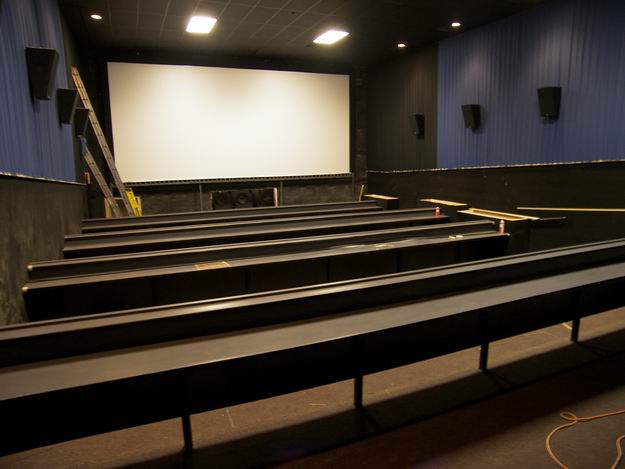
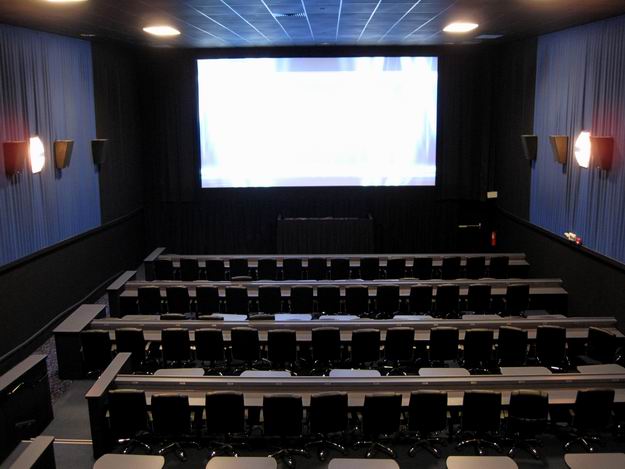
If you want to increase the quality of your picture, blacken the entire front of your auditorium. Here are a couple of examples where the first 15 feet of the auditorium side walls (and the ENTIRE screen wall) is pure black. Anything other than black within the entire front end of the auditorium is bad news for contrast. Also curved screens are bad for contrast, so always stay away from that. Finally make sure your port window is actual optical glass and that it and your lens is kept absolutely spotless. (The rear element of the lens can get dusty too.)
Posted by Mike Blakesley (Member # 26) on 04-19-2014, 10:49 PM:
The bottom 20 feet of our auditorium curtains are "nearly" black -- they're a dark forest green, so it looks pretty black with the lights off. There is a small stage in front of the screen which is painted black, and the screen is wall to wall so the screen wall is black except for the front of the stage which is pretty much invisible during a movie. The ceiling is black. Next time we replace the curtains I'll definitely change to black ones down there.
We do have a curved screen but it's a pretty slight curve -- it's 30 feet wide and I think the center is about maybe 18" back from the sides. We do have an optical glass port (it was new when we put in the digital projector) and I am pretty anal about keeping it clean, but I'm leery of touching the lens more than necessary!
Posted by Martin Thuss (Member # 7976) on 04-20-2014, 07:44 AM:
quote: Terri Lynn-Stevens
Have you had a chance to visit some of the other locations in the London area? I strongly suggest you research what people will pay for. Is the SilverCity North London showing open flat with scope projected. How about the location with the AVX and VIP?
We don't plan to compete with the IMAX/AVX theatres in London. With only three screens, we can't cut off such a large percentage of our low-cost options for our patrons. If we add a fourth or fifth screen down the road, we may do something there.
quote: Mark Gulbrandsen
Lets find out from him how big the screen is first... Martin?
Our current plans are for screens of approximately 50' (~ 235 seats), 44' (~ 178 seats) and 38' (~ 125 seats).
Posted by Mark Gulbrandsen (Member # 72) on 04-20-2014, 12:21 PM:
I agree it's fine for large sreen's and in the long haul make make more economic sense IF you can step down a lamp size and save some $$. I'd even suggest it for Martin's 50 footer.
On the other hand... quote: Steve Guttag
For me, it is all about the light and getting better life/performance out of the xenon lamp.
That's rediclous! I still do not have a single customer (out of over 200) that runs their lamps past warranted life, perhaps you do. Ushio's never have any problem at all even when running at full power their entire warranted time. MOST DLP projectors made today are so light efficient that there is little one can do to increase their operating efficiency... some lamps do work better then others is about it. All you can really do is try to shift that operating point with lamp vs. screen gain however, thats's a basic calculation we all make on every job. And don't forget that lamp expense (and service) is a deductible expense that most theaters get to write off every year.
Sharpness with anamorphic... there is a little gain in one direction from having more pixels (vertical) and a little loss in the other (Horizontal), that is a fact of physics... same as with film. But you are still stuck with all the down sides of using an anamorphic itself. The extra money spent on an anamorphic and changer would for the most part get you into a 4 K NC-3240 anyway which will trample any 2K projector with an anamorphic lens.
Mark
Posted by Brad Miller (Member # 2) on 04-20-2014, 12:34 PM:
A couple of points from your post Mark...
4K comes with a loss of contrast.
NEC, at least the last time I checked, was the least efficient of all the DLP projectors.
The NC-3240 also implies having to run a larger lamp (more expense) instead of an anamorphic on a mid-sized lamp in a mid-sized machine.
I would say all 3 of your comments are dead wrong in this particular discussion.
Posted by Frank Angel (Member # 248) on 04-20-2014, 12:47 PM:
There is a reason everyone on the planet has heard and understands what WIDE screen is and that is a very positive thing.
No one has ever heard of or understands what HIGH screen is or that it is a good thing.
Try selling the public that for a film that is shot in WIDE SCREEN, say one in Panavision, in this theatre it doesn't get wider, it gets smaller. Then tell them, but regular films, in this theatre, they get taller. See how well THAT plays and you will understand why common width was something that happen to fall out of some exhibitor's ass.
Posted by Geoff Jones (Member # 3668) on 04-20-2014, 01:03 PM:
Uh, yes. What Frank said.
Moviemakers don't choose scope ratios because they want everything to be shorter.
Anyone who puts in a constant width screen is doing it wrong.
Posted by Mark Gulbrandsen (Member # 72) on 04-20-2014, 02:48 PM:
Brad except going to the 4K you gain so much more in terms of resolution and sharpness, also pixels that can not be seen unless you go right up to the screen. The loss in contrast from 4K is going to be similar to the loss in contrast using an anamorphic. They do have some internal light scatter (all lenses do) and there is no way around that unless complex light baffles are incorporated into the design and they don't. Plus once you get to an NC-3200 price point the extra $$ to step up to the NC3240 is less than the cost of anamorphic and changer gizmo, it's less than 10 grand extra. That pricing point doesn't hold with Barko or Christie pricing though, both companies charge considerably more to hit the 4k realm so if that's what you sell then doing anamorphics may well make more sense. I have only had one instance where I have used one to date. And 4K is the future and 8K+ lies beyond that. You are also forgetting that 4K itself allows for about 15 to 18% more light output than 2K does. And again... It's not about who's projector puts out the most light. It's about pairing the right projector on the right size screen. I have quite a few NC-3240's running and the image even at the D.I.'s that have them is stunning on a 100+ foot wide image at 14+ fl. All but one which has a crapo screen surface is running a 4.5 kw lamp and easily hits light level with plenty to spare for ageing. You can't get much more economical then a 1500 hour lamp running on a 70 foot+ wide screen and having a 1500 hour warrantied life span. A 3K lamp if you can get away with it doesn't save much for price and has the exact same warrantied life span.
Mark
Posted by Steve Guttag (Member # 268) on 04-20-2014, 03:43 PM:
quote: Mark Gulbrandsen
That's rediclous! I still do not have a single customer (out of over 200) that runs their lamps past warranted life, perhaps you do. Ushio's never have any problem at all even when running at full power their entire warranted time.
I do indeed have customers that try to get more out of the lamps than warranted hours...that is their business decision to make. I don't endorse it...just respect it.
As to Ushios or any other xenon lamp...the lamp will decay over time...period. The harder you run them, the faster the decay...again, there is no room for debate...their characteristics are we documented by many (including myself).
quote: Mark Gulbrandsen
MOST DLP projectors made today are so light efficient that there is little one can do to increase their operating efficiency
What a silly statement. I news for you...I can make ANY DLP projector 23% more light efficient on Scope...just use an Anamorphic lens! It is a proven fact...it helps ALL of them...regardless of resolution.
quote: Mark Gulbrandsen
All you can really do is try to shift that operating point with lamp vs. screen gain however, thats's a basic calculation we all make on every job.
One...it is more than a basic calculation and anyone that tells a client that merely changing screen gain has them meet light levels is incompetent. The light requirement is NOT just 14fL...it is 14fL in the Center and no worse than 85% of center on the sides/corners. Any gain above 1.2-1.3 is NOT going to meet that on a flat screen. A matte-white screen will meet it easily and is what every flat screen should be if they want proper light distribution. If they want their image to look like the one that the studio said was correct.
quote: Mark Gulbrandsen
The extra money spent on an anamorphic and changer would for the most part get you into a 4 K NC-3240 anyway which will trample any 2K projector with an anamorphic lens.
Oddly enough...our primary anamorphic contenders are those that are also in a 4K situation too. However your argument misses the point that ANY system that is based on a 1.8963 ratio imager does better with an anamorphic on scope when it comes to the light.
So lets take that 50-foot wide screen...that would have a screen height of almost 21 feet...Allowing for some lamp decay after it is first installed and using round numbers, one is going to need about 17,000 lumens for Flat and 27,000 lumens for Scope. You aren't going to hit that lumen count for scope with just a 4.5KW lamp...you are heading up to a 6KW (or 7KW for an NEC). Plunk an anamorphic in there...the Scope demands drop to 22,000 lumens. For everyone other than NEC...that is in the 4.5KW range...for NEC is is back to the 6KW range.
But the math applies at any level. Looking at the smaller theatre in this example. For Flat we only need about 10,000 lumens (that is an NEC with a whopping 4KW lamp...admittedly their long-life version that performs like a 3KW)...for the rest we are talking borderline 2KW/3KW or a high brightness 1.8KW or 2KW. For Scope...we are up to 16,000 lumens. No matter how you cut it, you are in to either a 4KW lamp or a high-brightness/expensive 3KW. With an NEC, it would be a 4KW lamp that lasts about 600-hours. Put an anamorphic in there, you are down to about 13,000 lumens...that is safely in everyone (but NEC) 3KW lamp. For NEC, the medium 4KW lamp will do that is rated at 1000 hours.
As for contrast loss in an anamorphic versus 4K...I have not done the comparison but to my eyes, that isn't the case. 4K does have other anomalies (in DLP)...including lack of uniformity in color or light distribution...though there are SCC files available for some light engines (Barco in particular) that should mitigate it.
Posted by Mark Hajducki (Member # 1732) on 04-20-2014, 04:44 PM:
I have seen bad installations where the lense remains static and the image is scaled to fit the screen. In some screens which were neither constant width or height all the aspect ratios were scaled.
These included the UK Film Council (government) funded Arts Alliance installs.
Posted by Brad Miller (Member # 2) on 04-20-2014, 05:36 PM:
quote: Mark Gulbrandsen
And again... It's not about who's projector puts out the most light. It's about pairing the right projector on the right size screen.
Then perhaps you should put projectors other than NEC in. You only sell one brand of projector and one model of server...period. That's not always going to be the best solution for a given job.
quote: Mark Gulbrandsen
The loss in contrast from 4K is going to be similar to the loss in contrast using an anamorphic.
That's just not true. The addition of an anamorphic does not kill contrast like 4K does.
You should stop while you're behind. Steve's numbers above are dead on and hands down the NEC is the most expensive projector out there. Sure it may not be the most expensive in terms of "price", but in terms of "cost" it's a killer. Remember "cost of operation" is FAR more important than the initial price tag. Didn't you learn that from the Sony projectors?
Posted by Buck Wilson (Member # 5885) on 04-20-2014, 08:43 PM:
Is NEC ever the best solution? I was at a very freshly remodeled Marcus Theaters location watching Non-Stop in their large-format screen with Dolby Atmos. EVERYTHING was great(beautiful auditorium, great seats, sound, lobby, etc), except for two things. No masking, and a strangely flat, not-so-crisp, vivid lacking image. I knew right away it wasn't a Barco or Christie, but didn't know what it was until the large format specific Marcus Theater trailer came on advertising NEC. I let out a large disappointed sigh. A peek into the port later verified this, though I wasn't in doubt. The brand new NECs we have also under preform the much older Barco DP2ks we have.
I hate to say it, but it kind of 'ruined' an otherwise great outing.
My friends, "movie theater newbies", EVEN MENTIONED it afterwards without any solicitation from myself.
Posted by Mark Gulbrandsen (Member # 72) on 04-20-2014, 10:09 PM:
Actually I was at a side by side by side demo of the three and when all were aligned the same and projecting the same content you couldn't pick one from the other from the other. Marcus has never been known for any very high quality presentations as it is. They abandoned what few film decent "Ultra Screens" they had way before film ever disappeared and they are now just your every day giant multiplex like Regal or AMC. Like all the other largish chains they are about money over quality. Assuming that one projector looks better than the other just shows how uninformed and inexperienced you actually are in this business. I have installed a lot of all three brands and when set up properly you'd be hard pressed to pick them apart. Screens will cause the most striking difference in image quality. Some lenses will too.
Mark
Posted by Marco Giustini (Member # 4544) on 04-21-2014, 06:25 AM:
In my limited experience, there is also some tolerance when a projector is manufactured. I've seen some projectors perform better than others - same brand, same model - even though I could not take a measurement. The lens is also another thing to be factored. Finally the auditorium is also affecting heavily the contrast ratio: a pitch black room will yield a much higher contrast ratio than one using brighter colours.
Posted by Marcel Birgelen (Member # 6801) on 04-21-2014, 08:42 AM:
Getting back at the essential discussion regarding Common Height or Common Width:
My personal favorite aspect ratio is scope. And as Geoff already mentioned, I also don't suspect that any filmmaker will shoot his feature in scope because he wants to have it presented "less high".
It's also an experience that cannot easily recreated at home, so it is still something special. But it is only special if scope is really LARGE, if it looks like a narrow band in front of the room, you might as well say home and cope with the letterboxing on your HD TV set.
Most humans have two eyes, placed side by side. We don't know exactly why that happened, but it has probably something to do with our primarily planar movements. Most dangers come from the side, not from below or above. Our vision is wide, not tall.
So, if we want to simulate how reality feels, then wider is almost certainly better than taller. It's by all means more... *immersive* (there is that word again).
This discussion isn't entirely new, but it feels stupid that scope has a lower resolution than flat. Back in the 1.3K digital days, scope features used a scope lens and non-square pixels. Sure, this 1.3K was a horrible resolution, but during the transition to DCI, we lost something somewhere.
The anamorphic presentation of scope features right now just feels a bit awkward too. You're already working close to the limits regarding resolution and the first thing you do is you're going to stretch it across your imager. This digital stretching is what worries me, because no matter how good your algorithm is, you're going to hurt the quality of the image and giving up sharpness and detail for more light in return.
Also, the only setups I know are using this Christie WCL thing. It isn't a separate new lens, it "swivels" in front of your existing lens. While the end result might be perfectly acceptable, it cannot be as light efficient and perfectly adjusted as a single, purpose built lens.
Also, I've only seen this thing in action with a Z-Screen, how does it cope with RealD XL?
quote: Mark Hajducki
I have seen bad installations where the lense remains static and the image is scaled to fit the screen. In some screens which were neither constant width or height all the aspect ratios were scaled.
Unfortunately, those kind of setups are on the rise... In that case, flat often even has a lower resolution than scope.
I don't know why people choose such a setup, but probably because they either are not aware of the consequences or they value the capability of rapid aspect-ratio-switching more than resolution and the potential of nasty scaling artifacts.
Posted by Bobby Henderson (Member # 840) on 04-21-2014, 09:52 AM:
Common width screens and their letter-boxing of 'scope movies makes d-cinema even more like watching TV in public.
Posted by Brad Miller (Member # 2) on 04-21-2014, 11:04 AM:
Marcel, although I'm not advocating people do this, I think the general concern for those setups is if the anamorphic mover fails or if it doesn't always lock down dead-on to the same position. If the screen is really big and the throw is short, a small variance will throw things off. On the plus side, light levels between flat and scope are identical.
Posted by Steve Guttag (Member # 268) on 04-21-2014, 11:16 AM:
quote: Marcel Birgelen
The anamorphic presentation of scope features right now just feels a bit awkward too. You're already working close to the limits regarding resolution and the first thing you do is you're going to stretch it across your imager. This digital stretching is what worries me, because no matter how good your algorithm is, you're going to hurt the quality of the image and giving up sharpness and detail for more light in return.
The scaler thing really isn't an issue...it is a simple multiplication type scale. Which is the most benign. But before you guess at its issues...why not look at one to see for yourself. I sure have. You'd be hard pressed to find that the system with the anamorphic lens looks any worse than the one without. In fact, most have found just the opposite. Rarely, when a lens is zoomed out does the image improve...quite the contrary, the image is forced to be on the thinner parts of the glass which are typically more prone to aberrations.
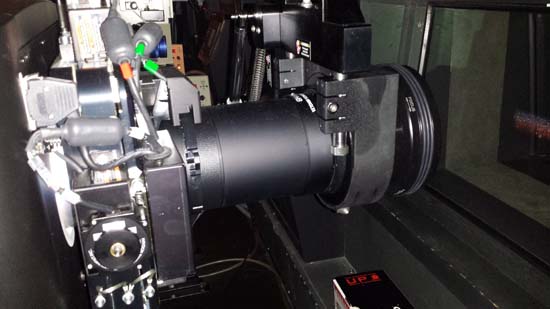
The WCL lens is just a straight magnifier. We have a couple of those on series 1 projectors. They did okay for their day but didn't benefit in the light department...they only overcame the limited zoom range of the prime lens. With Anamorphic lenses one also only swings it in place for Scope...and swing out for flat (or slide side-to-side as the case may be).
Again, on the anamorphic front...try it...you'll like it. As for Real-D XL...I suspect that one may have spacing issues as well as image size issues plus one is now hanging an awful lot of weight on the front of the projector.
Here is one on a 4K Christie.
Posted by Ron Ellis (Member # 8142) on 04-21-2014, 11:32 AM:
Shouldn't the ceiling also be black? I can see what appears to be quite a bit of light reflection on the 2nd picture.
Posted by Mark Gulbrandsen (Member # 72) on 04-21-2014, 11:50 AM:
Again, and as I said, I have no issue with doing this if it's absolute quality one is after. But I'd still be more likely to stick that extra ten grand into either 4K or what is usually an older and sometimes ailing sound system. People notice good sound way before they will notice you having an anamorphic in the optical chain.
Also quote: Steve Guttag
As for Real-D XL...I suspect that one may have spacing issues as well as image size issues plus one is now hanging an awful lot of weight on the front of the projector.
I've installed a lot of X-L attachments and there are no real issues with it and weight on any projector I have installed it on. It is also an attachment that stays aligned once it has been aligned... I was very skeptical of that part at first. NEC actually has the best deal going there with the X-L because it literally becomes attached to the projector's chassis.
For Barko they may include an entire new front with new air filter made out of metal instead of plastic that it attaches to and it is very sturdy and if not a little bit difficult to install the first time around!
For Christie they include an entire extension shelf unit and new legs that attaches to the front of the existing Christie pedestal. Even for the little NC-900 there is a plan whch mouts it to the pedestal... even the Kelmar pedestal! With Real-D's new huge Chunk-O-Change up front policy for the exhibitor I doubt I will likely be installing any more, it'll likely be Master Image instead.
Allow 18" projector to wall clearance, and you may also have to enlarge your port... usually by moving the top of the port upwards. If you have an adjustable height pedestal like the Eprad M-9000 them you might be able to slightly drop the projector and re-align.
Posted by Marco Giustini (Member # 4544) on 04-21-2014, 12:21 PM:
Barco filters made of plastic?
Posted by Ken Lackner (Member # 1002) on 04-21-2014, 12:32 PM:
No, Marco. They sure aren't.
Posted by Mark Gulbrandsen (Member # 72) on 04-21-2014, 05:56 PM:
quote: Mark Gulbrandsen
For Barko they may include an entire new front with new air filter made out of metal instead of plastic
Gosh Marco... I think you need to go learn to read all over again. But the air filters are pretty much worthless anyway except at keeping bugs out...
Posted by Ken Lackner (Member # 1002) on 04-22-2014, 04:33 AM:
Mark, I read your post the same way Marco did. It isn't clear that you are referring to the front cover of the projector as being made of plastic and not the filters themselves. I was wondering what the heck you were talking about.
Posted by Steve Guttag (Member # 268) on 04-22-2014, 06:24 AM:
Mark also didn't read my whole statement...I was commenting on the question of an anamorphic AND an XL together...since the XL would need to be spaced in front of the anamorphic...there may be spacing issues as well as the weight of the Anamorphic, mover, XL and possible mover...you have an awful lot of weight up there.
As for the $10K...it benefits the exhibitor since once installed, it reduces their operating costs on lamps, electricity. The industry got it wrong to have an imager that does not conform to Flat or Scope and got it really wrong when it figured that the image that was supposed to be largest would receive the smallest resolution and light. It is the exact opposite of what was learned in the '50s. At least when film's 1.85 format and "Scope" formats settled out...the light output was similar though Scope was more efficient. With DCinema...it is totally wacked where there is a great disparity between the two. The anamorphic lens cuts that disparity in half.
Posted by Bobby Henderson (Member # 840) on 04-22-2014, 08:56 AM:
There's one bright side to all of this: since digital projectors have a much shorter life span than film projectors there is at least some slim chance the ridiculous way 'scope is treated in d-cinema will be corrected in the future.
Posted by Steve Guttag (Member # 268) on 04-22-2014, 09:00 AM:
Without anamorphics...the issue will remain that light sources, particularly cheap ones, tend to put out round shaped light. Scope being rectangular tends to made this difficult.
For film cinema, "beam spreaders" were often tried with 70mm with mixed results of getting an even light across a rectangular aperture.
You also have the fact that a great many/majority of theatres are now geared towards a 1.85 picture rather than a scope one. For those cinemas, this is a non-issue since the light difference between flat and scope is practically non-existent.
Posted by Scott Norwood (Member # 30) on 04-22-2014, 09:23 AM:
At least with D-cinema, it is possible to have different lamp output settings to easily balance the light output between the flat and scope picture. (Yes, this can be done with film, too, but I know of no one who ever bothered.)
But, yes, having lower resolution for the bigger picture is silly.
Posted by Marco Giustini (Member # 4544) on 04-22-2014, 04:55 PM:
quote: Mark Gulbrandsen
But the air filters are pretty much worthless anyway except at keeping bugs out...
As NEC's are - and they're expensive.
Posted by Ron Curran (Member # 3631) on 04-22-2014, 06:36 PM:
DCPs should be optimised for Scope, with other formats falling within that width. It worked for film projection - remember Enchanted, The Horse Whisperer, etc.? We could then have just one beautiful prime lens and side masking to cope with everything from 1.33.
Cinemas that get high on constant width could use a zoom for flat.
Purists could argue for a 2.2 standard but that would be wasteful 99% of the time.
Posted by Mark Gulbrandsen (Member # 72) on 04-22-2014, 09:16 PM:
quote: Marco Giustini
As NEC's are - and they're expensive.
The NEC metal filters are worthless. The mesh is so coarse it wouldn't even stop large insects from being sucked in!! What were they thinking? Some material buyer at NEC ordered the wrong stuff for some equipment's and they had to get rid of it some where...
The HEPPA filters are the only way to go, especially in this desert area which is dirty and dusty. The HEPPA's are not expensive over here any more. Six USD each at best. Most of my sites change them twice a year. A few sites actually change them four times a year. All the projectors still look like brand new on the inside and no grease or oil dripping from the negative lamp connectors like you sometimes see in Christie projectors. It's always that projector at the top of the stairs that gets the popper oil the worst.
quote: Steve Guttag
I was commenting on the question of an anamorphic AND an XL together
I wasn't ignoring you. The X-L Christie pedestal adaptor would work fine for that purpose as I stated. It is easily adaptable to other pedestals as well because it is fully adjustable. Real-D has a solution for every projector Steve... Now if they only came up with a solution that exhibitors could actually afford!
Mark
Posted by Kenneth Wuepper (Member # 1174) on 04-23-2014, 07:31 AM:
Perhaps the person specifying filters looked at the back of their old TekTronix oscilloscope and saw the washable and recyclable metal filter. They probably didn't use the spray coating though as then you had to clean the filter much more often.
The metal screen filter without the spray is, indeed, not very effective at trapping small particles from the air stream.
Posted by Mark Gulbrandsen (Member # 72) on 04-23-2014, 09:27 AM:
Yes, Those Tektronix air filters worked good!! The metal was like compressed Brillo without the soap on it. The NEC metal air filters however... just like a screen door. 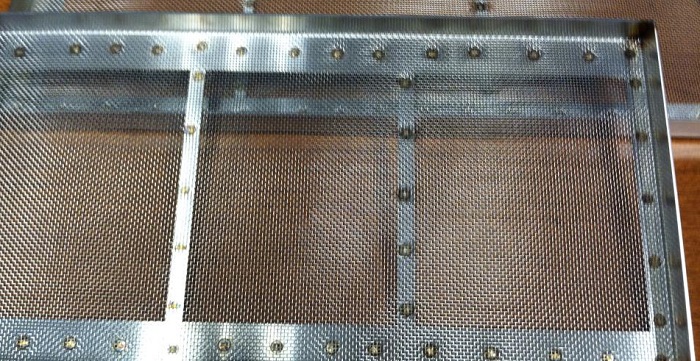
Posted by Kenneth Wuepper (Member # 1174) on 04-23-2014, 04:55 PM:
Mark,
That looks like the frame and screen to keep the replaceable filter from entering the air chamber. Isn't there another filter part that goes with these?
Our big air handler has a frame like this behind two thicknesses of regular fiberglass filter frames. The frame and screen just keeps the real filters from being sucked into the fan.
Posted by Monte L Fullmer (Member # 2797) on 04-23-2014, 06:45 PM:
We have two, 65ft screens where I'm using two 4K BARCO 32B burning 65BA bulbs in them for these screens. True, these BARCO's with their fine mesh, stainless steel filter, makes the filter cleaning task easy since they're washable filters, but not the best in containing real fine dust where I have to wipe out the module placement area and inside the lamp module itself when doing bulb changes.
One house is 3D with the XL slider in front and our good ol' directional friend, the silver screen.
I wish that the owners went the extra mile in going anamorphic so all of that 1.2" chip could be used for our scope presentations and get a great image on the non 3D white screen.
Big thing that really goes against using these units that my content is still 2K and I get folks coming out to holler "picture could use some sharpness in focusing"...and I'm sharp as a tack on the screen when shooting the Scheimflug test pattern on the screen to check focus on center and corners.
I just tell them that I'll get on it, which satisfies them since their request was acknowledged.
-Monte
Posted by Mark Gulbrandsen (Member # 72) on 04-23-2014, 07:21 PM:
Ken,
Yea... that's what it resembles. The projector already has a grate where the filters sit so they can't be sucked down in. This is what led me to make the comment I did about some buyer at NEC ordering the wrong stuff... but they still had to use it for something.
Monte... Your owners didn't even go ten blocks in building that place. Those lifts are a disgrace.
Mark
Posted by Amanda Mundin (Member # 3386) on 04-24-2014, 04:22 AM:
In terms of scaling the 1.85 image to fit within the 2.39, obviously with 2K this would result in a drop in resolution, but if you had a 4K projector and scaled 1.85 to fit in the 2.39 image surely you would be able to attain exactly the same light levels for both formats, and for the current majority of 1.85 films which are 2K you wouldn't be dropping resolution because the resolution would be somewhere in the region of 3175 x 1716. You could always have a 2nd 1.85 setting for full 4K for the rarer occasion that you get a 1.85 4K film. Would this approach not be acceptable?
Posted by Marco Giustini (Member # 4544) on 04-24-2014, 04:20 PM:
Monte,
I can't remember where the main blower in the projector is getting the air, but the air around the lamphouse is not filtered, that comes from the inlet grilles.
I'm not discarding the barco filters as 'poor' to be honest. They need to be kept clean, and with greasy air or fine pullution dust (London) they clog up till the point you can't see through them anymore. They need to be washed every how and then. I'm convinced that if those filters were washed and vacuumed regularly, their performances wouldn't be so bad.
Posted by Steve Guttag (Member # 268) on 04-24-2014, 04:41 PM:
Amanda,
Yes/No. Generally, that is not how scaling works. If things are on even multiples of a resolution, the scale works out better. However, going from a 1080 and having it scale to 2160 (non-obtrusive scale) but then back down to 1714...that is where you will lose resolution. The 1714 does not accurately represent either 1080 or 2160. It isn't like with a grain structure like film where if you have more resolution, capture the lower resolution in its entirety, digital like 1:1 mappings...once a pixel is morphed into multiple pixels...it doesn't morph back so cleanly. You are asking it to present flat at 79% as big so some of those pixels are not going to be clean.
The number of 4K movies are going to grow so, at best it is a very short term idea.
On the filtration front...none are perfect and only NEC puts any filtration on the lamp itself. Barco, on the C series has a fan that has nothing but a bug filter in front of it to blow on the cathode side of the lamphouse.
Personally, I don't find that Barco's wire mesh filters do an adequate job...I think they would be dramatically improved if there was a pre-filter on the outside of the projectors.
Posted by Connor Wilson (Member # 6088) on 04-25-2014, 06:08 PM:
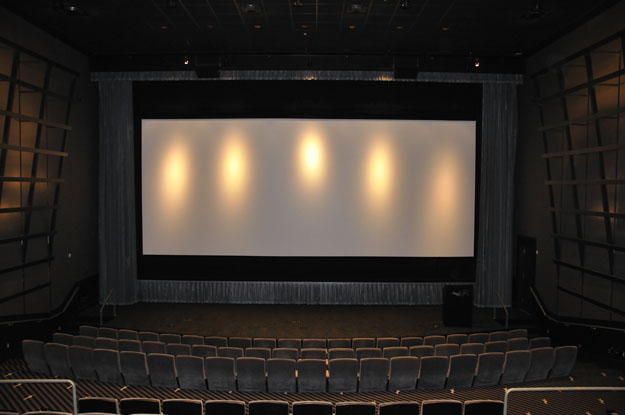
I am in favor of a screen that masks in all four sides, for example, if the flat setting was switched to scope, the screen will get wider, but a little narrower. I am also in favor of that screen having different presets for 1.37, 1.66, 2.20, and other obscure ratios that are different from the two standards.
The kind of screen I had in mind was Screen #2 in the AFI Silver at Silver Spring, MD. Here is the screen set for 1.37 and 2.39 respectively.

There is a Cobb plex I used to frequent often before Alamo opened in Ashburn. All the screens are common width, except for Screen #11 which is common height. The first two films I remember seeing in #11, namely after the Auro upgrade, were Turbo and Ender's Game. Both films were in scope and used the screen to its full potential.
I distinctively remember Turbo (in 2D) looking marvelous, colorful, and clean, more so than what I was used to at this plex. The projector was a Barco 2K model, as do all of the screens. Something about this presentation was so special than my previous trips, add to that with the 11.1 sound which is no Atmos but unique is its own right.
Months later, I caught a matinee of Ender's Game at the same theater, same screen. The Summit Entertainment logo that opened the film was so bright I almost had to shield my eyes. Just fantastic picture and the sound, also 11.1, was also improved.
But it was a different tune for Mr. Peabody and Sherman, same theater, same screen. This time, the film was in flat, and it was masked as such, but lo and behold, black borders around the four corners of the projected image. It had not filled up the screen. The sound also took a huge step down. I even noticed some aliasing in the image whereas it was minimized in the past two scope films. About the sound, I assumed the front left and right channels were obscured by the masking, resulting in the lackluster sound. There might be another factor obscuring the sound, but that's what I thought. It was a depressing night for some AV perfectionist like myself.
So be careful about sound positioning when it comes to common height. My solution was to install five speakers behind the screen, but since #11 in Cobb is Auro that would make ten speakers.
I then was reading this thread, learning about anamorphic lenses in digital cinema. Could it be that #11 in Cobb Village 12 uses an anamorphic lens? I can't really contact anybody who works there, but seeing how flat films with appropriate masking were projected with those borders and scope films filled up the entire screen, the only other reason could be the projector being too close or too far away.
Posted by Jonathan Goeldner (Member # 4854) on 04-25-2014, 07:54 PM:
personally I like taller screens ![[beer]](graemlins/beer.gif)
Posted by Steve Guttag (Member # 268) on 04-25-2014, 08:23 PM:
Hmmmm....those pictures look a bit familiar...oh yeah...they're mine!
FWIW...in DCinema, AFI/Silver screens 1 and 2 use anamorphic lenses for Scope DCPs and they both have 5-screen channels and do switch between the sets between flat and scope. The 5-screen channels were original installed for SDDS-8 and 70mm (theatre #1). However, acoustically transparent masking should negate any significant attenuation on the HF if one has Left and Right behind masking on Flat movies...like in the AFI #3.
Note, AFI 1 only has movable masking on three sides...the bottom is fixed.
Posted by Jonathan Goeldner (Member # 4854) on 04-25-2014, 10:02 PM:
^ yeah watching the screen drop down to 2.76 for 'Khartoum'(70mm) was a bit disappointing - wish it had expanded horizontally. Well at least the plus was hearing the 6-track sound (5 front channels) that music score was just gorgeous. (that brought back fond memories of the 8-SDDS 'music' scores of 'Interview with a Vampire' and 'Immortal Beloved')
yeah the Cobb Village 12 presentation of 'Mr. Peabody and Sherman' was a let down in both how it was projected on the screen AND the Auro mix - it didn't make me want to go back there. Interestingly the Bow Tie Reston BTX screen is a fixed constant height 2.35 screen - I didn't see 'The Life of Pi' screening there, but I wonder how they did the flying fish sequence when the screen jumped to 2.35 to 1.85
Posted by Steve Guttag (Member # 268) on 04-26-2014, 09:13 AM:
Really? Just where did you want the screen expand to? The Silver was built in a 1.37 era...the front end is in front of the original proscenium to get it as wide as legally possible and stay faithful to the Art Deco decor of the original front-end. As it is, we have the "walls" move out to reveal yet more screen. They also were faithful to the Ultra Panavision ratio of the feature and didn't crop or show it without the anamorphics. So THIS is what disappoints you? This is what should have PLEASED you...that they didn't mutilate the picture (or sound) and presented it in its original format.
The AFI strives to show all content in as close to original format as possible. They are not going to put in an Uptown-esque front end for the very rare UP70 movie that may show up. The vast majority of their rep content is anywhere from 1.37 to current 2.39.
I guess you would be disappointed if you saw a 1.37 rep title at the Uptown and the masking was closed down so the feature just used a 1/3 of its massive Cinerama screen. Though most people liked it just fine when we ran rep titles there (Fantasia, Wizard of Oz and the WB festival).
While there are places like the Seattle Cinerama that will put in an alternate front-end for a particular format...even those are compromises.
I think the AFI/Silver does VERY well at trying to present all content as it was intended given the vast diversity of content it runs.
Posted by Brad Miller (Member # 2) on 04-26-2014, 12:17 PM:
Steve, what he is saying is that he is disappointed to walk into the room, see a screen size, then watch as it got smaller.
The solution is to never let patrons into the auditorium until the screen is masked to the smallest size that any portion of the presentation will be using. This means for common width people, shrink the stupid preshow picture down before scope movies!!! ![[Mad]](mad.gif)
The Film-Tech DCS does this as soon as the previous show ends in anticipation of the next show. Having the picture get larger in front of the audience is fine, but it should never get smaller.
Posted by Steve Guttag (Member # 268) on 04-26-2014, 12:33 PM:
While I agree in principle...there is zero chance of having all of the preshow material be redone just for the odd UP70 movie. Furthermore, while the height would have come down...the preshow stuff is going to be 1.78 (video)...so the screen should have also gotten wider...total square area of the image should have been larger. The only things bigger on that screen would have been 35mm 2.39 or 70mm 2.20 (same width, only taller). 70mm was set up as the biggest picture.
Posted by Jonathan Goeldner (Member # 4854) on 04-26-2014, 09:40 PM:
yes, thanks Brad for the correct interpretation of my comment. While it's unfair to compare the Silver to the curved 'larger' Uptown screen, the 'Ben Hur' reissue I saw, where the curtain kept on unveiling to expose the full 2.76 screen area and no reduction of the screen vertically was a ('wow!') memory I will never forget.
In terms of the AFI Silver - the use and non-use of the pre-film slides/trailers is consistent at best. Just the other night the screening of 'Sorcerer' was only accompanied by the DLP, Dolby Digital Cinema and THX intros and then straight to the movie - 'Khartoum' in the same vein should have gone into the film minus all the pre-film extras
Posted by Monte L Fullmer (Member # 2797) on 04-26-2014, 10:49 PM:
quote: Brad Miller
Having the picture get larger in front of the audience is fine, but it should never get smaller.
Outside we know that these new complexes are built without any adjustable masking to save monies on installations of masking devices and maintenance, it still looks tacky when one week, a flat movie is in one house, and next week a scope movie is in that house with the image in the middle of an unmasked screen to give the image the "letterbox" image that is on our flat screen TV's.
..and customers that witnessed a flat movie in that same house, now attends a "letterboxed" movie in that same house a week later complains that the "movie needs to be stretched out to fill the screen", or they feel that they're getting cheated with not all of the image presented on the screen.
What's real sad is that you can't a good answer to the customer outside that "we're working on the issue".
-Monte
Posted by Terry Lynn-Stevens (Member # 7349) on 04-26-2014, 10:55 PM:
quote:
Outside we know that these new complexes are built without any adjustable masking to save monies on installations of masking devices and maintenance,
This is not to save money at all. It is deliberate. It is done to take on IMAX and give off the perception that there is a larger screen.
Posted by Brad Miller (Member # 2) on 04-26-2014, 11:33 PM:
Which would be the STUPIDEST REASON EVER.
There is nothing better than to impress someone when they walk into an auditorium and then realize only half of the screen is used. It's fantastic way to make people feel that either there is something wrong with the projector ("not showing all of the picture") or deceived and ripped off. It's bad showmanship, period.
Posted by Mike Blakesley (Member # 26) on 04-27-2014, 12:03 AM:
quote: Terry Lynn-Stevens
This is not to save money at all. It is deliberate. It is done to take on IMAX and give off the perception that there is a larger screen.
That's just crazy. It's absolutely done to save money. Masking costs a lot of money when it's movable and done right.
I suppose there are a few "suits" who say, "If we leave all of this huge screen exposed it'll make people think we have a bigger screen like Imax does!" but I know enough about corporate thinking to guarantee you that THAT is just an added "benefit" of not having masking. The first and foremost reason is to cut costs. The fact that it hurts the presentation doesn't even enter into their thought process.
Posted by Terry Lynn-Stevens (Member # 7349) on 04-27-2014, 12:11 AM:
quote: Brad Miller
Which would be the STUPIDEST REASON EVER.
There is nothing better than to impress someone when they walk into an auditorium and then realize only half of the screen is used. It's fantastic way to make people feel that either there is something wrong with the projector ("not showing all of the picture") or deceived and ripped off. It's bad showmanship, period.
I totally 100% agree that it is bad showmanship. But I think the box office performance of these locations demonstrates that the public does not care that masking is being eliminated. Cineplex actually uses the entire screen for all advertisements, most trailers and corporate/AVX/Atmos snipes and then shows the movie in scope. It totally sucks!
quote: Mike Blakesley
That's just crazy. It's absolutely done to save money. Masking costs a lot of money when it's movable and done right.
I suppose there are a few "suits" who say, "If we leave all of this huge screen exposed it'll make people think we have a bigger screen like Imax does!" but I know enough about corporate thinking to guarantee you that THAT is just an added "benefit" of not having masking. The first and foremost reason is to cut costs. The fact that it hurts the presentation doesn't even enter into their thought process.
I think you have been to IMAX once right? Well, you probably have not been to a premium large format theatre. The lack of masking is for perception reasons, these screens were installed to compete with IMAX. Premium large format screens are a chains way of making their own version of IMAX.
Go to a PLF+IMAX location and you will understand. There are a few in my area, in some cases the IMAX screen is smaller.
In some locations, all common width screen project scope on an open flat screen, (basically they do not use the masking anymore, they just leave it open) This has become a corporate mandate by Cineplex at some of their locations. Even worse than no masking at all is scope projection with digital masking on a fully opened common width masked flat screen.
The perception is that these screens are bigger and thus better.
Posted by Monte L Fullmer (Member # 2797) on 04-27-2014, 12:44 AM:
quote: Mike Blakesley
That's just crazy. It's absolutely done to save money. Masking costs a lot of money when it's movable and done right
Maybe for an "indie" house like Mike has, but corporate operations have "inexperienced mechanics" in suits running their complexes..and having them deal with something complex as a moveable masking setup is beyond their reasoning.
Thus, these corp operations follow the K.I.S.S. procedure - to keep the inexperienced from fiddling around, busting something, or themselves and creating all forms of liability situations.
Posted by Terry Lynn-Stevens (Member # 7349) on 04-27-2014, 12:54 AM:
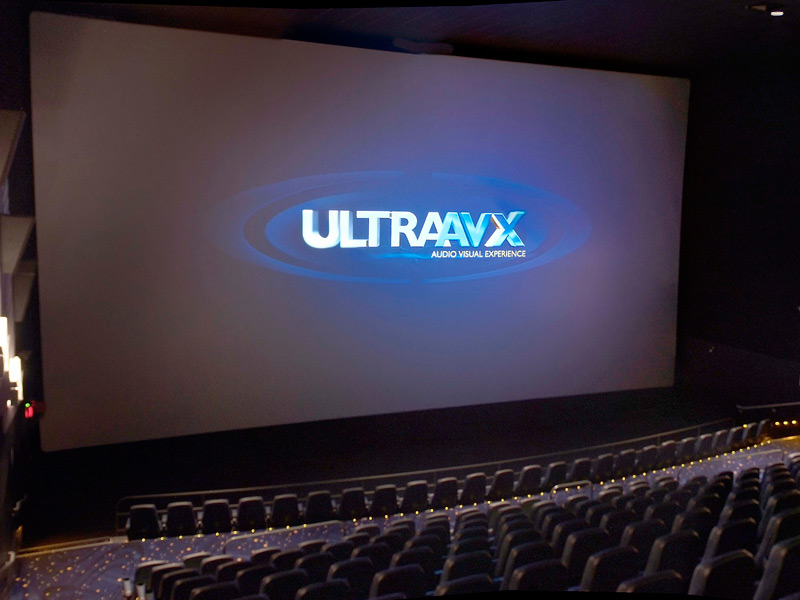
Monte, seeing that 4 out of 5 releases are scope, please explain why in the world would Cineplex convert 54 auditoriums in their network to a much, much, much larger open flat screen and leave out the masking and still show all of the movies in scope? Why not just leave the masking and leave the screen they already have? It's the perception!
This looks like an IMAX knock-off to me:
Posted by Buck Wilson (Member # 5885) on 04-27-2014, 02:33 AM:
Here's a fun discussion point- Is it a knock off if it's better?
Posted by Marco Giustini (Member # 4544) on 04-27-2014, 07:21 AM:
At least they show their films in Scope. I know a chain which installed such big flat screen, branded them and now show all their features so they fill up the screen, regardless of the original format.
Posted by Steve Guttag (Member # 268) on 04-27-2014, 12:23 PM:
quote: Jonathan Goeldner
While it's unfair to compare the Silver to the curved 'larger' Uptown screen, the 'Ben Hur' reissue I saw, where the curtain kept on unveiling to expose the full 2.76 screen area and no reduction of the screen vertically was a ('wow!') memory I will never forget.
Time to burst your bubble again...WRONG!
The Uptown did NOT present Ben-Her in 2.76:1...at least not in 70mm. I was a projectionist there from 1988-2005. We NEVER used UP70 lenses/attachments during that time. The 70mm of Ben-Hur you would have seen during that time would have been a 2.20 version which merely cropped the sides of the image.
This does not take away from the dramatic opening of the curtain in that theatre when running 70mm which I agree is impressive. With the lenses we had for 70mm, it was tack sharp too.
I can assure you that had you seen UP70 at the Uptown in that era (i.e. if we received a UP70 print) it would have likely have been softer and not filling the screen height. They (Cineplex/Loewes) would not have rescreened the theatre for a one-off week/weekend of a movie since the screen no longer was that wide...depending on the era, we would have had to add additional strips (it was strip screen into the '90s) and they would have been a different color due the aging of the hanging strips. Adding UP70 attachments to our deep-curve lenses would have not been possible so you would have had other issues to content with.
As it is, at the AFI/Silver...when UP70 prints are screened there...a different set of longer prime lenses are sent off and attached by Panavision to the UP70 anamorphics to ensure that the full intended image is presented.
Posted by Mike Blakesley (Member # 26) on 04-27-2014, 01:04 PM:
quote:
Well, you probably have not been to a premium large format theatre. The lack of masking is for perception reasons,
I haven't been to a lot of PLFs but I have been to a few. I just think you're out of your mind if you think the designers are saying "let's leave off the masking so the screen will look bigger and thus be better than an Imax." Even a corporate suit doesn't use such convoluted logic as that.
Posted by Mark Gulbrandsen (Member # 72) on 04-27-2014, 04:47 PM:
Yea, I remember the strip screen was still in there when I saw Gettysburg. It was before I even knew you but you were the one running the show that night!
Posted by Steve Kraus (Member # 476) on 04-27-2014, 06:36 PM:
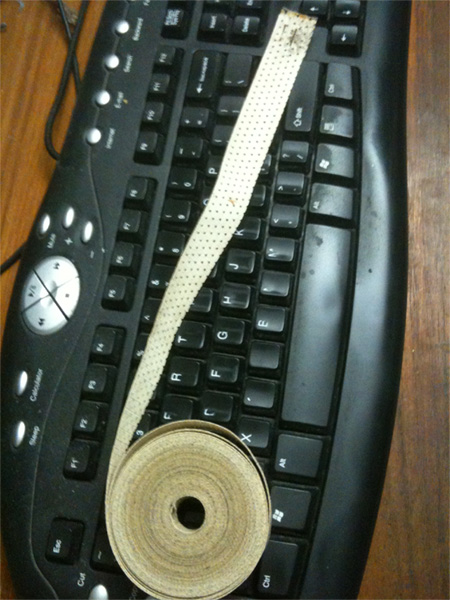
Not only do I still have the used strip Steve gave me at the Uptown years ago (along with a new one for Mark), but amazingly, I could lay my hands on it immediately.
Posted by Jonathan Goeldner (Member # 4854) on 04-27-2014, 08:18 PM:
(thread digression - sorry)
@ Steve Guttag:
question - I remember seeing 'Alien' at the Uptown (not the original releases) but a one off screening - I think during the time you were a projectionist there. Was that 35mm or 70mm? I thought it was the latter, Being the second time I saw the film, the prior, on a teeny-tiny 13 inch screen - the theatrical experience (obviously) was aptly scary and intense.
@ Terry Lynn-Stevens: which theater is that UltraAVX screen at?
Posted by Marcel Birgelen (Member # 6801) on 04-28-2014, 01:42 AM:
quote: Marco Giustini
At least they show their films in Scope. I know a chain which installed such big flat screen, branded them and now show all their features so they fill up the screen, regardless of the original format.
#$%^&<censored>$#@@# !!!???
And nobody even notices when obvious stuff drops off screen? Like titles, the occasional subtitle and stuff like end credits?
quote: Terry Lynn-Stevens
This is not to save money at all. It is deliberate. It is done to take on IMAX and give off the perception that there is a larger screen.
IMAX is going nowhere fast around here. Some people might have heard of IMAX, but have either never visited a venue or still only remember it from the good ol' 15/70 days.
Yet, at least since the digital conversion, movable masking is on its way out and that's not because they're trying to knock off IMAX. No, they're just being cheap.
Digital projection has the distinct "advantage" of having clean, sharp edges around the picture. I have the impression that many people think that masking only serves this single purpose and therefore, is not necessary for digital presentations...
It's no news, but most people are just ignorant. I recently watched a scope presentation that failed to zoom in. Only after a complaint they fixed the issue, but nobody else seemed to notice that stuff wasn't right...
IMAX seems to have learned from the ignorant public and made a business out of exploiting this ignorance. Their current digital setup is only a charade. Their smiley-face screens are made to look big and imposing, but it is really just an illusion that wears off rather quickly. Their blurry, pixelated, oversized picture is pimped with their rock-concert PA system. Throw in some high octane, see-how-good-we-are, trailers and *tada*...
If you want to make a difference and IMAX is a serious competitor in your region, I would rather focus on why your "classic" setup is better suited for watching movies than Digital IMAX. Many people are still susceptible for arguments that actually make sense, but most of them just don't know them.
Posted by Terry Lynn-Stevens (Member # 7349) on 04-28-2014, 02:00 AM:
quote:
@ Terry Lynn-Stevens: which theater is that UltraAVX screen at?
I took it from the Christie website. I believe it is SilverCity CrossIron Mills Cinemas
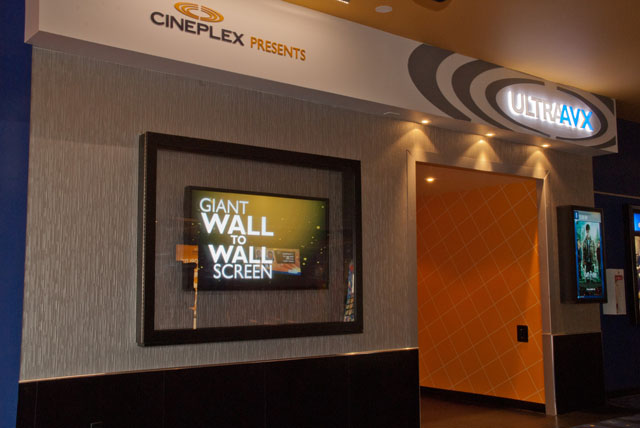
Here is Colossus Quebec:
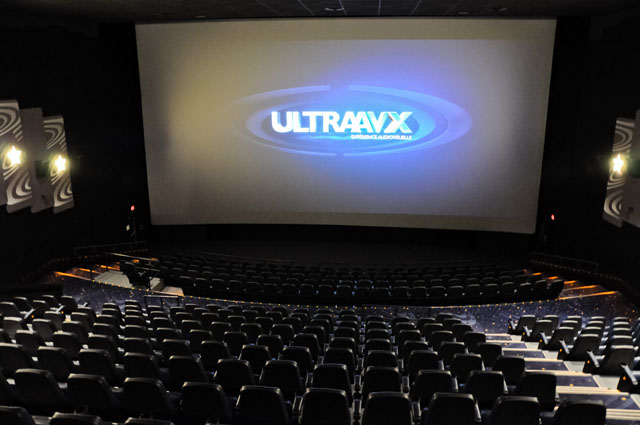
Cineplex also does a bit of a treatment to outside the auditorium as well.
Posted by Steve Guttag (Member # 268) on 04-28-2014, 06:24 AM:
While I do recall running Alien at the Uptown after the initial release, I do not recall it being in 70mm...only 35mm. The original release, it was 70mm (a blow up but still 70mm).
Posted by Bobby Henderson (Member # 840) on 04-28-2014, 10:09 AM:
quote: Terry Lynn-Stevens
The lack of masking is for perception reasons, these screens were installed to compete with IMAX. Premium large format screens are a chains way of making their own version of IMAX.
"Disappearing" screen edges that fill a viewer's peripheral vision only work with true large format film-based systems, like the real 15-perf 70mm version of IMAX. The method does not work with low resolution d-cinema systems meant to illuminate smaller, more conventional sized movie screens. None of these digital-only fake large format theaters have screens that fill all my peripheral vision. The common width screens are more rectangular and the auditorium ceilings are lower. It's a cheaper concept than a true 15/70mm film based large format theater. It's pretentious crap.
Hollywood movies are not even composed for this kind of method either. All of them, even ones that have used IMAX film cameras, always compose for some kind of border/frame. They're not composing their images for a screen that exceeds a viewer's peripheral vision. They're not tailoring the edit pace for such screens either.
The closest Hollywood has come to large format specific framing was back in the "golden age" of 70mm, and really only with a few movies, such as Lawrence of Arabia. That movie had numerous shots of riders on camels very tiny in the frame, dwarfed by sprawling desert vistas. If you watched the movie in 70mm on a big theater screen you could see the riders clearly. Still, Lawrence of Arabia did compose with the frame in mind. Freddie Young didn't put all the important stuff in the lower center of the frame and have all sorts of extra headroom on the top, left and right ends of the frame as a true IMAX film composition would.
Movie theater operators need to re-think this bare bones, wall to wall, wannabe IMAX screen garbage. The screens may be big in proportion to the auditoriums, but they still look cheap. Some of them even look like wall mounted trampolines.
![[Roll Eyes]](rolleyes.gif)
Worst of all, the non-masked, letter-boxing effect often displayed on these screens, along with the digital nature of the projection, really makes it feel like you're watching a rented Blu-ray disc on a great big TV set. It does not have any feel of film at all.
Posted by Martin McCaffery (Member # 37) on 04-28-2014, 10:24 AM:
off topic, but couldn't resist:
quote: Bobby Henderson
The closest Hollywood has come to large format specific framing was back in the "golden age" of 70mm, and really only with a few movies, such as Lawrence of Arabia. That movie had numerous shots of riders on camels very tiny in the frame, dwarfed by sprawling desert vistas. If you watched the movie in 70mm on a big theater screen you could see the riders clearly.
And this is why Lawrence was my dad's most hated movie. They had it on board the ship when he was in the Navy, but only 16mm. He just remembered a long movie with little dots moving across the sand. Of course, being at sea, they showed it over and over and over again.
Posted by Terry Lynn-Stevens (Member # 7349) on 04-28-2014, 11:56 AM:
quote:
Movie theater operators need to re-think this bare bones, wall to wall, wannabe IMAX screen garbage. The screens may be big in proportion to the auditoriums, but they still look cheap. Some of them even look like wall mounted trampolines.
[Roll Eyes]
I agree, movie theatres should always have masking, but what Cineplex is now doing is leaving the masking in an open flat position and then projection the scope image with the flat frame. To me that is even worse that no masking at all, this is happening to all screens at the multiplex. The only time Cineplex is not doing this is for the take over AMC locations and some common-height screens. There will be an entire generation who are now being brought watching movies this way. I curious to know if the chains in U.S. have started to do this?
For VIP, Cineplex is doing the floating screen concept and screens are 16x9 instead of the AVX flat style. Cineplex pillar boxes the image for flat features.
The younger generation who are growing up watching movies without masking will think this is the norm going forward.
Posted by Ron Lacheur (Member # 1126) on 04-28-2014, 12:25 PM:
Terry,
Leaving the masking open seems to be operator error. Most locations here dont have a problem setting them correctly. Even if they dont, there are ways of fixing it from the auditorium. ![[Smile]](smile.gif)
Posted by Buck Wilson (Member # 5885) on 04-28-2014, 12:40 PM:
I've thought about doing that a couple of times, but couldn't bring myself to actually do it! Haha
Posted by Mike Blakesley (Member # 26) on 04-28-2014, 12:49 PM:
Why don't these progressive, modern theaters just have a big white wall, set the speakers on the floor and project on the wall? Then they don't even have to pay for a screen, frame, and lacing! It won't matter because the young people will accept it as the norm going forward. Plus, bonus! The screen will seem even bigger than Imax!
Posted by Terry Lynn-Stevens (Member # 7349) on 04-28-2014, 01:27 PM:
quote: Buck Wilson
I've thought about doing that a couple of times, but couldn't bring myself to actually do it! Haha
Good call Buck!
Posted by Bobby Henderson (Member # 840) on 04-28-2014, 01:30 PM:
quote:
Why don't these progressive, modern theaters just have a big white wall, set the speakers on the floor and project on the wall? Then they don't even have to pay for a screen, frame, and lacing! It won't matter because the young people will accept it as the norm going forward. Plus, bonus! The screen will seem even bigger than Imax!
Not to mention the imagery will have a lovely cinder block texture. Kind of like a Photoshop texture filter applied to the digital image.
Posted by Jonathan Goeldner (Member # 4854) on 04-28-2014, 05:51 PM:
quote:
Why don't these progressive, modern theaters just have a big white wall, set the speakers on the floor and project on the wall? Then they don't even have to pay for a screen, frame, and lacing! It won't matter because the young people will accept it as the norm going forward. Plus, bonus! The screen will seem even bigger than Imax!
funny story - the Hirshhorn Museum here in DC did that to Peter Greenaway's "Tulse Luper Suitcases Part 1: The Moab Story" and "Tulse Luper Suitcases: Antwerp" and Greenaway who was attendance , and did a post film Q&A ... well, royally ripped the museum a new [expletive] for essentially ruining the overall hidef sharpness that happened as a result of NOT projecting on it on an actual screen. I could only imagine the film programmer and any museum staff at the screening shitting themselves out of sheer embarrassment
Posted by Marcel Birgelen (Member # 6801) on 04-30-2014, 05:14 PM:
quote: Bobby Henderson
Not to mention the imagery will have a lovely cinder block texture. Kind of like a Photoshop texture filter applied to the digital image.
Sounds like you're describing the IMAX Dome (formerly known as OMNIMAX) Experience, but minus the dome ![[Wink]](wink.gif) .
.
Anyway, giant screens with block textures have been done before, and they're "Bigger than IMAX".
Posted by Amanda Mundin (Member # 3386) on 05-31-2014, 11:06 AM:
On Christie's website they mention under accessories a 'Variable aperture kit', is this something that could be used to match the light output between 1.85 and 2.39 on a common height screen without using an anamorphic? Or does it do something else entirely?
Posted by Carsten Kurz (Member # 5396) on 05-31-2014, 11:28 AM:
They could be used to balance light, but not automatically/macro controlled, between CS and flat, etc.
These apertures are normally used to increase contrast and sacrifice brightness, e.g. on very small screens, for special applications like grading suites, postproduction, etc.
http://www.avalive.com/Christie-Digital/38-813028-51/65711/productDetail.php
http://www.christiedigital.com/supportdocs/anonymous/020-100668-01-christie-high-contrast-aperture-installation -instruction-sheet.pdf
'Variable' means, it's a set of different aperture inserts.
You should be able to balance CS vs. flat brightness with your projector/lamp brightness control, that is, lamp current. That's the standard for digital installs.
- Carsten
Posted by Amanda Mundin (Member # 3386) on 05-31-2014, 12:30 PM:
Are people able to get 14fl in both 2.39 and 1.85 by just adjusting lamp current or do they usually sacrifice one of the formats, either under-lighting 2.39 or over-lighting 1.85? (Assuming common height screen)
Steve seems to suggest on the first page that if you're getting 14fl in 2.39, 1.85 will be in the region of 22fl. Looking at the Operating Range Christie suggest that most of their bulbs will only operate between 70% - 100% which doesn't seem enough to match the two formats on paper.
Posted by Steve Guttag (Member # 268) on 05-31-2014, 08:22 PM:
Amanda, your analysis is right on the money. For common height screens, it is impossible to hit 14fL on both because there isn't enough range in the lamp...particularly throughout the lamp's life. Furthermore, swinging the lamp current like that is not doing your lamp any favors and will certainly shorten lamp life and lead to hard striking and flame-out.
Posted by Mattias Mattsson (Member # 4308) on 05-31-2014, 10:15 PM:
Philips has some new bulbs ("Helios") that is supposed to have a wider operating current span, at least the Barco variant. The XDC-4200-BH is specified as 80-160 Ampere: http://download.p4c.philips.com/l4b/9/928416906301_eu/928416906301_eu_pss_aenaa.pdf
Does anyone have experience with these?
Posted by Monte L Fullmer (Member # 2797) on 06-01-2014, 12:21 AM:
I ran a variant of the 4200w Philips bulbs in an NEC 2500 and they held up very well. Outside of light getting rather flat looking when time for warranty change, the envelope stayed clear.
Yet, the Philips XDC-4200S for the SONY's were terrible.
They'd lose half their light before they'd hit half of their warranty hours, being of 700 hours. When you pull the bulb, the envelope was almost black as pitch-mainly due to the poor cooling these SONYS were known for.
Posted by Carsten Kurz (Member # 5396) on 06-01-2014, 07:33 AM:
quote: Amanda Mundin
Are people able to get 14fl in both 2.39 and 1.85 by just adjusting lamp current or do they usually sacrifice one of the formats, either under-lighting 2.39 or over-lighting 1.85? (Assuming common height screen)
DCI/SMPTE spec for cinema is not 14fl center, but 14fL +/- 3fL. And some more variance is allowed off center (which no one installing silver screens cares about anyway). So, which part of the spec do we consider 'hard' or 'soft' to follow?
You shouldn't care that much about a little bit of over or under lighting. No one pays you for being right on 14fL. Operational needs in this case should be considered first. As is the case in the majority of installations.
- Carsten
Posted by Steve Guttag (Member # 268) on 06-01-2014, 05:57 PM:
Well NO! You ARE being paid to show the image at 14fL...that IS the spec. Review rooms, in fact have a much tighter tolerance of .7fL because any deviation from the spec will affect the overall presentation. When someone buys a ticket, they should expect that the theatre is showing the image in an optimal fashion.
So is your position that one should show Scope at 11fL and Flat at 17fL because that is the swing in the tolerance? Is it your belief that was the intent? Do you not see the issue of always presenting the scope image in an under-lit situation? Add into that gain screens that manufacturers are now pushing so you get the sides/corners down to 70% of center so the scope image gets down to 7.7fL at the extremities. I guess it is always an overcast day in that theatre.
But even with that sort of "method" good luck holding it at a mere 6fL spread. If the target was a mere 11fL for Scope...I wonder how well it will stay there...even with the various forms of "CLO."
Just because a specification has a tolerance, does not mean that an extreme part of the tolerance is where one should target. I personally, think +/- 3fL is too wide and should be tightened to 2fL because with digital...if one slips in either direction one has issues with either the whites or the blacks depending on which way one shifts.
Posted by Dave Macaulay (Member # 813) on 06-01-2014, 06:11 PM:
It's gone a bit crazy with digital.
Film projection: the color temperature was ... whatever it was. Strong started supplying super bright reflectors that are also very blue. Nobody yelled about it, they had bright (and blue) images. Brightness... pretty much whatever you had, ft-L meters were very rare except for Imax techs.
So now we have to calibrate colors and set screen brightness for the video projectors... color because it's adjustable and brightness because... well, who knows? because the color meter reads brightness as well?
I suppose peoples eyes have suddenly become more discerning? Not likely.
And - if the spec is 14 ft-L +/-3 then YES 11 scope and 17 flat is just fine.
There are a lot of 3D screens where the 2D picture is 20-40 ft-L at minimum lamp power, assuming they don't show 2D through the 3D system (hah!). Nobody complains. The DCI police have yet to drop by.
Specs are a great thing. When few screens meet the specs but nobody cares, maybe the specs should be revised.
Posted by Antti Nayha (Member # 4980) on 06-02-2014, 01:30 AM:
If you can run your lamp at 70% for flat and 100% for scope, you will almost even out the light levels. I usually find that there remains a light difference of about 1 fL, which I've decided is good enough.
That said, going between 11 and 17 fL would be a bit much for me. And anything higher than that looks terrible – I do and have complained about gross over-brightness.
Posted by Carsten Kurz (Member # 5396) on 06-02-2014, 05:07 AM:
quote: Steve Guttag
Well NO! You ARE being paid to show the image at 14fL...that IS the spec.
No, she's being paid to show the image between 11fL and 17fL center peak lumen - THAT is the spec, you know it, you read it. That's why it says +/- 3fL theatrical.
You're not okay with 11fL? Even less off-center (70%)?
Why? It's in the spec! Do you follow your own spec?
Steve - how many of your installs keep 14fL for every picture format over the full lifetime of the lamp?
The only way to do it is using anamorphics or constant wide screens.
Do you endorse these two methods as the ultimate way to do digital cinema?
Do you decide not to do the job, not to project the DCP, send people home, if these two methods are not possible/allowed/wanted?
The spec doesn't reference ambient lighting, effective projector contrast, black level, etc.
I do not endorse underlighting of screens. Certainly not as a measure to NOT overlight a screen. But the spec in itself allows for 6fL of variance already. So what are we talking about? Do we declare common height screens as non-DCI compliant?
- Carsten
Posted by Amanda Mundin (Member # 3386) on 06-02-2014, 05:37 AM:
Why don't the lens manufacturers install an iris inside the lenses as in camera lenses?
Surely the iris could be automated, and moving a quarter stop or third of a stop at a time would go a long way to balancing light output, then varying lamp current could be used for a final tweak to hit spec. Wouldn't have thought cost would be prohibitive as they already install them in much cheaper SLR lenses etc.
Posted by Steve Guttag (Member # 268) on 06-02-2014, 06:47 AM:
The realities are that once you go above 1.3 in the gain of the screen, you are out of DCI spec on the sides/corners. So lets not kid ourselves...11fL in the center...if that is the target means that it will not be there after the installer is done and the lamp decays...the tolerance is to allow for such realities. Nowhere will you read in the spec to target for the bottom end of the spec (or the top). They don't specify that "Flat" is 17fL and Scope is 11fL...14fL is the spec for all shows. Every screening I've done they have insisted on 14fL for EVERY FORMAT. 14fL is the spec...that is where you are supposed to be setting the light for every format.
I think Amanda's idea of an iris in the lens is outstanding though it would require all lens manufactures and projector manufactures to get on board with it to control it. It would improve focus on the irised format.
Personally, I agree that the industry is a bit overboard with the importance of the color balance, by and large. I can say from a studio point of view...it is something they definitely wanted in the film days...theatres always project too blue (Christie was the worst offender of the American companies). When the colors aren't right, the flesh tones aren't right and that is easy to pick off. I've found that the human brain is pretty good at adapting to that and just making it look normal...until the next reel change mucks it up again. With digital, we don't have that issue. I think that because we CAN set color and finally get that nagging thing right...it was codified and made of importance not because we can but because the studios always wanted it.
Light levels have always been measured. Long before digital...maybe not in your theatre but in my 34 years, they have ALWAYS been measured. With film, 16fL has been the goal (+/- 3). If one went higher, you got pronounced flicker on a typical 2-wing shutter. If you go low, you lose detail and get the overcast day effect. With digital, we have an even tighter system in that if you go bright, you don't have the black level to hide it...if you go dark you still get an overcast and loose yet more black levels because the system couldn't reproduce it.
I'll admit, with digital, (in the typical theatre, not screening rooms) I go on the bright side. Scope at 16 and flat as close as I can get because nobody complains about a bright picture and as the lamp ages...everything is going to shift down, not up.
As for 3D...oh yeah people complain about the levels and when a 3D theatre with a high gain screen runs 2D...okay so they are at 20-30fL in the center...but in the corners they are down to 8...so it isn't right anywhere. It is a problem that degrades the movie going experience. I'm happy that some of our Dolby 3D (actually most) have 2D and 3D lamps/lamphouses so that the light levels are always optimized. They also don't waste their expensive 3D lamps running 2D. Naturally, this only helps if there are NO shows in 3D for that day...they don't switch on a show-by-show...but day-by-day...again, except screening rooms where each show is optimized.
I honestly didn't know that you guys were using the spec in the manner you do...to let scope run at 11 and flat at 17. That may explain why I see so many under-speced systems that have no chance of showing at 14fL on scope. I guess it is a method.
Posted by Carsten Kurz (Member # 5396) on 06-02-2014, 11:07 AM:
Steve - make it short: When was your last common height installation with a zoom lens? How did you balance flat and scope brightness? What were your brightness readings after you finished?
- Carsten
Posted by Steve Guttag (Member # 268) on 06-02-2014, 12:57 PM:
For a conventional theatre...14 scope, 21 flat. With anamorphic lens, 14 and 14.
The spec is 14, not 11. If it was 11, the spec would read 11 +6/-0. Do you actually think that any movie is tested at 11fL to see if will look okay at that level? If so, you are delusional.
I dislike not using an anamorphic in a common height theatre for just this reason and I've stated so many times. But if I'm going to err outside of spec...it will be in the too-bright, not too dark.
Trust me, this discussion is going to come up the next time I'm at the proper committee meeting. It has been very enlightening as to what is really happening.
Posted by Amanda Mundin (Member # 3386) on 06-02-2014, 01:56 PM:
Out of interest is anyone aware of any cinema in the UK that uses an anamorphic lens on a digital system to project Scope? It would be nice to see it in action
Posted by Carsten Kurz (Member # 5396) on 06-02-2014, 02:40 PM:
Nothing 'is happening', Steve, you're making something up. No one confirmed putting scope at 11, no one endorses that. But the spec has a range, and no one ever believes that the idea behind the spec is that all formats have to come down at 14fL all the time.
Features are mastered AT 14fL with the assumption that theaters MIGHT be as low as 11 or as high as 17. That's what's behind the +/- 3fL spec.
DCI neither mandates the use of anamorphics nor constant width screens. So integrators have to work with a small, very limited equipment market that has been established so small because of the same spec.
Over- or underlighting should be judged based on the projector/lens in use, perceivable contrast/ambient lighting, screen quality, etc.
The more ambient light, the more overlighting is acceptable, the less ambient light, the more you can steer towards the lower side. Taking bulb-aging into account, there is no way to ever hit the spec the way you seem to suggest it.
DCI could have easily mandated the use of anamorphic lenses for common height screens if they'd wanted it. There is a reason why they didn't.
- Carsten
Posted by Brad Miller (Member # 2) on 06-02-2014, 09:11 PM:
The problem is that stupid 1.9 ratio chip. The chips SHOULD be 2.4 ratio. End of story. 90% of all movies are scope these days anyway. Series 3 equipment should standardize on that and the industry should start switching over to that standard.
Posted by Steve Guttag (Member # 268) on 06-03-2014, 06:37 AM:
quote: Carsten Kurz
Nothing 'is happening', Steve, you're making something up. No one confirmed putting scope at 11, no one endorses that. But the spec has a range, and no one ever believes that the idea behind the spec is that all formats have to come down at 14fL all the time.
I'm not making anything up...I'm looking your and other words...and just in that statement you issue the incorrect phrase that no one believes all formats should be at 14fL all of the time. That is PRECISELY what the film makers believe and what the goal is. No movie is EVER tested at 11fL (or 17fL for that matter) to see what the negative effects will be at the extremes of the theatre range. You could argue what the point of the spec is to allow the +/- 3 fL and I would agree with that. However, historically, there is an acknowledgement that theatres in the field, without other supervision, will stray from the optimal for a whole litany of reasons...mostly financial others from a practicality of a theatre's ability to have the resources to adhere to a more stringent spec. In Hollywood, theatres are checked before each screening...clearly not something the typical theatre owner can do.
The flaw in the specification, as it is currently written, is highlighted in this discussion in that the movies are NOT tested at the extremes to know just how detrimental they are. Nor are the full ramifications checked because most theatre designers and installers get the whole light on the sides versus center thing and put in these 1.4 and 1.8 gain screens to save on light...when in fact, they are darkening the picture as they hold the center at, apparently, 11, in some circumstances.
A clue to how important 14fL is to current digital projection is in the review room spec... .7fL...tighter than film. If one strays from it much, the blacks turn to grays, or the detail in the darker parts are lost. Also, as technology improves...the direction of the light is only going to go up...it is already happening with 3D...but even with film there has been a desire to get the white point over 20fL.
quote: Carsten Kurz
Features are mastered AT 14fL with the assumption that theaters MIGHT be as low as 11 or as high as 17. That's what's behind the +/- 3fL spec.
While it may be your assumption they are assuming that may be the case...but they aren't. That is the flaw.
quote: Carsten Kurz
DCI neither mandates the use of anamorphics nor constant width screens. So integrators have to work with a small, very limited equipment market that has been established so small because of the same spec.
A specification does not specify the path one takes to attain the result...just what the result should be. Anamorphics are a tool that are available to anyone to use. If you have a common-height screen, then they are the best tool to having a brighter scope picture and longer lamp life (or at least more stable during its life). The closer you keep the current demands between the formats, the better it is for lamp. The only reason anamorphics are not used more than they are has to do with cost. They are roughly $10K US per screen by the time you have it automated to move in/out. The other one is the myth that they are somehow non-DCI compliant. Nevermind that EVERY DCI projector thus far can handle them (allow for a 1.25 squeeze on the imager). Plus the DCI text is such that one has to be free from visible artifacts...of which an anamorphic in a cinema isn't visible from the seats (if you can see the pixels, then yes you will see they are wider than tall...but you will also see a lot of other "artifacts too not related to the anamorphic).
quote: Carsten Kurz
Over- or underlighting should be judged based on the projector/lens in use, perceivable contrast/ambient lighting, screen quality, etc.
I'm with you there.
quote: Carsten Kurz
DCI could have easily mandated the use of anamorphic lenses for common height screens if they'd wanted it. There is a reason why they didn't.
You are incorrect there...it isn't the spec's job to specify the method to the end-result. Perhaps with lasers, we won't have the issues we do with xenon matching the light on both formats...perhaps a different technology all together will evolve...who knows...why would one tie themselves to the technology of the day? That would be a poorly formed specification to state one were to use Anamorphics or DLP or such. Even those things like SMPTE 292 (HDSDI) was mentioned in the spec...it was more of an "if you use this method, then you will need to take security precautions) sort of thing...it never ties the hands of future technology nor stipulates this is the only technology to be used. Unfortunately, that spec did cause the biggest grief with using HDSDI as the transport medium for the picture...the dreaded Enigma module that has caused far more lost shows than keeping unauthorized copies of movies from being shown.
Brad, while I agree with you on the 2.39 imager...it does necessarily make the light less efficient with the current technology. Light tends to start in a roundish form...getting it to fit a rectangular opening generally wastes a lot of light...again, perhaps lasers will work towards this.
For those with the dreaded common width screens...which represent the VAST majority of all cinemas in use and being built today, we get a great light disparity again, but this time making flat the darker picture.
Posted by Carsten Kurz (Member # 5396) on 06-03-2014, 06:51 AM:
quote: Steve Guttag
No movie is EVER tested at 11fL (or 17fL for that matter) to see what the negative effects will be at the extremes of the theatre range.
As I wrote before, Steve, mastering takes place at 14fL, and theatrical is allowed to be 11 to 17, because that range is considered acceptable perceptually for the mastering centered at 14fL. If it wasn't like that, the spec would be 14fl +6/-0.
quote: Brad Miller
The chips SHOULD be 2.4 ratio
It's clear that, especially in the beginning of digital cinema, there was no efficient lightsource to support an imager aspect ratio like this. And I don't think it's there now. There are a few LED devices for projection with a specific 16:9 etendue/ratio built in.
http://www.luminus.com/products/PT-120.html
But I don't think this is possible with laser sources yet. Maybe they'll find a way with clustered laserdiodes at some point. The current fibre transmission for 3p/6p LIPs won't support that I guess.
You would have the same issue as you have with the way scope and flat are done now - a lot of wasted light.
- Carsten
Posted by Scott Jentsch (Member # 1681) on 06-05-2014, 09:16 AM:
quote: Brad Miller
The problem is that stupid 1.9 ratio chip. The chips SHOULD be 2.4 ratio. End of story.
It's baffling as to why 2.4 wasn't done to begin with. It's not like home theater and business projectors with DMD chips were using the 1.9 aspect ratio.
There must have been a reason, such as yields on the manufacturing process or something...
Posted by Carsten Kurz (Member # 5396) on 06-05-2014, 01:33 PM:
They could have easily done 2.35 on the imager level. The problem is to build an efficient rectangular light source for that aspect ratio. Think back 15 years when it started and how low the light efficiency of early projectors was. No way they would have wasted even more light with native 2.35.
- Carsten
Posted by Brad Miller (Member # 2) on 06-05-2014, 01:53 PM:
It's a valid point, but they could've also done a 1.2:1 ratio and required everyone to use a 2x anamorphics. They could've had slight pillarboxing for the silly flat ratio.
Posted by Steve Guttag (Member # 268) on 06-05-2014, 07:54 PM:
They pretty much did start there. They used 1.25 chips (Since SXGA was current then) and 1.9x Anamorphics.
I agree tha the 1.8963 chips make little sense from an intended final ratio standpoint.
Posted by Carsten Kurz (Member # 5396) on 06-06-2014, 05:13 AM:
At the time DCI took up pace, they probably didn't consider anamorphics and non-square pixels state-of-the-art technology for the digital future of cinema.
With a standard for anamorphic lenses in it, a call for non-square pixels on the container level would also have been a logical step. I guess they simply wanted to get rid of that stuff, lens adjustments,lens movers, drift etc.
No scaling, no jaggies, no aliasing, just 1:1 pixel from DI to projection.
- Carsten
Posted by Bobby Henderson (Member # 840) on 06-06-2014, 10:09 AM:
The problem with the current approach is it's just too much like HDTV at home. The 'scope format is smaller/lower quality than the flat format.
The first generation of d-cinema did support anamorphics, but the imaging chip was just too low in resolution (not to mention the video being played wasn't the greatest of quality either).
IMHO, for the next generation of projectors and delivery formats (because we all know this stuff is going to change and change again since change is the only constant with digital) they need to shift to an anamorphic design that makes 'scope the biggest format once again.
DLP chips with a 2048 X 1536 resolution for 2K and 4096 X 3072 for 4K would have more efficient lens and light coverage than the current rectangular chips. A 1.8x anamorphic squeeze would yield a 2.39:1 aspect ratio.
Posted by Mike Blakesley (Member # 26) on 06-06-2014, 11:19 AM:
quote: Bobby Henderson
IMHO, for the next generation of projectors and delivery formats (because we all know this stuff is going to change and change again since change is the only constant with digital) they need to shift to an anamorphic design that makes 'scope the biggest format once again.
They need to come up with a change like you mentioned to make scope the highest quality size, but they also need to come up with a "retrofit kit" to put it into an older machine for, say, 10 to 15 grand. There's gotta be a lot of stuff in a projector that could still be usable, such as lens, power supply, cooling system, lamp system, etc etc.
If the only upgrade path is by replacing the whole projector at full price, it's going to be a lot harder to get every theater in the country to upgrade than it was to get them to go to digital in the first place. Most places are apt to wait until it's absolutely necessary (and that's the time when we will REALLY see a lot of smaller places go out of business since there won't be a VPF program this time).
Posted by Steve Guttag (Member # 268) on 06-06-2014, 02:53 PM:
You are going to want to make that squeeze 2.0:1 if you are going to be that close to it. From a scaling/artifact standpoint, doubling/halving is much more palatable from an end result. The original systems used a 1.9 "Scope" lens and 1.5 "Flat"
However, lets not forget...anamorphics are CURRENTLY available at a mere 1.25x but almost nobody uses them because they add about $10K to the bottom line (give or take). What makes you think they will go to them in the future? Especially since so many theatres are built for constant width nowadays (which won't take advantage of an anamorphic).
Posted by Brad Miller (Member # 2) on 06-06-2014, 04:33 PM:
The industry just needs to abandon 1.85
Problem solved. ![[thumbsup]](graemlins/thumbsup.gif)
Posted by Lyle Romer (Member # 1266) on 06-06-2014, 05:04 PM:
quote: Scott Jentsch
It's baffling as to why 2.4 wasn't done to begin with. It's not like home theater and business projectors with DMD chips were using the 1.9 aspect ratio.
My guess would be that it has something to do with the resolution of film scanning. On a 35mm film negative, 1.85 is taller than super35 scope.
My assumption is that when super35 film was scanned the width of the frame was 2048 (for 2k) and 4096 (for 4k). Therefore, the scope image was defined to be 2048x858 for 2k (double both for 4k).
Next, I can only guess that flat wasn't quite that tall but they bumped it up to 1080 pixels tall (double for 4k) to be compatible with HDTV. The width of flat was then whatever the math calculated to with a 1080 pixel high image.
Therefore, super35 is confirmed to be the root of all evil. After ruining scope on 35mm film, it also ruined scope in digital cinema.
I could be wrong but I think the vast majority of scope films were shot on super35 at the time DCI was being defined so specifying scope to match super35 would make some sense.
What they should have done (and still should do) is make the chip 1080x2592 (2k) and 2160x5184 (4k). Common height screens would just pillar box flat and no lens zoom or light adjustment is needed. For crappy common width screens they can just letterbox scope in the flat image and you get the same benefit of no adjustments between formats.
Posted by Jonathan Goeldner (Member # 4854) on 06-06-2014, 09:16 PM:
quote: Brad Miller
The industry just needs to abandon 1.85
Problem solved.
I approve this statement.
Posted by Terry Lynn-Stevens (Member # 7349) on 06-06-2014, 10:37 PM:
quote: Bobby Henderson
The 'scope format is smaller/lower quality than the flat format.
If scope images were simply delivered in squeezed anamorphic and theaters were required to have an anamorphic lense then there really would be no discussion. The 16x9 chip is really the best of both worlds, if a theater uses an anamorphic then 100% light efficiency is being used for scope and something like 96-99% is being used for flat (I can't remember the exact spec). Everyone wins if the whole sensor is used.
quote: Bobby Henderson
they need to shift to an anamorphic design that makes 'scope the biggest format once again
The only way to get the entire use of the full 16x9 sensor is to use an anamorphic lense (this is current, no need to change the projector spec), this is only way to the full 2048 x 1080. It is the delivery of the scope DCP image that is the problem.
Posted by Connor Wilson (Member # 6088) on 06-06-2014, 10:55 PM:
quote: Jonathan Goeldner
I approve this statement.
I am confused. Didn't you say earlier...
quote: Jonathan Goeldner
personally I like taller screens
???
Posted by Ron Curran (Member # 3631) on 06-16-2014, 02:50 AM:
Until the Common Width people outlaw Scope, could we traditionalists please have Scope files for movies that include a substantial amount of Scope scenes.
A case in point is The Grand Budapest Hotel. It changes aspect ratio throughout, everything from 1.37 to 2.35, but the file is flat. How hard would it be to render it 2.35, then everything else would fall neatly inside.
Is this designed to make Common Height rooms look inferior?
Posted by Carsten Kurz (Member # 5396) on 06-16-2014, 06:04 AM:
It would have lost too much resolution if pillarboxed within Scope in the Flat and Academy parts. They would only have been 1587*858 / 1175*858.
And I guess Wes Anderson himself wouldn't call it a Scope movie just because a few framing scenes are in 2.35 ratio.
- Carsten
Posted by Brad Miller (Member # 2) on 06-16-2014, 11:49 AM:
Wes Anderson has been watching too much tv.
Posted by Connor Wilson (Member # 6088) on 06-16-2014, 04:30 PM:
Or perhaps he's watching a lot of Academy Ratio films.
About 85% of The Grand Budapest Hotel is in 1.37, and to gain the most resolution out of these sequences is in the flat container.
If TGBH was in a scope container, there would be a waste of space on the sides and the 1.37 majority of the film will look worse than an Academy ratio film on Blu-ray. The 2.35 scenes may fill up the screen, looking better than 2.35 in flat, but 2.35 appears for only about 10% of the film, defeating the purpose of a MAR film in scope.
So the HDTV-esque AR of 1.85 and resolution of 1998x1080 works perfect for this film. It's also interesting to note that through Rushmore and The Life Aquatic, Wes Anderson was a proponent of the 2.35 AR, despite being material another director would shoot in 1.85. Anderson's recent films are contained in 1.85 for different reasons. Fantastic Mr. Fox was shot with DSLR cameras, Moonrise Kingdom was shot in Super 16, and the majority of The Grand Budapest Hotel is in 1.37:1.
Posted by Ron Curran (Member # 3631) on 04-21-2015, 08:43 PM:
"Perhaps we should admit defeat on Scope and adopt the 70mm ratio of 2.2 within the DCI envelope, using 2048x931.
Posted by Jesse Skeen (Member # 586) on 04-28-2015, 01:58 AM:
Was wondering about how that movie looked in theaters- further proof that the digital cinema format is retarded.
Posted by Bobby Henderson (Member # 840) on 04-28-2015, 10:33 AM:
Common width screens, no masking and perhaps a blue glowy glowy halo thing behind equates to TV in public.
'Scope is literally a joke with how it is being treated in d-cinema. It is the lowest quality, lowest resolution format when it should only be the biggest and best. The only area where 'scope is getting any respect at all in "digital" is certain kinds of anamorphic based photography and the new Arri Alexa 65, whose 6K imaging chip has the same aspect ratio as a 5/65mm film frame.
Posted by Mike Blakesley (Member # 26) on 04-28-2015, 06:19 PM:
I get that Scope is lower quality than it should be and I agree that should have been the starting point with D-cinema. But, having said that, I think our digital picture looks great -- although our screen is only 30 feet.
If I could change anything about DC it would be to fix the contrast. I hate the way the picture looks during dark scenes. And, I would make the software in the server more intelligent - in my perfect world, things like the 7.1 version or the 6fl version or the Auro version wouldn't even show up on the ingest menu. And I'd be able to click on a "range" of files to delete. And movie files would auto-delete after the KDM expires (but could be flagged not to, if preferred).
There are SO many useful features they could have built into these things but didn't. It's a shame.
Posted by Steve Guttag (Member # 268) on 04-28-2015, 07:02 PM:
Mike,
Dolby Vision will get you your high contrast picture...scary high contrast...CRT like high contrast...high enough that the light level can be darn near triple standard projectors. At the moment, that high contrast will come with a high price tag too.
Depending on your server (or TMS) company, you can do bulk deletes. With a Dolby DSS server, for instance, shift-click and control-click behave as in a Windows environment for selecting items.
I think that most wouldn't like the delete content when KDM deletes feature you want. However, I could see an auto delete feature based on available space and content type/age. That is, trailers, features, shorts would be auto deleted if space runs short based on a FIFO status. One could always tick a "never auto delete" check box. To me that would be a more universally accepted type of auto delete.
I absolutely agree on servers should be configured to know what features the screen can handle and "pick" the content that works on that screen. We should be WAY past having to figure out which content works best for a particular screen.
But back on topic. You may think your image looks great and all but think how much better it would/should be if Scope got to use all of the pixels available...like it did with the grains on film.
The big disgrace is on the 70mm "restored" movies where instead of using a "C" container to get as many pixels on there as possible...they have opted for fitting it in either the "F" or "S" containers thereby not really attaining even 35mm resolution for 70mm features. Same goes for the sound...LC/RC have been in the DCI spec since day one but the 70mm features with 6.0 sound mixes have been dumbed down to 5.1, typically. It would nice if there these DCP things called "Version Files" so one could run the version that their cinema is capable of handling...if only
Posted by Terry Lynn-Stevens (Member # 7349) on 04-30-2015, 06:16 PM:
quote: Mike Blakesley
I get that Scope is lower quality than it should be and I agree that should have been the starting point with D-cinema. But, having said that, I think our digital picture looks great -- although our screen is only 30 feet.
Its often lower quality but sometimes flat is lower quality than scope depending on the theater set up.
The current scope/flat digital set up is the ideal compromise for all parties involved. I doubt most customers will see the benefit from an anamorphic set up, and I say that because customers just don't seem to care that masking is been eliminated. So I doubt an anamorphic set up is going to do any justice.
Posted by Brad Miller (Member # 2) on 04-30-2015, 06:47 PM:
Terry, I pulled one of your precious dual projector IMAX installs out and replaced it with a single DLP projector with an anamorphic...got a bigger image and on top of it the resulting image absolutely blew the IMAX image to shit and back. It was brighter, sharper and had more saturated colors. Heck, it didn't even have the geometric distortion that was in the IMAX image. Everyone saw the before and after and fully agreed the new install made the IMAX one look like a joke.
Anamorphics ALWAYS make the image better. One of these days maybe you will learn something from this forum if you would just pay attention.
Posted by Mike Blakesley (Member # 26) on 04-30-2015, 07:04 PM:
quote: Terry Lynn-Stevens
I doubt most customers will see the benefit from an anamorphic set up, and I say that because customers just don't seem to care that masking is been eliminated.
Hate to break this to you, but the masking (or lack thereof) doesn't change the image itself at all. It makes the presentation as a whole look shitty to a more sophisticated viewer when there is no masking, but the picture still looks the same. I wish we had the anamorphic setup here - but can't have everything. (Although my stage curtain is nearing the top of our to-do list!)
Posted by Michael Putlack (Member # 6523) on 04-30-2015, 07:38 PM:
I saw a preview of Inside Out yesterday (great btw. Made me cry a little ![[Frown]](frown.gif) )and the theatre never bothered adjusting the masking for the flat film. On top of that, the short before the film, Lava, was scope placed inside of a flat frame. So not only was that presented with lots of empty screen on each side of the picture, but also with lots of empty screen on the top and botom of the image. Super lame
)and the theatre never bothered adjusting the masking for the flat film. On top of that, the short before the film, Lava, was scope placed inside of a flat frame. So not only was that presented with lots of empty screen on each side of the picture, but also with lots of empty screen on the top and botom of the image. Super lame
Posted by Terry Lynn-Stevens (Member # 7349) on 04-30-2015, 07:39 PM:
What I don't understand is that you don't have masking yourself? You would think that someone like yourself would have it, but then again you also said that nobody has ever complained.
I never said it changes the picture and if you read some of my past posts, you would see that I want masking. I also would want an anamorphic set up but people are still going to the movies with a lack of it, so to the masses it may just not matter. Does this make sense to you?
Posted by Brad Miller (Member # 2) on 04-30-2015, 07:53 PM:
Actually Mike masking DOES affect the image. It improves it because it helps to cut down on reflected light...especially if the screen is curved.
Posted by Monte L Fullmer (Member # 2797) on 04-30-2015, 09:39 PM:
quote: Brad Miller
It improves it because it helps to cut down on reflected light...especially if the screen is curved.
Why I, and I bet a host of other members in this forum agree that we dislike the new practice of open masking on a 'scope image, being dead center of the screen, where the ambient light from the image(and even the 'black light' from the chipset) is filling this unused portion of the screen.
Just looks so tacky of all of that unused screen acreage with a picture only occupying some of that acreage.
The screen seems that it's begging to be masked to give that deserved scope presentation.
I like it when I do get to play flat DCP content, for at least, the screen is filled to capacity.
-Monte
Posted by Bobby Henderson (Member # 840) on 04-30-2015, 10:20 PM:
quote: Terry Lynn-Stevens
The current scope/flat digital set up is the ideal compromise for all parties involved. I doubt most customers will see the benefit from an anamorphic set up, and I say that because customers just don't seem to care that masking is been eliminated. So I doubt an anamorphic set up is going to do any justice.
I'll provide a visual image to show why the statement above is either trolling or just ignorantly stupid.
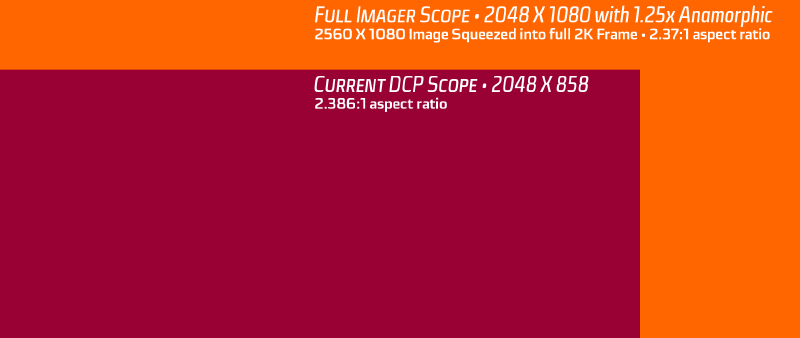
This is a proportionately accurate size comparison between the current DCP standard for 2K 'scope (2048 X 858) and what 2K 'scope really should be, a full frame 2048 X 1080 anamorphic enhanced image originally 2560 X 1080 in size.
The full frame anamorphic 'scope image is over 150% the size of the standard DCP 'scope image. That's a pretty freaking substantial difference. The 2560 X 1080 imagery used to encode the anamorphic image has over 1 million more pixels than the standard 2048 X 858 frame. 2764800 versus only 1757184. The full frame 2040 X 1080 imager chip has 2211840 pixels. Standard DCP scope omits 454656 of those pixels to arrive at its cropped bullshit scope image.
This is basically just like the differences between anamorphic enhanced DVDs and non anamorphic DVDs. I can actually watch an old 16x9 enhanced DVD on my 65" HDTV set and not be too badly bothered by the resolution limitations. The non-anamorphic DVDs I have, such as True Lies and The Abyss are totally unwatchable.
This anamorphic approach in d-cinema would make a big difference with image quality. But it takes both Hollywood studios creating DCPs with anamorphic enhanced content AND theaters outfitted with projectors using anamorphic 1.25x lenses to get the benefit.
With so many movies being created in 'scope format I might even go so far as to say the anamorphic approach should be used even in a single lens situation. Not many movies are made in 1.85:1. I don't think they would suffer too badly with the anamorphic treatment. Scope just needs to be the best quality format, not flat.
Posted by Mike Blakesley (Member # 26) on 04-30-2015, 11:17 PM:
quote: Terry Lynn-Stevens
What I don't understand is that you don't have masking yourself? You would think that someone like yourself would have it, but then again you also said that nobody has ever complained.
We DO have masking, it just doesn't move. Our screen is 2:1 and we run the scope picture to fill the screen, with the flat picture pillarboxed. It's been that way here since 1953.
When we first went to digital we set up the scope image so that it was slightly letterboxed, but I do agree with Brad that it makes the picture contrast seem better when there is no white screen, so we changed back to the 2:1 format. If the movie has content that needs the entire 2.39:1 frame (such as the recent "Frozen" short did), we run the movie with the slightly-letterboxed setting.
I would love to have moving masking but the way our screen area is set up I have no idea how many thousands of dollars that would cost.
Posted by Gary Lightfoot (Member # 8842) on 05-01-2015, 03:59 PM:
Do any/all current DCI projectors have the facility to stretch the 2048 x 856 scope image to fill the full 1080 height and use a 1.25 anamorphic lens to restore the geometry to 2.37?
Gary
Posted by Bobby Henderson (Member # 840) on 05-01-2015, 05:43 PM:
IIRC some can do that. The end result would be more efficient light spread. However, it isn't any better than zooming from an image resolution standpoint since it is still starting out with a lower resolution 2048 X 858 image. It would be FAR better is the projected image was an anamorphically authored, full frame 2048 X 1080 image. Movie studios need to render their 2K masters at 2560 X 1080 and when authoring to DCP compress them into an anamorphic 2048 X 1080 container.
By the way, 2560 X 1080 is a standard resolution that is supported by a lot of modern computer video cards. There are 21:9 computer monitors sold at 2560 X 1080 hardware resolution. That actually raises a point for future consumer video format standards. The electronics industry is seeing diminishing returns on a lot of new HDTV sets. Maybe they need to go wider from 16:9 to 21:9 ratio.
Posted by Frank Cox (Member # 6258) on 05-01-2015, 06:44 PM:
I don't have movable masking on my screen; it's a "perfect" scope screen and flat movies are centered with a foot or so of dead space on each side. It looks ok to me.
However, I always had the idea that if I ever wanted to put in movable masking, I could purchase some tracks like what you use for sliding closet doors. Build some tall "doors" to put into those tracks, wrap 'em with black masking cloth material, and that would be all that would be required. Slide them into place when needed, slide them back when not required. It wouldn't be automated, but so what? In my case (and Mike's, I would imagine) I'm only playing one movie at a time 99% of the time anyway so once I had the masking set I would be set for the week anyway.
I can't see that solution costing more than a couple of hundred dollars and a couple of days of construction work (since I'm not particularly good at construction). But I haven't actually bothered to do it, so far.
Posted by Monte L Fullmer (Member # 2797) on 05-01-2015, 06:44 PM:
quote: Mike Blakesley
I would love to have moving masking but the way our screen area is set up I have no idea how many thousands of dollars that would cost.
One could almost make their own masking..with the image scaled down to the proper ratio, move the image up to meet the top of the masking edge, then make your own width masking to go across the bottom of the screen to meet the bottom of the image.
Easily removable for flat presentations.
Where Mike has the long throw and small screen, the slight lines from the first three rows shouldn't be too affected by raising the image up a couple of feet.
-Monte
Posted by Steve Guttag (Member # 268) on 05-02-2015, 02:09 AM:
ALL DLP based projectors can handle the anamorphic lens. The scaling technology is on the TI side of things (both series 1 and series 2 projectors). So even if you have say a Barco DP2K-20C projector that doesn't show the anamorphic settings, you can use the TI ICP/Enigma program to make a SCREEN file with the anamorphic squeeze that the Barco projector will happily recall like any other.
As Bobby notes, using an anamorphic with current content does not buy you any resolution. However it does buy you 23% more light (with the other 3% loss in the glass). Ideally it would have be a 1.26x anamorphic but I'm sure if tested a 26% stretch would have shown significantly more scaling artifacts than 25% hence it is just under ideal. That 23%, however, can normally mean a lamp size difference to hit your light on "Scope." Zooming the lens just wastes the light. If you read other threads, you'll find discussions where people have taken to setting scope's light level in the 11-12fL range and the Flat's light level in the 16-17fL range so the lamp is not ping-ponged between near minimum and near maximum level trying to balance both. With an anamorphic, that range is cut in half. Depending on the screen size, projector and lamp, you can have both target the standard 14fL or reduce the spread to something like 15fL and 13fL without stressing the lamp. In larger lamp situations, dropping the lamp size can really add up (particularly the 4500-watt and larger lamps). I suspect even with lasers it will provide a significant cost savings as a smaller laser system could be used. The scope format being the determining factor on how much projector one needs.
Posted by Daniel Schulz (Member # 1881) on 05-02-2015, 09:53 AM:
quote: Bobby Henderson
This anamorphic approach in d-cinema would make a big difference with image quality. But it takes both Hollywood studios creating DCPs with anamorphic enhanced content AND theaters outfitted with projectors using anamorphic 1.25x lenses to get the benefit.
If I could change anything about the DCI standards it would be this. I miss real widescreen. Unfortunately the loss of resolution happens relatively early post production - even if the image is captured at camera with an anamorphic lens, typically the work files for editing and color correction, and definitely the DI, are 2048 x 858.
There is a company called Folded Space (a division of Panamorph, who make anamorphic lenses for home theatre projectors), who have developed a technology to create anamorphic widescreen Blu Rays that are backwards compatible with non-anamorphic playback. Essentially they take the extra pixel data, place it in the space normally occupied by the black letter boxing bars, and then use the Java in the Blu Ray standard to hide those pixels. If you have an anamorphic system, the Blu Ray player reincorporates the extra pixels, creating a 1920x1080 anamorphic squeezed image, which yields a true widescreen image upon projection. Folded Space has been hoping to get this technology adopted in Blu Ray and the proposed UHD Blu Ray, but I see no technical reason it couldn't be used in Digital Cinema as well.
Posted by Lyle Romer (Member # 1266) on 05-02-2015, 10:45 AM:
What makes Bobby's 1.25x anamorphically enhanced idea even better is that when applied to 4k, it makes it a 5k image. It can then be marketed as "Ultravision 5k" or something like that. It would be an image upgrade and a marketing upgrade for very little cost.
Posted by Daniel Schulz (Member # 1881) on 05-02-2015, 11:49 AM:
quote: Lyle Romer
What makes Bobby's 1.25x anamorphically enhanced idea even better is that when applied to 4k, it makes it a 5k image. It can then be marketed as "Ultravision 5k" or something like that. It would be an image upgrade and a marketing upgrade for very little cost.
Agreed 100%. And it's not as though cinemas aren't casting about looking for something to differentiate themselves from home theatre...
Posted by Gary Lightfoot (Member # 8842) on 05-04-2015, 06:32 AM:
I've been using anamorphic lenses for over 10 years in my home theatre (Primsasonic and now ISCO), and although the source resolution does not change, scaling does produce a visibly better image than when zoomed from where I sit.
At home, we zoom 33% (rather than 25% for 2k), which is like moving your seating 33% closer, and pixels become more 'chunky' compared to a scaled image that is using more pixels which are smaller. The image looks more detailed and sharper despite the source res being no different than when zoomed. It all depends on how good the scaling is, and these days it's usually very good - no visible artefacts unless you use a test pattern. Much of this depends on how close you sit of course, and that is an important factor, more so than physical screen size.
I've been watching folded space (John Schuerman) over on avsforum but somehow I don't think it's going to happen unfortunately. It looks like 4k is going to be installed (and then 8k) before folded space gets used. At home, constant image height is a niche within a niche (of people with projectors), and if the commercial market is shying away from ananmorphics I can't see them wanting to go for folded space over a more marketable 4k, especially where the 4k zoomed pixels are going to be smaller than the pixels of a 2k image using anamorphics. IMHO.
Zooming doesn't always lose you a huge amount of light with home cinema projectors, but it depends where in the throw the pj is - when you zoom the prime lens to make the image larger, due to the way the lens elements re-arrange, the F-stop changes and you often find that as you zoom larger, you get more lumens and less on/off contrast. When you zoom smaller the opposite happens. In some cases the difference between zooming and using an A lens can be small and inconsequential. I'm guessing that with commercial installs, the set up and choice of prime lens means that is never the case.
I'm a huge fan of constant image height and hate the way modern multiplexes are just like big tv now. Most cinema goers have no idea about constant width or constant height so don't know what they are missing. Looking at documents from people like SMPTE, THX, Dolby etc, they seem to actively promote constant height in preference over constant width (and no mention of other compromise formats like constant area), yet the commercial part of the industry is (obviously I guess) more concerned with the costs of things rather than the art of presentation. If the advantage of a $10k anamorphic lens is lost on 99.99% of the cinema going public, I can see why no one wants to spend that amount of money on one.
Would I be right in saying that due to the loss of people like yourselves in the industry, they now need projector operation etc to be so simple that an untrained guy like a multiplex manager or the guy who sells the tickets and popcorn can click a mouse and start a movie? If that's the case, I can see that zooming an image for scope or trying to implement an anamorphic lens would just be too tricky and lead to problems.
I'm purely a home cinema enthusiast but have popped over here to see what your guys take is on various aspects, and how things are done in the commercial space. Hope you don't mind me throwing in my own perspective and asking dumb questions.
Please be gentle with me.
Thanks
Gary
Posted by Marcel Birgelen (Member # 6801) on 05-04-2015, 07:36 AM:
Scope in DCI should have been anamorphic right from the get go. The pre-DCI 1.3K machines like the DP-50 used anamorphics for scope with non-square pixels in the digital source files and DCI should have gone this same route.
It's just a blatant cost cutting measure that a format that's supposed to be LARGER than flat has to cope with less resolution and less light than flat...
So, anamorphic lenses and non-square pixels should have been a mandatory part of the DCI specs. The fact that we accepted a lesser thing is yet another example of what happens if we let compromises rule the industry.
And it's not just this thing, it's the composite of all those "compromises" what makes cinema what it is today and why, if we all happily continue on this path, we'll finally destroy the industry along with it.
If going to the theater adds nothing but frustration, people will just not go, movie studios will start releasing their features day and date with the streaming and rental market and that will be the end of it...
Posted by Buck Wilson (Member # 5885) on 05-04-2015, 03:04 PM:
What would need to happen to make that change?
Or does it even matter with laser coming into the picture?
Posted by Marcel Birgelen (Member # 6801) on 05-04-2015, 03:16 PM:
quote: Buck Wilson
What would need to happen to make that change?
I'm not sure what it would take to fix it right now. I'm somewhat afraid this train has passed.
It's not that difficult to do though... Studios could just hack it into the DCI naming convention and start delivering anamorphic versions of their movies right now. On the playback side of things, for those that do scope with anamorphic lenses right now, it would just require a few tweaked macros to play this content.
quote: Buck Wilson
Or does it even matter with laser coming into the picture?
Laser does nothing to add resolution or to fix scope. Maybe you've got more headroom now and can afford to throw away more light, but why would this be a good idea?
I guess on the bright side (quite literally), all current laser systems are 4K systems. But I doubt there's even one single laser install out there that uses anamorphic setups right now.
Posted by Daniel Schulz (Member # 1881) on 05-04-2015, 06:48 PM:
Another thought to add to this conversation; I'm not sure how many people on the creative/production side of things are even aware of this status quo. A majority of movies are releases in widescreen, and many of those are shot using anamorphic lenses. Do the filmmakers and their DPs know that their images are ultimately getting flattened and then cropped (well, I guess the DPs must if they are involved in the DI color grading).
This came up when I was visiting NAB and chatting with a representative from ARRI about the new Alexa 65. ARRI was very proud of the fact that it was compatible with a whole range of legacy anamorphic lenses, and in discussing with their rep it became clear that he had no idea movies were no longer projected anamorphically in cinemas! And this coming from a guy whose job it is to sell directors and DPs on the merits of the camera system - probably half the pitch is about how you can use anamorphic lenses to capture true widescreen.
Posted by Bobby Henderson (Member # 840) on 05-04-2015, 09:49 PM:
Anamorphic photography seems to be hitting another fad-like peak level in popularity, just for the visual style of it. Anamorphic lenses create their own unique, football-shaped bokeh. Depth of field effects are more extreme and the visual perspective is often one of a more compressed, telephoto look (which is often more flattering in terms of portrait, close-up photography).
There is a bunch of content being shot with anamoprhic lenses that may never be shown in a commercial movie theater. Hundreds of music videos have been shot with anamorphic lenses. I've seen a lot of TV commercials lately that were shot with anamorphic lenses. The ABC-TV series American Crime was shot largely with anamorphic lenses, but broadcast in 1.77:1 ratio. The same goes for the upcoming 2nd season of True Detective.
At least with movie productions there is still an opportunity to do 'scope some legitimate justice rather than aping out a parody of it, HDTV style.
quote: Buck Wilson
What would need to happen to make that change? Or does it even matter with laser coming into the picture?
As Marcel said, laser doesn't buy any resolution. Pixels are pixels regardless if they're being projected via Xenon or Laser or back-lit at home with LCD, LED, OLED, etc.
Perhaps the biggest change for 'scope done right has to happen on the movie production and post-production side of things. Going from 2K 'scope done wrong (2048 X 858) to 2K 'scope done right (2560 X 1080 with 1.25x squeeze to 2048) is going to cost significantly more money in terms of render times, bandwidth requirements, storage needs, etc.
Plenty of professional level d-cinema cameras can already cover the 2560 X 1080 area. The popular Arri Alexa has a native 2880 X 1620 area (in ARRIRAW 16:9). The Red Epic Dragon can cover 2K 'scope done right and 4K 'scope done right areas with room to spare (it's a 6K camera). The new Arri Alexi65 would show off more of its full potential in 4K 'scope done right. Still, since there is no native 6K d-cinema projection (yet), only a 70mm print could show off the full resolution of the Alexa65.
There are still a number of camera systems and/or modes being used that knock the original camera image down to mere 1920 X 1080 resolution. The Alexa down-rezzes to that when shooting in ProRes. And then if the image gets cropped down to 'scope from that it makes the 2048 X 858 setting a slight "blow up" from an even lower resolution image. That crap might be fine for a TV-only show, but it needs to stop when it comes to movie productions meant for theatrical release.
The exhibition side of things might not be as difficult to fix as we might think.
Remember how DVD players used to work for old 4:3 ratio TV sets? The players would do some internal scaling to make anamorphic enhanced DVDs look correct on those 4:3 TV sets. The only downside was pretty huge, black bars for 'scope movies. But we were already kind of used to that with Laserdiscs.
The same thing could be probably be done with most projector and server systems in use now. If all DCI Series 1 and 2 projectors can anamorphically scale images in one direction it should be possible to update them where one selects what screen type and lens system they're using and the server and projector will automatically make the adjustments, just like an old DVD player outputting to either a 16:9 TV set or a 4:3 TV set.
This system would allow theater operators who choose to invest in anamorphic projection lenses and common height screens to get the most benefit out of them. Cinemas with common width screens and/or spherical lens setups would still get to show the image same as usual. The server and projector would just scale the image down to correct proportions before it hit the screen. Nevertheless, the anamorphic screens would be showing a much brighter, better looking image. I would even go so far as to say the pricey investment in that anamorphic lens might yield an even better return on investment than junking the whole system for an even costlier investment in laser but with 'scope still done wrong.
IIRC, IMAX' new 4K laser projection system will use an anamorphic lens to vertically stretch the 1.9:1 ratio image closer to 1.43:1. That should work at making people feel like they're back in the late 1990s watching a heavily letter-boxed 'scope movie on an old TV set, but with it being a really huge, old TV set.
![[Razz]](tongue.gif)
Another thing with this digital version of 'scope done right, it might reduce moiré patterns that can occur when a sharply focused pixel grid is projected onto the perforation pattern of the screen. The anamorphic lens would stretch the pixel grid out of its native proportions and likely cut down on moiré. That in turn might allow the image to be more sharply focused and get an even better improvement in image resolution.
quote: Daniel Schulz
This came up when I was visiting NAB and chatting with a representative from ARRI about the new Alexa 65. ARRI was very proud of the fact that it was compatible with a whole range of legacy anamorphic lenses, and in discussing with their rep it became clear that he had no idea movies were no longer projected anamorphically in cinemas! And this coming from a guy whose job it is to sell directors and DPs on the merits of the camera system - probably half the pitch is about how you can use anamorphic lenses to capture true widescreen.
Just a nit to pick, but I think the standard Arri Alexa is the model compatible with anamorphic lenses isn't it? The 6K imager in the Arri Alexa65 has a 2.20:1 aspect ratio (and is the same physical size as a 5/65mm film frame), making the use of anamorphic lenses unnecessary for 'scope -unless you're going to shoot a digital version of Ultra Panavision.
![[Cool]](cool.gif)
Posted by Buck Wilson (Member # 5885) on 05-04-2015, 10:04 PM:
So could someone who knew what they were talking about throw this idea in front of the studios? Seems like such a cheap investment for a very large benefit. Basically all the infrastructure is already there.
Posted by Jason Whyte (Member # 1433) on 05-04-2015, 10:10 PM:
A great remark from Daniel:
"Another thought to add to this conversation; I'm not sure how many people on the creative/production side of things are even aware of this status quo."
If only more filmmakers were aware that not only are their scope films are being presented in a smaller frame on a flat 1.85 screen. I really don't think many filmmakers, cinematographers or tech people are even aware of these types of theaters how their films are being shown.
They should also be aware that their movies also could potentially be shown without masking AND/OR a 2D screening been shown with the Real D lens over the projector, not moved out of the way from a previous 3D screening, further darkening the image. Both things happen in this neck of the woods ALL THE TIME.
I'd also like to get their opinion on how scope films are zoomed to 2048x858 on macro lenses as well.
Posted by Bobby Henderson (Member # 840) on 05-04-2015, 10:19 PM:
quote: Buck Wilson
So could someone who knew what they were talking about throw this idea in front of the studios? Seems like such a cheap investment for a very large benefit. Basically all the infrastructure is already there.
I would be shocked if they didn't already know about the option to render 2K 'scope in 2560 X 1080 and squeeze it to 2048 X 1080 full imager size. My theory is they went with the spherical, single lens 2048 X 858 approach because it was cheaper and deemed "good enough."
The "good enough" approach might, at first, seem acceptable for standard movie theaters -especially the growing number of common width theater screens. The problem is people are shelling out a hell of a lot more money in premium priced houses. They ought to be getting more of their money's worth. Letter-boxed, HDTV style 'scope done wrong is not a good approach for any premium priced movie theater.
That's another area where I'm really disappointed about Dolby choosing a common width approach to its Dolby Cinema screens. If any of Dolby's people are lurking in this forum they really need to take note of what I'm saying regarding d-cinema 'scope done right and incorporate that into their Dolby Vision oriented laser-based projection system (along with using common height screens). The substantial increase of native resolution with 'scope done right will make Dolby Vision images "pop" a hell of a lot more. If its the same old, slightly fuzzy, not quite dialed in focus kind of imagery, it's not going to make quite so much a difference if the projection is xenon-based or laser-based.
Posted by Frank Angel (Member # 248) on 05-05-2015, 03:41 AM:
quote: Bobby Henderson
My theory is they went with the spherical, single lens 2048 X 858 approach because it was cheaper and deemed "good enough."
Good Enough has been the digital mantra from its very incarnation. It never was that we need to make digital technology exceed 35mm before we transition to it...or at the very least, get it AS GOOD AS 35mm; and forget about 70mm -- that seemed to never even enter the thought process.
My first digital experience was watching digital via one of those first 1.3K non-DCI "roll-outs" (think DVD on a 50 ft screen) and I thought I was looking at a load of hippo manure on the screen, then reading, literally within days of that vomit-inducing experience, Richard Cook of Disney, countering some criticism leveled at digital saying that although it wasn't "quite as good as film," as far as he was concerned, it was -- exact quote -- "good enough." That's when I realized there must have been some sort of humungus sun flare or gamma ray burst and everyone had just gone completely insane.
Posted by Gary Lightfoot (Member # 8842) on 05-05-2015, 03:21 PM:
My experience with film in cineplexes is that it's not as good as digital - I beleve most 35mm film ends up in post as a 2k DI and then after bulk release prints and a few runs trough the projector, the quality isn't that good from what I've seen.
2K Digital doesn't have most of those problems so stays looking much the same.
Posted by Gary Lightfoot (Member # 8842) on 05-05-2015, 03:31 PM:
quote: Buck Wilson
So could someone who knew what they were talking about throw this idea in front of the studios? Seems like such a cheap investment for a very large benefit. Basically all the infrastructure is already there.
I thinkJohn Schuermann of Prismsonic/Folded Space is doing something along those lines already with the Folded Space idea (for BD at the moment, not sure about DCI), but although he says many in the industry are aware and not particularly happy about how multiplexes etc are doing things, they don't seem to have much power to actually change anything. I think he said that FS was kinda on the back burner as 4k is what is selling right now.
And if it's true that even movies that are filmed anamophically are rendered back to 2046 x 848 then other than scaling the imager and using an A lens, wer'e back to relying on the multiplexes to do it right again, which judging by the current state of affairs appears to be unlikely since they're mostly 16:9 to start with anyway.
I think until the multiplexes can start making money from constant height set ups (unlikely since that means maybe losing some smaller screens to make way for another bigger one), we're unlikely to see any changes in the near future.
Gary
Posted by Bobby Henderson (Member # 840) on 05-05-2015, 09:58 PM:
quote: Gary Lightfoot
My experience with film in cineplexes is that it's not as good as digital - I beleve most 35mm film ends up in post as a 2k DI and then after bulk release prints and a few runs trough the projector, the quality isn't that good from what I've seen. 2K Digital doesn't have most of those problems so stays looking much the same.
We're not really talking about film projection versus video projection. We're talking about common height screens versus common width. Film can come into the discussion when it comes to how 'scope was treated in a far better way on film than it has been in digital.
The super-widescreen 'scope format has traditionally been the bigger, more panoramic, more epic format for movies. On 35mm film 'scope was the brightest, highest resolution format since it used the entire 4-perf 35mm frame. The 1.85:1 and 1.66:1 ratios merely cropped into the frame.
In digital cinema 'scope is treated just like it is on ordinary TV screens at home: letter-boxed. It's the smallest, lowest resolution format. One can make a good argument that 'scope is a cheaper format to handle in post production than any flat format since there are fewer pixels to render. Maybe that's a big reason why there are so many fake 'scope movies made these days.
With regard to film print quality, during the past decade quality standards slipped a lot as labs shut down and the best film handling people moved on to other things. Movie productions switched over to digital intermediate processes in post production over the past 10-15 years. Digital intermediates, especially those rendered in 2K, have posed a serious image resolution bottleneck compared to an analog-only film-in and film-out work flow.
Once a movie has been post produced in digital intermediate form there really is not much need to see the movie output on a 35mm film print. There might some unique exceptions, but generally unless the movie is shot on film and post produced on film the film print itself is a waste of time.
quote: Gary Lightfoot
I thinkJohn Schuermann of Prismsonic/Folded Space is doing something along those lines already with the Folded Space idea (for BD at the moment, not sure about DCI), but although he says many in the industry are aware and not particularly happy about how multiplexes etc are doing things, they don't seem to have much power to actually change anything.
Multiplex theaters are goofing up d-cinema presentation quality based largely on how the technology was designed: like a HDTV screen in public. There is no wonder why so many multiplex theater screens are common width and letter-boxing 'scope movies just like a TV set at home. The 'scope format is getting goofed up from the start, sometimes right in the camera but always through a low quality bottleneck in post production.
Concepts like Folded Space or my suggestion of 'scope done right in d-cinema aren't going to go anywhere without movie studios admitting the current setup for 'scope just stinks.
One interesting thing is that some of the ground work has already been made to support 2560 X 1080 HD and 5120 X 2160 UHD resolutions. The latest HDMI spec supports both 21:9 modes.
quote: Gary Lightfoot
And if it's true that even movies that are filmed anamophically are rendered back to 2046 x 848 then other than scaling the imager and using an A lens, wer'e back to relying on the multiplexes to do it right again, which judging by the current state of affairs appears to be unlikely since they're mostly 16:9 to start with anyway.
There is already many opportunities to make mistakes in digital cinema. It's hardly plug and play. My proposal for 'scope to be treated as a full imager frame with 1.25x anamorphic format would be fairly easy. It would be no more complicated than changing the TV output setting of a DVD player, a one time change.
Posted by Gary Lightfoot (Member # 8842) on 05-06-2015, 01:58 AM:
I completely agree that using the full imager frame and 1.25 anamorphics is relatively easy to do (I do it at home and I'm just an enthusiast), but the multiplexes don't seem to want to spend the money or maybe train the staff. It's all about bottom line to them by the looks of things.
It drives me crazy too. I wouldn't have a constant width projection set up at home because it's completely wrong to do such a disservice to scope, removing the entire concept of being the biggest widest presentation (other than IMAX I guess) but the general public doesn't seem to know or care, and they still pay the money to see a substandard presentation. A small, crappy 16:9 screen with no masking.
I just can't see how it's going to change any time soon.
Gary
Posted by Terry Lynn-Stevens (Member # 7349) on 05-06-2015, 09:12 AM:
quote: Gary Lightfoot
I completely agree that using the full imager frame and 1.25 anamorphics is relatively easy to do (I do it at home and I'm just an enthusiast), but the multiplexes don't seem to want to spend the money or maybe train the staff. It's all about bottom line to them by the looks of things.
Of course it is about the bottom line, (that is what is usually is about) but studios made sure to put in a DCI requirement that scope DCPs were not distributed with an anamorphic requirement
quote: Gary Lightfoot
the general public doesn't seem to know or care, and they still pay the money to see a substandard presentation.
This sums it up perfectly, they don't care and I have always believed that because they see the giant PLF screen when the enter the cinema, they have the perception that the screen and presentation is superior.
Posted by Martin McCaffery (Member # 37) on 05-06-2015, 09:51 AM:
quote: Bobby Henderson
It would be no more complicated than changing the TV output setting of a DVD player, a one time change.
And how many people sit through movies and tv shows at home (and especially in hotels) where the picture is squeezed and stretched? How many you think would to it in a movie theatre? I remember people sitting through whole features in this town with the wrong lens in and not complaining. Do you think digital would make things different?
Posted by Dave Macaulay (Member # 813) on 05-06-2015, 11:30 AM:
Being within "what people will tolerate" is a poor justification for not doing projection well.
I could fill pages with stories of bad presentations that nobody complained about.
The studios are pushing for non-theatrical releases coincidental with theatrical and historically they have gotten what they want. Losing the theatrical-only release window will eliminate one good reason for going to a cinema. Making the presentation crappy will hardly help. Once day-and-date comes we will see how many people cherish the cinema experience.
The experience of seeing a movie on the big screen is all we will have to sell. I don't think overpriced popcorn and candy is a huge draw.
IMAX, Dolby, other brands, and some chains are trying to provide an enhanced experience - higher quality projection, multi-channel sound (available in home systems now or soon though), better seats... but young people seem happy seeing a movie on a tablet or a phone with their tinny sound: will they care?
Posted by Martin McCaffery (Member # 37) on 05-06-2015, 12:21 PM:
quote: Dave Macaulay
Being within "what people will tolerate" is a poor justification for not doing projection well.
In case there is any doubt, I, of course, agree.
Alas, I do not think the powers that be in the movie industry do.
Posted by Bobby Henderson (Member # 840) on 05-06-2015, 04:41 PM:
quote: Gary Lightfoot
I completely agree that using the full imager frame and 1.25 anamorphics is relatively easy to do (I do it at home and I'm just an enthusiast), but the multiplexes don't seem to want to spend the money or maybe train the staff. It's all about bottom line to them by the looks of things.
Right now Hollywood movie studios are giving theater operators zero reason for investing in anamorphic projection setups. The movie studios must first start creating their content in higher resolution, anamorphic enhanced fashion. Once that's in place movie theater operators who can upgrade their projection systems can consider doing so.
At the theatrical end it should not require any more than a firmware update. DCP playback would default to down-scaled 'scope for all the projection systems. Those who have anamorphic setups can enable the anamorphic playback setting.
quote: Gary Lightfoot
It drives me crazy too. I wouldn't have a constant width projection set up at home because it's completely wrong to do such a disservice to scope, removing the entire concept of being the biggest widest presentation (other than IMAX I guess) but the general public doesn't seem to know or care, and they still pay the money to see a substandard presentation. A small, crappy 16:9 screen with no masking.
They just don't know any better. The general public is also into brand worship. That's how IMAX can fool people into spending upwards of $20 or even more for a moderately big image with no better than HDTV resolution. They've been riding on the coat tails of the large format heritage they built showing 15-perf 65mm filmed content projected in 15-perf 70mm. They call both the film and digital versions "IMAX" and hope the customers won't bother to notice the fuzzy, detail lacking inferiority of the digital version.
quote: Terry Lynn-Stevens
Of course it is about the bottom line, (that is what is usually is about) but studios made sure to put in a DCI requirement that scope DCPs were not distributed with an anamorphic requirement
Movie studios are really the ones saving money on fake 'scope.
They render 1 million fewer pixels with 2K fake scope and 2 million fewer pixels with 4K fake scope. It's disgusting how classic 70mm films have been handled on DCP: window-boxed in a 1.85:1 container and probably sourced from Blu-ray AVC encodes instead of an uncompressed master. Then when you consider the generally derivate nature of the movie storylines themselves (assembled with Save the Cat beat sheet templates, just like clip art), there is no question studios are cutting corners where they can. Yet they feel totally entitled to price gouge the customers and generally take them for granted.
quote: Terry Lynn-Stevens
This sums it up perfectly, they don't care and I have always believed that because they see the giant PLF screen when the enter the cinema, they have the perception that the screen and presentation is superior.
People used to perceive the Earth was flat too.
quote: Dave Macaulay
Losing the theatrical-only release window will eliminate one good reason for going to a cinema. Making the presentation crappy will hardly help. Once day-and-date comes we will see how many people cherish the cinema experience.
Much of the movie industry as we know it would disappear if the studios embrace simultaneous day and date release between theaters and home video. Commercial theaters will fail in droves immediately. Then the studios themselves, no longer be buoyed by the theatrical platform, would be unable to finance productions of any significance. In the end, we would be left with the cable networks and streaming providers like Netflix.
But with as shitty a job Hollywood is doing with the "digital movie-going experience" I can't say that I would miss it all that much. The forms of movie presentation I loved are gone now. Today we have TV in public. I can watch TV at home for a lot less money, a lot less distraction and a lot more convenience.
Movie studios and movie theaters need to do a more professional job with the movie-going experience. The movie industry should count itself lucky when it gets paying customers who don't care about quality or know the details. But those customers who don't know any better would be the very first customers lost in a day and date release scheme. With the picture quality no better than Blu-ray at home, customers who do care about the details will be lost as well.
Posted by Terry Lynn-Stevens (Member # 7349) on 05-06-2015, 04:50 PM:
quote: Dave Macaulay
Once day-and-date comes we will see how many people cherish the cinema experience.
I saw at HMV today a sign saying "Pre-order Pitch Perfect 2" which hits theaters May 15th.
quote: Dave Macaulay
IMAX, Dolby, other brands, and some chains are trying to provide an enhanced experience - higher quality projection, multi-channel sound (available in home systems now or soon though), better seats..
Totally agree The IMAX with Laser presentation at the Scotiabank is the best digital viewing experience possible today.
quote: Dave Macaulay
but young people seem happy seeing a movie on a tablet or a phone with their tinny sound: will they care?
The young people do care, but the younger generation have discovered for themselves that not EVERYTHING needs or requires them to see it in a movie theater. They will see certain movies in a movie theater.
quote: Martin McCaffery
Alas, I do not think the powers that be in the movie industry do
I think they are aware, however the studios know all too well that it makes no difference to most people if there is a masking, anamorphics, Dolby Atmos, or even IMAX. It is a very small percentage of the audience that really cares.
Posted by Monte L Fullmer (Member # 2797) on 05-06-2015, 06:35 PM:
quote: Terry Lynn-Stevens
It is a very small percentage of the audience that really cares.
We did the Avengers 3D double feature on Thurs, and I forgot the first one was in FLAT when I ran this in 2012, and in 35mm, yet this second one was in 'scope.
Yet,I never could figure out why the first one and a strong action flick, would be in FLAT.
And granted, it was great to see a digital feature fill the entire screen with an image where you get a second one giving the "Letterbox" image (and back to the masking discussion if we allowed it to).
Yet, nobody made any comment on how both features were presented - they just loved the feature.
(Oh, they did love seeing SW:VII trailer in 3D...!)
-Monte
Posted by Jason Whyte (Member # 1433) on 05-07-2015, 04:31 PM:
It's amazing to me how digital projection SHOULD make things easier, yet months ago I went to a 2D screening of THE LEGO MOVIE that not only had its masking pushed all the way out to flat, but the 3D lens was still left on the projector. The theater was full and no one noticed. But I did. And wound up leaving and watching something else.
"People don't notice/care" is not an excuse to me, and no theater management should ever have that philosophy either. I am aware the majority of moviegoers today don't know any better. It doesn't mean proper projection standards shouldn't be ignored, either, no matter how many theaters your complex has.
quote: Terry Lynn-Stevens
The IMAX with Laser presentation at the Scotiabank is the best digital viewing experience possible today.
Sorry, but 99.9% of the people on this forum would disagree with you on that. Many individual locations offer a superior theatrical presentation for many reasons (better use of projector bulbs, lenses, masking etc) other than an extra resolution bump by way of a few lasers.
Posted by Dave Macaulay (Member # 813) on 05-07-2015, 06:00 PM:
"Sorry, but 99.9% of the people on this forum would disagree with you"
The opinions of those who haven't seen it are utterly worthless.
Have you?
I have, and I am sincere in saying that no xenon digital system can possibly compete on image quality. I have not seen the Dolby laser system though and can't comment on it (see how that works?).
Posted by Daniel Schulz (Member # 1881) on 05-07-2015, 08:04 PM:
quote: Dave Macaulay
I have, and I am sincere in saying that no xenon digital system can possibly compete on image quality. I have not seen the Dolby laser system though and can't comment on it (see how that works?).
I would like to second this opinion. Although I lament the lack of masking and the prioritization of a flat (ish) aspect ratio, the image quality at the TCL Chinese IMAX with the laser projectors is astonishing.
Posted by Bobby Henderson (Member # 840) on 05-07-2015, 09:52 PM:
Laser will obviously offer a noticeable improvement over Xenon-based projection, but at a really high price.
How much more focused or not will the image be? Aside from the dark gray blacks my bigger complaint with d-cinema has been deliberately blurry, slightly out of focus images. Contrast, image sharpness and color brilliance is going to be only so good if the projector is dialed out of focus to hide a pixel grid or eliminate moire patterns due to the pixel grid clashing with the perf pattern on the screen. Film never had that problem since the film grain was randomly spread. The image could be focused as sharp as possible without fear of revealing a pixel grid or creating strange moire patterns.
IMAX doesn't have a corner on laser projection. Other theater chains are already installing laser-based projectors of their own. But there is some question as to whether those other theaters will be installing single or dual projectors. At least with IMAX (and Dolby Cinema as well) you'll know dual projectors will be in use.
A couple big problems with IMAX laser: 1.: they're not going to install it in all of the IMAX-branded theaters. The laser-based systems may only go into a small minority of theaters. 2.: IMAX appears to not be calling any notice to the new laser based systems on a specific theater by theater basis to let customers know which theaters have laser and which one don't. They want customers to guess all theaters with an IMAX logo on the building have the new laser systems. This is basically the same approach they did between real 15-perf 70mm IMAX and 2K Xenon LieMAX.
IMAX-branded theaters newly built for laser in mind will have taller screens, which will make all those 2.39:1 'scope movies from Hollywood even more excessively letter-boxed.
As good as laser might be, it's still going to be stuck with a fake 'scope image. It doesn't have to be that way. But it will take some fundamental changes happening first with those people who dictate standards (DCI, SMPTE, etc), then with movie studios and post production houses and then finally the movie theaters.
In some cases 'scope is already being shot "correct" in digital form. The Arri Alexi XT can shoot 4:3 anamorphic 2880 X 2160 and yield a 2K or 4K image that would conform to digital scope done right. At least one or more Red cameras can do the same thing as well as shoot spherical in 5120 X 2160 mode.
Maybe scope done right in d-cinema needs some kind of new buzzword or brand name to get any traction. "Super 2K" and "Super 4K" would kind of fit in with terms like "Super 35" and "Super 1.85" that have been used in the past.
Posted by Marcel Birgelen (Member # 6801) on 05-08-2015, 06:42 AM:
I've seen both the Dolby/Christie based laser solution and the Barco based laser solution, both in 2D and 3D. I cannot comment on the IMAX laser system yet. It pretends to work differently by projecting two different images over each other, which would then blend together to something never seen before. I'm wondering how this works in conjunction with 3D.
I guess laser fixes the brightness issues for larger screens, but I wouldn't say the image quality of those setup exceeds that of a powerful, well calibrated xenon digital setup on a "normal" sized screen.
So, the experience with regular DCI content, both 2K and 4K was good, but not transcendental.
I've also seen demos using the expanded color gamut those laser systems offer and while they look great, so did the first iteration of HFR demos. It remains to be seen how it looks in feature films. I'm hoping to catch Tomorrowland in "Dolby Vision".
Posted by Steve Guttag (Member # 268) on 05-08-2015, 12:52 PM:
From what I can tell, a laser based system tends to be about 25% higher in contrast than a xenon system so I could see how an image would improve on just that one change. That said, I'm comparing conventional RGB lasers instead of the Blue-Phosphorus lasers used on the lower-end projector. However, since one of the target projectors for the Blue-Phosphorus lasers (the NC900) has such horrible contrast (1600)...the blue phosphorus laser is only 1750 or just over 9% improvement (NC1100L). Lasers alone do not make the image that much better...it is also how they are implemented.
Note, by this time next year, Barco will have Blue-Phosphorus lasers for their "C" series projectors as a lamphouse replacement (they were showing a prototype at CinemaCon this year). I guess the "sell" is not having to fool with xenon lamps...I think the problem is...if the light improvement is only 9% or so, the laser system would have to be under $5,000 or cost wise, on the smaller projectors, you are going to spend less on xenon lamps with no real perceptible change in presentation.
Posted by Mike Blakesley (Member # 26) on 05-08-2015, 01:36 PM:
So hopefully, by the time our 2010-model Series 2 NEC projector reaches end-of-life, they'll have all the bugs worked out of the laser machines and they'll start to drop in price because all the big theaters will start buying them to replace their ancient machines (many of which are now approaching 15 years old).
This rosy-colored view of the future may be way off base but it's worth hoping for.
Posted by Steve Guttag (Member # 268) on 05-08-2015, 04:09 PM:
Honestly, I think 10-15 years on a DCinema projector is realistic (at least xenon based ones...with any new technology you have your growning pains). We have CP2000s and DP100s that are now 11 years old and still going. They definitely show their age though. That is, they are nowhere near as efficient as their modern-day counterparts and they have learned a bit in serviceability since then. Picture wise though...pretty darn similar.
So between the first series 1s and late series ones, you have a significant jump in quality and manufacture For Christie, you add in the suffix letters to the CP2000 name like the SB and for Barco everything becomes 1000s...like the DP3000 replaced the DP100.
And then again, for the series 2s we got another bump in light efficiency as well as serviceability. We also have the fact that there are a whole LOT of series 2 projectors and they all share a lot of common parts...even between brands they all have the same ICP, Enigma and DLP chips. The production lives of series 2s have been longer...we are into the 5th year of the same models...which is longer than the predecessors had. So you have that many more systems out there and parts for them.
The realities are too...if you have a 10-foot tall picture or so...you just don't need the latest/greatest/most efficient projector to light that up any better. 14fL is 14fL. It isn't like your projector is getting worse than it was or the picture looks worse because a new technology comes out.
Posted by Monte L Fullmer (Member # 2797) on 05-08-2015, 04:40 PM:
With these laser based systems, is there a diagram/layout available on how the systems works compared to the xenon based system for us that are ignorant to how this works - are the same chips used, or different chips needed, et.al. ?
I'm always willing to learn something new in this field.
-thx Monte
Posted by Dave Macaulay (Member # 813) on 05-08-2015, 06:40 PM:
Imax released a video that mentions some of the differences between their system and most of the others. It's on youtube.
Many details are not public and Imax are sensitive about anyone who has seen them speaking of such things.
Posted by Carsten Kurz (Member # 5396) on 05-09-2015, 06:40 AM:
Monte - in general, they are the same. A standard series2 DLP projector, with a laser light source replacing the previous Xenon bulb, mirror, integrator, etc.
There are some differences, e.g. while cheaper systems create more or less a white light source from blue laser + a phosphorus conversion unit, or the more expensive ones coupling RGB onto the DMD per individual color. But in general, they are 'normal' series 2 machines.
Now, Barco uses their own Alchemy server with their own integrated ICP, so there is no 'traditional' ICP board in those machines.
IMAX use a special setup to increase contrast and reduce pixel visibility far beyond the 'ordinary' laser projectors from Christie and Barco.
Then again, Christie is working with Dolby on a cascaded DLP light engine that should increase contrast, or, should I say, reduce black level, so that 'Dolby Vision' can be supported by these, and this seems to stay a Dolby/Christie proprietary technology. Don't know wether Christie will sell these under it's own brand later as an inprovement to their first generation laser projectors.
I'd say, 4k with increased brightness need to go with increased contrast, because the washed out blacks of conventional DLP 4k systems come out even worse with higher brightness.
The economics of the smaller phosphorous laser DLPs - I don't see them. I checked the numbers for the NEC NC-1100L and the laser version actually has worse economics than the UHP version. Then who actually cares about plugging in an UHP cartridge every 2500-3000hrs? The energy consumption of this laser unit is actually worse than that of its UHP counterpart, because the phosphorous light unit is less efficient than the UHPs. It's just a marketing trick to get a foot into that market.
I can see benefits of phosphor-conversion laser projectors in the business projector market, public spaces, etc., you may want the longest possible uninterrupted projection there, like machines going all day. But in the cinema, and especially with the minimal labour that an UHP lamp change means, and the fail safe that you have with two lamps...
With prices for Barco and Christie 'real' LIPs between 300.000 and 500.000 US$, the economics aspect is a bit more complicated - even with a stacked xenon setup, running two 6-7kW bulbs for 6 shows a day, they won't pay out bulb-wise.
However, these systems are usually installed only for very large screens, where even a 2*7kW Xenon can't light a 3D presentation properly. Now they can have a brighter 3D, and even without a silver screen, less ghosting with Dolby 3D (or whatever Christie call there's). Same is true for the larger IMAX venues.
- Carsten
Posted by Marcel Birgelen (Member # 6801) on 05-09-2015, 07:08 AM:
quote: Carsten Kurz
Then again, Christie is working with Dolby on a cascaded DLP light engine that should increase contrast, or, should I say, reduce black level, so that 'Dolby Vision' can be supported by these, and this seems to stay a Dolby/Christie proprietary technology. Don't know wether Christie will sell these under it's own brand later as an inprovement to their first generation laser projectors.
Well, they actually brand their current "non cascading" setup also as being "Dolby Vision compliant". But they also promised upgrades to their existing Dolby Cinema theaters, once new and improved technology comes along. It remains to be seen if they keep this promise.
A cascading setup comes with an increased burden of an extra level of convergence, extra light loss and it will make this light engine one heck of an expensive device if you need to add three extra DLP chips.
I'm still wondering why nobody is actually considering laser scanning projectors. With modern MEMS technology, it's possible to achieve incredible scanning rates. A laser scanning projector should fix the contrast issues once and for all and could give you a virtually unlimited horizontal resolution.
Posted by Jeffry L. Johnson (Member # 453) on 05-09-2015, 11:26 AM:
Here's an NEC Solid State Light Source technologies web page to browse.
Posted by Brad Miller (Member # 2) on 05-09-2015, 11:50 AM:
quote: Carsten Kurz
Now, Barco uses their own Alchemy server with their own integrated ICP, so there is no 'traditional' ICP board in those machines.
Carsten, does that comment imply that to use the Barco laser kit that the Alchemy IMS whatever-they-want-to-call-it must be used?
Posted by Marcel Birgelen (Member # 6801) on 05-09-2015, 01:14 PM:
As far as I understood it, yes, you must use their Alchemy IMS bundled with their Alchemy IMB solution for now, because no other IMB is compatible with this machine. Maybe other IMB suppliers will come up with compatible devices in the future, but since the IMB is part of the bundle, I guess not much suppliers really feel the need to build an IMB for those projectors.
Also, the SDI inputs currently do not work either and will probably never be capable of doing DCI sanctioned crypto either.
Posted by Brad Miller (Member # 2) on 05-09-2015, 01:58 PM:
Wow. They just shot themselves in the foot.
Posted by Lonny Jennings (Member # 365) on 05-09-2015, 03:42 PM:
My first choice would be common height with side masking and an anamorphic. Second choice would be a 1.89 screen with side and top and/or bottom masking. With this setup there is no light change between formats; in fact, there is no change in the lens at all! Same zoom, focus, shift for all formats. For the larger Christie projectors you can leave off all of the adjustment pieces on the lens. On the Solaria you don't have to do anything; set it up and it's good forever. For the Barco and NEC you don't ever have to worry about the lens settings drifting over time.
Posted by Carsten Kurz (Member # 5396) on 05-09-2015, 04:14 PM:
I guess that the Alchemy needs to go into all current Barco 6P LIPs. Probably also because they need that specific functionality for the spectral separation 3D, and 4k/60fps.
I don't know, but doubt that this is also a prerequisite for their retrofit laser light source once that becomes available. That would make the economics of the laser retrofit quite problematic right from the start.
- Carsten
Posted by Marcel Birgelen (Member # 6801) on 05-09-2015, 05:57 PM:
The Cinemechanica laser retrofit claims to work with "any" DLP projector and should work with any common server. I guess their "laser box" does have either an Ethernet or serial interface you can communicate with, using some simple macros.
It's indeed the non-standard DCI stuff that requires the Alchemy IMB, like the 3D 4K HFR thing but also the "HDR"/wide gamut support and probably the interfacing with the LIPs too. I'm also not all that pleased with projector manufacturers starting to push their own IMSes. In my opinion a projector should do exactly what it's supposed to do: project images. Playing the actual content should, preferably, be done on a seperate player device using a generic interface... Then again, Barco is surely moving into the direction of building "one stop shop" solutions, where they supply projector, "server" and the sound system.
That's probably also why Dolby joined with Christie and created this "Dolby Cinema" concept.
Posted by Steve Guttag (Member # 268) on 05-10-2015, 08:23 AM:
It is not my understanding that the Dolby/Christie bond on Dolby Vision will remain an exclusive thing and that it can be ported to any of the DLP companies. But you have to start somewhere, particularly for an esoteric piece that costs as much as it does. Note, they are strange bedfellows since Christie has gone into the sound market as well as server market...both existing Dolby markets. Though Dolby is not known beyond the processing stage (they own SLS speakers now). They are one of earliest server companies and just bought Doremi, the biggest installed base of servers with OEM deals for both Barco and NEC and even LieMAX (not Christie).
Since the Barco Alchemy fits in the standard slots used by the ICP and the HDSDI/IMB slot. Also remember, post still uses quad link a lot...hence Barco (And the others) make a quad link input board...for that to be usable, one would need to have the projector work with the standard ICP and an HDSDI module.
However, Christie threw down the gauntlet with the Solaria 1/1+ that HAD to use the IMB S2. There was no reason for this...there is no way there was a "cost savings" by excluding others. What Barco has done with the Alchemy was to not be constrained by the bandwidth limitations of the ICP. The question still remains if they are a good server company...I generally don't like to fool with things where a company is "dabbling" in an industry that they have no credibility in.
Powered by Infopop Corporation
UBB.classicTM
6.3.1.2