This is topic Trumbull's 120FPS-4K project in forum Digital Cinema Forum at Film-Tech Forum ARCHIVE.


To visit this topic, use this URL:
https://ft-forum.com/ft/cgi-bin/ubb/ultimatebb.cgi?ubb=get_topic;f=16;t=001947

Posted by Monte L Fullmer (Member # 2797) on 06-21-2014, 11:14 PM:
 
Question: I was approached one day at work by a fellow who claimed to be a local film director using "Red" digital cameras, and he went to Seattle to witness Trumbull's 120fps,4k, 3D project film called: "UFOTOG". .. and this fellow was absolutely spellbound on the presentation results.

He heard that Christie, along with DLP, did create a digital unit to handle this huge amount of data along with a flash storage system to hold all of that information.

He came by to ask me on about my BARCO digital setup and if these units can handle 120fps. I simply told him with that much data to stream into these projectors, it would be way too much along with the package size would have to be very large.

Then, he hits me with something link-shooting with two cameras at 60fps with one camera being one frame off so the two contents can be paired together to be 120fps that this is what Trumbull did with his presentation.

But a question was that if is if after editing the content he has shot, could he split the image/data back into 60 fps video and used two drives to feed the projector through 2 different ports so the projector could handle all of this content.

His big thing is that he wants to find out if a current DLP series two unit can handle 120fps and what would it take to make one handle 120fps.

Interesting to say the least. - Monte
 
Posted by Steve Guttag (Member # 268) on 06-22-2014, 06:57 AM:
 
120fps 2K 2D is currently doable on some IMBs. What will be the ceiling on all IMBs designed and released by 2012 will be a 500 Mb/s limit bandwidth, regardless of how you cut it up. In fact, only the most recent stuff is trying to push that, like Barco's ICMP. Even Doremi's IMS1000 has a 500Mb/s limit. Barco had to essentially make their own ICP to do it too. It can do 4K 60fps 2D or 4K 30fps 3D. Barco is the highest frame rate of currently available IMB/IMS solutions...though I don't know if all of its advertised features are currently functional. Then again, I haven't seen any commercial releases of HFR 3D beyond the Hobbit in 48fps 2K...and that hasn't exactly won the world over. It is also only a 450Mb/s system.

So I'm wondering if there isn't some dual projector work going on which would allow each projector to run 4K 2D at 60fps.
 
Posted by Carsten Kurz (Member # 5396) on 06-22-2014, 12:39 PM:
 
Trumbull did not use DCI machines for the UFOTOG presentation. Christies Mirage projector e.g. has enough bandwidth to show 4k at 120Hz. The hardware platform is identical to their Solaria series2 machines, but it uses a beefed up input section and NO ICP.

http://www.christiedigital.com/en-us/news-room/press-releases/Pages/christie-mirage-4k35-screens-trumbulls-ufotog-premiere.aspx

In current DCI machines, the ICP is the bottleneck. That's why Barco made their own ICP with the Alchemy IMS. But I think it still tops out at 4k/60fps or 2k/120fps. The Christie will do 4k/120fps.

2D/2k/120fps can be done on any HFR enabled DCI machine. For 3D/2k/120fps, you would need two of them, but standard servers won't be able to play this from a single stream DCP. You would need two synced servers/IMBs playing two DCPs split into L/R.

- Carsten
 
Posted by Brad Miller (Member # 2) on 06-22-2014, 02:33 PM:
 
Oh boy here we go again. The worst thing to EVER happen to televisions was the 120Hz refresh rate. Yeah, let's go do that with film now. After all the Hobbit looked so [puke]
 
Posted by Carsten Kurz (Member # 5396) on 06-22-2014, 05:34 PM:
 
Trumbull knows it. Yet he doesn't give up. Because he is still more into rides and simulations, not into narrative cinema applications:

---
As quoted in a 2010 conference panel, Trumbull said:

'I love high frame rates, because I like to make simulation rides and reality-based experiences that are looking to be as realistic as they possibly can, but 24 frames is what I call the “texture” of feature films. And I don’t think anybody’s really ready to see what you would categorize as a feature film shot at 60. And that was one of the tests I did when I was at Showscan; we shot a fully dramatic short film with sets, props, actors, the whole thing at 60 and it was very disturbing. Because it was like live news, or sports, or something.'
---

http://www.highdefdigest.com/blog/douglas-trumbull-showscan-digital/

- Carsten
 
Posted by Brad Miller (Member # 2) on 06-22-2014, 06:32 PM:
 
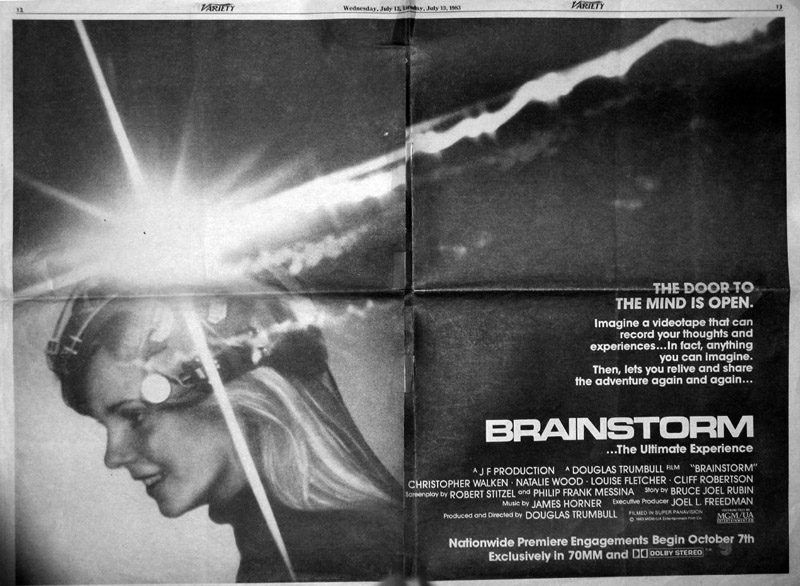
As anyone who has ever seen Trumbull's film Brainstorm properly presented on film in 70mm knows, "scope" is the simulation of reality and "flat" is just every day blah. [Razz]

It would seem the industry for the most part has come to realize this since 90% of all movie are scope now. [thumbsup]
 
Posted by Steve Guttag (Member # 268) on 06-22-2014, 07:21 PM:
 
Personally, I think it would have been REALLY cool if they could have done actual ShowScan sequences for the "Scope" scenes...it would have been rather dramatic. As it was, it was already in the gimicky state by going between the two...but going to a hyper-real...that would have been awesome, in my opinion.
 
Posted by Victor Liorentas (Member # 5272) on 06-22-2014, 09:18 PM:
 
Yes Brainstorm would have been awesome going in and out of Showscan!
 
Posted by Mark Gulbrandsen (Member # 72) on 06-23-2014, 11:42 AM:
 
Monte...

Don't be overly impressed by the fact that he says he owns a Red Camera. It is today's equivalent of yesterdays Super 8 camera and not really much more! If he had said Arriflex Alexa then he might be on to something.

Mark
 
Posted by Monte L Fullmer (Member # 2797) on 06-23-2014, 01:54 PM:
 
Agree - heard about the Arriflex units being tonnage better, but this guy was on a tangent with Red and just let him go on that tangent he was on.

He wants to shoot some video using different frame rates, resolutions and possibly play the content at our location to see the results.

I told him that he needs to contact the uppers on this one when they're ready to talk -it's out of my hands with this request.

-Monte
 
Posted by Marco Giustini (Member # 4544) on 06-23-2014, 03:17 PM:
 
there is something that puzzles me. We keep installing IMB's HFR ready and we keep talking about HFR... but the only HFR movie were the Hobbit ones and, as Steve suggested, they did not cause havoc outside of the theatres.

Compare that with Atmos: since the first release there has been roughly an Atmos release per month. And there are just a few Atmos theatres around the world - while virtually every projector installed today is HFR ready.

Either this still has to take off or it's just marketing gibberish.
 
Posted by Carsten Kurz (Member # 5396) on 06-23-2014, 04:30 PM:
 
Obviously, the results of the HFR presentations were not as breathtaking as anticipated by their endorsers.

- Carsten
 
Posted by Mike Blakesley (Member # 26) on 06-23-2014, 06:00 PM:
 
Oh I think they were breathtaking all right....just not in the right way.
 
Posted by Sean Weitzel (Member # 244) on 06-23-2014, 06:05 PM:
 
I agree going in and out of Showscan for the brainstorm POV scenes would have ruled. I've thought some on this and I figure the logistics would have been ridiculous. The entire print would have to be running at 60fps with frames duplicated to "slow down" the storytelling part to look like 24fps. I wonder if there would be any other possible way to pull it off. Also have to believe that the quality of the audio from the magnetic tracks going at 281.25 feet per second would be second to none! (assuming the concept didn't use synced 35mm full coat for sound like IMAX did back during that era)
 
Posted by Mike Babb (Member # 1379) on 06-25-2014, 04:47 PM:
 
http://www.7thsensedesign.com/

Our Delta® Media Server scales all the way from small form factor single HD playback to 2,3,4,6,8 & 12-Output fully uncompressed video servers with frame-accurate editing, live video input, 3D Stereo capability, UltraHD, 4k60 & 4k120fps over DVI, 4k60fps over SDI plus 8k60fps capability and the fundamental flexibility of realtime composition with built-in effects, realtime warp & blend.
 
Posted by Chad Capeland (Member # 8329) on 07-04-2014, 03:58 PM:
 
I worked with Trumbull on the post-production of UFOTOG, and was one of the projectionists at the Seattle Cinerama premiere. I was also responsible for the media server driving the video and audio. I'll try to explain a bit about the process and how we executed it in Seattle as well as at Trumbull's screening room.

Trumbull's "MAGI" process focuses on getting the most out of current technology, which currently is 4K, 3D, 120/240fps, >14 ft-L, ultra-high bandwidth playback. Audio for UFOTOG was mastered in Atmos. Trumbull's nominal specs for MAGI theatres also includes toroidal screens and steeply raked seating with very wide angle screens. It's not just HFR, which is what everyone fixates on, but a combination of many different aspects of what is possible in cinema today. Personally, I feel like the high brightness and high bandwidth contribute as much to the image quality as the 5x increase in framerate.

Most series two projectors can handle 120Hz playback at 2K, but so far the only 4K system we've seen that can do it is the Christie Mirage. If Sony or Barco or anyone else can do it through alternative content inputs, I'd love to know about it. The new Barco 6P projectors say they can do 4K 3D at 60, but I don't know if that implies 60 per eye or 30. And I don't know if that's through alternative content inputs. DCP is useless in it's current spec, so we bypass it entirely and rely on HDCP and AES-256 encryption in our server media to handle copy protection. Whereas DCP tops out at 500Mb/s, we ran UFOTOG at over 9000Mb/s.

Regarding 120Hz as an ideal framerate, remember that for 3D you end up alternating between the eyes for most theaters because they run single projectors. This is typically done at 144Hz, so you show 24fps content by triple flashing each eye alternating. This is, of course, goofy. And no amount of proclamation about the history of cinema will make me believe that this is normal. It's only in the last 10 years or so that we've had films exhibited at 144Hz. The problem isn't the framerate so much as the alternating eyes with the triple flash that's causing motion artifacts. It's an artifact of digital 3D, so the historical argument doesn't hold water with me. 120Hz is really the MINIMUM needed to run single projector 3D without strobing, but regardless of framerate, by matching the camera acquisition framerate to the projector framerate, you get motion continuity.

The Hobbit was run at 48, but didn't match the camera framerate to the projector frame rate, so it solved nothing of the strobing or continuity issues. If you saw The Hobbit in 48Hz on dual projectors, though, you would have seen less artifacts. Few people did see this though, simply because fewer cinemas run that. Does anyone know the real breakdown on single vs dual HFR 3D cinemas? If Peter Jackson just shot 12 more frames per second, however, anyone who saw it in a more typical single projection cinema would have experienced perfect motion continuity with no duplicated frames. So Trumbull tried to 'solve' what Jackson & Park Road did not by just adding 25% more frames. The results, as seen by lay audiences and many Hollywood insiders, has been spectacular. I wouldn't be surprised if 48Hz fell by the wayside as a failed experiment and was replaced by a cadenced 60Hz format as shown with UFOTOG. The real issue isn't technical, it's really just a matter of getting DCI to approve a new spec that more closely matches the hardware available.

One thing that hasn't been broadly exhibited is HFR 2D. There are advantages for this format, but no one has taken a stab at it outside of Showscan.

Responding to posters in this thread:

@Monte: Can't speak for the Barco line, if you know details about their alternative content inputs I'd love to know about it. The Christie CP projector we had before the Mirage was able to run 4k through the IMB, but only at standard frame rates. The alternative content inputs could run at 120Hz but only at 2K.

@Steve @Sean: We've had meetings and test shoots with a well known Hollywood director who intends to shoot his next picture like what Brainstorm should have been. He'll be running most of the film at 24Hz and switch to 240Hz or 120Hz for key dramatic scenes. Unlike with Showscan, digital acquisition and projection doesn't have the logistical and cost issues associated with film.

@Carsten: The Showscan short Trumbull was referring to was a period piece about Leonardo da Vinci. It suffered the same problem The Hobbit did, the audience has no real-world experience with the visual subject matter. The increased realism didn't help the audience relate because the only visual exposure the audience has had to The Renaissance is through 24FPS film. The Lord of the Rings trilogy probably didn't help Jackson out either. Too much of a style similarity that he couldn't deviate from to better suit the higher framerate.

@Mark: The Alexa makes a better image than the Red under most scenarios, but it doesn't soot 4K. The best image we've seen so far comes from Sony's F65. UFOTOG was shot on C500s, but other alternatives exist including Epics, Flex4Ks, F55s, F65s, and Cions. The Cion is interesting in that it can shoot 4K/120 for less than $9000.

@Brad: UFOTOG, as well as some other projects in development using this format, have visual content that works better at 5x the framerate. Film directors can pan more freely, there's less wagon wheel effects, images are much clearer with the reduced motion blur, etc. One famous Hollywood director commented that the actor in UFOTOG had a much more expressive and empathetic performance because you could see the subtle movements in the eyes and facial muscles that convey unspoken emotions. There will be a change to how films are directed with HFR; you can't just do what Jackson did and change nothing but the framerate. Regarding 120Hz TV's, they don't exist. They just take the 24 or 60 fps input and interpolate in realtime. It's cheesy and it has made the idea of 120Hz filmmaking become associated with that low quality. Real 120Hz films, the few that I've seen, are pretty amazing to behold. The comments from the 7 screenings we did in Seattle bore that out. It was largely a film buff crowd, and there were a large number of cynics that thought they would be seeing something that looked like The Hobbit or television, but what they actually saw felt quite extraordinary. A senior production manager from one of the hottest science-fiction production companies came to the VIP screening and said "I could watch three hours of this s***!"

@Mike: We tried to get pricing on a 7thsense server, but never got one. What would a 20 minute 4K 120Hz server cost? What about 240Hz? We made our own server because we couldn't find one, and we'd like to have options for other filmmakers.

- Chad Capeland
 
Posted by Martin Brooks (Member # 1269) on 07-04-2014, 07:06 PM:
 
A few years back, Trumbull demonstrated some of his work at a SMPTE meeting in NYC. While everything he said sounded great, when he played back his test footage, while it was true that the motion in the HFR footage was far clearer, it still had the dreaded "soap opera" effect and I was unimpressed.

Trumbull proposed the use of variable frame rates within the same movie with HFR used for action scenes, but I think this would make things even worse. Regular scenes would look closer to a film look and whenever there was action, it would look like videotape? What's the point? We need the blur of 24fps in order to suspend disbelief. You get rid of that and it looks like a bunch of actors prancing around on a stage.
 
Posted by Victor Liorentas (Member # 5272) on 07-04-2014, 07:09 PM:
 
Amazing! Thanks Chad!
 
Posted by Chad Capeland (Member # 8329) on 07-05-2014, 09:47 PM:
 
It's not so much changing framerate from one sequence to the next. That change IS jarring. That sudden visual style change can be used creatively. The far more subtle approach Trumbull advocates for is more like "framerate grading" where you might make individual regions of the frame have differing framerates and blur. So maybe your actor is 24Hz, but the motorcycle he's driving or the sword he's swinging is at 120Hz. A lot of experimentation has to go into developing this new visual technique.

In the case of UFOTOG, it doesn't look like film, no, but it doesn't look like videotape either. It's something that combines the best of both and yet is unique. Unfortunately, because of the Mirage and the special server running it, it's not easy to see UFOTOG for yourself, but that's something being worked on.

- Chad
 
Posted by Jarod Reddig (Member # 6363) on 07-09-2014, 02:30 PM:
 
Fantastic posts Chad thank you!
 
Posted by Victor Liorentas (Member # 5272) on 07-09-2014, 06:25 PM:
 
I can't wait to see it!
I hope things are moving forward with the process. I'm always rooting for Douglas!
This is the type of digital technology I'm most excited about!
Not since the days of Showscan have I been on the edge of my seat.
 
Posted by Chad Capeland (Member # 8329) on 07-09-2014, 08:15 PM:
 
@Victor:
We are working on a screening in Kitchener and one in Toronto, so if either of those goes forward, you might have a good chance of getting to see it. We're also looking at screening some MAGI format films done by other directors, but I'll update this thread when we have some more definitive screening dates and locations booked.
 
Posted by Victor Liorentas (Member # 5272) on 07-10-2014, 05:07 PM:
 
Okay thanks Chad!
[Smile]
 
Posted by Bobby Henderson (Member # 840) on 07-11-2014, 12:30 PM:
 
Chad, is there any chance of MAGI format screenings taking place in cities like Dallas, Austin, Houston, Denver or Oklahoma City? I'd like to check out UFOTOG. I don't get up to Seattle, but I do visit those other major cities I mentioned from time to time.

From its description, the 120Hz/240Hz 4K 3D process sounds like it would be best suited for motion simulator rides in the short term. Traditional movie theater customers would have to be eased into that kind of thing over a period of years. In the long term I think audiences will have to adjust to different "textures" in a post-film world.

I'm used to traditional movies having the "film look," but the best way to get the film look is by shooting the movie on film. The original source material will have the film look built right into it, and it will be a real film, not a digital movie someone keeps trying to call "film."

For years I've been complaining about people who shoot movies with digital video cameras not thinking outside the box. Not every movie needs the film look.

In some cases applying the film look is pretentious and illogical. Movies like Paranormal Activity or Cloverfield, which use the video camera POV approach ought to have the footage looking like video. The movie is made up of material recovered from the camera. That's only going to look like video. It doesn't matter if the camera was shooting the imagery in 24fps either. It takes more than just a change in frame rate to make video look like film. The film look processing, color grading, etc. all happens in post production outside of the camera. It doesn't happen in the camera. So any "found footage" premise movie having the film look is just utter nonsense.

Plenty of other "you are there" POV experience types of movies or other immediate run and gun style dramas may actually work better dramatically if the video look is maintained.

Then there is the matter that all the film look processing and other color grading tasks can seriously degrade the video imagery. The show ends up looking like you're watching it through an aquarium filled with urine or it has the tonal dynamic range of something run off on newsprint. Technology has become better about this in recent years, but I think some of the improvement has to do with cameras shooting in raw formats and recording in deeper bit depths. In a perfect world people would be shooting 4K RAW material with at least 16-bits per color channel. That would provide a whole lot more lee way in how one could alter the imagery without badly screwing it up. But such a thing requires an insane amount of bandwidth and storage capacity.

At some point this convention of forcing video to look like film is going to fall by the wayside. Fewer people are going to understand the reference of film image texture. Film projectors are rapidly disappearing from theaters. We're now at the point where a lot of professional photographers have never handled film. Video camera and projectors still need to continually improve. Once some of these old conventions are at least bent to some degree, a more extreme format like 120fps 4K will be embraced by traditional movie makers and movie-going audiences.

quote:
As anyone who has ever seen Trumbull's film Brainstorm properly presented on film in 70mm knows, "scope" is the simulation of reality and "flat" is just every day blah.[Razz]

It would seem the industry for the most part has come to realize this since 90% of all movie are scope now.[thumbsup]

As much as the entertainment industry uses the 'scope format, they're pissing all over it at the same time.

On 35mm, 'scope was the biggest, highest resolution format. In d-cinema it is now the smallest, lowest resolution format. Too many newer movie theaters install common width screens, that way 'scope can be letterboxed just like it is on the TV set at home.

I used to like the anamorphic look a lot, but that was when it was used exclusively on feature movies shot on film. These days the anamorphic look is applied to TV commercials and countless numbers of music videos -things not intended for movie screens. In the case of music videos they're all seen in a little YouTube window anymore these days. Much of the material is shot by video cameras, even regular DSLR cameras. I realize all these people are going for a particular look, but the novelty of it is being lost.
 
Posted by Chad Capeland (Member # 8329) on 08-20-2014, 10:00 AM:
 
Just an update on another screening...

Ad Infinitum: High Frame Rate Projection
Thurs Sept Sept 11 from 2-3:30pm
TIFF Bell Lighbox Cinema 2

Includes UFOTOG as well as a talk by Mr. Trumbull.
This will be a 4K, 3D, 120fps presentation using active LCD glasses.

Toronto area folk will also have a chance to see it again at the GSCA conference during a presentation of 6P laser projection by Christie. This screening will be at 2K, however.
 
Posted by Marcel Birgelen (Member # 6801) on 08-21-2014, 04:20 AM:
 
Any chance the people over here in Europe get any chance to see this without taking a transatlantic flight just for that purpose? [Smile]
 
Posted by Chad Capeland (Member # 8329) on 08-21-2014, 03:56 PM:
 
Would IBC work? Doug's showing UFOTOG (in 6P DCP format) as part of his keynote presentation.

http://www.ibc.org/page.cfm/action=Seminar/libID=2/libEntryID=115/listID=76
 
Posted by Marcel Birgelen (Member # 6801) on 08-21-2014, 05:01 PM:
 
Thanks.

IBC was a bit too obvious to check [Wink] .

I will check if I can get a reservation for that particular conference session that seems to be a keynote too...
 
Posted by System Notices (Member # 2357) on 09-08-2016, 01:10 PM:
 

It has been 748 days since the last post.


Posted by Jason Metcalfe (Member # 5739) on 09-08-2016, 01:10 PM:
 
It has been touched on in this topic but I wonder if anyone has a resource they could share or could explain how a dual projector setup works with regards to framerates ie. how does a left eye/right eye setup with each projector running 30fps combine to create 60fps? or 60/60 to create 120.
I'm sure this is a compromise over a single projector or display running at 120fps but is there a significant difference between the two?
 
Posted by Chad Capeland (Member # 8329) on 09-08-2016, 01:32 PM:
 
Not sure the point. The main benefit for dual projectors is more light. Adding dark time to increase framerate would be really expensive.

We've run dual projectors at 2K/120fps, but they were synchronized. 4K/60fps isn't DCP standard, but 2K/120fps is (sort of). Dual Mirage projectors can do 4K/120fps, but again, we ran those synchronized, and you won't find that hardware in a normal theater.
 
Posted by Steve Guttag (Member # 268) on 09-08-2016, 05:58 PM:
 
First off, dual projector isn't the compromise, single projector is. With single projector, one eye is off just over 50% of the time. Think about it, at least 50% of the time, the "other" eye is projecting. And since none of the 3D mechanisms are instant, there has to be a "dark time" where neither eye is projected in order to allow for the 3D mechanism to switch to the other eye (be it a spinning wheel or a active shutter or even a polarizing filter).

So in a dual projector, both eyes are on all of the time. You are merely limited by the projector's 2D capabilities (from its point of view, it is only showing a 2D image). All DCI servers can project 2D at 24 and 48fps (the original spec.). Most servers with traditional mediablocks can handle up to 60fps (2K). So 3D at 60fps 2K can be done by most servers in a dual projector configuration.

The early IMBs also seem to be restricted (due to bandwidth) and may or may not be able to handle beyond 60fps 2D or 24fps 3D (e.g. the first GDC IMB). The later IMBs that can handle high frame rates (including Dolby's CAT745), can handle 60fps single projector 3D (2K) so they can also handle 120fps 2D 2K (same bandwidth). Which means, in a dual projector set up, they can handle 120fps 3D 2K though I don't think Dolby ever implemented dual projector syncing on the CAT745 (someone else may know the actual answer there).

For 4K...the prospects are much more grim. Most of the HFR IMBs can handle 4K30fps 2D (again, same bandwidth as 2K, 2D, 120fps).

Only Barco's Alchemy can currently handle 4K60fps so they should be able to do 4K/60/3D in a dual projector system. My guess is that the studio will be more concerned about getting the 120fps part than the 4K part.
 
Posted by Steve Kraus (Member # 476) on 09-09-2016, 12:47 AM:
 
Sean, that is exactly what Trumbull wanted to do. Check the articles from back then. There was just no way logistically to pull it off. So they settled for 35mm / 1.66 blowup vs. conventional 65mm.
 -


Powered by Infopop Corporation
UBB.classicTM 6.3.1.2