This is topic How does a DP-3000 Detect Coolant Flow in forum Digital Cinema Forum at Film-Tech Forum ARCHIVE.
To visit this topic, use this URL:
https://ft-forum.com/ft/cgi-bin/ubb/ultimatebb.cgi?ubb=get_topic;f=16;t=002017
Posted by Greg Routenburg (Member # 1742) on 09-08-2014, 11:15 AM:
We have recently replaced the internal coolant pump after a failure on a DP-3000 with an external pump. It's been working great for several weeks until just this morning. The projector will no longer detect coolant flow. I have a flow indicator on the pump and can see that coolant is definitely circulating with good flow volume. On the DP-100s there was a flow switch just below the light engine on the non-operating side of the machine that could be bypassed but no such device seems to exist on the 3000s. I would like to bypass the sensor on the 3000 but can't seem to find it. I've even opened an old 3000 light engine to see if I can find a flow switch inside but have had no success. If anyone can shed some light on how these machines detect coolant flow and whether it can be bypassed I would be greatly appreciate it.
Thanks
Posted by Dave Macaulay (Member # 813) on 09-08-2014, 08:41 PM:
I think it's part of the coolant panel stuff beside (in front of?) the lamphouse. If you drain and refill the coolant as described in the service manual the low flow warning will maybe disappear. No idea why, Barco recommended it when one was doing what you have. Since then it sometimes comes up with "low flow" but that has cleared on a reboot so far.
I asked Barco where this sensor is, didn't got an answer (yet).
Posted by Mark Gulbrandsen (Member # 72) on 09-08-2014, 08:42 PM:
The external coolant systems are the best idea yet for these projectors. The pressurized cooling was so unreliable that even Barco bailed on it in later models. You still really need some sort of coolant flow sensor even in the external system so you don't accidentally cook the light engine. Hopefully you incorporated one that shuts off the rectifier, or something to that extent.
Posted by Steve Guttag (Member # 268) on 09-09-2014, 06:58 AM:
I don't think the DP3000 has a flow meter like the DP100. It does have temperature sensors so if you don't have sufficient flow, you'll get high-temp errors.
Posted by Pete Naples (Member # 761) on 09-09-2014, 07:14 AM:
It's always been my understanding that on DP3000 the coolant flow sensor is within the light engine.
The usual cause of low coolant flow is of course the old enemy, air!
Posted by Dave Macaulay (Member # 813) on 09-09-2014, 07:27 AM:
Well 3000s definitely will produce a "coolant low flow" error and red light. That's why I asked them where the sensor is, but never had an answer from Barco. I didn't pursue it much because the errors cleared after a thorough drain/refill.
What do you mean by "external cooling system"?
Posted by Gordon McLeod (Member # 33) on 09-09-2014, 10:44 AM:
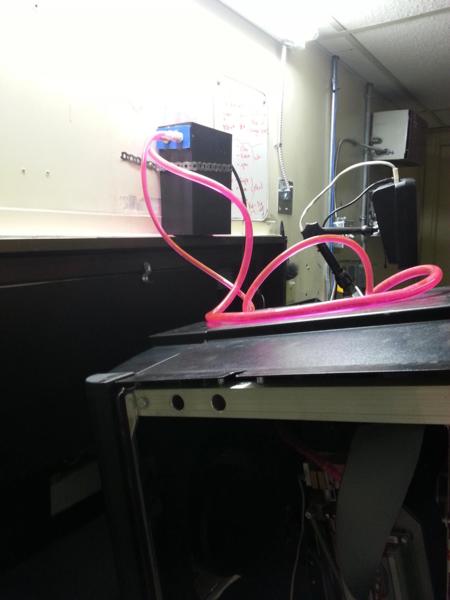
We were having so many problems with pumps we adapter a external resovoir with a submersible pump in it that bypass the pump section In this case the projector wasn't over temp so that wasn't the issue and there is a external flow guage that showed lot of flow
Posted by Greg Routenburg (Member # 1742) on 09-09-2014, 01:41 PM:
I've opened up one of the DP-3000 light engines and looked for anything that might resemble a flow switch but nothing stands out. There are no leads coming from any of the devices connected to the coolant loop except for the temperature probes on the heatsinks themselves. There's also nothing connected to the circuit board in the top of the projector where the flow switch was connected on the DP100s. It's a bit of a mystery. At any rate, I'll keep looking to see if I can make sense of any of it.
Cheers Guys.
Posted by Randy Stankey (Member # 64) on 09-09-2014, 02:26 PM:
I don't know much about the specifics of these projectors so I'm just theorizing.
But if the system uses an inductive or a differential pressure type of flow meter, it might not be readily apparent where the sensor is.
A magnetic/inductive flow meter might look like just a random coil of wire or a mgagnet in some non-intuitive place. A differential pressure flow meter might simply be a pressure sensor at the inlet and outlet of the system to be monitored.
Unless you know what type of sensor you are looking for, you might be skipping right over it without even realizing.
Posted by Pete Naples (Member # 761) on 09-09-2014, 05:04 PM:
It's a moving device Randy, the flowing liquid rotates a paddle in the body of the sensor. Electrically speaking it produces pulses, maybe there's a magnet on the paddle which passes a reed switch and produces x pulses per rotation.
Posted by Gordon McLeod (Member # 33) on 09-09-2014, 07:05 PM:
this the external system
Posted by Randy Stankey (Member # 64) on 09-09-2014, 11:07 PM:
quote: Pete Naples
It's a moving device Randy
In which case, I stand corrected.
An inductive device detects a potential difference in a coil of wire as fluid moves through a magnetic field. A differential pressure device deduces fluid flow by comparing the pressure at the input and the output of a system.
Both such types of devices could be small, difficult to spot or be located in non-intuitive places.
If it is, as you say, a moving (paddle) device, it should be relatively easy to spot.
As I said, I understand a few things ABOUT such projectors but I don't have enough hands-on to know beyond theory.
Thanks for the lesson. ![[Smile]](smile.gif)
Posted by Mark Gulbrandsen (Member # 72) on 09-10-2014, 11:34 AM:
Gord, It looks like you are giving it a transfusion! I am all,for this so let me know when you have units available for sale. I have one site full of old Barco's.
Powered by Infopop Corporation
UBB.classicTM
6.3.1.2