This is topic Dolby Cinema in forum Digital Cinema Forum at Film-Tech Forum ARCHIVE.
To visit this topic, use this URL:
https://ft-forum.com/ft/cgi-bin/ubb/ultimatebb.cgi?ubb=get_topic;f=16;t=002123
Posted by Daniel Schulz (Member # 1881) on 12-03-2014, 12:49 PM:
Well this is certainly interesting:
http://www.hollywoodreporter.com/behind-screen/sensory-assault-dolby-takes-imax-753479?utm_source=Sailthru&utm_medium=email&utm_term=hollywoodreporter_breakingnews&utm_campaign=THR%20Breaking%20News_2014-12-03%2000%3A00%3A00_acouch
Dolby, the company whose name is synonymous with sound, is looking to make some noise in the world of images. The brand is set to launch Dolby Cinema, a premium, large-format theater experience that could challenge large-format leader Imax.
Dolby is the world's top brand in theater sound. Its new Atmos immersive sound, which was introduced in 2012, has been installed in roughly 700 theaters worldwide, and its fiscal 2014 revenue of $960.2 million is more than three times that of Imax. But Imax boasts more than 800 theaters worldwide, and Dolby sees an opportunity to move in on that turf.
Dolby Cinema will include special design elements — like signature entrances that can be programmed to reflect the movie that is playing — as well as giant screens and, of course, Atmos sound. But what's really piquing the interest of filmmakers is the system's ability to project "high dynamic range," a process in which whites appear whiter and blacks blacker. Gravity's Oscar-winning cinematographer Emmanuel Lubezki, for one, has said he's eager to make use of HDR. In fact, many insiders from Hollywood's technology community believe that consumers will see a noticeable difference with HDR, compared with the more widely touted "Ultra HD" 4K resolution and high frame rates.
Initially, Dolby's new projection system will use two Christie 6P 4K laser projectors for increased brightness (at press time Dolby expected to reach 31 FootLamberts for 2D and 14 FootLamberts for 3D) along with some proprietary Dolby technology, as well as the Dolby 3D system for stereo movies. Next spring, the system, co-developed with Christie, will introduce updated laser projectors and playback technology that will enable the system to project "Dolby Vision," the newest Dolby format, which combines HDR with some proprietary color secret sauce. (At this year's Consumer Electronics Show, Dolby also introduced Dolby Vision for TV.)
Earlier this year, Dolby quietly previewed its system at the Vine Theatre in Hollywood for leading directors, cinematographers and studio executives. More recently, it has staged demos at the Harmony Gold theater in Los Angeles. The first Dolby Cinema is now set to open in early December at the new JT Cinemas complex in Eindhoven, Netherlands. San Francisco-based Dolby is offering a profit-sharing deal to theater owners, who are expected to raise ticket prices. JT Cinemas' managing director Ron Sterk says that while the adult ticket price for his theater's standard auditoriums is about $12.50, the price for Dolby Cinema will be about $18.
JT plans to open additional Dolby Cinema auditoriums in the Netherlands, including a second in June and a third in late 2015, according to Sterk. The system's early adopters also include the UCI/Cinesa La Maquinista complex in Barcelona.
Dolby will supply theaters with the equipment, which is not inexpensive — the projectors alone run several hundred thousand dollars each — while the theater would cover the cost of the buildout. "It's not cheap, but we think the economics work," Dolby senior vp cinema Doug Darrow tells The Hollywood Reporter, noting "it has to have a meaningful screen count."
Meanwhile, Imax also is in the process of launching a laser-projection-based system for its auditoriums. And Technicolor has publicly said that it, too, is working on a way to deliver HDR to the cinema using developing laser-projection technology.
While Dolby lines up theaters in the U.S., it's busy closing studio partnerships to ensure movies will be created in Dolby Vision during postproduction. Film cameras and high-end digital cinema cameras, such as the Arri Alexa and Sony F65, can currently produce enough picture information to generate HDR images. Numerous postproduction-technology makers either support or have committed to support the Dolby Vision format.
"We are talking to all the studios. There's interest," says Darrow.
Disney is likely to be an early candidate, with J.J. Abrams' Star Wars: The Force Awakens (Dec. 18, 2015) waiting in the wings, as well as Brad Bird's Tomorrowland. And since Disney's 2012 Pixar hit Brave was the first film released with Dolby Atmos sound, it wouldn't be surprising if Pixar's next release, Inside Out, helps launch the Dolby Cinema brand with much fanfare when it opens in June.
Posted by Mark Campbell (Member # 4411) on 12-03-2014, 01:34 PM:
Floating screen. That must mean no masking. Count me out.
Posted by Marcel Birgelen (Member # 6801) on 12-03-2014, 01:52 PM:
Yep, masking is sadly considered unnecessary gadgetry nowadays... You would expect Dolby to understand the importance, but I guess they're not making money on it so they don't care.
Also, this "HDR" concept will mess with the "visual DNA" of movies, maybe even more than HFR will ever do.
Once the JT cinema in Eindhoven opens, I will put some pictures up here and provide details regarding the real life implementation of this Dolby Premium Cinema Concept.
Still, when it comes to "immersive* cinema experiences", you should trust Dolby more than IMAX... Also, although they're bragging about it for years now, the first laser powered IMAX theater has yet to materialize...
* Yeah, that word again.
Posted by Jarod Reddig (Member # 6363) on 12-03-2014, 08:16 PM:
I had seen this on Twitter today and thought it was interesting. First thing that came to my mind too was the masking. I like the idea of the seating and the room design the best. I agree I would rather trust Dolby than IMAX.
Posted by Steve Guttag (Member # 268) on 12-03-2014, 08:43 PM:
Dolby has been working with super-high contrast in monitors for some time now. They are now bringing it to DLP projectors where incredibly high contrast ratio DLP projectors can finally bring this to the cinema. That is why they can go up to the high white levels. This is something people have had on TVs, slides...etc. for years. I think it could be awesome if it ever filters down to the every day cinema. Then again, you'd have to get people on board with putting in a system that will double-triple the light output.
However, I think something that is going to plague the bulk of this sort of roll out is the cost. I just don't see cinema owners clamoring for more means to spend money to show movies. And, like it or not, it isn't the technology that is/is not brining people in. It is, has been and always will be...the story...and Hollywood just can't be counted on for those. The movies have to be COMPETENTLY made, for sure and the better you make it be greater the enjoyment...but if you have a dud movie to start with...all of the technology you throw at it will do a damn thing.
Posted by Brad Miller (Member # 2) on 12-03-2014, 10:09 PM:
Well fuck that. If they can't understand the importance of masking then clearly they don't know what they are doing. Masking is NOT an option for a quality presentation. For a company that is trying to push higher contrast they should be smart enough to understand this. ![[thumbsdown]](graemlins/thumbsdown.gif)
Posted by Bobby Henderson (Member # 840) on 12-04-2014, 12:26 AM:
I can understand why Dolby is pursuing their Dolby Cinema concept from a marketing-sales perspective. And, judging from what I've read in the Hollywood Reporter article and seen in Dolby's 1 minute promotion video on Dolby Cinema the concept seems more driven by marketing rather than simply making the movie going experience as good as it can be.
The floating screen with no masking, halo lighted with LEDs or whatever, is a pretty big turn-off. It looks like a giant sized 1970's era projection screen TV. Bring back the masking. Better yet, bring back the layers of curtains too.
Dolby's cinema products, like Dolby Atmos, Dolby 3D and Dolby 7.1 have received next to nothing in terms of promotional support from both movie studios and exhibitors. The brands movie-goers see most often these days is IMAX and Real-D. That's about it. So it's obvious Dolby had to do something to make a high priced concept and make deals to give movie studios some of that tasty premium priced ticket money to get the Dolby brand front and center once again on movie posters and movie trailers.
It's still going to be a very hard sell to get movie theater operators on board with it.
The growth of "private label" premium big screen concepts (RPX, XD, Prime, etc.) movie chains have been developing in-house is clear evidence they're not all that keen having extra "partners." They don't like giving companies like IMAX or Dolby a huge cut of their box office take and kowtowing to various demands for everything from theater construction to bookings and marketing.
I also have to wonder how theater operators will feel toward Dolby and their cinema products. Dolby didn't wait much time at all to shift Dolby Atmos, a really high priced cinema product, into the consumer space. And now Dolby is literally going to be competing against at least some other theater operators with Dolby Cinema.
We also can't forget how the content from Hollywood has been performing lately. Some of the big theater chains aren't doing so hot. Maybe the public is starting to get tired of "Save The Cat" template-generated movies. The movies probably need to get a whole lot better and sell more tickets to get theaters on board with another high priced movie-going concept.
Is the general public even going to understand just what Dolby Cinema is and how it justifies a $6-$8 price premium? They sort of get the hype behind "IMAX," even if they're arguably being lied to in the process. Most people associate Dolby with surround sound and noise reduction. How much of the movie-going public is suffering from ticket price fatigue?
It's not going to be so easy to get movie productions to generate their content with Dolby Vision, Dolby Atmos and Dolby Cinema altogether in mind.
Right now not all that many movies are mixed in Dolby Atmos, and of the movies mixed in it not many really utilize the format very well. If you can't tell the difference between an Atmos mix and an "ordinary" 5.1 or 7.1 mix then what is the point?
Now we're going to expect movies to be shot somehow in Dolby Vision and/or "HDR?" I'm really kind of foggy on their idea of HDR. I really hope it's nothing like that garish, surreal crap I see in the still photography world. If movies start looking like that I'll just read more books!
Even if Dolby Vision just improves rendition of color, contrast and shadow/highlight detail, how is that going to fit into the "bit budget" of movie productions? We still see a lot of movies, regular 2D movies, being rendered in 2K. The 4K format, even in normal color bit depths, is considered a high priced format. What will productions have to do with cinematography, CGI, compositing, motion graphics, color grading and anything else to fit in with Dolby Vision? I can see a situation where a Dolby Cinema theater is playing a lot of standard color depth movies with only 5.1 sound. That's not going to be worth a high price premium.
I hope Dolby can do very well with Dolby Cinema, but I'm worried about its chances and also worried how it can impact sales of Dolby gear to movie theaters.
Posted by Carsten Kurz (Member # 5396) on 12-04-2014, 03:31 AM:
How can Dolby increase the contrast of DLP DCI projectors if Barco, Christie, NEC, and TI can't do? Even their new laser projectors do not go beyond 1:3000 CR. Which is nice compared to the common 1:2000, but not as much as expected previouly.
This is very different on flat screens, which do not suffer from stray light and have very high contrast ratios for years.
I never believed in this Dolby Vision crap. Looks like pure marketing gaga to me. And I haven't seen a single paper giving even the shortest line of real information on it. Dynamic contrast, local dimming, etc. has all been there for years.
- Carsten
Posted by Marcel Birgelen (Member # 6801) on 12-04-2014, 04:03 AM:
Besides the lack of mandatory screen masking, the most depressing thing really is the name of the concept. "Dolby Cinema" is just another generic term, stacked onto the Dolby brand. This generic term "Cinema" will be the first to be dropped from people's minds.
While professionals and semi-pros will have no problem in discerning the "Dolby Cinema" theater concept from their range of professional cinema products and their implementation in home theater products, it doesn't really help for the normal consumer. Most people know Dolby from the occasional trailer in the theater and the stuff in their home theater. By using the same brands everywhere, the consumer is basically being told: The stuff you've got at home is as good as you get it in the cinema... Try to sell this to your exhibitors.
quote:
Now we're going to expect movies to be shot somehow in Dolby Vision and/or "HDR?" I'm really kind of foggy on their idea of HDR. I really hope it's nothing like that garish, surreal crap I see in the still photography world. If movies start looking like that I'll just read more books!
No, fortunately, it will not look like those under/over exposed composite stuff. This Dolby Vision is nothing more than a custom image format, to deliver a broader color gamut than currently possible within the DCI specs. The idea behind this is to be able to deliver the full potential of those laser projectors. Obviously, they need to work with studios to make this happen. This "secret color sauce" they're referring to, might be some "upconversion" process (DMR anyone?), to convert existing content to "Dolby Vision", but I'm not sure about this.
Still, this will eventually mess with how movies look like. There will be a lot of controversy around the merits of this. And eventually, there will be some changes to the DCI specs which will make a proprietary format pointless, but given the speed at which those things are being adopted, it might take a few years.
Dolby has been the king of vendor locked sound formats for decades, they lost their key to the throne room once DCI specs made Dolby Digital redundant. They’ve been breeding on proprietary formats for motion pictures ever since. First came Atmos, now Vision.
quote: Carsten Kurz
I never believed in this Dolby Vision crap. Looks like pure marketing gaga to me. And I haven't seen a single paper giving even the shortest line of real information on it. Dynamic contrast, local dimming, etc. has all been there for years.
It's obviously a lot of marketing b.s., but it's essentially about having a mandatory two projector setup for 3D instead of one using laser light sources and Dolby 3D, which will be brighter than anything out there yet and about having a wider color gamut. All neatly packed together in some marketable buzzword lingo...
Posted by Steve Guttag (Member # 268) on 12-04-2014, 06:49 AM:
My guess is that they achieve the high contrast in a similar manner in which they did it for "Dolby Monitor"...since they are using laser projection, it is possible to modulate the light source. Also, by using lasers, you have the ability to have a more accurate color gamut (the more accurate your primaries are...and lasers are pretty monochromatic, the more accurate your color representations can be.
I agree though...if you are going to control the layout of the theatre...then by all means, IMPROVE THE LOOK of the theatre too. Demand things like curtains and masking!
What Dolby has on this high-contrast thing is something that other PLF (including IMAX) cannot duplicate using off-the-shelf equipment. Dolby gets a proprietary format in there.
I would presume, if the 6P laser system wasn't so expensive right now, they'd rather you just purchase the system and they wouldn't be a partner. However, to get the system launched, they are going to need to make it price attractive. Again, there isn't much loose money out there to spend on anything. People are already going for the comfy seats because there is a clear relationship to sales and the perception of a better experience with those.
Posted by Lyle Romer (Member # 1266) on 12-04-2014, 07:51 AM:
Can't they at least do common height if they are going with no masking.
I still don't understand this floating screen stuff. There is a relatively new regal here that does it on every screen. Is it supposed to be futuristic or something? I don't see how it adds to the aesthetics or the presentation.
Posted by Bobby Henderson (Member # 840) on 12-04-2014, 09:55 AM:
I don't think the floating screen looks futuristic at all. It actually makes me think of really old big screen projection TV sets from the 1970's:
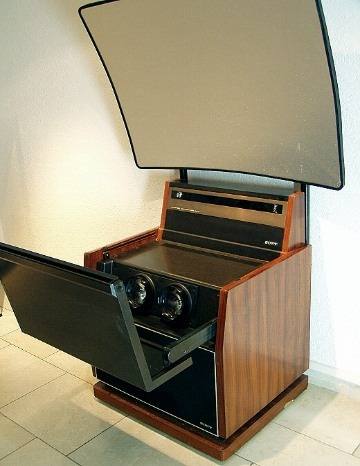
That's an image I grabbed from a Google Image search.
Has anyone else looked at the promotional video for Dolby Cinema? The decor in the theater looks very sterile and barren. I'd take a very opulent looking Warren Theaters "Grand Audiorium" scheme over that any day. It also looks like Dolby would be sinking a huge amount of money into the auditorium entrance. While it's nice to have an attractive entrance most of the money really needs to be spent where it counts: on the image and sound quality itself.
Regarding Dolby Vision and what it might change: movie-makers need to be on board with the idea up front. I think a lot of movie-makers would be pissed to see something they carefully adjusted in post production be changed by a proprietary digital projection front end. A lot of NLE, motion graphics and color grading software already allows one to do all sort of stuff to shadow and highlight areas, especially if they're working with raw, uncompressed camera hardware data. Honestly, what's going to stop others from just upping color bit depth and bypassing Dolby altogether?
quote: Carsten Kurz
How can Dolby increase the contrast of DLP DCI projectors if Barco, Christie, NEC, and TI can't do? Even their new laser projectors do not go beyond 1:3000 CR. Which is nice compared to the common 1:2000, but not as much as expected previouly.
This is very different on flat screens, which do not suffer from stray light and have very high contrast ratios for years.
And that raises the possibility of Dolby opening another Pandora's Box of sorts for theater operators.
Right now, razor-thin flat panel OLED TV displays are very expensive, high end items. But they're not going to be that way forever. The contrast ratios and deepness of black on those screens is utterly amazing. What's to stop Dolby from pushing Dolby Vision into the consumer space, particularly with OLED TV sets and doing so with "deep color" 4K content in home theater? Dolby is a publicly traded company now with a board more interested in growing profit margins than anything else. Preservation of the commercial movie-going experience might be a secondary priority to pushing consumer electronics sales.
Posted by Mitchell Dvoskin (Member # 751) on 12-04-2014, 10:21 AM:
I remember sitting in a Video Concepts store back in the early 1980's trying to figure out how I could afford one of those projectors that Bobby posted above. A blast from the past. A few years later, I ended up buying a Kloss Novabeam video projector, where the projector was also a coffee table that projected up on to a wall screen. Ultimately, I decided that the concave screen was just not "movie" like.
Posted by Sam Graham (Member # 2889) on 12-04-2014, 10:27 AM:
The Regal Floating Screen
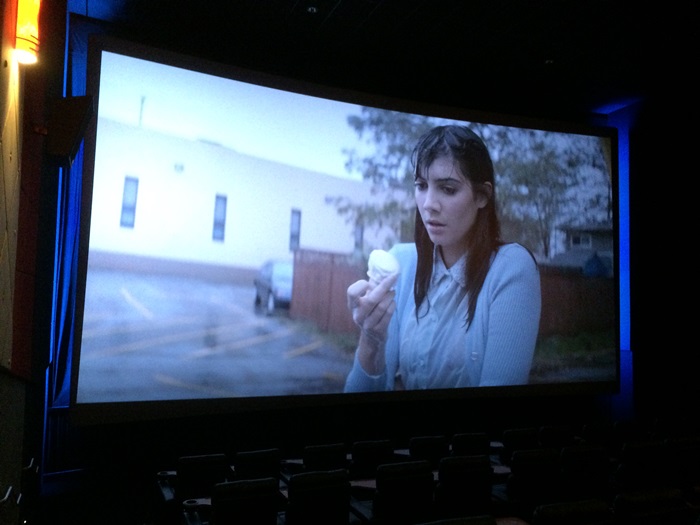
Mounted at the top and bottom but open on the ends. You can listerally stick your hand around it or under it on the corners.
The lighting shuts off during the feature and the curtains and walls up front are all pitch black, so during the feature, I noticed no difference watching the movie over a masked screen. However, the lights are ON during the trailers, and that experience was like watching a really poorly lit Samsung curved screen television.
Posted by Marco Giustini (Member # 4544) on 12-04-2014, 10:30 AM:
Carsten,
I read that it is made by using two light engines in series. One chip creates the light pattern for the second chip, which creates the picture. When black is needed, the first DMD gets rid of most of the light, the second chip will only need to get rid of the leftover. This is apparently giving much more contrast and because you have a very precise light pattern behind the second chip - it will be another DMD chip - the outcome should be very good.
Last time I heard something like that, it was done by using an LED background, with many LEDs, but not 2.2millions (2K picture)
Posted by Daniel Schulz (Member # 1881) on 12-04-2014, 10:36 AM:
quote: Bobby Henderson
What's to stop Dolby from pushing Dolby Vision into the consumer space, particularly with OLED TV sets and doing so with "deep color" 4K content in home theater?
Dolby has been quite open about their intent to push Dolby Vision into consumer video displays. They were running demos at CES this past year.
Posted by Antonio Casado (Member # 7592) on 12-04-2014, 11:07 AM:
quote: Bobby Henderson
Right now, razor-thin flat panel OLED TV displays are very expensive, high end items. But they're not going to be that way forever. The contrast ratios and deepness of black on those screens is utterly amazing
I have one OLED TV (LG 55EC930V) and the blacks they have is the best thing that I see in my life. The "blacks" of ANY cinema screen makes me laugh. Including this Dolby Vision or future Laser Projection, of course.
I mean...the screen is WHITE. So, any light, as minimum, will light the surronding space in that white screen, so the "black" will be...grey.
I think that in a very future the cinemas screens will be giant OLED screens, 8K or 16K ready, and then YES, we will really know the excellence of a true HDR image. Not the current cinema screens, sorry.
Posted by Marco Giustini (Member # 4544) on 12-04-2014, 11:20 AM:
Then what we do, we just don't do anything and we wait till massive OLED screens are affordable?
Posted by Terry Monohan (Member # 8285) on 12-04-2014, 11:56 AM:
Dolby®***How about putting a nice set of title curtains that go up or sideways plus a giant type deep curved screen. Just don't put in a big white sheet with no masking! What a boring name Dolby Cinema® Please come up with a new concept for something people can't get at home.
Posted by Antonio Casado (Member # 7592) on 12-04-2014, 12:11 PM:
Here in Spain the majority of the screens aren´t masked...In fact I remember to see one or two masked screens in my whole life here (42 years...)
Posted by Mitchell Dvoskin (Member # 751) on 12-04-2014, 02:05 PM:
Almost all of Dolby's cinema products history has been to come out with a "professional" product to advertise a new concept, and then to license the home version. Can you say Dolby Stereo? Can you say Dolby Digital? Can you say Dolby Digital EX (7.1)? Can you say Dolby Atmos?
There is a saying, fool me once, shame on you. Fool me multiple times, I must be a theatre owner.
Posted by Terry Lynn-Stevens (Member # 7349) on 12-04-2014, 02:22 PM:
This Dolby Cinema concept look more like a cross between a PLF and a small to medium VIP type theater. The dynamic/audio video pathway and the sensory way finding audio looks pretty pointless to me, people usually know how to enter a movie theater.
Something tells me that Dolby Atmos is not tracking all that well with the younger crowds ![[Roll Eyes]](rolleyes.gif) , the video at Dolby.com appears to show that the Dolby Atmos surround speakers are hidden behind acoustic panels. Why would you hide the speakers? Perhaps younger folks think it is an eyesore?
, the video at Dolby.com appears to show that the Dolby Atmos surround speakers are hidden behind acoustic panels. Why would you hide the speakers? Perhaps younger folks think it is an eyesore?
quote: Steve Guttag
I just don't see cinema owners clamoring for more means to spend money to show movies.
Dolby is about 6-7 years to late with this product, PLF screens are already over saturated in the marketplace and there really is only so much room to add more capacity. I doubt this concept will catch on.
From the wording of the press release, it appears that there will be two projector upgrades needed, the laser projectors that will initially be installed will not have Dolby Vision, the Dolby Vision projectors will come at a later date. This is a bit odd ![[Confused]](confused.gif)
quote: Sam Graham
Mounted at the top and bottom but open on the ends. You can listerally stick your hand around it or under it on the corners.
The lighting shuts off during the feature and the curtains and walls up front are all pitch black, so during the feature, I noticed no difference watching the movie over a masked screen. However, the lights are ON during the trailers, and that experience was like watching a really poorly lit Samsung curved screen television.
Cineplex now does this for their VIP theaters and the look and esthetics of the cinema is what they are after when you enter the cinema. I too have no problem if there is no masking at all, as long as it is not on a flat screen with the masking left open.
And from the Dolby site:
a sophisticated space that is carefully designed to maximize your immersion in the story.
dramatically different visual experience.
I don't know about the others on here, but I am sick and tired of the words immersion, immersive, and experience that comes along with just about everything these days.
Posted by Paul H. Rayton (Member # 1817) on 12-04-2014, 02:56 PM:
When I think of "an immersive experience", I'm thinking of swimming, or in my bathtub.... ![[Big Grin]](biggrin.gif)
But seriously: let's just take a wild guess and speculate that their "Dolby Theatre" (here in L.A. -- formerly the Kodak Theatre and home of the Oscars TV broadcast) will be an early candidate for such an installation. And about 100 yards away, there's the original Chinese Theatre, with their new Imax showcase screen, said to be one of their largest.
Jeez, it's a large screen smackdown event, right here in movieville!
Posted by Bobby Henderson (Member # 840) on 12-04-2014, 03:08 PM:
quote:
Something tells me that Dolby Atmos is not tracking all that well with the younger crowds [Roll Eyes] , the video at Dolby.com appears to show that the Dolby Atmos surround speakers are hidden behind acoustic panels. Why would you hide the speakers? Perhaps younger folks think it is an eyesore?
Terry, you're reaching quite a lot with that "younger crowds tracking" garbage -along with the usual and predictable anti-Atmos trolling.
This Dolby Cinema concept is far from the first time anyone has hidden surround speakers behind acoustical panels or other wall decorations. Warren Theaters hides the side wall surround speakers in their Grand auditoriums within old movie palace style decorative features. Lots of home theater installations feature in-wall speakers and speakers that are completely hidden from view.
Really, if you're going to blame this hidden speaker thing on any demographic it would sound more credible to blame it on older generations. They might be more concerned about maintaining the quality of decor in the room. Younger people don't mind it as much to have a lot of techie gear visible.
In the end, there appears to be some purpose in having the speakers hidden. The Dolby Cinema room is not a typical oblong box shape. The angled walls and ceiling appear to do more in controlling and/or eliminating unwanted sound wave reflections. A bunch of surround speakers sticking out of the walls and ceiling are going to have at least some effect on sound wave reflections.
Now, I might be more impressed with Dolby Cinema if they go to the same lengths they have with a couple of their own private screening rooms. Their Burbank screening room is really a room built inside of another room with extensive treatment applied between the floor and walls to eliminate sound leakage and other unwanted noises.
Posted by Marco Giustini (Member # 4544) on 12-04-2014, 03:40 PM:
I want to hope that this whole project brings some real AV experience and it's not just the same bunch of marketing nonsense, with a system installed and EQ'd in a rush and only re-aligned when customers begin to complain.
Posted by Mike Blakesley (Member # 26) on 12-04-2014, 03:43 PM:
quote: Bobby Henderson
there appears to be some purpose in having the speakers hidden. The Dolby Cinema room is not a typical oblong box shape. The angled walls and ceiling appear to do more in controlling and/or eliminating unwanted sound wave reflections. A bunch of surround speakers sticking out of the walls and ceiling are going to have at least some effect on sound wave reflections.
Even the Dolby screening room has the speakers hidden behind acoustic panels, and it's just a rectangular room. It's nothing to do with the sound, it's just aesthetics.
I'm sure some architect designed this Dolby thing and part of the design was not having ugly boxes sticking out of the walls.
As for the ever-increasingly immersive thing... I'm all about good sound. I love good sound, but I just don't see the huge need for all this immersivity or whatever you want to call it, especially if it's going to double (or more) the cost of a movie ticket. When I am watching a movie I get involved in what's going on on the screen. I'm not exactly caring if the bullet hits are in a certain spot overhead vs. just coming from the side. Just plain old surround sound gets the job done for me.
I'm sort of surprised they haven't tried to do even more screen channels, so you could have things happening in the top left hand corner or whatever. (Maybe that'll be next.)
Probably about 98% of moviegoers are what you would call "average moviegoers," meaning they just want to see a movie and have it look and sound good. They don't require the latest bells'n'whistles. I watched the trailer for the new Star Wars last night in my own theater, with the sound on a nice loud "6," and I was suitably impressed. Would I have been twice as impressed if the sound had been Atmos? I doubt it.
These ever-more-expensive options are starting to cater to a market that may not really exist.
Posted by Marcel Birgelen (Member # 6801) on 12-04-2014, 04:06 PM:
Dolby Vision isn't really an end-to-end technological solution. It's more like a set of specifications.
The idea is not just to improve the contrast or make white more white. It intends to broaden the color gamut of images, to more realistically simulate nature. So, not only brighter white, but also brighter yellow, brigher red, etc.
Current DCI specs are based on what could be achieved with film, current TV specs are based on what could be achieved with CRT screens. The new generation laser projectors, OLED and LED technology can achieve a much broader color gamut, but is limited by the current way content is created and encoded.
So, they drastically increased the "color palette", essentially and extremely simplified: it's like extending the color palette beyond "0xFFFFFF" (or rather 0xFFFFFFFFF) as the brightest you can go in any direction. I'm not sure if they actually increase the bandwidth for this or if they deem 12 bits per color sufficient.
Dolby has devised a new format for this content, called Dolby Vision and a few manufacturers will release Dolby Vision capable equipment.
quote: Steve Guttag
My guess is that they achieve the high contrast in a similar manner in which they did it for "Dolby Monitor"...since they are using laser projection, it is possible to modulate the light source.
You can indeed modulate the light source instantly and without any delay. This is even more powerful than what you can do with stuff like dynamic iris, because there will be no delay. There's one catch though: you can't modulate it via strobing, because it will interfere with the DMD modulation.
quote: Marco Giustini
I read that it is made by using two light engines in series. One chip creates the light pattern for the second chip, which creates the picture. When black is needed, the first DMD gets rid of most of the light, the second chip will only need to get rid of the leftover.
The problem here is that DMDs modulate light by switching it on and off. If you put two mirrors in sequence, you need a very exact timing pattern to make this work correctly. You will also lose a lot of light by putting two DMDs back to back, plus you will need to refocus the light after it exited the first DMD.
I've read about LCoS modules in front of a DMD in an experimental setup for a planetarium projector. Their "blackness problem" is even bigger than in normal cinemas. In my very personal opinion, those planetariums now running on digital projectors really look like crap. Everything is grey and the stars look very washed out.
quote: Daniel Schulz
Dolby has been quite open about their intent to push Dolby Vision into consumer video displays. They were running demos at CES this past year.
Yes, there will be Dolby Vision capable OLED screens, they will be in 4K and will be expensive, at least for now. So, the cinema market will get practically no head-start. Then again, it won't be long before the rest of the industry will follow with their own "Dolby Vision" implementations...
quote: Antonio Casado
I have one OLED TV (LG 55EC930V) and the blacks they have is the best thing that I see in my life. The "blacks" of ANY cinema screen makes me laugh. Including this Dolby Vision or future Laser Projection, of course.
Have you seen it yet?
quote: Antonio Casado
I mean...the screen is WHITE. So, any light, as minimum, will light the surronding space in that white screen, so the "black" will be...grey.
This is partly to blame on high gain screens (including silver screens). Normal, properly masked white screens, absorbing walls and a minimum of ambient light will keep reflections and greyness to a minimum.
quote: Antonio Casado
Here in Spain the majority of the screens aren´t masked...In fact I remember to see one or two masked screens in my whole life here (42 years...)
See, there's part of your problem.
quote: Marco Giustini
Then what we do, we just don't do anything and we wait till massive OLED screens are affordable?
You don't need OLEDs for massive screens, but you could theoretically use massive LED screens. I've seen several demos of 4K LED walls and from a certain distance, they look VERY impressive. The problem is the massive screen door effect though, once you get up close to them.
There are plenty of other problems for usage in a commercial cinema, like speaker placement problems, the fixed resolution of those things, costs, maintenance, etc.
quote: Bobby Henderson
In the end, there appears to be some purpose in having the speakers hidden. The Dolby Cinema room is not a typical oblong box shape. The angled walls and ceiling appear to do more in controlling and/or eliminating unwanted sound wave reflections. A bunch of surround speakers sticking out of the walls and ceiling are going to have at least some effect on sound wave reflections.
It's not just about limiting sound reflections, but also to limit the light bouncing back onto the screen from the walls.
quote: Mike Blakesley
As for the ever-increasingly immersive thing... I'm all about good sound. I love good sound, but I just don't see the huge need for all this immersivity or whatever you want to call it, especially if it's going to double (or more) the cost of a movie ticket. When I am watching a movie I get involved in what's going on on the screen. I'm not exactly caring if the bullet hits are in a certain spot overhead vs. just coming from the side. Just plain old surround sound gets the job done for me.
I do agree with you on this one. The main attraction is still just the movie itself. And if the theater gets it right and avoids unnecessary distraction, a lot of those technical bells and whistles are just a bunch of gimmicks. Then again, the only way for technology providers like Dolby to stay relevant is to come up with something new once a while. Also, if you're in a hugely competitive market, where everybody competes with essentially the same content, you will need some distinguishing features to stay ahead of your competition.
Posted by Mark Gulbrandsen (Member # 72) on 12-04-2014, 04:19 PM:
quote: Steve Guttag
My guess is that they achieve the high contrast in a similar manner in which they did it for "Dolby Monitor"
Actually, they didn't achieve anything. It was a design that already existed and which they bought up the existing company several years ago. Other manufacturers of Broadcast monitors such as Sony and Ikegami have very similar type monitors. Sony has had high contrast - high brightness monitors for a long time.
But... anything you can do to make a nickle!
Mark
Posted by Terry Lynn-Stevens (Member # 7349) on 12-04-2014, 07:39 PM:
quote: Mike Blakesley
Even the Dolby screening room has the speakers hidden behind acoustic panels, and it's just a rectangular room. It's nothing to do with the sound, it's just aesthetics.
I'm sure some architect designed this Dolby thing and part of the design was not having ugly boxes sticking out of the walls.
I never knew about the Dolby screening room not having exposed speakers, I figured they would not have them covered up. I think Dolby did some research on the new generation of movie-goer which this Dolby cinema looks to be aimed at, folks around 21-28 year of age, I would assume they are more likely use a sound bar at home, watch on Netflix off their phone, and pay $25 for the VIP treatment. I figure part of the Dolby Atmos "experience" (I just said it) would be to actually see the speakers when you enter the cinema, I must admit the lay out of an Atmos cinema with all the speakers hanging everywhere kinda looks like shit, perhaps Dolby figured that out.
This is the new Cineplex Atmos VIP: This is what people are paying $25 for.
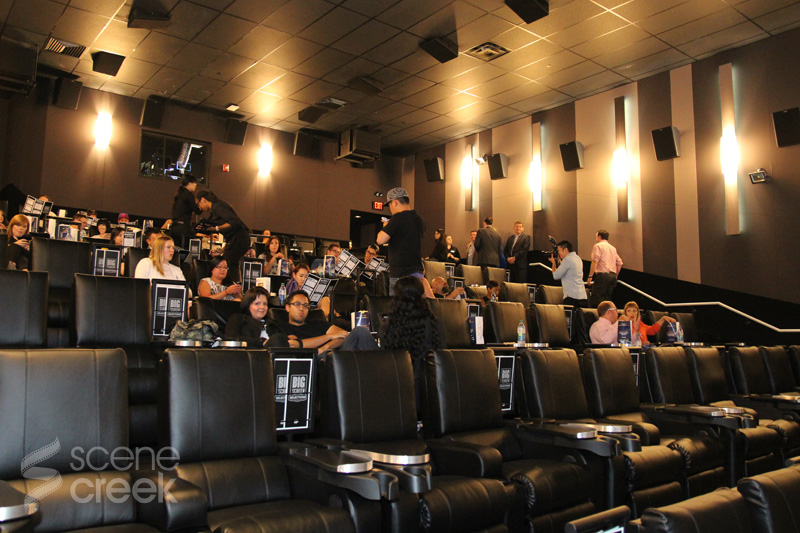
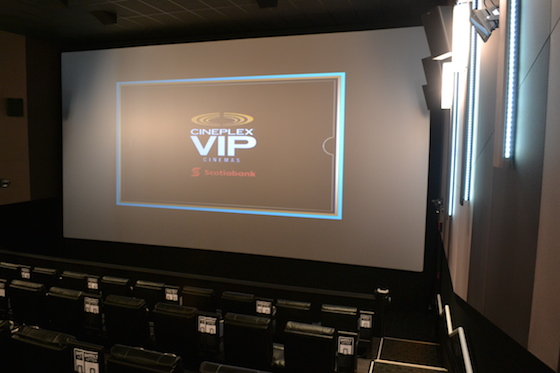
I am bit surprised that Dolby would hide the speakers with their new concept.
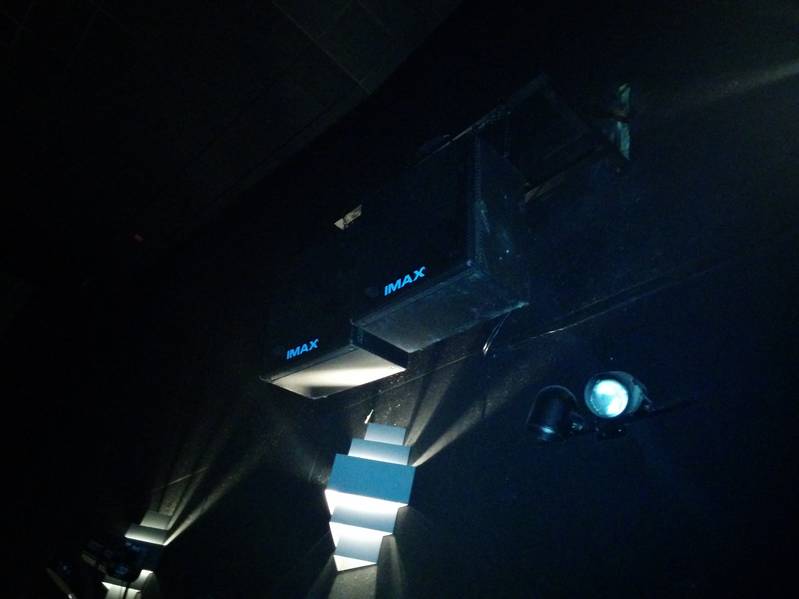
In contrast, IMAX throws their logo on everything the customer can see:
quote: Mike Blakesley
Probably about 98% of moviegoers are what you would call "average moviegoers," meaning they just want to see a movie and have it look and sound good. They don't require the latest bells'n'whistles. I watched the trailer for the new Star Wars last night in my own theater, with the sound on a nice loud "6," and I was suitably impressed. Would I have been twice as impressed if the sound had been Atmos? I doubt it.
I think this is just it, most people just want to watch the latest movie. I know a few people who were less than thrilled about Interstellar in 15/70 IMAX and they were equally unimpressed with Expendables in AVX with Atmos, they said to me they just want to watch the movie in a nice auditorium and sit in the back row, and they don't want the sound to be overly loud.
quote: Mitchell Dvoskin
There is a saying, fool me once, shame on you. Fool me multiple times, I must be a theatre owner.
That is pretty funny ![[Smile]](smile.gif)
Posted by Steve Guttag (Member # 268) on 12-04-2014, 09:54 PM:
I don't get what is so VIP about that Cineplex room...it looks aweful and the front-end doesn't fit the room. One thing about a typical Atmos room, the speakers do seem to be a bit over bearing in appearance.
Posted by Antonio Casado (Member # 7592) on 12-05-2014, 02:24 AM:
quote:
quote: Antonio Casado
I have one OLED TV (LG 55EC930V) and the blacks they have is the best thing that I see in my life. The "blacks" of ANY cinema screen makes me laugh. Including this Dolby Vision or future Laser Projection, of course.
Have you seen it yet?
No, of course. But I can imaginate it, is very easy: White screen (not cares if masked or not...is white) + Dark grey black...boom!.
I mean...true black in Cinema Projection is nearly impossible. I can get deeper blacks in my JVC D-ILA 350HD instead. I can prove it, nearly the 100% of the screens display the "black" like a 10,10,10 in RGB numbers. This is not black, sorry.
Black is the complete absence of light, like OLED does.
I continue to go to the cinema, because want to see those giant screens in front of my face. But I´m pretty dissapointed because the experience lived in that is not 100% accurate for me.
I got better contrast in my tiny home projection screen that the 90% of the screens in Spain (I cannot talk for about others Countries...)
Posted by Marcel Birgelen (Member # 6801) on 12-05-2014, 03:53 AM:
I'm still under the impression that you should not judge anything before you either have sufficient information of how it actually works or if you've seen it for yourself. Right now, you don't have either of both, but you already give it the thumbs down.
My 15 year old CRT projector which I still use for some movie watching now and then will also do "true blacks". It's my job to avoid light bouncing off the screen to not reflect back onto that same screen. If I manage to do that, I can assure you, the black is as good as it gets.
Will an OLED screen produce blacker blacks? Probably, although not really relevant in correct setups. Can it produce better colors? Most likely. But it will take a few more iterations before any OLED screen of the same size will become remotely affordable. Also, TV screens are mostly employed in rooms with plenty of other light sources, their screen therefore should avoid reflecting this same ambient light. But for some stupid esthetic reasons, almost all manufacturers use glossy screen finishes...
All current DLP projectors suffer from light leaking trough and DCI projectors, which have three DMDs are certainly no exception. It's rather hard to tame a multi-kilowatt light source with a bunch of tiny mirrors. There's still a lot of room for improvement here, but once this has been fixed, the white screen in front isn't your biggest enemy. Your next enemy will be badly masked Exit signs, badly engineered aisle lighting and people leaving the light on in the projection booth.
Posted by Allan Barnes (Member # 5178) on 12-05-2014, 04:06 AM:
JUST WHAT AMERICA NEEDS...
a process in which whites appear whiter and blacks blacker.
STILL LAUGHING HERE IN CANADA. THIS PROCESS WILL SOLVE YOUR RACE WAR.
Posted by Marco Giustini (Member # 4544) on 12-05-2014, 04:28 AM:
I love walking into an auditorium and see all the speakers. Those subs hung with metal frames are simply wrong though. Those should be flush with the wall.
Posted by Bobby Henderson (Member # 840) on 12-05-2014, 10:01 AM:
quote: Mike Blakesley
As for the ever-increasingly immersive thing... I'm all about good sound. I love good sound, but I just don't see the huge need for all this immersivity or whatever you want to call it, especially if it's going to double (or more) the cost of a movie ticket. When I am watching a movie I get involved in what's going on on the screen. I'm not exactly caring if the bullet hits are in a certain spot overhead vs. just coming from the side. Just plain old surround sound gets the job done for me.
While Dolby Atmos is an expensive surround sound format the funny thing is in Dolby Cinema's concept the Atmos component is going to be one of the lesser expensive things. That motion graphics wall in the front entrance, be it LED-based or a collage of flat panel monitors, is probably going to cost a lot more than the sound system. A pair of 6P laser projectors is going to be expensive as hell.
The scary thing for movie theater operators is, like with IMAX, it sounds like they're going to be on the hook paying for the construction of that unique auditorium building. Dolby and its movie studio partners will fund the hardware going in it. But what is the dividing line on who pays for what? If the Dolby Cinema auditorium is going to have some of the same kinds of in-wall and in-floor treatment as its private screening rooms will the theater operator have to pay for that or will Dolby?
quote: Marcel Birgelen
The idea is not just to improve the contrast or make white more white. It intends to broaden the color gamut of images, to more realistically simulate nature. So, not only brighter white, but also brighter yellow, brigher red, etc.
Dolby Vision sounds to me like it is meant to compete with other emerging standards, like the Rec. 2020 color space. HDTV sets currently sold (including 4K UHTVs) are limited to the Rec. 709 color space. TV sets that support Rec. 2020 color space will cover more than double the CIE 1931 color space (75.8% versus 35.9%). How is a Dolby Vision enhanced monitor going to compare to a UHDTV set that just supports Rec. 2020?
Repeating what I said earlier, there's no way to go with this wide gamma route without adding more bits of color depth in actual movie/TV show production. That's going to cost more money in terms of processing power, bandwidth and storage requirements.
It's perfectly acceptable for Dolby and other technology companies to push the boundaries of what's possible with color reproduction in projectors and video monitors. However, have they been watching many movies lately? Lots of movies these days aren't exactly what I would call brilliantly colorful. Often they're dreary looking, sometimes with a urine colored bath.
quote: Marcel Birgelen
You don't need OLEDs for massive screens, but you could theoretically use massive LED screens. I've seen several demos of 4K LED walls and from a certain distance, they look VERY impressive. The problem is the massive screen door effect though, once you get up close to them.
I don't think there's any practical way to scale OLED panel production to the size of a movie theater screen. It's challenging enough as it is to get OLED panels up to normal "big" TV screen sizes like 55".
A LED-based "jumbotron" style screen might be more possible, but would still be expensive as hell just to get to a 2K pixel count, nevermind quadrupling it to 4K. It would require a LOT of maintenance. Driver board panels have to be swapped out when a pixel gets stuck/goes bad. The jumbotron has to be continually adjusted to make replacement driver boards match the color and intensity of older existing boards. If that isn't done you'll see a whole lot of blocky squares of varying brightness -the dreaded quilt look.
quote: Marcel Birgelen
The main attraction is still just the movie itself. And if the theater gets it right and avoids unnecessary distraction, a lot of those technical bells and whistles are just a bunch of gimmicks. Then again, the only way for technology providers like Dolby to stay relevant is to come up with something new once a while. Also, if you're in a hugely competitive market, where everybody competes with essentially the same content, you will need some distinguishing features to stay ahead of your competition.
One possible good thing about Dolby Cinema: it will probably raise the bar on what's expected in a premium priced big screen theater. It might actually force theater chains to disclose just what is in their "premium" house to justify the damned surcharge.
Right now, all a theater operator needs to tack on a $3 surcharge is build a somewhat bigger auditorium, install a masking free, wall to wall screen and turn up the sound a bit. That's it. You could still be watching the same damned 2K resolution picture from a single projector and hearing 5.1 sound, but you've just paid a bunch more to see it in a somewhat bigger auditorium.
And now, going off topic a bit:
quote: Allan Barnes
STILL LAUGHING HERE IN CANADA. THIS PROCESS WILL SOLVE YOUR RACE WAR.
This is assuming racism doesn't exist outside the United States?
Posted by Antonio Casado (Member # 7592) on 12-05-2014, 11:08 AM:
Marcel, is obvious that I don´t have seen, but it´s the same obvious thing that a white screen cannot compare to a OLED screen, as are different things.
And I like a lot OLED, and I think that is the future. These deeper blacks are really atracting and is the way to go.
In fact I have done a photo of my OLED and my projector showing the same image, to match it, and finally I done it (this with another technology is really hard to set):
http://imageshack.com/a/img540/307/xy8Rn0.jpg
About the glossy panel, it not aesthetical, is simply that a matte panel introduce blur to the image and the sharpness is reduced. I don´t like it as well as you, but there isn´t any other option to make the best sharpness.
Posted by Terry Lynn-Stevens (Member # 7349) on 12-05-2014, 12:48 PM:
quote: Steve Guttag
I don't get what is so VIP about that Cineplex room...it looks aweful and the front-end doesn't fit the room.
I think it is a combination of reserve seating, comfy recliners, adults only admission, premium food and most importantly alcohol served at your seat. Its not my idea of a good night out at the movies but then again I don't exactly find brands such as Jeep, or Apple as all that appealing either but other people do. People actually like the idea of these VIPS and they find visit to one of these theaters very pleasant and appealing. I guess you have to give people what they want, if people are willing to pay $25 for a movie with no masking you gotta give them what they want.
quote: Steve Guttag
One thing about a typical Atmos room, the speakers do seem to be a bit over bearing in appearance.
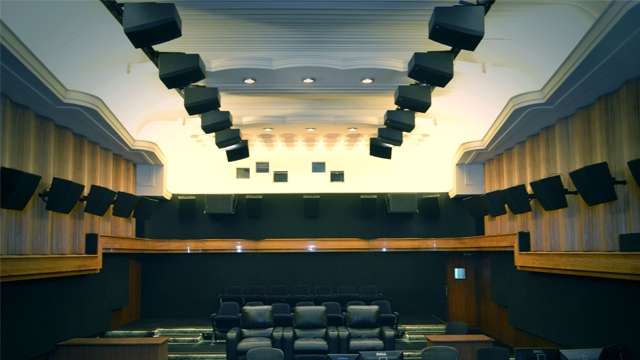
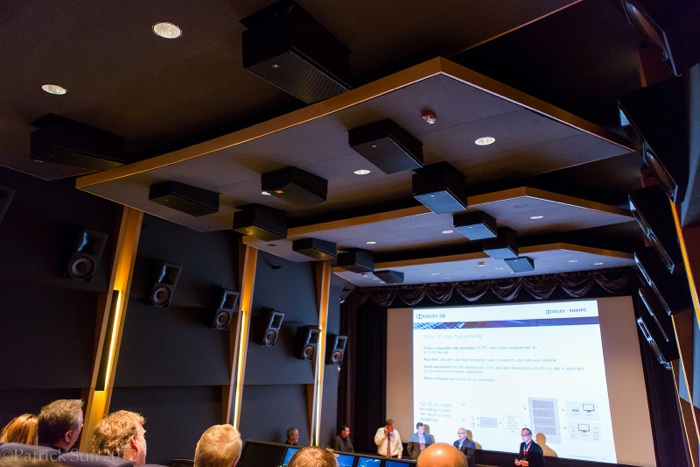
I always thought it was the hallmark for Dolby to show off the Atmos speaker arrays inside a cinema, now they are going the transparent route for this Dolby Cinema. I just find that a little strange. Why hide what is arguably the most visually defining feature (even if it is ugly ) of the Atmos concept?
quote: Marco Giustini
I love walking into an auditorium and see all the speakers. Those subs hung with metal frames are simply wrong though. Those should be flush with the wall.
Basic surround sound works for me.
Posted by Marcel Birgelen (Member # 6801) on 12-05-2014, 01:25 PM:
quote: Bobby Henderson
Dolby Vision sounds to me like it is meant to compete with other emerging standards, like the Rec. 2020 color space. HDTV sets currently sold (including 4K UHTVs) are limited to the Rec. 709 color space. TV sets that support Rec. 2020 color space will cover more than double the CIE 1931 color space (75.8% versus 35.9%). How is a Dolby Vision enhanced monitor going to compare to a UHDTV set that just supports Rec. 2020?
Their central white will probably be brighter than D65, but I guess it will be very similar. At least will they provide a delivery format and branding for this kind of content. The difference will be the most profound for the exhibition industry, it will probably take a few years before a non-proprietary implementation for a broader color gamut will become available.
quote: Bobby Henderson
Repeating what I said earlier, there's no way to go with this wide gamma route without adding more bits of color depth in actual movie/TV show production. That's going to cost more money in terms of processing power, bandwidth and storage requirements.
CIE 1931 is mostly done with just 8 bits (per color) and many claim it's sufficient for consumer applications. So, regarding Rec. 2020 or similar color spaces... Those 12 bits per channel give you 4096 steps in x, y and z. If you but them on a non-linear scale, maybe they still have sufficient resolution for what human vision is capable of "resolving". I cannot really give an answer to this, as it would require some scientific evidence and conclusive A/B/N tests.
quote: Bobby Henderson
It's perfectly acceptable for Dolby and other technology companies to push the boundaries of what's possible with color reproduction in projectors and video monitors. However, have they been watching many movies lately? Lots of movies these days aren't exactly what I would call brilliantly colorful. Often they're dreary looking, sometimes with a urine colored bath.
We can also slowly start the discussion of we actually want our movies to look different than they've looked for quite a while now. If HFR can movies look like video, will "HDR" not potentially do the same? Or maybe even worse?
quote: Bobby Henderson
A LED-based "jumbotron" style screen might be more possible, but would still be expensive as hell just to get to a 2K pixel count, nevermind quadrupling it to 4K. It would require a LOT of maintenance. Driver board panels have to be swapped out when a pixel gets stuck/goes bad. The jumbotron has to be continually adjusted to make replacement driver boards match the color and intensity of older existing boards. If that isn't done you'll see a whole lot of blocky squares of varying brightness -the dreaded quilt look.
Well, I've seen both a 4K and an 8K (2x4K) LED wall in a demonstration. It looked rather awesome, from a certain distance though. They managed to calibrate those things to perfection, at least I couldn't spot the individual panels that made up those walls. The brightness of those was also astonishing. I could, in a somewhat distant future, see those kind of walls completely replace projection screens in many applications.
And while it's clear we're nowhere near yet, stuff like color intensity and calibration could probably be automated by placing a camera in front off it and running a smart auto-calibration program. Somewhat more advanced panels could, maybe, be told to temporarily disable single defective pixels. Costs are also related to volume and those new high-end projection systems also don't come cheap obviously.
What keeps bugging me though is, how could you fix the giant gaps between the pixels? And what about speaker placement? Do you want to put a bunch of powerful speakers behind such a wall?
quote: Bobby Henderson
One possible good thing about Dolby Cinema: it will probably raise the bar on what's expected in a premium priced big screen theater. It might actually force theater chains to disclose just what is in their "premium" house to justify the damned surcharge.
Just like IMAX does to some extend, it sets a certain base line of standards, rather high standards for now. Without comparing the merits of any of them, it's like THX on steroids.
quote: Antonio Casado
Marcel, is obvious that I don´t have seen, but it´s the same obvious thing that a white screen cannot compare to a OLED screen, as are different things.
Well, my point was that it's apples and oranges. OLED screens work great in environments with lots of ambient light. White screens will not. Nobody can construct an OLED screen the same size as a cinema screen and it will take a few iterations before we even come close. Still, we can construct an auditorium that only leaks a minimum of light back onto the screen. The black in those auditoriums will be great.
No current projection technique, not even DiLA is capable of delivering true blacks, so currently there is just no comparison.
The image you pasted is more an advertisement of the brightness of your OLED screen than the lack of real black in the projected image.
quote: Antonio Casado
About the glossy panel, it not aesthetical, is simply that a matte panel introduce blur to the image and the sharpness is reduced. I don´t like it as well as you, but there isn´t any other option to make the best sharpness.
I've heard this "improved picture quality" argument and I call B.S., at least for 95% of the cases out there. Do you think that at the average viewing distance of a normal TV, this will make the least bit of impact? My current notebook has a matte screen, I can still clearly discern every single pixel, so what would a glossy screen add, besides a few unwanted reflections? And what's more distracting? Reflections or blur you can't see?
quote:
I always thought it was the hallmark for Dolby to show off the Atmos speaker arrays inside a cinema, now they are going the transparent route for this Dolby Cinema. I just find that a little strange. Why hide what is arguably the most visually defining feature (even if it is ugly [Big Grin] ) of the Atmos concept?
I doubt anyone at Dolby sees the sheer volume of visible speakers in the average Atmos equipped auditorium as a strong selling point of the technology...
Posted by Antonio Casado (Member # 7592) on 12-05-2014, 01:45 PM:
quote: Marcel Birgelen
The image you pasted is more an advertisement of the brightness of your OLED screen than the lack of real black in the projected image.
The reason to make it is to match the colors and look between two different technologies, not other. I don´t wanted to compare the blacks of OLED in front of projection, is a nonsense.
I can make a picture of a Black of a Cinema Screen and it appears like when you make the same in a LCD Screen vs OLED:
https://c2.staticflickr.com/2/1137/4726293281_8c64420359.jpg
I can see the "black masking" of 1920x1080 over 1998x1080 projections, is really visible, so the "black" is not black.
But hey, I´m really happy to see movies at that giant screens. Only wanted to imaginate that in a future maybe we see that deeper blacks in cinema screen...I hope!
Posted by Marcel Birgelen (Member # 6801) on 12-05-2014, 04:58 PM:
My previous post contains some serious broken language. Looks like the Submit button got in the way. Sorry for that ![[Wink]](wink.gif) .
.
Well, yes, with all current cinema projection technology (film or digital, although digital is usually far worse) you will see the edge of the projected image if it is smaller than the screen. It's one of the many reasons why proper, adjustable masking is still relevant, even in the days of digital projection and sharp picture edges.
Getting black back is part of this Dolby Vision concept. It will use some trickery to achieve this and how well it works remains yet to be seen. But wouldn't it be great to see bright white dots on a deep black background for once when we're in space?
Posted by Steve Guttag (Member # 268) on 12-05-2014, 05:33 PM:
Of course, we could always wait until we see/hear/feel/be "immersed" in it and then pass judgment! But what would the fun be in that? ![[Razz]](tongue.gif)
I still want big lavish curtains and a deep curve screen in my premium theatres!
Posted by Marco Giustini (Member # 4544) on 12-05-2014, 06:58 PM:
quote: Terry Lynn-Stevens
Basic surround sound works for me.
Yeah, let's go back to Dolby SR.
Posted by Mike Blakesley (Member # 26) on 12-05-2014, 07:14 PM:
Those auditorium pictures give you the answer to why Dolby is going to the hide-the-speakers-behind-panels route.
It's because those rooms are freaking ugly as hell. Dolby wants the sound, itself to make the statement, rather than a bunch of ugly boxes sticking out of everywhere.
Talk about a bunch of equipment just calling attention to itself. Why don't they put the digital projector out on a big platform with a spotlight on it while they're at it?
The whole thing is obviously a ploy to make people think their premium-priced ticket is worth the money. "See honey, this is why it costs $20....look at all those speakers! Wow!"
Having all those speakers bulging into the room space makes the room seem way smaller than it really is. (Note: I realize this effect might be exaggerated by the camera angle.)
Posted by Marcel Birgelen (Member # 6801) on 12-05-2014, 07:37 PM:
For me, it doesn't need to be all Disney themepark-esque, where all the technology is almost completely hidden from sight, but I sure do agree those speakers look ugly.
So, if you have a beautifully room, no matter if it's a more classical one or a modern design, I fully understand why you would want to limit the amount of visible technical clutter of whatever origin inside this room.
For what it's worth: THX Auditorium #1 (the one that used to be the reference theater) at Skywalker Sound also has all its speakers completely hidden from view.
quote: Marco Giustini
Yeah, let's go back to Dolby SR.
Heck, let's just get back to silent movies. If they put in a live orchestra, it would actually justify those $20 ticket prices.
Posted by Carsten Kurz (Member # 5396) on 12-06-2014, 05:36 AM:
I'm not sure on the economics of this. Is there a clear statement already on what exactly Dolby pays for? Projection, Atmos system, wall displays? This could easily cost 1.000.000+ How long will it take Dolby to get into the earning stage, and how many cinemas can expect the attendance to make up for all the cost, both exhibitor and Dolby? There are certainly places that can achieve this, but what will be the economical outcome for Dolby?
- Carsten
Posted by Marco Giustini (Member # 4544) on 12-06-2014, 06:09 AM:
I would like to see the speakers but flush - or partially flush - with the walls. The whole speaker is just ugly as pointed out, particularly the subs.
Posted by Steve Guttag (Member # 268) on 12-06-2014, 07:36 AM:
As others have pointed out...Dolby's end-game can be in the home with the consumer. If this drives sales all of the way into the home with Atmos licensed AVRs and some form of Dolby Monitor/Vision for the home...then that is where Dolby could really gain $$$ using the cinema as its advertisement/incentive.
For the ROI for the cinema, naturally, it has to be getting butts in the seats so if such a theatre actually does draw patrons such that these theatres are reasonably full on every show or at least in the peak hours, then there could be a good incentive for the exhibitor too. Naturally, if you are in a small town, it is unlikely that the expense would ever be repaid...but if you are in a competitive market, then everything you do that can give yourself a bigger piece of a pie you are sharing is key...so long as there really IS a ROI. I'm sure the money people have worked out what it has to do to be profitable for both sides.
Posted by Terry Lynn-Stevens (Member # 7349) on 12-06-2014, 12:42 PM:
quote: Carsten Kurz
I'm not sure on the economics of this. Is there a clear statement already on what exactly Dolby pays for? Projection, Atmos system, wall displays? This could easily cost 1.000.000+ How long will it take Dolby to get into the earning stage, and how many cinemas can expect the attendance to make up for all the cost, both exhibitor and Dolby? There are certainly places that can achieve this, but what will be the economical outcome for Dolby?
From the press release, it appears the cinema is on the hook for the build of the auditorium while Dolby will supply the equipment to make it all come together. It will take a lot of cinemas installations to make the economies of scale work, Dolby is also going to need to get the major chains like AMC, Cineplex or Regal to sign up for this up and I just don't see that happening in the North American market. Right now the North American market is over saturated with regular screens as well as PLF screens. Also, early cinemas will not have Dolby Vision as that will come a little later, early projectors will just be laser.
quote: Marco Giustini
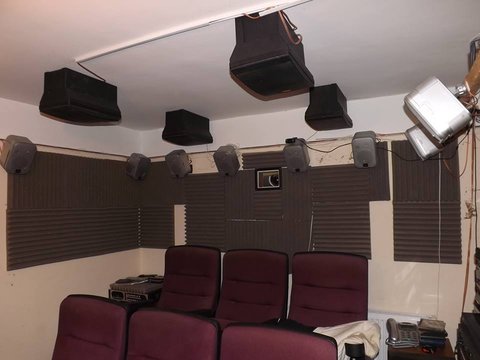
The whole speaker is just ugly as pointed out, particularly the subs.
Just imagine having this in your living room ![[Embarrassed]](redface.gif)
Posted by James Westbrook (Member # 3690) on 12-06-2014, 01:27 PM:
In a couple of the auditorium pictures I noticed two large speaker boxes in the rear that remind me of the old style ceiling mounted furnaces I sometimes see in places like a plumbing parts shop or some place that was not designed for retail but requires heat.
But yes, overkill.
Posted by Terry Monohan (Member # 8285) on 12-06-2014, 02:30 PM:
Wait till California gets hit with a major huge earthquake and all the junkie overhead speakers come down on peoples heads, will the patrons sue the theatre chain or Dolby® At least If the speakers are hidden they may not do as much damage to your body.
Posted by Bobby Henderson (Member # 840) on 12-06-2014, 02:46 PM:
An earthquake falls under the old "act of God" thing. Good luck trying to sue over falling debris from that.
quote: Terry Lynn-Stevens
It will take a lot of cinemas installations to make the economies of scale work, Dolby is also going to need to get the major chains like AMC, Cineplex or Regal to sign up for this up and I just don't see that happening in the North American market. Right now the North American market is over saturated with regular screens as well as PLF screens.
The premium screen market is indeed over-saturated. But the market is over-saturated with premium screens not worth the price of their surcharge.
While IMAX is still dinking around trying to get their laser projection system ready other theaters are getting ready to deploy their own in rooms without an IMAX brand. Warren Theaters is opening two such 4K laser based screens this Wednesday in Broken Arrow, OK. Those same houses boast Dolby Atmos systems in their maximum configuration, THX certified no less.
If I pay extra to see a movie in a Cinemark "XD", Regal "RPX" or one of Carmike's "Big D" theaters I'm probably going to encounter a theater with just one projector, possibly only 2K even, and either 5.1 or 7.1 sound. I can get that in any regular priced theater! Why do I need to pay extra for one of those acronym labeled houses?
The standards bar for premium cinema is going to be raised. Some theater operators may stick with IMAX, but demand IMAX get their shitty 2K projection and 5.1 sound upgraded ASAP. Others might ditch at least some of their private label premium screens and replace them with Dolby Cinema theaters instead.
Either way, movie theater operators will have to start doing to serious upgrades on those premium priced big screen theaters. They can't keep charging extra for what's really standard projection and sound. For some, they might pay for laser projection and sound system upgrades on their own. Others may think it's more economical to go the partnership route with either IMAX or Dolby.
Posted by Marco Giustini (Member # 4544) on 12-06-2014, 02:49 PM:
Terry,
I like that the guy took some time to (badly) fix some plastic ducts on the wall to make the whole contraption less ugly!
Posted by Terry Lynn-Stevens (Member # 7349) on 12-06-2014, 03:40 PM:
quote: Steve Guttag
but if you are in a competitive market, then everything you do that can give yourself a bigger piece of a pie you are sharing is key...so long as there really IS a ROI.
I do agree with you here, if a theater chain is in a highly competitive market then anything to give yourself an edge will help. I just don't see the point of the video screen inside the hallway or audio visual pathway doing anything for the ROI, and that fact that theater will need another projector upgrade from Dolby is a little strange
I think THX would have a better chance and penetrating the current market than this Dolby Cinema thing. I bet THX would omit the need for masking in this current day and age
This Dolby Cinema things reminds me of how auto manufacturers create a strange looking concept only to never release it to the public, but it this case Dolby has create a strange concept with stealth bomber style side walls only to in fact release it to the public.
quote:
Terry,
I like that the guy took some time to (badly) fix some plastic ducts on the wall to make the whole contraption less ugly! [Smile]
I guess that might be the defining example of Dolby ![[Moon]](graemlins/moon.gif) -mos
-mos
quote: Terry Monohan
Wait till California gets hit with a major huge earthquake and all the junkie overhead speakers come down on peoples heads, will the patrons sue the theatre chain or Dolby® At least If the speakers are hidden they may not do as much damage to your body.
Introducing, Dolby Atmos: Earthquake All Around You
quote: Steve Guttag
Naturally, if you are in a small town, it is unlikely that the expense would ever be repaid..
From what I understand, laser projection will not likely make it into the smaller cinemas, the upgrade will just be too costly to implement. The largest screens will get it but not all of the large screens.
Have you had a chance to see a demo of laser yet?
Posted by Mike Blakesley (Member # 26) on 12-06-2014, 03:59 PM:
We saw a laser demo at CinemaCon in 2012. It was brighter, but not up to the level of "OMG I have to replace my projector right now!"
Posted by Marcel Birgelen (Member # 6801) on 12-06-2014, 04:18 PM:
quote: Steve Guttag
Naturally, if you are in a small town, it is unlikely that the expense would ever be repaid...but if you are in a competitive market, then everything you do that can give yourself a bigger piece of a pie you are sharing is key...so long as there really IS a ROI. I'm sure the money people have worked out what it has to do to be profitable for both sides.
It's clearly targeted right at IMAX. And if it works for IMAX, why couldn't it work for them? Especially in markets where IMAX never was a "household brand".
quote: Terry Lynn-Stevens
Right now the North American market is over saturated with regular screens as well as PLF screens. Also, early cinemas will not have Dolby Vision as that will come a little later, early projectors will just be laser.
The great thing is, the European market isn't over-saturated with crappy Digital IMAX screens, our market is just over-saturated with crappy regular screens. So that's probably why Dolby sees an opportunity to pilot it in Europe...
Also, even the first installations will have "Dolby Vision", but no content yet. A common issue for early adopters.
quote: Terry Lynn-Stevens
I think THX would have a better chance and penetrating the current market than this Dolby Cinema thing. I bet THX would omit the need for masking in this current day and age
I doubt THX will ever matter for Cinema again. That brand is dead for the exhibition market and Logitech (the current owner for $#%& sake) has shown zero interest in reviving it for those purposes.
quote: Terry Lynn-Stevens
This Dolby Cinema things reminds me of how auto manufacturers create a strange looking concept only to never release it to the public, but it this case Dolby has create a strange concept with stealth bomber style side walls only to in fact release it to the public.
You're mixing up your airplanes... And you forget the fact that the first actual Dolby Theater will open in 12 days.
quote:
I guess that might be the defining example of Dolby [Moon] -mos
Yawn. Really? Are we back in kindergarten? Or is this your standard escape when logical arguments fail?
quote:
We saw a laser demo at CinemaCon in 2012. It was brighter, but not up to the level of "OMG I have to replace my projector right now!"
Most projectors are also just fine for their given screen sizes, at least in 2D. What almost nobody is showing though, is how this "extended color gamut" content actually looks.
The problem here is: yeah, it looks great, but do we want our movies to look like this? Remember the first HFR demos? Most people were rather excited, but once we got it in feature length, we started to doubt the merits, especially if you consider the costs of it all.
Posted by Terry Lynn-Stevens (Member # 7349) on 12-06-2014, 04:41 PM:
quote:
We saw a laser demo at CinemaCon in 2012. It was brighter, but not up to the level of "OMG I have to replace my projector right now!"
I think for the largest screens people will see or perceive a difference, not huge but some. IMAX did a demo recently and I was able to see some trailers shown on laser, to me it looked like really good 35mm projection. It was not shown on their 15/70 sized screens.
The Cinerama in Seattle is projecting with the dual laser Christie projectors, but I haven't heard much in the press or the forums.
I personally do not think the chains who install laser in a few of their cinemas will advertise it, I don't think they will want to take away from the their regular cinemas.
I think at the end of the day, laser projection is going to be a bit over hyped.
Posted by Marcel Birgelen (Member # 6801) on 12-06-2014, 06:37 PM:
For those who might want a bit more background information about "Dolby Vision", here is an article of about a year ago. Most of which is in there has already been mentioned in this topic though, also it focuses primarily on TVs. As you can see, this is clearly no cinema exclusive engagement for Dolby.
Posted by Mike Blakesley (Member # 26) on 12-06-2014, 09:11 PM:
quote: Terry Lynn-Stevens
I think for the largest screens people will see or perceive a difference, not huge but some.
Well I think the CinemaCon screen was 80-feet wide. Not sure about that though -- Steve Guttag would know.
We made sure to sit as dead-center as we could for the demo so the picture would look the best. And, I was only comparing it to what I am used to from my own theater, in which I think our 3D looks pretty good. Like I said, I could definitely see some difference but I wasn't exactly speed-dialing the bank for a new loan.
Posted by Steve Guttag (Member # 268) on 12-07-2014, 07:15 AM:
i actually don't recall the screen size.
As for the laser demo...there was no perceived improvement in terms of picture for me. To me, the subject of lasers in projection is one of economics. That is, if one were to switch to lasers would one lower or raise their TCO? If you are using 4500 and larger lamps, particularly if you are in the 6KW+...you can see where you'd save money by switching. There would be a higher cost up front but lower cost over the expected life of the projector.
If you are still into the 3D fad and are using Dolby 3D, the 6P laser systems (6 primaries) turn Dolby 3D from the least efficient to the MOST efficient (no more filter wheels so ALL of the light gets to the screen...the only filter left are the glasses). So in a single projector system (Barco), you can theoretically get near 50% efficiency (you don't wheel transition and each eye is only on the screen 1/2 the time). Christie went with a 2 projector approach with 3P in each projector. So like in LS systems, both eyes are on the screen at all times. One can lower the gain back down AND have 3D at the same light levels as 2D.
XpanD also benefits from lasers though not in light efficiency but since again the larger lamps that last a short time and cost quite a bit are no longer needed. If the screen gain can be lowered, the quality of the image goes up.
If you have a smaller lamp 3KW and below...it is never economically advantageous for you to use Lasers (at their current price range).
Perhaps if you are in an "S2K" projector that has nasty contrast, lasers might help a bit but then you lose the cost savings on the initial purchase you were going for so it seems counter productive there.
So in short, if you are typical cinema...I wouldn't worry about lasers at this stage, they make no economic sense and there is no marquee value.
Since I don't have the specifics on Dolby Vision, they might be using the lasers to dramatically increase contrast ratio...something DLP is not the best at achieving, particularly on the smaller mirrors used in the 4K and S2K projectors.
Posted by Marcel Birgelen (Member # 6801) on 12-08-2014, 04:48 AM:
quote: Steve Guttag
As for the laser demo...there was no perceived improvement in terms of picture for me.
Did they demo some of the "wider color gamut" content or just regular DCI content?
Because for standard DCI content, yeah, it's actually supposed to look the same. Also, did you notice any speckle patterns?
They're still there, unfortunately, you will faintly see them in bright, evenly lit surfaces if you're close to the screen.
Posted by Bobby Henderson (Member # 840) on 12-08-2014, 09:46 AM:
quote: Marcel Birgelen
Yawn. Really? Are we back in kindergarten? Or is this your standard escape when logical arguments fail?
I'm wondering if Terry really is the "AndySu" posting in the Atmos thread over at Home Theater Forum. "AndySu" posted that odd home theater room photo there and has been calling Dolby Atmos "Atmis" lately.
"AndySu" sounds very similar to the name of one participant who was booted from the forum a few years ago.
Posted by Terry Lynn-Stevens (Member # 7349) on 12-08-2014, 10:53 AM:
Bobby, you've gotta chill out a bit ![[Shrug]](graemlins/shrug.gif) Not everybody likes Atmos and I am just having a little fun with it. The fact of the matter is that Dolby Atmos has been a bit of a flop, it has not gotten the brand recognition is deserves, and I suspect Dolby has figured this out. The speakers arrays are ugly as hell as well. It is just a matter of time in that Dolby Atmos will just become forgotten at the movie theater.
Not everybody likes Atmos and I am just having a little fun with it. The fact of the matter is that Dolby Atmos has been a bit of a flop, it has not gotten the brand recognition is deserves, and I suspect Dolby has figured this out. The speakers arrays are ugly as hell as well. It is just a matter of time in that Dolby Atmos will just become forgotten at the movie theater.
As for Dolby Cinema, it is a little lame and it is not going to work. The audio visual pathway as you enter the cinema is stupid as hell and it does nothing. Looking at the actual cinema, it just looks like a standard premium type cinema, the stealth bomber angled walls really do nothing. So what, its got Atmos and dual Christie 6P projectors, the Seattle Cinerama has this already and nobody is talking about it. Dolby is about 6 years too late on this concept.
And what the heck has happened to Dolby Vision in the home cinema area, I think Chicago has been the only bluray title released in a whole year.
Posted by Marcel Birgelen (Member # 6801) on 12-08-2014, 12:49 PM:
quote: Bobby Henderson
I'm wondering if Terry really is the "AndySu" posting in the Atmos thread over at Home Theater Forum. "AndySu" posted that odd home theater room photo there and has been calling Dolby Atmos "Atmis" lately.
Is he also paid by the IMAX propaganda machine?
Terry, I know you mostly ignore me, because yeah, I'm an *sshole and logical arguments are just for pussies... Then again, to quote Will Smith, I'm allergic to bullshit. So, don't take it too personal. You're getting paid to swallow other people's shit, ain't you?
quote: Terry Lynn-Stevens
The fact of the matter is that Dolby Atmos has been a bit of a flop, it has not gotten the brand recognition is deserves, and I suspect Dolby has figured this out.
So, 400+ installs in about two years is considered a flop then, for a premium, extra expensive audio system? And tell us, what are the criteria for a flop?
quote: Terry Lynn-Stevens
The speakers arrays are ugly as hell as well.
Yeah, they're ugly, but according to you, putting them away is also stupid. So, what is it then?
quote: Terry Lynn-Stevens
Looking at the actual cinema, it just looks like a standard premium type cinema, the stealth bomber angled walls really do nothing.
What do they need to do to make it extra frickin' special then? Install rocking chairs? Include hookers and black jack?
And again, you're mixing up your airplanes. And might you enlighten us with your deep scientific knowledge why those stealth *fighter* walls do nothing?
quote: Terry Lynn-Stevens
And what the heck has happened to Dolby Vision in the home cinema area, I think Chicago has been the only bluray title released in a whole year.
Chicaco has apparently been remastered in Dolby Vision, but it hasn't been released in Dolby Vision... You cannot even buy a Dolby Vision TV yet.
Posted by Terry Lynn-Stevens (Member # 7349) on 12-08-2014, 01:00 PM:
quote:
ou cannot even buy a Dolby Vision TV yet.
And I doubt you will be able to buy these Dolby Vision TVs anytime soon, how long is going to take Dolby to get this Vision thing to the end consumer? Atmos has had a lukewarm reception in the home, do you agree?
Posted by Marcel Birgelen (Member # 6801) on 12-08-2014, 01:16 PM:
They're set to arrive late 2014, since 2014 is largely over by now, it will probably be early 2015. But how can you judge something before it's even there then?
We're also not talking about the home theater here, this is a forum for the Big Screen. But, for the home, even 7.1 surround has been largely a failure, maybe even 5.1, as most just don't bother. I know plenty of people who went from 5.1 back to just stereo or some kind of a sound bar with "virtual surround". So, if Dolby Atmos is a failure in the home, so is Dolby Digital or DTS.
Then again, many higher end, next generation AVRs will include Dolby Atmos by default, even if they do not offer more than just 7 full range and one LFE channel. More and more Blu-Ray mixes do include Atmos mixes, so what failure exactly?
Atmos or any other well supported spatial, object oriented audio format can become THE single inventory audio format of the future. No more need for five different mixes for every speaker layout, just one.
Posted by Terry Lynn-Stevens (Member # 7349) on 12-08-2014, 01:36 PM:
Well, I don't think there has been any mention of Dolby Vision tvs coming any time soon. Samsung, LG and Sharp appear to be doing their own thing. Plus, I am reading that these TVs with Dolby Vision will consume a lot of power.
quote: Marcel Birgelen
But, for the home, even 7.1 surround has been largely a failure, maybe even 5.1, as most just don't bother. I know plenty of people who went from 5.1 back to just stereo or some kind of a sound bar with "virtual surround". So, if Dolby Atmos is a failure in the home, so is Dolby Digital or DTS.
I agree 7.1 has been a complete failure, I do not agree that 5.1 is a failure, it has been around since 1995, it might be obsolete now but it did have a very good run. The brand DTS and Dolby Digital were both successes.
Posted by Bobby Henderson (Member # 840) on 12-08-2014, 02:02 PM:
quote:
Bobby, you've gotta chill out a bit [Shrug] Not everybody likes Atmos and I am just having a little fun with it.
I'll call it how I see it. You have no profile picture, yet have a posting style very similar to at least one or more former F-T forum members from the Toronto area (aka the "GTA") who were banned for excessive asinine behavior here. You joined the forum not very long after they left. I've seen people get banned from a forum before and show up later under a different handle to resume trolling behavior. I have the same suspicions about you.
"Andy Summers" was another forum member, who liked showing off photos of some very strange home theater setups, presumably his. I don't remember why he got banned here, but he did. Now the "same guy" is posting under the handle "AndySu" at Home Theater Forum.
I'm suspicious that it is far more than mere coincidence that you copied one of his home theater setup photos from the Atmos thread at Home Theater Forum, posted it here and that "AndySu" is all of a sudden sounding just like you over at HTF, claiming that Atmos in the home is dead on arrival and should be called "Dolby Atmis".
The similarities are just too damned similar not to notice.
Posted by Terry Lynn-Stevens (Member # 7349) on 12-08-2014, 02:04 PM:
Bobby, you've got to relax.
Posted by Bobby Henderson (Member # 840) on 12-08-2014, 02:07 PM:
Relax? Where was I yelling in the previous post? I've made those observations about you in a very calm manner.
If I was one of the moderators with access to the server logs I might be doing a little deeper investigation into things like IP addresses.
Posted by Terry Lynn-Stevens (Member # 7349) on 12-08-2014, 02:20 PM:
quote:
Is he also paid by the IMAX propaganda machine? [Razz]
LOL, I do not work for IMAX. I just don't let the transition from 1570 get me all worked up like some folks, especially Bobby Henderson. Sure it is not the same as 15/70 but it does not bother me. There are some very nice IMAX venues in the Toronto and New York markets that make going to these venues worthwhile IMO, these are not the AMC type refit locations.
It remains to be seen how successful this Dolby Cinema concept is going to be, IMAX has pretty successful marketing and studio support and IMAX is perceived as being the highest quality form of movie going experiences. This holds especially true in markets such as Asian areas that do not have the 15/70 past legacy. The economies of scale for Dolby Atmos to work is going to be the biggest problem, their patented theater design might work but I am skeptical if they can get enough signings to make this worthwhile.
Dolby recently has been doing in theater research regarding their Dolby Atmos branding, from what I have seen, the roll out of Atmos has not gone very well from audience reaction and surveys. Bottom line, the audiences didn't say it sucked, they just said they didn't know what it was, nor did they notice any difference during the movie as to sound quality. Dolby Atmos really lacks in the marketing department from what I have seen.
The new IMAX audio system will not be differentiated from the current set up from what I have heard. It will just be IMAX and no mention with regards to laser or the new 12 channel setup.
Here is a pic of the custom overhead speakers. They will look a little cleaner than current Atmos set ups.
Posted by Marcel Birgelen (Member # 6801) on 12-08-2014, 05:41 PM:
It's a given fact that Dolby's Atmos marketing isn't as strong as it could be. It has been iterated time and time again here. Still, I would not call this system a failure at all, especially given the cost of the system, I'm actually impressed it's going anywhere. At current price levels, it surely will only go into the biggest and best rooms and is obviously a candidate for "PLF" concepts.
As for Dolby Cinema: I'm pretty certain the Dolby Cinema screen at JT Eindhoven will be a strong competitor for the Digital IMAX "across the street", even if they offer it at the same price level. When they opened their Atmos based premium concept with a highly overpowered sound system in a massive room about 70 miles south, it generated sufficient buzz to knock the competition out within a few months time and they sold their tickets at a large markup compared to their competition. This competition was a 75-year old business which by no means offered any sub-par service, quite to the contrary actually.
As you might know, in a normal Atmos setup, it's not Dolby that decides what the end result will look like, but the theater owner. There are plenty of models to choose from and there are also plenty of ways to integrate those speakers into the design of the overall auditorium.
And have you ever seen a Barco Auro setup? It's in no way better than Dolby Atmos.
Regarding this "Stealth wall design", there are plenty of theaters around the world with more creative designs than the average shoebox with a screen against the front wall. The following came to mind:
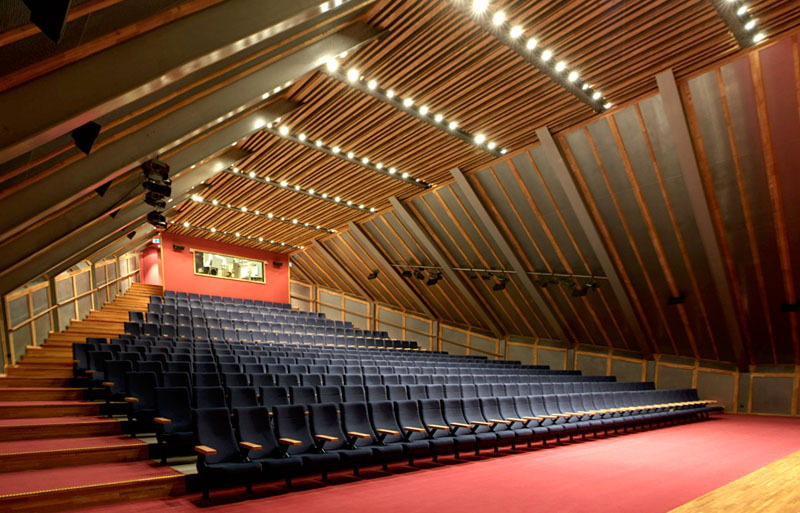
It might not be the most attractive looking room, but the acoustics are actually pretty decent. The whole thing is also built into a big earth wall.
Posted by Mike Blakesley (Member # 26) on 12-08-2014, 06:05 PM:
I expect Dolby has a tough time marketing Atmos because it's a hard thing to tell people in a couple of words. Think about it.... how would you create a "slogan" for Atmos that would tell exactly what it does in just a few words?
"Surround sound" was easy -- the sound is surrounding me, got it. The Atmos/Auro concept....not so easy to describe in a sound bite. "Really accurate surround sound" still doesn't give the consumer an idea of what they're getting for their extra $.
For what it's worth, Dolby is still promoting the heck out of Atmos in trade magazines. I do agree they need to get the word out to the masses, but how to do it?
Posted by Terry Lynn-Stevens (Member # 7349) on 12-08-2014, 06:06 PM:
quote: Marcel Birgelen
And have you ever seen a Barco Auro setup? It's in no way better than Dolby Atmos.
No Barco anywhere close. I can't confirm for sure, but the new IMAX sound system will be a skinned Barco set-up. Perhaps you might able to confirm something with regards to Barco, is the Voice of God a single channel from the roof or four individual channels?
quote: Marcel Birgelen
I'm pretty certain the Dolby Cinema screen at JT Eindhoven will be a strong competitor for the Digital IMAX "across the street", even if they offer it at the same price level.
That might be the case. Is the JT Eindhoven yet to open? Or are they open already and just adding Dolby Cinema?
Posted by Terry Monohan (Member # 8285) on 12-08-2014, 06:37 PM:
Does any one in Hollywood CA know If the demo Dolby Cinema set up is still in the Vine Theatre located near Hollywood Blvd and Vine. This old small second run movie theatre is closed more then open and is open for private rentals and screening from time to time. The Dolby® guys must have spent the $$$ fixing It up as It needed a complete re do. Hollywood needs a space like this to run old classic films and special events for the hungry movie tourist crowd. The poor old Warner Pacific Cinerama a few blocks down just sits closed year after year. The NYC Shubert's need to take It over and give the Neder's Pantages some competition. Turn on the neon star and bring the old guy back to his box office job at the Vine. I heard the projection man lived in the theatre when It was last showing 35mm films many years ago. The projector was so loud you could here it even in the front row. The old Dolby® sound system they did have at the Vine Theatre was full of cracks and pops. Now It looks like the place has a temp set up with new sound and digital projection. Did Dolby® go to all the expense just to please a few movie theatre owners and then rip It out? I always liked the candy counter at the Vine Theatre, had a ship type theme.
Posted by Bobby Henderson (Member # 840) on 12-08-2014, 09:26 PM:
quote: Terry Lynn-Stevens
LOL, I do not work for IMAX. I just don't let the transition from 1570 get me all worked up like some folks, especially Bobby Henderson. Sure it is not the same as 15/70 but it does not bother me.
If the tremendous quality difference between true 15/70mm film-based IMAX and its fake, 2K digital version doesn't matter to you, then why are you even bothering to pay extra to see a movie in "IMAX", the digital version? Why not save a few bucks and merely watch the standard priced digital version? You even profess this crap of preferring plain stereo optical Dolby SR over 5.1 channel digital. With all those statements put together there is no logic in you towing the line for IMAX in any respect, be it real film-based IMAX or its dishonestly marketed digital version.
quote: Terry Lynn-Stevens
IMAX has pretty successful marketing and studio support and IMAX is perceived as being the highest quality form of movie going experiences.
quote: Marcel Birgelen
It's a given fact that Dolby's Atmos marketing isn't as strong as it could be. It has been iterated time and time again here.
quote: Mike Blakesley
I expect Dolby has a tough time marketing Atmos because it's a hard thing to tell people in a couple of words.
Dolby is not necessarily doing anything wrong in its marketing of Dolby Atmos. And IMAX isn't necessarily doing anything right either.
It's a very simple situation: both IMAX and RealD are paying a lot of money to movie studios to get their brands whored onto movie posters, movie trailers and movie TV commercials. That's their "marketing." There is nothing very genius about that at all. Dolby Cinema will just allow Dolby to do the same damned thing.
Dolby didn't have to pay to get its brand on movie posters, trailers and more in the past. Neither did other companies like DTS, SDDS and Panavision. Those logos were often window dressing to make a movie's poster, trailers or DVD box art seem more legit.
Now that product placement fees are an ever more pervasive part of movie production, and all the big movie companies are owned by giant multinational corporations with an endless hunger for profit they now view space on a movie poster, trailer or whatever as a commodity that can be sold.
Posted by Buck Wilson (Member # 5885) on 12-08-2014, 09:47 PM:
quote: Terry Lynn-Stevens
Not everybody likes Atmos and I am just having a little fun with it. The fact of the matter is that Dolby Atmos has been a bit of a flop, it has not gotten the brand recognition is deserves, and I suspect Dolby has figured this out. The speakers arrays are ugly as hell as well. It is just a matter of time in that Dolby Atmos will just become forgotten at the movie theater.
You are literally the only person I know of that doesn't like Atmos. The only complaints I've heard are of the speakers being too aesthetically intrusive(which is fixable) and it's cost, which is not only warranted(there is value there) but will also decline with time.
The statement "not gotten the brand recognition is deserves" makes me a little suspicious of your true feelings.....
As Bobby said, you don't care about the downgrade from 15/70 to 2k? You prefer an aged Imax "5.1" system to a fresh Atmos install? Why are you here again?
Posted by Terry Lynn-Stevens (Member # 7349) on 12-09-2014, 12:56 AM:
quote: Buck Wilson
you don't care about the downgrade from 15/70 to 2k? You prefer an aged Imax "5.1" system to a fresh Atmos install?
Buck, where did I say that I prefer and IMAX 5.1 system over a fresh Atmos install? I prefer 5.1 (IMAX or not) over Amtos period. I also could care less about 7.1. Atmos to me means nothing, its 64 channel system is beyond ridiculous as IMO it is just not needed. There is a reason why some of the great directors such as Kubrick, Allen and some others make their films in mono etc. A few screen channels and 60 or so surround/overhead channels just simply gives the filmmaker the opportunity to go overboard and screw everything up, it becomes a giant distraction. Good sound and good sound mixing will sound good in all formats, and that is what I am most interested in. I actually like standard 35mm Dolby Stereo to Dolby Digital/DTS/SDDS as often times digital sound is played back way to loud. Also, nothing beats a good old fashioned THX auditorium, but they are harder to find these days.
quote: Buck Wilson
You are literally the only person I know of that doesn't like Atmos.
And I have never heard anyone complain either, but it must be said that nobody I have ever me knows what the Atmos is anyway.
quote: Buck Wilson
you don't care about the downgrade from 15/70 to 2k?
I don't compare 15/70 to digital IMAX, nothing comes close to 15/70. I compare IMAX digital to the standard theater down the hall, to me 22 ft lambert's on screen, dual projection, some image manipulation and quality control basics far outweigh some of the dimly lit single projection set ups. And IMAX digital left eye/right eye 3D is usually superior than the single projection 3D set ups from RealD. Sure, it is possible to exceed IMAX digital with digital but I have yet to see it in my area.
quote: Antonio Casado
Here in Spain the majority of the screens aren´t masked...In fact I remember to see one or two masked screens in my whole life here (42 years...)
It really is unfortunate that you have only seen two properly masked screens in 42 years. Masking is the way to go, 35mm without masking has gotta really look bad. And the digital masking on an open flat screen does not look good at all. I can put up with no masking all like on a PLF screen but not on an open flat screen.
quote: Antonio Casado
The "blacks" of ANY cinema screen makes me laugh. Including this Dolby Vision or future Laser Projection, of course.
Black from 35mm or 70mm will look better than digital blacks, I believe blacks from laser projection will look better than you might think. Do you have access to Interstellar in 15/70? Because if you do, you will see black from film and you might see the difference versus digital.
quote: Mike Blakesley
I do agree they need to get the word out to the masses, but how to do it?
If Dolby could get some sort of exclusive on a series of big films or a director who could champion it (like Christopher Nolan with IMAX) then I could see Dolby Atmos succeeding to the masses. What they are doing right now is obviously not working.
Posted by Marcel Birgelen (Member # 6801) on 12-09-2014, 04:21 AM:
quote: Mike Blakesley
"Surround sound" was easy -- the sound is surrounding me, got it. The Atmos/Auro concept....not so easy to describe in a sound bite. "Really accurate surround sound" still doesn't give the consumer an idea of what they're getting for their extra $.
The transition from analog sound formats to SRD, DTS and SDDS did have a larger, more noticeable impact for most people. The difference in clarity and dynamic range was, in many cases, rather obvious.
Now, there’s nothing wrong with a decently implemented 5.1 or 7.1 system and the step up from there to Dolby Atmos is more subtle than the change from analog to digital. Many people won’t instantly notice the difference, especially if you do not tell them.
Then again, the best marketing for the system are those trailers and the movies with GOOD Atmos mixes themselves.
quote: Terry Monohan
The Dolby® guys must have spent the $$$ fixing It up as It needed a complete re do.
Those kind of corporations often sink millions into a single stand on some trade show, which only lasts a few days.
quote: Terry Lynn-Stevens
Perhaps you might able to confirm something with regards to Barco, is the Voice of God a single channel from the roof or four individual channels?
In the Auro 11.1 layout, the “Voice of God” channel is a single channel. It has been discussed here before, but it would make sense for IMAX to choose a speaker layout that closely matches a pre-existing layout, like the Auro 3D layout. Sound mixers and studios obviously aren’t keen on adding yet another custom mix. Since IMAX and Dolby aren’t the most obvious partners and they’re already working with Barco on their laser system, partnering with Barco for their next generation sound system would make a lot of sense.
quote: Terry Lynn-Stevens
That might be the case. Is the JT Eindhoven yet to open? Or are they open already and just adding Dolby Cinema?
This is a new multiplex. Two Dolby Cinema upgrades of existing rooms in other complexes are planned for 2015. Compared to the U.S., the Netherlands is just a tiny market, but their approach seems to work. The Netherlands is also one of the few markets in Europe where Digital IMAX has some stronghold.
quote: Bobby Henderson
Dolby is not necessarily doing anything wrong in its marketing of Dolby Atmos. And IMAX isn't necessarily doing anything right either.
The biggest problem I do have with their strategy is how they’re blatantly using the exhibition industry to promote their consumer brands. The exhibitor pays boatloads of money to get into stuff like Dolby Atmos and the upcoming Dolby Vision, but the same brand will eventually not be much more than just another sticker on the next receiver or TV you buy, a few short years down the road. It’s rather hard to convince the public, the Dolby Atmos in your room is quite a bit different than this $100 surround set. (Which isn’t there yet, but I’m quite certain will be there in a couple of years.)
For the exhibitor, this creates a risk. Do you want to put all this money into a system with just limited marketing value for YOUR product, even if it’s the greatest system on earth?
quote: Bobby Henderson
Those logos were often window dressing to make a movie's poster, trailers or DVD box art seem more legit.
Those logos have been on movie posters and many trailers for ages. Technicolor, Cinemascope, Dolby SR, you name it. It’s not only to make them look more legit, but also to advertise their technical progress.
I guess both IMAX and RealD are paying for their promotion on posters and trailers, although I’ve not yet seen this confirmed.
quote: Buck Wilson
You are literally the only person I know of that doesn't like Atmos.
People I speak about it are either excited or just don’t noticed anything different. But most people are actually quite excited. Not everyone is totally convinced it justifies the inflated ticket prices that come with it though.
So in general, people are much more positive than negative.
Up until now, there was just one Atmos mix I really didn’t like, it was the Guardians of the Galaxy mix. The rest of the mixes were either an improvement compared to 5.1 or 7.1 or at least on the same level.
quote: Terry Lynn-Stevens
Atmos to me means nothing, its 64 channel system is beyond ridiculous as IMO it is just not needed.
It’s not a channel based system at all, that’s the whole point. I hope in the future, we will have just ONE mix, in an open, object based audio format. Your sound system will do the appropriate mapping to your speaker layout. The sound mixer can focus on just one mix and make this mix great.
quote: Terry Lynn-Stevens
I actually like standard 35mm Dolby Stereo to Dolby Digital/DTS/SDDS as often times digital sound is played back way to loud.
The volume level is the biggest complain I hear from Digital IMAX patrons and not so much about Atmos. Maybe exhibitors think that “PLF” is equal to pumping up the volume to ear shattering levels. They clearly haven’t seen the light yet.
quote: Terry Lynn-Stevens
There is a reason why some of the great directors such as Kubrick, Allen and some others make their films in mono etc.
Kubrick never formally discussed his films, but it’s a fact he filmed all of his movies, besides 2001, in mono, because he wanted to give everybody the best possible performance achievable. He apparently checked more than 300 cinemas himself prior to the release of Full Metal Jacket, only to conclude the stereo systems at most of those theaters sucked. Even in 2001, he wasn’t convinced the multiplexes of the time could deliver sufficient presentation quality in anything other than mono.
He did 2001 in 6-track stereo, because the 70mm release allowed him to do it right. I’m quite certain, if he would be alive today, he would embrace digital surround systems.
Woody Allan has never used anything else than mono, as far as I can recall. I'm not a great fan of his mixes. Then again, practically all of his movies are based on dialog and would only ever so slightly benefit from a multi-channel mix.
quote: Terry Lynn-Stevens
If Dolby could get some sort of exclusive on a series of big films or a director who could champion it (like Christopher Nolan with IMAX) then I could see Dolby Atmos succeeding to the masses. What they are doing right now is obviously not working.
Why does it have to be exclusives? Why would we even want to embrace anything that can only proliferate itself via forced monopolies? Right now, Dolby Atmos isn’t failing. I’m not sure what kind of numbers Dolby expected and if they’re way off schedule, but I’m not seeing Dolby declaring bankruptcy just yet. It seems their business is still doing quite well, in a competitive field.
Personally, I’m not even advocating Dolby Atmos as the ultimate thing. I'm repeating myself, but I really do mean it: I hope something more standard emerges from all of this. The same goes for Dolby Vision actually. The good thing of open standards is that it usually also gets the costs down, as there is no single vendor dictating the price. But like with many developments which made it to something of an open standard, it usually goes through a few iterations of proprietary formats, before a such a standard emerges.
I do see the opportunities for a single inventory object based sound format, as do I see the opportunity for an open, wider color gamut encoding standard.
The availability of those formats also doesn't imply every movie maker needs to adopt those standards.
Posted by Terry Lynn-Stevens (Member # 7349) on 12-09-2014, 10:48 AM:
quote: Marcel Birgelen
I guess both IMAX and RealD are paying for their promotion on posters and trailers, although I’ve not yet seen this confirmed.
It has been confirmed before, there is no payment from IMAX to the studios for the advertisement, this has been disclosed in their filed legal financial statements including their white papers. IMAX takes 12.5% from the ticket price at the box office (slightly less in Asian markets). This is the same fee for every movie they release.
quote: Marcel Birgelen
Those logos have been on movie posters and many trailers for ages. Technicolor, Cinemascope, Dolby SR, you name it. It’s not only to make them look more legit, but also to advertise their technical progress.
DTS, Dolby, and SDDS all charge a licensing fee for the use of their products, this fee is needed to produce a soundtrack for these formats when you do a release. A studio cannot just release a DTS release without paying the fee.
quote: Marcel Birgelen
Why does it have to be exclusives? Why would we even want to embrace anything that can only proliferate itself via forced monopolies? Right now, Dolby Atmos isn’t failing. I’m not sure what kind of numbers Dolby expected and if they’re way off schedule, but I’m not seeing Dolby declaring bankruptcy just yet. It seems their business is still doing quite well, in a competitive field.
Personally, I’m not even advocating Dolby Atmos as the ultimate thing. I'm repeating myself, but I really do mean it: I hope something more standard emerges from all of this. The same goes for Dolby Vision actually. The good thing of open standards is that it usually also gets the costs down, as there is no single vendor dictating the price. But like with many developments which made it to something of an open standard, it usually goes through a few iterations of proprietary formats, before a such a standard emerges.
In the case of Dolby Atmos, an exclusive release in Dolby Atmos for a big budget movie would be in the best interest of Dolby and its Atmos brand name. Just think about the exposure Dolby would get if the upcoming Star Wars was released in Atmos and Dolby Vision with no IMAX, or Auro formats. Those who have Atmos would benefit the most. Those who installed Dolby Vision would also benefit the most.
Right now there really is way too many formats or options that provide the so called "immersive" experience. Dolby Cinema is about 6-8 years late to the market, in the North American market there is very little room for more formats, and the Dolby Cinema concept is just another PLF format with the Dolby name attached to it. The biggest problem with Dolby Cinema/Atmos succeeding is the over saturation of other product.
quote: Marcel Birgelen
It’s not a channel based system at all, that’s the whole point. I hope in the future, we will have just ONE mix, in an open, object based audio format. Your sound system will do the appropriate mapping to your speaker layout. The sound mixer can focus on just one mix and make this mix great
And the average moviegoer understanding what an object based system is will never happen. The Transformers Age of Extinction release uses the words "multidimensional" a lot in their menus...I can't wait till people get their hands on Dolby Atmos headphones.
Posted by Antonio Casado (Member # 7592) on 12-09-2014, 10:59 AM:
quote:
quote: Antonio Casado
Here in Spain the majority of the screens aren´t masked...In fact I remember to see one or two masked screens in my whole life here (42 years...)
It really is unfortunate that you have only seen two properly masked screens in 42 years. Masking is the way to go, 35mm without masking has gotta really look bad. And the digital masking on an open flat screen does not look good at all. I can put up with no masking all like on a PLF screen but not on an open flat screen.
Well, here in Spain the majority of the screens are in Scope Format so no masking is needed when projecting in Scope. When project in Flat, there isn´t any digital mask or anything. Simply the Flat project in the center of the Scope Screen.
quote:
quote: Antonio Casado
The "blacks" of ANY cinema screen makes me laugh. Including this Dolby Vision or future Laser Projection, of course.
Black from 35mm or 70mm will look better than digital blacks, I believe blacks from laser projection will look better than you might think. Do you have access to Interstellar in 15/70? Because if you do, you will see black from film and you might see the difference versus digital.
Here in Spain there isn´t any IMAX 15/70 :-(
In other hand, I hate 35mm prints, as here in Spain is very bad copies, so I prefer the digital ones.
Compare any Oled screen with any other technology and amaze yourself :-). Even the Dolby people are thrilling about it. In fact, some Directors that see his movie in a OLED Screen, later when he see in Cinema or anything say that nothing compare with OLED Screens. It´s a fact.
Posted by Terry Lynn-Stevens (Member # 7349) on 12-09-2014, 11:11 AM:
quote: Antonio Casado
When project in Flat, there isn´t any digital mask or anything. Simply the Flat project in the center of the Scope Screen.
So what is on the left and right of the flat image, white screen?
Posted by Antonio Casado (Member # 7592) on 12-09-2014, 11:16 AM:
Yes, always when the projection is over Scope Screens
Posted by Mike Blakesley (Member # 26) on 12-09-2014, 12:29 PM:
We don't have moving masking here so we've always had a "pillarboxed" flat image. I don't know if it's me being used to it or because the sides are less in the field of vision, but the white on the sides never bugged me.
Posted by Dave Macaulay (Member # 813) on 12-09-2014, 12:48 PM:
Mike, don't poke the hornet nest!
There are some "true believers" here who will waste plenty of time and energy explaining why you are misguided, moronic - and maybe legally blind as well - if you don't mind screens without movable masking. And maybe inform you that any such masking-free perversion is a violation of the DCI standards - as if anyone is enforcing any of their non-security standards.
Just enjoy the movies... and find a white cane.
Posted by Marcel Birgelen (Member # 6801) on 12-09-2014, 02:23 PM:
quote: Terry Lynn-Stevens
Right now there really is way too many formats or options that provide the so called "immersive" experience. Dolby Cinema is about 6-8 years late to the market, in the North American market there is very little room for more formats, and the Dolby Cinema concept is just another PLF format with the Dolby name attached to it. The biggest problem with Dolby Cinema/Atmos succeeding is the over saturation of other product.
We'll wait and see. If it proves to be better and more consistent than all the other non-standardized and often unsophisticated "PLF" screens around, consumers might just start to embrace it.
quote: Terry Lynn-Stevens
In the case of Dolby Atmos, an exclusive release in Dolby Atmos for a big budget movie would be in the best interest of Dolby and its Atmos brand name. Just think about the exposure Dolby would get if the upcoming Star Wars was released in Atmos and Dolby Vision with no IMAX, or Auro formats. Those who have Atmos would benefit the most. Those who installed Dolby Vision would also benefit the most.
Maybe it will be great for Dolby or great for those theaters invested into Atmos, but it would suck for everybody else. So, I don't see any added benefit for the industry or the consumer as a whole. We really shouldn't embrace stuff that's forced down our throats. Dolby Atmos also doesn't need this, the format will eventually prove itself in the market, if it hasn't already done so. Please remember: Up until now it's considered a *premium* format, it isn't supposed to replace the Big Mac. It's the Big Kahuna layered with aged cheese and truffles, you're not supposed to have it every day of the week.
quote: Terry Lynn-Stevens
And the average moviegoer understanding what an object based system is will never happen. The Transformers Age of Extinction release uses the words "multidimensional" a lot in their menus...I can't wait till people get their hands on Dolby Atmos headphones.
The average consumer doesn't know anything about how his electronic gadgets work, so what's the point? Dolby Atmos is just another format, just like Dolby Digital AC3. And yes, there's no reason why your cellphone wouldn't be able to play it via your headphone... just like my cell phone can already play and downconvert Dolby TrueHD using something like VLC, for whatever that's worth. What matters is how it's being reproduced. I don't need to tell you there's a ginormous difference between cellphones and a properly equipped cinema.
quote: Antonio Casado
Compare any Oled screen with any other technology and amaze yourself :-). Even the Dolby people are thrilling about it. In fact, some Directors that see his movie in a OLED Screen, later when he see in Cinema or anything say that nothing compare with OLED Screens. It´s a fact.
So, let's close all cinemas and let's go see it in OLED at home then? Because the rest is... well, obsolete? Or should we just put an OLED screen in front of every cinema? Instead of 3D glasses we'll just hand out a bunch of binoculars? Or what are you proposing? Maybe Spain suffers from SCS... Shitty Cinema Syndrome. There are cures for that though.
quote: Terry Lynn-Stevens
So what is on the left and right of the flat image, white screen?
No, no, no... Unicorns and rainbows of course.
quote: Mike Blakesley
We don't have moving masking here so we've always had a "pillarboxed" flat image. I don't know if it's me being used to it or because the sides are less in the field of vision, but the white on the sides never bugged me.
It has been the subject here before, more than once . Some might see it as some kind of religious thing, but it isn't. No, it's not like night and day, but the merits have been proven.
If your customers will really mind is obviously another thing, but like many quality aspects it's often a subconscious thing for many. A properly masked screen will give you better perceived contrast. The extra darkness around the edges of the screen will make the picture itself look brighter. Less exposed screen with no image will also keep unwanted reflections to a minimum. Also, in my personal opinion, a masked screen will make your screen look more like a window and not just a big white "cloth" in front of the room.
I do think it's a rather worthy upgrade, even if many people don't really see the additional benefit of it.
If every movie would be in the same aspect ratio, it wouldn't matter much. A movie projected on a floating screen with the same aspect ratio usually doesn't look worse than a movie on a masked screen, as long as the regions around the screen are dark.
quote: Dave Macaulay
And maybe inform you that any such masking-free perversion is a violation of the DCI standards - as if anyone is enforcing any of their non-security standards.
I wasn't aware movable masking is mandatory according to the DCI specs.
Posted by Antonio Casado (Member # 7592) on 12-09-2014, 02:32 PM:
quote:
quote: Antonio Casado
Compare any Oled screen with any other technology and amaze yourself :-). Even the Dolby people are thrilling about it. In fact, some Directors that see his movie in a OLED Screen, later when he see in Cinema or anything say that nothing compare with OLED Screens. It´s a fact.
So, let's close all cinemas and let's go see it in OLED at home then? Because the rest is... well, obsolete? Or should we just put an OLED screen in front of every cinema? Instead of 3D glasses we'll just hand out a bunch of binoculars? Or what are you proposing? Maybe Spain suffers from SCS... Shitty Cinema Syndrome. There are cures for that though.
I don´t say that thing. Are you kidding me?
This is not serious at all, I´m go away.
Posted by Marcel Birgelen (Member # 6801) on 12-09-2014, 02:38 PM:
quote: Antonio Casado
I don´t say that thing. Are you kidding me?
This whole topic is about cinema isn't it? It's also in the Digital Cinema Forum. Yet you keep repeating how great OLED looks.
Well, great. Point taken. I agree, OLED looks great, at least at home. My question is, how does it matter in this context?
Posted by Antonio Casado (Member # 7592) on 12-09-2014, 02:46 PM:
Ok, I quit, no problem at all :-)
Posted by Jeffry L. Johnson (Member # 453) on 12-11-2014, 11:12 AM:
quote: Marcel Birgelen
What do they need to do to make it extra frickin' special then? Install rocking chairs? Include hookers and black jack?
Feel-Around
Posted by Frank Angel (Member # 248) on 12-17-2014, 06:50 AM:
I believe the "floating screen" concept has been around since the 30s, but my first ever encounter with one was in the very popular Walter Reade's Baronet Theatre on 3rd Ave in NYC. Don't flame me if it was in the sister Coronet Theatre...they were like frick and frak & my memory is skipping a few synapses on that. Anyway, the screen did exactly what the name implies -- it was just a white rectangle that floated out in front of the wall behind it. The screen was a scope screen and the film I was going to see was flat. Thing is, there was no masking on this floating white rectangle. First thing I though as I sat there before the show taking in this new configuration of a screen without masking or curtain was, "OK, so what are they going to do when they project a flat image on this scope screen....there's NO MAKSING! I was baffled. Back then I had never seen a theatre where there wasn't a curtain much less masking, so this was a puzzlment.
So the movie is about to start, house lights dim and there at the top of the ceiling I notice something moving out of two slots that I hadn't noticed before. It's two felt bands not more than 6 inches in width decenting from the two small openings in the ceiling. These bands of velour are spaced so that they fall exactly at the edges of the 1.85 image, forming sort of a mask, albeit a very small one, just wide enough to cover the film's soft gate edge. The bands get to the bottom of the screen and the show starts. Thing is, as they started to decend, at first I had no idea what was going on. When they got about a 3rd of the way down it dawned on me -- THIS is the masking, and I swear, I involuntarily laughed out loud. At the end the movie, these two strips of velour rolled back up into their little hutches above the screen.
This was my first encounter with a floating screen and it seemed quite comical. As far as I can recall, EVERYTHING in this room was WHITE. Seemed like a good example to put in a theater design book in the chapter, Bad Cinema Designs.
Posted by Marcel Birgelen (Member # 6801) on 12-22-2014, 04:15 AM:
I’ve tried to shoot some pictures, but a cellphone camera just couldn’t handle it. To quote Zaphod Beeblebrox: "It's the weird colour scheme that freaks me. Every time you try to operate one of these weird black controls, which are labeled in black on a black background, a small black light lights up black to let you know you've done it."
This essentially describes the whole layout of the room. Everything, except the screen, is black.
The "immersive tunnel" at the beginning is essentially a long, dark tunnel with indirect blue lightning all the way to the auditorium. It starts with about 15ft of slightly curved screen. This screen is a short throw projection affair. Four standard "office" LED DLP short throw projectors stitched together via edge blending and concealed in the ceiling. The whole thing runs a short loop based on the current movie and some generic Dolby content featuring some animated fanciness. After the projection, you get some "movie related multi-channel sounds" on a loop from some concealed speakers. Then you continue your journey to the auditorium itself. The space under the raisers of the auditorium has essentially been used to create this tunnel. There is a whole concept behind this tunnel and its design with curves and bends: You exit the busy lobby, the noises of the lobby slowly die away, while you enter the realm of the movie... The whole thing feels more like a theme park attraction than a movie theater. It remains to be seen how much of this effect gets still trough on a busy night.
The room is just sparsely lit. Besides the blue glow around the screen and the blue halo along the aisles, there's just the legally minimum of required light coming from lights in the ceiling. There’s also no other aisle lightning, so no shiny LED strips radiating their red, green or blueness at the screen. Emergency lightning also has been sufficiently masked to not interfere with the screen.
Something that will probably evade most casual visitors is that the walls of the auditorium, because it's so dark, are indeed all paneled and angled, much like a stealth fighter. It will take your eyes a few minutes to see just parts of it.
The seats are comfortable fake leather seats with headrests, but unfortunately with hard plastic arm rests. Also, those are not double armrests like in the concept pictures. The best part is the extreme legroom. Most people will be able to stretch their legs to full extent with still some room to spare. I'm unable to reach the seat in front of me and I do have rather long legs.
There are 64 speakers and 5 subwoofers in the room, none of them visible to the naked eye. They're indeed all concealed behind either the screen or the side panels. The Dolby Atmos system in this room sounds great, the acoustics in the room surely help. It's not the best I've heard, but we're entering the realm of "What does it matter? It's more than good enough." here. One of the most positive side effects of the acoustic treatments of the room: During the silent moments of a movie, it's totally silent. No audible noises leaking in from the lobby, the adjacent rooms, projection booth or air conditioning.
One of the biggest letdowns is the screen itself. It's a plain white screen, which is obviously an advantage over a silver screen. But like with almost all those new, premium concepts, there’s no masking whatsoever. Since the rest of the room is essentially black, if the content fits the screen exactly, this is no real distraction. Unfortunately, the screen is one of the common width type of screens, which in my opinion, is a missed chance to diversify from most of those other "PLF" concepts that use "flat screens".
The image is created by two Christie 6P laser projectors in a dual-mirror Christie Duo configuration. With their external laser light sources, fed via fiber and no need to fit a multi-kilowatt xenon bulb in their belly, they look rather nimble for what you would otherwise expect to find in such a big room.
One of the few barely usable pictures I managed to create is the one of the 3D glasses, using a bag of crisps as contrast. As you can see, those are not the standard Dolby 3D glasses, their glasses are bigger.
I've tried my own (far superior) Infitec 3D glasses with this system, unfortunately, they're not compatible with the 6P laser system. Seemingly, the color primaries differ from the standard Dolby 3D deployment.
The provided 3D glasses, although larger than the standard glasses, aren't the best unfortunately. Many of them suffer from color defects in the extreme left and right (left being green and right being red) and also have this distracting white glare around the corners, comparable to what you'll predominantly find in the barely usable plastic version. Dolby really needs to fix this, which seems to be possible, because those über-expensive Infitec glasses don’t have those defects and at the given ticket price, you might expect flawless glasses. The interesting part is that one pair of glasses are better than the others.
If you have seen laser before, you might know what to expect. Laser projection for normal 2D DCI content looks very much like a regular, Xenon projected image. The difference is noticeable only in content that actually uses the broader color gamut and besides a few short demos and snipes, there's no content in "Dolby Vision" just yet. The few trailers there are, make those 2K Dolby Atmos trailers look stupid. So, this HDR content looks great, but more like computer graphics on steroids, not really cinematic. For normal, recorded content, it looks a lot more like "being there", which will also not really improve the cinematic looks. A lot like HFR, the whole HDR process will have a steep learning curve and also will take time to get accepted by movie buffs, I'm not yet sure if I actually want this to seep through to feature films in general.
For 3D, this system is a whole different matter though. The difference is almost night and day. It delivers 3D images at about the same brightness you'd expect from a good 2D show. This really is a game changer for 3D. Besides the problems with the glasses, Dolby 3D delivers this enhanced brightness without any crosstalk whatsoever, not even in the subtitling, which is traditionally hard to do. All in all, this is remarkable, given the brightness of the two combined pictures.
So, now for this black thing, which is also supposed to be an important part of “Dolby Vision”. Let me first start by saying: No, black still is not black, unfortunately. Also, the unavoidable letterboxing on an unmasked screen for anything but "flat" also doesn't help. But, the black on black with black buttons and handles design of the room helps. Also, the greater contrast due to more brightness also adds in obviously. The black is probably one of the best blacks I've seen using DLP projectors up until now and comparable to what would be achievable using 35mm.
The Netherlands is one of the few markets in mainland Europe that has, given the population density, some credible Digital IMAX presence. As a matter of fact, there is a Digital IMAX screen just a few yards away. Both concepts are similarly priced and if you compare both concepts, Dolby Cinema wins hands down. The picture is about equally big, but in 4K, which even helps for 2K content, because there's practically no more visible pixel grid on those oversized screens. The dual laser projector outperforms the dual 2K IMAX xenon projection in every aspect regarding brightness, the room is acoustically better, the sound systems outshines it in both raw power, clarity and detail. Also, although not entirely due to IMAX alone, the seats in this auditorium are far better as is the legroom, which will be greatly appreciated by all visitors.
Posted by Bobby Henderson (Member # 840) on 04-09-2015, 01:37 PM:
Bump.
I was tempted to start another thread about this, perhaps in the "large format" forum, which could be called the Fake Large Format Forum once film-based processes have vanished completely.
Anyway, it's interesting news (from the L.A. Times) regarding Dolby Cinema in the United States.
quote: L.A. Times, Richard Verrier
AMC and Dolby are teaming up to build 100 high-tech theaters
AMC Entertainment, owner of the nation's second-largest theater chain, is partnering with San Francisco-based Dolby to bring sharper images and more lifelike sounds to cinemas.
The companies said they would debut 100 high-tech theaters over the next decade that will include Dolby Vision, a new laser projection system that offers sharper and more vivid images than conventional screens.
As part of the agreement, AMC will renovate its existing premium theaters, known as ETX and AMC Prime, and convert them into new venues called Dolby Cinema at AMC Prime.
Along with reclining seats that vibrate with the action on screen, the theaters also will be equipped with Dolby's Atmos sound system, which provides lifelike sounds of music, people and objects that flow around the theater in sync with the movie action.
Locally, AMC will debut the knew Dolby Cinema in Burbank in May, and in Century City in June. In all, 14 of the 100 new theaters will open in Southern California over the next decade, along with locations in San Francisco, Las Vegas, Philadelphia, Miami, Boston, Denver and Seattle.
"Guests should be prepared to be blown away when we launch this amazing theater experience," AMC Chief Executive Gerry Lopez said in a statement.
Financial terms of the partnership were not disclosed.
Theater chains such as AMC have been investing heavily in new technologies and premium services as a way to attract new moviegoers at a time when cinemas face rising competition from Netflix and other entertainment options that give consumers less incentive to leave their homes for the multiplex.
"We have what we believe is the ability to deliver a differentiated and unique experience that moviegoers can't find anywhere else," said Doug Darrow, senior vice president of cinema at Dolby.
Posted by Terry Lynn-Stevens (Member # 7349) on 04-09-2015, 03:51 PM:
This is great news for Dolby and I am happy for them.
Aside from the few fan boys who cannot see the bigger picture, the roll out and acceptance of Dolby Atmos has not been very good, most consumers do not give a shit about Atmos and is clear that Dolby Atmos as a standalone option really is not working. I have said for a long time that Dolby needs to get into projection and cinema concept part of the business and it looks like they have.
People will no doubt love Dolby laser projection. I have seen a good number of films in laser as well as a number of IMAX demos and I have to say that IMAX laser projection is spectacular. The difference is like DVD to Bluray IMO and watching Xenon projection (especially single projection) now looks sub par. You really notice the limits of single projection Xenon when you see them back to back. I have no doubts that Dolby Cinema will be just as good.
Dolby was also correct in attaching itself to AMC and to AMC Prime. I would prefer no Prime but something tells me that other companies will do the Dolby Cinema at Big D or Dolby Cinema and Cineplex AVX. I could probably do without the shitty looking stealth walls and such but the younger generation of new fans will probably like them.
I would also expect higher surcharges on par with IMAX as these will be joint revenue.
IMO, its good news for Dolby, and good news for those who really like going to the cinema and it is also good news in general.
Posted by Lyle Romer (Member # 1266) on 04-09-2015, 07:35 PM:
quote: Terry Lynn-Stevens
I could probably do without the shitty looking stealth walls and such but the younger generation of new fans will probably like them.
Those walls serve a purpose. They are trying to keep light from reflecting at the screen for better contrast and black level.
Posted by Bobby Henderson (Member # 840) on 04-09-2015, 09:47 PM:
I thought the angled walls are there to improve sound quality -basically to control reflections of sound waves.
The thing I don't like about Dolby Cinema: the screen. From the pictures I've seen the screen looks too small for the room size. It is shaped for common width, which is terrible. No masking, no curtains and a blue halo has the screen looking more like a TV set.
I would prefer a room that has a larger, common height screen -one equipped with both movable black masking and curtains. Also I would prefer a room that is better decorated. Those angled walls might serve a purpose, but for some reason the spartan look of it has me thinking more of a temporary trade show exhibit rather than something meant to be permanent or at least installed for a long term.
Posted by Marcel Birgelen (Member # 6801) on 04-10-2015, 04:08 AM:
I've seen their first install in the world in Eindhoven, which I described to some detail in the post above. They also explained their concept and what they try to achieve.
quote: Bobby Henderson
I thought the angled walls are there to improve sound quality -basically to control reflections of sound waves.
Those angled, deep black walls serve both purposes, both to suppress sound reflections but also to minimize light reflections. It's so dark in there, I couldn't take pictures of those angled walls, even with the house lights on.
quote: Bobby Henderson
The thing I don't like about Dolby Cinema: the screen. From the pictures I've seen the screen looks too small for the room size. It is shaped for common width, which is terrible. No masking, no curtains and a blue halo has the screen looking more like a TV set.
The screen is indeed, an unmasked common width affair. Proportionally to the room, it's smaller than the average IMAX digital installation. Since everything around the screen is in different shades of blackest black, if the content fits the screen, you won't miss the masking once the show started. But yeah, what about all those other non-flat aspect ratios...? I would have expected Dolby would have gotten this right...
Furthermore, the laser projection adds nothing really worthwhile for your average 2D DCI content. It's bright, but not really brighter than a well lit average sized Xenon digital screen.
Like I mentioned before, the wide-color-gamut content really IS impressive, but I'm still not sure if I want my movies to look like Candy Crush on overdrive.
Posted by Bobby Henderson (Member # 840) on 04-10-2015, 10:48 AM:
Yeah, I'm not going to be very fond of d-cinema shows that look more like an electronics store TV set whose color settings were dialed up to "torch". That's not very film like.
Wide gamma d-cinema projection should not have a goal of looking more garish or surreal. That's specifically what I hate about most high dynamic range still photography. They're not using all the extra bits of color depth to make things look more realistic. HDR video should simply be overcoming the limitations we have with traditional 8, 10 and 12 bit video. In normal digital still photography and videography it can be tough to capture and maintain a lot of subtle details in shadows without them crushing or keeping the gradient in a blue sky from banding when you want to alter it in post.
A candy crush color look also would seem to run totally against current color grading trends in movies. So many movies have been deliberately graded to look very dreary and desaturated, perhaps with tints of surgery room blue or urine yellow. Depressing.
Posted by Marcel Birgelen (Member # 6801) on 04-17-2015, 04:47 AM:
quote: Bobby Henderson
Wide gamma d-cinema projection should not have a goal of looking more garish or surreal. That's specifically what I hate about most high dynamic range still photography. They're not using all the extra bits of color depth to make things look more realistic. HDR video should simply be overcoming the limitations we have with traditional 8, 10 and 12 bit video. In normal digital still photography and videography it can be tough to capture and maintain a lot of subtle details in shadows without them crushing or keeping the gradient in a blue sky from banding when you want to alter it in post.
Stitching an under and overexposed picture together via some questionable tone mapping technique is not what I would call "HDR", although it's being "sold" as HDR.
HDR also only works if your display device is capable of producing the colors necessary and most displays out there simply are not. So what's being sold as HDR right now is just some surreal fantasy hogwash, not the HDR we're looking for.
quote: Bobby Henderson
A candy crush color look also would seem to run totally against current color grading trends in movies. So many movies have been deliberately graded to look very dreary and desaturated, perhaps with tints of surgery room blue or urine yellow. Depressing.
The problem with all new technology and techniques is that they tend to get overused. That's why I'm so afraid of the Candy Crush color schemes coming our way with this wide gamut cinema. Everybody wants to show off how great this new technology is and as a result, it gets used the wrong way. It's like someone new to Photoshop discovering the beveled edges or lens flares. Soon all their stuff has beveled edges and lens flares.
Posted by Marco Giustini (Member # 4544) on 04-18-2015, 01:14 PM:
I believe it's wide gamut, gamma is something else.
DCI gamut is already much larger than REC 709 gamut and I believe it's larger than any 'Wide Gamut' monitor on the market. A wider gamut is a tool, it does not mean that everything has to be candu crushed. It may be abused by someone at first but we cannot disapprove a technology improvement because it may be abused.
Thankfully D-Cinema projectors have pre-set gamut PCF files. We don't want to stretch the gamut of existing content to a wider one, that would be plain wrong
Posted by Marcel Birgelen (Member # 6801) on 04-18-2015, 06:40 PM:
The correct term is indeed Wide Gamut, although the term Bobby used, wide gamma, isn't all that wrong.
REC 709 covers about 75% of the DCI-P3 spectrum, so yeah, there are more (possible) colors in Digital Cinema already, compared to standard HD broadcasts and DVD/Blu Ray content.
I do not generally disprove this wider color gamut, but still it's a tool which should be used with care. Unfortunately, history has proven us that care and consideration often fly out the window in favor of showing off the latest gimmicks.
Posted by William Kucharski (Member # 7246) on 04-21-2015, 06:48 PM:
The projected revamp of AMC ETX theatres will be interesting, given it's my local ETX theater that has the bottom corners entirely washed out with an amber glow from the rope lights they strung along the stairs. ![[Frown]](frown.gif)
Or, presentation quality has never exactly been AMC's forté.
Posted by Marcel Birgelen (Member # 6801) on 04-23-2015, 06:29 PM:
If Dolby Cinema is consistent in their roll out, this will be a thing of the past.
The Dolby Cinema setup I've seen didn't have aisle lighting at all. I'm not entirely sure if that's entirely within regulation, but apparently they got the approval from the local fire department or they wouldn't be showing movies to the public.
Posted by Stefan Vogels (Member # 5573) on 04-24-2015, 06:39 AM:
The Dolby Cinema in Eindhoven ( presuming that's the one you saw ) does have aisle lighting, but it is properly dimmed during the show and it is in a very clever angle to avoid ending up with light on screen.
Posted by Marcel Birgelen (Member # 6801) on 04-24-2015, 07:30 AM:
quote: Stefan Vogels
The Dolby Cinema in Eindhoven ( presuming that's the one you saw ) does have aisle lighting, but it is properly dimmed during the show and it is in a very clever angle to avoid ending up with light on screen.
Since that's about the only Dolby Cinema theater in the vicinity, that's the one I've seen indeed.
I guess it was either not operational or I really didn't notice it. The automation had a few teething problems back then, the dimming of the halo effect for example, didn't work as planned and the show seemingly also didn't start automatically.
Posted by Greg Staten (Member # 8848) on 04-26-2015, 01:46 PM:
Regarding the Dolby Cinema installations for Tomorrowland/Inside Out, I've found out which AMC theaters are being converted in Houston.
The AMC Deerbook 24 has taken their Atmos screen down and conversion started on Friday. The screen will go back up in time for Tomorrowland. The Dolby construction crew will then move over to the AMC Willowbrook 24 and begin the conversion of that theater so it will be ready in time for Inside Out.
Both of these are suburban theaters outside BW 8 in North Houston, Deerbrook being in Northeast Houston off US-59 and Willowbrook being in Northwest Houston off TX-249.
Unsure of the other cities at this time.
-greg
Posted by Manny Montes (Member # 5639) on 04-26-2015, 02:00 PM:
I'm sure the miami location they mentioned will be the aventura 24, they have one auditorium that is standalone with atmos already and an ETX. Plus they seem to get all of AMCs new toys.
Posted by Lyle Romer (Member # 1266) on 04-26-2015, 02:42 PM:
I wonder if they will convert the ETX auditorium at Downtown Disney (soon to be Disney Springs) in Lake Buena Vista. If so, it will be interesting to see how they handle the design with the balcony.
Posted by Terry Lynn-Stevens (Member # 7349) on 04-30-2015, 05:52 PM:
LATEST NEWS
Dolby Impresses CinemaCon with 1,000,000:1 HDR Projection Demo
by Alex Billington
April 23, 2015
Dolby Cinema
Lasers. They're the future of cinema, so you better get used to it. I've been attending CinemaCon (formerly ShoWest), the movie theater owners' convention, for the last 9 years and have seen many fantastic technical demos. One year James Cameron came and showed us his first look at High Frame Rates; one year Dolby introduced their (now everywhere) Atmos sound system with a custom install in a big auditorium where we get to see screenings. This year, Dolby held a demo of their latest offering - a system called Dolby Vision (we've written about it recently). It runs on two 4K laser projectors and they claimed that the contrast ratio they were getting up to is 1,000,000:1. Most cinemas today are barely 2,000:1. It was mesmerizing to see.
There's a few details to clear up about what we are seeing. First things first, lasers (and "HDR") are not the same thing as "HFR" (or High Frame Rates, which James Cameron is all about and many moviegoers don't like). Secondly, this High Definition Range (or "HDR") branding is actually a brand new proprietary system from Dolby installed in the Christie 4K projectors. Instead of one DLP chip, there are multiple DLP chips, designed in a way to minimize light loss so that all of the good light goes straight to the screen. That means completely crisp, clear projection with unprecedented color depth. No really, you have never seen anything like 1,000,000:1 contrast ratio. The blacks looks completely black. It all looks spectacularly more luscious.
Now here's the other thing about laser projection. Many are wondering: will I even notice a difference? The answer is, frankly, probably yes and no. If you're a diehard cinema enthusiast and visual purist like me, you will notice it immediately because there is so much more detail in the darker areas of each frame. However, not everyone may notice this at first. But the way to make them notice is giving a side-by-side comparison. At the beginning of our demo in CinemaCon, the screen comes up with some text saying something like "this is how it used to be", then the screen splits and the blacks really become black, the text fully stands out. That kind of side-by-side comparison will surely make your jaw drop, because of how much better it looks.
Dolby Cinema
I spoke with CJ Flynn of DCinemaTools.com while at CinemaCon about the Dolby system and what he knows about it. His discussion indicated that this new technology is so impressive, and Dolby is so heavily invested in perfecting the cinematic experience (including their Atmos sound), that it could cause other premium theatrical offerings to suffer when consumers start to realize just how spectacular this is. It's hard to believe that claim without actually seeing it yourself, but it sounds like (and from what I've seen here) this definitely is going to be the offering that cinema purists will always want to choose from now on. Except that even by next year, 2016, only 9 theaters in the US will have this installed. It's going to be a long roll out.
The "Dolby Cinema" branding, which is what that image above shows, refers to perfecting the theatrical experience so that light loss/reflection/noise and other potential technical drawbacks are minimal. The entire theater, from floor to seats to screen, is constructed and designed in a way so that the audio/visual experience is truly perfect. That's where you'll actually see a contrast of 1,000,000:1, because even exit signs and aisle lighting used in most theaters today add too much ambient light that detracts from the amount of depth we see on screen. This is the ideal "premium" offering that many movie lovers have been waiting for.
While I have been discussing the future of cinema for many years, after this year's CinemaCon presentation I've got a really good feeling about the direction Dolby is going with this premium "Dolby Cinema" setup. AMC is already a believer too, as they've committed to a long term partnership with Dolby as well. I can talk about it and write about it all day long, but you have to experience this yourself, see the differences between standard projection and Dolby's HDR laser, to truly feel as excited for this future as I do. It will be worth it. Especially if you love the extraordinary glory of the big screen. For more information, check out Dolby.com.
web page
Posted by Buck Wilson (Member # 5885) on 05-10-2015, 04:30 PM:
GUYS LOOK!!
Microperf!

760lbs ![[scream]](graemlins/scream.gif)
Posted by Steve Guttag (Member # 268) on 05-10-2015, 06:43 PM:
Gonna curve that 1.8 gain screen or just live with the hot spot?
Posted by Buck Wilson (Member # 5885) on 05-10-2015, 07:09 PM:
Well the current screens are the late 90s AMC toris screens so it'll probably just stay that way.
Aaaaand that picture was oriented correctly when I posted it.....
Posted by Gordon McLeod (Member # 33) on 05-11-2015, 10:05 AM:
Hmm and how will they get the suck on a perf screen?
Posted by Marcel Birgelen (Member # 6801) on 05-11-2015, 10:11 AM:
It just needs to suck a whole lot harder.
But I don't really get this, is this screen for a Dolby Cinema install?
Posted by Jonathan Goeldner (Member # 4854) on 05-11-2015, 10:19 AM:
don't see any mention for the DC metro area for a Dolby Cinema screen - pathetic... AMC you suck.
Posted by Gordon McLeod (Member # 33) on 05-11-2015, 10:26 AM:
Well if they hang that on a torus compound curve frame it will just belly out in the middle so much for a concept of quality presentation.
Posted by Steve Kraus (Member # 476) on 05-11-2015, 10:57 AM:
Is the cross section the same for micro perf? (By that I mean solid vs. openings) If the cross section is the same the suction should not change. But of course the mechanical characteristics will be different.
Posted by Gordon McLeod (Member # 33) on 05-11-2015, 12:07 PM:
Suck screens were always non perf
Posted by Buck Wilson (Member # 5885) on 05-11-2015, 12:42 PM:
Yes it's for a Dolby Cinema install
And I guess I'm wrong about the toris. But the existing screen is indeed curved, and the corners rounded.
Posted by Marcel Birgelen (Member # 6801) on 05-11-2015, 01:54 PM:
Well, if Dolby Cinema is somewhat consistent, it should end up being a 100% flat screen, so no torus and no curve and also no sucking .
Posted by Buck Wilson (Member # 5885) on 05-11-2015, 01:58 PM:
One can hope!
Posted by Brad Miller (Member # 2) on 05-11-2015, 06:55 PM:
quote: Marcel Birgelen
Well, if Dolby Cinema is somewhat consistent, it should end up being a 100% flat screen, so no torus and no curve and also no sucking
Marcel...no physical sucking, but no masking is still sucking.
Posted by Randy Pryde (Member # 7488) on 05-11-2015, 09:57 PM:
I am not familiar with MDI screens, but Harkness recommends microperf for viewing positions under 16 feet. Does AMC/Dolby Vision plan on seats that close to a 29' tall image? Or would they specify microperf to avoid possible moire patterns?
Always interesting to see how the big boys approach tech design.
Posted by Steve Guttag (Member # 268) on 05-12-2015, 04:58 AM:
And what is with the 1.8 gain? There is no way to achieve SMPTE/DCI spec on brightness uniformity on a flat screen with a gain above 1.3.
Posted by Max Biela (Member # 1919) on 05-12-2015, 11:21 AM:
quote: Marcel Birgelen
Well, if Dolby Cinema is somewhat consistent, it should end up being a 100% flat screen, so no torus and no curve and also no sucking
The Dolby Cinema screen in Eindhoven is curved IIRC.
Posted by Greg Staten (Member # 8848) on 05-22-2015, 09:49 PM:
I headed out to the AMC Deerbrook this afternoon to watch Tomorrowland in Dolby Cinema. The biggest problem with the presentation was that the red (not blue) aisle lighting dimmed only slightly and as a result there was a very annoying red illumination of the bottom corners of the screen.
But ignoring that, the image was just spectacular. The difference was immediately evident in the first shot of the film - a head shot of Clooney where the image just popped off the screen and the shadow detail - excepting those lower corners - just went down forever.
There were several outdoor scenes with the sun backlighting the composition and it was staggeringly bright. At the same time, you had no problem making out the characters even though they were in shadow. There's no question this is a huge advancement in the way films look.
AMC needs to address this light bleed - if they can due to fire code restrictions - but otherwise the picture is just great. It is a fixed aspect screen with no masking and, with the exception of those damned red lower corners the blacks are so deep that you really don't notice the lack of masking.
Next up is Inside Out which I'll see at the second Houston-area Dolby Cinema location, the AMC Willowbrook. Hopefully the fire marshall will be more forgiving on this installation as compared to the fire marshall in Humble, TX.
-greg
Posted by Aron Toplitsky (Member # 6950) on 05-23-2015, 12:38 AM:
I'm a bit disappointed that Dolby Cinema has not yet arrived to the AMC Century City 15 here in Los Angeles. I thought they were going to presented in time with the release. Oh well...
Anyhow, I'm a bit unsure what you guys mean when you talk about masking screens. I know there are screens in a lot of the large format theaters (RPX, ETX, XD) that have only one screen size and the scope images tend to have a letterbox look on the top and bottom of the screen. I prefer the screens that have the side curtains and open horizontally when the aspect ratios change from each film. So which one is a masked screen?
Posted by Mike Blakesley (Member # 26) on 05-23-2015, 12:53 AM:
Masking is just black cloth that's placed around the screen to cover the mounting hardware. The best masking is movable (motorized) and can be adjusted to where it exactly frames the picture and covers any white screen.
The cinema you describe (where the curtains open for the wider scope picture) is the same idea, it's just using the curtains to mask the sides of the screen when necessary. That screen is probably still masked to the scope format, but the masking itself doesn't move.
There is also non-moving masking without a curtain, which is a compromise at best but it's still better than no masking at all.
Unfortunately both types seem to be an endangered species. Except here -- our screen is masked, and with any luck by the end of this year we will have our much-awaited stage curtain.
Posted by Aron Toplitsky (Member # 6950) on 05-23-2015, 03:16 AM:
Got it. Thanks Mike!
Posted by Bobby Henderson (Member # 840) on 05-23-2015, 01:05 PM:
quote: Greg Staten
I headed out to the AMC Deerbrook this afternoon to watch Tomorrowland in Dolby Cinema. The biggest problem with the presentation was that the red (not blue) aisle lighting dimmed only slightly and as a result there was a very annoying red illumination of the bottom corners of the screen.
Did AMC change any of the interior decor of the Prime screen? Your description of the theater makes it sound like all that was changed was the screen and projectors in the booth.
All of the Dolby Cinema stuff I've seen from their prototype theaters featured a lot of dark wall coverings angled to give it a strange kind of stealth fighter look. Do the Prime auditoriums have any of that treatment?
I'm also wondering if AMC has any sort of exclusive deal with Dolby on installing "Dolby Cinema" screens. It will be interesting to see if any competing theater chains install Dolby Cinema in the full configuration.
Posted by Jonathan Goeldner (Member # 4854) on 05-23-2015, 05:25 PM:
quote: Bobby Henderson
I'm also wondering if AMC has any sort of exclusive deal with Dolby on installing "Dolby Cinema" screens. It will be interesting to see if any competing theater chains install Dolby Cinema in the full configuration.
I was wondering that myself too - with AMC's planned rollout, the DC area market won't see a 'Dolby Cinema' for another year or so.
Posted by Marcel Birgelen (Member # 6801) on 05-25-2015, 03:44 PM:
quote: Max Biela
The Dolby Cinema screen in Eindhoven is curved IIRC.
I've had a close look at it today.
And well, it's almost as curved as the earth itself... There is in fact, a very slight curvature to it, but I'm not sure if that will do anything significant.
Also, like mentioned before, the screen is as naked as a baby at birth. There is no masking, nor will there ever be masking... The blue halo behind looks especially cheap, because it's uneven and generally shoddily implemented.
The screen is as a matter of fact, a micro-perf screen. I'm not sure why they choose this, it's not due to the distance to the first row I guess, maybe they went for it to minimize the chance of moire patterns? It's also very evidently a high gain screen, not sure if that's really necessary if you've got the power of two laser-fueled projectors at your disposal and the screen isn't really massive at all.
As for the hotspot, I've done my best to spot a significant hotspot, but I wasn't able to spot one. I'm usually rather sensitive to uneven lightning and I consider it to be a distraction.
They also fixed the aisle lightning, I'm pretty sure that wasn't switched on during my last visit. They were now also playing an ominous loop before the show, alongside a big Dolby Cinema logo projected on screen. The loop made some good use of the Atmos system by placing some "atmospheric sounds" in the surround field and slowly panning them around.
Posted by Carsten Kurz (Member # 5396) on 05-25-2015, 07:00 PM:
German language, but you can see quite bit of the Eindhoven Dolby Cinema installation in this video - auditorium as well as Dolby lobby and booth:
https://www.youtube.com/watch?v=q-jnd-CpfcQ&feature=player_detailpage#t=608
As it seems, they have a (tiny) Christie 2230 just for backup purposes in the booth, as well as a redundant second CP850. They also quote the cost for this auditorium to be around 2.500.000 US$. Ticket price is around 16US$.
- Carsten
Posted by Greg Staten (Member # 8848) on 05-26-2015, 06:48 AM:
quote: Bobby Henderson
Did AMC change any of the interior decor of the Prime screen? Your description of the theater makes it sound like all that was changed was the screen and projectors in the booth.
To be honest, I hadn't been to this theater (an hour from my house) before so I can't comment on what they changed. Considering they took the theater down for four weeks I'd be surprised if it was just the screen - which on close inspection appeared to be a microperf - and projector. (The theater was already Atmos, but perhaps they number of speakers was increased.)
My wife and kids wanted to see the film so I saw it again on Saturday at on a conventional Atmos screen. In this case the aisle lighting was very dim and there was no bleed onto the screen which meant a far superior even illumination. But the different was very pronounced in the illumination and contrast ratio.
As I mentioned earlier, the difference was apparent from the very first shot, a closeup of Clooney, where he didn't appear nearly as "lifelike" in the non-Dolby Cinema presentation. And the backlit shots were conventional as compared to the intense sun illumination but with much better shadow detail on the foreground actors and environment.
In about a month the second Dolby Cinema installation opens in Houston, this one only about 20 minutes away. Unfortunately they've already taken their Prime theater down for the conversion so I can't go in and see a film before the conversion to see what they are changing. I'm hopeful, though that they can fix the red light bleed onto the screen which was incredibly annoying and even more so with Dolby Cinema;s higher contrast ratio.
Posted by Lyle Romer (Member # 1266) on 05-26-2015, 09:26 AM:
Greg,
You should really send an email to AMC (and Dolby if possible) regarding the light bleed. It might be something the fire marshal made them do but there may be a solution they can come up with.
Having dealt with fire marshals, it is very possible that everything was done/calibrated and he came in complaining about aisle lighting and whoever was there turned it up but didn't notice the effect on the screen.
Posted by Louis Bornwasser (Member # 3063) on 05-26-2015, 12:45 PM:
Even so it might be possible to dump the lighting near the screen completely while having a minimal level for the rest of the theatre.
Posted by Bobby Henderson (Member # 840) on 05-26-2015, 02:26 PM:
quote: Lyle Romer
Having dealt with fire marshals, it is very possible that everything was done/calibrated and he came in complaining about aisle lighting and whoever was there turned it up but didn't notice the effect on the screen.
They just need to tell the customers to stop setting fires in the theater. I mean, damn, no campfires in the aisles, right?
Posted by Greg Staten (Member # 8848) on 05-26-2015, 03:53 PM:
quote: Lyle Romer
You should really send an email to AMC (and Dolby if possible) regarding the light bleed. It might be something the fire marshal made them do but there may be a solution they can come up with.
Having dealt with fire marshals, it is very possible that everything was done/calibrated and he came in complaining about aisle lighting and whoever was there turned it up but didn't notice the effect on the screen.
Agree completely. I reached out to the folks at Dolby I've been working with on Dolby Vision (HDR mastering displays) and asked them to put me in contact with someone on the Dolby Cinema team so I could give them feedback. As it is only one of a handful of screens currently up and running surely something could be done - or at least corrected at AMC Willowbrook before that screen goes online.
IMO there's really no excuse for stray light in any premiere theater and certainly a Dolby Cinema installation should be viewed as that. Plus, if this is what AMC has planned for the roll out of the technology they may kill Dolby Cinema before it even gets going!
Posted by Marcel Birgelen (Member # 6801) on 05-26-2015, 04:32 PM:
The avoidance of stray light is one of the basic design principles of this whole concept anyway. The black on black with black edges color scheme, the F117-compliant, faceted wall paneling.
The whole idea was that this Dolby Cinema logo came with the most strict compliance to "the standards" possible.
Still, I don't understand why proper movable masking could not be part of an auditorium design that apparently lands anywhere beyond the $2M mark...
Posted by Jonathan Goeldner (Member # 4854) on 05-26-2015, 09:55 PM:
so apparently the El Capitan theater is a Dolby Cinema venue - and it's not part of the AMC chain - but it's Disney, so I guess it's the exception.
Posted by Paul H. Rayton (Member # 1817) on 05-26-2015, 09:58 PM:
According to Howard Lukk, who's a high-ranking SMPTE member, there are 4 theaters in the US that were ready to show "Tomorrowland" in HDR. That's "High Dynamic Range", which is being branded as "Dolby Cinema" in these implementations. Actually there were to be 5 locations, but the AMC Burbank ran in to "issues" and didn't make it. However, the other 4: El Capitan in Hollywood, the aforementioned AMC Deerbrook 24 in Houston, the AMC Barrywoods 24 in Kansas City, MO, and one (name not provided) in Atlanta, GA. Some additional HDR locations are expected to be online for "Inside Out".
Specifics about HDR: It is timed/graded to be projected at 31FL (as compared to 14 to 16 for "normal" shows). It is intended to produce the High Dynamic Range of the name, thus allowing it to show textures in the blacks of the image.
At the El Capitan: it is definitely running there in the HDR mode, done with two customized Christie 4K projectors. They retain a 3rd "conventional" projector. The screen is (so I've been told) non-gain, and also is flat, not curved. They retain operating screen masking. I didn't think to ask if they'd changed the screen surface, or made any other changes to the ambient lighting inside the theater. They do have a silver screen for 3D, which "flys" up and is not in use now -- this is a 2D show. Not sure how or what would be done for 3D, or if 3D is even contemplated for HDR. (They use Real-D for 3D there, branded there as "Disney 3D", so what's the future for that is not known.)
The HDR is (according to reports) VERY impressive. A "film only" friend of mine saw it there and, so it seems, it's basically enough to push him out of the "film is the only way to see a picture projected" camp. There is ZERO publicity about the HDR, however. I assume it's because it's somewhat of what they like to call a "soft" roll-out -- don't brag about it too much until we make sure it's actually working OK and everyone is really happy with it.
Posted by Bobby Henderson (Member # 840) on 05-27-2015, 12:41 AM:
quote: Paul H. Rayton
Specifics about HDR: It is timed/graded to be projected at 31FL (as compared to 14 to 16 for "normal" shows). It is intended to produce the High Dynamic Range of the name, thus allowing it to show textures in the blacks of the image.
I'd like to know the bit depth of the "HDR" movie files they're producing. Is it really HDR, implying the use of a lot more digital detail? Or is it the same bit depth movie files, but with the shadow detail and color levels cranked up a bunch?
If the latter is taking place the rave reviews will eventually shift to revealing lots of observed flaws. At limited bit depths you can crank up the shadow levels, color saturation and what not only so far before you introduce noise, posterization and banding on subtle gradients.
If anyone doesn't understand what I'm talking about they can find out by taking an image originally in 12-bit or 16-bit color depth, like that of a modern RAW image from a good digital camera. Save out a standard 8-bit JPEG version of it. Then work on the JPEG and RAW image at the same time. The RAW image in 16-bit depth puts up with a whole lot more push & pull with adjustments via levels, curves and other slider operations. The same operations applied to the 8-bit JPEG can yield terrible results. A simple levels operation can totally shred the normal mountain like peaks you see in the histogram.
I'm used to "HDR" being a digital photography thing for 32-bit per channel images that are combined from 3 or more different exposures and carefully tone-mapped to bring out the detail in every aspect from light to dark.
The "HDR" they're talking about in movies sounds a whole lot different. Unfortunately it's sounding a little fake to me. I guess I just don't know enough about what they're doing in the photography process and post production process to know for sure. Considering how movie production and exhibition companies have played very fast and loose regarding truth in advertising in recent years I feel justified to be more than a little suspicious.
quote: Paul H. Rayton
The HDR is (according to reports) VERY impressive. A "film only" friend of mine saw it there and, so it seems, it's basically enough to push him out of the "film is the only way to see a picture projected" camp.
I'm a film only fan if the movie is produced, post-produced and exhibited in a pure film-only mode. When the movie is shot on film and then bottle-necked through a 2K digital intermediate there's no longer any reason to see the movie on film at all.
Unfortunately there isn't much reason to pay first run prices to see a 2K movie in a commercial theater either. I feel like I'm seeing just as good a picture (if not better) watching it on Blu-ray at home -at least I know the image is going to be properly focused on the TV set. A movie like Grand Budapest Hotel, with its shifting aspect ratios (letter-boxed 'scope and pillar-boxed Academy ratio) seems tailored for watching on TV.
Posted by Steve Guttag (Member # 268) on 05-27-2015, 05:37 AM:
Thus far, I've not met anyone that has seen HDR that didn't think it looked as good or better than anything they saw in film. There is something to having a 30+ fL white level. That is something one has only had in the home with CRTs and such and still retain black levels. I do not have the details of what they are doing to the picture to answer your bit-depth question though.
As for 3D...Dolby Cinemas use Dolby 3D with 6P laser systems so I'd suspect the El Cap will use Dolby 3D going forward. It will have 14fL 3D on a white screen. Dolby (Infitec) really benefits from the laser light since one can remove the filter since the primaries are already separated out via the lasers. It becomes the most efficient 3D system instead of the least.
Posted by Greg Staten (Member # 8848) on 05-27-2015, 11:37 AM:
quote: Bobby Henderson
The "HDR" they're talking about in movies sounds a whole lot different. Unfortunately it's sounding a little fake to me. I guess I just don't know enough about what they're doing in the photography process and post production process to know for sure. Considering how movie production and exhibition companies have played very fast and loose regarding truth in advertising in recent years I feel justified to be more than a little suspicious.
As I mentioned to you on another forum, Bobby, high dynamic range in digital cinema is a bit different from working with raw images in Photoshop/Lightroom or generating HDR images from bracketed exposures.
If you want to understand it, the best place to start is by digging through the documentation and explanations on the OpenEXR site and a good document to start with would be the Technical Introduction paper. It is written by color scientists at ILM and Weta Digital (as well as at Pixar, though Rod is included in the ILM group).
My understanding from my own discussions with the color scientists at ILM and Pixar is that it is very easy for them to generate HDR content as they are rendering it out anyway. This is likely why Inside Out is the second film released in the format -- and one I'm very much looking forward to seeing.
Posted by Bobby Henderson (Member # 840) on 05-27-2015, 02:06 PM:
The question that remains unanswered to me is: just what kind of file is a Dolby Cinema theater playing?
If it's a standard DCI-compliant JPEG2000 encoded movie file with a 250 megabit per second bandwidth ceiling I'm going to be liable to call the "HDR" played in the movie theater fake. Standard d-cinema movie files do not have the bit depth to support HDR, even as it is described in the OpenEXR documents. What's worse is JPEG compression routinely uses chroma sub-sampling as part of the compression scheme. At best, they're seeing something in 4:2:2, if not 4:2:0.
I would hope that Dolby Cinema would be going around this with its HDR movies. And why not? IMAX gets to cook up their own specialized movie files, so why shouldn't Dolby be able to do the same thing? (especially if a Dolby Cinema theater carries a price tag of around $2 million).
There is a tremendous difference between basic, consumer level, 8-bit per channel color and 16-bit. There's only 256 steps from black to white in an 8-bit channel. There's 65536 steps in a 16-bit channel. Obviously the 16-bit channel is going to have a far better tonal range, but at the cost of consuming a lot more bandwidth and storage capacity.
Posted by Carsten Kurz (Member # 5396) on 05-27-2015, 05:37 PM:
Bobby, there is something called DCI, or SMPTE ST428/429 documents.
https://www.smpte.org/sites/default/files/DigCinema_Wallchart_Final2.pdf
https://github.com/wolfgangw/digital_cinema_tools/wiki/Frequently-asked-questions
There is no 4:2:0 or 4:2:2 in DCI J2K.
IMAX is showing nothing else than DCI compliant DCPs following the same specifications, as is Dolby Cinema. 12Bit 4:4:4 XYZ.
Dolby Cinema currently does not yet have the final Dolby Vision contrast enhancement light engines available.
What they are doing different is they use special mastering/grading to deal with their specific brightness/contrast levels, tailored to their specific auditoriums.
If you have higher peak brightness levels and lower ambient light spill available in your circuit, you can use different gradings.
Which is basically the same process used for e.g. 4fL 3D - just towards the opposite direction. The result is always a DCI/SMPTE compliant DCP.
- Carsten
Posted by Greg Staten (Member # 8848) on 05-27-2015, 07:51 PM:
Carsten definitely helped set you straight, Bobby. I think you are confused about a lot of things. Since SMPTE charges a not insignificant amount for their excellent specs, you can also download and read the DCI spec here.
Posted by Bobby Henderson (Member # 840) on 05-27-2015, 10:37 PM:
He set me straight on 12-bit versus 10-bit content. A bunch of the 3D stuff is 10-bit though. However, there is a pretty big difference between 12-bit and 16-bit content (or even 32-bit, which OpenEXR apparently does support). And then you have to consider all the extra things that can be done with OpenEXR. Not all of that can be compressed down into a 12-bit DCP with a 250Mb/s max bit rate. It certainly can't fit into current consumer video playback standards, and the consumer electronics space is the ultimate destination for Dolby Vision tech. That's why I wonder just what kind of video file a Dolby Cinema theater is playing when playing HDR content.
Posted by Buck Wilson (Member # 5885) on 05-28-2015, 01:51 AM:
I saw Tomorrowland at one of the 4 theaters listed above... the AMC Barrywoods 24. The image was fantastic!
Whoever asked if they are keeping the "Prime" auditorium intact vs. remodeling it, at least at this location, they kept everything as it was, BUT all the speakers had been replaced.
I'm quite certain they were playing at reference, because it was LOUD. A bit too shrill to be as loud as it was, but everything was clear and I didn't walk out with a headache.
There was a "Dolby Cinema" snipe before the feature, but it didn't take advantage of the Atmos system like "Unfold" does. I was VERY excited to hear "Unfold" as loud as they had the fader, but alas, was majorly let down.
But again, the image looked fantastic.
Someone mentioned this:
quote: Paul H. Rayton
A "film only" friend of mine saw it there and, so it seems, it's basically enough to push him out of the "film is the only way to see a picture projected" camp.
I had the same thought in the middle of the feature myself.
Posted by Marcel Birgelen (Member # 6801) on 05-28-2015, 04:32 AM:
quote: Bobby Henderson
He set me straight on 12-bit versus 10-bit content. A bunch of the 3D stuff is 10-bit though. However, there is a pretty big difference between 12-bit and 16-bit content (or even 32-bit, which OpenEXR apparently does support). And then you have to consider all the extra things that can be done with OpenEXR. Not all of that can be compressed down into a 12-bit DCP with a 250Mb/s max bit rate. It certainly can't fit into current consumer video playback standards, and the consumer electronics space is the ultimate destination for Dolby Vision tech. That's why I wonder just what kind of video file a Dolby Cinema theater is playing when playing HDR content.
OpenEXR is an intermediate format designed to preserve as much of the fidelity of the source material as possible, not a delivery format. I don't think you need 32 bits per channel for a delivery format and 16 bits per channel should be sufficient in a linear color space to cover pretty much everything we can perceive, ranging from total darkness to retina burning brightness.
The Dolby Cinema setup is inherently compliant to the DCI specs for all DCI content, but... there is more.
The system, like many of the more recent Series 2 installs is capable of doing more than 250 Mbit/s. This particular system should be capable of doing HFR 3D in 4K. Compressing this down into 250 MBit/s will get very messy.
The Dolby Vision content apparently uses just 12 bits XYZ JPEG2000, but it uses a different color space, the so called PQ space as defined in ST 2084:2014. This is not a linear color space, but a logarithmic space. So, yes, they are stretching 12 bits per "axis" across a broader color gamut, but they're also exploiting the way human vision works to apply some extra "compression" to avoid things like posterization and banding issues. I've mentioned this before actually, as one of the possible solutions to achieve broader color gamuts without adding more "bits".
Obviously, the encoding side of things will need work. Your JPEG2K compression algorithm needs to be tailored to work with this new color space, to avoid artifacts building up. The rendering side of things obviously also needs some work.
On the production side of things... I'm not sure if any camera out there is fully capable of recording "HDR" in the full "PQ color space" in a single exposure. So, a lot of this HDR sauce will eventually be applied in post production. Then again, so many movies do get color graded or color "corrected" in post nowadays.
The Dolby Cinema systems in production right now, indeed do not feature the "Dolby Vision compliant" light engine. They are capable of displaying content mastered in this PQ space though. They should be upgraded with something like a "stepped" light engine solution in a later stage. This upgrade should finally bring the darkness back to cinema... I can't wait to see it.
As for the consumer side of things. Dolby apparently wants to leave the original color space intact for backward compatibility and wants to add their "Vision sauce" as a metadata stream.
Posted by Carsten Kurz (Member # 5396) on 05-28-2015, 06:05 AM:
3D DCI is 12bit XYZ just as 2D is. 'Legacy' systems drop to 10Bit 4:2:2 YCbCr only for the transmission part over dual HD-SDI links.
But the projection systems we are talking about here all use IMBs, they use 12Bit XYZ and P3 through all modes, also for HFR.
- Carsten
Posted by Bobby Henderson (Member # 840) on 05-28-2015, 11:10 AM:
quote: Carsten Kurz
Dolby Cinema currently does not yet have the final Dolby Vision contrast enhancement light engines available. What they are doing different is they use special mastering/grading to deal with their specific brightness/contrast levels, tailored to their specific auditoriums.
That just makes it sound like they're faking it and not really delivering true HDR playback. They're just showing (and charging) customers for a much brighter than usual projected image that is imitating HDR. The folks in movie production and post production might be seeing true HDR, but the customers are not.
It's kind of like someone mastering an music album in 24-bit 96kHz resolution then giving someone a .WAV file or even lossy MP3 downsampled to 16-bit 44.1kHz, yet still trying to claim that file is 24/96 because it was originally mastered that way.
quote: Carsten Kurz
3D DCI is 12bit XYZ just as 2D is. 'Legacy' systems drop to 10Bit 4:2:2 YCbCr only for the transmission part over dual HD-SDI links.
The end result of that bottleneck for anyone watching 3D on a legacy system is they're seeing 4:2:2 and not 4:4:4.
quote: Marcel Birgelen
The system, like many of the more recent Series 2 installs is capable of doing more than 250 Mbit/s. This particular system should be capable of doing HFR 3D in 4K. Compressing this down into 250 MBit/s will get very messy.
Very messy indeed when you look at some of the constraints in how movies have to be encoded in JPEG2000. No interframe compression is allowed. There are limits to the amount of tiling that can be done. Chroma subsampling is indeed a big part of JPEG compression, but if that and use of interframes is off the table then things have to get more severe in other areas. Blu-ray has more tools at its disposal via MPEG-4 AVC or VC-1 with being able to efficiently compress video, plus they're not trying to squeeze something like 4:4:4 video onto the disc. AFAIK, none of the Hollywood movies released on Blu-ray have been "deep color" at all, despite the early hype about deep color capability in Blu-ray.
I find it amazing, or rather alarming, that some 2 hour DCP movie files can show up only 60GB or 70GB in size. Just what are they doing to squeeze the files down that small without breaking any of the rules? I've seen complaints about deplorable video quality in repetory titles on DCP, raising the suspicion the JPEG 2000 imagery was actually sourced from a Blu-ray encode. That's basically re-compressing an already lossy compressed source. Total shit standards of practice.
Now we're going to expect HDR to work within current DCP limits? Or 1080p and/or 4K on consumer electronics platforms? After years of putting up with Lie-MAX hype and a big screen being all that's needed to call something "large format," this just seems like another opportunity for people selling technology to play fast and loose with the truth.
quote: Marcel Birgelen
On the production side of things... I'm not sure if any camera out there is fully capable of recording "HDR" in the full "PQ color space" in a single exposure.
For advertising purposes I don't think they'll use that kind of qualifier. Right a bunch of the hype is centering around how many stops of light certain cameras like the Arri Alexa XT can see (14+ according to the specs page) and what all can be done with that ARRIRAW footage in an uncompressed 16-bit workflow. That's all fine and dandy. Unfortunately the customers in the theater aren't really seeing any of that 16-bit uncompressed goodness. They're paying a lot of money to see a bit reduced approximation of it.
Posted by Carsten Kurz (Member # 5396) on 05-28-2015, 03:59 PM:
Dolby is not advertising Dolby Cinema as HDR yet. Nor is anyone advertizing HFR, HDR, Dolby Cinema , IMAX Laser etc. using legacy/HD-SDI systems.
If there is someone faking something, it's you because you seem to have no problem to make up issues for endless pages of discussions, but are not even interested in reading free docs that would help you in avoiding your false assumptions.
Okay, unlike e.g. IMAX you are not charging money for your statements, so, at least it's a free ride...
- Carsten
Posted by Marcel Birgelen (Member # 6801) on 05-28-2015, 04:15 PM:
quote: Bobby Henderson
Very messy indeed when you look at some of the constraints in how movies have to be encoded in JPEG2000. No interframe compression is allowed. There are limits to the amount of tiling that can be done. Chroma subsampling is indeed a big part of JPEG compression, but if that and use of interframes is off the table then things have to get more severe in other areas. Blu-ray has more tools at its disposal via MPEG-4 AVC or VC-1 with being able to efficiently compress video, plus they're not trying to squeeze something like 4:4:4 video onto the disc. AFAIK, none of the Hollywood movies released on Blu-ray have been "deep color" at all, despite the early hype about deep color capability in Blu-ray.
Keep in mind that even 4K 3D isn't part of the DCI specs just yet. Still, those newer systems, like this Dolby/Christie system and the Barco Alchemy IMBs handle DCP bitrates far beyond 250 MBit/s just fine. I doubt Dolby Vision content will be limited to 250 MBit/s, although it actually might be sufficient for most content actually.
You can mess around with everything obviously, but I do think the absence of interframe compression in the main delivery format for DCI is more of a blessing, because it at least avoids many of those ugly artifacts caused by sloppy executed MPEG compression. Although you could actually get better results when using interframe compression at the same bitrates DCI is using right now, the chances to mess up are also increasing almost exponentially.
quote: Bobby Henderson
I find it amazing, or rather alarming, that some 2 hour DCP movie files can show up only 60GB or 70GB in size. Just what are they doing to squeeze the files down that small without breaking any of the rules? I've seen complaints about deplorable video quality in repetory titles on DCP, raising the suspicion the JPEG 2000 imagery was actually sourced from a Blu-ray encode. That's basically re-compressing an already lossy compressed source. Total shit standards of practice.
Well, yes. It's primarily Warner and their subsidiaries who seem to be keen to compress the heck out of it. Some of their releases could even fit on a Blu-Ray disc... Maybe they pay their "labs" by the gigabyte, or I don't know what their issue is...
The lack of quality in repertoire titles is probably being caused by people not giving a shit and the lack of big budgets behind the project. If it's really the already compressed Blu-Ray which is being used as source, it's indeed piss-poor job, but that's just guessing.
Neither of this really is the fault of the DCI specs though. At 250 MBit/s, you end up at about 110 GByte/hour at the maximum bitrate, which every compliant system is supposed to handle just fine.
quote: Bobby Henderson
Now we're going to expect HDR to work within current DCP limits? Or 1080p and/or 4K on consumer electronics platforms? After years of putting up with Lie-MAX hype and a big screen being all that's needed to call something "large format," this just seems like another opportunity for people selling technology to play fast and loose with the truth.
Well, no. Not really. The color space Dolby Vision it's using, isn't in the DCI specs at this moment. Those DCP limits will most likely eventually be be widened, but it takes time before those specs get ratified. Like I mentioned before, the Dolby Vision content does use 12 bits JPEG2K, but uses a different, logarithmic color space. This logarithmic color space is essentially a form of compression, but I doubt it is really noticeable in the sense of how this is perceived by our vision.
Also, nobody is going to force Dolby to limit the bitrate to 250 MBit/s for their Dolby Vision releases, since their platform can do more already.
For the consumer side of things, you will need custom equipment to make it work and there will be a higher bitrate for Dolby Vision content. It's just that the Dolby Vision data will be delivered as some kind of transform mask as metadata alongside the normal video data. The normal video data will be in a "normal" color space, while the transform mask combined with the "base signal" will yield the image with the wider color space.
I'm not sure if this design will be compatible with a household Blu-Ray player though, as in if it can read and forward the extra metadata alongside the image stream. But you should be able to play those Dolby Vision Blu-Rays (of which there are already a few) on your "legacy" hardware, although without the benefits of "Dolby Vision" obviously.
quote: Bobby Henderson
For advertising purposes I don't think they'll use that kind of qualifier. Right a bunch of the hype is centering around how many stops of light certain cameras like the Arri Alexa XT can see (14+ according to the specs page) and what all can be done with that ARRIRAW footage in an uncompressed 16-bit workflow. That's all fine and dandy. Unfortunately the customers in the theater aren't really seeing any of that 16-bit uncompressed goodness. They're paying a lot of money to see a bit reduced approximation of it.
Sensitivity isn't the only thing important, the actual color filter arrays being used should also be up to the task and I'm not sure we're there yet. Sony is marketing their S-Gamut color system for the CineAlta F55 and F65 for example, which is already a lot wider than e.g. DCI or even printed film. It probably doesn't qualify for "single shot HDR", but continuous improvements are being made on this side of things.
Posted by Steve Guttag (Member # 268) on 05-28-2015, 04:56 PM:
With Hobbit HFR...we already have gone to 450Mb/s and all server companies say they can do 500. Avatar threatens 500 with their 60fps frame rate...whenever that nightmare arrives.
Posted by Bobby Henderson (Member # 840) on 05-28-2015, 11:57 PM:
quote: Carsten Kurz
Dolby is not advertising Dolby Cinema as HDR yet. Nor is anyone advertizing HFR, HDR, Dolby Cinema , IMAX Laser etc. using legacy/HD-SDI systems.
Yet HDR is the thing being hyped about it via the Dolby Vision brand name. If they're not specifically saying HDR the implication of a movie being HDR is still there.
quote: Carsten Kurz
If there is someone faking something, it's you because you seem to have no problem to make up issues for endless pages of discussions, but are not even interested in reading free docs that would help you in avoiding your false assumptions.
If you have a problem with something I'm writing please pick it apart with specifics rather than make a blanket statement implying anything I'm writing here at Film-Tech is based on false assumptions.
There is a strong degree of bullshit going on with how digital cinema is advertised these days, especially in the premium screen space where the term "large format" is now a bold faced lie.
It's one thing for a d-cinema theater to make compromises in a standard priced theater. When movie studios, technology companies and theaters start tacking on premiums the customers have every right to question just what value is actually being delivered for those extra dollars. We can thank IMAX for wall to wall movie screens with no masking, regardless of auditorium size. Scope in d-cinema is a travesty; they don't want to deal with the expense of anamorphic lenses, but there's no problem charging theaters and customers a bunch for 3D and a whole lot more than that for laser. Immersive audio looks it may go from being a promising advancement in surround sound to being a meaningless, jumbled mess, but it will at least be "open" -whatever that means to paying movie theater customers.
Posted by Lyle Romer (Member # 1266) on 06-11-2015, 09:08 AM:
Does anybody know if Dolby Cinema includes any type of automated QC, calibration and problem reporting of the video? I know Atmos listens to itself and reports issues.
Posted by Marcel Birgelen (Member # 6801) on 06-11-2015, 02:55 PM:
The whole system is remotely managed and monitored by Dolby.
The Christie Duo setup can be configured for auto-recalibration.
Powered by Infopop Corporation
UBB.classicTM
6.3.1.2