This is topic laser projection in forum Digital Cinema Forum at Film-Tech Forum ARCHIVE.
To visit this topic, use this URL:
https://ft-forum.com/ft/cgi-bin/ubb/ultimatebb.cgi?ubb=get_topic;f=16;t=002142
Posted by Carsten Kurz (Member # 5396) on 12-16-2014, 06:50 AM:
The latest issue of cinema technology magazine has a special on laser projection and two articles on Barcos and Christies solutions.
There is still little known about the new IMAX laser projection system. For a while I thought it would just be something like a customized version of Barcos 6P projector, but what I heard now is that they are using a very different approach, again with overlaying different spatial resolutions, similiar to their initial 2*2k solution. They also boast a higher contrast range than achievable with 'ordinary' DLP laser projectors, towards an 8000:1 number. So it seems Barco is selling a more or less 'conventional' DLP light-engine based system in the DP4K-60L, but developed a special IMAX system based on the KODAK IP that IMAX aquired years ago.
http://www.cinematechnologymagazine.com/
BTW - This emag reader is crap, and it doesn't work on iOS devices (flash). But on a conventional desktop machine, you can call up the 'save' dialog on the upper navigation menu of the emag reader - this will allow you to save individual pages or the complete edition in PDF format.
If you receive KDM emails from MotionPictureSolutions - they will include a link to your KDM download portal - and this also has a tab 'Cinema Tech Magazine' - which will allow to download the current and previous editions, without the registration necessary for the CTM own site.
- Carsten
Posted by Marcel Birgelen (Member # 6801) on 12-16-2014, 07:52 PM:
I didn't read the article, because the Flash applet crashed on me...
But what I've read and heard before is that their new system is supposed to be a "hybrid" system. They were using a conventional 2K projector, projecting a very soft image and used a sharp and detailed version of the image, projected with a 4K laser projector as overlay. Combined the image should look super-fantastic and mega extra bright.
As is broadly known, human vision is capable of resolving brightness and contrast at a far higher resolution than color. That aspect of human vision is also "abused" in practically all common image and video compression schemes and for me it feels IMAX is now also using it to cheap out.
Warning: What follows now might be pure fantasy, but from the very limited chunks of information that have been published, I constructed my own tale:
IMAX essentially offers joint ventures with theater owners. In essence, IMAX doesn't sell you the equipment, you rent it from them. IMAX is, to some extent, also on the hook for upgrades and especially if they already promised you projectors with frickin' attached to it, they might be actually required to put those things in there.
So, instead of having to replace BOTH projectors with mega-expensive laser projectors, they created some kind of Frankenprojector hybrid, using one existing projector and one, new 4K laser projector.
The end result will be a sharper and brighter picture than before, although it will obviously not beat a dual laser projector configuration.
But as we know already, they've become specialized in smoke and mirrors.
One of the biggest issues with this story is how they're going to do 3D with such a system. Right now, the only systems supported by laser projection systems are dual projector Dolby/Infinitec solutions using 6 primaries or shutter glasses.
Digital IMAX uses linear polarization and that's not going to fly with anything laser. So, what are they going to use for their "laser 3D"?
Posted by Carsten Kurz (Member # 5396) on 12-17-2014, 06:08 AM:
Polarization works with laser projectors (even with the new 6P machines), but the benefit of using spectral separation is just higher. I think the first Kodak 'near-ready' laserprojector was built to use polarization.
I think IMAX didn't spent too much into their polarization systems that would make them stick to it - the screen could stay, it would add brightness even to a spectral separation system, the glasses are no big deal. However, getting the very large IMAX screens installed and metal-painted on location is probably very costly for new installs, so I guess they would be happy to switch the 3D system to one without a silver screen needed.
Remains to be seen what they actually do. I heard they would open a few premiere laser locations with the Hobbit III, but haven't heard wether they actually managed to finish them in time.
BTW - the real-world efficiency for the LIP spectral separation is not as good as one would think - Barco says it is on par with RealD XL, so, around 25% or something. That is still a boost for spectral separation, especially with projector power of 60.000+ lumens, but it's not actually blowing away the competition.
Still, especially with the move to higher 3D luminance, the stereo-separation is much better. I would think that polarization systems have a hard time at 14fL with respect to ghosting. And the screen is the limiting factor, little room for improvement there.
- Carsten
Posted by Geoff Jones (Member # 3668) on 12-17-2014, 06:58 AM:
Seattle Cinerama is now using a laser projector.
www.cinerama.com
Posted by Marcel Birgelen (Member # 6801) on 12-17-2014, 07:23 PM:
Yeah, but that's just regular lasers, not lasers with frickin' IMAX sharks attached.
There are more regular lasers out there. Today the first permanent dual 6P laser setup in Europe will be opened for the public for example.
Posted by Bobby Henderson (Member # 840) on 12-17-2014, 07:43 PM:
I'm pretty sure, but not absolutely certain, the projection systems for the two Grand Infinity auditoriums at the Broken Arrow Warren theater opening next week in Broken Arrow, OK are Christie 6P laser models.
Warren's web site claims they'll have the first two 4K laser projection systems running in the US even though the Seattle Cinerama theater and Moody Gardens MGD screen have laser systems that went into operation recently
Here's a rather unique thing about Warren's Grand Infinity screens. They have a deep curve to them, kind of like an old D-150 screen. It made me think of the old UA Continental in Denver before UA fucked it up.
Christie's web site mentions "single head" and "dual head" 6P laser projector models. What is that exactly? The dual head 6P models used with Dolby 3D are twice as efficient in light output as the best 3D systems available today. If I read it correctly Christie seemed to say Dolby Cinema would use a dual projector, dual head 6P system. Is that right? Four heads?
Anyway, if IMAX is really going to Frankenstein a single 4K laser projector together with an existing 2K DLP projector they're liable to get beat up on seriously, further trashing their brand name and creating more opportunities for Dolby and others to take market away from them.
Posted by Marcel Birgelen (Member # 6801) on 12-17-2014, 07:56 PM:
quote: Carsten Kurz
Polarization works with laser projectors (even with the new 6P machines), but the benefit of using spectral separation is just higher. I think the first Kodak 'near-ready' laserprojector was built to use polarization.
From what I've read, standard absorptive polarizers are rather inefficient, because most laser sources are already highly polarized. A solution like RealD XL, which does not only absorb, but changes polarization might be more efficient though.
Posted by Carsten Kurz (Member # 5396) on 12-17-2014, 08:08 PM:
A Christie single-head laserprojector would be used e.g. for 2D only, or with alternating L/R stereo systems - e.g. Xpand or Volfoni.
I think for most venues, the Christie twin-head 6p machine will be used. I don't think four-head systems will be used anywhere, as the dual-head machines are very bright anyway.
Christie single-head/projector would only be 3P I think. In theory they could build a time-multiplex system with a single light-engine fed from 2*3P lasers. Which would make it similar to the Barco approach. Maybe later when cost has to come down for a larger market.
Funny, only when you read the article in CTM about the Barco DP4K-60L projector, you will learn that it DOES include the laser light sources and seemingly offers a one-box package - but then you notice six(SIX!) thick cooling tubes running to a huge cooling rack in the background. So, after all, the needed real estate is similar to the Christie 6P solution with the remote fiber coupled laser rack - just that the 'tubes' leading to the projector head(s) are a lot thinner ;-)
- Carsten
Posted by Dave Macaulay (Member # 813) on 12-18-2014, 08:07 PM:
IMAX laser is running to the public at Toronto Scotiabank. It is a dual projector system with Dolby type color separation glasses, not polarized.
Posted by Carsten Kurz (Member # 5396) on 12-19-2014, 06:45 AM:
It could well be that these are just 'standard' Barco DP4k-60l installs?!
- Carsten
Posted by Dave Macaulay (Member # 813) on 12-19-2014, 07:55 AM:
No.
Posted by Carsten Kurz (Member # 5396) on 12-19-2014, 08:29 AM:
Then the new IMAX laser systems are not single projector systems it seems.
- Carsten
Posted by Terry Lynn-Stevens (Member # 7349) on 12-21-2014, 09:17 PM:
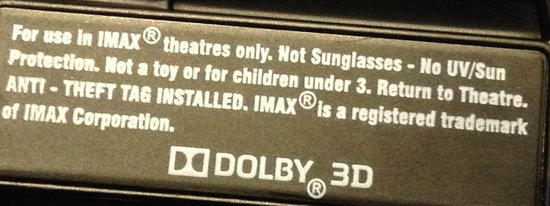
Dave is correct, the new glasses and the system uses a number of Dolby Technologies. The Dolby 3D logo is listed with the IMAX brand name for everyone who attends an IMAX laser presentation to see.
Posted by Marcel Birgelen (Member # 6801) on 12-22-2014, 05:40 AM:
quote: Dave Macaulay was the last to post
No.
And what, besides the IMAX label, makes it so special compared to the standard install?
quote:
Funny, only when you read the article in CTM about the Barco DP4K-60L projector, you will learn that it DOES include the laser light sources and seemingly offers a one-box package - but then you notice six(SIX!) thick cooling tubes running to a huge cooling rack in the background. So, after all, the needed real estate is similar to the Christie 6P solution with the remote fiber coupled laser rack - just that the 'tubes' leading to the projector head(s) are a lot thinner ;-)
Yeah, the Barco DP4K-60L also uses external light sources. Having seen both the current Barco and Christie laser projectors, I don't understand why the Barco machine is such a bulky beast, given the fact that both use external light sources fed trough fibers.
Posted by Antti Nayha (Member # 4980) on 12-23-2014, 08:38 AM:
quote: Carsten Kurz
when you read the article in CTM about the Barco DP4K-60L projector, you will learn that it DOES include the laser light sources and seemingly offers a one-box package
quote: Marcel Birgelen
Yeah, the Barco DP4K-60L also uses external light sources.
quote:
the DP4K-60L features a fully integrated system with unified laser light sources that are housed inside the projector, ensuring high durability and system efficiency.
(Barco)
![[Confused]](confused.gif)
Posted by Paul Gordon (Member # 3320) on 12-23-2014, 08:54 AM:
Of note IMAX had been testing the new Laser projection system at the closed Cinesphere in Toronto over the last year. Interested to see what kind of images it will produce.
Posted by Stephen Furley (Member # 1277) on 12-23-2014, 11:33 AM:
Cinema Technology magazine is now available on the MPS website from which trailers and some KDMs are downloaded here in the UK. Don't know if it is available elsewhere in the world.
Posted by Terry Lynn-Stevens (Member # 7349) on 12-23-2014, 11:45 AM:
quote: Paul Gordon
Of note IMAX had been testing the new Laser projection system at the closed Cinesphere in Toronto over the last year.
So I guess IMAX had the first laser installation? ![[Cool]](cool.gif)
Posted by Kris Verhanneman (Member # 5562) on 12-23-2014, 11:51 AM:
quote: Marcel Birgelen
Yeah, the Barco DP4K-60L also uses external light sources. Having seen both the current Barco and Christie laser projectors, I don't understand why the Barco machine is such a bulky beast, given the fact that both use external light sources fed trough fibers.
The DP4K-60L doesn't use external light sources. It are just a few tubes to cool down the lasers. The fridge and projector arn't even noisy.
Posted by Terry Lynn-Stevens (Member # 7349) on 12-23-2014, 11:52 AM:
quote: Paul Gordon
Of note IMAX had been testing the new Laser projection system at the closed Cinesphere in Toronto over the last year.
So I guess IMAX had the first laser installation?
quote: Paul Gordon
Interested to see what kind of images it will produce.
If you are in the Toronto area you can see for yourself (and hear for yourself ![[Razz]](tongue.gif) ), the Scotiabank now has it installed. There is an IMAX engineer at the facility doing tests during my screening. There is a lot of Dolby technology used for this system. Also, there is some Dolby advertising included with the IMAX branding.
), the Scotiabank now has it installed. There is an IMAX engineer at the facility doing tests during my screening. There is a lot of Dolby technology used for this system. Also, there is some Dolby advertising included with the IMAX branding.
Posted by Dave Macaulay (Member # 813) on 12-24-2014, 07:27 PM:
The IMAX laser projection system uses the Kodak technology, with 3 laser primaries feeding the 3 DMDs. The other laser systems I have heard much about combine the primaries into "white" light and feed that into a relatively normal light engine.
It is a 6P 3D system, using Dolby style glasses. Extinction looks better than normal Dolby 3D: possibly because the colours are pure single wavelength rather than band filtered white light?
Posted by Terry Lynn-Stevens (Member # 7349) on 12-25-2014, 11:45 AM:
Dave, have you had a chance to see (or hear) a demo of the new IMAX laser set-up at the Scotiabank in Toronto?
Posted by Marcel Birgelen (Member # 6801) on 12-25-2014, 05:00 PM:
quote: Kris Verhanneman
The DP4K-60L doesn't use external light sources. It are just a few tubes to cool down the lasers. The fridge and projector arn't even noisy.
Thanks for the clarification, it explains a lot. It's a little confusing, because there are exactly three tubes if I remember correctly. I didn't know the big box was just a chiller and not the RGB light sources themselves, but this explains the bulkiness of the DP4K-60L.
P.S.: I guess Barco must be somewhat disappointed you went for Atmos for your Ultra concept rather than Auro 3D ![[Smile]](smile.gif) .
.
Posted by Carsten Kurz (Member # 5396) on 12-26-2014, 01:06 PM:
Actually there are six tubes to/from the chiller. And yes, it does look very much like the Christie solution at first until you notice these six tubes can not be fibres.
I heard some basic numbers for these projection systems now - close to 500.000US$ for the Christie (dual projector head), around 350.000 for the Barco.
I assume the basic light output of these machines is about the same, around 60.000-70.000 lumens, but the Christie can output this luminous flux simultaneously from both projector heads, practically doubling it for 3D applications?
quote: Terry Lynn-Stevens was the last to post
So I guess IMAX had the first laser installation?
Not really, aside from some temporary prototype installations, Christie was first with a permanent installation:
http://variety.com/2013/film/news/laser-movie-projector-gets-first-permanent-home-1200585999/
- Carsten
Posted by Marcel Birgelen (Member # 6801) on 12-26-2014, 06:03 PM:
quote: Carsten Kurz
Actually there are six tubes to/from the chiller. And yes, it does look very much like the Christie solution at first until you notice these six tubes can not be fibres.
Which makes sense too, because you really want to circulate your cooling liquid I guess ![[Wink]](wink.gif) .
.
quote: Carsten Kurz
I assume the basic light output of these machines is about the same, around 60.000-70.000 lumens, but the Christie can output this luminous flux simultaneously from both projector heads, practically doubling it for 3D applications?
I've not yet seen a 3D movie in production on the Barco machine. I've seen 3D content on a demo setup, but the brightness didn't really blow me away. I will give the Kinepolis setup in Antwerpen or Brussels a try shortly, so I can do my own rather subjective comparisons.
The Christie Dual 3D setup is the first production setup which I've seen which will really deliver 3D at the brightness of 2D on a large screen.
Additionally, the wider color gamut pictures look really great, but not cinematic at all. Maybe it's the ideal platform for computer games on giant screens .
Posted by Carsten Kurz (Member # 5396) on 12-26-2014, 07:24 PM:
Is that screen size documented?
When I consider my own numbers from above - a common Barco DP4k-32B delivers 30.000+ lumens. The DP4k-60L delivers 60.000 lumens. The 6p/Dolby 3D efficiency is about the same as that of a RealD XL system, around 23-25%. That means, a single DP4k-60L lumenwise replaces a twin-DP4k-32B stack with RealD/silver screen (at three times the price - not including bulb cost).
But a dual DP4k-32B is not uncommon for large screen installations.
Yes - no silver screen necessary, no hot spot, better stereo separation, sllghtly higher overall contrast. But not really a breakthrough from a cinemagoer's perspective. The DP4k-60L ENABLES Dolby 3D for large screens, but it can not keep the '14fL Dolby 3D promise' for these screens, only for medium size screens.
While the Christie solution costs considerably more, I assume it would result in a significant increase in 3D brightness. Don't know if Barco is ready for stacked operation of two DP4k-60L. And the cost, wow...you can burn a lot of 7kW bulbs for that upcharge.
Really wondering what the IMAX solution looks like - it's designed to fill the largest IMAX screens. How many lumens would you need to accomplish this, and in 3D with 25% efficiency? And in how far will Barcos IMAX solution be different from their own general market DP4k-60L?
- Carsten
Posted by Marcel Birgelen (Member # 6801) on 12-27-2014, 05:06 AM:
quote: Carsten Kurz
Is that screen size documented?
My direct comparison would be JT Kerkrade against the Dolby Cinema setup in Eindhoven.
Auditorium 1 JT Kerkrade (XD PLF concept):
2 x Barco DP4K-32B
Circular polarized 3D using a silver screen
Roughly 24x10m ~ 240 sqm
Auditorium 6 JT Eindhoven (Dolby Cinema):
Christie 6P dual projector setup
Dolby 3D
Roughly 20x12m ~ 240 sqm
For the record, both screens feature Dolby Atmos.
Obviously, the screen in Kerkrade is a scope screen, so it loses some light if fully covered and has a smaller surface than the screen in Eindhoven for features presented in flat.
I’ve not seen the new Kinepolis setup using the single a DP4K-60L for 3D presentations.
The screen in Kerkrade is sufficiently bright for standard 2D presentations, but nothing to write home about. There is some hotspotting, but you need to look for it to see it. There are some reflections of exit lights on the screen, which are more troublesome.
For 3D presentations, the brightness is just acceptable and really not that great. It’s the best you can do with conventional Xenon bulbs or you need to add another two projectors to the setup, which will cause you quite some headaches, as Barco doesn’t currently offer a seamless convergence solution for their DCI gear.
Also, there’s always some noticeable crosstalk, especially in the ever-present subtitling.
The Dolby Cinema setup has already a few advantages built into the design of the auditorium. The dark, paneled walls, the plain white screen and the almost complete absence of other ambient light bouncing off the screen will create a larger contrast to begin with. So, the comparison might be an objective one, based on all factors, but still the difference for 3D is night and day, compared to the setup in Kerkrade. For 2D, it’s not really that obvious. The picture surely is bright, but nothing you couldn’t recreate on a somewhat smaller screen using a powerful projector like the DP4K-32B.
The Kinepolis screens in Brussels and Antwerpen are both about 23x10m, so a comparison would be based on roughly the same screen sizes.
Comparisons are obviously subjective, but in the end the perceptions of the average visitor is the thing that counts most.
Posted by Marco Giustini (Member # 4544) on 12-27-2014, 05:06 AM:
I was told that Dolby 3D on 6P lasers is "close to the physical limitation of 3D" which is 50%. I was not given a real world figure though. Where did you take your numbers?
A dual projector system is not practical for the real-world installations. The tweaks it requires and the maintenance required makes it suitable for special venues only - IMHO.
Posted by Steve Guttag (Member # 268) on 12-27-2014, 09:00 AM:
For 3D, real-world is no big deal with dual projector. If the images are not in precise alignment it doesn't really matter that much
For 2D, it matters greatly since any misalignment comes off of resolution and eventually appears as a double-image. However, if you check out the Christie Duo system in person...it can auto-align and it is impressive, to say the least. It can maintain corner-to-corner alignment rather well. So if you need the light, even with xenon, it is a viable real-world system. Naturally, you'll be spending a bit more on your projection set up...however, one presumes that you have sufficiently large auditorium to justify having a dual projection system in the first place.
As for the concept of mere dual projection in a 2D environment...we have theatres doing that due to poor design/lack of concern by the theatre all of the time with Real-D theatres. Most are aware that most Sony systems with Real-D leave their 3D lens in. Real-D XL in the DLP theatres also is putting out a dual image in 2D and the alignment is far worse than most people think from corner-to-corner. I've spent quite a bit of time trying to get them as good as possible but one rarely gets it dead on. I suggest using a dense cross pattern like NEC's 8-bit cross...that has a pretty decent grid that will let you see how you are doing on magnification.
Posted by Marco Giustini (Member # 4544) on 12-27-2014, 03:29 PM:
Two projectors require two lamps, and two maintenance schedules. In a world where changing a lamp can be a challenge and mis-installed lamps happen daily, that is a problem.
I am not familiar with the Christie Duo though, so I'm assuming that converging the projectors is not a problem. But does it do it automatically or does it require any human action? In the latter, even though it's just pressing a button then it's out of the question.
After all, the RealD XL unit could be moved away in less than 2 seconds but as Steve points out it is seldom done by theatres.
Posted by Steve Guttag (Member # 268) on 12-27-2014, 04:00 PM:
Again...presuming one is considering a dual projector system...the screen in question is probably sufficiently large to make it worth while. Naturally, it isn't the solution for all screens. A hope of laser technology is the ability to use a single laser projector for most large cinemas. The dual-projector thing is normally for very large screens, particularly with 3D. A format that I, personally, hope continues to die away. The numbers I recently saw at a local theatre show that it is making less money and definitely drawing fewer patrons than 2D...by a very significant amount (drawing less than 20% of the 2D shows)
As for Christie...the lamp alignment is second to none...it does a VERY good job and the duo convergence is not something I've had to work with...just seen it demonstrated...it was spooky good. Note...if one needs to realign it on any sort of regular schedule...if your theatre is too pathetic to have someone reliably do that with a push of a button...then automate it...that wouldn't be rocket science either.
Don't be so fast to condemn something you haven't personally worked with as not real-world worthy just because it may not work in your world. We definitely have the technology at our access in this day and age to minimize, if not eliminate, most human involvement in repetitive tasks.
Posted by Marcel Birgelen (Member # 6801) on 12-27-2014, 04:22 PM:
quote: Marco Giustini
After all, the RealD XL unit could be moved away in less than 2 seconds but as Steve points out it is seldom done by theatres.
There are multiple reasons why this, unfortunately, is the standard:
- Mixed bookings of both 3D and 2D movies in the same theater.
- Getting it out of the way isn't hard, putting it back in and getting the convergence of the two images right is another thing...
Both are lame excuses, but real world scenarios.
Posted by Steve Guttag (Member # 268) on 12-27-2014, 06:20 PM:
Nonsense. At least for Real-D XL. There are XL movers from Strong and MiT to automate the DLP experience. For Sony, MiT has one that will, at least, move the polarizers out of the way. But yes, it will still have the stupid dual 2Kish image left.
Posted by Marcel Birgelen (Member # 6801) on 12-27-2014, 07:06 PM:
No, it's not nonsense, rather unfortunately. It's not that I agree with such practices, but it happens and those are the main reasons why it happens.
I know about the RealD XL movers, but at least around here, they aren't common. It's all about cutting corners, mostly at the wrong end though. Instead of investing in a proper mover, they rather drive up the lamp to somewhat compensate for the lost brightness in 2D...
quote: Marco Giustini
I am not familiar with the Christie Duo though, so I'm assuming that converging the projectors is not a problem. But does it do it automatically or does it require any human action? In the latter, even though it's just pressing a button then it's out of the question.
Basic realignment for DuoAlign can be automated via macros. It uses a CCD camera together with a bunch of calibration paterns for the final steps of automatic alignment.
Posted by Marco Giustini (Member # 4544) on 12-28-2014, 06:05 AM:
Steve,
I believe you misunderstood me. If it was for me, all cinemas would have the best projection and sound system available and a skilled technician on site doing daily checks on everything. That is the only way I know to run a cinema.
I do not condemn anything, I'd love to work with a dual projection system or with whatever you can think of. But I can see what happens around me and my comments are based on that.
On most of the installations I see around the Christie LampLOC is never used. Why? Because they don't care/nobody is in the booth/they don't know about that - take your pick. Even adjusting picture focus and volume can be a problem sometimes.
And if the chain is leaving the XL unit in all the time, are you really expecting that they would send someone to check the convergence of their dual projector system every now and then? Or - even better - that they have someone capable of evaluating the system and adjust it?
Again, don't get me wrong, I am not discarding the DUO or anything else. I am just imagining those systems in my world and I can see that they're not going to work!
Marcel, the XL convergence will NOT change when the unit is moved in and out - unless you slam it to the stops! It is a 5 seconds job but if you don't have personnel available, you can't risk to start the next 3D show with no 3D. As you point out mixing 2D/3D shows does not help.
Posted by Carsten Kurz (Member # 5396) on 12-28-2014, 08:42 AM:
quote: Marco Giustini
I was told that Dolby 3D on 6P lasers is "close to the physical limitation of 3D" which is 50%. I was not given a real world figure though. Where did you take your numbers?
I took these numbers from a current Barco Whitepaper on their laser technology.
http://www.barco.com/~/media/Downloads/Presentation/NAB14_BARCO%20pdf.pdf
Also the general energy efficiency is not SO much better than for Xenon. Don't know if they even include the power needed for the chillers into their calculation. Okay, this is their first commercial laser product, so they may be able to improve that later.
While the Christie solution is similiar, so far I haven't seen any Dolby 3D branding for the Christie 3D setup. It seems to me that laser based 6P spectral separation is not covered by the existing Infitec patents/Dolby license. So it may be that Christie can do without Dolby. The Christie Duo solution does near-perfect automatic alignment. Aside from the mirror, it is a bit similar to the IMAX automatic alignment system. You need both projectors to have a Christie IMS/IMB installed though, as part of the alignment takes part in the image processing part of the IMS (as in the IMAX raster processor).
- Carsten
Posted by Steve Guttag (Member # 268) on 12-28-2014, 10:49 AM:
I did understand you and while you can certainly point to theatres around you that won't move a Real-D XL out of the way...I can point to many, many that will and others that have purchased some form of automatic mover to ensure that the task gets done. Likewise on the Christie LampLOC. Remember, I have "real-world" theatres too...they are not all screening rooms and special venues.
I took the comment regarding Sony's 2D/3D thing to mean that it wasn't just the polarizers but the physical 3D versus 2D lens itself...hence the convergence realignment once the dual lens is reinstalled. That the comment was not directed towards a convention RealD-XL.
Posted by Marco Giustini (Member # 4544) on 12-28-2014, 06:28 PM:
I honestly hope you are right and I am getting a little too pessimistic - honestly. There are lessen and lessen cinemas/theatres doing "film" right nowadays. Every now and then I think of one where I would like to pay and watch a film myself and I usually struggle to come up with a place.
2D/3D: I didn't realise we were talking about Sony? If the subject was Sony, convergence does not really matter too much. If the cinema cares enough to swap the lens - with the 515 and lens changing table it is in fact quite easy - when the 3D lens is in, it means the cinema is showing 3D. And as Steve pointed out, alignment with 3D content is not critical.
But I still have on my mind this 'projectionist' saying 'we can't be bothered swapping lens, we just put a 3D cue and it's ok'.
Again: I honestly hope I'm just getting too old and too pessimistic
Posted by Marcel Birgelen (Member # 6801) on 12-28-2014, 06:56 PM:
quote: Marco Giustini
Marcel, the XL convergence will NOT change when the unit is moved in and out - unless you slam it to the stops! It is a 5 seconds job but if you don't have personnel available, you can't risk to start the next 3D show with no 3D. As you point out mixing 2D/3D shows does not help.
Well, many multiplex operations here run more or less on auto-drive. Maybe there's someone around with just the most basic level of knowledge, but there's often nobody around to go swap non-automated polarizers after/before every show. So, those things will, in many cases, just stay where they are...
Convergence of RealD XL is an issue, if you keep getting the unit out and putting it in after each show, especially if done in a hurry, it will start to suffer.
Posted by Marco Giustini (Member # 4544) on 12-29-2014, 03:20 AM:
Marcel, I believe we are on the same page.
About the XL unit, I don't doubt the alignment will require a little tweak after a while, what I am saying is that it won't require a technician EVERY time you move it in and out.
And anything done in a rush is likely to have an awful outcome!
Posted by Dave Macaulay (Member # 813) on 12-29-2014, 10:05 AM:
It takes a good whack to throw the XL out of alignment much but "best possible" is still not good enough for 2D, if you care about presentation quality. Fine for 2D trailers in a 3D show but shabby for a 2D feature.
If your staff is slamming the XL in and out (assuming the rails are lubed properly so the unit slides smoothly and easily), they need some attitude adjustment - or you need some new staff.
Powered by Infopop Corporation
UBB.classicTM
6.3.1.2