This is topic JSD 60D crossover in forum Digital Cinema Forum at Film-Tech Forum ARCHIVE.
To visit this topic, use this URL:
https://ft-forum.com/ft/cgi-bin/ubb/ultimatebb.cgi?ubb=get_topic;f=16;t=002176
Posted by Marco Giustini (Member # 4544) on 01-17-2015, 05:05 AM:
I'm looking for some feedback on the crossover option in a JSD-60D. Does it work well?
I have used Behringer's in the past: they're ok for home use, not for professional use - not reliable.
What would a good budget alternative be, without going for a DCM?
Harold's opinion also very welcome! ![[Smile]](smile.gif)
Posted by Stephan Shelley (Member # 8587) on 01-17-2015, 02:16 PM:
I was involved in s retrofit of a theatre that had been using the crossover option in a CP-45. The JSD-60D worked out well. It has been over a year and no problems. I have had some issues with the QSC crossover monitor. One was issues with the surround input from a 650. Even though I programed it it did not want to enable the special input from the 650 surrounds. After finally getting it to work correctly a few months after the install it disabled itself. Also one nit to pick is that since they started making there own speakers the library of configurations only includes there own.
A little off topic but the JSD-60D has a drive-in mode too.
Another option is the USL moniter crossover.
Posted by Mark Gulbrandsen (Member # 72) on 01-17-2015, 06:34 PM:
I just can't say anything at all bad about the JSD-60 or the JSD-100. I have installed hundreds of them and not a single failure of one unit. Some JSD-100 are nearing five years old now.
Mark
Posted by Harold Hallikainen (Member # 5405) on 01-19-2015, 11:37 AM:
Thanks for the comments! There are, of course, several places in the signal chain the crossovers can go. As mentioned, the JSD-60 supports biamp of three screen channels. The manual at http://ftp.uslinc.com/?dir=ftp/Products/JSD-60/ provides a fairly extensive description. The GUI is also there for you to try. There's also a beta version available that adds support for AES/EBU outputs and BLU link outputs.
The USL monitors with crossovers has already been mentioned. There's now also a separate crossover that uses the same cards as the monitors. See the XTM-300A and XTM-300D at http://ftp.uslinc.com/?dir=ftp/Products .
Where to place crossovers is an interesting area for discussion. Some speakers include crossovers that are matched to the speakers, but these tend to be inefficient and may be overly simplified since power components are used. Next, many amplifiers include DSP crossovers. Crossovers can be moved back up the signal chain to between the processor and amplifiers, or back into the processor itself. Since the processor already has one or more DSPs, adding crossovers there is not overly complex or costly. It does add hardware in most cases. With the BLU link (or similar networked audio outputs), no additional hardware is needed.
Placing the crossovers in the processor is probably the lowest cost method since no additional devices or DSP-based amplifiers are required. This also keeps all the audio settings in one device simplifying setup and (heaven forbid) equipment swap outs.
THANKS!
Harold
Posted by Steve Guttag (Member # 268) on 01-19-2015, 01:42 PM:
You're not trying Mark...I can say something bad about most anything...including stuff I like!
I'm not a fan of crossovers in the processor but understand why some may like the idea. In our systems, that adds wiring to the monitor and often limits one a bit on the type of crossover you are going to use. For example, the JSD60 sports a L-R 24dB/Oct crossover. Is that what you need? Perhaps and it is a good type of crossover if you only have a choice of one.
We are often tri or even quad amping speakers now...again a cinema processor is going to fall a little short in that department, most of the time.
Putting the crossovers in the monitor makes a certain amount of sense as wiring is not complicated then. Certainly QSC has done well with the DCM line of monitors and THX also took this approach. A potential downfall in this is I've found most booth monitors to take a "cheap" approach to construction...it can be risky to run your signal through a cheap monitor. I've seen numerous audio drops due to poorly made booth monitors being the "Tie" point between the cinema processor and the amplifier. We always wire our systems such that the monitor can be removed without interrupting signal flow...unless it is a monitor/crossover or a cinema processor/monitor/crossover.
The vast majority of our systems use separate crossovers (now DSP based) and if we do that, we normally leave the cinema processor EQ flat as almost all use Graphic EQs rather than parametrics. One can tune MUCH better with parametric EQs.
The notion of the amplifer having the DSP with the crossover is an interesting one though I've found that beyond the crossover, they are often too limited and awkwardly configured. Plus...when the amplifier fails it may not be a simple task to swap it out as the DSP stuff died with the amp. If you didn't put the system in, there may not be a good back up either.
Another thought is to use self-powered speakers and let the speaker manufacturer handle the amplifier and crossover. That would make tuning go pretty fast since it should be "flat" out of the box. Wiring would all be with low-level small cables and one merely need have outlets for each speaker.
Posted by Carsten Kurz (Member # 5396) on 01-19-2015, 02:22 PM:
I know a lot of cinemas using the cheap Behringer DCX2496. In a fixed installation and properly set up, they are not that bad. Good thing is, they have both analog and AES/EBU inputs. You can network them using RS232/RS422. If your cinema processor fails, you can actually bypass it and use your bunch of DCX2496 as your CP as long as your real box is under repair. You can actually control all centrally from a laptop, level, have analog Non-Sync options, etc.
Having a fail-safe option is sometimes more important than the highest level of audio fidelity, especially with Bi- or TriAmped systems where you can not simply throw in any other device.
These Behringers have been built for mobile/PA use. They may not be the most reliable under heavy use in that environment, but under stable cinema condition, I would consider them a decent choice. Plus, they come at a price where you can easily stock a spare.
- Carsten
Posted by Marco Giustini (Member # 4544) on 01-19-2015, 02:37 PM:
Thanks all for your feedback.
In my case, the cinema owner already has a JSD60 and it would make sense just to purchase the crossover card. It's a budget installation, but they're looking to upgrade the speakers.
I have some experience with DCX2496. They used to work fine in a home environment. An acquaintance of mine has had to replace his three times in his cinema, and the faulty ones were coming back from Behringer with the same intermittent fault. Eventually he had to open them and fix the poor connections by himself.
I also heard of a big chain which went for Behringers and are now replacing at least one unit every month.
Behringer used to feature an advanced replacement - which was great for a cinema - but they discontinued it. To have a DCX repaired it took more than a month if memory serves. Unacceptable for a cinema.
Sorry, I may consider those for my Home Theatre (the crossover actually works very well in terms of sonic performances) but I can't recommend a DCX outside the enthusiastic realm.
Posted by David Buckley (Member # 2600) on 01-19-2015, 02:56 PM:
I too have had unfortunate experiences with the berry DCX2496. Which annoys me as loads of people use them without problem! Thus I wouldn't recommend them for high availability use unless you have a spare and switching so you can flip to it instantly.
However, even if you buy two (or three, or four), you're still saving money compared to a quality and feature equivalent DSP crossover. Having said that, its functionally not a great match to the requirements of a cinema looking to do 5.1.
Posted by Marco Giustini (Member # 4544) on 01-19-2015, 02:58 PM:
I didn't realise a Beringher was so cheap? There are DSP's everywhere these days, are DCX still massively cheaper than competition?
Posted by Steve Guttag (Member # 268) on 01-19-2015, 04:11 PM:
Carsten,
Speaking of failsafes...I had a site where the amplifier failed for Center channel...faster than they could swap an amp, I remoted into the DSP crossover (RANE HAL based system) and fed Center out of Left/Right. I've done the reverse too...if the Left/Right amp filed...monoed up everything and fed out of center. In fact, you could set up presets so that they would go even faster...but thankfully, this is not a common occurrence.
Personally, I don't think enough consideration is given to the whole crossover and how the speakers are tuned, as a general statement. I've also found that most "factory" specs on tunings to be not real-world. The surprising one is that the delay for time-alignment is often worse than no delay at all.
Another thing is all DSP isn't created equal as far as sound quality . High bit/sample rate is no guarantee of better sound quality either. I've definitely heard 16/48 out perform 24/96 though 24/96 should win every time. It is why I do get fussy on the stuff I use that has a direct affect on sound quality.
Posted by Marco Giustini (Member # 4544) on 01-19-2015, 04:19 PM:
quote: Steve Guttag
I've also found that most "factory" specs on tunings to be not real-world
Me too. The point is that most installations are just 'factory', single mike in the Dolby position, X-curve and go to the next auditorium.
quote: Steve Guttag
Another thing is all DSP isn't created equal as far as sound quality
That is exactly what I was asking in the first place. I'm sure the JSD60 can split the band in two or three, but does it do that right? Does it sound right? Does it do a decent job or would an external crossover be much better in term of sound quality?
Posted by Carsten Kurz (Member # 5396) on 01-19-2015, 04:31 PM:
quote: Marco Giustini
They used to work fine in a home environment. An acquaintance of mine has had to replace his three times in his cinema, and the faulty ones were coming back from Behringer with the same intermittent fault.
I had that happen as well. As a matter of fact, once I received a Behringer with a handwritten failure description in the box as 'new'. And it still had that issue ;-)
But I think these boxes never really made it to Behringer, but only to your suppliers repair department and back ;-)
The Behringer DCX2496 can be bought for as little as 300€ here, or 250 without VAT. I think the closest competition with digital inputs go for twice ot three times the price. That add's up for all your screen channels. They are quite flexible with their analog and digital inputs.
I have never heard of any unusual failure rates around here. But that device is pretty old now and still selling very good. One reason for Behringer to keep it available. There may have been very different batches quality wise over the years, as Behringer had them manufactured in China. And yes, I would never install them without keeping spare at hand.
- Carsten
Posted by David Buckley (Member # 2600) on 01-19-2015, 05:22 PM:
quote: Steve Guttag
Personally, I don't think enough consideration is given to the whole crossover and how the speakers are tuned, as a general statement.
I believe that to be a true statement, and with far wider applicability to cinema.
The discussion about the Berry DCX is all very well, but for a cinema you need a lot of them (assuming screen channels are identical) with a bunch of wiring. The Rane HAL system mentioned is one of the "drag n drop" DSP solutions that are just so much better than everything that went before them, others being Soundweb (where this paradigm started), Symnet, and there's more that I cant remember right now. These really come into their own where there are lots of inputs or outputs or both, and now that digital audio networking is commonplace, these solutions provide an especially great solution. The only problem is that they are relatively expensive. Perhaps more annoyingly, they expensive for what they are.
Posted by Carsten Kurz (Member # 5396) on 01-19-2015, 05:56 PM:
Would be less annoying if you'd use them to replace both crossover AND cinema processor. After all, a current digital CP is nothing else than a HAL, Soundweb, etc., with a single parametric 'cinema processor' preset.
On the other side, if the CP has digital crossover functionality, why should that be inferior to a crossover implementation in a configurable Audio DSP box? Okay, most CPs do not have enough I/O to implement Tri- oder Quad-Amping.
- Carsten
Posted by Steve Guttag (Member # 268) on 01-20-2015, 06:37 AM:
I think the design emphasis is much different. No, there is no reason why the CP can't have a good crossover design. QSC makes their DCP line and the crossover in there is at least as good (actually better) than what is in their DCM and most any other cinema processor based crossover. It is still limited as compared to one of the various DSP boxes.
While it is true that if all you wanted from the DSP is a good crossover, the DSP solutions are a bit pricey...but when you factor in tuning as well as possible other channel routing, mixing, leveling...they become more economical. Also, one has to factor in cost/performance. If they do the job better and yield a consistently better result, then part of what you are paying for is quality. Why does a QSC SC-424 cost so much more than some cheap Peavey speaker? Well one does a MUCH better job than the other. I claim that crossover and EQ have a great affect on the outcome of the sound. As such, paying more for a better piece is a reasonable expense. For us, the RANE HAL3S offers quite a bit of bang for the buck (and rackspace). Out of the box, it is a 2x6 DSP (stereo 3-way) but adding two RAD-16s to it it becomes a 6x10 DSP so you can effectively set up an entire 5.1 system.
One thing most DSP based systems now get you are the ability to remotely locate your inputs/outputs where needed. This can also facility lowering the costs of big heavy copper runs.
I have discussed the concept of using a HAL1x system (with Rane) as the cinema processor as well as DSP. Cost wise, it is on par with a DCP300 system with similar ins/outs. What you miss out on generic DSP systems, typically, are "pro-logic" decode blocks. Since DCinema felt the need to issue "2.0" DCPs...including the home-made stuff...one really does need a "proper" pro-logic decoder in there somewhere. A simple L+R/L-R system really isn't sufficient. That is really a "better than nothing" solution. I know some that have used Basis as the Cinema processor but again without Pro-Logic capability.
The JSD60 has the pro logic decoder...BUT it, at the present time, doesn't work with the 1/2 input! I've considered using a passive splitter to send 1/2 to both the 1/2 input and the S/PDIF input (impedance matched) on this and other processors to get the pro-logic decoder. QSC promises to activate their decoder for the Digital inputs on the "next" release (they only have it on the other inputs).
Posted by David Buckley (Member # 2600) on 01-20-2015, 02:26 PM:
One of the undoubted benefits of DSP based solutions, in both the drag 'n drop and fixed function variants, is that all the smarts are in software, so the manufacturer can change their mind once the product is shipped, and change things in a way that prior to the DSP revolution was just not possible.
I've done paper and setup software evaluations of a few of the cinema boxes (based on advice received on this very forum) and, of these, the JSD60 appears to the more flexible box than most others. Certainly, if our cinema is ever reborn in the digital era, the JSD60 is at the top of the list in the sound department.
Thus, given its all just software(!), and USL are well represented on this forum, couldn't the JSD60 be fixed?
Posted by Andrew Thomas (Member # 7000) on 01-20-2015, 04:24 PM:
Is there a technical reason the JSD 60 can't play 5.1 tracks from the toslink or digital coax port, or is it just product differentiation?
Posted by Steve Guttag (Member # 268) on 01-20-2015, 06:58 PM:
The JSD60 can decode AC3 and DTS tracks via the Toslink/S/PDIF port. The lack of ability to decode Lt/Rt from AES 1/2 on the main input I hear is an intrinsic thing due to the architecture of the unit.
In terms of all out DSP and flexibility for a Cinema specific product, the Datasat AP20 probably would win that race.
The JSD60 has a lot of bang for the buck though and it is in a very tidy 1U frame.
Posted by Carsten Kurz (Member # 5396) on 01-20-2015, 08:00 PM:
I inquired at USL a while ago about the possibility of matrix decoding for main/AES/EBU inputs, and back then USLs Tom Atkinson replied:
'The JSD-60 processor we have will do matrix decoding for the AES/EBU input. This is the only processor that we have that is capable of doing this.'
- Carsten
Posted by Andrew Thomas (Member # 7000) on 01-20-2015, 08:21 PM:
quote: Steve G.
The JSD60 can decode AC3 and DTS tracks via the Toslink/S/PDIF port.
As per the JSD 60 manual, the toslink and digital coax seem to be stereo inputs only. Anytime I have connected a device to them, it is stereo playback only. Am I missing something?
quote: USL JSD 60 manual
Two Channel Digital Inputs
The JSD-60 has an S/PDIF input and a TOSLINK input.
S/PDIF Input. A stereo digital input on an RCA connector marked COAX. It is a standard S/PDIF (Sony Philips
Digital Interface) input. Connect to appropriate sources with 75 ohm coaxial cable with RCA connectors on
each end. As with the other stereo inputs, various decode methods are available.
TOSLINK Input. A TOSLINK optical digital stereo input is included on the JSD-60. Connect this input to an
appropriate source with a standard TOSLINK cable. As with other stereo inputs, various decode methods are
available
Posted by Harold Hallikainen (Member # 5405) on 01-20-2015, 09:09 PM:
The JSD-60 can decode Dolby Digital or DTS on S/PDIF or TOSLINK inputs. It was not anticipated that there would be a need to decode the multichannel AES/EBU input since DCI specified that the media block would output PCM. The hardware has four DIR/SRC chips (digital receiver / sample rate converter). Chips 1-3 drive the DSP with L, R, C, LFE, Ls, Rs from the AES/EBU inputs. Chip 4 receives AES/EBU pair 4 which can carry HI/VI or Lrs/Rrs depending on the server routing. S/PDIF and TOSLINK drive DIR/SRC number 4. Its output can be routed directly to the DSP for stereo. As an alternative, the output of DIR 4 (SRC is disabled for this since it would mess up the binary encoded data) is routed to the optional DI-84 board which decodes Dolby Digital or DTS. It also applies an "active matrix" to unencoded (stereo) audio. The DI-84 has 3 I2S outputs carrying 6 channels back to DIR/SRC 1-3 sending the decoded L, R, C, LFE, Ls, and Rs to the DSP, just as was handled with the PCM AES/EBU input. It IS possible to decode DTS or Dolby Digital on the AES/EBU input, but, based on the description above, it is decoding AES/EBU pair 4. This is of limited usefulness, but that's the way the hardware is done. The JSD-60 is designed to be as flexible as possible at a reasonable cost. It has its limits, but should serve the vast majority of auditorium requirements.
Thanks for the comments on the JSD-60. I had a large part in its design and like the way it turned out. Coming up soon are AES/EBU outputs and BLU link outputs.
Harold
Posted by Dave Macaulay (Member # 813) on 01-21-2015, 10:05 AM:
That suggests that rerouting AES pair 1 (L/R) to pair 4 (normally HI/VI) could allow decoding from a DCP with encoded stereo on L/R. Doremi servers can reroute the AES outputs, I'm not sure others have this capability.
I don't know if the JSD-60D processor includes the logic to allow this though, it would need to activate the 4xAES input and then route pair 4 through the decoder and the decoder outputs to the main outputs.
Posted by Harold Hallikainen (Member # 5405) on 01-21-2015, 10:34 AM:
Yes, the JSD-60 can do that. I have to see if the gui supports it now, but salecting "active matrix" will route as you describe.
Harold
Posted by Steve Guttag (Member # 268) on 01-21-2015, 04:05 PM:
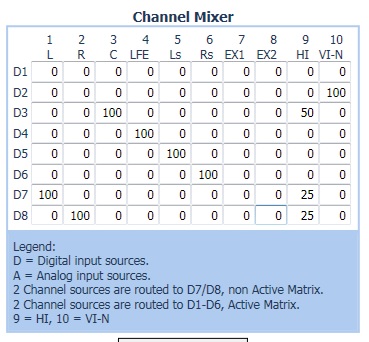
I was wondering...why not just wire the JSD60 input so that AES 1/2 lands on the 7/8 input and vice-versa. Then in the "Advance" tab for "8 CH Digital" use the matrix to reroute the outputs. At that point, you could use the matrix on it. You'd just have to get used to AES 1/2 being on the 7/8 input when you wire it. I'm sure Odyssey could come up with a suitable board to avoid remaking cables (or USL could do it).
Posted by Mark Gulbrandsen (Member # 72) on 01-22-2015, 08:15 AM:
Steve, I always use an external crossover, USL or QSC depending on what speakers I'm installing. Internal x-overs are usually too limited in whatn hey can do. The main thing IMHO is that the processor power supply never crap out! ![[Razz]](tongue.gif)
Mark
Posted by Harold Hallikainen (Member # 5405) on 01-22-2015, 10:52 AM:
Speaking of "power supply never craps out," how important is "bypass" circuitry in a cinema sound processor? NATO specifies ( http://mkpe.com/publications/d-cinema/misc/NATO_Digital_Cinema_System_Requirements_release_2-1.pdf section 4.2) that cinema processors shall have a bypass mode where multichannel audio is mixed to mono in case of a failure of the processor. USL includes this in all processors, but it is a bit complicated and increases costs. How important is bypass? How important is a backup power supply? What is the most likely component to fail? Is it the power supply?
I look forward to comments!
Harold
Posted by Steve Guttag (Member # 268) on 01-22-2015, 12:04 PM:
I think it is very important...having a single point of failure is a problem with DCinema...so many single points of failure can bring the show down. It is not like in film cinema where normally one could keep a the show going with minimal cheap spare parts.
I'd think a market for the DAX 602 is as a "back up sound processor" Yeah, you don't have volume control (but could with a mulitgang pot) but in a pinch it could "save the day" if one's CP doesn't have a backup system.
Posted by Carsten Kurz (Member # 5396) on 01-22-2015, 03:05 PM:
Actually when I read the functional diagram of the JSD60 today, I had exactly these questions, Harold. Traditionally, analog cinema processors were complex devices with multiple cascaded, more or less autonomous functional blocks. It was rather easy to decide which blocks could be bypassed in case of circuit failures, and, technically, the analog signal at the input of the processor could still be used to drive an amp, even without slit-loss compensation, NR, dematrix, EQ, leveling.
Now, with processors for DCI systems, it is not easy to decide how much sense fallback systems make. You would either have to design redundant mixing stages, or separate certain functions explicitly to enable fallback functions. Most CPs end up in D/A stages today signalwise. One would think that ultimately, a direct hardwired route from AES inputs to a separate D/A bank and a following analog mixdown/adjustment stage would be the ultimate solution for a bypass system, with an optional backup power supply only for that part. But then questions like where to put the AES/EBU receivers, SRC, etc. turn up.
Also, should a bypass system switch over automatically to save a running show, or is it sufficient if a manual bypass switch has to be activated?
Yes, apparently, power supplies fail rather often it seems. Unlike most of the processor electronics, power supplies are usually OEM sourced. Which seems to imply issues with quality control and also stocking of replacements. A cinema nearby had an early failure of the powersupply in one of USLs competitors devices. It took them 2 months to supply a replacement at the time (which was not at the beginning of the production phase for that device, it was in full sale at the time). They received a temporary replacement CP quickly, but waited 2 months for the replacement power supply and their original CP to be repaired.
But Harold - you're at the source for that kind of information - how often do USL CPs fail, and which circuit parts/subsystems fail more often than others?
BTW - I built my own backup processor from three cheap ebay S/P-DIF DACs followed by passive adjustment pots. Input and output is DB25 and fits as a plugin replacement between the cables leading from the server/MB and towards the amps. It was very cheap and we can afford to have it stuffed in a drawer even if we never need it.
It seems the JSD60 is still quite complex. I would think the design of a CP would not need much more than AES/EBU receivers,maybe followed by SRCs, followed by a single beefy DSP, and then again digital outputs and a DAC bank. Then the only thing left to bypass would be the DSP, and feeding the I/O section from a backup supply. Get's more complex if an internal crossover is used. I guess that's one of the reasons the crossover in the JSD60 is optional. If it can operate autonomously, I can be part of a bypass scheme. If it's integrated in the main DSP, it becomes hard to bypass it without major changes to the amp/speaker wiring.
Yes, external crossovers with AES/EBU inputs can compliment a backup scheme, as I depicted earlier in this thread about those cheap Behringers. But they can also be seen as additional points of failure, especially when they ARE cheap Behringers.
- Carsten
Posted by Harold Hallikainen (Member # 5405) on 01-23-2015, 04:49 PM:
Thanks for the comments, and sorry for the delay (off at ICTA and ISDCF). Because of analog input routing, routing of digital through the DD/DTS decoder, allowing for various output types (analog, analog biamp, AES/EBU, and BLU link), what starts out as a simple processor gets complicated. I've tried to make it as simple as possible. Steve's idea of swapping AES pairs 1 and 4 is VERY CLEVER. I wish I thought of that! Because the JSD-60 has an input mixer for source selection, you can do all kinds of stuff, including things we did not think of.
On bypass, the failure rates on the JSD-60 are low enough that I really can't get any meaningful data. The power supply does not seem to be any less reliable than anything else. The bypass circuitry does get a bit complicated. Bypass consists of separate digital receivers for AES/EBU inputs, TOSLINK input, and S/PDIF input, separate D/A for all these, analog switching to get the appropriate input, a digitally controlled analog volume control, balanced analog line driver, analog switches that drop the bypass analog onto the outputs. For biamp systems, there's an additional passive low level crossover for bypass use. There's a microcontroller on the front panel that controls all this stuff and also communicates with the main processor when not in bypass (reads buttons, reads fader encoder, updates LEDs, updates display, etc.). So, bypass does add considerable complexity. And, the cost is in every unit. By the time you have 15 or 20 processors in a building, it might be cheaper to have a spare than to include bypass circuitry in all those units. But, swapping out a processor takes longer than flipping the switch to off (and into bypass). However, I've seen quite a few installations where they bypass power supply is not installed or plugged in, so the benefit is lost.
Again, I really appreciate feedback from users. It helps me design stuff that is useful.
Harold
Posted by Marco Giustini (Member # 4544) on 01-24-2015, 07:44 AM:
Thanks all for the feedback.
Carsten, the DCX we sent back to Behringer went indeed to Behringer UK, they came back with a workshop slip inside. I believe two units were purchased and they developed the same issue (crackling noise); they were returned from Behringer UK exactly as they left the customer. We marked a screw in one unit and when it came back the mark was still there, so they hadn't even been opened!
I understand the units were eventually fixed by the owner by soldering the flat cable directly on the PCB. I cannot recommend such units in a professional environment!
Posted by Carsten Kurz (Member # 5396) on 01-24-2015, 09:17 AM:
Marco, I certainly won't speak up for Behringers product reliability here, as I have my own fair share bit of experience with them, but you can find singled out experiences like yours for every manufacturer.
I know a lot of cinemas and PA service companies using these devices for years without issues. They have been introduced in 2005 - that is ages ago considering common digital audio device life cycles. And I can tell you they still sell like mad. If the budget is there for higher-class gear, of course, go with it. As Steve pointed out - Crossovers are not sexy. Clients love their servers, projectors, CPs, their huge speakers. But a 1HE unit with a cryptic name he is never to touch himself - it's not easy to make him pay multiple times the price of a Behringer.
When people choose a CP750 over a USL or datasat or QSC because of the cost, you won't suggest crossovers that cost more than a CP750.
- Carsten
Posted by Mark Gulbrandsen (Member # 72) on 01-24-2015, 01:03 PM:
In 99% of my installations bypass wouldn't be used anyway, so having it is really insignificant. Running a show in bypass is doing your customers a dis-service in a very rude way. No one wants to listen to the sound with no EQ, etc. With a JSD-60 or 100 I would rather have an entire separate back up processor in a large facility. Then you might loose what... one show while the processor is being swapped out and the backup settings are loaded in...
And no one makes multi gang faders any more excepting the audiophile people. And those in six gang type (DACT) are going to cost you nearly as much as another JSD-60!
The main thing to remember is to install processors that don't break down. And Harold's stuff fits that catagory.
Mark
Posted by Marco Giustini (Member # 4544) on 01-24-2015, 01:16 PM:
Carsten,
Sure, but my own DCX2496 was replaced by Behringer with another one with which came with a broken wheel(they sent another one, it happened when Behringer had that nice advanced replacement scheme in place)
When I contacted Behringer to replace the other two, they were rude and unhelpful and the "repair" took months. Hence no, I can't trust them.
If I'm selling a JSD60 to a customer who is trying to save money, I'd recommend the JSD card. If a Datasat, well it comes with a crossover. Same with QSC - if you want to call them crossovers, but that's another story.
If the customer wants to go with a 750 and a DCX I woulds stress that all our DCX have broken down and service is awful. On a bi-amp I would not recommend a 750 in the first place.
Then it's their call of course.
Posted by Steve Guttag (Member # 268) on 01-25-2015, 12:02 AM:
Hmm...I've never had a problem with specifying whatever crossover system I thought was appropriate for the system going in. We use CP750s on all sorts of systems from passive to quad-amped. The crossovers have been analog (e.g. the XC-3 on the amplifier), DSP based (like the offerings from Rane or QSC) or possibly in the booth monitor (but those are more rare for us having to do with the said monitor/crossovers). I just don't see the problem.
Having a backup system in place at the theatre does make sense. Mark does make a valid point about having a spare processor. Depending on the size of the complex...having a spare of whatever your sound processor is would probably be cheaper than having backup systems in EVERY processor, just in case. Using the CP750 as an example...we supply a back up power supply for the COMPLEX since it is just a plug-in on a 4-pin XLR. I think of all of the units we have installed, it has only ever been put on line once. Cloning the current generation of sound processors is so easy that putting a spare on line and having it be a 100% replacement probably is a better choice, over all.
The exception I would make is if the unit fails mid-show...nothing is suckier than having a seated audience not be able to see their show to completion. Being able to quickly get sound up and going in some fashion will please more people than telling them "sorry."
Posted by Mark Gulbrandsen (Member # 72) on 01-26-2015, 02:17 PM:
The problem with having a backup in a small complex is that no one would know or remember how to use it. USL's are so dang reliable that you are a dozen or fifteen or more crews down the line from the original crew you trained by the time you may need it. And in the case of processors who's power supplies are going to head south on you the little plug in wall wort isn't going to be capable of powering up very much decent circuitry. And it too may have long since fried by the time you need it. Steve's idea of a D to A with multi gang fader and appropriate connectors could well save a weekend on a screen some place. But even that is a fairly big expenditure. I did find a really nice 6 gang fader that can be bought from Poland. I ordered a two channel balanced version for my line stage yesterday. These things are really first class. http://www.khozmo.com/products_dale_shunt.html
Mark
Posted by Steve Guttag (Member # 268) on 01-26-2015, 04:18 PM:
Those look to be "Daven pots" rather than a continuous pot. That is you are switching resistors in/out.
I believe potstacking is still an option from various companies.
Posted by Gordon McLeod (Member # 33) on 01-26-2015, 07:08 PM:
I believe you can still get a "modPot"
Posted by Carsten Kurz (Member # 5396) on 01-27-2015, 07:13 AM:
Most trimmers are built to be stacked. Of course, the ganging is not perfect, but this is for a backup solution.
It's also easy to mount cheap sliderpots next to each other and connect them with a sync-bar so they operate all simultaneously.
Of course, for all these solutions you need cascaded trimmers for the individual channel level adjustment. But they can be set and forget after initial aligment.
I would try to not change the amp volumes during the backup operation, although of course if you mark settings or have your own SPL meater, it's no big deal to correct levels after the CP has been put back in.
Besides that, Doremis have their own digital volume control server-side, so, for a while, one could live without a common volume control. One could also use a cheap analog mixer if available. The important thing is to HAVE the backup readily available and not start setting circuits and cables up once the CP failed.
- Carsten
Posted by Mark Gulbrandsen (Member # 72) on 01-28-2015, 10:03 AM:
It's a very high quality stepped attenuator. 64 positions and all gold contacts. Mod pots are stackable but they area absolute crap! Of all the pots in all the test gear I own the Mod Pots cause the most headache. Plus, any pot that uses plastic conductive surfaces is junk and will degrade the analog signal flowing through it.
Mark
Posted by Steve Guttag (Member # 268) on 01-29-2015, 06:43 AM:
We are talking about a backup system...right?
Posted by Mark Gulbrandsen (Member # 72) on 01-30-2015, 05:57 PM:
Yes! Plugs could be fitted to both cables on the 6 channel stepped attenuator and it could plug things right back together bypassing the processor. All old tube systems used stepped attenuators. Daven and others also used to make them. The one at the link above is just a much higher quality version of a Daven stepped attenuator. It's what you would find in a $6,000.00 line stage. It's also built to last and never require cleaning. I have some old single and three stack Davens here and they are only 21 steps and they sound like crap. Most just used carbon resistors.
quote: Carsten Kurz
When people choose a CP750 over a USL
Actually a JSD-100 costs more then a CP-750. And it's a little extra money very well spent. JSD-60 and CP-750 are I believe in a par price wise.
Mark
Posted by Steve Guttag (Member # 268) on 01-31-2015, 07:24 AM:
It all depends on the "deal" you get in this industry as to what is the price of the product. Left to their own devices...the JSD60 would be the lowest cost, then the CP750 then the JSD100.
That said, very little entices me to the JSD line over the CP750 for a "typical" theatre. I think the JSD60 hit the mark better than the JSD100 in terms of bang for the buck and flexibility. And it is all done in 1U of space.
If you want to play DCPs, the CP750 does everything you need. The CP750 even has 8-channels worth of analog input...something that the CP850 doesn't even have.
What big features of the JSD100 do you think make it worth the extra money? Personally, I don't like consuming "buttons" to merely change a decode mode when a simple command can do it on the same button. "Digital 1" is DCinema, regardless of the sound decoding format (5.1, 7.1, Pro-Logic...etc). Like so many things, the CP750 isn't perfect but it does have a very good balance of features to cost and performance. It sounds good too and "plays well" with automations.
Posted by Mark Gulbrandsen (Member # 72) on 02-01-2015, 05:34 PM:
Good grief!
For starters the dac chips used in the 750 are vastly inferior. They are old hat.
It is a very old design. I saw the first 750's over 8 years ago at the Megaplex District location when I worked for Claco. Dolby is very slow to introduce new designs. They must be too busy buying up other companies that have better ideas than they do. OMG! I thought I'd pass out when they introduced the CP-850! It's something THEY actually designed... Or did they?
And again they are having widespread power supply failures with the 750's. This has become a "Dolby tradition".
Poor customer support (not technical support). USL has the best support in the industry probably because they have very few problems. GDC would be second best. QSC, Rane, even Crown all have top notch customer support. I'd have to place Dolby's support right about at the bottom of the barrel, but they are great IF you by chance get the right person at the other end of the phone. Or if your problem is listed in their failure database. If your customer calls there oh good grief!
I'll stick with the companies that have worked best for my customers over the last couple decades or more, often at the request of them. Unfortunately, that typically has not been Dolby. But if they work fine for you then that's good Steve, continue on.
P.S. Watch for the DSS-200 to completely disappear when the current stock of build parts is all used up. Obviously building and selling Doremi's has a better profit margin or they wouldn't be doing it.
Mark
Posted by Steve Guttag (Member # 268) on 02-01-2015, 06:19 PM:
Mark...sonically, the JSD60 just doesn't stand up to the CP750...I've yet to hear it compare favorably. The CP750 is a good piece. Of rather large quantity of CP750s we have out there...we've had one power supply die (infant mortality). I have heard that they can run hot and die if you sandwich them in a rack and don't leave 1U above/below (particularly above).
As for customer support...Dolby got a theatre up and going for us when another server company was going to leave a theatre 100% down on a holiday weekend. So while you may feel that Dolby is towards the bottom...I can definitely show you a worse company. Honestly though, I've never had a problem getting problems addressed pretty quickly, 7-days a week. Right now, I'd say that Barco is at the top of my list for 24/7 support (including same day 7-day availability on parts). They clearly haven't always had such a reputation but in DCinema, they are up there now.
As for the DSS200...um...you are spouting your ignorance. For the record, the DSS200 (in the USA for sure) has already sold all of its stock and they are STILL making them to order. So try talking about what you know rather than what you think.
Mind you, I'm not trying to pick on the JSD60 (or even the 100) but don't try to tell me they are inherently better than the CP750. They each have their ups and downs but the CP750 has a lot right with it. The JSD60, in my opinion, is a better designed unit than the JSD100 given all that it does and the size they are doing it. Then again, it was designed later, wasn't it? One gets to learn as they go and possibly have more options in semis in later units. The CP850 certainly has some glaring omissions. I don't know of anyone that has one that doesn't have Atmos...Dolby has just issued the upgradable CP850...to what market...I don't know.
Posted by Marco Giustini (Member # 4544) on 02-02-2015, 04:34 AM:
I second Steve on 750's sound quality and reliability.
I'd rather install something more flexible but the 750 does work and its sound quality is top notch.
Posted by Stephan Shelley (Member # 8587) on 02-04-2015, 05:37 PM:
I will weigh in here and agree with Steve about the sound quality and reliability. I have been involved in installing about 10 or so over the past 4 years. No power supply problems so far. I know that is a small amount and short time compared to the rest of you. As the topic here is about crossovers. The 750 does not have that option and was the first Dolby processor since the 500 not to have that option. It is a glaring omission in my book. It presents an problem when doing retrofits where you are replacing a CP-500 or 45 that is using the crossover option. There are choice but a simple processor upgrade is not one.
Posted by Steve Guttag (Member # 268) on 02-05-2015, 07:20 AM:
I suppose I can see your point on feeling it was an omission...particularly fi you are doing a retrofit.
Since I've never liked anybody's internal crossovers (the DCP line of QSC being an exception but there the crossover has more than a passing design) and have always found systems with internal crossovers to be vastly inferior and, quite frankly, in adequate. That goes for the CP500 and CP650.
There are multitudes of external crossovers one can use. Need a good cheap one and you are working with QSC amps...use the XC-3...wiring is very simple then, isn't it? Yeah, it is just a L-R 24 but it is every bit as good as anything you'll find in the CP and if you used them back in film...that would be one less thing to "upgrade". Crossovers should be tied to the speakers, not the sound processors.
Powered by Infopop Corporation
UBB.classicTM
6.3.1.2