This is topic DTS:X for Cinemas in forum Digital Cinema Forum at Film-Tech Forum ARCHIVE.
To visit this topic, use this URL:
https://ft-forum.com/ft/cgi-bin/ubb/ultimatebb.cgi?ubb=get_topic;f=16;t=002269
Posted by Daniel Schulz (Member # 1881) on 04-09-2015, 04:58 PM:
DTS held their press event today to formally announce DTS:X. Much of the focus has been on DTS:X as a consumer format to render MDA based object-based mixes, but they did reveal some details about how MDA playback is going to be implemented in cinemas, including the new (to me anyway) information that the DTS:X brand will be used in cinema as well as home theatre:
DTS Press Release
(snip)
DTS:X + CINEMA
In 1993, DTS revolutionized cinema sound, delivering "Jurassic Park's" award-winning 5.1-channel soundtrack on CD-ROM, which was synchronized to the picture using a time code printed on the film. Twenty-two years later, DTS:X, the industry's newest audio solution, is no longer limited to channels or tied to a speaker layout and is now delivered as part of the Digital Cinema Package.
The foundation of DTS:X is MDA, DTS' license fee-free, open platform for creation of object-based immersive audio. MDA gives movie studios unprecedented control over the specific placement, movement and volume of sound objects. The platform also enables sound engineers to "mix once" for both immersive and conventional cinemas in a combined object- and channel-based audio format, allowing content to be easily distributed beyond the theater for streaming, broadcast, optical media and more.
"MDA is DTS' license fee-free contribution to the professional audio community for mixing and storage of immersive audio content," said Kirchner. "MDA fits perfectly within today's production workflow, and a combination of MDA and DTS:X provides a complete end-to-end workflow, from creation to exhibition."
The DTS:X licensing program in cinema will offer theater owners the opportunity to provide their audience the most compelling, immersive sound experience possible. This can be achieved for almost any room configuration by installing DTS:X-approved equipment and working with the recommended speaker installation guidelines.
To ensure quality and provide flexibility within the DTS:X program, DTS has partnered with industry-leading server, sound rendering and processing companies. GDC Technology, QSC and USL, have developed and made available DTS:X-ready components that process and render MDA files.
GDC Technology - develops, manufactures and sells digital cinema servers and provides a comprehensive suite of digital cinema products, services and solutions for exhibitors and distributors
QSC - designs and manufactures professional audio systems and solutions for professional installed, portable, production and cinema sound customers worldwide
USL - is engaged in the design, manufacture, and sale of motion picture audio equipment and sound processors
GDC Technology is an initial partner integrating DTS:X into theaters.
GDC Technology - boasts the largest installed base of digital cinema servers in the Asia-Pacific region, and the second largest, globally
GDC is the worldwide DTS:X certification agent with an exclusive in Asia
GDC will make MDA firmware updates available to theater owners over to its existing installed server base of more than 40,000 servers starting in May 2015
GDC will provide DTS:X installation and certification for approximately 350 screens throughout Asia beginning in May 2015
"GDC is committed to offering state-of-the-art technology to its customers. We chose DTS:X because we believe it will transform the movie theater experience for audiences around the world," said Dr. Man-Nang Chong, founder and CEO of GDC Technology. "Theater owners will appreciate the easy integration and flexible solutions that DTS:X offers as they upgrade their screens to this superior sound experience. Audiences win too. Because of the flexibility in speaker layout that DTS:X offers, immersive audio is now available to a larger number of theaters of all sizes than ever before."
DTS is presently working with several major studios and mixing stages in Los Angeles, Northern California and Canada that are evaluating DTS:X. DTS:X content announcements will be made by the studios when ready, in alignment with DTS. (snip)
Posted by Bobby Henderson (Member # 840) on 04-09-2015, 09:57 PM:
I figured DTS:X would be destined for the cinema somehow. It would have seemed a bit pointless to develop an object oriented audio format just for the home market and consumer electronics.
I'm still wondering how DTS:X is going to roll out into movie theaters. The partnerships going on between Datasat, DTS & Barco have me thinking DTS:X could in one way be intended as an upgrade for theaters already using Auro. The format obviously would be an alternative to Dolby Atmos for theaters operators looking to upgrade some existing 5.1 or 7.1 equipped theaters or be a possible choice for a new movie theater.
quote: DTS:X Press Release
"MDA is DTS' license fee-free contribution to the professional audio community for mixing and storage of immersive audio content," said Kirchner. "MDA fits perfectly within today's production workflow, and a combination of MDA and DTS:X provides a complete end-to-end workflow, from creation to exhibition."
That raises a question about content creation. If MDA is open source, can we expect to see companies like Apple, Adobe, Avid and Sony incorporate MDA creative capabilities into their audio-video editing products?
Posted by Jonathan Goeldner (Member # 4854) on 04-09-2015, 10:08 PM:
so I wonder how and where speaker placement will be different than what Dolby Atmos offers
I gather 'Jurassic World' would not be the first title released theatrically as such (or could it)?
Posted by Marcel Birgelen (Member # 6801) on 04-10-2015, 03:47 AM:
Will Datasat bring DTS:X to the AP20? It doesn't even have to be a free upgrade for existing installs. But this could be a game changer for object based sound and MDA for medium and small sized theaters.
Dolby Atmos is still way to expensive for anything but the most premium auditoriums at any given location. Combine this with their own brand dilution and Dolby Atmos alone is still a hard sell.
Posted by Jonathan Goeldner (Member # 4854) on 04-10-2015, 09:22 AM:
new news:
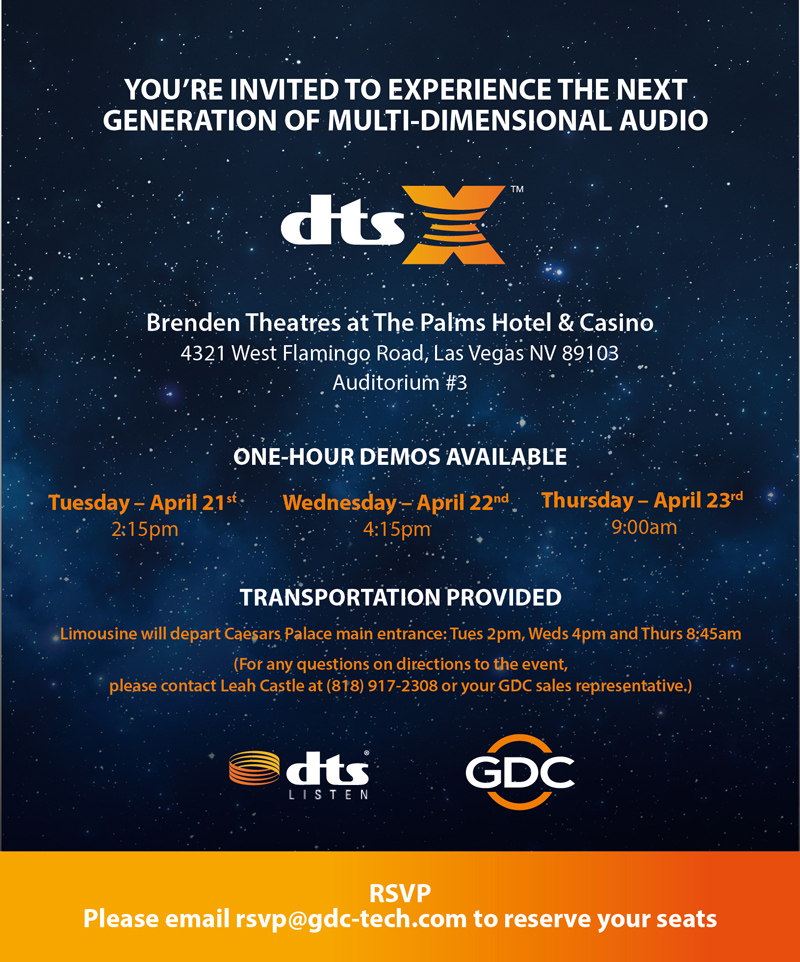
"The Brenden Theater at Las Vegas’ Palm Hotel has already been equipped with DTS:X, and DTS plans to demonstrate the system in this venue at CinemaCon, which takes place April 20-23.
DTS is currently targeting cinemas in North America and Asia. GDC Technology is DTS’ DTS:X integration partner in the Asia-Pacific region, and its projecting roughly 350 installations by this summer."
Posted by Bobby Henderson (Member # 840) on 04-10-2015, 10:26 AM:
There is no way to do object-based surround sound correctly without it costing quite a lot of money.
Nevertheless, Dolby is going to have to lower the price of the CP-850 down to a more reasonable (and competitive) level. An Atmos installation needs the CP-850, at least one DAC3201 unit that costs a few grand and two DAC3201 units if you're going to have more than 48 amplified channels. And then you have all the speakers, amplifiers and any other IT-related stuff needed if you're going to be sending audio over Ethernet with Dolby Connect. It's easy for a well configured Dolby Atmos sound system to cost North of $100,000.
I don't know the current list price of the CP-850, other than it is under $30,000 now. The first Dolby Digital DA-10 packages cost around $20,000 in 1992, but Dolby cut the list price in half by 1995 with the DA-20 and ran pricing specials matching the $5900 list price of the DTS-6. Dolby Atmos is nearly 3 years old, so it's probably time for some serious price cuts on gear. The arrival of DTS:X will probably force that to happen.
What is the list price of the Barco/Datasat AP24 used for Auro 11.1 installations? I saw one article claim it costs $25,000. With Auro, I suppose the big cost savings for theaters is not having to individually amplify so many surround speakers.
The situation with DTS:X seems far more murky. Its MDA format can do everything Atmos does, but the press releases are light on specifics about recommended speaker locations, amplification requirements and even how the DTS:X track is rendered in different sound processors from different companies.
My fear with DTS:X is some theaters (or maybe a lot of them) will have little more than a 5.1 or 7.1 based sound system and merely add just another couple of amplifiers to get a tiny bit of height information into the sound field. There won't be any way to distinguish these next-gen sound done cheap theaters from the theaters that spend a lot more money doing DTS:X the right way, where it sounds as good as a well configured Atmos installation.
Even Dolby has relaxed its standards a little. Not every Atmos installation has sub-bass cabinets in the surrounds. An Atmos theater can have as little as 9.1 amplified channels or as much as 64.
Posted by Jonathan Goeldner (Member # 4854) on 04-10-2015, 10:35 AM:
Carmike Cinemas, a leader in digital cinema and 3D cinema deployments and one of the largest motion picture exhibitors in the US, will upgrade selected theaters to DTS:X beginning in Spring 2015.
Carmike 15 (Columbus, Ga.)
Carmike Movies ATL 278 (Atlanta, Ga.)
Chapel Hills 13 (Colorado Springs, Colo.)
Rosemont 18 (Rosemont, Ill.)
Thoroughbred 20 (Franklin, Tenn.)
Thousand Oaks 14 (Thousand Oaks, Calif.)
Valley Bend 18 (Huntsville, Ala.)
“We believe in the open platform philosophy of DTS:X and are excited to be among the first theater partners to be onboard,” said Fred Van Noy, senior vice president and chief operating officer, Carmike Cinemas. “The flexibility of DTS:X allows us to deliver an immersive experience to a broader audience. We love the fact that DTS:X adapts not only to numerous room designs; it also enables us to continue working with our existing equipment provider, QSC."
Posted by Bobby Henderson (Member # 840) on 04-10-2015, 01:22 PM:
That sounds like a big decision from Carmike, although they could simply be choosing the least expensive method to get a next-gen sound format into their premium priced Big-D auditoriums.
Only one of their Big-D houses is equipped with Atmos (a theater in Illinois) and only one other Big-D is equipped with Auro (a screen in Georgia).
Carmike is building a new 13-screen theater here in Lawton. One of the screens will be a premium priced big screen theater, but at this point I don't know if it will be a Big-D screen or an IMAX-branded screen. Odds are it will be a Big-D though. If that's the case it will be interesting to see if it has DTS:X and how far Carmike goes with its installation, whether it's slightly better than 7.1 surround or something comparable to a proper Atmos installation.
Posted by Harold Hallikainen (Member # 5405) on 04-10-2015, 09:04 PM:
A few comments:
The USL DAX-16N can be used instead of the Dolby DAC3201 with the CP850 for D/A conversion. The DAX-16N does quite a bit more. It has DE-15 outputs and lets you monitor processor and amplifier levels and stream audio to a web browser for remote monitoring. More info at http://www.uslinc.com/index.php?page=shop.product_details&flypage=flypage.tpl&product_id=81&category_id=26&option=com_virtuemart&Itemid=108 .
The USL CMS-2200 can play DTS MDA content. More info at http://www.uslinc.com/index.php?page=shop.product_details&flypage=flypage.tpl&product_id=78&category_id=17&option=com_virtuemart&Itemid=66 .
USL is an active participant in various SMPTE standards committees, including the interoperable immersive sound bitstream group. There's a LOT going on there!
Harold
Posted by Brad Miller (Member # 2) on 04-11-2015, 01:36 AM:
But to have DTS-X does the theater have to use a GDC server? That's a point that seems to be inferred, but has been glazed over.
Posted by Steve Guttag (Member # 268) on 04-11-2015, 04:45 AM:
quote: Daniel Schulz
DTS:X-approved equipment and working with the recommended speaker installation guidelines.
To ensure quality and provide flexibility within the DTS:X program, DTS has partnered with industry-leading server, sound rendering and processing companies. GDC Technology, QSC and USL
USL is specifically mentioned as well. Furthermore
quote: Daniel Schulz
The foundation of DTS:X is MDA, DTS' license fee-free, open platform for creation of object-based immersive audio. MDA gives movie studios unprecedented control over the specific placement, movement and volume of sound objects.
Since it is license free and open...it more than implies ANYONE can jump on in. DTS may desire to partner with GDC or anyone else to help get the product out but I doubt they would be too exclusionary. The end game for them is going to be the home...where DTS is dominate in the Blu-Ray market and I'm sure would like to be dominate any other medialess based content. Cinema would, at best, be a marketing means for that.
More of an eyebrow raise would be the lack of mention of Datasat and having the AP20 or next generation processor be DTS:X feature laden.
Posted by Bobby Henderson (Member # 840) on 04-11-2015, 05:40 PM:
quote: Bobby Henderson
Carmike is building a new 13-screen theater here in Lawton. One of the screens will be a premium priced big screen theater, but at this point I don't know if it will be a Big-D screen or an IMAX-branded screen. Odds are it will be a Big-D though. If that's the case it will be interesting to see if it has DTS:X and how far Carmike goes with its installation, whether it's slightly better than 7.1 surround or something comparable to a proper Atmos installation.
I was driving through the West side of Lawton earlier this afternoon and passed the construction site of the new theater. Construction site signs were recently installed. The theater will be called the Patriot 13 and it will feature an IMAX branded house.
Posted by Carsten Kurz (Member # 5396) on 04-12-2015, 01:28 PM:
A standard AP20 does not have the necessary audio I/O for a decent MDA system. However, already now, multiple AP20 can be slaved.
USLs CMS-2200 has a completely different approach to MDA rendering. Harold - do you know wether there are already plans to extend the number of pre-rendered playout channels with USLs new breed of external D/A converters?
Practically, a CMS-2200 could become a very affordable object based audio solution compared to current Dolby offerings. It would also make the CMS-2200 even more attractive to customers. With the completion of the digital rollout, incentives like this will become very important to sustain sales.
- Carsten
Posted by Steve Guttag (Member # 268) on 04-12-2015, 03:38 PM:
Yes and no. What are the percentage of Surround 7.1 theatres are there out there? I ask because that is practically a ZERO cost item. For new builds, it is the cost of 2 amplifier channels (and there are many 4-channel amplifier offerings out there) and often breaks the surround array up into more power efficient loads anyway. For existing systems, it is normally, again, the cost of an amplifier and some minor rewiring. I'm curious as to how well it was adopted.
I know in our installations...if the surrounds were already effectively wired for it, then we wired it as Surround 7.1. That said, it is a hassle for a theatre if all screens are not capable as one has to keep track of multiple prints (like 2D/3D) to ensure the extra format doesn't wind up in the wrong theatre. What would have been a nifty feature (and you can do it with the JSD60, for instance) is to let the processor sum Ls/BLs and likewise for the right side for 5.1 systems...then it would take the burden of keeping them straight off of the scheduler.
I would think a chief cost to the whole "immersive" audio thing is the actual cost of the speakers, amps, wiring and INSTALLATION. For new builds, it can be designed in but for retrofits...pathways for anchoring speakers at the proper locations could be more difficult/expensive. If if the CP850 was $0 so you only had to pay for the speakers/amps/wiring and installation (as well as the DSP to get all of those channels to where they need to get to)...you still have a VERY expensive sound format. How many EXTRA tickets does one have to sell to get a ROI? In what markets is will the ROI make sense? I claim VERY few. Having immersive audio formats show up in the PLF theatres makes some amount of sense because you are charging a premium under the guise that the experience will be superior. Not just the sound be the entire show. In this respect, I think Dolby has the right idea in that one should make the entire movie experience superior and not just focus on one aspect (picture or sound). People are not going to appreciate the nuance of technicalities (never have). In big markets you will get more sophisticated people seeking out high-end systems but you can't build an industry around such a small percentage.
Posted by Ian Freer (Member # 1940) on 04-12-2015, 10:33 PM:
I would hope Datasat can build a single upgrade card for one of the slots that would add the necessary IO, but I guess that's a wait-and-see...
Posted by Harold Hallikainen (Member # 5405) on 04-12-2015, 10:56 PM:
In response to Carsten, I can't speak for my employer (USL), but I'll make a few unofficial comments. There is a real question as to what DCI will require for forensic marking. The typical forensic marking DSP will do 16 channels. As you add more channels, you can mark more (with another DSP) or not. As more and more of the audio is not marked, recovery of the forensic mark becomes more difficult. You could certainly mark every output, but it gets expensive and takes up space within the security boundary. It seems that if not all outputs need to be forensically marked, it would be possible to get more audio out of existing hardware (perhaps multiplexing additional channels onto an AES/EBU output (run 4 48k channels on a 96k output). Another thing that would help is if the forensic mark could be applied immediately after ingest (just as USL is now doing pre-rendering of object based audio). But, DCI seems to really want the forensic mark to include a time stamp, so that idea is out.
Before spending too much time and money on hardware, I think one needs to ensure there will be a bitstream that can be played. We're not allowed to talk about SMPTE meetings to the outside world, but I will say that the bitstream meetings suddenly got more interesting last week.
Personal opinions only...
Harold
Posted by Carsten Kurz (Member # 5396) on 04-13-2015, 02:31 PM:
Harold, thanks for your remarks. Can you tell us what speaker layout(s) the current CMS-2200 MDA renderer supports? Wondering what the preferred layouts are for MDA as opposed to ATMOS or Auro 3D?
I heard that the MDA spec/SMPTE object based audio spec would be almost finalized by now?
- Carsten
Posted by Harold Hallikainen (Member # 5405) on 04-13-2015, 02:50 PM:
In my opinion, SMPTE has a ways to go. On any format, whether channel based or object based, we are relying on amplitude panning to locate sounds. The closer the speakers are together, the better it works. But, I don't think we can sense direction with the same resolution horizontally and vertically, and suspect the resolution varies as we move away from straight ahead. In object-based formats, you're free to place the speakers where you want, concentrating them where we perceive with the most resolution. With channel based, we do the same thing, but we need to match the speaker placement of the dub stage. For a presentation for Mix Magazine a few months ago, I had a graphic showing the "very talented mixer" adjusting panning controls while listening to the results on the dub stage. The speaker signals for the dub stage are recorded and sent to similarly situated speakers in the cinema auditorium. For object based sound, we do something similar. The very talented mixer listens to the sound on the dub stage and adjusts panning as required. However, in object based, instead of sending the speaker signals, we send the raw audio and the panning instructions to the cinema auditorium. There, the object renderer acts on the panning instructions to send the audio to the speakers in this auditorium. Ideally, it sounds like the dub stage.
Harold
Posted by Carsten Kurz (Member # 5396) on 04-13-2015, 03:35 PM:
It seems that the CMS-2200 uses a so called 'VBAP' config file to instruct the MDA renderer to use a specific speaker setup. Googling VBAP shows some interesting results dealing with 'Vector Base Amplitude Panning', which is the base technology behind object based '3D audio'.
- Carsten
Posted by Marcel Birgelen (Member # 6801) on 04-13-2015, 04:44 PM:
quote: Carsten Kurz
A standard AP20 does not have the necessary audio I/O for a decent MDA system. However, already now, multiple AP20 can be slaved.
I guess those 16 output channels should be sufficient for small rooms and maybe they could add another 16 channels not only by slaving another one but by means of an additional I/O card.
quote: Harold Hallikainen
In response to Carsten, I can't speak for my employer (USL), but I'll make a few unofficial comments. There is a real question as to what DCI will require for forensic marking. The typical forensic marking DSP will do 16 channels. As you add more channels, you can mark more (with another DSP) or not. As more and more of the audio is not marked, recovery of the forensic mark becomes more difficult. You could certainly mark every output, but it gets expensive and takes up space within the security boundary.
There isn't a whole bunch of information about how this forensic watermarking actually works, most likely on purpose.
But does it work by actively manipulating the bitstream or is it just a signal modulated on top of the bitstream? I guess it's the former, but if it is the latter one, I don't see the big deal. Then you only need to create the signal just once and adding it to the output should be a no-brainier for any DSP.
quote: Harold Hallikainen
In my opinion, SMPTE has a ways to go. On any format, whether channel based or object based, we are relying on amplitude panning to locate sounds. The closer the speakers are together, the better it works. But, I don't think we can sense direction with the same resolution horizontally and vertically, and suspect the resolution varies as we move away from straight ahead.
Hasn't it been proven in numerous experiments already, that the horizontal "resolution" is much higher than our "vertical" resolution? Then again, although we humans do have two horizontally aligned, fixed ears, our heads are not fixed on our necks. We increase our vertical spatial localization resolution (I just made this up myself) by tilting our heads.
I really hope those "speaker placement advisories" of those upcoming MDA formats increase the resolution of speakers behind the screen, because that's where it matters most. Especially on large screens, I find dialog coming elusively out of the center speaker quite annoying at times. If this would materialize, we only need the mixing folks to motivate putting the dialog where the mouth is. ![[Wink]](wink.gif)
Posted by Harold Hallikainen (Member # 5405) on 04-13-2015, 09:04 PM:
Yes, VBAP is Vector Based Analog Panning. It is described at http://lib.tkk.fi/Diss/2001/isbn9512255324/ . There's also distance based analog panning, but I don't know much about that.
Based on our ear position, I also suspect we have more horizontal sound localiation resolution than vertical. Most systems add a height layer and perhaps a top layer for a total of 3. But if you look at the sound with spherical coordinates, you may get fairly good vertical resolution as you move from a normal height speaker to a "height" speaker, then through the various ceiling speakers.
I was thinking that it would be great if forensic marking could just be a series of numbers you multiply the audio samples by. It would be easy to set up a multiply for each channel. But, its probably more complicated than that. The forensic mark firmware supplier just gives you a compiled object file in a DSP and tell it to run. It can do up to 16 channels.
Harold
Posted by Marcel Birgelen (Member # 6801) on 04-14-2015, 05:42 AM:
A little bit of Googling gives you this interesting read about Distance Based Amplitude Panning. (Warning: PDF ahead)
quote: Harold Hallikainen
Based on our ear position, I also suspect we have more horizontal sound localiation resolution than vertical. Most systems add a height layer and perhaps a top layer for a total of 3. But if you look at the sound with spherical coordinates, you may get fairly good vertical resolution as you move from a normal height speaker to a "height" speaker, then through the various ceiling speakers.
According to what I've heard from the Auro3D folks, three "height layers" is already sufficiently dense. Maybe it's a marketing argument for their layout, but they put a bit of empirical research behind it. It's also one of their main competing arguments against Atmos: Their standard layout has one extra height layer compared to the standard Atmos layout.
quote: Harold Hallikainen
I was thinking that it would be great if forensic marking could just be a series of numbers you multiply the audio samples by. It would be easy to set up a multiply for each channel. But, its probably more complicated than that. The forensic mark firmware supplier just gives you a compiled object file in a DSP and tell it to run. It can do up to 16 channels.
Hooray for black box technology. But like you mentioned before, are you really required to mark each and every output channel? I'm wondering if Dolby is actually doing this for Atmos.
Posted by Carsten Kurz (Member # 5396) on 04-14-2015, 07:10 AM:
The question is indeed, how much concealment the watermarking can withstand by many independent channels playing at the same time, and how often you want to have a 'marker' in the signal. In general, I would think that marking the front speakers should be enough for the purpose, as you certainly do not need a detectable watermark every few seconds.
I would think that the watermarking uses similiar techniques as used in MP3/ATRAC encoding, there is probably a psychoacoustic model being used to apply masking effects, etc. It is possible that this needs to be applied to all channels to have the best benefit from it. So, simply modulating a fixed signal will certainly not work, given also the high dynamic range/listening levels in cinema environments.
SMPTE DCPs/new KDMs allow to disable watermarking for individual channels, so that e.g. data channels, timecode, etc. for Atmos, motion seats, etc. can be left out and stay intact.
Wondering what Dolby then does within ATMOS to comply with forensic marking.
- Carsten
Posted by Mark Gulbrandsen (Member # 72) on 04-14-2015, 11:47 AM:
If you're going to CinemaCon...
Posted by Bobby Henderson (Member # 840) on 04-16-2015, 01:52 PM:
Meanwhile Barco is going to be showing off AuroMax® at Cinemacon. AuroMax® apparently uses the same Open MDA technology as DTS:X.
Oddly this kind of makes it sound like DTS and Barco are competing against each other using the same technology. And doesn't Datasat make all the AP-24 processors used in Auro 11.1 installations?
![[Confused]](confused.gif)
Posted by Carsten Kurz (Member # 5396) on 04-16-2015, 04:25 PM:
But that's exactly why everybody except Dolby is preferring an open standard - the standard only defines the transmission protocol for beds and objects. Individual manufacturers can implement their own systems, enhancements and brands.
And at some point ATMOS will have to become only one of these various implementations and brands. Maybe the best, but not the only one.
dts and Datasat once split in order for dts to stay in the home-cinema and licensing business, and for Datasat to take over the cinema operations. I don't think dts will re-enter the cinema business again - they will most certainly leave this part to Datasat, but will benefit from a common DTS-X implementation in the home cinema and licensing area.
- Carsten
Posted by Bobby Henderson (Member # 840) on 04-16-2015, 09:36 PM:
quote: Carsten Kurz
But that's exactly why everybody except Dolby is preferring an open standard - the standard only defines the transmission protocol for beds and objects.
Unfortunately the lack of any branding consistency, much less any consistency of how "DTS:X" or "Open MDA" or whatever the fuck it's going to be called will make any mention of it in advertising or even technical discussion absolutely WORTHLESS.
Frankly, this is even worse than THX watering down its own certification standards to allow theaters not quite compliant to still carry the logo. They're threatening to ruin DTS' Open MDA process and "DTS:X" before it can even get off the ground. Customers aren't really going to know just what the hell they're getting with this stuff. In the end the various brands will mean absolutely nothing to them on every level, even if they happen to get curious about the details.
So on top of all the stupid acronyms labeling auditoriums, signaling to the customer "it costs $3 or more dollars to enter this room," we're going to have a smorgasbord of sound formats in name only, each applying its own flavor to MDA. It will be kind of like Disney and the phony "Disney Digital 3D" thing they paste onto their movie posters.
Movie sound designers will be pulling their hair out with this because the post production mixing stage is going to end up being the only place where they can get the mix to sound as they intend. When it gets into theaters it will be screwed up in all kind of random yet "OPEN" ways.
![[Roll Eyes]](rolleyes.gif)
quote: Carsten Kurz
dts and Datasat once split in order for dts to stay in the home-cinema and licensing business, and for Datasat to take over the cinema operations. I don't think dts will re-enter the cinema business again - they will most certainly leave this part to Datasat, but will benefit from a common DTS-X implementation in the home cinema and licensing area.
Without any brand consistency between the commercial theater and home theater there will be very limited appeal for DTS:X. Right now DTS is doing alright from a perspective of branding because enough people still remember DTS as being a film sound format they experienced in real movie theaters. If DTS didn't already have its 20 years of branding history in commercial movie theaters it wouldn't stand a chance against Dolby.
My opinion is a big mistake was made when DTS spun-off its cinema division with the "Datasat" brand. There are lots of companies in existence that have totally separated businesses that still carry the same brand name. I don't know why DTS and Datasat couldn't make some kind of similar deal with the DTS brand. "Datasat" makes me think of satellite TV, satellite-based Internet service or satellite connected phones. It don't of commercial movie theaters with that brand name at all.
Posted by Marcel Birgelen (Member # 6801) on 04-17-2015, 04:24 AM:
quote: Bobby Henderson
Unfortunately the lack of any branding consistency, much less any consistency of how "DTS:X" or "Open MDA" or whatever the fuck it's going to be called will make any mention of it in advertising or even technical discussion absolutely WORTHLESS.
The format will be "Open MDA" and DTS:X is just an implementation of "Open MDA". This "Open MDA" thing needs a better name and a cool logo.
quote: Bobby Henderson
Frankly, this is even worse than THX watering down its own certification standards to allow theaters not quite compliant to still carry the logo. They're threatening to ruin DTS' Open MDA process and "DTS:X" before it can even get off the ground. Customers aren't really going to know just what the hell they're getting with this stuff. In the end the various brands will mean absolutely nothing to them on every level, even if they happen to get curious about the details.
Customers also don't know what they're getting with a Dolby Digital or DTS logo on the door. THX is supposed to fix that. What you want is some kind of certification.
You cannot stop competing suppliers to push their own brands and "technology", even if it's just a label on top of someone else's technology.
quote: Bobby Henderson
Movie sound designers will be pulling their hair out with this because the post production mixing stage is going to end up being the only place where they can get the mix to sound as they intend. When it gets into theaters it will be screwed up in all kind of random yet "OPEN" ways.
So, essentially, everything stays the same then? That sounds (warning: French) vaguely familiar.
quote: Bobby Henderson
Without any brand consistency between the commercial theater and home theater there will be very limited appeal for DTS:X. Right now DTS is doing alright from a perspective of branding because enough people still remember DTS as being a film sound format they experienced in real movie theaters. If DTS didn't already have its 20 years of branding history in commercial movie theaters it wouldn't stand a chance against Dolby.
I have yet to meet someone who is all excited about DTS on their home cinema set. Those people I know that care about good sound in their home theater don't prefer DTS Master Audio above Dolby TrueHD when it boils down to sound quality, as it's essentially the same. Some people are somewhat excited about Dolby Atmos, but want to wait until there are actual alternatives before buying into a single technology. They all expect those future AVRs to support all comon MDA formats.
quote: Bobby Henderson
My opinion is a big mistake was made when DTS spun-off its cinema division with the "Datasat" brand. There are lots of companies in existence that have totally separated businesses that still carry the same brand name. I don't know why DTS and Datasat couldn't make some kind of similar deal with the DTS brand. "Datasat" makes me think of satellite TV, satellite-based Internet service or satellite connected phones. It don't of commercial movie theaters with that brand name at all.
Well, their sister organization, Datasat Communications is actually all about satellite communications .
DTS was already failing as a brand in the last years of the "Digital on Film" market, Dolby clearly won the race with its ubiqutous SRD and they clearly made an impact on the home theater market too. For DTS as a format, there was nothing to be gained in D-Cinema, just like Dolby Digital became redundant. They clearly focussed on the DVD to Blu-Ray transition and won the battle there as the leading HD audio format. Them spinning off their hardware and "Digital on Film" division makes sense to me. It also makes sense to give it another name, if DTS will only be one of the technologies you'll support in your product portfolio.
Right now, Datasat is a strong brand in both cinema and high-end home cinema. Doing the same with the DTS brand name would have been a whole lot more confusing. Also, consider your market here: Most of your customers are people who know what they're buying.
Posted by Carsten Kurz (Member # 5396) on 04-17-2015, 06:00 AM:
Frankly, I couldn't care less about branding efforts. An object based sound system is convincing when it offers a customer value over 5.1 and 7.1, is supported by the industry, and is available at a price that is justified by that value.
5.1 and 7.1, as well as LPCM and various other aspects of modern cinema sound do not have a specific branding associated with it. Yet they are standard technical aspects of modern cinema.
I don't think anyone can stop the move to object based audio in cinema anymore. The question is, which cinemas will play it downmixed to channel-based only systems or MDA compatible systems. Wether that is DTX:X, AuroMax or ATMOS, the audience won't care. They will not be able to create any specific preference for one or the other brand.
- Carsten
Posted by Lyle Romer (Member # 1266) on 04-17-2015, 06:34 AM:
My biggest issue with "Open MDA" is what its strength is supposed to be, which is no standardization of playback. This is an extreme example but there is nothing to stop an implementation of Open MDA playback where the theater has a left front speaker, 2 speakers on the right wall, one in the back left corner and one centered on the ceiling. The processor would then try to place the objects by varying the volume of the object on these speakers.
At least Atmos has some kind of playback spec. You can "cheap out" by not doing the individually amplified surrounds or not putting in surround subwoofers. You can use less than the recommended number of surrounds but at least there is some specification of where the speakers go so that the CP850 has some chance to make it sound like it is supposed to.
I also worry that DTS's push is going to lead to a lot of "cheap out" installs done just to slap a logo on the door. There were a ton of bad DTS 35mm installs just because it was cheap and they did everything to allow exhibitors to just slap the player onto a system that couldn't handle it.
I'd rather have discrete 9.1 or 11.1 (both options with 5 screen channels) than some mystery meat MDA setup.
Posted by Carsten Kurz (Member # 5396) on 04-17-2015, 08:51 AM:
You can apply that to speakers just as well...
If there is no brand, there is no expectation that can be fooled... only customer experience.
- Carsten
Posted by Bobby Henderson (Member # 840) on 04-17-2015, 09:26 AM:
quote: Marcel Birgelen
The format will be "Open MDA" and DTS:X is just an implementation of "Open MDA". This "Open MDA" thing needs a better name and a cool logo.
Things like "AuroMax" make it clear various cinema equipment vendors are going to apply their own branding. No effort was made at all to brand multichannel linear PCM audio, even though it is superior in quality to the lossy compressed surround sound formats. Uncompressed LPCM was one of very few quality advantages d-cinema had over film. Open MDA isn't going to get any better treatment from movie studios or theater chains.
The term "Open MDA" doesn't have any brand allure for next gen sound anyway. When I see the "MDA" letters I think Muscular Dystrophy Assocation. I'm not joking at all about that either. The Muscular Dystrophy Association owns the www.mda.org web domain. Honestly, the only branding chance Open MDA has is DTS:X. Anything else is a waste of time.
quote: Marcel Birgelen
Customers also don't know what they're getting with a Dolby Digital or DTS logo on the door. THX is supposed to fix that. What you want is some kind of certification.
Movie studios and theater companies aren't going to go along with any kind of certification process. That actually means complying with some kind of quality standard. Combine that factor with the glory of "OPEN STANDARDS" and it could equate to a bunch of stuff done on the cheap that does not work right.
Dolby Digital, SDDS and DTS all provided functionally very similar surround sound formats on 35mm film. A movie production could create a standard 5.1 channel mix and output for any of those formats. That is not the case this time around. There are major differences in speaker placement between the Atmos and Auro formats. The "open" nature of MDA means we could see all sorts of other random ways in how surround speakers are placed.
You keep mentioning how Open MDA can adapt to various speaker & amp configurations. Well, the system really needs a certain number of amplifiers and speakers in order for the system not to be a pathetic, worthless joke. A minimal number of speakers and amps will equate to a surround system with not enough 3D sound resolution.
At least Dolby Atmos tried to set a standard. The trouble is it costs a lot of money to do object based surround correctly. A system based purely on "Open MDA" will cost damned near as much as a proper Atmos system if done right. The sad thing is we probably will not see any of these MDA-based systems done right. They're going to be done cheap.
quote: Marcel Birgelen
I have yet to meet someone who is all excited about DTS on their home cinema set. Those people I know that care about good sound in their home theater don't prefer DTS Master Audio above Dolby TrueHD when it boils down to sound quality, as it's essentially the same. Some people are somewhat excited about Dolby Atmos, but want to wait until there are actual alternatives before buying into a single technology. They all expect those future AVRs to support all comon MDA formats.
You must be hanging around people who only listen to movies through their TV speakers. DTS has a legion of fans and fanboys that goes back to the early 1990s. Fans raised all kinds of hell about DTS output not being included in the first generation of DVD players and threats DTS might not be allowed on DVD at all. DTS' highly vocal fan base is one of the reasons why DTS-HD Master Audio is the dominant sound format on Blu-ray.
A huge part of "home theater" is carrying over brands from commercial movie theaters. Dolby has done very very well from that since the 1970's. There is an unmistakable level of prestige in taking a brand people associate with the cinema and carrying it over into home theater. Customers feel like their home system is more legit when they see those same logos they saw in the movie theater.
If DTS' brand is not visible at all in real, commercial movie theaters it has less marketing value in selling home theater.
quote: Carsten Kurz
Frankly, I couldn't care less about branding efforts. An object based sound system is convincing when it offers a customer value over 5.1 and 7.1, is supported by the industry, and is available at a price that is justified by that value.
If there isn't any credible branding, an effective way to sell next-gen surround sound to the public as a means of getting them away from their living room TV sets and putting more butts into theater seats, why would a commercial movie theater even bother making the investment in the first place? They're not going to spend thousands of dollars or tens of thousands of dollars on various upgrades for nothing.
quote: Lyle Romer
My biggest issue with "Open MDA" is what its strength is supposed to be, which is no standardization of playback.
This is essentially my main gripe with Open MDA as well. A theater could do as little as have an existing, conventional 5.1 system, add a couple speakers to the ceiling and then claim to have next-gen surround sound. "That'll be $3 extra for your ticket, Timmy!"
quote: Lyle Romer
I also worry that DTS's push is going to lead to a lot of "cheap out" installs done just to slap a logo on the door.
Exactly. Not only that, but we could see a lot of "what the hell is that" brands. They could come from various cinema equipment suppliers, speaker & amp manufacturers and even the theater chains. It could add up to a bunch of confusing bullshit.
Posted by Scott Jentsch (Member # 1681) on 04-17-2015, 09:50 AM:
quote: Carsten Kurz
Frankly, I couldn't care less about branding efforts. An object based sound system is convincing when it offers a customer value over 5.1 and 7.1, is supported by the industry, and is available at a price that is justified by that value.
Frankly, without branding, a theater investing thousands of dollars into the best sound system in the world is going to end up with a less-than-successful result.
Without branding, there's nothing to use in marketing messages. Without marketing, there's no differentiation between Theater A that made the investment and Theater B that hasn't, beyond word of mouth. Word of mouth advertising can be very effective, but it can be very unpredictable, and take a very long time to gain traction.
It's a mistake, IMO, to have multiple brands representing the same thing. All it does is create confusion in the marketplace, and the consumer is left to try and sort it out, which they probably won't do unless they're really motivated.
If a single brand won't be embraced to represent the benefits of the technology, then the theater needs to create their own branding effort (and spend enough money and effort in enough places to make it worthwhile).
For example, if you have a situation where object-based audio is a non-branded technology, and Theater A decides to invest in it, Theater A will need to come up with a name for it so they can market it to their existing and potential customers.
It might be that the technology itself gets the brand, or it's part of a larger package of offerings that is indicative of a PLF effort (a la AMC Prime) or a chain-wide effort (all screens, all object-based, in every screen in every location).
Then, they can market the package or their chain as being special, which will hopefully persuade the customer to choose Theater A with the WayCool(TM) auditorium over Theater B that says nothing about what they do.
But without the marketing, the investment doesn't make sense. It may make the theater owner feel good in some way, but why make the investment and keep quiet about it?
Posted by Carsten Kurz (Member # 5396) on 04-17-2015, 11:30 AM:
Apply that to '3D'. Does any customer care about RealD, Dolby3D?
Of course, it doesn't make sense to shell out 100.000US$ for an object based audio system without branding it ATMOS. But let's see how that goes if the prices drop due to competition. And then what's so different between 'ATMOS' and 'MDA'?
- Carsten
Posted by Bobby Henderson (Member # 840) on 04-17-2015, 12:30 PM:
quote: Carsten Kurz
Apply that to '3D'. Does any customer care about RealD, Dolby3D?
They may not care about the differences between RealD, Dolby3D and IMAX 3D, but at least they know about the 3D option being there rather than finding a $3, $6 or higher surcharge on their ticket price going unexplained.
quote: Carsten Kurz
Of course, it doesn't make sense to shell out 100.000US$ for an object based audio system without branding it ATMOS. But let's see how that goes if the prices drop due to competition. And then what's so different between 'ATMOS' and 'MDA'?
Go back to a comment Steve Guttag made in the "will Atmos last?" thread. Even if companies like Dolby, Datasat and others were practically giving away the processors for nothing a theater would have to spend a lot of money to install object oriented audio correctly. There is no way to do object oriented audio right and cheap at the same time.
If the theater operator is going to spend money on processors to do Atmos, Auro or whatever, he might as well buy enough of the extra amplifiers and more powerful surround speakers to do the job correctly or just not bother with it at all. His upgrade money will be better spent and speaker & amplifier improvements in his conventional surround sound system.
Posted by Jonathan Goeldner (Member # 4854) on 12-01-2015, 04:03 PM:
first of all let me start off by saying and commenting on the DTS-X mix of 'The Hunger Games: Mockingjay Part 2' I heard last Sunday over at the Brenden Theater in Las Vegas - I was very impressed with what I heard.
I read online that around a dozen more screens will be outfitted this month - anyone know what theater chain will be implementing said system?
Noted that Regal has one RPX screen in the entire US featuring the system - so why not more? Of the few RPX screens in and around the DC metro area, only one has a Dolby Atmos system, all the rest are 7.1
Why are the studios (other than Lionsgate) not jumping on board with mixing/releasing more movies? DTS' rollout is just as slow as IMAX's laser system implementation.
Posted by Carsten Kurz (Member # 5396) on 12-01-2015, 06:37 PM:
What hardware does currently support DTS-X playback in cinemas? Which servers play it, and what audio-processor supports it?
- Carsten
Posted by Jay Wyatt (Member # 8768) on 12-01-2015, 08:16 PM:
quote: Carsten Kurz
What hardware does currently support DTS-X playback in cinemas? Which servers play it, and what audio-processor supports it?
The GDC SX-2000X will render DTS:X audio real time up to 16ch of AES output from the media block.
The USL CMS-2200 has a pre-rendering solution with 16AES out as well.
Audio processors will need 16+ channels of processing, so Datasat AP20, USL JSD100, QSC DCP300 or Q-SYS. The QSC processors allow you to get a bit more creative when handling bass management and splitting up arrays.
Posted by Harold Hallikainen (Member # 5405) on 12-01-2015, 08:53 PM:
Good to hear from you Jay! As Jay said, GDC and USL have internal servers that render DTS:X to 16 channels. I've seen American Ultra and Mocking Jay 2 in DTS:X. They sound great! The local theater running DTS:X runs Quantum Logic Immersion between DTS:X movies. Also sounds great!
Harold
Posted by Bobby Henderson (Member # 840) on 12-02-2015, 09:05 AM:
quote: Jonathan Goeldner
Why are the studios (other than Lionsgate) not jumping on board with mixing/releasing more movies? DTS' rollout is just as slow as IMAX's laser system implementation.
One theory I have: lack of time during post production. The sound editing and mixing process is practically the last thing that gets completed. The sound editors, mixers, foley performers, etc. get very little time to get everything together. More time might be given to an elaborate production where a lot of unique sounds are needed, but I think those situations are rare. With such tight deadlines it's really asking a lot for the sound team to crank out a professional quality 5.1 mix and then have to create even more elaborate mixes in Dolby Atmos, DTS-X, Auro and 12-track IMAX. I think this is why I've heard more than a few Atmos mixes that seemed Atmos in name only.
IMHO, one thing that would help is if mainstream audio editing tools could create a single immersive mix that can be automatically be output to Atmos, Auro, DTS-X, IMAX 12-track, 5.1 and 7.1. That would make the job easier. Right now sound editors must use separate applications or plug-in modules for each next-gen format and create the mixes separately. That needlessly duplicates efforts and wastes time. The differences in surround speaker placement between these systems and no standards of surround speaker placement with DTS-X means a one app for all next-gen sound formats approach may generate unpredictable results. Nevertheless, we're not going to see a whole lot more studio support for immersive sound unless the post production process can be streamlined. I think folks from Dolby, DTS, Auro and IMAX need to have some talks with Avid (who makes Pro-Tools) and maybe some other companies who make pro audio editing software used in movie production. Maybe if they work together to make a sound designer's life easier they'll sell more of these elaborate sound systems to theaters.
quote: Jay Wyatt
Audio processors will need 16+ channels of processing, so Datasat AP20, USL JSD100, QSC DCP300 or Q-SYS. The QSC processors allow you to get a bit more creative when handling bass management and splitting up arrays.
16 channels of audio is more elaborate than conventional 5.1 or 7.1. But it's still pretty limited compared to what can be done with a Dolby Atmos setup. Meanwhile IMAX is the most overly hyped "large format" brand yet all but maybe a dozen of their screens are stuck with 5.1 (or is it 5.0) featuring two surround speakers in the rear corners like in the living room at home.
Posted by Jonathan Goeldner (Member # 4854) on 12-02-2015, 09:18 AM:
well that begs the question - how many folk are responsible for each mix: standard 5.1/7.1, Atmos, Auro, IMAX - particularly the latter: does a sound team from IMAX do their own 12 channel mix 'Age of Ultron' wiped the floor when compared to the Atmos mix.
Posted by Bobby Henderson (Member # 840) on 12-02-2015, 11:17 AM:
The number of people on a sound editing & mixing team varies from one movie to the next. They're usually listed in a movie's end credits.
Some people don't get mentioned though. I can't recall ever seeing the musicians who perform a movie's score ever getting listed. It's usually just the composer and people associated with recording and mixing the score.
I doubt if people outside of the production (such as employees at IMAX) are being allowed to take a movie's sound elements and craft their own mix of it. I know I wouldn't put up with any of that kind of nonsense if I was directing a movie and they were going to do that with an audio track on my project.
Posted by Jonathan Goeldner (Member # 4854) on 12-02-2015, 11:43 AM:
I've seen 'Dolby Consultant' listed in some end credits - what do they do? - some of the recent mixes from Marvel in 7.1 or even Atmos seem incredibly lackluster.
Posted by Peter Castle (Member # 1997) on 12-06-2015, 02:18 AM:
quote: Harold Hallikainen
As Jay said, GDC and USL have internal servers that render DTS:X to 16 channels.
OK. I'll bite. What are the 16 channels? Not having any ceiling speakers, we currently have a wired 6 (possible) channels of surround, as part of a 7.1 system - 3.1 at the front. (Our AP20 uses more channels, as our front channels are biamped - using 6 channels.) How many extra channels do we need? Left/Right and Front/Back of god channels?
Posted by Dave Macaulay (Member # 813) on 12-06-2015, 08:43 AM:
Probably you go through some design process to tell you where to put the extra speakers, and the processor maps the sound objects to the speakers.
That's how Atmos works at least - you set your CP850 up with the speaker locations and it does the rest. A CP850 has 64 possible output channels - so even using 5 tri-amped screen speakers through the CP850 internal crossovers, you have 49 channels available for LFE and surrounds.
Posted by Mike Renlund (Member # 4675) on 12-06-2015, 01:09 PM:
You can watch several videos on the design aspects that go into a Dolby Atmos theater here:
https://vimeopro.com/dolbycinemasupport/dolbyatmos
Mike Renlund
Dolby Laboratories
Posted by Peter Castle (Member # 1997) on 12-06-2015, 11:03 PM:
I'm not interested in Atmos. I'm talking about utilising the fact we are a GDC house with an AP20.
This set of posts is about DTS:X. I've seen nothing online regarding setup or installation for DTS:X.
So what's going on?
Who is providing the design service?
I want to see if we can do it "on the cheap"!
Posted by Carsten Kurz (Member # 5396) on 12-07-2015, 04:36 PM:
I guess you should ask GDC about it.
- Carsten
Posted by Bobby Henderson (Member # 840) on 12-07-2015, 04:56 PM:
quote:
I want to see if we can do it "on the cheap"!
If DTS:X is going to be done correctly there is no way to do it on the cheap. For any next-gen "immersive" sound system to work well it will have to feature all of the things Dolby recommends (but does not require) in an Atmos setup. That means more powerful & higher quality surround speakers and individually amplifying as many of those speakers as possible. Adding sub-bass enclosures to the surrounds would be good for timbre-matching between the stage and surrounds. Left Extra and Right Extra stage speakers would be good for really large screens. This doesn't get into the choice of cinema processor and other new things like Ethernet connections for amps & audio (like QSC Q-Sys).
Unfortunately the marketing coming from DTS on this new "X" format seems to imply any speaker layout will work even if certain zones are lacking, such as no ceiling surrounds! If I see a theater advertising DTS:X I'm automatically going to be suspicious about it.
I've been to a couple Atmos-equipped theaters whose sound systems weren't as well configured as I hoped they would be, and that's coming from a sound format that at least has a specific speaker layout. DTS:X doesn't even appear to have that. None of the marketing material I've seen about DTS:X mentions any speaker configurations. I don't like Auro 11.1, but at least it has a specific speaker layout. The danger I see for customers paying extra for a DTS:X show is they may walk into a room whose sound system is really no different than 5.1, it just has a new label on it.
Posted by Aran Clifford (Member # 9379) on 03-20-2016, 12:58 PM:
Hi all,
Its been really interesting looking at all your posts about immersive formats.
Im currently undertaking a dissertation in surround sound formats and what the future could be for these. I've put together a quick survey (about 7 or 8 questions) to see about peoples feelings with these formats. It would be great if you could help and spare a couple of minutes to fill out this survey. It would help me greatly and it might just be interesting for all of you too!
https://docs.google.com/forms/d/1GZMtUEr4tqlEEnOPYCrNFRgZEhgh-ZES-mCKHJD9K6I/viewform
Thanks!
AC
Posted by Marcel Birgelen (Member # 6801) on 03-20-2016, 06:25 PM:
Is this the first time you're on a discussion forum? If so, you might want to read up on the rules and general "netiquette".
Posting the same questions in multiple topics, while trying to get people to do you a favor while giving nothing obvious in return is not going to give you many credits.
Posted by Jonathan Goeldner (Member # 4854) on 04-23-2016, 04:18 PM:
so other than DTS-X on bluray - what's happening to the release and installation of the sound system for cinema application
... [crickets chirping] ...
the silence speaks volumes.
Posted by Harold Hallikainen (Member # 5405) on 04-23-2016, 04:56 PM:
GDC and USL both do DTS-X rendering in the media block. QSC does external rendering of DTS-X. However, I think the future is internal rendering. Only one security block is required with internal, while two are required with external. Internal also removes the complexities of sync, content transfer, KDM transfer, SMS to OMB communications (of which there is no standard), etc.
Harold
Posted by Steve Guttag (Member # 268) on 04-23-2016, 09:10 PM:
That may be. Then again, I see a bit of the 16-channel version of DTS-X being pushed on the server-rendered versions. The problem is, from what I've personally heard, why bother? Not only do I find very small to no difference in perceivable improvement between 7.1 and a 16-channel immersive, DTS-X seems to emphasize the height channels (including behind screen), which I find worthless (same goes for the height surrounds). Getting 5-across then Left/Right Wide bring the most to the table and then being able to localize the objects in the surround array...all of which 16-channels is really incapable of accomplishing effectively.
So do people start adopting a poor-man's immersive? Does a 16 channel DTS-X cheapen the brand such that if one were to do something in the 30+ channels in DTS-X that people would have no reason to know the difference and essentially not reward the person that invests in a proper immersive system? And if we are just talking about 16-channels, then aside from the ADA wrongly being on a prime full-bandwidth channel, we should have been able to handle 16-channels of discrete audio with the 16 channels of PCM...why bother with a proprietary sound format?
Posted by Harold Hallikainen (Member # 5405) on 04-24-2016, 12:41 AM:
16 channels is a first step. I'm sure the next version of systems will output more channels.
Harold
Posted by Steve Guttag (Member # 268) on 04-24-2016, 09:08 AM:
In my opinion, it is a non-worthy first step. It pre-cheapens the format in a manner of no going back. You'd have to change the name of the 30+ channel version to get distance from the silly 16 channel version. One thing I'll give GDC credit for is to have 16-channels of movie audio PLUS the ADA channels.
In my opinion, using the existing 16 PCM channels, we can get get 5-across, L/R wide (I have always called the idea Left-Outside, Right-Outside), 4-surround channels and subwoofer...without any extra rendering and I can guarantee you that better than 95% of the people will find that sound system to be preferable to any of the 16 channel DTS systems I've heard and not have to have one extra bit of processing.
Posted by Harold Hallikainen (Member # 5405) on 04-24-2016, 12:19 PM:
Could be. We'll see how the market goes. I've heard that a good sized chain chose Auro over Atmos because they could not hear the difference. That was Auro 11.1.
The problem with moving forward with channel-based systems (increasing the number of channels) is a lack of agreement on where the channels should be. Object-based gives flexibility since panning instructions are sent to the auditorium for panning amongst the speakers in THAT auditorium.
Another interesting approach is Ambisonics. I'm not super familiar with it, but it seems to be an expansion of M-S encoding which can be decoded to any speaker arrangement with fairly simple techniques.
Harold
Posted by Bobby Henderson (Member # 840) on 04-24-2016, 12:43 PM:
Where is a list of DTS:X theatrical releases? At DTS' own web site there is still only a basic overview of the sound format. There is no list of previous theatrical releases or upcoming releases. There is no list of Blu-ray discs featuring DTS:X. From what I've been able to find, it looks like there is hardly any movie release activity at all for DTS:X in movie theaters. It's almost all in home theater. And title support there is very sketchy.
A basic pre-rendered 16 channel version of DTS:X does seem like a waste of time. The height channels and ceiling surround design remind me of the Auro speaker layout. Perhaps DTS:X is meant to replace Auro at some point. With title support being so dismal and this 16-channel thing being perhaps the most common implementation of DTS:X it would just make more sense to use a straight 16-channel LPCM setup. Even 11.1 LPCM would probably be just fine.
By the way, I think ceiling surrounds can be very effective, but it depends heavily on two things. The sound mix has to place objects there effectively and the sound system has to be powerful enough to play the material properly. The Jungle Book had a very good Atmos mix featuring some effective ceiling surround use. The voice of the big snake, Kaa, panned all over the room and over the ceiling. It was very well done. But I can imagine the effect falling flat in a theater that cheaped out on speakers and amps.
quote: Harold Hallikainen
I've heard that a good sized chain chose Auro over Atmos because they could not hear the difference. That was Auro 11.1.
Cinemark chose Auro because it was cheaper. The Auro cinema processor itself is pretty expensive. But the huge cost savings come in by not having to buy nearly as many power amplifiers, like what is required in a properly configured Atmos system.
I think Auro 11.1 sucks. The big failure with it to me is no discrete back wall surround channels. You have a bit-reduced 5.1 LPCM 16-bit base layer and then some lossless compressed height channels added to it. Regular 7.1 LPCM has better surround coverage. Transient fly by surround effects work better in 7.1 LPCM than they do in Auro.
The other thing that sucks about Auro is very poor title support. Hardly any theatrical releases are using it. Kung Fu Panda 3 was the last US release in Auro (it also used Atmos). How to Train Your Dragon 3 is the next release. So when you visit a Cinemark theater and pay extra for that XD screen most of the time you're just going to hear ordinary 5.1. But I guess a lot of people don't mind that given the vast majority of IMAX branded screens have conventional 5.1 audio.
Posted by Jonathan Goeldner (Member # 4854) on 04-24-2016, 12:58 PM:
here's the list in forum form from bluray.com regarding blurays with DTS-X sound
http://forum.blu-ray.com/showthread.php?t=257742
Fox is releasing the upcoming 4K UHD of 'Independence Day' in DTS-X as well.
Auro has never impressed me - the one theatrical DTS-X presentation I heard ('The Hunger Games: Mockingjay Part 2') was stunning - but with so few releases, I don't see how they are treading water.
Posted by Steve Guttag (Member # 268) on 04-24-2016, 06:19 PM:
quote: Harold Hallikainen
The problem with moving forward with channel-based systems (increasing the number of channels) is a lack of agreement on where the channels should be.
I don't really agree there either. LC/RC are already designated 9/10, 11/12 are BLs/BRs, If dbox continues to steal an AUDIO channel we do run out before we hit Lo/Ro because ADA is taking up both 7/8 and 15/16...it should take up NEITHER and have been a dedicated set of aux tracks not needing full-range. Heck, I would have required that they be outputted analog straight from the server. it is absurd that they are taking up full-range audio for what they do.
The problem with having a low-end immersive audio that is object based is that it becomes proprietary and we get back to the EXACT problem that DCI wanted to prevent, (DTS, Dolby, SDDS)...hence PCM was the idea and 16 channels to allow for expansion. If you want to put in a PREMIUM sound system like Atmos...fine but for the remaining 95% of the theatres, they shouldn't to choose amongst non-compatible competing brands...like DTS, Dolby and Barco (so we traded Barco for Sony...and we are right back to where we didn't want to be). And, in the case of 16-channel DTS...for something that can be accomplished by 16-channel PCM.
I'm not trying to discourage going beyond or object based audio BUT...do what Dolby is doing and bring something that can't be achieved with basic PCM channels. DTS can do it so skip the 16-channel version which will only serve to cheapen the brand.
That said, like with 3D, only but a few movies are going to really benefit from the full immersive audio experience before it gets gimmicky. Cost wise, we are still only talking about a very small sliver of the market. I get the idea of trying to pawn off the 16-channel thing as a way of "immersive for the masses" but it really isn't immersive and audibly barely distinguishable from normal 7.1 (heck, full blown Atmos is barely distinguishable from 7.1 on MOST mixes I've heard and I've had hand picked test clips to show off the system). Ceiling speakers are always going to be a crapshoot for audio. Our ears aren't on top of our heads so to get the benefit you almost depend on a defect in posture or the room acoustics to get the effect and even then there are variables as to the speaker, pattern, location above, how many speakers there are to convey the effect (resolution, if you will). Side-to-side, those effects are always easy to translate, our ears help with that but up/down, we aren't built that way...even fore/aft can have mixed results but much more easily perceived because any head rotation will assist in the perception. Up/Down just isn't the easy directions to convey.
Posted by Harold Hallikainen (Member # 5405) on 04-24-2016, 09:12 PM:
Thanks for the comments, Steve! Doing DTS-X with 16 channels allowed products to get to market quickly (firmware update on existing hardware). It is VERY EXPENSIVE to get equipment through FIPS security and DCI compliance testing. As such, companies want to spread out the release of new hardware. I expect future media blocks will support more than 16 channels out.
It's much easier to get a license to implement DTS-X than it is to get one for Atmos. I believe DTS will move to the SMPTE bit stream when it's adopted (I'm hoping for the end of this year). Dolby might or might not adopt the bitstream. The differences in systems will then be in the renderer instead of in the bitstream. Theaters can choose among rendering systems based on cost and performance. Meanwhile, we have at least two object based bitstreams being used. Ideally this will settle down to one.
It is my personal opinion that it makes the most sense to do rendering in the image media block. This avoids needing a second secure processing block, eliminates the need to transfer content and synchronization (for which there is now a SMPTE standard), and the need to have the SMS communicate with the outboard media block (for which no standard exists) for KDM transfer, security messages, etc. The cost of additional audio outputs should not be significant compared to the rest of the system.
We'll see what happens in the coming years.
Thanks for the comments!
Harold
Posted by Steve Guttag (Member # 268) on 04-25-2016, 01:15 AM:
Harold,
I'm not arguing the merits of how Dolby or anyone else is doing the object based audio (beyond that Dolby isn't pawing off some 1/2 sized cut down version that is indistinguishable from ordinary 7.1 to 95% of the people.
The problem you have when you rush out this 16-channel version is you have already set the bar low for the format. So DTS-X is just a 16-channel format. So what if it can have a bazilion channels to render its objects like Dolby, why should anyone ever get the 30-60 channel version of the format when the Cheap-O theatre can advertise the SAME DTS-X on their marquee as the one that cost the exhibitor many, many times as much and actually does a worthy job? As I said, you then have to start coming up with cutesie names like DTS-ULTRA-X or some such nonsense. 16-channel DTS-X is really just DTS-X "lite." Companies are doing it because they can, not because they should. There are several 16-channel processors out there...why because 16-channel PCM was always in the DCI spec...thus it is easy...but I come back to...no need for a proprietary system for it. That solves your mediablock/FIPS problem too and it reduces the cost to EVERYONE.
I wonder how 16-channel or 16-track would play on a marquee as compared to DTS-X (or Atmos) which both are already polluted by a consumer element (how are they supposed to know that the theatre version is any different...and in the case of DTS-X-Lite, may not be)?
Lets meet again here next year and see how this actually plays out.
Posted by Mark Gulbrandsen (Member # 72) on 04-25-2016, 08:47 AM:
You guys can babble all you want about this. I have yet to even hear an Atmos mix that is even half as impressive as 70mm six track mag audio was. Honestly, all the Atmos stuff out there has been very lame.
Mark
Posted by Carsten Kurz (Member # 5396) on 04-25-2016, 09:01 AM:
Media block manufacturers could implement separate outputs for aux Tracks like dbox, Atmos TC and SMPTE TC, freeing more native AES channels for audio.
You could actually leave options for channels count enhancements to the manufacturer. E.g. Auro already uses it's proprietary bit-shuffling to hide more channels in standard 5.1/7.1 tracks. They could easily enhance this to more of the available AES channels.
Other manufacturers could offer ethernet based channel extensions similar to Dolby boxes.
Depending on the system, you would need external SPBs or enhanced water marking. But I don't think that is a real problem. Most recent media blocks come with more than 2 Ethernet interfaces already.
Then I don't care wether the audio is rendered offline or realtime.
There absolutely NEEDs to be a way to do immersive audio 'on the cheap'. Otherwise ATMOS will remain the only offer on the market. No competition, no price drop. No price drop, no competition.
After all, 6.1 and 7.1 all have been only 'cheap' enhancements of 5.1. Actually, most technical developments in the cinema industry had to be 'cheap enhancements' to gain traction in order to allow for single inventory or backwards compatibility.
- Carsten
Posted by Bobby Henderson (Member # 840) on 04-25-2016, 07:52 PM:
quote: Mark Gulbrandsen
You guys can babble all you want about this. I have yet to even hear an Atmos mix that is even half as impressive as 70mm six track mag audio was. Honestly, all the Atmos stuff out there has been very lame.
That makes me suspicious of how the sound systems were configured in the Atmos-equipped theaters you visited. Movies such as Gravity, Edge of Tomorrow and more recently The Jungle Book boasted surround panning and location detail in the mix that's completely impossible to achieve with conventional 4.2 or 5.1 channel 70mm mag audio, much less conventional 5.1 and 7.1 digital audio.
With that being said, I have been let down plenty of times by other movies claiming to be mixed in Atmos but sounding hardly different than conventional 7.1 or even 5.1. Far too many movie productions treat the sound mix as an after thought. It's something only to be done at the very last minute with crazy bad deadlines.
quote: Carsten Kurz
There absolutely NEEDs to be a way to do immersive audio 'on the cheap'. Otherwise ATMOS will remain the only offer on the market. No competition, no price drop. No price drop, no competition.
As a movie theater ticket buyer I absolutely disagree with this.
Immersive audio done on the cheap is basically bullshit, fake immersive audio. There literally is no way currently to put together a properly functional immersive sound system without spending a shit-ton of money on speakers and amplifiers. The processor, such as a pricey Dolby CP-850, is only one part of a pretty costly situation.
There is no way for a customer such as myself to find out just what the hell is installed in the booth. So I can't tell if a theater that just installed DTS:X actually installed it right or did it on the cheap. In the end it just makes me want to avoid that theater completely. If I have no other good choice where to see the movie then it's just as easy to wait for it on Blu-ray, Netflix or HBO.
The movie theater tacks some goofy acronym onto the auditorium entrance and wants a $3 surcharge on the ticket. They may or may not even say if the movie is playing in a certain sound format, such as Atmos, Auro or DTS:X. They try to imply it's their proprietary, custom bullshit theater acronym that's creating the audio-visual environment. This is basically another widespread problem I'd like to see disappear. I couldn't care less if a movie is in RPX, XD, GTX, ETX, etc. THX was the only one of those style acronyms that used to mean something.
Theaters doing immersive sound on the cheap, like some of the approaches DTS:X suggests, only makes a greater case for customers to seek out the really high end, closed approaches such as Dolby Cinema and IMAX with Laser. Both of those concepts cost a fortune to install. But they give the customer the impression such rooms are worth the price premium while other movie theaters are possibly or even likely lying to customers about what they have installed. The sad thing is such a development could harm movie theaters that have done a decent or even great job installing Dolby Atmos independently.
Meanwhile more activity is going on in the home theater space. If a commercial theater does a bullshit job on its immersive system the cost cutting could backfire. Home theater fans can take notice and install something in the living room yielding better results. This is reminescent of the DD-EX and DTS-ES thing; it ended up being a bigger thing on home theater and paved the way for Blu-ray to support 7.1 audio.
Whether DTS:X is done right in theaters or not is mostly a theoretical conversion at this point. DTS:X actually has next to nothing in terms of theatrical releases for movie theaters. I have no idea if any theaters in my region are equipped with it. The DTS:X presence currently is almost entirely confined to the home theater market.
Powered by Infopop Corporation
UBB.classicTM
6.3.1.2