This is topic Tomorrowland aspect ratio 1:2.20 in forum Digital Cinema Forum at Film-Tech Forum ARCHIVE.
To visit this topic, use this URL:
https://ft-forum.com/ft/cgi-bin/ubb/ultimatebb.cgi?ubb=get_topic;f=16;t=002299
Posted by Justin Hamaker (Member # 2165) on 05-18-2015, 08:29 PM:
Although this is being discussed in another thread, I figured it needs it's own thread.
Tomorrowland's aspect ratio is 1:2.20, in a Flat container - meaning it's letterboxed (black bars top and bottom). The ingest letter for the movie says you should use the flat settings on your projector and then zoom as needed.
What I am going to do is create an alternate set of lens and screen files which I will apply to my flat format while Tomorrowland is in the auditorium. I just have to be sure that if Tomorrowland shares auditoriums at any point in the run that it is always with a scope picture.
If you do change your lens files, the other issue is going to be playing scope versions of trailers - especially for any movies which are in flat. Otherwise the trailers will be cropped top to bottom.
The package does come with a framing chart for the 1:2.20 aspect ratio. When you ingest, this should be dropped into the Test category of your content. The framing chart is called "Tomorrowland Dlx51 2d FramingChart".
Posted by Jason Metcalfe (Member # 5739) on 05-18-2015, 08:42 PM:
We were actually told by our sales rep to adjust top and bottom masking to fit, just thought I'd throw that out there
It seems like they would rather have letterboxing that pillarboxing right? That's why they mastered it in a scope frame?
Posted by Andrew Thomas (Member # 7000) on 05-18-2015, 10:04 PM:
I think Brad Bird tweeted about it, that because of the restrictions of the DCI, the highest resolution way to present the movie is to letter box it in a flat container and then zoom. I could be doing the calculations wrong, but if they chose a scope container the image would be closer to 3775x1716, where as using the flat container it is 3996x1816. So a little extra horizontally and vertically.
Posted by Brian DeCiancio (Member # 1422) on 05-19-2015, 12:12 AM:
Am I the only one who thinks this is totally ridiculous--1:2.20?
My masking doesn't stop half way between flat and scope. Does yours, or am I missing something here? And do they actually expect me or my staff to putz around with lens files? What do you call it, "half-flat"? Not gonna happen.
My bet is that very few theatres will show it in the way it was meant to be.
Posted by Brad Miller (Member # 2) on 05-19-2015, 01:01 AM:
ASSUMING you don't have any cropping on your screen, running it in scope only shaves about a dozen pixels off of the top and bottom...well within safe area.
Just sayin'
If these nitwits can't stick to established formats, and can't properly utilize the container for odd formats...it is what it is.
Posted by Marcel Birgelen (Member # 6801) on 05-19-2015, 01:25 AM:
What's the reason for this 2.20 aspect ratio anyway? Was it filmed in 65 mm or is it just another "visionary director" doing something oddball just for the sake of it?
And if the "IMAX" version is in 1.90, why can't the normal theatrical release not just be in flat? This looks just like a cheap "wide screen" release made by just chopping off a bunch of "crap" tops and bottoms...
Posted by Justin Hamaker (Member # 2165) on 05-19-2015, 02:28 AM:
I just did screen files for this on one of my projectors and it was about a 10 minute job to change. The screen dimensions wind up being ~2000 x 909 (or 4000 x 1818 for 4K). Top of the screen is ~85 and bottom is ~995.
I have side moveable masking and found the set point was about 1/3 in from the Scope position, or 2/3 out from the Flat position. If you have motorized masking and are not able to easily change the set points, then you have to decide if you want to have it pillar boxed in Scope, or letter boxed in Flat (meaning don't make any changes).
Posted by Steve Guttag (Member # 268) on 05-19-2015, 05:07 AM:
Since "C" is a DCI container...that would have been the largest pixel count C-220. As I've said in other threads, those without a "C-220" format (meaning those that can't or refuse to create it), could run it "scope" and merely crop the height a little bit.
quote: Brian DeCiancio
Does yours, or am I missing something here? And do they actually expect me or my staff to putz around with lens files? What do you call it, "half-flat"?
Actually, quite a few people have multi-stop masking motors so setting a 2.20 setting is certainly doable but your point is taken that not EVERYBODY that has motorized masking as more than 2-stops.
As for what they "expect" you to do...they expect you to present the movie properly. Your theatre or management's choice not do is not withstanding. Mind you, I'm neither endorsing or condemning the concept of the ratio.
I question why this movie needs this ratio. My guess is that since it is an established ratio and numerous theatres running some classic titles filmed in 65/70mm have dealt with it on DCP...they decided that it framed the picture best.
For all of the constant width theatres without masking...this is a non-problem anyway...it will just appear less letterboxed than scope.
Posted by Carsten Kurz (Member # 5396) on 05-19-2015, 06:44 AM:
My guess is that it was a tradeoff between a 'director/camera' department choice for Scope, and a money department choice for a taller IMAX image.
2.39 to 1.9 would probably have created too many problems. Although I guess few people have actually complained about all the different aspect ratios of 'Interstellar'.
http://www.interstellarmovie.com/formats/
Now it's safe to assume that most cinemas (that's nearing 99%) will simply use the standard F preset and thus present it letterboxed, which hardly anyone will notice on those cheap unmasked screens.
How many projectionists are actually educated or allowed to build their own formats? With the central playlist building on the larger chains, that's no option anyway.
Silly.
- Carsten
Posted by Scott Norwood (Member # 30) on 05-19-2015, 08:22 AM:
How are the 35mm prints of this title made? Are they scope with side pillars?
Posted by Bobby Henderson (Member # 840) on 05-19-2015, 09:29 AM:
It makes no sense for the DCI people to mandate a 2.20:1 aspect ratio be shoe-horned into another container, other than compromising that format due to improperly designed digital projectors and movie theater screens. The 2.20:1 image needs to be as big as it can be for the projector's imaging chips. That means it needs to be full width.
Numbers, using 2K as a reference:
2.20:1 max size on chip: 2048 X 930 = 1904640 pixels
2.20:1 in flat container: 1998 X 908 = 1814184 pixels
2.20:1 in scope container: 1888 X 858 = 1619904 pixels
Obviously, putting 2.20:1 in a 'scope container is actually an even worse approach than sticking it into a flat container. Both approaches are inferior to allowing the 2.20:1 format to go full width on the imaging chip.
I've been beating the drum lately on just how much 'scope sucks in d-cinema compared to how great it was on 35mm -going from the biggest, brightest, highest resolution format on 4-perf 35mm to the smallest, lowest resolution format in d-cinema. It's really a shame. The DCI folks ought to be embarrassed by this considering how so many movies (I'd dare say a large majority) are framed in 'scope format. Making 'scope look its best should have been a top priority for d-cinema standards rather than being the lowest priority.
How would 2.20:1 do in a 1.25x anamorphic approach? The answer: even though it isn't as wide as full 2.39:1 scope it would still come out better than any of the approaches I listed above.
A 2.20:1 movie rendered for 1.25x anamorphic "Super 2K":
2K master: 2376 X 1080 = 2566080 pixels
After 1.25x squeeze = 1900 X 1080 - 2052000 pixels
I think the DCI folks must have been stuck in some 1980's VHS style thinking by not going with an anamorphic approach in exhibition. They're protecting the 1.85:1 format at the expense of the other bigger formats. Flat was dominant 30 years ago. Scope currently dominates and it has been dominant for at least 15 or more years.
1.85:1 (1998 X 1080) in 1.25x anamorphic: 1598 X 1080 size = 1725840 pixels.
That's over 400,000 pixels less than the current flat container. The problem is not many movies are using the flat format. Scope is dominant. The sad thing is a 2K scope image, 2048 X 858 has 1757184 pixels. That's LESS pixels than 1.85:1 after it is put into a 1.25x anamorphic squeeze.
The DCI folks probably ran these numbers and chose to go spherical only anyway. It's probably all about cutting costs on lenses and what not, regardless of how much customers like myself are paying for the damned tickets at the box office.
The materials shown in a commercial movie theater need to be on a quality level significantly better than what someone can see on TV in the home. Right now d-cinema is not doing that. It really is too damned close to TV standards. Factor in some soft focus projection and the TV image at home might actually look better. As 4K starts to proliferate in home theater that's going to become a bigger problem. There are no focus & moire issues with a huge LED TV set.
Posted by Jason Metcalfe (Member # 5739) on 05-19-2015, 02:19 PM:
Bobby, I've been thinking about this recently regarding Avengers 1 vs Avengers 2, and wondering why the aspect ratio change between the two movies and if it has anything to do with what you said about how the chip is utilized in flat vs. scope
Then again I think we forget that many of these aspect ratio choices are a combination of some technical but also primarily artistic choices, until D-cinema came along I always thought of scope as the "western/landscape" format and flat for films that take place primarily in interiors/close-up
Posted by Justin Hamaker (Member # 2165) on 05-19-2015, 02:43 PM:
Another consideration to keep in mind for theatre with LMS systems is how much control they have in setting up new automation cues. Unless you already have it set up, creating a true 1:2.20 format will require a new format cue, which means a new template. Then creating corresponding cues on your servers(s). This is a lot to ask for any theatre without a technician in house - especially in a window of 3-4 days before the movie opens.
I'm pretty irritated with Disney for not letting us know about this requirement a few weeks ago, and providing proper test content at that time so we have time to properly set this up an test - and I'm talking about a 2-3 minute clip from the movie as well as the framing chart.
Posted by Bobby Henderson (Member # 840) on 05-19-2015, 02:49 PM:
quote: Jason Metcalfe
Bobby, I've been thinking about this recently regarding Avengers 1 vs Avengers 2, and wondering why the aspect ratio change between the two movies and if it has anything to do with what you said about how the chip is utilized in flat vs.scope
My guess is the choice of going flat on the first Avengers movie was probably more of a philosophical choice on Joss Whedon's part. It might have been an acknowledgment about the trends of how modern movie theater screens are configured. Most new theaters have crappy, common width screens where flat is the bigger image.
Why revert back to 'scope? The obvious reason is popularity. People seem to love the 'scope format more that flat. The anamorphic look is very popular; even some TV series not shown in 'scope aspect ratio are being shot with anamorphic lenses for the visual style. When DVD was the dominant home video format for retail movie sales separate "full screen" and anamorphic widescreen versions were common. I can't recall seeing any of that on the Blu-ray platform. Customers don't seem to mind the black bars. I guess they think it makes the movie look more like a movie than a TV show.
I am also suspicious the very widespread use of 'scope in feature movie productions is motivated by cutting costs. The 'scope format is now the lowest resolution production and exhibition format. That also makes 'scope the cheapest format. There are fewer pixels to render, fewer pixels to store and fewer pixels taking up bandwidth during playback.
Even a major "tent pole" studio project with a $200 million production budget will have all sorts of cost and corner cutting taking place. Why bleed away money making the image look better on screen when you can do something "good enough" and pocket the difference?
Posted by Jim Cassedy (Member # 4115) on 05-19-2015, 03:53 PM:
Here's another whole curve ball:
I just found out I'm doing at least one show of this in 35mm.
Of course, I won't get the print till the last minute.
Anybody have any idea of what the 35mm aspect ratio will be?
>ALSO- - I went out to one theater very early this morning to try & figure out
a way to solve this aspect ratio issue in way that won't make the regular
staff have to pull their heads outta their i-phones long enuf to miss a tweet.
As most of you already know, is that if you set the masking according to
Disney's preferred framing chart, the pre-show FLAT trailers will have some
cut-off at the top and the bottom of the image.
BUT- - I discovered that (at least at this location) - - if I build them a
playlist using the SCOPE trailer versions, things actually looked OK.
. . .and I don't have to make new lens macros, or set up new cues, or write
special instructions to the staff. (which would require doing it in a least 4
different languages and they'd still screw it up)
It's a wacky solution, but it seems to work.
I've got an advance, private (4k, Digital Atmos) screening tomorrow, but
fortunately, I've already got all the projector macros & screen settings I need:
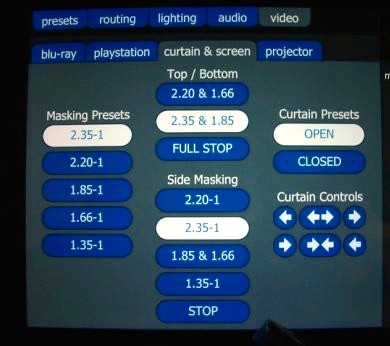
Posted by Justin Hamaker (Member # 2165) on 05-19-2015, 04:43 PM:
I'm thinking about Bobby's comments, and I can't help wondering if cost would really be a factor in choosing Scope over Flat, rather than it being an artistic choice. I get that fewer pixels means smaller storage requirements and less rendering time. But I can't help wondering if this is significant enough to dictate choosing one format over another. It just seems like the extra cost would be an insignificant portion of a multi million dollar budget.
Posted by Monte L Fullmer (Member # 2797) on 05-19-2015, 04:46 PM:
I have Barco 4K 32B units in two of my big houses and the flat container image fills the screen completely.
Thus, it looks like to me that the 2:20/1 image within that container will still look great .. for all to witness.
I trust the reason for doing this container usage is to take advantage of the 4K resolution for a wide screen image.
I'm leaving things alone.
-Monte
Posted by Bobby Henderson (Member # 840) on 05-19-2015, 05:10 PM:
quote: Justin Hamaker
I get that fewer pixels means smaller storage requirements and less rendering time. But I can't help wondering if this is significant enough to dictate choosing one format over another. It just seems like the extra cost would be an insignificant portion of a multi million dollar budget.
The difference between d-cinema flat and scope is pretty big:
400656 pixel difference for 2K
801312 pixel difference for 4K
The storage and bandwidth requirements increase geometrically when things like 3D and/or deep color bit depths are added.
Movies with 9-figure production & advertising budgets still have various people looking for cost savings everywhere. Any jobs that can be jobbed out overseas for less money are. They shoot the movie wherever they can get the best location deals (Hollywood is losing lots of work over this). Pinching pennies over pixels is not out of the question either. After all, they need enough money to pay the 8-figure salaries of all those actors, producers and other douche-bags that consume most of the budget.
Posted by Justin Hamaker (Member # 2165) on 05-19-2015, 06:08 PM:
I just tested some trailers on this format. What I found is that for flat movies you'll want to run scope trailers, and for scope movies you'll run flat trailers. For example, use scope trailers for Minions and Inside Out, and use flat trailers for Star Wars and Pixels.
Also, the flat trailer for Tomorrowland should fit the screen perfectly.
Posted by Brad Miller (Member # 2) on 05-19-2015, 10:54 PM:
quote: Jason Metcalfe
Then again I think we forget that many of these aspect ratio choices are a combination of some technical but also primarily artistic choices
I'm getting really tired of these arrogant filmmakers using that "artistic choice" line as a get out of jail free card for being dumbasses.
Posted by Marcel Birgelen (Member # 6801) on 05-20-2015, 01:33 AM:
quote: Bobby Henderson
Movies with 9-figure production & advertising budgets still have various people looking for cost savings everywhere. Any jobs that can be jobbed out overseas for less money are. They shoot the movie wherever they can get the best location deals (Hollywood is losing lots of work over this). Pinching pennies over pixels is not out of the question either. After all, they need enough money to pay the 8-figure salaries of all those actors, producers and other douche-bags that consume most of the budget.
While it might be something on some peoples mind, I don't think this was the reason for the oddball aspect ratio here.
First of all, IMDB still lists the aspect ratio as 1.90:1 for (Digital) IMAX, since it doesn't include the qualifier "some scenes", I expect the whole movie to be in that aspect ratio. This 1.90:1 is the native aspect ratio of 2K and 4K imagery. So, they already did all the filming, special effects and post production in this resolution. The pixels are already there.
I guess they could easily have gone from 1.90:1 to flat, just shaving off a few pixels left and right probably won't hurt the image composition at all, but for whatever reason they decided the "poor non-IMAX schmucks" can't have the whole pie and will be getting a trimmed version in this 2.20:1 aspect ratio.
This is also the primary problem I have with this kind of concepts. This is simply not a widescreen release. A movie using a wide screen format should be shot and framed with this wide screen in mind. Shots should be composed to look wide, it should not end up as a letterboxed version of the original movie...
Most likely, this movie was intended to be a scope release and a "larger than scope" (yuck) release for IMAX, just like all three of those Hobbit movies for example. But during production, someone forgot about it and the end result was a large amount of shots not fitting within a scope frame and the decision to go for 2.20:1 was born.
Another, but very unlikely reason might be a leftover from the apparently canned 3D conversion. Maybe many shots were composed with a floating window in mind and someone decided to leave the "safe zones" at the left and right edges out of the 2D version.
Posted by Lyle Romer (Member # 1266) on 05-20-2015, 12:34 PM:
So basically part of the sales pitch of digital projection would be that everything would be standardized so that things wouldn't get messed up and now directors are introducing non-standard aspect ratios which will either be pillar and letter boxed or require a new zoom setting so there is something else to get screwed up?!?
Posted by Carsten Kurz (Member # 5396) on 05-20-2015, 02:01 PM:
If cost was the reason for this AR, they certainly would not have chosen to go 4k in the first place.
The movie was shot full-frame on the F65, and then cropped to 1.9 for IMAX and 2.2 for general release. They had all options to begin with. And I guess the spread between 1.9 and 2.39 was just too much for them to simply be done in post.
- Carsten
Posted by Mike Blakesley (Member # 26) on 05-20-2015, 02:01 PM:
We have to keep in mind:
Most directors don't know the challenges of the exhibition side of things
Studios tend to give directors free reign with things like the aspect ratio. (The only thing they really seem to care about is bringing the picture in on time and with the rating they want.)
And studios might know a little more about exhibition than the directors do, but only technical requirements; they have no concept of how difficult it might be to put some of their ideas into practice in the real world.
All of this adds up to the nonsense we're seeing lately.
Posted by Bobby Henderson (Member # 840) on 05-20-2015, 02:39 PM:
The situation is what it is, but there is no justifiable excuse for it. The problem is like failing Graphics Design 101.
One of the most basic principals in design is this: tailor your design for the output device & size/shape of the display. If the finished design is going to be on a standard letter-sized piece of paper you design for that size and shape, and take into account the printer's capabilities.
Every design medium requires this, be it newspapers, magazines, signs, billboards, TV screens, web page banners, LED displays or even a freaking movie screen. All have a visual footprint described in some kind of numerical value, be it inches, points, picas or even pixels. Bonus points go to the people who bother to take into account how the finished design is going to be viewed, be it held in the hands up close, viewed from a speeding car or viewed from a seat in a movie theater.
The thing going on now is a little like someone throwing together a design in MS Publisher on a letter sized piece of paper, but he really wants the design to go on a wide, rectangular 14' X 48' billboard. This is an extreme example, but not in principal.
Too many people think that just because something is "digital" they can do whatever the hell they want to do. They think digital equates to being flexible and versatile when that's not really the case.
Movies need to be made in mind for how theaters are going to be playing them right at the start of production. With digital they know all the numbers up front. That's why there is no excuse for the nonsense going on now.
Posted by Brad Miller (Member # 2) on 05-20-2015, 04:00 PM:
I can't wait for that first artistic choice movie shot on a cell phone in vertical mode. ![[puke]](graemlins/puke.gif)
(At least IMAX would finally have a suitable movie to play though. ![[Razz]](tongue.gif) )
)
Posted by Carsten Kurz (Member # 5396) on 05-20-2015, 04:39 PM:
Mike - the crew that made this film shot 'Mission: Impossible - Ghost Protocol' on IMAX and 35mm for IMAX 1.44 and Scope. They also made
- Benjamin Button
- Life of PI
- Oblivion
- Tron Legacy
- Zodiac
- Ratatouille
There's Walter Murch in the editing department.
It's ridiculous to think they did not know what they were doing. They are not high-school filmmakers.
They may not know how to operate a popper, but they sure know about aspect ratio.
- Carsten
Posted by Marcel Birgelen (Member # 6801) on 05-20-2015, 04:59 PM:
Well, I was watching some of the music videos of this years "Eurovision Song Festival" candidates on Youtube (lots of crappy music, but kind of a big deal in Europe and for whatever reason in Australia too right now...). One of it (and I don't remember which country it was and neither do I care) featured a title card proudly mentioning the video was shot entirely on cellphone cameras...
We've had plenty of those fake found footage drivel the last decade and a half, so I'm pretty sure, there must be this visionary director out there, just waiting to shoot his first movie entirely on cellphones and in 9:16...
I can't wait for the first phone featuring vScope... Vertical Scope. More height for your crappy cellphone videos, just what you've been waiting for.
quote: Mike Blakesley
Most directors don't know the challenges of the exhibition side of things
While there is an almost infinite list of directors of which I'd expect just that, I would've expected better from someone like Brad Bird and his team. So, maybe he's not the one to blame right here..?
quote: Bobby Henderson
Every design medium requires this, be it newspapers, magazines, signs, billboards, TV screens, web page banners, LED displays or even a freaking movie screen. All have a visual footprint described in some kind of numerical value, be it inches, points, picas or even pixels. Bonus points go to the people who bother to take into account how the finished design is going to be viewed, be it held in the hands up close, viewed from a speeding car or viewed from a seat in a movie theater.
Movie screens are like web pages... an infinite amount of aspect ratios and sizes. The only thing that's missing are the scroll bars. ![[Wink]](wink.gif)
I've never really understood the fetish for odd aspect ratios, especially this constant switching between aspect ratios which has become increasingly popular.
In my opinion, aspect ratios are merely a product of the technology being used and are, in many cases, more like a trade-off. Luckily, most technologies offer multiple standard or de-facto standard aspect ratios to choose from, so choose one of those standard ratios that best fits the composition of your picture and leave it there.
I also agree with Steve on this, if you want to go for maximum resolution, which you should almost always do and which is also implied in the DCI specs, the only *right* way to do it is to release it as C-220... That's also how anything converted from 5/70 should be done.
And if you want to avoid your presentation getting all screwed up due to lack of "care and knowledge" on the exhibition side of things, you should just stick with F or S in the first place...
Posted by Justin Hamaker (Member # 2165) on 05-20-2015, 05:19 PM:
If there's a consolation to this, it appears the aspect ratio will be used more than once. From what I can tell, Jurassic World will be in this same aspect ratio. Maybe that will justify making all the necessary configuration changes in the LMS and servers to have this be it's own format.
Posted by Marcel Birgelen (Member # 6801) on 05-20-2015, 05:38 PM:
Wasn't Jurassic World supposed to be in 2:1? At least the trailers seem to be in exactly this aspect ratio and IMDB also seems to be in agreement with this.
Posted by Jonathan Goeldner (Member # 4854) on 05-20-2015, 05:39 PM:
unless it changed (again) Justin, 'Jurassic World' is 2.0, not 2.20 - which is strange since some of the film was shot with 65mm camera's (why not retain that AR?)
Posted by Justin Hamaker (Member # 2165) on 05-20-2015, 05:51 PM:
I'm just going by the trailer. The flat version perfectly fits the screen configuration for Tomorrowland. Granted, I didn't play the trailer with the crop removed, so I don't know for sure it isn't being cropped to some extent.
Posted by Marcel Birgelen (Member # 6801) on 05-20-2015, 05:57 PM:
I'm pretty sure you cropped the image. Maybe you can show the movie the same way. It's not like anybody will miss something significant. ![[Smile]](smile.gif)
quote: Jonathan Goeldner
unless it changed (again) Justin, 'Jurassic World' is 2.0, not 2.20 - which is strange since some of the film was shot with 65mm camera's (why not retain that AR?)
Visionary director chooses visionary new aspect ratio for his visionary new dinosaur movie and leads the way in a visionary and artistic vision.
That's why.
Posted by Jonathan Goeldner (Member # 4854) on 05-20-2015, 06:16 PM:
^ ![[Roll Eyes]](rolleyes.gif)
Posted by Brian DeCiancio (Member # 1422) on 05-20-2015, 08:35 PM:
They can "shoehorn" all they want. Not gonna happen at my theatres.
Totally ridiculous and unacceptable. I will not make new lens and screen files 4 days before a movie is released.
Done...
Posted by Jim Cassedy (Member # 4115) on 05-20-2015, 09:13 PM:
quote: Brad Miller
I can't wait for that first artistic choice movie shot on a cell phone in vertical mode
Too late. I already ran one at the Telluride Film Festival last year.
Don't know if it was actually shot on an i-phone, but 98% of the movie was
in a 1:1 "I-phone Format" I had a 35 foot wide screen with a 10ft square
image right in the center. I spent the first 10min of the movie dealing with
floor staff calling me on the radio saying that customers are complaining
that I'm running the movie with "the wrong lens" Some of them walked out.
The next day I was chatting with someone downtown, and when they found
out who I was and where I worked, they said "Oh,so you're the guy who ran
the movie with the wrong lens last night" D'oh! ![[Mad]](mad.gif)
Posted by Marcel Birgelen (Member # 6801) on 05-21-2015, 02:55 AM:
To be honest, if I would be fed such b.s., without knowing, I would also first and foremost blame the staff and not the film maker...
But I bet the movie was Mommy? Because it has been discussed right here before.
quote: Jonathan Goeldner
^
Well, if you have a better explaination I'm all ears.
But I bet there is none. The aspect ratio of this movie is as stupid as everything else in this movie, like the story... And I haven't even seen the movie, just the trailers.
For example, what's the deal with shooting your movie on 35mm, 65mm and in digital on RED cameras? Almost every one of those scenes will include loads and loads of CGI, so what are you wasting 65mm film for? You will first create a 4K or 6K scan of it, put it trough all kinds of digital mangling, paste in your CGI dinosaurs and stuff and ship it as a digital release... Also, this movie will NEVER see a 5/70 release nor an IMAX film release anyway. It's a f*cking waste of perfectly good film stock, just to please the ego of some wannabe big shots.
That's also how this aspect ratio came into being: Look at how great this looks! Yeah! It's awesome!Iit's something never seen before! Yeah! Let's just fcking do it all right!
Mind you, we're talking Jurrassic World here, not Tomorrowland... or "Project T" as it was recently rebranded right here (because we Europeans don't have a Tomorrowland at our local Disney theme park).
Posted by Carsten Kurz (Member # 5396) on 05-21-2015, 03:57 AM:
I think a lot of directors and cameramen simply WANT to do some 65mm shooting before it's gone forever now. And it seems to be good for some extra advertizing or money/support from IMAX.
- Carsten
Posted by Jim Cassedy (Member # 4115) on 05-21-2015, 12:59 PM:
I've had a 35mm back-up print of TOMORROWLAND for some of the special
screenings I've been doing this week.
The 35mm is is printed as SCOPE (anamorphic), but they've pillerboxed
it with a black borders on the left & right sides of the image.
Posted by Monte L Fullmer (Member # 2797) on 05-21-2015, 07:19 PM:
quote: Jim Cassedy
Don't know if it was actually shot on an i-phone, but 98% of the movie was
in a 1:1 "I-phone Format" I had a 35 foot wide screen with a 10ft square
image right in the center.
You know, if you turned that "eye-fone" ninety degrees to the left (or right so when playback, the image isn't upside down), you can have the nicest wide screen 1.78:1 movie that you ever shot with a hand held, esp when them things are doing HD video.
When I shoot videos with my Android, I turn the fone ninety degrees to the left to make wonderful wide screen videos.
And guess what? You get a lot of imagery captured that way!
Try it and see.
- Monte
Posted by Robert Harrison (Member # 3202) on 05-21-2015, 07:26 PM:
So, any on else get a last minute addition of a short which is apparently meant to be a prologue to the feature? Gee, can't these people tell us ANYTHING in advance? Received the following e-mail today:
Good day,
We come in this morning to a last minute filmmaker request for our ‘presentation house’ locations on TOMORROWLAND… there is a 3 1/2 minute animated introductory piece that we’re asking to have programmed before the film. We’d like this to remain part of the program throughout the run of engagement.
Still working out details of how the content will be delivered (thumb drive sent overnight maybe?)… will follow up with further info as we have it…
Thanks
Matt
Matt Kalavsky
Executive Director of Sales, Distribution
Walt Disney Studios Motion Pictures
So, I just got this thing in today on a USB stick. I reckon we must be a "presentation house," eh?
Posted by Jim Cassedy (Member # 4115) on 05-21-2015, 07:46 PM:
I almost hate to ask this, but- -
What aspect ratio is the short in?
Posted by Robert Harrison (Member # 3202) on 05-21-2015, 07:47 PM:
You gotta know it's the same as the feature, although not listed as F-220, only as F. And, for some dumb reason, the soundtrack is 2.0!
Posted by Jim Cassedy (Member # 4115) on 05-21-2015, 08:34 PM:
Posted by Scott Norwood (Member # 30) on 05-21-2015, 08:36 PM:
quote:
And, for some dumb reason, the soundtrack is 2.0!
If you have worked for a "film" festival lately, this should come as no surprise--I am seeing nearly 50% of DCP-format shorts (and many features) come in with left/right-only mixes (though I would expect better from a real distributor, of course).
It is pretty sad how DCP--which should have been the best thing to happen to movie sound quality in years--has, up to this point, generally caused more issues with sound than any other format.
Posted by Stephan Shelley (Member # 8587) on 05-21-2015, 10:33 PM:
Same late notice on the short. UPS tried to deliver at 9:30 am when no one is at the theatre. Ended up downloading it via the internet from deluxe.
Posted by Bobby Henderson (Member # 840) on 05-21-2015, 10:40 PM:
Why is 2.0 happening with DCPs? Considering the damned tools that are available, for cheap even, a 5.1 or 7.1 mix in LPCM or even encoded in a lossy format like Dolby Digital or Dolby Digital Plus should be very easy. Right now I could record some burps and farts, pan them around in a 7.1 layout in Adobe Audition CC and encode it in LPCM or Dolby Digital Plus, all without paying anything extra for any plug-ins. However, for a feature movie project $1500 to encode DTS-HD Master Audio for the Blu-ray isn't bad.
Are these guys just cheap, lazy or both? The only rational defense I can see is the final edit on that project, or any other 2.0 project, is they were working on it up to the very last minute. And then they were so burned out on all the laborious shit they didn't feel like going back and building up a proper 5.1 track.
Posted by Monte L Fullmer (Member # 2797) on 05-22-2015, 02:25 PM:
Been watching some of "Tommorowland" in our 4K house... Yes, image is a bit on the letterbox size, but can't really see the 4K resolution as a big thing since it looks like 2K stuff....
"Mad Max:Fury Road" looked better in this house and that was just 2K content.. go figure.
Looks like a good popcorn movie though ... - Monte
Posted by Jure Maticic (Member # 7197) on 05-23-2015, 02:59 AM:
Tested it yesterday - i think it looks great in 4K, and our Sony really didn't need any new macros. We just ran the Flat settings. It is strange though with the extra pixels on the top and bottom ..... But as far as the image goes, it is as close to a good 35 mm as you can get.....
Posted by Jonathan Goeldner (Member # 4854) on 05-23-2015, 11:10 AM:
this is a slight thread digression question, but why has Deluxe dropped Disney titles from it's DCP listings on it's website?
Posted by Brad Miller (Member # 2) on 05-23-2015, 11:21 AM:
Please start a new thread for that diversion.
Posted by Gary Lightfoot (Member # 8842) on 05-24-2015, 09:39 AM:
So, talking purely as a guy with only home cinema experience, would I be right in saying that what the directors etc need to start doing, is ensuring that if they want scope to continue to be the biggest/widest image with the most resolution (ignoring IMAX), they need to insist that all of the 1.9 frame is used with anamorphics on the camera, and kept that way for the rest of the production chain to the final release, so that it forces theatres to use a 1.25 anamorphic lens to show the film in it's correct aspect ratio and with the highest pixel density?
If that's the case, can't people like Brad Bird who has openly stated his dislike for the way movies are currently shown (small crappy screens in his word), just insist on this and maybe eventually get the DCI spec to change so that scpe is delivered via anamorphics for at least the primary release?
In the multiplexes, if they have a large scope screen for new releases, they would just need an A lens for that screen, and then when it goes down to the smaller screens, do they get a new master that is letterboxed, or does the imager scale down the height to get the correct aspect? If the latter, I can see that happening to anamorphic movies anyway, so they don't have to buy an A lens...
Just the thoughts of a novice
Posted by Brad Miller (Member # 2) on 05-24-2015, 11:43 AM:
Adding an amamorphic lens to a system will cost in the $10-15k range per machine. Plus the prime lens, which can be $5-8k may also have to be changed out.
It's all about the money. Nobody wants to pay for it. The industry is headed full throttle towards a "good enough" attitude (just like with being so cheap as not to install proper masking). It's these things that will kill first run exhibition as time continues on.
Posted by Steve Guttag (Member # 268) on 05-24-2015, 12:48 PM:
I would tend to say that it would be on the low end of that range. Also, the prime lens wouldn't need to be changed out since the zoom range needed would be effectively zero. Set the prime lens for Flat and merely use the anamorphic lens for scope.
For constant width theatres, the ICP should be able to scale down for scope (set anamorphic factor to .75.
Posted by Jim Cassedy (Member # 4115) on 05-25-2015, 12:12 PM:
I know this isn't digital, but since we're discussing aspect ratios, here's
a shot frame-shot from a 35mm "Tomorrowland" print. The 35mm's were
printed in anamorphic SCOPE, but as you can see there is a slight bit of
pillarboxing at the sides, and the frame-lines are thicker than normal.
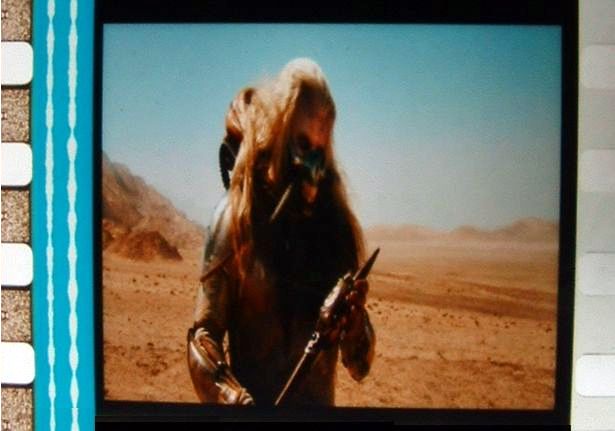
You'll also notice there's no DTS or SDDS tracks.
( I did several private advance preview screenings before the movie opened
last week, mostly for people who work in the movie industry, and I guess the
studios still don't fully trust the digtialstuff to work right, so they made sure
I had a 35mm 'backup print', in case something crashed)
Posted by Brad Miller (Member # 2) on 05-25-2015, 02:55 PM:
quote: Jim Cassedy
You'll also notice there's no DTS or SDDS tracks.
Actually no I didn't notice that there wasn't an SDDS track in your picture above.
Posted by Dennis Benjamin (Member # 1137) on 05-25-2015, 08:08 PM:
So,two posts above mine, the author is referencing a 35mm frame of "Tomorrowland". But it is a 35mm frame of "Mad Max: Fury Road".
?
Posted by Scott Norwood (Member # 30) on 05-25-2015, 08:11 PM:
The current 35mm prints of 2001 are printed this way, too. Scope image with side pillars to produce a 2.2:1 image on screen.
Posted by Geoff Jones (Member # 3668) on 05-25-2015, 08:21 PM:
My favorite part of Tomorrowland was the George Clooney v. Immortan Joe fight.
Posted by Jim Cassedy (Member # 4115) on 05-25-2015, 08:28 PM:
[QUOTE] The author is referencing a 35mm frame of "Tomorrowland". But it is a 35mm frame of "Mad Max: Fury Road".
OMG Dennis- You're right! I uploaded the wrong scan. ( ![[uhoh]](graemlins/uhoh.gif) Extremely embarrassed)
Extremely embarrassed)
I had back-up prints of both sitting around here. It's too late for me to edit the original post but I'll upload the correct picture when I get bak home.
I didn't catch it because I actually haven't seen either movie.
(I only run them. Nobody ever said I actually had to WATCH them) ![[Big Grin]](biggrin.gif)
Posted by Jonathan Goeldner (Member # 4854) on 05-27-2015, 11:15 AM:
so is Disney releasing 2K and 4K DCP's of this?
I thought the brightly lit scenes had tremendous pop to the image.
Posted by Manny Knowles (Member # 1171) on 05-28-2015, 06:28 PM:
It's interesting that one of the selling points for digital cinema was/is that it would simplify exhibition to the point where there would no longer be a need for projectionists.
And then we start getting these "special" releases in non-standard formats. At a typical cinema, who's supposed to be making these modifications? Managers?
And I agree with Steve -- C-220 would be the best way to go for a release like this, or (more commonly) a d-cine re-release of an older 70mm title.
Posted by Rachael Barbash (Member # 5158) on 05-29-2015, 03:15 AM:
Is anyone here playing Tomorrowland in scope or actually zooming for each show? Currently we're just playing it as flat with letter boxing on the top and bottom but it looks annoying IMHO - even though no one has complained that we're playing the movie incorrectly.
I'm not up to making new screen files for this and the film moves around to different projectors too much to easily zoom for each show, depending on what projectionist is working.
I think someone mentioned that only a bit would end up getting cut off on the top and bottom playing in scope but how does this look to anyone doing it?
BTW we played Mommy as well with the 1:1. Ugh.
Posted by Jason Whyte (Member # 1433) on 05-29-2015, 03:29 AM:
Just as a presentation update: every cinema playing this movie in this city is playing it letterboxed to 2.20:1, set with a flat cue and on a screen set with flat masking.
At the very least they're all on top-masking screens, but still...
Posted by Gary Lightfoot (Member # 8842) on 05-29-2015, 03:49 AM:
I think the problem here is that the directors etc want to present their movies in a particular way/aspect ratio (like they could in the old days), but the multiplexes and even the DCI format it seems are more interested in saving money and have no interest in the art of presentation.
Here in the UK (and probably everywhere else) there no longer seem to be dedicated projectionists any more, so there is no longer the skill available to ensure all movies are presented correctly. If the manager or even the guy who sells the popcorn is being relied upon to play the movie, it seems there's little chance that they will be able to get things correct for anything that is not flat or scope, and even then there seems room for mistakes.
It's all well and good them sending out people to ensure the movie house can do their movie justice by checking the audio and video before a particulr presentation, but if the projectionist is being relied upon to make files for the movie and doesn't have the skill/training, there seems little point in checking the theatre IMHO. or do they check the staff for ability as well?
I think the directors etc have got to start getting involved in the presentation side of things and making a fuss, as currently DCI movies aren't being presented a great deal differently to Blu Ray at home on tv,so then many people may start thinking what's the point paying to watch a big tv when they can do something similar at home for a lot cheaper and without the hassle or inconvenience.
It's not surprising that Joe Public doesn't understand why they have black bars at home or in the theatre for scope movies - they think that's how they should be presented and then ask that all movies should be 16:9 because scope is too small and they don't like black bars. They don't understand that it should be the other way round.
Just my point of view but it feels like we're getting further away from cinema and closer to big tv now. I don't know what can be done about it either...
Gary
Posted by Lyle Romer (Member # 1266) on 05-29-2015, 05:33 AM:
quote: Gary Lightfoot
I think the problem here is that the directors etc want to present their movies in a particular way/aspect ratio (like they could in the old days), but the multiplexes and even the DCI format it seems are more interested in saving money and have no interest in the art of presentation.
In the "old days," weren't there standard aspect ratios? I don't recall Spielberg deciding that Jurassic Park should be 2:1. Would he have wanted special aperture plates cut for that? Would it have been letterboxed flat prints or pillarboxed scope? Would he have expected the masking to be adjusted just for him?
If they are going to invent a new ratio, make it 1.9:1 and use the whole imager. At least then you can say that you are truly maximizing the resolution of digital cinema.
Why are they even picking these ratios? Don't they understand that the reason that 70mm was 2.2:1 was because it was the height of the frame but couldn't be wider due to the magnetic soundtrack location? Do they think that 2.2:1 was chosen for artistic reasons?
Posted by Gary Lightfoot (Member # 8842) on 05-29-2015, 06:33 AM:
That's my point - with 2.20:1 that was a standard aspect. With digital, there is only 1.9 and however many vertical pixels you want to use for the ratio you want, and the issues that creates, so to do 2.20 means either filling the width of the 1.9 imager and using around 982 pixels for the height (kinda like on a Blu Ray - constant width), or using the same height as for scope, and having black bars down the sides - effectively window boxing the whole image a bit like the 35mm film had done for Mad Max Fury Road (as shown earlier).
I get the impression there's a disconnect between the movie makers and the delivery chain so they don't understand what's happening to the movies when it gets to theatres, or what problems it's creating.
Didn't Spielberg use 1.85 for Jurassic Park rather than scope to try highlight the height and size of the dinosaurs?
I agree - if they use 1.9 and 1.9 anamorphic then everyone would get the best images they could for both formats (assuming the theatre has constant height capability). But again, going anamorphic means the use of an anamorphic lens and that adds cost and complexity, neither of which seem to be wanted by the multipexes.
Gary
Posted by Lyle Romer (Member # 1266) on 05-29-2015, 06:55 AM:
quote: Gary Lightfoot
With digital, there is only 1.9 and however many vertical pixels you want to use for the ratio you want
Not exactly. For whatever reason, when they did the DCI specs, they made flat use the entire height of the imager but not the entire width and scope use the entire width but not the entire height.
Posted by Gary Lightfoot (Member # 8842) on 05-29-2015, 10:45 AM:
Oops, yeah - flat is 1.85 so can't use the entire width.
Thanks
Gary.
Posted by Gordon McLeod (Member # 33) on 05-29-2015, 11:14 AM:
And 2.2:1 could have used the entire width of the imager and extra height just like in effect70mm had a extra perf of height
then it could be projected using the maximum available for its aspect ratio but to be fair many 70mm theatres cropped the 70mm frame to the same as ascope
Posted by Bobby Henderson (Member # 840) on 05-29-2015, 03:06 PM:
The "filmmakers" and their assistants are largely wasting their time bothering the movie theaters because doing the job wrong is getting baked into the movie from the start of production and into the theaters when they are built. There is a litany of things that should have been done differently with d-cinema, but were not out of cost cutting concerns and/or trying to imitate the look of an IMAX theater, but on a much smaller scale (we'll still take that premium surcharge, thank you very much).
Posted by Marcel Birgelen (Member # 6801) on 05-29-2015, 03:52 PM:
quote: Lyle Romer
Not exactly. For whatever reason, when they did the DCI specs, they made flat use the entire height of the imager but not the entire width and scope use the entire width but not the entire height.
You could say that those DCI specs where "somewhat influenced" by what the market had to offer in terms of DMD chip availability.
I guess 2K ended up being 2048K pixels in width*, because it's a power of 2, which often makes stuff easier in discrete logic design. And it fits flat just right if you take 1080 pixels (an industry standard) as height.
* Actually, it's the DCI definition of 2K, some other definitions are also floating around...
Posted by Joris Springer (Member # 4175) on 05-29-2015, 07:28 PM:
Why don't we all just say as projectionists that it looks like shit in a Flat container and that even though as much as we would have liked to have given Disney a better quality of image nobody is going to adjust their masking to create a perfect 2.20 image on our screens because hardly anyone has the knowledge in house to create a macro and adjust the masking in that macro for a 2.20 movie.
It is a ridiculous decision from Disney to release a movie in that format and I wonder how many cinemas are really creating a macro just for this movie (though I heard rumors we can expect the same thing with Jurassic World).
Posted by Buck Wilson (Member # 5885) on 05-30-2015, 01:35 AM:
Sooooooooooo Who should we tell?
I feel like there's a lot of garbage we as a group of professionals could at least influence if we took all this energy and direct it through the proper channels.
But to be honest, that's a pipe dream of mine that perhaps someday if I have my own theater, that I can present things properly and actually not be bottlenecked with the content I receive.
Posted by Carsten Kurz (Member # 5396) on 06-02-2015, 07:26 AM:
Same thing now for Jurassic World...1:2.20 in Flat for both 2D and 3D.
They were releasing all their children flics in 1,77 so they'd fit nicely on DVD and BluRay.
Now it seems they found something new, trying to please both epic scope and IMAX screens.
- Carsten
Posted by Jim Cassedy (Member # 4115) on 06-02-2015, 08:50 AM:
quote:
every cinema playing this movie in this city is playing it letterboxed to 2.20:1,
I was at a theater last week to do some work, and as I walked around to
check out their various auditoriums, I noticed they had TOMORROWLAND
playing in two auditoriums. In one it was playing FLAT, and in the other
it was SCOPE. I could not get any kind of coherent explanation as to why
they did this. In fact, even they seemed to be unaware of the difference.
The closest I came to an explanation was someone who told me:
"That's just the way it is" ![[Eek!]](eek.gif)
Posted by Brad Miller (Member # 2) on 06-02-2015, 09:26 AM:
quote: Carsten Kurz
Same thing now for Jurassic World...1:2.20 in Flat for both 2D and 3D.
Jurassic World is 2.0:1, not 2.2:1
Posted by Lyle Romer (Member # 1266) on 06-02-2015, 09:49 AM:
At least Jurassic World won't look as bad when everybody ignores the instructions and plays it in letterboxed flat. Can somebody please explain why the director thought that 2:1 was going to be better than 1.85:1 if they wanted a taller image for the dinosaurs like Spielberg did for the original? Didn't they shoot some on IMAX film so wouldn't the taller ratio work better for that anyway?
Posted by Bobby Henderson (Member # 840) on 06-02-2015, 11:14 AM:
Without any film prints, shooting in 15/65mm or 5/65mm is largely a waste of time. They might as well just shoot in ordinary 4-perf 35mm if it's going to get down-rezzed to 2K TV screen resolution and converted into 3D. I guess the IMAX cameras were put into use just to fool various digital fan boys into thinking the "film makers" encoded some extra magic pixels between the actual pixels. I swear that's how IMAX fans sound when trying to claim they're seeing a whole lot more in one of those 2K digital shows than they do in a standard 2K theater.
quote: Jim Cassedy
I was at a theater last week to do some work, and as I walked around to
check out their various auditoriums, I noticed they had TOMORROWLAND
playing in two auditoriums. In one it was playing FLAT, and in the other
it was SCOPE.
In the long run we'll probably end up with movie theaters with both the screens and projectors set to show only 1.9:1. Then the "film makers" can letterbox or pillarbox the image to their heart's delight, all without any movable masking, format pre sets, etc. This will probably come along with smaller, less expensive prime lenses. No need to zoom if you're really stuck at 1.9:1 100% of the time.
quote: Joris Springer
Why don't we all just say as projectionists that it looks like shit in a Flat container and that even though as much as we would have liked to have given Disney a better quality of image nobody is going to adjust their masking to create a perfect 2.20 image on our screens because hardly anyone has the knowledge in house to create a macro and adjust the masking in that macro for a 2.20 movie.
To be fair, there isn't a giant amount of difference between the 2.20 image being 1998 pixels wide versus 2048 pixels wide. The difference is 25 pixels of width on the left and right ends of the image.
It would make a much bigger difference in terms of image quality if the image was 1080 pixels tall and anamorphically encoded for a 1.25x projector lens. A whole lot more detail would get on screen.
quote: Carsten Kurz
Now it seems they found something new, trying to please both epic scope and IMAX screens.
The approach isn't too far removed from how Super35 popularized home video safe widescreen. Crop the image down to 'scope, restore some of it for the VHS 4:3 "full screen" home video release.
The problem is when movie makers try to compose for multiple aspect ratios at the same time they end up not really composing for anything. At best, they're only doing rule of thirds composition. Other compositional methods, such as golden triangle or golden spiral, don't work for multiple aspect ratios because they require a single, specific frame size be used.
This non-visual, let's make it work anywhere, bullshit is taking place in more than just movies. "Responsive" web design is a good example. "The future is responsive," they scream, demanding any web page have a single liquid layout that works on anything. Unfortunately any true responsive layout just ends up looking like a visually glorified, boxy Microsoft Excel spreadsheet with no sense of composition at all. Web viewing devices are an extreme of differences. You have vertical and horizontal screen orientations, in wide aspect ratios. Display sizes are vastly different, from a microscopic low rez vertical phone display to a 5K resolution horizontal display on a new iMac. If someone wants their web site to look good on all those different display sizes & types they have to design each page of their site multiple times, tailoring it for all those display types and triggering each layout via media queries. Giant pain in the ass.
Movie screens aren't quite so extreme in their differences, but with IMAX adding taller screens to new laser-based theaters it will threaten to least plunge movie compositions back into some of the same VHS style silliness we have seen in the 1980's and early 1990's.
Posted by Lyle Romer (Member # 1266) on 06-02-2015, 01:47 PM:
quote: Bobby Henderson
It would make a much bigger difference in terms of image quality if the image was 1080 pixels tall and anamorphically encoded for a 1.25x projector lens. A whole lot more detail would get on screen.
In all seriousness, why don't you work with Brad and other experts on this site and actually create this proposed format. You can name it and come up with a logo. I assume IMAX doesn't use DCI compliant DCPs since they are using the whole imager for the 1.9:1 ratio so that shouldn't be a major issue.
If you can create it, you'd just need Christopher Nolan or somebody like him to produce a movie in it. It should be something that can catch on.
From a marketing perspective, it will be significantly higher resolution than 4k scope. It would have 1.8 million pixels more.
Posted by Bobby Henderson (Member # 840) on 06-02-2015, 02:13 PM:
I'm all but certain 1.25x anamorphic had been considered and wrongly discarded during the planning stages of current 2K/4K d-cinema standards.
If I was going to give the anamorphic system a brand name I'd just call it Super 2K and Super 4K. The 2K and 4K terms are commonplace now and the "Super" addition would make it very easy for anyone to figure out the 2K and 4K versions are enhanced and better.
Anamorphic 2K/4K would be a big improvement, but common height theater screens would see the biggest quality improvement. Two areas where I would expect the biggest resistance against adoption of Super 2K/4K: 1. movie productions; they would be rendering a lot more pixels in their DI's and CGI. 2. theaters with common width screens; they wouldn't see quite as much benefit from the resolution boost as common height screens.
Posted by Brad Miller (Member # 2) on 06-02-2015, 02:32 PM:
TI has already created a DLP chip that is native 2.40:1, which is what SHOULD have been done all along.
Series 3 simply needs to move to that standard.
Posted by Marcel Birgelen (Member # 6801) on 06-02-2015, 03:29 PM:
quote: Lyle Romer
In all seriousness, why don't you work with Brad and other experts on this site and actually create this proposed format. You can name it and come up with a logo. I assume IMAX doesn't use DCI compliant DCPs since they are using the whole imager for the 1.9:1 ratio so that shouldn't be a major issue.
There's nothing non-DCI compliant about using the full imager width, it just doesn't fit in one of the two common Flat and Scope containers.
But I've been advocating a new "Seal of Quality" for a while now, since THX went further south than the South Pole, there's been a void there which has been filled with various snake oil offerings.
If I look at how big the home cinema "community" is, there must be quite a population out there that still cares about quality, so I'm pretty sure such a brand could succeed if a critical mass can be created.
quote: Lyle Romer
Didn't they shoot some on IMAX film so wouldn't the taller ratio work better for that anyway?
Maybe I missed something, which isn't unlikely because the creation of this movie seems to be one big mumbo jumbo, but afaik, there is no IMAX footage in this thing, or at least no IMAX film footage. There is, however, some 5/65mm footage in it.
quote: Brad Miller
TI has already created a DLP chip that is native 2.40:1, which is what SHOULD have been done all along.
Series 3 simply needs to move to that standard.
And why not make anamorphic lenses and non-square pixels for scope a mandatory requirement for all "Series 3" equipment? Wouldn't that be the most efficient solution? It worked well for decades...
Sure, it would ruin the single inventory concept, but I guess we know where those good intentions went.
Posted by Bobby Henderson (Member # 840) on 06-02-2015, 03:35 PM:
quote: Brad Miller
TI has already created a DLP chip that is native 2.40:1, which is what SHOULD have been done all along.
I can't find anything on the web regarding a native 2.40:1 aspect ratio DLP chip from TI. What is the pixel dimensions of the chip? Does it support 2.40:1 while maintaining 1080p or 2160p image heights for 2K/4K (or even go higher rez than that)?
quote: Marcel Birgelen
And why not make anamorphic lenses and non-square pixels for scope a mandatory requirement for all "Series 3" equipment? Wouldn't that be the most efficient solution? It worked well for decades...
What needs to be done is making anamorphic 1.25x available for current Series 2 setups AND supplying those projectors with FULL FRAME anamorphic enhanced 'scope DCPs. Image quality will not be improved without the higher resolution, anamorphic enhanced software. Just adding an anamorphic element to the projector alone will only improve brightness/lamp efficiency.
Posted by Marcel Birgelen (Member # 6801) on 06-02-2015, 05:22 PM:
On the presentation side of things, you don't need any "software enhancement" at all to make it work. You just need to put non-square pixels in the DCP and it works right now. It's not DCI compliant, but it should work with ANY current system with anamorphic lens setups...
Posted by Carsten Kurz (Member # 5396) on 06-02-2015, 06:17 PM:
Guys, what are you dreaming about? The world is nearly 100% digital now, based to the largest part on 1:1.9 DLP and zoom lenses. It's done forever. This is like 100years ago when 35mm was becoming standard.
It's like kicking a bunker with your foot...
It will be hard enough to get even small changes or extensions through now. Useless HFR is probably the last thing that made it through because it came on time with the IMB.
Look for how long they are working on the SMPTE DCP transition. And that is software only.
Won't be too long until you won't be able to buy anamorphics at all. Most manufacturers have unlisted them.
Funny, for all those IMAX haters, they will be the only ones using anamorphics regularly on their 4k laser installations - just not actually for scope...
- Carsten
Posted by Bobby Henderson (Member # 840) on 06-02-2015, 11:23 PM:
quote: Marcel Birgelen
On the presentation side of things, you don't need any "software enhancement" at all to make it work.
I'm only using the term "enhanced" to say the image on the DCP is squeezed from 2560 X 1080 down to 2048 X 1080. The pixels are still normal. It just takes a 1.25x anamorphic lens to unsqueeze the image onto the screen. Non-square pixels are not required.
Under this setup theaters without anamorphic lenses would need their servers to down-sample the image to standard 2048 X 858 resolution. This wouldn't be much different than a DVD player down-sampling a "16x9 enhanced widescreen" movie to play in normal looking proportions on a 4:3 TV set. That function shouldn't be difficult to incorporate into modern d-cinema servers.
The most difficult thing about this Super 2K concept is getting Hollywood productions to support it. They would go from rendering movies in 2K/4K to 2.5K/5K. That would impact their production costs.
quote: Carsten Kurz
Guys, what are you dreaming about? The world is nearly 100% digital now, based to the largest part on 1:1.9 DLP and zoom lenses. It's done forever. This is like 100years ago when 35mm was becoming standard.
Has there ever been a single, unchanging, unimproving standard for anything "digital"?
"Digital" can be done good and it can be done very very badly. Honestly it's about time for the stupid "digital" buzzword to take a hike. It means nothing, at least not anything useful in terms of specifics.
quote: Carsten Kurz
Funny, for all those IMAX haters, they will be the only ones using anamorphics regularly on their 4k laser installations - just not actually for scope...
They'll be using a vertical stretch instead to get to something more like the old 4:3 TV screen ratio. It should be fun shifting between that and 'scope, or just having really severe letter-boxing on a tall screen most of the time. It will be like going back 15 years watching DVD movies on the old SD CRT screen.
But not to worry, over 60 of the 70 or so laser-based setups IMAX plans to install in the near future are going in China. Few of those laser systems will show up in the United States or Europe. The vast majority of American IMAX-branded theaters will remain 2K Xenon-based, even in most new builds. I'm certain the IMAX screen Carmike is looking to build here in Lawton will be 2K. From what I've heard the issue still hasn't been totally decided, despite the site signs with the IMAX logo on them. The big screen might actually open as a single projector Big D screen.
Posted by Brad Miller (Member # 2) on 06-03-2015, 12:35 AM:
quote: Bobby Henderson
What is the pixel dimensions of the chip? Does it support 2.40:1 while maintaining 1080p or 2160p image heights for 2K/4K (or even go higher rez than that)?
1080p tall
Posted by Carsten Kurz (Member # 5396) on 06-03-2015, 07:19 AM:
quote: Bobby Henderson
Has there ever been a single, unchanging, unimproving standard for anything "digital"?
Adding an anamorphic lens is far from 'digital'.
Current equipment is a longterm investment, due to the rather short digital rollout, series-II has the largest installed base. This won't be replaced before 8-10 years.
Guys, you are referring to 'corporate greed' being responsible for things like 2k, high-compression ratios, etc. Where is that corporate greed when it comes to retrofitting anamorphics and issuing ever more DCP variants?
It's easier to go 4k to pacify those resonerds.
- Carsten
Posted by Lyle Romer (Member # 1266) on 06-03-2015, 08:12 AM:
quote: Brad Miller
1080p tall
No 4k version? I think that Series 3, at minimum, should be 4k.
Posted by Brad Miller (Member # 2) on 06-03-2015, 09:51 AM:
Nobody said anything about that being some sort of final standard. The 2K chip will always come first.
Posted by Bobby Henderson (Member # 840) on 06-03-2015, 10:10 AM:
quote: Carsten Kurz
Adding an anamorphic lens is far from 'digital'.
Is this to suggest any of the spherical lenses currently in use on d-cinema projectors are somehow digital? How that even relevant to the previous question I asked about standards with digital? Also, why are you even complaining about this? It sounded kind of like you really enjoyed the idea of IMAX adding anamorphic lenses to vertically stretch the 1.9:1 image in their new 4K laser projectors, but you think the same thing ought to be off limits to projectors without an IMAX logo?
quote: Carsten Kurz
Current equipment is a longterm investment, due to the rather short digital rollout, series-II has the largest installed base. This won't be replaced before 8-10 years.
Long term investment? That and digital do not go together at all. A good film projector was a long term investment, something that could last a few decades if properly maintained. None of this digital stuff can claim to have a 20 or 30 year life span. You're lucky if you get a 10 years out of anything digital. By that point any component that fails threatens to turn it into a door stop.
quote: Carsten Kurz
It's easier to go 4k to pacify those resonerds.
It's even easier (and cheaper) to watch fake 'scope movies at home. It's not going to be long before people can watch fake 'scope in 4K on a fairly widespread basis.
Don't you think movie theaters should have more obvious technical superiority to anything in home theater -superiority the customer might more likely understand? D-cinema isn't doing that nearly well enough currently. The average person isn't going to know the difference between 12-bit or 10-bit video versus some highly compressed 4:2:0 stuff he's watching on the TV set at home.
Posted by Carsten Kurz (Member # 5396) on 06-03-2015, 04:07 PM:
Digital systems evolve because software evolves. Lenses are not software. It's expensive hardware.
quote: Bobby Henderson
The average person isn't going to know the difference between 12-bit or 10-bit video versus some highly compressed 4:2:0 stuff he's watching on the TV set at home.
But you expect cinema operators to invest +10.000US$ for an anamorphic lens (and, that anamorphic has to be good for 4k at future laser-induced increased contrast ratios of +4000:1).
Again - where is that corporate greed you fancy so often here when it comes to shell ing out that money 'for nothing'? Won't happen. Anamorphics make sense to increase light-output, but not image quality.
Digital cinema will stay at 2k and some 4k at 1:1.9 base AR for a very long time. Probably as long as digital cinema will exist.
- Carsten
Posted by Monte L Fullmer (Member # 2797) on 06-03-2015, 05:26 PM:
quote: Carsten Kurz
Digital cinema will stay at 2k and some 4k at 1:1.9 base AR for a very long time. Probably as long as digital cinema will exist.
True, since there isn't any big, on-screen "wow factors" to bring the people out to see the new visual changes.
Tighter resolutions and major sharp images on a 60ft plus "Giant Screen", or IMAX screen - like heading up into the 8K realm - could bring more people out since this high resolution could be considered a "wow factor" in large screen digital presentation.
Then, get Hollywood studios to produce digital features that supports this higher resolution to address this need.
It's not like the days when "Cinerama", and "CinemaScope" made the huge splashes to combat television, and these processe got the public back into the theatre seats.
We have a new generation that has different demands now for visual entertainment.
-Monte
Posted by Bobby Henderson (Member # 840) on 06-03-2015, 05:38 PM:
quote: Carsten Kurz
Digital systems evolve because software evolves. Lenses are not software. It's expensive hardware.
Newly developed hardware makes some changes in software possible. Current 2K and 4K projectors and the food chain of software supporting them wouldn't have been possible without TI developing full HD resolution DLP chips and then 4K DLP chips later.
quote: Carsten Kurz
But you expect cinema operators to invest +10.000US$ for an anamorphic lens (and, that anamorphic has to be good for 4k at future laser-induced increased contrast ratios of +4000:1).
They're already putting more money into things like D-Box, Real-D, etc. And the laser-based systems you mention cost way the hell more than a mere $10,000 per screen price.
quote: Carsten Kurz
Again - where is that corporate greed you fancy so often here when it comes to shell ing out that money 'for nothing'? Won't happen. Anamorphics make sense to increase light-output, but not image quality.
You're deliberately ignoring my previous examples proving that anamophics would improve image quality. You're crazy or blind if you think there would be no quality difference between a cropped 2048 X 852 image versus an anamophic 2048 X 1080 image sourced from a 2560 X 1080 original.
quote: Carsten Kurz
Digital cinema will stay at 2k and some 4k at 1:1.9 base AR for a very long time. Probably as long as digital cinema will exist.
Don't count on it existing forever, especially at those quality levels.
Hollywood studios and their global media parent companies have been shooting themselves in the feet over the past decade with race to the bottom economics stunts, particularly in the home video space. That part of their business is a lot smaller than it was 10 years ago. But they're going to keep shrinking release windows, hoping they'll grow revenue and get people to buy/download virtual copies of movies as opposed to just waiting for it to appear on Netflix. People can say movie theaters will never die, but we've seen other kinds of businesses that have been around for a long time thrown onto the verge of extinction in the past decade. Movie studios and theater chains are foolish if they think they're immune to that.
quote: Monte L Fullmer
We have a new generation that has different demands now for visual entertainment.
If that generation wants to get their entertainment on the home HDTV set, or even a tablet or mobile phone, where is that going to leave movie theaters?
Posted by Monte L Fullmer (Member # 2797) on 06-04-2015, 02:56 PM:
quote: Bobby Henderson
where is that going to leave movie theaters?
They'll still survive since you still have the one attribute that people want to be entertained and will get out of their "personal bubble" to achieve such. Just that Hollywood and Cinemas needs to reach a different plateau to keep the "wow" factor still in existence.
Posted by Carsten Kurz (Member # 5396) on 06-04-2015, 03:20 PM:
quote: Bobby Henderson
You're deliberately ignoring my previous examples proving that anamophics would improve image quality. You're crazy or blind if you think there would be no quality difference between a cropped 2048 X 852 image versus an anamophic 2048 X 1080 image sourced from a 2560 X 1080 original.
Scope 4k is available NOW at 4096*1716 without hurting DCI specs. If someone is interested in increased image quality, shouldn't he better go for 4k instead of 2k + anamorphics?
- Carsten
Posted by Marcel Birgelen (Member # 6801) on 06-04-2015, 03:31 PM:
Why should we start throwing away pixels and light with 4K?
A good business case for anamorphics? Look at how much light you're dumping into your heatsinks all the time. How much lamp life could've been saved? How much power could have been saved?
Posted by Carsten Kurz (Member # 5396) on 06-04-2015, 04:36 PM:
I'm not saying it couldn't make sense. I'm saying it won't happen... Ten years after DCI disapproved non-square-pixel containers, and with ever growing numbers of DCP versions shipping, it is more than unlikely. If you want to save light - you can do that already now based on existing technology AND DCI compliant. There is your business case for energy saving or light increase - but only for that. It's the rare occasion where anamorphics are still being used today for projection.
- Carsten
Posted by Bobby Henderson (Member # 840) on 06-04-2015, 06:03 PM:
quote: Carsten Kurz
Scope 4k is available NOW at 4096*1716 without hurting DCI specs. If someone is interested in increased image quality, shouldn't he better go for 4k instead of 2k + anamorphics?
I never said anything about anamorphic lenses being off limits to 4K systems. You can go back and see where I mentioned both "Super 2K" and "Super 4K." The same kind of 1.25x system could apply just the same to 4K. Hollywood studios would need to create even higher resolution digital intermediates. Their "Super 4K" master would really be a 5K master, 5120 X 2160. That 5120 X 2160 image would be squeezed to fill the entire 4096 X 2160 chip on a 4K system.
Anamorphic setups can be used by existing theaters to light common height screens more efficiently. Unfortunately current systems digitally stretch the DCP image vertically and then optically stretch it horizontally. There is no benefit to image quality from this approach, other than just gaining a more uniformly bright image. It would be a whole lot better if the 'scope image on the DCP was already full frame before it was optically stretched onto the screen.
quote: Carsten Kurz
I'm not saying it couldn't make sense. I'm saying it won't happen... Ten years after DCI disapproved non-square-pixel containers, and with ever growing numbers of DCP versions shipping, it is more than unlikely.
Consider the fact electronics companies have already made TV sets and computer monitors specifically in both 2560 X 1080 and 5120 X 2160 resolution.
Posted by Carsten Kurz (Member # 5396) on 06-04-2015, 06:34 PM:
Yes, there are also loads of movies released in 1:2.39, believe it or not. But just like on 21:9 TVs, they don't need anamorphics to be presented.
- Carsten
Posted by Marcel Birgelen (Member # 6801) on 06-05-2015, 01:18 AM:
quote: Carsten Kurz
I'm not saying it couldn't make sense. I'm saying it won't happen... Ten years after DCI disapproved non-square-pixel containers, and with ever growing numbers of DCP versions shipping, it is more than unlikely. If you want to save light - you can do that already now based on existing technology AND DCI compliant. There is your business case for energy saving or light increase - but only for that. It's the rare occasion where anamorphics are still being used today for projection.
I consider stretching content across your imager to be suboptimal at best. No matter how good your interpolation algorithm is, you're going to introduce scaling artifacts.
I'm not saying that it's very likely to happen, but I don't think that's a valid reason to just deny it outright as a possibility. You might remember the pre-DCI D-Cinema systems like the Barco DP60. Those machines did use anamorphics and non-square pixels for scope.
Also, nobody will stop anybody to push forward new formats, whether they're DCI compliant or not. Barco just recently introduced their rather awkward Escape format, which might be based on DCI compliant DCPs, but sure isn't DCI compliant as a whole. If this format would ever become successful (which I hope, will not be the case), it might find its way into the DCI specs at one time.
In my somewhat engineering based background, I'd always opt for the better solution, especially if at the end of the line, the costs for the better solution probably are about the same. The extra costs for the anamorphic lenses are most likely easily recouped in other savings.
Also, in my humble opinion, you should try to optimize the way the light flows trough your projector as much as possible. If you end up throwing away a huge amount of light and resolution for a large part of your presentations, I'd consider this design as deficient.
Posted by Steve Guttag (Member # 268) on 06-05-2015, 06:54 AM:
The original DCPs didn't use non-square pixels either. BOTH Flat and Scope used anamorphics and the vertical stretch happened in the projector with a complimentary horizontal expansion happening on via an anamorphic lens (1.5 for "Flat" and 1.9 for "Scope").
I'll say this...unlike 2:1 and 2.2:1, an anamorphic based scope format would not require theatres to do anything more than apply a scaled format in their projector to make it 100% compatible with existing systems. That is, put in a .75 anamorphic factor in the projector and your existing lens/screen settings all still work. If you buy the anamorphic, then you get the light and resolution benefit.
With the 2:1 and 2.2:1...most will be showing an unprofessional letterboxed image that fits neither their flat or Scope settings.
Posted by Bobby Henderson (Member # 840) on 06-05-2015, 10:13 AM:
quote: Carsten Kurz
Yes, there are also loads of movies released in 1:2.39, believe it or not. But just like on 21:9 TVs, they don't need anamorphics to be presented.
A 21:9 ratio TV would not need anamorphic settings for 'scope if it was playing material natively encoded in 2560 X 1080 or 5120 X 2160. Currently, such TV sets have to zoom or stretch any letter-boxed 'scope content, like the stuff typically found on a Blu-ray disc. Of course, it is currently possible to fill a 1920 X 1080 Blu-ray frame with an anamorphically squeezed 'scope image and have a 2560 X 1080 TV set stretch it out to normal proportions and fill the screen.
The larger point with that existing 21:9 hardware in computer monitors and HDTV sets is there is infrastructure in place to support 2.5K and 5K 'scope digital intermediate production. Hollywood studios wouldn't really be wasting any efforts on doing 'scope right for d-cinema because they would have a possible consumer channel for the same true 'scope material.
quote: Marcel Birgelen
The extra costs for the anamorphic lenses are most likely easily recouped in other savings.
A theater with a common height screen will definitely save money on power and lamp costs because of the increased efficiency the anamophic lens would provide.
quote: Steve Guttag
I'll say this...unlike 2:1 and 2.2:1, an anamorphic based scope format would not require theatres to do anything more than apply a scaled format in their projector to make it 100% compatible with existing systems. That is, put in a .75 anamorphic factor in the projector and your existing lens/screen settings all still work. If you buy the anamorphic, then you get the light and resolution benefit.
That's really the thing: current projectors. "Super 2K" and "Super 4K" isn't something I just want to wait and see incorporated into a Series 3 d-cinema standard. It is something that can (and should) be deployed with a lot of existing equipment.
Posted by Daniel Schulz (Member # 1881) on 06-05-2015, 11:17 AM:
quote: Bobby Henderson
The larger point with that existing 21:9 hardware in computer monitors and HDTV sets is there is infrastructure in place to support 2.5K and 5K 'scope digital intermediate production. Hollywood studios wouldn't really be wasting any efforts on doing 'scope right for d-cinema because they would have a possible consumer channel for the same true 'scope material.
And with Panamorph's Folded Space there is even a proposal on the table to encode true 'scope material in a way that would make anamorphic 'scope Blu Ray or Ultra HD Blu-Ray content backwards-compatible to existing players.
Posted by Carsten Kurz (Member # 5396) on 06-05-2015, 05:05 PM:
quote: Marcel Birgelen
In my somewhat engineering based background, I'd always opt for the better solution, especially if at the end of the line, the costs for the better solution probably are about the same. The extra costs for the anamorphic lenses are most likely easily recouped in other savings.
Also, in my humble opinion, you should try to optimize the way the light flows trough your projector as much as possible. If you end up throwing away a huge amount of light and resolution for a large part of your presentations, I'd consider this design as deficient.
How does it come anamorphics are now considered virtually transparent devices? How could an anamorphic, considering all aspects of their use (up until automatic movers) be the optimum way for light through a projector? I want to see the anamorphic than can cope with 4k and +4000:1 contrast...
Light efficiency is only ONE aspect of that equation. And it only has that benefit for scope presentations. Then you will need to supply all scope features in square and non-square DCPs to cinemas with and without anamorphics. Both for 2D and 3D. Now how may studios will get on that train?
And some multiplexes may have screens with and without them and need to assign the right version and playlist to corresponding screens.
Sounds like another Technicolor 3D to me. I do not even know why I'm writing in this thread. It's nothing but silly to think this would ever happen.
- Carsten
Posted by Bobby Henderson (Member # 840) on 06-06-2015, 12:42 AM:
quote: Carsten Kurz
Light efficiency is only ONE aspect of that equation. And it only has that benefit for scope presentations. Then you will need to supply all scope features in square and non-square DCPs to cinemas with and without anamorphics.
Again, non-square pixels are not needed. Also a dual inventory of real scope and fake scope DCPs would be unnecessary either. That is unless a d-cinema server is less advanced than a fucking DVD player made in 1998 that could make an anamorphic DVD work on a square TV set.
Very few movies are released in any "flat" format (1.66:1, 1.77:1, I.85:1) these days. The prevailing majority are all in 'scope. You can go back and look at my math figures. Even if all DCPs were anamorphically squeezed, including flat ratio movies, those flat ratio movies wouldn't lose all that much. A 1.85:1 movie squeezed for a 1.25x anamorphic lens would still have more native pixels of detail than the letterboxed fake scope movies being distributed on DCPs today.
quote: Carsten Kurz
Sounds like another Technicolor 3D to me. I do not even know why I'm writing in this thread. It's nothing but silly to think this would ever happen.
I don't know why you're so dismissive of the idea. I've laid out plenty of specifics showing 'scope treated in the manner I'm suggesting would be a big improvement over the sad bullshit being passed off as 'scope today. Current DCP 'scope is no better than watching it at home on Blu-ray. It's letterboxed, TV set style 'scope.
Posted by Marcel Birgelen (Member # 6801) on 06-06-2015, 03:51 AM:
quote: Carsten Kurz
How does it come anamorphics are now considered virtually transparent devices? How could an anamorphic, considering all aspects of their use (up until automatic movers) be the optimum way for light through a projector? I want to see the anamorphic than can cope with 4k and +4000:1 contrast...
I guess you only consider the anamorphic add-ons. I don't see a reason why a truly anamorphic lens, which is designed that way from the ground up, would be considerably less transparent than a spherical lens.
quote: Carsten Kurz
Light efficiency is only ONE aspect of that equation. And it only has that benefit for scope presentations. Then you will need to supply all scope features in square and non-square DCPs to cinemas with and without anamorphics. Both for 2D and 3D. Now how may studios will get on that train?
Most studios already deliver plenty of versions of many of their movies already. 2D, 3D, 5.1, 7.1, Atmos, Auro and a few permutations of that.
quote: Carsten Kurz
And some multiplexes may have screens with and without them and need to assign the right version and playlist to corresponding screens.
Sounds somewhat familiar, doesn't it?
In all honesty, I don't think this single inventory thing will ever fly... It never really was and never really will. In the history of exhibition, there has almost never been a true "single inventory" system.
I guess it's part of the business. Exhibition done right isn't easy, it still takes a lot of work, knowledge and showmanship. If it was as easy as playing a DVD or a movie on YouTube, most of us would be out of business rather soon.
quote: Carsten Kurz
Sounds like another Technicolor 3D to me. I do not even know why I'm writing in this thread. It's nothing but silly to think this would ever happen.
Don't you disqualify yourself a bit with those kind of statements? Aren't forums like this one the place to discuss something like this?
You might be right in stating that the fact that this will, most likely, not happen. Still, why can't we have a discussion about the possible benefits and downsides of an alternate approach without ridiculing it?
quote: Bobby Henderson
Again, non-square pixels are not needed. Also a dual inventory of real scope and fake scope DCPs would be unnecessary either. That is unless a d-cinema server is less advanced than a fucking DVD player made in 1998 that could make an anamorphic DVD work on a square TV set.
I'd still go for non-square pixels in the source. Why is everybody so afraid of them? Even the Lisa had them, although we know where that went.
If you go for optimal quality, you don't want to have your cinema server or any other thing digitally stretching or "deforming" your content. No matter if you use linear, bilinear, Lanczos, bicubic or outer-space filtering, you will lose detail and you should know that.
Posted by Steve Guttag (Member # 268) on 06-06-2015, 07:23 AM:
quote: Carsten Kurz
How does it come anamorphics are now considered virtually transparent devices? How could an anamorphic, considering all aspects of their use (up until automatic movers) be the optimum way for light through a projector? I want to see the anamorphic than can cope with 4k and +4000:1 contrast...
Really Carsten? No pun intended but you are sharper than that! The anamorphics available are made by ISCO, the best anamorphic company in the business (ever). They aren't junk. I have them on 4K projectors and have zero problem resolving 4K pixels (apparently a better job than some IMB/IMS systems). I can't claim to have tested how they affect contrast ratio but DCinema is not nor will EVER need to exceed a real 1000:1 (simultaneous black and white projected...the sequential BS numbers). Beyond 1000:1, no fire marshall will approve of the theatre's ambient light level...it would exceed even the Motion Picture Academy which, let me tell you, gets VERY black in the theatre when the lights go down.
The other reality is if there is a renewed interest in the use of Anamorphics as a cheap means of improving the movie going experience, just like with film anamorphics, development and competition on digital anamorphics would emerge. That is just the nature of business. As a low volume item, they are going to be expensive.
The fact (as a matter of physics) remains, getting light through round holes is more efficient than getting it through rectangular holes. With the wider ratios, if the imager were to go to a 2.39:1 ratio, then we still would need to fit the round cone of light through that rectangular imager (the return of "beam spreaders...anamorphics on the lamphouse side of things) and even then the constant width theatres would then have to zoom the lens to get Flat to fill the height and waste light on the side walls...or use an anamorphic in the other orientation.
There would NOT need to be dual inventory, ever. I can't speak to Sony but every DLP based projector has the ability to set an anamorphic factor that would either compress or expand the image vertically. It would merely become like it was for DVDs...old movies would do scope by letterboxing within 4x3 and new movies would do it by encoding it anamorphically. You add another preset to the projector. If you don't have the anamorphic lens, the anamorphic factor would be .75, if you do have the lens it would be 1.0. If it is done the "old" way, it would be 1.25. You don't even need to change the screen masking settings since how you fill the imager would be the same for any form of scope.
As for the industry doing it...it is a matter of the first person with clout saying they are going to do it and if it is a success it may stick and become the new way it is done. We are in times where the studios are clearly experimenting. This summer we have F-220 and F-200 releases almost on top of each other and NO theatre was really set up for that (except my retro houses where dealing with "70mm" releases necessitated having 2.20 formats at the ready).
What percentage of the theatres showed these 2.20 and soon 2:1 releases without the image looking properly "zoomed?"
Posted by Antti Nayha (Member # 4980) on 06-06-2015, 09:36 AM:
quote: Steve Guttag
This summer we have F-220 and F-200 releases almost on top of each other
Sorry for the off-topic, but do we already know that Jurassic World is F-200, i.e. 1998x998 or thereabouts?
Instead of being S-200 (1716x858) or C-200 (2048x1024), that is...
Posted by Carsten Kurz (Member # 5396) on 06-06-2015, 11:46 AM:
Steve, we know anamorphics have been done and will be done whenever there is a business model for it - and that is increased light output or better balanced light output. But some here actually think that there is a 'picture quality' business model based on the combination of anamorphics with non-square pixel 2k DCPs and increased vertical resolution over the classic 2048*858 spherical way of doing scope.
That's no business-model now that the world has spent their money on the digital rollout, that's a nerd-model.
- Carsten
Posted by Steve Guttag (Member # 268) on 06-06-2015, 02:23 PM:
Antti,
Yes, at least in the USA, we know since the spec sheet is now on the Deluxe site. I like how they say it is in the Flat 1998x1080 format but in the title it says F-20:
"JurassicWorld_FTR-4-2D_F-20_EN-XX-CCAP_US-13-INT-TD_71-HI-VI-DBOX_2K_UP_20150526_DLA_IOP_VF"
The 5.1 version is the same but with "51" in the audio section. The 3D versions follow suit too.
I dunno Carsten. I think there IS a business model for Super 2K and Super 4K. In the scheme of things, it is VERY cheap to use an anamorphic stretch to increase resolution for Scope as compared to other forms of VERY expensive "quality" improvements. The fact you get more light just makes it all that more attractive. If there is a business model for immersive audio, then there is a business model for anamorphic encoding on the image. Both technologies will be lost on the masses and both technologies will improve the final result.
We need technologies that differentiate us from the home experience and anamorphics would improve our picture yet cost the theatre that doesn't want to fool with them zero except to have another format on their projector (that can support what? 64 formats at minimum?). If you can remote in, you don't even need to go to the site to add in the format.
Posted by Bobby Henderson (Member # 840) on 06-06-2015, 04:53 PM:
quote: Carsten Kurz
But some here actually think that there is a 'picture quality' business model based on the combination of anamorphics with non-square pixel 2k DCPs and increased vertical resolution over the classic 2048*858 spherical way of doing scope.
Carsten, obviously you're calling me out in passive-aggressive manner.
I never said anything ever about using non-square pixels on a DCP. No current hardware in use is compatible with non-square pixels. Non-square pixels died with old 4:3 TV sets. My ideas about Super 2K and Super 4K involve using normal square pixels. The square pixel imagery on the DCP is simply made in a different manner during post production. They render a 2K 'scope image in 2560 X 1080 and digitally re-sample it to fit 2048 X 1080. 4K is 5120 X 2160 scaled to fit 4096 X 2160.
You're throwing this business model crap around in an attempt to support a claim there wouldn't be any quality difference between 2048 X 858 fake scope and 2048 X 1080 Super 2K sourced from a 2560 X 1080 image. A full 2048 X 1080 frame has 2211840 pixels. A fake scope frame has only 1757184 pixels. That's a difference of 454656 pixels just for 2K. That's a damned huge difference. Scaled to 4K the difference is quadrupled.
Posted by Ron Curran (Member # 3631) on 06-06-2015, 09:13 PM:
Have I missed something? A reply to Brad's question about a thousand posts ago: is anybody showing this feature in Scope with just a slight trim off the picture height?
Also, would converting to anamorphic or to 4K be the better option?
Posted by Steve Guttag (Member # 268) on 06-06-2015, 11:51 PM:
I don't know anyone showing it in scope. If you did, it wouldn't quite fill the screen in width while cropping a bit in height. I have one theatre, for sure, that is running it in 2.20:1.
Posted by Brad Miller (Member # 2) on 06-06-2015, 11:56 PM:
The theaters I've installed are running it in scope, but then again my targets are always dead on without having to blank pixels. Even though I'm losing a few pixels on the top and bottom, it's less than a typical theater would crop on a normal 1.85 or 2.40 target and it looks FAR better than that "just run it in flat" nonsense.
Yes there are small pillarbox bars on the side, but that's always preferable to the evil letterbox.
Posted by Steve Guttag (Member # 268) on 06-06-2015, 11:57 PM:
I now know of someone running it in scope!
Posted by Bobby Henderson (Member # 840) on 06-07-2015, 12:16 AM:
quote: Ron Curran
Also, would converting to anamorphic or to 4K be the better option?
The best option would be anamoprhic Super 4K:
5120 X 2160 digital intermediate master,
re-sample 5K 'scope image to full frame 4096 X 2160,
unsqueeze during projection.
A 2.20:1 would be slightly pillar-boxed in that kind of work flow, but the pillars are easily hidden by movie theaters using common height screens and movable masking. The 2.20:1 image would carry quite a bit more native resolution than the letter-boxing nonsense currently taking place within a flat container.
Posted by Ron Curran (Member # 3631) on 06-07-2015, 02:34 AM:
Bobby,anamoprhic Super 4K would be desirable but I am asking what would be the best option given existing choices.
Brad, I have not run the feature yet but I projected the Tomorrowland trailers with flat and Scope settings and the letterboxed flat image looks, as you say, crap. The pillarboxed image was more acceptable. Unless the feature has extremely tight scenes with essential action in that top six inches, this would probably be the way to go.
We might have a 2.2 setting before our season but, failing that I will try a Q.C. screening in Scope.
Posted by Marcel Birgelen (Member # 6801) on 06-07-2015, 03:02 AM:
quote: Bobby Henderson
No current hardware in use is compatible with non-square pixels.
That's not true actually. Every current D-Cinema system with an anamorphic lens or attachment would be perfectly suitable to play back a DCP with "squeezed" and thus non-square pixels in the DCP. If you play it as a full container and switch to your anamorphic lens, you're already there. It works for both 2K and 4K.
On the other hand, asking a cinema server or projector to squeeze 5120 X 2160 back to 4096 X 2160 is something that needs upgrades to either the projector or the media block.
Posted by Philip Jones (Member # 6677) on 06-07-2015, 05:05 AM:
How do I create a new screen file on an NEC 2000C\1200C?
We use buttons 1 and 2 on the projector for Flat and Scope, and 7 and 8 for AVI Flat and Scope. Buttons 3 to 6 are labelled for 3D but we don't have 3D so I don't mind overwriting these.
We have the Communicator software and I can log in as an Advanced User.
Posted by Steve Guttag (Member # 268) on 06-07-2015, 08:58 AM:
It is most annoying on the NEC. They put it in the "TEST" section of the MAIN page.
I always use the ICP/Enigma program to set the screen file on NEC (and even Christie)
Posted by Bobby Henderson (Member # 840) on 06-07-2015, 12:32 PM:
quote: Ron Curran
Bobby,anamoprhic Super 4K would be desirable but I am asking what would be the best option given existing choices.
In the case of Tomorrowland, its 2.20:1 image should have been spread the entire width of the imager, rather than reduced to fit the size of a flat container. The very act of decision makers to go that route is an admission the current standard is really lousy for widescreen movies. Even if the 2.20:1 image was spread across the entire width of the imager it would still be a TV-style letterbox treatment.
Super 2K and Super 4K could be done with existing equipment from principal photography to post production and exhibition pretty easily. At least 3 different companies are making professional level d-cinema cameras models that record in 6K resolution or higher. Post production systems can handle digital intermediate work flows in 5120 X 2160 resolution with little to no problem at all. I've already explained how Super 2K and Super 4K can be applied in exhibition. I think the biggest hurdle with Super 2K and Super 4K is getting movie productions to render their digital intermediates at those higher resolutions rather than the watered-down junk that is happening with 'scope movies currently. There is no point in taking a 'scope image only 2048 X 858 in resolution and blowing it up to 2560 X 1080 (and then squeezing it to fit a 2048 X 1080 chip). A movie's 2K master would need to be 2.5K from the start.
quote: Marcel Birgelen
That's not true actually. Every current D-Cinema system with an anamorphic lens or attachment would be perfectly suitable to play back a DCP with "squeezed" and thus non-square pixels in the DCP. If you play it as a full container and switch to your anamorphic lens, you're already there. It works for both 2K and 4K.
No, it doesn't. The pixels on all DLP imagers are square. There is no projection hardware that natively supports the display of non-square pixels. When the Super 2K and Super 4K imagery I describe is re-sampled to fit full frame on a 2048 X 1080 imager or a 4096 X 2160 imager all of those pixels are square. None of the d-cinema cameras in use are recording non-square pixels. None of the post production systems are messing around with non-square pixels. In the past the only reason why people needed to mess with non-square pixels was because SD TV sets only used non-square pixels.
Posted by Marcel Birgelen (Member # 6801) on 06-07-2015, 02:58 PM:
quote: Bobby Henderson
No, it doesn't. The pixels on all DLP imagers are square. There is no projection hardware that natively supports the display of non-square pixels. When the Super 2K and Super 4K imagery I describe is re-sampled to fit full frame on a 2048 X 1080 imager or a 4096 X 2160 imager all of those pixels are square. None of the d-cinema cameras in use are recording non-square pixels. None of the post production systems are messing around with non-square pixels. In the past the only reason why people needed to mess with non-square pixels was because SD TV sets only used non-square pixels.
Bobby, you're just not understanding what I'm writing... you're essentially saying the same as I am.
The "non square pixel thing" refers to the DCP, NOT the imager, the actual DMD. I'm not expecting ANYBODY to build an actual imager that uses non-square pixels. Yet, what you're doing is saving non square pixels in the DCP. "Square" doesn't actually mean shit for binary formats anyway, it's not like the bits in them are squarish, rectanglish or roundish... Or... let me say it this way: The pixels in the DCP are supposed to be stretched before presented and they will thus end up as non-square pixels on screen...
This "Super 2K" or "Super 4K" thing like you call it, is essentially the same I'm proclaiming for a while now. And the nice thing is, you don't need to upgrade ANYTHING for systems with anamorphics to make it work.
Posted by Bobby Henderson (Member # 840) on 06-07-2015, 05:23 PM:
quote:
Bobby, you're just not understanding what I'm writing... you're essentially saying the same as I am.
The "non square pixel thing" refers to the DCP, NOT the imager, the actual DMD.
I don't think I am. Using Super2K as an example, I would expect the imagery in a 'scope DCP to be 2048 X 1080, all square pixels. The imagery's proportions would look squeezed, but the pixels would still be square. Only the anamorphic lens would unsqueeze the image to its proper proportions (but make the pixels non-square on screen).
If the DCP contained a non-square pixel image, I would assume that would be a 2560 X 1080 image for 2K and 5120 X 2160 image for 4K. The DCP file size would have to be signficantly larger to accomodate the larger images, or it would have to be more data compressed. The image would have to be digitally scaled to fit the 1.9:1 ratio of the projector's imager chips. It would end up being digitally squeezed by a flat hardware function and then un-squeezed again by the projector lens. If scaling artifacts were going to be a problem they would more likely occur via a flat hardware function in the projector than if the image was re-sampled from 2560 X 1080 to 2048 X 1080 during post production by more intelligent re-sampling tools.
Posted by Marcel Birgelen (Member # 6801) on 06-07-2015, 06:16 PM:
Bobby, what you're describing are "non-square pixels" in the DCP and is exactly what I'm advocating, since pre-production scaling/squeezing/resampling tools can do a better job at scaling from e.g. 2560x1080 to 2K than a projector or server could do real-time. The non-square pixels refer to the fact that they're supposed to be viewed as non-square pixels. In this case, you're going to "stretch" them in appropriate form using an anamorphic lens, so you won't lose any resolution or detail on the projection side of things.
So, if you create a DCP by taking a 2560x1080 source and squeeze it to 2K, or maybe you film something with an 1.25 anamorphic lens, your end result would be a "squeezed DCP", containing "squeezed" and thus "non-square" pixels.
You can feed this to any DCI compliant projection system with anamorphic lenses, without any need for software or hardware modifications. You just need to switch to your anamorphic lens and show this as a full container. This way, there will be no need for any kind of scaling (besides 2K to 4K or vice versa) inside the projector or server. The system will operate at the best possible resolution and best possible light level.
The only "problem" is that the DCI specs officially requires "square pixels" (pixels which are meant to be projected like little squares and not like little rectangles). So, this "Super2K" and "Super4K" would currently not be DCI compliant.
Posted by Bill Moore (Member # 8894) on 06-07-2015, 09:31 PM:
Just FYI, with all the technical aspects aside, we're running it as scope. It's 4K. Looks just fine. In our little 2 screen theater, it did not look too hot as flat with side masking and letterboxing.
Posted by Bobby Henderson (Member # 840) on 06-08-2015, 09:43 AM:
quote: Marcel Birgelen
So, if you create a DCP by taking a 2560x1080 source and squeeze it to 2K, or maybe you film something with an 1.25 anamorphic lens, your end result would be a "squeezed DCP", containing "squeezed" and thus "non-square" pixels.
No. The pixels never get non-square. Only the imagery takes taken out of normal proportions. When an image is squeezed from 2560 X 1080 image to 2048 X 1080 every 5th column of square pixels is removed. It is not preserving a 2560 X 1080 image in a 2048 X 1080 space. The image is re-sampled to correspond with that more narrow space and map properly to the hardware that will be projecting the image.
Here's some visual examples if you're still not understanding it.

Image #1: This represents the starting 2560 X 1080 image with its content in normal looking proportions.

Image #2: This is the image reduced to 80% of its original width, re-sampled to the fit the 2048 X 1080 full frame space of the d-cinema imager.

Image #3: This is a blow-up from part of that squeezed image. Notice the pixels are still perfectly square.
The only thing that is made "non-square" is the pixels of detail after they are stretched by the anamorphic lens and projected on the screen. There is nothing non-square going on before then.
Nevertheless, this approach is indeed compatible with current d-cinema projection systems. That's really the easy part, despite what theaters would have to pay for anamorphic lenses.
The harder part would be getting movie productions to go along with this approach. They would have to render 'scope images 157.3% the size of the current ones they're producing -over 1 million more pixels for 2K and over 4 million more pixels for 4K. A Super 4K source image would have over 11 million pixels per frame.
I think there is also a race against time element with this. Many of us prefer common height screens. Those are real movie screens. But those kinds of screens are in danger and the 'scope format is in danger in the long term. If too many movie theater screens have the same shape as a home HDTV set movie makers will eventually shift to fill the extra height of those screens. Scope will go bye bye then.
Stadium seated theater designs deserve some of the blame for the popularity of common width with theater operators. You can make what seems like a big screen without building as huge an auditorium; the screen is just taller. But 'scope ends up being smaller. It never seems epic in any of those rooms. IMAX launched the trend of installing these common width screens without any masking or curtains. D-cinema seems like it was tailored for common width screens and flat ratio movies. It's really disappointing Dolby would reinforce the common width trend in their new Dolby Cinema theaters. They had a real opportunity to correct this situation of 'scope being done wrong.
I don't think the trend of theaters building common width screens will be stopped unless there is a way for 'scope to be presented as the best quality, highest resolution option.
Posted by Marcel Birgelen (Member # 6801) on 06-08-2015, 01:31 PM:
quote: Bobby Henderson
No. The pixels never get non-square.
Bobby, that's just a definition. In the concept of a DCP, this would be considered non-square pixels. The end result would be non-square pixels on screen and that's the thing that matters. The second picture you posted essentially contains "non square pixels", but because you encoded it as a simple JPEG lacking the necessary metadata uncommon aspect ratio of the pixels, every viewer/renderer/browser will interpret it as square pixels and thus the squeezed result.
And yes, I know you just rescaled that image, but think for a moment. Pixel aspect ratios are nothing new and what you (and I) are proposing here is nothing different.
The "problem" though is, DCI specs currently do not allow those "non square pixels" or rather this "pre-squeezed" content inside the DCPs. They follow most HD TV standards which also try to avoid non-square pixels in the distribution formats.
quote: Bobby Henderson
When an image is squeezed from 2560 X 1080 image to 2048 X 1080 every 5th column of square pixels is removed.
If you do that without some form of averaging, the end result WILL look dreadful. Just like scaling without filtering looks dreadful while projecting a movie. Visible vertical scaling artifacts will be the result, especially in scenes with lots of panning and zooming.
quote: Bobby Henderson
The only thing that is made "non-square" is the pixels of detail after they are stretched by the anamorphic lens and projected on the screen. There is nothing non-square going on before then.
Thus, you could easily state: The pixels were non-square already when you put them in the DCP. The only thing that defines how a pixel should be rendered is standards, conventions and settings. It's not like a file format encodes "pixels with square bits" or something. In the end the uncompressed datastream is just a long string of binary XYZ color values.
Posted by Bobby Henderson (Member # 840) on 06-08-2015, 02:31 PM:
quote: Marcel Birgelen
Bobby, that's just a definition. In the concept of a DCP, this would be considered non-square pixels. The end result would be non-square pixels on screen and that's the thing that matters.
Not when the imagery is being captured, modified in post production or encoded to DCP for the exhibition stage. Any use of the term "non-square pixels" anywhere in those areas is dangerous. Mistakes can be made by way of confusion over irresponsible use of terminology.
quote:
The second picture you posted essentially contains "non square pixels", but because you encoded it as a simple JPEG lacking the necessary metadata uncommon aspect ratio of the pixels, every viewer/renderer/browser will interpret it as square pixels and thus the squeezed result.
No. The second image contains square pixels. It contains fewer pixels than the first image, only 80%. Suggesting the pixels are non-square is trying to claim more pixels are there in that specific space. You can check the pixel dimensions/numbers of both images. Those numbers make the pixels nothing other than square. No extra metadata regarding aspect ratio is needed to re-state that.
quote: Marcel Birgelen
If you do that without some form of averaging, the end result WILL look dreadful. Just like scaling without filtering looks dreadful while projecting a movie. Visible vertical scaling artifacts will be the result, especially in scenes with lots of panning and zooming.
I used the description of every 5th column being dropped as a simple way to explain 2560 X 1080 pixels isn't magically mapping into a more narrow 2048 X 1080 space with all those extra pixels intact. Your insistence that non-square pixels are being stored implies such a thing when it is not true. BTW, I used a modified version of Photoshop's bicubic sharper filter to reduce the width of that second image.
This kind of scaling of 2.5K/5K to 2K/4K has to happen on the post production side, prior to DCP authoring in case there are any nasty looking scaling artifacts present in the imagery. If the theater were to receive a 'scope DCP in 2.5K/5K resolution and leave it to hardware to do the scaling chances would be greater to have nasty reduction artifacts hitting the screen.
quote: Marcel Birgelen
Thus, you could easily state: The pixels were non-square already when you put them in the DCP. The only thing that defines how a pixel should be rendered is standards, conventions and settings.
No. You can't state that at all. Both the hardware and software from production to exhibition, and not to mention simple laws of geometry, is defining those pixels to be square. The imagery hitting the d-cinema projector and its 2048 X 1080 chips has to have nothing but square pixels to map to it 1:1. Nothing in the digital realm is making any of it non-square. It is only after the digital image has been converted into analog light that the pixels are getting stretched out of normal, square proportions.
Posted by Justin Hamaker (Member # 2165) on 06-08-2015, 03:25 PM:
To answer Ron's question from Page 8, my theatre is showing Tomorrowland and Jurassic World in the proper aspect ratio - which is neither flat or scope. Although I have it set up on the flat macro for automation purposes, I have changed the screen files on that macro to reflect the appropriate aspect ratio. I have also set corresponding masking stops.
For trailers I have found we need to run the scope version of flat movies (Inside Out, Minions, etc) and the flat version for scope movies. Otherwise the trailers wind up getting cropped.
On the Cinedigm LMS, you need to uncheck the Asign Version option when building the trailer packs, so it doesn't automatically select the format which matches the feature.
Posted by Marcel Birgelen (Member # 6801) on 06-08-2015, 03:54 PM:
quote: Bobby Henderson
Suggesting the pixels are non-square is trying to claim more pixels are there in that specific space.
Nobody is claiming that there are hidden pixels or whatever... you get the basic concept behind pixel aspect ratios, do you? It's even something that can be configured in e.g. Photoshop. The thing you're describing in an infinite amount of words is just that: Non-square-pixels. You can wrap it in ever so much more complicated explanations, but damn... Every broadcast engineer will call it "Pixel Aspect Ratio" or "Non Square Pixels", whatever is in your signal path doesn't matter, analog, digital, optical... The pixels in the source (in this case, the DCP) are supposed to be stretched to be viewed, so they are non-square by definition... But don't worry, their bits are entirely square though.
quote: Bobby Henderson
This kind of scaling of 2.5K/5K to 2K/4K has to happen on the post production side, prior to DCP authoring in case there are any nasty looking scaling artifacts present in the imagery. If the theater were to receive a 'scope DCP in 2.5K/5K resolution and leave it to hardware to do the scaling chances would be greater to have nasty reduction artifacts hitting the screen.
Exactly my point for this whole "Super4K" thing or whatever you want to call it.
quote: Bobby Henderson
No. You can't state that at all. Both the hardware and software from production to exhibition, and not to mention simple laws of geometry, is defining those pixels to be square. The imagery hitting the d-cinema projector and its 2048 X 1080 chips has to have nothing but square pixels to map to it 1:1. Nothing in the digital realm is making any of it non-square. It is only after the digital image has been converted into analog light that the pixels are getting stretched out of normal, square proportions.
It doesn't matter at all. It's only the end result that counts. Those pixels are not meant to be presented as squares. Their aspect ratio is therefore not 1:1, so those pixels are not square in the DCP. If you present it without stretching it first, you will get very stretchy people... If you stretch it optically, digitally or whatever way you want, doesn't matter for what it's called. Is it so hard to get this?
The reason why you want to optically stretch those non-square pixels, rendered as square pixels on the fully square imager is because you want to avoid nasty digital scaling on the presentation side.
Posted by Steve Guttag (Member # 268) on 06-08-2015, 04:43 PM:
Justin,
Since you area Cinedigm guy. For my first site dealing with this, I "took" the HFR projector modes (the 2D ones) that aren't and likely will never be used and turned them in to this odd ball format. I used the "Scope" one for 2.2 and the "Flat" one for 2.0.
Like you, unchecked the assign version box on the trailers so they would be formatted best.
As of today, Cinedigm has a "patch" for an "Extra" format to deal with these non-typical formats. The patch is just in SQL so it doesn't require a full patch update to add them. They made the "Extra" format fully 2D and 3D Flat and Scope. The TCC will NOT auto assign it, you have to in Title Mapping, and likewise will not assign flat/scope trailers based on "extra", you'll have to do what you did already.
Posted by Justin Hamaker (Member # 2165) on 06-08-2015, 05:52 PM:
Steve, that's exactly what I wanted to get in touch with Cinedigm about. We haven't had an update in a while, so we don't have the HFR formats to use. But Mario did indicate an update with additional formats coming soon.
Posted by Steve Guttag (Member # 268) on 06-08-2015, 07:24 PM:
Wow. The HFR modes have been there for a long time now. Definitely since Hobbit 2.
TCC 3.4.7.0 patch 4 is current and good. I think patch 5 will be out in a month or 2.
Powered by Infopop Corporation
UBB.classicTM
6.3.1.2