This is topic The end of film. in forum Digital Cinema Forum at Film-Tech Forum ARCHIVE.
To visit this topic, use this URL:
https://ft-forum.com/ft/cgi-bin/ubb/ultimatebb.cgi?ubb=get_topic;f=16;t=002364
Posted by Christopher Lani (Member # 7952) on 07-11-2015, 06:03 AM:
I made the conversion to digital about a year ago and I am glad that I did. As I pretty much run the theater myself, the automation of the movie presentation and all other facets of the show (lights, curtains, sound ) have saved me untold journeys up and down the stairs. I know longer wonder if my projector will make it through a show. But I really just want to know when film will be done.
Posted by Justin West (Member # 920) on 07-11-2015, 09:11 AM:
Soon. Some of the big studios are not making any 35mm prints at all and the rest who are still printing a few, well, print counts barely get into the double digits. It's a VERY short time before the other shoe drops. Good thing you have made the jump! ![[puke]](graemlins/puke.gif)
Posted by Buck Wilson (Member # 5885) on 07-11-2015, 09:47 AM:
I'm not so sure it will. I feel like it has leveled off and will just hover.
Posted by Marco Giustini (Member # 4544) on 07-11-2015, 11:02 AM:
A properly installed and maintained 35mm would have given you the same peace of mind!
Posted by Leo Enticknap (Member # 534) on 07-11-2015, 12:11 PM:
This topic is covered extensively on this thread.
The current state of play appears to be that a small quantity of 35mm prints of new, mainstream releases are still being struck for the remaining theaters that are still doing enough business to justify making prints for them, but for whatever reason have not converted to digital. In addition to this, small quantities of prints are still being made by archives and for one-off "film forever" type projects, e.g. Nolan's and Tarantino's.
To create release prints on film, you need five things.
1. The stock.
2. Printing and processing equipment.
3. Processing chemicals.
4. The manufacturers and service providers that produce 1 through 3 to remain in those businesses.
5. The knowledge and skills to produce 1 through 4.
If you really want to answer the "When will film be done?" question, the information needed to answer it includes what Kodak's plans are, what labs still exist and what their plans are, who makes the processing chemistry and what their plans are, and how reliable the supply of workers is who can do all this stuff (keep in mind that many of those who previously did it will have either retired or moved into other lines of work and not be interested in coming back).
To my knowledge, FotoKem is now the only remaining commercial lab in the US that is actively offering a full service for making 35mm and 70mm color release prints. There are one or two others that are processing camera negative rolls for subsequent scanning and digital post, one or two boutique labs (e.g. Cinema Arts and Colorlab) that may or may not still be offering release printing services, and some of the larger nonprofit archives (e.g. UCLA, NARA and the LoC) that have printing (color and b/w) and b/w only processing capability in house.
As Buck notes, it would appear that film is having a "long tail" of small print runs for the remaining mainstream theater holdouts. I'd guess that the next major change will happen when a critical mass of these theaters has either converted or gone out of business. The studios won't want to continue making prints forever (and therefore won't have undertaken to keep supplying them forever), and so the question is when the tipping point comes. When it does, the next question is if the remaining boutique business is enough to sustain FotoKem's release printing operation and Kodak's 2383 production line. If the answer is no in either case, then the end of color release printing will happen very quickly at that point.
Posted by Bobby Henderson (Member # 840) on 07-12-2015, 10:16 AM:
There is another market for film prints, "analog" film-out back-ups for movies that are otherwise 100% digital (shot with digital video cameras, post produced digitally and released only on DCP).
There is currently no type of digital media that is reliable enough to store digital data anywhere near as long as a good 35mm safety print.
If it hasn't happened already we will soon have cases of all-digital movies that have been lost, where the only surviving elements are consumer DVD and Blu-ray discs. A laser-recorded 35mm dupe might be a pretty good back-up.
I wonder just how much data a movie studio keeps in regard to a movie release. Any movie heavy with CGI effects and digital intermediate work will have numerous terabytes worth of data to store. Do they keep any of that after the movie is released or do they just dump it? Even if they do hold on to a lot of those work assets those assets may become "dead" after 10 or 20 years due to changes in computing platforms, operating systems, software applications that come and go and differences in how a new version of a software application opens files from projects made in previous versions years ago.
I watched Jurassic World a few days ago. One thing that bothered me was the T-Rex in the movie's climax. It looked noticeably different from the T-Rex from 22 years ago. And not in a good way either. The new T-Rex kind of looked more goofy than scary; it's eyes were more beady looking. It just wasn't modeled very well. Why couldn't they pull up the T-Rex models, texture maps, etc. from 1993 and use that? That was more awesome looking. The obvious answer is they probably didn't have any of that data anymore. And even if they did, it was based on dead/old software that ran on a dead UNIX operating system.
Posted by Carsten Kurz (Member # 5396) on 07-12-2015, 10:32 AM:
The most obvious answer is: THEY liked the new T-Rex better than the old one.
- Carsten
Posted by Leo Enticknap (Member # 534) on 07-12-2015, 12:50 PM:
quote: Bobby Henderson
There is another market for film prints, "analog" film-out back-ups for movies that are otherwise 100% digital (shot with digital video cameras, post produced digitally and released only on DCP).
That's a market for fine grain originating or intermediate stock, not release print stock. The emulsion on release print stock is a lot thicker than that on pre-print stock, plus there's no color mask, both of which cause image information loss in scanning. Sure, a release print can be scanned or photochemically duplicated, and if a release print is all that an archivist has, it'll be used as the source material for a restoration. But it's not what you'd archive from the start, given something better.
It's a been a while since I've really had my finger on the pulse of the archive world, but the last I did, most of the studios and big nonprofit archives were trying to preserve digital original and intermediate files, but were not putting much faith in their ability to do so long term. For a high profile feature film restoration with a decent budget, a filmout master negative or IP, and possibly even seps, would be made as well as the DCDM for long-term preservation.
The emulsion formulation and the processing chemistry are significantly different for release print stock to the ones used in original and intermediate stock, and so even if the studios and archives can continue to provide enough of a viable market to keep the latter in production, that doesn't necessary mean that release printing will remain viable, especially color release printing. I'd hazard a guess that the chemistry involved in b/w is so cheap and simple that even if Kodak pulls out of that market, as long as they can continue to sell the uncoated raw stock to a third-party manufacturer that puts the emulsion on it and sells the processing chemistry, it would be viable to carry this on as a boutique operation.
Posted by Steve Matz (Member # 1890) on 07-13-2015, 11:37 PM:
Both DELUXE AND TECHNICOLOR were constantly being hounded by OSHA and EPA concerning Hazardous Chemical Disposal in their Labs. The only reason their Processing Labs had lasted is because of their longevity in the Industry too begin with; so they were cut some slack concerning hazardous Chemicals. No one in there right mind especially in California would want to Venture in a Film Processing Lab today as they would be monitored / hassled twice as much as Deluxe and Tech ever were. EPA gets worse every year; they want to ban everything from lawn fertilizers to any commercial chemical that they deem potentially hazardous to the environment. I'm surprised they haven't tried to get Coke and Pepsi banned. If stricter EPA requirements keep coming down on existing processing Labs,they will eventually Fold and throw in the towel and Film will really be Dead
Posted by Leo Enticknap (Member # 534) on 07-14-2015, 10:30 AM:
And again, that's probably more an issue for color than b/w. Really, the gnarliest chemical used in b/w processing is bleach, and given that I can buy that to my heart's content at Stater Bros. and it's poured down drains in huge quantities, intentionally as a disinfectant, I'd like to see the EPA start to meow and hiss about it.
Color processing, however, really does use 1,1,1,trichloro-ethyl-dichloro-methyl-badshit (and, IIRC, mercury in at least one of the couplers) - in the consumer market, Kodak even discontinued the E-4 process and replaced it with E-6 because the processing chemistry was so darn poisonous.
Posted by Sean Weitzel (Member # 244) on 07-14-2015, 01:23 PM:
It's been said that one reason magnetic striping of film for sound was because some compound in the adhesive was banned by the EPA.
Posted by Stephen Furley (Member # 1277) on 07-14-2015, 02:17 PM:
quote: Leo Enticknap
And again, that's probably more an issue for color than b/w.
Noises have been made about Hydroquinone in recent years, though it never seemed terribly harmful to me. It used to be used in some skin-lightening creams appearently, which doesn't seem like a very good idea. Silver compounds tend to be toxic, but most of that would be recovered in commercial processing.
Posted by Monte L Fullmer (Member # 2797) on 07-14-2015, 04:46 PM:
quote:
As I pretty much run the theater myself, the automation of the movie presentation and all other facets of the show (lights, curtains, sound ) have saved me untold journeys up and down the stairs. I no longer wonder if my projector will make it through a show.
I have to shake my head on this comment since I know that if a booth was correctly and properly maintained with religious maintenance that this comment would have never have been mentioned.
I can easily testify, that if a film booth was taken care of, it can run plenty of circles around digital operation, in which this owner here, it seems, hasn't experienced the horrors of what digital equipment can do when it goes bad, along with the cost involved, which film was pennies compared to what he has to face with digital.
Posted by Mike Blakesley (Member # 26) on 07-14-2015, 05:45 PM:
He's not talking about maintenance. He's talking about daily operations.
While we do have to go upstairs to turn on the lights and such, I sometimes go several weeks without physically touching my projector setup other than to put hard drives into the server. If my theater was being built today we probably would put a lot of that stuff into the office so we wouldn't really need to go upstairs much at all, except to change filters and bulbs.
Posted by Monte L Fullmer (Member # 2797) on 07-14-2015, 07:10 PM:
If Mike were to build another theatre, wonder if he'll do this this way with no booth.
Bottom comes down, being the platform for the projector. Server and amps in a closet in the hallway.
-Monte
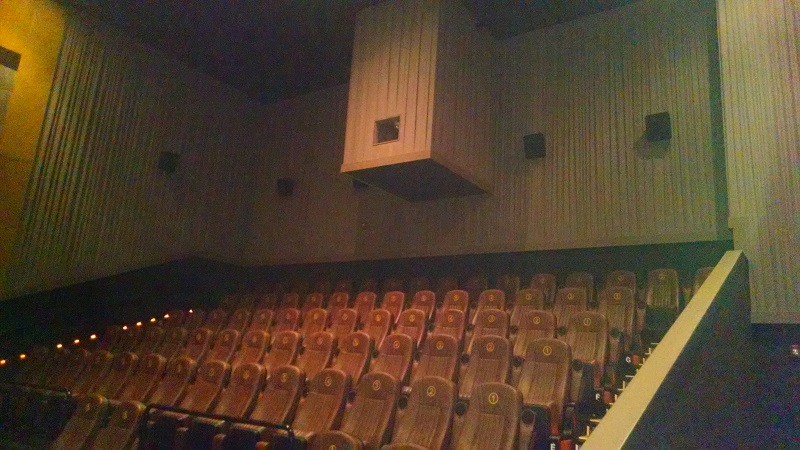
Posted by Mike Blakesley (Member # 26) on 07-14-2015, 11:49 PM:
Nope I would definitely not do it that way!
Posted by Christopher Lani (Member # 7952) on 07-15-2015, 02:22 AM:
I basically inherited a 75 year old projector that had been run by teenagers for about 10 years. Religiously maintained. Not.
Posted by Dave Macaulay (Member # 813) on 07-15-2015, 06:07 AM:
We work with a few boothless cinemas. It saves a pile in construction cost and simplifies the building layout. If the owner does it right, it can work well. No major issues servicing if the projector housing was well thought out and access was designed in properly. It is obviously less convenient than a regular booth, but booths were for film projection where constant access was required: digital projectors don't require that and it is quite expensive to provide.
When an owner is only interested in cutting costs, the cinema is usually a nightmare whether it has a booth or not.
Posted by Martin McCaffery (Member # 37) on 07-15-2015, 07:54 AM:
quote: Christopher Lani
I basically inherited a 75 year old projector
No one is ever going to see a 75 year old digital projector ![[Wink]](wink.gif)
Posted by Steve Guttag (Member # 268) on 07-15-2015, 01:51 PM:
So how do you converge or bore-sight in your boothless systems? Generally, the projector should be in final position for both though convergence should be fine if done at a different angle bore-sight absolutely has to be done in final position.
And who is cleaning the filters in these boothless systems (or changing them, as the case may be)?
Posted by Sam Graham (Member # 2889) on 07-15-2015, 03:39 PM:
Mike would still have a booth because he needs the space to hide the bodies.
Unless Gulbrandson stops bringing him bodies. Then maybe no booth.
Posted by Rick Raskin (Member # 1561) on 07-15-2015, 04:13 PM:
quote: Martin McCaffery
No one is ever going to see a 75 year old digital projector
Sure you will...In a museum.
Interestingly, when I worked the Kennedy Center they had E7s in the booth of the Eisenhower Theater. No clue what's there today.
Posted by Monte L Fullmer (Member # 2797) on 07-15-2015, 06:25 PM:
At this location of this pict, I take care of the Barco filters (and have trained others on how to do these), but I've heard that with other cinemas that have gone with this boothless style, that an actual presentation crew has the task of doing the maintenance on the units with this new form of setup.
Not all houses are easy to maintain like this one - crawl spaces, closets, enclosures and ladders are the norm for this location.
Posted by Martin McCaffery (Member # 37) on 07-15-2015, 06:27 PM:
quote: Rick Raskin
Interestingly, when I worked the Kennedy Center they had E7s in the booth of the Eisenhower Theater. No clue what's there today.
I ran those a few times, but they were probably only 40 years old then
Posted by David M. Leugers (Member # 2968) on 07-15-2015, 11:50 PM:
The EPA has been a serious problem for even the smallest labs it seems. A guy named Frank ran a B+W film lab developing R-8mm, S-8mm and 16mm film in California a number of years ago. He made his own equipment and did wonderful work, but he had to shut down due to ridiculous and costly EPA demands. This from an organization that allows fracking and its use of seriously toxic chemicals in millions of gallons everyday destroying the underground water supply all over the country...
Posted by Steve Guttag (Member # 268) on 07-16-2015, 01:13 AM:
Allows? Or is prohibited to do anything about?
Posted by Randy Stankey (Member # 64) on 07-16-2015, 05:55 PM:
It always seems, to me, that there is always an undercurrent of laziness in these "going to digital" threads.
"Untold trips up and down the stairs."
"Always repairing projectors."
"Don't want to perform maintenance."
There's always an unspoken feeling that says, "I don't want to work."
People just want to sit in their chairs and type on a keyboard. They don't want to maintain machines (digital OR film) They don't want to clean. They don't want to do the things necessary to run a business but, at the same time, they complain when they don't make money.
I don't care if it's digital or film.
I don't care if you are in the movie business or if you dig a ditch.
Sorry folks... If you want to have a business and make money, no matter what your business is, you have to work for it.
We can't go around whining about how heavy film cans are and how much it costs to ship them.
We can't go around whining and pontificating about how "dangerous" film chemicals are. (Then getting sidetracked into a discussion of fracking... that's weird!)
We can't go around arguing about how much it costs to build a theater, either with or without a projection room.
Just a few years ago, people were complaining about how hard it was to make and ship film prints. Now they are bitching about shipping hard drives. They bitch and moan about wanting to get movies via internet or satellite links.
Just a few years ago, people were complaining about threading projectors and keeping them running right. Now they bitch about how hard it is to change the air filters in a digital machine.
People bitch and moan about how "hard" it is to run a theater and at the same time they bitch about how the movie companies try to screw the little guy. Well, if you don't want to do your job and let somebody else do the work, you are going to have to give up the credit for doing that job and the money will go with it.
I don't care what the medium is, just get off your fat ass and do your damned job!
If you don't want to do your job and work for the money you make, you might as well stay home and watch movies on your smart phone with everybody else because you won't have a theater to whine about, anymore!
Either stop whining and work or don't bother to get out of bed in the first place!
Posted by Mike Blakesley (Member # 26) on 07-16-2015, 06:48 PM:
I didn't buy a digital projector to get me out of work -- I'm glad it's less work, but that's not why I bought it. I think if we all stopped using "machines" for everything we'd be amazed at how lazy we've all gotten.
quote: David M. Leugers
destroying the underground water supply
Hmm, I think that's a bit of an exaggeration, otherwise we'd see hordes of dead people lying all over the place.
Posted by Randy Stankey (Member # 64) on 07-16-2015, 07:29 PM:
I didn't mean to say that all people who use digital projectors are lazy. I thought that would be understood.
Yes, I use a digital projector at work and I generally like it.
The thing is that, without film, movie theaters no longer have a monopoly on audiovisual entertainment. Anybody can see a movie at almost any time, almost anywhere. They don't have to go to a theater if they don't want to.
There is the key... "If they do or don't want to."
How is the theater owner going to make it so people want to go to the theater?
If we consider that digital projectors free up some of the time and resources formerly use to staff projection rooms, we could use those resources to help improve the customer experience.
Yeah, I've heard all the payroll cost and human resources cost arguments. I've heard all the reports of increased costs to run theaters and decreased profits. That's not my argument at all.
What I am saying is that, digital or film, the focus needs to be on the customer experience. Done right, using digital can allow that to be done better.
Most of the people here DO try to focus on the customer. I never argued differently.
But, still, I say again, every time I hear one of these questions about "when film will be gone" I also hear an undercurrent that tells me those people don't want to do the hard work that it takes to run a theater in the first place.
If people don't get over that, it won't matter how good digital projectors are and the question of comparing movies on film to digital movies in any respect will be moot because there won't be theaters to show movies in, anymore.
Posted by Monte L Fullmer (Member # 2797) on 07-16-2015, 07:31 PM:
If Randy's post was on FB, I'd would give it a "like" and do a "share" with this post.
Excellent post, by the way !
Kinda goes on a story of a man was given a hundred dollar bill by his friend, and he bitched that he wanted it in five twenties.
People just can't be pleased.
quote: Randy Stankey
I also hear an undercurrent that tells me those people don't want to do the hard work that it takes to run a theater in the first place.
Seen managers do this also - just don't want to get involved with their assigned location and pull the rope along with everyone else that works under the roof.
-Monte
Posted by Christopher Lani (Member # 7952) on 07-18-2015, 10:32 PM:
Lazy? Seriously Randy. How do you come to judge someone else's work ethic. It's like asking, "So Randy, have you stopped beating your wife?" It is not only an ignorant supposition, but insulting. You have no freaking clue about what it takes to run this particular theater. I spent the first 2 years running the operation by myself with my Wife taking tickets. 2 years without one day off. In that 2 years I only had 3 days down due to needed repairs to the projector. I find your entire poat laughable. The digital system has given me more time to focus on the most important element of running a theater, the customers. As a result of the improvements in picture quality and reliability, business has increased 5x over the previous years numbers. There are a few more choice words I would like to offer you, but they would probably get me kicked off of this forum.
Posted by Leo Enticknap (Member # 534) on 07-18-2015, 10:52 PM:
quote: Randy Stankey
But, still, I say again, every time I hear one of these questions about "when film will be gone" I also hear an undercurrent that tells me those people don't want to do the hard work that it takes to run a theater in the first place.
I wasn't hearing (or reading) that undercurrent at all. I was simply reading someone revisiting an important question for this industry that has been discussed and chewed over for about a decade now. Even though most of the very big change has now already happened, when we finally get to the stage at which color release prints simply can't be made anymore, it will still be an important milestone (especially for me, in the art/rep/archive theater sector, which has a hard core of regular customers who want us and expect us to continue showing classics on film).
In a typical first run/multiplex operation, DCP projection does require fewer hours of a skilled technician's time to operate on a day-to-day basis than 35mm projection did. But as you point out, progressive and intelligent theater business owners have taken advantage of that to direct the freed up human resources into improving the customer experience in other ways, rather than simply pocketing the reduction in their payroll costs. I don't see anyone advocating the latter (work avoidance, in other words) on this forum or thread.
Posted by Christopher Lani (Member # 7952) on 07-18-2015, 11:23 PM:
Thank you Leo! ![[thumbsup]](graemlins/thumbsup.gif)
Posted by Buck Wilson (Member # 5885) on 07-19-2015, 07:42 AM:
I don't think anyone including Randy was directly calling you lazy.... That said, the following quote is what will more likely get you into trouble here(rightfully IMO):
quote:
As a result of the improvements in picture quality and reliability,
Posted by Steve Guttag (Member # 268) on 07-19-2015, 09:34 AM:
Okay...before going "postal" and all...lets look at the conversation just a little. You said:
quote: Christopher Lani
I made the conversion to digital about a year ago and I am glad that I did. As I pretty much run the theater myself, the automation of the movie presentation and all other facets of the show (lights, curtains, sound ) have saved me untold journeys up and down the stairs.
Which is perfectly fine on its own. There is nothing wrong with automating a show for cinemas when you are just showing the movie. It will provide better consistency show-to-show for customers too. Rarely are repetitive tasks better done by people over machines (there are cases when it makes sense but there is no magic in timing the lights, drapes, douser...etc. for the day-to-day show).
But then you add this:
quote: Christopher Lani
I know longer wonder if my projector will make it through a show.
Now in your special case, your film projector may have been unreliable. But as an industry statement, film projectors are about 5-6 times more reliable than digital projectors. Setting aside the media for a moment. I don't know a single person that knows both systems that if they had a digital projector (ANY of them) and a film projector (most of them) and both are in good repair and their entire career depending on that show running...would take take the digital projector over the film one. The service record of film projectors is pretty secure...they work almost all of the time and almost across the brands with some clearly being better than others. Furthermore, they are easily made reliable via proper maintenance. Digital projectors can work one day and not the next. Yeah, it might just take a reboot to get it going again but it is like a bad game of Russian Roulette...you never know when it will be feeling at odds. Yes...99+% of the time they work just as advertised but even that .001% chance of "WTF?" will get you. And you are helpless about it and have no way for heading it off.
But lets compare same-same. If you were to maintain your digital projector at the same level as those prior kids abused the film projector, would you not expect the digital projector to fail at a higher rate? Go ahead, don't keep it clean, filters changed...etc...and see how it survives. Do you even wishfully think that your digital projector will be around and reliable in 15 years? I can point to piles and piles of film machines that were happily doing their job 50 years and more.
You were comparing abused equipment with new non-abused equipment.
But here is where I think the train came off the rails and it was likely a misinterpretation.
quote: Christopher Lani
But I really just want to know when film will be done.
This can be read as a simple question and means no harm or it can be read (given the prior comments).."My experience with film sucks. When it will be gone already? It is such an unreliable technology. I'm surprised it made a year, let alone 100" Or words to that effect.
I know I read it as the former statement but one does not get inflection from text so it could have been interpreted as the latter and then taken as an insult to one that has spent a career in the "film" business.
As to Randy's comment on laziness. That, I can assure you, is a jadedness that comes about over time when one looks around and realizes that most people are indeed lazy and seek out laziness over quality. Those that don't really are the exception to the rule. As such, a "jump to conclusion" situation occurs when anyone espouses what they no longer have to do even if the statements have nothing to do with laziness but instead allow even better use of time. There are only 24-hours in the work day so doing one thing inherently takes away from something else and lazy people use that time for sleep
Posted by Leo Enticknap (Member # 534) on 07-19-2015, 02:54 PM:
quote: Steve Guttag
Now in your special case, your film projector may have been unreliable. But as an industry statement, film projectors are about 5-6 times more reliable than digital projectors.
Even a statistic like that has some complex variables and math behind it.
A Lada or Skoda from the 1980s will probably be more reliable than a 2015 Civic if the former is maintained per the manufacturer's instructions and the latter is not. The problem is that a 1983 Skoda 120 is probably designed to need an oil change after every trip to the local supermarket, whereas a 2015 Civic only needs one annually. Would you say that a reliability statistic is only valid if it is based on machines that have been "properly" (as in, manufacturer's recommendations followed) maintained, or would you try to apply some kind of averaging factor to apply an industry-wide typical number of maintenance hours per year (in other words, a machine that is designed to need more than that average would be judged for reliability only based on that average, not the maker's recommendation)?
The attraction for theater operators is that a typical DCP/DLP projector needs less routine maintenance than the 35mm one it replaced. The quid pro quo is that it probably comes with a much higher ownership cost in depreciation.
Posted by Steve Guttag (Member # 268) on 07-19-2015, 05:33 PM:
quote: Leo Enticknap
The attraction for theater operators is that a typical DCP/DLP projector needs less routine maintenance than the 35mm one it replaced. The quid pro quo is that it probably comes with a much higher ownership cost in depreciation.
I challenge that statement as flat out wrong. That the DCinema projector of today requires more maintenance then the film projector it replaced. Unlike cars, there were not too many models of projectors in service in the bulk of the theatres. Since the 1950s, the projectors changed VERY little...yeah, things like turrets and such were augmented to them but the percentage of sameness far exceeded the differences.
In the USA...Simplex XLs and its variants combined with Century SAs (and its variants) covers a lot of ground. Routine maintenance is rather small. Keeping them lubed will keep them running a very long time. Look at the time spent fooling with filters on digital projectors, then tearing them apart to clean out the crap that got past the filters and the repair time of some of the internals as compared to the film projector counterparts. Even if you add in the next tier down of the likes of Christie and Ballantyne in the USA...you still don't have maintenance levels approaching the needs of Digital. And what if you suck and let your intermittent lock up Which one is going to hear before it happens) or never lube your gears...up time is still going to be greater and faster.
You could probably make similar comparisons in Europe with how much ground once covers with the Cinemeccannica and Philips/Kinoton.
There just isn't a whole lot going on in a film projector. As such, there isn't a whole lot to keep them going.
Conversely, in a digital projector EVERYTHING must be running near perfectly or the whole thing just stops. Heck, you have self-inflected injuries with the whole KDM debacle. There are MANY shows that don't run because there is a problem with KDMs...how they are made or how/when they get there. Who hasn't lost shows due to a KDM issue?
So I bring it back...if you have a "typical" film projector maintained (they kept it clean and lubed) and a DCinema projector also kept cleaned and coolant topped off...the show HAS to run and it is a 1-off event...you can only pick one...which would you bet your career on?
Now, in the event of a show stopping event...which system do you think you could get going again (even not knowing what caused the show stopper)? Common hardware items and rubber bands go a long way in a film machine to get things to finish up...one can babysit it. How about digital when the tail light turns red. How long will it take you to even figure out what it is upset about?
I'm telling you...we will NEVER see the reliability of film systems again. Their up-time versus down-time was huge. They were very simple machines and required rather little care to keep going.
Posted by David Buckley (Member # 2600) on 07-19-2015, 06:36 PM:
quote: Steve Guttag
I'm telling you...we will NEVER see the reliability of film systems again. Their up-time versus down-time was huge. They were very simple machines and required rather little care to keep going.
I'm sure that is absolutely true. The cinema world has moved from one of mechanicals to one of electronics and software, yet still it is the non-electronical parts (like the aforementioned filters and fans) that are the items likely to fail.
But clearly there is no one really worried about the need to keep a picture on the screen. Show fails? Cant get a show on the screen?? Hand out the passes. If the show simply had to go on, then cinema systems would have highly available systems with dual everythings. Other than the raided disk arrays, cinema presentation systems are a chain of single points of failure. Failure of any one component in the chain takes the show down. Who would double their investment and increase their running costs just to avoid handing out a few passes every now and again?
Posted by Leo Enticknap (Member # 534) on 07-19-2015, 07:30 PM:
quote: Steve Guttag
Conversely, in a digital projector EVERYTHING must be running near perfectly or the whole thing just stops. Heck, you have self-inflected injuries with the whole KDM debacle.
But is it really fair to describe that as an issue of the reliability of the technology per se? I'd say that failing to receive a valid KDM for your show is analogous to the delivery truck not showing up with your print in time for the show. Both happen, occasionally.
The DCI security paranoia is a whole new can of worms, i.e. a layer of technology that is completely unnecessary for showing digital movies, but which we're saddled with anyway.
quote: Steve Guttag
So I bring it back...if you have a "typical" film projector maintained (they kept it clean and lubed) and a DCinema projector also kept cleaned and coolant topped off...the show HAS to run and it is a 1-off event...you can only pick one...which would you bet your career on?
It would depend on which film system and which digital system we're talking about. I'd choose the system I had the greater knowledge of common faults and how to fix or work around them. That means that if I had the choice of a Norelco AA (been using on and off since 1992) vs. a Sony projector (never touched), I'd choose film on the Norelco, but if it was, say, a Century film projector vs. a NEC, I'd take my chances with the NEC, because I've barely touched Centuries, but after a year's baptism by fire on how NECs can jerk their operators around, I'd figure that I was at least in with a fighting chance.
Over the last year or so here, I'd say that we've been roughly even in the number of, shall we say, "unplanned maintenance events" in film and digital. Admittedly, both of our theaters are very unusual (containing both a digital projector and server, plus a two-projector/changeover film installation) compared to most, though.
Posted by Steve Guttag (Member # 268) on 07-19-2015, 07:54 PM:
quote: Leo Enticknap
But is it really fair to describe that as an issue of the reliability of the technology per se? I'd say that failing to receive a valid KDM for your show is analogous to the delivery truck not showing up with your print in time for the show. Both happen, occasionally.
No! Not a valid comparison. The KDM is like not having the combination to the pad lock on the print cans...the difference is one can cut the locks.
Remember, there can be delivery issues with digital just like with film. However, while one may have a bum print that has some sort of printing defect, a damaged HDD, that could render the show dead in the water.
If you'd take an NEC projector with anybody's server over a Century projector as a greater likelihood of showing the movie from beginning to end without incident, you are kidding yourself. You are confusing "comfort" with reliability. With all of your knowledge of the NEC, if it comes up with a red tail light, there is not a damn thing you can do about it. I'd wager that if you had a few minutes with a Century projector, you'd have it pretty easily figured out (it is a VERY VERY simple machine. The parts are all nice and big and use very simple tools (screw drivers and maybe an allen wrench).
You're claim is not defendable...the reliability of the Century projector is just far and away higher than the likes of NEC or any other digital projector and the repairability...again, much, much higher...even if you had never seen it before.
Now as to doubling up on equipment...we'll yes...in important screening rooms where the shows are all one-offs...we do indeed have that...two projectors, two servers...even the sound has redundancy for much of it. Ever have a Christie CPxxxx give you a "sudden lamp off" during a show? Would you rather race to get the lamp relit or open the douser on the other projector and switch the sound?
Posted by Steve Matz (Member # 1890) on 07-20-2015, 12:47 AM:
Three of our now gone downtown Single Screen theaters had the same Simplex Projectors from the early 40's through the 70's before closing or changing venues. They were still in great working order according to a long time old school projectionist that worked all of the theaters at different times; even saying that the projectors at one of the theaters still had the original intermittents.
Without really be knowledgable about the present day Digital Projectors(i.e. Barco,Christie,NEC) I truthfully doubt they would last 30+ years disregarding whatever technical advances come about. Nothing today is built like it was post Industrial Revolution. Back then Mfger's made things to last a 100 years. Now because Money is the main object in business; your lucky to get much past the warranty period. My friend that owns a TV Repair Business in town says the majority of the Flat Screen Televisions he works on are less than 5 years old. He said if you get 7 years out of one than your lucky. Same story in almost everything. Your modern day Refrigerator/Freezer won't go as long as your Parents / grandparents old Philco or Norge. Not that Mfger's couldn't make a product last indefinitely; they just don't want it too. You don't continue making money having Products last for decades. ![[Roll Eyes]](rolleyes.gif)
Posted by Sam D. Chavez (Member # 1841) on 07-20-2015, 09:43 AM:
I don't think things were made better on purpose back in the day. They were just not as sophisticated at value engineering and computer wear simulations.
Cars, Steve's favorite topic, were certainly not better from a wear standpoint. 100,000 miles was about time for a valve job or rings. GM introduced the concept of planned obsolescence after all.
Posted by Mike Blakesley (Member # 26) on 07-20-2015, 11:36 AM:
Heck I remember in the 80s, if you had a car that ran over 100,000 it was almost unbelievable unless you were a mechanic. But now...when we traded in our 2002 Ford Escape (in 2012) it had 230,000 miles on it and our dealership kept it for a loaner vehicle and it's still going strong today with over 245k on it.
quote: Steve Guttag
Now, in the event of a show stopping event...which system do you think you could get going again (even not knowing what caused the show stopper)? Common hardware items and rubber bands go a long way in a film machine to get things to finish up...one can babysit it.
The thing I liked about film was the same thing my grandpa liked about steam engines. He would say, "If something goes wrong, you can see it, hear it or smell it." Unfortunately that doesn't apply with computer-based equipment, usually.
But as for things lasting 50 or 60 years...who would WANT something to last that long these days, given how fast technology improves? Even if I could count on my TV (or digital projector) lasting that long, I'm sure to want a new one with the new fancy features long before that time passes.
Posted by Leo Enticknap (Member # 534) on 07-20-2015, 11:39 AM:
quote: Steve Matz
Without really be knowledgable about the present day Digital Projectors(i.e. Barco,Christie,NEC) I truthfully doubt they would last 30+ years disregarding whatever technical advances come about.
The main reason they won't is software compatibility, not hardware durability. Sooner or later the DCI standard will change such that DCPs can be made that series 1 projectors and/or older servers simply can't show. Even at the moment, you need the latest software updates in them to show more recent subtitled DCPs, and ones with weird frame rates, correctly.
My father has a Dell PC he bought in 1991, and it's still going strong. Over the 24 years it's been in constant use, I've replaced a couple of fans for him, removed and replaced the thermal grease on the processor and replaced the CMOS battery a few times. It runs Windows 3.0 and he still uses it to run an old, DOS-based wordprocessing package that he learnt in the '80s, still does all he needs and that he still likes.
The reason why it's almost unheard of to find a microelectronic device that old still in regular use is Moore's law, not the quality of the hardware. That ranged from very good to very poor, just as it does with every other form of technology.
Posted by Steve Matz (Member # 1890) on 07-20-2015, 01:23 PM:
Well Electronic Technology has certainly taken leaps in the last decade or so. That's what was nice back in the 60's when Color TV's were coming into homes. They were going to last 20 yrs or so and no real advancement except Picture Tube Brightness during that time. Now anything Computer related becomes a Model T after a year or two. My old Compaq Laptop has the same amount of HD Space as the Ram on my present PC.
As far as Automotive engines of today;the only real advancement is in Ignition and Electronic Fuel Injection components for the most part. As far as things like Piston Rings,Aluminum bearings, etc., their still pretty much whats been around since the late 60's and 70's. Other than Blocks and Cylinder heads being of Aluminum alloy, not that much internally is different. As far as saying after 100,000 your engine needed rebuilding; that's a farce. The old Checker Cabs that were in every city in the US commonly got over 200,000+ miles before needing any major maintainence. It still comes down to the Owner and how often he changes oil/filter, Air Cleaner,etc. Modern Engines may have more precision and care in their Assemble because of modern CNC Machines and Robots but were still using Carbon Steel or Cast Nodular Iron Crankshafts, Aluminum Bearings, Cast or Forged aluminum pistons, etc. Some people that use Synthetic oil think they should never have to change their oil for 20,000 miles or more. An engine still wears and micro metallic particles are always going to be present that haven't been trapped in the Filter. that's why it's important to keep clean uncontaminated oil and premium filter in an engine for extended service life ![[beer]](graemlins/beer.gif)
Posted by Mike Blakesley (Member # 26) on 07-20-2015, 02:53 PM:
quote: Steve Matz
As far as saying after 100,000 your engine needed rebuilding; that's a farce.
Please tell me where I mentioned anything about your engine needing rebuilding. I just said it was a rarity for a car to go over 100,000 and I was right on that. In the 80s and prior, most people would trade them in or junk them long before that. Notice I said MOST people, there would always be exceptions.
If we all had to switch back to 1960s-era cars, I think there would be a wail of protest that would be heard to the moon and back. The comfort/luxury/convenience improvements alone would be enough to convince most people that today's cars (and especially pickup trucks) are vastly better.
Posted by Carsten Kurz (Member # 5396) on 07-20-2015, 03:29 PM:
I never gave up my cars under 350.000km... I drove two VW golf towards 390.000, and my current audi just approaches 300.000. And no, I am not a car mech, I do not even care much about them.
But I prefer to drive my cars as long as they are going, because I think everything that's made has an inherent right to last as long as possible. ;-)
- Carsten
Posted by Martin Brooks (Member # 1269) on 07-20-2015, 04:03 PM:
quote: Mike Blakesley
I just said it was a rarity for a car to go over 100,000 and I was right on that. In the 80s and prior, most people would trade them in or junk them long before that. Notice I said MOST people, there would always be exceptions.
If we all had to switch back to 1960s-era cars, I think there would be a wail of protest that would be heard to the moon and back. The comfort/luxury/convenience improvements alone would be enough to convince most people that today's cars (and especially pickup trucks) are vastly better.
Absolutely. While most American cars were relatively easy to fix, there was always something wrong and many people with decent incomes would always trade-in their cars after two years, rather than suffer through the unreliability. American manufacturers especially produced a lot of incredibly awful cars with major defects.
Ever notice that in spite of how much mechanics can get today to fix cars that there are actually relatively few places to get cars fixed? When I was a kid, every gas station did repairs. Now few do. That's mostly because cars have become so much more reliable (recalls aside). My current car isn't even scheduled for a tune-up until 100,000 miles. My bicycle has given me more problems than my car.
----
As far as digital projectors go, yes, they won't last anywhere near as long as 35mm mechanical projectors. So what? The technology is going to radically change over time anyway so they don't need to last.
All this moaning about the end of 35mm is ridiculous, IMO. Whether good or bad, it's over - digital won, get over it. They'll be a few stragglers that will hang on for a long time by playing just what's still available on film and many museums and universities will keep their 35mm projectors, but I think anyone who doesn't think that we're already living in a digital world is living in complete denial. And while a well-maintained theatre playing new prints by a trained projectionist could be a great experience, the fact remains that the average theatre has far better presentation today than during the film era. There was a holdout in my area and the last 35mm presentation I saw there was really kind of awful. Without renovating the theatre, they recently (and surprisingly) switched to digital. I saw "Love & Mercy" there and was really impressed at how good the presentation was. Of course the theatre was still empty, so I don't know if they're going to last anyway.
Having said that, I'll be very interested to see "The Hateful Eight" in 70mm Ultra Pan.
Posted by Steve Guttag (Member # 268) on 07-20-2015, 05:02 PM:
quote: Martin Brooks
As far as digital projectors go, yes, they won't last anywhere near as long as 35mm mechanical projectors. So what? The technology is going to radically change over time anyway so they don't need to last.
And just who is paying for that? For this first round, it was the studios.
Posted by Mitchell Dvoskin (Member # 751) on 07-20-2015, 05:17 PM:
Just curious, are hardware parts still available for series 1 projectors?
Posted by Jack Ondracek (Member # 1466) on 07-20-2015, 05:55 PM:
quote: Steve Guttag
There just isn't a whole lot going on in a film projector. As such, there isn't a whole lot to keep them going.
Conversely, in a digital projector EVERYTHING must be running near perfectly or the whole thing just stops. Heck, you have self-inflected injuries with the whole KDM debacle. There are MANY shows that don't run because there is a problem with KDMs...how they are made or how/when they get there. Who hasn't lost shows due to a KDM issue?
It's a bit of a surprise, but I do get that there's still an undercurrent of resentment about digital. To quote a former Secretary of State... "what, at this point, does it matter?"
I'm an owner. I felt the pain of writing a check for 3 big Barco machines. I still haven't scrapped the old gear, but I'm starting to accept that the day is coming.
Having made the transition, comparisons to the trusty old Simplexes are pointless. It's a new world now, and the reliability of the digital gear will be determined, at least to some extent, by the new maintenance regimens that we have to apply.
In the 3 years I've had my digital gear, I haven't found them difficult to maintain, only different.
It really doesn't matter how long a digital projector will last, what it costs to keep it going and what kind of education you need to do it. This is the new normal. Get used to it.
Oh... I have yet to have a KDM problem. Guess I'm just lucky. I make sure I have my drives and keys by Wednesday or I find out why. That gives me Thursday nite / Friday morning to check keys and QC the film.
I've had more trouble with delivery than anything technical. Fortunately, I have a good relationship with one of the indoor houses in my area, and have borrowed drives from them on 2 or 3 occasions over the past year or so.
Posted by Mike Blakesley (Member # 26) on 07-20-2015, 07:08 PM:
quote: Jack Ondracek
Oh... I have yet to have a KDM problem.
Me either, unless you count a couple occasions of weirdness I've had with unzip programs. But never a problem with the KDMs themselves in 5+ years. And only one bad feature hard drive in all that time.
Posted by Steve Guttag (Member # 268) on 07-21-2015, 06:30 AM:
quote: Mitchell Dvoskin
Just curious, are hardware parts still available for series 1 projectors?
Depends on the projector. Some of the very first generation series 1s are now not 100% supported. For example the Barco DP90 and DP100 is no longer supported but they share a LOT of parts with the DP3000, a late model series 1 so, as such, they are supported to a great degree. Likewise with Chrisitie. The original series 1 Christie's were not RoHS compliant so those original parts are no longer available but it shares a LOT (perhaps all) with late model CP2000S and SB...which ARE supported. At this point, I believe all of the late model series 1 projectors are fully supported.
quote: Jack Ondracek
Having made the transition, comparisons to the trusty old Simplexes are pointless.
I think you just jumping into a discussion in the middle. It is just a discussion that drifted into the reliability of one technology versus another and in particular if you had to guarantee that a show would go on and your choice is a well maintained film projector versus a well maintained digital one...which would you choose? I stand by that even if you are VERY familiar with the digital projector and perhaps not very familiar with the film one...the film one still has a greater likelihood of showing the movie from beginning to end. And more to the point...if a problem did show up, the odds one can overcome it on a film projector is MUCH higher than on a digital one. When that red tail light pops up on your digital projector and the show stops..what are you going to do? You reboot the projector (the first step, typically)...still red still no show...what are you going to do? You can open up the projector and see everything connected and the boards are all spic and span...what are you going to do?
The discussion was strictly on the inherent reliability of one technology versus another and, as a consequence, the longevity of one versus another. It is not a discussion of the big mistake we've made by going digital. Honestly, in the past couple of years, unless you are a special venue, when people have asked to keep both film and digital equipment side-by-side in their booth I've rolled my eyes and asked "Why?" "Is it for booth tours?" "Do you really think you will be running film again?" Because, first off, if you don't have 2-projectors, no archive is ever going to loan you a print and just because you do, doesn't mean you'll be on their list of approved places. Without the films, there is no point in having both systems integrated. It is a total waste of time and money.
We have our dual systems where it makes sense...the American Film Institute, for example...they still run film regularly and they do have their connections to just about every collection that will loan out a print. Examples like this can be found around the country but they are so few and far between.
As to you two not having KDMs problems...I'm almost shocked. Anyone that deals with KDMs on a large scale deals with the problem on a weekly basis. If you are associated with film-festivals...both drive formatting and keys can be a nightmare. If you do screenings, those KDMs can be just a few hours long and I'm not the only one that has expired mid show...nothing like seeing the status going red on a studio screening. Yes, it will play through once started (unless it takes more than 6-hours) but if you have to stop it...that show is dead. But I consider the KDM thing self-inflicted. Once a title hits home-video, there really isn't a point to KDMs on older titles because who are you stopping? The thief will just rip the movie and the honest person is going to pay your money anyway.
Posted by Carsten Kurz (Member # 5396) on 07-21-2015, 07:26 AM:
I am sorry to say, we never had an issue/glitch with our Sony+AP20, trying to remember the last 2-1/2 years of operation... No, not with KDMs/content, not with the equipment, and it is operated by 'normal staff' most of the time. Yes, we did have a dead board once that was swapped out within a day, that was the only single lost show. Festivals and KDMs - yes, that's certainly a completely different story. But what would a 'traditional festival' without DCI projection look like? Yikes!
Yes, you can do much to keep problems away by establishing structures that help running operations properly. Dedicated email addresses for KDMs, backups, calenders, logbooks, assigning certain operations only to staff with a higher level of training or routine, attaching stickers to switches, don't mess around with gear unnecessarily, etc.
I know we would have issues if we would assume our normal staff being able to ingest content properly, create SPLs and run a show. That is done only by our core team. So, reliability depends on proper work structuring, not just the equipment.
When I try to compare this with the 3 years of operating our 35mm gear before the conversion, it is hard to compare it. Never a lost show, yes, but quite a few glitches, but that was a fully manual booth, so the 'more or less trained' projectionists had a lot more options for making errors.
Actually I prefer the tighter control about show presentation we have now. I can adjust playlists at night to run perfectly smooth down to light and curtain timing, sound levels, etc., and that is repeated for every single show. Yes, that would have been possible with a modern, fully automated 35mm booth as well, though certainly not to the same degree of flexibility. Which is the real benefit of the digital systems, much more flexibility, we are doing a lot more shows and different shows now with digital projection. 35mm limited us to commercial movie releases only.
- Carsten
Posted by Steve Guttag (Member # 268) on 07-21-2015, 11:26 AM:
As someone that has sat in an audience for an industry screening on a Sony projector and the screening had to be cancelled since it couldn't be brought back on line in a reasonable amount of time that your experience is not "universal."
There is NO QUESTION that digital brings about many new means to improve things and yes, more can be taken on by fewer people (from a support and operational standpoint). As for festivals...well...there are headaches with both film and digital. But with film, the gauges were pretty standard...with digital, the formatting is merely presumed to be anything goes. And when the person that needs to make your key is 1/2 way around the world, getting a replacement key because the one you have isn't for the version you are going to run...well that can be dicey. Even had one key that just refused to work period and come to find that had been problematic at other festivals too.
There are absolutely things one can do to minimize the key thing and early detection of any problems should be a must. I'd get movies ingested and keys ingested early as possible to ensure everything is right if you can so you have time to deal with it when it is wrong. But the real world doesn't seem to make people do that.
Posted by Scott Norwood (Member # 30) on 07-21-2015, 12:27 PM:
D-cinema is a win for festivals, if only because, by the time it became common, most festival "content" was coming in on some video format, anyway, and I like not having to install rented video projectors for each festival and then un-install them afterwards. At least now the typical theatre already comes with permanently installed high-quality video projectors, so the festival just needs to bring in playback decks and connect them. Further, D-cinema projectors allow the configuration of format and lens presets, which makes multi-format shows way easier than in the past, and allows, for example, a 2.39:1 feature to be shown correctly after a 1.37:1 short.
Not that this is without problems--home-made DCPs and non-working (or nonexistant) keys are annoying, but I will take this over the state of video circa 2002-2010 any day. I am actually hoping for the day when all festival video content is DCPs. That is probably a few years away, but it will be a win when it happens. Now, if only people would stop making left/right (only) sound mixes.... Oh, and I hope that the issues with subtitles and D-cinema get fixed soon, too.
I do wish that every festival venue had maintained at least some semblance of 35mm capability on at least one screen, but that has not happened in some cases, leaving filmmakers who actually did make films on film without the option of exhibiting them that way.
Posted by Mike Blakesley (Member # 26) on 07-21-2015, 12:30 PM:
quote: Carsten Kurz
I can adjust playlists at night to run perfectly smooth down to light and curtain timing, sound levels, etc., and that is repeated for every single show.
One of my favorite benefits of digital is being able to adjust trailers on the fly. If we're playing a kiddie movie, for example and happen to get nothing but older kids/adults to a show, I'll "copy" the current playlist, delete everything up to the feature, and insert whatever different trailers I want to play. Then at the end of the currently playing trailer, stop the proceedings, quickly load up the copied playlist and hit play.
This also works well to insert an extra trailer or two if the crowd is unexpectedly big and the concession is running behind.
Posted by Carsten Kurz (Member # 5396) on 07-21-2015, 03:33 PM:
quote: Steve Guttag
As someone that has sat in an audience for an industry screening on a Sony projector and the screening had to be cancelled since it couldn't be brought back on line in a reasonable amount of time that your experience is not "universal."
Oh well it seems to be quite universal, as I mentioned above that our system experienced such a breakdown as well and we were not able to get it online in that situation just as well ;-)
Aside from that, we had:
- no clogged log memory
- no wait for log download/cleanup
- no bricked enigmas
- no subtitles disappearing
- no 'wait before playback' license check nonsense
- no lost projector cues
- no long wait for lens adjustments (2-3s total)
- no playlist scroll bugs
- no 'insufficient space' for KDM errors, no need to delete 'all' KDMs to clean it
- no lens shake
- full 'always 4k' j2c signal decoding
- no dedicated 2k/4k/auto IMB presets with wrong scaling or subtitle placement
- no lens focus, size and position drift (and I mean NO lens drift in 2.5 years)
- no projector firmware unable to keep focus for a full year
- no flashes, image droputs, false colors, noise, grey pattern... you name it on screen or whatsoever. And I mean NEVER.
- no intermittent play, no sync issues, no watermarking audio distortion, no robosound, no click or plops, no spurious audio channel swaps
- thus: no hotfixes
- no unsynced projector/server software updates, unified single system updater
- no sloppiness on DCI/SMPTE definitions like messing with 64Bit signer certificate numbers
- no playtime firmware upgrades to enable HFR
- no encrypted logs
- no 2TB disc limit
- no havoc running show or IMB clocks
- no practical limits on frame rates, data rate, signal formats within DCI/SMPTE specs (interlaced HDMI video support)
- no short limit of format presets
- no abstract naming and assignment/selection of presets - all the same free assignable names on projector and server
- integrated server and projector GUI - adjust presets while using them
- no need to reseat boards to get it working again
- no lost 3D sync
- no burst lamps+mirrors
- no need to to manually input lamp serial numbers
- no risc to run lamps past warranty
- no coolant exchange, refill, or broken connectors
- no USB 2.0
- no slow ingest, dynamic ingest speed adoption between play&ingest and full ingest
- no low contrast/raised black level
- no premium for 4k
- no 2k only systems
- no cheap 2k only lenses
- no software RAID
- no 'TLS/SSL/connection to projector lost' playground
- no need to decide on or supply your own UPS or rewire for it
- no need to keep expensive spare lamps on site
- no need to keep spare discs on site (triple redundancy)
- Sub-SPLs and intermissions from day one
- no longish reboot times (around 1min)
- no need for proprietary remote client
- no licenses/KDMs for software upgrades
- no lack of power-off switch
- no unnecessary power consumption (1.1kW total server+projector+UPS for 10m screen), no need for HVAC
No, they are not perfect, certainly, no system is, and I AM missing some features (mainly for my private entertainment), but I have yet to find any obvious fundamental glitch in them of the above sort. And we are primarily talking glitches, not features, yes?
But I'll stop here before Darth Maul kicks me out for saying 'Jehova'. I went too far already... ;-)
- Carsten
Posted by Justin Hamaker (Member # 2165) on 07-21-2015, 08:05 PM:
I just wanted to chime in on the KDM issue. In almost 5 years of running digital, I have yet to have a KDM issue. In the rare instances where a key wasn't provided for a particular format, all it took was a phone call and the key was usually in my inbox within 5-10 minutes. The closest thing I've had to an issue is grabbing the wrong version by mistake - especially for one of those movies where we get 12-16 different versions.
Posted by Monte L Fullmer (Member # 2797) on 07-22-2015, 03:34 AM:
I'm good on the KDM issue also.
My only gripe is when studios can't decide when to release certain KDM's where I finally receive mine less than an hour before showtime since we do the Thurs preopening public screenings (used be called "sneaks".)
-Monte
Posted by Jack Ondracek (Member # 1466) on 07-24-2015, 12:31 AM:
quote: Steve Guttag
I think you just jumping into a discussion in the middle. It is just a discussion that drifted into the reliability of one technology versus another and in particular if you had to guarantee that a show would go on and your choice is a well maintained film projector versus a well maintained digital one...which would you choose? I stand by that even if you are VERY familiar with the digital projector and perhaps not very familiar with the film one...the film one still has a greater likelihood of showing the movie from beginning to end. And more to the point...if a problem did show up, the odds one can overcome it on a film projector is MUCH higher than on a digital one.
Thanks for taking the time to consider what I said, Steve.
Yes. When the the situation is presented as you described, a properly maintained and operated film projector would, most likely, win in the long run. However, failures in 35mm gear weren't unknown. Brenkert had their problems with shutter gears. I know I lost 2 or 3 here before I threw in the towel and replaced them with Simplexes. I've lost the occasional diode in a lamphouse supply... usually when starting the second show of a double feature. It was never fun to get halfway through a perfectly good show, only to start back up and see flicker on the screen from a lost phase. Before I upped the size, most of those bad diodes were in ORC supplies, but I have lost one or two in a Strong. Speaking of Strong... their early (black) switchers were nothing to write home about, and I have a couple of those laying around... nonfunctional.
In most of these cases, the best maintenance in the world wouldn't have prevented the failures. Granted, they may have been easier to fix... for someone with the knowledge to do so. Today, there's less of that talent in the booth, so the fixes will be, most likely, more expensive. If I hadn't known how to change a shutter gear or diode, or swap out an entire head, the cost to bring in a technician to do those kinds of repairs for me would also have been substantial.
Today, a manager can go upstairs to turn on the breakers, then leave and not come back until the end of the day. In most cases, the digital boxes will get from one end of the day to the other without a second thought. In the 45 years I ran movies on film, I developed an obsession for being near the projectors, at least when first starting them. That obsession must have become genetic, because I still do that with my Barcos. The difference is that once I've confirmed that I have good pictures and sound, I walk out of the room and usually don't come back until the night is over. I can keep a general eye on them from my office or smart phone, but I'm no longer locked away in the booth.
I get that this topic will generate differing opinions, because there are several angels from which to approach it. I don't view your position as "wrong", just coming from a somewhat different angle than from where I look at it.
-Jack
Posted by Justin Hamaker (Member # 2165) on 07-24-2015, 01:48 AM:
And lets not forget that one mistake or equipment failure could ruin a print. I had my fair share of issues with diodes and other parts that failed, but at least that only affected a single show. But I have had issues that affected prints over the long run. I had a period where a gate tension issue was scratching prints, and it was very difficult to diagnose. I've had scratches resulting from rollers that broke. And other equipment related issues that had nothing to do with human error.
Then there were the instances where someone had a loop that was a little too big or small, or didn't get the film seated in a roller.
Other than occasionally tweaking the focus, and changing lamps as necessary, there is very little that affects show to show presentation quality. Most presentation issues with digital are the result of equipment failures or poor installs. Plus most parts that fail on a digital projector can be fixed by anyone who knows how to work on a computer.
I won't argue the quality of film vs digital under ideal conditions for either, but the consistency of presentation is the single best point of digital. The picture looks just as good at the end of the run as it did on opening day.
Posted by Christopher Lani (Member # 7952) on 07-26-2015, 04:17 PM:
For one, thanks again for all of the wonderful replies. First, I have the utmost respect for the profession of being a film projectionist. When I first started running my motiograph, I was amazed at how durable the design was. It was only from lack of maitenence that I experienced any problems at all. I also have a 3 platter Christie system that was a source of many problems. Only 2 were working when I inherited it and the system and the brains and cards had been abused and were barely funtioning. Thank God for You Tube! Again, I am sure that a properly maintained system wold have been no problem. I can see what the advocates of film are talking about. My experience with my digital system has been nothing short of flawless. Aside from having to restart my server once, I have not had a single problem with my Christie projector or dolby server. I know they will not last a 1/4 of the time the motiograph did, but I can deal with that. The convenience of being able to play multiple formats with the Geffen scaler has greatly improved the versatility of my theater. The ease of changing my programing bis a definite advantage. I do miss operating the film projector, but the ease of operationof the digital system is hard to beat. I have also had amazing support from the company that installed the digital system. My question is this. What is it specifically about the 35 mm film image do you find to be superior to digital? Color representation? The sense of the flow of motion? Sharpness of image? I'm very curious to know.
Posted by Buck Wilson (Member # 5885) on 07-26-2015, 05:35 PM:
For me, it's the 'resolution' or the quality of the image, and the fact that it 'looks like a movie' and not a TV screen. Which I suppose would be a combination of not seeing pixels, moire, convergence issues, focus issues, etc etc. Film has more 'depth' to it which sounds stupid but I have no other way to really describe it. It just seems more 'real'.
Posted by Justin Hamaker (Member # 2165) on 07-26-2015, 07:49 PM:
Buck, I understand what you're saying, but I have never observed that with digital. I can see the pixel issue when I'm standing a few feet from the screen, but you don't watch a movie from a few feet from the screen. Digital features have never looked like anything but movies to me.
Posted by Mike Blakesley (Member # 26) on 07-26-2015, 08:49 PM:
After watching everything in digital for 5 years now it drives me crazy when I see something where the image originated on film, such as an older TV show or something like Disney's "Soarin." Little scratches, weave, or dust specks totally take me out of the experience now where they didn't before.
I keep hearing that the "next big thing" (after laser, supposedly) is when the image will originate from the screen itself and not be projected. Even though that would solve a lot of problems with digital, I think it would be a gargantuan mistake, because it would eliminate the "beam of light" that adds a touch of magic to theatrical movies.
Posted by Leo Enticknap (Member # 534) on 07-28-2015, 03:34 PM:
quote: Christopher Lani
What is it specifically about the 35 mm film image do you find to be superior to digital? Color representation? The sense of the flow of motion? Sharpness of image?
Various different film advocates claim all of the above, both individually and in combination.
I think the flow of motion one is potentially the most interesting (and still contentious).
Tarantino, with his characteristic elegance, described watching the digital image for him as "like staring right into a fucking light bulb," by which I'm guessing he means that he misses the flicker. If so, that's deeply ironic, because the industry spent the best part of a century trying to reduce or eliminate perceived flicker with film projection. Hollywood standardized its frame rate at 24 essentially for this reason (so that with a two-blade shutter, there would be no perceptible flicker for most people), despite howls of protest at increased film stock costs. Starting with Todd-AO, higher frame rates were used in an attempt to make motion look smoother.
In that context DLP should have been the holy grail - it nuked both flicker (the bane of film) and interlace artifacts (the bane of video) in one fell swoop ... and now people are complaining that they miss the flicker! If you want to, you can now see The Birth of a Nation at the actual 11-12fps that Billy Bitzer cranked most of it at with completely steady illumination, but in reality, it's not, it would appear, what these people actually wanted.
Posted by Scott Norwood (Member # 30) on 07-28-2015, 05:47 PM:
I think that properly printed, processed, and projected 35mm film looks better than the current state of D-cinema.
Specifically, I will second the comment about film having more "depth," which probably really translates into film having a greater range of values between dark and light. Actually, a typical DCP looks fine until it is put up against a film print of the same movie in the same theatre, at which point (to me, anyway), the film looks more "real" and has more "depth," while the DCP looks more "flat" and "plasticky." Bad description, I know, but I can see this even in my own films, which I shot myself on 16mm (and which were printed in 35mm and made into DCPs). The difference is even greater for material shot in 35mm by professionals.
I can go either way on flicker. I don't like a really flickery image, and would agree that flicker is a "flaw" in standard film projection (which can be improved upon with three-bladed shutters, etc.), but there is supposedly some research that suggests that flicker affects perception of motion pictures at a subconscious level. I have no idea if this is valid or a load of crap, but it is probably at least worth studying.
Also, film grain is random and does not cause moire patterns like many DLP systems do. This, alone, is a win in many cinemas.
One aspect of DLP systems that I do prefer is that "white" actually is "white" and not the color of the film base. It is more like watching a nitrate print (where the base really is clear) than a modern print.
The other win for D-cinema is sound quality, which is unquestionably better than any current 35mm format.
Finally, there are some operational benefits to D-cinema (for example, the lack of hot spots due to the integrator rod) that would be nice to see brought to film projection equipment, although that will likely never happen. Too bad.
I am not as anti-digital as some people here. I realize that it is the future for mainstream cinemas, and that no whining about it here will change the economic realities for distributors and exhibitors. I also see some advantages for many exhibitors and for producers and exhibitors of "alternative content." I do feel strongly, however, about the importance of retaining film projection capability in (some) cinemas and printing capability in labs for both repertory screenings of films in their original format and for filmmakers who, for whatever reason, prefer to have their work exhibited on film.
Posted by Timothy Eiler (Member # 383) on 07-30-2015, 12:57 PM:
After i was asked if I was converting any more screen to digital I was told that Screenvision ads will no longer have 35mm copies as of 9-1-15
Posted by Frank Angel (Member # 248) on 07-30-2015, 10:53 PM:
HOT DAMN!!!....That's enough to make me want to throw a party! Now if only there were a way to get them to not make DIGITAL prints as well and just go someplace and crawl under a rock...
Posted by William Steele (Member # 8276) on 07-31-2015, 09:29 PM:
Sorry for hijacking this thread but anyone who thinks film is dead should visit the National Film Center in Tokyo. While I was in Japan recently I had the privilege of seeing a number of 60s-70s Japanese films (all photochemically restored on Kodak stock) projected through what looked to be Kinoton FP-38s. Notwithstanding the subject matter of the films--one of them was a low-budget Manoru Watanabe "pink eiga" film that I doubt anyone in the U.S. has ever seen--in terms of exhibition quality they were a feast for the eyes. They reminded me of what 35mm is capable of when artists and professional projectionists are involved at every step of the process. Film capture and projection is truly a remarkable thing that we must preserve for future generations because while digital is good and has many benefits, it simply doesn't have the magic (for lack of a better word) of light projected through celluloid at 24fps. Let's be honest. That magic is what drew us all to the movies in the first place (at least those of us of a certain generation). It wasn't just the "content". There are things happening with film projection that we still don't fully understand and can't quite articulate because we lack the vocabulary to describe what we see. Vinyl records are a useful analogy. While much of the recent resurgence in Lps has been driven by hipsters who don't really care all that much about sound quality, the truth is that vinyl records do sound more natural and are more emotionally involving than CD, even when the source is digital. How is that? I don't really know. All I know is that like many, I dumped my vinyl Lps when CD first came out in the 80s. And I loved the CD sound -- at first. But after a few years I pretty much stopped listening to music. It wasn't until a friend invited me over to listen to some of his records that I suddenly realized digital recordings were the reason.
The point of this long-winded diatribe is that it's important to have these reminders, these reality checks -- we've all grown so accustomed to seeing Hollywood movies through 2K digital presentations, or digital intermediates, or whatever, that when we go back to the origin it is a revelation. It's also an opportunity to rethink our assumptions. When digital projection first came out about 10 years ago I was excited about watching flawlessly rendered films with perfect illumination levels. I remember seeing "Bad Santa" at Roger Ebert's Overlooked Film Festival (the great James Bond in the booth) and thinking 'Wow, this is the future! This is gonna be awesome!' But now the bloom is off the rose. After a decade of digital filmmaking and presentations, I am increasingly annoyed by its faults and frankly bored by the monotony of the images I see, which as others have pointed out are pretty much the same images we get on TV. I'm not arguing that we try to put the genie back in the bottle--no way that is going to happen--but I think it is vital that film should be preserved, and more importantly, that innovation should continue. There is still much to be mined with the 35mm format, not to mention 70mm. But you guys are pretty much the only ones left with the know-how to do it. Hopefully there are still a few of you out there who care to enough make the effort. For my part, I will continue to attend and support film presentations. We make the future what we want it to be, not what others tell us it is, or should be.
Posted by Mike Blakesley (Member # 26) on 07-31-2015, 09:52 PM:
When people here say "Film is dead," it mainly pertains to the mainstream theatrical business (both popular and "art" films). Nobody is arguing that there will never be film. This thread is mostly about major studio movies some of which are already being distributed digital-only.
The same thing is happening in the music business -- people are always saying the CD is "dead" but there were still 140 million of them sold last year alone.
Posted by Louis Bornwasser (Member # 3063) on 08-01-2015, 07:43 AM:
I have always said that film will collapse because of lack of infrastructure. No one buys equipment that is also being recycled into tin cans. Companies fail; old men retire/die. At some point there is no one alive who remembers/cares/knows how. I assure you that this period of remembering the past glory of film will be very short.
Film use is a bit like a muscle: use it or lose it. It is for this reason that I advised my customers to ride film as long as you can THEN avoid used digital equipment and buy as far into the future as you possibly can. For the guys who saved their film equipment in a usable position, I advised them to make it easily removable. Soon no one will know how to use it or to add oil before use.
Posted by Steve Guttag (Member # 268) on 08-01-2015, 09:54 AM:
I respectfully disagree with you Louis. Not that I disagree with the idea that film will die from lack of infrastructure (if no one is making film or its equipment, it is kind of hard to support).
What I disagree with is the notion that film will be a forgotten medium. There is just so much of it and it remains THE archival medium. I don't doubt that it will be replaced for that but nobody is actively destroying it from archives because it isn't needed anymore. That would be like taking a picture of the pyramids and then knocking them down. Film has recorded our history for over a 100 years. It is also a explanatory medium. If you were to bury it and 1000 years later someone were to dig it up, how it works would be instantly figured out as far as the picture goes. The sound may take a little longer to figure out and that it is off set and what speed thing thing would run. Like writing on stone or paper, film enjoys that simplicity of "how it works." That is something that digital can never enjoy.
Posted by Leo Enticknap (Member # 534) on 08-01-2015, 12:19 PM:
quote: Steve Guttag
Film has recorded our history for over a 100 years.
Compared to the lifetime of some other recording media as mainstream technologies, 130-150 years (which is probably how long we'll eventually be talking about, from the first still images on celluloid to the complete cessation of new color film manufacture) is very short. The various substrates for writing and printing that existed before modern paper (e.g. slate, canvas, parchment and vellum) were all in widespread use for millennia. True, other audio-visual media invented during the last century had much shorter lifespans, and data storage media in particular involved dozens of formats that came and went in the blink of an eye.
But of all the media that were used on an industrial scale and for a significant length of time worldwide, photographic film faces the dual challenges of having been relatively short-lived, and being relatively fragile and difficult to preserve.
In terms of its continuing use as an exhibition medium, I agree with Louis, but would add that the availability of labs and processing chemistry is another weak point. True, that won't affect the ability to project existing prints, but it will to make new ones.
On the AMIA list last week, someone in Brazil asked about the availability of film lamphouse xenon bulbs, because his usual supplier has just discontinued them. OK, they are still made elsewhere in the world, and if he's prepared to pay the punitive Brazilian import duty he will be able to get hold of some ... for now. But it's another straw in the wind that in the world's fifth largest nation there is now no-one selling these things anymore, and indicates that as far as first-run mainstream movie theaters are concerned, film is now so dead that Planned Parenthood is probably trying to sell reels of it.
Posted by Steve Guttag (Member # 268) on 08-01-2015, 02:10 PM:
Xenon lamps would never be able to cease the use of film Aside from them still being used with current technology. Other lighting technology could be adapted to show film, if need be.
Does Brazil use NEC projectors? If so, do any of them use the "HS" style lamps? All but the laser and NC900 can and many do. it is a reason that Ushio opened up the UXL line to the digital world. the HS lamp is a film lamp and could be adapted to most any lamphouse so long as they had access to a machine shop to make the adapters (we are talking about machining round things without too much precision...something that a machine shop or a person with a lathe could do). Even "digital" lamps could be used in film projectors. With enough effort, I have no doubt that lasers can be adapter to film projectors too.
Xenons isn't where film is going to die...it will be the lack of film itself.
Posted by Justin Hamaker (Member # 2165) on 08-01-2015, 06:19 PM:
Recently I took a friend's Victrola to a local man who does repairs on them. In chatting with the guy, he services machines from all over the US, and the world. While there are probably a handful of people doing this, it sounds like they are few and far between.
This man has a huge warehouse filed with parts and old machines in various states. I asked him if he has an apprentice, and he said he does not. He said his kids were not interested in learning the business, so he would do it as long as he could and then close up shop.
While film may be many years from this point, I think it will eventually head in the same direction. Because it is essentially an obsolete technology, and an expensive hobby, it's difficult to see any large number of young people taking an active interest in film. Sure there will be a handful, and enough to ensure there will be "someone" who knows how to run film and service projectors. But it will hardly be something people will get into for a career.
Posted by Buck Wilson (Member # 5885) on 08-02-2015, 07:39 AM:
I'm pretty sure I was born 10 or 20 years too late.
Posted by Rick Raskin (Member # 1561) on 08-02-2015, 04:51 PM:
quote: Steve Guttag
If you were to bury it and 1000 years later someone were to dig it up, how it works would be instantly figured out as far as the picture goes.
That brings to mind Arthur C. Clarke's short story "History Lesson".
Posted by Jim Cassedy (Member # 4115) on 08-05-2015, 10:06 AM:
I recently did a special "tech screening" of the new Steve Jobs flick.
It will premiere in New York in late fall this year.
It's still a "work in progress" so it wasn't the final version and it
was missing a few things. (Like credits)
But I believe this is one of the first times anyone outside of an
editing room got to see it. It was a small, private screening for
only about half-a-dozen very select people. (and me!)
Steve Wozniak was invited, but they told me that he turned down
the invitation by saying: "I'd rather watch it on my I-phone"
. . . . . And so, kiddies, that's the end of film, or at least the
'beginning of the end' of theatrical exhibition as we now know it.
Posted by Frank Angel (Member # 248) on 08-05-2015, 02:28 PM:
quote: Jim Cassedy
Steve Wozniak was invited, but they told me that he turned down the invitation by saying: "I'd rather watch it on my I-phone"
![[fu]](graemlins/fu.gif)
Posted by Mike Blakesley (Member # 26) on 08-05-2015, 03:15 PM:
That serves to underline the fact that people who are really smart in some ways are idiots in other ways.
Posted by Adam Martin (Member # 641) on 08-05-2015, 09:52 PM:
I think you guys are reading Wozniak's response wrong: He doesn't give a shit about yet another movie about Jobs.
Posted by Dwayne Caldwell (Member # 417) on 08-28-2015, 05:20 PM:
It's what Jobs would have wanted.
Powered by Infopop Corporation
UBB.classicTM
6.3.1.2