This is topic 2001: ASO - how to present the overture? in forum Digital Cinema Forum at Film-Tech Forum ARCHIVE.
To visit this topic, use this URL:
https://ft-forum.com/ft/cgi-bin/ubb/ultimatebb.cgi?ubb=get_topic;f=16;t=002375
Posted by Richard Curtis (Member # 4915) on 07-26-2015, 10:05 AM:
Hi all,
We're showing 2001: A Space Odyssey this evening and I am after some opinions about how best to present the Overture and Entr'acte.
Obviously on the DCP these are all against a black screen, however we've not had anything issued in the way of instructions, so I would have four options:
A. Shown with screen curtains closed, red screen/curtain footlights on low, houselights on low
B. Screen curtains closed, red screen/curtain footlights glowing, houselights off
C. Screen curtains open, red screen/curtain footlights glowing, houselights off
D. Screen curtains open, screen/curtain footlights off, houselights off
The screen curtain would technically decrease the volume of the music to the listener, but not by much.
I am not sure what I favour - obviously we try not to have a black screen, so I'd be ok with either B or C, but I'd be interested to hear any other opinions about the best way to approach this.
There's one caveat, which is we obviously have a BBFC rating to show before the overture begins, but this could be projected on the curtains.
Does anyone know what might have originally been intended by Kubrick?
Thanks!
Richard
Posted by Leo Enticknap (Member # 534) on 07-26-2015, 10:50 AM:
Unless the terms of your cinema license states that the BBFC card has to be projected, I wouldn't worry about projecting it.
About the one saving grace of BBFC cards* is that when the audience sees it, it signifies that the crap is over and that the real show is about to start, and so people quieten down and start to concentrate on the screen (and nowadays, put their phones away, I guess, though when I last showed a movie to a paying audience in Britain it was before most people had them). Even though it's only 4-5 seconds, it really does the trick.
I remember on the opening night of Titanic hearing a huge round of applause through the wall of the booth when that BBFC card appeared. Though I suspect it was sarcastic, because (despite pleading with head office to let us cut it down because, coming before a three-hour movie, it would p!ss our customers off) we'd just shown 17 minutes of ads followed by 11 of trailers.
However, they really bugger up a roadshow presentation with an overture that follows the card.
From your list, B would be my ideal and A a compromise that the house manager would probably live with. I like to play overtures and entr'actes with the house lights out and a dim screenwash on, but the house managers don't like it, because people do tend to get up during the overture (once they realize it's happening, they get up to use the loo, buy more popcorn, etc.), and house managers are conscious of trip hazards and general disruption as they retake their seats.
The crucial thing is to note the timings and offsets (unless you're programming the light changes on automation cues) so that you can make them look seamless. So if your curtains take 18 seconds to open and your footlights 16 to fade, time hitting the buttons such that the first image hits the screen exactly when you want it. Even 2-3 seconds of a black screen and a silent room can really kill the atmosphere and scream "technical problem!" to the viewer.
* Note for non-UK readers: British Board of Film Classification ratings card, which, unlike the US rating cards, appears at the start of the feature, not the end.
Posted by Mark Ogden (Member # 43) on 07-26-2015, 01:30 PM:
A BBFC card for a classic piece of mid-1950s Allied Artists Roger Corman cheese:
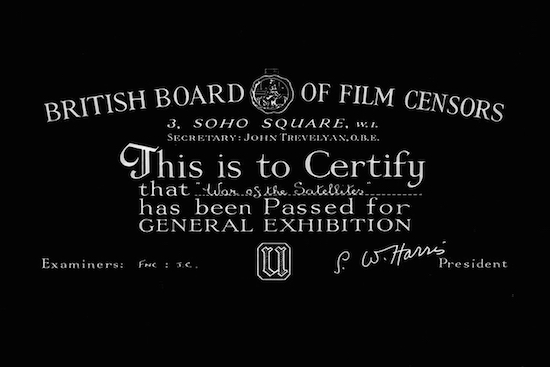
As far as the 2001 overture goes, my vote would be parts of both A and C: curtain open (for sound), house and footlights at trailer level, then brought down to feature level just a little bit before the MGM logo. If I recall correctly the overture runs just 2:19, so it's not like it's a long time with an empty screen, and you can show your BBFC card as well, if you truly must.
Posted by Rick Raskin (Member # 1561) on 07-26-2015, 05:00 PM:
I'm old school. Dim lights to coincide with the end of the music then open the curtains when MGM logo hits the screen.
That's how we did the opening for both acts. The 70mm print had music on clear film so paying close attention was necessary to avoid a white screen. The dimmers were motorized so we had a cue sheet with the time mark to begin dimming the lights.
Posted by Thomas Hauerslev (Member # 566) on 07-26-2015, 11:00 PM:
No need to worry, MGM and Stanley already made a presentation guide on how to show "2OO1: A Space Odyssey": http://www.in70mm.com/news/2014/2001_presentation/index.htm
Posted by Leo Enticknap (Member # 534) on 07-27-2015, 10:26 AM:
Those instructions assume that the censor's certificate appears at the end of the overture (which is absolutely where it should be to facilitate a proper presentation with overture). From the way Richard describes this DCP, that would appear not to be the case.
Mark - interesting that War of the Satellites ever got distributed in the UK. We showed it last winter as part of a Dick Miller tribute season, on a 16mm print from UCLA. Photographically it was pretty good for 16mm, but sadly it was all scratched up - a former airline print, probably. No wonder Corman's movies made such huge profits if not only were his production costs so infamously low, but he was able to find export markets as well.
Posted by Scott Norwood (Member # 30) on 07-27-2015, 11:32 AM:
How about this: pause the DCP on the BBFC certificate. Open the curtains ("tabs," I suppose, in the UK) and dim the curtain lights on that, hold for a few seconds, then close the curtains, bring up the curtain lights, and douse the projector. Wait a minute or two and then start the walk-in music (and light dimming, etc.) per the presentation instructions.
This might look a bit goofy, but would be less awful than showing 2+ minutes' worth of blank screen after the BBFC certificate.
Posted by Frank Angel (Member # 248) on 07-28-2015, 10:45 PM:
My recollection is that, at least in the 35mm and 70mm prints, there is a substantial pause after the Intro music before the MGM logo as well as the sounding of the Zarathustra opening cord -- possibly as much as 30 seconds -- which give more than enough time for the curtain to open so as to be past the logo when it hits the screen. Since we use the screen curtains for EVERY show, we have long ago measured the level difference between curtain closed and curtain open so that situations like this where there is Intro and Entr'acte music that needs to be played in black with the curtain closed, we easily compensate to match the levels (approximately). Of course we can't compensate for frequency changes, but then we took that into consideration when purchasing the material which was kept a very light man-made poly spun "satin" and so by it's very nature is nearly acoustically transparent. We anticipated needing to play preshow music thru the curtain too.
From an aesthetic perspective, I don't think it makes much sense to have a curtain and then to leave it open during sections where music is in black, ESPECIALLY the opening music.
I also believe that the exit music after the credits and THE END card actually drops significantly. That has been the case on all the prints I have run over the years, both 70mm, 35mm mag, and 35mm DDigital. I don't know if that is done on the DCP as well, but given how consistent that has been over the years, in all the prints, I assume it was done intentionally, possible to keep the exit music sounding decidedly "background" even though it is still the Blue Danube cut.
Anyway, hope you had a good show and turn-out, Richard. What scenario did you eventually go with?
Posted by Louis Bornwasser (Member # 3063) on 08-01-2015, 07:50 AM:
Last time I saw overture music used was Star Trek 1. 60% of the audience was in the lobby complaining about there being no picture when the picture finally started. Later they wanted their money back when they realized that THEY had missed the actual picture start. We cut the overture off after that.
Posted by Steve Guttag (Member # 268) on 08-01-2015, 09:59 AM:
See...we never had that problem. The use of curtains and lighting...nobody would think it was part of the movie. In fact, when Trek II came out, at the MacArthur (the World Premier site of Trek 1), we actually had to improvise a bit of an overture.
The MacArthur cropped scope a bit on the width and the opening of Trek II had "Paramount Pictures Presents" except on our screen it looked like "aramount Pictures Present"
Our solution was to time it right to dim the lights/open the curtain right after that card so the star field hit the curtains just at they were opening...it actually looked/sounded pretty good and seemed quite natural. It also sort of worked with the music on that movie.
Posted by Martin McCaffery (Member # 37) on 08-01-2015, 10:48 AM:
The first time I ran Trek 1 was at the Springfield Cinema in N. VA (where I'd been an usher a few years before) where I was covering for the regular projectionist.
The regular projectionist left instructions on how to run the film with overture. Lights were already half dimmed for trailers, curtains closed, dowsers closed sound changed over, overture playing. Time comes to dim the lights all the way open the curtains, hit the changeover button...Nothing on screen. Thought I'd mistimed, but then feature sound on. I look at the projector- lamp on, lamp douser open, changeover dowser open. But nothing on screen. Think for a few seconds, getting buzzer from downstairs. Put my hand in front of the lens - no light coming out. Took another few moments and a check through to figure it out. The cable on the changeover snapped. Fortunately, the lower part of the cable was accessible enough to pull it open.
The joy of freak malfunctions ![[Wink]](wink.gif) Never had it happen anywhere again.
Never had it happen anywhere again.
Powered by Infopop Corporation
UBB.classicTM
6.3.1.2