This is topic Barco DP4K-60L Contrast Question in forum Digital Cinema Forum at Film-Tech Forum ARCHIVE.
To visit this topic, use this URL:
https://ft-forum.com/ft/cgi-bin/ubb/ultimatebb.cgi?ubb=get_topic;f=16;t=002553
Posted by Muhamad Taufiq (Member # 8868) on 01-17-2016, 04:35 AM:
Just a curious movie-goers here.
A week or so ago the first laser projector has just been installed in my country, and today I decided to give it a go and see what's up. The trailers play as usual, no difference in color and sharpness, which is expected, the contrast feel the same but I reserve my judgement because the house light is still turned on. But when there's a few seconds of "black screen" between trailer and the actual movie where the screen opens up, I noticed that the black level is about the same as xenon projector. During the movie, I looked back to make sure that the laser projector is indeed projecting the image and not the old Barco xenon projector that's sitting idle beside it.
My question: Is the black level of laser projector higher or about the same than xenon? Because the specs claims 2.800:1 contrast ratio of laser compared to 2.000:1 of xenon, so I kind of expecting some differences in black level between them.
Posted by Marco Giustini (Member # 4544) on 01-17-2016, 05:32 AM:
from 2000 to 2800 there is not a huge gap. I am not sure the difference can be seen by eye. Remember, our eyes adapt to light level.
Assuming 48cd, with 2000:1 CR you achieve 0.024cd. With 2800:1 CR you achieve 0.017cd. I can't be sure but I reckon this is not something you'd notice too much from an audience.
As a comparison, if you get a good Sony 515 and manage to achieve the boasted 8000:1 CR, then your black level drops to 0.006cd which is probably more noticeable.
Posted by Dave Macaulay (Member # 813) on 01-17-2016, 06:47 AM:
The minimum light leakage is a factor of the prism design, black level won't be changed a huge amount from changing the light source to laser. You can get darker blacks by redesigning the light engine (like certain large screen laser projectors have) but a prism similar to those in xenon projectors will have this characteristic light leakage.
Posted by Carsten Kurz (Member # 5396) on 01-17-2016, 07:22 AM:
True, the DP4k-xxL machines perform just on the upper end (or lower end, if you want to put it like that) of DLP black levels, but not further. At least in 4k, they are considerably better than ordinary 4k xenon DLPs, which hardly reach 2000:1.
People seem to think that the buzzword 'laser' takes care of every possible issue that projection might have, but that is not true, there are even a few extra issues with laser light sources that need to be solved.
IMAX so far is the only DCI oriented company with a completely redesigned light engine for their laser projectors that uses no prism and achieves higher contrast and black levels. These machines have been developed with Barco, but as far as the light engine goes, they seem to be completely different from Barcos own brand laser projectors. Dolby Vision cinemas achieve high contrast by utilizing cascaded DLPs in a sort of 'pixel level local dimming' approach. But both Dolby Vision and IMAX LIPs are considerably more expensive than already the DP4K-60L is.
That said, the 60L delivers a stunning 3D when Barcos color separation 3D is used.
- Carsten
Posted by Marco Giustini (Member # 4544) on 01-17-2016, 07:42 AM:
Dave,
Barco themselves advertise 2500:1 vs the usual 1800:1 of a 4K DLP machine. That implies that - with the same peak white level - black level must be lower.
Carsten
I thought IMAX projectors were just re-branded Barco's? I did now know they had custom optics inside. How do they re-converge RGB without prism?
Posted by Carsten Kurz (Member # 5396) on 01-17-2016, 08:00 AM:
Marco - I was asking that myself for quite a while - but IMAX was able to use Kodaks LIP patents on the IMAX projector design. I think Barcos main contribution to the IMAX projectors were electronics (ICMP), laser light sources, etc. There is an IMAX video quoting their CTO about the new light engine design. I am not sure, but it seems they use beam combiner plates instead of a prism.
https://www.youtube.com/watch?v=tegPejMAoaE
While IMAX is usually pretty closed about any technical details of their systems, they once said their laser systems could achieve around 8000:1 or 10.000:1 contrast ratio. The same was said about Kodaks laser projection prototype, so I guess they were able to keep these aspects by utilizing Kodaks patents. Some of Kodaks LIP prototype PR also mentioned a redesigned, laser-optimized light engine. It may also be that certain ways to recombine RGB primaries are easier to achieve technically with the narrow laser lines than with filtered white light. Maybe what IMAX uses now to recombine the primaries would have been too ineffective with xenon based light sources? Some optical devices are very wavelenght-picky...
- Carsten
Posted by Marco Giustini (Member # 4544) on 01-17-2016, 09:30 AM:
That's very interesting, thanks Carsten.
My last experience with IMAX was still with 2K Christie projectors. The presentation was so poor that I promised myself "no more IMAX" (you know, they asked me £18 for being able to count the pixels on screen).
When I heard IMAX was changing Christie's with Barco's, I thought it was just marketing. It seems they're not Barco's after all. Maybe I shall pay £18 again and see what they've done - let's hope I'm not going to be disappointed by IMAX again, so far it's been 2 times out of 2!
Posted by Mark Gulbrandsen (Member # 72) on 01-17-2016, 12:26 PM:
Yes, their light engine is kind of like an early color tv camera but in reverse. It only uses mirrors to combine the images. Their light engine main frame which is made of Invar is the same Stainless Steel type material that master clock pendulums used to be made out of through out the 1900's. It was invented in the late 1890's and the inventor received the Nobel Prize for it.
The use of mirrors and beam splitting mirrors eliminates most of the chromatic abberation associated with using solid block prisms. Just replace the Image Orthicon tubes in this basic diagram of an early camera with DMD's and there you go.
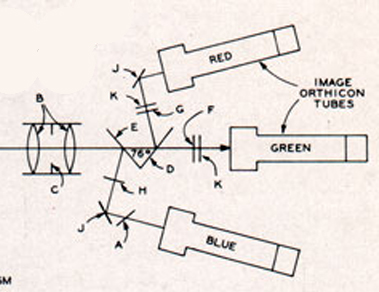
Mark
Posted by Marco Giustini (Member # 4544) on 01-17-2016, 01:40 PM:
I'm not an optical engineer so my question is likely to be silly but the light has to come from somewhere, shine on the DMD's and reflect back to the V-shaped mirror.
Anyway that seems an 'easy' concept, why using a prism in the first place?
Posted by Carsten Kurz (Member # 5396) on 01-17-2016, 02:34 PM:
quote: Marco Giustini
When I heard IMAX was changing Christie's with Barco's, I thought it was just marketing.
IMAX indeed switched from using Christie to Barco Xenon for their 2*2k LIMAX installs a few years ago. At the same time, they signed an agreement to cooperate on the development of the new IMAX laser systems based on the KODAK patents that IMAX bought. When I first heard about Barcos IMAX LIPs, I also thought they would just be DP4K-60L in an IMAX box as they did with the xenons. But they must be very different.
These Kodak LIP technology rights are either not available for Barcos 'standard' laser projectors, or simply too expensive to incorporate into these.
The idea to use mirrors instead of a TIR prism may appear easy in itself, but I guess it carries implications that make real implementations not cheaper, but more complex. I would assume an IMAX laser light engine to appear more like an optical bench, but constructed from materials with extremely low temperature drift.
- Carsten
Posted by Marco Giustini (Member # 4544) on 01-17-2016, 04:18 PM:
I see, that makes sense.
It would be nice to see some actual pictures of that setup.
Posted by Carsten Kurz (Member # 5396) on 01-17-2016, 06:47 PM:
I have read a lot of PR paper on the Kodak LIP, but they are not specific enough.
It could be in here:
http://onlinelibrary.wiley.com/doi/10.1889/1.3621311/abstract
- Carsten
Posted by Mark Gulbrandsen (Member # 72) on 01-17-2016, 08:35 PM:
Yea, the light would just enter through beam splitting mirrors as well. The loss of chromatic aberrations would be substantial compared to those generated by a thick prism block. If Laser I suppose each DMD could have it's own separate light source as well.Having all this mounted in the Invar housing makes it ultra stable so once the mirrors are set up and aligned they would essentially never change. That was not true of TV cameras that had had mainly aluminium chassis and had to be constantly tweaked for best convergence and reproduction.
Its blurry because they only let you preview one page but it is pretty much what I described and easy to see how it works. It did indeed have three separate, R,G,B laser sources.
Also, see this

Imax Licenses Kodak Patents
Mark
Powered by Infopop Corporation
UBB.classicTM
6.3.1.2