This is topic Pro hardware video players 2016! in forum Digital Cinema Forum at Film-Tech Forum ARCHIVE.
To visit this topic, use this URL:
https://ft-forum.com/ft/cgi-bin/ubb/ultimatebb.cgi?ubb=get_topic;f=16;t=002643
Posted by Javier Plano (Member # 9416) on 04-10-2016, 08:25 PM:
hi guys
I discover this forum googling for professional video players to use on an indie film festival. there was a thread about it from 2012.
http://www.film-tech.com/cgi-bin/ubb/ultimatebb.cgi?ubb=get_topic;f=16;t=001206#000000
as I didn't wanted to revive such an old topic, I'm starting a new one, just to see if anything has changed since then. I'm from Argentina, sometimes things take a little more time to become popular here
if DCP it's not an option (for its costs), what's the next best thing out there right now for screening digital files with high quality and stability?
if the answer is a computer, any software free or paid to do a decent playlist, that really makes videos look and play as should (VLC it's not top notch, in my opinion)? what about file formats, some HD codecs are really preferable to others for a public screening?
thanks for the answers, I really apreciate them.
Posted by Marlon Martins (Member # 8823) on 04-11-2016, 01:15 PM:
i like VLC cause it's easy to manage playlist, create shortcuts, and very very configurable.
im using not for cinema, but on small projectors on social events. not the same audience, but the same functionality.
i got a mini-pc just for this function, everything works great. i use my phone as remote controller with shortcuts for enhanced usability.
when using windows/mac/linux, there are a lot of possibilities on playing videos ![[Wink]](wink.gif)
about video formats, a few can easily be used. h.264 i-frame (properly configured) can get amazing results. also mpeg2 i-frame with high bitrate.
some codecs also can use higher profiles for lower quality loss, to keep the best "originality"
i believe there is some programs aimed specific for this (like some VJ software) but for now, quality wise, VLC is great for me.
as VLC have internal decoders, it handle it better and more safely. just drag the playlist to a second monitor, and primary hdmi output to the projector. disable any on-screen stuff, works great.
my main tip is: use SSD only
Posted by Javier Plano (Member # 9416) on 04-11-2016, 02:08 PM:
thanks for your reply Marlon
I need something a little more dynamic and robust, as it is a ten days festival with 3 or 4 programs by day
I'm thinking on a mac book pro, because of the file formats we receive (I'm a PC man myself). and yes, with an SSD
I just want to know if there is some specific hardware for this, or at least a pro software player with this function, besides the free ones we all use at home
Posted by Scott Norwood (Member # 30) on 04-11-2016, 02:28 PM:
The most stable option would be a broadcast videotape format. HDCAM, HDCAM SR, and D5 are all good choices. This is really the right way to go if you don't want to do D-cinema. You don't want to see the price of the decks, however.
I don't like using actual computers for cinema playback. If something goes wrong, you can potentially end up showing the computer output on screen, which strikes me as terribly unprofessional. If you are going to do this, get something with an SDI output, so that the only signal being fed to the projector is actual video content, and there is no risk of showing error messages to the audience. Also, SDI lets you play back embedded audio in whatever channel configuration is provided to you. Otherwise, you need a high-end sound card wired in such a way to connect it to your cinema processor if you want discrete multichannel sound.
For hardware players, I like the AJA Ki-Pros. They only play a couple of file formats (Pro-Res 422 and DNxHD) and the requirements are very specific. If you can get your content in one of these file formats, this would be a good choice.
With all of these options, you have the issue of mixing frame rates in one program, which tends to cause glitches on screen and sometimes pops in the soundtrack. The Ki-Pro cannot (or, could not, when I last used one...maybe a firmware update has changed this) have a playlist with a mix of different frame rates.
The two primary issues that I have seen with venues that accept file formats are a) no two venues want the same formats, which means that the producer needs to make or have a lab make a different file type for each exhibition (or he will just send you what he has, regardless of your ability to play it) and b) there are no standards for submission (should the content be broadcast-legal or full-range, for example). I still have hope that DCP will make these issues moot, but it has not happened yet for all producers and venues.
Posted by Javier Plano (Member # 9416) on 04-11-2016, 02:58 PM:
thank you for your reply Scott!
quote: Scott Norwood
I don't like using actual computers for cinema playback. If something goes wrong, you can potentially end up showing the computer output on screen, which strikes me as terribly unprofessional. If you are going to do this, get something with an SDI output, so that the only signal being fed to the projector is actual video content, and there is no risk of showing error messages to the audience. Also, SDI lets you play back embedded audio in whatever channel configuration is provided to you. Otherwise, you need a high-end sound card wired in such a way to connect it to your cinema processor if you want discrete multichannel sound.
this is very good advice, because it is true, the worst possible situation is having a problem and show it to the audience.
sadly, I don't have experience with SDI. are there any good external cards that output video connecting thru HDMI, USB3 or thunderbolt?
and what about software? any specific for playing video lists? any needed to route the video to the SDI output?
if I'm using a laptop, am I able to take stereo audio out from it using SDI?
thanks again, really appreciated
Posted by Carsten Kurz (Member # 5396) on 04-11-2016, 03:23 PM:
While I like the idea of having a professional output card, they are in reality limiting choices for codecs and frame rates too much.
I hate VLC for it's cluttered interface, and it's a lot of work to configure it properly for festival use. But it's unbeatable for its functionality.
The question is: Will this festival constrain the formats to be shown during the festival, is there provision for conforming all sorts of formats? I do not advise a festival to transcode those zillions of incoming media to a common format supported by a dedicated HD-SDI output card or hardware player. It makes the projectionist's job easier, but it doesn't guarantee a proper presentation. A festival is not a mastering service.
In our location, I prefer to convert incoming content to DCP (if time allows), otherwise, show with VLC.
A Mac/Mac Book with a second monitor configured (black desktop) will not show the computer desktop on screen, even if it crashes.
What I usually prefer to do on smaller events is to configure a poster slide (e.g. the festival logo) as the desktop background for the second screen. When playing back video, that logo is invisible. When the videos finish, you always see the festival logo on the background. That's an easy way to accomplish a streamlined presentation with very little effort. Of course you can as well add slides to the video playlist giving additional information, or serving as spacers. The Mac will play up to 8ch of audio, either stereo or up to 7.1, through it's HDMI or display-port/HDMI output.
- Carsten
Posted by Javier Plano (Member # 9416) on 04-11-2016, 04:24 PM:
thanks for the reply Carsten. converting everything ourselves is not an option
we are thinking on asking just one or two file formats (apple pro res), and if it is impossible for someone (for whatever reason), allowing something more standard, like a HQ H.264 file (letting them know that we think is an inferior format for screening their work on a theater)
quote: Carsten Kurz
I hate VLC for it's cluttered interface, and it's a lot of work to configure it properly for festival use. But it's unbeatable for its functionality.
sometimes I note that the video playback and image quality of mac files (pro res and the like) is better on mac players than on VLC. but I don't know if it's only because of the configuration of those softwares is already tweeked to look good, and that something has to be made on VLC to match it
Posted by Marlon Martins (Member # 8823) on 04-11-2016, 04:56 PM:
VLC can be set show images indefinitely, so i use them as a "holder" on the playlist. (if changing manually)
image
movie1
image
movie2
image
movie3...
and i can change, reorder, add stuff while playing, so really flexible...
about "not liking the idea of a PC", i understand that, but i also disagree. get a decent computer, remove/disable anything you won't need or would cause interruption, and that's it.
my mini-pc have a "clean" windows 7, im using for months, all the time, works wonderfully. Intel have some great mini-pc's, so you don't have to carry big stuff (like a full-pc), the components quality is great. a good quality laptop also works great.
also, if i recall, some cinema servers does not have pc components inside, like the doremi showvault? ![[Big Grin]](biggrin.gif)
Posted by Carsten Kurz (Member # 5396) on 04-11-2016, 06:17 PM:
I agree that if VLC is the base, it makes no real difference wether you use a PC or Mac.
But festivals will still receive a lot of different ProRes formats, and having a Mac simply is safer in order to play most of them in proper quality. Quicktime for Windows is not really a solution to that problem.
- Carsten
Posted by Javier Plano (Member # 9416) on 04-11-2016, 07:06 PM:
it's hard to believe that there isn't a more professional player out there, designed for this kind of tasks ![[Confused]](confused.gif)
Posted by Leo Enticknap (Member # 534) on 04-11-2016, 07:27 PM:
There is - Playback Pro - but it's quite pricey ($400 for the basic version and $700 for an enhanced version with features that you may or may not be willing to pay the extra for), and only available for MacOS, annoyingly.
Posted by Richard Fowler (Member # 893) on 04-11-2016, 07:45 PM:
I ran an entire four day festival using Playback Pro several years ago without problems. I recently used it for a one hour presentation loaded with visuals, logos, sound cues, music with zero issues. VLC with a clean dedicated MAC again a lifesaver.
Posted by Scott Norwood (Member # 30) on 04-11-2016, 08:33 PM:
More later, but, for now, I should also mention "Qlab" playback software, which the live stage people seem to like. I have not used it, but it seems to be standard in the stage theatre business. It is a commercial product that runs on the Mac.
As for VLC, I have never managed to get it to play back a complete playlist without some glitching between titles. Not that I have spent much time trying.
As for HDMI, it presents too many issues (HDCP, cable run length limits) to really recommend it for professional work.
Posted by Marlon Martins (Member # 8823) on 04-11-2016, 09:06 PM:
HDCP? this is only needed if it plays copyrighted blu-ray from the computer, no? i believe everything else does not require HDCP.
did a quick test on VLC, with a few ProRes files and it played all
Posted by David Buckley (Member # 2600) on 04-11-2016, 10:15 PM:
quote: Scott Norwood
I should also mention "Qlab" playback software, which the live stage people seem to like.
This is for the Mac platform; the free version will do a single video stream, which for this type of application should be sufficient.
Windows folk might like to try Screen Monkey, which is free for this kind of use.
Posted by Javier Plano (Member # 9416) on 04-11-2016, 11:42 PM:
guys, thank you so much for all your replies, really aprecciated
I'm gonna dig on those pro players, to see if they can fit our needs
quote: Scott Norwood
As for VLC, I have never managed to get it to play back a complete playlist without some glitching between titles. Not that I have spent much time trying.
this is a real issue, I have had white "flashes" between files before, and I cannot find the reason why
Posted by Scott Norwood (Member # 30) on 04-12-2016, 08:46 AM:
I think that VLC may work better with some graphics cards and worse with others, as I have heard good things about it from people who have used it successfully. As I said, I didn't spend much time with it. I have used "mplayer" before with good results, but that uses a command-line interface and is not something to spring on the uninitiated. It runs on Windows and Linux...not sure about the Mac.
Blackmagic and AJA are the two best-known manufacturers of SDI I/O cards. There are various "playout" programs that can be used to send video files to them. Sound needs to come from the SDI signal, not from the computer sound card (due to latency issues), so you need a disembedder and D/A converter. I have used the "MLT" software for Linux for playout purposes and had mixed results. There also exist component analog I/O cards, but they seem somewhat obsolete in today's digital world.
One issue with playing back to the computer output is that everything gets displayed at the computer's refresh rate (usually 60p, but not necessarily so), rather than its native frame rate. SDI will output in the correct frame rate, but, again, mixing frame rates in a single program can cause issues.
As for HDCP--it can come into play even if you are not showing "protected" content. Mac laptops often have issues with it, and there is a reason why most scalers have a "disable HDCP" option. Add in the short cable length limit and the non-locking connector, and you have something that really is not suitable for professional use.
Posted by Carsten Kurz (Member # 5396) on 04-12-2016, 09:28 AM:
Depending on the projector you need to use and media type you get, you may actually be glad that the computer output has a fixed rate...
That said, some players have options to adjust the display rate according to the file framerate if needed.
HDMI cable length issues can easily be overcome with extensions, CAT-Converters, etc. Yes, I would love to have a more solid signal connection, but 'after the long run', the benefits usually outweigh the disadvantages. Depends a lot on the festival profile and 'grade' of the participants.
Good planing and media qc is always advised, there are lot's of other issues besides the image or frame rates. Lot's of festival entries get mixed on laptop or iMac speakers nowadays. These kids have no idea what goes on in the bottom department of their 'location sound'. A realtime EQ (either digital, like VLC offers it), or between the computer audio and auditorium sound system (small mixing desk) can be a life saver...
- Carsten
Posted by Marcel Birgelen (Member # 6801) on 04-12-2016, 05:15 PM:
For the real ghetto setups, I prefer using MediaPlayer Classic instead of VLC. VLC, although being a swiss army knive in regards to playback, has issues. I've had issues with flashes in between movies and also erratic output window switches.
I've also used ScreenMonkey, but didn't really find it all that intuitive. QLab is more intuitive, but limited to MacOS X. If you're looking for a cheap/free P.C.-based show control software, you might check out OpenLP, which is essentially open source Church worship software, but can be used for unholy things just as well. I've actually used different worship software packages as cheap show control solution in the past.
Posted by Carsten Kurz (Member # 5396) on 04-12-2016, 09:22 PM:
We were playing preshow for a while using MPC-HC, and preferred it over VLC. One benefit for us was that it can be told to read all it's settings from an INI file instead of the registry. It is easy to move around your favorite settings, write protect them, etc,.
Especially secondary monitor operation is more solid that in VLC.
- Carsten
Posted by Javier Plano (Member # 9416) on 04-13-2016, 12:47 AM:
I'm getting really good advices, that would help me take the right decision. keep it comming guys, thanks to all, really appreciated.
if I get something like the ultrastudio mini monitor from blackmagic, that could do the trick? I don't see much options on the local market
https://www.blackmagicdesign.com/products/ultrastudiothunderbolt
if I understand correctly, that cannot work with any software, right? i.e. VLC can't route the video stream thru it. and what about audio? I cannot get it from that, just from the haerphone jack?
Posted by Carsten Kurz (Member # 5396) on 04-13-2016, 05:01 AM:
It is rather low cost and you won't regret having bought it, but your choices of playout software and codecs is limited against other solutions. Audio will come out up to 8 channels through HDMI and SDI, but you need systems to split it out of the video path.
Some professional playout software will support it. Otherwise you are limited to BMDs Media Express.
That said, if you use a MacBook Pro, then you have the choice of both - thunderbolt/display port/HDMI, and SDI/HDMI through the BMD. Not so bad. You may still end up with VLC, Qlab, or Quicktime Player Pro more or less often.
Keep in mind that some MacBooks come with proprietary SSDs, and so storage space for many video files could be very limited (or costly). You may need an external thunderbolt drive as well.
What kind of projection system and cinema audio processor will this be connected to?
- Carsten
Posted by Dennis Fung (Member # 8362) on 04-14-2016, 08:03 AM:
My experience, you should aware the VNC with additional monitor. It's really rely on computer CPU and GPU. If the computer didn't fast enough, you may not able to playback Pro Formats (i.e. ProRes) smoothly.
For BMD ultrastudio solution, I may say mp, unless you have professional software on hard. Otherwise you drag in the videos into Resolve, just like a preview monitor when you on editing. But I don't think this is a proper way for screening.
BMD Media Express can't handle some rare codecs, it will create another problems.
I got many bad experiences on VNC with Mac Mini. And I saw some terrible error on Playback Pro with Macbook Pro. Not just the hardware or software problems. All about the files are not complete.
Again, there are no way to make sure everything all right on video playback, unless you convert into DCP.
Posted by Javier Plano (Member # 9416) on 04-16-2016, 04:58 PM:
guys, I want to thank all of you for your replies, it clarified so much for me
I'm going to propose this configuration for the festival, let me know what you think:
-MacBookPro i7 - 2.5 Ghz, 16Gb DDR3 1600 Mz RAM, 15,4" (2880x1800) Iris pro display, GeForce GT 750M 2 Gb ram, 500Gb SSD, thunderbolt ports
-Blackmagic ultrastudio mini monitor adapter to SDI and HDMI
-Panasonic PT DZ870 projector, 8.500 ANSI, Full HD, 1.7-2.4:1 lens, SDI input
-PlaybackPro Plus software
-limit the types of files accepted for screening (mostly mac supported formats, making a concession on HQ H.264 AAC when nothing else is available)
my only doubt is about the sound. if I understand correctly, I can get digital audio from the HDMI output of the blackmagic adapter, right?
if I can only send analog audio (audio setup is provided by the theater, and I still don't know for sure which is going to be), I should convert that digital audio through another adapter? or am I gonna be able to use the earphone jack of the mac? I assume the first option is better and I can have less risk of having latency, am I right?
thanks for all your help, really appreciated
Posted by Carsten Kurz (Member # 5396) on 04-16-2016, 07:40 PM:
What do you know about the sound system at the festival location? Is that a 'real' cinema? Try to find out first. As I said, you may need gear to split audio/video from the HDMI/SDI output.
- Carsten
Posted by Javier Plano (Member # 9416) on 04-17-2016, 02:16 PM:
it's probably going to be a live theater/music venue, with a decent system installed. I don't know if it's going to be prepared for digital audio, I bet it's going to be analog.
so in that case, I need to get digital audio out from the blackmagic hdmi, and convert it to analog, right?
Posted by Jim Cassedy (Member # 4115) on 04-17-2016, 04:01 PM:
quote: Leo Enticknap
There is - Playback Pro - but it's quite pricey
quote: Richard Fowler
I ran an entire four day festival using Playback Pro
several years ago without problems.
I got used to seeing Playback Pro at many of the big Union convention
& trade show jobs I sometimes work at. (Apple, Facebook,Oracle, etc)
I also got used to using it for some corporate presentations at
Dolby. Yes, it's expensive, but it does so much and I liked it so much
that I not only went out & bought my own copy, but also got a dedicated
Macbook Pro to run it on. It's much more versatile & stable than Keynote,
and the ability to match black levels, audio & re-size pictures and even
re-arrange content "on the fly" makes it worth every penny to me.
I've never had a show hang or crash, nor had it unexpectedly put the
"desktop" on screen. It's almost impossible to muck-up a show.
Here's (part!) of the setup I used at a big Asian-American Film Festival
here in San Francisco recently. Content was a mix of DCP, HDCAM, Blu-Ray
& Computer files. I actually had 2 Macbook Pros running Playback Pro here.
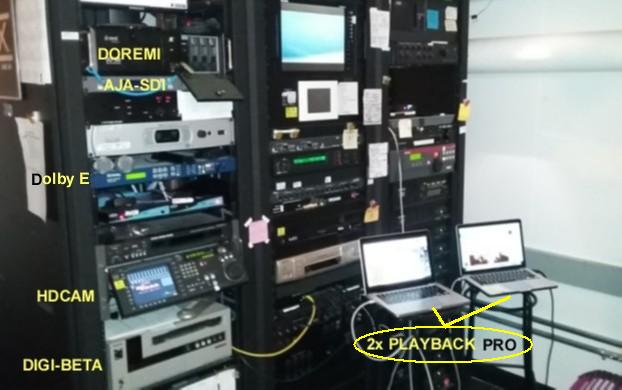
The sharp-eyed might even notice there's even a Laser-Disk player in that rack!
This particular room can pretty much do everything, including 16 & 35mm
Posted by Javier Plano (Member # 9416) on 04-18-2016, 12:45 AM:
nice feedback on the Playback Pro Jim, thank you!
do you use SDI video output with it? and how do you solve the audio part of the screening with the macbook pro?
ps: I did a laserdisc screening today, the audience had a blast
Posted by Marcel Birgelen (Member # 6801) on 04-18-2016, 03:12 AM:
Maybe I missed something, but why do you even need HD-SDI? The Panasonic PT DZ870 you proposed has both DVI and HDMI inputs. If your output is a PC/Mac, why make life hard by going to HD-SDI first?
I'd really go with some decent show control software. PlaybackPro is one example (which is strong in playback, but not much else), but you could also try Qlab if you're going the Mac route anyway.
The nice thing about this kind of software is that you easily can add some slides in between. For the kind of event you're scheduling, this seems to be the right fit.
Real show control software like Qlab can also be used to control other things via e.g. MIDI. You could even script it to dim the lights if the venue provides the necessary means.
Posted by Javier Plano (Member # 9416) on 04-18-2016, 03:20 PM:
thanks for your input Marcel
SDI uses BNC connectors, wich are safer than a hdmi plug (I never really liked it, I think it's a bad, unsafe design for non home configurations)
also, through PlaybackPro I can use the SDI as a dedicated video output, so I only send video to the projector, instead of an extended desktop
and also, I think the macbook pro doesn't have a hdmi output, so I have to put something to adapt the thunderbolt to anything, SDI, hdmi or DVI
am I wrong on something?
I think I don't want to use a show control software, but something simple, easy to understand and operate for anyone (I'm not going to be that person). I only need it to make playlist, smooth transitions, and be stable. that's it
Posted by Marcel Birgelen (Member # 6801) on 04-18-2016, 04:26 PM:
quote: Javier Plano
also, through PlaybackPro I can use the SDI as a dedicated video output, so I only send video to the projector, instead of an extended desktop
In order to work with playback software, the BMD device you're envisioning will also publish itself as another "Screen" in your Operating System. Those mechanics are deep at the core of most Operating Systems and are needed for things like application compatibility and hardware acceleration (needed for decoding and scaling, if applicable) to work properly.
Ideally, what you want is a pure frame-buffer device, but those things are hard to use and usually do not come with any hardware acceleration.
In the past, I've built a pre-show machine, which used two video cards running Debian Linux. I would manually start two X Servers, one for each card. The first card would run a fully featured X Windows including a Window Manager, the second one would not run anything other than X Windows itself. I even made sure the mouse pointer wasn't displayed.
The control software, which was a bunch of Python scripts and essentially just big hack, would run on the fully featured X Server and content would be played using an mplayer, which was bound to the second X Server. This way, I would never have a BIOS, boot screen or even an X Windows starting on screen. It worked quite nicely, but was inflexible as hell. Also, a simple system upgrade would ruin the whole system.
quote: Javier Plano
SDI uses BNC connectors, wich are safer than a hdmi plug (I never really liked it, I think it's a bad, unsafe design for non home configurations)
You can buy a Thunderbolt to HDMI converter for just a few bucks (around USD 15). You can use an HDMI to DVI cable and plug the DVI side into your projector. DVI plugs can be properly fixed. On the MacBook Pro side, you'd stuck with Thunderbolt anyway, which is also just another "home standard" made for easy plugging and unplugging, not improving much on HDMI in regards of connector design.
Posted by Javier Plano (Member # 9416) on 04-18-2016, 05:30 PM:
quote: Marcel Birgelen
In order to work with playback software, the BMD device you're envisioning will also publish itself as another "Screen" in your Operating System. Those mechanics are deep at the core of most Operating Systems and are needed for things like application compatibility and hardware acceleration (needed for decoding and scaling, if applicable) to work properly.
sorry Marcel, but are you saying this from real life experience with the SDI port? or are you just guessing?
I have used dedicated video outputs (firewire, for example), that the software (any video editing, like vegas or premiere) treated like exactly that: dedicated video output. the program would show just the video you were editing, for monitoring. and anything else. not the desktop or anything else.
from what am I reading (here, and elsewere), not all software can use the SDI output. VLC and most non-professional players can't use it. it's not another monitor, you need software that can manage that output. Playback Pro can, for example.
I appreciate your thoughts about this, but please talk from experience, and not just what you think a technology is or can do without specific knowledge, because that produces confusion and doesn't really help.
Posted by Carsten Kurz (Member # 5396) on 04-18-2016, 05:56 PM:
The MacBook Pro has a Thunderbolt AND separate HDMI output. Yes, a HDMI socket.
- Carsten
Posted by Javier Plano (Member # 9416) on 04-18-2016, 11:27 PM:
quote: Carsten Kurz
The MacBook Pro has a Thunderbolt AND separate HDMI output. Yes, a HDMI socket.
good to know that I would have options ![[Smile]](smile.gif)
Powered by Infopop Corporation
UBB.classicTM
6.3.1.2