This is topic The Jungle book in forum Digital Cinema Forum at Film-Tech Forum ARCHIVE.
To visit this topic, use this URL:
https://ft-forum.com/ft/cgi-bin/ubb/ultimatebb.cgi?ubb=get_topic;f=16;t=002645
Posted by Annli Com (Member # 8266) on 04-11-2016, 08:44 AM:
Dear All
Happy Inform To The Hollywood Movie "The Jungle Book" First Released In India on Last friday.
The Movie In Flat Format, Total Running Time 01:45:40
And End Credit Start 01:35:45 ,We Drive The Fader Level 6.5 In Indian Censored Version.
Very Good Responce For The Movie.
Thank You.
Posted by John Wilson (Member # 269) on 04-15-2016, 01:15 AM:
What did they censor?
It looks like a great film. Love that they re-used some of the original score from the animated version.
Posted by Annli Com (Member # 8266) on 04-15-2016, 10:36 AM:
Dear Sir
Censor means
Central Board of Film Certification (CBFC) is a Statutory body under Ministry of Information and Broadcasting, regulating the public exhibition of films under the provisions of the Cinematograph Act 1952.
Films can be publicly exhibited in India only after they have been certified by the Central Board of Film Certification.
The Board, consists of non-official members and a Chairman (all of whom are appointed by Central Government) and functions with headquarters at Mumbai. It has nine Regional offices, one each at Mumbai, Kolkata, Chennai, Bangalore, Thiruvananthapuram, Hyderabad, New Delhi, Cuttack and Guwahati. The Regional Offices are assisted in the examination of films by Advisory Panels. The members of the panels are nominated by Central Government by drawing people from different walks of life for a period of 2 years.
The Certification process is in accordance with The Cinematograph Act, 1952, The Cinematograph (certification) Rules, 1983, and the guidelines issued by the Central government u/s 5 (B)
At present films are certified under 4 categories
U-Unrestricted Public Exhibition
UA-Unrestricted Public Exhibition - but with a word of caution that Parental discretion required for children below 12 years.
A-Restricted to adults.
S-Restricted to any special class of persons.
Junglebook Certified In UA.
By ShibuPaul
Posted by Mike Blakesley (Member # 26) on 04-15-2016, 11:50 AM:
Everybody knows what censorship means. What he wants to know is, what was cut from the film (if anything?)
Posted by John Wilson (Member # 269) on 04-17-2016, 09:13 PM:
![[Roll Eyes]](rolleyes.gif)
Posted by Leo Enticknap (Member # 534) on 04-17-2016, 09:49 PM:
Maybe by "censored", Annli simply means "passed by the censor," not that anything was cut from it?
I showed it last week - we did a sneak members' preview. I liked it: a welcome example of a movie where 3-D added something (especially in the landscape shots and Mowgli running around with the animals) without needing to resort to shock gimmickry. I didn't catch anything in it that looked like it could have been problematic to a censor, though.
That having been said, Rudyard Kipling remains a controversial figure in India, and so maybe there is the odd line or scene in there that might touch a raw nerve with Indian audiences that I didn't pick up on.
Posted by Marcel Birgelen (Member # 6801) on 04-17-2016, 10:59 PM:
quote: Leo Enticknap
That having been said, Rudyard Kipling remains a controversial figure in India, and so maybe there is the odd line or scene in there that might touch a raw nerve with Indian audiences that I didn't pick up on.
They've simply cut out everything that could be closely associated with him. What remains was a little short, but a great movie. ![[Smile]](smile.gif)
Posted by Annli Com (Member # 8266) on 04-17-2016, 11:07 PM:
Censor Means
1. The objectives of film certification will be to ensure that –
a) The medium of film remains responsible and sensitive to the values and standards of society;
b) Artistic expression and creative freedom are not unduly curbed;
c) Certification is responsive to social changes;
d) The medium of film provides clean and healthy entertainment; and
e) As far as possible, the film is of aesthetic value and cinematically of a good standard.
2. In pursuance of the above objectives, the Board of Film Certification shall ensure that-
i) Anti-social activities such as violence are not glorified or justified;
ii) The modus-operandi of criminals, other visuals or words likely to incite the commission of any offence are not depicted;
iii) Scenes –
a. Showing involvement of children in violence as victims or perpetrators or as forced witnesses to violence, or showing children as being subjected to any form of child abuse;
b. Showing abuse or ridicule or physically and mentally handicapped persons; and
c. Showing cruelty to, or abuse of animals, are not presented needlessly;
iv) Pointless or avoidable scenes of violence, cruelty and horror, scenes or violence primarily intended to provide entertainment and such scenes as may have the effect of desensitizing or dehumanizing people are not shown;
v) Scenes which have the effect of justifying or glorifying drinking are not shown;
vi) Scenes tendering to encourage, justify or glamorize drug addiction are not shown; Scenes tendering to encourage, justify or glamorize consumption of tobacco or smoking are not shown
vii) Human sensibilities are not offended by vulgarity, obscenity or depravity;
viii) Such dual meaning words as obviously cater to baser instincts are not allowed;
ix) Scenes degrading or denigrating women in any manner are not presented;
x) Scenes involving sexual violence against women like attempt to rape, rape or any form of molestation, or scenes of a similar nature are avoided, and if any, such incident is germane to the theme, they shall be reduced to the minimum and no details are shown;
xi) Scenes showing sexual perversions shall be avoided and if such matters are germane to the theme, they shall be reduced to the minimum and no details are shown;
xii) Visuals or words contemptuous of racial, religious or other groups are not presented;
xiii) Visuals or words which promote communal, obscurantist, anti-scientific and anti-national attitudes are not presented
xiv) The sovereignty and integrity of India is not called in question;
xv) The security of the State is not jeopardized or endangered;
xvi) Friendly relations with foreign States are not strained;
xvii) Public order is not endangered;
xviii)Visuals or words involving defamation of an individual or a body of individuals, or contempt of court are not presented;
Explanation: Scenes that tend to create scorn, disgrace or disregard of rules or undermine the dignity of court will come under the term “contempt of court”, and
xix) National symbols and emblems are not shown except in accordance with the provisions of the Emblems and Names (Prevention of Improper Use) Act, 1950 (12 of 1950)
3. The Board of Film Certification shall also ensure that the film
i) Is judged in its entirety from the point of view of its overall impact; and
ii) Is examined in the light of the period depicted in the films and the contemporary standards of the country and the people to which the film relates provided that the film does not deprave the morality of the audience.
4. Films that meet the above – mentioned criteria but are considered unsuitable for exhibition to non-adults shall be certified for exhibition to adult audiences only.
5. (i) While certifying films for unrestricted public exhibition, the Board shall ensure that the film is suitable for family viewing, that is to say, the film shall be such that all the members of the family including children can view it together.
(ii) If the Board, having regard to the nature, content and theme of the film is of the opinion that it is necessary to caution the parents / guardian to consider as to whether any child below the age of twelve years maybe allowed to see such a film, the film shall be certified for unrestricted public exhibition with an endorsement to that effect.
(iii) If the Board having regard to the nature, content and theme of the film, is of the opinion that the exhibition of the film should be restricted to members of any profession or any class of persons, the film shall be certified for public exhibition restricted to the specialized audiences to be specified by the Board in this behalf.
6. The Board shall scrutinize the titles of the films carefully and ensure that they are not provocative, vulgar, offensive or violative of any of the above-mentioned guidelines.
7. The process of certification
7.1 The Cinematograph (Certification) rules, 1983 have laid down the procedure that a producer must go through to get his film or vide film certified, explicitly stating the steps he has to undergo and also the fees he has to pay and other materials he should submit.
7.2 The film or video film and other material specified in rule 2.1 have to be submitted to the regional officer of the concerned regional centre. On receipt of all the film materials, requisite fees and written matter required under the rules, the regional officer will form an Examining Committee to view the film. Under rule 22, this Examining Committee, in the case of a short film, will consist of an officer of the CBFC and one advisory panel member either of whom shall be a woman, and in the case of a long film / feature film, four of the two persons shall be women. After the film has been previewed, the CBFC has to ensure that each member gives a report in writing about his recommendations about the deletions and / or modifications and the certificate the film should be given. The report is then given to the Chairperson who will ask the regional officer to initiate further procedures.
7.3 However, if the Chairperson, on his own motion or on the request of the applicant, so feels, she may refer the film to Revising Committee under Rule 24. The Revising Committee will consist of Chairperson, in his absence, a board member and not more than nine members, drawn either from the CBFC or the advisory panel, provided none of them was on the Examining Committee formed earlier. The Revising Committee will view the same film print shown to the Examining Committee without any changes, and each member will be required to record his verdict before leaving the theatre. If the Chairperson is no in agreement with the majority view, she may direct another Revising Committee to see the film. The quorum of the Revising Committee shall be five members of whom at least two persons shall be women: Provided that the number of women members shall not be less than one-half of the total members of a committee constituted under sub-rule (2).
7.4 After the applicant in apprised of the decision of the Board, he will delete any portions (if so directed) and submit them to the regional officer, along with one copy of the film as certified.
7.5 Before any order prejudicially affecting the applicant of a film is passed by the Board, he is given an opportunity to represent his views in the matter before the EC/RC.
7.6 If the matter goes in appeal under section 5C of the 1952 Act to the Film Certification Appellate Tribunal which is headed by a retired judge as Chairperson and not more than four other members, the FCAT may hear both the applicant and he CBFC before coming to its judgment.
8. Violations
8.1 As stated before the Central Board of Film Certification is responsible for certifying films for public exhibition. However, enforcement of the penal provisions of the Cinematograph Act, 1952 is the State Governments/ Union Territory Administrations, since exhibition of films is a State subject.
8.2 There are various forms of violations which often go unchecked because there are no checks and no complaints from either the law enforcement agencies or members of the public.
8.3 The following are the major violations that agitate the minds of the public:
a) exhibition of an “A” certificate film to a non-adult.
b) exhibition of an “S” certificate film to persons other than those for whom it is meant
c) exhibition of a film in a form other than the one in which it was certified. Such violations are known as interpolations. Interpolations can be described as follows:
i) re-insertion in prints of a film for exhibition those portions which were deleted by the Board before certification of the film;
ii) insertion in prints of a film portions which were never shown to the Board for certification;
iii) exhibition of ‘bits’ unconnected with the certified film.
d) exhibition of a film which was refused a certificate (or ‘banned’ in common parlance)
e) exhibition of uncensored films with forged certificates of other films.
f) exhibition of films without censor certificates
By ShibuPaul
Posted by Jim Cassedy (Member # 4115) on 04-17-2016, 11:19 PM:
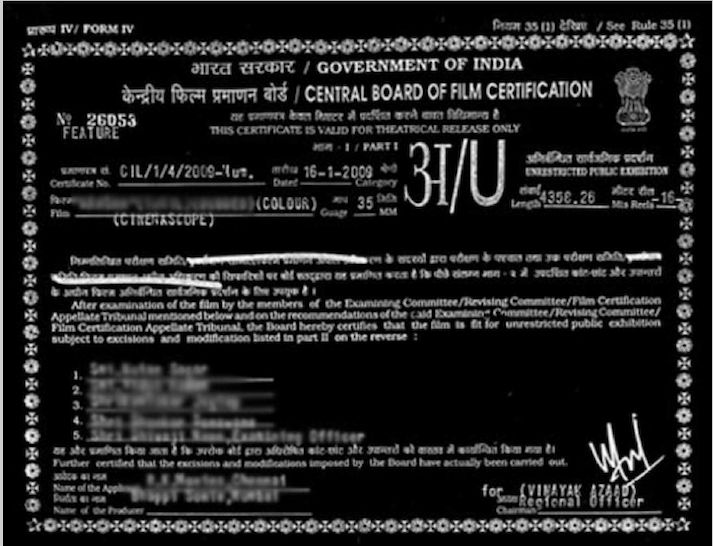
. . . and anyone who has ever run a film produced in India is familiar with this seal,
(or one similar to it) which appears at the head of every movie:
Posted by Annli Com (Member # 8266) on 04-17-2016, 11:25 PM:
More Info Available Here /
http://cbfcindia.gov.in/html/uniquepage.aspx?unique_page_id=20
Posted by Leo Enticknap (Member # 534) on 04-18-2016, 02:26 PM:
So the censor card is for a 'scope movie ("CINEMASCOPE" under the title), but the card itself looks somewhere between Movietone and 1.37. Presumably it's shown stretched.
I've run the occasional Bollywood epic (including one, the name of which I've forgotten, which literally arrived on 27 1,000-foot reels, and I had to scribe changeover cues onto 26 of them!), but don't remember seeing one of these certificate cards. Presumably the British (where I was working at the time) distributor removed them and replaced them with the BBFC equivalent.
quote: Indian censorship rules
xi) Scenes showing sexual perversions shall be avoided and if such matters are germane to the theme, they shall be reduced to the minimum and no details are shown;
So they had to cut the scene in which Mowgli fellates Akela? Boring! And looking at those rules above, if Tarantino ever tried to distribute any of his films in India, they'd probably be down to one-reel shorts by the time the censor was through.
Just a little bit more seriously, unless they have more detailed and unpublished written criteria, it must be an interesting job to have to decide what constitutes a sexual perversion and what doesn't.
Posted by Bill Brandenstein (Member # 7758) on 04-19-2016, 12:51 PM:
Why, oh why, in this day and age, would anyone ever distribute a movie on 1K-ft reels? Unless it's an archival print from before 1940?
Posted by Mitchell Dvoskin (Member # 751) on 04-19-2016, 01:27 PM:
Back in the mid 1970's, I ran Howard Hawks personal print of Rio Lobo. He was there in person to speak after the film. Mr. Hawks and his assistant showed up at the theatre about an hour before showtime, carrying a big cardboard box containing the film, a dye transfer print entirely on 1000 foot reels. I still remember rushing to get it built up onto the platter in time for the show.
Posted by Mike Schulz (Member # 4297) on 04-19-2016, 04:45 PM:
quote: Mitchell Dvoskin
dye transfer print
quote: Mitchell Dvoskin
platter
![[Frown]](frown.gif)
![[Confused]](confused.gif)
Posted by Jim Cassedy (Member # 4115) on 04-19-2016, 05:58 PM:
quote: Mitchell Dvoskin
print entirely on 1000 foot reels.
That's always a challenge, Mitchell.
Directors & Film Makers still show up at the last minute, only
now they hand you a DCP 30min before showtime that's going to
take almost an hour to ingest. (Despite asking numerous times
to have it 'in hand' well in advance, and explaining why that
was necessary).
I had a guy do that to me last month, and, I must admit, I
didn't handle it well. Some of my co-workers were shocked
at the verbal tirade I unabashedly unleashed at the guy.
(But I'll bet he never does it to anyone again!)
Years ago I worked running 'dalies' and 'work-prints' for a
well known director. Those were not only all 1000ft reels, but
with the sound on separate mag track reels. To make things
more 'fun', they were usually only spliced on one side, and often
they would re-use the same piece of splice-tape when making
some changes; and, of course, all of this was delivered shortly
before screening time.
I enjoyed the challenge of getting it all checked & patched up
well enough to run through the projector in short time for the
screenings, and remember, the preview projectors had to run
the film in 'forward' and 'reverse' too!
I only had one "major meltdown' where almost every-other splice
came apart, but they were very understanding since they knew I
had only received the reels (15 or 20 of them) a few minutes
before screen time.
(Although I did almost pop-my-cork when one of the editors said:
"I don't understand why you're having so much trouble........
. . . it ran fine in the Movieola" D'oh! ![[Mad]](mad.gif) )
)
Posted by Ian Freer (Member # 1940) on 04-19-2016, 11:30 PM:
quote: Jim Cassedy
...only now they hand you a DCP 30min before showtime that's going to take almost an hour to ingest.
That's one advantage of Dolby DSS or GDC servers over Doremi; It's not ideal, but you can mount and play the DCP's directly off a CRU drive if there isn't enough time to ingest.
However while it's a useful function of those servers, I completely agree with handing the guy a verbal bashing; anything to 'encourage' people to respect what you do actually takes time to ensure the job is done properly, 'digital' and 'DCP' are not terms that mean 'everything will be perfect'!...
Posted by Marcel Birgelen (Member # 6801) on 04-19-2016, 11:54 PM:
quote: Ministry of Information
India has a free press and the same freedom applies to cinema, which is free enterprise and outside the control of Government except the Films Division and the Doordarshan, which are aimed at educating and informing the public, while entertaining them. The press in India is free of any control when compared to other countries of the world, and the same applies to cinema.
quote: Ministry of Information
But this right is subject to “reasonable restriction” on grounds set out under Article 19(2) of the Constitution. The reasonable restrictions can be put in the interests of the sovereignty and integrity of India, the security of the State, friendly relations with foreign states, public order, decency or morality or in relation to contempt of court, defamation or incitement to an offence.
Gotta love those liberal, doublespeak interpretations of Freedom of Speech.
Posted by Jonathan Goeldner (Member # 4854) on 04-23-2016, 04:09 PM:
'Jungle Book' is also the first Dolby Cinema released in 3D.
"Hi, this is Jon Favreau.
...
There is a very exciting new technology out there right now, and Jungle Book is the first film that has been released in the format. It’s called Dolby Vision 3D. Unfortunately, there are only a handful of theaters that have it. It’s a laser projection system with extended dynamic range. The black levels on the screen are extremely deep, the contrast levels are much higher and the brightness of the screen make for a 3D experience where the glasses disappear. I think this technology is a game-changer and I applaud Dolby for this breakthrough and look forward to it being more widely available.
Here are the places where it’s currently available:
Los Angeles: El Capitan Theatre
New York: AMC Empire 25
Chicago Area: AMC Hawthorn 12
Internationally- Four locations:
Two in The Netherlands (JT Eindhoven & JT Hilversum)
Cinesa La Maquinista in Barcelona
The Cinelpexx in Linz, Austria"
https://www.reddit.com/r/movies/comments/4g1b6o/this_is_jon_favreau_there_are_many_ways_to_see/
http://www.dolby.com/us/en/brands/dolby-cinema/the-jungle-book.html
Posted by Jonathan Goeldner (Member # 4854) on 04-27-2016, 09:14 AM:
question: are the DCP's created by Dolby for their Dolby Cinema theaters 4K? Wouldn't the 3D DCP's for this actually be 2K (since 4K and 3D are not technically possible)?
Posted by Frank Angel (Member # 248) on 04-29-2016, 12:16 PM:
Oh, deep deep blacks and great contrast numbers are fantastic, but now put that Dolby Vision movie in a theatre where in addition to the changes they've made to enable Dolby Vision, they haven't made any real improvement in the room's ambient light levels. Dolby Vision and the deep deep blacks they claim they can get in their screening room won't amount to a hill of beans in a theatre where the ambient light levels are off the chart. And as we know, many rooms just can't eliminate high ambient light levels due to the immutable room metrics and the demands of the regs regarding safety lighting.
Powered by Infopop Corporation
UBB.classicTM
6.3.1.2