This is topic Power Strip Meltdown in forum Digital Cinema Forum at Film-Tech Forum ARCHIVE.
To visit this topic, use this URL:
https://ft-forum.com/ft/cgi-bin/ubb/ultimatebb.cgi?ubb=get_topic;f=16;t=002713
Posted by Jim Cassedy (Member # 4115) on 06-05-2016, 10:29 AM:
I got a call from a theater yesterday that one of their shows stopped,
. . . and that "the projector was on fire".
Given the absolute lack of any sort of technical knowledge of most
theater employees these days, I took that trouble report with a grain
of (popcorn) salt. So, I rushed right over there after I finished
de-lousing the cat and ironing my socks.
When I got there, the projector, of course, hadn't burned up. They
assumed it was the projector because the saw smoke coming up
out of the pedestal.
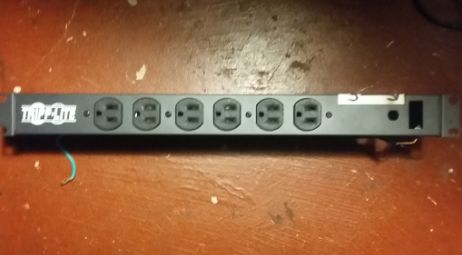
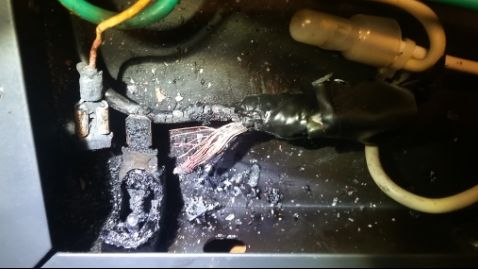
What I did find was that one of the rack-mount power strips
had a major internal meltdown. Here's the power strip:
Inside:
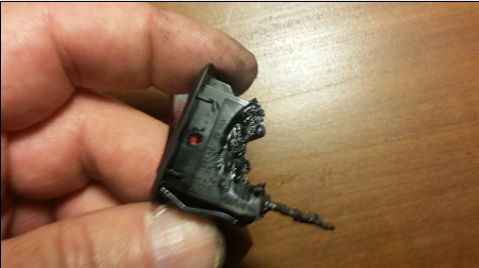
This is all that was left of the power switch:
I don't think the power strip was overloaded, but was probably
running at close to its' full capacity. One of the things connected
to it was a line that ran up into the attic & powered an old booth
exhaust blower that probably has a 1/3hp motor. They used the
switch on the power supply to turn it (everything else plugged
into it, on & off ever day.
I later found out that the switch had failed once before about a year
ago, and had been replaced by the the theater's handyman (basically,
the janitor) and that it had been acting up & making intermittent
contact for several days when they came in to turn things on in the
morning; but, of course, nobody thought to tell anyone about it.
And, apparently, a couple of people had smelled something burning the
day before, but they thought the smell was from the popcorn machine,
because,(quote): "We're always burning the popcorn". ![[Roll Eyes]](rolleyes.gif)
(and, of course, because burning popcorn smells so much like melting
bakelite & plastic?? ![[Confused]](confused.gif) ??)
??)
Posted by Harold Hallikainen (Member # 5405) on 06-05-2016, 11:16 AM:
It's always interesting to see what causes a fire. Is there any chance of finding the ratings on the replacement switch that burned up? At least this outlet strip is metal to enclose any internal fire. I've heard of plastic surge suppressor strips burning down houses. Th Varistor that's supposed to dissipate the surge eventually catches fire and burns the plastic. I've also heard of some outlet strips having fake UL stickers. Another cause of fires is outlets that don't make a tight connection to the plug. When we moved into our condo, I had to replace every outlet. Plugs would just fall out of the wall. Many years ago, I was in a donut shop that had the coffee makers on a shelf over a counter. I could see where the coffee makers were plugged in. The outlet was glowing. Apparently no one else had noticed.
I'm glad the damage was restricted to the outlet strip. Thanks for the great photos!
Harold
Posted by John Roddy (Member # 7348) on 06-05-2016, 12:44 PM:
There was a motor connected to it that was relatively far away? Any idea what gauge the wires were in the cable going up to it? A motor like that needs a decent amount of amperage, which requires a relatively thick wire to deliver safely. I actually tested a 1/2 HP motor recently with a cable that was a bit thinner than I realized. It didn't take long for that wire to get really hot. Of course, that was a motor that was completely shorted out, so it was going way overboard. But still, it does show where some frightening amounts of heat can come from easily.
It'd be a good idea to check the amps being drawn from all of the stuff plugged into that strip to make sure it's capable of handling it. A standard outlet is usually rated for 15 or 20 amps (both at the outlet itself and the breaker). Power strips like that should have some ratings printed on them to show what they can handle. And the further away from that max the actual load is, the better. That switch likely passes the full load on the hot line to the outlets, so it's probably the part that was overloaded and asploded. So why did it overload in the first place?
If nothing else, I'd strongly recommend getting that motor onto its own circuit. Induction motors can draw a lot of current.
Posted by Mark Gulbrandsen (Member # 72) on 06-05-2016, 12:49 PM:
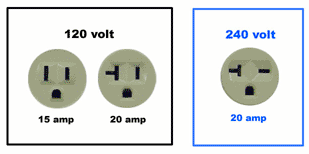
Using 15 amp stuff like that is an invitation for a fire. Always try to use 20 amp equipment where there is a 20 amp breaker. None the less even if the breaker was at the proper 15 amps for that strip (unlikely) they probably had too much stuff plugged into that strip anyway. Sound systems normally require multiple circuits. Projectors deserve a solid 20 amp hard wired outlet of their own where applicable. Or plugged into a UPS. Fortunately, most projectors are power split with the projector electronics on the UPS and the Projector Xenon hard wired in. The smaller projectors are another story. An NC-900 draws 9.8 amps with both lamps maxed out. So a 15 amp outlet is barely gonna get by and may even fail if the wires going to it are crimped at all. Also, crimps in outlet strips are usually the first point if failure, have seen the same failure mode in light dimmers as well.
Most of you know the difference but there are always some that do not. You must have a matching plug rated for 20 amps!
Mark
Posted by Leo Enticknap (Member # 534) on 06-05-2016, 02:38 PM:
quote: Jim Cassedy
I've also heard of some outlet strips having fake UL stickers...
Reminds me of a story I was told a few months ago.
Back in the 1990s and as part of a refurbishment that was running over budget, a theater installed cheap, no-name Chinese breaker panels, which an investigation later established had fake UL stickers. It was a decision they regretted, because these things were always tripping out for no apparent reason, causing canceled shows, platter brain wraps, and all sorts of other mayhem.
One day, the three phase breaker in the base of a console projector fried, and the lamp wouldn't strike. They had no ongoing service contract, and no service company could get to them for two days. As this was Friday afternoon and a mega-blockbuster was about to open, this was a problem.
Enter the 90-something great-grandfather of one of the concessions kids, an army engineering veteran who had worked on the experimental radar system at Pearl Harbor (the one that saw the Japanese planes coming, but the top brass refused to believe its predictions and did nothing). As a souvenir, he had taken home a three-phase breaker unit from that installation, and was delighted that it could see service again.
So he showed up at the theater and installed it, unaware of the fact that the wire color coding had changed since 1941. He connected two phases to each other and the third straight to ground. When the power supply to the unit was switched on, three city blocks, including a police station, went out instantly. A 20,000 amp fuse in a nearby substation was said to have been vaporized.
But the cheap Chinese breaker on the distribution panel in the booth did not trip.
Posted by Frank Cox (Member # 6258) on 06-05-2016, 04:56 PM:
Unfortunately, I don't think there's any way to absolutely guarantee than a mass-market item like electrical equipment is not counterfeit. Even offering approval number lookups on a website wouldn't do you much good.
Sticker number B1412 shows a Flugelsnoot Mark II with a yellow stripe across the bottom. Yup, that's what this thing is.
But is it?
Posted by Rick Raskin (Member # 1561) on 06-05-2016, 05:04 PM:
IMHO using power strips in a commercial installation is a no no. Get an electrician in there and install proper outlets.
Posted by Jim Cassedy (Member # 4115) on 06-05-2016, 06:00 PM:
quote: Rick Raskin
IMHO using power strips in a commercial installation is a no no.
Get an electrician in there and install proper outlets.
Well, Rick, I sort of agree with you, but this was not some el-cheapo Walmart
power strip. It was a 'commercial grade' Trip Lite, - - that was installed by the
company who did the digital upgrade.
And I doubt the owner is going to get an electrician in there, especially after
finding out how much money they're going to have to spend to transgenderize
their bathrooms. (Don't laugh. . wait till YOU get hit with a lawsuit from the
LGBT bathroom inpectors. And you thought the ADA lawyers were a pain....)
One other thing I forgot to put in my original post, which may or may not
have anything to do with the power-strip meltdown:
Not more than 5min after I got their system operating again by temporarily
dividing the load between power strips on two other circuits, there was a big
power failure that knocked out several square blocks of that same neighborhood.
The power stayed on at the theater I was at, but it went totally out at another
theater down the street. I went down there and hung around for about 15min
till the power came back on and helped them get the shows running again.
The relative timing of the power-strip meltdown and the power failure was
probably just a conincidence, but. . . . ? ?
Posted by Randy Stankey (Member # 64) on 06-05-2016, 07:25 PM:
quote: Harold Hallikainen
I've also heard of some outlet strips having fake UL stickers.
As I understand it, Underwriter's Laboratories doesn't necessarily test every consumer product that gets the UL Sticker.
From what I heard, the design of a product and a prototype is submitted to UL but, once the item goes into production, there isn't any oversight by UL.
Th sticker only indicates that, at some point during the pre-production phase of the product, UL said it was up to their standard.
Posted by Steve Guttag (Member # 268) on 06-05-2016, 08:17 PM:
Note, any changes to a UL (or ETL) approved equipment requires resubmittal for reapproval.
Note, the Tripplite RS-1215 shown in the first photo is also missing its 15A breaker (the hole next to the switch hole). Was the initial problem the breaker that kept popping until they removed it?
We use that power strip (as do a lot of people) and never had an issue with it. Given that it is breaker protected by design, what happened shouldn't have been possible without a defective breaker or an alteration by someone. And as the story was told, the handyman did indeed alter it.
Posted by Harold Hallikainen (Member # 5405) on 06-05-2016, 09:02 PM:
Besides what Steve said, UL and other safety labs (such as ETL) do periodic factory inspections (I think it's quarterly). These are unannounced inspections. They pull finished goods off the shelf and check critical components against what UL approved in the original submittal. I really appreciate the work they do.
Harold
Posted by Gordon McLeod (Member # 33) on 06-06-2016, 09:10 AM:
I know here one submits 4 units for destructive testing and one as archive sample to CSA that if the device is approved then inspect your manufacturing facilities to see if you are capable of maintaining that level then they do periodic inspections
to get CSA on a product is a expensive thing to do
Posted by Louis Bornwasser (Member # 3063) on 06-06-2016, 01:01 PM:
Look up the specs on any of those power SWITCH and compare to the power STRIP. The strip usually has better specs than the switch. One addition, the crimp lugs are derated because they are push on.
I know all of this because of the single phase Christie system the H-10and CH-10. Burned up everything in the transformer primary circuit. (Worked OK as a 3 phase; same components.)
Posted by Steve Guttag (Member # 268) on 06-06-2016, 04:28 PM:
That switch is also rated 15A (possibly 20A)...including with the push-on terminals.
Odds are, if it is getting daily use and is switching near maximum current....it is going to decay internally and die from inside-out.
Posted by David Buckley (Member # 2600) on 06-06-2016, 05:03 PM:
quote: Leo Enticknap
A 20,000 amp fuse in a nearby substation was said to have been vaporized. But the cheap Chinese breaker on the distribution panel in the booth did not trip.
That's some quality breaker right there. A definite keeper.
Posted by Jim Cassedy (Member # 4115) on 06-06-2016, 06:30 PM:
quote: Steve Guttag
the Tripplite RS-1215 shown in the first photo is also missing its 15A breaker
WoW! Steve- you're absolutely right (as usual).
For some reason I thought that hole had been for a neon pilot light.
No wonder the switch melted down.
I have no idea of the 'history' of that power strip before I had to deal
with it the other day, but seeing as how I found no trace of it in the ashes,
I'm assuming some Bozo pulled it out at some time in the past, and I
wouldn't be all that surprised if they pulled the breaker out because it
kept tripping due to the overload. D'oh! ![[Eek!]](eek.gif)
I'm going to go back to that location as soon as I get a chance and see
what kind of load they were trying to pull through there.
Geez! Whatwerethythinking?
Powered by Infopop Corporation
UBB.classicTM
6.3.1.2