This is topic Strange crud found on xenon bulb envelope in forum Digital Cinema Forum at Film-Tech Forum ARCHIVE.
To visit this topic, use this URL:
https://ft-forum.com/ft/cgi-bin/ubb/ultimatebb.cgi?ubb=get_topic;f=16;t=002721
Posted by Leo Enticknap (Member # 534) on 06-13-2016, 12:18 PM:
At one of our theaters, we use an NEC 3200S with a 3kW bulb for 2-D shows, and we swap in a 7kW bulb whenever we play a 3-D DCP, to ensure adequate light. Last night was a 3-D night. When I was swapping the smaller bulb back in after the show, I noticed some strange, dark yellow/cream deposits along the envelope of the 7kW bulb while removing and repacking it, near the seam and the wire. The bulb is an Ushio 70SN with 102 hours on the clock (out of 300 warranty).
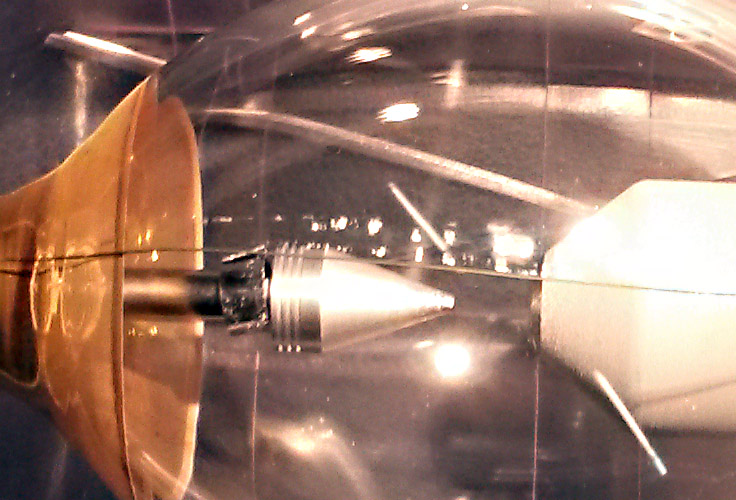
Apologies for the poor quality cellphone pic (artistic photography not easy while wearing a visor, Kevlar jacket and gloves!) - I've Photoshopped it slightly to enhance the detail. The deposits are just above the wire, and look dark yellow/cream colored under regular room lighting.
I tried to rub them off gently using a (dry) lens cleaning cloth, but they wouldn't budge. Whatever this stuff is, it's baked on solidly.
Any ideas? We've always been scrupulously careful to handle bulbs by the ends only, and after installing one I've also rubbed the ends with a microfiber cloth to even remove any traces of fingerprints from those. The lamphouse is vacuumed out regularly and the air filters changed twice a year, too. Some sort of chemical reaction to do with the wire?
I'd also be grateful for everyone's thoughts as to whether this bulb is safe to continue to use. It performed perfectly last night (running at 160 amps / 6.1kW), and gave me no cause for alarm, but if this contamination could pose an explosion risk, then obviously (a) we can't continue to use it, and (b) we're looking at a warranty return, given that it's only a third of the way through its warranty life.
Posted by Sam D. Chavez (Member # 1841) on 06-13-2016, 02:05 PM:
Just to be clear, you're sure the deposits are on the outside of the bulb? Can't say I've ever seen this before.
Posted by Leo Enticknap (Member # 534) on 06-13-2016, 02:27 PM:
Yes, they're definitely on the outside. They are slightly raised, and don't reflect the light in the same way that the quartz surface around them does.
I'm at least 99.9% sure that they weren't there when I last did a 3-D/2-D bulb swap (on May 29), too. I do look at the bulbs very carefully every time immediately before and after installation, using a powerful LED flashlight (a Nitecore MH20 - perfect for the job), to be totally and utterly sure that there is no foreign object contamination on the envelope's surface, and am as close to positive as it's possible to be that I would have spotted these deposits at the May 29 show if they'd been there then.
This is a new one on me, too.
Posted by Mark Gulbrandsen (Member # 72) on 06-13-2016, 09:03 PM:
Id send that picture to the Ushio Rep in your area and ask them if they've ever seen it. I have a lot of 3200's and 3240's running and never had any deposits on the lamps. I have seen popcorn oil collect in Christie lamphouses and in CP-2000's & ZX's though....
Mark
Posted by Buck Wilson (Member # 5885) on 06-14-2016, 02:13 AM:
What about what looks like damage/arcing on the cathode mounting point? Or am I just seeing things
Posted by Sam D. Chavez (Member # 1841) on 06-14-2016, 09:55 AM:
I was wondering about this discoloration too.
Posted by Marcel Birgelen (Member # 6801) on 06-14-2016, 06:43 PM:
Maybe I'm seeing things, but what's that ring beneath the cathode doing there anyway?
To me it looks like the ring/cap which is supposed to be near the "neck" on the cathode side somehow came loose and lodged itself under the tip of the cathode in this skewed position. This could also explain the discoloration due to arcing, since that object doesn't seem to belong there.
Maybe the ring/cap dislodged itself with quite some force and this caused some stuff to rub off and once it hit the hot surface of the bulb baked into it.
On the other hand, the crud on the outside of the bulb might not actually be related to the strange cathode damage.
I would surely try to RMA this lamp, not really because of the few specs on the surface, which are probably mostly harmless, but because of the apparent cathode damage.
Posted by Ian Freer (Member # 1940) on 06-14-2016, 08:05 PM:
I have seen that sort of white marking on quite a few lamps over the years. I haven't really noticed a lack of performance from these lamps, I only find the marking when I remove the lamp, and most lamps make warranty hours OK...
Ushio lamp
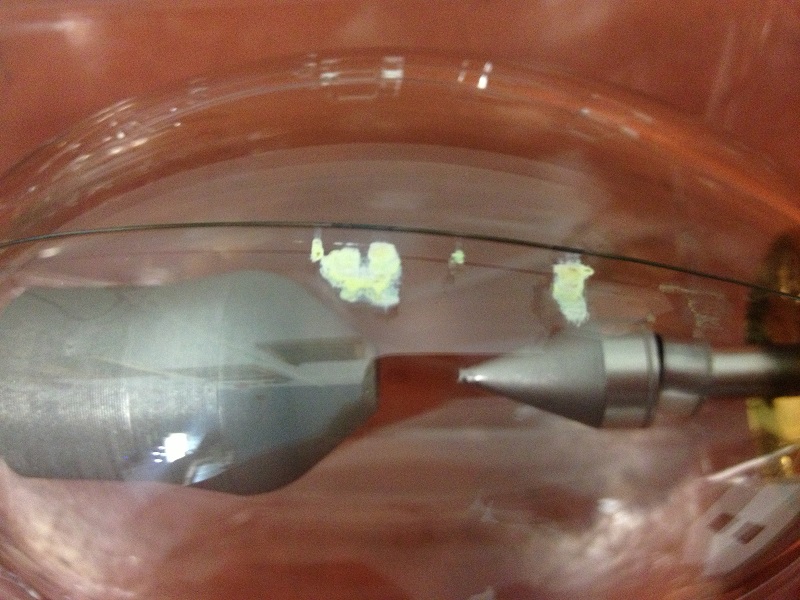
Philips lamp
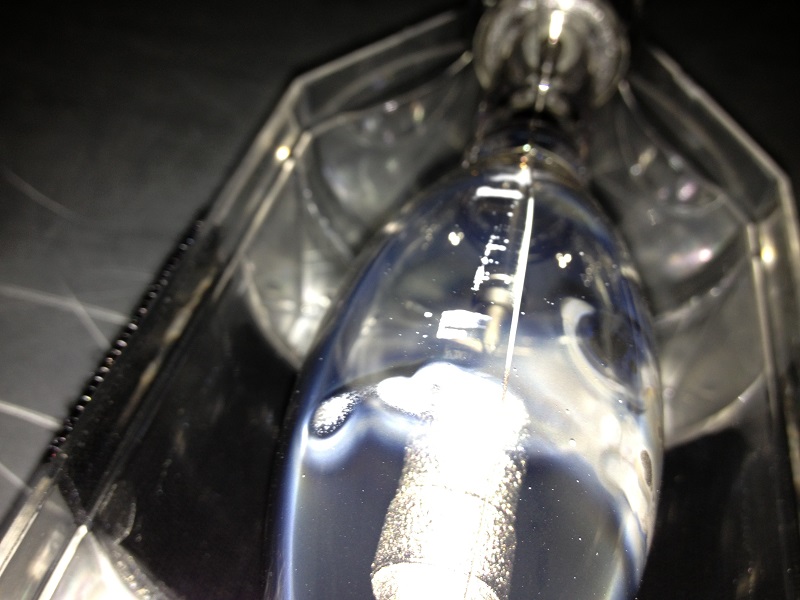
I thought I had asked Philips about the markings at one time but I cannot find any correspondence about it now, so maybe I just planned on asking and never did... It always appears near the wire, so I assume it's some interaction between the wire/heat/quartz under certain conditions.
I've heard of some sites that thought they were getting a bit of condensation build-up overnight in their projection exhaust ducting due to some settings of the air conditioning system, and that was dripping and leaving what looked like water deposit spots on the quartz. But I don't think this white marking is the same.
There are even more marks on that Philips lamp above but I think it still made warranty, I cannot quite remember... Both those photos were taken in 2013, but I'm pretty sure I've seen the white marks more recently too...
Posted by Monte L Fullmer (Member # 2797) on 06-14-2016, 08:15 PM:
^^ Good ol' LTi/Philips bulbs and the Helios varieties.
You were lucky to reach warranty with these bulbs.
They look great within the first quarter of their warranty life, but then they begin their problems til warranty hours.
Posted by Leo Enticknap (Member # 534) on 06-15-2016, 02:13 AM:
Thanks Buck - I was so focused on the crud alongside the trigger wire that I failed to notice the heat damage on the cathode mounting point. It's there alight, though interestingly, on one side of the bulb only (the side visible with the trigger wire facing upwards: rotate the bulb 180º - trigger wire facing down - and it looks as new).
I wonder if it was subjected to overheating at some point in its career. We had an incident recently in which one of my co-workers forgot to switch on the exhaust fan and cooked a 3kW bulb (grrrr...). This bulb is at least three years old (it was bought before I was hired) and possibly a bit older: we show 3-D DCPs pretty rarely, and so it probably gets swapped in and out around 10 times a year, being run for 2-6 hours each time. The only exception to that was a week-long run of the Jean-Luc Godard 3-D movie last year (the pretentious, esoteric thing with the naked couple and the dog - trying to remember the name but it's the end of a long day and I can't), when it did around 30 hours in a week.
Given its age (in years, if not hours burned), I'd probably be on a sticky wicket trying to return it for a warranty claim. I am, however, relieved at Ian's comment that he's noticed these deposits near the trigger wire on bulbs that have gone to warranty hours without any explosion. That being the case, I think I'll probably continue to run it until it either reaches warranty hours, or starts to flicker and/or loses light output beyond acceptability. Thanks folks.
Posted by Steve Wilson (Member # 2411) on 06-23-2016, 12:14 AM:
I have saw these deposits before on my drive in bulbs when I was running 35mm. I have not had time to experience it on a digital bulb. It always looked like calcium deposits to me. Why and how I have no idea. Most all of my lamps would have this by the time the final time was up on the bulb. I always figured it was condensations of night area right before the bulb cooled off, but that's just a guess!?
Powered by Infopop Corporation
UBB.classicTM
6.3.1.2