This is topic the future of 4K in forum Digital Cinema Forum at Film-Tech Forum ARCHIVE.
To visit this topic, use this URL:
https://ft-forum.com/ft/cgi-bin/ubb/ultimatebb.cgi?ubb=get_topic;f=16;t=002748
Posted by Scott Norwood (Member # 30) on 07-12-2016, 07:00 AM:
What is the current thinking on the future of 4K D-cinema content and projection? So far, it seems to have mostly not caught on, except for the very largest screens (and Sony), and most releases are still 2K. Will 4K become more common in the future (due to public demand and/or decreased costs), or will it remain a niche product? Does the movie-going public even notice the difference?
(I am actually not sure that I have ever even seen 4K content with 4K projection, so I don't even have an opinion on this one.)
Posted by Frank Bolkovac (Member # 6201) on 07-12-2016, 09:26 AM:
My opinion, the movie going public is there for good entertainment. The majority doesn't care whats projecting out the portholes. Hollywood hasn't caught this yet...
Posted by Scott Norwood (Member # 30) on 07-12-2016, 10:21 AM:
In principle, I agree, although I don't see why that should stop distributors and exhibitors from trying to improve picture and sound quality in cinemas.
A well-made, entertaining motion picture will not be made worse by being projected in 4K, and the experience might be more enjoyable. Which is not to say that a bad movie in 2K will be any better in 4K.
Posted by Carsten Kurz (Member # 5396) on 07-12-2016, 11:13 AM:
Wether it's a 'niche' or a 'premium' segment, I don't know. But there are more and more 4k features released. Laser IMAX is 4k, Dolby Cinema is 4k.
4k is also growing bigger in production equipment.
Yes, it may have developed slower then some people thought, but it is still coming.
Cinema has different branding and customer relation schemes than e.g. TV selling.
- Carsten
Posted by Bobby Henderson (Member # 840) on 07-12-2016, 12:33 PM:
There is a pretty big push going on for 4K in consumer electronics. I think that is going to force movie theaters to adopt 4K in defense against home theater if they don't already have 4K.
In the past couple of years TV manufacturers have replaced just about all their new model high end and mid range priced displays with 4K-based monitors. Big 4K resolution UHDTV sets are now dipping below the $1000 barrier. Just yesterday I got a piece of email spam from Sony showing off a large and extremely thin 4K HDR TV for $999.
The Ultra HD Blu-ray format has finally launched, but with some controversy due to quite a few launch titles (such as Mad Max: Fury Road) really being 2K movies that were just blown up to 4K. Reviewers say the these discs still look better than the regular 1080p Blu-ray versions thanks to better color quality and a bigger video bit rate. Nevertheless, fake 4K isn't going to look as impressively detailed on a UHDTV screen as real native 4K content.
The computing industry has also gone UHD. They're trying to entice users to dump old desktop and notebook computers that still work perfectly fine. My own personal notebook computer is now 5 years old (jeez!) yet I'm in no hurry to replace it. Plus it has some features in it, like a Blu-ray burner, that would be very difficult to find in a new computer. The UHD monitors are good for graphics work, but unless you have a high end Internet connection running 75 megabits per second or more you're not going to get real 4K from an Internet video stream.
Go Pro cameras, DSLR cameras and certain new smart phones are supporting UHD capture.
quote: Scott Norwood
I am actually not sure that I have ever even seen 4K content with 4K projection, so I don't even have an opinion on this one.
That kind of echoes my complaint about soft projection quality in a lot of theaters. If it's not tack sharp it's going to be difficult to tell the difference between 2K and 4K. The deeper color depth in the DCP (versus what's on Blu-ray) also gets diluted. I can sure tell the difference between 2K and 4K on a big UHDTV set showing native 4K content.
quote: Scott Norwood
Will 4K become more common in the future (due to public demand and/or decreased costs), or will it remain a niche product? Does the movie-going public even notice the difference?
I think 4K will eventually be the de-facto production standard. Movie production technology is pushing well above that level (6K, 8K). The main bottleneck is production time and render time needed for higher resolution visual effects and digital backlot work. Wall Street investors screaming for ever more profit are a downward drag on quality versus doing things faster and cheaper.
quote: Frank Bolkovac
My opinion, the movie going public is there for good entertainment. The majority doesn't care whats projecting out the portholes. Hollywood hasn't caught this yet...
Very few people in a theater audience know any of the technical details about film or digital projection. They would need to know those details in order to really, deliberately not care about what is being projected. The fact is they don't know any better. Any theaters choosing not be lax about presentation quality are asking for it.
We're way past the days when living rooms at best had square TV sets and low resolution analog imagery. There used to be a giant sized gap between the image quality one could see in a movie theater versus that in the home. That gap is all but gone now.
One thing is certain, there's a lot of people in the consumer electronics buying public that care a great deal about technical details. There is a good amount of consumer anger revolving around those early Ultra HD Blu-ray releases in fake-4K.
Posted by Gordon McLeod (Member # 33) on 07-12-2016, 12:45 PM:
4K DLP has lower contrast ratio than 2K
Posted by Adam Martin (Member # 641) on 07-12-2016, 12:55 PM:
Based on content seen on our network here, it seems that 4K "release prints" peaked in 2014.
2012 - 11 titles
2013 - 15 titles
2014 - 26 titles
2015 - 23 titles
2016 - 5 titles so far (and we're half way through)
quote:
2016:
Allegiant
At the Fork
God's Not Dead 2
Hail, Caesar!
Hostile Border
Posted by Brad Miller (Member # 2) on 07-12-2016, 12:56 PM:
What Gordon said.
In my opinion 2K puts out a better quality picture than 4K is capable of (especially if you are using a Series 1 "dark chip" or a Series 2 machine with a high contrast lens.
Remember, resolution isn't everything. Here is an overly-extreme example to help make the point...what's better: an Atmos system with 64 channels using K-Mart brand car speakers or a mono system with an awesome QSC speaker? Give me a single speaker with really good quality sound any day over an assault of 64 ear-bleeding speakers.
Besides, the tiny vibration evident in many systems make it so much of that additional resolution doesn't make it to the screen anyway, as the slightest minute vibration in the lens or projector kills it.
If you like real film and want to achieve as close as possible to the look of film, a 2K DLP with high contrast lenses is the closest you will currently get in the digital world.
Posted by John Roddy (Member # 7348) on 07-12-2016, 03:02 PM:
4K did a pretty sad job entering the digital cinema market. Even the newest 4K equipment leaves a lot to be desired. Luckily, it's holding up very well in the consumer scene. 4K TV's are rapidly dropping in price, and 4K monitors are becoming more and more feasible. Even the computing power necessary to drive games at that resolution is becoming more affordable. Heck, even the screen on my freaking phone is closer to 4K (1440p/"Quad HD"; I have an LG G3). It's very strange to look at the massive movie screens at my theaters and think that my phone has a much better resolution, not to mention an insanely high PPI.
Personally, I'm interested to see what laser can offer. After all, one of its key advantages is that it offers a much higher contrast ratio, right? Only problem right now is that the 4K-ready higher end stuff is still way out of the price range for most theaters. There are several cheaper options available, and even the laser-phosphor upgrade for Barco's C-series projectors (I'm not 100% sure if a B-series upgrade is in the works, but I'd imagine it is). Sadly, they're all 2K. But hey, if laser works as well as it's supposed to, then it's really really good 2K. So that's…something, I guess.
Posted by Mike Schulz (Member # 4297) on 07-12-2016, 04:02 PM:
Bobby Henderson mentioned this above and the main reason most titles are not released in 4K is due to the visual effects. Almost every VFX intensive movie has all of the effects rendered in 2K so even if they are shooting on film or capturing on a 4K Alexa, if you have a movie like Star Wars with hundreds or even thousands of VFX shots, the DI and final output will be 2K.
I work at a venue with Dolby Vision projectors and we were a little upset that "The Force Awakens" was released only in 2K and that is when I found out that the only reason was because of all of the VFX that were rendered in 2K. They might get away with upscaling Bluray to 4K but when you are trying to do that on a huge cinema screen, it just doesn't look good so they just do the whole thing in 2K.
"The Jungle Book" has been our only 3D 4K EDR title so far and when I asked about it, Disney actually spent the time and money on having all or most of the VFX work done in 4K, and the result was pretty incredible. It really looked great in 4K.
Posted by Monte L Fullmer (Member # 2797) on 07-12-2016, 05:58 PM:
AND ... most of the 4k content gets played in scaled down 2K if 4K projectors aren't available.
I have 13, 2k units and only 2, 4K units, which are my ATMOS houses. Rarely do I get 4K content for ATMOS, where now, I'm showing "Pets" in an ATMOS house, but the content is only 2K firing through a DP4K-32B Barco.
-Monte
Posted by Muhamad Taufiq (Member # 8868) on 07-13-2016, 05:49 AM:
I'm a bit curious here.
Cost-wise, is it makes sense to use 4K projector in every new install? I mean, surely in the cinema market 4K prices are dropping, just like the consumer market (or is it not?)
Posted by Carsten Kurz (Member # 5396) on 07-13-2016, 06:22 AM:
Not really. The problem there is, the cinema equipment market practically went belly-up after the rollout finished. Neither small operators nor large chains buy new equipment every other year like consumers do.
There was a remaining market for smaller screen projectors where cost has lowered considerably (e.g. NEC NC900, Christie Solaria, Barco DP2K-6E).
But low cost for small screens usually means 2k, not 4k.
And there is a market to replace underpowered large screen xenon DLPs with laser at ridiculously high cost, that of course is 4k. But, other than Sonys 510/515, there were barely any price reductions for 4k DLP.
- Carsten
Posted by Scott Jentsch (Member # 1681) on 07-13-2016, 11:24 AM:
Bobby's reply covered things pretty well.
Consumers are very familiar with the 4K branding, thanks to TV manufacturers who have made 4K the current marketing buzzword to sell new units. Ultra HD Blu-ray is building steam pretty well considering that it just debuted in February, and that's with just one player available in the U.S. marketplace.
The awareness of 4K is there among the general population, and if theaters aren't getting questions about it, it may be because moviegoers might assume that theaters have something better than what they can buy for $900 at Best Buy and put in their living room. If there was a sign at the ticket booth that stated the resolution of each movie, there might be some enquiring minds wanting to know why your 25-75 foot wide movie screen doesn't have the same number of pixels as their 4-5 foot wide TV does.
Once again, though, I think it boils down to showmanship. Gordon and Brad have stated that a 2K setup can provide a better quality picture (overall) than a 4K setup, and if that's the case, then going with 4K wouldn't be automatic if you're truly looking to provide the best possible experience.
Anyone that asks why you're not showing the movie in 4K would likely appreciate an answer that is along the lines of "We found that the 2K system we have outperformed the 4K systems that are available, and we want to provide our customers with the best quality possible."
Unfortunately, many of the movie screens around here are the shiny variety to make 3D brighter, which conspire with too much lighting to elevate the blacks to the point of dull grey. My home displays (flat panel, front projector) are brighter and have more contrast.
Further complicating the matter is that the source material often isn't "true" 4K, as has been stated previously. That's an artificial limitation simply due to choices made by the studios, and Mike's comment about the quality of The Jungle Book speaks to what can be done if the will is there.
For a theater looking to make a purchase, the issue is definitely not clear-cut. Do you buy 2K because it's cheaper and there aren't many 4K movies out there anyway? Do you invest in 4K because it will most likely be the future, albeit at some unknown date?
If it were me, I'd lean toward 4K, but then I would need to see for myself how it would perform next to an equivalent 2K setup to see if it was worth the upgrade (while weighing a prediction about where the industry was going re: 4K production).
If I could get a really good 2K image, why not go that route? Especially if it opened up funds that could be used to improve the sound and the auditorium for a better overall experience.
Posted by Bobby Henderson (Member # 840) on 07-13-2016, 01:31 PM:
2K DLP may have better color and contrast than a 4K DLP system or a 4K LCOS system. But I don't see that as a good thing. I see it as a problem. It doesn't bode well for the future in the rivalry with home theater. The problem is compounded by the extreme prices of laser-based projection systems. The laser systems might be better (especially for 3D) but they're never going to be installed on a widespread basis as long as they carry such ridiculously high price tags.
I read somewhere that it's costing IMAX between $1.3 million to $2 million to convert an existing IMAX screen from 15/70mm film projection or 2K Xenon projection to the new 4K dual laser projection system. IMAX has nothing on their Drupal generated web site mentioning IMAX with Laser. As of May 2016, The Large Format Examiner web site says IMAX has only 7 screens in the US equipped with the new system. AMC has 19 Dolby Cinema screens in operation with 3 more in the process of installation and 10 others planned after that.
quote: Adam Martin
Based on content seen on our network here, it seems that 4K "release prints" peaked in 2014.
2012 - 11 titles
2013 - 15 titles
2014 - 26 titles
2015 - 23 titles
2016 - 5 titles so far (and we're half way through)
Is that based on info from the Feature Info, Trailer Attachments & REAL Credit Offsets forum? Or is it a complete view of all titles playing in North America?
quote: Mike Schulz
Bobby Henderson mentioned this above and the main reason most titles are not released in 4K is due to the visual effects. Almost every VFX intensive movie has all of the effects rendered in 2K so even if they are shooting on film or capturing on a 4K Alexa, if you have a movie like Star Wars with hundreds or even thousands of VFX shots, the DI and final output will be 2K.
I forgot to mention a very important thing: 3D. Just about any movie being released with a 3D version will produced in 2K. Perhaps Dolby Cinema and IMAX with Laser theaters can present 3D in 4K, but AFAIK no other theaters can do it with the current technology. I'm not sure if any movie has been made in both 3D and 4K yet.
quote: Scott Jentsch
Consumers are very familiar with the 4K branding, thanks to TV manufacturers who have made 4K the current marketing buzzword to sell new units. Ultra HD Blu-ray is building steam pretty well considering that it just debuted in February, and that's with just one player available in the U.S. marketplace.
Ultra HD Blu-ray is doing alright, but the fake-4K titles really stained the launch. One thing that is interesting: 3D is pretty much dead on the 4K platform. Not many of the new 4K UHDTV sets support 3D. I don't think the Ultra HD Blu-ray players are doing it either. The higher resolution video and next generation audio formats are taking priority over 3D.
I think the failure of 3D in the consumer marketplace was mostly a self-inflicted wound via price gouging. The discs were just too damned expensive. The pricing gap grew even worse as an existing 2D Blu-ray headed to bargain pricing while the 3D version stubbornly stayed near the $30 level or even more depending on the retailer. 3D works great on my TV set, but I have only a handful of 3D titles thanks both to the high price and the sheer lack of titles I like enough to buy at all.
Posted by Adam Martin (Member # 641) on 07-13-2016, 02:43 PM:
quote: Bobby Henderson
Is that based on info from the Feature Info, Trailer Attachments & REAL Credit Offsets forum? Or is it a complete view of all titles playing in North America?
It's based on movies that have played in our network of theaters; you can infer all wide release and some smaller and indie films.
Posted by Mitchell Dvoskin (Member # 751) on 07-13-2016, 03:01 PM:
I would tend to think that there will be more 4K theatrical releases going forward as consumers demand native 4K content for their 4K flat screens and Ultra HD Blu-ray players.
Posted by Mike Blakesley (Member # 26) on 07-13-2016, 07:00 PM:
How many people are "demanding" that though? There are a whole lot of people around today who can't tell (or don't care about) the difference between SD and HD. I think Ultra HD is going to be a tougher sell -- it's going to be something that'll creep in gradually as people replace older sets.
Posted by Daniel Schulz (Member # 1881) on 07-13-2016, 09:26 PM:
quote: Mike Blakesley
How many people are "demanding" that though? There are a whole lot of people around today who can't tell (or don't care about) the difference between SD and HD. I think Ultra HD is going to be a tougher sell -- it's going to be something that'll creep in gradually as people replace older sets.
This might turn out to be a case of the demand coming from the production side, rather than the consumer side. Now that Amazon is streaming in 4K Dolby Vision, and UHD-BD is on the market, the filmmakers themselves may start to take it as a point of pride that *their* movie be treated just as well as the *other* movie. Dolby for one is making a full court press to court the filmmakers themselves to adopt Dolby Vision and Dolby Atmos for the theatrical releases, with an obvious downstream play for streaming and disc delivery.
I predict that Moore's Law, coupled with evolving industry best standards and practices, will result in most content within a couple of years being 4K with EDR as a matter of course, both theatrically and for home video.
Posted by Steve Guttag (Member # 268) on 07-13-2016, 09:27 PM:
4K DLP only takes a hit on contrast, not color.
I see us putting in more 4K as time goes on but 2K remains the bulk. However, that is normally a cost/size thing. The only thing that seems to have gotten cheaper on the 4K side of things are the servers. Dolby never charged a premium for 4K decoding and now on the Doremi products, they have ended charging for the 4K license there too. GDC still charges for it.
Projector wise, I have not seen a decrease in 4K for years.
Posted by Harold Hallikainen (Member # 5405) on 07-13-2016, 09:45 PM:
What would be the best way to improve contrast? Larger chip? Something else?
Harold
Posted by Marco Giustini (Member # 4544) on 07-14-2016, 02:14 AM:
Barco claims a higher contrast figure on their Laser/Phosphor machines.
Also, they now have a high contrast Laser version of their Laser projector. I believe the 'normal' flagship machine is rated 2500:1, the HC version is rated 4000:1 - trading some brightness for it of course.
But it seems the path has been set to improve the mediocre (2K)/dreadful (4K) DLP contrast level. Which is good news.
Posted by Steve Guttag (Member # 268) on 07-14-2016, 04:15 AM:
There shouldn't be any improvement on the Laser Phosphor machines. They use the same light path (as it leaves the lamp area and have the same issues trying to mitigate stray light.
You'd have to ask someone that is on the design side as to how to improve contrast. As I understand it, one of the problems is with the smaller mirrors not being able to direct the light cleanly away when the pixel is not at 100% on. This is why that the S2K projectors suffer contrast like 4K since they are using the same sized mirrors.
Posted by Marco Giustini (Member # 4544) on 07-14-2016, 04:47 PM:
Well, that was what Barco (not a reseller) told the audience just before a demo.
In fact the official specifications of the 15C say 2000:1, while 15CPL is rated 2200:1. Nothing massive but every little helps! The picture looked a little better indeed.
I agree that that sounds weird as the light path should be the same. I do not really know how they can do that - unless they trade some light for contrast, maybe adding a cat eye somewhere.
Posted by Carsten Kurz (Member # 5396) on 07-14-2016, 06:31 PM:
Well I guess they need to improve contrast a little bit for marketing as well. As the whole brightness calculation changes due to the lack of xenon-type degradation, there certainly is room for it.
With a fresh xenon lamp after a few thousand hours of operation, you could still get max brightness. With the LP, you will end up at 50% +/- and need to buy a new laser source. The way they put this on the Barco pages means that the 13.500 lumens spec is initial brightness, not average?
Well, in typical environments, that would be about 10 years of operation anyway.
Did they say something about the warranty for the laser source? NEC quotes 30.000hrs operating life, but only 10.000hrs warranty...
- Carsten
Posted by Leo Enticknap (Member # 534) on 07-14-2016, 10:15 PM:
4K seems to have caught on more for restoration and re-release titles than for newly produced movies. Sony's archival restoration DCPs appear to be almost all 4K, as are a good many of the other studios' arthouse/rerelease output are as well. My impression is that a rerelease of a classic is far more likely to be a 4K DCP than a newly produced movie.
Posted by Jonathan Goeldner (Member # 4854) on 07-14-2016, 10:30 PM:
^ not only from Sony, but Janus, Rialto's 4K restorations (which have become the forefront to eventual Criterion bluray releases) have been encoded as such on DCP's.
and with the rumor of 4K UHD releases from Disney the longest hold out from a major studio is being hinted (rumored) that 'Finding Dory' as their first release as such.
@ Mike Blakesley:
Variety had this story in regards to UHD sales versus bluray sales:
"New format growing four times as fast as Blu-ray Disc a decade ago
Studio executives are cheered by early Ultra HD Blu-ray sales numbers.
A total of 45 Ultra HD titles have been released on Blu-ray Disc since March — and according to Home Media Magazine market research, consumers bought more than 228,000 discs as of June 24.
By comparison, Blu-ray Disc, launched in June 2006, moved just 57,000 units in the comparable time frame.
Ultra HD is a new format that not only offers viewers four times the resolution of HD, but also includes high dynamic range (HDR), which produces brilliant highlights, vibrant colors and greater contrast on compatible displays. Observers expect the new format to trigger a resurgence in overall Blu-ray Disc sales, which already are tracking up 3% for the year in units and 6% in dollars, Home Media Magazine market research numbers show.
“2016 will be a phenomenal year for 4K Ultra High-Definition (UHD) TVs — driven in part by the market introduction of next-generation technologies — with shipments of 4K UHD displays projected to reach 13 million units (an 83% increase),” the Consumer Technology Association said in its latest research report. CTA expects revenue from 4K UHD displays in 2016 to top $10 billion, a 65% increase from last year.
“The new Ultra HD format with HDR allows us to give audiences the best-quality picture and sound available at home today,” said Ron Sanders, president of Warner Bros. Worldwide Home Entertainment Distribution. “With Ultra HD HDR televisions now widely available, filmmakers and consumers alike are excited about the way we are able to present our films to home viewers. It is truly the closest thing to what the filmmaker intended.”
At this point, there are only two Ultra HD Blu-ray players available, from Samsung and Panasonic, but that situation is expected to change — and fast. In June, the 10th birthday month for the Blu-ray Disc, Microsoft announced its new Xbox One S games console is Ultra HD Blu-ray and HDR compatible, while Sony said it is developing an upgraded version of its PlayStation 4 gaming console that will offer Ultra HD 4K resolution and richer graphics.
Other CE companies are expected to roll out players of their own in the coming months.
In January 2016, the UHD Alliance unveiled a consumer logo to identify devices, content and services capable of delivering a premium experience to an Ultra HD market expected to grow eightfold by 2019. The “Ultra HD Premium” logo is reserved for products and services that comply with performance metrics for resolution, HDR, peak luminance, black levels and wide color gamut, among others. The specifications also make recommendations for immersive audio and other features. These advances in resolution, contrast, brightness, color and audio combine to deliver a premium Ultra HD experience in the home. The UHDA includes most of the major Hollywood studios, consumer electronics companies representing the majority of today’s 4K Ultra HD TV market, cutting-edge developers of enabling technology and top players in content distribution.
The association in April 2016 expanded the range of products that can bear the Ultra HD Premium logo with the announcement of certification and logo licensing for Ultra HD Blu-ray Disc players.
Next-generation immersive, object-based sound formats also will be delivered via the Ultra HD Blu-ray specification. Additionally, with the optional digital bridge feature, the specification enhances the value of content ownership by embracing the notion that a content purchase can enable consumers to view their content across the range of in-home and mobile devices.
The specification also mandates all new Ultra HD Blu-ray players be capable of playing back current Blu-ray Discs, giving consumers access to the vast library of more than 12,000 titles currently available on Blu-ray Disc.
Thomas K. Arnold is editorial director of Home Media Magazine."
Posted by Marco Giustini (Member # 4544) on 07-15-2016, 02:28 AM:
quote: Carsten Kurz
As the whole brightness calculation changes due to the lack of xenon-type degradation, there certainly is room for it.
Hi Carsten,
I'm not following you, contrast is white/black. If white goes down, black goes down too. What is your thought on the subject?
Posted by Carsten Kurz (Member # 5396) on 07-15-2016, 07:41 AM:
They offer less brightness degradation in shorter intervals, so they could sacrifice some more brightness for some increased contrast.
I guess that is the reason they offer the 15CLP with less spec lumens (13.500) for the same screen size than the 15C with xenon (14.500).
They can also design a cooling system that needs less air pumping through the unit, hence longer filter change/cleaning intervals. And that's what they're after. Less visits to the booth (if booths at all).
- Carsten
Posted by Marco Giustini (Member # 4544) on 07-15-2016, 02:21 PM:
I see what you mean. If it is as you said there would be a cat-eye or similar in the retrofit kit - assuming the retrofitted projector can enjoy the same increase in contrast ratio?
Posted by Scott Jentsch (Member # 1681) on 07-15-2016, 07:06 PM:
quote: Bobby Henderson
Ultra HD Blu-ray is doing alright, but the fake-4K titles really stained the launch. One thing that is interesting: 3D is pretty much dead on the 4K platform. Not many of the new 4K UHDTV sets support 3D. I don't think the Ultra HD Blu-ray players are doing it either. The higher resolution video and next generation audio formats are taking priority over 3D.
3D and Ultra HD Blu-ray are mutually exclusive. There is currently nothing in the Ultra HD Blu-ray standard to support 3D. My understanding, however, is that it could be done, much in the way that 3D Blu-ray was done after the fact, if the will existed to do so. There's no sign of that, though.
quote: Bobby Henderson
I think the failure of 3D in the consumer marketplace was mostly a self-inflicted wound via price gouging. The discs were just too damned expensive. The pricing gap grew even worse as an existing 2D Blu-ray headed to bargain pricing while the 3D version stubbornly stayed near the $30 level or even more depending on the retailer. 3D works great on my TV set, but I have only a handful of 3D titles thanks both to the high price and the sheer lack of titles I like enough to buy at all.
3D has been taken out back and shot by so many parties, it's actually quite surprising that any discs are created in the format currently.
The studios charged a premium for 3D Blu-ray titles, sometimes a hefty premium.
The studios created some really substandard 3D, which does nothing to further the format. I just popped in Avatar in 3D and watched several scenes while demoing it to someone, and that movie had it figured out. Then, quite a few movies were produced that were stinkers, either quality-wise or 3D-effects wise, or both.
Disney in particular did not release all of its 3D titles for sale in the U.S. 3D fans had to order from overseas to get their favorite titles, which was expensive and difficult. Not for the mainstream consumer, to be sure.
Retailers are scaling back the amount of floor space they're giving to movies and music, so I would imagine that high-priced 3D titles are going to be relegated to online-only when floor space is at a premium and sales can't support the space it takes up.
The TV manufacturers decided that 3D wasn't selling TVs and started removing the capability in newer models. It started with Vizio and just kept going from there. 4K was much sexier and they saw a wave they could ride for a good long time.
Now, when you go into Best Buy, you see 4K this and 4K that. TV commercials and sale flyers in Sunday's paper all advertise 4K TV's. Costco is selling the Samsung Ultra HD Blu-ray player, which speaks to market awareness and penetration.
From the theatrical perspective, this presents a threat. Is it a big one? Maybe not, but it's yet another thing to compete with. A smart theater owner is going to rise to meet that challenge with a great presentation, whether that's done with a kick-butt 2K system or with a kick-butt 4K system.
But it better be kick-butt.
Posted by Adam Martin (Member # 641) on 09-26-2016, 12:29 PM:
You will all be exited to find that the 2D version of Miss Peregrine's Home for Peculiar Children is 4K while the 3D version is 2K.
Posted by Mitchell Dvoskin (Member # 751) on 09-26-2016, 04:00 PM:
My new LG 65" 4K UHD will do 4K 3D. It actually looks pretty good, but that was from a 4K 3D demo that I downloaded from the internet. I am not aware of any 4K 3D blurays, nor do I know what my Samsung 4K bluray player (that supports 1080 3D) would do if it ever encountered one.
Posted by Scott Jentsch (Member # 1681) on 09-26-2016, 04:43 PM:
I think it's possible that 3D could be added to UHD Blu-ray and that current players might play such a disc, but I wouldn't hold my breath on any of that coming to be.
Posted by Adam Martin (Member # 641) on 12-14-2016, 03:31 PM:
You will all be excited to find that the 2D version of Passengers is 4K while the 3D version is 2K.
Posted by Kristo Nalo (Member # 9748) on 12-30-2016, 06:37 AM:
Hi everyone, you guys have a lot of experience than me. Glad to learn about the difference of 4k than the other. Happy new year guys.
Posted by Adam Martin (Member # 641) on 12-30-2016, 02:48 PM:
You will all be excited to find that the 2D version of Underworld: Blood Wars is 4K while the 3D version is 2K.
Posted by Steve Guttag (Member # 268) on 12-30-2016, 03:39 PM:
Why do I feel that Adam is merely cutting and pasting while just changing the feature title.
Posted by Bobby Henderson (Member # 840) on 12-30-2016, 03:54 PM:
I would be more excited if the Underworld saga would just disappear already. You know January is coming when there is a tide of crap movies fixing to hit theater screens. Studios should charge discount rental rates for these dogs and pass the savings off to the customers. It could make modest hits out of some of these would-be bombs.
Posted by Edward Summerhays (Member # 9646) on 12-30-2016, 05:31 PM:
I am always hungry to see a 4K film in the cinemas, but it always turns out of the very few 4K titles being released, they are mostly average to awful films. Or, I know a movie is mastered in 4K, but they only release a 2K DCP.
Passengers, Snowden, Allied, Live By Night are a few that come to mind as 4K, but probably aren't/weren't worth my money to see in the cinema.
Rogue One apparently was 4K, but the cinema I went to had the projector out of focus, so it didn't look great. Another example of cinemas not really caring about presentation.
Background: I live in Sydney. IMAX has just closed down for 3 years, so no more 15/70 for me. There is a multiplex about 35mins from my house. It has the biggest multiplex screen in Australia. It's out of the way, but I have been twice this year to watch on the big screen. They have dual 4K projectors.
I went and saw Finding Dory earlier in the year, and the damn thing wasn't in focus. both projectors weren't lined up so you could see doubling. I told them after the movie and they said they'd fix it. Come December, I decided to make the trip out to see Rogue One. I figured a blockbuster scope production in 4K. I have to see it on a big big screen. The same thing! Doubling/Out of focus. It looked like 2K or worse. I complained again, but I know they won't bother fixing. Why spend money building the biggest multiplex screen, paying for dual Christie 4K projectors, if you can't even set it up properly. Another reason to wait for home release.
Posted by Adam Martin (Member # 641) on 01-19-2017, 04:15 PM:
You will all be excited to find that the 2D version of Resident Evil: The Final Chapter is 4K while the 3D version is 2K.
Posted by Adam Martin (Member # 641) on 02-10-2017, 03:59 PM:
You will all be excited to find that the 2D version of The Great Wall is 4K while the 3D version is 2K.
Posted by Justin Hamaker (Member # 2165) on 02-10-2017, 04:56 PM:
I feel like the main reason 4K hasn't caught on yet in a big way is because so many theatres just installed 2K projectors in the past 3-5 years. 4K will probably increase substantially in a few years as theatres start to replace projectors. Also, there hasn't been enough 4K content released so far to push the industry in that direction.
Posted by Frederick Lanoy (Member # 5416) on 02-22-2017, 08:47 AM:
quote: Carsten Kurz
Dolby Cinema is 4k
Yes but what about the 3D ? Does anybody know if Dolby Cinema is able to do 4K 3D ?
Posted by Leo Enticknap (Member # 534) on 02-22-2017, 10:13 AM:
quote: Justin Hamaker
Also, there hasn't been enough 4K content released so far to push the industry in that direction.
And also, unless it's a humongously large screen, most audiences simply can't see the difference between 2K and 4K.
Posted by James Biggins (Member # 8574) on 02-22-2017, 11:14 AM:
quote: Adam Martin
You will all be excited to find that the 2D version of The Great Wall is 4K while the 3D version is 2K.
No Adam, I'm not. Not in the least.
Posted by Bobby Henderson (Member # 840) on 02-22-2017, 12:57 PM:
quote: Frederick Lanoy
Yes but what about the 3D ? Does anybody know if Dolby Cinema is able to do 4K 3D ?
Dolby Cinema is supposed to be able to do 4K 3D, even as high as 60fps. But it seems like most Dolby Cinema theaters just show everything in 2D.
quote: Leo Enticknap
And also, unless it's a humongously large screen, most audiences simply can't see the difference between 2K and 4K.
For projected imagery in a commercial movie there are multiple variables at play which can muddy a viewer's perceived difference between 2K and 4K. Soft focus ruins most of the difference immediately. If the DCP has aggressive levels of compression that will destroy detail too. And then just how much of the movie is really, truly native 4K resolution? Lots of funny business can happen in production and post production, like CGI rendered only at 1080 HD and then blown up to 4K.
I can certainly see the difference between 2K and 4K on a decent UHDTV set, provided if the TV set is showing a rare piece of genuine native 4K content.
Posted by Mark Gulbrandsen (Member # 72) on 02-22-2017, 01:29 PM:
So far Dolbly Cinema is pretty much irrelevant. Its in less than 50 locations according to their web site and I sure as hell am not going to seek out an AMC Theater to go see it at. No matter how good this system is AMC will screw it up some how no matter what.
Mark
Posted by Carsten Kurz (Member # 5396) on 02-22-2017, 05:22 PM:
quote: Frederick Lanoy
Yes but what about the 3D ? Does anybody know if Dolby Cinema is able to do 4K 3D ?
Yes, both IMAX Laser and Dolby Cinema can do 3D in 4K. IMAX Laser is able to do 4K/3D at max 60fps, while Dolby Cinema can do 4K/3D at max 30fps.
As both master their own DCPs, they are not limited by the fact that so far there is no official DCP spec for 4K/3D. They can do whatever their hardware allows.
How many of their sources/masters actually justify the use of 4k, I have no idea. I guess the number is small, but growing.
With previous 3D systems, their low brightness, contrast, separation figures, ghosting, etc., I never felt 4k was worth the effort to have with 3D - too fuzzy overall to actually see 4k.
Now with very large screens, higher contrast and brightness laser projection, the excellent stereo separation of the color separation 3D, I guess 4k makes more sense.
- Carsten
Posted by Bobby Henderson (Member # 840) on 02-22-2017, 07:20 PM:
quote: Mark Gulbrandsen
So far Dolbly Cinema is pretty much irrelevant. Its in less than 50 locations according to their web site and I sure as hell am not going to seek out an AMC Theater to go see it at. No matter how good this system is AMC will screw it up some how no matter what.
Sounds like someone has a grudge against Dolby.
Actually AMC has opened 56 of their own Dolby Cinema screens in the United States so far. They have another 15 locations announced; those will will probably be finished by summer. In 2015, when AMC originally announced its plan to install 100 Dolby Cinema screens in the United States the company was going to spread it over a 10 year period, first converting former "ETX" and "Prime" houses. Last summer AMC announced it was accelerating the 100 screen roll out to be finished by the end of 2017. I'm thinking they may be going into 2018 with those installations. More screens may be added after the 100 screen program is complete.
As to whether Dolby Cinema is "irrelevant," the concept is certainly building out faster than IMAX with Laser. Worldwide there are 38 screens equipped with IMAX' new 4K laser process. And only 13 of those screens are located in the United States.
My primary complaint with Dolby Cinema is more theater chains in the US besides AMC should be offering it. The concept seems like a natural to build into a Warren Theaters site. Plus a Warren version of it might feature proper masking around the screen and curtains.
If I'm going to pay a higher premium price to see a movie I'm going to expect a few things extra. Most premium priced theaters don't really do that. They're just throwing the movie image onto a somewhat bigger screen and giving you the same old 5.1/7.1 surround sound, maybe with the sound cranked up a bit louder. At least the Dolby Cinema screens provide a few check list items (Dual 4K 6P laser projection with Dolby Vision, Dolby Atmos surround sound, power recliners).
Posted by Lyle Romer (Member # 1266) on 02-22-2017, 09:25 PM:
quote: Carsten Kurz
Yes, both IMAX Laser and Dolby Cinema can do 3D in 4K. IMAX Laser is able to do 4K/3D at max 60fps, while Dolby Cinema can do 4K/3D at max 30fps.
Why would Dolby Cinema be limited to 30fps if they are using dual projectors (or are they only using a single projector)?
Posted by Tyler Purcell (Member # 9213) on 02-22-2017, 09:45 PM:
I've been to three Dolby theaters and none of them were any good.
The TV Academy's theater is Dolby and it has white hexagonal lines going through the image on any highlights.
The AMC Burbank and El Capitan theaters have the same problem, which is clearly being able to see the DLP imagers grid.
Also, the Dolby cinema's don't have special content made for them. They play regular movies, not designed for HDR display. Where IMAX tweaks all their content pretty heavily, making the experience more integrated. I've seen a few Laser IMAX movies and that system is beyond leaps and bounds better then the Dolby system. It has richer blacks, it has warmer colors as well. The dolby system is harsh looking, it's not as pleasing to watch as the IMAX system.
I assume most of these issues are early days of new technology. Clearly defocusing the projectors will help slightly, but the lack of HDR content isn't going to change. Doing post for HDR is a nightmare because you need to have HDR equipment in the post house that matches the theaters, which is very expensive. If Rec 2020 becomes a practiced standard, we may see things change as it's dynamic range is higher then our current P3 standard, which is to say the least antiquated.
In terms of 4k... yea it's a joke. Netflix, Amazon and a hand full of internet distributors are really pushing for 4k, but the studio's still dictate how things are delivered and even though almost every movie today is made in 4k or higher, finishing in 4k is an expense a lot of them aren't willing to make, even with the cost being not much more then 2k. It's a real shame because there are a lot of 4k cinemas, plenty to merit a 4k release, it just doesn't happen.
Posted by Steve Guttag (Member # 268) on 02-23-2017, 06:24 AM:
4K/30 is tops for all IMBs except the Barco ICMP (Alchemy). It is a bandwidth limitation so even in a 2-projector situation, those projectors are both topped out at 4K30.
Posted by Carsten Kurz (Member # 5396) on 02-23-2017, 07:58 AM:
quote: Lyle Romer
Why would Dolby Cinema be limited to 30fps if they are using dual projectors (or are they only using a single projector)?
As Steve says. Dolby Cinema uses (modified) Christie laserprojectors in a duo-style configuration, thus they are limited to the capabilities of Christies IMB-S2 and an ICP. They can not choose any server. With their Alchemy, Barco got rid of the ICP bottleneck. The Alchemy/ICMP drives IMAX laser systems.
I don't see it as a problem (Dolby Cinema can do 120fps/2k 3D) for now.
Christie could do more if it was economically useful.
- Carsten
Posted by Jim Cassedy (Member # 4115) on 02-23-2017, 02:25 PM:
quote: Lyle Romer
if they are using dual projectors (or are they only using a single projector)?
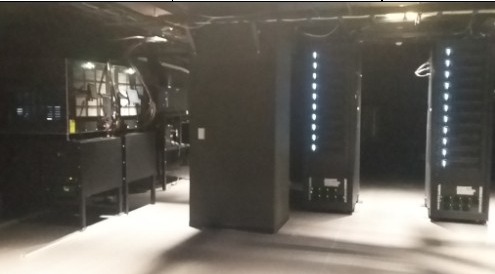
"ACTUAL PHOTO" !
Here's a photo from one of the screening rooms I work at.
Dual projectors are on the left; Laser Racks are on the right.
quote: Tyler Purcell
Also, the Dolby cinema's don't have special content made for them.
Many(but not all) major movies have specially mastered versions for Dolby
Vision. At the screening room pictured they only play DV mastered content.
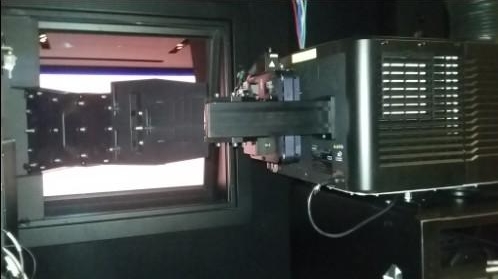
This room has a 3rd projector...a 4K Christie for
occasional non-Dolby Vision and "alternate content" use.
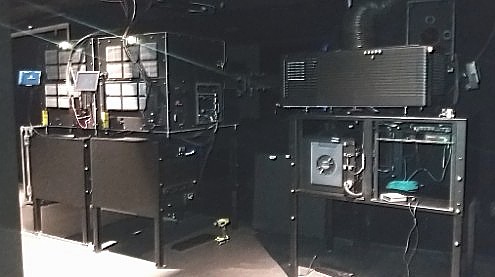
(Due to space limitations, the 4K Christe is at 90deg to the
screen,& shoots the image through a right-angle mirrorthingy)
Posted by Jarod Reddig (Member # 6363) on 02-24-2017, 01:55 PM:
I visited the closest Dolby Cinema to where I live one time. Its at the Barrywoods AMC in Kansas City and it use to be an ETX/Prime room. Ive seen many movies in that theater but only one since they changed it to a Dolby Cinema. The movie was Inside Out and from the get go I could see that it was terribly out of focus. A shame since I drove 4 hours just to see and experience the theaters makeover. Blacks were very deep and colors were almost too saturated but the focus had me fuming thru the whole feature. The audio was great tho.
I knew complaining to the kids working there would do nothing so I had sent an email into corporate. They said thanks for bringing it up and they'd look into it. No offer of refund or free passes. I have not been back since.
Powered by Infopop Corporation
UBB.classicTM
6.3.1.2