This is topic Intersting NC-900 prism problem.... in forum Digital Cinema Forum at Film-Tech Forum ARCHIVE.
To visit this topic, use this URL:
https://ft-forum.com/ft/cgi-bin/ubb/ultimatebb.cgi?ubb=get_topic;f=16;t=002755
Posted by Mark Gulbrandsen (Member # 72) on 07-18-2016, 03:26 PM:
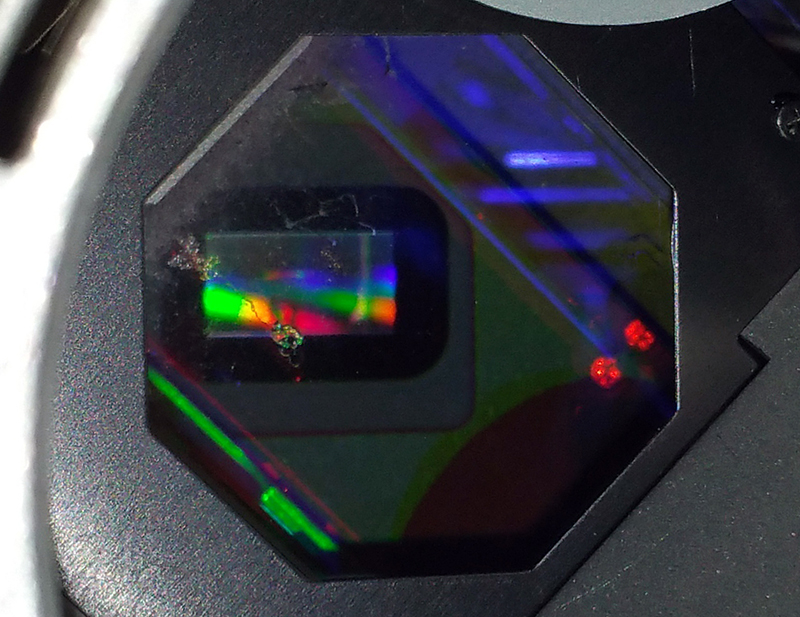
I have these pictures and confirmed via test patters that the odd shading is something to do with the red DMD only. I am guessing its separation of the red filter on the prism block.
Air filters get changed regularly and the light engine is buried pretty far inside this projector for a glob or some grease or something to get carried that far inside. Plus the green and blue are clean as a whistle. Doesn't look like DMD failure either as no stuck or misbehaving pixels at all. So I am suspecting the actual prism in this case. I will find out this coming weekend and report back.
Mark


Posted by Marco Giustini (Member # 4544) on 07-18-2016, 06:22 PM:
wait a second... are you suggesting that an NEC projector actually failed on field without notice? And the customer cannot fix the problem in 5 minutes?
Are you serious?
Posted by Mark Gulbrandsen (Member # 72) on 07-18-2016, 07:07 PM:
You got it! This is the forth legitimate failure out of 335 projectors some of which are going on seven years old. The other outright unannounced failures were a bad xenon ballast in an NC-1200, a blown ballast in an NC-900 and a failed lens driver board in an NC-900 because the factory did not route a motor wire correctly. Otherwise these things just keep running and running. I have had some white switch failures, not like that wasn't common knowledge though. Crappy German circuit breaker! We leave them all on now. Have external power switching arrangements. The GDC's have been even more reliable than this with only two media block failures in seven years. Yes, I feel like the Maytag man... All I generally do is updates (remotely at 334 of the sites) and on site image and sound checks twice yearly.
Mark
Posted by Steve Guttag (Member # 268) on 07-19-2016, 07:43 AM:
jeez Mark! That is a simple purity adjustment. Use the degaussing coil first then by adjusting flyback yolk, you should be able to get a pure red field.
Actually, dirt getting into an NC900 is VERY VERY easy. I was amazed at the training class when we dug into one just how far dirt gets into them...it gets EVERYWHERE...we pulled the light pipe and it was EVERYWHERE.
Posted by Mark Gulbrandsen (Member # 72) on 07-19-2016, 09:03 AM:
LOL! That purity thing is the first thing that came to mind! I wish it was that easy! And... we have LOTS of dirt out here in many desert places. I see a little dirt in most model NEC's mainly due to those crappy cardboard filters Wrong used to sell, but this Idaho location is not so bad. The worst place is Jackson Hole, WY where they change filters every 60 days and they buy filters by the case.
Its definitely NOT in the illumination system because the blue and green are perfect. Minor dust in the illuminating system isn't going to show up like this anyway. Its either a giant grease blob that's gotten just on to the red prism, or its the red filter separating from the prism itself. That prism also uses heat pipe type cooling and some of those are liquid filled. So it's also possible the red heat sink sprung a leak if that's the type they use. The theaters popper is exhausted outside... so it's not from that. Checking to see if Wrong even repairs these prisms or if they have to be bought outright. But I will go take a look at it before any decisions are made there...
Mark
Posted by Marco Giustini (Member # 4544) on 07-19-2016, 03:43 PM:
Are DMD's using colour filters? I though the role of the prism was to split the colours itself!
Posted by Marcel Birgelen (Member # 6801) on 07-19-2016, 04:03 PM:
3DLP is definitely not using color filters, that's one of the reasons for the increased light efficiency of 3DLP technology compared to other technology that does use color filters. But the prism itself consists of multiple components which are glued together. It's quite plausible the red component is separating itself from the rest of the block, due to a slight production error. Those things are exposed to quite some heat over time and the continuous contraction and expansion might be a factor in this.
Posted by Mark Gulbrandsen (Member # 72) on 07-19-2016, 04:32 PM:
Yes, standard DMD - Xenon systems have to... Or you'd be overlapping three monochrome images... The prism combines the colors...
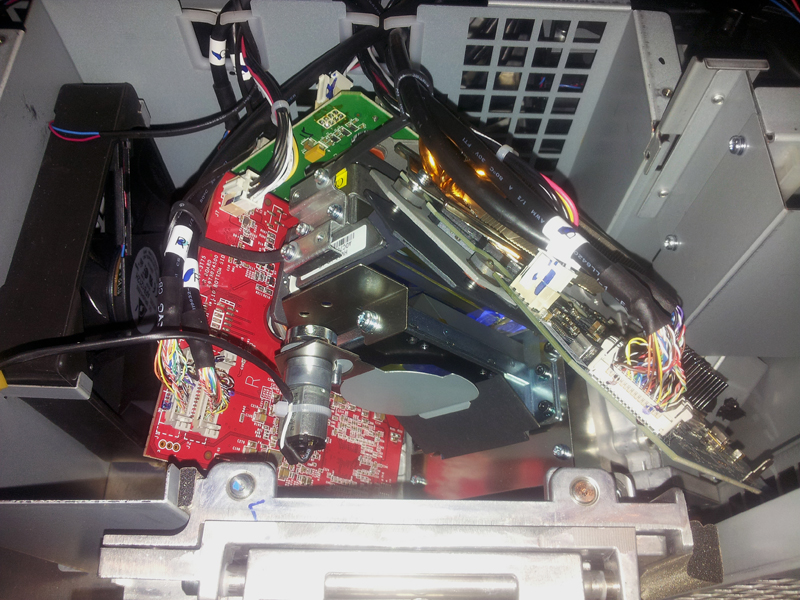
Not the suspect prism but one just like it...
Posted by Marcel Birgelen (Member # 6801) on 07-19-2016, 04:52 PM:
quote: Mark Gulbrandsen
Yes, standard DMD - Xenon systems have to... Or you'd be overlapping three monochrome images... The prism combines the colors...
Please keep in mind that a prism is a splitter and multiplexer, not a filter. A filter blocks stuff, a prism splits and combines it.
Posted by Mark Gulbrandsen (Member # 72) on 07-19-2016, 08:55 PM:
The filters are generally on one of the passive surfaces of each DMD's prism where the light entering is first filtered and then reflected off the face of the DMD. The latter is the most common way I have seen 3-DLP done with RGB filters and some other trim filters involved. Its also an additive color system.
Mark
Posted by Marco Giustini (Member # 4544) on 07-20-2016, 06:08 AM:
Mark
I'm not 100% sure on DLP but are you sure the TRIM FILTERS are there to just trim the colours and make the spectrum DCI-happy - as the notch filter does.
A prism splits white light into the full spectrum, I thought it was designed to split white light into R/G/B and onto the relative DMD's and then another prism would reassemble the picture.
Sony are doing that differently, light is indeed filtered and split into RGB - then reassembled by a prism into a single image.
I'm not sure of the above to be honest, but I've never heard of RGB filters in a DLP engine to be honest.
Posted by Kenneth Wuepper (Member # 1174) on 07-20-2016, 06:45 AM:
The use of a prism was chosen for the total internal reflection of light. The direction of the image is changed inside the prism where other methods, like the front surfaced mirror, have loss and can deteriorate the image with dust, surface defects etc..
Posted by Carsten Kurz (Member # 5396) on 07-20-2016, 07:54 AM:
A prism (combination) only can not separate colors as needed for a (white light source) 3chip projection system. It is always a combination of prisms AND some sort of color filter. The diffraction aspect of a prism is not used for color separation here.
Usually, the prism combinations used in 3Chip projectors have color selective dichroic coatings for the color separation. Wether you consider this coating part of the prism combination or call it 'prisms + color filters', is up to you.
- Carsten
Posted by Marco Giustini (Member # 4544) on 07-20-2016, 01:56 PM:
Thanks Carsten, I did not know that.
Posted by Mark Gulbrandsen (Member # 72) on 07-20-2016, 03:17 PM:
If you pull an NEC or Christie engine you can see the seperate R,G,B filters as part of each prism. The trim filters I am pretty sure are in the optical path before the engine and there may also be other trim filters or coatings to do the trimming applied to certain prism surfaces as well. There are T.I. technical papers on the web pertaining to color wheel type filters, their trim filters and such but nothing on 3-DLP.
Mark
Posted by Mark Gulbrandsen (Member # 72) on 08-07-2016, 08:29 PM:
So I finally got around to looking at this projector this morning. Looks like a booger on the prism. What it most likely is in this case is cooked insect guts.
The real pisser is that this is on the rear of the front prism. In the picture it looks like its on the front side... sadly, its not. That's how clear and passive the glass is that is used on these! There are actually five fans blowing on the light engine in this projector! This has been in over three years and already needs a cleaning. We are going to get a standby light engine to install so I can pull the front prism off this engine and attempt to clean it. It appears relatively easy to do. One side of it is for sure dowel pinned at one side, it may be at both. Until I pull it and have a closer look I won't know for sure if it's pinned at both sides. If it is then pulling that off and cleaning will be pretty easy. If there is only one dowl pin then I can use feeler gauges to get the correct clearance on the opposite side set back perfectly again.
So far no word back from manufacturers or NEC distributors as to weather they clean these or not. A replacement prism is about 8k. So developing a method to clean these safely is going to be pretty necessary.
Mark
Posted by Carsten Kurz (Member # 5396) on 08-08-2016, 06:56 AM:
Wow. How did this get in there?
- Carsten
Posted by Mark Gulbrandsen (Member # 72) on 08-08-2016, 07:08 AM:
Absolutely no idea. I'm the first one inside of this projector. Possibly a spider included during factory assembly or something...
Posted by Marco Giustini (Member # 4544) on 08-08-2016, 07:25 AM:
the problem is that you're looking into a prism, the damage could look very close but it may be anywhere in the assembly!
Posted by Carsten Kurz (Member # 5396) on 08-08-2016, 08:55 AM:
Hmm, from the photo it looks safe enough to assume it's on the front (or back) of that exit glas. I think you can assure that assumption by using different light angles onto the dirt. Anyway, it would be heart-breaking to dump this light engine without at least trying to recover it the way Marc suggests.
- Carsten
Posted by Mark Gulbrandsen (Member # 72) on 08-08-2016, 10:24 AM:
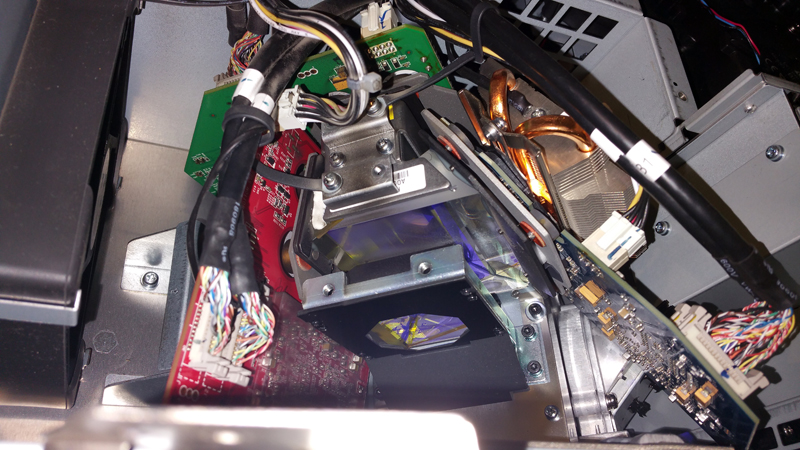
Well, fortunately the front prism (which I call the light inlet prism) is easily removable for cleaning. There are no other visible gaps between the three other prisms the DMD's are attached to. So those should stay clean except for the one combining face behind the inlet prism. The inlet prism is secured to the engine mount by four black allen screws. You can't see the lower pair but there is also a dowel pin to locate that end. Hence my thought on using feeler gauges to get the opposite end back in perfect alignment. This goober is definitely on the rear of the light inlet prism. There is only about a 1/16th inch gap between the two prisms. So more or less impossible to clean them in place.
The larger NEC prisms are very similar in construction but the rear prisms are a bit more complex. However there is like a 1/4" gap between the light inlet prism and combining prisms on those. And it is possible to clean the dust from them if done carefully. They do not get nearly as dusty though.
Converting an NC-900 to water cooling would be highly beneficial in dusty environments like I have around here.You could get rid of the compartment four fans. I'd just leave the one on top.
Posted by Carsten Kurz (Member # 5396) on 08-08-2016, 12:23 PM:
Keep us updated (pictures, pictures...)!
- Carsten
Posted by Mark Gulbrandsen (Member # 72) on 08-08-2016, 12:47 PM:
I will....
Posted by Carsten Kurz (Member # 5396) on 08-08-2016, 02:23 PM:
Did the owner/operator give any time after installation when this issue occurred?
Any info wether this 'suddenly' popped up, or developed gradually?
As far as actually insects were involved... ;-)
- Carsten
Posted by Jim Cassedy (Member # 4115) on 08-08-2016, 02:32 PM:
Great photos, Mark. [thumbsup]
I had a similar issue last year with a large non-dcp DLP Christie projector
that suddenly developed a strange colored dark 'blotch' near the corner of
the image. Shining a very bright LED flashlight through the lens, I could see
there was SOMETHING inside on either the DLP assembly or one
of the prism faces, but it was impossible to tell which one.
By sliding a thin piece of paper in & out of the mirror & prism assembly
until I saw the 'blob' disappear, I was able to determine which surface
it was on.
It turns out that the projector had been moved recently so that a wall
could be painted. Movimg it somehow dislodged a small piece of foam
rubber gasketing that was used to seal around the outside cover.
The tiny chunk of foam rubber found its' way onto one of the heat
filter surfaces and melted- - creating the on-screen botch.
Posted by Mark Gulbrandsen (Member # 72) on 08-08-2016, 02:49 PM:
That's a thought Jim....
It certainly could be a piece of debris that fell in there... Projector is just over three years old... I am just not sure that (A.) I am going to get the front prism perfectly re-aligned although I think a micrometer will work fine. And (B.) That even when I do take it apart to clean it that it's all going to come off ok and not take some of the optical coating with it. That's the main reason I am not going to mess with it till I have another light engine with me in the booth. Its not going to get any worse than it is, however they have had complaints about it so fixing it in the next 30 days is important. This is going to kind of become an experiment in partial disassembly and cleaning of the prism so I can also be able to clean other NC-900 prisms. I am very good at cleaning this stuff having learned the proper techniques and chemicals to use when I was a tech at Canon.
Mark
Powered by Infopop Corporation
UBB.classicTM
6.3.1.2