But that's the thing about their Q-SYS systems, you can literally DESIGN YOUR OWN monitoring GUI from scratch. You can put any bit of data you want on it, as advanced as you want or as simplified with green/red status. Here are a couple of basic examples, but in the end it's almost limitless.

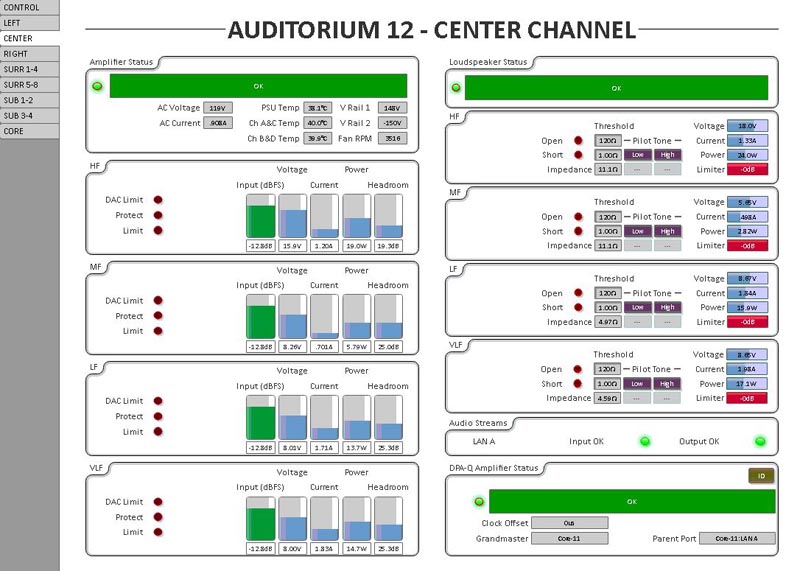
Posted by Steve Guttag (Member # 268) on 08-06-2016, 08:26 PM:
I was referring to actual user monitoring (audio). Yes, with most drag and drop DSPs, one can monitor singles at most any point on the chain.
Clearly, you've set up a bit of a GUI with that one. So do you provide touchscreens or perhaps a web gui for the end user to access the UI above or is that just for your NOC to monitor the system in case of difficulties?
Posted by Lonny Jennings (Member # 365) on 08-06-2016, 10:14 PM:
I've done a couple of projects with the QSC Core 110F now and Brad is correct: it's a fantastic piece! I do mostly specialized designs and it really is amazing how much you can do with this one very reasonable priced unit. The 110F has a large number of analog inputs and outputs; none are Dataport so you'll need to go back to the old days and actually cut and strip wires for your connections to the amps. As Brad mentioned you can create your own GUI's that can control various audio processing functions within your design or utilize the GPIO's (16 each I's and O's) to effect changes or control external events. There's a free app for smartphones that gives you control of the unit via the custom GUI's you can create. I've created a GUI page that let's me call up pink noise on any or all channels from my phone via WiFi. There's even a RS-232C port to talk to external devices and, of course, you can communicate with external devices via IP. I'll be doing a regular multiplex soon and it's utilizing Core 110F's in the Atmos houses replacing Core 500's that were used in the last build. There's plenty of processing power in the 110f for this application.
Brad: I had an idea on this subject that I'd like to suggest. How about a place on the Film-Tech website for people to post Q-Sys designs? That way people who aren't interested in getting completely up to speed could just download a design. It would probably require some understanding of the basics of the Q-Sys designer but, it might save some people a lot of time and effort. Kind of like open source software. What do you think?
Posted by Carsten Kurz (Member # 5396) on 08-07-2016, 08:03 AM:
How do you solve the most basic application of a digital cinema installation with the 110F - 8 AES channels from a media block into the Core 110F?
I am fascinated by the features of this device, but it comes with many features hardly any cinema installation needs (POTS/VOIP), but lacks important I/O like AES. Sure it can be added by using an external networked converter, but where is the real benefit for typical cinema auditoriums? You would need to beef the system up with Crestrons, external HDMI switches, audio converters, AES/SP-DIF bridges, decoders etc. I would always prefer an AP20 for typical cinema installations.
- Carsten
Posted by System Notices (Member # 2357) on 10-23-2017, 05:57 PM:
It has been 442 days since the last post.
Posted by Carsten Kurz (Member # 5396) on 10-23-2017, 05:57 PM:
QSC now launched a QSYS I/O interface dedicated to cinema applications, the DCIO/DYcIO-H. It offers AES, analog line, mic, and even HDMI with Dolby and DTS HD decoding, plus HI/VI, monitoring, some automation, through a QLAN interface to the QSYS core:
https://www.qsc.com/cinema/products/processing/qsc-processors/q-sys/network-io-peripherals/dciodcio-h/
- Carsten
Posted by Steve Guttag (Member # 268) on 10-23-2017, 07:09 PM:
That could be a game changer. I wish that they had a version of the 110f with these features though. Some systems need not be 2-box solutions.
Posted by Magnus Eriksson (Member # 6085) on 10-24-2017, 01:34 AM:
Can it do Prologic on the line input?
I know, an option from the stone age, but still useful.
/M.E.
Posted by Steve Guttag (Member # 268) on 10-24-2017, 06:02 AM:
The current QSYS has a 2:4 decoder module (only shows up in the RHP if running in cinema mode). So, yes.
Posted by Marco Giustini (Member # 4544) on 10-24-2017, 11:55 AM:
I don't understand the purpose of the HI, VI and monitor lines. Can't the I/O of a 110f be configured to do exactly the same? Wouldn't have been easier to manufacture a 111f with the AES inputs?
Posted by Carsten Kurz (Member # 5396) on 10-24-2017, 02:09 PM:
I guess they aim at having central Q-SYS cores and only remote/booth interfacing. For booth local CPs, they have their traditional cinema QSC and USL processors.
- Carsten
Posted by Marcel Birgelen (Member # 6801) on 10-24-2017, 04:01 PM:
Yeah, the concept is total centralization of your Q-Sys cores.
The major problem I have with this though, is the possible impact during an outage of such a core. They're supposed to be able to operate in redundant failover mode, but this would also require your network to be redundant to make sense. Also, I've got some bad experiences with redundant systems in the past, primarily if one of the systems ends up in a failure mode that isn't recognized as being a failure by the other one.
What I really would like to see is support for DTS:X. An affordable DTS:X "input" breakout, could really be a game changer for MDA in the cinema. It could also force Dolby to step up their game in regards to Dolby Atmos.
Posted by Marco Giustini (Member # 4544) on 10-24-2017, 04:55 PM:
I see, so this is the cinema version of an I/O frame. Interesting but I still don't like the idea of multiple auditoria running on a single core.
Posted by Carsten Kurz (Member # 5396) on 10-24-2017, 05:31 PM:
Well, most cinemas run on a single power supply line ;-)
The Q-SYS cores are used a lot in huge installations far beyond entertainment. I guess they don't expect them to fail easy. Then you can design-in redundancy..
I guess the benefit is not only in replacing x local CPs, but also many other functions. And it certainly is not for every cinema.
- Carsten
Posted by Marco Giustini (Member # 4544) on 10-25-2017, 04:33 AM:
If you lose your mains, then you lose the whole cinema. Following your logic, then there is no point in having redundant power supplies as 'you only have one mains line!"
But that is not my primary concern.
My concerns are:
1. You'll need someone familiar with QSYS to work on the sound
2. If someone is working on sound in an auditorium, you are still connecting and tweaking a system which is driving the rest of the multiplex (see point 1).
3. If you need to amend your design, you can only do that when the WHOLE cinema is not showing movies
4. (This is a little silly, ok). If you lose the Core and somehow you lose the backup, then you'll need to re-do the sound in ALL screens!
5. Some newer sound processors feature advanced auto-EQ which may achieve better/faster results than a classic EQ.
6. You can only reboot the system when all auditorium are off screen
7. To have a redundant system you need twice as many switches and network wires.
8. Indeed you can create a cool UI for it. That means you'll need some display device to connect to it. Maybe a cheap android tablet - another thing that can fail or can lose its configuration etc.
My point is: it's an interesting idea and I'd love to see that in action but how much money are we saving here and what are the advantages?
Posted by Carsten Kurz (Member # 5396) on 10-25-2017, 05:30 AM:
I am not really defending the idea of a central audio processor, your points are all valid.
I understand people find Q-SYS tempting for it's modularity and setup flexibility.
The AP20 has most of the needed flexibility, but in an easier to use package.
- Carsten
Posted by Steve Guttag (Member # 268) on 10-25-2017, 08:53 AM:
I think a cost analysis needs to be done on the centralized processor versus islands. I think there can also be some logic into doing some centralizing. Let the big auditoria run as islands and the "move-over" houses be more centralized. Or, perhaps, break a 12-plex into two groups of 6, that sort of thing.
As for updating a design affecting all cinemas...well, how often have you found you need to update a design, RIGHT NOW in a DSP system? Mind you, we are not talking about tuning, that is done on a live system anyway. We are talking about actual reconfiguring (the equivalent of rewiring a traditional system). Odds are, if there is a design flaw or update needed for a particular feature, then you'd want to do it to all of them anyway and I tend to do updates like that without anything on screen anyway.
I see the DCIO box is something that mounts right where the projector is and that is it. You have short premade CAT cables to it for audio. If Blu-ray or other HDMI source is coming in, plug it into that and a short jumper to the projector and your sound is just about done.
Put the DPA-Q amps where the speakers are so again, short wiring with the exception of a couple of CAT cables (and the DPA-Q amps are up to 8-channel now so you can knock out quite a bit with few boxes).
As for GUI (or UCI, as they call it), you have options there. For traditional booths, touchpanel, for others create a UCI that any workstation on network can access and even have one for iOS devices so you have access there too. Remember, with Q-SYS you also get a bit of an automation system too so you could really develop these UCIs to be a low-cost user interface into the booth stuff.
For small time basic 5.1/7.1, I think "canned" solutions using traditional DCinema sound processors (JSD-xx, CP750, DPM, DCP) with normal amplifiers/crossovers are going to be a cheaper collection of boxes though perhaps not necessarily the cheapest to install.
I still think QSC needs to come out with a cinema specific core to avoid the 2-part system. The two pieces put Q-SYS significantly above canned solutions. Get rid of one box and you are likely in the middle of the pack but with significantly more possibilities.
Posted by Marcel Birgelen (Member # 6801) on 10-25-2017, 03:17 PM:
I think that if the combination of a Core 110F, DCIO and a panel for their "UCI" can be had at roughly the price of an AP20, I'd prefer this solution, even in an "island per screen" setup. The only reason for an AP20 would be a screen with lots of alternate content coming in via HDMI, although you could solve that one with a remotely switchable HDMI switch (although the AP20's HDMI switch is one of the better ones out there).
Maybe another final reason for an AP20 would be the Dirac Live auto-EQ, which can save a lot of time in the initial EQ. But I guess QSC will be able to come up with some auto-EQ tool targeted at cinemas.
You can still put your DPA-Q's close to the speakers, e.g. behind or close to the screen and you can still network the Cores together for some centralized stuff like house music or emergency PAs.
Posted by Steve Guttag (Member # 268) on 10-26-2017, 06:38 AM:
I think if there is much more QSYS discussion, it really should be moved to its own thread.
I think the DCIO-H puts an end to the AP20 advantage entirely. First, which company/product do you have more confidence in being there 5-years from now? The HDMI ports on the AP20 may be good but they are also stuck in HDMI 1.4, DCIO-H is at 2.0.
QSYS will have QSC's intrinsic correction for their speakers so if your room is decently made, just how much EQing are doing?
Though more costly, you could still use a Trinnov Ovaition into a 110f if you are into that sort of processor though then you wouldn't have addressed HDMI without yet another product.
The auto-EQ thing just doesn't seem to be a factor to me on a typical 5.1/7.1 system. On Atmos (and similar) I see the advantage beyond the stage speakers so I suppose an auto-EQ is a good starting point. At the end, I always judge the stage speakers based on the human voice (male and female) and I often use non-American accent English as the final judge. If an American can understand the accent of say an Australian, it is a good sign that the sound has good dialog clarity. I've learned this from our art houses will show various European movies and it is the "English" accents that will be the most touchy. If they are in French/German, etc. it isn't an issue because there are subtitles but when it is your own language but a different accent, then the listener can be frustrated because they don't understand. Mad Max was released in the US dubbed though it was an Aussie film because they feared the accents would be too thick for the average American to easily understand.
Posted by Carsten Kurz (Member # 5396) on 10-26-2017, 07:02 AM:
The AP20 can be ordered with HDMI 2.0 switcher as well. As the RS20 shares the same hardware and HDMI 2.0 is a must in the high-end home cinema market now. The 2.0 board can be retrofitted to existing AP20 as well.
About the future of the AP20, yes, that may be a bit cloudy - although that friend of mine who ordered one back in July finally received his fully featured AP20 just yesterday.
Honestly I don't understand why QSC launched their DPM-100/H instead of making a nice Q-SYS package with some prebuilt functionality targeted towards cinema. But who knows wether the DPM-100 is actually a Q-SYS in disguise? ;-)
- Carsten
Posted by Steve Guttag (Member # 268) on 10-26-2017, 07:33 AM:
I think the DPM-100 was a means of breaking away from the DCP line, which is more akin to Basis (Cobranet based) than QSYS.
Having a canned solution that allows a fast installation like a DPM-100 makes for the most cost effective installation in a typical 5.1/7.1 cinema. You have everything you need in one box that connects with Dataport cables.
I wonder how long the DCP100 will remain. What does it have over the DPM100?
I think there would be a significant market for the DCP200/300 if they were ported over to a more Q-SYS based system. Most people don't want to "figure out" their system. They just want it to go in fast.
I'm surprised that QSC hasn't come up with templates for DCinema systems for QSYS where one can just run a "canned" template. If you want to change it, fine but if you just want to put in a DCinema based QSYS, load the template and you are off and running.
Posted by Carsten Kurz (Member # 5396) on 10-26-2017, 07:44 AM:
That's what I mean. Sell a Q-SYS with a standard 5.1/7.1 setup preconfigured for quick deployment. Add specials later based on a tested framework. Techs would see more or less the same familiar setup in most installations, but would still have the flexibility to add extras. The digital rollout is over, and it's hard to justify the development effort for a dedicated cinema processor hardware with all the flexibility we expect now. Standard hardware, custom software seems to be the better solution now. An external I/O box is not such a bad idea, as it can solve some wiring issues, and when mounted above or below a core in the rack, what's the difference to an all-in-one solution, besides some minor cost disadvantage?
It will also be much easier to cover the future object based audio systems based on a Q-SYS.
- Carsten
Posted by Steve Guttag (Member # 268) on 10-26-2017, 10:37 AM:
I don't really think that object based audio is going to go too far beyond premium houses. I've heard it and it costs a lot to get very little perceived "improvement." Furthermore, everyone ports it to the home for relatively low cost so like 4K, you don't get marquee value with it.
Posted by Carsten Kurz (Member # 5396) on 10-26-2017, 01:25 PM:
I'm not talking of marquee value, especially not when the SMPTE standard is finalized. But a Q-SYS is then the natural central building block for object based audio systems, no matter what brand/system it is.
- Carsten
Posted by Steve Guttag (Member # 268) on 10-26-2017, 01:50 PM:
Well they already have CP850 and MDA blocks in the cinema mode so I suppose you are right there. It is naturally an expandable platform.
Posted by Harold Hallikainen (Member # 5405) on 10-26-2017, 01:54 PM:
Because of the need of being an outboard media block for external rendering (required security and associated costs), I really expect most object based systems to go with internal rendering. The object based audio would be decrypted, rendered, forensically marked (all speaker feeds), in the IMB then dropped onto Ethernet based audio output like Qlan. Qsys would then handle eq, delays, other inputs, etc.
Harold
Posted by Marco Giustini (Member # 4544) on 10-27-2017, 04:35 AM:
![[Smile]](smile.gif)
![[Roll Eyes]](rolleyes.gif)