This is topic Anyone Notice the 1.85:1 Trend? in forum Digital Cinema Forum at Film-Tech Forum ARCHIVE.
To visit this topic, use this URL:
https://ft-forum.com/ft/cgi-bin/ubb/ultimatebb.cgi?ubb=get_topic;f=16;t=003053
Posted by Aron Toplitsky (Member # 6950) on 06-24-2017, 06:06 PM:
I noticed Justice League (according to IMDB and seeing the new trailer) as well as the new Transformers film, are both presented in 1.85. Are studios and filmmakers finally getting it, that our HDTVs are 16x9 and most theaters are now showing films on Common Width screens? Or is this just an artistic decision?
According to IMDB in the "aspect ratio" section it says this about the new Transformers....
1.85 : 1
1.90 : 1 (IMAX 3-D version: some scenes)
2.00 : 1 (IMAX version: some scenes)
That doesn't make a lot of sense to me. Why three different ratios if the film was entirely shot on IMAX digital cameras? I believe they also rigged two cameras to shoot simultaneously for 3D.
Posted by Stephan Shelley (Member # 8587) on 06-24-2017, 06:29 PM:
You also have more pixels with 1.85 vs scope on 2k and 4k.
Posted by Frank Cox (Member # 6258) on 06-24-2017, 07:06 PM:
I firmly believe that common width is film (or digital) done wrong.
The fact that this is different from television sets is a feature.
Posted by Carsten Kurz (Member # 5396) on 06-24-2017, 07:20 PM:
Transformers is not 1.85 - it flips between different aspect ratios throughout the movie.
You think that's an indicator they had 16:9 screens on their mind?
Really?
If I look at the list of KDMs and thus CPL names we played in the last 5 years, I see a very strong tendency towards scope. Every now and then some prominent movie shows up in flat when it was 'expected' to be a typical scope feature. That doesn't show a trend.
It's the occasional outlier.
- Carsten
Posted by Marcel Birgelen (Member # 6801) on 06-24-2017, 07:55 PM:
About a year or five ago I thought I witnessed a trend of major blockbusters starting to prefer flat as the preferred aspect ratio, but I never ran actual numbers, so it might have just been a gut feeling or some correlation without any real causation.
But I'd say if you look at the last 5 or so years, scope is still going strong and still seems to be the preferred aspect ratio for most a-list releases, especially action movies.
Somewhere during the last 5 or so years, somebody started this in-movie aspect-ratio switching stuff. Am I the only one who things this is just flat out retarded? Except for the oddball release where the aspect-ratio switching is part of the concept (think about The Grand Budapest Hotel), I think this aspect ratio switching is totally counter-intuitive. Besides breaking all the benefits of adjustable masking, for me, this constant switching breaks my focus, it's really killing to my sense of immersion.
Posted by Leo Enticknap (Member # 534) on 06-24-2017, 10:30 PM:
quote: Marcel Birgelen
Somewhere during the last 5 or so years, somebody started this in-movie aspect-ratio switching stuff.
The first movie I remember doing this was The Horse Whisperer, and that was about 20 years ago. It changed from 1.85 to 'scope about an hour in to a three-hour movie. The prints were anamorphic with the first two or three reels pillarboxed, though. I have a dim recollection that the change happened on a reel change, but may be wrong about that. I remember having to be there to change the masking at the right moment, though. At the time I was working in a place that ran most features from a platter, but had absolutely no automation of any description.
Posted by Brad Miller (Member # 2) on 06-24-2017, 11:42 PM:
Horse Whisperer reel 1 was pillarboxed to 1.85
Reel 2 and onward were full scope.
There was no scene change at the reel change. It was just a camera change mid-scene. About as retarded as all of this IMAX nonsense going on with multiple aspect ratios.
Posted by Carsten Kurz (Member # 5396) on 06-25-2017, 06:50 AM:
A lot of that bs is actually only happening nowadays because IMAX is trying to sell 'their' aspect ratio.
- Carsten
Posted by Geoff Jones (Member # 3668) on 06-25-2017, 09:07 AM:
quote: Marcel Birgelen
Somewhere during the last 5 or so years, somebody started this in-movie aspect-ratio switching stuff.
Superman (1978) and The Road Warrior (1979) both opened with 1.33:1 prologues which transitioned to scope.
Galaxy Quest (1999) introduces the "Galaxy Quest" TV show in 1.33:1, then transitions to 1.85:1 for the "Real World," then transitions to scope when the characters realize that they are in outer space.
In Brother Bear (2003), when Kenai becomes a bear, the film transitions from 1.85:1 to scope.
Enchanted (2007) switches from 1.85:1 to scope when the film transitions from animation to live action.
Posted by Marcel Birgelen (Member # 6801) on 06-25-2017, 09:56 AM:
Yeah, I was somehow waiting for the Mad Max 2 (1981 if I remember correctly) intro/prologue to appear or the one of Superman. ![[Smile]](smile.gif)
Those 5 years were not an absolute number by any means, it's more like an indicator of what I think is a period in where we've seen an uptake of this aspect-ratio switcheroo, to a point where I think, it's becoming ridiculous.
I remember watching movies like The Dark Knight and The Dark Knight Rises in both 70mm and 2K digital IMAX and I found this aspect-ratio switching pretty disturbing, especially in 70mm IMAX presentations where you went from a narrow-banded image to a full-screen monster image every now and then. Every time the image switched back to "narrow vision", it felt like you're now watching the unimportant discount scenes.
There are other more recent examples, like The Wolf of Wall Street, which opened on a "flat" fake commercial, while the entire rest was in scope.
There's also the first Alice in Wonderland or Tron: Legacy, that switched from non-stereosopic images for the "real" world to stereoscopic 3D for the "alternate world" scenes.
I think Leo is right on "The Horse Whisperer" (1998) though, it is probably the first movie to do a "prolonged aspect ratio switch", so not just for a few seconds of narrative or for exposition purposes like a fake commercial, infomercial or information video.
quote: Leo Enticknap
I remember having to be there to change the masking at the right moment, though. At the time I was working in a place that ran most features from a platter, but had absolutely no automation of any description.
I guess you're probably the only one who ever bothered adapting it "in flight". It also often comes at a price, since most movable masking systems aren't entirely silent. So, you could argue that "remasking" an already running movie only adds to the distraction.
quote: Carsten Kurz
A lot of that bs is actually only happening nowadays because IMAX is trying to sell 'their' aspect ratio.
Ah, it's *their* aspect ratio.
*Their* aspect ratio is also a pretty ambiguous concept when it comes to IMAX.
Is it 1.43, like their classic 70mm builds?
Or is it 1.85, like which is closest to most of their current installs?
Or is it 2.35, like what most DMR-secret-sauced movies still end up in, due to the lack of any "special IMAX content"?
Or is it all of the above? Because that's what you basically can expect when going to watch an IMAX special feature. If you're "lucky", you'll get them all in one single show.
Posted by Michael Coate (Member # 757) on 06-25-2017, 12:42 PM:
I think the best example of this "in-movie aspect-ratio switching stuff" (and I'm surprised no one has yet mentioned it) is Doug Trumbull's "Brainstorm" (1983).
Posted by Carsten Kurz (Member # 5396) on 06-25-2017, 02:10 PM:
Life of Pi also has some. Not nearly as stupid as in Transformers 5, though.
- Carsten
Posted by Mark Lensenmayer (Member # 134) on 06-25-2017, 03:19 PM:
More American Graffiti -- 3 stories -- 3 aspect ratios
Posted by Daniel Schulz (Member # 1881) on 06-25-2017, 03:26 PM:
quote:
Ah, it's *their* aspect ratio. [Smile]
*Their* aspect ratio is also a pretty ambiguous concept when it comes to IMAX.
Is it 1.43, like their classic 70mm builds?
Or is it 1.85, like which is closest to most of their current installs?
Or is it 2.35, like what most DMR-secret-sauced movies still end up in, due to the lack of any "special IMAX content"?
Or is it all of the above? Because that's what you basically can expect when going to watch an IMAX special feature. If you're "lucky", you'll get them all in one single show.
I think what IMAX is pushing these days is a 1.9:1 AR, which is just the full-container image of a DLP chip. They had a whole marketing campaign for Sully and also for Beauty and the Beast which showed you the picture you were missing out on if you saw those movies at 2.35 in a non-IMAX theater. Which of course is silly, if the filmmakers wanted you to see a taller image they could have framed for 1.85 and released a flat DCP.
The only justifiable variable AR I can think of (apart from things like Grand Budapest Hotel) is Christopher Nolan, because he wanted to use 15/70mm IMAX film for both image acquisition and projection, but for practical reasons can't film the *whole* movie with IMAX cameras. So the native IMAX 70mm footage is 1.43, and everything else is 2.35.
Posted by Bobby Henderson (Member # 840) on 06-25-2017, 03:29 PM:
quote: Aron Toplitsky
I noticed Justice League (according to IMDB and seeing the new trailer) as well as the new Transformers film, are both presented in 1.85. Are studios and filmmakers finally getting it, that our HDTVs are 16x9 and most theaters are now showing films on Common Width screens? Or is this just an artistic decision?
This hardly establishes any sort of trend. From what I can tell, the 'scope aspect ratio is still by far the most popular for movie releases. The dominance of 'scope doesn't look like it's going to wane any time soon. I have my own theories why the 'scope ratio is more popular. One is that it's a money thing; there are fewer pixels to render with 'scope. In digital 'scope is the lowest resolution format. The optical effects of anamorphic lenses are very popular and make any feature production look more like a movie rather than just a TV show (although a growing number of TV shows are using anamorphic lenses on their cameras).
Justice League could be yet another experiment to give favor to premium priced screens (like IMAX, Dolby Cinema, etc.) Nearly all of those premium screens are common width and in some kind of flat 1.9:1 or 1.85:1 ratio.
Looking at the first trailer for Justice League, the movie looks like it was specifically composed for the 1.85:1 ratio. I doubt Warner Bros. will try to do what Sony did with the James Bond Skyfall release. The movie was shot in flat format with IMAX Digital screens in mind, but a 2.39:1 extraction was made for standard priced theaters.
Posted by Frank Angel (Member # 248) on 06-25-2017, 03:39 PM:
WOODSTOCK opens with pre-title exposition in a pillared 1.37 image in 2.35 anamorphic. If my memory serves, that segment ran about 10min half a reel, and then there was a slow fade-out with a faded-in to full scope. quote: Marcel Birgelen
I think Leo is right on "The Horse Whisperer" (1998) though, it is probably the first movie to do a "prolonged aspect ratio switch", so not just for a few seconds of narrative or for exposition purposes like a fake commercial, infomercial or information video.
So certainly THE HORSE WHISPERER wasn't the first.
We actually used a masking move cue for that AR change in R1. Not only did the mask changed, but because our curtain had different stops for 1.85 and 1.37, not only did the mask widen to full scope, but so did the curtain. It also should be mentioned that the prologue in 1.37 was in center channel mono, then at the change to scope, sound changed to full surround stereo. Since that change is at a specific point/pause in the "running movie" with picture and sound changing, I don't think using a mask change (and in our case, the curtain as well) was a distraction but it actually was very dramatic. It worked so well that we did it every time we booked that classic R&R documentary (at least 4 engagements over the years).
Posted by Martin McCaffery (Member # 37) on 06-25-2017, 03:50 PM:
Maybe I'm just remembering trailers, but didn't a Cinerama movie do the 1.37 AR to Cinerama routine?
Posted by Carsten Kurz (Member # 5396) on 06-25-2017, 04:05 PM:
There are many explicit demonstrations of wide screen or super widescreen starting from narrower formats. But that makes explicit sense to demonstrate the super wide formats. This is far from being the nonsense we see in Transformers 5 or other IMAX-Promo infected flics.
- Carsten
Posted by Marcel Birgelen (Member # 6801) on 06-25-2017, 04:55 PM:
quote: Michael Coate
I think the best example of this "in-movie aspect-ratio switching stuff" (and I'm surprised no one has yet mentioned it) is Doug Trumbull's "Brainstorm" (1983).
Thanks, I totally forgot about that somewhat underrated movie. But indeed, it constantly switches between 1.85 and 2.35 if I remember correctly, even within the same scene.
quote: Daniel Schulz
I think what IMAX is pushing these days is a 1.9:1 AR, which is just the full-container image of a DLP chip. They had a whole marketing campaign for Sully and also for Beauty and the Beast which showed you the picture you were missing out on if you saw those movies at 2.35 in a non-IMAX theater. Which of course is silly, if the filmmakers wanted you to see a taller image they could have framed for 1.85 and released a flat DCP.
I totally agree, especially when the whole movie is in 1.9, it makes no sense not to release it as a flat DCP for normal releases or if you filmed it in such way that it can be framed in both 2.35 and 1.85 or 1.9, release both formats and let exhibitors choose what format they want to present.
I'm wondering though, if there are any recent Digital IMAX releases that use 1.43, because their retrofitted laser sites should technically be able to show them with their anamorphic setup.
quote: Frank Angel
So certainly THE HORSE WHISPERER wasn't the first.
Brainstorm also predates The Horse Whisperer, so it already had to trade in first place.
I'd say Woodstock's non-scope content falls into the "info" / "exposition" category, although full 10 minutes makes it a doubtful case. ![[Wink]](wink.gif)
quote: Martin McCaffery
Maybe I'm just remembering trailers, but didn't a Cinerama movie do the 1.37 AR to Cinerama routine?
Well, maybe we should indeed classify this under the "Trying to blow your mind" category, or the "Showoff" category.
Disneyland Paris also had a show in their studios park, based on a 70mm movie that actively used AR switch-overs as part of the concept. It was called Cinemagique and only recently closed. I don't think those specialty cases, like attraction movies, should really count though.
quote: Carsten Kurz
There are many explicit demonstrations of wide screen or super widescreen starting from narrower formats. But that makes explicit sense to demonstrate the super wide formats. This is far from being the nonsense we see in Transformers 5 or other IMAX-Promo infected flics.
I didn't see the latest Transformers movie yet and also I somehow don't feel tempted to do so, neither for fun, nor for work actually. The previous movie didn't do any of this aspect ratio flipping in the normal DCP, it might have done so in the Digital IMAX release. Are you saying this movie also has changing aspect ratios in the regular DCP release?
Posted by Kenneth Wuepper (Member # 1174) on 06-25-2017, 05:07 PM:
Back in the "dark ages" of epic films, C B Demille made the introduction to the 10 Commandments in flat 1:37 in an otherwise scope picture. We used the grand curtain to track the opening of the curtains in the film as the audience gasped.
I also remember that he told the length of the film followed by, "there will be an intermission".
Well placed format change indeed.
Our first projectionists told of how they used the next shorter focal length lens to make the last reel of the silents appear bigger on the screen. ![[Big Grin]](biggrin.gif)
Posted by Sascha F. Roll (Member # 9043) on 06-25-2017, 05:26 PM:
The 2010 movie "BIUTUFUL" by Alejandro González Iñárritu also has an A.R. change. The first 10-15 (?) minutes were 1.85 compressed in the Scope 2.39 35mm print.
One of the "recent" famous examples of a very obvious A.R. change is the change from the square 1:1 A.R. to 1.85:1 in Xavier Dolan's "MOMMY" (1:53 min in the video):
https://www.youtube.com/watch?v=PoFM4pWCAg0
Posted by Frank Angel (Member # 248) on 06-25-2017, 06:23 PM:
Martin, you are correct -- the first Cinerama film (THIS IS CINERAMA) did have a center screen intro with Lowell Thomas explaining what this new Cinerama process was all about. It was in black and white and it ended with him uttering the famous, dramatic line, "Ladies and gentlemen, THIS (dramatic pause) is Cinerama." And then the curtains kept opening and opening to reveal the deeply curved, widest, largest screen audiences had ever seen. It was quite impressive. I was lucky enough to see it as a kid and there is no question that it took your breath away.
The system also had fifth projector that was loaded with the "break-down film -- a pseudo-documentary explaining the complexity of the process. This was in ready to be able to be played should the show had to be stopped due to malfunction. It would run while the projectionists were resetting the projectors and magfilm dubber so the show could be restarted. I read somewhere that Cinerama had beak-downs in 1 out of every 11 shows, hence it made sense to have something to play for the audience during a shutdown.
I don't know if the opening Lowell Thomas b&w intro section was spliced into the actual first reel of the film in the center ("Baker") projector with Abel and Charlie projectors just running black leader, or if it ran on the breakdown projector.
"This is Cinerama" - (from the video release trailer)
Posted by Carsten Kurz (Member # 5396) on 06-25-2017, 08:26 PM:
quote: Marcel Birgelen
I didn't see the latest Transformers movie yet and also I somehow don't feel tempted to do so, neither for fun, nor for work actually. The previous movie didn't do any of this aspect ratio flipping in the normal DCP, it might have done so in the Digital IMAX release. Are you saying this movie also has changing aspect ratios in the regular DCP release?
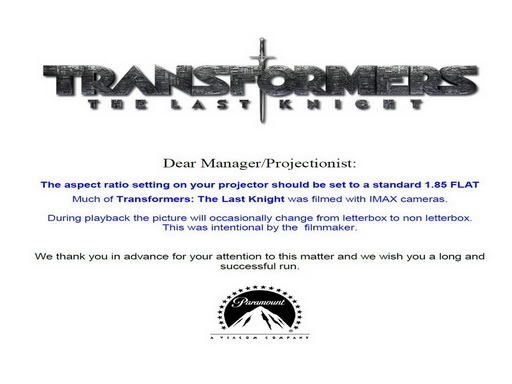
'Dear Manager/Projectionist:
The aspect ratio setting on your projector should be set to a standard 1.85 FLAT
Much of Transformers: The Last Knight was filmed with IMAX cameras.
During playback the picture will occasionally change from letterbox to non letterbox.
This was intentional by the filmmaker.'
- Carsten
Posted by Mike Blakesley (Member # 26) on 06-25-2017, 09:40 PM:
Regarding "Brainstorm"...
quote: Marcel Birgelen
Thanks, I totally forgot about that somewhat underrated movie. But indeed, it constantly switches between 1.85 and 2.35 if I remember correctly, even within the same scene.
The 1.85 picture is used when the action is in "real life," and whenever a character is experiencing a "recording," the picture switches to 2.35. So while it does happen within scenes, at least in this case the intent makes sense.
Posted by Steve Guttag (Member # 268) on 06-26-2017, 05:39 AM:
The Road Warrior started off narrow to tell the pre-story ("Mad Max") and then transitioned to Scope for the remainder of the movie.
Posted by Marcel Birgelen (Member # 6801) on 06-26-2017, 07:14 AM:
quote: Carsten Kurz
Much of Transformers: The Last Knight was filmed with IMAX cameras.
During playback the picture will occasionally change from letterbox to non letterbox.
This was intentional by the filmmaker.
They make it sound like the letterboxing is the result of the "IMAX" footage...
A movie in "flat" on an "unmasked" scope-sized screen and the movie itself containing many letterboxed scenes must really look totally stupid. Like watching a bunch of cheap TV commercials, where nobody cared to frame them somewhat correctly.
quote: Mike Blakesley
The 1.85 picture is used when the action is in "real life," and whenever a character is experiencing a "recording," the picture switches to 2.35. So while it does happen within scenes, at least in this case the intent makes sense.
It's been really quite a while since I've last seen this movie, but the discussion about it at least stirred the interest to watch it again shortly.
I don't remember being annoyed by the constant AR switchovers. I guess, it is also because it does make sense, since it indeed happens between the "real" and "recorded" world.
So, I guess it's like with most other things. If it somehow makes sense, you're probably not so easily annoyed with it. This AR switching is probably no exception, at least not for me.
I remember watching the "IMAX BluRay" version of the Dark Knight Rises (the IMAX scenes are in 1.78 and not in their native 1.43) with friends and at least two of the five people we were watching the show with, kept complaining about the fact that the image kept changing in size and I wasn't one of those two.
Usually, I don't hear anybody complain about "geeky stuff" like aspect ratios. With friends, it's usually like: Yeah, you're the only one even noticing what aspect ratio it is in.
Posted by Mitchell Dvoskin (Member # 751) on 06-26-2017, 09:27 AM:
The first film that I am aware of to purposely change aspect ratios for artistic purposes in Napoleon (1927), that opens up to multi-projector 4.0:1 for the final battle.
In answer to Frank's question, when I saw This Is Cinerama at the New Neon Movies in Dayton when they were running their Cinerama festival they gave tours though the booths, and explained how the process worked. The prologue is indeed part of the first reel, with black leader on the 2 side reels.
Cinerama Holiday also had a B&W 1.33 prologue.
The Girl Can't Help It (1956 scope) opens pillar boxed to 1.37, and then opens up to full CinemaScope.
The changing AR in Brainstorm annoyed me then, as it annoys me now.
Posted by Allan Young (Member # 6332) on 06-27-2017, 10:47 AM:
quote: Mitchell Dvoskin
The changing AR in Brainstorm annoyed me then, as it annoys me now.
It was quite effective in 70mm though, as it's not just switching aspect ratio but also from 35mm blow-up to actual 65mm footage.
Posted by Mike Blakesley (Member # 26) on 06-27-2017, 11:56 AM:
It'd be interesting to interview a Transformers audience at exit and see if they noticed the picture changing shape all the time. Most of them would probably just say "I didn't notice that, I just noticed how my ears were bleeding."
Posted by Joseph L. Kleiman (Member # 3097) on 06-27-2017, 02:23 PM:
Joss Whedon had been advising Snyder on filming an ensemble supehero film and has since taken up direction duties on Justice League after Snyder removed himself following the unfortunate suicide of his daughter a few months ago. Whedon filmed both Avengers films in 1.85 and recommended it for this film as well.
Posted by Mike Blakesley (Member # 26) on 06-27-2017, 03:39 PM:
I do have to admit, in all my years of watching movies I don't think I've ever thought to myself, wow I wish this picture was wider! (or narrower). The filmmaker composes to the frame he's using and that's it.
I DO remember a sci-fi movie ("Passengers" I think) that was partly filmed with Imax cameras and seemed like the picture was too tall for the scope frame at times.
Posted by Martin McCaffery (Member # 37) on 06-27-2017, 03:44 PM:
On the other hand, I sit through so many movies wondering what possible reason they had to shoot this in scope, especially in the days where they would shoot things to be safe within the TV frame. (Looking at you Brett Ratner).
If your not going to use the sides, then don't use scope. I have to admit though for 3/4's of A Quiet Passion it bothered the hell out of me that it was in scope, but then it all made sense in the end.
Posted by Marcel Birgelen (Member # 6801) on 06-27-2017, 07:55 PM:
quote: Joseph L. Kleiman
Whedon filmed both Avengers films in 1.85 and recommended it for this film as well.
I’m 99,9% positive the second Avengers movie was released in 2.35.
quote: Mike Blakesley
I DO remember a sci-fi movie ("Passengers" I think) that was partly filmed with Imax cameras and seemed like the picture was too tall for the scope frame at times.
Which is somewhat strange, because there was no “IMAX aspect ratio” release. The cameras they used were Arri Alexa 65, which are 6K cameras with a full size 65mm CMOS sensor. IMAX has taken this camera and slapped an IMAX logo on them, together with some “secret sauce”, whatever it may be. But the IMAX version of this camera also wasn’t used for the production of Passengers (2016).
The native aspect ratio of those cameras is 2.11, so it’s both suitable for 4K acquisition in both scope and flat, without losing resolution or without the explicit need for anamorphic lenses.
So, the conclusion must be: The cinematographer was drunk.
Posted by Mike Blakesley (Member # 26) on 06-28-2017, 12:02 AM:
It may have been some other movie than Passengers, I'm not sure. I remember making a comment in a review on this forum. The movie I was talking about definitely had an Imax release and they made a big deal out of shooting it on Imax cameras.
Posted by Marcel Birgelen (Member # 6801) on 06-28-2017, 03:58 AM:
I think you're referring to The Beauty and the Beast, which was in 1.90 for IMAX and 2.35 for everybody else. And while not really a sci-fi movie, I do think you have a point there.
Also, I think it is pretty hard to correctly shoot a movie in an "open matte" like way, it requires top-notch cinematography to get it right and it certainly doesn't work with every movie equally well.
Posted by Mike Blakesley (Member # 26) on 06-28-2017, 12:46 PM:
quote: Marcel Birgelen
I think you're referring to The Beauty and the Beast, which was in 1.90 for IMAX and 2.35 for everybody else. And while not really a sci-fi movie, I do think you have a point there.
You're right, that was it... here's the comment I made:
quote:
The only part of the movie that sort of bugged me was the framing of it...I kept on feeling that the picture was sort of crammed into the frame, and then it hit me...this movie was made for Imax type squarish screens. The effect was most noticeable during a couple of the musical numbers. Dammit, Disney, the vast majority of people will see your movies on regular theater screens now, and TV-shaped screens later....why not make the movie for the format most people will see it in?
I just got my films mixed up...the perils of getting older, I guess.
Posted by Joseph L. Kleiman (Member # 3097) on 06-28-2017, 02:13 PM:
quote: Marcel Birgelen
I’m 99,9% positive the second Avengers movie was released in 2.35
You're correct. It was Ant-Man, which came out two months later, that was 1.85
Posted by Rick Raskin (Member # 1561) on 06-28-2017, 02:26 PM:
The 1956 "Around the World in 80 Days" had a prequel of Georges Melies "Trip to the Moon" followed by a then modern Atlas rocket launch which opened to scope AR. Trailer
Posted by Aron Toplitsky (Member # 6950) on 06-28-2017, 05:37 PM:
Thank you all for responding. I must say, I'm a bit disturbed! I just finished watching a movie at an Arclight theater, then decided to poke my head in on a 2D showing of Transformers and the aspect ratios were constantly changing. Now it's one thing for the changes to happen like in Dark Knight and Dark Knight Rises, but this was just so distracting and horrendous! I saw three different aspect ratio changes during scenes of dialogue, and within the same scene, like from cut to cut. There is no way I could sit through something like that!
Posted by Monte L Fullmer (Member # 2797) on 06-28-2017, 06:49 PM:
When you think of it, you can see why the trend to do 1.85 for the simple fact to rid of the "band-aid" image in the middle of the screen with this new trend of no-masking screens installs.
Go 1.85 and you're using the entire screen and people feel that they're getting their entertainment monies worth instead of that "cropped image" when presenting wide screen features.
Posted by Steve Kraus (Member # 476) on 06-29-2017, 12:41 AM:
I run a screening room. My last four screenings:
F-20 (2.00 : 1)
F-166 (1.66 : 1)
no format indicator but it was 1.78 : 1
S-276 (2.76 : 1)
Posted by Daniel Schulz (Member # 1881) on 06-29-2017, 02:17 AM:
quote: Monte L Fullmer
When you think of it, you can see why the trend to do 1.85 for the simple fact to rid of the "band-aid" image in the middle of the screen with this new trend of no-masking screens installs.
Go 1.85 and you're using the entire screen and people feel that they're getting their entertainment monies worth instead of that "cropped image" when presenting wide screen features.
Except *most* big box office draw films are 'Scope (the occasional IMAX or Avengers movie excepted). A 1.85 screen with no masking is the worst of all worlds, because then the majority of your films are being projected simply letterboxed; it's no better than a giant TV! In an era when cinemas are worried about being displaced by ever-improving home theater technologies, I should think they should be focusing on doing the one thing that home theater *can't* do, which is widescreen projection!
Posted by Marcel Birgelen (Member # 6801) on 06-29-2017, 06:40 AM:
quote: Joseph L. Kleiman
You're correct. It was Ant-Man, which came out two months later, that was 1.85
The reason why I still quite vividly remember is, because I disliked the choice for 1.85 for the first Avengers movie. Also, 2.35 seemed to be the de-facto standard for all other "second generation" Marvel releases up until that moment. So, the choice struck me as particular odd. I expected the sequel to keep in line and also be in 1.85, but I was surprised to find out it was in 2.35. And although I didn't really like that particular movie, I think at least the aspect ratio was a better match than it was for the prequel.
quote: Steve Kraus
I run a screening room. My last four screenings:
F-20 (2.00 : 1)
F-166 (1.66 : 1)
no format indicator but it was 1.78 : 1
S-276 (2.76 : 1)
Yeah, well, if I'd keep a list on the aspect ratios I've been screening, then scope currently isn't winning.
But like others, including Daniel, I don't see a continuing trend for 1.85 for big budget releases, besides the oddball release targeted at IMAX.
I think the idea of "wide screen" and movies is pretty much engrained in the mind of many people, just like the somewhat stuttering experience of looking at 24 frames per second. Take this away, and a bit of the movie magic dies with it.
Also, I agree with Daniel on this one. In the continuing battle to capture the audience, the industry should focus on experiences they cannot get at home. Wide screen done right is one of those things.
Posted by Carsten Kurz (Member # 5396) on 06-29-2017, 06:56 AM:
Our recent screenings:
BAYWATCH_FTR-3_S
ConniundCo2_FTR-1_S (german teenager comedy)
ROCKY-HORROR_FTR_F
DENIAL_FTR-2_S (britisch drama)
POTCDeadMenTel_FTR-1-2D_S
GoingInStyle_FTR-1_S
LOMMBOCK_FTR-1_S (german comedy)
BeautifulFantastic_FTR-1_S
BlindDate_FTR-1_S (german drama)
ZuGuterLetzt_FTR_S ('The last word')
AlienCovenant_FTR_S
Paula_FTR-1_S (german drama)
GetOut_FTR-1_S
SmurfsLostVill_FTR-2D_F
DjungeKarlMarx_FTR-2_S
GuardiansGala2_FTR-1-2D_S
Elle_FTR_S
AUnitedKingdom_FTR_S
Moonlight_FTR_S
BibiUndTina4_FTR-1_S (german kids comedy)
FastFurious8_FTR-4-ROW_S
DogsPurpose_FTR-1_S
GITS_FTR-2D_F (Ghost in the shell)
T2_Trainspotti_FTR_F
BossBaby_FTR-2D_S
DenSternSoNah_FTR_S (The space between us)
HellOrHighWate_FTR-1_S
LegoBatman_FTR-2D_S
BeautyBeast2017_FTR-1-2D_S
HacksawRidge_FTR_S
Split_FTR-2_S
Logan_FTR_S
...
Now, how many S in that list, and how many F?
I'd go as far to say that all block buster features in flat are IMAX infested...
As blockbusters in flat are so rare, they sure get special attention by TV fans. But attention doesn't necessarily signal a trend. Just the odd exception.
- Carsten
Posted by Leo Enticknap (Member # 534) on 06-29-2017, 08:05 AM:
quote: Steve Kraus
I run a screening room. My last four screenings:
F-20 (2.00 : 1)
F-166 (1.66 : 1)
no format indicator but it was 1.78 : 1
S-276 (2.76 : 1)
I projected a show at which Wes Anderson did a Q & A, and someone asked him why he used multiple aspect ratios in The Grand Budapest Hotel. He replied that he had long wanted to use the device, but didn't feel it was practically possible if the main theatrical release medium was 35mm, because either some shots would be cropped, or some would look unacceptably small on common width or commmon height screens. This puzzled me somewhat, because the same problem exists with digital, unless you make lens zoom and masking adjustments during the show. As I recall, the DCP had a flat container, and with the 'scope scenes letterboxed and the 1.37 scenes (probably around 90% of the footage) pillarboxed.
But it does appear that digital projection has got some movie makers into the mindset that the use of ratios other than 1.85 and 'scope is now a viable artistic choice, and one that can be made without the risk of unwanted cropping in the theater (assuming that a pillarbox or letterbox is acceptable).
quote: Marcel Birgelen
I guess you're probably the only one who ever bothered adapting it "in flight". It also often comes at a price, since most movable masking systems aren't entirely silent. So, you could argue that "remasking" an already running movie only adds to the distraction.
This place was an arthouse, and when we tried setting the masking to 'scope at the start of the film, customers were coming out and complaining that we'd set it incorrectly. My memory is indistinct (The Horse Whisperer was an overlong, pretentious and easily forgettable pic - indeed, my only vivid memory of that week was building the print up and discovering that a previous projectionist had placed a label on the end of the last reel, to identify the print in its built up configuration, which read, simply, "HORSE SHAGGER" - and this was two decades ago), but as I recall, there was a music cue over the AR change that would have covered any masking noise.
Posted by Steve Kraus (Member # 476) on 06-29-2017, 10:32 AM:
I spoke too soon. I have one right now which is curiously labeled F-C. Apparently that means 1.37 within 1.85 but with rounded corners, at least that's what I've got on screen. We're common height so easy to just bring in the side masking.
Posted by Pietro Clarici (Member # 4937) on 06-29-2017, 11:50 AM:
quote: Monte L Fullmer
Go 1.85 and you're using the entire screen and people feel that they're getting their entertainment monies worth instead of that "cropped image" when presenting wide screen features.
I've always wondered about that, but never found official data: PLF aside, is Flat the most common screen format in US theatres? Are they getting a revival now, because it's easy and cheap to pair a 1.9:1 unmasked screen with a DCI projector and call it a day?
Posted by Marcel Birgelen (Member # 6801) on 06-29-2017, 02:13 PM:
I think Carsten pretty much proved that Scope is still the most common format for mainstream releases. Although there can be a difference between aspect ratios between "formats" (e.g. IMAX v.s. vanilla DCI), there's not yet such a distinction between territories.
Even if you subtract the German territorial releases from the list, Scope is still pretty much leading.
Posted by Jim Cassedy (Member # 4115) on 06-29-2017, 02:29 PM:
quote: Steve Kraus
I have one right now which is curiously labeled F-C. Apparently that means 1.37
within 1.85 but with rounded corners, at least that's what I've got on screen.
That sounds like the same flick I did a press screening of the other day.
I had been warned by the someone from the studio about the 'off' aspect
ratio and rounded corners in advance. But I noticed that the movie was
also mostly shot with very 'low key' lighting. So much so that I double
checked the projector before the clients arrived to make sure there was
nothing wrong with the projector.
(Which there shouldn't have been since it had gotten a new bulb and
complete calibration a little more than a month ago)
Posted by Monte L Fullmer (Member # 2797) on 06-29-2017, 04:09 PM:
quote:
I should think they should be focusing on doing the one thing that home theater *can't* do, which is widescreen projection!
If push comes to shove, Need to go back to 140* curved screen with 2.77:1 ratios and get widescreen images on these screens.
Home Cinema won't touch this for a few generation.
But, the next thing coming out is the LED panel screens where no projector is needed that could chase this ahead of the cinema since panels could possibly be made with a curve for home cinema.
But, as before - people want to be entertained-to escape the real world-and are willing to leave their homes for this attribute.
This is the only factor that could save the industry.
Posted by Annli Com (Member # 8266) on 06-30-2017, 11:17 PM:
T5 Release Note.
Posted by William Kucharski (Member # 7246) on 07-05-2017, 10:32 PM:
quote: Mike Blakesley
Most of them would probably just say "I didn't notice that, I just noticed how my ears were bleeding."
Only if they were at one of the two or three theaters left in the country that still plays movies at their proper volume.
At most these days it's hard to hear the dialog over the popcorn crunching and rusting snack wrappers. ![[Frown]](frown.gif)
Posted by Bobby Henderson (Member # 840) on 07-06-2017, 12:06 AM:
I'll echo that response. About the only time I hear noticeably loud volume in movie theaters these days is when I pay extra to watch the movie in an IMAX-branded auditorium or some other kind of premium theater. If I watch the movie in a normal priced theater I can pretty much expect to hear the movie played at TV speakers volume -front stage speakers only, with the surround speakers and sub-bass enclosures damned near silent.
This past weekend my girlfriend and I watched Alien: Covenant at the old, former Carmike 8 here in Lawton. It's the first time I've visited this theater in at least a couple years and the first time I visited since AMC took ownership of it. Damn, they're running the place on the cheap. There's no mylars for the movie title signs; just generic AMC Classic stuff put into every sign container. Previously the auditoriums weren't numbered visually (since the movie title mylars did the job). So they had somebody go to the hardware store and buy numbers meant for mailboxes and front porches to screw into the walls. They had only one staff person working in the lobby and no managers in view anywhere. This staff lady might have been the only crew person in the building for all we knew. As for presentation quality, the projected image was decent, but the audio felt like I was watching this movie on HBO at home with only the TV speakers running. Surrounds were barely there at all. But I guess this is what I'm supposed to expect at what is now a bargain theater. The trouble is I know how well that particular auditorium sounded previously. So it leaves me a little pissed off.
I guess the business model for commercial movie theaters these days is to only deliver "good" surround sound when the customers are paying close to $20 per ticket for it.
Posted by Mark Campbell (Member # 4411) on 07-06-2017, 02:52 PM:
Back to Brainstorm: I never saw it in the theater but I imagine for 35mm it was projected in scope with the "real life" 1.85 scenes pillar boxed in the scope image. Thus the dream world expanding to the sides making the image larger.
I watched it a few years back either on DVD or Laserdisc. For that transfer way it was done was reversed from theatrical. On the TV their 1.85 image was letterboxes on TV screen as usual and the scope/65mm image was letterboxed even further. So a common width screen experience making the dream world "smaller" and reversing the intentions of the filmmakers.
Anyone seen a transfer done "properly" like the theatrical version?
Posted by Donnacha Kenny (Member # 6371) on 07-06-2017, 03:01 PM:
I think if you have to ask if anyone notices a trend, it's not much of a trend.
Posted by Marcel Birgelen (Member # 6801) on 07-06-2017, 04:13 PM:
quote: Mark Campbell
Back to Brainstorm: I never saw it in the theater but I imagine for 35mm it was projected in scope with the "real life" 1.85 scenes pillar boxed in the scope image. Thus the dream world expanding to the sides making the image larger.
There was both a (non-anamorphic) 70mm and an anamorphic 35mm release. The aspect ratio for the 35mm print was 2.35. The 70mm blowup of those scenes most likely cut off the edges. The BluRay release seems to retain the 2.20 aspect ratio of the 70mm release.
quote: Bobby Henderson
I'll echo that response. About the only time I hear noticeably loud volume in movie theaters these days is when I pay extra to watch the movie in an IMAX-branded auditorium or some other kind of premium theater. If I watch the movie in a normal priced theater I can pretty much expect to hear the movie played at TV speakers volume -front stage speakers only, with the surround speakers and sub-bass enclosures damned near silent.
My last IMAX experience was actually less loud than it should've been. So, I paid premium for less.
But I think part of the reason why so many locations turned their volume down, is most likely also due to customer complaints.
Also, I blame it partially on modern movies, which seem to have fallen into the same trap that so much commercial musical releases have fallen into: The loudness war.
Many of those modern action releases are just unbearably loud all the time, when you play them at reference. Most likely also to compensate for theaters turning their volume down and to still leave an impression. In the process, they're killing dynamic range.
The trend isn't as bad as with commercial music, where everybody tries to compress the hell out of it, to be as loud as possible on the radio, but it is most definitely there.
Try to go through the latest Transformers crapola at reference or the latest Pirates movie for example. It's an almost constant full-frontal attack on your eardrums, you're almost longing for scenes where stuff isn't flying and exploding all around you.
Some stuff needs to be quiet and delicate, dialog should be at a normal level which doesn't equal at people shouting all the time and explosions need to be REAL LOUD. The extreme dynamic range of modern digital sound systems is something great if done right. Unfortunately, we're all to often abusing it for the wrong, selfish purposes.
So, I guess both film makers and the exhibition industry are to blame.
Posted by Michael Coate (Member # 757) on 07-06-2017, 08:47 PM:
quote: Mark Campbell
Back to Brainstorm: I never saw it in the theater but I imagine for 35mm it was projected in scope with the "real life" 1.85 scenes pillar boxed in the scope image. Thus the dream world expanding to the sides making the image larger.
I watched it a few years back either on DVD or Laserdisc. For that transfer way it was done was reversed from theatrical. On the TV their 1.85 image was letterboxes on TV screen as usual and the scope/65mm image was letterboxed even further. So a common width screen experience making the dream world "smaller" and reversing the intentions of the filmmakers.
Anyone seen a transfer done "properly" like the theatrical version?
From my "Brainstorm" retrospective :
quote:
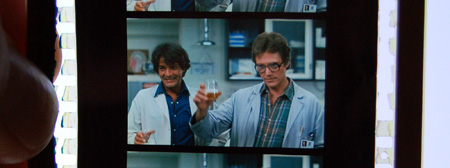
Promoted as a Super Panavision 70 production, in actuality only a portion of the film was shot in large format. The objective “real world” sequences in “Brainstorm” were filmed in spherical 35mm and have a 1.66:1 aspect ratio; the subjective “brainstorm” sequences were originated in 65mm and are in 2.20:1. Presentations have varied over the years in how the aspect ratio changes have been handled. The 70mm and 35mm scope release prints have the 1.66:1 footage pillarboxed within the wide frame. The pan-and-scan video edition has a 1.33:1 ratio and reveals no ratio change between the real world and the brainstorm sequences. The first letterbox edition (the 1991 laserdisc) featured a transfer of the film that mirrored the original theatrical presentation. A remastered letterbox edition (the 1998 laserdisc and subsequent DVD releases) retains the proper aspect ratios but betrays the intended effect by letterboxing the brainstorm segments within the real world segments.
Powered by Infopop Corporation
UBB.classicTM
6.3.1.2