This is topic Samsung's "No Projector" Cinema Screen in forum Digital Cinema Forum at Film-Tech Forum ARCHIVE.
To visit this topic, use this URL:
https://ft-forum.com/ft/cgi-bin/ubb/ultimatebb.cgi?ubb=get_topic;f=16;t=003070
Posted by Mark Ogden (Member # 43) on 07-14-2017, 07:05 PM:
Article, from Engadget. " . . . might be too close to watching TV in public for some cinephiles . . ."
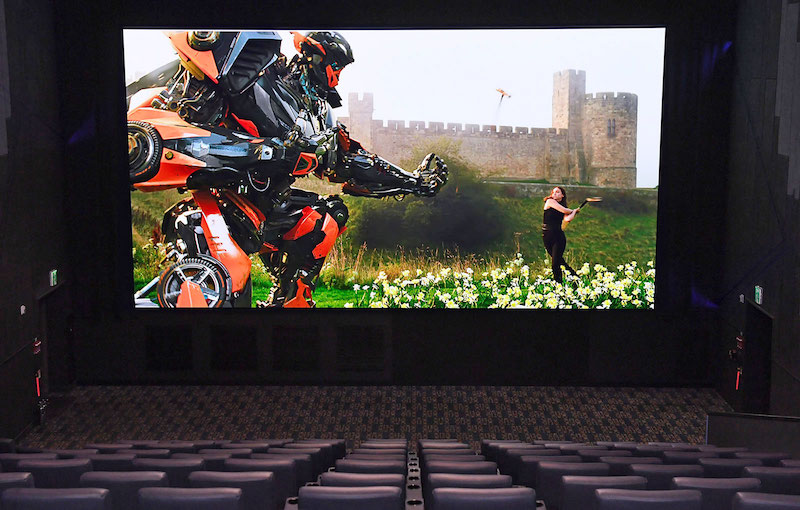
So you just spent $120,000 on a 120-inch 4K HDR screen and think you've got the biggest, baddest TV around? Nope! Samsung has unveiled the Cinema LED Screen that's an epic 10.3 meters (33.8 feet, or 406 inches). It runs at full 4K (4,096 x 2,160) resolution, features HDR and peaks out at 146 fL of brighntess, "ten times greater than that offered by standard projector technologies," Samsung said in a news release.
The set, first teased in March this year, offers a "distortion-free" presentation with deep blacks, accurate whites and bright colors "at a nearly infinite contrast ratio," according to Samsung. While it didn't say so, the extra brightness could possibly improve 3D films, which normally look dim with projection systems due to the polarized glasses required.
To complement the image quality, Samsung worked with its JBL by Harman division on the sound tech. That system features speakers around the screen, proprietary audio processing tech, and "Sculpted Surround Sound" from JBL to provide more dramatic and faithful audio.
Samsung Electronics unveiled the model at the Lotte Cinema in Korea, saying it's the "first ever commercial Cinema LED Screen" it has installed. The average movie theater screen is around 50 feet, but the 33.8-foot Cinema Screen would be a good fit in smallish multiplex rooms.
Samsung says it adapts to a wider range of dark and ambient lighting situations, making it work well for corporate events, sports viewing and gaming competitions. For films, it would certainly offer a very different experience than a projector and might be too close to watching TV in public for some cinephiles.
Samsung is obviously one of the few companies out there, perhaps along with LG, that could even create such a giant LED screen. It was certified by the Digital Cinema Initiatives (DCI), meaning it can showcase films in theaters with unaltered color spectrum accuracy. As for the price, unless you've got an 80-foot yacht parked in the harbor, it's probably best not to ask.
Posted by Scott Norwood (Member # 30) on 07-14-2017, 07:18 PM:
In what universe is the average movie screen fifty feet wide? Thirty feet is probably far more likely.
Posted by Stephan Shelley (Member # 8587) on 07-14-2017, 08:34 PM:
I was just working on a Dunkirk 70mm install at a Century Theatre in Daley City CA and it has a 44 ft wide screen and it is not the XD screen either.
Posted by Marco Giustini (Member # 4544) on 07-15-2017, 04:39 AM:
How does that work with the pixel resolution? Are the panels custom-manufactured to provide a 1:1 mapping?
What I am saying is that the pixel pitch will change with the side of the screen. If those panels have a fixed resolution then you cannot end up exactly at 4096x2160 and they would be forced to rescale.
How do they handle the change in pixel pitch between flat (3996x2160) and scope (4096x1716)? It can't be possible, so I guess those screens have a much higher resolution and they then just rescale.
Posted by Pietro Clarici (Member # 4937) on 07-15-2017, 10:39 AM:
At this point, I believe it's single size only.
96 cabinets arranged in a 10.3x5.4m array, each cabinet is 256x360 pixels. The pixel pitch is 2.5mm.
Since it's 4096x2160 on a 1.9:1 aspect ratio, Scope is letterboxed and Flat is pillarboxed with no scaling involved except the usual pixel quadrupling with 2K material.
Posted by Bobby Henderson (Member # 840) on 07-15-2017, 11:28 AM:
This "cinema screen" Samsung is showcasing is not exactly ground-breaking new technology. This is basically an LED-based "jumbotron" sign, just one with a fairly tight pixel pitch. Maybe Samsung is the first to try to sell such a product to install in traditional movie theaters.
Sony has its "CLEDIS" crystal LED technology. They have these "canvas" displays with pixel pitches down to 1.2mm. The LEDs themselves are almost microscopic to allow a lot of black in between each pixel.
Daktronics is the biggest American LED jumbotron manufacturer. They're mainly known for traditional outdoor LED signs and huge LED signs for sports stadiums. They're putting the finishing touches on the world's largest sports stadium LED sign, the enormous halo ring going into the Atlanta Falcons' new stadium. They have narrow pixel pitch UHD video displays in different sizes and pixel pitches, from 2.5mm down to 1.2mm
quote: Marco Giustini
How does that work with the pixel resolution? Are the panels custom-manufactured to provide a 1:1 mapping?
What I am saying is that the pixel pitch will change with the side of the screen. If those panels have a fixed resolution then you cannot end up exactly at 4096x2160 and they would be forced to rescale.
Just like any flat screen electronic display the content must be mapped to the display's pixels 1:1. The content will look its best when it's created exactly for the native resolution of the display. Scaling will almost always soften the image (unless you're doing something like an exact 4K down to 2K reduction with bilinear resampling).
Companies like Daktronics make a variety of different LED boards with many different pixel pitches for both indoor and outdoor use. They have the really tight 1.2mm, 1.9mm and 2.5mm SMD LED boards for UHD use. You can go 4mm, 6mm, 10mm, 15mm and 20mm. The driver boards are modular. So you can custom configure whatever size and pitch you need (and what your budget can handle, this stuff can get very expensive very quick).
I don't expect these Jumbotron style screens to take over movie theaters any time soon. Cost is one really big issue. How much is Samsung wanting for their cinema screen?
I think audio is just as big a problem, and probably a deal breaker for really large screens. Speakers above and below the screen only seem to work for modest sized auditoriums. It doesn't work well for giant sized screens.
As tiny as some of these LED clusters are being made I think it's possible to create a porous curtain-like LED system that can hang in front of stage speakers. But that would require a lot of design changes in how these boards are built. If you open up a LED sign you'll see all sorts of fans, ribbon cables and other stuff connected to each square tile of LEDs. Somehow the manufacturers have to change how the LED boards are connected so they don't require a big solid chunk of plastic and metal going into each tile of LEDs.
Posted by Randy Stankey (Member # 64) on 07-15-2017, 01:24 PM:
That could be done with flex circuits.
They are just a sheet of laminated multi-layer polyester (or something) with the circuit traces between the layers. They can even laminate flex circuits between sections of standard fiberglass/epoxy circuit board. With that and some low-profile snap connectors it would be possible to make flexible, perforated LED panels in almost any size you want.
The SMT machines where I work can handle panels from 3 inches square up to 18 or 24 inches.
Flex circuits are a pain in the ass to manufacture but flexible, giant screen LED displays with perforations are certainly within the realm of current manufacturing technology.
I can't tell you the details because of ITAR regulations but I can tell you that we make stuff like that on a pretty regular basis.
Some of those surface-mount LEDs are smaller than a grain of rice.
Posted by Bobby Henderson (Member # 840) on 07-15-2017, 02:14 PM:
It's a good thing some of these LEDs are so tiny (the ones in Sony's CLEDIS system are about as thick as a strand of hair). The black between the LED pixels is very important for contrast and very dark black levels.
A flexible LED screen that allowed sound to pass through would still need to be modular for maintenance. It would be cost prohibitive to replace an entire screen just because one pixel got stuck or went dead. The components do wear out over time. It's a lot cheaper to replace one driver board. The manufacturers have been getting better at making these displays easier to maintain. They'll have to go farther with LED movie theater screens.
I'll be hanging out with some of Daktronics' people in 4 weeks at a regional sign convention at a casino resort near Joplin. I'll talk with them about some of this stuff.
Posted by Randy Stankey (Member # 64) on 07-15-2017, 02:49 PM:
Imagine a panel with a "picture frame" of standard fiberglass/epoxy, 1/2 inch wide around the four sides with low-pro snap connectors at the edges. The LEDs could be mounted on a sheet of flex circuit inside that frame. It could be a sheet of perforated PET laminate or it could be made of thin strips. (Like a woven pie crust.) There could be support/driver circuitry around the frames.
These panels could be, maybe, 6 inches square and they could snap together at the edges like Legos.
With today's technology, it is certainly possible to create something like this. You could make giant LED displays in virtually any size you want.
Some of the SMT components that I work with are the size of a small grain of rice or a large grain of sand. I keep a 10X photographer's loupe in my pocket in case I need to verify a component ID. I know that there are SMD LEDs as small as 1 mm X 2 mm. That includes the component case and everything. The elements inside are microscopic. I have no doubt that there are LEDs, as you say, as small as a human hair.
With the new technologies that are emerging, I have no doubt that it would be possible to manufacture LEDs directly onto a polyester flex circuit.
From what I know by experience and the things I read about, I believe that, in the next decade, it would be possible to manufacture a flexible LED cinema screen that could be rolled up, shipped and installed in a similar way to the way that traditional movie screens are done today.
Posted by Neil Brimelow (Member # 9480) on 07-16-2017, 01:35 AM:
I'm just curious if anyone has found out the price on this new Samsung Cinematic Abomination? ![[Smile]](smile.gif)
![[puke]](graemlins/puke.gif)
The only way it would be viable for smaller theaters is if the cost is $50k, or less. Nobody's going to drop $120k on a "TV" screen when a $30k projector (or less) will do. Also, the custom sound workaround doesn't sound cheap either.
But, it is 2017, and there are much more advanced tech from other companies, and even large 4k UHD sets can be found for less than $500 bucks. Heck, we priced out a monochrome 36 inch tall, 38 foot wide sign for the theater and it only cost $4,500 shipped.
To be honest, I'm just surprised it took this long for "Big TV" to hit theaters. ![[dlp]](graemlins/dlp.gif)
![[bs]](graemlins/bs.gif)
Posted by Marco Giustini (Member # 4544) on 07-16-2017, 07:04 AM:
Neil,
That screen does outperform (I'm basing my claim on the datasheet) a £30K projector big time.
You should compare it with a Laser HC solution, not with a NC900!
Posted by Carsten Kurz (Member # 5396) on 07-16-2017, 08:08 AM:
Well then, who puts a HC laser in the back of a 10m screen?
The real benefit compared to ALL current projection solutions is it's ability to operate at very high ambient light levels. There are certainly applications where that capability justifies the high price. I don't know, however, where such a price level, application, medium screen size, and 'cinema' meet.
- Carsten
Posted by Steve Guttag (Member # 268) on 07-16-2017, 08:41 AM:
I believe the price will drop, dramatically. I believe it is already in the RGB Laser price point. Imagine a flexible direct view OLED screen. Something where sound can come from behind the screen. Something where you can curve it for esthetics without the geometric issues of a reflected screen. You could even make such a screen non-reflective to Exit signs. You have a VERY high contrast ratio. You have a technology that is more generic (OLED) rather than proprietary and VERY expensive to maintain (DLP). You have a technology that the likes of the consumer can make cheaper via mass production that DLP and cinema would never achieve.
It is the end game of cinema viewing, not projectors.
It isn't there yet but it is definitely like looking at the 1.3K DCinema projectors; you know it won't be too far off.
Posted by Tony Bandiera Jr (Member # 2365) on 07-16-2017, 10:28 AM:
You said it Steve..it is the end game of cinema viewing..and the end of the cinema as a viable alternative to what you can get at home.
Let me elaborate: With projection technologies, there is theoretically no limit to the types of presentations that can be done, based on the use of a standard screen. You can do a shadow puppet artsy fartsy show if you wanted to, as an extreme example. Any type of direct lit screen cannot accommodate that. With a little thought you could come up with other types of presentations that would be cumbersome or not possible with that type of "screen."
One real-world example from my days at the university screening room comes to mind. We had a film print come in without subtitles..the subtitled print was overseas and could not be sent to us in time. The filmmaker had, however, a powerpoint file with the subtitles on it. So we set up a laptop in the booth, operated by a student familiar with the film and the language, and used our video projector re-aimed and masked off to shoot the subtitles to the bottom of the screen. It worked great and got us through the show.
Now, in the above scenario, unless the new tech screen could simultaneously (in real time) accept an input that is DCI compliant AND an non-DCI compliant input whose location could be mapped separately, we would have been screwed. And we know that the DCI nazis would never allow such a thing to happen.
Obviously that was a very unusual set of conditions, but you get the idea.
Bottom line is, I still don't like how we have migrated from a proven technology that was working and versatile for many years, (and had it's own set of issues of course) to a technology that HAS to be changed/upgraded "constantly" for no reel end other than making more money for the studios (who are trying their hardest to destroy the whole exhibition chain so they can go direct to video or online).
End game indeed.
Posted by Steve Guttag (Member # 268) on 07-16-2017, 11:16 AM:
Tony,
If that was a major concern, it could be accommodated. We have one venue that invested in auxiliary screens just for subtitles! That is, you can these two very rectangular screens to the bottom masking board and you have subtitle screens and project on them.
I do not think of direct view LED screens as any more of a threat to cinema as any other home technology. The classic restaurant rule comes into play here. You can have professional stoves/ovens all you want at home and for convenience and price, you can stay at home but people STILL want to go out.
I still maintain that what theatres should work together on is pushing that release window out to a year, particularly on A-list movies such that the home doesn't have access for, at least, 1-year.
If it is just technology, the home has eclipsed most cinemas a long time ago. Sound wise, there are many other choices and the person can pick what suits their hearing tastes best. Picture wise, 4K in the home isn't even "special" anymore, it is standard. The Cinema continues to be stuck at 2K with mostly miserable 4K options (low contrast, or speckle, VERY high costs).
It just doesn't cost the homeowner all that much to set up a reasonably impressive home-theatre with technology that stands pretty close to professional and, in many cases, better.
Posted by Daniel Schulz (Member # 1881) on 07-16-2017, 11:34 AM:
quote: Steve Guttag
I still maintain that what theatres should work together on is pushing that release window out to a year, particularly on A-list movies such that the home doesn't have access for, at least, 1-year.
If it is just technology, the home has eclipsed most cinemas a long time ago. Sound wise, there are many other choices and the person can pick what suits their hearing tastes best. Picture wise, 4K in the home isn't even "special" anymore, it is standard. The Cinema continues to be stuck at 2K with mostly miserable 4K options (low contrast, or speckle, VERY high costs).
It just doesn't cost the homeowner all that much to set up a reasonably impressive home-theatre with technology that stands pretty close to professional and, in many cases, better.
I pretty much agree with this, although it should be noted that even 2K DCI projection has some advantages over what is seen in home theater in terms of color space, compression technologies used and bitrate. Obviously those things will improve on the home side as well, but digital cinema projection is still superior to even UHD Blu Ray.
More importantly, cinema always has the advantage in screen size and available decibel levels. Yes, sitting 8 feet away from a 70" flat screen is impressive, but it still doesn't compare to a 40-foot wide screen. And virtually no home theaters are equipped (and soundproofed) to play back at anything approaching true cinema reference levels.
Definitely agree on the release window, and I will continue to argue that cinemas should pay much more attention to the things that truly set them apart from home theatre, such as 'scope screens with proper masking. Hell bringing back curtains could serve as a nice reminder that you're seeing something really special.
Posted by Marco Giustini (Member # 4544) on 07-16-2017, 05:21 PM:
quote: Daniel Schulz
but digital cinema projection is still superior to even UHD Blu Ray.
in a post production studio.
Then you go to your local cinema, 3D is run at 0.8fL, picture is blurry, convergence is off etc.
Carsten,
I've seen 6P laser machines on 10m screens myself. Not HC though
Posted by Steve Guttag (Member # 268) on 07-16-2017, 07:25 PM:
The gap keeps narrowing. REC 2020 is wider than DCI P3 and the home viewing technology improves year-by-year. DCinema has to take snapshots at technology in order to be financially viable (businesses cannot change out their equipment very often or they'll go broke).
Contrast ratio at the home can be better than commercial cinema (direct view LED) is going to beat DLP or even film!
Compression is still worse but again, the difference is getting narrower.
Posted by Bobby Henderson (Member # 840) on 07-16-2017, 07:30 PM:
I always figured direct view LEDs would someday compete with projectors for showing movies in commercial theaters. Years ago I figured the day would come many years in the future, but the technology appears to be improving much more rapidly.
My primary concerns with "jumbrotron" style screens has been color quality, maintenance and cost per pixel. The cost has been coming down as the technology continues to scale in production. Our sign company is continuing to sell ever better LED signs to businesses because the cost per pixel continues to fall and the displays are getting more durable and easier/cheaper to maintain. The color quality of these displays has improved dramatically. In the early 2000's LED signs were pretty garish looking. Shadow and highlight detail would almost always be crushed or blown-out. New displays look so much better. And you have the full RGB spectrum to use, not a reduced gamma range like REC 709 or REC 2020.
quote: Neil Brimelow
I'm just curious if anyone has found out the price on this new Samsung Cinematic Abomination?
I'm certain that demo unit from Samsung is probably prohibitively expensive for mainstream theaters. As noted previously, I think LED display manufacturers need to come up with something different than a thick plastic and metal box to mount in front of the seats.
But I'll tell you something that's an abomination: very poor projector to screen geometry. Last night my girlfriend and I watched Baby Driver at the local AMC/former Carmike Patriot 13 theater. I sensed something was wrong with the image, especially during the opening title sequence. The framing seemed like it was really a bit off kilter. Then the end title credit run started and it was all too clear. The keystone alignment from the projector to the screen wasn't for shit. It was absolutely awful. A bunch of the credits on the left margin were getting clipped.
One huge advantage with a LED-based display: PERFECT freaking screen geometry. No need for damned keystone correction, whether it's optical-based (better) or digital (just plain awful). The picture will be in perfect focus 100% of the time.
But, it will seem like a TV screen. IMHO, d-cinema already feels like a TV screen anyway. So what the hell is the difference? If the purchase price point and total cost of ownership gets down to a manageable level, I'm all for swapping out the projectors for LED-based displays. However, they really have to figure out some way to allow sound to project through the screen. That's an absolute must.
quote: Steve Guttag
Compression is still worse but again, the difference is getting narrower.
The big key in this is residential and mobile Internet bandwith speeds. Just here in back-woods freaking Lawton our cable Internet ISP now provides 250 megabit per second service. That's 10 times the typical bandwidth you see from a movie on consumer Blu-ray disc. Gigabit Internet speeds are becoming more common in larger cities. Mobile phone companies are battling each other for bragging rights in advanced 4G and new "5G" technology, demonstrating bandwidths above 200Mb/s and 300Mb/s. In another 10 years Gigabit Internet speeds will be pretty common. And at that time any bandwidth advantages d-cinema theaters have over home viewing options may be a moot point.
Posted by Lyle Romer (Member # 1266) on 07-17-2017, 12:23 AM:
quote: Bobby Henderson
The big key in this is residential and mobile Internet bandwith speeds. Just here in back-woods freaking Lawton our cable Internet ISP now provides 250 megabit per second service. That's 10 times the typical bandwidth you see from a movie on consumer Blu-ray disc. Gigabit Internet speeds are becoming more common in larger cities. Mobile phone companies are battling each other for bragging rights in advanced 4G and new "5G" technology, demonstrating bandwidths above 200Mb/s and 300Mb/s. In another 10 years Gigabit Internet speeds will be pretty common. And at that time any bandwidth advantages d-cinema theaters have over home viewing options may be a moot point.
All of those speeds are peak, not sustained. Consumer plans don't have dedicated pipes with the speed guaranteed even with fiber. The oversubscription ratio in the network makes it highly unlikely to be able to stream video at those speeds. Sure, you could download it first.
With mobile, if you streamed at those file sizes, you'd either have a $1,000 bill for overages or have your unlimited plan speed throttled down to that of a 28k modem.
The other part of the equation, is that it isn't free for the streaming services to output the streams. They have to pay for bandwidth so unless there is a market of people paying a premium to get ultra low compression ratio video, they won't stream at those rates. They will continue to provide whatever level of compression they can get away with for 95% of their customers to think the picture looks good on their 55 inch TV.
Posted by Jack Ondracek (Member # 1466) on 07-17-2017, 05:46 AM:
So... when one of these electronic screens needs work, will the cinema service companies be set up and spun up, or will the theatres have to call the local sign shop... or what?
Posted by Scott Norwood (Member # 30) on 07-17-2017, 06:39 AM:
Bobby (or anyone else who might know): what would a screen like this weigh? Could it be flown like a regular movie screen in a live stage house, or would it need to be fixed in its position?
Posted by Pietro Clarici (Member # 4937) on 07-17-2017, 07:06 AM:
The standard 10.3m array (96 modules) is 1440Kg not including the frame.
Posted by Marcel Birgelen (Member # 6801) on 07-17-2017, 07:13 AM:
This thing was already discussed in this topic. Unless they find a way to make it audio-transparent AND get rid of potential screen-door effects even in the front row, I don't see any use for this in big venues.
Also, flexibility in screen sizes still will make this an issue, as long as you want to avoid scaling and don't care about "oddball" aspect ratios and maximizing screen real-estate.
The flexibility in screen sizes might increase, once multiple pixel pitches become available. Still, since it all needs to be DCI compliant, you cannot just pick and choose from any manufacturer you please.
quote: Scott Norwood
Bobby (or anyone else who might know): what would a screen like this weigh? Could it be flown like a regular movie screen in a live stage house, or would it need to be fixed in its position?
All current LED screen installs are considerably more heavyweight than any conventional screen. In general, I wouldn't really want to fly such a screen, because it's a pretty delicate piece of electronics.
Posted by Bobby Henderson (Member # 840) on 07-17-2017, 09:04 AM:
quote: Lyle Romer
All of those speeds are peak, not sustained. Consumer plans don't have dedicated pipes with the speed guaranteed even with fiber. The oversubscription ratio in the network makes it highly unlikely to be able to stream video at those speeds. Sure, you could download it first.
I personally have a modest 25 megabit per second plan with our local cable ISP and it routinely sustains 27 megabits per second. If I stream video content from a service like Netflix or HBO GO I get video quality that easily blows away satellite TV and comes close to rivaling Blu-ray. The content starts playing immediately. It's not taking seconds or minutes to buffer like it did in the past (when I had AT&T's 3Mb/s "Uverse" and DSL service). Perhaps if I get a 4K TV in the next couple or so years I might upgrade to their 75 or 125 megabit tier to stream content in 4K. Right now there's just not enough native 4K stuff out there to watch. I'm not bothering with crap blown up from 2K to fake 4K.
Mobile phone service quality varies by location, but I have personally seen sustained speeds on my carrier over 100 megabits per second in places like Wichita Falls (but not here in Lawton unfortunately). I have an unlimited data plan and never seen my connection throttled down to old world 28k modem speed.
Whether the advertized speeds are sustained or peak, residential and mobile Internet service is getting faster and faster. Unfortunately the improved quality of video streaming has played a role in killing off the traditional video store and even laying waste to music stores. Commercial movie theaters may see their technological edge in terms of bit rate badly eroded too.
Another thing to bear in mind: DCPs for movie theaters can be overrated for quality. Some DCPs will have enormous file sizes (over 200GB) and bandwidths that are at the upper limit. I've seen other 2-hour DCPs only 60GB in size. When you consider some of the compression rules for DCP authoring (like no inter-frame compression and limits on tile blocks) a 2K DCP only 60GB in size may look no better than a consumer Blu-ray encode and maybe even potentially worse.
quote: Scott Norwood
Bobby (or anyone else who might know): what would a screen like this weigh? Could it be flown like a regular movie screen in a live stage house, or would it need to be fixed in its position?
If the LED screen is made up of the usual plastic and metal driver board modules, a movie theater screen sized display could easily weigh thousands of pounds. The auditorium would need a steel support structure to hold it.
quote: Marcel Birgelen
Also, flexibility in screen sizes still will make this an issue, as long as you want to avoid scaling and don't care about "oddball" aspect ratios and maximizing screen real-estate.
To repeat what I said earlier, these manufacturers already make these boards in various pixel pitches. Different pitches will create different screen sizes.
quote: Marcel Birgelen
This thing was already discussed in this topic. Unless they find a way to make it audio-transparent AND get rid of potential screen-door effects even in the front row, I don't see any use for this in big venues.
The screen door effect issue is solved by installing a display with the correct pitch for viewing distance. If a unit with something like a 4mm or 2.5mm pitch is too coarse then you can go tighter to something like 1.9mm or 1.2mm.
Displays like these are not getting installed in movie theaters at the moment (in part because of the sound thru screen issue), but they are going up in other high traffic places. I've seen them in malls, large sports bars, stadiums and hanged on the exteriors or interiors of other kinds of businesses. These displays are going to continue getting better and better.
quote: Marcel Birgelen
All current LED screen installs are considerably more heavyweight than any conventional screen. In general, I wouldn't really want to fly such a screen, because it's a pretty delicate piece of electronics.
The Daktronics units we sell are not "delicate," especially the outdoor units. These things have to stand up to serious weather conditions: heat, cold, rain, wind, hail and dust.
Posted by Mark Gulbrandsen (Member # 72) on 07-17-2017, 10:21 AM:
Well, weather you like this display or not it IS the future of exhibition if exhibition is to have any future. As prices on this equipment drop they will begin to overtake projection methods. The systems will be ordered by the square meter much like screens are ordered today, then installed and assembled in sections quite easily on to a frame. It's also likely that some of the technicians on this site will eventually be doing these installs. I'm going to predict <10 years till these are in widespread use.
Mark
Posted by Martin McCaffery (Member # 37) on 07-17-2017, 11:02 AM:
Less than ten years, eh?
Just enough time for everyone to invest in at least one more round of digital projectors.
Posted by Marcel Birgelen (Member # 6801) on 07-17-2017, 01:07 PM:
quote: Bobby Henderson
To repeat what I said earlier, these manufacturers already make these boards in various pixel pitches. Different pitches will create different screen sizes.
Unfortunately, not really relevant until Samsung starts making them. Or others, like Daktronics join the DCI train and implement end-to-end encryption.
You see, in DCI, everything that needs to generate an image, needs to be certified or otherwise you won't be showing any DCI content on those screens. So, you can't just put a Daktronics ledwall into your room and expect to play the latest Spider-man movie.
Also, even with variable pixel pitches, you're not as flexible as with current screen sizes. And you still don't account for the many different aspect ratios we're currently dealing with. At least, as long as I can zoom or anamorphically squeeze the image, I'm presenting the image without any scaling. You simply can't do this with a fixed pixel imaging device like a LED wall.
quote: Bobby Henderson
The screen door effect issue is solved by installing a display with the correct pitch for viewing distance. If a unit with something like a 4mm or 2.5mm pitch is too coarse then you can go tighter to something like 1.9mm or 1.2mm.
This will even further complicate designing the display correctly, at least if I want to have my screen a "native" 4K resolution. You see, many of those modern PLF cinemas really run over-sized hunks of screens. On many of those screens you clearly can see pixels, EVEN in 4K. Fortunately, the screen-door effect of DLP is somewhat limited, especially with modern DMDs, where the space between the mirrors is pretty small. Also, the DMDs will never be entirely in focus, further reducing the screen door effect. The screen door effect of LED screens of comparable resolution will be visible, especially in darker scenes and it will be terrible.
I know, because I've seen it. Back in 2013, when 4K slowly became a thing, I already saw a demo of a giant 4K LED wall by Barco. It looked amazing from a distance, but from a normal "seating distance" in any modern "PLF screen", I already started to notice the screen door effect.
So, either you use some kind of diffuser in front of the screen, or I won't even dare to look at it.
quote: Bobby Henderson
The Daktronics units we sell are not "delicate," especially the outdoor units. These things have to stand up to serious weather conditions: heat, cold, rain, wind, hail and dust.
The outdoor models will only be heavier, so more difficult to "fly" in any stage setup. It's not impossible to do, but I'm pretty sure the Samsung install isn't suitable for this.
quote: Bobby Henderson
I've seen them in malls, large sports bars, stadiums and hanged on the exteriors or interiors of other kinds of businesses. These displays are going to continue getting better and better.
They got increasingly better in the last few years already, but I'm still not sure we're there yet. You see, I don't mind so much seeing pixels on a billboard. Even on a large out-door venue screen I can somehow live with it. Still, I will NOT watch a movie on a screen with noticeable screen door effect.
I still remember those 1.3K machines, the precursor to the current DCI machines. They used to have a terrible screen door effect. In the front rows, anything presented with them was just entirely unwatchable.
quote: Steve Guttag
If it is just technology, the home has eclipsed most cinemas a long time ago. Sound wise, there are many other choices and the person can pick what suits their hearing tastes best. Picture wise, 4K in the home isn't even "special" anymore, it is standard. The Cinema continues to be stuck at 2K with mostly miserable 4K options (low contrast, or speckle, VERY high costs).
It just doesn't cost the homeowner all that much to set up a reasonably impressive home-theatre with technology that stands pretty close to professional and, in many cases, better.
Cinema always has been a technical race, from the very first incarnation of moving images to what we have now. But it wasn't until quite recently that you could have a picture quality that equals or in many aspects even excels 35mm at home.
One of the very limiting factors right now is the whole DCI certification issue. In my opinion, we're stuck with overpriced speciality equipment, provided by just a handful of suppliers who also have the tendency to consolidate each other every now and then, only further limiting options. They control the pricing and we're stuck with them when it comes to innovation. Look at what they come up with... Just one example: Barco Escape? Really?
Meanwhile, I've done stuff with edge-blended large stacks of affordable projectors on large, curved screens, which would be entirely mind blowing, if it would be possible for actual feature presentations of "hot" content. Cinema could be a lot more, if not only Hollywood would be allowed to experiment more, to innovate and to progress beyond what we have now.
Posted by Mark Gulbrandsen (Member # 72) on 07-17-2017, 02:22 PM:
quote: Martin McCaffery
Less than ten years, eh?
Just enough time for everyone to invest in at least one more round of digital projectors.
Yep! That's why there are series 3 projectors.
Mark
Posted by Mattias Mattsson (Member # 4308) on 07-17-2017, 04:14 PM:
Wouldn't it be possible to use WFS (Wave field synthesis) instead of putting the front speakers behind the screen?
https://en.wikipedia.org/wiki/Wave_field_synthesis
Posted by Marcel Birgelen (Member # 6801) on 07-17-2017, 04:27 PM:
quote: Mattias Mattsson
Wouldn't it be possible to use WFS (Wave field synthesis) instead of putting the front speakers behind the screen?
In 2015, Barco bought Iosono from the he Fraunhofer Institute. Iosono essentially developed a WFS system for large venues, like cinema auditoriums. Before Barco bought them, they even fitted a few screens with the technology and remixed a few movies. I haven't heard anything from them though, since they've been acquired. Whether Barco is planning a new audio decoder product and possible even a format based upon their technology or it will just rot away within their portfolio of unused technology with great potential, remains to be seen.
WFS still requires a very high speaker density. An array which envelops the subject from all sides, so most likely you would still need speakers in the front. I'm not sure what the effect would be, if they would be elevated and pointed down.
If a WFS setup would be required to make this type of screen work for large rooms, it would obviously only add to the costs.
Posted by Mike Blakesley (Member # 26) on 07-17-2017, 06:38 PM:
The Bose company made millions of dollars on "direct/reflecting" speakers where they put the midrange/tweeters in front, and the woofers facing the wall. Maybe somehow this type of technology could make speakers around the screen work. I have no idea of course, just spitballing here.
I can just hear it now though... even if a perfect sound solution is NOT found, they'll still be pushing this type of screens because the sound will be "good enough" and the logic will be that "people are used to speakers under (or over) the screen because that's what they have at home."
Posted by Marcel Birgelen (Member # 6801) on 07-18-2017, 05:51 AM:
The 901 is indeed a living proof that acceptable sound can be produced using reflections.
This was also mentioned in the previous topic, but if the screen itself would be sufficiently reflective, you could point a bunch of line arrays mounted on the ceiling on it.
You'd end up with a big, reflective surface in the front of the room though, which will also reflect sound coming from the surround speakers. You could replace your surrounds with expensive line array assemblies too and avoid any of them inadvertently hitting the screen...
I'm not saying those kind of screen assemblies don't have their literal bright side too. Using those for an actual cinema setup has been on my mind for quite a while. But let's not make the same mistake again please. Before those kind of screens should be unleashed on us, they should at least enter the 8K realm and issues with sound should be properly worked out.
Posted by David Buckley (Member # 2600) on 07-18-2017, 06:57 AM:
Even though the hoohah is over Samsung with what appears to be a a 1.9mm pitch LED panel, Barco have 1.9mm panels too, and smaller pitch panels, 1.6, 1.5 and 1.2mm.
So when Martin notes:
quote: Martin McCaffery
Just enough time for everyone to invest in at least one more round of digital projectors.
The cynicism is probably well placed; Barco have the panels ready to go, and can probably demonstrate a cinema-size panel at the drop of a hat, and indeed have built some really big displays for non-cinematic purposes.
Posted by Harold Hallikainen (Member # 5405) on 07-18-2017, 08:51 AM:
Quote: This was also mentioned in the previous topic, but if the screen itself would be sufficiently reflective, you could point a bunch of line arrays mounted on the ceiling on it.
We'd be moving the image from being a reflected image to direct emission and moving sound the other way. Maybe we could put a "sound projector" in the booth!
Harold
Posted by Daniel Schulz (Member # 1881) on 07-18-2017, 10:39 AM:
quote: Marcel Birgelen
In 2015, Barco bought Iosono from the he Fraunhofer Institute. Iosono essentially developed a WFS system for large venues, like cinema auditoriums. Before Barco bought them, they even fitted a few screens with the technology and remixed a few movies. I haven't heard anything from them though, since they've been acquired. Whether Barco is planning a new audio decoder product and possible even a format based upon their technology or it will just rot away within their portfolio of unused technology with great potential, remains to be seen.
I don't know if they're continuing development on WFS for cinema, but one nifty thing that came out of that acquisition was the AuroMax renderer, used to render an MDA object-based soundtrack into an Auro speaker configuration. Anticipating a future in which SMPTE standardizes on an object-based delivery system, they needed an upgrade path for cinemas that had already upgraded to Auro 11.1. They used the technology & engineering expertise from Iosono to help build a really first-class object-based audio rendering system, to compete with Atmos and DTS:X.
Posted by Bobby Henderson (Member # 840) on 07-18-2017, 04:10 PM:
quote: Marcel Birgelen
Unfortunately, not really relevant until Samsung starts making them. Or others, like Daktronics join the DCI train and implement end-to-end encryption.
You can try to imply building LED boards at different pixel pitches or incorporated DCI compliant security are huge hurdles. They are not.
The only real problems with an LED-based movie screen is the high cost and the need for getting sound to pass through it rather than building speakers around it.
quote: Marcel Birgelen
Also, even with variable pixel pitches, you're not as flexible as with current screen sizes. And you still don't account for the many different aspect ratios we're currently dealing with.
Pardon me while I laugh hard at that statement.
You're assuming current movie theaters are actually "dealing with" multiple aspect ratios when most are really taking a giant shit on them. There are countless thousands of un-masked, "wall to wall" common width movie theater screens showing damned near every movie letter-boxed, just like watching a fucking HDTV set at home -except the HDTV at least has the picture properly framed and in focus.
The 'scope format, which nearly every Hollywood release uses, is now the lowest quality, lowest resolution format. This is thanks in part to a cost cutting measure eliminating the use of anamorphics in d-cinema standards. They could have used the entire imager and a 1.25X anamorphic squeeze to yield a far better quality version of 'scope. Instead, we have TV quality 'scope.
D-cinema projectors don't come with wide variety of imaging chip shapes and optics. The imagers are all 1.9:1, either in 2048x1080 or 4096x2160 resolution. The optics are almost always spherical. The flat 1998x1080 format is the only one that gets treated properly in that setup. Everything else is getting cropped in some odd way or another. There's really no difference in what's going on there versus what you would see happen with a 2048x1080 or 4096x2160 LED wall, except formats like 2.20:1 wouldn't need to be window-boxed in a flat container the way it is in d-cinema projection.
LED walls can be built to just about any aspect ratio. Check out the giant 360 degree LED ring Daktronics is putting in the Atlanta Falcons' new stadium. There are custom projects where the LED board is an irregular shape or you have things like giant letters filled with LED clusters to play motion graphics and even video.
Developing a new DLP imaging chip for a d-cinema projector is a very expensive endeavor. Commercial movie theaters are a very limited niche market, which is yet another reason why companies like Daktronics may not even bother with selling LED-based screens to cinemas.
quote: Marcel Birgelen
At least, as long as I can zoom or anamorphically squeeze the image, I'm presenting the image without any scaling. You simply can't do this with a fixed pixel imaging device like a LED wall.
There is no need to scale the image with a LED wall. The image geometry is going to be perfect from the outset. You install the board for the size you need. Maybe you're forgetting why projectors have things like zooming and optical/digital keystone correction. The projector is trying its best to frame the image, sometimes from a very stupidly absurd high angle. Very often the image geometry doesn't line up all that well, which becomes all too clear on end credit runs or imagery with level horizon lines or patterns. What should be straight lines or level lines of lettering gets bent into a smile-like curve.
quote: Marcel Birgelen
This will even further complicate designing the display correctly, at least if I want to have my screen a "native" 4K resolution. You see, many of those modern PLF cinemas really run over-sized hunks of screens. On many of those screens you clearly can see pixels, EVEN in 4K.
Most movies aren't rendered in 4K; they're just 2K. Witness the joke that is the Ultra-HD Blu-ray format where very few of the titles have native 4K resolution. The 4K theater is either going to show these movies with a more obvious pixel grid or an image that is softer looking due to bicubic smoothing re-sampling.
Theoretically, if you're playing with an unlimited amount of money, it's fully possible to build a large LED board with native resolutions well above 4K. The hard limitations of a DLP chip aren't getting in the way. New d-cinema cameras can shoot 6K and 8K resolution, but right now the only way you could conceivably get that resolution onto the screen is by using a 70mm film print. An ultra-fine LED board and bottomless wallet could do the same thing.
quote: Marcel Birgelen
I know, because I've seen it. Back in 2013, when 4K slowly became a thing, I already saw a demo of a giant 4K LED wall by Barco. It looked amazing from a distance, but from a normal "seating distance" in any modern "PLF screen", I already started to notice the screen door effect.
What are the spes on this Barco board? How large was it, what was the pixel pitch and viewing distance? Four years ago very few jumbotron boards were even getting built near 2K resolution levels. The really tight boards in 1.2mm, 1.9mm and 2.5mm weren't getting made yet. So I can't help but wonder if the display you saw really was 4K. I've heard plenty of sales people stretch the truth or just plain lie when selling electronics.
Overglow from LEDs does a lot to hide the black space between the LEDs. Like I said earlier, the right kind of board has to be installed for the viewing distance. Customers buying LED boards for outdoor signs, billboards or even closer viewing indoor applications will often go with more coarse pitch displays to cut costs.
The fundamentals of LED boards are not really any different from a home TV screen. A giant sized 1080p screen viewed from only a few feet will be showing off a fairly obvious pixel grid to anyone with good eye sight. The same size TV in 4K will have a much tighter pixel grid. 6K and 8K shrinks the grid much more.
Posted by Marcel Birgelen (Member # 6801) on 07-18-2017, 08:11 PM:
quote: Daniel Schulz
I don't know if they're continuing development on WFS for cinema, but one nifty thing that came out of that acquisition was the AuroMax renderer, used to render an MDA object-based soundtrack into an Auro speaker configuration. Anticipating a future in which SMPTE standardizes on an object-based delivery system, they needed an upgrade path for cinemas that had already upgraded to Auro 11.1. They used the technology & engineering expertise from Iosono to help build a really first-class object-based audio rendering system, to compete with Atmos and DTS:X.
I think it will be somewhat of a loss if they discontinue developing WFS for cinema, because you should be able to use MDA soundtracks with this system. So, I hope they bought it for more than just the AuroMax renderer, which was based on their technology.
I don't know if you've heard the real Iosono sound system in action, but WFS is really what surround sound should eventually become.
quote: Bobby Henderson
You can try to imply building LED boards at different pixel pitches or incorporated DCI compliant security are huge hurdles. They are not.
Obviously, you have absolutely no clue at all what it takes to become a DCI certified supplier and what kind of security implementations are required to meet the specs. If it would be so simple, why didn't all those other projector manufacturers jump on the DCI train? Why leave this potentially lucrative market segment behind? Currently we have Barco, Christie, NEC and Sony to choose from. I can't install a Panasonic, Epson or whatever other brand of projector, because it simply won't play DCI content from any studio. I can't even just install any Barco projector I would want to use, I need to pick a model that is DCI certified. It's not just an optional check mark, I simply won't be able to play the content as the server would not allow me to.
If you think delivering a system that pleases the content industry is easy, name one manufacturer who currently will deliver a LED wall system that's HDCP 2.2 compliant for example?
quote:
You're assuming current movie theaters are actually "dealing with" multiple aspect ratios when most are really taking a giant shit on them. There are countless thousands of un-masked, "wall to wall" common width movie theater screens showing damned near every movie letter-boxed, just like watching a fucking HDTV set at home -except the HDTV at least has the picture properly framed and in focus.
So, there's a megaton of shit out there and that's why we should just accept shit as the new standard?
quote: Bobby Henderson
LED walls can be built to just about any aspect ratio. Check out the giant 360 degree LED ring Daktronics is putting in the Atlanta Falcons' new stadium. There are custom projects where the LED board is an irregular shape or you have things like giant letters filled with LED clusters to play motion graphics and even video.
Look, you can assume that I'm totally stupid (and maybe you're right)... But I actually do know how LED screens work. I had my fair share of issues with them too actually. I know you can build LED screens in almost any aspect ratio as you please, I know they're made out of modules and most manufacturers offer modules in many different pixel pitches. It's all fine and well, but that was NOT my point.
(Well, not entirely true, because right now, there's just one manufacturer to choose from and just a single pixel pitch.)
The point is, and I'm sure you're able to understand it, since even I do: If I want to build a new LED screen with a native AR of 2.35, because as you mentioned yourself, most new big budget releases are in that aspect ratio, I'm already in a pretty interesting situation. Because what will I choose as my native resolution? Will I choose 4096 × 1716? That would result in all movies presented in flat to be scaled. Will I choose 5066x2160 or something close to that resolution? In that case, all scope movies would need to be scaled.
There are plenty of other examples that I could mention, but I hope the issue is obvious now.
quote: Bobby Henderson
Most movies aren't rendered in 4K; they're just 2K. Witness the joke that is the Ultra-HD Blu-ray format where very few of the titles have native 4K resolution. The 4K theater is either going to show these movies with a more obvious pixel grid or an image that is softer looking due to bicubic smoothing re-sampling.
Like you already mentioned yourself, most movies are already shot in a resolution higher than 4K. I can assure you, post processing and special effects are now also commonly done in 4K for any big name Hollywood production. Even many independents are already using 4K as the norm.
The re-release of existing titles on UHD Blu-Ray is an entirely different thing. In many cases those UHD releases are mere cash grabs, where they just took a 2K or FullHD master and applied some filters on it and called it a day. Those aren't the reference standard for new productions though.
quote: Bobby Henderson
What are the spes on this Barco board? How large was it, what was the pixel pitch and viewing distance? Four years ago very few jumbotron boards were even getting built near 2K resolution levels. The really tight boards in 1.2mm, 1.9mm and 2.5mm weren't getting made yet. So I can't help but wonder if the display you saw really was 4K. I've heard plenty of sales people stretch the truth or just plain lie when selling electronics.
I don't know what the exact pixel pitch was, it was about 70ft wide, so you can estimate the pixel pitch from there. Like I mentioned, it had a NATIVE 4K resolution and was build for trade shows, to show off their LED modules. They did make sure it looked good. And it did, especially from a distance.
quote: Bobby Henderson
Overglow from LEDs does a lot to hide the black space between the LEDs. Like I said earlier, the right kind of board has to be installed for the viewing distance. Customers buying LED boards for outdoor signs, billboards or even closer viewing indoor applications will often go with more coarse pitch displays to cut costs.
"Overglow" doesn't work well with dark scenes and that's were your problems start to manifest.
quote: Bobby Henderson
The fundamentals of LED boards are not really any different from a home TV screen. A giant sized 1080p screen viewed from only a few feet will be showing off a fairly obvious pixel grid to anyone with good eye sight. The same size TV in 4K will have a much tighter pixel grid. 6K and 8K shrinks the grid much more.
The problem is simply the large dark space between the individual pixels in most models. The simplest solution to this problem I've seen is a diffuser in front of the LED wall, which helps to eliminate those dark spots at the cost of some brightness. Some studios also have started to use those diffusers, in order to avoid moire patterns for close-up shots with LED walls in the background.
(Just to be sure: I know moire will not be something you will see with your own eyes in this case.)
Posted by Steve Guttag (Member # 268) on 07-19-2017, 07:15 AM:
quote: Marcel Birgelen
Obviously, you have absolutely no clue at all what it takes to become a DCI certified supplier and what kind of security implementations are required to meet the specs. If it would be so simple, why didn't all those other projector manufacturers jump on the DCI train? Why leave this potentially lucrative market segment behind? Currently we have Barco, Christie, NEC and Sony to choose from. I can't install a Panasonic, Epson or whatever other brand of projector, because it simply won't play DCI content from any studio. I can't even just install any Barco projector I would want to use, I need to pick a model that is DCI certified. It's not just an optional check mark, I simply won't be able to play the content as the server would not allow me to.
That was an uniformed moment there.
First, DCinema is NOT a lucrative market. For many it is a prestige market. There are about 150,000 screens in the WORLD. If you cut the pie up to just 4 suppliers you are down to 37,500 units. That is not a very appetizing number for a lot of manufacturers. And that isn't annual sales either! Exhibitors would like to get better than 10-years, preferably, forever. Annual sales (due to new-builds and attrition) are going to be in the 3-4 digit range unless you take some of your competitor's piece of the pie.
TI deliberately limited the OEMs to three! Digital Projection Inc was to be the third DLP OEM but got cold feet and backed out, freeing up NEC. Note a common thread there, all three OEMs were already DLP manufacturers. You can see a lot of their R/S projector line in the Cinema line to minimize re-engineering things. Heck, the NEC IS-8 (R/S) and the NC-800 (Cinema) were the SAME projector. Due to licensing, each lens even has to be licensed for DLP Cinema use, which is what limits the lens choices (hint, if you need a lens outside of the cinema offerings, odds are, the various projector companies have an R/S lens that will get you, typically, to a longer EF). It will be a DLP lens and it will work with the projector but it won't be a "Cinema" lens.
Even Kinoton and Cinemeccannica, traditional names in cinema projection had to use Barco's light engine to get around the licensing thing and I was told that it was an oversight of the DLP clause that TI closed (you don't see any other manufacturers using OEM light engines, including after Kinoton shut its doors).
Samsung showed their TV at Cinema Con 2017. It used a GDC server and guess what, it is already DCI certified. The big security hurdles are in the mediablock. That is where the valuables are turn from scattered bits into picture and sound.
Getting big screen TVs DCI certified isn't going to be the hurdle you think it will be. The prestige part of cinema has a lot of potential payoffs for display companies like Samsung that has a HUGE consumer presence. The money they spend on making cinema displays can be ported to potential consumer sales which takes them from 150K to hundreds of millions and billions with higher turnover rates.
You don't have many options on digital projectors because, in truth, it isn't a big enough (lucrative) market that anyone (else) want to put up the investment to get a VERY small piece of a VERY small pie. And, now that the conversion is essentially over for most, that pie is even smaller yet.
Think about it. With film, how many new projector companies were clamoring to break into the lucrative market of cinema? With film projectors, you just needed access to mechanical engineers and a machine shop. There wasn't any licensing needed. But how much time and money are going to put into a product that you hope to sell a few hundred a year?
Posted by Marcel Birgelen (Member # 6801) on 07-19-2017, 09:09 AM:
quote: Steve Guttag
That was an uniformed moment there.
I dare to differ, let me explain why:
quote:
First, DCinema is NOT a lucrative market. For many it is a prestige market. There are about 150,000 screens in the WORLD. If you cut the pie up to just 4 suppliers you are down to 37,500 units. That is not a very appetizing number for a lot of manufacturers. And that isn't annual sales either!
If there would not be the requirement for DCI certification, but simply something which could conform to e.g. HDCP, then many more manufacturers would be in the Digital Cinema market. Some of them could even be in the market "by accident", without specificially choosing to be in that market. I'm not implying all would be better, but at least there would be more flexibility if off-the-shelf solutions could be used.
quote: Steve Guttag
TI deliberately limited the OEMs to three! Digital Projection Inc was to be the third DLP OEM but got cold feet and backed out, freeing up NEC.
Sure, but there were and are other technologies available than TI's DLP. Sony used their LCoS solution to get there, there are other OEM LCoS manufacturers. Other technologies like 3LCD could have been a feasible solution for smaller screens. Several projector manufacturers offer many different light engine technologies across the board.
quote: Steve Guttag
Samsung showed their TV at Cinema Con 2017. It used a GDC server and guess what, it is already DCI certified. The big security hurdles are in the mediablock. That is where the valuables are turn from scattered bits into picture and sound.
The last thing I heard it was not yet certified, but it is undergoing the DCI certification process. At least, at CinemaCon, back in April, it was NOT YET certified.
An integrated mediablock is required for the more advanced DCI features. Why do you think this is? It's primary in order to shorten the unencrypted data path to an absolute limit. It's really a no-brainer to transport e.g. 20 GBit/s worth of traffic between Device A and B, you can do it with a cheap HDMI cable nowadays.
But in case of a big LED walls, those signal paths will be much, much longer. The entire secure chain of DCI would break if there would be an exposed, unencrypted signal path. So, I'm pretty sure the stakeholders in DCI will require signal paths to be encrypted up into the very display modules themselves. None of the LED wall suppliers I know currently employ this kind of encryption. It's not something that CAN'T be done, but it requires a considerable investment for, like you already indicated, a rather niche market. So, if you need to put in a lot of R&D, you might just decide to not cater to this market.
HDCP 2.2 certification also requires encrypted signal paths inside unprotected parts of the imager, maybe DCI's stakeholders will become more reasonable and accept HDCP 2.2 as a "good enough" security scheme for any interface behind the actual mediablock. HDCP 2.2 also, hasn't been cracked, until now, despite a few 4K UHD rips showing up in the wild.
quote: Steve Guttag
Getting big screen TVs DCI certified isn't going to be the hurdle you think it will be. The prestige part of cinema has a lot of potential payoffs for display companies like Samsung that has a HUGE consumer presence. The money they spend on making cinema displays can be ported to potential consumer sales which takes them from 150K to hundreds of millions and billions with higher turnover rates.
We're talking about Samsung here, one of the biggest technology and heavy industry conglomerates in the world. If they put something in their minds, they'll get there. Smaller manufacturers simply have far less money to play with.
quote: Steve Guttag
Think about it. With film, how many new projector companies were clamoring to break into the lucrative market of cinema? With film projectors, you just needed access to mechanical engineers and a machine shop. There wasn't any licensing needed. But how much time and money are going to put into a product that you hope to sell a few hundred a year?
With film, you needed to invest a lot of money to come up with pretty complex mechanical devices to make an entry into this market. The technology in those devices would also be of limited practical use for other endeavours. There are many projector manufacturers out there, including quite a few who build pretty decent big venue projectors, which can do everything a DCI projector can do with the proper lenses.
Going from such a projector to a cinema projector would be an almost zero investment, if there would not be the need to tightly integrate it into the DCI system and you could do with a simple HDCP-compliant interface for example.
Posted by Steve Guttag (Member # 268) on 07-19-2017, 01:13 PM:
They achieved DCI compliant by March 22nd 2017
http://www.dcimovies.com/compliant_equipment/KEIO-Samsung-RAK0116ZZ-F7PG-20170323.html
So they had it by CinemaCon.
Getting various technologies to meet the image quality requirements is harder than you think. LCD is miserable for color stability and the panels die very easily in the heat. There is more to the DCI projectors than just the security that is in them.
As for HDCP security, screw-THAT! What an abomination that crap is. HDCP is the bane of any A/V installer's project...it hiccups way too easily. Generally, if you have the KDMs, the DCinema security doesn't get in the way too much with the KDMs themselves being the big PITA.
Again, you'd find that the likes of Panasonic would not see the minuscule cinema market very lucrative. They, like Samsung could view it, though, as a prestige for selling consumer sets.
As for making a film projector, it is easier than you think, particularly if you take a Christie approach and just use belts and pulleys but even with gears, it isn't rocket science.
Posted by Marcel Birgelen (Member # 6801) on 07-19-2017, 02:21 PM:
quote: Steve Guttag
They achieved DCI compliant by March 22nd 2017
http://www.dcimovies.com/compliant_equipment/KEIO-Samsung-RAK0116ZZ-F7PG-20170323.html
So they had it by CinemaCon.
Interestingly, their [url=https://news.samsung.com/global/samsung-electronics-premieres-the-theater-of-the-future-with-new-cinema-screen-technology]own PR[/quote] wasn't aware of that.
quote: Steve Guttag
Getting various technologies to meet the image quality requirements is harder than you think. LCD is miserable for color stability and the panels die very easily in the heat. There is more to the DCI projectors than just the security that is in them.
3LCD isn't suitable for large screens. The LCDs indeed have a problem with extreme heat, they start to loose color and in some cases they can even turn entirely black.
But Epson has been building 3LCD projectors for many years now. Color stability doesn't seem to be a major issue anymore. They seem to know what they're doing and they still seem to be committed to the technology, at least for now.
LCoS already made it into DCI with SXRD. DiLA by JVC is a pretty amazing alternative to SXRD and I think it's a loss they never used it for bigger projectors.
Every technology has their own shortcomings, but there were multiple imaging technologies available, which could do the job, but never found their application in DCI.
quote: Steve Guttag
As for HDCP security, screw-THAT! What an abomination that crap is. HDCP is the bane of any A/V installer's project...it hiccups way too easily. Generally, if you have the KDMs, the DCinema security doesn't get in the way too much with the KDMs themselves being the big PITA.
I'm not a big fan of HDCP and yeah, it often gets in the way. Yet again, the content industry will continue to insist on DRM.
The problem actually often isn't HDCP itself, but the crappy implementation of it on many devices. DCI has, in this case, the advantage of a limited number of devices needing to communicate with itself. HDCP is also not a single protocol, it is a stack of protocols attempting to secure the chain from the delivery media (e.g. a BluRay or digital download) to the actual imager.
The newer standards have become increasingly strict. If they could encrypt the stream right into your brain, they would've done so. DCI also relies on watermarking, which is not a requirement for HDCP.
quote: Steve Guttag
Again, you'd find that the likes of Panasonic would not see the minuscule cinema market very lucrative. They, like Samsung could view it, though, as a prestige for selling consumer sets.
In order to become part of the secure DCI chain, you've to go through quite a few hoops. Those hoops, no matter how you look at it, will require quite a major commitment. This commitment might be too high for new parties to join the DCI marketplace. I've mentioned HDCP 2.2 as an example, because everybody who even wants to be of any significance in the AV industry at large, would need to confirm to it anyway.
If HDCP 2.2 would be deemed sufficiently secure for the part between mediablock and imaging device, other manufacturers could easier join the DCI market with their products. Essentially, there would not really be a DCI market anymore or in other words: the DCI market would join the "global market".
This is also why I don't see e.g. a Daktronics or other LED wall manufacturer being too willing tp join the DCI market. So, Samsung could very well be the only DCI compliant LED wall supplier for quite some time. The only serious contender I could see is Barco, as they already are in the DCI niche with both video and audio products and they don't want others to eat their lunch.
quote: Steve Guttag
As for making a film projector, it is easier than you think, particularly if you take a Christie approach and just use belts and pulleys but even with gears, it isn't rocket science.
I agree that it isn't rocket science, but it still requires commitment to a particular industry and the associated market. Turn back the clock 25 years or so. What would be the potential market for a 35mm film projector outside of cinema?
Posted by Scott Jentsch (Member # 1681) on 07-19-2017, 04:33 PM:
As long as the color is good, and the sound issue can be worked out, I think this technology would be a very good thing for movie theaters. Who cares what technology is doing the job? Shouldn't the most important focus always be on the end result? With all its quality tradeoffs, digital cinema is far better than the days of film that was projected by less-than-capable theaters. No jump. No weave. I'll take that anyday.
Let's get rid of poor contrast due to 3D-friendly silver screens. Let's get rid of images that smile because the projectors aren't lined up properly with the screen. Let's get rid of blurry/soft images because someone didn't clean the port glass, used the wrong port glass, put an HVAC outlet in the path of the image causing heat waves, etc.
I could see this screen working for drive-ins, if the price was reasonable for them.
- The sound behind the screen isn't an issue.
- If the screen is bright enough, it would allow the first feature to start earlier.
Given that so many Jumbotron-type displays are in outdoor stadiums, and electronic billboards are always outdoors, exposure to the elements must not be an issue.
As far as DCI compliance goes, that's just a matter of money. You throw money at the technology to make it compliant, and/or you throw money at the licensor to make them happy and persuade them to flex their requirements. I would think technology compliance is the least of the obstacles to making this type of screen a reality in movie theaters.
Standardizing on panels like this could bring back true widescreen sources. No having to be limited to the 1.9:1 container, just because the projectors aren't made in 2.35:1. If different DCI files can be made for all the different variations out there, certainly they could make a source file with a 5,184x2160 resolution for a 2.4:1 display panel, if there were enough to make it practical.
A far bigger issue is that some theaters would try to get away with a screen with too large a dot pitch, simply because it was a little cheaper.
Posted by Bobby Henderson (Member # 840) on 07-20-2017, 12:36 AM:
quote: Marcel Birgelen
Obviously, you have absolutely no clue at all what it takes to become a DCI certified supplier and what kind of security implementations are required to meet the specs.
Obviously you have no clue about the engineering capabilities of companies like Daktronics. Hell, Barco has been making LED jumbotron displays for years and they're one of the few companies who make d-cinema projectors. They're just not nearly as dominant as Daktronics in that jumbotron market.
quote: Marcel Birgelen
If you think delivering a system that pleases the content industry is easy, name one manufacturer who currently will deliver a LED wall system that's HDCP 2.2 compliant for example?
That's a stupid question. We're talking about a product that's a freaking prototype. And then you're showing off your lack of knowledge about LED technology, going on and on as if it's just impossible for these companies to ever bring something to market. I've been working closely with this stuff for the past 20 years, watching the technology mature. The pace of improvement has been pretty rapid the past few years.
I don't think a solid board, like the DCI compliant unit Samsung recently demonstrated will work -at least not on any really large sized screens. I think it's a must for sound to be able to pass through the boards, which would require a different kind of LED panel.
quote: Marcel Birgelen
So, there's a megaton of shit out there and that's why we should just accept shit as the new standard?
You're trying to characterize a fixed resolution LED screen as something worse than what's in a d-cinema projector. News flash: every "digital" display currently being manufactured has a fixed, native resolution. The chips in d-cinema projectors have only one native resolution. All other digital projectors currently being sold have one fixed resolution. Flat screen TV sets and computer monitors all have only one native resolution.
As I said earlier, projectors do have certain disadvantages -ones that become severe when people making decisions in how movie theaters are designed create an impossible alignment situation between the projector and screen. For example, the two biggest "grand" auditoriums at Warren Theaters' Broken Arrow, OK location have deep curved "infinity" screens. I thought the image alignment on these screens was terrible. A LED-based jumbotron screen could be formed into a deep D-150 curve without any problem.
quote: Marcel Birgelen
The point is, and I'm sure you're able to understand it, since even I do: If I want to build a new LED screen with a native AR of 2.35, because as you mentioned yourself, most new big budget releases are in that aspect ratio, I'm already in a pretty interesting situation. Because what will I choose as my native resolution? Will I choose 4096 × 1716? That would result in all movies presented in flat to be scaled. Will I choose 5066x2160 or something close to that resolution? In that case, all scope movies would need to be scaled.
The answer is you choose whether the screen will be 2K or 4K and then build it as 2048 X 1080 or 4096 X 2160 -the same overall resolution as the chips in d-cinema projectors. And that's if the people mandating standards want to stick with the current standard, which very much favors common width screens.
In a perfect world common height would be given priority in standards. Hollywood studios would shift to making 2.5K and 5K DCPs at 2582x1080 or 5162x2160, with flat movies pillar-boxed (and masked) as was done previously many years ago. LED boards can be made to fit those resolutions precisely.
quote: Marcel Birgelen
Like you already mentioned yourself, most movies are already shot in a resolution higher than 4K. I can assure you, post processing and special effects are now also commonly done in 4K for any big name Hollywood production. Even many independents are already using 4K as the norm.
I strongly doubt that, judging by just how few movies are finished in 4K. You can't assume just because a movie production has the latest Arri or Red cameras on set that they're shooting at the camera's max resolution. Plenty of them still shoot at only 2K. Most CGI and digital intermediates are still rendered at only 2K, even if they had a 6K or 8K camera on the set. Rendering only 2K is much faster and cheaper. The production can fart around making changes closer to the last minute with 2K. And considering the movie will be on home video only 90 days after the theatrical debut, why bother wasting all that money rendering 4K?
Even if Hollywood actually embraced higher resolution production, like native 6K, 8K or higher, a LED-based panel seems more likely to be able to show off that resolution than a digital projector. I keep looking, but there appears to be no plans at all for d-cinema projector manufacturers to go beyond the 4K level. No one is going to spend countless millions or even billions of dollars creating a new breed of DLP chips that deliver native 6K or 8K resolution.
quote: Marcel Birgelen
The re-release of existing titles on UHD Blu-Ray is an entirely different thing. In many cases those UHD releases are mere cash grabs, where they just took a 2K or FullHD master and applied some filters on it and called it a day. Those aren't the reference standard for new productions though.
Actually, it seems like more old catalog titles, ones with a film-in/film-out workflow, are getting real 4K releases on UHD Blu-ray. Some reviewers are raving over the new UHD BD of Leon: The Professional -a movie made years before the tyranny of 2K digital intermediate took hold.
quote: Marcel Birgelen
"Overglow" doesn't work well with dark scenes and that's were your problems start to manifest.
Overglow is more a creation within your eyes and it (like persistence of vision) is actually a good thing. We wouldn't be able to tolerate looking at our TV sets or computer monitors without the lumens of every pixel filling in the dark spaces between.
quote: Marcel Birgelen
The problem is simply the large dark space between the individual pixels in most models. The simplest solution to this problem I've seen is a diffuser in front of the LED wall, which helps to eliminate those dark spots at the cost of some brightness. Some studios also have started to use those diffusers, in order to avoid moire patterns for close-up shots with LED walls in the background.
Um, NO. Screw sticking anything in front of a LED panel. Doing that would harm color fidelity and contrast. And then there's an issue of ventilation. Most conventional LED panels are ventilation through the front and back.
Moiré can be a real pain in the ass if you are trying to take a picture of a LED billboard or jumbotron. I speak from experience on this. It's a lot more fun taking a picture of a neon sign than a LED board. The moiré pattern is caused by two fixed pixel grids conflicting with each other. The camera's imaging chip has a fixed pixel grid and so does the LED board. If the jumbotron has a tight enough pixel pitch the moiré pattern will disappear. TV productions that install LED boards on their sets have to spend extra for higher resolution panels to combat moiré from showing up in the background. They can also use depth of field, separating a person they're photographing from the LED board in the background. That gets rid of moiré in the image too.
The giant Google jumbotron on the Marriott Marquis building is one display I've seen photographed and shot on video numerous times. Moiré doesn't show up in the footage unless someone photographs it pretty close. The 323' x 77' Mitsubishi display has a native resolution of 10048x2396 and a pixel pitch of 2.59 pixels per inch, pretty close to 10mm. That's fairly coarse, but it's overkill for most outdoor displays.
quote: Steve Guttag
First, DCinema is NOT a lucrative market. For many it is a prestige market. There are about 150,000 screens in the WORLD. If you cut the pie up to just 4 suppliers you are down to 37,500 units. That is not a very appetizing number for a lot of manufacturers. And that isn't annual sales either! Exhibitors would like to get better than 10-years, preferably, forever. Annual sales (due to new-builds and attrition) are going to be in the 3-4 digit range unless you take some of your competitor's piece of the pie.
I guarantee Samsung and other LED display manufacturers would only develop this kind of LED cinema screen technology only if there were possible applications in other areas. The product Samsung demonstrated is barely any different from other indoor LED-based sign displays.
To me, a real LED movie screen would have to be a different breed of product (which I already described). There are already numerous applications for "flexible" LED displays. They've been applied to the exteriors of buildings, even in such a manner where people inside the building could still see out of the windows. Concert sets have had various examples of it. Different kinds of businesses with high foot traffic could utilize it.
quote: Scott Jentsch
I could see this screen working for drive-ins, if the price was reasonable for them.
Cost would be a critical issue for any theater, but it would be more critical for drive-ins given they can only run evening shows. These LED panels are bright enough they could be run during day time, but day time just doesn't seem right for watching movies outdoors.
LEDs do have a limited life span. Some products hold up better than others. But you're still looking at perhaps a 10 year life span at best for one of these boards. By then all sorts of issues come into play, like availability of replacement parts. No electronics supplier will keep making the same exact product forever.
Posted by Marcel Birgelen (Member # 6801) on 07-20-2017, 04:49 AM:
quote: Scott Jentsch
Let's get rid of poor contrast due to 3D-friendly silver screens. Let's get rid of images that smile because the projectors aren't lined up properly with the screen. Let's get rid of blurry/soft images because someone didn't clean the port glass, used the wrong port glass, put an HVAC outlet in the path of the image causing heat waves, etc.
Unfortunately, every technology has their own annoying failure modes if not taken care of. Digital cinema has theirs and LED walls can be plagued by broken modules, which will be much more annoying than a stuck sub-pixel. No technology is proof to willing neglect.
quote: Bobby Henderson
Obviously you have no clue about the engineering capabilities of companies like Daktronics. Hell, Barco has been making LED jumbotron displays for years and they're one of the few companies who make d-cinema projectors. They're just not nearly as dominant as Daktronics in that jumbotron market.
Really Bobby? I don't doubt the engineering capabilities of those companies. Like both I and Steve in his own way already put forward: DCI is a considerable niche market.
It can be a lucrative niche, especially if you have products that could fit into this market. Still, there are just a limited number of companies trying to get into this market. The reason why is simple: The DCI specs and especially the security part of those specs are something exclusive to this market only. They are a major hurdle to get into this market, not because they're so difficult, but it's a cost-benefit analysis.
Also, I'm not saying other manufacturers will never jump into the market, my point is: I don't expect too much competition.
quote: Bobby Henderson
That's a stupid question. We're talking about a product that's a freaking prototype. And then you're showing off your lack of knowledge about LED technology, going on and on as if it's just impossible for these companies to ever bring something to market. I've been working closely with this stuff for the past 20 years, watching the technology mature. The pace of improvement has been pretty rapid the past few years.
Just try to understand what I'm writing right there, alright?
I'm not doubting the engineering capabilities of those companies. I'm only indicating what kind of priorities can be expected from those companies. We've all seen this technology mature over the years. And it's not a stupid question. You know why you don't see HDCP 2.2 just yet? Because it is a pain to implement and for most manufacturers it's too much of a niche. How often will somebody use such a screen for content that requires HDCP 2.2? I'm pretty sure it will eventually arrive, but it is not a priority.
You know why I mentioned HDCP 2.2? Because I actually read quite some parts of the specs (I had to, it wasn't because it's fun to do). The security precautions they require mimic in large part the latest DCI requirements, I'd say the requirements are actually even more strict than the DCI requirements.
quote: Bobby Henderson
You're trying to characterize a fixed resolution LED screen as something worse than what's in a d-cinema projector. News flash: every "digital" display currently being manufactured has a fixed, native resolution. The chips in d-cinema projectors have only one native resolution. All other digital projectors currently being sold have one fixed resolution. Flat screen TV sets and computer monitors all have only one native resolution.
Sorry Bobby, this is down to kindergarten level. News flash: I do have a barely functioning brain, I know that every raster display imaging solution has a fixed, native resolution. Thanks for repeating this invaluable knowledge though, in case I start losing my mind and expect my LCD panel to magically divide its pixels when I select a higher than native resolution.
Also, I'm not trying to characterize a fixed LED screen as something worse than a D-Cinema projector. If you'd read all of my posts and would try to follow the points which I'm making, then you would see that I actually do see quite some merits in the technology itself. I'm only trying to bring forward some real issues that are going to arise if not taken account for.
One of those issues is the following:
There is no doubt that you will still be able to see pixels even in a fully DCI compliant 4K theater, once you sit close enough to the screen or once the screen reaches a certain size compared to the room. In the latter case, you will even be able to see them from the center of the room. Those pixels are primarily discernible in details like subtitling, credits, etc. The fact is: They are still visible. They usually do not really distract, because they mostly appear as "discernible little blobs".
On a LED screen, since the space between the pixels is much higher and there is no way to "blur" those individual pixels in such a way the space in between them gets "filled out", like you could do with a projector, where you just slightly put the imager out of focus. So, you will see dots in many scenarios, especially where the pixels aren't bright enough to "overglow" the space between them.
So, the point is: you would either need a way to blur those individual dots or a 4K LED wall is just not good enough.
That's why I'm saying: Let's not fall into the same trap again. 2K wasn't good enough for DCI. It was way too many trade offs and it is barely above the threshold of being acceptable. We should not fall into the same trap again.
If we're stuck with a fixed resolution surface, we should make sure that we get the most out of it. I think I made clear that even 4K is not good enough for this. That's why I say, before we start rolling out this kind of technology en-mass.
quote: Bobby Henderson
The answer is you choose whether the screen will be 2K or 4K and then build it as 2048 X 1080 or 4096 X 2160 -the same overall resolution as the chips in d-cinema projectors. And that's if the people mandating standards want to stick with the current standard, which very much favors common width screens.
So, there it goes, the possibility to build a screen in whatever aspect ratio you please?
And the unwritten standard, like you put forward yourself, for almost all big Hollywood releases is scope, not flat. Yes, it is delivered in an awkward way, where scope is less than flat. You know this, I know this, we all know this. Still, Hollywood seems to prefer scope. So, let's just give scope the treatment it deserves.
But again the point is:
A 4K or even worse, a 2K LED wall simply isn't good enough for many rooms out there. And especially if you would need to do scaling to fit it on your wall and use the maximum size possible for your content. If all you do is showing flat and scope and you don't mind scope being letterboxed, then screw it. But cinema should really be better than watching TV, we all seem to agree on it.
With optics, you have the possibility to optically zoom in, which is what happens at almost every cinema doing scope on a screen with an AR of 2.35. Zooming in, in a fixed resolution wall display means scaling. Scaling means artifacts. If you use an imaging surface with sufficient high resolution, those artifacts will become negligible and that's the entire point.
quote: Bobby Henderson
I strongly doubt that, judging by just how few movies are finished in 4K. You can't assume just because a movie production has the latest Arri or Red cameras on set that they're shooting at the camera's max resolution. Plenty of them still shoot at only 2K. Most CGI and digital intermediates are still rendered at only 2K, even if they had a 6K or 8K camera on the set. Rendering only 2K is much faster and cheaper. The production can fart around making changes closer to the last minute with 2K. And considering the movie will be on home video only 90 days after the theatrical debut, why bother wasting all that money rendering 4K?
We're talking about production companies that spend millions and millions of dollars on a single feature. Most recent big-budget productions also already employ HDR (mostly Dolby Vision). But they're not producing 4K releases targeted at the cinematic release, but because 4K is the new norm at home.
Heck, even modern series are shot, produced and released in 4K, some of them even in HDR. Just fire up your Netflix. And yeah, the compression might suck, but they clearly are produced in 4K.
quote: Bobby Henderson
Even if Hollywood actually embraced higher resolution production, like native 6K, 8K or higher, a LED-based panel seems more likely to be able to show off that resolution than a digital projector. I keep looking, but there appears to be no plans at all for d-cinema projector manufacturers to go beyond the 4K level. No one is going to spend countless millions or even billions of dollars creating a new breed of DLP chips that deliver native 6K or 8K resolution.
Putting so many pixels in such a tiny surface area is pretty challenging. The best solution to increase both resolution and brightness using projectors is a stacking solution. It obviously comes with other challenges, but it is entirely doable. My credo is: If I can do it, so can anybody else with half a brain.
Unfortunately, in DCI it is not possible to stack projectors other than to overlay them 1:1.
quote: Bobby Henderson
Um, NO. Screw sticking anything in front of a LED panel. Doing that would harm color fidelity and contrast. And then there's an issue of ventilation. Most conventional LED panels are ventilation through the front and back.
Ventilation is also one of those issues which needs to be accounted for in a cinema install, also because of the possible noise. Barco uses liquid cooling for their rear projection video wall modules, but I've not yet seen it in a proper LED wall.
Still, sticking a bunch of micro-lenses in front of a LED wall will most likely be not too harmful for both contrast and color. We've been doing high-efficiency optics for ages. Nowadays, you can even 3D print optics with pretty amazing results (we've ordered some 3D printed lenses a short while back.)
quote: Bobby Henderson
TV productions that install LED boards on their sets have to spend extra for higher resolution panels to combat moiré from showing up in the background. They can also use depth of field, separating a person they're photographing from the LED board in the background. That gets rid of moiré in the image too.
Well, what I've seen is that they really became fed up with all the limitations with such a backdrop. That's why they switched back to projections, video walls based on LCD panels, green screen or started to use diffusers in some cases.
I've seen an "art wall" using a diffuser, where the image is sharp and bright from a distance, but once you get closer, you get a nice looking "bokeh" instead of seemingly random flickering dots. I was rather impressed at how it looked from all distances.
Posted by Bobby Henderson (Member # 840) on 07-20-2017, 02:07 PM:
quote: Marcel Birgelen
Unfortunately, every technology has their own annoying failure modes if not taken care of. Digital cinema has theirs and LED walls can be plagued by broken modules, which will be much more annoying than a stuck sub-pixel. No technology is proof to willing neglect.
A faulty LED driver board is fairly easy to replace. A customer won't have to replace boards very often when buying a good quality product from a reputable company. Problems with projector & screen alignment are likely to be permanent since the problems were created by the very design of the auditorium, booth or lack of a booth.
quote: Marcel Birgelen
I don't doubt the engineering capabilities of those companies. Like both I and Steve in his own way already put forward: DCI is a considerable niche market.
If a LED display manufacturer was determined to get into the cinema screen market they would do so. The only factor that would make them not bother is the small, niche size of the market. If there's not enough money in it they won't go to the trouble.
Even if there is enough potential money to be made, they probably still wouldn't go to the trouble unless at least some of the same board designs can be used in other industrial and advertising applications.
The same issue is just as critical, if not even more critical, in development of DLP chips for projectors. I guarantee Texas Instruments wouldn't have bothered with DLP technology unless there was enough consumer and industrial applications for it. No one buys RPTV sets anymore and sales of consumer projectors continues to fall. So I think there's virtually no chance TI will ever develop a DLP chip with higher than 4K resolution. I could even see TI eventually pulling the plug on DLP chip production if overall sales fall low enough.
quote: Marcel Birgelen
I'm not doubting the engineering capabilities of those companies. I'm only indicating what kind of priorities can be expected from those companies. We've all seen this technology mature over the years. And it's not a stupid question. You know why you don't see HDCP 2.2 just yet? Because it is a pain to implement and for most manufacturers it's too much of a niche. How often will somebody use such a screen for content that requires HDCP 2.2? I'm pretty sure it will eventually arrive, but it is not a priority.
LED displays are driven by a wide variety of controllers. It takes a fairly simple controller to feed imagery to LED displays on billboards and street signs. The biggest displays will often have a custom built controller system and/or servers delivering the imagery. The technology can be tailored to very specific needs.
quote: Marcel Birgelen
There is no doubt that you will still be able to see pixels even in a fully DCI compliant 4K theater, once you sit close enough to the screen or once the screen reaches a certain size compared to the room.
This is why I keep repeating that the customer must buy/configure the proper resolution/pitch of LED display for the viewing situation. If the customer wants a huge screen, yet achieve a continuous tone look even in the first few rows then he'll really have to dig deep in his wallet to install a higher resolution display.
quote: Marcel Birgelen
So, there it goes, the possibility to build a screen in whatever aspect ratio you please?
The content providers are picking the aspect ratio based on the content they render. Most of it is 'scope and some of it is flat. Any theater must be able to play both. So you're going to be stuck letter-boxing one or pillar-boxing the other. Going back to film projection is the only way around those fixed resolution difficulities, but even there you're still dealing with varying aspect ratio problems. The travesty of letter-boxed 'scope has been created by both Hollywood studios pinching pennies on what they render and theater operators wanting taller screens to save money on stadium seated auditorium construction.
quote: Marcel Birgelen
We're talking about production companies that spend millions and millions of dollars on a single feature. Most recent big-budget productions also already employ HDR (mostly Dolby Vision). But they're not producing 4K releases targeted at the cinematic release, but because 4K is the new norm at home.
Production companies spending millions and millions of dollars on feature projects have far more of that money getting put into people's pockets rather than getting burned up in post production render time. As I said before, very few movies on UHD Blu-ray have native 4K resolution. The studios are not doing a 4K render for theaters and then down-sampling it down to fake 4K for consumer release.
There are TV series, such as House of Cards that are produced in 4K. But that's not an effects-heavy production, so it doesn't take quite as much time and money to finish it in 4K. 4K is still far from being the norm for movie releases and TV shows.
Posted by Lyle Romer (Member # 1266) on 07-21-2017, 08:22 PM:
The biggest issue I can see with making an LED video board acoustically transparent is the cooling of the panels. You'd probably need some kind of liquid cooling system. I can't imagine it would work to have speakers firing through cooling fans.
Maybe heat sinks with holes in them and cooled air blowing from top to bottom over the heat sinks?
All I know is that you have to keep those LEDs cooled or they will end up degrading much faster.
Posted by Bobby Henderson (Member # 840) on 07-22-2017, 01:20 PM:
The LEDs themselves don't really put out a great deal of heat on their own. Each LED driver board has IC boards with ribbon cable connections and power connections. Those components produce some heat. The big deal with all the fans has more to do with ambient temperatures where the LED display is installed. An outdoor LED sign needs driver boards that are weather proof, which means a thicker, more heavy panels that do more to trap heat. Most companies who manufacture LED displays will use many of the same materials and components for both their indoor and outdoor LED product lines.
I think these companies could create modular LED boards for cinema screens where most of the supporting electronics is installed separately, above or below the screen. The LEDs themselves would be mounted onto a kind opaque, mesh-like modules that would allow air (and sound) to pass through. The power and data connections for each board would need to be greatly simplified. If a company can manage that it will be possible to use the concept for movie screens and all sorts of other large, flexible displays.
Posted by Lyle Romer (Member # 1266) on 07-23-2017, 11:04 AM:
quote: Bobby Henderson
The LEDs themselves don't really put out a great deal of heat on their own
Certainly not relative to the driver electronics but they do need to be cooled. I don't know how powerful each LED is a video board is relative to an LED light bulb but a part of LED light bulb design is cooling of the LEDs themselves.
Even those LED "filament" bulbs where the LEDs are suspended in the middle of the bulb, a lot of times they fill the bulb with a gas mixture designed to pull heat away from the LEDs and transfer it outside the bulb.
I guess in your "LED mesh" idea, a small heat sink on each LED package should do it.
Posted by Jesse Skeen (Member # 586) on 07-28-2017, 07:12 AM:
If this takes off, how are they going to handle people throwing food at the screen?
Posted by Bobby Henderson (Member # 840) on 07-28-2017, 02:13 PM:
It would probably be easier to clean the face of a LED driver board than it is to get Coke or Gummi Bears off a conventional movie theater screen. A damp cloth should work in most cases. Conventional LED driver boards are mostly weather sealed on the front. If some idiot slings a huge cup of soda at a regular movie screen the resulting stains might required replacement of the entire screen.
Posted by Mark Gulbrandsen (Member # 72) on 07-28-2017, 03:09 PM:
quote: Bobby Henderson
If some idiot slings a huge cup of soda at a regular movie screen the resulting stains might required replacement of the entire screen.
Yep! Exactly... Replaced lots of screens due to coke and slasher work.
Mark
Powered by Infopop Corporation
UBB.classicTM
6.3.1.2