This is topic IMAX Digital semi-rant in forum Digital Cinema Forum at Film-Tech Forum ARCHIVE.
To visit this topic, use this URL:
https://ft-forum.com/ft/cgi-bin/ubb/ultimatebb.cgi?ubb=get_topic;f=16;t=003084
Posted by Thomas Pitt (Member # 4322) on 08-02-2017, 05:40 PM:
Not long ago, I went to see an IMAX short at the National Media Museum. This is real proper IMAX, not the 'IMAX Lite' (as I call it) that you get at the multiplexes.
Like most other IMAX venues, they have moved to a digital projection system now. But the quality is vastly inferior to the 70mm film... you can see the individual pixels!
I dare say the movies wouldn't look too bad on the smaller multiplex screens but for a full-size IMAX screen, digital projection really doesn't cut it. They really need to be made in a much higher resolution so you can enjoy it without being distracted by the screen door effect.
What's worse is that the sound is MUCH too loud for myself (and my family members) to cope with. They can't even turn it down at audience request since the volume levels are pre-set by the IMAX technicians and can't be changed. I've had to start bringing earplugs to each IMAX showing I attend these days...
Posted by Mike Schulz (Member # 4297) on 08-02-2017, 06:09 PM:
The first generation IMAX digital system is basically just dual-2K projectors layered on top of each other. You're correct in that on a real IMAX screen, you can actually see the pixels on the screen when you're that close to it and it is blown up that big. It's horrible and why I avoided IMAX digital at all costs for the longest time.
IMAX does have a new dual-laser projection system that is vastly superior to the 2K crap they had before. While it's not quite as good as Dolby Vision, it's still very good and provides an image very close to 70mm film. I know the laser rollout has been a lot slower than IMAX wanted but I'm sure most of that reason comes down to cost. You might inquire about this at your local IMAX venue and see if they are on the list to get the laser system. If they are, then you will definitely want to check it out once they get it installed. As long as they are using the 2K xenon projectors, it's not worth it at all.
As for the sound system, IMAX is famous for being too loud. They don't want you to just hear the movie, they want you to FEEL it. It is a requirement to play the movies at their preset levels and this was true back when I worked at an AMC MPX venue years ago. Our management team hated it because we got complaints constantly.
Posted by Leo Enticknap (Member # 534) on 08-02-2017, 07:41 PM:
I'd be interested to know if the audio level is actually legal.
In response to a customer complaint claiming that we were breaking the law during a screening at my last workplace (usual story: a-hole movie director at a fest screening believing that he has the right to damage his audience's ears, and insisting on a stupidly loud level), I took a course at the Google law school.
The only relevant thing I found was the California Code of Regulations, Subchapter 7, group 15, article 105, which states that in a workplace, an employee should not be exposed to 90dBA for more than eight minutes in every eight hours.
But that just covers employees in a workplace. Presumably, if a theater does not require an employee to be present in an auditorium throughout the screening, this is completely irrelevant, and the audio level that a movie is played at is completely unregulated. But I'd be astonished if there aren't any other jurisdictions with IMAX screens that do have a maximum volume law for movie theaters.
Posted by Edward Summerhays (Member # 9646) on 08-02-2017, 08:09 PM:
To clarify, are you referring to the new 4K laser set up, or the LieMAX 2K set up?
I live in Sydney, home to the largest cinema screen in the world, being IMAX (however it's currently closed and won't reopen til 2019 due to a full rebuild).
I have a love/hate relationship with IMAX. I have gone back and re-watched Nolan's films several times. There is nothing out there like it. I am simply blown away despite having been several times. However, that was once ever two years when he'd release a film. He is the only director to shoot on IMAX and edit photo-chemically. Even when other directors used IMAX cameras (never as good as Nolan anyway) they were scanned in digitally at perhaps 4K and then printed back into film. Not the same thing.
Every other time other than these rare film presentations, you're watching a 2K presentation that doesn't even fit the width of the screen. Their digital projectors were obviously low resolution and chose not to fill up the screen, as you'd see the pixel structure more than you already could.
Before I educated myself on IMAX's digital setup, I was really excited to see Spectre, as I knew it was a 4K DCP, and knew it would look amazing on the IMAX screen. However, was so disappointed. I remember thinking "this is not sharp at all". I later learnt it was their 2K system. The image only fills about 60-70% of the screen width.
I have been to only one 4K IMAX laser presentation (this was in Melbourne as Sydney never installed the 4K digital projector), however it was a 2K film in 3D. It was hard to compare to 15/70 as I wasn't watching good source material.
I remember the Dunkirk trailer before hand looked good, but it was only a minute long.
IMAX always prided themselves on surpassing what ordinary cinemas provided, however perhaps they should have aimed higher and gone 8K? 4K is already what most cinemas can push out, and 70MM can scan in higher than 8K.
I always find it a big sad when locals and tourists come to Sydney to watch the biggest screen in the world, but they're given a 2K presentation that doesn't fill the screen. I could just go to my local multiplex and I'd be seeing a true 4K presentation on a screen not much smaller.
Posted by Bobby Henderson (Member # 840) on 08-02-2017, 10:13 PM:
I think IMAX is in a spot of trouble.
First of all, I agree extremely that the 2K digital projection system is woefully inadequate for giant sized IMAX screens originally built for 15-perf 70mm film projection. If you're not seeing the obvious pixel grid with such a setup then the projection system is merely dialed out of focus enough to turn the picture into a big blurry mess.
The dual 2K thing only works on modest-sized multiplex screens bearing the IMAX logo.
The dual 4K laser-based system would be better for all those previous 15/70mm IMAX houses. Unfortunately IMAX With Laser is costing IMAX over $2 million per screen to install. There's still only 13 IMAX With Laser installations in the US -it's been at that level for going on a year. Worse yet, there are complaints about all sorts of rainbow speckle in the imagery, something that doesn't seem to be affecting Dolby Cinema screens nearly as bad. Meanwhile AMC has over 50 Dolby Cinema screens, with plans to have more than 100 such screens by next year.
quote: Edward Summerhays
IMAX always prided themselves on surpassing what ordinary cinemas provided, however perhaps they should have aimed higher and gone 8K? 4K is already what most cinemas can push out, and 70MM can scan in higher than 8K.
Like I said, IMAX is in a tough spot.
IMAX does not have the capability, nor does any d-cinema equipment manufacturer, to build an 8K d-cinema projector. They might be able to put together the optics, light path and other hardware for the projection system, but they're dead in the water when it comes to the imaging chips. IMAX, like all the other d-cinema companies, are dependent on Texas Instruments to blow billions of dollars to develop new DLP chips that go past the 4K barrier. I don't think TI is ever going to do that.
In all actuality there is a real chance TI could pull the plug on DLP chip fabrication lines. There's really not much money in DLP anymore. Texas Instruments needs a hell of a lot more than just the professional cinema market to justify making DLP chips. Projection sales are in the toilet over in the consumer and industrial sector. Giant flat panel TVs have eaten a lot of the market for consumer and office video projectors. And no one is making rear projection screen TV sets anymore. So the market for DLP is shrinking worse and worse.
It costs a lot of money to keep a chip fabrication facility in operation. Every chip fabricator routinely kills off old product lines and re-uses that floor space to build different, newer, better lines of products. At some point TI is not going to feel like maintaining what amounts to a technology museum when they can use that production space to build different kinds of semiconductors that will sell in far greater numbers.
So, when it comes to showing off imagery that's better than 4K in a commercial movie theater, 70mm film projection is the only way to do it currently. The only possible digital-based, better than 4K solution that could come about in the years ahead is LED-based "jumbotron" movie screens. But the cost is so freaking ridiculous it won't be practical on any mainstream basis for a long time. And then there's the matter of developing a system that can pass sound through the screen.
Movie theaters are stuck doing no better than 4K in digital presentation, perhaps permanently. With that being said, Hollywood studios are still post producing and rendering most of their content in mere 2K, which even makes 4K overkill in both commercial settings and even at home where 4K UHDTV sets are now very common. And that gets back to the comment about 8K. Hollywood studios don't fart around blowing a ton of extra money to render something like 8K unless there is a specialized and high profile purpose behind it -like 70mm film-out of a big name project. And even some of the CGI material in Dunkirk was rendered in 6K. In most cases the bean counters are all too happy to "phone it in" and spit out the same old usual, TV-quality 2K stuff. It's "digital" and therefore "good enough."
Posted by Geoff Jones (Member # 3668) on 08-02-2017, 11:26 PM:
quote: Bobby Henderson
The dual 2K thing only works on modest-sized multiplex screens bearing the IMAX logo.
Based on watching the Raiders of the Lost Ark reissue on a modest-sized multiplex LieMax screen (the only LieMax movie I have ever seen), this statement is not true.
It was as if I was watching the movie through a screen door. Visible pixels.
It might be correct to say:
"The dual 2K thing only works when viewed from the back few rows of modest-sized multiplex screens bearing the IMAX logo."
Posted by William Kucharski (Member # 7246) on 08-03-2017, 03:19 AM:
I'd say that's not far from the truth.
What kind of does work is IMAX 3D, at least at the UA Colorado Center in Denver, perhaps because when you have the 3D glasses on you don't notice the stacked projectors are slightly out of registration with each other (watch the 2D end credits and you'll wonder why your eyes have gone wonky/if your glasses are dirty.)
Posted by Scott Norwood (Member # 30) on 08-03-2017, 05:32 AM:
Couldn't they just use multiple 2K or 4K projectors in a tiled configuration, rather than needing 8K or higher resolution DLP chips? The alignment could be computer-controlled and checked/adjusted daily, and the picture would be sufficiently better than 2K or 4K such that Imax could sell it as being something special.
Or they could just stick with 15/70, which still looks amazing.
Posted by William Kucharski (Member # 7246) on 08-03-2017, 09:29 AM:
In theory, but given they can't seem to keep dual 2K projectors aligned, I'd hate to see what a nightmare four or more would be because there will always be keystoning.
My local Dolby Cinema has a very nasty problem with alignment also; the sides of the screen have clear errors in alignment but the center is spot on.
Posted by Jonathan Althaus (Member # 5042) on 08-03-2017, 10:16 AM:
I saw Dunkirk in 15/70 (Cinemark Dallas) and laser IMAX (Bob Bullock Austin) on back to back days. I thought the laser presentation was actually more dim of an image than the 15/70 was. Not very impressed at all
Posted by Edward Summerhays (Member # 9646) on 08-03-2017, 08:54 PM:
quote: William Kucharski
My local Dolby Cinema has a very nasty problem with alignment also; the sides of the screen have clear errors in alignment but the center is spot on.
Same. About 20mins from my house is the largest multiplex screen in Australia. That's 28m wide. It has dual 4K Christie projectors. I have been twice, never to return, as the PROJECTORS AREN'T ALIGNED. When text is on screen, you can clearly see it doubling. The first time I went, I reported it and they said they'd fix it. I came again a few months later, and the same issue. The chain boasts this as their largest cinema, but can't even set it up properly.
Posted by William Kucharski (Member # 7246) on 08-03-2017, 09:00 PM:
quote: Edward Summerhays
The first time I went, I reported it and they said they'd fix it. I came again a few months later, and the same issue.
Same here with mine.
Especially with their losses, I doubt AMC for one will be having techs fly around anytime soon.
I've tried complaining directly to Dolby, who seemed concerned, but I popped my head in last time I was at that theater seeing something in another house and it doesn't look like anything improved.
Posted by Marcel Birgelen (Member # 6801) on 08-04-2017, 07:31 AM:
If I understand the deal correctly, at least the ORIGINAL deal is that AMC is NOT paying for the tech and neither the maintenance in the room, but Dolby is.
Dolby Cinema is supposed to be a revenue-sharing concept, where one party furnishes the room (AMC) and the infrastructure around it and the other the stuff to make the magic happen (Dolby).
The AMC deal doesn't seem to be a native Dolby Cinema roll-out, so maybe something is different here, though I still think the technical side of things is in the hands of Dolby.
Posted by Mark Gulbrandsen (Member # 72) on 08-04-2017, 11:08 AM:
It's possible that Dolbly structured the deal so they actually get paid. AMC is in deep doo-doo right now financially after being cut off from it's Chinese lifeline...
Mark
Posted by Marco Giustini (Member # 4544) on 08-05-2017, 06:09 AM:
quote: Mike Schulz
You're correct in that on a real IMAX screen, you can actually see the pixels on the screen when you're that close to it and it is blown up that big. It's horrible and why I avoided IMAX digital at all costs for the longest time.
I didn't know about that when I was asked an arm and a leg to watch "Skyfall" in a proper IMAX theatre. The show started and I could see pixels as big as watermelons. I thought it was a different projector used for commercial but my hopes disappeared when the MGM logo hit the screen. I promised myself I would never set foot in an Imax theatre again after that experience.
quote: Mike Schulz
As for the sound system, IMAX is famous for being too loud. They don't want you to just hear the movie, they want you to FEEL it. It is a requirement to play the movies at their preset levels and this was true back when I worked at an AMC MPX venue years ago. Our management team hated it because we got complaints constantly.
I like it loud. But the few IMAX shows I've attended where just that: loud. Sound was not crisp and dynamic. It felt like the system was struggling to cope with those levels and the low end was not deep - just very loud.
Posted by Manny Montes (Member # 5639) on 08-05-2017, 05:38 PM:
I hate when people say they can't change the sound level on an IMAX projector, you absolutely can change it, theres a damn setting on the projectionist terminal to do so. Sounds like lazy managers.
Then again I know that it is annoying to have a movie sound perfectly crisp but slightly louder (what you'd expect from IMAX) and have a little old lady complain that "its too loud".
Posted by Marco Giustini (Member # 4544) on 08-06-2017, 06:42 AM:
sounds like the usual excuse "the film is pre-set by the studio". And yes, you don't want to turn it down for just 1-2 customers complaining.
Posted by Frank Angel (Member # 248) on 08-06-2017, 07:06 AM:
Manny, it's probably just stupid corporate policy -- their techs configure everything properly and they don't want anyone mucking around with it, which on its own is a good GENERAL policy; violation it is probably met with punishment of nastiness. It's not that they CAN'T turn it down, it's that they WON'T turn it down. And the customer is ignored because, you know, the complaining customer isn't the one who hands the manager his paycheck.
Of course, the real issue isn't how perfectly the system is calibrated to reference, it's that the ears of the audience aren't. And that's just a fact -- everyone perceives audio differently and THAT parameter can't be worked into any system tweak. The whole idea that as long as EVERY piece of audio equipment from the mixing studio to the theatre B chain is calibrated exactly to spec, then everyone in the audience will hear exactly what the mixing engineer heard, is rubbish. Problem is that PAST the theatre speakers, you've got the audience's hearing systems to contend with and they can't be calibrated. The audience's perception of volume can vary wildly due to everything from the person's age and gender to the humidity in the room. And it's not only volume -- frequency response PERCEPTION is highly dependent on the listener's hearing much more than the fact a tech can get the system to read 20-20K,+-.003db. That is why good theatre management LISTENS to audience complaints.
If I get more than 4 or 5 complaints that the sound is too low or to loud, I pay attention to that. And that, boys and girls, is why they put LEVEL controls on all audio systems. The goal of Good Presentation is not to make the tech happy when he gets his meters to all hit their mark; the goal is to make the audience enjoy the show.
That all said, I just saw DUNKIRK, unfortunately in LIEMAX not film (only because friends were wild to see it but didn't want to subway into Manhattan) And I will agree, IMAX was playing that thing at gonad vibrating levels, which for me, was fine, but the women in the group bitched and complained all the way home. The explosions were like they were going off a foot away from you; which was perfect for this film. The droning score also was just a constant, insistent presence that would have been substantially diminished if it were weren't played at that near-nerve-racking level. But I do understand how the women were affected negatively by those levels. I don't see a good solution. Maybe for anyone who comes out and complains, just hand them a pair of headphones with volume controls and be done with it. ![[Big Grin]](biggrin.gif)
Posted by Martin Brooks (Member # 1269) on 08-22-2017, 11:38 PM:
I saw Dunkirk in IMAX 15/70 at the AMC Loews Lincoln Square NY and it was too loud IMO. I think directors have completely forgotten the idea of dynamic range. I love low frequencies, but the low frequencies in Dunkirk were so distorted, it sounded electronic which would make no sense in a movie about WWII. Other than that, the presentation was quite good. I didn't even notice the aspect ratio changes.
I've never seen an alignment problem at the AMC Empire Dolby Vision screen. Sound there is horrifically loud for the trailers and sometimes too loud during the actual movie. I don't think when two characters are having a quiet conversation, it should sound like everyone is screaming at you.
But I can't say I understand the industry anymore. It seems like everything they do is going to reduce revenue. For the first half of 2017, AMC sold only 91 tickets per day per screen on average. Due to acquisitions, they lost $176 million in the second quarter. In the first quarter, they only earned $90 per location per day. That's about $9 per screen. How long can that go on?
Posted by David J Hilsgen (Member # 2614) on 08-23-2017, 04:25 AM:
Major bankruptcies to come ,just like in 2000 when amc was down to $1.00 & General went away
Posted by William Kucharski (Member # 7246) on 08-23-2017, 04:58 AM:
quote: Frank Angel
If I get more than 4 or 5 complaints that the sound is too low or to loud, I pay attention to that. And that, boys and girls, is why they put LEVEL controls on all audio systems. The goal of Good Presentation is not to make the tech happy when he gets his meters to all hit their mark; the goal is to make the audience enjoy the show.
My issue with that is simply I want the levels to be what the filmmaker dictates, not what is too loud or too soft compared to what I'm used to; that's why I used to go out of my way to find a THX theater (when there were any around me) so that I could be sure the film was being played at reference level (and when they weren't I was on the phone to leave a message for TAP by the time I hit the lobby; ah, those were the days…)
I even wrote several letters to the editor of the local newspaper when some patrons wrote letters complaining the theaters were too loud noting the whole point of THX certification was the volume level was supposed to be set by the studios, not by the theater.
But I digress…
quote: Martin Brooks
I saw Dunkirk in IMAX 15/70 at the AMC Loews Lincoln Square NY and it was too loud IMO. I think directors have completely forgotten the idea of dynamic range. I love low frequencies, but the low frequencies in Dunkirk were so distorted, it sounded electronic which would make no sense in a movie about WWII. Other than that, the presentation was quite good. I didn't even notice the aspect ratio changes.
Then that's a calibration and/or equipment problem.
The bass on Dunkirk should indeed be loud, especially at reference level, but it doesn't distort, it's clean and crisp (and is meant to be overwhelming at times, as with Interstellar.)
Posted by Mike Blakesley (Member # 26) on 08-23-2017, 07:53 PM:
We don't generally get "too loud" complaints...more often, we get people coming out smiling and going "boy, that was loud!" so I take that as a good thing. At least I hope it is.
I played Dunkirk slightly below our normal setting but the explosions still shook the floor very satisfyingly and we had a few negative comments from old people ("I shoulda brought my earplugs"), so I think we were OK. I always set the sound to where the dialogue sounds good. Sometimes that's a 7, other times it's a 4.5. I'm not going to let some filmmaker who's never set foot in our building tell me what number I need to set our sound to. I rely on my years of experience to set it where it sounds the best on our system.
Posted by Marcel Birgelen (Member # 6801) on 08-24-2017, 05:54 AM:
Dynamic range is important. Dialogue should be easily understandable and should not sound like people shouting at each other. Explosions should be LOUD and give a nice satisfying rumble, as should do other effects. Subtle sound effects should be exactly that: subtle.
The industry has tried all kinds of algorithms to define some kind of baseline normalization for stuff like broadcast, unfortunately, it doesn't work there either.
Some film makers really look for the limits of what people can bear. Christopher Nolan is one of them. While Dunkirk was back into the realm of the acceptable, Interstellar was just plain idiotic. If you played it at reference in a properly calibrated room, the effects were so loud, it really hurt. Yet, some of the dialogue was still pretty much incomprehensible.
The same was true for The Dark Knight Rises, it also didn't help they had one of the main characters yelling through a muzzle the entire movie...
So, ideally, we should play all those movies exactly how the film makers intended them to be played. But in some cases, it's better to save them a little from themselves...
Posted by William Kucharski (Member # 7246) on 08-25-2017, 02:33 AM:
quote: Marcel Birgelen
Some film makers really look for the limits of what people can bear. Christopher Nolan is one of them. While Dunkirk was back into the realm of the acceptable, Interstellar was just plain idiotic. If you played it at reference in a properly calibrated room, the effects were so loud, it really hurt. Yet, some of the dialogue was still pretty much incomprehensible.
The same was true for The Dark Knight Rises, it also didn't help they had one of the main characters yelling through a muzzle the entire movie...
So, ideally, we should play all those movies exactly how the film makers intended them to be played. But in some cases, it's better to save them a little from themselves...
No, the volume in Interstellar was an effect, as was the "unintelligible" dialogue so many have complained about; it was meant to be so, once again for dramatic effect, as Nolan has explained in multiple interviews and was verified when the sound was the same way on the Blu-ray. If you want a non-Nolan example, check out the nightclub scene in The Social Network the effect is supposed to be that of a real club, where you can barely make out what Justin Timberlake is telling Jesse Eisenberg because the music is way too loud and bass heavy.
Interstellar was designed with specific loud and very loud passages and obviously, in scenes in space, perhaps for the first time since 2001, no sound at all.
If you feel you know better what works, or decide to save filmmakers from themselves, I wish you would advertise that fact so I know not to waste my money seeing a film in your theater.
I want to see it the way the director intended, unintelligible, earth shockingly loud or otherwise.
That's the whole point of reference level calibrations, whether THX or Dolby. If your theater and the sound stage are both calibrated to the same volume level, ideally what they heard on the mixing stage is what will be reproduced in the theater.
For example, most, if not all AMC houses are barely worth visiting now as I play movies louder at home than they do in the theater (once again because I have my system calibrated to reference level and try to play films at home as close to that level as practicable.)
Just as some choose not to go to movies at theaters that play it "too loud," I will have to start waiting for home video release and visit the theater less often if theaters keep turning it down further and further.
(Why? Most often to reduce bass transmission between adjacent theaters, unfortunately.)
Seeing Dunkirk in 5/70 at the Regal Continental was much more involving and satisfying than seeing it in 5/70 at the AMC Westminster 24 because, among other things, it was played at something nearer the intended volume level.
Posted by Marcel Birgelen (Member # 6801) on 08-25-2017, 03:23 AM:
You don't need to tell me about reference levels and room calibrations.
Also, I'm not advocating dialing back the volume, only because a handful of complaints. I'd rather explain them what the deal is.
Then again, you obviously never have experienced theater operations in real life. You know, where the opinion, comfort and actual health of the people inside the theater you run matters.
The soundtrack of Interstellar was an absolute mess, Nolan needs to have his ears examined. I know nobody who ran it at reference other than for maybe the first show.
Also, "reference level" is a pretty flexible term. You know, each and every room sounds differently. Also, where you sit in a room, has a big impact on your perception. Most film makers have no or just limited clue about those factors or they simply don't seem to care. The ultimate proof is the big load of crap that's out there.
You want to play the latest Transformers movie at 7? Great, see what your customers think about the experience after two and a half hours of ear shattering sound and constant bone rattling.
Posted by William Kucharski (Member # 7246) on 08-26-2017, 09:52 PM:
quote: Marcel Birgelen
The soundtrack of Interstellar was an absolute mess, Nolan needs to have his ears examined. I know nobody who ran it at reference other than for maybe the first show.
Also, "reference level" is a pretty flexible term. You know, each and every room sounds differently. Also, where you sit in a room, has a big impact on your perception. Most film makers have no or just limited clue about those factors or they simply don't seem to care. The ultimate proof is the big load of crap that's out there.
You want to play the latest Transformers movie at 7? Great, see what your customers think about the experience after two and a half hours of ear shattering sound and constant bone rattling.
You've just outlined why I try to go opening night; I want to hear those films at reference level, to feel the "ear shattering assault" and bone rattling the director wanted.
Whenever I watch Interstellar at home I try to watch at as close to reference level as I can pull off, but I don't have quite the sub capability to do it justice. When that rocket takes off you shouldn't just hear it, it should viscerally rattle your core. When a Transformer hits the ground you should feel it.
You're right, I don't have operations experience, but if a theater were to advertise they ran everything at 7 (and flat out banned cell phones) I would go there, every time.
Posted by Jim Cassedy (Member # 4115) on 08-27-2017, 12:31 AM:
quote: Manny Montes
I hate when people say they can't change the sound level
on an IMAX projector, you absolutely can change it, theres
a damn setting on the projectionist terminal to do so.
I was sent out-of-state to run DUNKIRK 70mm at a large theater
in the mid-western part of the US.
They also were playing it in IMAX digital down the hall in another
auditorium. I was given a two-way radio on the theatres' "tech
channel" in case I had a any problems or needed something in my
booth.
On more than one occasion I overheard one of the assistant managers
or someone on the floor staff relaying a customer complaint that the
sound in the IMAX auditorium was too loud, and asking for it to be
turned down a bit. And so their projectionguy would lower the volume
a little, and within a few minutes IMAX was on the phone with him
wanting to know why the volume was changed. On two occasions I
was standing right next to the guy when he got the IMAX call, and
a couple of other times I heard him being paged on the radio to
"come to the phone and talk to IMAX"
So, I assume IMAX must have a NOC that monitors stuff like this.
I asked 'the kid' about it and he said that when he was learning the
system there, he was told that the volume level was 'set in the IMAX
contract". I don't know if that's actually true; I'm only repeating what
I was told, and what I observed- - which is that every time they made
a volume adjustment, or one day when a show started a couple of
minutes late- - IMAX called to find out what was going on.
Posted by Aron Toplitsky (Member # 6950) on 08-27-2017, 12:59 AM:
quote: William Kucharski
You've just outlined why I try to go opening night; I want to hear those films at reference level, to feel the "ear shattering assault" and bone rattling the director wanted.
So William would you say most theaters play a film at reference level opening night? I agree and would rather hear a film very loud than turned down. I'm actually getting pretty fed up with theaters playing films too low. Unfortunately I don't like going opening night and dealing with inconsiderate idiots who talk, text or walk in 20 minutes after the movie starts.
And a question for anyone, what is the db difference with the fader from one number to the next? For example from 6 to 7, how many decibels will the sound increase by?
Posted by Marcel Birgelen (Member # 6801) on 08-27-2017, 10:13 AM:
quote: Jim Cassedy
So, I assume IMAX must have a NOC that monitors stuff like this.
Yes, they do have a NOC and they do monitor those settings. Although their NOC seems to be sleeping or understaffed when the European main shows are running. They usually won't call you immediately when you turn the volume down. Or maybe they just don't have the right numbers on file. ![[Wink]](wink.gif)
Still, monitoring some presets doesn't say anything about how it sounds in the auditorium itself. There are plenty of IMAX rooms which are far too hot and also plenty that are far to soft.
quote: William Kucharski
Whenever I watch Interstellar at home I try to watch at as close to reference level as I can pull off, but I don't have quite the sub capability to do it justice. When that rocket takes off you shouldn't just hear it, it should viscerally rattle your core. When a Transformer hits the ground you should feel it.
When I play it at 7.0 in our screening room, the stuff is a borderline threat to your hearing. I doubt you ever heard it at this level in any theater, except if you attended a few of those screenings were Nolan was present.
This room is perfectly calibrated to the point that any calibration beyond it is rather pointless, you would simply not objectively hear the difference. We were regularly going over 103 dB SPL, which in my opinion is just batshit crazy and close to the THX ceiling of 105 dB. That's louder than a jackhammer at 10 or so feet...
quote: Aron Toplitsky
And a question for anyone, what is the db difference with the fader from one number to the next? For example from 6 to 7, how many decibels will the sound increase by?
The right answer here is... it depends. It depends on your equipment for example. There is no set difference between those numbers. Some faders also have the tendency to be not entirely linear. I'd say a good guideline would be ~3 dB per 1.0 step between 6 and 8, but in the lower regions, the difference is often far greater.
Posted by Tony Bandiera Jr (Member # 2365) on 08-27-2017, 10:15 AM:
quote: Aron Toplitsky
And a question for anyone, what is the db difference with the fader from one number to the next? For example from 6 to 7, how many decibels will the sound increase by?
EDIT: I see Marcel answered while I was typing this.. looks like I was pretty well correct on most of it..
IIRC, with Dolby equipment the difference in level between "6" and "7" is 3dB.....which BTW results in a PERCEIVED difference in sound volume of roughly double.
I also seem to remember a discussion on here about the faders on Dolby processors where it was mentioned that the "steps" if you will are not linear....in other words, from 1-2, 2-3, 3-4 and so on are not the same dB values....again IIRC the values decreased between steps the further up the fader you went...
I am writing this after three straight 18 hour work days so I could be wrong on some of all of that..
Posted by Jim Cassedy (Member # 4115) on 08-27-2017, 11:29 AM:
quote: Aron Toplitsky
What is the db difference with the fader from one number to the next?
For example from 6 to 7, how many decibels will the sound increase by?
As Tony mentioned, the fader steps are not linear.
Here's a chart direct from Dolby. The last paragraph,
right above the chart, directly answers your question.
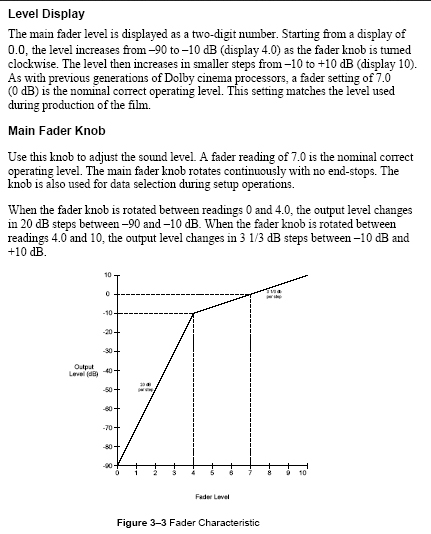
(This came from the CP-650 documentation, but
I believe all models with digital displays follow
this same level 'curve'. I'm not sure about the
early models (CP-50/CP-45) but there's probably
not a wholebuncha them in use any more. )
Posted by Aron Toplitsky (Member # 6950) on 08-27-2017, 10:30 PM:
Hmmm, a lot interesting info! Thanks guys!
And when I posted earlier how I enjoy the volume up nice and loud there has been one exception. When I saw the 15/70 version of Interstellar, there is a scene towards the beginning of the film with Matthew McConaughey, that sustained low note played by the organ was hurting my ears. I literally felt pain from the low frequency. I have a high tolerance, but for me to feel pain means things are out of control!
Posted by Manny Montes (Member # 5639) on 08-27-2017, 10:46 PM:
quote: Jim Cassedy
I was sent out-of-state to run DUNKIRK 70mm at a large theater
in the mid-western part of the US.
They also were playing it in IMAX digital down the hall in another
auditorium. I was given a two-way radio on the theatres' "tech
channel" in case I had a any problems or needed something in my
booth.
On more than one occasion I overheard one of the assistant managers
or someone on the floor staff relaying a customer complaint that the
sound in the IMAX auditorium was too loud, and asking for it to be
turned down a bit. And so their projectionguy would lower the volume
a little, and within a few minutes IMAX was on the phone with him
wanting to know why the volume was changed. On two occasions I
was standing right next to the guy when he got the IMAX call, and
a couple of other times I heard him being paged on the radio to
"come to the phone and talk to IMAX"
So, I assume IMAX must have a NOC that monitors stuff like this.
I asked 'the kid' about it and he said that when he was learning the
system there, he was told that the volume level was 'set in the IMAX
contract". I don't know if that's actually true; I'm only repeating what
I was told, and what I observed- - which is that every time they made
a volume adjustment, or one day when a show started a couple of
minutes late- - IMAX called to find out what was going on.
That's strange, having worked at one of the largest IMAX houses in the US we never got a call regarding volume, in fact there is an IMAX tech bulletin that specifically discusses how to lower volume if you receive customer complaints. The IMAX SMS also has built in volume cues that you can have lower the volume automatically as well (tech bulletin about using this too which specifically says it can be used for the feature OR trailers depending on complaints). This is why all IMAX users are set up as showmanagers because their "limited" usergroup doesn't allow for them to change volume.
I'm not doubting what happened but IMAX even puts the volume control on their PJT so that you can only adjust it + or - 3 (or 5) db and not any further than that. It's strange that they would call asking why you lowered the volume considering they tell you to lower it if you get complaints. Especially because if anyone emails the QC IMAX email that they show at the end of the movie, you'll get a call directly asking what happened with the presentation (and you may even get a visit from a tech because of it).
Posted by Marcel Birgelen (Member # 6801) on 08-28-2017, 04:05 PM:
I think there is a major difference between the classic 70mm IMAX installations and the digital installations regarding how they're monitored. The most of the digital ones are definitely under a different contract with different conditions, than the old "museum-type" installations, that used to play mostly documentaries.
The latter ones also rely on actual projectionists doing their work, being specifically trained to run and monitor the show. The digital version runs just like every other multiplex show: fully automatic and usually barely supervised by a local meatbag, hence the need for more constant remote monitoring.
Also, 24/7 remote monitoring and access, what nowadays can be done with a simple DSL line for a few bucks a month, did cost an arm and a leg in telco fees just a couple of years ago.
Posted by William Kucharski (Member # 7246) on 08-29-2017, 05:04 AM:
quote: Aron Toplitsky
So William would you say most theaters play a film at reference level opening night? I agree and would rather hear a film very loud than turned down. I'm actually getting pretty fed up with theaters playing films too low. Unfortunately I don't like going opening night and dealing with inconsiderate idiots who talk, text or walk in 20 minutes after the movie starts.
There's no good answer for this.
For many houses, they do start the run at the proper level and then turn it down in response to viewer complaints.
On the other hand, at AMC (yes, them again) I've had to complain the movie was barely audible, and have been told it was because a kids' film had been playing in the theater before the premiere of the new feature, and they had it turned "way down" because parents had been complaining they were "damaging children's ears."
My best rule of thumb to try and see films presented at proper volume (and heck, who am I kidding, presented properly period) these days is to just avoid AMC as much as possible. ![[Frown]](frown.gif)
Posted by Martin Brooks (Member # 1269) on 09-03-2017, 07:54 PM:
quote: William Kucharski
On the other hand, at AMC (yes, them again) I've had to complain the movie was barely audible, and have been told it was because a kids' film had been playing in the theater before the premiere of the new feature, and they had it turned "way down" because parents had been complaining they were "damaging children's ears."
Just about every AMC I've been to in NYC plays the films far too LOUD, IMO. I've got to start remembering to bring an SPL meter with me to see what it really is.
Depending upon the situation, the parents were right to be concerned, except they should have been concerned about their own hearing as well. According to a 2002 article in EQ magazine, OSHA considers levels (DB, A-weighted) in excess of the following to be hazardous:
85db 8 hours (street traffic)
95 db 47m+ (loud classical music)
100 db 15m
110 db 89 seconds (thunder)
115 db 28 seconds (loud rock on stage)
Another document, I think from OSHA itself, permits exposure to the following maximums, but remember these are workplace maximums and I don't think leisure activities should permit this same level of exposure:
95db 4 hours
97db 3 hours
100 db 2 hours
102 db 2.5 hours
105 db 1 hour
110 db 30 minutes
115 db 15 minutes
But anytime you walk out of a situation with ringing, damage has been already done. Every musician I know has hearing loss or tinnitus. IMO, sound levels have become completely ridiculous in clubs, music venues, many movie theaters and even some Broadway shows.
I went to see some act at a club and the opening act was a solo flute player. The genius at the sound board threw the levels up as if this guy was Metallica. Completely absurd.
I'm surprised that there's never been a class action lawsuit by employees in bars or music clubs who have experienced hearing loss. Guess it's too hard to prove that it came from any one venue.
Posted by Marcel Birgelen (Member # 6801) on 09-04-2017, 03:01 AM:
My experience with AMC is obviously somewhat limited, but most times I visited, the sound was way too loud, just a few times it was notably lacking and a few times it actually sounded spot on.
Around here, the situation is largely hit and miss in most multiplexes. In Belgium, the biggest chain has actively reduced sound levels in all their complexes, after complains about unhealthy sound levels kept streaming in.
And you know what? They were, unfortunately, entirely right. I don't like their solution though: Globally turning down the fader.
You should think you could assume that if you've got a correctly calibrated room and you play everything at 7.0, you should be fine. But unfortunately, you're not.
In Europe, you'll find all kinds of regulatory bodies in each and every country that will first issue a warning and if you don't take action, will simply shut you down, if they detect you're playing movies at levels considered unhealthy by their definitions. In the U.S., you might find yourself in the midst of an class action suit first.
Once we made the transition from analog to digital soundtracks, we gave those filmmakers a very powerful tool. We gave them 20 dB of extra headroom, they could use to do amazing things.
Instead of doing amazing things with this enormous dynamic range, many filmmakers decided to use it as a weapon against us moviegoers. Because, imagine your movie might not sound as loud as that of your competitor. People want to have it LOUD, don't they? If I scream the loudest, people will remember me!
Just like the radio loudness wars first killed dynamic range in the ether and later even on the very records you buy, it also made many movies unnecessarily loud, so loud in fact, that playing them "at reference", in quite some cases, is just plain bad for your health.
So, that's why any good and responsible showman should act as a layer of protection between the filmmakers vision and the ears of our audience.
Posted by Scott Jentsch (Member # 1681) on 09-07-2017, 10:00 AM:
I haven't noticed the issue in movie theaters that I've been to, but music venues are a different story. Live acts are one thing, but even DJ's at weddings, etc. are guilty of cranking up the volume so high that it's downright painful, and it makes it impossible to talk to someone.
I was a church festival this summer, and there was a live band playing in one of the tents (no side panels). Standing outside the tent, on the opposite side from the speakers that the band was using (probably 300 feet), the sound on my sound level app registered at over 90dBA. It was too loud to my ears, and I don't mind cranking up the music when I'm in the car or alone at home.
My impression of the issue of theater sound is that, unless the theater is just playing it too loud, it's either the mix that is too hot (compressed) or there is an issue with the sound calibration and/or equipment in the theater. Given that I've rarely had issues with mixes on home video releases (admittedly these are often "remixed for home environments"), my guess would be the latter.
Posted by William Kucharski (Member # 7246) on 09-16-2017, 01:23 AM:
Recently honored to be able to hear Dunkirk 70mm and a presentation at the big Paramount screening room.
Both at 7.0, both glorious and both proved to me how much gets lost when the volume gets turned down, not unlike reducing lamp brightness to make bulbs last longer. :-(
(Seriously, after Paramount I'm ruined for any commercial theater, even ArcLight.)
Posted by Jason McMillan (Member # 5542) on 09-18-2017, 10:04 AM:
My two cents on this...
I saw my first digital Imax movie this past weekend. Some friends and I saw "It" in a less-than-a-month-old DLP Imax installation (they picked).
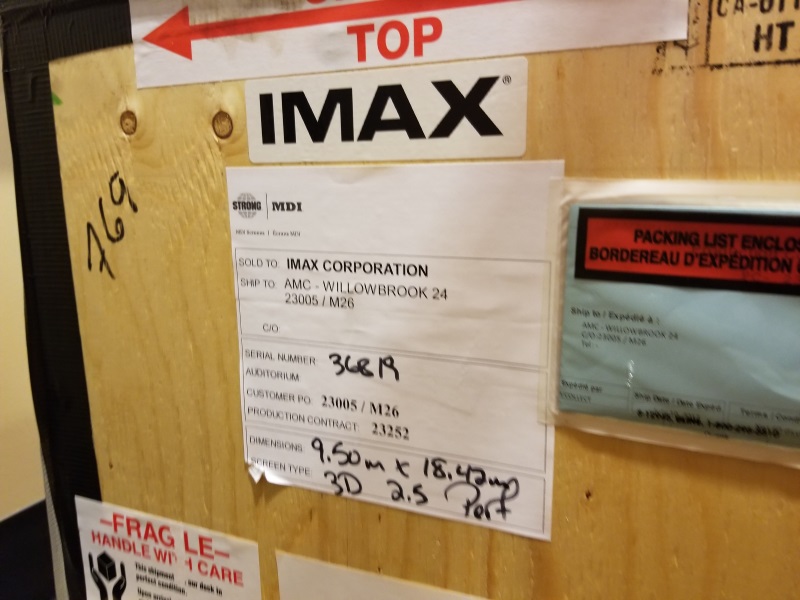
I was horrified at how bad the presentation was. Even 3/4ths of the way back in the auditorium you could clearly see the pixels. This same theatre also has a Dolby Cinema with pretty much the same size screen (I've attached a photo for screen size reference), which I had seen "It" with another group of friends a week earlier, and the presentation was decent enough by AMC standards (mind you not saying they do it right).
I guess I was just really shocked to finally see this for myself and how genuinely bad it looked. It was so distracting I'm not sure I'd spend my money for Digital Imax again.
Powered by Infopop Corporation
UBB.classicTM
6.3.1.2