This is topic IMB with Raspberry PI in forum Digital Cinema Forum at Film-Tech Forum ARCHIVE.
To visit this topic, use this URL:
https://ft-forum.com/ft/cgi-bin/ubb/ultimatebb.cgi?ubb=get_topic;f=16;t=003086
Posted by Carsten Kurz (Member # 5396) on 08-03-2017, 07:05 PM:
Now, is that a teaser subject?
Raspberry PI 3B:
https://cdn-reichelt.de/bilder/web/xxl_ws/A300/RASP_03_01.png
GDC new SR-1000 IMB (IMS):
http://www.gdc-tech.com/ndownload/product/SR1000/SR1000_front.jpg
They just removed the USB sockets. But it sure is a Raspberry PI 3B. It is probably the PI that earns this MB the 'standalone'. No, the PI will not do the heavy (J2K) lifting et al., the MediaBlock itself is below the huge heat sink on the right side.
- Carsten
Edited to upload the photos to the discussion thread. Outside links are not permitted as this breaks the archive at some point in the future.
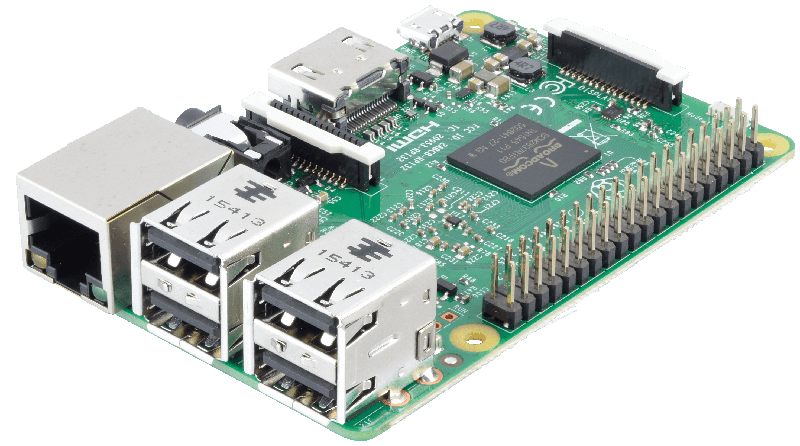
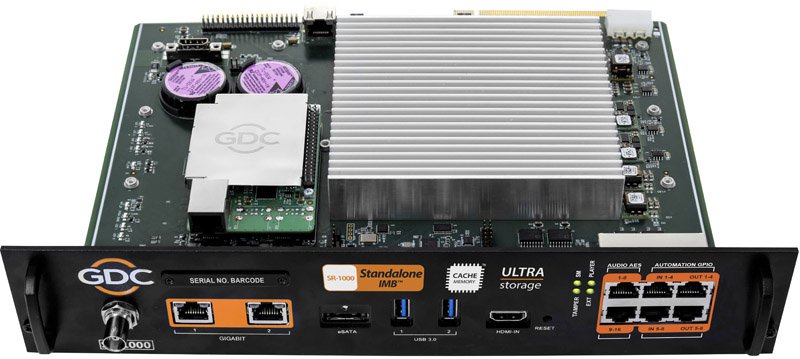
[ 05-16-2019, 10:50 AM: Message edited by: Brad Miller ]
Posted by Dennis Benjamin (Member # 1137) on 08-03-2017, 07:27 PM:
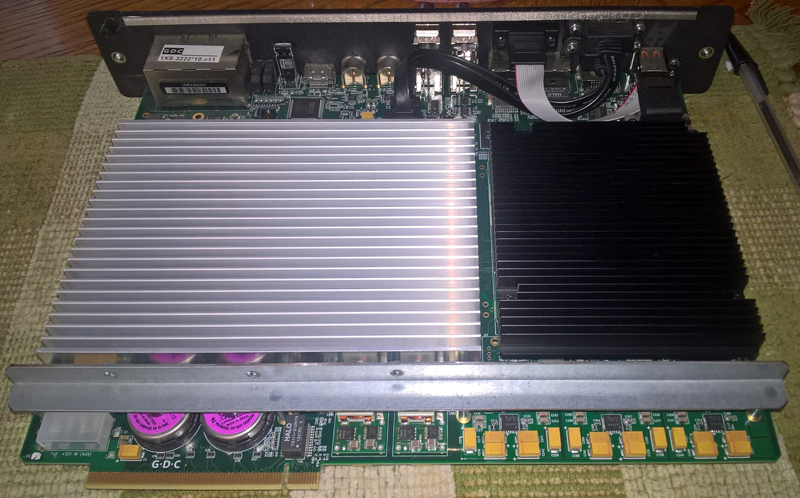
Do you mean the one underneath the metal "GDC" plate in this picture? I noticed this back at CinemaCon and snapped a pic.
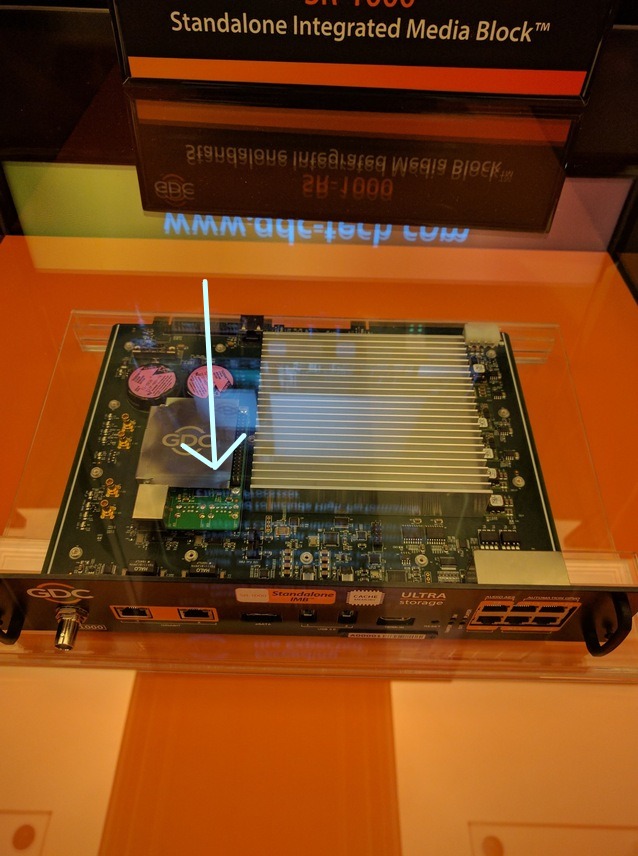
Posted by Tom Bert (Member # 5719) on 08-04-2017, 03:22 AM:
I believe that specific part of the module is onboard (flash) storage: combined with the external NAS/DAS it creates a hybrid system: (some) integrated + (mainly) remote storage
Posted by Marcel Birgelen (Member # 6801) on 08-04-2017, 07:10 AM:
There's obviously no budget for a proper Intel processor and chipset, those IMBs are sold for pennies on the dollar. ![[Wink]](wink.gif)
Is it just me or does this look like a major hackjob? Something I could've come up with, but would rather not be too proud of?
I'm wondering how they interface with it. Did they put headers on the USB ports on the bottom-side? Also, the GPIO pins seem to be entirely untouched.
Posted by Marco Giustini (Member # 4544) on 08-04-2017, 03:07 PM:
The Pi3 is indeed much more powerful than the pi2 but... seriously?
Posted by Mark Gulbrandsen (Member # 72) on 08-04-2017, 05:31 PM:
So far all the GDC IMB's use an Atom processor. The SX-3000 uses a single core Atom.
Mark
Posted by Carsten Kurz (Member # 5396) on 08-04-2017, 08:14 PM:
You can see that this IMB Photo lacks the internal cabling, e.g. between the front HDMI port, and the HDMI port in the back, and there are two Ethernet sockets as well, one of them is probably forwarded to the PI Ethernet port, the other goes to the back close to the MediaBlock heat sink. I guess the PI is just a quick solution to setup a decent GUI and communications. I don't think it will even touch the DCP data during transfer or playout, it is not fast enough. I wouldn't call it a hack, it's a pragmatic solution. You get a cheap embedded system and the OS for free. Then again, we don't know wether the PI will stay there when this IMB is manufactured in numbers.
- Carsten
Posted by Mark Gulbrandsen (Member # 72) on 08-04-2017, 08:34 PM:
I wouldn't be surprised if they left it in place. The latest version of the PI has quite a powerful CPU compared to the first two gestations.
Mark
Posted by Marco Giustini (Member # 4544) on 08-05-2017, 06:01 AM:
Fine but... cannot they integrate the Broadcom processor on their board?
Posted by Pietro Clarici (Member # 4937) on 08-05-2017, 06:11 AM:
The Pi could also be field-replaceable in case of failure, while an onboard SOC would require a full IMS change. Maybe that's what they mean by "new 6th generation D-Cinema media server designed for near-zero maintenance
need and minimal total cost of ownership".
I just don't get how it would interface with the internal cache/flash storage subsystem, given that it only has USB 2.0 and Fast Ethernet.
Posted by Mark Gulbrandsen (Member # 72) on 08-05-2017, 01:23 PM:
quote: Marco Giustini
Fine but... cannot they integrate the Broadcom processor on their board?
Which Broadcom and for what purpose? Broadcom makes a lot of different processors... There are a lot of major parts integrated on all their IMB's outside the actual media block. Having the main processor and some of the sub systems that aren't involved in security issues separate from the actual media block is a huge advantage IMHO.
Mark
Posted by Marcel Birgelen (Member # 6801) on 08-05-2017, 07:03 PM:
quote: Carsten Kurz
I wouldn't call it a hack, it's a pragmatic solution. You get a cheap embedded system and the OS for free. Then again, we don't know wether the PI will stay there when this IMB is manufactured in numbers.
Yeah, pragmatic solution or a hack, the difference is in the details, if there are.
There's no way to get any form of commitment if the Pi3B will still be available in even a few months time. It could've been replaced with a Pi3C or Pi4, with totally different specs and connector layout for example.
Obviously you face similar challenges if you design your own PCBs from scratch, but in most cases the supplier of the individual components, usually gives you a pretty clear overview of the life cycle of the product.
quote: Pietro Clarici
I just don't get how it would interface with the internal cache/flash storage subsystem, given that it only has USB 2.0 and Fast Ethernet.
That's my problem too, the Ethernet interface is just a Fast Ethernet port, so it does 100 MBit at max, which is fine for most IPC purposes, but not something that handles DCP content in real-time in any way or form. USB 2.0 isn't doing any better. So, I guess it will be there as a form of an UI frontend, not to process any actual content, even not as a "NAS".
quote: Mark Gulbrandsen
Which Broadcom and for what purpose? Broadcom makes a lot of different processors...
The BCM2837, which is a quad-core 64-bit ARM-based CPU. You can obviously just integrate them on your own PCB.
Posted by Mark Gulbrandsen (Member # 72) on 08-05-2017, 07:55 PM:
Integrating the main processor precludes any future changes. Plus the media block will undoubtedly be used with other versions of this IMB that may require different processors. It makes it more obsolete proof as upgrades are very easy if an actual part does become obsolete.
Just ask the guys at Dolbly about parts becoming obsolete... I once needed a RAID card for a DSP-100 that was only two years old and they were already NLA. We replaced that DSP-100 with a GDC and kept the old server for parts.
My experience with GDC and parts for older units has been no sweat at all for servers and IMB's. We just replaced a motherboard in a 6 year old GDC server that was skipping just occasionally. GDC tech support led us through checking the RAM and some other stuff. The drives showed they were ok. If that was a Dolby Server they would have said too bad like on the DSP-100... While I can't speak for the GDC support you use I can tell you they are absolutely top notch over here.
Mark
Posted by Carsten Kurz (Member # 5396) on 08-05-2017, 08:48 PM:
quote: Pietro Clarici
I just don't get how it would interface with the internal cache/flash storage subsystem, given that it only has USB 2.0 and Fast Ethernet.
They could use something like FXP (relayed FTP). That way, the PI would only start and coordinate transfers, but the data stream would travel through the second ethernet port (Gigabit) directly to the cache subsystem.
- Carsten
Posted by Ioannis Syrogiannis (Member # 3235) on 08-06-2017, 03:50 AM:
quote: Pietro Clarici
The Pi could also be field-replaceable in case of failure, while an onboard SOC would require a full IMS change.
I wouldn't depend on field-replaceability of customized hardware. But then again, I can't say what is soldered down and what is not by the pictures above.
quote: Mark Gulbrandsen
GDC tech support led us through checking the RAM and some other stuff. The drives showed they were ok. If that was a Dolby Server they would have said too bad like on the DSP-100...
If it was a DSP-100 (DSS employ the HDDs), they probably would, since they passed the support on to another company for some years now.
As for the DSS200 and DSS220, I have been instructed to run RAM checks in the past, and I was lucky to find the culprit.
Now, for "some other stuff", I wouldn't know. Yet I -for one- can't complain about the European support of Dolby, whether it has to do with original Dolby SMSs or with its (French part of) doremi-turned-Dolby ones.
I am in favor of implementing widely tested and available components in an industrial system. I wouldn't know, though if the limitations (mentioned above, or other) of such equipment, designed for micro-computing, would cause strains on the usability of the whole system. For instance, I wouldn't appreciate a non-gigabit ethernet port to serve as a control (nor data) network adapter.
Carsten might be right about missing connectivity, though.
The Ethernet port on the back of the board might be irrelevant to the two ports on the faceplate and serve as a bridge between the Fast Ethernet port of Raspberry π 3 and the rest of the system. It might be that the GPIO is custom connected to the main board on the bottom of it ![[Confused]](confused.gif) or that it is working in a similar manner to the USB drive that was implemented in the doremi DCP2000/DCP2K4/SV3/SV4, where it was just used for hosting the operating system, without posing limitations to the RAID, USB or MB functionality. The difference being that in the doremi case, the same CPU was in charge of the whole system, here you'd have a "system on a chip" to play manager with all other components. (But, hay, what about integrated wi-fi connectivity? That could be a plus, no? On the other hand, so it would be if those SDI interfaces on the left of the board were available on the faceplate... One has to dream big.
or that it is working in a similar manner to the USB drive that was implemented in the doremi DCP2000/DCP2K4/SV3/SV4, where it was just used for hosting the operating system, without posing limitations to the RAID, USB or MB functionality. The difference being that in the doremi case, the same CPU was in charge of the whole system, here you'd have a "system on a chip" to play manager with all other components. (But, hay, what about integrated wi-fi connectivity? That could be a plus, no? On the other hand, so it would be if those SDI interfaces on the left of the board were available on the faceplate... One has to dream big. ![[Smile]](smile.gif) )
)
Posted by Pietro Clarici (Member # 4937) on 08-06-2017, 06:11 AM:
quote: Marcel Birgelen
There's no way to get any form of commitment if the Pi3B will still be available in even a few months time. It could've been replaced with a Pi3C or Pi4, with totally different specs and connector layout for example.
I could be wrong, but I think they can stockpile on standard or lightly modified Pi3s for less than a custom on-board integration. At this point, anything D-Cinema related is going to be very small volume, probably doesn't justify high upfront costs.
Posted by Marco Giustini (Member # 4544) on 08-06-2017, 06:37 AM:
quote: Mark Gulbrandsen
Which Broadcom and for what purpose? Broadcom makes a lot of different processors...
The one installed on the Pi3?
DTS went for standard off the shelf parts in the past. Their DTS6 and DTS6D were just i386/i486 computers with a few proprietary boards. How many versions of motherboard and SCSI boards and CDROM's have we seen in the past? How many customers had to pay an arm and a leg to swap a bad CDROM drive because they also had to replace the SCSI controller which went EOL in the meantime?
Nothing against the Broadcom chip, but I'd like to see a GDC board with the chip on it - not a Pi3.
That said, isn't the Pi3 an open source project? Maybe GDC simply took it, modified and used it for their server. In that case, it's a GDC board they manufacture and which has full GDC support.
Posted by Carsten Kurz (Member # 5396) on 08-06-2017, 06:50 AM:
The PI already has a nice footprint of being held compatible between previous and successor models as much as possible. So I wouldn't be too concerned about that issue. Whoever uses a PI in a commercial product, is able to benefit from all community efforts targeted at the PIs hard- and software development. It's big and healthy enough a project to rely on it for a product like an IMB I'd say.
You only need to make sure the board will not become a performance bottleneck.
- Carsten
Posted by Mark Gulbrandsen (Member # 72) on 08-06-2017, 10:33 AM:
quote: Marco Giustini
DTS went for standard off the shelf parts in the past. Their DTS6 and DTS6D were just i386/i486 computers with a few proprietary boards.
Well, DTS-6 & 6D motherboards were very reliable and there was no foreseen need to have to upgrade the computing power in them... they were what they were so to say. However, a good example is when DTS went through some serious issues with the XD-10 and it's first verson motherboards all failed because they got caught in the capacitor scam some years back. All of the first generation XD-10's motherboards eventually failed. DTS could rebuild the player, but the cost was 1200 USD to do it. It required a new motherboard which of course was quite a bit different than the original. This entailed replacing some parts of the chassis and metal work to accommodate the new board. The rest of the boards more or less stayed the same, although the D to A board had to be modified to work with the new power supply. And of course.... the original motherboard could just be re-capped in about an hour and was the subject of a post I did on here some years ago. Eventually, I recapped several dozen of the first Gen DTS motherboards rather than submit to the 1200 USD repair by DTS.
So assume this is Doremi or Dolby having these capacitor issues on the motherboard in their server... Dolby did in fact have this issue with some of their CP-650 power supplies. Thank god those supplies were not part of the main board!
Mark
Posted by Marco Giustini (Member # 4544) on 08-06-2017, 03:30 PM:
I don't want to go OT, Mark, but I clearly remember that DTS also had issues with CDROM's - which weren't lasting forever anyway - and the original 2x SCSI required a different controller than the later 4x SCSI and they then went for a SCSI to IDE bridge for the latest models.
We can argue as much as you want on this, the bottom line is that if you rely on a off the shelf part, you cannot control its availability.
Posted by David Buckley (Member # 2600) on 08-06-2017, 04:01 PM:
That absolutely is a Pi 3, if you blow the images up you can see the component annotations are the same.
However, this is nothing unusual, the Pi is used in truckloads of applications exactly like this. In exactly the same way that many boxes one buys have the standard PC socketry on the back, because under the covers, there is a standard PC motherboard in the box.
Why reinvent wheels?
Posted by Carsten Kurz (Member # 5396) on 08-06-2017, 04:08 PM:
Marco - isn't nearly every part an off-the-shelf part?
Sometimes this is a benefit in itself - relying on a standard part that can be expected to be available for a longer period of time, because you can consider it an industry standard. Like a USB interface. Yes, sometimes your estimate goes wrong and something is gone sooner than you expected. But then, maybe DTS did not rely on a CD-ROM drive, but a SCSI interface, and because SCSI was so popular so long, they could later even source off-the-shelf SCSI-ATAPI bridges. Given the enormous speed of development and thus volativity of computer hardware during the nineties, not such bad track record. We can still source SCSI CD-ROM drives today. Yes, not for new products, but you still benefit from their huge previous market penetration.
Maybe, on this IMB, they do not rely on a PI 3B, but an embedded board with a Linux based OS and Ethernet connectivity. If there will be no PIs in three years ( highly unlikely), they can easily source another system with this minimal feature set.
- Carsten
Posted by Marco Giustini (Member # 4544) on 08-06-2017, 05:08 PM:
indeed they could manufacture their own Broadcomm board and then declare it EOL when the Broadcomm chip is not available anymore. But I think the Pi is another story. Pi4 will be out at some point and what happens to the GDC's? Maybe they'll just adapt the Pi4. Or maybe they'll ask you to install an adaptor and a different board at 2x the price.
Indeed DTS was able to keep the 6 and 6D alive for a long time relying on SCSI technology. However, lots of customers had to pay fortunes to replace the whole chain CDROMS -> SCSI boards when the technology changed.
If you design your own board, you can issue a rev2 with a different chip when the older chip is not available anymore.
Posted by Marcel Birgelen (Member # 6801) on 08-06-2017, 07:04 PM:
I'd say, if you simply put some kind of Atom reference design on your IMB, you can go all directions you want to go. It's something that can be done almost out of the box. A modern Atom will also handle gigabit speeds with ease for most applications. And, as a bonus, interfacing with the mediablock, should be easier. You can put the heavy lifting stuff right on the PCIe for example.
I still don't get what this RPI3 will be doing there. Will it be the "controller part" of the IMB? Will it run the User Interface and control APIs? How will it communicate to the rest of the IMB? Via Ethernet? It all sounds pretty bloated to me. Or will it just fulfill some auxiliary functions which we're forgetting about?
Posted by Mark Gulbrandsen (Member # 72) on 08-09-2017, 11:18 AM:
quote: Marcel Birgelen
I still don't get what this RPI3 will be doing there. Will it be the "controller part" of the IMB? Will it run the User Interface and control APIs?
Yes, it will be the main system controller, just like the Atom board is that is used on the SX-3000 now. I believe the Quad Core on the current Raspberry Pi is actually quite a bit more powerful than the Atom is, although I need to confirm which Atom is being used next time I go into the bios.
In the case of the current AR GDC Media Block, It acts as a media block/motherboard. Adding extra components gets you an SX-3000 and one of the larger added components is the Atom processor board that's under the black heat sink. It is field replaceable and the RAM Drive is right below it on the bottom side.
So, if the RP-3.0 is as powerful or better, then why not use it instead? Its inexpensive and very reliable. I have one here that I made a nifty NTP time server out of.
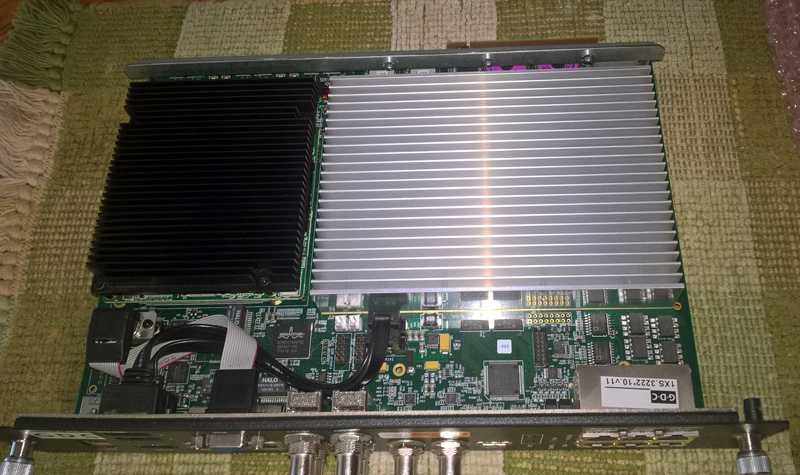
Posted by Tom Bert (Member # 5719) on 08-10-2017, 06:14 AM:
quote: Marcel Birgelen
Or will it just fulfill some auxiliary functions which we're forgetting about?
quote: Tom Bert
I believe that specific part of the module is onboard (flash) storage: combined with the external NAS/DAS it creates a hybrid system: (some) integrated + (mainly) remote storage
Posted by Marcel Birgelen (Member # 6801) on 08-10-2017, 06:26 AM:
That's specifically were I see the potential pitfalls of using a RaspberryPI 3(B), because the thing has only a Fast Ethernet connection. Also, the USB interfaces are only USB 2.0.
While USB 2.0 can theoretically achieve 53 MB/s, Fast Ethernet is stuck at a theoretical 12 MB/s. By all means, the Pi3 doesn't sound like the best solution for such a function.
Posted by Leslie Hartmier (Member # 7053) on 08-10-2017, 01:59 PM:
For those people who mentioned the longevity of access to Pi3B, remember that the schematics for making your own are available.
It is easy to buy Pi3Bs. It is fun to make Pi3Bs.
Just saying.
Leslie
Posted by Mark Gulbrandsen (Member # 72) on 08-10-2017, 07:15 PM:
quote: Marcel Birgelen
because the thing has only a Fast Ethernet connection.
Actually, it does have other interfaces besides ethernet, usually it's through other boards that plug on to the Pi.
Mark
Posted by Marcel Birgelen (Member # 6801) on 08-10-2017, 07:42 PM:
It does, it has plenty of GPIOs, it has HDMI, it has a "camera" port and a "display" port.
The GPIOs obviously don't outperform Ethernet and USB and the other interfaces aren't really the most suitable ports for interfacing with a "motherboard" or daughter card.
The thing misses a generic high-speed bus like PCI-e, which the Atom actually does offer.
Posted by Carsten Kurz (Member # 5396) on 08-11-2017, 05:29 AM:
Marcel, the PI does not necessarily need a fast data connection. This is an IMS. You could think of the PI as a touch panel controller. As on a Barco or Christie, they don't need any direct contact with the DCP data. That can be dealt with by other (sub)systems.
- Carsten
Posted by Marcel Birgelen (Member # 6801) on 08-11-2017, 05:49 AM:
Carsten, that's true if it just runs the IMS part, but Tom indicates that it serves as a storage "frontend" for both internal flash storage and remote storage. If that is true, it will need to transport a considerable amount of data. If it is indeed just the IMS and doesn't do the heavy lifting, a RasPi should be sufficient.
Posted by Dennis Benjamin (Member # 1137) on 08-11-2017, 07:05 AM:
quote: Carsten Kurz
You could think of the PI as a touch panel controller
This makes the most sense in regards to what it's being used for.
Posted by Mark Gulbrandsen (Member # 72) on 08-11-2017, 05:19 PM:
quote: Marcel Birgelen
but Tom indicates that it serves as a storage "frontend" for both internal flash storage and remote storage. If that is true, it will need to transport a considerable amount of data.
That's not even how the SX-3000 operates. There is a separate storage controller processor that does all that. It's gonna be eSATA or gigabit or faster ethernet for the incoming data.
Mark
Posted by Dave Macaulay (Member # 813) on 08-12-2017, 10:45 AM:
What does this matter? If it works, and it seems to, great. Design decisions are both technical and economic. Why design and qualify a processor subsystem if an off-the-shelf one will do the job?
Posted by Mark Gulbrandsen (Member # 72) on 08-12-2017, 02:58 PM:
Exactly Dave... Even the SX-3000 CPU board is an off the shelf item. It is not doing any of the actual signal handling anyways.
Mark
Posted by Leo Enticknap (Member # 534) on 08-12-2017, 10:09 PM:
quote: Dave Macaulay
Why design and qualify a processor subsystem if an off-the-shelf one will do the job?
And furthermore, if the off-the-shelf component has been manufactured in larger quantities and for a greater range of applications than something as specialized as an IMB (for which a few thousand of each model will have been made at most), that potentially extends the service life of the product it's being used as part of: there will be a better chance of being able to obtain a replacement if it fails after the product it's integrated into is no longer officially supported by the manufacturer.
A recent example I encountered is the power supply units in DSS100s - they're a standard issue Supermicro server slide-in PSU, still used in datacenters everywhere and thus easily available from several vendors.
Posted by Mark Gulbrandsen (Member # 72) on 08-13-2017, 10:44 AM:
quote: Leo Enticknap
A recent example I encountered is the power supply units in DSS100s - they're a standard issue Supermicro server slide-in PSU, still used in datacenters everywhere and thus easily available from several vendors.
Actually, All of Dolbly's servers are customized Super Micro equipment. The fan noise speaks for itself ![[Roll Eyes]](rolleyes.gif) . IMagine if Dell had made them for Dolbly how quiet today's booths would be.
. IMagine if Dell had made them for Dolbly how quiet today's booths would be.
Mark
Posted by Mark Gulbrandsen (Member # 72) on 08-13-2017, 08:20 PM:
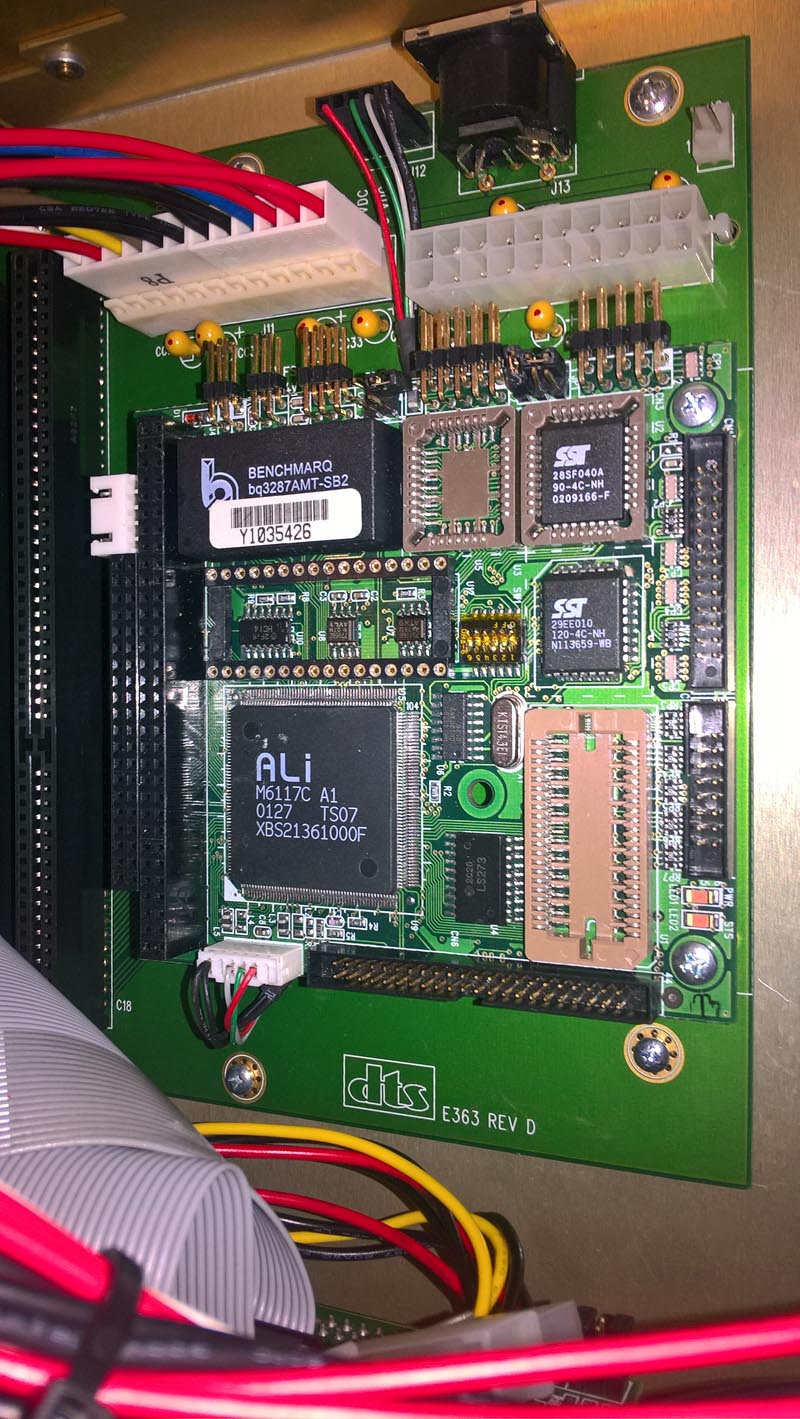
Marcel... Speaking of DTS... I had an interesting encounter today in a DTS 6D. I serviced lots and lots of these but never saw one like this. Must have been a way to rebuild units that had failed motherboards. Years back this player has been sent to Computer Spirit which was one of the DTS sub contractors. It has a buss style motherboard and a small industrial 386 equivalent plug on processor board. The Ali chip is a 40 mhz 386 and the board has 4 gb of ram. Its evident that in doing this DTS still wanted to be able to offer repair on these units down the road so they didn't become obsolete. There are various small Chinese industrial computers that would fit in this spot. This had to be the last of the mods DTS provided for the 6D.
Also, The Benchmarq BQ3287 is a lithium backed RTC. Although it likely has a very long life, but its still going to die and crash eventually. 10 to 15 years is typical for these in other equipment I've worked on.
Mark
Posted by Marcel Birgelen (Member # 6801) on 08-18-2017, 04:58 AM:
Interesting find. I guess DTS never got their software to run on more recent Intel compatible CPUs, so that's why they resorted to some exotic Intel 386 compatible chipsets. Else, you'd indeed expect them to use off-the-shelf Intel compatibles, of which there is an almost endless supply.
It's probably one of those cases were the original software developers are long gone and nobody dares to touch the original code. Or even worse, where the original code is gone and all that's left is a binary runtime.
Posted by Mark Gulbrandsen (Member # 72) on 08-18-2017, 11:22 AM:
This was a 6D that had been sent back and upgraded by them, obviously long after they ran out of the original 386 motherboards. This one is still running on DOS.
Mark
Posted by Gordon McLeod (Member # 33) on 08-18-2017, 11:55 AM:
All 6d ran dos
either from a Rom dos card or embedded
Powered by Infopop Corporation
UBB.classicTM
6.3.1.2