This is topic JNIOR Redesign in forum Digital Cinema Forum at Film-Tech Forum ARCHIVE.
To visit this topic, use this URL:
https://ft-forum.com/ft/cgi-bin/ubb/ultimatebb.cgi?ubb=get_topic;f=16;t=003139
Posted by Bruce Cloutier (Member # 9615) on 10-13-2017, 11:13 AM:
I know you guys can help me with this. We just had yet another discussion around the office about the JNIOR and its enclosure and connectors. Even we know it is not ideal!
Part of the problem too is that the thing is not only used in the cinema market. Everyone has their own opinions as to what might be a better package. We encounter different situations and environments.
I am also not looking for complaints from the one or two of you that we know always have something to say. Somehow I need to collect some constructive criticism and food for thought. At the same time feel like we're coming to a consensus that would be helpful industry wide. I also need to know what works for you already.
I've heard before that a 1U rack mount would be nice. But there is more to it than that. Should all connections be on the rear? If the box is only a few inches deep would that impact your ability to wire back there? What should be on the front? Etc. Then there is the question as to whether or not there would be any demand for that new format? I mean there has to be enough because it is expensive to make just 100 of something. Then you won't like the price.
Okay, so we all carry around cameras. To start I would like to collect photos of as many JNIOR installations as possible. Good and bad. It doesn't matter if you are proud of your handiwork or not. We will keep them anonymous. I don't need to know where they are or who did it.
Maybe studying these pictures I can come up with simple changes that can benefit all of you. Or perhaps it will be apparent as to what direction we should go with it.
Besides a gallery of these photos might be helpful to those of you trying to figure out how to install the things. It could be fun.
Please feel free to post photos here, private message me, or email me directly. Heck you can mail actual pictures on something like paper using a stamp right to the office.
You can also join our new covert tech forum at jnior.com. Kevin and I are running this on the side solely to create a direct connection between user and designer. You can post there. By the way, I have been adding Series 3 technical information there to help you with those now that they are out of production. Some of you are trying to redeploy them as more and more Series 4 units are being installed.
What do you think? Do you want to help?
Posted by Marcel Birgelen (Member # 6801) on 10-13-2017, 05:52 PM:
I've used Alcorn McBride equipment for show automation in the past (they're big in the theme park market, you'll find them at the heart of many ride systems).
Both their V4 and V16 show controller are rack mountable, which I really do like. I think if you want to expand considerably beyond just "simple" cinema automation, 19" rack mountable units are a must have. They put all their I/O on the backside and I think that's the most reasonable way to roll. Unless you're building Ethernet or Voice gear, you should preferably put your I/O on the back side of things.
The only problem I have with ports on the back-side is that when you have a lot of equipment with differing heights in the same rack and one of those units is shorter and not very high (e.g. 1 or 2U), it will make those ports hard to reach.
Still, the front-side should be the "human interface" part and the back-side the machine interface. What might be useful though is a console port on the front-side. Also, if you offer something like an interactive display, make sure you can configure the network settings that way.
What I also like about the Alcorn McBridge machines is the way they connect their inputs. Instead of using cable clamps, they're using DB-9 and DB-37 connectors, which makes swapping the unit pretty easy, it also reduces the reachability issues, as it is far easier to plug in most connectors than to connect individual wires.
Posted by Bruce Cloutier (Member # 9615) on 10-14-2017, 08:46 AM:
Great comments Marcel!
quote: Marcel Birgelen
The only problem I have with ports on the back-side is that when you have a lot of equipment with differing heights in the same rack and one of those units is shorter and not very high (e.g. 1 or 2U), it will make those ports hard to reach.
This is the exact concern I run into. I agree with ports on the rear with potentially the COM/Diagnostic port connection on the front. Relative to the JNIOR we would also have all of the LED indicators on the front. The door is then open for other HMI options.
But the height is of concern. To keep costs down I would tend towards a short box. That allowing connectors and indicators on both edges of a single PCB. But exactly as you mention that makes access to the rear difficult. We would still use the removable two-piece connectors but still 1U is a tight space to reach into.
Making the package deeper would then increase the cost. Not just because the box is bigger but because we would then need to use separate PCBs and some form of board to board interconnection. I'm not aware of any standard. What would be the ideal depth of the box then?
Of course now you could use a 1U drawer/tray and mount the current JNIOR on it. I am sure no one has bothered but it is an idea.
I might break the ice here and post some photos of JNIORs in the office. We have them basically thrown all around. Rick tried to neatly mount his on the wall. Kevin has shelves lined with them.
It would really help for me to see some shots of your JNIORs laying in the bottom of pedestals and things like that.
Posted by Bruce Cloutier (Member # 9615) on 10-16-2017, 12:41 PM:
Also if you like to read but don't post... You can join jnior.com with an alias. So far the private messages and emails have been awesome. I'd like to foster some discussion if that is at all possible. It's the idea behind trying to develop a consensus. Maybe we can use this forum that Kevin and I have just put up.
Posted by Kenneth Wuepper (Member # 1174) on 10-16-2017, 06:12 PM:
Hello Bruce,
You have a great idea for using the internet to get some really valid market research.
If there are folks that are willing to help design the item it is highly probable that they will purchase the product of their creation.
Wonderful idea. Competitors beware.
KEN
Posted by Bruce Cloutier (Member # 9615) on 10-17-2017, 09:11 AM:
Well it would be nice if people bought more JNIORs but honestly I am just trying not to have to design in a vacuum.
Engineers like to design solutions to user's problems. Well most I think. From my perspective the only users that have a problem with our product are the ones that have already bought the thing.
Marketing, Sales and Business people have problems like not selling enough product. Users have issues like trying to make it work after someone else has bought it.
Through my career I have done a lot of guessing as to what you and everyone else wants. I try to create flexible and generic tools that hopefully can be someone's solution to their problem. In this case that is why you find JNIORs running aspects of transportation systems. For example, you've run your car through a car wash. The JNIOR controls car washes made for whole trains. At the same time it can control your house lights and protect your patrons in case of fire.
It would be awesome if I could be made to feel your pain. Given the opportunity to understand what the implementer goes through. And, afforded the chance to create an ideal solution. The Internet is a great tool for this.
You are right to point out that few take advantage of it. Look around you. None of your technology is perfect and working as precisely as you think that it should. Makes me worry about computers navigating the roads.
Uh. Okay. You don't want to get me off on a rant. I can do a great Lewis Black impression. ;-)
Posted by Barry Floyd (Member # 385) on 10-17-2017, 03:31 PM:
When we made the switch from 35mm projection to Digital projection several years ago, we had never used any type of automation in a drive-in setting before. I have seen many JNIOR automation installations before, but they always seemed to be a "hack-job" secured to a pedestal with zip-ties. When we looked at all of the various automation units available, I immediately dismissed anything that was not rack mountable.
We ultimately went with the KLA-1 automation units from American Cinema Equipment. Very simple 1 RU space design which is essentially a 1 ru space panel with a circuit board on the back of it and some LED's on the front. It ties in easily with our servers, and the pluggable terminal blocks makes connections to the in-house controlled devices a breeze. It also offers control via RJ45 connections as well.
You mentioned having a "deep box". This particular unit we have doesn't even have a box or chassis. Pretty simple design, and gets the job done. Don't know why the JNIOR couldn't be adapted to a similar design.
Posted by Randy Stankey (Member # 64) on 10-17-2017, 04:31 PM:
Instead of completely reinventing the wheel, why don't you build a rack unit which has a mount for an existing JNIOR controller with breakouts for various connectors that people might use.
You already make expansion modules that attach to an existing controller. Why not build on this idea?
A rack mount could have a spot to hold a JNIOR module and a power supply, if needed. It could have punch-outs in the face or back plates for people to install the connectors that they need.
It would almost be like a "Build Your Own" type system that the customer can use to create just what he needs.
At Mercyhurst, I used to have a Component Engineering TA-10 automation. I liked that automation because it allowed me to build the kind of system that I need without a lot of extras that I didn't need. It was kind of like a box of Legos that I could use to build whatever I want.
The TA-10 came in a rack mount configuation...
http://www.componentengineering.com/ta10.html
The rack/drawer mount unit is what I am thinking of.
Posted by Steve Guttag (Member # 268) on 10-17-2017, 04:43 PM:
I guess an advantage to that style of wiring (the KLA-1) is that one merely takes the rack panel off and dangles the unit while wiring it and then put it back so one need not leave any space to it. That said, it still has three relays for up to 5A of control, presumably 120V devices so one is routing that sort of wire in a potentially tight space. I can definitely see how some would be drawn to that style.
Thus far, for me, I've used the EPRAD eCNA-5P by treating it as a 2-part system. Mount the eCNA-5P on a low-cost rack shelf (e.g. Mid Atlantic UTR-1) and mount that at the rear of the rack/pedestal so wiring is quick/easy. It too has removable terminal blocks that are well labeled on the removable part too and the controls are connected via umbilical to a panel on the front.
The other style we've used is the eCNA-10R. This unit is rackmount BUT unlike the eCNA-5R, the 10 has the front panel flip down so one can wire/service it.
So, if you are looking to pre-package the jnior, those are the styles that would draw me to the automation.
I agree with Barry that it shouldn't look like a "hack job" though I'll admit, due to the very fast pace so many of the DCinema conversions happened, things were dress a lot less than I had been accustomed in the past.
Posted by Bruce Cloutier (Member # 9615) on 10-17-2017, 04:54 PM:
We figured that people would just get a standard rack mount tray either 1U or 2U. The JNIOR would just be mounted to it centered. It takes but two screw holes or good double-sided tape to affix it. Heck you could even pull the JNIOR out of the box and just mount the board. MIT does that. We sell the boards to them without the housings.
Do you realize that you could ask us for a quantity of JNIORs mounted that way? No one has. And since we weren't aware of anyone mounting their JNIORs in a tray (aside from MIT) we haven't been able to justify going in that direction.
I could design something but that doesn't mean that the company decides to invest in its production and subsequent marketing. Not that we do much of the latter. It takes demand and sometimes that has to be completely in your face before you realize what you should be doing.
This is why I am here trying to collect the feedback (by force if I can).
Are you saying that you selected the automation more or less because of the packaging?
Posted by Steve Guttag (Member # 268) on 10-17-2017, 07:18 PM:
I think you'll find that is a factor in it. A tech is going to be influenced by the ease in which something goes in or is repaired. A support person will be influenced by what is inside (the UI, feature set and the number of calls one gets on it). The field tech and the support person may be the same person (I am) so it all goes into the mix.
I can say that I've dismissed equipment in the past due to packaging. I generally look down on things that have wall-wart power supplies too. I realize it is the easy street to UL listing but it is an outlet hungry device. In-line supplies are better but then you have to tie them up, afix them down or otherwise find a separate place for them. If one is putting the automation on a shelf, perhaps one can affix an in-line supply to the same shelf.
I can tell you that when one is putting in a complex, the more out-of-the-box ready something is the better. The more kit-like, the worse. Field time is expensive and time is always in short supply.
To use a different type of product entirely, speakers. When I started, speakers were shipped as entire kits (particularly from JBL). If you ordered a stage speaker, you got a cabinet in one box, drivers individually boxed, brackets individually boxed, horns...etc. So step one, you put it all together. It would easily quadruple installation time. Look at how QSC packages their speakers. Take the LF cabinet out, set the HF (or MF/HF) on top and screw down...done. Don't think that sort of thing doesn't influence purchasing decisions. It all goes into the cost of using something.
I guarantee you that people are choosing some servers not for their performance but for how fast the installation goes or if it can be pre-packaged in the projector. An IMS or ICMP can be installed faster than the multi-piece designs.
So back to automations, I'm sure some choices will be based on how fast/easy the installation goes, without any respect to what it does.
Posted by Bruce Cloutier (Member # 9615) on 10-17-2017, 08:13 PM:
I suppose a lot depends on the care and attention a tech can give to an installation. Or should I say 'allowed' to give to an installation. It sounds like here that some thought it was sufficient to hang the JNIOR and haphazard the wiring. Then when others see that implementation it detracts from the perceived quality of the automation in total. Unfortunately.
Not all installations involve racks. When Kodak first encouraged us to create the Series 3 JNIOR they were interested in a wall mounting. So the wall wart power supply seemed appropriate at the time.
Still other applications already have a voltage source sufficient to power the JNIOR and don't use our supply. Typically that is the case outside of the cinema market.
But, I agree, I too am not a fan of the wall warts. It's even a rats nest here at INTEG. We just don't have any other option with current package. We do not force you to use our supplies. The in-line supplies are an option for you.
Again, this is why I am getting out here. None of this feedback ever got back to me before. And those who use the JNIOR in volume certainly would have the incentive to tell us how they would rather it be.
Posted by Randy Stankey (Member # 64) on 10-17-2017, 09:50 PM:
It seems to me that you are already half way to producing the JNIOR in a rack/tray mounted configuration. You're already selling bare boards for other people to mount as they see fit. You're just not making the "home stretch."
You already say that the JNIOR can be mounted in a tray but you let the customer figure that out for himself. You are already thinking about the wall wart versus in-line power supply issue. You are already thinking about how to mount the unit in a tray. You are already thinking about connection/wiring issues. Why not do these things yourself and get the money for providing the goods and services that others are already doing for themselves?
There are companies that provide box builds and custom enclosures. I don't know for sure but the company that manufactures your units might already provide that service.
The electronics manufacturer that I worked for does provide that service.
Posted by Buck Wilson (Member # 5885) on 10-17-2017, 11:51 PM:
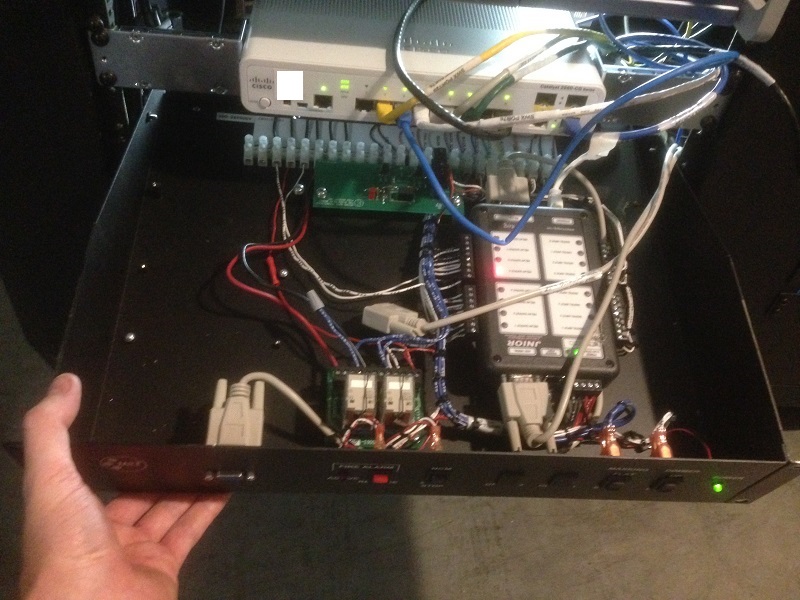
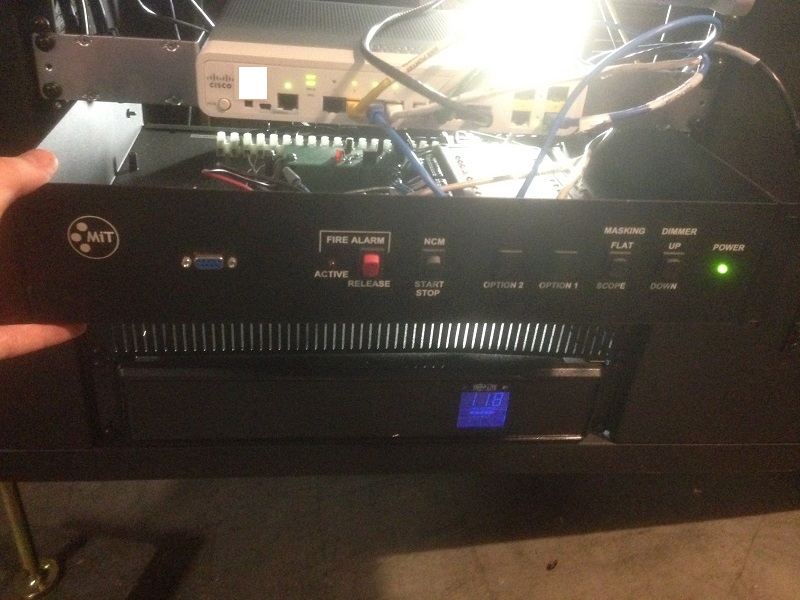
As with others, these were installed in a hurry. Ready-made rack mount would have saved them a lot of time and frustration, I remember them getting these in and working was a bit of a nightmare.
We'll soon be switching to eCNA automatons in order to allow automated bulb shutdowns based on zero ticket sales.
Posted by Steve Guttag (Member # 268) on 10-18-2017, 07:28 AM:
See. That right there is what I hate about rackmounted automations (some of them). It is impossible to work with. Even leaving the cover off, if you have anything above it, you can't get to it.
MIT makes a smaller automation IMC2 that is 1U and is a "canned" solution with buttons on the front, connectors on the rear (outside). Place it at the top of the pedestal rack and you'll always get to the connectors. Its program is set but has most of high points covered and there are undefined relays that have commands that fire them built in so you can go beyond the very basic.
As for the eCNA that can shut your lamps off with zero ticket sales, that is the new "nano host" that actually gets a copy of the POS schedule that a TMS would get and parses out the ticket sales. Way cool.
Posted by Bruce Cloutier (Member # 9615) on 10-18-2017, 07:59 AM:
quote: Buck Wilson
We'll soon be switching to eCNA automatons in order to allow automated bulb shutdowns based on zero ticket sales.
By the way this is something that we can easily handle. It just doesn't appear as a default function. You just need to tell us which POS system you are using so we can track down the protocol.
I think that one thing with us that most of you are missing is that you can ask and tell us what you need. We won't tell you that the JNIOR is what it is and that you can go fly. Rick and Kevin are constantly working unique solutions for customers and I am sure that we are not charging them for any of it. We probably should as its revenue left on the table. But, really it is all about making the JNIOR perfect. We are all engineers here and not really business people. We like to be a part of the team.
That goes for physical mounting. You know you can easily get rack mount trays through Amazon these days. We would be happy to create a specific configuration but for us to keep costs down we need to produce it at least in the 100s. That is a lot (especially when there might be steel involved and weight) to inventory without knowing what kind of demand there is or how quickly they will move. And there is the question as to how that might impact the current JNIOR inventories. We 100% manufacture in the USA by the way.
Ask yourself too, when you call the others for support do you get a real person, better yet do you get the president and an owner of the company? If you leave a message does it forward immediately to that person's cell phone or is it picked up by a support tech on Monday morning? INTEG is really unique in that sense. Rick has supported customers while standing on the sidelines of his kid's soccer fields. Maybe he is crazy.
Look I hate to 'sell'. I am really looking to define my next project with help from you all here.
Also, there are no proprietary secrets with the JNIOR. So if you want to know how something works just ask. I'll show you schematics. I'll show you JANOS operating system code. If the others will do all of that then I accept defeat. Is it worth anything to you?
Posted by Harold Hallikainen (Member # 5405) on 10-18-2017, 10:57 AM:
Interesting discussion! It's always interesting to hear how to make products better. The POS lamp control is interesting. Is automation the best place to handle this, or should it be handled by the SMS? The SMS could just not run a show if it knew no tickets were sold.
Is POS API information readily available? Is it somewhat standardized, or does everyone do their own thing?
Thanks!
Harold
Posted by Bruce Cloutier (Member # 9615) on 10-18-2017, 11:20 AM:
Let me relate my perception of this POS stuff so you can set me straight.
If a theater is going to be showing a film soon after the completion of the prior show it is better to keep lamps lit in standby or whatever than to shut them down and restrike them. The automation can get involved with that. If it gets an indication from the POS system that the next movie is going to indeed be run then it keeps the lamps at the ready. Otherwise it allows them to shut off.
It does seem like this can be done by the media server if it talks with the POS system. The automation can be used to work-around any limitation.
One advantage of using the automation would be potentially more flexibility for the theater to tune how it works. For instance it might matter what the temperature in the projection booth has become. The automation would be in a better position to take that additional parameter into consideration in deciding whether to keep the lamp active.
Anyway, JNIOR can be easily programmed to do all of this.
I am told that a few years ago we had an inquiry and so we talked to a couple of POS systems. At that time the only information available from them would be the sales numbers and they (rightfully) were protective of those. So there wasn't a ready-made protocol. There might be something now where you can ask the POS about an upcoming show status.
If anyone wants this on their JNIOR, just call and ask Rick for it. Give us a contact for your POS vender and we can make it happen. Heck, we can even put something up front so your cashiers can green-light a show. A JNIOR can run all of that. Um, well let's be a little cautious as to how much we can do with a Series 3. The current product (Series 4 - 410, 412 and 414) can be all over this in a millisecond.
Posted by Steve Guttag (Member # 268) on 10-18-2017, 11:34 AM:
I have an opinion on that too (big surprise ![[Eek!]](eek.gif) )
)
The automation is the best place to handle this, not the SMS server. You don't want to cancel the show, you just want to keep the lamp off to preserve life. If someone comes in late, once that ticket is sold, the lamp can turn on to the show "already in progress."
As for the POS systems. There are a range of no standards to quasi-standards like the "blode" file. Every POS system that wants to sell in the DCinema world HAS to provide a schedule export in order for TMS systems to be able to parse the film schedule. Most POS systems will have in that file remaining seat count (at least from what I can tell of the ones I've looked at). You may need to know what the total potential seats are to know when that first one is sold.
Most any of the POS companies will happily send you their schema for their respective export files. I have no doubt that some do NOT have ticket sold information in them but many do. It may be on a case-by-case basis.
Heck Film-Tech's TMS system monitors the seat count to alter the volume level of a particular show (fuller theatres get more volume than nearly empty ones).
Posted by Buck Wilson (Member # 5885) on 10-18-2017, 03:13 PM:
quote: Bruce Cloutier
By the way this is something that we can easily handle. It just doesn't appear as a default function. You just need to tell us which POS system you are using so we can track down the protocol.
I figured that might be the case, but alas, it's completely out of my hands. I'm not sure why they feel the need to switch then, especially considering I've been told "They're not even going to hook up the masking because the new automation doesn't have a way of handling it" That's gotta be a crock of shit. SO DUMB.
Posted by Dave Macaulay (Member # 813) on 10-18-2017, 03:17 PM:
I could take a lot of pictures of where we've installed them, but description is enough.
- attached to the inside of the sound rack, generally with machine screws but maybe some with tek screws to remind ppl not to walk too close to it.
- Attached to the inside front of projector pedestal, same mounting method.
Those are chosen according to the location of the auditorium network switch and/or server and UPS.
- booth wall beside the port, screwed to the wall. Power supply gets tricky here but some clients want this. They can see the "heartbeat" LED and function LEDs.
- hanging on wire tie inside the rack or pedestal. Poor choice but I see this.
- just laying in a mass of wires and dirt inside the pedestal. Really poor choice.
I have come across a few MIT rackmounted ones. This mount is pretty much a PITA, the default wiring has never been useful, the Jnior is annoying to connect to since the tray has to come out, and it's invisible when installed.
I have no problem with the unit as is.
As far as functionality it's incredible. We generally use them just as network controlled relays and event inputs but have used some of the more advanced features. The downside to that is easy swapability... with them unmodified except for addressing it's a snap to replace one. Having them with devices, cues, TCP/IP to serial enabled, etc... you then need a system to save the configurations and keep those saves up to date so replacement doesn't turn into a head shaker.
Support is amazing. Rick may indeed be crazy.
Posted by Bruce Cloutier (Member # 9615) on 10-19-2017, 08:19 AM:
As an aside, one of the issues that we see with the JNIOR is that brief power interruptions and dropouts say from nearby air conditioning compressors kicking in cause the controller to reboot. The solution as you all probably know is to run these critical circuits on a UPS.
Using a separate UPS is not always cost effective and the lack of stable power can be an issue in a lot of cases (where the JNIOR is employed.
Right now I am developing the 412DMX JNIOR. We have a functional prototype and will have a few more shortly. This model replaces the AUX port with a DMX512 Universe and we can control stage lighting fixtures directly. Some of you are moving towards those in some of your theaters.
As part of the design I am testing new internal power circuitry that, well, tends to ignore the loss of power for several seconds. This takes power dropouts and glitches out of the equation. I am thinking of rolling this into all new versions of our products.
Here's a short video of the 412DMX prototype. This will screw you guys up who like to reboot the JNIOR by yanking power. You'll have to be patient.
https://www.youtube.com/watch?v=Vadk-6R4oh8
What do you think? Seems like a valuable feature for an automation controller. If power is restored before the saved energy runs out the JNIOR just keeps on doing its thing. Nothing is interrupted. I log both the loss of power and its return. Kind of cool, eh?
Posted by Bruce Cloutier (Member # 9615) on 10-19-2017, 10:27 AM:
How often do you need to access automation wiring?
Would a 1U/2U rack mounted drawer arrangement be worth anything? I am thinking of a JNIOR in rack mounted form with indicators across the front and maybe the COM (RS-232) diagnostic port connector. Inside you would have the relay and input connectors, options for expansion modules (sensor port), the AUX port connector, LAN and maybe a 12V supply (to eliminate the wall wart).
This could be in a lockable drawer to where when you pull out the drawer all of your connections are revealed. There would also be strain reliefs inside to stabilize cabling prior to the connectors.
So maybe this would have the ride-thru supply thing, use 10A NC/NO relay outputs, and a power switch on the front.
Comments?
Posted by Buck Wilson (Member # 5885) on 10-19-2017, 01:30 PM:
That ride-thru is very cool! I like the idea of it being a drawer with switches etc on the front. More "ready to go" than it was, without sacrificing customization possibilities. But I'm honestly no expert.
Powered by Infopop Corporation
UBB.classicTM
6.3.1.2