This is topic Lamp question in forum Digital Cinema Forum at Film-Tech Forum ARCHIVE.
To visit this topic, use this URL:
https://ft-forum.com/ft/cgi-bin/ubb/ultimatebb.cgi?ubb=get_topic;f=16;t=003182
Posted by Gronw Roberts (Member # 9141) on 12-19-2017, 10:31 AM:
I was told recently that a lamp needs to cool down before being re ignited otherwise it can cause problems. Is this true? I ask because the gap between playlist for the new Star Wars are short (4 screenings a day), the shortest being 4 mins. The lamp failed to ignite yesterday (my day off so I didn't see it) although the gap was 14 mins in that instance which seems like more than enough time.
We have had our igniter and power supply replaced recently (NEC NC2000C) because the lamp on command wasn't working all the time and it's been fine since. It seemed to be more problematic when the gaps between playlist were short. If I can get my laptop to work I'll pull the logs to see what happened, there's no one else around today that was here when it happened to talk with me about it.
At the moment I've taken out the lamp on/off commands from the playlist and added them to the schedule instead, the lamps on all day now but the gaps between playlists are so short I'm not losing too much lamp hours at all.
So can re igniting too quickly cause problems? I can't be here all the time so I need to make sure the way I'm automating has the best chance of success.
Thanks.
Posted by Frank Cox (Member # 6258) on 12-19-2017, 10:54 AM:
It's always been my understanding that if the gap between shows is less than 20 minutes then you should leave the lamp on. And striking a lamp before at least ten minutes of cool-off time is really hard on it.
Posted by Gronw Roberts (Member # 9141) on 12-19-2017, 11:13 AM:
Thanks Frank. I'll make sure to keep that in mind from now on.
Posted by Steve Guttag (Member # 268) on 12-19-2017, 12:38 PM:
The current recommendation from the likes of Ushio is a 10-minute off period per show but if there is less than 10-minutes, leave the lamp lit.
Posted by Gronw Roberts (Member # 9141) on 12-19-2017, 12:45 PM:
Thanks Steve.
Posted by Jack Ondracek (Member # 1466) on 12-19-2017, 01:24 PM:
Our drive-in runs lamps that range in size from 4,000 to 6,500 watts. We run them for roughly 4.5 hours a day, once you add intermission and the time we turn them on before we start.
We start them manually at the beginning of the show, and let the automation shut them down at the end of our double features.
I've got no science to back up our habit. It just seemed dumb to shut them down, just to start them back up again. We also had some early trouble, re-lighting hot bulbs, but a software update fixed that some time ago.
Posted by Carsten Kurz (Member # 5396) on 12-19-2017, 04:28 PM:
Gronw - while you might reason about 10min vs 15min in general, I think when you have such a tight ongoing schedule like currently, you should not use automatic lamp off. Yes, the bulb may add on some few hours like this, but lamps clearly also age with ignitions.
- Carsten
Posted by Steve Guttag (Member # 268) on 12-20-2017, 06:56 AM:
Carsten, again, Ushio is showing that a 10-minute off period, per show improves lamp life/stability.
From their "Spec sheet":
quote:
Operational Note for Digital Cinema Xenon Lamps: Based upon our internal research experiments,
operation cycles with “On/Off” mode every 2 hours (10 minutes off), delays the generation of lamp
flicker by up to 30% when compared to the operation cycle of 11 hours continuous mode.
Posted by Gordon McLeod (Member # 33) on 12-20-2017, 09:52 AM:
That is a very poor design requirement to require a cool down each 2 hrs
Almost all theatres i deal with run there lamps all day as adverts start as soon as the feature ends and there is always something on the screen
Posted by Jack Ondracek (Member # 1466) on 12-20-2017, 11:25 AM:
Guess that brings up another question. Is the onset of flickering a common problem with digital xenon? Seems that, considering the dramatically shortened warranties these things come with, you barely have time to tint the envelope, much less degrade the anode.
At my place, I get full warranty out of my 4kW bulbs and flicker, to the extent you can see it, has never been a factor... maybe as much because I never get close to 4k with them as anything else. I can take my 6.5k bulbs to warranty, but I run them hard and the falloff is noticeable enough that I don't get too much past 1/2 life out of them.
Posted by Steve Guttag (Member # 268) on 12-20-2017, 01:56 PM:
Gordon. It isn't so much a design REQUIREMENT as a fact of xenon lamps and their nature. They FOUND (not designed in) that a 10-minute cool down between 2-hour feature improved lamp stability.
They don't require nor deny warranty because you can't prove a cool down period. Depending on the schedule, we too have lamps that never turn off during the day. On our TCC systems, we set the threshold to 10-minutes. If there is a 10-minute or more gap, the lamp goes off. Any shorter, the lamp stays on. We've had no issues getting warranty out of them.
As for lamp life (warranted) in DCinema versus Film Cinema, really, the lamp life is as high or greater, in most cases. 2K cinema lamps were 2000-2400 hours, DCinema they are 2400-3200 hours. 1.6K lamps were 1500-1800-hours, DCinema are 3000-hours. 4K lamps were 900-1000 hours, DCinema are 1000-1300 hours. 6K lamps were 500-hours DCinema are 500-800 hours.
Now, the lamps are not priced exactly the same but they also don't put out the same light either, with DCinema typically 20-50% brighter than their film counterparts.
Posted by Carsten Kurz (Member # 5396) on 12-20-2017, 05:22 PM:
Steve - he says that occasionally they had only 4min between shows and still shutdown the lamps because that is in tbeir playlists. I don't know how they organize their schedules and playlists, but once it becomes so tight, it's useless to save a few minutes run time per day by risking hot strikes or strike failures. They will only have that issue for those few weeks they play SW8 - so I would simply stop shutting down the lamps beetween these shows. It's just not worth it. They may return to their normal dealing once their schedules normalize as well. Another option would be to just lower the lamp current between tight shows. We do this on our two UHP systems, and it seems to increase bulb life noticeably. That said, UHP really dislike ignitions.
- Carsten
Posted by Gronw Roberts (Member # 9141) on 01-06-2018, 08:29 AM:
Thanks all. I'm keeping the lamp on all day for the duration of Star Wars 8 and will automate future playists accordingly taking in to consideration how much time there is between films.
Posted by Peter Hall (Member # 695) on 01-06-2018, 10:28 AM:
I may be wrong but I'd usually associate flicker with worn electrodes on the lamp - interesting that the drive in (with I guess a slightly upwards rake) doesn't get flicker issues. Where we have seen uneven wear on the points, we have implemented a 1/3 rotate every 1/4 lamp life and this usually exceeds warranty hours. With 35mm and extreme rakes, sometimes an additional arc magnet helped. Interestingly with Digital, we seldom get flicker on Barco projectors, where the lamp is always horizontal. Does anyone remember the vertical Cinemecannica xenon lamphouses ? - the lamps lasted forever but they gave appalling light output..
Posted by Steve Guttag (Member # 268) on 01-06-2018, 06:20 PM:
On the Barco DPxK-32B, there is a magnet in the lamphouse near the bottom) that helps with arc stabilization. A "feature" of both Barco and NEC is that regardless of projector tilt, the lamp stays horizontal because it is mounted transversely.
Posted by Leo Enticknap (Member # 534) on 01-06-2018, 11:07 PM:
quote: Jack Ondracek
Is the onset of flickering a common problem with digital xenon? Seems that, considering the dramatically shortened warranties these things come with, you barely have time to tint the envelope, much less degrade the anode.
I think it's also a culture thing. In the film days, I was encouraged to run bulbs for as long as possible, using regular rotations to maximize their service life. We boasted about squeezing double the warranty hours out of the smaller ones (1.6 and 2kW) before they started to flicker. I suspect that this was because (a) explosions were so rare, especially if the lamphouses were not allowed to overheat, that the risk of running them over hours was considered to be a risk worth taking, and (b) if one did blow, there was still a good chance that it would not write off the reflector. In fact, on the one and only occasion I've witnessed a bulb explode, the reflector wasn't even scratched that we could see.
With digital, however, the pressure in the bulb is higher, the reflector is closer to the bulb, it's a lot more expensive to replace, and there is also the risk of taking out other expensive components - cold mirror, triaxial gearbox, etc. etc. So you don't risk it: if the bulb makes it to warranty hours without flickering or losing light output such that you can no longer achieve 14ft-l, then out it comes. The software nag messages and red tail lights also apply subtle psychological pressure not to overrun bulbs, either.
I remember pulling one 3kW bulb at the Aero when it started to flicker after around 1,000 hours of a 1,200 hour warranty, but that's the only one. I agree that as a general rule, retiring them at warranty hours means that most digital xenon bulbs are never run for long enough for flickering to become an issue.
Posted by Steve Guttag (Member # 268) on 01-07-2018, 08:55 AM:
Remember too, digital projectors use glass reflectors so an explosion almost guarantees that the reflector will be a total loss. With metal reflectors, even if it get dingged up a lot, you can limp along until a replacement comes. This is not the case when a glass reflector shatters.
We have a couple of customers that run past warranty. Some have a set percentage (e.g. 25% over warranty) while another goes until a "demonstrated need" like flicker.
One thing about digital lamps and their shorter arcs...once they open up enough, they are going to flicker and it will be a pretty rapid transition from stable to flicker.
Posted by Peter Fagan (Member # 7134) on 01-08-2018, 04:59 AM:
If a bulb is starting to flicker on screen i will swap it out as soon as i can.I've been doing this job for 20 years now & the only time a bulb exploded on me was in a digital projector.
Like leo said with the 35mm projector you could get double the life from a bulb before you would need to change it out.
With digital it is not worth the risk.Granted the bulb that exploded was a faulty bulb so it was covered by warranty from the company.However it did take out the main reflector which i had to wait for a new one to come from Germany which took a few days so i was down a screen for that duration.
Normally now once the bulb has reached its warranty hours i just swap it out.tbh its just not worth the cost or the risk to try to squeeze a few more hours out of the bulbs.
Posted by Monte L Fullmer (Member # 2797) on 01-08-2018, 08:26 PM:
Course, the trick to bulb longevity is exhaust and lots of it.
Get that heat out of the console and the bulbs will like you.
Heard why digital projectors has transverse installed bulbs is that the machine can operate at any angle to almost 90 degrees and the bulb remains at a horizontal position.
Christie, even though losing one prism in the light stream with their inline bulb installs, can't pitch the machine too much, or the flame touches the envelope of the lamp.
Posted by Leo Enticknap (Member # 534) on 01-09-2018, 07:17 PM:
quote: Monte L. Fullmer
Heard why digital projectors has transverse installed bulbs is that the machine can operate at any angle to almost 90 degrees and the bulb remains at a horizontal position.
It's also, I guess, why Barco came up with that nightmarish pressurized liquid cooling system for their Series 1 projectors: it works upside down. The Series 2 cooling system, in which coolant is transferred by gravity into the cooling circuit from a reservoir mounted above the light engine, has the advantages of lasting far longer before hoses and quick release couplings have to be replaced, and being much easier to flush and refill; but the projector can only be installed in an upright position.
Posted by Buck Wilson (Member # 5885) on 01-09-2018, 07:37 PM:
quote: Peter Fagan
the only time a bulb exploded on me was in a digital projector.
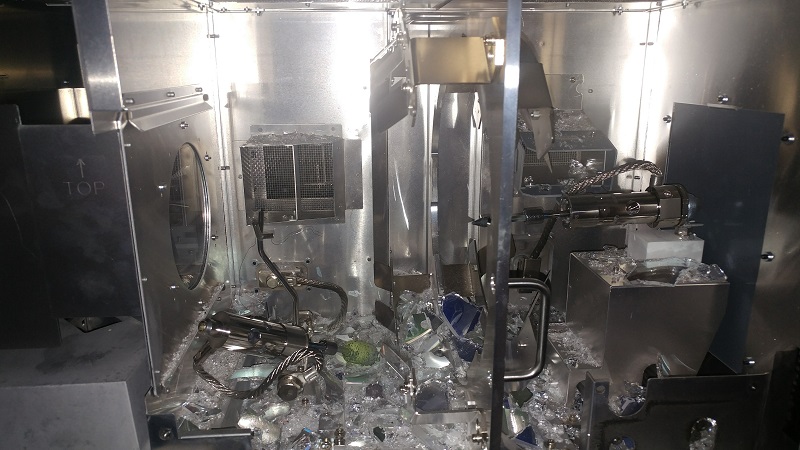
Same here. We just recently had one explode, a 4k or 4.5k in an NEC NC3200. Crazy the force it must've packed, turned most of the bulb AND reflector to basically sand. A few larger pieces, none larger than the oval portrait on a dollar bill, but the rest just absolutely pulverized. Down house for 3 days.
Posted by Steve Guttag (Member # 268) on 01-09-2018, 07:41 PM:
I gotta know...what brand lamp?
Posted by Leo Enticknap (Member # 534) on 01-09-2018, 09:35 PM:
Did you take any photos? Would be very useful for show-and-tell if one is ever asked why wearing the safety gear is necessary.
Posted by Buck Wilson (Member # 5885) on 01-12-2018, 06:17 PM:
Phillips. Before warranty was up.
The finely obliterated dust was about an inch thick in places in the bottom.
Posted by Steve Guttag (Member # 268) on 01-12-2018, 06:28 PM:
That looks like a "film" lamp rather than a DCinema one (DCinema lamps normally have the cable come out of the end rather than out of the side like that.
Posted by Buck Wilson (Member # 5885) on 01-12-2018, 07:18 PM:
Well that's news to me, I have no reason to believe we have been using film lamps
Posted by Leo Enticknap (Member # 534) on 01-12-2018, 10:01 PM:
Thanks, and yikes!
Interesting that the UV filter appears to have sustained almost no damage. I think I see some debris on it towards the bottom left, but compared to the reflector, it appears to have survived intact. It looks like almost all of the force of the explosion went sideways in all directions, but hardly any went forwards or backwards.
Was the triaxial gearbox OK, or had pulverised quartz got into it and clogged the mechanism?
Posted by Buck Wilson (Member # 5885) on 01-13-2018, 12:29 AM:
I was surprised the UV glass made it out too. The debris wiped off. It was kinda like when you throw snow at a brick wall and some sticks.
I have not tried for myself but it is my understanding that the alignment mech. is a bit 'crunchy' to advance but still works.
The UV glass was very difficult to pull out of it's track, though, with all the crap in there. Probably a mix of bits being forced into it while hot, then cooling off... stuck it in there pretty good
Posted by Steve Guttag (Member # 268) on 01-13-2018, 11:39 AM:
Three clues that it is a film lamp, the side-mounted anode cable, likely there is no "certification" code in the lamp box, the Cathode (negative) end needs a brass adapter to fit the projector instead of going directly in.
Do you have the model number of the lamp (hint, if it says helios, it is a film lamp)?
Posted by Carsten Kurz (Member # 5396) on 01-13-2018, 11:52 AM:
So, in the end, how much money was saved in choosing a cheaper lamp over a better one (USHIO)? Only if you have many screens this may pay out on a statistical scale, even if warranty is factored in.
- Carsten
Posted by Stephan Shelley (Member # 8587) on 01-13-2018, 02:04 PM:
The Osram D cinema lamps for the NECs have the cable coming out the side.You do not have to use the collet adapter like you do with the standard cinema lamps.
Posted by Steve Guttag (Member # 268) on 01-13-2018, 04:47 PM:
He had identified it as a Philips. I didn't mean for my 3-clues to be a general statement BUT most of the NEC approved lamps do have the anode cable coming out of the end.
The three most recent updates to the NC1200/2000 projectors (current is 4.221) relates to more lamps (both Osram and Philips, coincidentally) being certified.
Posted by Monte L Fullmer (Member # 2797) on 01-14-2018, 03:28 AM:
And, the 42XDC Philip bulbs for the Sony projectors were nothing but horrible. After 300 hrs, they would lose half their brightness for the twin lens SRXR320 units. Just not enough cooling and airflow in these units.
And two weeks ago, I had a Ushio DXL40BAF/L let go in a Barco Module. Destroyed the reflector, but just barely nicked up front UV filter/anode holder. Bulb had less than 400 hours on it. Definitely under warranty where I sent the paperwork in for warranty rebuild.
Vacuumed out the quartz dust, cleaned out the module and waited for the replacement reflector to come in where the tech came in and rebuilt the module.
Luckily, we had a spare C module so we only lost one show.
Posted by Dave Macaulay (Member # 813) on 01-14-2018, 07:41 AM:
Barco digital lamps do have the side anode wire and don't use cert codes like NEC.
Correct would be a Philips XDC4000B OR XDC4500B lamp, I don't know what film projector lamp would fit with the threaded cathode end.
That's what a blown lamp does, looks pretty normal to me.
If the Z axis adjuster is crunchy it should be cleaned. Remove circlip and thumbnut/washer, remove 2 allen screws and the spring retainer plus spring, take the connector block out, pull out black tube without losing the small spring. Wipe the tube and hole, reassemble. The tube can be stiff coming out, the castellations get dented - run a file lightly around them and the tube will go back in easily. While it's out, confirm the ball joint is fully seated and moves freely. A bit of exercise and a drop of oil will free up a sticky one. Replace if completely frozen... Barco only sells the entire assembly but that part (Durbal DG-12-PB) is somewhat standard ... odd metric size here in NA though. A stuck one can cause lamp failure due to twist stress on its envelope.
If XY mech is dirty it is cleanable but not as easy to get at. And more fogiving, being driven both directions. Z just has the spring pushing out and will make adjustment difficult if it gets sticky.
Posted by Steve Guttag (Member # 268) on 01-14-2018, 08:52 AM:
Dave, for Barco, only the 32B (of the current production) line of projectors can use Cinema lamps (HS style). A 32B projector comes with a set of adapters and list various lamps. It is the SAME set of adapters supplied with the DP100 so using that manual you can get a more complete list of lamps that will fit.
I have one site that uses a DXL-60BA2/L for Dolby 3D and a UXL-20SC for 2D (separate lamphouses). It is the only site I did that way. I later learned that the 32B has no problem using the S/M version of the lamphouse so one could use the "BAF" style lamps, which increases the wattage range down to 850 if you desired. If I had the option, I would probably drop it down another lamp size to 1600 (it is that big a swing between 3D and 2D). I'll say this, the UXL-20SC has FAR exceeded expectations in the DP2K-32B in terms of light, lamp life, decay. That arc gap must really work with the 32B's reflector design. That is probably due to the design dating back to the DP100, where film lamps were one of the selling points of the projector (sort of like NEC does though I can tell you a film lamp in an NC1200/2000 doesn't put out anywhere near the light of a digital lamp.
Posted by Leo Enticknap (Member # 534) on 01-14-2018, 03:04 PM:
quote: Buck Wilson
I have not tried for myself but it is my understanding that the alignment mech. is a bit 'crunchy' to advance but still works.
Might be worth taking the triaxial gearbox out of the lamphouse, opening it up, taking it out into the parking lot (so there is no danger of blowing the crap straight into other sensitive machinery), blowing the particles out (e.g. with a Datavac), and then relubricating. Those particles must be super abrasive. If it were me, I'd be afraid of needing to make an adjustment more than a fraction of a turn one day, and having it seize up.
quote: Monte L Fullmer
And two weeks ago, I had a Ushio DXL40BAF/L let go in a Barco Module. Destroyed the reflector, but just barely nicked up front UV filter/anode holder. Bulb had less than 400 hours on it. Definitely under warranty where I sent the paperwork in for warranty rebuild.
Interesting - same result in a different lamphouse. All the force went up/down/sideways, and pretty much none forwards or backwards.
quote: Dave Macaulay
Barco digital lamps do have the side anode wire and don't use cert codes like NEC.
But you should remember to enter the serial number and reset the hours on the lamp module memory when replacing a bulb. I had one customer who forgot to do this and had a warranty claim turned down when a bulb started to flicker only 250 hours into what should have been a 1,800 hour warranty. They had never done this when replacing bulbs, with the result that the log showed that the bulb had done 22,000 hours or thereabouts! They'd been writing down the hours at every change, but not resetting the counter. Ushio wanted to see a projector diagnostics package, and refused to honor the warranty once they had done so.
Posted by Frank Cox (Member # 6258) on 01-14-2018, 03:41 PM:
The Christie Lamp Change Wizard forces you to to all of that as part of changing the lamp.
Seems like a good idea to me.
Posted by Steve Guttag (Member # 268) on 01-14-2018, 05:24 PM:
Barco forces you as much as Christie does. If you are not annoyed by the non-green tail light, you can merely change the lamp, I suppose. Note, Barco WILL shut the lamp off once the hours get to 10X warranty.
Posted by Dave Macaulay (Member # 813) on 01-15-2018, 10:16 AM:
Working on Barco all week my brain was locked on Barco. Maybe you can use a "standard" lamp in a Christie, I haven't tried. They don't make it simple to install (in the TPC) anything except their lamps, so you have to pick the closest Christie lamp to what you actually put in. Warranty hours may be way off.
The Barco lamp change "wizard" now allows you to install a used lamp easily, entering the used hours and starts directly. It was a less easy on previous Communicator versions. Probably changed because the S projectors have the lamp data in the projector rather than with the lamphouse.
They update the lamp data file relatively often so as brands/lamps are approved they show up in the pick-a-lamp list.
One of the advantages (and there are disadvantages!) of the Barco removable lamphouse system is that you can have a complete spare lamphouse and pop it in in minutes and be back on screen if a lamp blows. Or swap lamphouse from a smaller room if compatible. A lamphouse costs $$$ but I've had owners pay for hand carried courier delivery of a mirror set across the country when a premiere screen was down - that probably cost like a lamphouse and lamp.
Posted by Steve Guttag (Member # 268) on 01-15-2018, 11:19 AM:
The only "film" lamp Christie has allowed (made relatively easy) was the Christie CXL line (aka UXL from Ushio) with the standard Christie 14mm threaded base. Note, if one wanted to use the CXL-20, you DID have to use a different cathode adapter (and it was different between the CP2220 and CP2230). The CP2000S series was "aware" of other "film" lamp sizes. Christie now has a digital equivalent of the CXL-20 for those that need less light in a larger projector (I think it is something like the CDXL-20LP...I don't feel like looking it up at the moment).
On the CP2000-M/CP2210/CP2215 they made adapters to allow the CXL-16SC to be used. This was pricor to the CDXL-14 coming out. So they used film lamps as low-power/lower light output lamps until such time as they made an offical "drop in" lamp that required no special fixtures. Though the CDXL-30SD does require the extra space on the cathode and one may have to move the anode support about as one moves between lamp sizes.
Barco is semi-good about their lamp updates. They have gone over a year without them but have issued two recently. On in the 2.5.57 and one as a separate lamp file update. That said, they have not realized that the USA is the center of the universe and the warranty hours are based on Belgium warranty conditions. For example, they refuse to update the DXL-12BAF to 3500 hours or the DXL-22BAF to 2000 hours. I have requested it. What I wish they would do if there is a warranty discrepancy is to create a different file or require the lamp manufacturer to use a different part number only available in that country. So I'm not letting Ushio off the hook here. The warranty should be uniform. I've had to create custom lamp files with the proper USA warranty rules (something that probably most don't realize can be done so they are not getting the full life out of those lamps. Then again, I'm sure that the DXL-12BAF and the DXL-22BAF are not the biggest sellers but still.
I've been pleasently surprised at their courier service for same-day. That is "Expidited shipping." The few times we've had something expidited, the typical cost was about $500. Honestly, $500 is pretty cheap to be up and running that day. Particularly on the Weekends/Holidays. I've called at noon and had the part by 4:00 and made their 5:00 and evening shows on a weekend.
One of the depots used to be relatively near us (Carlisle, PA). I had a light engine fail going into a weekend. I was able to call in the PO for the replacement and go and pick it up! When the wife asked why I was heading to Carlise and would be late coming home...I responded that I was going to the "Light Engine Store." They forklifted the flight case right into the van I was driving too! I don't know where our nearest depot is now but I'll bet the days of picking it up local are over (the theatre that went down was only about an hour or so away from the depot).
Posted by Buck Wilson (Member # 5885) on 01-15-2018, 06:16 PM:
Phillips XDC-4500N
Posted by Steve Guttag (Member # 268) on 01-16-2018, 08:34 AM:
I don't know why I was thinking it was in an NC2000C when you stated it was in a NC3200S. That is indeed a digital lamp and on the certification list. Rated at a whopping 900 hours.
The latest version is the XDC-4500NL and starting with firmware 4.220, that lamp is recognized. In theory, you get about 1500 more lumens and the warranty goes up to 1300 hours.
Posted by Mark Gulbrandsen (Member # 72) on 01-16-2018, 01:15 PM:
A customer that I was at just last week had surprisingly switched over to Phillips, apparently through Cinema Buyers Group. He has had quite a bit of trouble with them and is going back to Ushio after these lamps he has now expire. I just don't understand the logic (or lack there of) in thinking a less expensive option is actually going to be as reliable as what you were using. Ushio is an install and forget it lamp till it's time to change it based on hours or how ever you like to calculate it.
Mark
Posted by Buck Wilson (Member # 5885) on 01-17-2018, 07:33 AM:
"If it were up to me"...
We do use Ushio in our 3 Barco DP2000s, but Phillips in all the NECs. No clue why.
Powered by Infopop Corporation
UBB.classicTM
6.3.1.2