This is topic high pass protection filters for bass reflex speakers - surrounds? in forum Digital Cinema Forum at Film-Tech Forum ARCHIVE.
To visit this topic, use this URL:
https://ft-forum.com/ft/cgi-bin/ubb/ultimatebb.cgi?ubb=get_topic;f=16;t=003196
Posted by Carsten Kurz (Member # 5396) on 01-09-2018, 07:23 AM:
It is common knowledge that the drivers of bass reflex speakers as they are commonly used for cinema front systems and LFE need to be protected with high-pass filters that keep signals around the resonant frequency away.
Now, I guess most surround speakers are also of the bass reflex/vented type. What do you think about the need to protect your surround speakers the same way?
I am asking this because, since the digital rollout, I notice that in many cinemas the low frequency drivers of surrounds are dying like flies if the auditoriums are operated at close-to-spec levels.
I would think that in pre-digital days, critical signals never made it to the surrounds due to limitations in both the analog production (e.g. audio transformers, coupling capacitors, signal sources), as well as film sound systems (even SRD).
That clearly has changed. Digital production and presentation allows to put any spectral content at levels up to Fs into the surround channels now - and it does happen.
Common input filters for amps work in a frequency range targeted at larger 15-18" drivers that is not suited to typical surround speakers. The AP20 can employ suitable filters per output channel, but what about other processors? Do any of you installers/techs cater for that issue, or do you prefer to sell and install new surrounds every now and then?
- Carsten
Posted by Harold Hallikainen (Member # 5405) on 01-09-2018, 10:36 AM:
The JSD-60 has user configurable filters on each channel. See the "Filters Tab" at http://ftp.uslinc.com/ftp/Products/JSD-60/Documents/Manual/JSD-60%20User%20Manual%20160406.pdf#page=46
By the way, the SMPTE 2096-1:2017 section 7.3.4 calibration procedure suggests doing a sine wave sweep of screen speakers at -3 dB FS and surround speakers at -6 dB FS while looking for any harmonics higher than 20 dB below the fundamental. It is also suggested that -10 dB FS could be used if there are concerns about speaker damage. What do you think about putting continuous sine wave into speakers at these levels? Would -20 dB FS be safe?
Harold
Posted by Steve Guttag (Member # 268) on 01-09-2018, 07:37 PM:
I have not noted an uptick in driver failure. We do design our systems with the proper amount of power handling.
That said, I also think it is good practice to always high pass speakers so they are only fed what they can handle. What is the point of feeding 20Hz information and having to amplify it if the speaker can't reproduce it?
It is/was common for audio processors to offer a 50Hz HPF for the surrounds. QSC amplifiers typically have a selectable filter of 30Hz (stage) and 50Hz (surrounds).
If DSP or like processing is involved, then I let the amplifiers operate without filters and perform the High Pass filtering based on the actual response I'm seeing. This is true for all channels, including the subwoofer. I'd wager a lot of subs are playing with 30Hz HPF using the factory preset from QSC. We also generally use the SF-3 module and set both HPF and LFP on it for subwoofers, in addition to any B-6 alignment that a subwoofer may need for a flat/extended response. Again, if DSP is used, we'll handle the B6 HPF/LPF in the DSP.
Posted by Marco Giustini (Member # 4544) on 01-10-2018, 04:27 AM:
I always set HP on my systems. If I have a capable DSP I choose the best frequency for the speaker otherwise I rely on the amplifiers - if an HP is available. Even subwoofers need a 20Hz filter as a minimum, higher if the system is underspec'd - I install what the customer pays for, Steve, I don't always have the luxury of installing 'properly spec'd systems'.
As Carsten says, soundtracks sometimes contain very very low frequencies on all channels and it's just adding distortion on speakers.
The AP20 is one of those processors with advanced DSP capabilities. I always set HP filters there, precisely tailored to the speakers/auditorium. Either in the Dirac or in the crossover setting.
Posted by Steve Guttag (Member # 268) on 01-10-2018, 06:40 AM:
Properly speced systems isn't a luxury. It is a responsibility. Do you find that you come up against this sort of thing a lot? It is quite rare for me. It isn't like we always have to put in top-shelf stuff either (in fact, far from). Putting a system in that doesn't blow up when run at spec, to me, would seem a pretty low threshold. If a customer chooses to under purchase on a system, I let the know the consequences of their choice, with hard numbers so, at least, they are informed on their decision. Normally, that is enough for them to find the money or, put in a less ambitious, but reliable system.
Posted by Marco Giustini (Member # 4544) on 01-10-2018, 07:01 AM:
when you say 'run at spec' do you mean the speaker should be within its rated power when running at 7? Then yes, it happens all the time mainly on LFE and surrounds.
I have found myself dialling a higher HP filter on subs when the subs (er... THE sub) is heavily underspec'd for the auditorium. At least it doesn't even try to play very low frequencies. Nothing terrible, I'm talking about a 30Hz filter.
That being said, to go back IT, even if the system is properly spec'd I always set an HP filter as a stage speaker will never be able to play 20Hz anyway and there is nothing preventing the soundtrack from carrying those frequencies.
Posted by Carsten Kurz (Member # 5396) on 01-10-2018, 07:19 AM:
Running vented speakers with signals around the resonant frequency without a HP is not 'to spec'. It's a technical setup fault. It was probably rarely an issue in analog/film days since the surrounds never received those signals. That changed.
- Carsten
Posted by Harold Hallikainen (Member # 5405) on 01-10-2018, 11:23 AM:
Repeating a question I asked before...
By the way, the SMPTE 2096-1:2017 section 7.3.4 calibration procedure suggests doing a sine wave sweep of screen speakers at -3 dB FS and surround speakers at -6 dB FS while looking for any harmonics higher than 20 dB below the fundamental. It is also suggested that -10 dB FS could be used if there are concerns about speaker damage. What do you think about putting continuous sine wave into speakers at these levels? Would -20 dB FS be safe?
Ideas?
Thanks!
Harold
Posted by Jay Wyatt (Member # 8768) on 01-10-2018, 02:51 PM:
Just a theory, but perhaps more LF content is getting sent to surrounds because of immersive soundtracks. A re-recording mixer doing a native immersive mix first, potentially could sent more LF to the surrounds -- operating under the assumption of bass management (or higher spec'd surrounds). Maybe during the 5.1 and 7.1 translation all the LF material is left in and not re-accounted for. End result being lots of >50Hz spectral content hitting surrounds in non-immersive rooms.
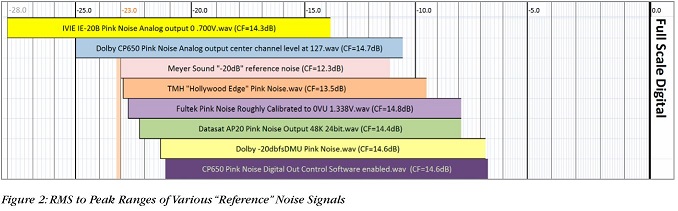
To Harold's question: Is the SMPTE doc referring to -3dbFS peak or RMS? Either way, -20dbFS seems 'too-safe'. Shouldn't a stress test actually stress the SUT? I think it'd make more sense for a sine sweep to at least be in the neighborhood of the peak ranges of the 'reference' noise signals (somewhere between -12 and -7).
Posted by Harold Hallikainen (Member # 5405) on 01-10-2018, 06:25 PM:
Thanks Jay! As I recall, the SMPTE standard pink noise has a crest factor of 12 dB or thereabouts. For a sine wave, I believe dB FS is the same whether RMS or peak. A -3 dB FS sine wave has a peak code value of 70.7% of full scale. The SMPTE test procedure puts a continuous sine sweep at -3 dB FS into the screen speakers, -6 dB FS into surrounds, or -10 dB FS if you are afraid of damaging the speakers. If we assume a 12 dB crest factor for program or pink noise, and our reference level is -20 dB FS, the peaks of program and noise are at -8 dB FS. With program or noise, therefore, we can run a maximum of -12 dB FS RMS (which puts peaks at 0 dB FS). We MIGHT assume this is the maximum continuous signal a speaker needs to handle as far as thermal considerations are concerned. The SMPTE test procedure will make the tones REAL LOUD! I'm thinking of running a series of tones, one per octave, starting at 50 Hz, and measuring the THD. I've heard "rattling" in a speaker in a theater when it's driven with -20 dB FS pink noise. Ideally this test would catch that. The concern is making this a destructive test...
Thanks for the comments!
Harold
Posted by Carsten Kurz (Member # 5396) on 01-10-2018, 06:44 PM:
That's the question, what's the intention of such a stress test? Should SMPTE demand that systems are actually stress tested?
I haven't done real tests with our surrounds, but I am pretty sure that -6 to -10dB FS could be a real threat to 'real'/existing systems. Steve is certainly right that it's a fundamental mistake to underspec systems. But there is little benefit in demanding that all existing systems in the field to be retrofitted with an array of higher spec'd surrounds. Even if that has been done, do you stop there? Soon you'd be requested to replace a 'working' system with a properly spec'd system at 15.000 to 20.000...
My intention to post this was my observation that many surround setups seem to lack these protection filters. And the consequences seem to become more obvious since the digital rollout, fully digital sound production, and, as Jay correctly states, object based sound systems which are much more demanding in the low frequency range of surround systems.
Fundamentally, yes, people should probably shell out more money for sound systems that are properly spec'd as opposed to rule of thumb or 'we're mostly playing arthouse'.
- Carsten
Posted by Steve Guttag (Member # 268) on 01-10-2018, 06:55 PM:
Object based systems SHOULD be new systems since the demands on the individual surround speakers are clearly VASTLY different than arrayed surround speakers.
And yes, every speaker should be high-passed such that frequencies it cannot play are not fed to it. As I said before, not only are you protecting the speaker, you aren't wasting amplifier power making sound that nobody will hear (aside from the woofer flapping about prior to complete failure). Most cinema-specific processors provide for this. Many amplifiers provide for this and ALL DSP systems allow for this too so it would seem that one would have to try and not apply a suitable filter.
Posted by Carsten Kurz (Member # 5396) on 01-10-2018, 07:10 PM:
Steve, of course, 'real' object based audio systems will usually be equipped with properly spec'd surrounds and have ample ressources to tune individual speaker response. What Jay was referring to is that, as more mixes are initially created for the more capable object based systems, and on speaker systems tailored for object based sound, more low frequency signals make it into 5.1 and 7.1 mixes derrived from these object based mixes or being mastered on these systems.
Does a CP750 allow to setup a protection HP for every speaker channel?
- Carsten
Posted by Jay Wyatt (Member # 8768) on 01-10-2018, 10:16 PM:
That's only a theory I was throwing out there. Someone would need to analyze the LF content of features done natively in immersive formats and compare to channel based only movies.
Steve and Carsten: when you guys pull blown speakers off the wall, does it seem to be an age thing or is it speakers asked to reproduce frequencies they cannot? Or would one even be able to diagnose the cause?
Posted by Carsten Kurz (Member # 5396) on 01-11-2018, 04:13 AM:
I have seen both voice coils being burnt (bubbles) and diaphragms being torn. Some speakers use foam suspension which deteriorates over the years all by itself.
Steve recones speakers and knows more, although the typical surround speaker probably rarely experiences a reconing job.
The trouble is that in classic 5.1 and 7.1 setups, many speakers carry the same signal, so it may turn out that from 4 speakers assigned to e.g. back surround left, 3 LF speakers are gone, with the remaining one still masking the defect. Since they are usually paralleled, there is no quick test procedure to find that out, as there is for the screen speakers or in object based audio where every surround speaker has it's own signal/amp channel. Every now and then I think about a special wiring/switching solution that allows me to test individual surround speakers that use no dedicated amp channels.
When we went digital 5 years ago, we noticed when calibrating the sound system that most of our surround LFs were gone. Diaphragms and suspensions looked like new, but many coils had bubbles. They would stick and not move with low signals, but make very unpleasant scratchy sounds at high levels. But we only found this out when we supplied high level test signals to them. We did not have an idea for how long this was going on already. I was shocked this went unnoticed for an unknown time. To complete the ongoing installation, we configured 200Hz high pass filters in the AP20 for the surround channels to keep the LF speaker from being driven, until we replaced them.
- Carsten
Posted by Steve Guttag (Member # 268) on 01-11-2018, 08:08 AM:
As I've stated, my surround failures have been minimal. Probably our biggest failure was the JBL 8330A midrange. They would die pretty easily, as it turns out so don't over drive that speaker. I'm sure the original 8330 would be similar. The voice coil former will bubble up as it overheats.
By and large, we've had few woofers give it up (except for foam surrounds that simply deteriorate, e.g. Boston Acoustics that Regal put up in the late '90s).
In the optical sound says, the surround was a 100Hz - 7KHz speaker (yeah it went beyond that but not much more) and the level was notably reduced so they didn't have a hard life. When digital hit film, that changed and, depending on digital system, they were asked to run 20-20KHz. I'm not saying the movies had all of that information but they could be asked to do that. That is, all but DTS who put Subwoofer on the Ls/Rs channels and used simple filtering to high pass the surrounds and low pass the subs. That said, how many heard when the the Empirical Test disc was run and it got to the subwoofer channel ALL of their poor surround speakers start flapping their woofers when the signal was that low? I don't know what filter they were using but it wasn't all THAT steep for that much information to make it to the surrounds.
For DCinema the spec on surrounds is 102dBc/channel (should have been 105dBc) and 20-20KHz is the bandwidth. So, compared to optical surrounds, yeah, they are being asked a bit.
To answer Carsten's question (which I'm sure he already knows but is trying to make a point!), no the CP750 does not have HPF for the various channels. I did qualify my statement with the word "most." And that leaves also MOST cinema amplifiers have a means of a HPF too. This is true not only for the surrounds but the stage channels. The subwoofers should also be HPF right. I can't think of any system I've put in where all of them weren't HPFed. We use QSC amps, pretty much exclusively, and they have the filters for the stage and surrounds built in, so it is free. I've worked with the likes of the Crown DSi (originally installed by "others") stuff and that has a little DSP on board so you can get a HPF there.
I, personally, think that when the tech is tuning the room, you should be able to see, pretty clearly, where a speaker can and cannot reproduce sound and use available filtering to restrict the bandwidth to what it can handle. I am a bit surprised that it has become the problem that is being presented here.
Lastly, as to reconing, no so much on surrounds. As a rule of thumb, if the driver is some sort of stamped out frame, you don't recone it, you replace it. Reconing, due to the labor involved, is something that is done to more expensive drivers and for perhaps obsolete drivers where one really wants to keep the original sound. So LF drives of a stage speaker but primarily, subwoofers is what we have seen the most of. I can recone a JBL 2241 for much less than half of a new one and it will perform identical (same parts!). But for a surround speaker, pitch the driver and replace it. If no longer available, consider changing the surround array and use the remaining speakers as parts for remaining auditoriums that still use it. We have one site were we are finding replacement "equivalent" woofers. Mind you those speakers are over 20-years old and owe nobody anything!
Posted by Marcel Birgelen (Member # 6801) on 01-11-2018, 10:33 AM:
Many modern soundtracks are pretty heavy on the surrounds and those surround channels are full-range channels so I guess it's almost mandatory to filter them properly, to avoid prematurely damaging the voice coils.
quote: Carsten Kurz
Does a CP750 allow to setup a protection HP for every speaker channel?
The CP750 doesn't have HP protection on each channel, unless it was recently included in a firmware update. I'm pretty sure the hardware would be able to do it.
As you've noticed yourself, the AP20 does have HP/LP filters though and we're using them on any channel. We're actually using filters on both the AP20 and the amplifiers for each of our channels. Since those DSPs are just software-driven, it cannot hurt to have a little extra protection, to avoid a bug creeping in.
It's indeed not always trivial to spot a burnt-out surround speaker immediately, unless it's actually making unwanted noises. Still, if you run a continuous loop of pink noise on low volume and you just walk by, you can usually easily spot them. If they're mounted too high and too close to others, a microphone on a pole will help. ![[Wink]](wink.gif)
Posted by Carsten Kurz (Member # 5396) on 01-12-2018, 05:50 AM:
I see many cinemas over here use standard pa amps, which lack the necessary or optional input filter modules. Then who is using active crossovers on their surrounds that could cater for a LF protection HP?
If in his daily work Steve mostly sees the auditoriums he spec'd himself, he will probably hardly ever see blown speakers ;-)
- Carsten
Posted by Marcel Birgelen (Member # 6801) on 01-12-2018, 07:35 AM:
I guess you're right, many locations don't properly filter their surrounds.
I know a few places around that have blown essentially all their JBL 8330(A)s. There is close to no surround left in those rooms. At least one of them is using proper QSC amps, not some no-name generic PA amps, but they simply never bothered to set the filters. I guess you can blame that on the installer either not knowing about the potential issue or not caring.
Posted by Steve Guttag (Member # 268) on 01-12-2018, 08:05 AM:
I do mostly see systems that I speced! Even on the ones I didn't, rarely do I see ordinary PA amps. I was going to say that the VERY popular DCM series of monitor/crossovers also has HPF on surrounds but I guess if you are using the DCM, then you probably had DCA or ISA amps that have HPF built in.
So you all are saying that the intersection of cinema processors without HPF for the surrounds and amplifiers that also lack this is so large that this is a problem? Or are people just not designing systems worth a flip or possibly tuning rooms beyond the equipment capabilities?
Now I do see under-speced systems, all of the time. Not just sound but in projectors too (too little light). The latest scam is putting in high-gain screens to offset the inadequate light (it isn't a new scam as it was done in film quite some time ago). The screen doesn't "make light." The screen just concentrates the light you have. If the customer doesn't want to "pay" for the proper system that can handle what they are playing, then they can pay to fix it indefinitely. For the most part, I don't have a problem talking people into a properly fitting system (light or sound) but I do come with hard numbers to back up my statements.
Posted by Marcel Birgelen (Member # 6801) on 01-13-2018, 10:45 AM:
quote: Steve Guttag
So you all are saying that the intersection of cinema processors without HPF for the surrounds and amplifiers that also lack this is so large that this is a problem?
Yes!
quote: Steve Guttag
Or are people just not designing systems worth a flip
Yes!
quote: Steve Guttag
or possibly tuning rooms beyond the equipment capabilities?
Yes!
Or the less annoying form: All of the above.
I have to agree with Carsten, you'll find a lot of standard PA amps in quite some cinemas around here. The CP750 is also by far the most common cinema processor. And while even some of those standard PA amps will have limiters, they're not always configured correctly or at all.
I also agree with Carsten that a lot of the damage to the surround speakers will also go unnoticed at many sites, especially those who aren't so good in their upkeep, which unfortunately, are plenty. So, many of those surround speakers will probably remain silent, until someone decides it's time to refurbish the room or until someone halfway competent is hired to recalibrate the room.
Posted by Carsten Kurz (Member # 5396) on 01-13-2018, 11:38 AM:
Yup. I also wanted to stress that, with clearly more low frequency content in surround signals turning up, installers should not ignore protection filters for surrounds in new installations or replacements - using a suitable CP and/OR amps with suitable protection filters should be on the checklist.
I also follow other cinema forums closely, and I never saw that being mentioned. What I see is quite a few reports of complete arrays of surround speakers being blown. Some cinema operators, at least if these speakers are older, seem to reflect on this with pride - 'Oh yes, we do play it loud!', and replace them - but maybe it's time to think and talk to their installers.
As Steve explained, this is not only to protect the speakers from early defects, but also to make the most from the existing installation - if you force speakers into reproducing frequencies they can not reproduce properly, they underperform in other areas of the spectrum. So, setting the right filters does not only protect the speakers, but will also improve the sound of an existing installation.
- Carsten
Powered by Infopop Corporation
UBB.classicTM
6.3.1.2