This is topic NATO sound volume study results in forum Digital Cinema Forum at Film-Tech Forum ARCHIVE.
To visit this topic, use this URL:
https://ft-forum.com/ft/cgi-bin/ubb/ultimatebb.cgi?ubb=get_topic;f=16;t=003324
Posted by Mike Blakesley (Member # 26) on 06-01-2018, 12:34 PM:
I'm not sure how many have seen this, but I found it quite interesting. There is apparently a growing discussion on whether to revisit trailer and feature sound levels, especially considering the last time it was evaluated was before digital projection was the norm.
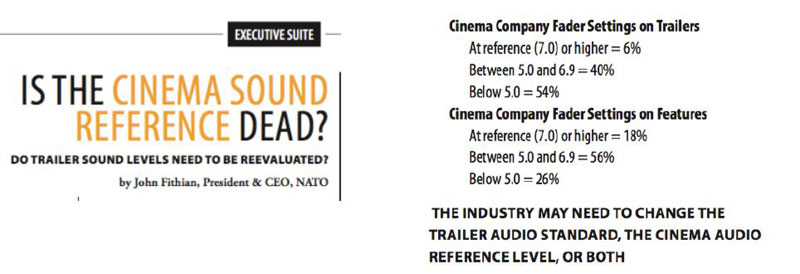
Posted by Frank Cox (Member # 6258) on 06-01-2018, 12:51 PM:
I have my "feature" cue set to crank up the volume as well as cranking down the lights. If I play a trailer at the same volume as the feature it'll blow you out of the room.
Are they supposed to be recorded at the same volume? They certainly aren't.
Posted by Brad Miller (Member # 2) on 06-01-2018, 03:35 PM:
I still to this day at locations I oversee run trailers at 3.5 to 4 on the fader and features at 6.5 to 7 on the fader. (For a sold-out house, 7.5 is common for the feature.) Yes there are exceptions, but for the most part that works well on almost all content. It is a VERY RARE occurrence for a volume complaint.
Digital changed nothing. Those are the same typical settings I used back with film.
I think the bigger issue is the field techs these days are not doing a very good job calibrating the systems and the end result is harsh-sounding so the fader has to be lowered to stop complaints. Then you have Atmos systems of which most are "auto-EQ'd" which hurts the potential playback volume as well.
Posted by Christian Lerch (Member # 8083) on 06-25-2018, 10:00 AM:
Where has this article by John Fithian been published, please?
Posted by Mike Blakesley (Member # 26) on 06-25-2018, 11:41 AM:
The article was in the NATO President's Report which is confidential to members, but the survey results are available on the NATO website, so that's why I only posted the header.
Posted by Mark Gulbrandsen (Member # 72) on 06-25-2018, 02:38 PM:
The whole thing makes me laugh! NATO or someone similar has done this study before in the early 2000's only to conclude that trailers were too loud. So they set a new standard back then and trailers levels climb even louder. What a joke! It's why Digital Cinema Systems can adjust auditorium levels on a per cue basis today.
Mark
Posted by Aaron Garman (Member # 1653) on 06-25-2018, 03:39 PM:
Brad nails it: it's the poor tuning of rooms causing the biggest issue. A major chain who will remain nameless is notorious for running everything extremely quiet except their premium large format houses. I have not heard what I would call good sound in one of their auditoriums in a very very long time.
All that survey seems to prove is that very few people are doing anything right when it comes to sound.
I can get superior sound at home and that should not be the case.
Posted by Steve Guttag (Member # 268) on 06-25-2018, 04:02 PM:
For trailers, it isn't poor tuning. For loud features...it really depends on who mixes the movie, what equipment you are using and how well it was tuned.
I have a customer that primarily runs "art" movies and at one site, the consistently run the volume in the 6-7 range whereas it is closer to 4.5 in most of their other theatres. The difference is JUST the speakers (and room acoustics, of course). The room that has the higher volume level has better speakers than the other ones. Not that they have bad speakers anywhere it is just that some speakers (QSC SC-423/SC-424) will not sound as offensive run run louder than others.
Posted by Mark Gulbrandsen (Member # 72) on 06-25-2018, 10:24 PM:
Trailers are very highly compressed... way too compressed. Everything on trailers is at the same blasted level.
Mark
Posted by Martin Brooks (Member # 1269) on 06-28-2018, 02:10 AM:
I can't think of a single instance in the last five years or so where the audio levels were too low on anything except when I saw "Blade Runner 2049" and was stuck sitting in the last row. The trailers are almost always louder than the feature, but even the features are usually absurdly loud. I think this is partially because I've been seeing more films during the day now that I have the time and the theaters are empty. With a full audience, especially in the winter when everyone brings heavy coats, the levels are probably okay.
I finally remembered to bring a sound meter with me and for "Solo", I believed there was constant peaks at 102dba (in a Dolby theater), but that doesn't really mean anything because it's the length of those 102dba peaks that matters.
Posted by Carsten Kurz (Member # 5396) on 06-28-2018, 06:19 AM:
We have much better ways to measure and control mastering levels to spec nowadays. Digital FullScale and LEQ(m) are sharper knives than pre-existing methods. However, digital systems allow for higher overall levels (e.g. full range signals in surrounds). I played BladeRunner2049 a good bit louder (6.5 vs. 5.5 on our AP20) than our usual feature level, simply because it was so much fun. I announced this before the feature started, and offered to be at the exit for any complaints. I am not nuts, but I am strictly against setting 'comfort levels'. Recently I sat in an arthouse movie with my father who complained about the loudness of some initial score elements. I told him to shut up and watch the movie ;-)
Our preshow and trailers always play at 4.5.
Cant' say there is a real problem, we certainly have fewer complaints now than we had in 35mm days. Probably because now we always adjust between trailers and feature per SPL cue. Before, it was left to staff with the auditorium fader (no automatic reset), and that was no solid solution.
While one can certainly question our 4.5/5.5 standard procedure, I watch most movies we show, and in most cases, it fits. Only once or twice a year we get a DCP with levels that fail completely, either because levels are too low, or too hot.
If that happens unnoticed during the first showing, we usually get a complaint to staff or by email afterward - but only if people felt it was too loud. We never had a complaint about a showing being too soft, which is compliant with all studies being done on the topic. As long as people understand important dialogue, they don't consider it too soft, even if it is.
All that said - we nearly exclusively play dubbed movies, and very often the sound balance of these is far from the original movie. Sometimes for good, sometimes for bad.
- Carsten
Posted by Steve Guttag (Member # 268) on 06-28-2018, 08:53 AM:
One casualty of running the fader lower than reference are the surrounds. Presuming one calibrated the room right, the surrounds, which rarely are the cause of complaints because they are too loud will be brought down right with the rest when the fader is lowered to 5.5 (about -5.0dB, if you're one of "those" people), you brought the surrounds down by 5dB too and then I get complaints about them being too soft. In theatres were the fader can comfortably live closer to 7.0 (0.0dB), the surrounds sound much fuller.
I don't think it is the volume level that people are complaining about it is the "pain" level, which are not one and the same though one can lead to the other. However, what people DO know is if you turn the volume down, the "pain" will go with it. For the purposes of this discussion, pain referring to not just a physical pain but as a perceived assault on their eardrums.
Posted by Carsten Kurz (Member # 5396) on 06-28-2018, 10:04 AM:
I know these absolute numbers do not mean much within a common tolerance range. I see some cinemas setting their CP750 as low as 3.6. I have never seen these numbers on other non-Dolby processors, but that doesn't mean it isn't done on USLs or AP20 in certain installations as well.
There is a slightly disturbing report on mastering levels vs. Dolby fader 7 here:
http://www.associationdesmixeurs.fr/wp-content/uploads/2017/09/NIVEAU-DE-MIXAGE-CINEMA.pdf
Two major points in it seem to be - some mixers actually use hearing protection during their work, and, more and more big screen content is mastered on rather small near-field monitoring systems.
- Carsten
Posted by Bruce Cloutier (Member # 9615) on 07-04-2018, 07:54 AM:
This even pisses me off at home. Streaming from Amazon is at much higher audio levels than Netflix. It's always been an issue even with vinyl recordings. My bet is that there has been one "standard" after another and none have been acceptable to the content suppliers. The joke with standards has always been that the trouble with them is that there are so many to choose from.
Add to that the ulterior marketing motive where they think that somehow a higher audio level, brighter picture and more active screen content is more efficiently burned into your brain.
Well... I doubt there is any solution to this other than to dynamically adjust volume levels for different material as best that you can (according to your own standard of comfort). My point being that there is no solution.
I thought THX had a grip on it. For a while my audio settings for Blu-Ray disks had been consistent. That hasn't been the case for the past 2 or 3 years. I've been thinking that Dolby has come along and disrupted things.
Posted by Bobby Henderson (Member # 840) on 07-04-2018, 01:05 PM:
I'm rarely impressed with movie theater sound these days.
It's not for a lack of technology. Really cinema sound should be better than ever considering the kind of audio material being provided: usually 24-bit 48kHz uncompressed Linear PCM audio in 5.1 or 7.1 channel layouts. The more elaborate sound formats (Atmos, DTS:X) use no lossy data compression; it's all lossless compressed or a combination of lossless and uncompressed data. All of this is technically better than the data lossy digital sound formats from the 1990's. And it should be at least equal if not better than the magnetic audio formats from the 1970's and '80's. Nevertheless too many movie theaters have sound quality that falls in the range between "decent" and "meh."
Obviously it's the human beings at various stages of the process who are messing up the situation.
I suspect various types of dynamics compression are being applied to elements in the movie's sound mix, if not applied globally to the entire thing. Much of the music industry has been afflicted by the disease of dynamics compression over-use for over 20 years. I suspect the philosophy has been creeping into the movie industry over the past 10-15 years. The sound is being tailored more to the limits of tiny speakers in TV sets, sound bars and mobile devices. That comes at a cost of movie sound having less of the startling dynamics many of us enjoyed when digital sound was first becoming a thing in movie theaters during the early 1990's. Now every element in the mix is loud or not.
I think a lot of commercial movie theaters have sound systems with limited capabilities (cheaper, less powerful speakers and amplifiers, fewer sub-bass enclosures, etc). I think the greater cubic air volumes of taller, stadium seated rooms require a different approach. To me it looks like the speaker configurations are really no different than that of a standard sloped room of decades past. The tiny surround array speakers are just going up the walls diagonally now.
We don't have anything like THX or something similar guiding commercial theaters to confirm to certain quality standards. I think they're installing what's deemed good enough to get the job done. I'm not sure what to think of Cinemark re-purposing the THX brand onto its XD screens. I'm not getting the vibe it's very legit at all.
quote: Aaron Garman
A major chain who will remain nameless is notorious for running everything extremely quiet except their premium large format houses. I have not heard what I would call good sound in one of their auditoriums in a very very long time.
I strongly suspect the AMC locations in my region do this. But I also think other theater chains use the tactic as well. Pay extra to see the movie on an IMAX-branded screen or Dolby Cinema house and you'll hear some surround activity and bombast. Watch the show in a standard-priced house and the audio will have character hardly any better than TV set speakers back home. Decent surround sound is being transformed into a premium item. Maybe the bean counters want the sound run lower in the standard-priced houses because it might translate into less wear and tear on the sound systems.
It also takes a caring theater staff to notice and fix problems with the sound systems. That has always been an issue that set good and bad theaters apart from each other. Even if the theater has good staff and management I can't help but think their hands are tied in some way.
We can't leave out the customers who insist on the sound being turned down to ordinary volume levels. I think that factor has affected the IMAX-branded screen at our local AMC theater. When Carmike first opened the Patriot 13 the IMAX-branded house had sound levels that were fairly hot. It's definitely a few decibels lower now.
A couple days ago a co-worker brought up Jurassic Park because of the new movie and the original recently marking 25 years since it was released. I haven't seen the latest sequel; I still like the original the most. One reason is the memory of seeing it for the first time on the GCC Northpark #1 THX screen in Dallas. The audio was lossy compressed DTS, but the theater's sound system was so well-tuned and had such powerful dynamics I couldn't help but be blown away by it -right from the rib-rattling drum beats of the JP opening title card. It takes some beastly power for a sound system in a 1000+ seat room to pound the air in your chest. For all the raw power music sounded excellent in that room too. Some of the IMAX-branded theaters can deliver loud audio and strong sub-bass. But in terms of tone and overall quality those sound systems are harsh compared what was in the GCC Northpark 1-2.
Posted by Steve Guttag (Member # 268) on 07-04-2018, 05:11 PM:
Oh, I dunno Bobby. I think it comes back to my statement (shared by others) that if you sucked then, you suck now.
So, going back to the good Ol days, you'd be amazed at how many MONO sound systems were going in...even in the 90s!
I lot of the theatres I was involved with had a 3-tier approach to their sound systems. That is, the big theatres in the complex got the spiffy sound systems with the cutting edge equipment, the next tier down got an economy version of that and the bottom tier theatre got an economy version of that or mono. The thought being, the people that cared about such stuff came in the first few days/first week and those that were thrifty and came towards the end of the run, they didn't care about whiz-bang sound system so why spend the money on it?
As for speakers, in the major brands, there used to be fewer choices. in the pre-1980s, there was Altec and there was junk, by and large. In the 1980s, you saw JBL emerge as the speaker brand of choice but again, there weren't many versions. There was the 4675, the 4670, the 4673, and 4671 (there were horn loaded versions, the 4672 and 4674 but those were more akin to competing with Altec speakers of yore). EV (Electro-Voice) had their versions of the JBL speakers but again, a relatively small spread of models with clear distinctions as to what size would fit the job.
Note, this isn't to say there weren't other brands at play (Klipsch and Frazier, as examples) but the bulk came from Altec, JBL and EV with Altec going down fast in the 1980s)
Then you move into the 90s. There was this trend towards the 3-way speakers. The problem is, a good 2-way beats a bad 3-way EVERY time. Most 3-way speakers suck too (if you listen to them). Though Klipsch had 3 and 4 way systems out there in the 80s, it was in the 90s that things started to change. JBL had their 5000 series speakers (5671, 5672 and 5674), which were more money than people were going to spend so the econo 3-ways came out. By and large, they don't sound very good (really). It isn't the shape of the theatre, it is the sound coming out of the speaker.
From the speaker's point of view a stadium theatre is taller (easy on the speaker because most of them have a 40-degree dispersion vertically) and the theatres became shorter. It was harder for the speakers in the old days where theatres were 100-feet plus long on a sloped floor. The higher up the speaker went behind the screen, the better your chances.
So you have this trend of the econo 3-ways and then, the need to be yet MORE competitive so you get variations of everything. Companies now have a "Good, better, best" line of speakers for EACH MODEL. And you have it in a 2-way or a 3-way. There is always someone telling you you can do it for less/cheaper. Why get model "A" when Model "C" is essentially the same thing but cost $1000 less and fits in just 12-inches of depth? The realities are, there are reasons why the better speakers are more expensive and why small speakers rarely make good sense behind the screen (it is all in the physics of making and moving sound.
You should look at the number of models the major players in cinema sound have (JBL, QSC and Klipsch...again, there are others, like Meyer but in terms of speakers sold, JBL and QSC are going to cover the lion's share now). They both have good products, if you know what to go for. I just counted, QSC has 22 models of screen speakers on their web site. JBL has 15 currently showing. Are there really that many variations of cinemas that it takes that many models to cover every theatre size/shape? Don't get me wrong, 1-size does NOT fit all. Within those numbers, there are quite a few different size categories. I guarantee that many/most of those models came out to find a particular price point because they lost a sale to "the other guy" that was "just as good" but cheaper.
My point is, how is the exhibitor really supposed pick from that collection? Many are indeed going to vote with their wallet since it is a business after all. If you spend an extra $500/speaker on the "better" speaker and multiply that times 3 speakers/theatre or 30 speakers per complex, you are going to save $15K/complex. How much MORE popcorn has to be sold and attributed to the better speaker to justify the better one?
Again, it isn't that these companies can't, won't or don't make good speakers. They do...but if all you have is the "Cadillac", you'll lose sales to the guy selling the Chevys and also lose what Cadillac sales were there for the "good theatres."
Another truism is that when budgets get tight, that money always comes from projection and sound. Everything to do with showing the movie itself is a loss. The money is made in the lobby/concession area...that is what gets the money. People don't see the speakers (except the surrounds) or projector.
There are some other fact about today's cinema. They are not the big barns of yesteryear (pre-1980s and really pre-1970s). You give me a big old theatre and plunk some Altec A4s or A2s (if big enough) and you'll get that big-fat sound you remember. You have to be 25-30 feet back from an Altec A4 before the HF/LF converge...that would put you half-way back in a modern cinema. I do find it humorous that after maligning the Altec A4/A5 designs in the 1980s and basically stomping them to the curb, when the modern 3-ways came out, they keep trying to capture what Altec did in the 1950s/1960s with 2-ways. That is, it is a mid-bass horn with a bass-reflex bottom end.
So you tell me Bobby, how is the modern exhibitor supposed to choose his sound system...even if he can specify the type (immersive, 7.1 or 5.1)? Note most people can't calculate the power requirements too. Heck, I'm noticing some spreadsheets can't do it either.
Now, in the field of surrounds. You'd have to admit, most of those HAVE gotten better. Before the 1980s, surrounds were either some "box" with an 8 or 12" utility speaker in it or some bookshelf speaker attached to the wall. With rare exception where you might see an Altec A8, 604/640 or in a HUGE theatre, Altec A7s (the Uptown in DC used 12 A7s for surrounds...bi-amped, no less!).
Frazier was one of the first for having a dedicated surround speaker (sounded nasty but it was a "surround" speaker). JBL then turned their utility speaker line speaker, the 8325 into a "Surround speaker" with the 8330. The have since maintained 2-3 variants of surround speakers ever since. EV likewise ported other speakers into surround use. Late comers like QSC have had dedicated surround speakers with probably too many choices (they currently are showing 7 models though some are designated for immersive).
How do you make a good speaker in a little box? And since one needs, typically somewhere between 8 and 24 of them per screen (5.1/7.1), cost effective such that they will actually sell? Also, since they hang over people's heads and can be awkward to get to once seats are in, it is nice when some weight considerations are made. It is tough to make a really good surround speaker with all of the constraints on them. My favorite surround remains the Altec 604/620 combination but it would be too large in most cinemas (9 cubic foot box) and too expensive (if made today...probably close to $2K each). But there was never really a heyday for good surround speakers. There is always a size/budget constraint to them. Also, back in the day, you sort of depended on their crappy response to hid ugly things like hiss, tones...etc.
Subwoofers. Now this is an area where things really HAVE gotten better.
Pre-1980...what did you have? Sensurround? So big cabinets with Cerwin-Vega drivers in a proprietary sound format.
Moving into the the late 70s early 80s, I recall mostly JBL's lone offering, the 4645 (single 18") and Kintek's KT-90 (self-powered dual 15"). There wasn't really much. The 4645 had a good driver (2245H) and would play really low but it could only handle 350-watts and it combined that with okay efficiency so you really needed a lot of them if you were serious. Most cinemas, except for 70mm, didn't get subwoofers back then. I saw a lot of KT-90s out here. They were not a great subwoofer but at the time they were one of the choices. They tended to have the same sound, no matter what was playing. Eventually, in the later 1980s the subwoofer field expanded and the double 18s like the EV TL-880 and JBL 4642 and later the 4642A became available. The 4645 gave way to the 4645B and Later 4645C. So in the 90s you really have a decent range of subwoofers to choose from and the ability to have as many as you needed to fill the room. These subs play pretty deep and are pretty powerful.
Current cinemas have even more choices of decent subs. It is now mostly a choice of how deep you want it to play (and you better have the room isolation to back that up), how much space you have behind the screen and how much power you have. JBL is showing 5 subwoofers currently and QSC is showing 9. Again, some are immersive specific products (e.g. Surround LFE). By and large, subwoofers get better with size and quantity. Check out QSC's SB-15121. It is large, efficient, plays deep and is powerful. Check out JBL's 5628 (note the power rating on it (4000-watts continuous pink noise), it plays deep though not as sensitive as others (needs to be bigger!).
My point is, compared to yesteryear, we have choices and some pretty darn good ones for subwoofers.
And bringing this full circle, we actually have some pretty good choices for speakers now, in general too. There are a mountain of them to wade through when choosing though and many are targeting the thrift side of things. There are other brands out there that have decent offerings as well.
If you aren't hearing good sound, it is because the exhibitor didn't think you would value it to the point it would hurt their business (how frequent you attend the movies based on sound quality) or they were convinced what they put in was "just as good" as the better offerings. Furthermore, far too little attention is paid to the acoustics of cinemas. That was probably THX's biggest contribution, that lingered for a while...the notion that a cinema had to be made right (acoustically) before you put the equipment in.
Posted by Jarod Reddig (Member # 6363) on 07-04-2018, 05:12 PM:
I sure wish I could of visited that Northpark GCC at least once. The stories of amazing presentations at that location are legendary. Wasn't Brad a projectionist there? Also, wasn't it the location of one of the first THX installations in a commercial cinema or am I confusing it with a different place?
Posted by Bobby Henderson (Member # 840) on 07-05-2018, 12:34 AM:
quote: Steve Guttag
If you aren't hearing good sound, it is because the exhibitor didn't think you would value it to the point it would hurt their business (how frequent you attend the movies based on sound quality) or they were convinced what they put in was "just as good" as the better offerings. Furthermore, far too little attention is paid to the acoustics of cinemas. That was probably THX's biggest contribution, that lingered for a while...the notion that a cinema had to be made right (acoustically) before you put the equipment in.
Yeah, I have basically suspected that "good enough" sound quality in movie theaters is a deliberate choice on the part of the theater chain. Neglect or lack of attention to detail on the part of the staff as well as customers demanding the sound be turned down are also persistent factors.
I do remember the configuration of theaters in the 1980's and 1990's. Theaters that showed 70mm prints were rare; and of the ones that did the typical 70mm-equipped multiplex usually had its one big 70mm-capable house and the rest a combo of mono or stereo. In the 1990's a lot of multiplex sites had maybe one or two digital sound equipped houses. When our old Carmike 8 theater opened in late 1994 it opened with two THX-certified screens, each with Dolby CP-65 processors and DTS-6 players. The other 6 rooms had regular stereo optical surround via Smart processors. One upside is all the rooms had JBL speakers and QSC amplifiers. About 10 years later those 6 analog houses were upgraded to 5.1 digital sound, just a couple or so years before the conversion to digital projection.
Back in the early 1990's I think there was some understanding of what to expect from a better auditorium equipped with digital sound versus one that only played audio in optical stereo or mono. These days the technology is providing so much more potential than was there in the past. Yet that potential is largely being completely squandered.
I totally get that really great quality sound in a commercial movie theater costs a lot of money. It pretty much costs a fortune if the theater operator wants to install something like Atmos and do it right. However, the theaters boasting this gear are often carrying a ticket price premium. If I'm having to pay something like $18 per ticket or more (on top of the high cost of those snack counter items) then I'm going to be a little more demanding that the theater's sound system packs more of a wallop than the old 5.1 home theater system in my living room.
I still think something is going on at the production and distribution end -like the theory of sound mixes being more dynamically compressed for cheaper speakers. Jurassic Park is currently available to stream on Netflix. I fired it up just to see how it would look and sound. The sound dynamics of the Netflix stream are just pathetic. They're not in the ballpark of the mix from the old DTS DVD, much less what played in theaters back in 1993. The movie has its dramatic flaws. Coupled with wimpy audio the flaws stand out worse. Some scenes just don't play right at all without thunderous sub-bass.
Obviously people on the distribution end are monkeying around with the sound mixes of catalog titles. And I think the same deciders are forcing their influence on the sound of new movies.
quote: Jarod Reddig
I sure wish I could of visited that Northpark GCC at least once. The stories of amazing presentations at that location are legendary. Wasn't Brad a projectionist there? Also, wasn't it the location of one of the first THX installations in a commercial cinema or am I confusing it with a different place?
Brad did work there. Unforunately I didn't meet Brad until years after the Northpark 1-2 closed. Yes, the GCC Northpark 1-2 was one of the original handful of theaters to be THX certified for the release of Return of the Jedi in 1983. IIRC Tomlinson Holman was personally involved in the THX setup for house #1 at the Northpark. The GCC Avco Cinema in Los Angeles was very similar to the Northpark. The Prestonwood Town Center in Dallas was also an original THX site. I can't remember the other theaters. I think there were maybe 5 total then.
The Lion King was another movie I liked watching at the Northpark #1. The drum beat on that movie's title card was maybe even more scary dynamic than that of Jurassic Park. That was also back when the original Dolby Stereo Digital "train" trailer would seriously threaten speaker drivers.
Posted by Jarod Reddig (Member # 6363) on 07-05-2018, 12:24 PM:
Very very cool Bobby thanks.
Powered by Infopop Corporation
UBB.classicTM
6.3.1.2