This is topic Contrast issues nec3240s in forum Digital Cinema Forum at Film-Tech Forum ARCHIVE.
To visit this topic, use this URL:
https://ft-forum.com/ft/cgi-bin/ubb/ultimatebb.cgi?ubb=get_topic;f=16;t=003326
Posted by Fernando Caldeira (Member # 5680) on 06-02-2018, 06:56 AM:
Hi enveryone,
We've been having some complaints from local directors due to the lack of contrast on our projector.
I think we have done everything possible on the projector and last month we screen a movie called "DRVO - A ÁRVORE" which is very dark, and we couldn´t see half os the movie.
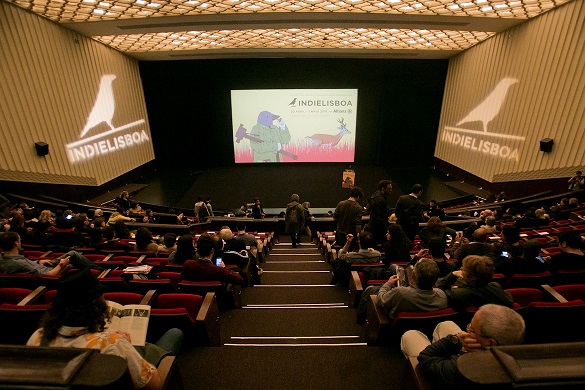
The room has egg shell coloured walls which I know its not very nice but it´s an old protected building that we can´t touch.
So now I´m trying to find out if chaging the screen could solve this problem.
The room seats 830 but as very high sealling, about 15m.
The screen is 16m wide by 5.5m high.
The Projection distance is 30m. ( I think this doesen´t help)
Should I get a silver screen? Will it ruin the 35mm projection?
We don´t do 3D anymore.
The room:
A smple of he prblematic film:

Thanks in advanced for any advice.
Cheers
Fernando
Posted by Dave Macaulay (Member # 813) on 06-02-2018, 10:54 AM:
I don't know if you can fix this, it looks like a director/cinematographer problem more than a projector problem. Like they timed it on a TV and expect it to look good in a cinema.
Standard 4K DMD projectors do not have excellent contrast. But timing a print to be in the bottom 10% of the luminance is not a good choice.
The light walls are a problem, and you are stuck with that. A gain screen will cut down the problem a bit. The gain screen hotspot will affect any projection equally, film or video. A high gain screen would be pretty bad, a mid gain one should be acceptable.
I doubt if that movie would look too good in any cinema. There are complaints now about "Solo" because the cinematographer chose to print it very dark so shadow detail is lost in many theatres.
Posted by Fernando Caldeira (Member # 5680) on 06-02-2018, 11:59 AM:
Thnks Dave,
The picture shown is of what it should be. In our projection you couldn´t see much of anything in that frame.
Posted by Steve Guttag (Member # 268) on 06-02-2018, 12:44 PM:
What size lamp?
You can cheat contrast "a little" by going from a matte-white to a 1.4/1.5 gain screen but you will affect the overall image too. The gain doesn't really improve contrast, that is set by your projector but by forcing a hot spot, you effectively lower the light levels on the sides/corners so it appears you have affected contrast.
If the problem you describe is that you can't see any details on the image you show, then it may be that you don't have enough light to begin with. Contrast ratio is the the measure of the brightest to the darkest and without the image as bright as it should be, you can't improve it.
The focal length of your lens has no effect on contrast ratio. Its design/construction can have an effect but the focal length itself is not an indicator.
Keeping all of the dirt/dust off of the entire optical path from lamphouse, integrating rod, prism and lens will also improve contrast. Anything that causes the light to bounce around hurts contrast and dust will do that.
Posted by Mark Gulbrandsen (Member # 72) on 06-02-2018, 01:15 PM:
I reccomend you only use the actual NEC air flters in the NC-3240. Many of the Chinese variants allow dust leakage around the air filter itself. The NEC filters are expensive, but so is having a light engine properly cleaned...
Mark
Posted by Fernando Caldeira (Member # 5680) on 06-03-2018, 09:19 AM:
Steve,
The lamp is 4.5k. We getting 20fl and bavig a hard time going under.
Mark,
We only use original nec filters
Posted by Mark Gulbrandsen (Member # 72) on 06-03-2018, 09:30 AM:
That somewhat explains your problem. 20 fl is way too much light and DLP is not capale of doing absolute black as it is. So I can imagine it looks washed out. You can try defocusing just the lamp focus control (not the X-Y controls) to get light levels down to 14 +/- 2 fl, I tend to set light levels to just under 16 fl. Or try going down to a 3kw lamp. Remember the larger 1.38" DMD chips in that projector are going to put out a bit more light than your average 2K projector does....
Posted by Gordon McLeod (Member # 33) on 06-03-2018, 10:23 AM:
Nec does have a iris that fits in the patch of the lamp to reduce light and will improve contrast
Posted by Mark Gulbrandsen (Member # 72) on 06-03-2018, 01:30 PM:
quote: Gordon McLeod
Nec does have a iris that fits in the patch of the lamp to reduce light and will improve contrast
I do not recall one being supplied with the larger projectors, but they may have... There is for sure one supplied with NC-1200 & NC-2000.
Posted by Paul H. Rayton (Member # 1817) on 06-03-2018, 06:38 PM:
NEC definitely does have an iris for their 3240 projector. Accessing the location of said iris is a bit of a project, however. In the case of the 3240 projector, it's necessary to get in by disconnecting some of the rubber coolant piping, and moving away (but not removing) the coolant reservoir. Difficult, but not impossible - but you wouldn't want to do it very often.
So the iris attachment is a very valid approach for improving your contrast, plus it will also drop your screen brightness somewhat, possibly 3 or 4FL, depending some variables. That seems to be good side-benefit for you since you indicate that you're already having difficulties getting screen illumination below 20FL.
We successfully used a similar iris in the NEC model 2500 and it was very good for the image. Sadly, as the optical system aged, the system gradually lost efficiency. After about 6 years we mostly had to leave the iris out because we were having trouble hitting 16FL. That being said, it's also generally accepted that 2K DLP chips have better native contrast than 4K DLP chips, so while it's not practical in your case, you could also achieve a slight contrast improvement going to a 2K projector.
And finally -- those light-colored walls are absolute killers for screen contrast. That's been known for decades, of course, and that's why contemporary high-end cinemas are specified to have dark (or black) walls and ceilings. (The "black box" concept.) I once worked in a cinema that did a refurbishing, including painting the walls and ceiling black, and was astounded by the resulting difference in image quality.
Posted by Leo Enticknap (Member # 534) on 06-04-2018, 12:31 AM:
Thanks, Paul. Literally, about the only truly good, "no strings attached" comment I have about the Series 1 NEC compared to the Series 2, is that inserting and removing the iris/depth of field booster plate is so much easier and simpler. The contrast ratio of the 2500 at the Egyptian with the iris in place really looked nice. I remember early one morning watching a Warners' DCP of The Treasure of the Sierra Madre on it shortly after I started working there in 2014: I'd only intended to look at the first ten minutes or so, because our programmer was worried about what it was like. In the event, the sharpness, contrast and gamma struck me as being almost as good as a nitrate print (and certainly better than many of the several 35mm safety prints I'd seen projected), and so I made myself comfortable in the balcony, and watched the whole thing. I'm ashamed to say that this was probably the last time I watched a movie in a movie theater from start to end.
On the 3240 you've got to go in behind the cooling system reservoir to insert and remove the iris, with the result that it's generally considered not worth the hassle, even during 2-D / 3-D conversions. At the Aero it's a Hobson's choice: if you have the iris permanently in, a 4K bulb is perfect for 2-D, but a 3K bulb isn't, and 7K isn't quite bright enough for Dolby 3-D. Without it, a 3K bulb will do (just) for 2-D and a 6.5K will work for 3-D, but the contrast ratio really takes a hit.
Posted by Fernando Caldeira (Member # 5680) on 06-04-2018, 04:53 AM:
So,
We do have the iris instaled (cat's eye right?) we had about 30 fl before.
Mark,
quote: Mark Gulbrandsen
You can try defocusing just the lamp focus control (not the X-Y controls)
you mean on the back side of the projector right? with the 3 socket screws?
If I reduce the lamp power will it help?
If I need to use a 3k lamp I will need to change the power rectifier right?
Posted by Sean McKinnon (Member # 612) on 06-04-2018, 10:23 AM:
You could also try a grey or negative gain screen to improve your contrast if the iris alone does not cut it.
Posted by Steve Guttag (Member # 268) on 06-04-2018, 11:16 AM:
Grey screens do not help contrast in a darkened environment. They lower both the top and the bottom (ratio remains the same).
The thing to do after checking with the iris (aka catseye) is to lower the lamp wattage until you are in spec.
Posted by Mark Gulbrandsen (Member # 72) on 06-04-2018, 11:19 AM:
quote: Fernando Caldeira
you mean on the back side of the projector right? with the 3 socket screws?
Yes. Two are X & Y and one is focus or Z.
quote:
f I reduce the lamp power will it help?
You can take it as low as it allows you because the minumum and maximum settings that you are allowed to use are the actual lamp parameters and it's fine.
Yes, you may have to get a different rectifier for a 3kw lamp if you have the 7KW version of the 3240. The rectifiers are directly interchangable with just a simple firmwarte update required so the firmware can properly control that smaller rectifier.
Mark
Posted by Frank Cox (Member # 6258) on 06-04-2018, 01:00 PM:
I'm wondering what happened here. Does this chap have a vastly overpowered/oversized projector for his auditorium and screen size? That seems like a good way to spend a lot more money for equipment and electricity to run it, and end up with a lesser result in terms of the picture that people are watching on the screen.
You wouldn't use a John Deere tractor to tow a kids red wagon. Why would you do this either?
Posted by Sascha F. Roll (Member # 9043) on 06-04-2018, 01:54 PM:
Well as he stated in his first post they don't do 3D "any more" so I guess the projector initially was correctly spec'd for 3D on his 16m (52 ft) wide screen as they must have used shutter or Dolby 3D with less-than-stellar light efficiency.
I'm still a bit surprised about the numbers quoted earlier (hitting 20 fL with a 4,5 kW lamp on a 50 ft screen), especially if you consider that he already has the Iris in place and (probably?) a matte white screen.
I guess those numbers (20 fL Peak White) are for Flat only?
Taking into consideration that NEC is not the most light-efficient DLP projector out there a 4,5 KW lamp with the Iris seems like the right choice for the given screen dimensions to me. Next question would be which lamp is he using? Were the 20 fL Peak White measured with a brand new bulb? Talk about aging lamp, luminance dropoff...
Lots of variables here. We have a few NEC 3240 in Berlin (as well as Barco DP4K 32B and Kinoton DCP30 LX II 4K) and they _ALL_ have shitty picture with poor contrast - so nothing that is really surprising me. DoPs and / or directors are also constantly complaining about the poor image quality in some "premiere" venues - but usually the "other" choice for their event would be the multiplex across the street with a 2.4 gain silver screen...
Posted by Fernando Caldeira (Member # 5680) on 06-06-2018, 07:05 AM:
It´s a Matte white screen.
The bulb is 4.5Kw. The numbers are for flat only, yes.
We use Ushio DXL-45 lamps.
Cheers
Fernando
Posted by Sean McKinnon (Member # 612) on 06-06-2018, 10:26 AM:
Fwiw, I have found that they do help with contrast because you have less stray light being reflected.
Posted by Steve Guttag (Member # 268) on 06-06-2018, 04:36 PM:
You find you have stray light reflected in a darkened theatre? (aside from the Exit sign, I suppose). Perhaps some ill designed step lights pointing at the screen?
Powered by Infopop Corporation
UBB.classicTM
6.3.1.2