This is topic Issues with Digital Projection in general in forum Digital Cinema Forum at Film-Tech Forum ARCHIVE.
To visit this topic, use this URL:
https://ft-forum.com/ft/cgi-bin/ubb/ultimatebb.cgi?ubb=get_topic;f=16;t=003413
Posted by Monte L Fullmer (Member # 2797) on 08-17-2018, 02:20 AM:
I'm writing this note to get feedback from locations around the film-tech world on the reason of this topic:
At your respective location(s), what kinds of issues has their been with this Digital Cinema now that it has been on the market for a good couple of decades, especially when the huge rollout happened a little over 5 years ago.
For Example: Content corrupts, TMS issues, storage drives crashes, rectifiers going out, light engines having their image issues, network failures, where bottom line weekly reboots if units are to stay online due to VPF contracts, .. and the similar.
..just situations that were rare to never happening when we were running film.
Thx - Monte
Posted by Scott Norwood (Member # 30) on 08-17-2018, 07:04 AM:
Disclaimer: I don't deal with this stuff on a day-to-day basis. My involvement with digital cinema is largely limited to screenings at festivals and special events.
The biggest problem that I have seen is the non-standardization of DCP formatting and delivery.
It is possible to make a valid DCP that does not play and to make an invalid one that does Some DCPs will play on some server/projctor combinations, but not on others. Not all servers support all frame rates (24, 25, and 30). All servers will read ext3-formatted drives, while some but not all will read HFS+ and NTFS formatted drives. Homemade DCPs are often made with titles like "My DCP" that can be difficult to find in the list of files on the server. Generated subtitles are still problematic. Many festival movies are mixed as left/right stereo, even though that is not a cinema format. Finally, I have seen a number of festival DCPs where the wrong container size was chosen (such as 2.35 in a flat container).
We don't these problems with film or with broadcast videotape formats. Those who work in regular cinemas probably don't have these problems with major-studio releases, either.
On the plus side, the equipment has been more reliable than I would have expected, and D-cinema has forced many theatres that previously had substandard sound systems to upgrade to modern equipment.
[ 08-17-2018, 09:16 AM: Message edited by: Scott Norwood ]
Posted by Frank Cox (Member # 6258) on 08-17-2018, 09:10 AM:
I think the main issue is that this stuff is a black box.
With film, if something went wrong you could usually figure out why and sometimes you could do something to make the show work anyway. (I once spent an entire show spinning a platter by hand when the payout motor refused to start.)
With the digital setup, if it doesn't work you can't do much other than call a tech and say "It doesn't work"; If you push the button and nothing happens you're already at the end of what you can do to get a movie on the screen.
The primary design is intended to not work and nobody is allowed into the inner sanctum of the anti-piracy measures if something fails. The primary focus is on anti-piracy rather than getting a show on the screen for the paying customers.
When it works, it's great. When it doesn't, you're stuck.
Posted by Barry Floyd (Member # 385) on 08-17-2018, 11:26 AM:
On the lines of what Frank mentioned, the big black box scenario was kinda scary when we first installed it back in 2013, now not so much. You really have to play by the machines set of rules and don't deviate from them. Certain things have to be turned on in a particular order, but that's really not that big of deal. Know your passwords to everything, know how to use your diagnostic software (i.e. Barco Communicator) to diagnose your problems, know where your security keys are and how to use them, and do your preventative maintenance on a consistent schedule. You take care of the machines and they will take care of you.
Spending a week in Rancho Cordova, California at the Barco training school really helped ease my fears of the dreaded black box. The only issues we've had related to digital projection has been either an on-board battery die or in one instance a switched mode power supply went out on one of our 23B's. I will say that when the power supply went out, the 24/7 technicians at Barco were able to help me diagnose the problem and had the replacement part flown to me from the other side of the country within 12 hours. The extra money spent for the extended warranties really paid off in that instance.
With 35mm, we didn't have to deal with extended warranties as we were dealing with machines older than me, but they were all mechanical and relatively easy to fix.
We play mainly (99%) first run features, so we really don't seem to have the issues of non-compatibility that Scott mentioned.
Digital projection has eliminated the time consuming build up and tear down of films, and I don't miss that one bit. Film was less forgiving if a metal shaving or speck of something got embedded on a pad roller in the soundhead and destroyed your print on the first run of the night.
Posted by Mike Blakesley (Member # 26) on 08-17-2018, 12:15 PM:
I have the same feelings about the "black box" thing, but problems have been relatively minimal, although with digital, a real problem usually means canceling the show. In 8 years and two months, we've had the following problems I can think of:
One distribution hard drive problem (had to "skip past" the problem area of the drive, causing audience to miss about 20 seconds of the feature each night, but the shows went on)
One defective lamp (replaced under warranty - show went on after bulb was changed out)
One server failure (upgraded the server to a media block with external storage, paid for by insurance since the failure was caused by an electrical surge - closed for three days while it was fixed)
Three server hard drives fail (replaced whole set each time, and lost one show each time)
I've had to have technician Mark remote-in numerous times to fix small issues, like clearing an error message I wasn't familiar with or installing updates...things like that.
We've had zero problems with keys, drive delivery, etc.
Posted by Victor Liorentas (Member # 5272) on 08-17-2018, 12:46 PM:
A constant nagging depression due to not running film all the time but instead selling tickets and popcorn to stay employed. ![[Smile]](smile.gif)
Posted by Mark Gulbrandsen (Member # 72) on 08-17-2018, 04:56 PM:
Monte...
I see this stuff happen at places where too many different people have their hands in the mixing bowl. Also in places where not all updates are promptly done promptly, or at the same time. Overall I have almost no problems with TMS, excepting a couple versions of the TMS app. I used very reliable Dell servers and patterned my TMS systems after Cinedigms with the exception of managed switches. No real need for those and they have caused issues of their own at various locations in the past. I've had tech's lose, or change passwords on them, and the little fans in them go bad all the time. All network cabling should also be certified so it is the last thing questioned.
Mark
Posted by Marcel Birgelen (Member # 6801) on 08-17-2018, 05:33 PM:
quote: Mike Blakesley
I have the same feelings about the "black box" thing, but problems have been relatively minimal, although with digital, a real problem usually means canceling the show.
Unfortunately, the "black box" thing is on-purpose as it is the way "Hollywood" wants to protect their intellectual assets.
I think the biggest problem is that what used to be mostly minor mechanical failures and simple problems with some electronica has now become a matter of IT problems.
IT problems are often caused by bugs, essentially defective software. The problems that arise out of this are often not easily identified nor easily solved. That has accounted for quite some failed shows.
Unfortunately, there are no real hard numbers whether or not the number of failed shows has been increasing or decreasing since the exhibition world migrated from film to digital. I also think those numbers would only be fair over a larger timespan, now since the older digital deployments are actually starting to show their age.
Posted by Martin McCaffery (Member # 37) on 08-17-2018, 05:49 PM:
As someone said, we're all beta testers now.
I desperately want to get rid of the machine I have, but do I get a laser machine, or stick with xenon?
I'd have to go to my notebook to get most of the problems. I think we are on our 5th IMB. Replaced the prism set, power supply ballast, lamps cannot maintain 14fl for longer than a week (now show at 8.1 and no one has complained), recently lots of ingest problems. Batteries run down.
One hard drive in the RAID was bad when we opened the box, since then it has been fine (though the ingest problems could still be related).
Weird unidentified aspect ratios.
When showing DVD/BluRays, quirkiness about handshaking.
As has been said, when they work they are fine (except for the light in my case) but when they have even the littlest problem you're off the screen.
Maybe if I were younger I would find them fascinating. Now they are just annoying.
Posted by Frank Cox (Member # 6258) on 08-17-2018, 06:09 PM:
It's the only commercial/industrial equipment that I know of that is deliberately designed to not work. Just about any other "mission critical" equipment has bypass modes or some sort of built-in redundancy so it can be made to work in an emergency. Or at the minimum it's designed to be as robust as possible within its price point.
Digital cinema equipment comes at a very high price point, and it has failure modes designed right into the equipment.
Posted by Marcel Birgelen (Member # 6801) on 08-17-2018, 06:25 PM:
I agree with you on this one. For the amount of costs involved, Digital Cinema equipment has very little redundancy or at least "bypass" functionality in general.
I guess the reason for this is because it's pretty expensive and complicated to do so.
But even in the film days there were more bypass scenarios for many potential equipment failures.
Posted by Steve Guttag (Member # 268) on 08-18-2018, 08:40 AM:
DCinema equipment is towards the "cheap" end of their class of equipment. Look at the cost of an equivalent Rental/Staging projector in any of the brands and the DCinema street price is considerably less.
That said, I think it is horrible the amount of "reboot it" solutions. It isn't a solution, it is overcoming a problem. This stuff should be 24/7 capable but sooner or later, it is going to bite you.
Reseating boards is another thing I'm sick and tired of. It has happened on all projectors we deal with and mostly the ICP and continues on in series 3 with the likes of the ICMP. Enough is enough with this stuff.
Even things as simple as closed captions get overly complicated in DCinema. We've had Closed Captions in TV for decades but in DCinema they go out of their way to make it less reliable. Just this past week I've had to do updates to get things more reliable with it and even then on GDC, you might get the red "caption encoder not found" error though it will still work. We didn't used to get this error all of the time but now we do.
The number of issues I have to deal with because of subtitles/captions is appalling. The problems come right from authoring down to how some TMSes or server ingest them, to studios wanting to encrypt them to fonts that are missing or how SMPTE handles them versus Interop.
KDMs are another thing...every week I get some sort of KDM issue. Deluxe sends out last week's KDMs or the theatre doesn't realize that if a movie opens on a Wednesday that their keys will likely die EVERY Wednesday, not Friday. Would it be so hard for the studios to, regardless of the opening day to have KDMs for regular releases die on Friday Morning? It is like they go out of their way to have problems.
Posted by Martin McCaffery (Member # 37) on 08-18-2018, 04:05 PM:
Do most Pop movies have KDM's that are only good for a week?
I get week long KDM's for some of my films that are only a week, but we generally only do one week bookings. On the other hand, from the smaller studios I'll get keys that are good for up to a month.
To the studios really make you run around for new KDM's weekly?
Posted by Rick Raskin (Member # 1561) on 08-18-2018, 04:22 PM:
quote: Marcel Birgelen
Unfortunately, there are no real hard numbers whether or not the number of failed shows has been increasing or decreasing since the exhibition world migrated from film to digital.
Interesting point. I can count on one hand the number of failed shows I experienced running film and still have fingers left over.
In my opinion they have taken something that should be relatively simple and turned it into something wholly other. On the other hand, as things evolve further there should be more plug-and-play solutions, better redundancy and better interoperability between vendors.
Posted by Steve Guttag (Member # 268) on 08-18-2018, 04:33 PM:
Martin, It varies from studio to studio. Some give you multi-month KDMs but most are tight-fisted and have them die weekly and, again, on the same day that they opened. They do KDMs for features that are on Blu-ray already! What is the point? The theatre could run the Blu-ray if they wanted. Why bother KDMing the DCP, at that point? The cat is out of the bag.
Posted by Marcel Birgelen (Member # 6801) on 08-18-2018, 04:38 PM:
The whole KDM issue is really retarded to start with. By now, there should be infrastructure where playout servers /IMSes can automatically download the KDM for any given movie.
All it would require would be some publicly accessible licensing servers and a simple API and you would never to have load a KDM again, it would simply download itself...
Also, imagine if all studios and distributors would invest in meaningful licensing portals, where you could simply extend the license for a movie at the click of a button?
quote: Steve Guttag
Even things as simple as closed captions get overly complicated in DCinema. We've had Closed Captions in TV for decades but in DCinema they go out of their way to make it less reliable. Just this past week I've had to do updates to get things more reliable with it and even then on GDC, you might get the red "caption encoder not found" error though it will still work. We didn't used to get this error all of the time but now we do.
The way subtitling works in DCI, with one old, scewed up defacto standard and a newer, overly complicated standard that's not universally accepted is just retarded.
Instead of re-inventing the wheel, they should've simply looked at how it's done with Blu-Rays and called it a day.
F.y.i.: Blu-Ray uses simple transparent PNG images as overlay per subtitle stream, so there is never an issue with fonts that won't load because they're too large or contain "incompatible" stuff or rendering issues because the subtitling engine craps out after it didn't understand the XML or some glyph in the font.
Since a PNG is just an image, subtitles can also be in any language you want, they could even be in Klingon...
quote: Steve Guttag
DCinema equipment is towards the "cheap" end of their class of equipment. Look at the cost of an equivalent Rental/Staging projector in any of the brands and the DCinema street price is considerably less.
I'd say that across the whole board prices for projectors keep dropping. One advantage nowadays is that, with the amount of graphics performance that can be had for a few hundred dollars, you can do pretty amazing things with stacks of "cheap" projectors.
DCI is its own isolated island, but the only reason for this is the type of DRM it's using. We should try to homogenize the playing field, and the industry should choose a more widely accepted form of content protection, so cinema projection and playback technology could leave the island it is right now.
It might also be beneficial for the stability of those systems. There really isn't that much difference between a movie theater playing a preprogrammed show to a performing arts theater using pre-programmed video as part of their show or an attraction using video effects and projections. Yet we keep on using different projectors and different automation tools. Those islands of technology that don't mix with each other is a lost chance at improving technology on both sides.
quote: Steve Guttag
That said, I think it is horrible the amount of "reboot it" solutions. It isn't a solution, it is overcoming a problem. This stuff should be 24/7 capable but sooner or later, it is going to bite you.
It's like you're sometimes stuck between a rock and a hard place. It probably keeps you off the street, otherwise you could use the time you spend on menial bug remedies on so much other stuff... ![[Wink]](wink.gif)
Posted by Stephan Shelley (Member # 8587) on 08-18-2018, 04:39 PM:
On the KDMs, the length varies by studio policy and from feature to feature. Disney's policy is initial key 2 weeks and week to week after that. I have seen one week keys to start with from Disney. Others vary greatly. Sometimes 6 or 8 weeks to start with. Sometimes more like Disney.
Martin are you first run because most of the studios will not book a 1 week run. At least not in northern CA. Often you have to play 3 or 4 weeks to book a first run feature.
Posted by Martin McCaffery (Member # 37) on 08-18-2018, 05:52 PM:
We are a calendar art house. Most of the films we play don't play anywhere else in Montgomery, so you could call us a first run. Sometimes, for whatever insane reason, the distributor will put a film in the AMC discount house before we show it. If we pick it up a month later and it is still in the first run window, they will treat it like first run (and charge accordingly).
Then there is the whole platforming thing that digital was supposed to get rid of.
Posted by Mike Blakesley (Member # 26) on 08-18-2018, 09:12 PM:
Our experience is that Sony always gives us 8 week keys, or sometimes 16 weeks, whether a movie is brand new or weeks old.
On one- or two-week bookings, Disney always gives us keys for the full run of the movie, but theirs usually open two days before the opening date, which is nice. For three-week/four week runs, they will send the first two-weeks key first, then the other weeks one at a time.
The rest of the studios, as far as I can remember, give us keys for the length of our run.
I agree it's ridiculous how complicated it is.
Posted by Justin Hamaker (Member # 2165) on 08-18-2018, 09:34 PM:
My theatre has been 100% digital for just about 7 years. In that time I have had a few issues such as failed RAID drives, failed media blocks, and some others. But the issues have all been relatively easy to resolve. Over the 7 year period I don't think we have lost any more shows than we would have with film.
Periodically I have to go through and check screen files and make small tweaks to the focus/zoom settings, but that's about all besides changing bulbs and air filters.
In terms of content we have had very few issues with content/key mismatches, delivery of keys, corrupted content, or anything else.
We have had very few issues related to automation, and most of the ones we have had were the result of show overlap (when you include trailers and preshow). One of the 'quirks' we had to learn was we need to have a gap of at least 2 minutes between shows or the automation will not kick in for the next show. This may be related to how the Hollywood Software TCC sends a unique SPL for each and every show.
Posted by Victor Liorentas (Member # 5272) on 08-18-2018, 10:23 PM:
I had to ingest new keys for Book Club every 3 days!
![[Roll Eyes]](rolleyes.gif)
Posted by Paul Shuttleworth (Member # 9057) on 08-29-2018, 01:58 PM:
I think the most irritating problem for me aside from frame rate differences and unusual variety of aspect ratios is the slowness of 'checking for licenses and contents' on the Dolby server.
Aside from that our Kinoton seems to work marvelously.
Posted by Mark Gulbrandsen (Member # 72) on 08-30-2018, 08:18 AM:
quote: Paul Shuttleworth
frame rate differences and unusual variety of aspect ratios is the slowness of 'checking for licenses and contents' on the Dolby server.
I always wondered why they did it that way too. GDC does that check right after it boots up, just before the log on screen appears. It scans content and licenses so there is no delay when playing content...
Mark
Posted by Dennis Benjamin (Member # 1137) on 08-30-2018, 09:46 AM:
I love film.
Just had to say that before I start.
(/Ramble on)
We have less and less shows go down with digital though. Yes, there are the physical problems: RAID drives getting old, dowsers failing, etc. But we had worse physical issues with film (brainwraps, roller wear, etc.). As with anything - Human error is the number one factor when it comes to problems.
Here is what I found: A film projection booth was only as good as the person running it. Being pro-active kept the physical issues from being a problem (inspecting rollers, checking oil levels, sound and picture checks). You were bound to have issues, it was a matter of staying out in front of them. I ran a theatre in Florida, had a former Union projectionist who was in charge of the booth, and only lost a single show in a 2 plus year period. (Shout out to Ronald Green of Broward County, Florida, one of the most professional guys I ever worked with)
With Digital it is the same. Have someone in charge, with the right knowledge, and it will keep the problems to a minimum. Yes, problems will occur. Stay ahead of the curve. Our theatres up North have their managers come in an hour earlier than normal on Fridays and run all the playlists well before show time. Once the playlists go into the feature, they stop it. They do this to check a whole bunch of things before a paying audience goes into the auditorium. That's what I call being pro-active.
As far as your question Monte: We have worked out all our issues currently, or until the next software update comes out! Which is, by the way, they way it is in the modern world with digital technology. RAID drives are going to fail, cards will need reseated, and all computers will sometimes need a reboot (just hopefully not on a Friday night at 7 p.m.). Other than that, the hardware people will try to sell you thier newest stuff and the software people will always have a new version for you to update to (eventually leading to trying sell you new hardware from thier buddies that make the hardware).
No doubt the digital transition was a great big money grab on a bunch of people's parts. But I think it overall was good for the industry as far as stability is concerned. While I LOVE FILM and I miss it, I have adapted to the change.
(/Ramble off)
Posted by Martin McCaffery (Member # 37) on 09-02-2018, 06:00 PM:
This:
quote:
*HOLIDAY ALERT* Christie Technical Support will be closed Monday September 3rd for a national holiday:
Please let us know how we can help to ensure any outstanding concerns are taken care of before the holiday.
Posted by Jeff Fruchey (Member # 10302) on 09-02-2018, 11:04 PM:
My biggest headache has been with the hard drives we receive.
Screws rolling around in the case or not fasten completely and sticking up. Have had a few so damaged you would not dare slide it in your DX115.
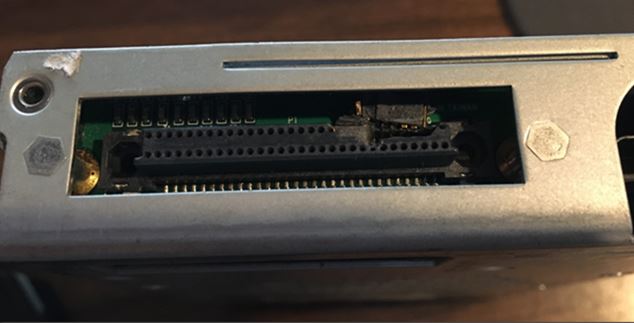
Others with so many stickers on the case it would not slide into the DX115 or misaligns with the pins.
Brings back memories of receiving a bad print from the film depot.
Guess this provides an argument for satellite delivery?
-Jeff
Posted by Frank Cox (Member # 6258) on 09-02-2018, 11:09 PM:
I keep a screwdriver beside my server for the purpose of tightening those screws.
And I peel off those thick pads of stickers when the hard drive won't slide into the slot.
Last week's trailer drive fooled me, though. It went in fine but when I removed it the sticker disintegrated and rolled itself back around the little rollers on the top of the slot. It took a while to get that pulled back out again. First time that's ever happened.
Posted by Buck Wilson (Member # 5885) on 09-03-2018, 01:49 AM:
10 plex, digital in Aug 2012 with 7 new NECs and already had 3 handmedown Barco DP2000s
It's been kinda rough, and even more so lately. I'd say we have a pass-able(readmit) event roughly once a month or more just due to the flaky nature of IT... Artifacts/wrong colors/weird shaped image on screen, stopped or other issues with playback, wrong content playing, RAID issues, 3D issues, etc. "Reboot it" is all too often the "solution"(I agree with Steve... That's not a solution, it's a band-aid.)
We've had a handful of events taking down an auditorium for multiple shows to multiple days in the last year or so. Light engine failure, bulb/reflector explosion, "main board" or whatever in one of the NECs, drive issues, etc.
Our LMS just ate enough shit that they felt the need to completely replace it with a TMS which has been a nightmare of a process.
Lens file issues, convergence degradation, coolant issues, bad/missing content/KDMs, finicky macro problems... It's always something. You don't really ever know if a movie is going to play. I don't have much confidence in the stuff. It is annoying. I don't hate digital, it can put out a decent picture and is flexible as all get out as far as scheduling... it has it's benefits; but dear god, there is plenty of room for improvement. As someone else mentioned, seemed like there was almost always something you could do to get back on screen with film, and you could see and touch and hear the problems.
Posted by Marcel Birgelen (Member # 6801) on 09-03-2018, 08:13 AM:
quote: Buck Wilson
As someone else mentioned, seemed like there was almost always something you could do to get back on screen with film, and you could see and touch and hear the problems.
You could say that with digital, the problems also have become more digital... one or zero, it's all or nothing.
Maybe the good thing about Digital not being perfect in the way it was advertised is that, is that many of us still have a job.
Posted by Harold Hallikainen (Member # 5405) on 09-03-2018, 12:12 PM:
Marcel Birgelen wrote:
quote: Marcel Birgelen
The whole KDM issue is really retarded to start with. By now, there should be infrastructure where playout servers /IMSes can automatically download the KDM for any given movie.
All it would require would be some publicly accessible licensing servers and a simple API and you would never to have load a KDM again, it would simply download itself...
Also, imagine if all studios and distributors would invest in meaningful licensing portals, where you could simply extend the license for a movie at the click of a button?
There was a proposal (I think it was by Fox) for automated key delivery (actually automated key fetching) called. Theater Key Retreival (TKR). The server or TMS does an HTTP request with the URL built upon a URL included in the DCP and the IMB public key thumbprint.
I always thought this was great, but it does not seem to be going anywhere.
Harold
Posted by Carsten Kurz (Member # 5396) on 09-04-2018, 04:56 PM:
quote: Harold Hallikainen
There was a proposal (I think it was by Fox) for automated key delivery (actually automated key fetching) called. Theater Key Retreival (TKR). The server or TMS does an HTTP request with the URL built upon a URL included in the DCP and the IMB public key thumbprint.
I always thought this was great, but it does not seem to be going anywhere.
A while ago I attended a session given by the Gofilex people. They are supporting many sites across Europe with digital DCP delivery (and occasionally also KDMs). Their analysis why server based TKR doesn't work is simple - theater operators do not want their systems to be connected to the internet. Yes, there are firewalls, but... The larger sites without these concerns usually run a TMS which takes that burden from them anyway.
For me, KDM reception by email and application to our servers is so simple and hassle-free, that I simply do not care about TKR. Hotfolders and automatic ingest comes very close to TKR.
The only issues I have with digital projection is KDMs and DCPs appearing unnecessary late. Would TKR help with that? As KDM service companies or studios issue KDMs late for email transfer intentionally, why should they issue them earlier with TKR? They would probably think - 'Wow, as TKR is automatic, we can issue our KDMs even later!' Just-In-Time KDM is coming...
- Carsten
Posted by Frank Cox (Member # 6258) on 09-04-2018, 05:34 PM:
Cinema servers (or at least GDC cinema servers) run on such ancient versions of Linux (Fedora Core 5 from 2006 is what I have here) that connecting them directly to the Internet would be a really bad idea.
Posted by Harold Hallikainen (Member # 5405) on 09-04-2018, 06:31 PM:
Thanks for the comments! Through Network Address Translation, anything past the router would not be available to the outside world. Only HTTP connections from inside the theater could get out and get a response. No outside device could establish a connection. That's how my home network is set up (other than one internal IP address I allow external access to). So, I think it can be done securely. To get keys automatically, it seems that there has to be SOME connection to the internet, whether that's a mail client or an HTTP client. If the keys are coming in via email and copied to a flash drive that is then carried over to the internal network, there is an "air gap" providing security, but that's not very automated. If the mail client can copy emails to a server on the internal network, it appears the internal and external networks are electrically connected somehow.
So, I like the simplicity of TKR and believe it does not pose a security risk (with proper firewall with NAT).
Again, thanks for the comments!
Harold
Posted by Monte L Fullmer (Member # 2797) on 09-04-2018, 06:47 PM:
quote: Jeff Fruchey
My biggest headache has been with the hard drives we receive.
Going back on this topic above: I've done the following:
If the can that the HD is mounted in is all tweaked where the unit cant slide into the CRU slot, I'll take out the HD from this can and another can, remove the HD from the good can and put the needed HD into the can that isn't tweaked out of proportion. After the ingest is completed is when I'll return all back to normal.
Can is kind of okey, but can't lock the lever being the can is so tight going in the CRU slot, and that is after removing all of the paper?
Just shove in the can until the activity light comes on and leave it alone-don't lock the lever. The back plug on the can has met the connector in the slot.
You need the lever to pull out the can from the slot.
Posted by Frank Cox (Member # 6258) on 09-04-2018, 07:56 PM:
I've had at least two that were bent out of shape to a point that they would still run but not slide into the slot. So I just hooked them up with that external USB boot thing that they used to send along with the drives and loaded it that way.
Takes longer that way but it gets there.
Posted by Mike Blakesley (Member # 26) on 09-04-2018, 08:19 PM:
Mostly "loose screws" has been the only problem with drives. The first time it happened, I was surprised at how little they have to be unscrewed before the drive won't slide into the bay.
Posted by Marcel Birgelen (Member # 6801) on 09-07-2018, 08:21 AM:
I've seen drive tray designs not using any screws at all to keep the disk in place.
The stupid thing is, some of those trays have such specific screws that if you lose one, you'll have a hard time finding another one that does not only fit the winding, but doesn't stick out too much to block the sliding mechanism.
Powered by Infopop Corporation
UBB.classicTM
6.3.1.2