This is topic AMC Theaters sound system in forum Digital Cinema Forum at Film-Tech Forum ARCHIVE.
To visit this topic, use this URL:
https://ft-forum.com/ft/cgi-bin/ubb/ultimatebb.cgi?ubb=get_topic;f=16;t=003473
Posted by Justin Bacon (Member # 10638) on 10-17-2018, 04:22 PM:
Lately I've been noticing AMC Theaters has been installing QSC dcp300s in their theaters lately and the sound is super addicting. I don't know if anyone knows how they are getting those speakers to sound that good but I first noticed it in Houston and now Orlando at the West oaks Mall. I don't know if it's simply and eq or it's there way the qsc system shapes the sound. Maybe someone on here knows so now I personally want to own a qsc dcp100 and bring that sound home. I own a Dolby CP650 currently
Posted by Marcel Birgelen (Member # 6801) on 10-17-2018, 07:39 PM:
The DCP 300 is a cinema processor, while you're specifically mentioning the sound of speakers.
Maybe you can try to explain what you mean with "addictive" sound? Maybe somebody just did a fresh EQ on the room after they swapped e.g. the cinema processor and ever since it sounds like it should? ![[Razz]](tongue.gif)
Posted by Steve Guttag (Member # 268) on 10-17-2018, 09:41 PM:
Likely, they are also pairing the DCP series processors with QSC SC series speakers (especially the SC-424 or SC-423 or a variant based on the room size and LF demands). Those speakers are VERY easy on the ears. I typically find that the fader levels tend to run higher when those speakers are used. As such, if the fader is run closer to 7.0 (0.0dB) you'll also find that the surround speakers also have better presence since they are not being attenuated and likewise on the subwoofers.
Another suspicion is that QSC has developed "intrinsic correction." This is a process where they have measured the speaker's response in precise detail and then puts those measurements into a file such that their cinema processors can provide a complimentary response that should, effectively, make the speaker "flat" before you begin tuning. Now the room itself will have a huge effect on this but presuming reasonable acoustics, little in-theatre tuning should be required.
Officially, the DCP line has not incorporated intrinsic correction yet though it wouldn't surprise me if AMC does not have versions that have it (they are a pretty major circuit). The DPM series (100 and 300) have intrinsic correction as does the QSYS system. The NEW DCM100/300 monitor/crossovers also have intrinsic correction.
Posted by Mark Gulbrandsen (Member # 72) on 10-19-2018, 06:23 AM:
There is a brand new AMC just a mile down the road from me. I was not impressed at all by it. Teeny auditoriums for such a populated area. I will drive further to the nearest Cinemark for some sort of actual cinema experience.
Mark
Posted by Justin Bacon (Member # 10638) on 10-20-2018, 03:45 PM:
Thanks for the responses and no I can't explain the sound unfortunately, btw AMC is keeping their old speakers from 20 something odd years ago but the sub bass still slams and they run flat down to 20htz as well. The theaters besides Katy Mills has new JBL speakers in the 5732 and 3732 screen arrays not really a jbl fan anymore but the sound incredible
Posted by Steve Guttag (Member # 268) on 10-20-2018, 04:28 PM:
I haven't heard the 5732 myself so I cannot comment on its sound. I can say, the components that it uses are some of the most impressive out there. The 2226 is one of the best 15" woofers, particularly for cinema (great frequency and power handling). The differential drive series woofers are pretty incredible things and two of them are used for the midrange. The HF is the 2452SL. Again, it is one of the best compression drivers on the market. The 2452SL is a 1.5" exit driver but uses a 4" titanium diaphragm (and a neodymium magnet). That driver finds its way into high-end systems though some use a beryllium of the diaphragm.
I could easily believe it is a good sounding speaker...it has all of the right components. It should be substantially better than the 4000 series screen array speakers. I'm happy they improved the 4732 because the 4632 was a "difficult" speaker though I'm not sold on their mid-range "shading" scheme they use on the speaker. It has never been pleasing to me.
If they are still using "old" 4675s...then those are VERY good and some of the best ever for cinema use...particularly in the bass-reflex 2-way category. I'd put those up against most 3-ways (which is often a non-solution in search of a non-existent problem.
Without a doubt, the best speakers I've ever heard are 2-ways and they are far easier to pull-off successfully.
Posted by Mark Gulbrandsen (Member # 72) on 10-21-2018, 12:43 PM:
The very best dialog I have ever heard out of the two way double woofer systems was at The Stag Theater where they incorporated JBL 46xx series cabinets and the big EV horns with JBL HF drivers on them. They actually encouraged me to install that exact system in the field and would supply x-over cards if I did. I stuck with all JBL based systems though.
Mark
Posted by Steve Guttag (Member # 268) on 10-21-2018, 02:35 PM:
They were always messing with that system, to a degree...seeking a better and better system. Honestly, it wasn't my most favorite theatre. I was actually put off by their lack of a curtain in a theatre like that...made it 2nd rate right off the bat. They didn't put LC/RC in their proper places too (and it was evident on the movie I heard there). But I can't judge a room by one movie...too many variables there in the mix.
The fact is, a JBL 4675 is a pretty good meat and potatoes speaker. It has a great and predictable frequency response, great power handling with very few downsides (a bit of turbulence in the throat area). I don't think I've ever pulled one from a typical cinema. Where they don't do well is in free-air (4-Pi space) as no direct-radiator speaker will.
Posted by Gordon McLeod (Member # 33) on 10-21-2018, 04:15 PM:
I still prefer the Altec A6 cabinet or even better A4
Posted by Sascha F. Roll (Member # 9043) on 10-21-2018, 04:52 PM:
JBL 4676... usable with a replaced HF driver (I prefer BMS Coax) and driven in Tri-Amp. The original HF driver imho lacks HF response, especially if used with a mini-/ microperf Screen (which is common here in Germany).
I converted a former THX certified system in Berlin from the original Layout (JBL 4676, Bi-Amp via THX crossover) to JBL 4675 with a BMS 4590 Coax Compression Driver (http://www.bmsspeakers.com/index.php?id=bms_4590), Tri-Amped with Crossovers at around 500Hz and 6 KHz. The staff could almost not believe how much better the HF section sounded. I like the horn construction of the 4676 itself a lot, especially compared to the dreadfull 4675 which always screams at you.
Posted by Steve Guttag (Member # 268) on 10-21-2018, 05:28 PM:
No. The A6 LF section is a bit flawed and definitely doesn't go low enough (not much below 50Hz). It's fine in its passband but insufficient for full cinema frequency response and was no match for power.
As for the A4, it was an awesome speaker. Many 3-way speakers try to achieve what it and the A5 did as a 2-way...50 years earlier.
The 4676 was JBL answer to the A4 but used a horizontal cabinet (like the Altec 211) the 4560. The HF section of the 4675 and 4676 were identical on any given year so I don't know what you are referring to. Perhaps a different model.
Posted by Sascha F. Roll (Member # 9043) on 10-21-2018, 05:39 PM:
Sorry for the typo, I was of course talking about the horn of the 4670 speaker that I absolutely don‘t like... never sounds right to me.
Unfortunately very common over here... though there are (and were) better speakers for the same money or even less. (HF wise KCS stuff built in Spain was way better than the JBL stuff, using Beyma drivers.)
Were KCS speakers ever sold in the US?
Posted by Steve Guttag (Member # 268) on 10-21-2018, 07:26 PM:
The 2380, as used on the 4670 was indeed a rough sounding horn. It has no real pattern control below 1K and it's response drops like a rock below 800Hz.
In the US, one could get most anything but people often buy based on momentum or what the big boys buy (often a mistake). In the US Altec dominated until about 1983, then JBL...which still remains dominant. The other big player in the 80s and 90s was EV. I never liked the EV sound and absolutely detested the DH1A driver.
EAW made a stab at cinema in the late 90s early 2000s. Peavey made a stab at cinema in the 80s/90s. Klipsch has its fans but for real numbers now, it is JBL and QSC...who is a relative late comer to cinema speakers but they jumped in with both feet and have made some really nice sounding speakers. The SC-424 is my go to speaker now. If you like the beyma, you'll love the MH-1090 used on the SC-424 system and other 4-ways. It's a coax compression driver too. It does VERY well.
Posted by Sascha F. Roll (Member # 9043) on 10-21-2018, 08:14 PM:
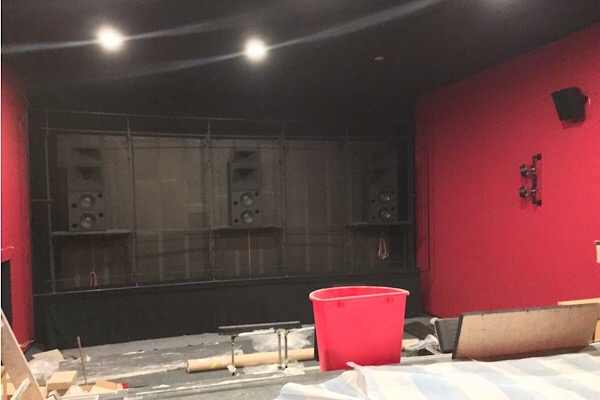
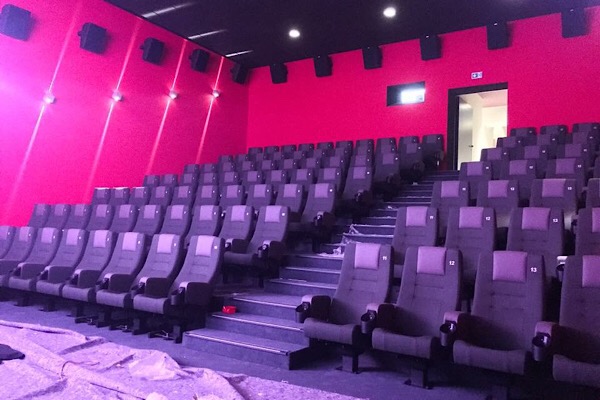
To the last part of your post: very good guess, I installed plenty of QSC SC speakers in the last years, just recently finished a small 90 seat room using SC323C, 16x SR1030 and 2x SB7218. Front Triamped and always 2 Surrounds parallel on one Amp Channel. Amazing sound, absolutely clear, high levels without distortion.
(Unfortunately the baffle wall was removed from the project due to exploding costs with the roof or something... real life.)
Posted by Sam D. Chavez (Member # 1841) on 10-21-2018, 11:44 PM:
That's a lot of surrounds.
Gordon mentioned the Altec A6. Beginning of the end that model. Had a horrid passive crossover and cheesy slide switches.
Posted by Steve Guttag (Member # 268) on 10-22-2018, 02:27 AM:
Most passive crossovers are pretty bad. In cinema, notable exceptions were the ones that EAW used. Most of the Mid-High crossovers are okay but I'm not too impressed with 2-way (or 3-way) passive systems.
If you really want a good surround speaker, give the SR-1290/SR-1590 a shot. They are probably the best thing going.
QSC has come out with the SC-223 that is targeted for the SC-323 customer that normally biamps the speaker. It is a little more purpose built.
Give the SC-424 a shot. It can be wired tri-amp and is respectable in that mode. The high frequency improvement is substantial.
Posted by Marcel Birgelen (Member # 6801) on 10-22-2018, 02:47 AM:
I'm not too familiar with the SC-424, but isn't it still using a passive crossover in tri-amp mode?
Posted by Steve Guttag (Member # 268) on 10-22-2018, 07:09 AM:
Yes, in tri-amp mode, the HF/VHF use a passive crossover. However, as making crossovers go, it is FAR easier to match a coaxial compression driver (similar wattage, zero time difference) than the tremendous power differences between an LF section and either a Mid or HF section.
I'm not saying it can't be done. There are some really impressive crossover designs out there and the fact that there are multiple designs for various frequencies of crossover goes to show that there is a market for different designs. The best are going to be purpose built where all of the mechanical/electrical parameters are known and likely the design was finalized on the actual speaker to ensure correct phase/power response. With passive you have the impedance curve of the driver(s) to consider as well as their physical geometry and the actual crossover points. To do right is a bit of an art form. That is a level of detail that us unlikely to go into a typical cinema crossover that has about $25-$100 worth of parts. It will function as a crossover and protect the HF...it may even have a simple first order boost for CD horns but it isnt going to be too fancy. Think about it...the person that is thinking passive is also thinking "cheap" so you can put the design effort into a high-end passive crossover that would cost something that approaches just bi/tri/quad amping the speaker. Again, the lower the frequency, the trickier it is to make a good passive (and not waste too much energy just driving the components of the crossover itself...as the power goes up, the component size grows with it). Now, Home Hi-Fi...that is another story...people will spend silly money on that sort of stuff. JBL just issued a new L100 speaker called the legacy to look like the 1970s model...starting price $4K/pair!!! They are backordered for months on them! And those aren't even on the high-end of home hifi. JBL's Everest speakers cost more than many homes! https://jblsynthesis.com/productdetail/everest-dd67000.html
But that's not cinema. People shopping passive crossovers are shopping cost too. And, to be honest, the little crossover in the JBL 4722N does okay for the value conscious cinema sound system.
If you download the MHV-1090 user manual (not the spec sheet), they show the various responses of the speaker in tri-amp versus quad-amp mode. Depending on the particular installation, if I needed to say bridge a pair of amp channels to give more to the LF section, I could see tri-amping the speaker using a 4-channel amp. One nice thing about the DPA-Q amps is that there is a bit of "gain sharing" between the channels so the LF section can take more than its 25% of the available power while the HF/VHF will never use their allotment.
Posted by Jay Palmer (Member # 10656) on 11-02-2018, 06:09 PM:
Interesting topic here. Sorry for the long-winded first post!
10 years ago at Fox Studios we retrofitted the JBL 2-way system with BMS Neodymium Co-axial 2” compression drivers. The resultant was a 3-way discreet system that sounded much better than the old ferrite JBL driver. It was common knowledge that the ElectroVoice EVHP9040 horn was a better sounding horn (They all have their characteristic sound) than the 2360A JBL horn normally used. It was just as the Stag Theater at Skywalker that Mark G referred to.
So what we wound up with was a 4675 twin 15” JBL bottom with 2226 woofers driven by a Bryston Class AB amp, an ElectroVoice EVH 9040 horn with a BMS 4592ND Neo Co-ax 2” driver driven by a sweet-sounding Parasound amp. We chose to Tri-amp the whole works rather than use the passive x-over. I cannot remember which crossover/processor we used. Dolby Lake maybe?
Note: Using a BMS passive crossover results in perfect time alignment between HF and VHF. Using an active crossover and bi-amping the coax driver, you must delay one of the components x microseconds. We chose active because it usually sounds cleaner.
The system sparkled and sounded very smooth while easily going to 20 Khz.
We then took lots of HF boost out of the EQ for those screen channels.
Subsequently, other studios followed suit with some adding very low freq components like the Bag End ELF system extending down to10 Hz!
Fast forward to today
We want to retrofit our existing 5000 series JBL system.
The 5674 with the Diamond-Quad-15” bottom
I have on my desk 2 new BMS Drivers
1. BMS 4595HE 1.5” (High End) Co-ax Neodymium
2. BMS 4599HE 2" Neo Dual Diaphragm Driver, 2x 3.5" VC, 400 W AES, 123 dB
It is the loudest audio transducer ever made (and very low distortion)
The midrange frequency range is optimized for human voice
These would be used to replace the HF and MF drivers in our JBL 5674 system
But the JBL 2490H midrange driver is a 3” throat and the BMS 4599 is a 2” so I built a throat adapter…. I’m not sure if this will work better than the JBL mid??
I do know that that the BMS 4595HE HF will be better than the JBL 2451 HF driver.
Way back when the first 3-way JBL system went into the Academy, the HF horns needed to be pushed as close as possible to the screen to get usable high frequency response.
Now we’ll be able to move the HF horn back, which usually results in a less-distorted/more-natural sound. And we’ll still get significantly better and smoother high frequency response.
To note, the QSC 4-way 424, 434, 444 Cinema speakers with the asymmetrical long/short throw horns also use the BMS Co-axial driver for their very top end. And yes it should sound very good!
I've been down to their Costa Mesa factory and they really build some good sounding speakers even their teardrop hang-from-the-ceiling speakers were excellent
Some Scandinavian Theater operators tell me that they also replace JBL woofers with BMS woofers. I met the owner of his BMS component company and his “Coda” finished speaker company. They showed at InfoComm and their line arrays I will test in March.
A very innovative company!
bmspro.com
If you guys are interested I'll post my findings and detail the retrofit?
My next….shorter post will be regarding TAD Cinema speaker systems
Take care all,
Jay
Posted by Steve Guttag (Member # 268) on 11-03-2018, 05:59 PM:
Thanks Jay! Very interesting.
The JBL 2450SL series has a bit of a following. Many like using beryllium diaphragms.
Have you heard any JBL M2s? The "D2" (D2430K) compression driver is about as good as I've ever heard but it wouldn't; be up to really high power applications.
Posted by Jay Palmer (Member # 10656) on 11-04-2018, 06:35 PM:
Hi Steve,
The technology is quite incestuous.
Back in the early 80s Pioneer TAD came out with a 2" throat driver and an Alnico magnet structure. The design was very similar to the JBL drivers of the day. But that TAD 4001 used a very very lightweight yes and brittle mil-spec diaphragm material known as Beryllium. Drives were typically maxing out at 10~12 Khz. The TAD went to 20Khz no problem. Many recording studios switched to these with custom horns. In the early 90s Fox used a custom system Tad 4001, JBL 90 degree theater horn and Altec A2 twin double bin bottom with JBL woofers! The Beryllium drivers were copied.
TAD came up with a newer better driver the 4002 and Jerry Steckling designed a 3Way system at Skywalker. Currently the Linwood Dunn Theater at the Motion Picture Academy's Dunn theater uses an All-TAD Steckling design. But to replace a Beryllium diaphragm could cost in excess of $2,000.00 each! Sadly Pioneer has killed the TAD brand and finding parts or even recone-ing is really expensive!!
JBL then was sourcing parts from BMS. QSC is sourcing parts from BMS. BMS took the metal out of the diaphragms.
JBL followed suit with their own dual diaphragm annular polymer diaphragm, the D1 driver...now used in their line arrays and the M1 monitor. This all has the practical function of reducing harshness. I believe it's all good!
Powered by Infopop Corporation
UBB.classicTM
6.3.1.2