This is topic Protecting equipment during prolonged power failure in forum Digital Cinema Forum at Film-Tech Forum ARCHIVE.
To visit this topic, use this URL:
https://ft-forum.com/ft/cgi-bin/ubb/ultimatebb.cgi?ubb=get_topic;f=16;t=003518
Posted by Frank Cox (Member # 6258) on 12-08-2018, 02:51 PM:
Sask Power had a day-long outage in some places a couple of days ago; thankfully not here. We lost our power for about two hours and then it came back. *whew*
However, it got me to thinking: What steps, if any, should I take to protect my equipment from freezing if the power does go off for several days during the winter? My building is heated with a natural gas fired hot water boiler and it doesn't run when there's no electricity.
I don't think cold would affect the server or the sound system, but the projector (Christie 2210) is liquid cooled and what would happen to that liquid if it got really cold in here?
Any insights would be appreciated.
(I'm also starting to consider the idea of putting a gas fireplace into my apartment...)
Posted by Jack Ondracek (Member # 1466) on 12-08-2018, 03:00 PM:
What do you mean by "really cold", Frank?
Posted by Leo Enticknap (Member # 534) on 12-08-2018, 03:06 PM:
I don't know how much power the gas-fired boiler needs to operate, but my guess is that it only needs electricity to run the control board and pump. If so, a relatively small and cheap genny would at least keep your heat going, assuming that the gas supply isn't affected. This happened in my mother's house during the very cold snap in December 2010: although she had gas central heating, the boiler needed electricity to operate, and her local substation was knocked out in a snowstorm.
I bought a 400w generator for around GBP100 (this was before I'd left the UK), and hooked it directly to the boiler. It was easily enough to power the boiler, two or three LED-powered lamps around the house and the Internet router. That made the difference between the house being habitable while they fixed the substation, and having to go to a hotel.
Obviously, you need long enough mains cables to enable you to put the genny far enough away from the house that the exhaust emissions cannot cause a monoxide hazard inside it. The model I bought was only able to be run for four hours at a time before you had to shut it off for an hour, to prevent overheating, and it consumed about a gallon of gas during that time (so you need a gas station to be open nearby for this to work as an emergency plan). It was also effing noisy - neighbor complaints would have been very likely under normal circumstances.
In your case, I'd guess that even being able to get the heat on for a few hours a day might make the difference between equipment damage and not. I'd further guess that humidity is likely to be the bigger problem than absolute temperature (especially if condensation forms on the envelope of a xenon bulb). For that reason, I wouldn't want to power up any projection or sound equipment following a prolonged loss of power until after the booth has been heated for long enough period to dry it out thoroughly.
Posted by Frank Cox (Member # 6258) on 12-08-2018, 03:09 PM:
quote:
Winter generally lasts from early November to mid-March. Temperatures remain below freezing at all times, even during the daytime. January and February are the coldest months, with low temperatures often dropping below -30°C (-22°F) and high temperatures not rising above -10°C (14°F).
That sounds about right for around here on average.
Posted by Scott Norwood (Member # 30) on 12-08-2018, 03:32 PM:
The specifications for the CP2210, as listed here
http://www.filmtechniek.nl/wp-content/uploads/2013/12/020-100556-04_CP2210_Service_Manual.pdf
give a "non-operating" temperature range of -13 to 149 degrees Fahrenheit (-25 to 65 Celsius) on page 8-9 (135 of the PDF).
Unless your ambient temperature is lower than that, you should be fine. That said, I would worry a but about condensation if the temperature increased too quickly from freezing to normal room temperature.
Realistically, though, buildings take a long time to change temperatures, so I doubt that it would be a concern. If anything, a flameproof blanket over the equipment with a 150-watt (or thereabouts) light bulb under the blanket should keep it at a reasonable temperature. Obviously, the bulb should not be touching the blanket or the machine or anything else flammable or easily damaged by heat.
Posted by Stephan Shelley (Member # 8587) on 12-08-2018, 03:37 PM:
The min ambient temp for operation is 10 C. But storage is much lower -25 C. One wants to make sure the glass components are at min operation temp before turning on the lamp. Don't want heat shock. Also be careful bring back up to temp that you don't get condensation or frost inside on the optics or electronics.
They all use a version of an industrial antifreeze/coolant so as long as you are running the recommended coolant freezing should not be a problem.
As far as general things from a power failure if things are on UPSd do an orderly shutdown, turn off the UPS. Kill breakers or pull plugs. Protect stuff from surges when the power comes back on. If no UPS just disconnect from the power source. I have seen power failures take out power supplies. The power rarely goes off and back on cleanly.
Posted by Mark Gulbrandsen (Member # 72) on 12-08-2018, 04:10 PM:
For safe long term there should be a 10kw generator(at least) that can run off propane or gasoline.
Mark
Posted by Andrew Carr (Member # 9264) on 12-18-2018, 02:29 PM:
Hi Frank,
We design and install theaters globally. Often, during installs in the northern US, we have to keep gear in shipping containers outside in the cold for extended periods of time.
Basically, I ensure that projectors are brought into the building and allowed to sit for 1-2 days before applying power just to avoid condensation and sharp temperature swings as mentioned above.
Knock on wood, no issues as long as they are slowly climatized before operation.
Posted by Marcel Birgelen (Member # 6801) on 12-18-2018, 04:52 PM:
Alternatively, you could have a look at what it would cost to keep your basic operations running on a generator. When the power is out for multiple days and you're the only place in business, I guess people will flock to your place to get some entertainment, while the lights are out at home. ![[Wink]](wink.gif)
Posted by Mark Gulbrandsen (Member # 72) on 12-20-2018, 09:29 AM:
In cases of areas that had the fire issues and will be closed a long time, your insurance might pay for a generator to keep the basic building alive and allow equipment to be cycled on an off every couple of weeks. Its a lot cheaper than insurance paying for all new IMB's and or ICP's. Not to mention the importance of keeping air flow and pumps running to mold and mildew don't occur.
Mark
Posted by Justin Hamaker (Member # 2165) on 12-20-2018, 10:40 PM:
quote: Mark Gulbrandsen
In cases of areas that had the fire issues and will be closed a long time
We actually had someone from the insurance company come into our theatre today to evaluate the situation for smoke damage. The actually took swaps of our equipment to see if there is any particulate which will be dangerous to electronic components. I don't know how long the test results will take, but this seems reasonable when you're looking at a potential claim for a few hundred thousand dollars for replacement equipment.
Posted by Harold Hallikainen (Member # 5405) on 12-20-2018, 11:36 PM:
In the 1970s, I evaluated smoke damage to equipment in a radio station for an insurance company. There had been a fire in the building, but not the station. In that case, the insurance company decided to replace everything because long term reliability would be affected. Their taking swabs of residue is great! I guess that identifies what was in the smoke. But even if it's "safe" residue, getting it out of switches and mechanical stuff (or optics) is a pain! Maybe not worse than popcorn residue, though...
Speaking of generators, I just talked with someone on 40 meter CW. He has a Honda generator "that runs forever on a fart." Never heard that before!
Harold
Posted by Mark Gulbrandsen (Member # 72) on 12-22-2018, 07:31 AM:
We used a Honda Generator backfeeding the main panel to power up the CInedome 70 theater near Ogden Utah a bout 5 years ago for a last round of pictures. I think the genny was 7500 watts and it had no problem powering everything up.
Mark
Posted by Tony Bandiera Jr (Member # 2365) on 12-22-2018, 11:25 AM:
quote: Justin Hamaker
The actually took swaps of our equipment to see if there is any particulate which will be dangerous to electronic components. I don't know how long the test results will take, but this seems reasonable when you're looking at a potential claim for a few hundred thousand dollars for replacement equipment.
Justin, first off I am sincerely glad that you are OK and your theatre survived the fire. I have friends from the area who lost everything.
But I am gonna say that, what the insurance agency did is IMHO a way to try to avoid paying you for replacement equipment, so don't be surprised if they come back trying to say that what they found is "not harmful." When it comes to electronics, ANY fire residue particulate IS very harmful. It may work for a short time, but combustion particulate is electrically conductive and will cause problems. (At the very least, degraded performance.) Unlike optical stuff, carpets, seats, walls, etc. you cannot economically thoroughly clean electronics exposed to a fire. (Some would say you could use solvents, which might work for things like amplifiers and the processors, but who in their right mind would try that with a projector?)
If they try to deny the claim for replacement of ALL of your electronics...fight it. Hire a lawyer if necessary. (Especially if you've been with that company for a long time with no major claims in the past.)
Case in point: a relative has a small kitchen fire that spread smoke through the entire house. Even the master bedroom TV, which saw very light smoke, no heat and no water, was damaged beyond repair, as were all of the light dimmers and motion switches. (The fire started from grease, no electrical factors were involved.) All of the house (except the kitchen) was cleanable and mostly undamaged, but the smell took forever to go away.
quote: Mark Gulbrandsen
In cases of areas that had the fire issues and will be closed a long time, your insurance might pay for a generator to keep the basic building alive and allow equipment to be cycled on an off every couple of weeks. Its a lot cheaper than insurance paying for all new IMB's and or ICP's. Not to mention the importance of keeping air flow and pumps running to mold and mildew don't occur.
Yes it is an excellent idea except for the part about cycling the equipment. Who knows what the smoke residue has affected? Why risk powering it up without being absolutely positive that no damage will result?
And who cares if the insurance has to pay for new IMB's or ICP's? (or whole projectors for that matter.) Things like this are WHY you pay insurance in the first place. For the reasons I mentioned to Justin above, in the cases of fire/smoke exposure (with the MAYBE exception of the amps and processors, which it is possible, though costly, to solvent clean them) the only safe option is full replacement. (As for the projector, the lens is one component that could very likely be cleaned and saved, but the rest would be replaced.)
Another thought: the screen(s). Most of them claim to be cleanable, but again the labor would probably cost more than replacement, with cleaning it not being a guaranteed success.
Thankfully the speakers will not be affected, other than retaining the smell.
Posted by Louis Bornwasser (Member # 3063) on 12-22-2018, 07:14 PM:
Fresh thought: designate your cinema as a public area to be used in case of emergency. Apply for government assistance to install a serious generator with automatic on. Also, refrigerators, etc. 99.9% of the time you then have a cinema. When required, you have an emergency shelter for your local neighbors. I know of at least one Canadian cinema that did this.
Posted by Tony Bandiera Jr (Member # 2365) on 12-25-2018, 11:40 AM:
quote: Louis Bornwasser
Fresh thought: designate your cinema as a public area to be used in case of emergency. Apply for government assistance to install a serious generator with automatic on. Also, refrigerators, etc. 99.9% of the time you then have a cinema. When required, you have an emergency shelter for your local neighbors. I know of at least one Canadian cinema that did this.
Now that is one outstanding idea, that everyone who owns a cinema or other public space should consider.
Think of all the benefits: One, serving the community in a time of need, two, providing a safe gathering point so people can be accounted for readily (perhaps the POS system can be used to issue tickets to everyone to make a database easier?),three, providing shelter and safe water, food, etc., four, provide some form of entertainment to ease the stress of a disaster, etc...
And the theatre benefits from immunity to power outages that would ordinarily shut them down for a long time.
Even if government assistance is not available for the generator and associated electrical equipment, in most cases even a large complex can get by with a 200-500KvA generator (a quick way to figure out roughly what size is needed: go look at the transformer(s) serving the theatre..they are almost always marked with the KvA rating on them. It can be a simple number like "150" or "150kva".) For example, a 500KvA rated padmount:
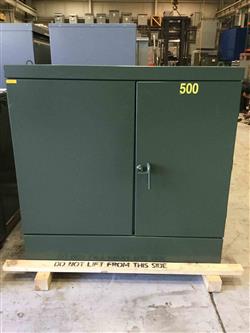
A generator and associated transfer switch, while not cheap, is not so expensive that it couldn't be financed with a reasonable loan. Doing so will give the business a tax write-off as well. If memory serves, the cost was around $.75 - $1.20 per KvA for the generator, transfer switch and installation.
Another, less costly solution (though not the "instant" backup that a permanent generator would provide) is to install the transfer switch with appropriate means to connect a temporary generator from a rental firm. However, availability of a generator during a major outage or disaster is not guaranteed. But it would simply the process of getting the power if needed.
Powered by Infopop Corporation
UBB.classicTM
6.3.1.2