This is topic Barco 32B color Alignment Issue in forum Digital Cinema Forum at Film-Tech Forum ARCHIVE.
To visit this topic, use this URL:
https://ft-forum.com/ft/cgi-bin/ubb/ultimatebb.cgi?ubb=get_topic;f=16;t=003528
Posted by Waqar Azhar (Member # 9735) on 12-20-2018, 05:44 AM:
Hi All,
i have installed new light engine but facing problem that red color is not align and overlapping on other colors. pls advise how can we fix it.
BR
Azhar
Posted by Stephan Shelley (Member # 8587) on 12-20-2018, 06:12 PM:
You need to do convergence. There are six nobs under the back side secure cover. There is also a convergence test patter that tells you which nob to turn in which direction. The nobs are numbered. Make sure you know how to clear the temper event that opening the secure cover will cause.
Posted by Leo Enticknap (Member # 534) on 12-20-2018, 08:54 PM:
Also, unless you have 20/20 vision, a convergence camera, or a spotting scope, then this is unlikely to be something that you can do solo, especially if the throw from projector to screen is a long one. You'll avoid eyestrain and get much better results if you recruit an assistant to stand right in front of the screen and give you directions ("number 5 a hair to the right, please," etc.) through walkies or a cellphone as you operate the knobs on the light engine. It doesn't need to be another tech: anyone will do, who has reasonable eyesight and an explanation of what you are trying to achieve.
Posted by Dave Macaulay (Member # 813) on 12-20-2018, 09:00 PM:
Seriously? You installed a light engine but never heard of convergence?
Wow.
Posted by Juan Jose Vazquez (Member # 10496) on 12-20-2018, 10:26 PM:
use the DPxK Convergence Pattern test pattern and a monocular for a better fit. Be patient and turn carefully the knobs that are on top of the Light Engine, the color of the knobs are the DMD.
Posted by Ioannis Syrogiannis (Member # 3235) on 12-21-2018, 01:23 AM:
Well, I wouldn't trust a monocular for the convergence procedure and I would even try to remove the glass of the port that I am seeing through. And If I did, I would definately need to validate from up close afterwards.
Convergence issues are not the prerogative of the lens and the light engine, it can as well be a glass between the screen and my eyes that refracts light in a different angle for different wavelengths. I have before spotted issues (they are easily detected and acknowledged during the procedure) with my eye glasses and given that my eyesight is not too bad, I prefer assisting the procedure without them.
Usually, I ask for help from the projectionist or another person to whom I previously explain the task. When a convergence camera is handy, I definitely go for it.
I can't possibly say if the monocular you are using is Hi-Fi, but in my (short) experience, there weren't any I could trust for such applications where titles and subtitles could end up loosing sharpness and being... laureated with different colors.
Dave has a point there. Changing a light engine absolutely poses a need for such checks. And taking into account the stakes there, the minimum knowledge of doing the checks, being familiar with the equipment and its mode of operation in such a way, is a prerequisite for changing the light engine.
Posted by Waqar Azhar (Member # 9735) on 12-21-2018, 02:31 AM:
thanks for all to acknowledge. i followed convergence procedure according to PDF file and as you people instructed. when i rotate the knob clockwise and anti clockwise there is no effect on colors on screen. one by one i rotated all knobs as mentioned in PDF file but there is no effect at all. can you people advise how much we can rotate the knob because i rotated all knobs one and half round maximum.
BR
Azhar
Posted by Ioannis Syrogiannis (Member # 3235) on 12-21-2018, 03:34 AM:
You are sharing too little info for us to have the full picture.
Do you have the correct test pattern for a 32B projector activated?
(It is not the same as for the smaller B series, as the converging lines are drown parallel to the sides of the screen, instead of diagonally.)
When you were rotating each knob, where you looking at the part of the screen that the corresponding number (of knob) is appearing? The changes are small and each knob corresponds to only a color and a part of the DMD that projects onto the screen.
The more I think of it, the more I wonder if the red that is (I quote:) "overlapping on other colors" is just a convergence issue.
One thing I am certain of: If you haven't found the solution by reading the Barco manual and trying, you (and the projector) would be better off if someone who has the skills was showing you the procedure, instead of taking instructions or suggestions from a forum. What a light engine costs is way-way more than a technician's visit. If you just installed a new light engine, you probably should be aware. If I would turn the fonts of the phrase before the previous in bold red and enormous wouldn't be sufficient underlining of the fact. I am not trying to sell something to you here.
Edit: A small correction. Where "smaller B series", read "smaller C series"
Posted by Leo Enticknap (Member # 534) on 12-21-2018, 10:48 AM:
quote: Ioannis Syrogiannis
Convergence issues are not the prerogative of the lens and the light engine, it can as well be a glass between the screen and my eyes that refracts light in a different angle for different wavelengths.
True, but that glass is going to be in place when the system is in regular operation. I take your point (especially if the port glass is angled), but surely it won't work to set the convergence with the port glass removed from the light path, because when the glass is replaced, the convergence will be thrown out.
By the same token, color calibration should be done with the theater's house lighting set as it would be during a show. If you shut the exit boxes and Tivoli lights off (for example, and I've seen techs do this) and shoot the colors in total darkness, the reading from the red, green and blue test patterns will not be exactly the same as it would be in show conditions. Same for tuning with the HVAC shut off, etc. etc.
Agreed that Waqar would likely benefit from a visit from a tech, and/or to do the Barco installation and basic maintenance school. Don't know if they do them in Pakistan, though. To be fair to him, swapping out a light engine on a B series is not that complicated: the only real gotcha is being sure to put all the multi-pin connectors back in the correct jacks on the backplane (I almost wonder if one or two of them got swapped, thereby causing his current issue). But as Dave and Ioannis point out, there are adjustments and calibrations that need to happen once you've done that, which is where it seems that Waqar is getting a bit stuck.
Posted by Dave Macaulay (Member # 813) on 12-21-2018, 10:58 AM:
"By the same token, color calibration should be done with the theater's house lighting set as it would be during a show. If you shut the exit boxes and Tivoli lights off (for example, and I've seen techs do this) and shoot the colors in total darkness, the reading from the red, green and blue test patterns will not be exactly the same as it would be in show conditions"
I can't agree with that. I want to measure the image colors from the projector without extraneous light on the screen - what the site does to ruin their screen image once I have it per spec is their problem. I don't think it make any sense to come up with an MCGD file to attempt compensatation for exit lights or Tivolis putting a colored light wash on screen. And unless it's super bad the projector raw colors should overwhelm any stray light from those sources...
Same with HVAC: if it's loud enough to affect audio calibration it gets shut off during tuning. I inform the management that they have a problem, and then it's up to them to fix it or live with it.
Posted by Sean McKinnon (Member # 612) on 12-21-2018, 11:22 AM:
Keep in mind that the DMD chip is on a pivot so when you adjust the "knobs" you are not really moving the chip laterally or vertically you are causing the chip to pivot on a point. The amount of movement seen on the screen can be pretty slight and sometimes when you lock down the "knobs" they can slip slightly in either direction.
Posted by Marco Giustini (Member # 4544) on 12-21-2018, 06:13 PM:
Azhar
Usually all you need is a fraction of a turn - you may need a bit more if you end up on a dead spot.
If you are rotating the knobs one and a half turn, you’re probably looking at the wrong pattern and you’re likely damaging the engine.
I would stop and call someone familiar with the procedure before it’s too late.
Posted by Ioannis Syrogiannis (Member # 3235) on 12-22-2018, 08:02 AM:
Leo, what I was talking about there:
"it can as well be a glass between the screen and my eyes"
is not the projection port glass, but the glass of a window through which I see the screen.
Often enough, that is not one and the same. That is the reason I made that rather peculiar choice of words, instead of mentioning the projection port. The same reason that I got to mention my eye glasses just after.
What I want to avoid is any interference between the screen and me, not between the projector and the screen. If I can't, I go with help from another party, as I already mentioned.
As for learning to do the convergence, one may learn to follow the procedure from another, even if they don't sit a school for it (the best case scenario). Indeed, the courses can be as far as Noida, India, if someone lives in Pakistan (I, myself, had to go to Kortrijk). In any case, though, I strongly believe that if someone doesn't manage to go through it with the detailed instructions of the Barco installation manual, wouldn't be better or more securely guided via a forum, where others are mostly based on assumptions and don't actually know what the situation is.
Posted by Marcel Birgelen (Member # 6801) on 12-23-2018, 04:16 AM:
I consider color convergence a two-man job. One in the room and one at the projector and a bunch of walkie-talkies to communicate witch each other.
If you're using the correct test patterns and are unable to fix the offset of your red DMD compared to the others using standard manual color convergence, your light engine might be damaged. I've seen light engines that were damaged during transport, that were so much off-set, it could not be corrected anymore by the manual convergence.
I do agree with the sentiment on this topic. If you're spending the money on a new light engine, don't skimp on the qualified technician to install and calibrate the thing. You can easily ruin the most expensive part of your projector by mishandling it...
Somehow, when doing those manual convergence calibrations on modern DLP machines, I want back to the days of the old analog CRT projectors, where you could conveniently converge the hell out of every region with your remote in hand. ![[Wink]](wink.gif)
Posted by Dave Macaulay (Member # 813) on 12-23-2018, 09:06 AM:
CRT convergence is not comparable to DMD convergence. The DMD is static, the pixels can not move relative to each other. A CRT image is entirely flexible, the beam deflection system can direct and distort the image freely, limited only by the complexity of the deflection drive electronics.
The DLP prism is a very precisely made complex block of optical glass. Getting the three chips to produce an image with all three aligned and in focus is quite a trick. Each pixel on each of the 1.2" DMD chips is about 0.005" square, although my calculation of that is rather suspect.
Posted by Leo Enticknap (Member # 534) on 12-23-2018, 01:41 PM:
quote: Ioannis Syrogiannis
"it can as well be a glass between the screen and my eyes" is not the projection port glass, but the glass of a window through which I see the screen. Often enough, that is not one and the same. That is the reason I made that rather peculiar choice of words, instead of mentioning the projection port. The same reason that I got to mention my eye glasses just after.
So to be clear, you are suggesting that if a tech is wearing an eyesight correction device (eyeglasses/spectacles or contact lenses), that will mess with his or her perception of projected image enough to make it impossible to do an accurate convergence adjustment?
If so, you could be right, but there are a lot of techs out there who do not have good enough eyesight not to need a corrective device, especially middle-aged and older ones. Most people's eyesight declines significantly in their 40s and early 50s, and then tends to stabilize in their mid to late 50s. I'm in my late 40s and have needed three new glasses prescriptions in the last five years.
Also, and not meaning to start a political thread, but most service techs are men, and as a general rule, men tend to suffer from declining eyesight in middle age more than women do.
Unless you're fine with firing all the techs who have less than perfect eyesight, this also emphasizes the importance of two pairs of eyes (though only one of them has to belong to a trained tech). The same applies to adjusting focus uniformity (Scheimpflug), because again, that adjustment can only be made standing next to the projector.
Posted by Ioannis Syrogiannis (Member # 3235) on 12-23-2018, 03:54 PM:
Leo, I am getting the impression that what we are talking about, here, is not the subject in hand.
I do make an effort to find where in my writings I haven't been clear. Unfortunately, maybe because of the limited power of observation one have on their own texts and words that call for text editors and their likes, I can't quite spot it.
Is there something I wrote that offended you? If that is the case, I am sorry. I very much value your opinion, your experience and your input in the forum and consider you a better technician than I am.
If not, and what you are suggesting is out of some kind of misunderstanding of what I write, I will just write that I myself have seen that on my eye-glasses and on a convergence test pattern (where I could make the observation) I was not seeing the blue line exactly where I was seeing it when I was not wearing them.
I am one of them technicians that are in need of a corrective device, and the fact gave me the opportunity to make the observation. For that reason, as I already mentioned, I always prefer, either to use help from someone in the auditorium, or using a proper camera *if* I have one available and *if* I can avoid the glass between the camera and the screen. The fact that I came to observe issues with the monoculars *I* came upon in color sharpness, made me share my disinclination towards using them.
So, I can't really see from where on what I write the fact can be deduced that I might be fine with firing all the techs that have less than perfect eyesight.
The fact that one stands next to the projector using eye glasses, doesn't affect their ability to adjust focus uniformity or focus, since the focus test pattern (that is usually needed for the Scheimpflug adjustment as well) is using one of the three colors only and therefor doesn't pose problems deriving from DMD convergence.
I sincerely hope that I made my self clear now and that hereby we both agree that I am not in any way biassed against technicians that have less that perfect eyesight or hearing.
Posted by Leo Enticknap (Member # 534) on 12-23-2018, 04:25 PM:
Don't worry, I'm not offended at all, just exploring the implications of the perfectly valid point you made (that eyeglasses and contact lenses may be messing with our ability to judge convergence in the same way that a port glass in the light path can).
My point in response to that is projection techs are a demographic that is more likely than average to be affected by poor eyesight, because they tend to be older (having first worked as a projectionist, or, increasingly since the transition to digital, in other technology-related professions), and male.
And my suggested workaround for this is in agreement with you, too: ideally, a second, and healthier, pair of eyes on the job, to cross-check the adjustments being made.
For lens and screen files, none of this matters, because you can stand right next to the screen and make the adjustments by wifi. But convergence and focus uniformity can only be adjusted by operating mechanical controls on the projector itself, hence the problem.
Posted by Marcel Birgelen (Member # 6801) on 12-23-2018, 05:07 PM:
quote: Dave Macaulay
CRT convergence is not comparable to DMD convergence. The DMD is static, the pixels can not move relative to each other.
Yeah, sure, the point was, it was one of those things you didn't need to do physically on the projector, you could walk close up to the screen and adjust it from there. (although focus and Scheimpflug were a different issue...)
It's a pity color convergence on 3DLP machines has never been motorized. Even some of the top 3LCD machines offer "motorized" convergence options, by putting actuators on the LCD panels.
quote: Dave Macaulay
A CRT image is entirely flexible, the beam deflection system can direct and distort the image freely, limited only by the complexity of the deflection drive electronics.
Well, those deflection systems had their inherent quirks and it took a while per model, to get a good feel at the best approach.
Maybe, one day we might get laser scanning systems to compete with laser-light spread over DMDs.
quote: Leo Enticknap
Don't worry, I'm not offended at all, just exploring the implications of the perfectly valid point you made (that eyeglasses and contact lenses may be messing with our ability to judge convergence in the same way that a port glass in the light path can).
You wear glasses made out of cheap window glass? ![[Razz]](tongue.gif)
Surely, someone wearing a set of perfectly good glasses, which compensate for 99% of all chromatic aberration, can do the manual color convergence on a typical DCI machine.
Let's not overdo it. We're not vertically landing rockets on a floating platform in the ocean...
It needs to be unnoticeable from the first row of the theater on forward. It will never be micrometer-perfect, heck, I congratulate you if you get it millimeter-perfect. And over time, it will also start to drift.
I think the biggest gotcha is to do the calibration on a cold machine, only to see that it has shifted, once it's at its operating temperature.
Posted by Peter Hall (Member # 695) on 12-24-2018, 07:58 AM:
I wear glasses and so does most of the audience - the growth in this industry is in the "over 55" sector, so happy to match the chromatic distortion of the customers varifocals with my own. Anyway, I think you would get a better set up from a patient 53 year old tech (with failing eyesight, raising blood pressure, 20-14k response if I am lucky...) than a young guy or girl with perfect eyesight, no training and rushing the job. I've seen too many "plug and play and run" installs by quick-fix "techs" who don't even sit in the theatre and run a reel of known good content. Bring back Wendy Carlos !
Posted by Steve Guttag (Member # 268) on 12-24-2018, 10:47 AM:
For "quickie" convergence, I'll adjust while holding binoculars. For serious convergence, I use the USL (QSC) VCC-102
https://www.qsc.com/cinema/products/test-and-measurement/usl-vcc-102/
To use anything else is to do it wrong
When doing convergence, I check relative locations (individual colors compared to each other) as well as a group (white lines should be white without fringes).
Final check is to go down to the screen and confirm that my setup didn't have false readings due to aberrations.
One color will essentially be not movable (depends on the brand and model). If Blue isn't movable, I set green reference to blue and then red reference to green. I avoid setting opposites of the color spectrum relative to each other. You'll also likely find that you can't get corner-to-corner perfect (particularly blue relative to red) as everything in the optical path of the projector is trying to not deflect those colors identically (index of refraction)...hence chromatic aberrations.
Posted by Marco Giustini (Member # 4544) on 12-27-2018, 05:26 AM:
quote: Leo Enticknap
So to be clear, you are suggesting that if a tech is wearing an eyesight correction device (eyeglasses/spectacles or contact lenses), that will mess with his or her perception of projected image enough to make it impossible to do an accurate convergence adjustment?
Yes and No.
I wear glasses and I have to make sure I am looking at the convergence pattern through the CENTRE of my glasses or perceived convergence will be affected. It depends on the angle the light passes through your lens, anybody can try that: just look at the convergence pattern and rotate your head keeping your eyes on the pattern.
Convergence is a two person job for me too - alternatively I walk to the screen after each adjustment to confirm. Binoculars is also affected so it can be a bit unreliable.
If you are looking for a serious result, it's a two men job.
Posted by Steve Guttag (Member # 268) on 12-27-2018, 07:11 AM:
Have you used the VCC-102? It really removes the second person from being required:
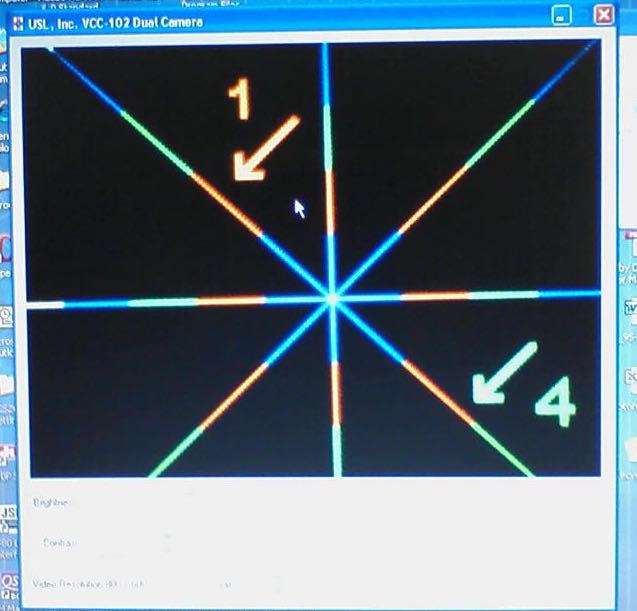
It brings the screen right up to your computer. There is a laser pointer on the unit to aim it since the magnification is so great you'd get sea-sick trying to manually aim it.
Posted by Steve Guttag (Member # 268) on 12-27-2018, 01:15 PM:
I guess people will have to do it wrong. The VCC-102 has sold out and is now discontinued. ![[Frown]](frown.gif)
Posted by Marco Giustini (Member # 4544) on 12-28-2018, 06:26 AM:
never tried that but I'm sure it is (was ) a great piece of kit.
Posted by Marcel Birgelen (Member # 6801) on 12-28-2018, 06:27 AM:
I'm afraid that's a result of USL being assimilated by the much larger QSC. Those kind of cameras are really a niche product. Although, with a broader focus on the whole projection market, a product like this should be pretty viable.
Posted by Carsten Kurz (Member # 5396) on 12-28-2018, 07:25 AM:
I guess you could easily use a USB Astrocamera with 'some' tele lens. They can be bought for very little money, and I am sure that the USL camera was based on one of those modules. Some of them use C-mount, most work driverless in all major operating systems (UVC).
- Carsten
Posted by Leo Enticknap (Member # 534) on 12-28-2018, 08:58 PM:
quote: Marcel Birgelen
Those kind of cameras are really a niche product.
And unlike the ADA amenities for which USL is widely known, a discretionary one. As has been noted above, the convergence camera offers convenience and efficiency, but there are other ways to get that job done. HI/VI/CCAP equipment, however, is a legal requirement, and so there is a substantial, guaranteed market for it.
Posted by Carsten Kurz (Member # 5396) on 01-01-2019, 04:36 PM:
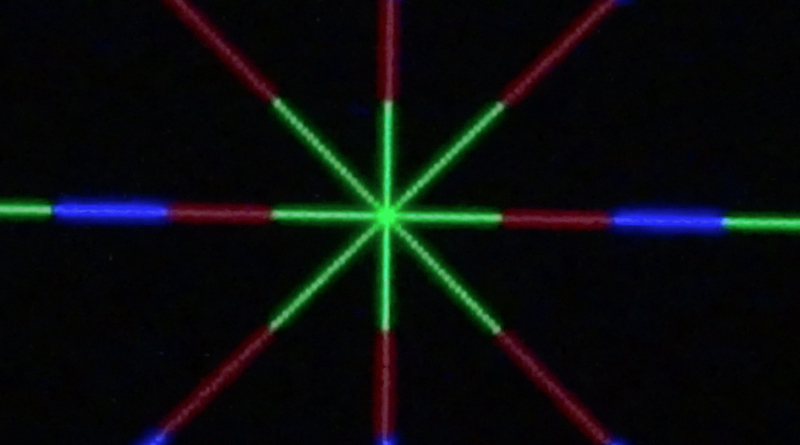
That's what my (rather cheap) old Sony digital still camera gives me over about 21metre distance (roughly a 3:1 throw) fullscreen. One would need at least a 16x to 20x zoom by common camera properties. Not too exotic nowadays, most simple digital stills cameras today boast 30x-60x optical zooms. The display is realtime, and a simple tripod is necessary, of course. Shot through a (dirty) observation port glass.
- Carsten
Posted by Steve Guttag (Member # 268) on 01-01-2019, 05:39 PM:
So are you using mirrors to be able to see the display while adjusting the convergence from the other side of the projector? Many booths don't have ports on the same side as the adjustors.
Posted by Carsten Kurz (Member # 5396) on 01-01-2019, 07:00 PM:
I never did convergence this way, just wanted to see what a generic still camera could do.
Those cameras can usually be hooked up to a monitor or notebook for relayed display if necessary.
- Carsten
Posted by Carsten Kurz (Member # 5396) on 01-02-2019, 08:33 AM:
Many medium priced still cameras also support live view on a smartphone through WiFi, so you can put the camera where ever you need it and have the convergence target visible on your smartphone.
Posted by Bruce Cloutier (Member # 9615) on 01-02-2019, 10:38 AM:
I've found this topic interesting. I had a product concept along these lines. I owned one of the Pioneer Elite rear projection TVs which were the first to offer 1080p (I think) resolution in rear projection (upscaled) which was burdened by this alignment procedure (for each video mode). I think there were a couple of hundred points in a rectangular pattern across the screen where you would adjust R G or B for alignment. That in turn affected the linearity of the image in the area and often drove you back to readjust adjacent locations. Without having done this on the big screen, I hope it isn't the same nightmare. Is it?
I figure you could use a camera as you say but maybe a program in a device like the JNIOR running JANOS with a camera input could automate the alignment process and generate the proper inputs for whatever projector. Ultimately producing a report and before/after pattern images.
Of course, without firsthand knowledge of this process the concept never went anywhere. It is the kind of generic application in a niche that INTEG likes to do. I would need a local theater where we could experiment. We could develop the concept even using the old TV (which I still have but don't use). But, we also don't know if there is any interest or really, a market. I think a lot of useful stuff fails to become reality for reasons like that.
People like to get paid to do the alignment too I bet.
Posted by Harold Hallikainen (Member # 5405) on 01-02-2019, 11:49 AM:
This reminds me of a USL/Christie patent that provided an automatic method of adjusting the projector mirror for even screen luminance. See https://patentimages.storage.googleapis.com/30/09/2d/c02fec2306c1ed/US6013911.pdf .
Harold
Posted by Steve Guttag (Member # 268) on 01-02-2019, 12:03 PM:
Christie's thing was adjusting the lamp, not the mirror (despite what may be discussed in the patent). Christie had motorized lamp adjusters in the last generation of their consoles/lamphouses.
Bruce, convergence, at the moment, is not a motorized thing. I'm sure it could be, though it would add significantly to the cost. It is done either via flex-shafts or using set screws (with counter pressure applied by spring loaded set screws).
Could it be automated? Sure. I don't know anyone that will pay for it because the bulk of your cost is going to be in the projector waiting for the day it is used.
The VCC-102 was a relatively inexpensive and worked with one's handy laptop.
Posted by Bruce Cloutier (Member # 9615) on 01-02-2019, 04:07 PM:
quote: Steve Guttag
Bruce, convergence, at the moment, is not a motorized thing. I'm sure it could be, though it would add significantly to the cost. It is done either via flex-shafts or using set screws (with counter pressure applied by spring loaded set screws).
Oh ok. With the Pioneer screen you moved from point to point and selected the color then used directions on the remote to overlap the points making pure white without edge coloring. A crazy amount of work to get it good enough to appease a perfectionist. Trust me. Would be interesting to automate.
Posted by Harold Hallikainen (Member # 5405) on 01-02-2019, 04:38 PM:
Thanks Steve! I never saw one of the USL/Christie things, just read about it.
Bruce, I suspect the TV is doing alignment of the current and waveform through the deflection coils, so no motors there.
Harold
Posted by Bruce Cloutier (Member # 9615) on 01-03-2019, 06:30 AM:
Well, one of these days I'll find out how the alignment is accomplished. I plan to dismantle the thing for disposal. It has a really nice large black piano finish cabinet that cries out to be reused for something. Maybe a fish tank? But I agree, there are likely no motors. It has to have been done electronically.
That TV is c1990 when the RoHS standards were first being applied. A faulty solder was used that with temperature cycling would eventually crack breaking connections. The TV would fail. Of course, I would just pull the boards and re-solder. And, some almost 30 years later I still have a useless but functional TV occupying space.
Anyway, I lack the direct theater experience that would allow INTEG to be more helpful. We just picked up an order for JNIORs in a theater right down the road. We're going to try to strike up a relationship so we can visit and get some direct feedback.
Posted by Carsten Kurz (Member # 5396) on 01-03-2019, 07:00 AM:
I had one of these early analog projection TVs as well. There was a bank of pots to adjust convergence over the full screen. I know that later revisions allowed this to be done with a remote as well, and they probably had eepot or D/A converter banks to do the actual adjustments.
There are certainly more ways to use a JNIOR in cinemas in addition to the classic applications as light and curtain control. Not only the actual application is of interest, but also the means to apply user interaction. E.g. all servers enable automatic actions in playlists, but playlists are only active during an actual movie showing. So, one has to look closely at what happens when and what is useful for the operator. I am sure that cinema will have a good time with you sneaking in.
Convergence on digital cinema projectors is only done so rarely, that automation doesn't make sense. Bulb adjustment for xenon systems happens often enough (with every bulb change) that it makes some sense, even though some operators choose to refine the automatic setting manually afterwards. However, there is no way to retrofit adjustment gear practically.
Bruce - ever thought of adding IR remote control as an expansion module?
Now, this should go to another thread probably...
- Carsten
Powered by Infopop Corporation
UBB.classicTM
6.3.1.2