This is topic Ground Loops With Ultra Stereo J-200 in forum Digital Cinema Forum at Film-Tech Forum ARCHIVE.
To visit this topic, use this URL:
https://ft-forum.com/ft/cgi-bin/ubb/ultimatebb.cgi?ubb=get_topic;f=16;t=003574
Posted by Trevor Meusx (Member # 10737) on 01-31-2019, 01:31 AM:
I grounded the processor to the Doremi thinking that might help... not really. Lost now and wondering what the culprit is in this system. If anyone has time to enlighten me on ground loops in cinema that'd be great.
Posted by Dave Macaulay (Member # 813) on 01-31-2019, 01:59 AM:
J-200?
Anyway: If you use the Doremi AUD-D2A it's got unbalanced output, I don't know if the J-200 input is balanced or not. Unbalanced analog audio is definitely prone to ground loops. Odyssey makes adapter boards with isolation transformers for the server input to hopefully eliminate them.
Also one theory of amplifier wiring says to connect the cable shield at the amplifier end only, another says connect both ends.. you can try connecting or disconnecting the processor shield, this hum would be on all inputs though not just the server input. Also things change when connecting a balanced processor to an unbalanced amp input and vice-versa and some monitors can introduce hum.
Isolate where the problem comes from, the server input or the processor output: hum only on the server input is likely from poor wiring practice or you should add the transformer board. Hum on all inputs is likely the amp wiring or a monitor problem.
If it still hums with the processor off and unplugged, the amp(s) may be bad.
Posted by Marcel Birgelen (Member # 6801) on 01-31-2019, 06:14 AM:
I've successfully used the DTI Dual Transformer/Isolator to eliminate nasty ground loops on unbalanced audio interconnects in the past.
Posted by Carsten Kurz (Member # 5396) on 01-31-2019, 06:47 AM:
Trevor - is that a USL JSD-100, or an old JS-200? How do you connect either to the Doremi? Do you know what digital AES audio is?
- Carsten
Posted by Mark Gulbrandsen (Member # 72) on 01-31-2019, 10:48 AM:
The JSD analog inputs are all unbalanced. The solar cell input is balanced.
Mark
Posted by Carsten Kurz (Member # 5396) on 01-31-2019, 11:23 AM:
The JSD-100 analog 8ch inputs are active balanced.
- Carsten
Posted by Gordon McLeod (Member # 33) on 01-31-2019, 04:14 PM:
The analog JS processors have unbalanced inputs except for the solar cell
Posted by Mark Gulbrandsen (Member # 72) on 02-01-2019, 06:51 AM:
quote: Carsten Kurz
The JSD-100 analog 8ch inputs are active balanced.
Carsten... Are you sure you are not thinking of JSX-1000 USL which was THX approved?
Mark
Posted by Carsten Kurz (Member # 5396) on 02-01-2019, 12:15 PM:
I made a cable for a colleagues JSD-100, and the manual gave a symmetrical pinout. But I don't think Trevor has a JSD-100, the connection would probably be digital/AES, and he would have no hum from that connection. Unless his Doremi has one of these rare 8ch analog out cards.I guess he uses a JS-200.
- Carsten
Posted by Gordon McLeod (Member # 33) on 02-01-2019, 01:14 PM:
Also the JS200 was a mono processor that could be upgraded
Posted by Marcel Birgelen (Member # 6801) on 02-01-2019, 01:21 PM:
It's somewhat ironic that a company called "Ultra Stereo Labs" sold mono equipment. ![[Wink]](wink.gif)
Posted by Bruce Cloutier (Member # 9615) on 02-02-2019, 09:06 AM:
I had to isolate the power cord ground on my subwoofer to get rid of hum. This reminds me to look into isolating that LFE audio signal.
With audio at least the ground loops make themselves apparent. These can affect serial and other unbalanced data connections. In those cases things may run fine for a long time and then fail for no apparent reason only to work again sometime later.
A few years ago when (RS-232 was mainstream) I had a system dependent on communications which would fail on a Friday every two weeks. We had no idea. Turned out that on that schedule in an adjacent room they performed maintenance and would bring in a machine of some kind and plug it in. That created the mysterious reoccurring ground loop. Was fun. I can't take credit for figuring it out.
Posted by Steve Guttag (Member # 268) on 02-02-2019, 10:36 AM:
quote: Gordon McLeod
Also the JS200 was a mono processor that could be upgraded
I would say that is a mischaracterization. The JS200 series were configured as desired at the time of order. Mono only was an option and was upgradable to various forms of stereo. But one did not necessarily order it a monitor and then order upgrade cards.
Technically, the CP55/CP65 would be mono processors by the same logic because there were "M" versions.
I believe the "stereo" companies chose that name due to Dolby using "Dolby Stereo" to mean any cinema sound system they put their name on. As I understand it Dolby dropped the name "stereo" because there some that thought it was too "'70s" sounding (e.g. archaic).
But you had Eprad Stereo Ultra Stereo, Kintek Stereo (though they started as a psudostereo company and even SMART Stereo.
Bruce brings up an excellent point of about ground loops. They exist, even if you can't hear them like in an analog system and they are just as bad. A ground "loop" implies that ground is at different potential (and not ground somewhere or everywhere in the system).
The real solution is to fix the grounding problem, which wouldn't exist if grounding was carefully designed and everything attached plays by the rules (no current flow on ground). Remember, if there is ANY current flow on the ground conductor, that conductor is no longer at ground potential (can't get around Ohm's Law).
The fast solution, that most take, with audio is to float one end of an unbalanced system. This works on lower frequencies, as dealt with audio but doesn't work well on higher frequencies as used in video. A solution there is to apply a capacitor to remove the direct coupling but allow higher frequency noise to still drain to its "nearest" ground. Transformers can also be your friend, if they are high enough quality to not adversely affect your signal and can withstand the power applied.
Note, "balanced" is not necessarily the key to noise free. Balanced implies that one has a signal that equally modulates above and below a reference (e.g. ground). The key to it is the differential signal that has a very high CMRR (common mode rejection ratio) since noise/interference that hits the cable during its length will likely hit both leads equally and will sum to zero.
One can use a transformer and remove the ground reference and still achieve a differential input and not, technically, be balanced as it is not balanced to a reference.
Rane Note 110 is a good reference:
https://www.rane.com/note110.html
Posted by Bruce Cloutier (Member # 9615) on 02-02-2019, 04:07 PM:
If you really want to blow your mind you can read about it in the Handbook for Sound Engineers. I have the Fifth Edition and Chapter 36 "Grounding and Interfacing" is written by Bill Whitlock (name not familiar to me) and is like 40+ pages of small print.
Steve, the RaneNote was a good read. I especially liked the interconnect reference table of cable assemblies.
There are serial port grounding concerns with the way some have employed the JNIOR which is otherwise isolated. That's best held for another topic if anyone wants to hear about it.
Posted by Mark Gulbrandsen (Member # 72) on 02-03-2019, 11:17 AM:
quote: Gordon McLeod
Also the JS200 was a mono processor that could be upgraded
Seems to me it was the other way round where it was supplied Stereo as standard but you could order a mono unit if you asked. I never saw a mono unit in service.
Mark
Posted by Steve Guttag (Member # 268) on 02-03-2019, 01:57 PM:
If you recall, there were three series in the analog life... the 5/95, the very short lived 105/195 and the 205/295. The second and third digit defined what its capabilities were. It is the same frame in each case. The only differences were what cards were stuffed in. One could add a JSYN-05 to a processor to get Synth stereo too. However, most used that slot for their "pink card" for testing.
There was a VERY VERY close variant to the JS-200 series the JSX-1000A for THX people and, officially, only approved for Dolby-A noise reduction though there was a JSX-1000S that had the SR module too.
I saw the JS series in mono, Center-Surround, the very goofy Left-Surround, Center, Right-Surround (Left was played out of Left-Surround and likewise on Right to Right-Surround). as well as the more popular JS-280, which was a full stereo unit. The lesser decoders were a simple L-R for surround rather than actual audio steering.
Posted by Mark Gulbrandsen (Member # 72) on 02-03-2019, 04:59 PM:
Yea, I did have Center-Surround and Left-Right-Surround in a few places. All those went away for Digital.
Posted by Trevor Meusx (Member # 10737) on 02-07-2019, 12:17 AM:
Thanks guys sorry for the delay. Wasn't getting email notifications for some reason. Apologize for the typo it is a js200.
Dave: the doremi is not an AUD, im pretty sure its a DCP 2000. it's all the way in fortuna and I'm in Sonoma. The processor is unbalanced. Ive been troubleshooting cp 50s and 65s that have shielding to disconnect, and it's where I go first with ground loops. so the first thing I noticed was that I had no audio grounds to disconnect on a js200. Thank you very much for the ideas.
Carsten: the doremi connects to the processor with serial pin. Definitely digital. I understand AES to be a digital audio signal as opposed to good old analog. Correct me if I'm wrong or elaborate, I'd love to learn everything I can. Thanks.
Bruce: yeah I was wondering. So you're saying that the bad ground in your sub amp presented hum across all your outputs? Or just the sub? It's an old building and I wonder if there is some ancient projector vent causing it somewhere in the circuit whenever it turns on. Cool story.
Steve: thanks I've noticed floating one end of the input never seems to fix it completely. Where and how does one apply this capacitance you speak of in a circuit? I have trouble picturing what that looks like.
Posted by Bruce Cloutier (Member # 9615) on 02-07-2019, 07:54 AM:
The hum was just the sub. I had meant to pull the amp back out to see how chassis and signal ground are handled internally. I haven't yet. Guess I do have the schematics someplace.
I rebuilt that Klipsch subwoofer after a lightning strike some years ago. The hum existed before then. Basically I had to replace all of the ICs and most caps but didn't want to invest in another sub at the time. Klipsch was very helpful even to the point of discussing the apparent manufacturing line changes to filters that I discovered. I probably just found the right guy at the time. But as a result now everything is Klipsch. And, without asking the insurance company included compensation for my time in performing the repair in the settlement.
Posted by Trevor Meusx (Member # 10737) on 02-07-2019, 08:59 AM:
Carsten: I am mistaken. It's serial pin out of the analog output on the back of the doremi
Posted by Carsten Kurz (Member # 5396) on 02-07-2019, 05:41 PM:
Trevor - Doremis have serial out, but that is a control interface (typically, a 9pin, DSUB, computer type connector). That could be used to issue commands towards the JS200 (switch formats). No idea wether a JS200 has a serial interface, I am not familiar with that processor.
Now, the audio needs either an analog multichannel, or a digital (AES/EBU) interface, usually on a larger connector (typically 25pin DSUB). Maybe you could show us some pictures of the back of the Doremi?
In many digital installations which reuse film age processors, a digital to analog converter was placed between server and processor - one common type is the Doremi AUD-D2A (see a picture here: https://www.dolby.com/us/en/professional/cinema/products/aud-d2a.html ). Another common type was the USL ECI-60, or the Dolby DMA8(+).
However, I think some older Doremis also offered a server-internal 8ch analog output card, so, it may be that your installation can output analog audio from the server directly. I don't know if there is any technical reference available about this analog audio card.
- Carsten
Posted by Trevor Meusx (Member # 10737) on 02-07-2019, 11:30 PM:
On the back of the DCP 2000, is two 25 pin outs. One is AES and the other is analog. The JS has no serial interface built in but adaptors exist that mount above the screw terminals. or it just gets hardwire. split and fanned out to the appropriate screws. Sorry the processor is like 200 miles away, so I don't have pictures of it. But here's what the Doremi looks like.
http://www.film-tech.com/ubb/f2/t004863.html
Posted by Carsten Kurz (Member # 5396) on 02-08-2019, 03:17 AM:
Yes, that's one of the old Doremis with a rev.B Dolphin (4 BNC), GPIO on DB25, AES AND analog out on DB25. I can imagine that you get ground loop problems using this analog out. I guess I don't have a pinout description for the old analog out card that could help with that. If I remember right, there were balanced and unbalanced out versions of that audio card.
If we can't figure out a different wiring solving the issue, I would suggest a set of isolation transformers or 'DI boxes'. You can also find them rack mounted in 8ch configurations, although these are usually more expensive than a set of 6 single channel or 3 stereo DI boxes. There's a bit of rewiring involved, as these typically use XLR connectors at least on one side.
edit: I found the analog pinout in the Doremi audio wiring document. There is also a suggested wiring guide towards some common audio processors in that document. Not towards a JS-200, but some towards e.g. the JSD80 or DTS6AD may help.
I would NOT connect DCP2000 chassis ground towards the JS-200. Also, do not connect cable shield/connector to audio ground. You may connect cable shield only on one side of the cable.
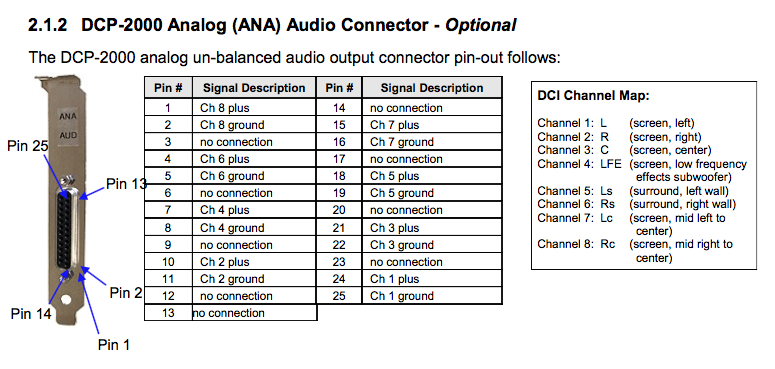
Full document: http://www.manualsdir.com/manuals/751530/doremi-dcp-2000.html?page=9
- Carsten
Posted by Tony Bandiera Jr (Member # 2365) on 02-08-2019, 09:57 AM:
quote: Steve Guttag
If you recall, there were three series in the analog life... the 5/95, the very short lived 105/195 and the 205/295. The second and third digit defined what its capabilities were. It is the same frame in each case. The only differences were what cards were stuffed in. One could add a JSYN-05 to a processor to get Synth stereo too. However, most used that slot for their "pink card" for testing.
There was also the very first Ultra*Stereo analog processor, the one with the taller cards and the full plexi faceplate, the series numbers escape me at the moment.
I had one of those, loved the look of it but compared to the later JS Series it was somewhat lacking in performance. (Not in a bad way really, just the NR seemed a bit off and it had higher noise floor.) I also recall it took me a while to scare up a format card with remote fader ability.
One flaw that IIRC all of them had, was that it was possible to force the Surround decoder card into the SYN slot, which always fried a few resistors on the backplane and sometimes the Surround decoder card. (On second thought, it might have been the other way around, I think this location only had center-surround, so it would be the SYN card into the surround slot.)
I had a theatre I serviced with a notoriously sleazy owner who had that problem constantly at one location, due to a popcorn kid who fancied himself a tech (or fancied me, I was young and pretty then). ![[Big Grin]](biggrin.gif)
The owner was one of those guys who, if you fixed the rectifier on lamp #1, blamed you for theatre #4 losing sound the next day. He quickly became a cash-only, 4 hour minimum UP FRONT customer. He only did it because I was the only one dumb enough to show up.
He had bought a really bad location (4 screens, with Cinecitas (or as I called them, Sorry-to-see-yas), CFS consoles, and the Ultra*Stereo processors). The late Conrad Button had a field day riling that guy up.
Back to the main topic:
Trevor, you really need to check out the Rane document that Steve linked to on the first page.
It offers detailed explanations about balanced vs. unbalanced, and has several options (with illustrations) on how to make up cables with balanced to unbalanced connections.
The balanced connection (usually shown as the XLR connector on the diagrams, pin 2 is +, pin 3 is - ) would be on the server side, and the unbalanced would be the JS 200 side.
They also show the capacitive shield coupling.
Posted by Gordon McLeod (Member # 33) on 02-08-2019, 12:16 PM:
The original USL was the CS serries but it had a predecessor that had a solid blue cover the matrix was very smooth in it
Posted by Trevor Meusx (Member # 10737) on 02-08-2019, 07:42 PM:
Carsten: yeah grounding to the doremi doesn't seem to cut it. Does the audio ground on the amps link to the chassis? Cause the bit of Steve's note I read mentioned connecting the shielding of a balanced cable to the chassis.
very helpful thanks man.
Tony: I started to give it a read last night. Feels like I found the dead sea scroll. Thanks.
Posted by Marcel Birgelen (Member # 6801) on 02-08-2019, 08:21 PM:
quote: Trevor Meusx
Does the audio ground on the amps link to the chassis?
That's usually an important safety requirement. So, the answer should be: Yes
A ground loop essentially occurs when you have two grounds in your system. There will be a difference in potential between those grounds and even if it's just a few volts, there will be a current between those systems over the ground loop you created. It's this current that introduces the hum on your system.
A ground loop can also occur if equipment is connected to the same ground, but with one of the devices having a problem with the grounding, introducing some level of resistance. In those cases, it can help to give those devices a new ground, by connecting the chassis directly to the ground.
If you cannot connect all devices to the same ground, I strongly advice a transformer, like I mentioned before. That will not only get rid of hums produced by ground loops, but will also make your setup safer, since it will introduce a Galvanic isolation between both systems.
Posted by Trevor Meusx (Member # 10737) on 02-18-2019, 09:28 PM:
Anyone ever had luck isolating the hum with an in line xlr iso block?
Posted by Marcel Birgelen (Member # 6801) on 02-19-2019, 04:14 AM:
Like I and others mentioned before, if this "Iso Block" is an isolation transformer and your issue is a ground loop and the device you're eying is any good, then it should work.
Powered by Infopop Corporation
UBB.classicTM
6.3.1.2