This is topic Video monitor in forum Digital Cinema Forum at Film-Tech Forum ARCHIVE.
To visit this topic, use this URL:
https://ft-forum.com/ft/cgi-bin/ubb/ultimatebb.cgi?ubb=get_topic;f=16;t=003697
Posted by Steven Neumann (Member # 10882) on 05-26-2019, 06:54 PM:
Hello. Using a Dolby DSS220, CAT no 745 IMB, and an NEC NC1200C with NC-80LB01, is it possible to connect a monitor to display the video output in the projection room? It would be useful to test play shows without using lamp hours and see how things are progressing without needing to look through the projector window. The DVI and HDMI ports are described as inputs in the literature I've seen, I'm not sure about the HDSDI BNC plugs, which are marked A, B, Sync In and Sync out. There's an ethernet port marked AUX, perhaps an ethernet connection to a laptop or PC could help?
Posted by Jim Cassedy (Member # 4115) on 05-26-2019, 06:59 PM:
quote: Steven Neumann
is it possible to connect a monitor to display the video output in the projection room?
The simple answer is "No".
That being said, I did hook up a system at one of the screening rooms
I work at which allowed me to view unencrypted content in a rack mount
monitor, but it involved using a couple of SDI Distribution Amps, an SDI
switcher, and an SDI compatible monitor, all of which I had available at
that location. It was very useful to check content & playlists for film
festivals, etc, without having to fire up the projection lamp.
But it could only be used with UNENCRYPTED content.
Although it was possible to do it this way, it tied up a couple of thousand
dollars worth of equipment to achieve. You can't just "plug in a monitor"
Posted by Leo Enticknap (Member # 534) on 05-26-2019, 09:45 PM:
Like Jim says.
The whole DCI ecosystem is designed first and foremost with anti-piracy in mind, which means making it impossible for the decrypted video to be rendered on any display device other than a DCI-compliant projector.
I believe what Jim did was to take advantage of a feature on one specific model of Series 1 HD-SDI media block, whereby it is possible to shut off link encryption altogether. However, once you've done that, that server and media block will only play unencrypted (i.e. does not need a KDM to play) DCPs. Another hurdle is that that DCI "container" (native resolution) is 2,048 pixels wide, not the 1,920 used in the consumer and broadcast sectors. So even if you manage to get unencrypted video coming out of the media block, you then either need a native DCI 2K monitor, or a scaler, to enable that video to be displayed on most monitors.
Posted by Marcel Birgelen (Member # 6801) on 05-27-2019, 01:10 AM:
I know a few locations that point a camera on the screen.
Problem is though, studios don't like that either...
Posted by Marco Giustini (Member # 4544) on 05-27-2019, 05:31 AM:
Marcel,
The OP mentioned saving lamp hours so that is not going to help either unfortunately
Posted by Jim Cassedy (Member # 4115) on 05-27-2019, 09:51 AM:
At several venues & film festivals, I still work with HD-CAM source
material, and one of the things I really like about the HD-CAM decks
(usually SONY's) have a small video playback window that's part of the
LCD control display panel. It's no more than about 1.5in square, if that,
and I don't understand why they can't do the same thing on a DCP servers.
I understand the DCP consortium's over-obsession with anti-piracy, but
geez, IMO it would be very handy to have a tiny, less than 2"sq image,
watermarked if necessary, for testing DCP's & playlists without powering
up the whole system, & without compromising security.
Sony SRHD-5500 HDCAM Deck
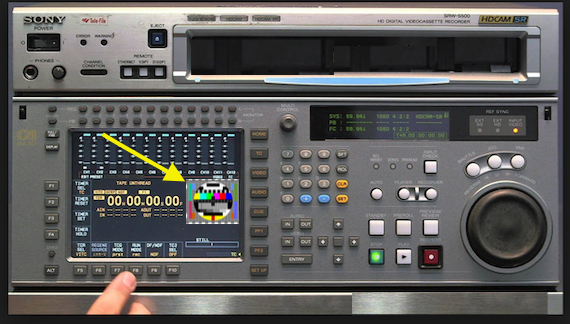
(Simulated picture, but this is what it looks like. Why can't they do this on DCP servers?)
Posted by Steve Guttag (Member # 268) on 05-27-2019, 11:06 AM:
You mean the servers that fit in the projector and have so little real estate left that they are now using mini-bnc connectors due to lack of space? You want those to have a little monitor?
With all current servers showing via IMBesq systems, what is on the drives is encrypted to the point of the IMB and its output goes right to the projector (typically the ICP or equivalent)...there is no point that an image is in the clear...by the design.
Posted by Leo Enticknap (Member # 534) on 05-27-2019, 12:41 PM:
I guess DCI's justification would be that there was no such thing as a preview monitor for 35mm (unless you had a Steenbeck in your booth!), and so we can jolly well live without them in the digital era, too.
The difference is that there are many defects and issues in a 35mm that can be detected from a bench examination. With a DCP drive, however, you need to ingest it and play it in order to know that you have a show.
Posted by Carsten Kurz (Member # 5396) on 05-27-2019, 01:17 PM:
I think the early Quvis servers had a small display showing content. Obviously, DCI doesn't like it. It is not easy to create a standard that allows this kind of addition without specifying allowable/necessary picture parameters that would e.g. prevent any kind of piracy. I understand discussions like this would be crazy.
In theory they could have a small accessory LED light source that could be used to give just enough light into the light engine to watch something, somewhere. But that's all weird...
- Carsten
Posted by Steven Neumann (Member # 10882) on 05-27-2019, 02:36 PM:
It seems that using the projector is the cheapest and simplest method then. I did read elsewhere on the forum about turning off link encrypt for un-encrypted content, but that seems inconvenient and would still require something to decode the output. We could open the lamp housing and get the usherette to shine a torch in there... ![[Smile]](smile.gif)
So there is no socket that a video monitor can be plugged into, which explains why I couldn't find any details about connecting one. Thank you for your help. From an operating point of view a small display in the Dolby Show Manager control panel GUI would have been ideal, but I can see why from a security perspective this was not done, although with a watermark or logo superimposed on a low resolution image before it was output it would not be very usable elsewhere.
Posted by William Kucharski (Member # 7246) on 05-27-2019, 06:03 PM:
Given how prevalent pirated DVDs or low-res streams (280 lines or less) are, I don't think it would stop anyone.
Keep in mind that a watermarked copy from a low res source like a front panel would still be perfectly watchable on a smaller display like a watch or phone, and watermarks don't stop anyone who wants to watch the latest stuff "for free."
Watermarking is also a very "Spy vs. Spy" scenario:
quote:
“So-called ‘HashCode removal tools’ work in near real-time to strip away any kind of visual marks from a video feed. This ranges from unique fingerprints right down to the broadcaster’s on-screen logo that’s so familiar on many channels, both helping pirates to cover their tracks,” the company explains.
“These tools are so smart, they take a sample of the surrounding pixels and re-use them to replace the visual marks, so the viewer of the pirate stream barely notices any disturbance in the picture.”
Irdeto says that its work with TV companies has revealed an uptick in the use of such tools in recent months. That’s partially down to how readily available they are.
“Research by Irdeto’s anti-piracy team found HashCode removal tools openly on sale via popular selling platforms like eBay and Alibaba for less than US$2,000,” the company reveals.
“These devices fall into a legal grey-area. They don’t actively ENABLE piracy, but they do help pirates to mask their identity. This means the sellers don’t even need to be shy about describing exactly what their products can achieve,” Irdeto notes.
‘Live’ TV Piracy Watermarking Defeated by Devices Sold on eBay
This company even proudly has a demo on YouTube:
HashCode Remove Pro in Action Demo 2
It wouldn't be hard at all to run a low res capture through such a device and then through an upscaler to generate 480p for DVD/streaming release.
Posted by Marcel Birgelen (Member # 6801) on 05-27-2019, 06:44 PM:
It's obvious that "dewatermarking" would eventually become available. Those anti-piracy measures are a cat and mouse game. Yet, there hasn't really been a confirmed high-profile DCI leak in the history of DCI. Most leaks have been screeners sent out by the studios or leaks on their side...
Although, I'd say that it is pretty hopeless to fight those who would watch such crappy videos, like those captured from a front panel with a mere 300 lines or so. Are those really your paying customers?
Posted by William Kucharski (Member # 7246) on 05-27-2019, 07:22 PM:
That's the question no one has ever been able to answer.
The recording industry says piracy kills record sales, many younger people say they would never pay money for music. The real answer lies somewhere in between.
Are there people who don't go to a theater because they've watched a 240i video on their phone? Undoubtedly.
Does that reduce the amount a blockbuster like Avengers: Endgame bring in? Not a huge amount, I suspect.
The issue lies in between; what about a movie like the new Aladdin? I suspect Will Smith's genie comes across as well on a 2" screen as a 40 foot one, and a good chunk of the audience first saw the animated one on a seat-back screen in a minivan. :-)
Posted by Marcel Birgelen (Member # 6801) on 05-27-2019, 07:48 PM:
There is simply no denying that piracy has both hurt and actually helped creative industries at large, although nobody in the industry is willing to acknowledge the latter.
And although nobody is buying records anymore, almost everybody I know now has a subscription to a streaming service like Spotify. Also, live shows seem to have become the new milking devices, as tickets to those events never have been more expensive.
Yes, there might be the odd case where somebody doesn't want to go to see Aladdin, because he/she's seen the 300x200 pixel version bootlegged from a monitoring screen somewhere, but the number of people that really base their decision on this will probably be so small, it isn't worth the effort to fight it.
In my opinion, the best remedy against such kind of piracy, is simply by offering the paying public a far better product.
The best solution seems to be in the studio's hands though: Just make movies people actually want to see...
Posted by Steve Guttag (Member # 268) on 05-27-2019, 10:13 PM:
I belong to no audio streaming services (that I'm aware or take advantage of). I do visit YouTube and have heard music "for free" there but I'm not part of their various means of paying.
I do have a CD collection that continues to grow (not quickly).
I would argue that with the demise of the studio system in records, the quality of recording/music has gone down. It isn't that you can't show good examples from current times but there simply isn't the budgets of yesteryear to develop and make albums. The whole concept of albums isn't there (for most).
I agree however, somewhere between "I won't pay for content" and "I won't pay that much for content" is likely "Okay, I'll pay for that."
Is is true, however, there are people that do not see the copyrighted work of others as something they stole because they have not deprived anyone else of buying it (they didn't steal a physical thing, they stole a viewing or a copy of that thing). They don't get that it wasn't theirs to take, view, copy...etc.
There is no price cheap enough for them. I think part of what motivates them is the challenge of getting away with it.
Posted by Scott Norwood (Member # 30) on 05-28-2019, 12:56 AM:
Encrypted content aside, it would be nice if DCI servers could show unencrypted DCPs on a monitor without going through as many contortions as Jim did. Is there really any justification for not allowing this? If a theatre has an unencrypted DCP, it can easily turn it into some other format that can be played on a computer in full quality.
If nothing else, it would be useful for pre-viewing trailers and snipes.
As for 35mm viewing--I've worked in a booth that had a Steenbeck. It was less useful than one would expect. The "fast forward" mode is only about 2x-3x normal speed, and getting a print on cores, threading the Steenbeck, fast-forwarding through each reel, then rewinding the film back onto reels for projection is actually slower than doing a thorough bench inspection and projecting a reel or two to determine the fader setting and spot-check the print. It's nice to have, but not super-useful in most cases.
Posted by Marcel Birgelen (Member # 6801) on 05-28-2019, 05:34 AM:
The DCP format should be flexible enough, so it could be extended with an option that allows for previews for SPLs or the entire DCP package. Both in the form of an unencrypted thumbnail still, video or short video loop. This could especially be useful for stuff like commercials, trailers, logos, etc.
Also, a lot more useful metadata could eventually be added, stuff like:
- The full title of the feature
- Credit offset times
- An offset time for an optional intermission
- A clear definition of the container size and "safe image size" inside the container
- Notices to the projectionist in digital form
- All kinds of other useful attributes I didn't think of ![[Wink]](wink.gif)
I guess the reason why nobody dares to do so, is because the entire switch between Interop and SMTPE has already proven to be a pretty big mess. Extending the format with new options will most likely lead to unexpected side-effects on some equipment...
quote: Steve Guttag
I would argue that with the demise of the studio system in records, the quality of recording/music has gone down. It isn't that you can't show good examples from current times but there simply isn't the budgets of yesteryear to develop and make albums. The whole concept of albums isn't there (for most).
I had hoped that the eradication of the middle-men would lead to greater expressive freedoms. Yet it seems to be difficult to make a living on just music, if you're an independent band with just a handful of fans.
One of the major issues today is that the average length of a song has come down significantly. Artists no longer give a song the necessary length to unfold itself, they try to squeeze everything into a 2.5 minute window. The reason is that you get paid per play and not per minute on all those on-line platforms and also broadcast radio. The more songs you can fit into an hour, the more potential profit there is to be made...
I'm afraid that the movie industry might face a different faith than the music industry. It's simply darn expensive to shoot a movie, worthy of a presentation in any self-respecting theater. It's not like you need $150M to shoot a movie, but somewhat more attainable figures like $250K will get you close to nowhere nowadays.
So, in order to shoot good movies, you still need proper funding. Funding that's hard to attain for any small-scale operation. Once the current Hollywood studio system fails, we lose a big provider of those funds.
Right now, post production and special effect houses can ride the "gravy train" of those big jobs coming from Hollywood. It's not only Hollywood benefiting from more choice and more competition, it's also the lower budget, independent and broadcast productions that can benefit from this.
But if Hollywood implodes, it will certainly lead to a big drop in quality of movie productions across the line.
quote: Steve Guttag
There is no price cheap enough for them. I think part of what motivates them is the challenge of getting away with it.
It's also the reason why, in my humble opinion, you shouldn't put all your efforts into fighting them. They will always be there. You should create a culture of minimizing the amount of freeloaders, but you don't do that by almost criminalizing the people that actually pay for your content.
I've always been the "technical guy", but with a somewhat creative background. I know how much time and efforts people put into creating content, I know what it costs to make it and I know that not everybody is living the good life. I understand why studios and content creators want to put locks on anything, although that's not always a good solution. As a technical guy, I hate the practice, because it adds all kinds of complications that, technically, add nothing to the end result.
But in the end, that's also true for the consumer. The copy protection that's still present on almost all physical media hurts the normal guy/girl the most. If he/she wants to make a LEGAL copy of his/her Blu-Ray, he'll be faced with all kinds of roadblocks, including potential big legal issues in many jurisdictions. As a bonus, even if he simply wants to watch the content on the disc, he is often faced with un-skippable copyright notices and trailers...
Meanwhile, the freeloader downloads the same content, without any limitations and irritations, for free, from the Internet.
Somehow, that situation is simply not fair. The guy who bought a legal copy with his hard earned cash is getting screwed over from all sides and treated like a potential criminal, while the guy/girl who just freeloaded it, gets exactly what he/she wants.
This really needs to change. The guy/girl who paid for the content should get a premium product. Since it's already out there in the wild, just remove any useless copy protection and give him a hassle-free experience.
Posted by Steve Guttag (Member # 268) on 05-28-2019, 07:14 AM:
Need we have any more example than Hollywood putting KDMs on catalog titles that are available in Digital 4K in the home? Once it hits the home, genie is out of the bottle. Enough with the KDMs on that sort of stuff. About all it does (and it isn't insignificant) is control when the movie is played.
Heck, sometimes they outright tell you to obtain the Blu-ray yourself and merely pay them the license fee to play it.
Posted by Martin McCaffery (Member # 37) on 05-28-2019, 08:14 AM:
quote: Steve Guttag
Heck, sometimes they outright tell you to obtain the Blu-ray yourself and merely pay them the license fee to play it.
Sometimes? Quite often.
The flip side being the studios that won't allow the projection of a DVD/Blu-Ray, even when they don't have a DCP or decent print.
Posted by Steven Neumann (Member # 10882) on 05-28-2019, 12:47 PM:
Copyright (or similar) issues have been around a long while, like when Mozart transcribed La Miserere after hearing it in the Sistine Chapel. Surely the legal protection is the main enforcement, a decoded full res image comes out of the front of the projector too and can be recorded with a commonly available device called a camera, which has existed in various forms for many decades now. Copies have always been made, whether by historical art forgers or modern pirates. But can they financially profit from them without suffering consequences, because selling means displaying their wares publicly? Modern technology makes it easier to create copies but also to find those who have done so.
I was just looking at LED light sources and 100W - 500W LED chips are now available at quite reasonable prices so perhaps in time there will be LED replacement projector lamps.
It's a privilege to show the latest movies, and here, we'll do what those who provide them require.
Posted by Paul Finn (Member # 10726) on 05-28-2019, 01:51 PM:
I also vote for some way to preview DCP content without projector operation required. Stealing originals, copying and forgeries always remind me of the often forgotten wonderful and charming Audrey Hepburn and Peter O'Toole movie "How To Steal A Million".
Paul Finn
Posted by Sean McKinnon (Member # 612) on 05-28-2019, 02:16 PM:
I would imagine someone could build a display that contained a link decrpytor where the device was in a secure case with tamper switches and no signal outputs. This way *IF* the device was connected to a normal media block and *IF* the distributor made the key valid for this device then what everyone has proposed would work however the media block in the projector would still be required to decrypt the DCP.
Posted by Carsten Kurz (Member # 5396) on 05-28-2019, 02:44 PM:
Building a monitor with a link decryptor would be probitively expensive, and it would only work with a diminishing number of server/projector combos still using HDSDI. I guess it would be much easier to build a small monitor right into the projector within the secure enclosure. An ICP type board could downscale and apply the same watermarking as used for the projection. Then, as Steve says, there is not that much space available on these systems, plus - most of these systems with integrated servers nowadays are designed to see no humans anymore. So, I guess there is little incentive for the manufacturers to build that little extra.
I usually try to schedule my SPL building, qc, etc. ahead of or right after a regular showing, trying to keep the bulb burning. When I need to preview a specific trailer or ad or short, I can do that on a PC running right next to the projector with DCP-o-matic player.
- Carsten
Posted by William Kucharski (Member # 7246) on 05-28-2019, 03:40 PM:
quote: Steven Neumann
Copies have always been made, whether by historical art forgers or modern pirates. But can they financially profit from them without suffering consequences, because selling means displaying their wares publicly? Modern technology makes it easier to create copies but also to find those who have done so.
While it’s true that it’s always been possible to make copies of things using a camera or some other device, the bigger problem is today with digital, it’s possible to make copies that are complete duplicates of the original in every way.
With the advent of the dark web or, even more commonly, torrents, it’s virtually impossible to track down the source of a pirated copy of a film to any particular site or even geographic location. As I posted earlier, even watermarks are relatively easy to defeat now.
Media blocks could steganographically encode origination information into the projected media itself but even that would be easily defeated.
The only real enforcement mechanism is whether the consequences are worth the payoff.
Posted by Steve Kraus (Member # 476) on 05-28-2019, 04:11 PM:
How about a monitor output that can show unencrypted items in your timeline and when an encrypted item comes up the display goes blank with some text saying "ENCRYPTED CONTENT" followed by the DCP name and some technical specs? Maybe audio would be allowed since one notes that unlike video it is not re-encrypted; no enigma in the audio processor.
Posted by William Kucharski (Member # 7246) on 05-28-2019, 04:27 PM:
I suspect if that feature were added, studios would start encrypting trailers and ads too.
I do recall a recent Fathom showing where the feature went out unencrypted as well, likely assuming anyone who wanted to pirate a film from the 1960s would just rip the Blu-ray instead. 😁
Posted by Marcel Birgelen (Member # 6801) on 05-28-2019, 07:34 PM:
There are plenty of trailers already that are encrypted and need keys...
I've yet to encounter an ad that requires a key, but I'm pretty sure there are examples of that out there too.
Posted by Leo Enticknap (Member # 534) on 05-28-2019, 09:44 PM:
quote: Steven Neumann
Copyright (or similar) issues have been around a long while, like when Mozart transcribed La Miserere after hearing it in the Sistine Chapel.
Allegri died (1652) over a century before Mozart is alleged to have done that (1770), so even if modern copyright legislation had been in force in either Italy or Austria, it would have been in the public domain by then. Still, threatening the creators of unauthorized copies with torture and execution, as the Vatican is supposed to have done, is, it has to be admitted, a more effective method of enforcement than prowling around a movie theater with night vision glasses...
Sorry to veer this off topic, but there is an interesting comparison between the tactics used to keep classical music and movies perpetually in copyright. When a piece of classical music establishes itself with serious staying power, publishers crank out "scholarly" new editions, which are usually no different from the ones in the public domain apart from typesetting and the spacing of each measure. I have five different editions of J.S. Bach's Toccata and Fugue in F Major, BWV 540, published between 1865 and 1989. Three of them are identical apart from fingering and pedaling suggestions (which, unless the anatomy of your hands, legs and feet is identical to that of the editor's, should be ignored), and the differences in the other two are insignificant: an omitted trill in the second iteration of the trio here, a suggested ralantando at the end of a section in the fugue there, etc. etc. But of course, each new edition has a copyright period as essentially a "new" work, and is used to try to make people buy the same music twice.
The problem for that industry is that most classical music that more than about 6 people want to perform or listen to was written at least 150 years ago, and even Disney never managed to get copyright terms extended for that long!
Same thing with movies: isn't it funny how the real classics are constantly being restored, digitally remastered, etc.? You've got Casablanca on VHS, Laserdisc, DVD, BD ... but of course now you've just got to spend another $20 to have it in 4K on Amazon Prime streaming! Each new version resets the copyright clock, and the old one is pulled from circulation, thereby ensuring that the movie never truly enters the public domain.
In an attempt to return to the topic, the production and distribution sectors of the industry have decided that movie theaters should not have the easy ability to preview and QC content before public screenings. I don't like that, but there isn't much we can do about it.
Posted by William Kucharski (Member # 7246) on 05-28-2019, 10:48 PM:
quote: Leo Enticknap
the production and distribution sectors of the industry have decided that movie theaters should not have the easy ability to preview and QC content before public screenings.
To be fair, it's not difficult - the easiest way to QC it is to run the show, arguably the same thing you would have needed to do to QC a 35mm print if you didn't want to check every inch by hand.
Really the only issue is the time required on behalf of a projectionist and burning off another few hours of projector bulb life.
I'm a bit surprised that no theaters have a policy of having projectionists do a late night QC screening at 1 AM Thursday morning that employees can attend if they choose as a perk as long as they can keep quiet during the screening and until the release date.
Perhaps I'm being hopelessly naive here.
Posted by Marcel Birgelen (Member # 6801) on 05-29-2019, 06:22 AM:
I'm afraid you are. Even projectionists are humans.
Many multiplexes run a one-man show when it comes down to projectionists. So, in a week opening e.g. three new movies, the projectionist has to sit in QC screenings until like 8am in the morning?
Ideally, if he moves a movie to a different screen, he should also do a full QC on that screen... never gonna happen.
At most single-screens I know of, the projectionist is the theater owner, often also having a day job. They need to catch a few hours of sleep, somewhere...
It's not like late deliveries never happened during the 35mm heydays, or stupid stuff like cans with number locks on them, but in general, there was more time to do QC than with a lot of those hot titles nowadays.
Studios simply shouldn't be so anal regarding their KDM windows... problem solved. Anybody showing the movie to a crowd a few days before the official release will get their collective asses spanked so hard, they will make sure it never happens again...
quote: Leo Enticknap
Same thing with movies: isn't it funny how the real classics are constantly being restored, digitally remastered, etc.? You've got Casablanca on VHS, Laserdisc, DVD, BD ... but of course now you've just got to spend another $20 to have it in 4K on Amazon Prime streaming! Each new version resets the copyright clock, and the old one is pulled from circulation, thereby ensuring that the movie never truly enters the public domain.
At least until recently, we could get everything on a hard copy media that we still could copy (although some workarounds with potential legal implications in some jurisdictions apply).
More and more content is streaming only. If the content owner or distributor decides we can no longer see it, it simply dissapears from distribution...
I'm all for paying those who create new, creative works for their efforts. It's important to keep not only this industry, but many other industries alive. But, I'm against perpetual or quasi-perpetual copyright, like we've got today. There is no such thing as "true creativity", everything new that's created, is based on something that already existed. The things we create are an important part of our history and our culture and have to be preserved and they have to be accessible.
I'd say that a copyright term of 20 years on any original work should be sufficient. It's also in line with the maximum term for patents.
Also, in case of motion pictures, I'd say that in order to be able to claim copyright, you should be required to file at least one original copy with an "official recognized" film archive. After the copyright has expired, those film archives are required to provide a copy of the filed motion picture to anybody requesting a copy at a reasonable cost.
Posted by William Kucharski (Member # 7246) on 05-29-2019, 08:54 AM:
quote: Marcel Birgelen
Also, in case of motion pictures, I'd say that in order to be able to claim copyright, you should be required to file at least one original copy with an "official recognized" film archive. After the copyright has expired, those film archives are required to provide a copy of the filed motion picture to anybody requesting a copy at a reasonable cost.
I'm not sure a copyright should ever expire. For example, there's zero reason something like Casablanca should ever be public domain no matter how old it is unless that's what Warner Brothers wants to happen.
On the other hand, if a film has been truly abandoned such that the copyright hasn't been renewed, then it's a different story, but I can think of few cases where that has occurred with a feature film that wasn't due to a bookkeeping accident.
Posted by Scott Norwood (Member # 30) on 05-29-2019, 09:12 AM:
This is getting off-topic, but, at least in the US, copyright and patent terms are required by the Constitution to be limited in time:
quote:
To promote the Progress of Science and useful Arts, by securing for limited Times to Authors and Inventors the exclusive Right to their respective Writings and Discoveries;
I liked the old US copyright system--28 year term, renewable once for an additional 28 years. People who cared renewed their copyrights, while people who did not care allowed their work to become PD. The current system has become a muddled mess, with terms being extended. For motion-pictures, only pre-1923 titles were guaranteed to be PD until recently.
Posted by Sean McKinnon (Member # 612) on 05-29-2019, 12:25 PM:
Carsten,
What I mean is similar to an IMB LD that can take the output of a regular IMB/IMS as if you were doing two projector 3d. of course it would be expensive but isnt everything in digital cinema?
Posted by Marcel Birgelen (Member # 6801) on 05-29-2019, 02:50 PM:
quote: William Kucharski
I'm not sure a copyright should ever expire. For example, there's zero reason something like Casablanca should ever be public domain no matter how old it is unless that's what Warner Brothers wants to happen.
There are good reasons why copyrights should always expire and not end up, locked up in some kind of corporate deadlock for infinity. We should choose for maintaining our cultural heritage, instead of corporate greed.
Those creative works become part of our history and our culture. As I pointed out earlier, the big corporations, those who own most of the IP we consume every day, are quickly moving away from physical media.
They want to control what we can see, when we can see it and how much it is going to cost us. If something isn't deemed valuable anymore, they can simply drop it from distribution and henceforth it will practically disappear from existence.
Many of those companies haven't been the best caretakers of their own IP. In the end, many classic movies only survived because of (often illicit) external collectors, who did take care of their precious copy...
Also, like I said earlier, there simply is no such thing as true creativity. We all draw from what we've learned, we've experienced, we've read, we've seen. We create new things from stuff that's out there. If everything is locked behind paywalls, this will be bad for creativity.
On the other hand, if nobody pays for creative works anymore, that's equally bad for creativity, henceforth did we invent copyright laws. Yet, when they were first implemented, they tried to balance the rights of the creator versus the rights of the common good. People that create worthwhile, new, original works would be sufficiently compensated, so they can continue to create new, creative works for us to enjoy.
An expiring copyright forces the creative industry to be actually creative, not just being an accounting frontend for rights acquired over decades. Why should a company be able to ask money forever, when they're essentially creating nothing new? They get a broad monopoly on everything new they create, but once it has expired, why shouldn't others be free to expand on those works? Most of the Disney classics we know, are reheated, creative re-interpretations of old stories, that have long been in the public domain.
quote: William Kucharski
On the other hand, if a film has been truly abandoned such that the copyright hasn't been renewed, then it's a different story, but I can think of few cases where that has occurred with a feature film that wasn't due to a bookkeeping accident.
In the current system, copyright doesn't need to be renewed, it's an automatic license, granted on every original work. There is also no need to register an original work, to be able to claim copyright on it. So, it either expires and enters the public domain or there are still copyrights attached to it, even if the owners don't seem to care about it anymore.
Powered by Infopop Corporation
UBB.classicTM
6.3.1.2