This is topic Trinnov Ovation Sound Processor in forum Digital Cinema Forum at Film-Tech Forum ARCHIVE.
To visit this topic, use this URL:
https://ft-forum.com/ft/cgi-bin/ubb/ultimatebb.cgi?ubb=get_topic;f=16;t=003732
Posted by Geoff Halls (Member # 7501) on 07-01-2019, 12:32 AM:
We are currently trialing a Trinnov Ovation sound processor (made in France). Has anyone had any experience/ comments on them.
Posted by Mike Babb (Member # 1379) on 07-01-2019, 08:16 AM:
Quake!
Posted by Carsten Kurz (Member # 5396) on 07-01-2019, 11:35 AM:
Do a forum search on 'Ovation' or 'Trinnov', and you will find a couple of recent threads dealing with it.
- Carsten
Posted by Mark Strube (Member # 4190) on 07-01-2019, 03:48 PM:
We have a very challenging auditorium here in Milwaukee. Domed ceiling, limited ability to cover hard surfaces in order to preserve the architecture. The Ovation was simply a revelation. Its ability to operate in the temporal realm cleaned up our audio like no one's business. I highly recommend trying it out especially for challenging rooms. (You can get an idea of the room from the photo at AvalonMKE.com )
Posted by Mark Gulbrandsen (Member # 72) on 07-01-2019, 04:33 PM:
I am very familiar with the Avalon. Did work on the booth there on and off in the 80's, and 90's and at the Times... Yes, that room not only has standing waves, but it's very live with a long delay!! I'm glad the Ovation worked for you. Its the best cinema processor out there right now.
Mark
Posted by Geoff Halls (Member # 7501) on 07-02-2019, 09:44 PM:
Thanks Mike, Sounds Great.
Posted by Marcel Birgelen (Member # 6801) on 07-04-2019, 05:43 PM:
You're trailing the original Ovation or the Ovation 2?
Would be nice to hear some real-user stories regarding the Ovation 2, if they're already out in the field.
Posted by Stephan Shelley (Member # 8587) on 07-04-2019, 08:25 PM:
The flexibility of being able to route input to output is good. On AES input I do 7.1 surround and on the 8 channel analog input the extra 2 channels are for Le and Re. Also have a preset for baby boom on 6 track mag. The 8 channel analog input comes from our CP200.
Posted by Mike Babb (Member # 1379) on 07-08-2019, 06:43 AM:
To answer Marcel's question about Ov2, there are about 75 out in the field already and as far as I know, only Pete Naples on F-T could comment so far.
The Ov2 from a sound quality standpoint is the same as Ov1. The differences are:
New calibration wizard that is web based and very intuitive. Others can comment but the feedback I have had in training is it's very easy to proceed from start to finish. The Ov1 was pretty good but more of an engineering program.
The front control is two touch panels, one is the Trinnov audio board and one is the Linux PC. This resolves some international shipping issues we had with knobs and some manufacturing speed is added by not having front panel alignment/button alignment be so critical.
The GPIO board option which was almost never purchased is removed in favor of a 16 channel AES3 output board, TASCAM pinout. Please note this is available in the 16 channel output version, but not the 24 channel output version, as the extra output board makes it an either/or situation.
I'll save the sale pitch, but can answer any questions that come up.
Posted by Mike Blakesley (Member # 26) on 07-08-2019, 08:41 PM:
We're getting one here this fall to replace our 14-year-old CP650.
Posted by Marcel Birgelen (Member # 6801) on 07-09-2019, 10:00 PM:
Interesting Mike. You just replace your CP650 with the Ovation 2 as drop-in replacement or will you do other improvements as well?
It will be interesting to know if you're going to hear the difference between the two.
quote: Mike Babb
I'll save the sale pitch, but can answer any questions that come up.
I've read that there were some trials with DTS-X on the Ov1. So I was wondering if there would be a DTS-X option out-of-the-box for the Ov2? And if so, what kind of maximum output channels the box could handle.
Posted by Mike Blakesley (Member # 26) on 07-09-2019, 11:19 PM:
quote: Marcel Birgelen
You just replace your CP650 with the Ovation 2 as drop-in replacement or will you do other improvements as well?
It will be interesting to know if you're going to hear the difference between the two.
Just replacing. We already upgraded the rest of our system a few years ago with QSC amps and 3-way speakers, and a full baffle wall. Not sure what else we can do affordably, outside of adding more channels and our place isn't really big enough to make that necessary.
Our tech has said he thinks I will hear a difference, so we'll see.
Posted by Marcel Birgelen (Member # 6801) on 07-10-2019, 08:14 AM:
quote: Mike Blakesley
so we'll see.
I hope you'll hear it too...
Sorry... worst joke of the day.
quote: Mike Blakesley
Not sure what else we can do affordably, outside of adding more channels and our place isn't really big enough to make that necessary.
It's just an idea, but if every surround speaker has its own amp and you do have sufficient outputs on your upcoming Ovation 2, maybe it's an option to run them to individual outputs on the processor. That would only require a little bit of extra wiring inside the booth.
Even though "MDA audio" does only add a minimum of extra experience in smaller rooms, if DTS-X becomes available and the licensing costs aren't through-the-roof for your new machine, it may offer some extra "marquee value".
Posted by Mike Babb (Member # 1379) on 07-10-2019, 11:02 AM:
To answer the DTS-X question...GDC can decode 13.1 or 15.1 and send it to Ovation 1 or 2 as AES3. Then we take it and send it out bi or tri amp screen speakers, sidewall backwall and ceiling surround zones. Because of the time and phase alignment the mix holds up really well and setup is an hour or less.
Posted by Jarod Reddig (Member # 6363) on 07-10-2019, 06:50 PM:
Nothing but good things to say about Trinnov from my experience.
Posted by Stephan Shelley (Member # 8587) on 07-10-2019, 08:33 PM:
Mike, I am guessing you are no longer running any film. One thing the Ovation will not do on its own is film but you can daisy chain a legacy processor into it.
Posted by Mark Gulbrandsen (Member # 72) on 07-11-2019, 09:37 AM:
Nope, We moved his projector to behind the baffle wall after conversion 8 years ago... In fact out of 334 conversions I did on the Mountain States only two film projectors were left in place and neither has been used in 5+ years.
Mark
Posted by Mike Blakesley (Member # 26) on 07-11-2019, 11:57 AM:
Well we DID leave the film projector in place for about 3 or 4 years but we never did use it, so we finally got it out of the booth to make some storage space. (Anybody want it?)
Posted by Tim Androes (Member # 9010) on 07-11-2019, 12:45 PM:
what kind of equipment?
Posted by Mark Gulbrandsen (Member # 72) on 07-11-2019, 02:03 PM:
It's a Simplex X-L on a 5 Star mounted to a Christie console with every upgrade known to man. I do not remember the lens sizes. There is also a Christie AW-3 and MUT.
You can see pictures of it on the Roxy Theater web page below...
Derelict Projector needing a New Home
Posted by Pete Naples (Member # 761) on 07-14-2019, 05:49 PM:
Geoff,
It's now my 'goto' processor, especially when bi/tri/quad amplifying.
Installed lots of them, every one has been well received. A couple of really acoustically challenging rooms have been tamed where everything in the past failed.
My most recent install which was an OV2, one of those challenging rooms, an ancient cinema from the silent era (it would make an excellent cathedral).
The owner said "I can't believe the sound, worth every penny"
Posted by Geoff Halls (Member # 7501) on 10-14-2019, 07:14 AM:
After successful trial we are installing two more Trinnov Ovation-2 along with speaker and amplifier upgrades from Krix Speakers. Can anyone suggest a good monitoring option to suit a tri amplifer system with the Ovation.
Currently using CP650 with QSC DCM-3 VGA cable to amps. This was a nice easy install. Looks like I will have to now tap off from all the amp outputs!!
Posted by Sean McKinnon (Member # 612) on 10-17-2019, 03:44 PM:
FYI- even though they use the same connector the QSC dataport cables are not VGA cables. While VGA cables may work the shielding is different and they are made to carry 15 volts so using an off the shelf VGA cable IMO is risky.
Posted by Steve Guttag (Member # 268) on 10-17-2019, 04:27 PM:
As I recall, Dataport cables also use pin 9, which VGA cables typically don't. It's been awhile since I looked at/made a Dataport cable.
Posted by Mark Gulbrandsen (Member # 72) on 10-17-2019, 05:10 PM:
Mike has the ONLY CP-650 that I installed which has not lost it's power supply. IDK why it has not because his booth some times gets pretty toasty and every other CP650's power supply I ever installed failed within about 7 years of use. His 650 is also the only Dolbly I kept in place during Digital installs. Almost everything else got Ultra Stereo JSD-100 and later on some JSD-60. We did keep the Panastereos.
Mark
Posted by Khushwant Singh (Member # 10493) on 11-06-2019, 01:10 AM:
Hi we are going to deploy in next week will share our input , very excited
regards
Posted by Steve Guttag (Member # 268) on 11-06-2019, 06:08 AM:
Yes, pin 9 = +15V. It isn't crucial for this wire to exist in a dataport cable as I don't think that pin is used for anything but the dataport accessories like the XC-3 and SF-3 (The XC-3 was just discontinued, btw).
Posted by Mark Gulbrandsen (Member # 72) on 11-10-2019, 10:24 AM:
Mike B. just switched his CP-650 out for a Trinnov processor and I know he's really happy with it. Hopefully he'll chime in and relate some of the differences between it and the 650.
Mark
Posted by Khushwant Singh (Member # 10493) on 11-29-2019, 12:52 PM:
Dear All
We have recently deployed the first Trinnov Ovtion 2 in India.
The performance is mind blowing ..... AMAZED... not only listening , we can also see the sound travelling across the auditorium.
This sound processor has no barrier, irrespective the content is 5.1 or 7.1 the output is Marvelous.....
One should experience the difference if he true sound lover.......Amazing
Thanks and regards
Posted by Brad Miller (Member # 2) on 11-29-2019, 01:37 PM:
quote: Khushwant Singh
we can also see the sound travelling across the auditorium
Sounds like you should shoot a video of this amazing phenomenon.
For people who are issuing comparisons, you REALLY NEED TO add into your post the processor that was removed and any acoustical or speaker changes that were made. Even then it's still not a true comparison unless just before the swap the old system was calibrated by the same technician, but still I have to ask what potential garbage equipment was being upgraded when the new processor went in?
Case in point, consider a Trinnov processor installed into an auditorium with underpowered Peavey speakers and then an old CP50 was installed with high end QSC speakers. That 40 year old CP50 is going to sound better!!!
I've no doubt the Trinnov produces very good results, but I would like to at least hear some truly fair comparisons because I suspect not all of these are...especially when I read such ridiculous claims such as the above post. My curiosity and concern here is similar to the old DLP demos where they ran the DLP on screen side by side against a completely beaten to hell film print.
Posted by Steve Guttag (Member # 268) on 11-29-2019, 02:07 PM:
Brad,
I agree. But tell me this...have you found even ONE claim of someone that has put in the Trinnov Ovation (1 or 2) that didn't think the sound was a significant improvement? In speaking with technicians (as I'm apt to do because let's face it, those that just spent money are pre-conditioned to believe the money they spent did amazing things), I've yet to find a single naysayer. In fact, just the opposite. They are the simple installation because it tunes itself and sounds really good doing it...less work.
You have a home theatre (with DCPs as well as film and video)...give it a shot. I'm sure Mr. Babb would spot you one to do the test. If my home theatre was up, I'd certainly do the challenge.
For me, the Ovation is in an awkward area, price/feature wise. It isn't the cookie cutter area of the DPM/CP950/JSD60/JSD100 world (price/installation wise) and it is nowhere near the flexibility of Q-SYS. So the problem comes down to that customer that is willing to pay extra for the mere claim of "better sound" with no marquee appeal but wouldn't also benefit from the likes of Q-SYS and its incredible flexibility (and now the ability to deal with HDMI sources).
Back in the day, what allowed me to sell a "better" processor was it was more flexible. That is, a Panastereo system was 10dB quieter than Dolby (great for screening rooms), was much more friendly to control systems of the day (RS232), had MANY inputs (Three 5.1 inputs), a great remote/booth monitor system...etc. So it wasn't just that it "sounds better."
Then again, the Ovation has multi-channel analog inputs...so there is that!
Posted by Mike Blakesley (Member # 26) on 11-29-2019, 02:27 PM:
We've been using our Ovation for about a month now. I am impressed with the sound. I think the highs are more defined and overall it just has a nicer sound. (Our technician described it as "less barky.") We changed over in the middle of a movie's run, so I was glad to be able to get an A/B comparison on the same movie. I find the dialog to be more intelligible too.
The most recent Star Wars IX trailer has a nice musical crescendo at the end that sounds absolutely outstanding when cranked up. We even watched an old movie for fun yesterday and even the 1980s-vintage sound from the Blu-Ray was excellent.
I cannot say that I can see the sound traveling across the room, but I wasn't expecting to see that anyway! ![[Big Grin]](biggrin.gif)
It's also nice to know that there is a "company guy" right here on Film-Tech to answer questions. That's something we never got with Dolby.
Posted by Steve Guttag (Member # 268) on 11-29-2019, 06:24 PM:
Mike Renlund chimes in from Dolby from time-to-time. I would presume the more corporate/public the company the tighter the reigns they place on employees representing the company in such a manner.
Posted by Brad Miller (Member # 2) on 11-29-2019, 06:37 PM:
Steve, you are correct I have not heard of a single person stating the Trinnov wasn't an improvement and I've no doubt it's a reputable unit. I just find some of the reviews a little bit TOO over the top, and THAT is what makes me question things. (You have to admit "seeing the sound" is beyond ridiculous and it completely discredits the entire review.)
For me to take someone's review seriously, I want to know what was in there before (speakers and everything included) vs. what is in there once the Trinnov was installed. The whole point of reviewing the Trinnov is to review THE TRINNOV, not a bunch of upgrades all done at the same time.
At the end of the day what I think we are seeing is likely that the Trinnov has a method of automatically EQ'ing a room in a fashion that doesn't suck like every other auto-tuning processor out there. Compare that to most technician's patience/test equipment/ability and it's no surprise that the Trinnov is getting great reviews. I also think most of the technicians that could tune a room well have moved on, further establishing the Trinnov as a means to "better sound". Until I get the time to actually install it side-by-side in a theater or the screening room, I'll likely not know for sure.
In the meantime I await the next review touting the Trinnov's ability to create sound so perfect that you can smell the actor's body odor.
Posted by Marcel Birgelen (Member # 6801) on 11-29-2019, 07:36 PM:
I'd the opportunity to listen to one about a month ago. It was my first conscious experience of one of those units.
The theater recently had been upgraded, so the whole A and B chain was new, no way to do an A/B test. From what I could see... or rather hear, it's a decent unit. The sound in the theater was pretty good, but not better than what you'd expect from a well-tuned room using a CP750 or AP20/AP25. And to be honest, that's about as good as it gets with 5.1 or 7.1 sound, most of the rest is somewhere in your head...
Some people may expect wonders from their sound processor, but I'd say a sound processor is what it is... if it doesn't do any object-based sound, it's essentially nothing more than a switching matrix, D/A pre-amp with built-in equalizer.
The problem I have with those units is the price. They don't offer any more magic than the proven solutions from Dolby, Datasat Digital, QSC and they aren't really a much cheaper solution. So, I've got a little bit of a hard time to give them a good place.
quote: Brad Miller
In the meantime I await the next review touting the Trinnov's ability to create sound so perfect that you can smell the actor's body odor.
Can I license this remark for the next time I listen to some audiophile's ground-unicorn-horn-sprinkled audio setup?
Posted by Carsten Kurz (Member # 5396) on 11-29-2019, 09:29 PM:
Well, what is factually known about the Trinnov way of tuning?
The AP20 has Dirac/Dirac 2, but that is optional. You may use traditional tuning, or Dirac (and even switch between the two per format, so, have one format with Dirac, and one without, which makes A/B easy).
- Carsten
Posted by Khushwant Singh (Member # 10493) on 11-29-2019, 11:20 PM:
The is installation is done is a new multiplex having two Auditorium.
We are using Christie 2K Projector with IMS3000 (Vanilla) and Trinnov processor in one auditorium
and in the other we are having IMS3000 with ATMOS configuration.
The speakers are KRIX from Australia.
Posted by Mike Blakesley (Member # 26) on 11-30-2019, 12:20 AM:
quote: Brad Miller
For me to take someone's review seriously, I want to know what was in there before (speakers and everything included) vs. what is in there once the Trinnov was installed. The whole point of reviewing the Trinnov is to review THE TRINNOV, not a bunch of upgrades all done at the same time.
I guess I'm qualified to comment on it then, because we installed the Trinnov, but 100% of our other equipment is un-changed. Our other equipment (Stage and surround speakers, and amps) is from QSC.
I hear an improvement. Whether it's real or "the power of suggestion" is up for speculation but it sounds better to me. Quite a bit better in some areas.
Posted by Brad Miller (Member # 2) on 11-30-2019, 12:53 AM:
Thanks Mike. That's a much more useful review. The only thing that leaves open is if your prior B-chain wasn't as good as it could have been, or the Trinnov is simply a better sounding unit.
Khushwant, that doesn't surprise me. Dolby may hate me for saying this, but I've never found the CP850's auto-tuning to be worth a flip. It just doesn't sound good. The only Atmos room I liked the sound in I later found out was because unnamed techs went in behind Dolby, flattened the CP850 and tuned by hand within a QSYS using a D2.
I may be paraphrasing, but to quote Scott Norwood from many years ago, "I would rather watch a movie in good mono than bad stereo". For that reason I couldn't give a flip about the ceiling speakers and object-based surrounds if the overall quality doesn't sound as good.
I really will get a Trinnov at some point and do a proper on the fly A/B comparison via toggle switch and setup blind listening tests to keep things as fair as possible, but it will be 100% under my setup so there can be no shenanigans with the comparison. I went out of my way to ensure the SRD/DTS/SDDS is truly setup absolutely fair in my screening room. When I do blind listening tests to visitors it's always hilarious when a listener is so positive they have identified what they are listening to as one format, but it's actually another. ![[Razz]](tongue.gif)
Posted by Mike Babb (Member # 1379) on 11-30-2019, 05:32 AM:
Greetings all...I will post more later but regarding Khushwant's post, I think I can clarify. I think he is saying (and it was said in the room with me) the sound in the room precisely follows the action on the screen,and to the 4 surround channels, panning, dialogue and special effect placement. If it's located somewhere specific in the mix, the calibration accurately places it there.
I think I will find a lot of agreement on F-T that a good 5.1 or 7.1 mix can be very immersive and impressive.
Posted by Steve Guttag (Member # 268) on 11-30-2019, 08:53 AM:
What the Ovation can do that most conventional sound processors can't is get the time/phase alignment done right whereas conventional sound processors don't give you those tools. You may be able to do some basic time alignment between the section of the speaker but have zero tools for phase.
QSYS and like DSPs can give you those tools (e.g. an all pass filter) and if you have the right analysis equipment (e.g. SMAART) you can get things like time and phase into better alignment.
With respect to the Auto Tune of Dolby versus hand tuned...I have some agreement with you there. Now they way I was taught was to "pre-tune" it so that you have removed any if the really rough or dramatically out of level areas. I have a site where there is both auto-tune and hand-tuned. It has an IMS3000 and what comes over the Atmos Connect line (AES67) is auto-tuned. What comes down the normal AES 1-6 is not. So for 5.1/7.1 you can A/B my hand tuned to the auto-tuned audio. I find my hand-tuned to be less harsh on the high-end and dialog to be a bit less metallic sounding. It sounds good both ways but I prefer the hand-tuned. I just wonder how well one is going to consistently tune some 50 or so speakers. I only tuned (by hand) the stage channels, subwoofers and the traditional surround arrays.
Let's not forget what analyzer and microphones you use wil factor in. One thing the D2 has over most other is that each mic is individually calibrated and that the analyzer will normalize all mics to mic-1 so no mic gets an exaggerated contribution to the overall response.
Posted by Mark Gulbrandsen (Member # 72) on 11-30-2019, 06:58 PM:
Mike's previous processor was a CP-650.
Posted by Mike Babb (Member # 1379) on 11-30-2019, 07:23 PM:
Me again after a 12 hour sleep (Delhi to Melbourne yesterday)....
Excuse me if any of this gets into seeming like a sale pitch but remember before Trinnov I have installed hundreds of other brands, and B chained many more than that. I started working as a day rate engineer assisting in demos and because I really believe in the technology and results, I went to half-time, then 3/4 time, now full time technical and sale manager over a period of 4 years.
The Ovation works on two levels in my opinion. One is that in a basic setup it streamlines the setup of a 7.1 or 5.1 room, bi amp for example. I did a video of me calibrating a room in our office that runs less than 8 minutes and yields a really good result in that time. We don't really call it auto-eq because of the historical results of that sort of thing, but indeed it is a step by step process that if you follow it, you will get the same good results.
The second level is it has sophisticated analysis and graphs of the room for people that want to use that, and their ears, to take it to the next level. This kind of thing takes time and experience but given that, it does make it easy.
The information includes room response, direct response (very valuable), phase response, and impulse response, viewable by channel, or by microphone.
The system we did with Khushwant has 3 way speakers at the screen, and each of the 4 surround zones is bi-amp with the array being the "HF" and a subwoofer being the "LF" so it delivers down to about 20hz. All time aligned, the experience is very immersive.
Khushwant, Pete Naples, Larry Zuverink, Sam Chavez, Geoff Halls and others on F-T can comment if they like to more credibly back up my arguably biased words.
Posted by Steve Guttag (Member # 268) on 12-01-2019, 09:07 AM:
Where is the video?
Posted by Mike Babb (Member # 1379) on 12-01-2019, 11:49 AM:
Steve, PM me if you want a preview. It will be finished with a voiceover eventually, released on youtube, but I don't mind sharing with a few people who probably don't need the explanation of what they are watching.
Posted by Mike Babb (Member # 1379) on 12-01-2019, 01:59 PM:
Brad uploaded the Quickstart manual to the f-t warehouse. It may be updated soon and I will resend to Brad but if anyone wants a look it gives you an idea of the basic procedure.
Posted by Sam D. Chavez (Member # 1841) on 12-01-2019, 04:17 PM:
I'm a pretty skeptical guy but Trinnov definitely improved the audio in the Grand Lake, Oakland. This is an old movie palace twinned up and down and the acoustics are pretty challenging. It supports 5.1, 7.1 and is also has 5 full channels backstage. Stephan and Mike were able to configure the system and made use of its channel mapping feature to allow quick playback of any of the extensive format choices available.
I'm guessing the audio improvements come mostly from improved phase response and time alignment at each speaker, or in the case of surrounds; the group or bank. This results in more distinct first arrival audio at your ear from each channel., LCR, Ls, Rs, etc.
I'll stop here before I start spouting audio buzzwords and be called that most unflattering of all terms; an audiophile.
I'd say the Trinnov is at its best in difficult acoustical venues.
Posted by Pete Naples (Member # 761) on 12-03-2019, 04:12 PM:
I'm a believer!
Seriously though.
I have installed Ovations in a number of sites where only the processor changed. The improvement has been marked and commented on by owners, managers and customers each and every time. The very first one in the UK went into a iWerks/Megasystems room, originally an 8/70 installation by Clyde McKinney. It brought that room to life, made it sound how it should, and had not done for some time.
Sam Chavez pretty much nails it, time alignment and phase correction are the big bonus things where the main improvement lies.
It is at its best in at minimum bi-amp configuration, and makes marked improvements in rooms which are acoustically bright, RT60 not optimal. To get the best out of it in those rooms does require experience and practice, but even a basic calibration will beat all but the very best hand eq's.
Posted by Geoff Halls (Member # 7501) on 12-08-2019, 11:10 PM:
Just completed another 2 Trinnov installations along with speaker/amp upgrades and plenty of additional LFE's.
Lucky to have Mike Babb in town last week to re-calibrate with our locally manufactured, world class, Krix speaker engineers and designers.
End result, amazing clarity and can be played at high volume bringing sound to life without harshness or listening fatigue.
Posted by Marcel Birgelen (Member # 6801) on 12-10-2019, 05:34 PM:
In order to understand the technical mumbo-jumbo which often prevails when describing the quality characteristics of some audio equipment, I have a stupid question.
What's the difference between:
- time alignment
- phase correction
Because in my simple mind, those are exactly the same things.
Posted by Mike Babb (Member # 1379) on 12-11-2019, 01:42 AM:
Hi Marcel, only commenting regarding Trinnov, I would say this. The time alignment uses delay to match the arrival times. So for example the low and mid and high on a 3 way speaker. Or having done that, the arrival time of the left and center channel for example.
The phase correction is done within the response of one speaker. For example a phase rotation at a passive crossover, or a measured rotation within the frequency response of a driver.
The processor both sends the test signal and receives the result so it is able to analyze.
I will freely admit some of this is in the special sauce of the software and I'm not able to explain "how".
Posted by Sam D. Chavez (Member # 1841) on 12-11-2019, 01:52 AM:
In the electrical industry it was called phase angle. Maybe easier to visualize.
Posted by Marcel Birgelen (Member # 6801) on 12-11-2019, 03:18 AM:
Modern room EQ systems like the Dirac Live system on the AP20 can already do "parametric phase correction" as in phase correction over the frequency domain of the speaker. That covers much of the "impulse response" issues you can get over the frequency domain of a speaker.
But essentially, what you're saying is that this system is capable of correcting phase rotation/phase angle differences between individual coils that occur at passive cross-over frequencies?
I guess you can do a Fourier transform on the measured input of the calibration mike and do a rough compensation, so that at least the peak values are being compensated for. I don't know what that will do for the perceived audio quality though. Maybe it will improve the perceived clarity in the crossover frequency domains, but I can imagine it also introducing new artifacts.
Posted by Steve Guttag (Member # 268) on 12-11-2019, 05:05 AM:
Marcel,
I would say the chief differences between simple time-alignment and phase alignment is the frequency dependent component.
Simple time alignment (delay) electrically compensates for a physical displacement (HF driver is physically behind an LF driver, one can delay the LF signals so they are emanating from the speaker system at the same time as the HF signals so it is a unified front.
Where phase comes in would be when you have a time dependent component (reactive components like inductors or capacitors, EQ and other things that will alter the phase at particular frequencies). As Mike points out, a passive crossover will inherently alter the phase as the signal travels through the chokes and capacitors. EQ will inherently alter the phase at the frequency the EQ is applied. If these are not done identically on all speakers that are carrying the same signal, you set up for phase anomalies.
So in looking at the EQ below...the magenta line represents phase and you can see how it is altered about the point where the ⅓-octave EQ band was raised.
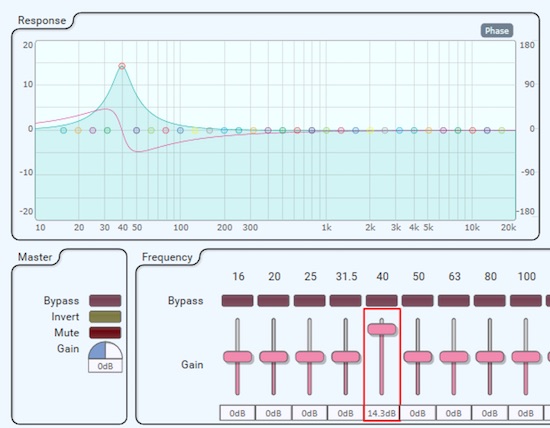
As one EQs a room and starts moving various frequencies...what they normally don't notice is that they are altering the phase response with it.
Have you ever heard the expression "EQed the life out of the room?" (Or words to that effect)? Likely it is the combined phase alteration that is contributing to it. And then when you have a mix with music or other sounds that will emanate from a combination of the stage speakers, those phase anomalies will combine in a non-beneficial way.
This doesn't speak to how we use analyzers and EQs in the first place. So you have a ⅓ octave analyzer...but it isn't good at letting you see the bits between the bands. Graphic EQs and RTA feel nice because there is a 1:1 relationship...if you are willing to ignore that there is detail you are missing. Parametric EQ and higher resolution RTAs are a better way to fly because you can better shape the signal and apply the least amount of damage. And, you can even apply ALL-PASS filters to repair the phase problems though that takes different tools and experience than the relatively simple RTA.
I think this is an area where the Ovation shining because it does this work for you. You just have to set up the mics and "press a button" and let it work its magic without a lot of human analysis.
Of course, having the room built properly (low noise, low RT-60) and good speakers are the best fix of all, if not always practical or possible. The best fix is the one you don't need.
Posted by Mike Babb (Member # 1379) on 12-11-2019, 05:08 AM:
Hi Marcel, Paris is not so far if you want to connect in our office sometime for a demo and q&a, I can probably ask the CEO to lunch with us. He knows the technology and development history, as well as being able to decide how much is able to be discussed vs proprietary.
Posted by Khushwant Singh (Member # 10493) on 12-11-2019, 12:26 PM:
Trinnov is gaining the market ....difference is only felt when we have live demonstration .... content played in normal 5.1 vs Trinnov 5.1 ....wow effect.
Posted by Marco Giustini (Member # 4544) on 12-12-2019, 02:27 PM:
Ok - so what’s the difference between what the trinnov does and what Dirac does? Dirac will give you a flat phase response - I measured it.
Posted by Mike Babb (Member # 1379) on 12-13-2019, 07:08 AM:
Marco, I don't know much about how Dirac does it so I can't comment really on that side. I don't remember the Dirac having much in the way of analysis. On the Ov2 you can see room response, direct response, phase and impulse response, by microphone, which can be valuable to take you beyond the wizard, which in itself yields a very impressive result. It will also measure up to 8 mics at once, and as I remember the Dirac involved moving the mic for 9 measurements?
Keep in mind I am not saying anything negative about AP or Dirac, the AP was my go to processor before I was introduced to Trinnov, which I thought was a better result and a better analysis tool.
Posted by Marco Giustini (Member # 4544) on 12-13-2019, 10:27 AM:
Dirac is automatic and will take an average of readings and correct amplitude AND phase. As I am a sceptical person by nature, I did my own test on a speaker using a single reading (actually 5 readings taken in the same place as moving the microphone would have averaged a phase response) and then checking the phase with and without Dirac: with Dirac applied the phase of the signal becomes flat +/- a few degrees.
Posted by Mike Babb (Member # 1379) on 12-16-2019, 03:34 AM:
Marco, happy to show you the procedure and let you hear the results if the opportunity arises, let me know.
Posted by Marco Giustini (Member # 4544) on 12-16-2019, 07:44 AM:
I was shown the procedure briefly at CineEurope some time ago. But that would still not answer my question ![[Smile]](smile.gif)
Posted by Mike Babb (Member # 1379) on 12-16-2019, 11:06 AM:
The Ov2 is quite a bit easier than anything you might have seen some time ago, although the core optimizer technology is similar. I'll introduce you to Arnaud Laborie if you attend CineEurope this year.
Posted by Torsten Juergens (Member # 7916) on 12-21-2019, 01:06 PM:
Another question.
Is it possible to run every single active surround speaker with a common subwoofer over a matrix as a 5.1 or 7.1 system?
If so, is then each speaker measured individually by the system and then combined as an array.
Or is the array formed by using a matrix before measured as one channel?
Which method would actually be the best?
Posted by Marcel Birgelen (Member # 6801) on 12-22-2019, 01:38 AM:
quote: Steve Guttag
I would say the chief differences between simple time-alignment and phase alignment is the frequency dependent component.
Simple time alignment (delay) electrically compensates for a physical displacement (HF driver is physically behind an LF driver, one can delay the LF signals so they are emanating from the speaker system at the same time as the HF signals so it is a unified front.
Sorry for the late reaction, I had a busy few weeks running up to the end of the year. But thanks for pointing out what is being meant with 'Phase Response Alignment'. So I was correct in the initial assumption that it's time alignment based on the frequency component. Which makes sense, but in my opinion should get a more descriptive name. ![[Wink]](wink.gif)
But... Interestingly, this is a feature that's also supported by Dirac Live, which comes with every AP20 and AP25. (And if I remember correctly also with more recent releases Audyssey, but which is limited to the home cinema domain). While I think that the auto-calibration features of the AP20 are OK, they're far from being perfect. So, it would be great to see or rather hear the difference between a Trinnov Ovation and Datasat AP20/AP25 in this regards.
quote: Mike Babb
Hi Marcel, Paris is not so far if you want to connect in our office sometime for a demo and q&a, I can probably ask the CEO to lunch with us. He knows the technology and development history, as well as being able to decide how much is able to be discussed vs proprietary.
Challenge accepted, if I'm in the neighborhood and the French aren't on national strike, effectively disabling any kind of transportation option, I'll drop you a line.
Posted by Pete Naples (Member # 761) on 12-22-2019, 04:52 AM:
"the French aren't on national strike"
Marcel, good luck with that!
Posted by Leo Enticknap (Member # 534) on 12-22-2019, 04:00 PM:
Just grab your self a gilet jaune, a bottle of Absinthe, a packet of Gauloises (or Gitanes - your choice), a placard with a glamour shot of Marine Le Pen on it and a few rocks to chuck at the gendarmes, and I'm sure that they'll let you through the roadblocks and get to the Trinnov factory without any problem!
Posted by Marcel Birgelen (Member # 6801) on 12-23-2019, 03:20 AM:
I think I will order a few Le Pen bumper stickers, let's hope they're not permanently adhesive. The bottle of absinthe will make a good companion to the mandatory alcohol test you're supposed to have in your car.
From someone who lives there and has to travel from the Côte d'Azur to Paris and back again several times a week, I've heard the trick to bypass most roadblocks is to simply put a 'gilet jaune' behind your window. Also, he has swapped his regular car for a rental of the lowest class.
Still, the French way of staging a strike is an art-form in itself.
Posted by Mike Babb (Member # 1379) on 12-23-2019, 11:03 AM:
Torsten, answered you via email.
Marcel, I'm in the US til February but we'll catch up in the new year if possible.
For anyone attending ICTA Los Angeles, I will be there, and also doing an Ov2 presentation at MiT on the 24th.
Posted by Leo Enticknap (Member # 534) on 12-23-2019, 05:48 PM:
quote: Marcel Birgelen
The bottle of absinthe will make a good companion to the mandatory alcohol test you're supposed to have in your car.
You don't need to worry about that. The mandatory breathalyzers only detect English gin, Scotch whisky, Belgian beer, Graanjenever, Schnapps, Chianti and Rioja. They cannot detect the presence of Claret, Armagnac, Kronenbourg, Absinthe, Cointreau, or any other domestically produced alcoholic beverage in a breath sample. This is a concession that the agricultural workers' union extracted from the government in exchange for refraining from dragging M. Macron to the guillotine by the towbar of a Citroën Deux Cheveaux.
Posted by Steve Guttag (Member # 268) on 12-24-2019, 07:23 AM:
I'll be at ICTA but have not planned to stay over...in fact, I leave at a very early hour for LA time.
Posted by Marcel Birgelen (Member # 6801) on 12-24-2019, 09:37 AM:
Well... I'm just veering slightly off-topic, but...
quote: Leo Enticknap
You don't need to worry about that. The mandatory breathalyzers only detect English gin, Scotch whisky, Belgian beer, Graanjenever, Schnapps, Chianti and Rioja. They cannot detect the presence of Claret, Armagnac, Kronenbourg, Absinthe, Cointreau, or any other domestically produced alcoholic beverage in a breath sample. This is a concession that the agricultural workers' union extracted from the government in exchange for refraining from dragging M. Macron to the guillotine by the towbar of a Citroën Deux Cheveaux.
That's great to know. I had a "guaranteed certified set" of them, they even were pretty hard to get around here... "What? Throw-away breathalyzers? Ils sont fous ces Français!"
So, I finally got a set, only to discover that they come with an expiration date... Now I bought like a 10-pack for about the same I paid for just one from AliExpress... I'm wondering though if they're correctly calibrated to avoid the detection of French alcoholic produce though.
Powered by Infopop Corporation
UBB.classicTM
6.3.1.2