This is topic Film Preservation school...HELP! in forum Ground Level at Film-Tech Forum ARCHIVE.


To visit this topic, use this URL:
https://ft-forum.com/ft/cgi-bin/ubb/ultimatebb.cgi?ubb=get_topic;f=5;t=001303

Posted by Allison Parsons (Member # 2728) on 11-11-2004, 11:35 PM:
 
Hello everyone. I'm not sure if this topic should be in the ground level section but.. I need your help. I am very interested in attending the L. Jeffery Selznick school of Film Preservation next year in New York. I applied last year and got rejected (they only accept about 12 people per year) Now...I have over 8 years of film experience under my belt. My question to everyone is:
1)Does anyone know anyone who attended this school? If so, how did they like it/where are they work at now.
2) Does anyone know any helpful hits they can give me to get accepted. Like I said, if 8 years of film work can't get me in... Maybe my cover letter just sucked (?)
3) Is this a career that I should be interested in. I am VERY interested in it already but I fear there aren't too many places for film preservationist around the world... And how good is the pay (not that it really matters but i'm just curious to know)

Any help would be greatly appreciated!!! [Cool]
 
Posted by Steve Kraus (Member # 476) on 11-12-2004, 07:10 AM:
 
Sorry no help but preservation of the moving image is a topic I and certainly others here are very interested in so please keep us posted on your progress. As you may know Robert Harris, one of the best known in the preservation field sometimes posts here on F-T (See also his Digital Bits column.

Now if I can only find that small roll of nitrate that's around here somewhere before it finds me. [Embarrassed]
 
Posted by John Pytlak (Member # 331) on 11-12-2004, 01:27 PM:
 
For the past three years, I was a speaker for one of the classes at the Selznick School. Here is their website:

http://www.eastmanhouse.org/inc/education/selznick_school.asp

AFAIK, they are joining with the University of Rochester in offering a Masters program in film studies, with specialization in film preservation. Graduates often find positions with film archives around the world.

Admissions requirements are similar to any university program, and there are probably many more applicants than positions in each year's class.

Good luck this year! [thumbsup]
 
Posted by Jason Miller (Member # 2341) on 11-12-2004, 04:30 PM:
 
put at the bottom of your resume that you can sit through ANY Woody Allen film and not utter a sound.

THAT will impress them.
 
Posted by Wayne Keyser (Member # 2420) on 11-12-2004, 07:51 PM:
 
Have you asked the school for some names of graduates who would be willing to give you their opinions of the school? Most schools have at least some people they can send you to ... THEN ask those people your other questions (how to increase yr chance of acceptance, etc) - and some of them may also be willing to write you a letter of recommendation.
 
Posted by Martin Brooks (Member # 1269) on 11-13-2004, 10:55 AM:
 
Film Preservation work is mostly done at museums and not only are the jobs scarce, but museums are known for paying incredibly little (except to the top curators), so unless you're the recipient of a trust fund or you intend to marry rich, you might want to consider the economic ramifications of investing in such a career.

On the other hand, if you ever become responsible for saving a work of art, that's an incredible thing. My understanding is that half of all pre-1950s films have already been lost. This serves to show how short-sighted the studios were.
 
Posted by Steve Kraus (Member # 476) on 11-13-2004, 02:01 PM:
 
$$$ would be nice but I really don't see myself marrying anyone named Rich. Thanks anyway.

Here's a good non-technical book about film preservation which I like:

 -

(Rutgers University Press, 1997)

Another book of purely historical interest now is Preserving the Moving Image. This dates to 1974 so way out of date but still interesting.

How much does anyone want to bet that Lucas has preserved shot-on-video Episode II (and will preserve Episode III) on FILM? I don't mean just incidental to having released it on film and saving the film-out negatives and or IP's but something more overt like making B&W separations. I think you can bet the farm on it.
 
Posted by Allison Parsons (Member # 2728) on 11-13-2004, 03:57 PM:
 
Thanks to everyone for the info. But if you have anymore, please still pass it on [Smile]

I think it was Steven Spielberg who said that he'd still shoot movies on film (as opposed to digital) as long as there were still film to shoot with. Good for him!

Off the top of your head, how many museums (excluding the George Eastman House)have film archives? I think I heard one of the big museums in Washington DC just opened a historical film section. But maybe i'm wrong.
 
Posted by William Hooper (Member # 71) on 11-15-2004, 02:29 AM:
 
The best direct infromation would be to ask someone on the admissions staff what they look for on an application. HS, college or vocational background including chemistry or time working at institutions like libraries or museums? Probably background, personal pursuits including home canning or candy-making would be very attractive, since the preservation process involves pressure cookers & lots of sugar.

Getting a survey of what was on successful applications may not be possible, and asking admissions staff what they look for usually isn't very successful. Admissions folks like to think that they're open, objective & analytical, when actually they're primarily enjoying intuition. They reward themselves. Intuition is not ESP; it's a predominnatly unalytical process of assocition from an unexamined collection of tastes & insights from observation. There are lots of techs who are intuitive but you won't find them here - they don't like to & can't be particularly research-oriented & analytical. They mostly just do things the way they've seen worked before, or the way they liked. People who operate mostly intuitively can't tell you how they did something, how they knew something, & certainly how they figured something out, since the process was not research & analysis of a new problem. It's an old thing they recognized & are doing again the same way.

The next approach would be to understand that the admissions staff is looking for folks that fit in with the objectives of the program. A description of what a program is supposed to be is not particularly useful, since it's been chewed over & fluffed for public consumption & the institution's personal enjoyment. You get a better idea of what a machine is supposed to do by looking at the machinery. There's a page with the course topics at

http://www.eastmanhouse.org/inc/education/selznick_course_topics.asp

Non-typical features are:
History
Practice (Film handling & projection)
Chemistry (of photographic materials)
Management (of an archive)
Activities (Event programming)
Legal Issues (Copyright, etc.)

So you know that for whatever reason, in-depth experience with Practice (Film handling) isn't counting for diddly with them. Either most applicants have it, or they're looking for something else, possibly in addition. Start picking from the others to add to the application.

Home darkroom photography background would probably bump your chances up. Working (even as a volunteer) at a museum would, too. If you taught Saturday classes on home darkrooms at a free community activities program, you'd probably climb high - not the least because the admissions staff (we're educaTORS!) would identify faster &, relevant or not, think you're the stuff.

Working at a library, organizing & producing lectures on History of Film would suck up in the History & Activities categories, as well as stroke the admissions staff.

Don't ever forget that the machinery of admissions is the admissions staff, & amissions is a function of their own functionality. "I see that this applicant wassails, & although no one has said anything about this applicant, I would like to point out that *I* wassail, & know from personal experience that wassailing, although not directly related itself, fosters just the sort of talents & skills that are useful to a successful person in this field." Or golf, tatting, or breeding little rat-like dogs, or who knows. That's why applications are loaded up with goo in the "Interests" section.

You can also go the route of paying John Pytlak to infiltrate their organization & report to you on the distribution of things that are on applications that the admissions staff shoots through. That would provide the most useful information fastest.
 
Posted by John Pytlak (Member # 331) on 11-15-2004, 09:47 AM:
 
Of course, the Association of Moving Image Archivists (AMIA) would be an excellent resource:

http://www.amianet.org/

quote:
AMIA is the largest non-profit professional membership association for individuals and institutions concerned with the preservation of moving images. Incorporated in 1991, AMIA was established to advance the field of moving image archiving by fostering cooperation among those concerned with the acquisition, preservation, exhibition and use of moving image materials. With an international membership of over 750, individuals and organizations from a wide variety of constituencies are represented. In addition to its publication and education programs, AMIA holds an annual conference, develops and promotes standards, encourages fieldwide communication through its listserv, honors the work of archivists and archival organizations, administers a scholarship and fellowship program and collaborates with other institutions and organizations to design, promote and implement national moving image preservation policies and plans.



Posted by Leo Enticknap (Member # 534) on 11-16-2004, 01:53 PM:
 
Allison,

As a film archivist myself I'd say that joining AMIA would be an excellent move. The newsletter, journal and listserv will start to get you 'in the loop' with the moving image preservation world and let you build up a picture of what organisations hold archival film collections, why, where the jobs are and so on and so forth.

As for the Selznick School, I happen to know that it's a truly excellent programme, but it's not the only one. NYU and UCLA also offer film archiving masters' programmes in the USA. Were you to consider looking further afield, the University of Amsterdam offers a course which places a special emphasis on digital restoration (they work closely with the Nederlands Filmmuseum and Haghefilm), taught in English ... or you might consider the programme I took, which was at the University of East Anglia in Norwich, UK (that was the first ever formal film archivists' training programme, which took its first students in 1990).

Please feel free to email me off the forum if you'd like any more information or contact details.
 
Posted by Steve Kraus (Member # 476) on 11-26-2004, 10:30 AM:
 
 -

Found my 200' of low order explosive...er...I mean nitrate. Note the BH perfs on a positive print. What typeface is that, Bobby?
 
Posted by Stephen Furley (Member # 1277) on 11-26-2004, 10:55 AM:
 
quote: Steve Kraus
Note the BH perfs on a positive print.
Also note the cracks starting from the corners of many of the perfs.
 
Posted by Steve Kraus (Member # 476) on 11-26-2004, 11:27 AM:
 
Quite so. It's shrunken to the point of being unrunnable on conventional sprockets. I did manage to run it on my KEM and shoot a crude tape off the screen.
 
Posted by Leo Enticknap (Member # 534) on 11-26-2004, 08:15 PM:
 
That perf splitting is not a major issue as far as preservation duping is concerned. This element should print on a Matipo or any other pin-registered step contact printer without any significant problem. The perf splitting is on the corners of the leading edges (as run through a mechanism from head to tail) as per usual - very common in nitrate release prints from the teens and '20s.

Any idea what the edge marks on the right are? They don't look like standard Eastman Kodak, Agfa or DuPont stock marks.
 
Posted by Mark Gulbrandsen (Member # 72) on 11-27-2004, 09:24 AM:
 
A Videola(MFG by Moviola) although obsolete and pretty scarce is a very good and safe way to transfer Nitrate film for general purpose viewing. Even very shrunken film will run quite well through a Videola although expect some image unsteadiness.

Mark
 
Posted by John Pytlak (Member # 331) on 11-27-2004, 09:33 AM:
 
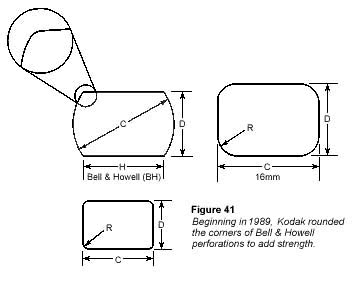
The familiar rectangular "Kodak Standard" KS perforation for 35mm prints was developed to reduce the perf tearing at the sharp corners on the BH perforation.

KS perforations are also used for 65mm negative films, and 70mm print film.

http://www.kodak.com/US/en/motion/support/h1/sizesP.shtml#perfs

 -

In the 1989, Kodak developed a method of slightly rounding the corners of the BH perf and maintaining compatibility with existing camera/printer registration pins, helping reduce the wear on printing elements.
 
Posted by Ed Inman (Member # 2583) on 11-27-2004, 06:44 PM:
 
Steven,

Your question about the font on your nitrate frame caught my eye as I am one of relatively few printers who still casts hot metal type slugs on a Linotype.

The letters on your nitrate frame appear to be drawn by hand. There are minor inconsistencies in several letters which indicate that it was probably drawn and not proofed from actual type. However it could have been based on an actual cast metal type style.

It has certain elements of Parsons which is said to have been Charlie Chaplain's favorite font for titles:
http://www.myfonts.com/fonts/barnhartbrother/parsons/familytree.html

It also has certain elements (such as the "g") of what in digital type is called Fritz, which is also based on sign lettering of that era:

http://fontbureau.com/fonts/Fritz

But to ID it as an actual font...well frankly I'm stumped.
If there ever was an actual metal type cast to look exactly as your film letters do, I suspect it must be pretty obscure and probably cast only by a small regional foundry as opposed to a large national foundry like ATF or BB&S.

But again, I'm not certain.

Ed
 
Posted by Steve Kraus (Member # 476) on 11-27-2004, 07:08 PM:
 
Random thoughts: Now I know why they call those places "type foundries"...because they once really were. Parsons is the name of the orginal poster...what are the odds on that? And the molten lead and nitrate film...poof.
 
Posted by Allison Parsons (Member # 2728) on 11-27-2004, 11:56 PM:
 
Parsons is a gooood name [Wink]

Having written the original topic about film preservation schools and now reading all the reply's... I REALLY don't know jack about film stock. I thought I knew some but boy, it looks like i know nothing. Hopefully, if I get accepted, I can chat about all this with you but for now I have to sit back in awe.
 
Posted by Leo Enticknap (Member # 534) on 11-28-2004, 05:22 AM:
 
quote: Mark Gulbrandsen
A Videola(MFG by Moviola) although obsolete and pretty scarce is a very good and safe way to transfer Nitrate film for general purpose viewing.
Sounds like a similar thing to a 'video Steenbeck'. There was a company in London which bought normal ones and then modified them by removing the mirror and screen unit and replacing it with a CCD video camera behind the rotating prism. The film transport was synchronised to the scanning rate (fixed at 25fps to enable two-field scanning for PAL) and although the picture quality wasn't brilliant (for one thing the camera only had composite video output) it was fine for viewing copies. The added attraction for nitrate was that Steenbecks only use a slide projector bulb and even then it's nowhere near the actual film, so heat exposure is practically non-existant. Steenbecks are not at all kind to shrunken elements, though.
 
Posted by Steve Kraus (Member # 476) on 11-28-2004, 09:08 PM:
 
I believe the Videola was based on Moviola's 35mm flatbed editing machine. KEM offered the same thing based on their KS series flatbed; possibly also as a module for existing RS/KS/K800 type machines. I think in their case they simply deliver an image to a camera you supply.

In all these cases we are talking about a non intermittent system where the film rolls through the gate continuously and a rotating prism compensates for the motion of each frame and does a dissolve of sorts from frame to frame without a blackout period. I don't see any reason that the film speed has to be locked to anything. Seems like you ought to be able to run the film at 24 while the camera runs at 25 fps.

Even without shrunken film these are not a very good way to make a transfer. The prisms arent always that great at tracking the image so there is some flutter and of course there is a loss of resolution. And least in the case of the KEM and probably on all three the prism facets are close enough to the focal plane that dust and dirt on them will be visible as each face comes around.
 
Posted by Stephen Furley (Member # 1277) on 11-29-2004, 01:17 AM:
 
There were several shutterless film projectors as well, which used various arrangements of either prisms or mirror drums, with continuous film movement. All the ones that I've seen dated from either the '20s or '30s. The BBC used a modiified version of the Mechau, a mirror drum machiine, for both telecine and film recording.
 
Posted by Leo Enticknap (Member # 534) on 11-29-2004, 04:17 AM:
 
quote: Steve Kraus
I don't see any reason that the film speed has to be locked to anything. Seems like you ought to be able to run the film at 24 while the camera runs at 25 fps.
You'd get interlace flicker if you tried. None of the PAL telecine systems use anything like the NTSC 3:2:2 pulldown. Instead, to sync up to the 50hz scanning rate of a PAL TV, the film speed is simply increased from 24 to 25 and each frame is scanned twice. If you ever see an 'off the wall' PAL video transfer made using a 24fps projector, the interlace flicker will give you a bit of a headache before long! The video Steenbecks synchronised the rotation of the prism so that it was at its 'darkest' point as one scan finished and the next started. That made replacing belts on them an absolute bastard - get it just one tooth wrong and the flicker on the video is horrendous.
 
Posted by Steve Kraus (Member # 476) on 11-29-2004, 11:15 AM:
 
Well on the KEM (speaking about the later "flickerless" picture modules) the image intensity doesnt change. The major downside is that even these which were a huge advance over the older module's optics the incoming new frame disolves in at a slightly different point on the screen than the old one which is fading out and the new frame moves very slightly upward on the screen before it starts to fade and the next one comes in. If they could eliminate that they'd be much better. Perhaps they already have.

Major interframe flicker sort of eliminates 50% of the reason to have a prism system: Partly for the gentleness on the film from continuous motion and partly so the image is always there no matter where it stops!

When I worked for the post-production center we had a 16mm projector from MTM built like a dubber and using a continuous motion prism system. Interesting machine and good for mixes etc. but not the ideal way to show a movie.

[ 11-29-2004, 09:45 PM: Message edited by: Steve Kraus ]
 
Posted by Leo Enticknap (Member # 534) on 12-13-2004, 04:48 AM:
 
Returning to Allison's original question, I've had a few calls and e-mails from people asking about film preservation school in the last couple of weeks, as a result of which I've put links to all the courses and programmes I know about on our website here. If there are any I've missed please let me know and I'll add them on.
 
Posted by System Notices (Member # 2357) on 01-16-2008, 03:17 AM:
 

It has been 1128 days since the last post.


Posted by Allison Parsons (Member # 2728) on 01-16-2008, 03:17 AM:
 
Third times the charm. (hopefully) Wish me luck!
 
Posted by Tim Reed (Member # 137) on 01-19-2008, 12:18 AM:
 
Bless your heart, Allison. Good luck. You're an ol' pro at this game now...


Powered by Infopop Corporation
UBB.classicTM 6.3.1.2